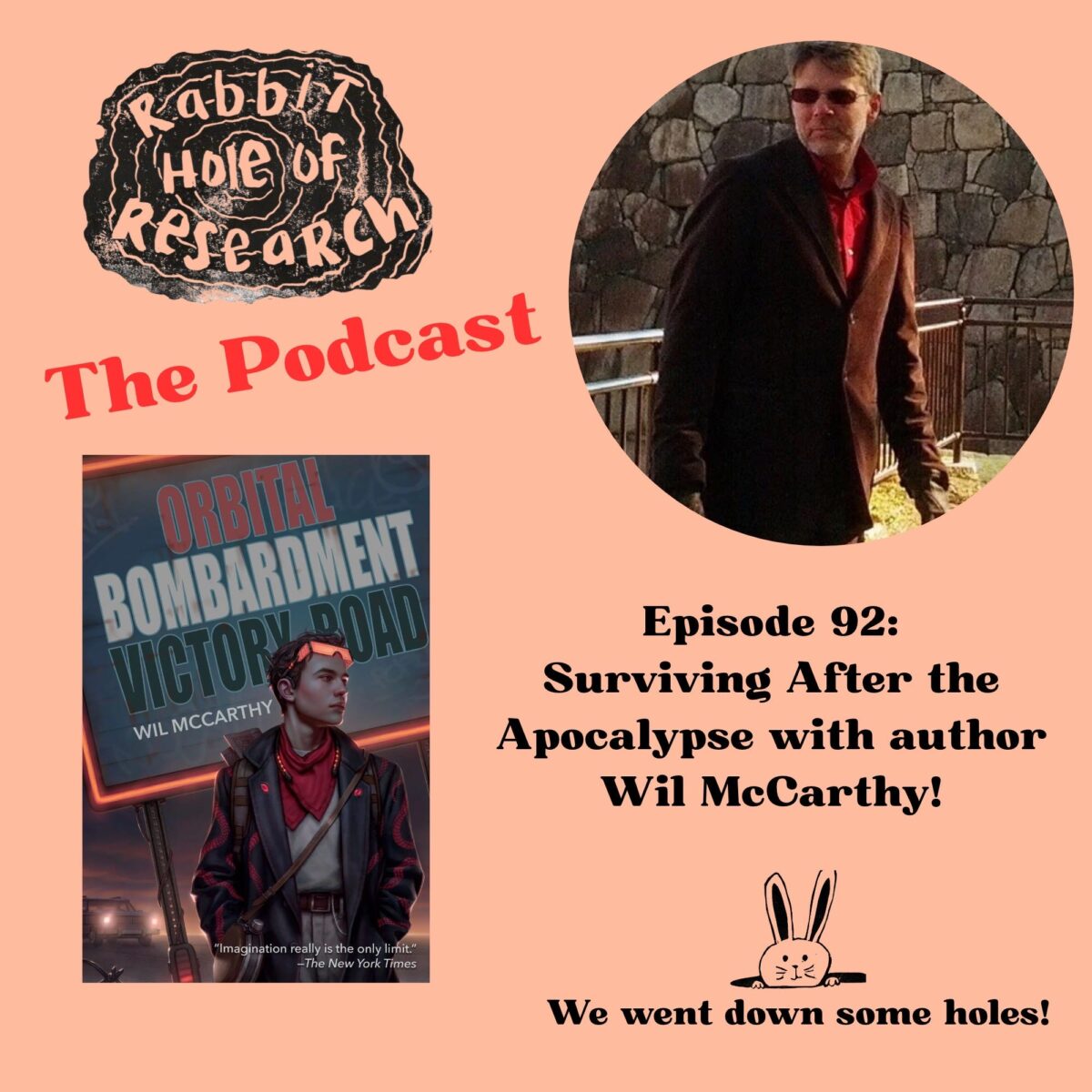
AI, zombies and orbital bombardment, oh my! Sci-fi author Wil McCarthy joins us for disaster survival, seed vaults, the return of nature, doomsday in fiction, and is Nick Patient Zero?
Substack, Apple, Spotify, YouTube, Amazon
Episode 92 Transcript
In Episode 92 of the Rabbit Hole of Research, Joe finds himself in the Basement Studio all alone, Georgia is downtown Chicago and Nick calls in from his sickbed (the show must go on). They’re joined by Wil McCarthy to talk about his new book, Orbital Bombardment: Victory Road, and what happens after the world ends. Joe’s gives his updated apocalypse list (see EP 15 for the original controversial apocalypse list), would communities pull together when the power goes out, the three-day grocery problem, Nature’s return to Chernobyl, the Svalbard Global seed vault, warning future societies with “ray cats,” and it’s been a minute, but Joe has his historical apocalypse fiction list. And is Nick Patient Zero…What???
Where to find Will McCarthy:
Orbital Bombardment: Victory Road
Wil McCarthy’s Old Time Science Bar
COSine in Colorado Springs, January 22nd-24th
Georgia and Jim’s Touch of Noir 2027 Wall Calendar —
12 months of all-original art by Jim and Georgia; orders are open now (Limited supply)
Check out what the RHR crew is creating:
Joe:
- Words // Friends with Sara: Replay on YouTube
- Jump to Joe’s Reading (But you should listen to all the amazing authors)
- Named by the Guild Literary Complex as one of the 35 Writers to Watch!
- Red Line: Chicago Horror Stories Anthology featuring a story by Joe!
- Joe’s Sci-fi physiological thriller Novel: Will You Still Love Me If I Become Someone Else?
- Joe’s Rom-Com Novella: Tomorrow May Be Too Late
Future Events to Hang with the Crew:
Podcast Cross-Appearances
- Joe on GoIndieNow: 21grams with Joe Compton talking about villains.
- RHR Crew on This Podcast Will Change Your Life with Ben Tanzer
Events & Conventions:
Joe:
- Family Day: Seeing the Invisible World to Build a New One; in conjunction with the fall exhibition: teamLab: Everything Exists in Infinite Continuity, at the Smart Museum of Art In Hyde Park, IL, Nov 14th, 11-3pm
- Art and Science lecture about the Science of Zombies at Parlour and Ramp Art Gallery, 2130 W 21st St, Chicago, IL 60608, Dec 10th, 7-10pmGeorgia:
- The Inaugural 4th Street Print Fest exhibit at Chesterton Art Center is still up (go check out Georgia’s artwork and a panel with Georgia on Nov 7th). The exhibit goes until November 28th.
It’s Science for Weirdos
Want to support the show? Tell your friends. Follow us on social media, Discord, share the podcast, and let us know what topics you are excited about. Leave a Comment. And for email alerts sign-up for the Substack newsletter and never miss an episode, exciting updates or the bonus images we talk about on the episodes.
We discussed these questions on the episode and now want to Hear From You (leave a comment):
- Which apocalypse on Joe’s list worries you the most: asteroid, nuclear war, pandemic, climate, infertility, space debris or Wil’s addition: the “soft” AI apocalypse where machines take all the jobs (or Vampires! if you listen to Joe’s OG list on EP 15)?
- How long could your household last on what’s in your pantry right now?
- What do you think future archaeologists will make of our landfills?
- What’s your favorite apocalyptic story (bleak or optimistic)?
Drop your thoughts in the comments. We read them all, and your ideas often shape future episodes.
Future Episodes
- Episode 94: Doomsday series 1: Dr. Doom, Science and AlchemyGuest: Rengasayee (Sai) Veeraraghavan, PhD
- Episode 96: Doomsday series 2: Building Dr. Doom and His WorldGuest: Julio A. Guerra (@artedeguerra)
- Episode 98: Season 3 recapGuest: Alex and others TBA
For more stuff (Images, Episode Highlights, events, etc), subscribe to our Substack newsletter!
Show Notes & Fun Facts
Books and Short Fiction
- Epic of Gilgamesh (c. 2nd millennium BCE), anonymous
- Genesis, Noah’s flood story (chapters 6–9, written in the 1st millennium BCE), traditionally credited to Moses
- Le Dernier Homme (1805), Jean-Baptiste Cousin de Grainville
- The Last Man (1826), Mary Shelley
- “The Comet” (1920), W.E.B. Du Bois, short story in Darkwater: Voices from Within the Veil
- “There Will Come Soft Rains” (1950), Ray Bradbury, short story collected in The Martian Chronicles
- Alas, Babylon (1959), Pat Frank
- Lucifer’s Hammer (1977), Larry Niven and Jerry Pournelle
- Footfall (1985), Larry Niven and Jerry Pournelle
- The Stand (1978), Stephen King
- The Handmaid’s Tale (1985), Margaret Atwood
- The Children of Men (1992), P.D. James
- Deep Time: How Humanity Communicates Across Millennia (1999), Gregory Benford
- Country Wisdom & Know-How (2004), the editors of Storey Publishing
- The Road (2006), Cormac McCarthy; film directed by John Hillcoat (2009)
- The World Without Us (2007), Alan Weisman
- The Passage (2010), Justin Cronin; trilogy continues with The Twelve (2012) and The City of Mirrors (2016)
- Station Eleven (2014), Emily St. John Mandel
Comics
- The Walking Dead (2003–2019), Robert Kirkman, Tony Moore and Charlie Adlard, Image Comics
- Snowpiercer (1982) French graphic novel Le Transperceneige
Movies
- Night of the Living Dead (1968), directed by George A. Romero
- Planet of the Apes (1968), directed by Franklin J. Schaffner
- The Terminator (1984), directed by James Cameron
- Armageddon (1998), directed by Michael Bay
- The Matrix (1999), directed by the Wachowskis
- Shaun of the Dead (2004), directed by Edgar Wright
- Children of Men (2006), directed by Alfonso Cuarón
- I Am Legend (2007), directed by Francis Lawrence
- WALL-E (2008), directed by Andrew Stanton
- Snowpiercer (2013), directed by Bong Joon-ho
- Avengers: Endgame (2019), directed by Anthony and Joe Russo
TV
- Life After People (History Channel special 2008; series 2009–2010), narrated by James Lurie
- Station Eleven (2021), limited series on HBO Max
- The Walking Dead (2010–2022), series on AMC
- Snowpiercer TV series on TNT (2020–2022) and AMC (2024)
- The Last of Us (2023–present), TV series on HBO
- Fallout (2024–present), TV series on Amazon Prime Video
- The Handmaid’s Tale (2017–2025), TV series on Hulu
Video games
- Fallout (1997), developed by Interplay (later franchise by Bethesda); TV series on Amazon Prime Video (2024–present)
- The Last of Us (2013), developed by Naughty Dog, published by Sony Computer Entertainment
Fun Facts to Impress Your Friends With or Win Trivia:
- Chernobyl fungi feeds on radiation. A black, melanin-rich fungus, Cladosporium sphaerospermum, grows on the walls of the Chernobyl reactor and may use radiation as an energy source (scientist aren’t completely sure how). It was even tested aboard the International Space Station as a possible living radiation shield.
- Earth panicked over Hailey’s Comet. In 1910, astronomers used spectroscopy to detect cyanogen gas in Halley’s Comet. When Earth was set to pass through the tail, people feared mass poisoning and some bought “comet pills” and gas masks.
- “Rods from God.” In the 1950s, Jerry Pournelle (co-author of Lucifer’s Hammerand Footfall) proposed Project Thor while at Boeing: dropping telephone-pole-sized tungsten rods from orbit, which would hit with the force of a large explosive without any warhead.
- “Ray Cats” as a future warning. To warn future humans about buried nuclear waste, researchers proposed breeding cats that change color near radiation, paired with songs and folklore teaching people to fear them. Why are we always picking on cats (See EP 90: Witch Please)?
Episode Highlights
- 00:00 Joe All Alone in the Basement Studio: With Georgia downtown Chicago and Nick calling in sick, Joe welcomes sci-fi author Wil McCarthy in an empty studio.
- 00:40 Why Post Apocalypse: In most fiction, the apocalyptic event is where things start, and everything after is what’s interesting.
- 01:54 Tornado Lessons: Joe and Nick share experiences after an F1 tornado and derecho knocked out power for up to two weeks in their town.
- 03:27 Community vs Chaos: Fiction shows society breaking down, but in crises people usually band together, Wil countered that he saw less of that while living in Dallas.
- 05:27 When Comms Fail: Text messages failed after the tornado, but satellite communication is quietly coming to ordinary phones.
- 07:00 The Apocalypse List: Joe brings back his updated end-of-the-world list from Episode 15.
- 07:29 Asteroids and Fallout: Impact dust could blot out the sun for years, and after nuclear war, famine may be deadlier than the fallout.
- 11:02 Pandemics and Know How: Wil makes the case for keeping paper encyclopedias, because Wikipedia will go down.
- 12:42 Solar Storms to AI: Wil raises the idea of a “soft” AI apocalypse, where machines take all the jobs and people can’t afford food or other resources.
- 17:03 Orbital Bombardment Victory Road: In Wil’s novel, space colonies strike Earth with kinetic projectiles, and a highway is built where electric light is only allowed.
- 23:54 First Days After Impact: Grocery stores hold about three days of stock, and Wil’s three weeks of COVID supplies ran out faster than expected.
- 33:09 Rewilding After Humans: In Wil’s book, large swaths of the United States have been rewilded, an ironic upside to the apocalypse.
- 34:34 Radiation Adaptation: Chernobyl’s wolves show possible cancer-resilient genes, and a fungus on the reactor walls may feed on radiation.
- 39:04 Cities Decay Without Us: The Last of Us shows skyscrapers falling and bridges rusting after decades without maintenance.
- 39:42 Nature Reclaims Cities: Stories like Last of Us gets city decay correct andI Am Legend even shows Times Square with wild life as wetlands return erasing the city.
- 40:41 Civilization Markers: Bronze statues like the Statue of Liberty might survive for millennia, but most of our structures won’t.
- 41:27 Voyager Gold Record: Gold was chosen for Voyager’s record because it’s inert and won’t melt, scratch or break like vinyl.
- 42:00 Silurian Hypothesis: If an industrial civilization existed millions of years ago, only chemical traces might remain, or Wil suggests that fossilized cell phone may give clues.
- 43:37 Landfills as Legacy: Our landfills may be our legacy, or future mines for gold and rare earth metals.
- 45:55 Repopulating Humanity: Estimates for restarting humanity range from 50 breeding individuals to tens of thousands.
- 48:13 Seed Banks and Bunkers: The Svalbard seed vault sits north of the Arctic Circle is ready to restart agriculture, while Biosphere 2 is an example of what happens if we try to live in closed environments.
- 51:48 Apocalypse Fiction History: Joe goes way back to the Epic of Gilgamesh and Noah’s Ark.
- 58:09 Future Warning Systems: From Gregory Benford’s Deep Time to the Long Now’s spiraling microtext and color-changing “ray cats.”
- 01:04:43 Favorite Apocalypse Media: Wil picks Ray Bradbury’s “There Will Come Soft Rains,” Nick picks The Last of Us and Shaun of the Dead, and Joe picks The Passage.
- 01:10:59 Book Plug and Farewell: Orbital Bombardment Victory Road is out November 3rd, and Wil will be at COSine in Colorado Springs in January.
“Stay curious, stay safe… Love Y’all!”
Join Rabbit Hole of Research on Discord: https://discord.gg/2nnmKgguFV
Subscribe and Share our Substack newsletter to get email updates, never miss an episode, and spread the word!! Don’t forget to give us 5 stars or a like!
Transcript
[00:00:00] joe: Hey, welcome back to the Rabbit Hole of Research down here in the basement studio. All alone in the basement studio. Georgia is not here. She is off downtown Chicago having fun. So I’m here, and then Nick is at home trying not to infect the Basement
[00:00:23] nick: You got neck.
a little rough today.
[00:00:27] joe: is me, Joe. So, already let in.
And then we will have– we have a guest joining us
[00:00:32] nick: Oh, hey
[00:00:34] Wil: Hi. My name is Will McCarthy and I’m a science fiction writer
[00:00:39] joe: Excellent. Excellent. Yeah, today we’re gonna be talking about after the apocalypse. So, , a lot of fiction usually the apocalyptic event is where things start and it’s everything after that’s interesting. If folks remember, we did episode 15, [00:01:00] season one, we did a favorite
[00:01:02] nick: Do you know, man, uh,
[00:01:03] joe: So yeah, so it’s been a little bit since we’ve talked about apocalypses. But but yeah, so that’s it. I don’t have a monologue to start this one off,
[00:01:12] nick: I’m
shocked.
I mean, feels a little bit more real every day,
where it’s like, are we coming closer to this? Is this gonna be like one of those survival guides that people look back on and they’re like, “Wow,
[00:01:25] joe: could be the episode where you have to go back and I will say that and I do have a list. So I had the list from episode 15. I’ve modified it a bit, and so I will go through my kind of end of the world apocalypse list, and we can kinda jump off, and then we can hear Wil I know your story involves a apocalyptic event and 100 years in the aftermath.
So a, a little real because in what’s that? Was that July? August? August, I think it was. We had a F1 tornado and derecho come through our town [00:02:00] and knock power out for about 11 days to 14 days for some people, depending on where they’re at. And so it was very apocalyptic feeling there. Because gas stations had no power, so we couldn’t pump gas.
So even people had generators, they were driving, tens of miles, to try
[00:02:20] nick: It was a weird
time.
[00:02:21] joe: food, things like that. So
[00:02:23] nick: I do have to say, seeing the community pull together like it did was so cool.
Like, the day that the tornado hit, all, my whole block got together and we ended up having a barbecue because everything in the fridge was gonna go bad. So we just set up someone’s grill and used everything in there, ’cause we didn’t know how long it was gonna be.
[00:02:51] joe: Wil
[00:02:52] nick: it was good to see that.
‘Cause in movies and media, you don’t see that community coming together.
[00:02:58] joe: Yeah, I was gonna say
[00:02:59] Wil: a, we had a…
[00:02:59] joe: [00:03:00] go ahead, Wil
[00:03:01] Wil: I was gonna say, we had a similar thing happen. I lived in Dallas for two years, and a tornado came through and a lot of people, including us lost power. One of the weirder things is it was really selective.
The building that I was in, half of the building had power and the other half didn’t, and the power was out for a week. But we didn’t see that kind of community
coming together in, in Dallas, at least not in my part of it
[00:03:27] joe: Yeah, I was– that’s interesting ’cause I was gonna say that was we– like Nick was saying, in fiction we’d usually see societal breakdown and people go at it right away. But oftentimes you, see the opposite in crises events that people will band together mo-most of the time,
Wil you’re saying that didn’t happen, but
[00:03:46] nick: Sorry about that, Will.
[00:03:48] joe: Yeah, I saw more human cooperation, and if we think about kind of big disaster kind of moments, people usually put aside their political, religious , social differences, come [00:04:00] together to , common good or common help. So that’s something that, you know I know why in fiction you go right to everyone’s…
You build on that, that, that s-strand there. But it’s something that may or may not happen during an apocal- especially the early, and locally we might not see that, so.
[00:04:19] nick: I think it really depends on your community. Like, if it’s a smaller-knit community,
[00:04:25] joe: Mm-hmm.
[00:04:26] nick: I think you’re more likely to find that it’s easier to come together with your neighbors.
[00:04:34] joe: Right. Yep
[00:04:36] nick: But maybe in a larger one, it might get a little bit more diluted
[00:04:41] joe: Right.
[00:04:42] Wil: I think it depends on the nature of the apocalypse.
If people have continu- continuous access to food and water
you know, that makes it a lot easier to be warm and fuzzy. If there’s not enough to go around, that, that might be a different thing
[00:04:56] joe: Yeah, a scarcity-based model and maybe [00:05:00] even the severity of the apocalypse, right? So if we’re talking about tornadoes or derechos we figured out at some point the rest of the world is still moving on and we’ll catch up with our little… So we can be super nice and helpful and, kinda kumbaya.
But if it’s something more globally, that, that might change the calculation, to, to your point, Wil that you might go, “Well, resources are gonna run out.” especially in those early
[00:05:27] nick: But then how would you end up knowing? Like, if the power grid goes down, we won’t be able to know if the next town over has power unless we go over there. Know if the next state over has power
[00:05:41] joe: the thing is that we are very interconnected now as a society, and so your phone will have enough power for you to get communication that this event is wider
[00:05:54] nick: Joe.
[00:05:54] joe: right?
[00:05:55] nick: When we had the tornado here, I was sending messages and half of [00:06:00] them weren’t even going through
[00:06:01] joe: Right, right, right.
[00:06:03] nick: Like, the communication just… What, I think you and I were on the phone after that and… Or no, it was, I think it was Georgia who called.
[00:06:13] joe: Mm-hmm.
[00:06:14] nick: And we were just like, “Yeah, it’s spotty at best.”
[00:06:18] joe: you could go to CNN, New York Times, Washington Post, et cetera, et cetera, and y- you still had access to outside.
[00:06:26] Wil: Also satellite communication is coming to ordinary phone
handsets. Some of them already have it and just don’t advertise it. I know that I was up in the mountains a couple of weeks ago out of cellphone communication, and my phone asked me if I wanted to turn satellite communication on. Oh. So it’s in there doing something
[00:06:45] joe: So yeah, so I think communication we would know if it’s a global event. And global could be, there, there’s probably a lot of fractions or things that can control the global information that we get, but I think we would get with [00:07:00] something.
But I wa- I wanna take a slight step back and I’d like to give my list. You know, it’s been a while since I’ve started. And we’re a little bit into the episode, but I’d start with a
[00:07:10] nick: I thought you scrapped the
[00:07:11] joe: Yeah. No. Lists are never scrapped. I got a few lists on this episode ’cause it’s always a
[00:07:15] nick: Oh, damn
[00:07:17] joe: But I modified my, my apocalypse list from episode 15 ’cause you guys gave me a little hard time.
So I’m gonna try to keep it… I’m gonna keep it safe, and then we can add, subtract. You can argue with me, as you know. But I have asteroid impact would be kind of global scale apocalyptic events potentially, or at least in fiction and maybe in real life. So asteroid impact.
There’s evidence already that we’ve had a global asteroid impact. The the Yucatan Peninsula in Mexico that was the end of dinosaurs, kind of catastrophic life-ending event. So
[00:07:56] nick: So if something like that happened, what would be the [00:08:00] ramifications for humans?
[00:08:02] joe: I don’t know. It’s not good. No.
[00:08:04] nick: Like
[00:08:05] joe: Yeah we had earlier this season, we had Charl- Charles Blue on talking about the global impact and what they’re doing their tabletop exercises at NASA and how they prepare for that so that we could have as much time, the DART missions trying to knock them off course.
These, these,
[00:08:22] nick: Yeah … the Armageddon movie. Yeah.
[00:08:25] joe: That’s… And you’re hedging… You don’t hedge your bets on that. But
[00:08:28] nick: No, I wanna send a rocket to another comet and knock it off course
[00:08:34] joe: Yeah, I think if we had an impact event like that it would be an extinction-level sort of event. And, we’re probably now thinking of, humanity, what happens decades after that event.
It’s not gonna be we just sweep, up a little bit and move forward. It’s gonna be a major disruptive event there, in my opinion that it could be
[00:08:56] Wil: yeah the, the dust would blot out the sun for, [00:09:00] potentially years and the plants would die out. So we’d have to have years of food on hand in order to just survive until the daylight comes back
[00:09:10] joe: Yeah. Or different food sources or… Yeah it would be– there would be some, some issue there that you would– you could have. But yeah, you know, I’ll, I’ll– we’ll talk about a few other things. I have some other ideas and I think they’ll tether in. But have nuclear war when that could potentially have a, an apocalyptic kind of a feel and depending on the extent a lot of our, you know, populist- populations could be devastated could set us back, , technologically decades to recover.
Not so much the fallout, but I think a lot of estimations, the famine. Once again, food scarcity, and things like that would happen right after. So you probably can make it out of the fallout, but it’s then what happens after that. And the same thing with the asteroid, you now have to eat.
And if you can’t eat, you can’t drink water, [00:10:00] you’re gonna have a problem.
[00:10:01] nick: And is there any actual way to prepare for months and years after without being like a doomsday prepper?
[00:10:11] joe: , So one of the, the problems we have now is that we’re getting de-skilled in some of these, these areas. So, and we’re, we use technology that very few of us know how to,, rebuild, work properly, put together.
But even if we take a step back from technology, we’ve now de-skilled in basic agricultural skills animal husbandry these types of things that just 20 years ago might have been much more prevalent, has now degraded in the majority of humans on this earth in major cities or small cities or rural America.
You know, maybe they have the advantage there. So we really are, looking at something that you’re right, that we would be fairly… [00:11:00] Yeah it would be hard-pressed to feed people.
My next thing was pandemic. So if you kill off you know, like The Stand, it was like 98% of the human population, a super flu type thing, which, , a little handwavium there.
So if you kill off the people or a lot of them, and you leave a lot of infrastructure around, then there, there’s probably food stuffs around that, that one can go after. Canned goods last for some time, so you can try to regroup, try to find a knowledge base make it to another growing season potentially, where you can try to grow plants and learn how to can, things like that.
So, those are, those are-
[00:11:41] Wil: a good argument to be made that we should keep paper encyclopedias around
’cause Wikipedia’s gonna be going down
[00:11:48] joe: Yep,
[00:11:49] nick: Hey, Joe, don’t you have a book that’s in arm’s reach?
[00:11:52] joe: I do, yeah. I have my my Country Wisdom.
[00:11:55] nick: Ah,
[00:11:56] joe: that’s it. Yep, yep.
[00:11:57] nick: What did I say? In arm’s [00:12:00] reach.
[00:12:00] joe: things I got, Country Wisdom: Practical Guide to Everyday Know-How, and it’s just, it’s a, it’s just a wonderful resource. So you talk about having something on hand, and it just goes through to do all these things that we might have forgotten.
But yeah, you’re right. Libraries will still be around hopefully, so if you don’t have all the books on, in your shelf, maybe, hit the grocery store and then hit a library and get a few books in, in, in your downtime without, Twitter and Facebook.
You can learn how to grow plants.
[00:12:32] nick: And we’re not sponsored by them still,
right?
I mean, we’ve brought them up enough to where you would think that they would’ve contacted us.
[00:12:39] joe: Yeah, we’ll see what happens. , we’ll get those sponsorships. I have solar storms. I think that’s there, especially the EMP kind of events that would once again take out a lot of technology, and then you have these downstream effects that’s there. So that’s a new one I’ve added on, onto the list.
Climate collapse it’s one of these things. A little slower than [00:13:00] the other events. , the, the other events are pretty fast, but climate collapse is one that’s a little slower, and we should be able to prepare for it if we get out of our way. But that’s one there
[00:13:13] nick: I feel like we’ve been trying to do that for a while, but are constantly putting our foot in the way
[00:13:18] joe: Well, we’re only human. I have infertility, so kind of the the inability to reproduce. Classic sci-fi Children of Men, The Handmaid’s Tale. This was the pinning underlying that. Space debris, the Kessler syndrome effect.
And a little teaser here I threw it in. This is new on the list, but we’re gonna have Christopher Lee Jones come on and talk about the Kessler effect, and this is where you have cascading collisions in close orbit around Earth. So all our debris will start to make micro debris, which is pretty large, and then rain down on Earth in, in a very catastrophic and [00:14:00] disastrous, apocalyptic level of of damage.
[00:14:02] nick: Just a nice little dropping debris.
[00:14:05] joe: right. Yeah. It’s just a little rain of flaming metal. Yeah, we’ll make it. And then machines, AI, I have, so the rise of the robot and, There’s plenty of examples, Terminator, Matrix, things like that. And we go
And I always think those movies are a little overblown ’cause usually the, the machines, they’ll do something or, , use us as batteries, which doesn’t really work, or Terminator, like, how do we kill all the people?
[00:14:29] Wil: About the soft AI apocalypse where the AI just simply puts everybody out of work, and we don’t have a plan for that.
[00:14:38] joe: Mm-hmm.
[00:14:39] Wil: that could go very badly, and it might not be that far off.
[00:14:43] joe: Yeah, you’re absolutely right. Where, we think about machines picking up arms, and I was gonna say because that- that’s one where, the machines, if they’re smart we are water-based, so we actually have to drink water. So if you’re a machine trying to kill all the humans, [00:15:00] you just need to contaminate the water source.
Saves a lot of trouble, a lot of effort, but doesn’t make a good movie probably, so. But
[00:15:08] nick: yeah, it’ll wipe us out in no time
[00:15:10] joe: Yeah, so it’d be… The uprising would end pretty fast. But I think to Wil’s point, that’s a good one that Will they push us into boredom, I guess? I don’t know, like, right?
That’s,
[00:15:18] nick: think Wall-E. Like Wall-E.
is a prime example of that one where it just had us all in those
[00:15:25] joe: Oh, right. The
[00:15:26] nick: chairs
[00:15:26] Wil: I- I’m talking about a, a scenario that’s a little more pessimistic than that though, where everybody’s out of a job and they don’t have any source of income, and they can’t participate in the economy.
So then even though food and housing and water are technically available, m- people can’t afford them because AI has taken all the jobs
[00:15:52] joe: Well,
[00:15:52] nick: All right. Yeah, I could…
[00:15:54] joe: What’s the economic value if humans aren’t doing anything? So are the machines demanding payment for [00:16:00] stuffs, or is it just no one wants to make stuff? I’m trying to
[00:16:05] Wil: I think you’d have a, an elite that owns the machines that
were doing work.
But, you know, there’s lawyer software, there’s doctor software, there’s you know industrial robots are getting more capable. So you can see this kind of effect where there’s less and less need for humans.
Like,
we’ll have a stage where one person can do the work of five, maybe one person can do the work of 10, but what happens to the other five or the other 10 people in that scenario?
[00:16:37] joe: I see. So those five, that one person is now… has money and income, and they can do things and trade with the other people who have jobs. And people might not be so nice, so I gave a little list here. Probably not every apocalyptic event that we can think of. I’m thinking of the big fictional ones. But Will, in, in your story, what’s the [00:17:00] inciting apocalyptic event, if you wanna touch on that a little bit?
[00:17:03] Wil: Well, in, in my book Orbital Bombardment: Victory Road the apocalypse is actually 100 years in the past. The, the book opens 100 years
after that, that apocalypse. But what happens is this group of space colonies bombard the Earth with kinetic projectiles that… You know, it doesn’t take a lot of mass if it’s moving very fast to create a big hole in the ground.
So, that’s, , certainly when people are living in space, that’s a substantial risk that people on the ground are going to face
[00:17:39] joe: Right. And was that the the bombardment there, was that the that Project Thor? Was that the original concept of that in, like, the ’60s? ‘Cause that
[00:17:50] Wil: I don’t think I’m familiar with that
[00:17:52] joe: Yeah, I’m trying to remember. Jerry Pournelle and Larry Niven, they had Lucifer’s Hammer and Footfall, but I think Jerry [00:18:00] Pournelle was in the Navy, and I think it was a concept that he had proposed was to put
[00:18:06] nick: the flying crowbars?
[00:18:08] joe: Yeah, the tungsten rod, so like telephone pole-sized tungsten. I think that was called Project Thor but I might be thinking of a different project. All those cool code names that they give these things.
[00:18:18] nick: I love when they do cool code names. It makes everything feel so much better.
[00:18:25] joe: Just a quick look. The Rods from God. Yeah, the, the Project Thor. It was 1950s , Jerry Pournelle while working at Boeing proposed that idea . So I guess that would fall a little bit under s- asteroid impact, but also the nuclear war because the impact would be catastrophic.
I mean, enough to destroy cities. And you’re right, if you– I think the problem with that was how do you get the tungsten-sized telephone poles into space? Or, how do you position them and things like that, and the speed and figuring all this out. Like, when would you use it on a, a tactical enemy?
But if [00:19:00] you just wanna take out the whole Earth, I guess that’s you know, you can be a little more chaotic with it and have it done. So yeah, interesting. So you start 100 years your book starts 100 years after this event. But-
[00:19:14] nick: I’m sorry, what was the name of your book again?
[00:19:17] Wil: It’s called Orbital Bombardment Victory Road. And yeah, it, the idea is the, the Earth wasn’t completely devastated. It was just forced to surrender in much the same way that we forced Japan to surrender in World War II. And then there was a period of , occupation and dominance where the spacers were calling the shots particularly for America.
But then the apocalypse sort of ended and reversed in a sort of a very American way because the American economy generated enough wealth to buy the space colonies and sort of then achieve this backhanded [00:20:00] victory. And so there’s a there’s a highway, as kind of a punishment, the spacers ordered the United States to create an east to west highway where electric light was forbidden within a certain distance from the road.
This was kind of a, you know, a punishment, but the people along that route said, “Well, okay, fine. If we have to live in the dark, we’re gonna own it, and we’re gonna, we’re gonna make it ours. We’re gonna have a good time with it.” and so you have all these subcultures that have kind of responded to that constraint in different ways.
But then 100 years further on this has all kind of evolved. The, you know, the, the post-apocalypse aspect of it is kind of reduced, but nev- not forgotten. But that, that’s why the road is named Orbital Bombardment Victory Road. This is the reclaiming of of, you know, the, the previously conquered territory.
[00:20:58] joe: Yeah. Interesting. Yeah, [00:21:00] that’s really cool. I was just going to say in the world-building aspect and if we can go back to, did you think about the first hours, days after? We kinda touched on this a little bit talking about the tornado events that we, we’ve all shared, and maybe other people listening have.
But, what did that look like for the folks on the ground? We talked a little about food, things like that but did you go– did you kind of world build that out to then get 100 years, or did you just kind of, you know,
[00:21:34] Wil: No, I had, I, I had the luxury of stepping over all of that.
[00:21:38] joe: Yeah.
[00:21:39] Wil: the, the- … characters in the book they think about it, you know? They had family members and you know, the, their homes, the, the places that they live were all deeply affected by this disaster. So it’s not off anybody’s minds for very long.
But the specific [00:22:00] details are discussed only kind of tangentially. But the, the story begins in a town called Baltimore which is on the edge of a crater that used to be Baltimore. And it ends in a city called San Fiasco, which is on the edge of a crater that used to be San Francisco.
[00:22:19] joe: Yeah. That’s
[00:22:21] nick: Love your
naming for those.
[00:22:23] joe: So in, in this world, one of the things I always think about, and we touched on it a little bit and Stephen King in The Stand, he did a really excellent job. I think one of the best is this kind of knowledge gap after you have, an apocalyptic type event when humanity is reduced by something.
So how did you, how’d you handle that? Like, were you had… Was technology still passed from the spacers down to the remaining Earth people, or did the Earth people get together and they worked it out themselves to rebuild and find that, that technology that they had?
[00:22:57] Wil: Yeah, the, the apocalypse wasn’t as [00:23:00] comprehensive as all that. It was, the Earth after the bombardment was in much the same sta- state as Japan after World war II.
You know, impoverished and wounded, but not obliterated. So that was the situation that people are coming back from. So, yeah, and that I agree the, The Stand is a very vivid and kind of detailed and plausible account of what would happen in those early days.
But again, I had the luxury of not worrying about that stuff.
[00:23:29] joe: Yeah. No
[00:23:31] nick: it something that you plan on going and exploring in a future book? Or is it just something you wanna keep a mystery?
[00:23:40] Wil: Well, for right now yeah I envisioned this book as a one-off just a standalone novel. There’s always a chance, you know, lots of standalone novels turn into series.
… but I certainly haven’t conceived of this as a series, at least right now
[00:23:54] joe: it is interesting to think about, you know, kinda wanna take you back, pull you back a little [00:24:00] bit. Let’s make the event more catastrophic where we do have, or even locally, right? So in, in– You said Baltimore and San Francisco.
You know, probably to them and to Nick’s point that he made earlier, if you’re cut off communication it would feel like it’s an apocalypse even if you don’t– even if you can’t and you don’t know what’s happening around you or the greater world, your immediate is affected greatly, and it would feel like a, a global apocalypse because you are cut off and you are struggling and you are trying to make it to the next day with you and yours and the people around you.
So it’s like in thinking of that, immediately after you got the power grid will probably be affected. You know, water pressure in buildings, things like that would start to fail, so you start to have these kind of immediate problems in the first several days of an event like this.
Grocery stores would get raided. Most stores
[00:24:54] nick: Which we saw during the pandemic, where everyone was
[00:24:59] joe: That’s
[00:24:59] nick: [00:25:00] absolutely justified in being scared and
freaked out, but they were buying stuff in excess
[00:25:07] joe: Well, grocery stores usually hold about three days of stock for their the region they’re in. It’s one of these issues that, that people plan for or think about, that if you have a major event, that you could potentially be cut off for about three days. So that’s kind of that window when an event happens.
So if you go to the stores, all your, the stores around you they’re not stocked for months of, you know, of food in there. They usually have this kind of three days of stock. So people out there listening, just keep that in
[00:25:38] nick: why is three days the number that we always go for?
[00:25:43] Wil: I was gonna say, that’s just the size of the footprint that
they have. You could build a store that held three months worth of food for its community, but it would be a big building.
[00:25:53] joe: Yep. Yep
[00:25:54] nick: But, like, even when you’re, like, hearing that you should prep [00:26:00] for three days worth of a- an emergency, like, it always… I feel like it’s always three days,
[00:26:09] joe: I think three
[00:26:10] nick: even for at home
[00:26:11] joe: how long it would take a response to get to you. I think that, on the low, that’s on the low end. If you’re like a prepper, you’re prepping for months , maybe a year, , so have water there. But kind of some of this is that you’re not gonna
[00:26:27] nick: ‘Cause what, I mean, for people, I think what it says, you need about like three gallons of water per day, and then you would just do that per person
in your household. What the average household is what? Four people
[00:26:44] joe: 3.5, right? No.
[00:26:48] nick: Yeah, it’s
[00:26:49] joe: Yeah.
[00:26:51] Wil: When COVID hit my wife and I are actually huge nerds, believe it or not. … and when COVID first started spreading we built a [00:27:00] math model to figure out how concerned we needed to be and how quickly it was going to spread. And after we did that, we went to the to Costco and the grocery store, and we bought three weeks’ worth of supplies, and we figured we were really… We thought we were being a little bit you know, overzealous. But as it turned out, we caught COVID just a few days after that, and we used that entire supply
of,
stuff- Oh,
[00:27:33] nick: shit …
[00:27:33] Wil: Being isolated. We eventually had some friends come and deliver us groceries, but we had been actually overly optimistic about both the timing and the amount of stuff that we needed.
So we were,
[00:27:49] nick: Now I have to ask, did you get COVID for going to Costco that day?
[00:27:54] Wil: Actually, we were pretty stupid in retrospect. It had started [00:28:00] spreading in Seattle, and there were a few places around the US where it was confirmed to, to be in circulation. But we were living in Dallas at the time, which was far away from Seattle, and so we went out and hit the town.
We we said, “Oh, we’re gonna be, we’re gonna be shut down soon. So we better go out and have our fun now.” So we went to, out to dinner, we went dancing we hit the bars. And we interacted with probably, I don’t know, 300 people that day. Oh,
[00:28:34] nick: damn.
[00:28:35] Wil: And what we learned is just because it wasn’t known to be circulating in
Dallas at that time doesn’t mean it wasn’t circulating in Dallas at that
[00:28:45] joe: right. Yep. Yeah
[00:28:48] nick: time.
[00:28:48] joe: I think that’s one of the in, in the apocalyptic scenario, that pandemic one, that’s the one thing that people underestimate the spread, how fast, who’s being honest about having it, and that’s a…
[00:29:00] It’s really interesting that psychology of folks going out and thinking about it. And then even our best efforts, right? So that’s the thing. You could have all this great plan, but then you get sick, and then it’s out the window. Like, you’ve you didn’t plan for that. You planned for, like, the health and things like that.
So yeah, so that
[00:29:17] nick: and you also don’t know when someone has it and they don’t know they
have it
[00:29:21] joe: if it’s a good pandemic germ, right? The, the bad ones like Ebola they spread really fast and you know people have it. You want the good ones where it’s a little sniffle, you know. Is that allergy or is that the is that the super flu?
So yeah, no it’s okay. Y- you know. But yeah, that three days that’s it, and that’s kind of like trucking, things like that. The, the infrastructure starts to break down. You’re gonna be three days is about what you have. If you live someplace, the New Yorks, the Chicagos subways are gonna flood.
Pumps are gonna start failing. They’re not gonna be able to move the water, so all these kind of sub-level places will start to go. Week, some weeks out, and I- [00:30:00] I’ll point out there was this really great book and studies The World Without Us, which was really good and goes through some of the stuff too.
And so I’m pulling this kind of from, that, the reading of that. You start losing backup cooling for refrigerated medicines will start to spoil. Insulin. Three to 12 months out gas, stored gasoline can start to degrade.
Diesel will last longer, but we will start to hit reserves and start going through that, so keeping hospitals running, all these things that take generated power would start to be using and diverting diesel to those efforts and not to maybe your home and things like that. Pills, probably still will work a, a year out, you know, so you can…
, a lot of these drugs that we have will last past their expiration. Canned goods, even though, it’s the, best by, you know, this date on the, the cans they’ll last also much longer, so they have a, a
[00:30:58] nick: But if they’re [00:31:00] bulging,
if they look like they’re rusting, don’t eat it
[00:31:04] joe: Well, we’re year-round, so hopefully you’re not, you’re, we’re not there yet. So yes, don’t…
[00:31:09] nick: you find something in the back of the cabinet
that you’re like, Oh, this is still good,”
And it’s know, and then the problem as you start getting out and you start having energy kind of deficiencies, you hit for a lot of places winter or you’ll hit summer and those can be very deadly, right?
[00:31:29] joe: So if you now don’t have air conditioning, you don’t have heat now you’re susceptible to the elements even with shelter. So it becomes this kind of comp- compounding thing as you go out, you know, in this year cycle, you’re gonna hit these seasons, especially places like that.
And that’s… It’s gonna be… So it’s pretty rough and bleak when you actually think about that first year going through a, a true apocalypse eve- event. And, like, Wil was saying with COVID, that was, months. And it wasn’t even… We [00:32:00] weren’t… Yeah, we were cut off, but it wasn’t.
You knew, there, there were stores, there was groceries. Someone could bring you groceries if you couldn’t… So it wasn’t this like, “Oh man where are we gonna get our next meal? Have you checked the rabbit traps?” or things like that. Or how do you make a rabbit trap?
[00:32:16] nick: I don’t know about you guys, but
currently I have a 50 pound bag of rice, a 25 pound bag of pinto beans, 25 pound bag of lentil beans. Th- these are just things I keep stocked up at my house. Not for prepping. That’s pretty nice. Y- gotta get those sealed containers. Yeah, just a lot of airtight stuff just to make sure,
[00:32:47] joe: you’re going–
[00:32:47] nick: But yeah, it’s just stuff we cook with o- often enough to where we’re like, “Oh yeah, this is what we have
constantly on hand.”
[00:32:55] joe: Mm-hmm. Mm-hmm. Yeah, I think there’s a lot of ways, you can stock [00:33:00] up and have even, the dry meals or prepared meals. I forget what they’re called. The the prepper meals. So people do that all the time and have that.
The other thing I think is interesting and bring up and we think of apocalypse is nature, the natural world, and how it would rebound if you reduce or remove human population from certain areas. And so I think that’s always something that’s fun when stories explore that. Did you happen to touch upon that in, in your thinking, Wil in your creating your story or
[00:33:37] Wil: Yeah, definitely. There are large swaths of the United States that have been rewilded just because of, you know, population reduction or because the people in that area were killed and no one moved back into it. So there is this kind of ironic upside to the apocalypse that doesn’t escape the notice of [00:34:00] our characters.
You know, as tragic and sad as it was, there are always kind of positive effects downstream as well.
[00:34:10] joe: Yeah. Yeah, I know, I
[00:34:12] nick: What was that? Also kind of like in Endgame,
right? Where the homeless population was down, whales came back to parts of the ocean that weren’t seen before
[00:34:24] joe: Yeah, ’cause boating and things like that, there wasn’t as heavy shipping happening, and so they were free to move in temperature. So no, yeah, you’re right. You have that. But even in real cases, we look at things like Chernobyl and the exclusion zone they’re starting to see wolves lynx, bison come back into these areas.
They have, their genetics has changed some, and they’ve adapted, so they have like immune changes. They’re there, so they’re a bit more resistant and resilient. So some of these [00:35:00] cancer-resilient gene variants are a little bit higher in this population. And so it’s really interesting.
They found mold fungi, which is growing on the reactor walls, and it’s maybe using radiation as an energy source. So kind of nature using what’s available, and we see this in other kind of zones where you have microorganisms come in, and then they utilize what’s there, this man-made artifact or disaster that then they will go.
But it’s really
[00:35:30] nick: So quick question, Joe. Since Georgia isn’t here, would this be considered an extremophile?
[00:35:37] joe: They would be, yes. They would be considered extremophiles. Yes, no.
[00:35:44] nick: I wasn’t gonna do it. I can’t do it today.
[00:35:46] joe: Where’s Georgia at? Yes. They would be kind of extremophiles. They are living in a, in an extreme condition, and actually the you know, they kind
[00:35:54] nick: So is it also getting rid of the radiation or no?
[00:35:58] joe: In some [00:36:00] ways, yes. I mean, if you’re using… But I don’t– Right. It’s you’re radiating yourself to consume this material as its energy source, and researchers do not know exactly how it’s using it. But the this fungus Cladosporium sphaerospermum it was actually tested aboard the ISS as a possible radiation shielding, so kind of a bio-shielding.
If you had this organism, could it be used in some way that it would that it could benefit from this? So, so really interesting.
Some of these areas the Korean DMZ zone, this four-kilometer kind of wide strip, it’s been empty of humans since ’53, and now they’re finding rare cranes and other endangered species live in this zone where there’s no human activity.
So that’s interesting. And Fukushima, the nuclear incident that happened, , in 2011, they’re now seeing wild boar and other mammals move into the evacuated towns and live there. [00:37:00] So, you know, these areas, that, that’s what happens. The man-made
[00:37:04] nick: are all of the animals getting I’m assuming an unhealthy dose of radiation moving back there, right?
[00:37:12] joe: Yes. I mean, you’re absolutely right, and that this is where this goes into that, this adaptation and selection, right? So if you go there and you live, then potentially you had some genetic advantage that was only presented when you were challenged by this kind of high dose of radiation.
[00:37:36] nick: So would that be considered a mutation or no?
[00:37:38] joe: not necessarily. I mean, it could– they’ve could have already had those genes, and it’s just that there was no ad- no, no advantageous aspect to them. So in just normal, everyday, no high radiation, they were just average bison. But then the radiation they were challenged by an [00:38:00] environmental event.
They can now live and sustain with a slightly higher, so they’ll be able to pass their genes on to the next generation and go from there. So yeah, so really fascinating. So we’re seeing, , adaptive selection in real time happen there, so.
[00:38:17] Wil: I think it’s safe to say that mutations are happening at a higher rate in those areas too, though.
[00:38:23] joe: That, that’s pot- yeah, I mean, both probably lethal and non-leth- lethal mutations are happening. Yep, so that’s right. ‘Cause you, I mean, you could have higher instances of cancer and things like that, so not all mutations are positive. But if you live, then that means you probably have something that was advantageous in some way and you go on there, so.
Yeah, and it’s interesting and shows, I think The World Without Us in, in this Life After People series that the History Channel did. They did a really good job of showing that, how structures…
[00:38:55] nick: that with Warner Herschel?
[00:38:57] joe: I don’t know. Was it? [00:39:00] It was a
[00:39:00] nick: I think he’s the one that narrated
[00:39:02] joe: he narrate it? Oh, okay.
Okay. But I always think it’s cool, like when you see it, like, so like the, The Last of Us, they did a good job of showing , cities, towns, months, years after the zombie apocalypse. And, buildings were dry rotted out and rusted. Skyscrapers had fallen over after decades of neglect.
Fires that weren’t put out. You have all this, rusty bridges, unsafe rusty bridges, so even, , what was safe maybe 20 years ago would no longer, without maintenance, be safe even to walk across. And so you have… You build this tension up using your environment. Good storytelling you do that in there, and I think that’s, I Am Legend did it with the Will Smith movie. Deer in Times Square, and these wetlands that we’ve paved over are reclaimed by nature. And which is really… Which is cool to see it, like this is what it used to look like, ?
[00:39:58] nick: I do love seeing that [00:40:00] stuff.
[00:40:00] joe: yeah.
[00:40:01] nick: In video games, movies, reading about it, it’s always so cool to see how much nature just takes it all back.
[00:40:09] joe: And it’s also
[00:40:10] nick: we just see ourselves as such a force that we’re like, “Oh yeah, this is how it is now.” It’s like, no, it’s not
[00:40:17] joe: No, I think it’s really– it’s kind of– it’s interesting ’cause also when the Statue of Liberty is still there, so we can think of classic apocalyptic examples where you have the Statue of Liberty is still… But
[00:40:30] nick: Planet of the Apes
[00:40:31] joe: bronze would survive for, millennia. So it’s of one of these really fun things that you can think of that some of our structures probably would live, but , a lot won’t.
So if, humans encounter or cause one of these apocalyptic events, you know, a, a millennium or a few millennia will people even know we, we were here, right? So that’s what will be the marker that tells people that we actually were in [00:41:00] Chicago or Dallas or Seattle or San Francisco, right?
So it’s kind of this really interesting thought process that when you go, like, what’s our true marker that we were a civilization here?
[00:41:12] nick: Obviously this podcast, we’re recording it on vinyl and sending it out to space,
right. Joe?
[00:41:18] joe: Well, you know, for,
[00:41:19] nick: This is what you tell me
every time we’re recording.
You’re like, I’m recording this on vinyl. Don’t worry
[00:41:25] joe: we’re cutting gold records, right? Vinyl will melt, will scratch, will break. So that’s why on Voyager they have the gold record there that you know. And you’re right, a stylus you can always replay.
Really simple technology. So that’s why the gold record was sent, and gold’s a inert metal. Not much reacts with it, so it’s good for medical implants and for sending records into deep space.
[00:41:53] nick: Just the way I like it
[00:41:55] joe: it.
[00:41:56] nick: Sorry, guys
[00:41:57] joe: Yeah, so I think that was really, really [00:42:00] cool. Yeah, the Silurian hypothesis I had written this down. If an industrial civilization existed millions of years ago, would we even be able to detect it? Usually only chemical traces would remain.
So I think that’s
[00:42:14] nick: like we have structures that have been up for what? How long have the pyramids been up for? Or the
[00:42:23] joe: Couple
[00:42:23] nick: Colosseum
in Rome? Like the, all these structures have lasted, but it’s also been because we’re maintaining them.
We’re
[00:42:33] joe: right. We
[00:42:34] nick: constantly there.
[00:42:36] joe: Yeah
[00:42:37] nick: We didn’t just abandon them. It’s
[00:42:40] joe: When you think about how many structures were lost in Europe during for war and things like that. there’s a lot of things and knowledge that was destroyed through human history that, that no longer exists anymore. So you’re right, our structures would, but…
[00:42:57] Wil: I think we’d leave some interesting fossils [00:43:00] though. I mean, imagine if a pocket calculator or a cell phone got you know, covered by mud. Even if the materials that the phone was originally made from dispersed into the environment, they would re-mineralize in the way that, that fossils do, and that would leave a trace that couldn’t probably be explained biologically.
[00:43:23] joe: Right. No.
[00:43:24] nick: love that idea. That is hilarious that they’re gonna come across a Nokia phone one day and be like, “What is this brick? Did they build houses out of
this?”
[00:43:37] joe: I mean, the thing it’s really interesting too because, and I forget where I heard this, but, , probably our landfills are gonna be… It’s not just gonna be a random, maybe someone will hap upon it, but we have these huge, , mountains of debris, human debris and that’s probably where they’re gonna find it, and then how do you interpret that?
You go, there was something [00:44:00] here,” but did it just, live in this mass of, , what was this thing this creature that left this huge mass of debris there that you go through?_ Could be historical and some from the bottom of it to the top._
Yeah, I can imagine people excavating it like we excavate out, , digs in, in the, the cataracts along the Nile and people are going, they’re “Oh, look at this. Here’s this, chemical signal from some sort of mechanical device next to, plastic, microplastics that’s just kind of been, you know, this, this huge plastic signal that’s here.”
You know, you know, did they eat plastic, right? ‘ and poop it out. So I think it’s it’s interesting to think of our garbage and when we go to other– when we excavate other sites, you know, and they find the garbage pile, and it’s, , pottery and things like that were tossed away, these building materials that were potentially recycled even they were there and then reused in society.
We’re at a point now where we don’t. We put things in these landfills, and There’s no intention to reuse them or to reharvest [00:45:00] the material there. I think, Will, that’s a good point that they– That, that might be our legacy you know, sadly.
[00:45:06] Wil: A
[00:45:06] nick: mountain
[00:45:07] Wil: of trash We may be turning these landfills into mines because they’ve become a repository for gold and rare earth metals and things like that. So we may find that we get more productive mining from our own trash than we do from digging holes in the ground.
[00:45:26] joe: Yeah. Yeah, potentially.
[00:45:27] nick: I mean, yeah, ’cause there’s, what, gold in so much of the technology as well as copper. Like,
[00:45:34] joe: Mm-hmm.
[00:45:35] nick: w- it just ends up in the trash
[00:45:38] joe: And see, there, there is– we’ll last a job for the humans for the machines. They’ll just send us all to the landfills to find precious metals and rare earth metals, so . Yeah. Joking aside but yeah,
[00:45:53] nick: yeah.
Joking,
yeah.
[00:45:55] joe: I was gonna say the other thing, we touched on genetics, but do you have enough [00:46:00] people to avoid inbreeding in your genetic stock and what that looks like . So Those numbers range from, 50 breeding individuals and 500 for long-term genetic diversity.
But some people say you need thousands. Starship studies you need tens of thousands to, to come and to repopulate,
[00:46:23] nick: tribes before had figured out, right? Like, I’m assuming someone would figure it out
again
[00:46:30] joe: don’t know if it’s probably not as straightforward, like, you know,
[00:46:33] Wil: here’s what I- You have to keep track so you don’t end up marrying your
[00:46:36] nick: cousin.
[00:46:38] joe: But yeah. I mean, and some people think that, like 900,000 years ago, the, th- there’s some evidence that the, th- we dropped, humanity dropped to about 1,300 breeding individuals. Genetics and things suggest differently that maybe that wasn’t the case.
But that, this is something to think about. And when you see movies or shows [00:47:00] like something like The Snowpiercer, where they packed everybody onto like a train. Th- there’s, you know, and then they classed in, and they had a, hierarchy of class. You know, what would the breeding look like there, right?
You’re getting into this weird thing where are there enough individuals of breeding
[00:47:17] nick: I feel like that, that’s gonna be a cesspool real
[00:47:20] joe: That’s right. But yeah, it’s something you think about in, , post-apocalypse what, you know … I think after you figure out how you’re gonna live and you’ve, you get some routine, the next thing is, do we have enough to actually keep humanity going, or is it this is it?
Let’s, listen, let’s have the best life we have ’cause it’s just the 20 of us, and we’re all guys, right?
[00:47:44] nick: Sure. Oh, rough
[00:47:47] joe: Yes. It’s one of those things where… ‘Cause it’s not just people. They, I mean, they have to be breeding age, right? So if you’re all in, in your 50s, you’re probably screwed. So, go out dancing and have fun, right? [00:48:00] So that’s kinda that’s where I’m at. So I’m speaking from my own, I guess maybe I could reproduce or something, but yeah.
[00:48:06] nick: Wow. This took a weird turn, Joe.
[00:48:10] joe: did. It’s about repopulating the humanity, right? That’s yeah, and then, I mean, and then we do a lot of things to maintain, so like the seed bank that’s been created so that we can, potentially have seeds to grow crops, agricultural crops things like that
[00:48:28] nick: And where is that one at again? That’s Alaska? No.
[00:48:31] Wil: It’s an island called Svalbard north of the Arctic Circle. Oh.
[00:48:34] joe: Mm-hmm. Yep. Yeah, so it’s naturally cold, so you’re not worried about that. But yeah, mm-hmm, yep. Yeah, then the other thing are bunkers, underground Silo, things like that in fiction. The prepper bunkers, we go down and we’re gonna, we’re gonna just wait it out and then come up.
You have the breeding number that comes into question, you know, so, , different stories play with that, and you have that [00:49:00] in there. But these things have been tried, you had the, the biospheres and those projects did not go well.
They were just like eight people for a little bit, and they went kinda crazy in isolation. They ran out of oxygen. They ran out of food. It was just a, a hot mess. So I don’t know. It’s probably not the best way to go. You know, Fallout style if you’re a video game or… Is that HBO Fallout?
[00:49:24] nick: No, that’s Amazon
yeah. I know about Fallout though.
Game and show
[00:49:30] joe: bunkers. Did anyone live in bunkers in, in Your world, just,
[00:49:35] Wil: not as such, no. It’s you know, it’s a post-apocalypse story. People aren’t still hunkered down
[00:49:45] nick: So there’s no, like, crazy cult that is telling its people that the world above is unfit for humans?
[00:49:54] Wil: Well, there are cults,
[00:49:56] nick: Ooh … but,
[00:49:57] Wil: Not gonna weigh in about whether they’re crazy or [00:50:00] not. The, the book is a thoughtful comedy about the great American road trip.
So it’s about interactions between people
[00:50:10] nick: So it’s not a super dark book, but like a fun read?
[00:50:15] Wil: Yeah, I mean, it was … I like to set myself difficult challenges in in my writing. So I wanted to tell a post-apocalypse story that was both funny and heartwarming. And that’s a tall order. But I like to think I’ve succeeded.
[00:50:31] joe: Yeah
[00:50:32] nick: Well, Wil, I’m not gonna lie, you sold me on that book just by saying that it’s gonna be a little bit more lighthearted.
Like, I think post-apocalyptic is always so dark. And I wanna say the last few times we’ve talked about apocalypses or anything like that, it’s some of the darker episodes that we’ve done.
[00:50:55] Wil: Yeah, no, I wanted to write something hopeful and fun.
[00:50:58] joe: No, it’s, that’s really [00:51:00] good. Yep. And you’re talking about The Road. I that was a, a classic one. Cormac McCarthy wrote that, and that was kind of a father and son traversing some unknown apocalyptic kind of event, so which was bleak and dark and not lively at all.
It was a road trip, , through hell, I guess that’s… So no that’s good. That’s really nice. Something a little lighter. And you said it being 100 years after the fact also gives you that freedom that you’re telling a different story. You’re, you kinda don’t have to go through the grit and grime, like we’ve been talking about some on this episode, that you would have to go through to, to make it to 100 years.
Already figured out. That’s right. Yeah,
[00:51:44] nick: You get to just
[00:51:46] joe: Figured it. Yeah. Sure. One of the things I, I like to do, and I don’t, I… It’s been a little bit since I’ve done it, was to go back and first pieces of fiction, and we probably can think about it, but the [00:52:00] Epic of Gilgamesh was one of the first in the second millennium, second millennium BCE, and, , it’s kind of God’s send a flood.
It’s a flood story, and they’re warned by a sympathetic god, and they build a boat, and this is… The Noah story comes, you know, maybe 1,000 years later. So you have these, these, these flood stories especially we were very agricultural-based society dependent on rains, usually lived by major sources of water.
And so you can imagine these stories would be the flood story of losing everything, and we talked about that. You know, the apocalypse could feel like a g- apocalypse if it’s local and it affects you greatly, and you’re in that localized kind of pain that you’re gonna have to suffer through it. And so that’s really what we see in some of these, these early stories where you have that excuse me, this kind of thing.
A little more [00:53:00] modern time we have Jean Baptiste Cousin de Grainville Le Dernier Homme. I don’t speak French, so probably hacked that up pretty good, in 1805. But exhausted, it’s a sterile earth. Last man able to father children must decide whether to restart humanity or let the world end, so kind of this infertility kind of issue.
Mary Shelley in 1826, The Last Man. A plague slowly kills humanity until a single survivor wanders wanders through a empty Europe, so kind of a road trip story there. So, The Comet, W.E.B. Du Bois is a short story in 1920. And so a, a comet has a poisonous tail, so this is this idea, and I think we talked about in some other episodes that a lot of people were worried by the chemical composition they thought that was in Halley’s Comet, and then a tail would pass through and then poison everyone, so people freaked out about that.
But this was… It [00:54:00] was kind of in a
[00:54:00] nick: Is that re- a real thing?
[00:54:03] joe: That they were worried about it? Yeah, they were worried about it. Yep, yep. Yeah. They had, they detected cyanogen gas was detected. And when they analyzed, used spectroscopy to analyze the light from the comet, and they discovered this. And so in, like, 1910, there was global panic because Earth was scheduled to pass directly through the comet’s, tail, and they were really worried that they would be, poisoned and all die.
And so it was kind of a mass hysteria that they had there. So, this was… that’s the story. And , W.E.B. Du Bois story, a a, a Black man messenger, and a wealthy white woman they’re the last two people a-alive until rescuers arrive, and then racial order kind of snaps back in place.
So it’s kind of this social commentary, when we’re the last two people, we’re helping, but then, you know, s- the rescuers come, and then everything shifts back to normal. So a
[00:54:57] nick: I don’t know
[00:54:58] joe: short story. That’s right yeah. [00:55:00] What’d You Do for Me? So yeah. So we go, one of my favorites, go into the ’50s kind of, Alas, Babylon by Pat Frank.
Kind of nuclear war. Society has to rebuild. Medicine, money, electricity all go away and then kind of you gotta… It was a great thought exercise, what happens after that. I mentioned earlier Lucifer’s Hammer by Larry Niven, Jerry Pournelle, ’77. It’s about a comet that strikes Earth and then cal- and then California survivors fight cannibalistic armies, and they need to save knowledge.
And it’s really interesting. It’s like, what… how do you find this knowledge base? How do you keep it post-scarcity kind of society or scarcity society? It’s not post yet. You have these things. So, zombie-wise, we got Night of Living Dead, ’68. Romero started that. So once again, that was probably a localized…
Meaning that movie, it was very localized to Western Pennsylvania, and that was kind of where it was set. We don’t know if it was a global pandemic, but later [00:56:00] movies,
[00:56:00] nick: Well, yeah, we don’t know the, what happened around that area and how it got to
them.
[00:56:06] joe: So
[00:56:06] nick: Like-
[00:56:07] Wil: Zombie apocalypse is my favorite kind of apocalypse because, like, if an asteroid hits the Earth you’re just, you’re wiped out. You know what I mean? You just see a flash of light and then that’s it. But with the zombie apocalypse, every human on Earth gets to fully participate in the apocalypse twice.
[00:56:28] nick: You’re
right.
[00:56:29] joe: And I think something about apocalypses also is and which one do you wanna be in, is what happens, I think, 100 years later? I, I think, you know, your… Wil, in your book, the way you set it up, it kinda answers that it was localized. It was painful when it happened. Like you said, it was like a post-Hiroshima a nuclear attack of Hiroshima or Nagasaki.
But, there was still infrastructure. They still could rebuild. There, there was some light at the end of the tunnel, [00:57:00] whereas I think some of the apocalyptic stories that, or events,
[00:57:05] nick: weren’t left at absolute
zero
[00:57:07] joe: there’s no, no light. And there might not even be a tunnel.
Like, you’re just under the, the tunnel’s debris at some point in time. And so,
[00:57:13] nick: tunnel has collapsed on top of you and you’re running out of air.
[00:57:17] joe: Yeah, I was gonna bring up Station Eleven. I thought that was one of the flu pandemic kind of stories, and it follows, like, this kind of traveling Shakespeare troupe around the Great Lakes, and it’s really interesting.
And they have the, it was, like, the Museum of Artifacts. This is one of Georgia’s favorite authors, Emily St. John Mandel. And it was really… It was fascinating, because this person started collecting artifacts, so cell phones record players, telephones, and made a museum of these different artifacts, and the histories, and what they did and what they didn’t do.
‘Cause as you had kids and things growing up in this world, these… they would have no context for what [00:58:00] these devices did, or could do or should do. And it’s really, that was really, I thought, fascinating and a, a thinking about that and that, that idea. And that, that extends to how do you warn people that something bad is there, right?
How do you transmit information, especially over generational, that as you’re hiking through this now wilderness that used to be some thing, a, a thousand years ago and then there’s some toxic waste that, that we’ve buried there.
How do you warn people? Because now language could be different. The iconology may not make any sense if you just see it. Might be almost… Your– the human curiosity might pull them into it. So it’s really, I think, thinking of
[00:58:49] nick: ever really any warning for things, even if you try to and there’s a language barrier? I mean, you could [00:59:00] try, but
it’s always up to them on how much they’re gonna pay attention to the warning.
[00:59:05] Wil: Greg Benford wrote about this in a book called Deep Time, nonfiction book. How do we communicate with the future,
[00:59:13] joe: Mm-hmm.
[00:59:14] Wil: not knowing who they are and what languages they speak or even what their culture is like?
How do we create iconography or other communication tools that they can interpret
[00:59:29] joe: Yeah
[00:59:30] Wil: There’s also a group called The Long Now project that does things like inscribe micro text on disks, and you can see the text starts large, but it spirals in smaller and smaller. So you get the sense just looking at it, that there’s text there that’s too small to see.
So the idea of magnifying that is something that would hopefully occur to people
[00:59:54] joe: To go through, right.
[00:59:56] nick: But like, what if they don’t have the ability to [01:00:00] magnify those? Like,
would it just be lost information for them?
[01:00:06] joe: Well, I mean, you mean they don’t know the technology to magnify, like they’ve… Or how to
[01:00:12] nick: in a post-apocalyptic world, magnifying glasses just aren’t available. Like
[01:00:20] joe: yeah. No, that’s… Or well, you may take pause until you can understand what that says. I think that is at the o- that’s the other point that might be there. And I think that was the Rosetta Project. If you were talking about, Wil is that the same one?
[01:00:35] nick: Probably, yeah
[01:00:37] joe: Named after the Rosetta Stone which was, the key to us understanding ancient languages, ’cause it was a stone with the same text written in many different languages of the time, ancient languages that…
And then add some-
[01:00:49] nick: I’m still shocked was an actual thing.
[01:00:53] joe: Someone
[01:00:54] nick: we’ve brought that
up a few times. It’s just like, “Oh, someone [01:01:00] thought this out before
[01:01:01] joe: Yeah
[01:01:02] nick: it was not around anymore.”
[01:01:04] joe: So it was one of the, the weird ones I found on this topic ’cause I did– I , did a little research on it, was there– it was proposed to breed cats that would change color near radiation, the “Ray Cat” proposal and then you can make songs and folklore to teach people to fear the cats when they change color.
I wonder why cats are always picked on, ’cause we, we– in the, the witches episode I just released a, a few weeks ago, it was like kind of the black cat. But yeah,
[01:01:38] nick: We- people just love picking on
cats
[01:01:40] joe: right. I love my cat. Where you have this this thing where you could use some sort of biological warning, some other animal would warn people away or folklore , and this is how folklore has been used as a warning to tell people not to do something or a way to behave socially. You create these these [01:02:00] folklores and superstitions around that so that could be
[01:02:02] nick: Like the never whistle at night.
[01:02:05] joe: Never whistle at night. Never whistle at night.
That’s right.
[01:02:07] nick: give, it gives your location away to whoever’s around
[01:02:11] joe: If you see writing too small to read, maybe you should not go any further. Oh, it’s got… The eyeball monster is there. Like, you know, so the magnifier. I don’t know. We’re gonna make something up, so. Yeah, so I think that’s that’s always really interesting how that’s handled in the post-apocalyptic worlds.
Like how– Because that’s even our knowledge. Like our know– Like you Wil you started off saying that this is a case to have print encyclopedias around because media, you know, even if your computer goes down, the cloud goes down, you go, “Okay. Well, I still have an encyclopedia on CD-ROM.” , we can no longer read CD-ROMs.
We don’t have power, computers, right? So what– how far back in media do we have to go? Print is the most stable, but print has limitations also, [01:03:00] right? So it’s susceptible to , its environment, moisture bugs mold. So it is this kind of fire. That’s right. Yeah. So really interesting to think about how do you archive information through unknown generations.
And that’s, that’s– I, I think that’s just us now. Like how do we archive information? And we’re not in an apocalyptic situation. So imagine if an apocalypse situation happened, how do we maintain information, right? That’s even more challenging, right? It’s challenging when we aren’t pressured to do anything.
[01:03:36] nick: Hell, I mean, e- even with a Atlas, like
road signs will end up going away,
[01:03:42] joe: That’s right. That’s right. Mm-hmm.
[01:03:44] nick: by feel
[01:03:45] joe: You almost have to redo all that, right? So if you were gonna recreate a road, does this make sense, Wil you would have to re-kind of figure out the lay of the land, and if you got craters and things like that. You just can’t go get on [01:04:00] I-80 and go straight now.
You might have to recalculate and rethink about all these different pathways and roads to, to get from location to location, so
[01:04:10] Wil: This, this road was laid out after the bombardment. And it’s got a subsurface of diamond so it won’t wear out
[01:04:19] joe: Interesting.
[01:04:20] nick: Oh, damn.
[01:04:20] joe: Yeah. Cool.
[01:04:22] nick: Some expensive roads right there.
[01:04:24] Wil: I mean, even now we can make diamonds,
[01:04:27] joe: synthetic ones. Okay. Mm-hmm.
[01:04:29] Wil: right
[01:04:30] nick: They’re not using blood diamonds in the roads.
[01:04:35] joe: And once AI displaces humans, we gotta do something with our time. So get into mine
[01:04:41] nick: Yeah. But, Wil do you have any apocalyptic movies or media that you really enjoy? Like, what’s your go-to?
[01:04:55] Wil: There’s the Ray Bradbury story, There Will Come Soft Rains where there’s [01:05:00] a robot house that’s trying to conduct its day-to-day business, but all the people are dead. So it’s making cups of coffee and it’s, you know, giving daily announcements.
It’s birthday tomorrow. You know, it’s trying to do all the stuff as though it it had humans in it, but the, all the humans are dead. It’s a really short, very dark, but very touching story
[01:05:30] nick: Very cool
[01:05:33] joe: That’s neat.
[01:05:33] nick: What about you, Joe?
[01:05:35] joe: Yeah, I gave a whole list of stuff that I that I enjoyed. Station Eleven, I will have to, send people that way. I think it’s just a really good story. I think I’d say Footfall or Lucifer’s Hammer, both of those were by Larry Niven and Jerry Pournelle,
one was about a comet hitting, the other one was a extraterrestrial attack using a, a- an asteroid [01:06:00] to change, to tariff- terraform? I mean, I guess they’re terraforming it to their liking. But really good. Last Babylon. I, and I gave– The ones I mentioned are probably my favorites. That’s why I talked about them.
Zombie-wise you know, Walking Dead, but The Last of Us, I think does a really good job, especially showing that kind of post-apocalyptic kind of feel to the world, the grit that would be there.
[01:06:22] nick: Honestly, I think with The Last of Us, it also gives such a human story with
[01:06:26] joe: Yeah, that’s right. You’re right. They’re wired at the, the… With Frank and that, that was a such a great, story there. Yep. Mm-hmm. Yeah, I’m trying to think of Frank in
[01:06:34] Wil: All the ethical dilemmas in The Last of Us how he was constantly having to make these very weighty choices
[01:06:43] joe: Mm-hmm.
[01:06:44] nick: Oh, yeah.
It’s just like trying to weigh your options of what’s gonna be the best solution
[01:06:52] joe: Yeah, and that’s one– I mean, you get to these… I always think in these stories, like it’s really hard not to give up hope and you [01:07:00] imagine yourself any scenarios like, “What am I living for?” Because the, the world is just… It doesn’t look like it’s… You know what I mean? Like, it’s like, “What am I there for?”
So you need that thing. You need a kid or a dog or some- I mean, something that you’re fighting for. A cat.
[01:07:17] nick: A kid or a dog Mm-hmm
[01:07:19] joe: But you gotta have that thing because if you don’t, like if it’s just you in your bunker alone I think you’ll go crazy because, “Why am I doing all this? Why am I, , why am I waking up every day making the donuts?”
It doesn’t really make sense to keep doing it, especially if the world has crumbled around you, the world that you’ve known. I don’t know if you’ll feel fine, right? If the, the world, I know
[01:07:40] nick: Yeah. I mean, being in solidarity doesn’t sound great.
[01:07:43] joe: What about
[01:07:44] nick: I know I couldn’t do it. I would say The Last of Us is pretty much up there for me. Like, it’s just bringing it to human for me, where Joel looks at himself as a [01:08:00] father to Ellie, and it’s… He’s re- trying to replace the daughter that he lost, and that whole journey of coming back to caring,
I think, just kind of always worked well for me through the game and the show.
I’ve enjoyed it all. And then on the opposite, seeing Ellie trying to adjust to having someone around for her,
[01:08:33] joe: Mm-hmm.
[01:08:34] nick: where she was growing up without that,
[01:08:39] joe: Right.
[01:08:40] nick: and the apocalyptic world is just the setting that they’re in.
[01:08:45] joe: Mm-hmm. Mm-hmm
[01:08:47] nick: Yeah
Also, Shaun of the Dead
[01:08:50] joe: Also Sharma then. Oh, Sharma then.
[01:08:54] nick: Always one of my favorites ’cause they, i- in the end they end up figuring out a [01:09:00] way to live with the zombies
[01:09:01] Wil: Right.
Again, that’s a an apocalypse that’s funny and you know, optimistic and a little bit heartwarming
[01:09:09] nick: And isn’t it also localized as well? I can’t remember if it’s worldwide or not
[01:09:15] joe: It felt worldwide. I-
[01:09:17] Wil: Yeah, I- think so
[01:09:18] joe: but the story was felt local, but I think it was, Yeah … Very… I’m a, one that’s not, I was just thinking about it, that’s not I don’t know if it’s feel-good at all, but that’s The Passage by Cronin. Justin Cronin? It’s a vampire story and in my mind an apocalypse . In episode 15, if you go listen, I got a lot of grief about vampire apocalypses. But
[01:09:40] nick: What? You having grief?
[01:09:42] joe: The Passage is… It, I mean, Justin Cronin is a wonderful writer, and his story, how he, you know, the process of writing this, this kind of story, which became a trilogy, was just really fascinating and really cool.
But this really took the, he had a very literary approach to [01:10:00] the vampire story and then his story did the same thing. It, the first part of the first book was the beginning of the apocalypse of the vampires kind of taking over the world, and then the book jumps, I believe, 100 years or 150 years, and it’s the last remaining human colonies struggling to survive and planning to mount some sort of attack back against the 12 these 12 vampires.
So really, it was a really good series because you had this and you had the beginning of it, really there’s no, no hope, and then you go 100 years and it’s like, well, okay, people made it out. They’re building something. But they’re always under threat and they have to do something now to, to do that.
So I think that’s a good one if people are looking for something that’s in there, so, cool.
[01:10:49] nick: Very cool.
[01:10:50] joe: Yeah, wanna- Will. Will if you wanna… Go ahead, Nick, what do you got?
[01:10:55] nick: No, I was just about to send it off to Will as
well.
[01:10:57] joe: right. Yeah. Okay, go. Go
[01:10:59] Wil: Well, [01:11:00] I’m going to tout my book again. It’s called Orbital Bombardment: Victory Road. And if you like post-apocalyptic fiction, I think this is a, you know, an, an interesting take on it. And if you don’t like post-apocalyptic fiction, well, this might change your mind.
[01:11:16] joe: Very good. And that, is that
[01:11:17] nick: Will, I absolutely cannot wait to check that book out
[01:11:20] joe: Yeah, and is it out now?
[01:11:22] Wil: November 3rd.
[01:11:23] joe: 3rd. Okay, great. So
we’ll have all the links where you can find Will, where you can find his books, ’cause I think you have some other books also in your in your catalog. So we’ll have all that there that people can find you, and yeah, just check out… I mean, it s- it seems like a a great read, so I’m looking forward to reading it also.
[01:11:41] Wil: Thanks for having me. This has been a lot of
[01:11:43] joe: Yeah, definitely. Do you have
[01:11:43] nick: Thank you for being here with
[01:11:45] joe: any events coming up? Any book signings or people can find you out in the wild if they’re, you know, looking? Do you have anything I’ll be at a,
[01:11:54] Wil: I’ll be at a convention in Colorado Springs in January called Cosine. So that’s [01:12:00] the third weekend in January
[01:12:02] joe: excellent. Yep. Yep. We’ll put that in the show notes also. Great
[01:12:06] nick: Absolutely. Well, thank you again so much for being here. I cannot wait to check out this book. It sounds up my alley. And again, I’m so sorry for being sick today during this episode,
[01:12:23] joe: You’re fine. We
[01:12:23] Wil: I hope you feel better soon.
[01:12:25] nick: Thanks, man
[01:12:26] joe: Or people are hearing the start of the Nick apocalypse patient, patient
[01:12:31] nick: If I’m patient zero,
I’d be so upset. I wouldn’t even get a chance to try to survive this. I’m just
[01:12:41] joe: That’s the way I always feel, like I’ve got my Country Wisdom, I’ve got all my seeds, I’m ready to go. I’ve got the knowledge, and I’ll be like the first person to go. Like, it’s…
[01:12:51] nick: Joe, don’t worry. I will save your brain.
[01:12:54] joe: That’s right. ‘Cause that… You’re, you watch Fall- too much Fallout. Yeah. [01:13:00] Oh, cool. All right then. Let’s yeah. Thank you, Will, again for coming on and chatting with us, going down rabbit holes. And Nick, you wanna take it away?
[01:13:10] nick: And we went down some holes
[01:13:15] joe: Stay safe out there. Prepare for the apocalypse.
[01:13:19] nick: Bye-bye.
[01:13:21] joe: Cheers
