Transcript of Rabbit Hole of Research Episode 68: The Hive Mind

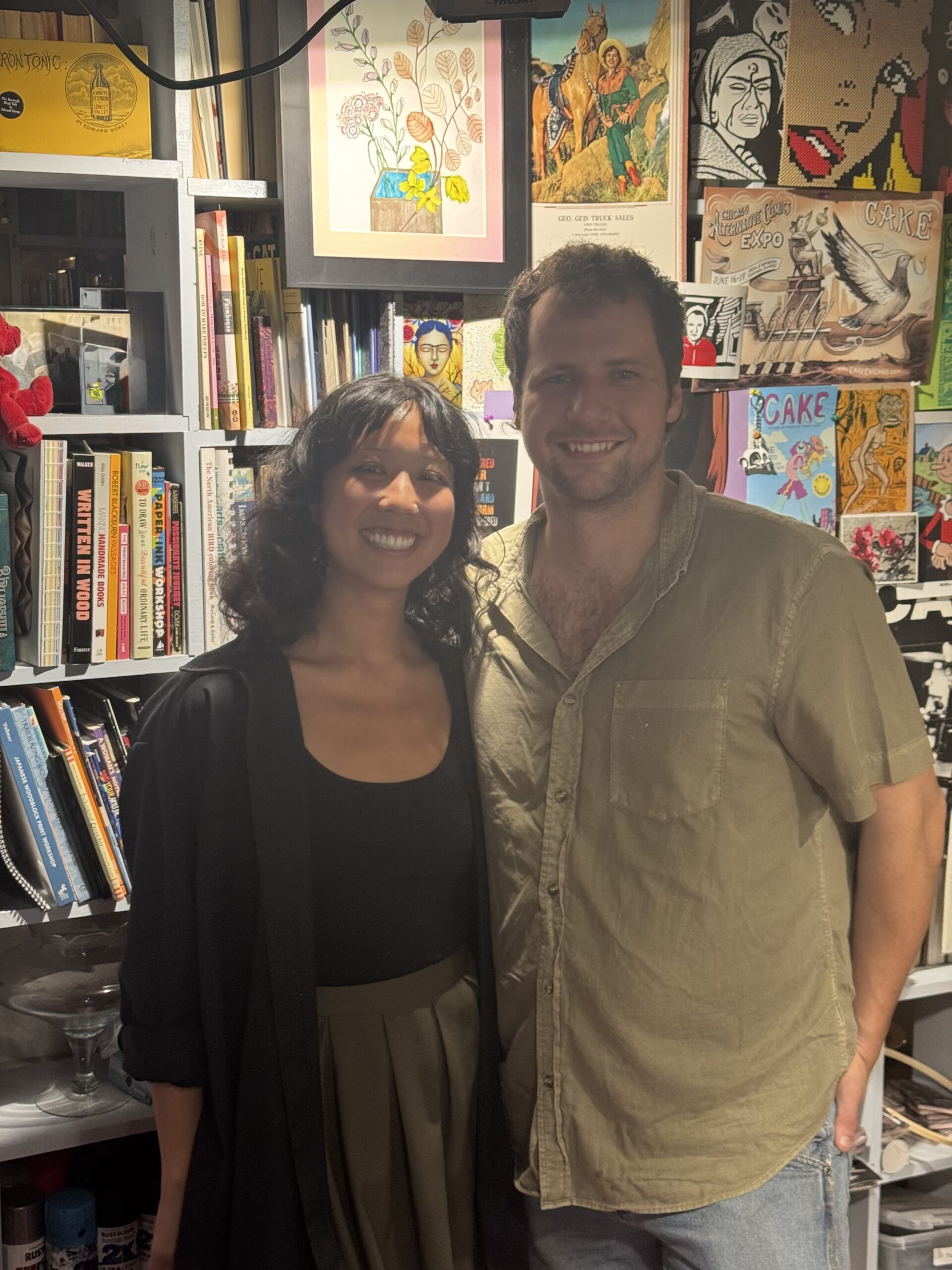
with guest: Wes Thorn

What if the scariest thing about a hive mind isn’t losing yourself, but finding out you never had a self to lose? Resistance may be futile.

SubstackAppleSpotifyYouTubeAmazon

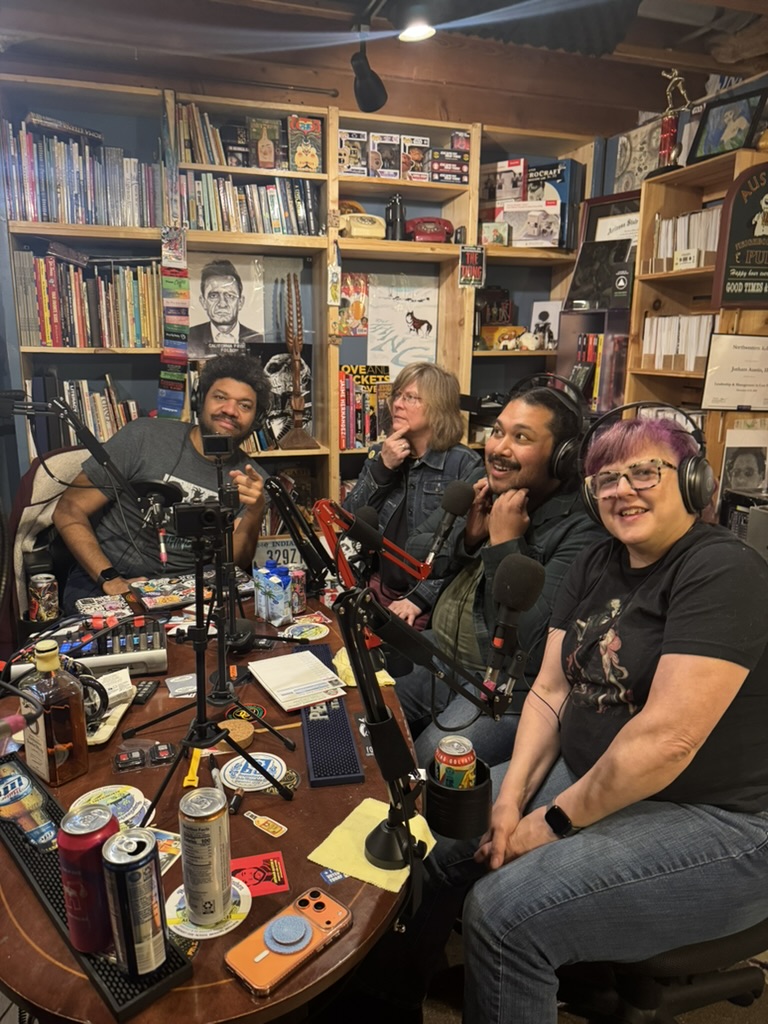
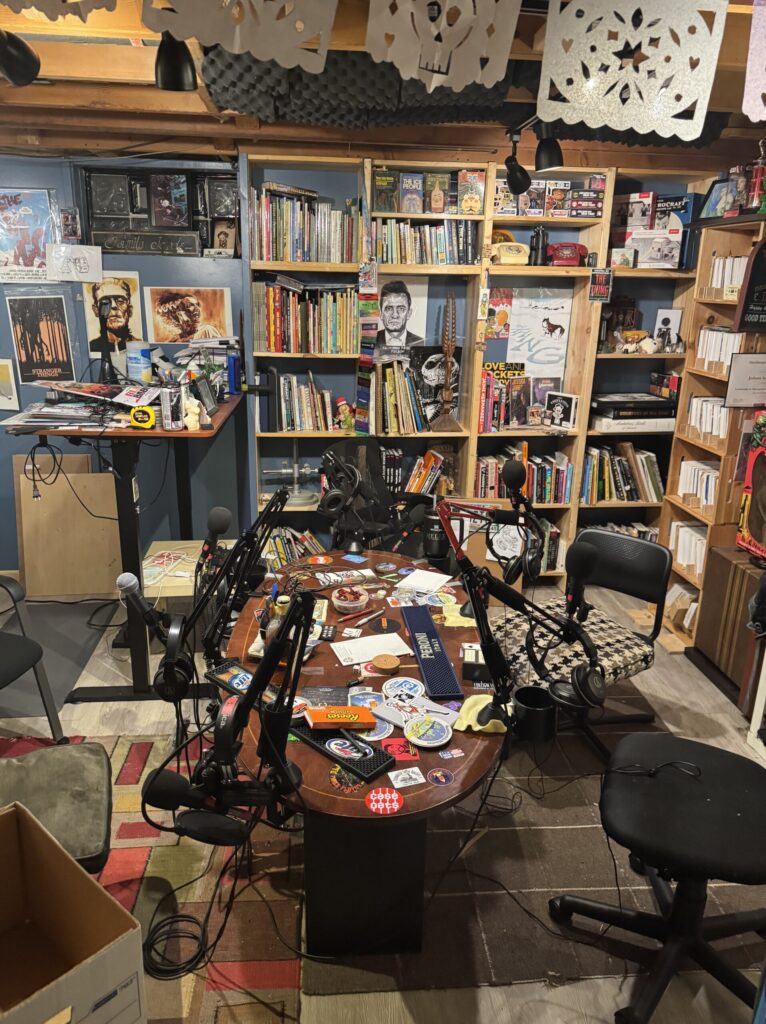
joe: [00:00:00] Hey, welcome back to the Rabbit Hole of Research down here in the basement studio. We are all crewed up. You have me, Joe?

nick: Yeah, I got Nick. We’ve

joe: got Nick. We’ve got Nick Georgia, we’ve got Georgia. And

Wes: And you got Mary.

joe: We’ve got Mary and we have a very special return guest.

Wes: Yeah.

Yay

I’m Wes, 

Was here for the, what was the episode I was on last time?

the simulate 

geo: right

Wes: the sim the hypo simulation hypothesis.

joe: There you go. Yep. Yep. So, and this one is just as interesting and hard to define and that’s the hive mind. So we’ll be going over

nick: from what I’ve heard this episode is called The Hive mind.

joe: The Hive Mind.

nick: Yeah. That’s what the hive has been telling me.

joe: what the hive’s been telling.

That’s right. Yeah. I was at

geo: trust the hive though.

joe: I was at the door before Nick rang the doorbell.

Wes: Maybe you can,

nick: did ring the doorbell. What are you talking about?

joe: So

Wes: I think the

nick: not my fault the doorbell wasn’t working.

joe: that’s [00:01:00] a different story.

nick: There’s

joe: doorbell in the basement studio.

geo: So

nick: you think

geo: I

joe: my little open.

Let me get y’all into it. Lemme set the mood, okay? Right now you’re having a private thought. Maybe it’s about what you’re going to eat later. Something you never say out loud. Some new project idea, maybe trying to predict what interesting thing I’m gonna say next. But these private thoughts are yours.

That private space, that voice sealed inside your skull, is so fundamental to being human, that we barely notice it. Your body can be touched, your words recorded, your actions watched, but in your head, you are alone. Now imagine that space has a door. And something has its ear to it. Listening, wanting in not necessarily to control you, just to join you, to think with you, to invite you into something larger than yourself.

Would you let them in? Would that be transcendence? What if you had no [00:02:00] choice? Would that be the most terrifying thing you’ve ever heard? But what if I told you that sealed room of a brain isn’t what you think it is? Your brain is 86 billion neurons communicating, making decisions without you. Hello, involuntary nervous system.

And you have little to no say Your gut has 500 million neurons. That’s your enteric nervous system, or the second brain, along with billions of bacterial cells, your gut microbiome making another set of decisions you never agreed to. And that special private voice you think of as you is just a story.

Your brain tells itself slightly after the fact. So if all this communication goes on without you knowing. Right inside your own private cellular space. The question science fiction keeps asking isn’t really whether a hive mind is possible. It’s whether you’d even know if you were already in one.

Wes: Interesting,

Ooh, 

geo: Ooh

nick: I mean, we essentially are a hive. Yeah.

Kind

geo: like the simulation [00:03:00] hypothesis.

That your inspiration?

joe: was, yeah, sure. I knew Wes was coming back, and you’ll probably make our way there, but yeah.

Wes: Yeah. I’ve

geo: what’d you

Wes: may have changed my opinions a little 

bit on the, 

simulation hypothesis since what, over a year ago, but. Let’s talk about the hive mind. 

nick: Wait. What? What changed it? You can’t just, you can’t leave it like that.

joe: Yeah.

nick: that. 

Wes: That’s another

nick: right?

joe: That’s right.

Wes: So for those who hadn’t listened to the episode that I was on, I was pretty adamant about believing we were probably living in a

joe: a

Wes: simulation,

joe: And that was just for folks to catch up. If you wanna go back and listen. And that was the first episode of season two, so episode 26. So yeah, you can go back and check it out. But yeah, Wes was, he was a defender of Yeah, the simulation.

Wes: Well, I just, I don’t know, it just, I try to always look at things, logic based and based on the evidence that’s [00:04:00] available. And I don’t know. I have my doubts, I have my doubts.

joe: Yeah.

nick: So you haven’t completely stepped away from it, but you’re.

Wes: you’re

nick: Taking a

geo: sure. You’re not as like

joe: That happens. Yeah. You gotta be curious.

Wes: Yeah, I’m not, 

mary: I think there’s a good way to test it. 

Wes: Oh, that’s, that would be interesting. 

mary: End Program. 

Wes: Oh, we don’t have access to that. 

mary: Oh,

geo: don’t listen.

nick: I had a joke for this, but I feel like it would be very inappropriate

joe: Okay.

geo: They don’t listen to us. Yeah.

mary: All right. Oh, darn

it. 

joe: No, I

nick: alt delete.

joe: you went in program. I would like cheat codes, please. So that I can 

geo: okay. 

joe: Tomorrow I wake up with the Yeah, it’d be awesome. 

Wes: I’ve tried

nick: to glitch through walls so many times. It never works. Yeah. I just end up like the Kool-Aid

joe: that explains a lot.

geo: Not

nick: enough.

joe: Okay. Right. But yeah, I think coming back to the hive mind and somewhat that gets into consciousness and what is it and how.

Wes: Yeah,

joe: Undefined. That is, there still is no real good scientific explanation of it. 

geo: And there really is [00:05:00] examples of hive mine especially. Right. Especially in

Wes: in nature.

geo: different animals. There,

joe: there are. So I mean, I think there’s, if I can give a, you want me to give a list for jumping right in? So

geo: I’m

nick: bees for one.

geo: yeah. I’m just saying it.

beehive mind.

joe: and they’re, have shared coordination of their activities. Do they have shared consciousness? Right. That’s the, maybe the definition of a hive Mine is that shared consciousness,

geo: was gonna say, is that the definition?

Because

Wes: We don’t even know if insects have consciousness the way we think about it.

joe: right? Yep, exactly.

geo: Or that they don’t,

nick: I mean

joe: that they don’t.

nick: you also don’t know if the person next to you has the consciousness that you do,

geo: Sometimes you, Hey,

Wes: we’re all having our own experience

geo: and I

joe: you infer that your fellow humans have consciousness, right?

By their actions and what they do. So that’s what goes on there. And for those without video, we don’t have video. Nick and Georgia are sitting next to each other, so, 

geo: Thank you, Joe.

Wes: grab ass.

joe: yeah. Well you guys are laughing over [00:06:00] at your own private joke and not letting the

nick: private joke. That was a very open one. Georgia immediately went, Hey,

Wes: not appreciating,

geo: appreciating it. I think

Wes: the

joe: mind has a unified brain, right?

So they have a unified.

Wes: So in a, the model that’s most in the pop culture right now, in the pluribus model, it’s just one consciousness.

And you can think of all the humans that are in the hive, mine as just appendages of this one consciousness. That’s what it is.

geo: It’s a single

joe: like your brain. I think you have many neurons, many cells that make it up, but really they’re coordinating themselves to, to act. And the insects use social colonies are ants and bees. And so that’s there, their behavior is coordinated. 

mary: They’re just

geo: very good at communication is what

joe: That’s exactly right.

And usually through pheromones, wiggle dances or waggling their bodies to direct 

nick: so going to a club, you just see a bunch of people wiggle dancing.

That’s it.

joe: it. Wiggle hands on.

geo: that’s what we’re missing. We need to do more

joe: and the waggles.

geo: wiggle [00:07:00] dances. See the

mary: the Mystery Science theater episode with the Deadly Bees? 

geo: No.

joe: no, I haven’t seen that one. And

mary: Mike Nelson dresses in the bee costume. Oh

geo: Oh

mary: yeah. He said, well, bees communicate through movement and odor.

joe: That’s right.

mary: And then there was a little pause. I’ll just be using movement.

joe: So, and he’s just adorable. He gets, he’s, he little bee costume,

geo: bco,

mary: You can see it on YouTube and all his little bee costume. And he wiggles this way. And he wiggles that way. That’s so,

geo: so cool.

mary: yeah.

joe: I think the other one is the networked intelligence. So we think of the web, the worldwide web, the internet distributed computation across many nodes that come back. And then, as Wes was saying, you have the sci-fi kind of model where you lose yourself and you just become one shared mind, one shared, consciousness.

And we can get into consciousness and what

geo: and the n thing about pluribus and,

nick: I mean, you have to go to no spoilers, don’t forget. Right.

geo: I think the interesting thing about Pluribus is you’re questioning as you’re watching it if the individual still [00:08:00] has their individual consciousness, or is it just completely a group consciousness?

And I’m not saying that I could tell by watching yet I don’t think.

Wes: there’s no individual consciousness in the. Human appendages that are part of

geo: I dunno. I think there’s, I think

Wes: there’s one consciousness,

geo: but they’ve showed a few hints at maybe

joe: I

nick: army of darkness. You get a hand that has its own consciousness that gets cut off and then turns into a whole nother body.

Wes: Well, sure. I mean,

nick: saying 

Wes: That’s a different universe. I was just talking about that. 

joe: Like you have disembodied limbs, so, The Thing on Wednesday, right? That’s a disembodied kind of entity

nick: or phantom limbs, bringing it into a more grounded reality where I had a great uncle who lost his whole leg and he was like, I have an itch on my knee.

And I’m like, you don’t have a knee? And he goes, I do. And I’m like, I don’t know what you’re talking about anymore. It

joe: [00:09:00] back to your brain that’s making up that story for you.

Like it’s something should be there and you should feel something. And now it’s having that there. But yeah. And we’re talking about  Pluribus and that show was Apple Plus. You probably

geo: highly

recommend it

Wes: probably

joe: should go. You maybe stop here, go watch some episodes. ’cause we, I can’t guarantee we won’t spoil something.

I watched

nick: I mean, I’ve watched absolutely none of

joe: Yeah. So Nick he’ll yell at us. But the show essentially is we get a message from some other species in the universe. We decode the message it leads to some sort of genetic code. We synthesize that code. And then that leads to everyone who gets access or gets infected with that code.

This piece of genetic material. They didn’t join this hive mine. And the hive’s goal is for happiness, everyone to be maximum define happiness.

Wes: I think that’s a byproduct of it, but I think their genetic imperative is to retransmit the signal. That’s, again, that’s their

joe: Under the guise of happiness [00:10:00] is to, right.

So the conflict in the show is that there are 12 individuals or 13.

Wes: there were 13, but the Kasama decided to rejoin a young Peruvian girl.

Sorry about the spoilers,

joe: but yeah,

geo: It’s okay. It’s still,

joe: show then is you have the main protagonist Carol is, I don’t know, one of the angriest

geo: So it really is a, I think it’s really a character study of Carol

joe: It can be. Yes. Yes.

geo: And then there is other characters, individuality. There are other characters that haven’t been that are also immune.

And now, and at certain points, these people that haven’t been taken into the hive mine are interacting. And that, that also, that’s interesting. It’s very, it’s a really well made

joe: Yeah.

Really good and explores. Yeah. But

geo: does bring up all these interesting

Wes: debates about would you prefer to be unjoin, that’s what they call it, joined or unjoin, 

geo: right?

Wes: [00:11:00] Or would you prefer to be part of the hive mind? I see this, I see some upside to it, 

geo: right. So you’re go leaning more into joining.

Wes: I don’t know. I’m like, the questions come up. Well, you’ll lose your individuality. And I’m like, well, I’m an artist and I don’t know doesn’t, but you

joe: you lose your creativity,

Wes: I lose

joe: is no creativity. I mean, that’s the, that’s it. That’s the thing about AI and generative

geo: do, I dunno If you lose your creativity because all those people’s skills and thoughts 

joe: but it’s not

geo: there. They’re part of the hive mine. So could it also be that everyone in the hive becomes more creative,

joe: the hive just directs their energy?

Wes: all they’re doing. At least in the pluribus model is working towards their goal

joe: Mm-hmm.

nick: And

Wes: And putting the planet back to Right. So

nick: so is this, is that far off of a cult? Like

geo: except it’s

nick: end up getting more hive mine, yes. Than anything

joe: do

geo: That’s a really

joe: The problem is that with the cult, it’s, you don’t truly merge. So at [00:12:00] any moment you can. Am I thinking you can actually unculture yourself and go, hold on. What am I doing?

nick: But like the likeliness of getting into a cult and then getting deep into a cult, you tend to not have that ability

joe: are people And that do though, right?

nick: yourself from the

joe: a small number.

geo: Look at Jamestown, right?

I mean, how did all those people do what they did? It really was like a hive. Mine still

joe: I think that goes more to the Borg model.

So the Borg aren’t. Well, so

geo: okay. What’s the Borg model? So 

joe: is a race in the Star Trek

geo: was gonna say Star Trek.

joe: and they’re very technologically advanced. And what they do is any new species they come in contact with, they assimilate into this kind of cyborg ish hive neurological, wet wear hive mind

and you have no, so that it would, initially, it was a true hive mind, but in the, I think it was the First Contact movie, they had a queen all of a sudden, and that [00:13:00] queen had an independent thought outside of the hive. So therefore that’s following more, the Bee model, this u social kind of model, not a true hive mind model.

So BBIS actually is following the true, there is no leader, there is no queen or that we know of. I mean, I could come up not spoiling anything. There could be more things coming later on, but really we haven’t seen that. So in a model presented that’s more true hive, the Borg model

geo: is like a commune, right? Like a, like everybody is equal,

joe: right? So I think

geo: the.

joe: the cult is more like that, that you, where you have a queen

nick: there has to be a main head though. For there to be a hive, someone has to have that central intelligence.

Wes: No,

joe: that’s the whole thing. It’s spread out. Yeah. No head.

nick: there has to

joe: There has to be. So you just have a directive.

Your directive is, and

nick: giving the directive?

joe: It’s

geo: it’s 

nick: So something inside you has that directive

joe: and it’s an everybody, so it’s a shared conscious effort.

nick: So it’s a body inside everybody that has

geo: There’s no Jim Jones in the

Wes: There has no, there’s no [00:14:00] cult leader.

joe: There’s

nick: I don’t believe it.

Like I, again, I haven’t seen the show, but I’m already like, there has to be something. Why

geo: it is hard to wrap your mind

joe: think you’re filtering that through, see this is that individual you want. You’re wanna maintain that and you’re like, there has to be a leader because secretly you want be that leader.

Wes: We should have watched

nick: I would make a great cult leader, guys like I understand

joe: and go get episode one, watch to come

Wes: should. We should just go watch it. 

mary: Nice cold. There’d be lots of coffee and art. 

nick: Well, 

mary: It

what

nick: what

geo: think is so interesting is.

Everybody gets everybody’s knowledge, right? So you don’t need to worry about getting a plumber. ’cause every single human being has the plumbing knowledge

Wes: Or fly the space shuttle 

geo: or a rock, yeah.

Wes: Perform surgery. Anybody could do it. 

joe: There’s no scarcity. So you,

geo: there’s no I wanna say class system, but there’s no hierarchy because everyone is the same.

nick: this is only season one.

Yeah.

joe: season one. Yeah. I wonder what

nick: it two seasons,

joe: a friend [00:15:00] of the show Amron, who did the finance of the future in this kind of hive model, what’s the friction, right?

Because he said every society, you need to have that fri economic friction to move goods and move trades. So in a hive, you actually, we were trying to think of, examples where that broke down and we didn’t in the episode. But now the hive, a true hive mind as set up wouldn’t, you don’t have any economic friction.

You just do whatever you need to do. Oh, I need to,

geo: it’s 

joe: a plumber, you just do it.

geo: there really truly was communism or is it Marxism? I get confused on my isms. But this would be the true communism. Like every single person is exactly equal and you know what I mean?

joe: If you a community, yes.

So if you’re

geo: And think about that. And for this show, it’s not just a little community, it’s the whole entire world.

joe: Oh yeah. Whole world here on Earth. But it seems to be connected to their whole Right. Universal seems

geo: to be an alien 22,

joe: Yeah, that’s right. Yep.

Wes: We don’t even know if the [00:16:00] Keplers are still alive. They transmitted that signal 600 years ago.

geo: Wait, can you refresh my memory about what that is?

Wes: So the we know that the Pluribus, the signal or originated from Kepler 22 solar system around that star, and it

geo: that a real star?

Wes: It is. Okay. And it’s 600 and some odd light years away. So we know that the signal has been traveling for at least that long. So, yeah. And we don’t know if the people,

geo: if they’re even still there, if

Wes: the species that sent it is even still alive, we don’t know.

nick: the people or the species on Kepler

joe: Yes. Mm-hmm.

nick: Have this hive mind as well.

Wes: Yes. It’s I

nick: so that means assume that

Wes: that, yes.

nick: Okay. So there,

geo: it could, there could be a leader.

nick: like there’s a leader, Joe.

geo: Oh right. He’s really fighting

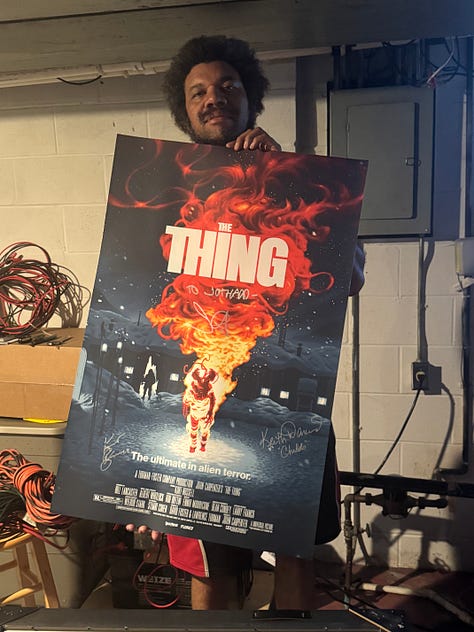
joe: don’t know if there’s a leader. No leader has identified themselves. It’s the same. I think if we go back into, my favorite. I’m wearing a shirt, is The Thing. Right. I [00:17:00] think the thing that it is still, it’s functioning under the hive mind mechanism.

geo: don’t think like one Thing is different than another

joe: No, I think they’re all the same Thing. And I, and

geo: We dunno that though. That could be a very

joe: you all were the things, you would just attack me, but you guys are conspiring to hold back. And so that was part of the psychological effort in there that you, The Thing didn’t actually, and that’s why I think the ending kind of reveals itself because if one was The Thing and

geo: the interesting thing about that

why would

joe: attacked?

I think they both were human or both Things.

geo: Okay. You had to get that in.

joe: I got

geo: Okay.

joe: anytime I can. Yes.

geo: Yes.

I think the interesting thing was obviously that story, that show was called The Thing and then we have The Things

joe: right. From their perspective 

geo: and

was their perspective.

And obviously there’s not a single thing. There’s many things and it’s like these crazy humans and all their fricking Yeah. Weirdness

joe: us for no reason. We’re here just chilling. We just wanna be friendly, make, 

geo: I do think the internet [00:18:00] does feel like a hive mind. Yeah.

nick: Is it a hive mine or an echo chamber

geo: Yeah. I know. I just feel like sometimes, like you were talking about private thoughts and I feel

nick: like

geo: My FI know it’s when you say something out loud and your phone hears it and they send you ads and stuff, but it feels like they even can hear me like when I

joe: It doesn’t work. I’ve asked for particular ads to show up and they didn’t show up.

’cause I wanted to rewatch a commercial and I’m like, show me

nick: are you trying to find?

joe: I don’t know. It was, I

nick: What? Why are you looking for a commercial?

joe: Commercial. Some commercials. They’re, yeah. Or they, something happened. Remember we were watching, I forget what the Tratiors I think,

geo: are you talking about the one where the animals like the car?

I

joe: I don’t know. Okay. That’s a different

nick: All right guys. We’re not sponsored by whoever this commercial is.

geo: right.

joe: I don’t wanna, yeah. They drop us some coins then. We’ll 

geo: it happens all the time where you just, it feels like you’re just thinking something and all of a sudden that it’s on your phone.

joe: Yeah.

geo: But I really appreciate like Mary, you’re not on social media.

No. And I think that [00:19:00] is so amazing. That’s so great at this day and age to be like unconnected

joe: would be the Carol of our group.

geo: Yeah.

nick: So

joe: So in the

geo: Carol’s the

joe: pl she was the one that,

geo: Caroley.

she

joe: so you haven’t seen it either, so Yeah, we, 

geo: I’m a blank.

joe: All right. You two need to watch episodes by the mini, because that’s a, would really

geo: would like,

nick: for a

geo: would like, you would really Carol, I think. Don’t you think Mary would like

nick: Find it in our budget.

Wes: kinda looks like Carol too.

geo: Okay,

mary: I think so. The thing

joe: boy. Yeah, actually you do.

mary: I don’t deserve, I

joe: don’t deserve that

mary: praise.

geo: Are you Carol?

joe: right.

mary: I’m miming

nick: of you

mary: mask off of off of my face. I don’t deserve that much praise because I’m on YouTube all the time. So that’s basically

joe: social. Social media. Yeah.

geo: Yeah,

joe: but you limit in it. I mean it is, it’s gotten that way.

They want that model where you go and you feed into the

nick: Are you using the, like the

geo: it feeds you an A

nick: feature and all that?

joe: I,

geo: so I,

nick: or are you just watching the long form videos?

mary: I stumbled upon, [00:20:00] so I use Echos as my browser. I

joe: delete the YouTube

mary: app and I watch YouTube through the SIA browser on

geo: I’ve never even heard of the SIA app and

mary: no ads.

geo: ads.

joe: Don’t do that. I

geo: Wow. I don’t know

mary: why, but there are no ads when

geo: I then that definitely

nick: Some browsers do let you do that. So 

geo: that

mary: will let you

joe: that. DuckDuckGo

nick: Opera DuckDuckGo, these are all very

geo: These are the ones everybody should be

joe: They’re to tor browsers, so they go, they don’t track you.

Also, they I know DuckDuckGo, some of these other

nick: opera has VPN 

joe: they have ai, generative AI kind of features defaulted off versus the other ones Firefox, Google Chrome, that you have to go in and you can turn

Wes: is interesting. I’ve been put off by YouTube because so much content is obviously just AI generated content is

joe: Yeah. Well you get that, right, right,

geo: Yes. 

Wes: No, not ads. I mean the whole videos. Yeah. Yeah. So I’ve been avoiding YouTube.

nick: I mean, it really depends on like [00:21:00] you. Knowing your creators

joe: That’s right. Yep.

nick: This is a show that you can contact us and we will message you back. Not even like trying to plug us, but we are real people.

Like we will talk back to you, we will give you very human

joe: are real.

geo: us.

Wes: Please

geo: contact us.

nick: But 

joe: Reach out. Yelling us. Tell us what we got

nick: just one of those things like knowing the creators that you’re watching the videos of. And yes. We don’t have video right now, even though we’ve promised that a

joe: Yeah, we did. Yeah.

geo: we have these little cameras

joe: We do. Yeah,

Wes: Hey, I forgot

mary: can see how beer I drink during podcast. 

geo: Mary. I wanna get back to the internet thing.

nick: Oh, I thought we were talking about Carol. I

geo: back to the, well in a minute. I want, okay. Mary slash Carol. Yes you can.

mary: Right.

nick: Right? I.

geo: So the fact that this browser is one of the browsers, like Joe talked about, that it’s doesn’t default to generative ai right?

Content. Yes. Do you feel that, do you [00:22:00] feel like most of the things that you get. On your feed and YouTube is real creators or do you feel like there’s a lot of ai?

mary: I think that’s

joe: yes, it’s a browser, not it’s a browser. Not sounds like when you type in a Google,

geo: but do you say that it defaults to the fact that

joe: So when you do Google now you go and you go, tell me something about, hive mind. Let’s use that. Or episode you’re doing some searches, trying to get some research done.

You’ll get an AI generated summary of content that pops up and that then directs where you should go and what you should look at. It has things, there’s ads sometimes embedded in there. The top hits the, with these kind of factors. SEO factors that, that bump up a page, that’s what you get first.

And you usually have to move that out the way to get to the true search results. Research papers,

geo: So like the browser

joe: these other browsers, they don’t pop that up. You get the true search, you get the pages that come up. That’s right. So

geo: it doesn’t affect what you get on YouTube. So you go to 

joe: yeah, YouTube is its own

geo: on the browser. [00:23:00] Yes. And that’s where you are watching. So,

mary: and I just noticed that, well, I just noticed that I’m trying

to, I’m trying to wean

myself off

of

of the more egregious 

big tech that’s out there.

geo: Mm-hmm. So, including 

mary: Gmail and

joe: And Google.

mary: So instead of

geo: using Chrome,

mary: I’ve been using Ecosia. 

geo: Mm-hmm. 

mary: And Ecosia, when I li and I deleted the YouTube app. I’m trying to,

joe: in my own small

mary: way to starve the beast because

it’s a,

yeah. They’re,

I they a

disproportionate 

joe: level of influence.

mary: over.

Yeah, everything right

now.

and and I can’t, we can’t stop it all, but I can do my part

Yeah.

In that to sort of, pull the legs out.

So one of the practical effects is I’ve been able to finally listen to YouTube, like the things I like to listen

joe: to mm-hmm.

geo: without it giving you an a, a,

a, oh,

how do you say that?

Algorithm?

nick: Algorithm?

joe: Yeah. Well, the [00:24:00] algorithm

mary: is still there,

joe: It is.

geo: Okay. I’m not getting

mary: the ads.

geo: Okay.

mary: And I just noticed it. I was, as I was listening to, as I was listening, I usually listen to YouTube.

I like, I put it in my pocket and just

nick: do chores

mary: listen to long form podcasts

joe: like this, like the rabbit hole of research, rabbit hole of research. You can find us.

nick: Wow. We’re really plugging ourselves this

joe: I was gonna, yes.

I’m sorry, go ahead. No, I was gonna bring it back a little bit because one of the things when I did my, the research and.

oh, down

Through my own rabbit holes was coming back to consciousness because I think you have to define that. And that led me to thinking about the, some of the science of Plubirus risk.

How would you have an interlinked hive mind? How would you really do that? That is through this idea of consciousness. The problem is, as I said, there is no real. Definition, there’s 29 theories or so. Some reports have come out Yeah. Of consciousness. Mark Bitman had a

geo: like a single

joe: There is not. It is very, it’s one of the most unsolved problems [00:25:00] in science and

geo: Wow, that’s so interesting.

joe: as well. The problem is like the simulation hypothesis with Wes coming back, going for this, when I started doing my research, it was like, oh, this is a nice end cap because that it, it’s hard to study something if you’re in it.

So our only tool to study consciousness is our consciousness. So you really can’t get outside of that to actually study it. So if we’re in a simulation, we really can’t study if we’re in a simulation because you’re in it. So it that’s always a problem. If you’re in the thing you’re trying to study, how do you study it?

So usually you gotta send something outside of you. And then do it, but Right. We don’t have that. So why, 

geo: like science,

a lot of times things, these big breakthroughs come from people that might have been trained in other areas, in

joe: Look at it in a differently way. Right. Different tools. They’re applying tools, but the tool we have really, our consciousness is what

geo: like an, we need like this alien group to come and study us. And then, but would we

Wes: a whole nother

joe: that’s right. Yeah. That’s, would that,

geo: would we trust their,

joe: that’s right. [00:26:00] Their judgment. Are they telling us what’s right? Are we looking at those results? So you’re, I mean, it’s like trying to study.

geo: Would they care? That’s a

joe: that’s the other, it’s like studying, trying to study the water in the ocean.

If you live in the ocean and water is around you and you, what tools do you use to actually figure that out?

nick: like we study the air and we live in the air.

joe: We have a lot of tools, but air is made up of other elements that we have tools to actually monitor and measure what those elements are. So we truly do have other tools to measure these other physical properties.

geo: some, what are some ways that scientists are trying to study consciousness? Can you tell us that?

joe: Yeah, I mean, I think some of it, and what I found was you go and you start, Wes you look like you’re about to jump in or you got

Wes: go ahead. I’m wrapped. Wrapped with your attention.

joe: I was like, you look like I look up and you were like, you’re ready to jump in there.

But I, I think a lot of it is this idea of consciousness that we’re having, these internal thoughts. Then do we have. Techniques that we can [00:27:00] record our internal thoughts or record what we’re thinking or how we’re processing

geo: how certain things in your brain light up

joe: Yeah.

So exactly. And so functional MRI, so this is a magnetic resonance imaging but functional part of it is that they can actually follow blood flow, see different parts of your brain light up, use this as a tool to go, okay, you are, you’re having some conscious thought, you are having some kind of, a higher thought there, 

geo: a lie detector?

nick: It

joe: would not be a lie detector

geo: Isn’t that trying to figure out if your thoughts are true. 

joe: Well, we, we did an episode on the truth and lie detection. Yeah. That’s measuring, right? That’s right. Yeah. So it’s not measuring consciousness per se, it’s measuring kind of an outward projection of how you’re feeling.

Heart rate breathing rate, respiratory rate. So that’s where you get there. So your fear of 

mary: not

being believed.

joe: Right. So, 

geo: it’s like your blood 

Wes: there’s a whole subculture of people that think that consciousness is non-local.

That it’s [00:28:00] not located in your brain. It doesn’t depend on your brain to be generating it. And

joe: And that’s a noetics

geo: what group? Yeah, 

Wes: he said it Noetics

geo: noetics is the

joe: idea that there’s non localized consciousness, that your brain activity alone can explain our conscious behavior. And so Noetics is this kind of idea that all the consciousness think of it like a cloud for your iTunes or Spotify.

So all the music live somewhere and then you recall it and you have recall of that, and you can bring it down and you have access to it. And so Noetics is like your consciousness, everything you know and learn. Are floating somewhere in the uni, in the ether, and then you can pull it

geo: Ah that’s hard to,

joe: That’s hard, dude.

And so one hard, two, two areas where it, people have backed this One is near death experiences and people experiencing things that they see. And there’s a lot of, it’s, there’s some interesting studies where like people have, they describe things and [00:29:00] then some, doctors, they’ll put like signs or papers.

They started putting it on top of a tall shelf. So you go, I’m floating off. Then they go, what was on that paper that was up there? And then they go, what paper? So there’s some interesting things

geo: looking down onto their

joe: but the other interesting. One I found was this what’s called acquired Savant syndrome. And so these are cases where someone had a traumatic brain injury Yep.

Recovered, and then had a phenomenal ability so they could speak perfectly. Another language. They became a a maestro of piano playing or an instrument. And so there was no they couldn’t play before, couldn’t speak the

geo: is somehow they tapped into

joe: That’s right. Like a radio, like they, like a radio station.

They tuned in. Their brain had an opportunity to tune into it.

Wes: Yep.

joe: And so you could, their brain tuned into the frequency that was just right to get that information. And then when they woke up, they all of a sudden could do this amazing thing. Yeah. So I had a few. Derek Amato, he hit his head in the [00:30:00] swimming pool accident and he woke up.

He could play piano at a concert level, never having any lessons. He sees the music as black and white squares flowing through his head. Orlando SRO got hit with a baseball at 10 afterwards. He could remember every day’s weather day of the week, personal events moving forward with perfect AC accuracy.

So yeah, Jason Paget. There’s, I mean, a couple examples I got hit in the head, woke up seeing in fractals and became a mathematician savant. So he had been a fur, a furniture salesman before, no mathematical background, so woke up and he just could do this amazing thing. So this idea of noetics that’s it.

And the, I, the other thing is that our brains have suppressors. They’re actually, we take in a phenomenal amount of information and we really can’t process all that information. And function. And so your brains are actually actively depressing, right?

geo: out this stuff,

joe: What’s happening? So maybe the signal is coming in, but your brain is just filtering the signal out because there’s so much noise.

If I

geo: But I [00:31:00] wish my brain would realize, I would love to do concert p be a concert

joe: That’s why I think in ris, maybe that’s what’s happening. Maybe the genetics signal that got sent this kind of genetic thing was a tuner that allowed it to tune and focus. And so now to focus, now you’re only focusing on one particular thing out of the cloud.

And everyone’s focused on that. And then if that message changes, then everyone focuses on that. So we gotta go and do repair some infrastructure. We all then tune in. Everyone has the skills to do it. We know our jobs. There is no hierarchy. So you just show up. And you were performing heart surgery one minute.

Next minute you’re digging a ditch and fixing the sewer line. And this goes to the, I think the ARC episode where we talked about that. Where at point at Nick, ’cause we had that conversation and I think you had brought something up like this. If you’re the surgeon, then go build a barn. Like we

geo: I

nick: finish the surgery first. Don’t go start digging that.

geo: want the surgeon to hurt their hands, so.

joe: Well, that’s the thing. And this universe,

geo: It doesn’t matter.

Wes: a surgeon. Anybody’s a ditch

geo: I’m, yeah, but [00:32:00] that’s usually not the case.

joe: There’s,

mary: there. Well, when you were talking about consciousness, you know how hard it is to. Study yourself

nick: while you’re

geo: in this

mary: thing. I’m thinking about this through the lens of yoga, which, 

I’m

joe: I’m interested in it.

geo: And

nick: wait, is this because you went to yoga today?

joe: No.

mary: I

geo: She actually teaches the yoga.

Wes: Yeah. 

mary: So,

joe: Yeah. So, yeah. She’s a yogi. Is that term? Yeah. Yeah. Oh,

mary: I’m a yoga

joe: Okay.

mary: And in, in yoga philosophy the human body is thought of as

joe: layers. 

mary: Mm-hmm. 

joe: There’s 

mary: your physical layer of your body, and then there’s the sensations that body has your level of

joe: attention and your thoughts and feelings.

And then finally, your

geo: consciousness. And

mary: yoga is very interested in teasing out

what is permanent and what is temporary what is your fleeting thoughts and feelings versus your consciousness. Huh.

And you do that through meditation through

geo: practicing

mary: the [00:33:00] postures.

joe: So you know, when you

mary: see people, like through, through movement and through also through

geo: breath, like the wiggle dance,

mary: that’s, what’s that?

geo: Like the wiggle dance?

nick: Absolutely.

mary: Through the wiggle dance.

joe: Back to the wiggle dance through the wiggle dance. What, through, through that you, you sort of tease

mary: out you, yeah. There’s ways to separate that may, not, maybe not

nick: as, is that like the chakras or is that a different

joe: That’s a, that’s more

mary: of a different thing, but it’s more there’s like yoga is yoga philosophy thinks

joe: of the body

mary: Thinks of us as layers.

And like the final, the most inner

joe: layer is the consciousness. And then 

mary: you tease out what is your thoughts versus what is real versus

What are your thoughts, which are

joe: are transitory? Interesting. Yeah. Yeah.

nick: No, but I mean not, so your thoughts aren’t real in this, right? So what are your thoughts? Like just

joe: your thought,

mary: your thoughts

nick: Just like fleeing

mary: your thoughts are temporary and what you do when, because we can get overwhelmed in thought, get lost in thought, and

geo: confuse

mary: our [00:34:00] thoughts with reality. And one of the rea and one of the things that we can do to step back from that is to use our breath and, to consciously just remember

joe: To take a breath,

mary: What does it feel like to take a breath end out Right. Right. Probably a warmer exhale

and something like that. Just, it’s almost like a timeout for your

joe: body. Yeah. It reminds me, yeah, go ahead. Go ahead. No, appreciate that. And then

mary: With yoga, we

we get control over our thoughts so that our thoughts don’t control us.

joe: Yeah. It reminds me of the book Lose Your Mind, and I’m slipping on the author right now, but he’s he’s his dad worked on the Manhattan Project and he became like an author actor and he is now an actor coach. And the whole idea is that when you’re going for an audition, you’re going on stage, you’re doing improv, you’re doing all sorts of things your body can take over and sabotage you.

And so he’s teaching people how to take your thoughts and how to use your breathing,

nick: Is this, ’cause you watched Wonderman recently?

joe: this was [00:35:00] not, but it was, we thought about Lose

nick: you watched Wonderman and that’s where you’re getting this

joe: But it

geo: It’s a really good book.

joe: Yeah.

geo: It’s a really good book.

joe: he had that whole premise, and that was the whole thing about breathing, about channeling your thoughts, 

geo: taking

joe: letting go

geo: and looking at something in a different way so you realize, oh, that’s my, you know what I mean? Like just your thought shift,

mary: your focus from

geo: thoughts.

Exactly. Back to, and he has a lot of, he has a lot of exercises to do this and stuff. Mm-hmm. Like it’s really good. Yeah.

mary: Oh,

joe: awesome.

geo: I, thanks Sarah. I’ll have to check that

mary: that out.

joe: out.

nick: out.

joe: Yeah, by oh I just looked it up. Josh pe

geo: PECE. I was gonna

joe: lose your mind.

The path to creative invincibility is the

geo: this would not have been, this would not have been helpful at all, but I’m like, his name starts with a J but that would not

joe: would,

nick: man, you really gotta tap into that.

joe: it’s a j Dave High. You had a high mind. Let me pull from the universe. The conscious cloud. But the interesting thing about con, ’cause we talked about it and we do this ’cause we’re human, so [00:36:00] we always have a human-centric point of view, but there are other organisms and one are our plants.

And one can question are plants conscious? Not because like bees ants, they all have a nervous system. They have a brain, so you can make the jump. Okay. Yeah. They are doing things in a court and they do have a consciousness. But plants don’t have a nervous system as we understand a nervous system.

And so are they conscious or do they have conscious thought? Are they, this kind of awareness of their environment? And there’s a lot of evidence that they do.

geo: it does. And it does seem like they’re collective because you have all that root system going down. And I think, I’m especially thinking of mushrooms and fungi.

joe: mushrooms are different. They’re

geo: all, oh yeah. But they have that, they do, they have that interlocking system of roots, and it seems like they all become one.

Mm-hmm.

That’s correct.

joe: Yep. Yep.

geo: much like

the,

joe: they’re

geo: the pluribus. 

joe: But then they

nick: becoming one or is it just one?

joe: It’s just one. Usually it’s just one.

[00:37:00] That’s right. And that’s 

nick: because what if you replant a different part of it elsewhere? It’s not like it’s still connected. It’s a separate entity.

joe: Now those are two, so there’s two concepts there. One is cloning. So if you, and that’s asexual cloning. So if you take a piece of the plant or the fungal and try to regrow it, then it’s a genetic copy of the original and you’ve made a clone and they could be separate and they’re not there.

I think what George is referring to is the interconnectivity of the actual organisms themselves to form one kind of thinking organism or being, and so in Utah you have the grove of quaking aspen, and it’s considered one. Single organism and it, but it’s like 47, 40 some thousand tree trunks share a single root system.

Wow. And so they go, it’s 80, 90,000 years old, something like that. The oldest living thing on earth. And it’s just there’s no brain, no nervous system, and it, but it’s a unified kind of a organism. And it’s, and sadly it’s currently dying because of [00:38:00] human activity. So, that’s that’s, that there,

geo: It’s gonna,

nick: another AI data

geo: and that’s, I feel like that’s really the motivation of the pluribus. Beings, or however you would say being is to save the world. Like they, they’re really like want to save resources and they wanna be more,

Wes: they won’t

geo: environmentally conscious won’t, they

Wes: even pick an apple.

Even though they picking an apple won’t kill the tree. They won’t,

joe: part doesn’t understand that because there are fruits like that.

So you’re not killing it, but you are. There

geo: are, you’re actually helping

joe: apple. So even if it falls to the ground and you eat it, you still are ingesting, right?

geo: They’re

Wes: with picking up windfall.

joe: know, but it’s still a living. It still is living as it was on the tree. So I think that’s a little, ’cause the cells in the apple are still doing stuff.

I mean, when you have an apple in your fridge, you pull it out, those cells are still biologically active. They’re not, you’re not eating a dead thing.

nick: Can they eat bread? Because bread is yeast and yeast is living,

joe: the yeast is dead in the bread.

nick: But you [00:39:00] had to use the yeast to

joe: did have to

nick: so that means you’re killing it to eat it.

joe: Yeah.

geo: they will

Okay. We’re not gonna go too much into what they eat. Okay.

nick: Wait I have a whole discussion

joe: Yeah, I think so. Yeah, you’re right. 

geo: We’re

Wes: Not in the show,

geo: We don’t wanna do,

spoiler. 

Wes: No,

joe: this certain a

Wes: not much of a spoiler. They will eat any processed food that already existed prior to their

joe: arrival or create.

Yeah.

Wes: So they’re okay with that.

nick: Are you able to opt out of being part of their cult?

geo: No.

we, you gotta watch the show. You gotta watch

nick: are you then killed? Or is it

joe: No, they don’t kill,

geo: you gotta watch the show because

joe: people, 13 people who originally were not susceptible to this

geo: they didn’t get so

joe: they could not be, so Carol, the main protagonist she did not become

geo: so she is the main character and she,

joe: figure out

geo: struggle is how much does she wanna fight against this? And how much did, because her, yeah. So,

nick: no matter what she does, they [00:40:00] won’t retaliate or No.

geo: no, 

Wes: they won’t retaliate. 

geo: There’s

fine, there’s some fine

joe: She pushes the envelope.

geo: There’s some fine lines and some interesting, I don’t wanna say blue

nick: for some good anarchy. Carol

geo: say, I don’t wanna

joe: would have a lot in common. I think. So it’s like you would love Carol.

geo: would love Carol. Yeah. Yes. Interesting. And there’s some loopholes that she’s trying to

joe: to exploit.

geo: but then they, but the chive mind is trying to exploit some kind of loopholes

joe: and that this questions okay. I don’t

geo: don’t, yeah. No,

joe: But I was gonna say back to the fungal point, that’s the Mical networks that they have underneath.

And so I think there’s a number, I think organ, there’s one of the largest interconnected fungal masses.

geo: makes

joe: makes that you have

geo: the last of us so scary because that’s fungal based.

And fungi, the

joe: controlling like a hive mine

geo: and that is like as far as like organisms of the earth, they have the greatest Right.

right.

nick: Fungal

joe: Organisms. Yeah. Greatest one. Sorry.

geo: [00:41:00] That is the greatest number of. Beings on earth is fungal. I

joe: know. I

geo: I

Wes: don’t know. There’s a lot of insects.

There’s a lot

joe: of insects, but

geo: I don’t know. I think fun. I think

joe: would be, but microbial just has, I think they have the numbers there because even in like us,

geo: are you talking about an extreme of

joe: We have no, this normal files,

nick: you just had to get that one in. Didn’t.

joe: But even, I mean, so it’s funny

geo: We’re a normal file.

joe: even in like insects, they have microbes that are live on them and interact with them. Fungals. So every species has their own group of kind of microbes, their own

geo: the highest percentage, but I could totally be wrong.

I don’t know,

joe: Per species, I think you’re just

geo: maybe, could you say the more complex they’re the most,

joe: I don’t know. I mean, all right. I don’t wanna offend the fungal

nick: I do, let’s go burn them all down. No

geo: No,

joe: no, yeah.

geo: fungal is our friend. A

joe: a lot of, I mean, there’s a lot of. Organisms on earth that have a lot of numbers and they’re just smaller so they can reproduce.

Are we [00:42:00] talking about, do you take each cell of the being and say, that’s a

geo: so easy to grow.

joe: So

geo: if you just get a

joe: per volume

geo: you get a dark like a box and you just a little, 

joe: they need to eat though. Yeah. Everything needs to eat.

geo: and that’s true. 

joe: Fungi

geo: I feel like they were pretty easy to grow. They are.

They are.

joe: they are,

geo: they’re tasty.

joe: easy to grow. Yes. I’m not gonna say that. And then people write those. These are the hardest things I’ve ever grown in my life. So, okay.

geo: I had an idea, but, oh my gosh. I’m, I think I might have forgot. Sorry.

joe: Some other interesting things I had that I thought was cool and still lack nervous systems is the slime mold.

And their problem solving, how they can come together at these they will go and sort of the most famous thing was that they took the a map of Tokyo and they put food sources in all the major stops.

geo: Okay.

joe: Okay. And then they put slime mold on, and then the slime mold found the most efficient route to all of the.

Food sources that they put on all the stops. Darn. And that [00:43:00] mirrored the actual subway the station their transportation system. So they were looking, so they used that as a, can we figure out a more, they were trying to figure out a more efficient way. ’cause the slime mold was going to,

nick: what is a slime mold? What is this? I’m sorry.

Did you explain that? 

joe: I didn’t. Yeah. So I

geo: No, you didn’t.

nick: Okay. I was like, yeah, wait I have slime in my car. Can I go get that and it’ll eat things? Well, 

joe: It’s a single cell

nick: What? You don’t have slime in your

geo: Oh, you mean

joe: on a sec. Go ahead. No, they can.

nick: is

mary: explaining. 

joe: Slime mold is a single celled organism. Amoebas are slime molds they were originally classified as fungi, becasue they make spores, but they’re not. So that’s hence the mold part of

geo: they’re not extremophiles,

joe: not extreme of files their family would be Protist the kingdom of Protista

so there’s different kingdoms instead of fungi, animal, or plant . And so that’s

geo: what do they look like? Can we like post a picture when the show notes

joe: picture. They’re these little, I mean they’re like amoebas these little. Slimy things. I’m showing everyone in

geo: oh. They’re colorful.

joe: They are colorful, and they will, [00:44:00] they’ll, they’re individuals, but then they’ll come together as a multicellular organism at differnt parts of their life cycle . especially when food is scarce or replicating They’re they’re predators, so they actually will engulf other organisms to eat them. They’ll form a slimy kind of mass. They’ll find food and they’ll act like large amoebas. They’ll come together, but they’re just an individual selves and they’ll group together communicate and then do their work and live their best lives.

So

Wes: so we could make an argument that these are hive mind

joe: That’s exactly right. That was my point. But I guess I gotta explain what a slime mold is to you. Sorry.

nick: didn’t know what

geo: I’ve never heard of a slime mold.

joe: but they have no kind of central command.

geo: so cool.

joe: have one mission. That’s to live, that’s to survive, that’s to eat, that’s to replicate.

And they just move. They just move forward. So it was really

Wes: perfect harmony. Yes,

joe: harmony. And they mirror, so humans figured out this is the most, efficient, railway system. And then you actually ask them, oh, go find it. They’re not going to, they can’t, they don’t have, they’re not gonna dilly [00:45:00] dally.

They wanna make the straightest easiest line to these kind of

Wes: Yeah. It’s almost like we asked an AI to figure it out for us. I mean, and in, and a hive mind is a Georgia mentioned, it’s like communism.

It’s also like an ai intelligence.

joe: It is. And ai, we, I mean, I wanna be careful ’cause we always say intelligence and it’s a predictive model based on math and

geo: what you put in is what you get out’s, right?

joe: you put in things and then it’s going to go, what’s the highest, what’s, if it’s making a sentence, it goes, what’s the predicted word that should come next? Right. So, if you go the, excuse me the ball bounced down the stairs as it’s writing that sentence, it goes the ball.

Then it has to choose what did that ball do? It’s not gonna put Bumblebee in because that doesn’t make sense. So it’s predicting you rule things out and then you construct a sentence that way. And that sentence is just based on the information that was put in. So the material that was put in the point at what humanity had contribute to that information.

[00:46:00] That’s it. But it has no sensory, it can’t create it, can’t look

geo: say slim old over ai? That’s what I’m, 

joe: are I

nick: I

geo: I vote slim. Old.

Wes: At least it’s organic. Right?

joe: Different organ, different episode I think. But yeah, that’s you can

nick: versus ai.

joe: go there. Yeah, let’s set it up. That’ll

nick: be our next episode. We’ll win.

geo: So, I did think of my point. I think the biggest thing is the question of individuality. And if we wanna lose our individuality and our consciousness, and this makes me think of. Invasion of the Body Snatcher. And I think that’s very similar to Plubirus.

That idea of, and actually they could be fungi ’cause they’re plants. Well I know fungi iss not plants, that connect. I know. But that connective thing, and then they make the pods and stuff. Right. 

joe: I was gonna say, avatar also follows the world of avatar.

nick: The last Airbender

joe: No, the Avatar. James Cameron, avatar with the planet. It’s all in connected.

And they [00:47:00] can take their little hair loops and connect into the organism. It’s, but this a tree and it’s the whole planet is 

geo: I guess that gets into the whole thing, like connecting in with nature.

nick: I thought you were going with the colonization view of that. I was like, wait, where are we going with this?

joe: No, but I think that’s the horror of all this, and in a psychology and fiction is losing your autonomy,

nick: but that’s colonization, like to a T what this

geo: is. Mm-hmm.

nick: you’re taking over someone’s personality.

You’re taking over their views, you’re taking over their. Do

geo: you think you know better and you think that you should take over, oh this culture that doesn’t know

nick: to America, calling them savages. Right.

geo: Which, when they’re actually have a lot better take on how

nick: And is that is that where this pleis is coming from?

Are they thinking that the way we were now that we are savages and that we need to be changed? If not we are going

geo: but

nick: to these

joe: in here and say something, is that in those models there that you’re [00:48:00] bringing up, Nick, where we went somewhere at, other humans went to another place

nick: I was gonna say we

Wes: I was gonna say we,

joe: and they did it.

Us right now, we,

nick: Joe, I think you and I had, it’s been a long ride,

joe: have been along for the ride, but not in the way we weren’t making decisions. 

nick: Yikes. Joe. Gotta dodge that bullet.

geo: Yeah. Which side of a colonization were you on? I’m

joe: what I’m saying there. But I was gonna say that those decisions in those narratives were set up. To justify doing something that people would find morally objectable.

Right.

geo: And taking over the land. Taking over what

joe: Reason to kill ’em. Right, right. That was

geo: take over their land and take over the resources and make, basically make money.

joe: not necessarily hive. I think that’s, that goes into this economic friction.

nick: the idea

joe: you don’t have that

geo: But

nick: is getting the people behind you,

geo: the motivation of the pluribus

nick: entity is gonna be with a problem taking over.

geo: So you are back to the there is some [00:49:00] alternative motive.

nick: Yes, I am. That is a very hard stance for me not to get off of.

Wes: Yes, you’re right. In the pluribus model, we find out, I’m gonna try to do this

nick: without

Wes: spoilers, that the hive mind is, they say they cannot lie, but they didn’t say they cannot manipulate.

So we think that maybe the hive mind is manipulative even though it can’t lie or kill. So

joe: yeah,

Wes: what you’re suggesting is not out of the question.

nick: Thank you. That’s all I need to hear.

joe: But you gotta have, you gotta have some motive, right? So that motive has to be there. ’cause you go through all this and you want to have some, even cult leaders had a motive to do what they did that could be powered, that could be for, free love or whatever

geo: mentally ill and they

joe: they wanted something out of that. So that’s the thing about the hive mind and this consciousness when you tap into it and when people join it. And then can they unjoin? ’cause you do, that’s this idea of Indi[00:50:00] 

geo: And I think that can be, like Nick said, very difficult to unjoin a cult

joe: and we’re at bread, I mean, we are autonomous at some level.

Like we do come together we do. Work together. I think, what is it, 150, you’re gonna have close relations. Everything after that is in the periphery. So we do work, we are social organisms and animals, right? But we are, we also have our own thoughts and we

geo: But I do think that you could be in maybe a cult-ish religion. You could be really in it deep.

You’ve been born into this and this is all, that affects how you think

nick: And then trying to get out of that religion, you have people that will just disown you,

geo: right?

nick: that same, your problem. So

geo: your whole being relates to

joe: your sense of

nick: you need,

geo: Yeah.

joe: selfhood is that question. And is your self hood, do you ignore yourself hood or do you join group hood? I guess if we’re gonna, 

mary: would argue that AOC cult is [00:51:00] not a hive mind. It’s a

hierarchy.

geo: Exactly. Yeah,

joe: Touched on that.

Yeah.

nick: it emulates a hive Mine. They have the person at the hi art.

geo: they want there to be a hive mind and they’re controlling it.

joe: it. So I think that’s why it separated Hive. I said that I think hive minds, there is no controller, so I think you just have a collective group, so a you social kind of group. And in a true hive mind, there is no.

Wes: agenda,

nick: don’t think there can ever be a true hive

geo: but I think going back to Nick’s point, and going back to Wes’

nick: has to have that main,

geo: he’s saying there has to be some sort of end game.

joe: like the slime

nick: a motherboard

geo: there has to be a motivation.

nick: your computer.

You have to have the motherboard to, run everything through it. To run any process. It has to go through

joe: I think you’re thinking about this from a very humanistic point of view, human-centric point of view.

nick: we are humans as far as I know,

joe: the problem with studying any of this. Our consciousness is that we are filters through, we, our tools are limited.

And [00:52:00] so really it’s about let’s, what would it look like outside of that? What would it be if we didn’t have selfhood as our driving factor? You’re our driving impetus

geo: But I do think it’s cultural. I think there’s certain cultures that are very much more into the collective than the individuality. I do think 

joe: but still at some level I think money. I think status, I think you, you start off with these very high moral morals. And then what happens is these things aren’t factored in and they corrupt the system. It’s one of the reasons I think communism as it’s set up, it failed because certain people then will take advantage of the system.

geo: And there’s always,

nick: which is what a,

geo: the wealthy part.

joe: is a little better because it factors in that everyone can make it

nick: oh, I thought it was initially corrupt

geo: it’s It has a lot,

joe: unless you run away.

geo: of problems too, right.

joe: Unless capitalism runs away and then a few people take everything and then they keep telling people that they have a chance to get things right.

So

Wes: I think we’re there

joe: are right. We are there and all these systems

geo: the

joe: we’re [00:53:00] going up against.

nick: I feel with capitalism, you get the corruption already ingrained into it to begin with. So you walk into it with the idea, alright, this is corrupt from the start,

geo: You 

nick: but at least we know the corruption.

joe: right.

That’s the idea. Yeah, that exactly. But. But once a few people

nick: is where the hive mind comes from, the corruption is ingrained in it,

joe: But no that’s not a hive mind, I mean a hive mind. Right, right. Let’s say that now you collected in with someone else, so you share their thoughts. Really, you’re the same body, you’re an autonomous body, so you go and you’re just doing, you have the same mission, the same idea as the same knowledge.

There is no, you can’t get ahead. You can’t fall behind because anytime I learn something new, you’ve learned it. So I really don’t have a competitive edge. I

geo: really hard to wrap our mind around that,

joe: that’s the thing you have I think if it’s 

nick: thinking of something having, just being all so good and nothing wrong. I’m so sorry, Wes. I feel like we’ve just cut you up for a minute. But, having that idea that this pleiss is [00:54:00] so above all that it does no bad, that it’s only thing in life is to do good.

Add something to

Wes: to this. She one of the joined members gives an analogy to one of the Unjoin people. Carol. She says if you saw somebody drowning, would you. Ask for consensus. No, you would just save them so they see the unjoin humans as drowning. Okay. So

joe: Right. Right.

Wes: that’s the analogy they give.

joe: They don’t have, I mean, as in the show, as it’s

nick: by the way, I do that you, when you said Carol, you gestured at Mary in

joe: our video here.

nick: That was a great just,

joe: but that’s the hive mind. As a setup you’re really just one. So we all would be on this podcast with equal knowledge and then just taking turns talking

nick: this conversation would go nowhere.

joe: would probably be a very boring, ’cause everyone else would know, right? I mean, that’s so let’s say you had micro hive minds.

So you had your close [00:55:00] associate group and you 20 people would all have the same knowledge, the same

geo: I think that’s what a co-op is supposed to be.

joe: That’s exactly it. Except you go one step level where every thought, every decision is innate. It’s just should we play Scrabble tonight?

There’s no question. It’s not even asked. It’s yes, we’re setting up the Scrabble board. We’re playing. That’s the level, I think in the you social kind of model where there is a queen or king leader. Then they dictate, then you go to them and they go, yes, we’re playing Scrabble tonight. And then everyone plays Scrabble.

So the right, the Scrabble, the cult of Scrabble. But then,

nick: if someone initiated that idea and everyone else agreed right away, because it’s already, that idea is that one person that’s initiating that

joe: The idea is just, and there is not an

nick: that you think that’s, it’s the unknown.

joe: the idea.

There. There is no thought, there is no thinking. You just do. 

mary: I love when 

joe: you get choke up on this.

nick: Yeah, this one is great. This one is like one of those ones where it’s 

joe: I 

mary: love it. 

joe: You gotta suspend [00:56:00] your brain for a second and just go

geo: is like Carol, I

Wes: I’ve had a lot of conversations with people and this is where people get hung up on this show, is they cannot wrap their brain around.

nick: Who would wanna be in part of this? Don’t think

Wes: about it. They give you something to do. They give you a place to sleep. They give you three squares a day.

geo: I don’t know. You

joe: know, they don’t give you squares.

They’re just, it’s just

nick: is this jail?

geo: I think.

No, watch

joe: filtering it through

Wes: jail. You’re out in a world doing

joe: I think western’s still filtering it through human experience really. They just go to gymnasiums, they lay down when they’re tired and then they go, right. Yeah. They come together and then when tasks are required in their area, they just go, I’m gonna go do this task.

I’m just gonna go. Right. And they eat. They don’t eat. Eating isn’t time. It’s when you’re metabolically needed to eat. So you have this whole process. So really you disassociate all of our human social constructs into just existing .

geo: And I think it’s funny because I think, I’m sorry, Mary. No, it’s [00:57:00] okay. Go ahead. But I think it’s funny because I think this show really brings out, like some people would be like, oh yeah, I wanna be in the I mind and other people.

Oh no, that’s horrible. I do think it just really gets at this like very unique thing that some people like, and some people don’t like.

joe: Right. Exactly.

geo: And there is

nick: a benefit to

joe: collectively or are working collectively. There is. 

mary: Mm-hmm. 

joe: One of the lines of capitalism is that you

nick: can do

geo: everything all by yourself.

joe: And that’s

mary: just,

geo: and that’s just not true. And

joe: going back to yoga there’s a con, there’s a concept in yoga that’s called No Self.

geo: And it’s hard to, it’s hard to explain exactly.

joe: But

geo: it,

nick: the way

geo: I see it, and I,

joe: and forgive me, I may be wrong, but we are,

mary: This being called Mary

Jones is the product

of everything

nick: that

mary: came before us. Mm-hmm. Mm-hmm. Back to the

last

universal, common ancestor, who’s,

And so

we, [00:58:00] so what I

of mine, mine own, it’s actually

just a collective of

my ancestors.

right?

We,

and then as a collective,

well it’s, it is beneficial for to do things collectively,

people, our resources and to be more social.

One of,

one of the exact, and of things

that’s that dictators or

authoritarians like to is to ban groups of people.

And

some that would, extreme strength in numbers, There’s strength in 

numbers 

there. Author authoritarians love

to ban large gatherings 

or

or even

any gatherings. There’s 

are, 

I me the name name, but of them, like

More

than two people

together

together outlawed. Mm-hmm.

Because

if get

people together.

it’s

not so much in that

the mind.

We, we think

of it as some like just a [00:59:00] thought that originates or throughout the 

But there 

ideas life that 

hold and we of them as sort spontaneously generating. But what is somebody generated they think they either wrote

it down or they 

it somebody else, and for whatever reason it, boy, it

just.

catches on like wildfire.

But some, in,

in 

a human model, has

express it. They can’t just think it.

joe: Right, 

right. We don’t all have that. Right. But I would like to, yeah.

mary: before we leave

nick: today, 

mary: I would like ask people what their. like to see before we, I’m gonna, I’m gonna do go viral so to speak.

joe: I’m gonna do before we do that. Sure. And final thoughts. ’cause I think there’s a couple probably people have a couple questions asked a group we’re not, we don’t share hive mind. But I wanted go through the literature. I like to do this the example of the hive [01:00:00] mind because I think in fiction and narrative fiction you do set this kind of individual versus, loss autonomy.

And so I have some, my little list

geo: and then there’s a whole other rabbit hole that we can’t go into ’cause it’s too late.

But mind reading and mind control.

joe: Oh yeah. Like the episode we did on that. So,

geo: cues. Yeah. Anyway, sorry. Go ahead Joe.

joe: so I had, and if someone has something earlier, please chime in. I had the first men in the moon HG Wells literature in 1901.

I think that was the

geo: oh no, I knew about one that was in 19 hundreds.

Sorry. It

joe: the yeah,

geo: just kidding.

joe: it had the it had insect like aliens with kind of a biological caste system. They weren’t exactly emerged it consciousness, it was more like a u social kind of environment. And it was really the first kind of where fiction biology, came together to form to see what the society would be like. 

We move forward by the last and First Men. Olaf [01:01:00] Stapleton, 1930 first known use of the term group Mind in science fiction. And it goes through billions of years of human evolution and they develop some sort of telepathy kind of thing where they’re going through and, this, the group mind is an evolutionary endpoint of humans that we get there.

And then we’re all running there. 1950 James h Schmitz, second night of summer, first use of Hive Mine as a science fiction concept. What year was that? Excuse me. And so 1950 and it was originally in the Galaxy of Science Fiction magazine. And so that was the.

Official people’s official birth a year that I found of that where you go in there you go forward, you have a lot of these are more insect base. The Mid Witch Cuckoos by John Windham, who also did the Night of the Triffids my favorites of 1957. This book alien Children Born in a Small English Village, share a [01:02:00] collective mind and use it to protect themselves from the humans around them.

That might sound familiar because that was the premise for Village of the Dam. So that was the same story there. So we jumped the film and TV Invasion of Body Snatchers, classic pod people emotionless. Collective kind of mind they go through, almost like ris, they just have their jobs, they do what they do and they go forward.

You have a few humans left that they want to assimilate The Thing we mentioned that 82. Yeah, go for it.

nick: Is severance the same model or No, it’s another show I have not

joe: no. Severance is not No,

Wes: that’s a totally different thing. But I am very eager to talk about that one too.

geo: That’s, we keeps

joe: ping me about a Severance episode. We’re waiting for the next season to drop and then we will probably jump into

nick: actually watch that one. I swear. I mean, I’ll watch this one too eventually. But yeah, if we just need to get that subscription,

joe: Where’s our Apple sponsorship? A

nick: collective mind

geo: subscription. I think that

nick: the 

mary: Thing is an, the thing I was gonna say, 82 the [01:03:00] Hive Mind. Absolutely. That’s right. Because every single part of it is its own distinct. Yeah.

Feature that they all come together 

joe: and I think like Georgia pointed out the thing John Carpenter’s, the thing is told from the perspective of the humans trying to assess out who is become a thing, who’s actually losing their autonomy and becoming part of the collective. Peter Wells did The Things where it was from the things point of view.

So a really different take on how that would look and feel for that story. So, 

oh, interesting. 

Yep. Then The Stuff, one of my favorite B sci-fi movies, 19 five. It’s about a parasitic organism that people eat and then they become a collective

geo: marshmallow goo

joe: marshmallow go very similar to Plumas.

’cause people have, they eat or ingest the genetic signal the Star Trek Borg that, that’s in there. The X-Files, the black oil, remember that’s there. It’s an alien

nick: oh, I forgot about that.

One episode

joe: infects humans and works towards colonizing them. The matrix [01:04:00] is part of humans are farmed and they’re tethered into a collective mine.

So you have, right, so you have collective kind of hive thinking and a simulation, so that merges into

Wes: with a high, yeah, with high poss

joe: Yep. So those are ones that we go all up to a pls on Apple

nick: you missed Rick and Morty too,

joe: I’m sure I missed quite a bit and

nick: go

joe: maybe people will write in and let me know where, but I’m just hitting some highlights, the big.

A landmark, a merging of ideas, I thought. But you’re right. I could go on for probably another 20, 30 minutes of listing.

nick: I thought that was your whole thing today. You were gonna go

mary: through

nick: everything that’s ever showed up.

joe: Oh boy. Yeah, that’s right. Yeah, no, I just wanna get people some things to think about go back, watch the movie, think about what we’ve talked about.

And even getting to, I think Mary’s question on that you were trying to lead into, I wanted to have that so people can go out, watch RIS and see what we’re talking about. Give us your opinions. I think it’s

geo: kind, and hopefully it’ll come out on DVD and you can get in the library. Not just apples, but Exactly. Ready for physical media. [01:05:00] But

mary: yeah. One the things

I is interesting,

especially in our culture, the

thing that fear, at least

been the big fear

for

the last

70 plus years at least, is working together collectively.

Right. seems to

to 

because we would cut out a lot of middlemen, we would cut out a lot of people that are like money grabbing

Yeah,

Yeah, they

entities in our culture, the, this, the, don’t know what

we aspire

to

is to be cowboy, to 

be alone. to be 

self-sufficient, 

self-sufficient, self-contained 

and 

then,

then 

the culture is giving little things like

working together is suspicious.

I won’t, 

joe: right, Yeah, 

mary: right. Yeah, yeah.

nick: exactly.

joe: Yeah. So socialism collective, collectively working together, it just, it sparks a fear in people. And I think that’s very interesting. I think the thing that it’s fearful is that you’re gonna miss out, right? Because, I mean, ’cause we are, we live in a capitalist. I mean, we’re all we’re all good Americans.

We all were born as [01:06:00] capitalists. We’re good. That’s our society. Maybe you’re

nick: man,

joe: you’re a good capitalist also. You spend your dollars buying things. So, but that’s who we are. And so in that type of society. You can really then take people and even some of our divisive politics, I think, I don’t get into politics that on this show we can talk in private,

nick: You don’t? I thought we had a whole episode of that.

geo: I

joe: don’t, but you know, you have people. I think the thing is that you see people at the top of the heap and then they say you one day you could be like me. And this is why you shouldn’t do these things that could benefit you right now to get you on your way to that.

And it’s really interesting because we bought into this kind of, this group, think that this is the path, this is the way we

geo: to be successful.

joe: we become successful. And individuality is a lot of that. Like we can do it on our own. We can beat a lone wolf, we can beat a cowboy. And that’s bred into American kind of almost all narratives breed into that.

And it’s this journey that we are [01:07:00] stronger as an individual. Then as a group. And that’s, it’s really interesting. And in movies, the horror of a lot of them is losing that and what happens, right, right. When you lose that and it is, it’s scary. You don’t trust That’s right.

geo: the

joe: It’s a Nick point that someone’s in the lead position so we all know that happens.

Right.

nick: bad

joe: and it’s a,

nick: There are no,

geo: so, Mary, your question is, I don’t know if I totally understand your question.

nick: is your question? That’s not

joe: a question. I, it’s not more

geo: of

mary: a question. Were you asking me if I was a cowboy?

think it’s, 

joe: I’m not a cowboy. It’s okay.

mary: I 

geo: mean, I think it’s

mary: right to be suspicious of

nick: my mother was a cow.

geo: Well, 

nick: I think it’s

joe: and my dad was a boy.

geo: that q that people shut up

mary: are suspicious of

of of things believe of cute

theories are 100% into something like you anon

where see

who is 

actually 

feeding

this into thehy V. It’s 

and there’s.

joe: no,

geo: no. Incred incredulity

joe: that.

But anyway, but what I

geo: wanted to say is there any [01:08:00] idea

joe: or

geo: any bit of self, any bit of expression that you wish that you could

joe: send out into the world that that would catch on into

geo: the headline? Empathy. Empathy. Yes.

joe: Research podcast. The Rabbit Hole of Research podcast.

geo: We Wish.

nick: Yes. Third plug for this episode.

geo: We

nick: I think it’s at

geo: of listeners

Wes: Smash that subscribe button. That’s

joe: right. Yeah. The get us out there. Well, how about

mary: you, Wes? 

joe: What, what

what, 

mary: would, idea

do you think that

should be out into the wider world?

Wes: Yeah. Empathy. It’s the thing that we’re missing right now and the divisiveness in our country right now is at an all time high.

I don’t think it’s been this divided since Vietnam. Sure.

joe: Yeah. Civil rights movement, I think. Yeah.

Wes: Civil rights movement. Vietnam, I think Vietnam and civil rights movement were happening at the same time. It’s just, okay I’m biased and I don’t wanna, I don’t wanna scare away people that aren’t necessarily thinking the way I think, so

geo: that’s okay.

joe: Yeah. We’re not a, we’re not a conscious mind. So that’s a, this is what we are here for. Be curious.

Wes: Yeah. [01:09:00] There’s a lot of things going on that I think the brute problem right now is nobody really knows what’s true and what’s not true. I think the way the information is right. Distributed now that nobody really knows who’s telling the truth.

Right.

joe: Yeah. And

geo: And that’s a good plug for our one episode.

joe: Yeah. Our pro. Yeah. We

nick: Our only one

joe: Episode on,

nick: only have one

geo: no. We have an episode on

joe: we do.

geo: Yes. That I think you will enjoy. I think you’ll enjoy that one. Wes. I

joe: enjoyed it. If you haven’t,

Wes: I’ll have to check it out. I’ll listen to it on the way home.

geo: but

I think, yeah, more or less. Accept acceptance and understanding of others.

But I’m merely excited. Like this year we’re going to, well we’ve, we have been doing a garden, but I think that’s a perfect example of different people coming together and have a goal in mind and growing things and sharing, yeah.

nick: Our own little commune.

joe: Yeah.

nick: Our own little cult. Is this the beginning of our cult? You will

joe: first Yeah.

geo: will not be the leader. Okay.

joe: I think

I’m the leader. Alright.[01:10:00] 

nick: Alright. 

Wes: All

joe: I was gonna say, yeah.

geo: about you, Mary? Did you say

mary: I added something more, more specific in mind.

was thinking I actually

heard say

this wouldn’t have you,

the last time that they had the Powerball was hit a billion dollars.

It did, yeah. A couple times now.

yeah. A couple times then 

A couple times though. 

and then they

talked about, this person

is gonna such such money after taxes. someone said, why just tax all billionaires like lottery winners. Yeah. think Yeah, help that. That’s to my point, that, yeah, we don’t do that because people go, one day I’m 

joe: be 

geo: people have the

joe: And I don’t want to get taxed like that. Oof. And then they don’t think about it though. Even if you get taxed like that. So you get taxed at whatever, even 50% of all your money go, you still have 500 million bucks in a bank. That’s it’s so you’re not gonna be struggling like the rest of us here.

So it’s one of these things that, it’s really, yeah.

geo: I can’t afford that planet I was gonna buy.

joe: that’s, it’s one of the things. It’s so much money, the numbers are so big. It’s like talking about the speed of light. It’s such an astronomical number that our brains really can’t [01:11:00] comprehend. When you start thinking billions, trillions of dollars in money,

geo: you have way,

joe: you really can’t

nick: And how are you gonna spend all that? You’re not gonna do anything with it. And we’re very

joe: deferential to the people at the top That’s right. This hierarchy. And at the same time, the suspicion is being bred that 

mary: we start to work together. 

joe: Mm-hmm. 

mary: Wrong. 

joe: Well, I think it’s I

nick: like Bernie Sanders when I go the top 1% Exactly. Of all the,

joe: Well, I think it’s like any, 

mary: yeah, 

joe: anything.

When you look at or try to model, and I think Andy J Pizza talks about this in this podcast Creative Pep Talk is that when you try to model yourself your creative career, art, writing, whatever that may be, any career it’s very hard to, we wanna look at the one hit wonders and go, they came out the gate, they did big stuff, they got splashed around.

They made, it became

nick: became a

joe: but really, you should be looking at the people and not even the people. You look at a Stephen King, he’s here, but look at his early career. What was he doing at the beginning of his career? Cocaine where you’re at. [01:12:00] Okay, let’s

nick: is that not where we were going?

Is that not where we were

joe: I’m talking about building his craft, building his

geo: He 

joe: Working. He worked to earn where he is at. So if you look at that point and go, I’m gonna do that right now, then you would fail. So everything, so really that’s the problem that we have. We don’t look at where people started. Even these billionaires and trillionaires, no one looks at, oh, they got a super head start.

Like they, they inherited a hundred million bucks. So of course they’re gonna have a, a trillion dollars by now. Later in their life. They inherited this money. They inherited something that was done. Go back to that person that they inherited from. What did they start from? How did they work their butts off?

How did they use the leverages of

geo: and is that really, should that really be our goal to be this,

joe: If it that. Well, but if it is your goal, go back there and understand that. But that’s I’m just saying that’s the thing that we don’t do. We look at, and the thing that’s propagated and put in front of us is the shiny coins, and that’s what you should go for.

But really to get to that [01:13:00] level,

geo: but really there’s so much more to life than having all this wealth and making those human connections, 

joe: I, Georgia a

geo: making those memories segue,

joe: ’cause I got, I do have the a question.

geo: Oh.

joe: would you join? Did the Hive?

geo: I haven’t

joe: the show yet. I mean, that’s just what we talked, you, we

Wes: I want a 48 hour trial. Please gimme a 72 hours or

joe: it’s one and done. You join.

nick: I’m causing a

joe: Or you look out like you, I

geo: think you’re No right Nick.

nick: I’m a definite No. I’m causing ruckus for everyone involved,

joe: Nick’s being taken out?

nick: I probably would. Yeah. Yeah.

Wes: just speaking question. In the pluribus model, no, because there was a ton of stuff I would like to do

joe: I think that’s the, that’s a true hive. I actually, I think, I mean, give credit, I think that’s a true hive model. I like the Borg model, but the true hive model. We know in season one, season two could have some

geo: I think, to be

nick: I’m giving all the spoilers

joe: talking about, no, there is no leader. [01:14:00] Everyone shares consciousness.

Everyone shares, thought, everyone shares. There is no kind of economic, financial gain or scarcity. We are all in one, essentially one body with different appendages. As Wes, he laid that out perfectly earlier.

Wes: Well, they talk about, everybody’s happy. Right? But

joe: right.

nick: what is happy at

geo: what does that mean? 

Wes: What concept of happiness are they?

joe: it’s all, it’s a monolith. Right? It’s, there is no, everyone’s happy because you all think the same. So whatever pleasures me, pleasures you, pleasure. It’s all a very,

geo: once you are the hive mind, you don’t even care then at that point?

Wes: point. Right.

geo: And people who, and I wanna

joe: mind, take advantage of this and get.

geo: some days I would

nick: Yep.

geo: some days I don’t wanna join.

nick: pleasured by everyone over here.

Wes: No, there’s a guy that like has a harem.

geo: I said some days I would wanna join and other days I wouldn’t.

joe: So you gotta decide right now in the episode.

We had a good discussion.

geo: I’m in the more, not join today.

joe: maybe the mini will [01:15:00] do it. I

nick: feel like, I think I’m giving everyone

geo: needs to

joe: to be had. Mary, how about you and your yoga? Are

geo: have enough info, I think. Think that I would like

nick: to,

mary: I would like know more about the collective.

Yeah. I would have some questions. I like joining collective. I like joining collective efforts. The rabbit hole of

research is a collective

effort. It is, we are Stay

nick: no, we’re a cult. Thank you. But

joe: one idea, but.

Wes: And Joe’s the leader, or Nick’s 

mary: the

nick: he’s only the puppet man.

joe: No. Right. But I love it. I it people don’t have video. Yeah. But I noticed Mary for the whole episode, had a name tag on it

nick: thought I saw that and I’m like,

joe: talking about individuality and joined a collective.

She rips it off

geo: Well,

joe: yeah, I wish

nick: there from the start?

geo: I

joe: was, yeah,

mary: I realized they still had

my name tag down Midwest

slide.

I car show. noticed it. I was like, that this is being recorded. If this

joe: survives is, if this survives

the edit. This thing that, that got me in yeah, exactly. It was really funny

Wes: I thought, where’s my name tag?

joe: right name. And I just

nick: realized, I thought she put that on for the pictures before the [01:16:00] show

joe: that I still had

nick: it

on and I’m

mary: like, oh, 

geo: heaven’s sake, 

mary: why do you still have this anyway?

But, and so just to be fair, I’ll answer. Right. I would not, I don’t think I would join

nick: Wow. I’m shocked consciousness. Yeah. You

geo: you like being an individual too much.

joe: do. I love being an individual. I’m sorry.

nick: Joe, I thought you

joe: I would’ve to go with

geo: he’s a cowboy

joe: a, if it’s a centric, the u social model of collective, then I would want to be not a drone worker, but the actual, I’m gonna be the king.

geo: oh.

nick: you wanna be, all right. There we go.

joe: Alright.

nick: why you’re trying to get everyone into on it.

geo: on that.

mary: in though. It’s be

gone on that

joe: note. Start a cult. Yeah. The cult of Joe.

nick: Well thank you so much Wes, for being here again.

Wes: Thank you for having me.

nick: Sorry, I had to cancel the last episode,

joe: I’m

nick: that last recording day

joe: Norovirus. Norovirus is trying to get you into the collective probably,

nick: but I won.

geo: He fought. He fought that

joe: and 

nick: gave it. Hell.

joe: Excellent. All right, so you got me, Joe?

nick: Got Nick still

geo: Georgia

nick: still[01:17:00] 

geo: you

mary: got married still.

Wes: and Wes is your guest Today we, and

nick: And we went down some

geo: some

joe: and we’re still US

geo: some collective holes. Stay or whole Say you we.

joe: We love y’all.

nick: Bye-Bye.

“Stay curious, stay safe… Love Y’all!”


Subscribe and Share our Substack newsletter to get email updates, never miss an episode, and spread the word!! Don’t forget to give us 5 stars or a like!

Transcript of Episode 65: The Mini: Living Underground

The crew revisits living underground, lunar lava tube safety, and drops into a science hole about a Stanford discovery that rewrites how we think life produces DNA

SubstackAppleSpotifyYouTubeAmazon

joe: [00:00:00] Hey, welcome back to the Rabbit Hole of Research down here in the basement studio for the mini.

Nick: The Mini.

joe: you have me, Joe. We’ve 

Nick: You got, Nick. 

joe: we got Nick.

Nick: Georgia. We’ve

joe: Georgia here, kinda coming at y’all. Last episode, we talked about the challenges of living underground, both on Earth and or other worlds, other planets.

Nick: planets. 

joe: had a wonderful guest and friend, Dr. Ernie Bell, who was part of NASA for some time

Nick: and,

joe: currently with Blue Origin working on their landers and taking us back to the moon and, or taking to Mars. So

Nick: I don’t think I’ve been as excited about space stuff as I have this year in a very long time.

joe: [00:01:00] Yeah.

Nick: I don’t know about you guys, but I have… I, yeah, I don’t know. I this has just been very space-heavy.

joe: been very spacey. Yeah, it has been. Yeah. And then I, we have this mini, then a episode after this will be planetary defense kind of, 

Nick: Yep, 

that was another one 

joe: yeah, large rocks that could be on a collision with Earth. And so there are people and scientists who are looking out for us and making sure nothing is headed our way that we don’t know about.

So that’s gonna be a fun one with Charles Blue. So yeah.

Nick: a fun

Yeah, that was another fun one, talking about s- all the space stuff. So if you’re on a space kick like me, it is going to be a good time.

joe: Yeah, very good time. Artemis II went to around the Moon and back successfully. I think the only little hitch they had was with the toilet not working properly, but it seems like that, , they were– it’s a learning mission, so hopefully Artemis III, but yeah.

Nick: ’cause what the first mission was just to [00:02:00] see if it can… That design can make

joe: The rocket, yeah, it was unmanned un-personed. I don’t know what the

Nick: The third one is also gonna be,

Awesome. 

Without people, I thought, right?

joe: I think the third one will have people, and that’s the one where then it will, 

Nick: will

joe: have the lander? Will that the second 

Nick: was just the delivery truck next time, pretty much.

joe: No, it will be the the SLS Orion and docking with the lunar landers. I thought that was three, and then four was gonna be landing on the Moon. I think everything is with people from now on.

Nick: Oh,

joe: Yep, I could be wrong, but I guess we should put that in the show notes.

Nick: W- we’ll add that onto the show notes. Yeah. So it’s… Is it the footnotes then?

it’s in the notes section.

joe: It’s still the show notes. Yep, and just quickly look in. It’s targeted for twenty twenty-seven, and it will be a crewed mission. So it’s the Orion capsule with– it’ll have a commercial lunar lander, so either from SpaceX or from Blue Origin. So [00:03:00] in any episode,

Nick: gonna be

joe: Ernie 

Nick: a regular 

joe: the episode.

So

Nick: you

joe: you can go back in here. Yeah he kinda went over the next steps of this mission. So it’ll– we’ll put it in the show notes, but also you can go back and if you listen to the episode, you would’ve heard Ernie speak about that. Now, Joe, do you know if this is gonna be like a more regular thing for space travel?

Like, are we going to

Nick: Thank you. No judgment at all.

are we going to continue going to the moon and,

joe: I think that’s the idea, that once we get there that we’ll start to have regular missions that, you know, that, that felt like the idea with the International Space Station, and we had this kind of way station there, then that would keep the momentum going.

But we had, some delays, and now we’re getting back to that. So my idea is the, , the Moon first and then Mars would be the next goal was the long-term plan that I’ve heard and seen,

so.

But [00:04:00] yeah, we’ll see what happens. For a little bit of a better

Nick: happens.

Yeah, I feel like just sticking to the moon for a little bit is a better idea. Get comfortable with the moon and then start going further.

joe: how long

Nick: ‘Cause

Yep. 

I

what, how– it’s been how long since we’ve been to the moon?

joe: How long since we’ve been to the Moon? Was it ’72 was the last Moon mission?

Nick: That sounds about right. So it’s 

like, 

joe: have a rough time since we are

Nick: give it a little time since we are just getting back into it. 

joe: Yeah, the other thing I had in there was I talked about the Catacombs of Paris that episode, and so this is where about six million remains are buried in this kind of this dark labyrinth catacomb of bones floor to ceiling. And so tourists can go and visit and walk through there.

there.

it’s, over time things degrade, so there was an effort, I was reading about it just in April effort where they were going down architects, designers, technicians, masons to renovate the [00:05:00] tomb.

So add new lighting, kind of ventilation systems, restore the bone walls new audio kind of guides, modernize it so that you can have this experience as a person going through, but, be a little more lively. So.

Nick: So. But

joe: yeah, so that was really cool.

Nick: yeah. And well, I think we didn’t have too many comments this week and about this this episode. I think Alex was the only one to comment on the episode from what I saw.

joe: episode from what I saw. That might be right. Yep. I

Nick: Yeah, that’s right.

feel like that’s right.

joe: Mm-hmm. Mm-hmm. 

Nick: You know, it’s interesting. I

answering the episode’s question. Ernie mentioned that the moon’s volcanic activity is essentially over, making its lava tubes potentially stable for billions of years.

Does that make you more or less interested in living in one? You know Nick will be there. He’s right. I [00:06:00] would. He said it’s too risky for me. And am I right to be cautious? I wouldn’t try to live there, but I might visit. Which I think, yeah I think it would be a s- I feel like I feel like it’d be a safe place to live after it’s not active, right?

Like…

joe: Right. No, I think that was what Ernie’s point was out on the moon there’s been no lava flow activity measured, and they suspect there’s been no activity for millions of years. Once they– once the lava tube source, the lava source is dormant or non-existent, then the lava tube is essentially safe.

So that was my take on it from what he said. But yeah, so

Nick: a good one.

I’d be there. 

joe: But I think there’s still gonna be moonquakes, so there might not be lava, but the moonquakes or something. But also that activity they could predict where and, not use this tube versus this tube. So that was something we talked about.

Nick: question that I forgot about asking on the episode. [00:07:00] Since the moon is smaller, would you feel a quake a

further away from where… Like, are they…

it’s a larger mass of land at which point- 

joe: I mean, the moon 

Nick: because of 

joe: smaller, but I think it’s still very large. I mean, it’s not insignificantly small, so I don’t…

Nick: No, I, you know, since it is a smaller mass,

joe: Yeah, I don’t– I think it’ll be the 

Nick: know if it would be… Okay.

joe: I think it’ll be distance dependent because you’ll have these kind of whatever plates they have are moving if it’s the same. I don’t know much about moonquakes, tell you the truth. And so if it’s the same as on Earth where you have kind of movement of the tectonic plates that causes these quakes

to happen, then it would have some distance depending on, , 

Nick: The intensity 

joe: of the kind of shift.

But that would also be probably distance dependent, just like on Earth. And you probably wouldn’t, like if a earthquake happens in [00:08:00] California, you don’t feel it in Chicago. Like the–

Nick: it if it goes to a tsunami, no?

Not or Chicago.

Does… Do earthquakes 

joe: Yeah. I mean- Earthquake

Nick: into s-

joe: into a tsunami.

Nick: tsunamis or

joe: If a earthquake is under the, on the ocean floor, that’s how you get a tsunami. Yep. I don’t know why in my brain

Nick: I don’t know why in my brain it’s just like, yes, these two are always connected if it’s

on the coast.

coast. All right. 

Geo\: The moon doesn’t… The moon, this is a stupid question. Have like bodies of water like the ocean?

joe: The moon has no wa- well, except some ice at the poles.

Geo\: That’s what I was thinking, is no-

joe: There is no- There’s no ocean or lakes or rivers or anything like that, no. No. No. So that’s… There is no atmosphere on the moon, so water would evaporate out into space.

Nick: What’s the 

definition of an atmosphere? Don’t even know if I [00:09:00] know exactly what an atmosphere is.

joe: Atmosphere would be the layer of gases surrounding the planet held in place by gravity.

that’s

like Earth, our atmosphere is primarily nitrogen with some oxygen, and that provides this kind of pr- protective bubble. We can breathe. Insulation- Yeah … protection from UV- Yeah … Protection from UV radiation, so you think of ozone layer, all these kind of stratosphere, those are part of our atmosphere that we have.

Nick: Hey, Joe do we wanna jump on over to the next section

of our episode? Our… What are we calling this

joe: Science holes? Science

Nick: Science holes.

joe: I don’t know. I thought

Nick: over 

to 

were gonna-

joe: Hop into. Hop down our science holes. Science holes.

Nick: Hop into? 

joe: I think down, right? ‘Cause we’re… I don’t know.

Nick: [00:10:00] drop into our science holes.

hole. 

joe: The…

Nick: you had something big

joe: Yeah, it was I mean, very

Nick: You said it was gonna be groundbreaking 

joe: I think it’s very, yeah, it’s the way we think about how life produces DNA. So we’re familiar with DNA as a hereditary material. It’s the instructions for life. And, this is something that we study and we have a process.

You have DNA. DNA it’s translated To RNA, which is also kind of information. So in the nucleus, your DNA’s there. It needs to give instructions. RNA then, which is called messenger RNA, goes out into the cell, and then you have ribosomes translate that mRNA into proteins, and then protein can do work in the cell and make us function.

And so that’s how we

Geo\: And we all have our own unique DNA

joe: Yeah. I mean, the building blocks of DNA is the same, [00:11:00] and the instructions are relatively close to same for all humans. But you’re right, we do have some obviously-

Geo\: Because that’s how

joe: in

our to find

find different

Nick: Like in crimes and Yeah

joe: I… But you’re talking very small. Very out of, millions and millions of base pairs, it’s a very small difference between humans. I mean like point one percent or something like that , different species, you would have differences there that, that would be larger. But for humans it’s very close. 

And what’s interesting is we… Just last mini, we got on the whole thing about small and how that wasn’t probably the right adjective.

Nick: that. I was like,

joe: And we go and… But it was really more about process. Like, has, have all the processes of, , biological life, , been identified or do we– what’s our handle on that? And was like, “Well, you know, we have a lot.” Do I think there’s still novel stuff out there? Probably, and that’s why we do science and we fund science to find these things similar to how the CRISPR system was found as this defense mechanism.

[00:12:00] So this team in Stanford have also now, in bacteria, found a enzyme that does something really peculiar. It actually will use the protein

the, bacteriophage as a template for creating DNA.

Nick: What? Really?

joe: so instead of the process I explained where you go from DNA to RNA, sometimes you can go from RNA to DNA, so there’s reverse transcriptases where you can do the reverse there.

So some viruses have RNA. They go into our cells. We need– it needs DNA, so then reverse transcriptases will make the DNA, so our cells then would make the RNA, then

Nick: And that’s why you get sick

joe: That’s– Well, viruses infect you. Yes, ’cause they’re replicating using your machinery, and at some number, they burst your cells open, and then they spread out to other cells, and rinse, wash, and repeat.

And so then your body has an immune response , your sickness is your body responding to that [00:13:00] fever, that kind of thing. 

But in this in bacteria, as we talked about, the bacteriophages, so the CRISPR system was one mechanism where when the bacteria put its genetic material in, the CRISPR system could recognize that and then, like scissors, the Cas clip it and snip it out, and chop it up, and you can’t make the…

The virus isn’t made. You stop replication, cell lives, cell’s happy. Great defense.

Nick: Wait, that’s so wild.

joe: So that’s how CRISPR works, so we had talked about that.

Nick: Are they trying to stop it before it

joe: It replicates, yes. Yep.

Nick: Whoa.

joe: So that’s what– That’s its job. That’s what it 

Nick: is a major thing. 

joe: what this, that’s what that system does, CRISPR. That’s not this what I was talking about.

This is even crazier. That’s there. That’s how CRISPR works, and so that’s why we use CRISPR because CRISPR goes in and finds a DNA match and says, “Oh, here’s the piece of DNA I need to cut,” and then use a editing system in our cells to then replace it with the piece of DNA that you wanna replace it with .

So that’s how we manipulate that system. But in the bacteria, [00:14:00] the way it uses the system is to have these kind of repetitive repeats from, viruses, and then it uses that as a template, goes, “Oh, I’m being infected,” and then, “Ah, I see this piece of DNA. I’m gonna cut that out and chop it up.”

And then it doesn’t replace it with anything. It just cuts it up, and the virus can no longer replicate itself and make new ones in simple terms.

This newly discovered system here is a defense where it doesn’t use the nucleic acid as a template. It uses the protein itself, and so the protein comes in, and then it says, “Ah,” and then it takes it and makes a DNA strand out of that to then use and help protect from viruses that are infecting them, right?

So if you chop up all the DNA, how do you make the repeated sequences that CRISPR can use? Well, one of these ideas is that if you have something like this, you can– the protein that was left behind, you can now copy off of that and then save that [00:15:00] as your template, right?

So you can make your own blueprint to fight the next infection event more efficiently.

Nick: absolutely bonkers that can help cure a lot of things before it gets too bad,

joe: Yeah, you could start making, in the paper they talked about this using this to make customized DNA strands to make advanced biomaterials or DNA hydrogels or things like that.

So you don’t need DNA to make protein. You can actually go protein to DNA which is really quite fascinating that you can go that way. So- Yeah … yeah. I

Nick: like 

joe: eventually

Nick: I think that’s absolutely wild that we were talking about stuff like this last week. It

joe: Yep, yeah.

Nick: Or not last week, the week before,

joe: Yeah, and I thought, ’cause this is, it’s really a dogma shifting ’cause you don’t think about this, like I said, we usually go, from, DNA to RNA to protein. You don’t really think- Well- … go protein to DNA, so

Geo\: that’s- Right. Well, I think many people probably don’t think about that at all.

at

It’s one of those things, like, how does that [00:16:00] work? You know what I mean? Right. But the implications can be really big. But again, it’s like having that understanding at that level. Right.

joe: I guess people, A, may not know how proteins are made in their

cells- Not 

Geo\: think protein, oh, I need to eat more-

joe: Protein,

Geo\: protein, you know? Yep. And I don’t even know how that relates to DNA. you’re,

joe: You need– Well, you’re eating protein for the amino acids, right? The building blocks of protein. So all the proteins use the same what are called amino acids. And so when you have your DNA code, it’s instructions to build something.

What you’re building- Is protein … is a string of amino acids, and these amino acids make proteins, and proteins build your muscles, they build all your cells. So you have proteins on all the work of your body, but you need these things. So- … 

Geo\: That’s interesting. I saw something that might be related, but I’m not even sure.

joe: sure.

Nick: But this is something I just saw a headline, and then you’re always interested, [00:17:00] f- first patient cured of sickle cell anemia. Did you see that show?

joe: Yeah. Did that happen a little bit ago with CRISPR, right? Yeah. It was CRISPR gene

Geo\: then it was interesting because this is an article, Infectious Disease Advisor, only because I Googled it because I saw this headline, like, on Instagram or something.

Like, oh, that’s interesting. But it says “For 21 years, Sebastian…” I cannot pronounce his last name, but he lived with the chronic pain of sickle cell anemia. Now, thanks to groundbreaking genetic treatment- Mm-hmm … the first person… Now, this is the thing. In this article, it says he is the first person in New York- to be cured of the disease. Before, it made it sound like first person, but this now says first person in New York, so I don’t know.

And it says that the hospital used an advanced therapy called Lyfgenia, [00:18:00] L-Y-F-G-E-N-I-A, which modifies a patient’s own bone marrow to produce healthy red blood cells.

joe: interesting. Oh, okay. So they didn’t actually

Geo\: Oh.

joe: repair the mutation in the hemoglobin gene,

Geo\: No, it was… Yeah. They, 

joe: they- 

Geo\: They didn’t, they- … modified the bone marrow. And it says, “When we could use this Sebastian’s own sim- stem cells to do this therapy, we were delighted.” And I thought that was really interesting. I guess sickle cell anemia was first described in 1910.

Mm-hmm. I just thought that was here we are over 100 years later, and this is the first cure we’re seeing in this way. And I just thought that was fascinating.

Nick: Yeah, that actually absolutely

Geo\: but I don’t… Yeah. I don’t know how that relates to, like, CRISPR and stuff. [00:19:00] That’s really totally a different thing, right, Joe?

Well,

joe: , so with CRISPR, what you would do is actually… first lets take a step back. So sickle cell anemia is a it’s an inherited autosomal recessive, so autosomal means non-sex-linked gene. And so this is a genetic disorder that causes hemoglobin to form kind of stiff crescent-shaped red blood cells.

Your red blood cells usually are like they’re disc shape and they are indented in the middle. And so they look like a flat thing with a little indent in the middle. Mm-hmm. And they’re nice and round, and they go around, they travel around-

… through your veins, your arteries, and in your capillaries in the tips of your finger or your lips so blood can get to every part of your body.

So in sickle cell anemia, if you’re a recessive gene, that means you have two copies of every gene, and so if one is normal- And one is the sickle, the HBB mutation, then what happens then is that you won’t show a phenotype [00:20:00] for sickle cell. 

Geo\: To- And what you mean by that is you don’t show a symptom?

joe: right, exactly. But genetically you do, so in most sickle cell people with sickle cell are f- of African descent. And so if you’re having, if you’ve had a kid or you’re about to have a kid, they might do genetic testing to see, ’cause there are different genetic disorders which are culturally more prevalent, and sickle cell anemia is one of these.

And so if you were a mom and a dad and you did genetic testing and you both have a recessive gene, there’s a chance 25% genetic probability that your baby could have two copies of the mutated gene, which then will lead to sickle cell anemia. And now sickle cell anemia doesn’t mean that you die or anything. I mean, you can live, but what’s painful about it is that under stress, when your blood has to really flow these small capillaries, these sickle-shaped red blood cells will get trapped in, in, in these areas [00:21:00] and won’t leave, and so cutting off blood flow and that can be pretty…

That’s pretty painful. So that’s the idea. Anemia, all sorts of things that can happen when you have these kind of weird weirdly shaped crescent red blood cells trying to work its way through your body.

that

if we have this set up now and we say, “Oh, well, CRISPR, what can you do with that?”

We just said, “Well, you can go in, and you can have it find some piece of genetic material and then cut that out and then replace it with another piece of genetic material.” The idea then is can you use CRISPR to go in and find the sickle cell gene, that has a mutation, cut that piece out and edit the new piece in, and then you would have a healthy, you wouldn’t have you wouldn’t have that disorder the syndrome, sickle cell anemia syndrome. So that’s the idea that you would

Nick: different than what they were doing.

joe: That’s different than what they were doing. Yeah, so this one sounds like they used this patient’s own stem cells, and we’ve talked about stem cells in the episode, these kind of pluripotent, they can become- any part of [00:22:00] your body, like they, they are just kind of– They have no identity, and they can be coaxed to become, you know, eye, a ear a heart cell or whatever.

In this case, bone marrow cells. So it sounds like they took someone’s own stem cells added a funstional gene using a molecular technique , and then you put that into their bone marrow

So I looked it up quickly while we were talking. 2023, the FDA does approve a first CRISPR-based medicine for sickle cell anemia, and that’s probably what I had seen about,

Nick: so did that lead to this other-

joe: totally

Nick: different

or they’re totally 

different. 

So- The

joe: person wasn’t cured- So- … with CRISPR. Mm-hmm.

Nick: so it’s oh, there’s these two different cures. Right. And if it’s cured, so they’re both good. Mm-hmm. But I guess- And CRISPR,

joe: you can think of it that the CRISPR editing can happen in embryonic state. instead of doing a bone marrow graft, can you actually just go in, target these cells in the bone marrow of the patient and with a CRISPR system can directly edit the [00:23:00] gene.

Nick: But not 

later on.

joe: on. Well, I mean, later on also. You could do it. Yep. Mm-hmm. Mm-hmm. So 

Nick: is it could do it or have we done it?

joe: They have done it with deaf children, but no one’s done it with sickle cell. But, 

Nick: I feel like we need a whole episode on this, dude.

joe: like we need a 

Nick: the amount that goes into it all, I want to know so much more.

joe: That’s the whole idea now is that you can have these tools. 

Nick: I can’t wait to see more of that comes from it. 

and, kind of

joe: the power of that and now you have this other tool now that I’m just describing that’s just been discovered where you can go from protein.

So you can actually do different things in the system. So how can you manipulate DNA and create other structures and other ways to help, with gene editing or with other materials that we might need bio- biomaterials that we might have. So very interesting.

This is why science is important and reading and learning it. And yeah, we’ll break it down. I mean, let’s– these are complex topics if you’re not with it all the time, [00:24:00] the terms and terminology, RNA transcription, translation. Everyone’s learned this probably in some high school biology class, but, you know, it’s been a while for a lot of people and going through it

Yeah, it is fun.

So proteins. I was gonna say you, Georgia, you had mentioned we’re eating protein, but we only make, I think, 11 of the amino acids that we need and the rest we get through food, so. 

Nick: Interesting.

joe: Yep. 

Nick: I didn’t know that.

joe: Yep.

Nick: I should have known that, I guess.

joe: that’s why protein’s important ’cause you, you can’t do without it.

So yeah, so people even tell you eat these foods,” and you’re like, “I don’t know why I’m eating the food, but they tell me it’s important.” That’s why. Your body’s using protein all the time that’s why 

Nick: how many Big Macs is that, Joe? 

joe: right.

Nick: That might not be the best- There’s a- That might not be the best source of

joe: of- There’s always like my– a fun joke or bumper sticker.

I forget where I saw it, but it was like, ” I may look like I’m doing nothing, but molecularly, I’m very busy.” So it’s … 

Nick: It’s always like

joe: It’s always like that because so much goes on inside of [00:25:00] ourselves. Yeah, but

Nick: what kind of media have you guys been watching, consuming lately? Oh, I’m sorry, Joe, were you…

joe: No I was just gonna go just like on the other side with Artemis and going back to the Moon and space. I know we get super gaga over that ’cause it’s something we can see. It’s a big rocket. It’s blasting off. We got the astronauts in space kind of communicating with us, and it- it’s just exciting to think about that ’cause we see so much of that in sci-fi.

But on the other hand, inside of ourselves you know, there’s still this wonderful kind of machinery that’s being used and we know a lot about it, but obviously there’s a lot we don’t know, and that’s cool. So on the same kind of both spectrums, both ends of the small and big scale that, that you were starting

Nick: starting 

joe: we, we have this you know, that inside of our inside of us, there’s still a lot of unknowns and,, I think people go, “Well, we got all this figured out, don’t…”

No. You know, “Why are we doing all this research?” And- There’s so much that

Geo\: that we don’t figured out. Yeah. And that also makes me think of the [00:26:00] oceans- 

’cause I always think of space- and, like, the uncharted, you know, things about space. But if you think about the deep oceans and not understanding what’s going on there either. You know what I mean?

joe: Yep. No.

Nick: space. 

Me

don’t know why. 

No, I think I’m exact- I’m there too.

joe: Yeah.

Nick: Like, it… Just something about it, it doesn’t sit right with me, and maybe it’s ’cause it’s, like, right underneath us and I’m like 

Yeah, and 

anything could be down

joe: be down there Right. 

Geo\: I was gonna say, maybe it’s just the un- the fact that it’s unseen, you know? But-

joe: Yeah. If you

Nick: and it’s just like, “Wow,

joe: the surface, just look up there. Right.

Nick: I wanna go there.”

So

joe: It’s so

Nick: It’s so peaceful up there. But [00:27:00] sh-sh-should we move on to media consumed?

joe: Definitely, yeah. Yep. You

Nick: yeah.

what kind of media have you guys been consuming since we’ve talked on the podcast last?

joe: think still kind of going through… For All of Mankind, Daredevil third season, making our way through that. Fifth season I think of For All of Mankind. Third season for Daredevil on Reborn, .

Geo\: that’s kind of that one.

Mm-hmm. 

joe: Yeah, so kinda watching that. This week was kind of strange. We had… I mean, I mentioned it on here, the the Guild Literary Complex had named their 35 Writers to Watch, and so they had the reception-

Geo\: and who was one of 

those? 

joe: Happened, my name happened to be on that list. Yeah. So that was real exciting, and meeting all the other wonderful writers who were there and I’ll put the link and you guys go check ’em out.

They were just… They’re incredible. So I was really honored to be mentioned as part of this kind of, you know, crop of writers. So yeah, that was in the middle of the week and then Saturday was Free Comic [00:28:00] Book Day.

So went out to a comic book shop.

Geo\: a big shout out to 10th Planet- 10th Planet,

joe: 10th Planet.

Nick: because they were really generous with their free comics. They

joe: out, nice layout, nice store. Yeah. Jon Parish was there who, you know, a comic book writer and

Nick: And from- … saw a

joe: great stuff in,

Nick: the Northwest Indiana region, so.

So 

joe: I’ve seen his career grow and over the years. So yeah, I’ll put links to him. He’s got a nice running newsletter he’s had for a while talking about the challenges of being,

an artist or writer, cr- comic creator, both, going through indies and different publishers and rights and, imposter syndrome, the whole thing.

So really good. No, I like John, and so it was good. He hasn’t been out at shows in a while, so it was nice to go out and see him, and he was being hosted by 10th Planet as part of the Guerrilla

Nick: I didn’t get to talk to him much, but he seemed to be a pretty cool person.

joe: cool person. 

Nick: So yeah, [00:29:00] I– We were all there together. 

right. Having 

joe: hole of

Nick: that was a fun

Mobbing around.

all went to go get free comic books.

Nothing better than that.

Geo\: And actually, I do think that a free comic book day is such a cool thing because I know for a fact, like I can think of two or three times where I wasn’t familiar with the comic, and I went and I got the free comic book version of it, the sample, and then it was like, “Oh, I need to check this out,” and it was like s- some really cool stuff.

So I think it is a great way to get exposed to a lot of different comics and

joe: Yeah. No, I

Geo\: novels and stuff. So, I, I don’t know if I, how much I ta- I don’t think I had finished the last mini. So I finished Strange Animals by Jared K. Anderson, and I I would [00:30:00] give it a five-star rating, and really good.

Have you started that, Nick?

I have not.

Yeah. It’s, yeah, very well-written and I guess we’ll talk about it later when you finish, Nick.

Yes I have been slacking on my reading 

joe: on 

Geo\: lately.

then I’m not quite done, but I’m reading Strange Buildings,

joe: Mm-hmm.

Nick: and now I’m drawing a blank on the author. It’s a Japanese book, and the author is actually, his identity is unknown. But his writer’s name, I c- I’m sorry, I don’t even have that right in front of me.

joe: How

Nick: all right. It start- It starts with a U.

I know that.

joe: Well, you wanna… You can look it up. I got a few

Books that while you’re looking that up for the author. I’m re- I’m in the middle of… Well, edits are off with my agent, so I’ve got a little bandwidth, but I’m reading The Art [00:31:00] Cure by Daisy Fancourt.

It’s a book about how art can be used as medicine and help mentally, physically help us recover and adjust. Reading Havana Hangover book one in in a series by Randy Richardson, so

really 

Geo\: got a lot of reviews … reviews,

joe: And he just came out with a second book, An- Another Hangover, I think it’s called.

Geo\: called. Another Havana.

joe: Another Havana Hangover, yep. And then I’m reading Absolution by Jeff VanderMeer book four in the Area X trilogy. Well, now it was a trilogy and now this is

Geo\: Now this Area X.

joe: what that makes it, a quadrilogy or something like that. Yeah. No, I love Jeff

Geo\: and that’s the Annihilation that the movie- Yes … is 

based and everything. 

joe: So yeah, that’s a few things that I’m reading at the same, and they’re all, I read at different times, … So these… Actually, Absolution is a little… I’m reading the other two a little bit more, and that one is kind of in the background.

Kind of a [00:32:00] mix between audiobook and physical book.

Nick: So

joe: Yeah. So just waiting to hear back, I think soon, so I’ll probably not be reading for a while.

Geo\: so I’ll probably be moving forward on it.

joe: Be writing.

Geo\: His name is Uketsu, and I’m not positive I’m pronouncing that right.

U-K-E-T-S-U. And 

joe: And 

Nick: he has, 

said the writer was unknown.

Well, that’s like his pen name, you know what I mean? That’s

joe: That’s like David

Geo\: His 

true identity is not known. Kinda like a Ba- like a Bansky, which didn’t they come out with Bansky’s true identity? I’m saying his name wrong. But yeah, didn’t they come out with his true identity recently?

joe: did. I 

Nick: I thought it still wasn’t 

joe: him. Yeah, I don’t know if they confirmed it, but they think they have him. I was gonna say it’s like, David Wong,

Nick: But they’ve been doing that for a while, though.

Geo\: Who has?

Nick: Just different people have been pointing fingers at a few different people on who he is.

joe: Oh, okay. Right. Yep. Right. Yep.

Nick: But I’m under the group that thinks that

[00:33:00] Banksy is a, not just a single person, but a group of

Geo\: a- yeah, like a collective.

Nick: Yeah, which would make more sense for how big the pieces be- get.

Geo\: I mean, how spread out they are.

joe: Yeah, different locations. Yep. Yeah. Mm-hmm.

Geo\: Mm-hmm. Well, and so this, and he Ukitsu ha- started out with Strange Pictures, then Strange Houses, and now it’s Strange Buildings. But I recommend it. They’re very different than any other books that I’ve read.

But I really like them. Yeah. 

joe: Mm-hmm. 

Geo\: I think that’s about it. 

Yeah.

I feel like we … Did we watch a movie? I don’t know.

joe: Have we watched a movie? Probably.

Geo\: movie. Probably. My brain is, like, having a hard 

time recalling stuff. Yeah. 

joe: Yep.

Nick: We’ll probably pick it up next week or 

next time be like, [00:34:00] “Oh yeah, we 

We’ll

joe: move along. It’s just kind of go

Geo\: Yeah, unless it’s 

joe: like, Yep 

Nick: oh my gosh, I really needed to mention that, then I’ll mention it, right?

joe: What about yourself, Nick? What have you been up to? Me, I’ve been

Nick: up to?

Me? I’ve been watching just some old movies lately. I just rewatched Spaceballs 

joe: Spaceballs

Oh 

Nick: I love it.

joe: watching the show Community. Mm-hmm. Oh, I don’t remember

Nick: a lot,

Oh, I don’t remember that. What 

really been getting into… Community is a TV show on NBC. Joe McHale Chevy Chase, Alison Brie.

Community,

It’s a really good show. Highly recommend that.

joe: college, right?

Nick: thing I

joe: I remember when that was. I don’t think I watched, I didn’t watch it, but I know what you’re talking about.

Nick: talking about.

joe: Yeah. Mm-hmm. Yep. Oh, cool.

Nick: But yeah, besides that, I’ve just been playing some games. Skate, I picked that back up again. Just downloaded Phasmophobia [00:35:00] again ’cause they’re gonna have a big Alan Wake update crossover. So yeah, we we’ve been waiting for that to happen, which Alan Wake is a really cool one. But yeah, that’s about 

all I’ve Been 

joe: for this for- Yeah. Oh, you, you know what else we started watching? That Widow’s Bay. Yeah. We

Geo\: Yeah, only one episode,

joe: reminded me of John Carpenter’s The Fog, I think the, you know, it’s Apple+? It’s

Geo\: on TV. Yeah, Just, It, 

just came out, and people are kinda ex- comparing it a little bit to Twin Peaks, and Yeah … like, supposed to be, 

Nick: yeah. 

Geo\: it’s supposed to be like a horror comedy

joe: probably a little atmospheric kind of

Nick: Yeah.

joe: character-driven thing. Yeah, a little twisty. But yeah, I from the first episode, I’m like, “Oh, this is like, The Fog.”

But I’m just a John Carpenter fan,

so.

Geo\: No. 

joe: Coolio. All right.

Nick: all right. Well, that was another mini episode.

episode. Yeah,

joe: that was another mini episode. Yeah, definitely. The mini. Coming to Maxi. Coming to Maxi. [00:36:00] All right. Well, you got me, Joe. You got me.

Nick: You got

Nick. 

joe: Nick.

Nick: Georgia.

joe: We got Georgia.

Nick: And we went down the mini hole.

joe: y’all, stay safe, stay curious. We love y’all.

Nick: Bye-bye.

Bye-bye

“Stay curious, stay safe… Love Y’all!”

Subscribe and Share our Substack newsletter to get email updates, never miss an episode, and spread the word!! Don’t forget to give us 5 stars or a like!

Transcript of Episode 64:Living Underground: Terrestrial and Extraterrestrial

On the day Artemis II launched, the RHR crew with special guest Ernie Bell, PhD, headed down below the Basement Studio to ask the question fiction keeps digging up, can humans live long-term underground?

SubstackAppleSpotifyYouTubeAmazon


[00:00:00] 

joe: Hey Welcome back to the Rabbit Hole of Research down here in the Basement Studio. We are all crewed up. You have me, Joe? 

nick: Yeah, I 

joe: We’ve got Nick Georgia, we’ve got Georgia. 

geo: You’ve 

mary: got Mary. 

joe: We’ve got Mary and we have a very special guest joining us. Ernie

mary: Hi

Ernie. 

ernie: Yeah. I

don’t know what else you’d like me to say. 

I guess, currently 

Rocket scientist 

engineer working on lunar landers

formerly plantar geophysicists, studied lava

tubes and volcanoes and a whole bunch of field work with that so a lot of time on the ground A lot of time on top.

of the ground too.

I guess. 

nick: Yeah. 

joe: I mean, you make it sounds like Oh yeah. You know, rocketing 

nick: Yeah. That, 

that, that was the most casual. 

joe: That’s like 

nick: Yeah.

joe: everyday thing, you

geo: ground 

nick: and 

rockets and stuff.

joe: Yeah. So, yeah and it’s, your [00:01:00] expertise will come in. This episode is about the challenges of humans exploring other worlds living in caves, underground, terrestrial, extraterrestrial, , we see that in fiction a lot where people are, escaping to the underground.

So thought that would be a fun one to dig into and you 

geo: get at, dig into.

mary: yeah, 

Oh boy. 

joe: There you 

geo: go. 

mary: It’s so early. 

joe: got it. 

Yeah. 

So usually I start with, not my little monologue to get into the episode but actually before I do that, I do wanna say, and I don’t know to if people know, but today we had went the day of recording our TIMI

mary: two

joe: launched successfully.

And so I just, I mean, for me, I, it was pretty exciting. , it was 72 was the last time we sent people to the moon, so that was a little before I was born. And yeah, I just want to, I’m sure you’re excited, , you still are in the business of sending people into space, and so, how’s that feel?

ernie: Yeah it’s an exciting day for 

all of us. like that. I mean, everybody 

should be excited about this in my opinion, [00:02:00] but 

I personally I’m

incredibly excited. It’s

it’s

I’ve been most 

forward to this since I 

was a little kid, like,

like you.

Joe we, we

were all born just after

they did this in Apollo, grew up being told that, Hey, you know, 

your

generation is 

gonna carry on

to the moon and

Mars and all this.

And now 

we’ve been waiting 50 years to actually get 

the 

chance to carry 

on with this. 

And we’re there, we’re on the, we’re on the doorstep. We got crew of four out there orbiting earth now. The Orion spacecraft. the Second 

launch for what’s called the SLS. 

NASA’s big, huge 

moon rocket.

And, 

They rode that off into orbit. They’re gonna stay in orbit around the earth for about,

a, I 

think a little 

less than a day.

They’re getting, get some rest 

and then they’re gonna wake up in four or five hours, then fire 

up their engines again. Start bumping their way off to the moon. 

And, 

but yeah, 

I mean, my work

ties directly to this

all goes 

right. You know,

we will be, 

waiting 

for them very soon

In one 

of these future 

missions. 

and one of these Very

soon

next missions. Getting some

testing done on our vehicle on

the lander that we’re putting [00:03:00] together and

you know,

it’s Blue 

Origin,

it’s SpaceX We’re both, 

Working on lunar landers for the.

astronauts for. 

at NASA. And 

So, 

yeah, it’s exciting. This is, we need this step they’re gonna go out 

there gonna go fly out around the moon and 

come back

10 days.

And like I say, 

next one, hope, it’s

I dunno 

if you heard the administrator basically said that

oh, and the next time 

that

SLS

with Orion launches, the 

idea is to Dock with the landers in Earth orbit. 

joe: Right.

ernie: And then the next one after that

would

be the Idea with the land

on the moon and it’s either gonna be US Blue

Origin or

SpaceX, with the lander that’ll be,

waiting for

him at the moon. 

joe: Wow, that’s really exciting.

Yeah. 

nick: so 

cool. 

ernie: pretty cool. 

geo: it’s, 

joe: no, that’s nice. Get your ticket and

The moon base. Right. That’s the ultimate plan is to, is it 

nick: is it

gonna be underground? 

joe: It’s gonna be,

ernie: So it’s gonna start on ground above ground, on ground above ground. You as about 

underground, and actually there’s papers going

back to seventies, sixties. And there are these caves underground, 

so I dunno if we wanna 

get into that right 

[00:04:00] now or not, but yeah there’s advantages 

to eventually putting ’em underground on the moon and Mars and other places, but

it’s, it also takes a lot of equipment and stuff there to be able to do that.

It’s a lot easier to set it on the surface and a little bit harder to get it underground. So Yeah. We can get into that whenever you want, but Yeah.

we can, 

joe: Yeah. I mean, we can, I do 

nick: have to say something before we move on. Is, I watched the takeoff with my daughter today

and she was so enthralled,

like

she was already asking

if she can watch another one and if she can fly one, and I was like, that’s awesome.

This is how you get that obsession. 

Like,

mary: mm-hmm. 

nick: like I can’t wait to see what, like, what triggers her

and

be like, oh yeah, this is something that’s gonna be one of those lifelong things where you’re just 

so enthralled

by 

Space. 

joe: Yeah. That’s what I thought 

we would start the episode there since it’s happening on this day, so, yep.

nick: Yeah. like, 

mary: well, let’s continue with that [00:05:00] thread with underground caves on the moon. 

geo: Right?

joe: That’s what we’re 

geo: and I think Joe, we’re gonna set it up right. 

joe: I was, I mean, we can, I mean, 

If

people just gonna cut right to the bit, I know Mary’s always 

just ready to go,

mary: just boom.

joe: just like, you

mary: get right to it. 

geo: Come on, Joe. Enlighten us. 

joe: Every instinct humans have was designed for open spaces to scan the

horizon for predators to navigate by the stars in the night sky, to race the wind. And yet every culture has a word for what’s below. The Greeks had Hades, the Maya had Xibalba. Both described the doorways to the underworld, and before any of that, our ancestors were crawling hundreds of meters into the Earth to paint on walls where no natural light ever reached.

We don’t fully know why. We just know they went. Maybe it was for shelter. The thrill of the unknown, connection to our ancestors, a place of punishment or where dark things hide fiction has been obsessed with it forever. From [00:06:00] Verne sending explorers through a volcano to a sea that shouldn’t exist, to Tolkien building entire civilizations and inside mountains to current sci-fi, imagining our first footholds on Mars and other outer worldly planets, and going underground isn’t just Handwavium device. It might be an important survival strategy because on earth and off world, they can provide ready-made shelter, radiation shields, and thermal regulation. But are humans or any other terrestrial life built for a life closed in and isolated from the open?

But what if underground is our last refuge or a new home? What would it actually take to make life find a way in the deepest caves on Earth or the lava tubes of a strange new world? 

geo: Yes, 

joe: that’s it. That’s where we’re at. So we’re headed that way

geo: We better Start digging. We 

joe: better start digging.

nick: I heard Bigfoot likes to live in cave 

joe: lives in cases. 

ernie: That’s why we can’t.

joe: that’s right [00:07:00] there. , maybe the start and if you like, what is a cave? How’s a cave form? Maybe let’s start on 

Earth. 

Let’s start there for folks. I did, I looked this up and I really didn’t know

ernie: Yeah. There’s

It’s two

guess put em in

two primary types of caves, maybe say

on earth. One is.

a kind of a kar type cave

Like

a Limestone formation where you have water and precipitates and 

it’s basically eroding the volume under

the ground, 

That’s seemed like a more damp type of

environment, or you got also the ones that actually

I’ve did all of my research on, which are lava

tubes. They, they’re formed in volcanic wva

flows and there’s a couple different ways.

those are formed. So 

they can either be kind of an inflation where the fluid of the, basically the lava comes 

out and it basically inflates. and

the

outer skin of it,

because

it’s contacting the air cools faster. So it 

actually starts 

to 

solidify. So you get this kind of a, 

basically like a skin

over top the the outer 

edge, the outer surface of [00:08:00] the 

lava flow,

and 

it actually then starts causing an 

insulating effect. 

So It keeps the fluid

lava 

molten 

and flowing through 

it as 

the outer skin thickens and as it thickens gains structural integrity, into the point that it gets thick enough that it’s able to support its own weight.

And then the way that the 

tube 

in this case 

forms is 

that 

downstream, essentially 

downflow of the lava, 

There’s an outlet

where the source lava stops producing out of the earth. You know, the molten lava stops 

coming out, 

but it’s still flowing down the hill. It maintains high enough temperature, that stays molten.

And then this continues to flow all the way down and out the end of the 

tube 

where

you know, a hole is basically, essentially 

formed and then 

you just get this

big void of a inflated lava flow 

that 

you can walk across the surface 

and you won’t know 

it.

It’ll look Just like any of the other lava flows. And it, assuming 

it’s thick enough, you don’t fall through. which is a good thing if you want,

But there 

there are 

[00:09:00] collapses that’ll 

form in it, you know, holes you know, where it’s weak.

There’s even 

parts 

where when it’s forming, just

won’t solidify

and completely, and they’ll be 

called skylights, 

so

after a lava 

goes out, it’s 

there’s these holes

either through collapse, we’ll go

in the formation 

that are still there. 

And these 

can be,

there’s

different sizes. you know, 

There’s tiny 

little 

ones you couldn’t even crawl through.

There’s 

big ones that are, you know, 

10 plus meters in diameter.

More than that even, 

There’s another

way

that

they can 

actually form 

is that, 

Very 

high flow 

water 

flow can form 

a trench. 

joe: Mm-hmm.

And

ernie: Essentially you get 

filled up on either side,

so keeps it 

kinda like a river of,

lava. and as it’s it gets the same effect where you get 

A cooling across the top.

surface, kinda like a river in wintertime 

and 

you get that ice warm across the top and it will start building up and it can zipper 

up actually from the 

edges oh, to 

the center line.

And

then

you get 

that same effect where you get a 

buildup of thickening. 

an increase in thickness there 

where it’s structurally sound. again, the 

lava drains [00:10:00] out of it 

downstream.

And those 

are, those 

can be quite large.

too. I’ve been in Some 

that are 20 

meters in diameter.

Or even slightly Better here on Earth.

nick: So

is lava, like, does it just constantly flow? Is it like, is

it

flows like water, right? Like,

ernie: well, 

I mean 

it 

flows, 

yeah.

Maybe not quite like 

water, but Yeah. It 

flows. 

And 

it’s just an eruption from a volcano or, you know, 

a vent

basically.

nick: So 

it dries out, right? Like 

ernie: It, yeah. it stops 

flowing eventually. 

like volcanic eruption, It

only lasts so 

long, And once it 

Stops, then

you know, the, 

nick: Oh,

ernie: doesn’t have a

way to 

drain out. then it just solidifies.

in place eventually and Just the big

lava flow.

at that

point.

joe: So, after the primary tube is made. What’s the chances that another lava flow event will happen? So you put people in there. Are they always like, get out here, what’s the

ernie: Yeah,

No,

that’s 

good question ’cause actually

They do get reused

basically

assuming that the Erupt Center [00:11:00] has, a source of lava 

that can 

come 

up 

and 

flow out of it. Magma can come up and flow out lava 

and you get an interesting features sometimes when that 

happens. So you’ll 

get like

benches if it doesn’t completely fill it, 

you’ll get a, 

A solidifying

effect along the edges. 

where you get these things called benches that literally looks like a bench on the

along the edges. 

You’ll

get look what looks 

like 

icicles falling 

from the ceiling. It ceiling. It’s just kind of, 

it’s 

molded, 

it’s 

dripped down, but 

it’s solidified just 

like a icicle does.

in wintertime. And you’ll guess they’re called lava sickles.

We Call ’em. I don’t know if that’s really a technical term, but that’s what we like to call ’em. So, and then we get.

Other like, formations on

The surface and that frozen 

lava flow It’s might only

be, you know,

few inches thick or something on the surface

On 

the floor, but 

yeah, 

But eventually 

if

the source of it is

no longer available. then there’s no longer a danger of getting three reviews.

Kinda like on the,

Basically

the volcanic,

so our Knowledge,

volcanic 

eruption, 

volcanic capability 

on the 

moon is 

basically over at this point. It’s 

cool 

to the point that 

[00:12:00] anything 

that’s molten is so far 

down 

under the 

crust.

We don’t 

think there’s 

a way for it to get 

up, 

we don’t 

see evidence. Of the volcanism.

there’s 

some debate on

that. But 

in 

general,

there’s

nothing

that 

indicates recent.

volcanism. So we find these types 

of things 

and we’ve found, 

you know, 

skylights collapsed 

pits and things like that on the moon.

And We know there’s void space

in either direction, 

we just don’t know if it really goes 

on 

and on

it’s a tube or not, but. 

joe: Right.

ernie: There’s evidence on, of Mars as well, eventually. So, yeah they can

most

likely be a 

lot 

larger 

though too.

on these locations. But moon, The gravity

Is 

so 

much 

less. 

We actually expect them to 

be,

I mean, one 

of the re one researcher did 

just a structural 

calculation on 

’em that they could be hundreds of meters 

across.

We’re 

talking where,

2, 3, 400 meters across 

ones that we know, where we see these

collapsed pits. There’s one Mario Hills pole. 

And we 

suspect that there’s lava tubes there 

and there’s these poles where 

the [00:13:00] ceiling is essentially like 25 meters thick.

There’s 40 

meters 

of void space underneath,

and

we know 

it will go off 

in either direction. We just don’t know if it keeps, if it’s just a hole or if it actually 

goes as a 

tube. But it’s 

compared to Earth, they’re enormous. 

it can be enormous. You know, they’re small 

ones too, 

just like on Earth. it’s a whole range 

of size.

nick: How

long have we known that there was like

lava on the moon?

Because

I

Didn’t know that. 

mary: Yeah I didn’t know that either.

Yeah. 

nick: I always thought it was cheese.

mary: Well,

maybe not that, but

nick: that.

you’re gonna go Harry Carey for that one. 

joe: Yeah. Gotta have jokes. 

nick: could be, what kind of cheese could it be? 

that 

joe: was

ernie: Oh, it’s kind. It depends. Was it Swiss pea?

joe: A trip. A trip to the moon, right. In the early 19 hundreds. Then they. They catapulted a cannon rocket there, so, no, no realistic , escape velocity. But they didn’t make it to the moon and they crack in, but I think they go into a cave with the little [00:14:00] creatures in there,

and I think that is, it was like a lava tube.

I mean, I think that’s what that 

a cave or did they base

geo: it on that they knew that was on the moon or they just, 

that was, 

joe: I don’t know when they figured out lava two in there,

ernie: Yeah, that was probably more of a guess. 

Just a equating at the Earth than a good,

geo: Yeah. 

joe: yeah. It was a good guest though. I mean, that was 

geo: think that was just,

the 

joe: but I remember that ’cause it, it smacked with, you know, it was like hit the eye or whatever, but 

Yeah. That was 

nick: very

iconic image. of that. 

Yeah. 

joe: right. But yeah, it was, they went in they 

ernie: that the, or something? 

joe: yeah. When that, well, Jules Verne and that was the center, that was 

Journey to the Center of the earth.

That was in the 18 hundreds. Right. 1850s or something like that.

geo: I 

don’t know. I only know the Brandon Frazier one 

joe: to brand 

The 

nineties. Nineties,

geo: or whatever it 

joe: yeah. I don’t nineties. I think, you know, Brandon Frazier was more nineties. 

nick: Yeah, 

geo: you’re right.

But I’m sure there was quite a few renditions of that story.

joe: Yes. I think they went in through [00:15:00] a volcano. That was a Journey to Center of the Earth. They went in through a volcano, then they went 

down and then they found there was like dinosaurs down there and then they had and then they found the river.

Yeah. They had then the sea, they found like a sea and then there was a sun. So it was like there was a sun down there and they had a hole. 

nick: I feel like the new, 

King Kong film did that too.

Didn’t they? Where 

joe: that 

and the Ice Age one or was it Ice Age where they had the crack and they went in and then that was like all of the dinosaurs and stuff were down.

There was like a whole nother world. I think it was Ice Age, 

nick: I don’t know, I 

joe: age three or four or seven. I don’t know where they’re at with that, but 

geo: Well, so

nick: I went King Kong, you went Ice Age, 

Yeah. 

geo: these Lava 

tubes 

Does 

anyone actually inhabit Lava tubes? 

nick: Are

you trying to set yourself up for Extremophiles?

mary: Ah, 

joe: No.

geo: No.

joe: That Well,

geo: You’re,

gonna take that.

joe: will say that’s one of the things that live in caves are extremophiles, [00:16:00] so especially microorganisms, 

geo: would think,

joe: I think there’s more biocarbon mass from living microorganisms in caves than there is terrestrially on the Earth. I think it’s like 

not even close. 

Yeah. So there’s a lot of life, especially microorganism, like 

mary: oh, okay. Organism 

joe: life.

It’s 

nick: Yeah. 

Microorganism life. 

Microscopic.

joe: microscopic. 

There is, I don’t know 

why I was

geo: Go ahead.

ernie: Oh

yeah, I just, I know some of 

the 

folks 

I work with they actually are studying that. You know,

like some of 

the,

lava tubes we’ve been in,

it’s there’s actually,

if you.

ever get a chance, Lava Beds National

Monument,

out in Northern California.

it’s this 

Beautiful place in near Medicine Lake and 

it’s got some of the

Tubes

there.

They’re called, 

like one, one of

the names is Golden

Dome.

You go in this place

And the bio

Growth 

in there, literally

it just looks like it’s covered

in a sheen of

gold

and 

it’s just beautiful, amazing the way. it sparkles in the light and 

things like that. So 

yeah, there’s definitely, 

and there’s, 

some folks that work with 

are studying 

that and studying 

other, like,

Like,

you say, microbes.

and, 

[00:17:00] Microbial growth and such, And they’re using various techniques

Ultraviolet lighting.

And Things like 

that 

to

illuminate it and

Record

it, 

and study it. So

a

lot of 

interesting 

things there.

And they’re,

Yeah.

And Actually

you know, you’ll find animals in your bats that’s one thing. You go to these places you gotta, There’s bats.

in gave, you gotta be protective of the bats and such. But

people you know, living

there, 

there’s, Native 

Americans from way 

back 

have 

lived in 

these caves. Lot of bats,

national mine for one. And Since, 

you know, 

criminals 

from the 

law 

nick: Mm-hmm.

joe: Yeah.

I can see that 

ernie: them as a good refuge

to hide out into the

lava tubes. 

’cause they’re really 

hard to get through. They’re really hard to 

get into and 

they’re really hard 

to find, even if you 

know 

it’s there. Some,

of you know, folks like 

that, that

didn’t wanna necessarily 

have anything to do with 

the rest of society 

would, 

Wander 

off, 

cases.

Yeah.

mary: Yeah.

nick: I mean, it’s a good shelter, right? Like,

joe: I, yeah, I mean there’s problems living 

in 

geo: I was 

gonna say, well, if it would, You know, you would, we would think there’d be more people living in 

joe: yeah, I you have, you need, [00:18:00] so there’s health concerns. What, so vitamin D so we need the sun 

mary: need Yeah, that’s true. Well,

geo: but 

that’s any underground.

joe: I mean, I guess, but I’m just pointing out CO2 buildup in cave systems and 

ernie: moisture.

in ’em, you know, and such, some of ’em actually have ice all year round too, because you

get this weird. Thermal effects that go where Literally there’s one,

cave I

was

in,

there was literally 

I think three to 

four meters of 

ice 

They just, you go in, 

you 

Have to crawl through it because it’s so, 

So narrow.

But reality the cave itself,

is four

meters.

deeper. It gets this completely device, it just, or melts. It’s some amazing.

ice,

formation to find on the ground in these

places. 

joe: yeah.

So temperatures, I mean, so yeah. 

So 

nick: that sounds like fresh water to me, 

joe: yeah. Well, I don’t know. There’s probably mineral stuff in that water. Yeah. 

So you’re 

geo: your bag you’re ready 

joe: ready to 

nick: to go. 

joe: No, so you have radon, a radioactive order less gas that, that can affect you, that, that are found in caves.

So, yeah. So there are. 

[00:19:00] Conditions, 

You need food to eat. So if you are living in a cave, you have to then grow things to eat. So there are some challenges. It’s not just, go down in a cave and 

nick: up I’m 

joe: set up shop. But there

are 

ernie: the other thing Is

You get your like, 

The day, night circuit Yeah. Circadian rhythms. 

joe: That’s right. Yep, 

ernie: yeah.

European 

Space

Agency, they actually have a

program where they’ll take astronauts down in their caves as part of,

like kind explor.

Exploration, kind of

a training

and such, and it’s called

CAVES 

actually

It’s a real unique name, but it’s really cool program 

to have. And

it’s over to lava tubes over 

in the

Canary Islands. And 

you go down

and you’ll spend days,

and days 

of a week or more down 

in the caves 

and.

your sense of day night is just completely gone

Because you have no keying of 

the

sun, you know, the sunrise, sunset, and all 

those types of 

things. So, 

but

the, it’s really good analog 

to just, you know, how to go 

and do exploration in extreme environments.

joe: Yeah. 

Yeah. 

mary: have a question 

about that, 

if you don’t mind. I want so when, how long does it, I mean, [00:20:00] does it take for people to get off their circadian rhythm when they’re underground? 

joe: Sir was, oh, 

go ahead. 

ernie: I, I wouldn’t be the right person to

ask

mary: Oh, okay. 

geo: was 

joe: say I, 

ernie: But it’s it does happen. I know 

nick: And, 

ernie: one instance I can, I don’t know the researcher’s name, but he did a self study. He put himself down in cave for. You’ve heard of this year, but

a really super long time. I mean

like Weeks, months or something. 

And

when 

he came 

back out, 

he was 

completely skewed. He didn’t take a clock or watch or anything.

with him, but when he came

back, out, when it was done, he 

thought Only like a certain amount of time.

had passed, and it had been, I don’t know, twice that or something. It had been significantly longer time that he thought

It 

actually passed, 

joe: Michael, Siffre 

in 1962. He actually went down with no timepiece, so this is a self sign. This, I think this is a study you’re thinking about. And his internal day extended to 24.5 hours, then drifted to about 48 hours. 

mary: Oh, 

joe: by the end of the, his two months, he only thought he had been [00:21:00] down there 34 days. Then in 1972, he repeated the experiment for about six months. But he completely psychologically unraveled around month four, he was crying without cause inability to concentrate. Very suicidal coming out this experience, so Yeah.

It doesn’t, 

nick: oh, Well, how does he adapt back to

society

after 

that? 

joe: I mean that, yeah, 

mary: his name again?

joe: Michael Siffre 

nick: did they follow up on him? FRE, 

joe: So 

mary: Oh, okay. Wow. 

nick: the 

follow up? Did they do that? 

geo: I 

joe: know. It 

geo: check in on him, 

mary: was just, 

joe: he was just, he was 

geo: somebody check on him. 

joe: it was like a self experiment. Like he just, he kind of, 

mary: And we didn’t really tell anybody.

He just like, went in and just did it. Yeah. So it they might have set them back down there,

nick: if something, happened like that today, 

geo: like 

nick: they’d have their own YouTube channel and 

joe: No, you’re right. Like sensory deprivation. So that’s a big thing. 24, 48 hours, you start having full psychosis symptoms. I mean, it is a,

We are [00:22:00] the sun sets and it’s day night cycle that sets a lot of our rhythm and our biology.

So take that away, then you will become skewed. Your biological internal clocks will just get off and then that throws everything in the whack. 

So 

geo: think about people like solitary confinement and things like that. Like how much that It’s a similar 

mary: Underground experience. That’s right. Yep. 

joe: Yeah. But

ernie: it’s more similar to the astronauts out space

too. On Space Station

They get 16, 

sunrises and sunsets every day on 

space. Station going around ‘

joe: cause they’re going around Wow.

ernie: So you have to really make.

Yeah. 

You have to maintain that

day, 

night

cycle 

just by the watch. 

And make sure you do 

that

and shut down 

at the right time. Otherwise Yeah. You’d end up in the same issue

You know, crew 

going out to the moon.

They’re not 

gonna 

have 

sunrises and sunsets.

Sun’s gonna be there

the whole 

time. for 10 straight days, except

for when they go out around the moon maybe if they were,

I’m not sure

it’s a, or Dynamics completely blocks from the sun even there or not.

but 

yeah.

so it’s but there’s plays around. You just, you have to be disciplined.

You have to, you know,

you just [00:23:00] Set

up something, 

that there’s a day, night cycle that you follow.

It’s Same thing. 

if We put,

this on, bases and, 

such on the 

moon 

someday and put ’em on the ground. It’s a lot of

benefits to actually doing that,

like you said initially, Joe, but 

It’s a hard thing 

to get them there though.

joe: Yeah. Another

thing you can, full spectrum lighting. I look that up and like I said, that mimics our, the solar, benefits that you would get, the intensity and color temperature of the sun over the day cycle you would get, but only that will only partially compensate.

So, and then you also need significant power

geo: would that give you vitamin,

D? 

joe: again, if it has a full spectrum, you would be 

able to, 

Get 

some, but you probably would take 

supplements vitamin D work. 

geo: Is it something about the sun.

Like

interacts with something in your body and creates it, or I don’t understand how that 

joe: Yes.

mary: That’s the next, that’s 

the next podcast. Yeah. Yeah. Right. Yeah.

geo: And vitamin

D

deficiency is such a prevail, like a,

what’s the

word? 

mary: Prevailing or prevalent. It’s very prevalent in our society. 

Yeah. Yeah. And 

geo: it causes so many [00:24:00] mental health issues and 

nick: and mm-hmm.

geo: Other health issues. Yeah. 

joe: Yeah. Yeah. 

It’s 

. It’s synthesizing the skin. We’re all ultraviolet B radiation breaks down TD hydro cholesterol into Previtt D three, which then is, I thermally into vitamin D three. So that’s the process of 

geo: that the only kind of vitamin that

works like that, or is there.

other. 

joe: I 

think that’s the only vitamin that I know of that works out in humans. But I, once again, 

a sorry.

geo: I’m just curious. I can, 

So 

I was gonna say like when, like in Fallout 

nick: I was just about to bring that up,

Thanks. 

geo: Right. Or in

like Silo. Is it Silo?

joe: Silo Yep.

Or Wool what’s the, 

geo: They obviously create these, that’s all manmade. That’s not in caves, but then they manmade the sun to come up and it seemed like 

joe: Right, 

right.

geo: In Both of those shows, they have like this, 

joe: they have some sort of cycle. They maintain that. Yep. Yeah, [00:25:00] but the other problem with those shows that, I mean, their generational volts or ca you go on the cave generationally your body will start to adapt.

So you will start to have these adaptations. But the funny thing with those shows and the fictional thing is that they just come back to the surface 

and 

they’re like totally 

geo: like, 

It’s no issue. 

joe: the full sun is right hitting ’em. They’re running around. No muscle atrophy.

They’re, they’ve kind of totally,

they’ve never lost the adaptation, even though true cave adaptation with would take, you know, millennia. But you see no effects, no ill effects of living underground. That’s really not 

geo: very plausible. 

joe: very,

ernie: Yeah, there’s another

good show. I know you probably have heard

of The Expanse.

It’s that,

sci-fi Show

it set to the others. The solar systems colonized basically.

and set. But there’s 

Mars 

is colonized and a 

lot of folks 

live underground in Mars, 

so 

they’re all ENC closed base

of that to that

point. 

of Seeing the sun and things that 

show does a really good job of

like when 

the Mars, the Martians, 

human martians 

come to earth 

[00:26:00] and

they’re just out in the Open.

they don’t

like 

it. 

The 

nick: right. 

joe: Yeah. 

ernie: in General. you know, it’s, there’s like this

Adjustment that they

have To 

take

Some of ’em just can’t in the show,

They’ve actually 

kind of hit on 

that that it would be a unnerving

a concern.

You’ve

had generations 

essentially living underground,

that now have these wide, expansive open places

and big

skies and It’s,

just, you Yeah. 

joe: I was gonna say agoraphobia would probably be a big one, that you’ve been in this tight, confined space and now just, it’s just open. You know everything there. But there are something that’s tr glo bites. They’re, 

geo: you say that again?

For blow bites, 

joe: They’re

obligate.

I like that. They’re obligate cave dwellers. So they can only live, these are animals that have truly adapted to living in a cave environment.

nick: Moles. They 

joe: live 

mary: nowhere else. right? 

joe: nowhere else. So you have the blind cave fish.

And so

there actually is a fish there has, there is a terrestrial species that’s related, but this the blind cave fish, they’ve lost their eyes and pigmentation.

So they actually don’t have an [00:27:00] optical structure. And they live in their environment. No pigmentation. You have the

om salamanders. 

nick: Is

the angular fish on there too. 

joe: What’s that? 

nick: The angular fish. Isn’t that the one with the little dangly bit on its 

joe: lives in the bottom of the ocean? Yes. Yes. 

nick: Little 

joe: it’s not, it doesn’t live in a cave, 

so it wouldn’t be on the list?

No, it lives at the bottom of the ocean. 

geo: that’s a similar thing. 

joe: I mean, yes, it’s a, it’s nothing like the bottom of the ocean.

Yes. I similar in the fact

geo: it’s dark.

always 

joe: Yes. Okay. No, no light. That’s about it. But I mean,

one is Part?

I mean, I think so. I don’t know. There aren’t angler fish Islas. I thought they had eyes. 

nick: know. Yeah, I I think they have 

All I 

geo: I know about ’em is,

the, 

joe: some, it’s very, yeah,

Then there’s om salamanders.

They’re really interesting ’cause they can live. It speculated to live like a hundred years and they can go about 10 years without food. So you just can 

geo: they’re kind of like extremophiles 

joe: they are the, all these animals are like extremophiles. And then Pale Cave Spiders was another [00:28:00] one I saw, which once again, don’t have eyes.

So, you know, there’s species of spiders. We all know terrestrially, but these don’t have eyes. And so yeah, they’re really interesting. But they live , in ca they’ve made a, they made a go at it. So life can find a way as I, you know, as I said. So 

nick: do Moles Fund fall under this or no? 

geo: Moles? 

joe: Oh, I mean, I guess, yeah.

geo: But they kind of come out. 

joe: They can come out, right? I mean, they can,

nick: they’re, 

joe: live mostly below ground. 

nick: They make their own caves. 

joe: they make their own caves.

They’re cave diggers. 

nick: Yep. 

joe: Yeah. But that’s, 

geo: you go 

joe: through. People have tried to simulate this too, like the biospheres, are you familiar with those tries that 

ernie: Out in Arizona. 

joe: Yep yep.

geo: Is that

still there?

mary: Yeah.

ernie: Yeah. 

joe: A 

destruct. 

ernie: It actually is still 

geo: Oh, wow. 

ernie: Yeah.

you can,

You,

you can, It’s maintained.

You can go and use 

it for various 

types of experiments and such, 

but 

that initial one where 

they tried 

that 

was pretty crazy 

[00:29:00] ’cause they 

tried to have 

all these 

different,

I think it’s biomes if I

got the right.

term there and just one huge

en environment 

and it 

just 

it 

didn’t 

work.

you know, it was too close

It ran together.

They had I think they had problems with

Insects.

and then They also 

had social 

Yeah. 

was

It 

was just, Yeah. 

it Was 

there 

was a lot

of interesting

results that came out of

It and, but it’s still there. It it’s definitely used. You can go out

and see it, even

geo: is 

joe: There was one and two. Yeah. They had like, it was like a bad reality show. ’cause I think fractions formed 

nick: Oh, 

joe: hated each other. Oh. And then oxygen problems, like, so oxygen levels dropped, pretty severely.

Like they totally 

underestimated that, So 

geo: not underground though, 

joe: it was above ground. But I think the idea is that if you are, I guess if you’re in a domed enclosure,

geo: to being underground. 

joe: underground. Right. 

Because, you know, 

geo: they saw the sun 

and everything because 

it was like, Yeah. 

joe: They didn’t,

have to worry about that problem.

I mean, they had a,

Ernie was saying they had a number of other 

nick: problems. 

Well,

Amazon

is 

ernie: of other 

nick: that, Show, that’s gonna be [00:30:00] like a Fallout

shelter where

it’s like a reality show where they put contestants in a biome, essentially. Yeah. So it’s like, oh are they trying to. 

emulate this? recreate that.

geo: that yeah, 

joe: yeah. 

ernie: I didn’t hear about that. 

joe: Yeah.

nick: Yeah.

Yeah. 

geo: It’s,

nick: and it’s like, oh, like, yeah. Fallout in general. Their whole thing 

is and 

geo: it gonna look like the Fallout? 

nick: Oh I hope 

joe: they’re gonna have like 

geo: no. But

like 

nick: the Vault Tech Company in the show is.

Doing different 

experiments in each of these vaults? No, I 

geo: I 

think 

joe: the 

geo: Yeah.

It’s kind of 

nick: in the show. Vault Tech, the company,

mary: right?

geo: No, No. I mean, we went from Amazon reality show, 

nick: is gonna be a Fallout

geo: they experimenting. on be inspired, 

joe: Are they experimenting on ’em? 

geo: No, but like

in Squid, you know, like squid I know I’m saying, but he s Yeah, I’m asking.

joe: So, so they, show. So they,

I’m 

asking, are we [00:31:00] still talking the reality, real reality or the fictional Vault Tech? That was my question. Like, have you moved to 

nick: Oh, I moved on. Okay. Right. I 

joe: I 

was clarifying. 

Not I got, I

I got everything else. It was just, I thought he had moved on and I was like, is this part of the show still?

Like the reality show

geo: I didn’t move 

joe: didn’t move. And then he was joking and then you just kind of went with it and I’m like, let’s take a 

geo: us when you Move on.

nick: I 

can’t, 

joe: I can’t, yeah, a little segue would be nice,

nick: but, 

joe: but 

ernie: train has already left

the 

nick: Exactly.

joe: I 

was gonna say, but you have the luxury, like the speaking of Vaults I mean the, there people are buying bunkers and having those installed, but then historically we’ve had bunkers.

I was doing this in the Green Breer in West Virginia. It was like the it was this congressional 

bunker. 

ernie: too far 

joe: Yeah. Yeah. So that was really interesting that it was a luxury resort hotel kind of thing, that they kept it operational secret for like 30 years and then it was only decommissioned in the nineties after journalists exposed it.

geo: And [00:32:00] that was

the government? 

joe: the government 

that was a government funded Oh, 

geo: Oh, wow.

But don’t, does it

mary: it 

nick: it 

ernie: Is that the one though that

after nine 11

actually

got put back into use or was that another, there’s Another,

one Maryland maybe I’m

thinking of, but

there’s a couple.

of them around. yeah 

geo: yeah, Because 

I was gonna say, don’t they have something like that or they, 

and 

joe: Cheyenne Mountain is that NORAD has a facility underground. 

Yep, yep,

nick: Yep. 

ernie: But there is the one that you’re talking

about, Joe and I,

maybe it’s Greenbrier or Maybe 

it’s the one

in West in,

in Maryland 

here. But they, as far as I know, I 

was watching something

They actually

have it still 

in

use, I believe, ’cause after nine 11 they realized they, they

need to

have,

you know, continue they call

continuation of government or something. 

joe: Yeah.

Yeah. 

But this one became like a luxury resort. Like they was more than a last survival bunker. It was, 

uh, 

geo: I’m sure

there’s some of those around,

that We don’t know about,

joe: no, it’s, 

ernie: Out.

west.

some old missile silos

are, if you look, if you look up on YouTube or something, there’s a I don’t

know The guy’s name. But he’s, 

he’s

Buying 

these

missile silos and [00:33:00] converting them into luxury

bunkers for 

the end of the world kind of thing.

And there’s, I don’t know, like 10 or 15 families, whatever. 

it 

each 

one 

gets a level 

that’s essentially an 

apartment. They have 

water storage, they have 

swimming 

pool, they have all the toilet paper 

you could possibly

need.

It’s just

They have, it’s just fully

supplied with everything.

and It’s,

just

like I said, I wouldn’t even wanna

guess how much they are, but yeah, this guy

he’s selling ’em out there? People are buying,

them. 

geo: I wonder if there’s an Airbnb. 

joe: Oh, probably. I mean, that would be, 

mary: in a bunker.

ernie: There is, there

joe: aren’t there? 

Aren’t

Airbnbs 

mary: of

course,

geo: course, 

ernie: Yeah. Apparently I spend too much time watching YouTube, but one of the channels there is

joe: not a sponsor, 

ernie: couple that go around traveling all

over the place,

And one of their episodes is

Airbnb and

A Bunker. kind of 

geo: Oh

Wow. 

nick: That’s

pretty cool. kind of 

geo: cool. Yeah.

joe: But

yeah, they, I mean it, luxury bunkers is a thing. You can, there’s companies that sell ’em, you can get ’em and Yeah, they hold 

geo: well. There’s also 

joe: whatever, and,

you know,

geo: well there’s also like preppers, 

joe: right? I mean, that’s what, right, right. That’s kind of Yep, yep. [00:34:00] Exactly. 

nick: see that they had a missile silo, for

sale recently. I was like, Ooh, that’d 

be really 

joe: You’re in, I mean, you’re in the lava tube 

cave, 

so missile silo, it’s 

a, that’s 

a step up. I mean,

uh, 

ernie: but 

it’s where, it’s what your means are. You know,

either get the high 

nick: exactly.

Like,

joe: Yeah, 

nick: yeah. 

geo: I mean, it, I mean, been that, like the Paris Catacombs, I mean, so that was one of these natural caves, and it was 1774. They. More than, was it 6 million people are buried there? It was to solve the cemetery, graveyard overflow situation in Paris. And so they have these catacombs that are down 

joe: and, um, I mean,

I guess it’s cool, 

nick: Sure.

geo: wow. yeah, it’s 

nick: Super creepy. But down. 

geo: I think it’s kind of cool.

Yeah, 

mary: I do too. 

joe: And then 

People get lost. I mean, down, that’s like regular caves. Like they get lost in these catacombs and, cave diving fatalities, like all these 

kind 

of things where, 

mary: Well,

ernie: That’s a thing. Like I say,

going into Cave, that’s one thing. 

I Actually, 

it’s 

[00:35:00] funny, 

my mom

is, was surprised

I didn’t up doing so much 

research

in lava tubes because 

the 

only, 

there was this 

one, 

She was a high school 

teacher

and

she helped take the science, 

Club 

to a cave,

one time. She was one of the chaperones as a local 

cave. And I went 

along with them. 

It was just one 

of these limestone caves And we had a map,

we 

had flashlights, you know, there 

was people, 

but. 

you were directed to, okay, if you

Don’t come out by a certain time. 

we come 

in, we get you. And we Went

in, we knew where we’re, we got back to where we thought the beginning

was supposed to be, and we

couldn’t find a way out. I was just like, oh my goodness.

It was just bugging me. I’ve got

all this, you know,

we’re perfectly fine. But it,

joe: Wow. 

geo: Wow. 

joe: Yeah. 

ernie: thrilled. I wanted 

to Get,

outta the cave and we couldn’t figure out. She was Really amazed. But the,

difference to me, like lava tubes, 

you 

can get lost in ’em, but 

it’s not the same kind of 

loss as in, a, in one of these limestone

case where it just 

kind of 

just, you know, fall down a hole or something.

Somewhere. It’s, you can fall down

a hole in lava tube too, I guess But it’s just the ones I’ve been very just,[00:36:00] 

it’s very known which direction you go in, what weighs it out? It’s 

very easy to

maintain,

you know, you can get lost and some get very

intertwined, but in

general,

they’re a lot more

linear, 

geo: Maybe that kind of inspired you, 

ernie: What’s That 

joe: That 

geo: maybe that kind of inspired you.

ernie: Maybe it did, maybe that’s, I had to defeat that fear.

joe: Yeah, 

I think it would be an unnerving something. I was I was reading about caves, but this infrasound at 1819 Hertz it was like research in the nineties that it’s a standing waves at this frequency. So this is a sound wind resonating in caves. This in cave. You have this sound this infra sound and it causes anxiety, un ease, peripheral vision, disturbances, sensation of presence.

Like it’s this really.

nick: if I already have that? is it just amplified? then 

joe: but I mean, in, in cave especially when it, the lighting is low [00:37:00] you’re below twilight , you’re having this, , is that something you, I’ve never been in a, I’ve not, I mean, I’ve not been in a cave, 

nick: Do we have to do a rabbit hole 

joe: I know, yeah, we Have 

to go field 

trip 

ernie: you get very far down. I mean, even the

big. ones, It doesn’t take long, until it’s just dark. I mean, it’s just,

You don’t have lights with you. You don’t know what 

you’re 

gonna smack your head 

into something, or gonna trip over something. 

It’s just dark.

So Yeah. 

You have to, you go with lighting and 

it’s,

just, you’re in a 

bubble of light basically. 

So 

depending on how

bright

your light is, it’s, 

And lava tubes 

say, well, you know, they, some of them go on for a long distance.

It’s,

I really like 

the big ones just ’cause they’re so impressive 

to me. You know, just physically, I think 

that this, there’s this

huge 

just empty

space 

under the ground. 

And 

but you can get into some 

small ones 

too, and 

but yeah 

you it’s 

dark. 

There’s no, 

natural light down there. There.

joe: yeah. Yeah. That sounds 

nick: great. 

joe: Yeah. We touched on the caves and why, you wanna do it.

’cause we’re gonna build on surface basis first, I guess. [00:38:00] But, Mars, there’s no, the atmosphere, so radiation, 

geo: it’d be easier, it would be easier to control the atmosphere if it’s 

joe: it’d be easier to you, you would get radiation protection going underground is one. Thermal regulation, you know, the caves, even though they’re colder.

They are the temperatures 

geo: And Are we talking 

about caves that exist there because they are already are there? 

Or

are we talking about more like the Fallout, Silo kind of thing where you build the case? 

Well, I but it’d be really the same thing.

ernie: actually, because Yeah.

Once

you get on the ground 

it’s

it provides on the moon, like you’re saying Joe. It’s 

joe: a 

ernie: thermal regulation, it’s protection from Radiation, and it’s also protection from micro meteoroid. So any kind little, there’s no atmosphere. So anything that’s outer space is just gonna Yeah. So it protects you from all three of those, Which is really key.

On the moon and Mars

eventually too. ’cause there’s

no radiation protection like there is on,

Earth with the

Magnetic.

Magnetic sphere and stuff. so, You Gotta,

have that, but

you gotta 

get down 

to it. 

And 

it’s, 

it

[00:39:00] would provide a lot 

and you can actually get some of that on Earth 

if you cover or on earth, On

The 

surface of the moon.

If You 

take

the lunar regular lift, so the dirt

and 

you cover

up your shelter with that. 

you’ll

get some 

thermal regulation, 

you’ll get some 

of the protection. like meter, you’ll get Some radiation protection. And it’s the same idea. You’ve got 

this, 

you know, natural, 

Surface on top of you that 

just 

protects you from that 

So

One of some 

of the ideas for 

underground though, is that 

people have

is, you know, one is you put.

in

premium. Paid

habitats. Another Is

that 

you

somehow 

seal

the,

cave off 

so that you can

you know. to maybe Georgia’s

point there, you can actually,

then fill it with an atmosphere. 

but then you gotta Fill every little

crack and make

sure you don’t have any leaks or not too many leaks or something like that.

geo: Yeah.

ernie: and 

then There’s 

concern, 

with

On earth you

have earthquakes. 

So if 

you know, like you have moon, you have Moonquakes Mars you have, 

Mars Quakes and

if it, 

shakes 

and you’re underground, you know? What does that.

mean?

It’s

structurally sound,

Is it not structurally sound? You have stuff falling on you that [00:40:00] you start getting leaks. If you seal it,

It’s all engineering concerns. So it’s geotechnical concerns. It’s

things that you can figure out a way to,

probably

address.

joe: no, I mean, is this a situation where you would combine where you would build a habitat in the cave, , you don’t have to use the natural walls of the cave. Can you build, just have a structure within the cave that would have some. Movement and things like that, or is that 

ernie: Yeah,

so you can 

Exactly.

You could take a 

shelter down there, maybe

like an inflatable

shelter or just say 

run through a structural shelter 

to maintain your atmosphere 

and

then you get the other protection from. the cave, like 

you said. So even if it does shake a

little bit

assuming it doesn’t just, well

pull out, collapse on you.

it’s, you’re not

having to worry about the loss of atmosphere. that part of it.

So 

nick: do we deal with 

the 

ernie: do a survey? 

geo: and

nick: stuff

on earth with, you know,

underground

bunkers and stuff like that? Like it, do 

joe: you put on where it is? Not earthquakes. No

nick: Well, can’t earthquakes happen

anywhere? Like

isn’t that. Like

mary: there’s a

joe: thing. 

geo: [00:41:00] some 

joe: Some places are a little more Right, yeah.

ernie: yeah, They’re more 

likely to happen certain 

places than others,

though. Like, 

joe: you know, 

ernie: around 

The where the plates

all can

meet up. So boundaries between plates, tectonic plates

on the earth, Those are, 

you know, primary 

locations for

For earthquakes, 

you know.

where you, 

see major faulting and 

things 

like that. So if you’re in the center of a plate, you’re less likely.

Still there’s other

things that 

can cause earthquakes. like 

on 

the East coast

you can actually get, 

nick: there

ernie: there 

was some 

really severe 

earthquake. It was a 

very severe earthquake, I don’t know, probably 20 years ago now. or Something 

and it 

had to do with

The 

soil.

And so that’s

really

basically

because of

the structure. 

So it was, The earthquake itself was relatively small, 

but

the, it was

augmented, as I said by the structure of 

the earth itself. 

So, 

but you could, you would know that you 

can study the Earth. 

you can say 

the moon, you could find those

locations.

There’s not 

plate 

boundaries on the Moon like 

there is,

on earth, but you know, if You need enough studying, you might be able to start figuring 

out where 

they occur versus where they

don’t. Or just how

it 

would be billed to them

Just like 

in [00:42:00] California. 

nick: Interesting. 

joe: I think the other thing in a lot of these is food 

nick: I was Gonna ask that. next. really 

joe: like, and it was, 

geo: you can grow

potatoes

on Mars, you 

grow

joe: you can grow potatoes on Mars. I, but I, something was this from nasa, late seventies researched the cells, the controlled ecological life support system project where they were , trying to determine what you would need.

But it was like a crew of four needs, approximately 50 meter squared of agricultural growing space per person to be nutritionally self-sufficient. And so that’s, that’s quite a bit of area , to grow food and crops and a lot of show, , especially fictional, usually they got one little room with some plants in it and they’re like, , they got a hundred, 200 people in this compound.

You’re like, hold on this little,

geo: or like the 

train in 

joe: Yeah. Or, yeah. 

Right, snow. piercer. Right, right. 

geo: They had the one car. 

joe: have the,

like, you know, 

mary: that’s gonna 

satisfy everybody.

yeah.

joe: I think they’re, they had like the [00:43:00] little jelly cubes, which is probably like soy green. So for people that haven’t seen that I’m not.

I’m not gonna spoil it.

geo: gonna spoil it. 

joe: Not gonna spoil it, but it was grandpa.

geo: I think You just

mary: said 

geo: right? 

nick: Yeah.

geo: Yep.

joe: Yeah, I know. But food is one and water recycling. Right? ’cause you have these closed environments, waste , and

waste. , hopefully you recycle some of it. 

nick: to fertilize your land and

joe: land and like when, I mean, Nick was joking, like on earth with ice, , whatever you have a water source and you can probably purify it and make it potable.

geo: I

don’t think, he was joking on,

nick: I was serious

joe: on Mars, on the moon water is a hard commodity to come by. , I think they think there’s ice, frozen ice at the poles. 

ernie: So there is,

but Yeah.

And like

as far as recycling, the space station 

actually 

does that. It Recycles, I just saw it recently

too. It’s some very high percentage of the water.

It’s High.

nineties, I 

joe: Yep. 

Yep. 

mary: Yeah.

ernie: they are able to recycle It’s been recycled multiple times

[00:44:00] now over the years. So it has saved

hundreds, if 

not thousands of

kilos of you know, transporting

water to the space station. 

joe: right.

mary: right. 

ernie: And so

there’s 

some of that technology is 

actually

getting

developed 

you know, carbon,

dioxide side you know, removal,

things like that.

so 

a lot 

of 

regenerative

type of work on station. 

is being done.

But, you know, to the point of doing it on the moon’s got,

a, we believe

it has water

or frozen ice, we’ll say it has volatiles. So

anything

that

will freeze 

as a, you know

was 

there, 

but it’s not gonna be most,

if we don’t expect it to be chunks of ice, like

Hey, we,

found a big glacier. It’s

likely it’s just,

imagine a bunch of sand that had some water in it,

Just a little bit of water. 

in it. I’m not even talking much. 

And it’s just kind of 

all 

in there. And We have to figure

our way to 

process.

it to get it outta there. And It’s gonna take, 

it’s 

gonna be something that’s on large scale 

as far as like most likely

needed

to

get enough to.

provide for any sizeable, type of community on 

that. 

So it’s gonna have to [00:45:00] be a 

real, 

it’s gonna 

be a problem. that needs to be figured out

is how do you do it efficiently to actually provide,

but 

we think there’s plenty there. 

It’s just

joe: Yeah.

getting it out, right. Extracting it. Mm-hmm. 

Yeah, it’s always interesting when you have stories, what Isaac Asimov’s caves of steel and there was like, hundreds of thousands of people in the cave living doing their best lives.

That structural, how you handle these systems is not trivial. To do it like just the space station. There’s, you know what, at one time, six, seven crew members, or 

seven, yeah. Six, 

ernie: seven, seven

compliments, seven crew 

members now. But they 

nick: I gotta throw something at Mary. Hold on. 

joe: See I said six in another number and that, that 

ernie: Oh no, 

this, 

nick: Hold on, 

in the studio.

Joe, how much do you like that guitar?

ernie: nice, nice. Well played.

geo: Thank you.

mary: you. 

joe: Sorry, 

I didn’t mean to cut you 

off 

there.

ernie: It’s okay. But

No 

you hit on

a [00:46:00] bunch,

of things.

Joe. 

It’s like, you know, even we, the cave is just,

a shoulder. It’s, but it’s

getting, and it

might be large enough.

but then It’s getting the volume

that, that you’ve

enclosed now. You can make it

or to provide, you know,

what you need there. You have food, you have to be able to get enough

WA source water,

or oxygen,

Carbon 

dioxide removal.

And

It’s

getting 

the area 

like you say to support, 

you know,

’cause we just, on Earth it’s just, you know, we got

half

us that can grow stuff. Basically

for the population

or probably more, you know, and it’s

having enough on 

the moon or Mars or something. It’s 

It’s kinda one of those things 

like a 

science 

fiction, 

You got

I’ll go back to a movie

or a show that Expanse

It’s, they do Some

of this stuff 

really Well, they really thought about it.

in there where they Have

like the

moons of

I think it’s the moons of

Saturn or Jupiter, I forget which that

Is

that they 

Essentially 

have

as the agricultural bread basket.

of the

solar system and it’s feeding All these

asteroid

communities and all

these 

Space stations where if

they go 

under,

that’s it.

[00:47:00] Because there’s, That’s 

where it 

actually comes from 

because it, this

is needs to be done on massive industrial scale. So it,

Yeah. 

joe: yeah. 

I mean that was that was 

Time machine with the Morlocks. Remember the Morlocks lived underground, then you had the, what, the Eloy

Lived

above ground.

mary: It’s been a long time. 

joe: I mean it, once again, it was a cannibal situation, but nonetheless the people on the surface was feeding the people

mary: the 

geo: people

joe: below. That was the idea there. So there, there was you know, some thought to that back in what was that was also late 18 hundreds. 

nick: Joe, I think I have a question.

I think it might be for you. Oh, 

joe: oh. 

nick: Is 

there plant life in caves and stuff like, 

joe: so 

there’s no, because of the light situation, there’s no light. So you’re not you’re not gonna have photosynthesis because you need light to have photosynthesis, but I bet you would have other bacterium that are close to that. But you, you might not have plant, you won’t have frozen synthetic organisms.

So [00:48:00] 

nick: if you 

grow, like

grow, lights, can you grow stuff underground then? Sure. 

Like,

Is the soil gonna be okay enough for it or is 

it, 

geo: if 

joe: you’re bringing the lights, you can bring the soil. 

nick: What if you didn’t pack the soil? 

geo: Well, 

but 

joe: I’m sure you can, uh, Yeah, 

right. I mean, you’re kind of 

in, listen,

nick: I come with lights, no soil. 

joe: Well, I guess if you have water, you could do it where you grow with hydroponics you. I mean, other thing we haven’t talked about maybe is doing genetic editing and using some genetic tools to modify organisms to fit our requirements. , be it living out in space and or living underground.

And so the foods we eat, you can modify. So maybe you do things that are more aquatic. So you would then use algae or cyanobacteria and then they would actually produce products. So you get a twofer or a three fer. They would actually make different things for you that 

nick: would that also then also

joe: also then can 

nick: your CO2 problem.

Your carbon problem. Right. [00:49:00] 

joe: It could be a way to scrub the app. I mean, you know the balance is right. Yeah. I mean you would need the balance probably isn’t there? I don’t know if they would use as much CO2 to 

geo: You 

joe: or get rid of 

it or vent 

geo: in a lot of stuff. 

joe: Yeah.

Yeah. But

nick: I am

just trying to plan my own.

I, Yeah. So 

joe: no caves 

as is a dark cave will have No, you’re not growing any plants. So be it cyanobacteria, be it algae, be it plants. None. No. Jules Verne Sun 

geo: you have your lights or you 

joe: or you have like skylights. I guess you could have these pockets where you would have

ernie: but some

of these yeah, some of these latitudes, like

I say, has some sort of, and I’m not the expert on

what type of planet, but it is a, It’s

A

growth of

some sort. Like I say, there’s bold silverish

colored growth, and it’s. But

yeah, you have

to have the right

condition. It’s not, certainly not in

everyone, it just happens like the

moisture’s just right?

The gross, is right.

and it’s just that they’ve adapted

to Growing, and living

and gaining their energy. without the 

joe: They would, they live on methane, so like a stream of files. They live on [00:50:00] some other carbon source methane, which is in a lot of caves. So they can actually start growing on other, , materials like, heat vents, and thermo vents in the ocean, right?

So we’re talking about the ocean. We have stream of files there that can actually use those resources and use alternate kind of pathways to sustain their life. But yeah, it’s probably not photosynthetic. 

geo: And you probably don’t have enough extre of files to eat. I 

joe: know if you should be eating 

nick: I don’t. Yeah. What 

joe: So yeah, 

nick: you just wanted to say 

joe: let’s leave those extreme of fouls may maybe the spiders. I mean maybe the, you know,

nick: catch 

some spiders and eat 

joe: and the you know,

nick: eat a hundred year old salamander. 

joe: Yeah.

Little 

geo: oh, 

joe: hunter year. Other,

Underground refuges the matrix they were down in Zion. That was an underground , they had to go to the core to get to geo the geothermal heat because they were gonna be cold because they blacked out the sun, the, to stop the machines.

And that’s why the machines [00:51:00] used them as batteries, which was it’s kind of dumb. But they did that. And you know, and

they were

down in Zion. 

ernie: I hadn’t thought about that movie in a long time. Yeah, that’s right. Underground.

joe: yeah. Yeah. Yeah. once again, they didn’t really touch on the food. They had the, some slop or something they were eating, some sort of mush. 

nick: I’m Pretty sure it was just decomposed humans. 

geo: Pretty, 

nick: They’re just like, these

humans eat human food. And that’s humans. 

joe: well, I mean, the people, , they had, I mean, they’re living underground.

Once again, you need like, you know, how would you how would you have this.

nick: humans

joe: are they eating? Yeah. Oh, okay. But yeah, that would be the, 

mary: I’m not going to Nick’s world. 

joe: Yeah, Probably grow yeast. 

mary: I’m all stringy and tough. 

joe: Talk about, you know, fungi, but yeast, you could grow yeast, vats of yeast, and

I think that’s what they did in caves of steel, Asimov’s caves of steel.

They had, they made yeast like stuff. Yeah.

Yeah.

nick: then how are you making flour for the 

joe: don’t, no, you just eat the 

geo: Yeah. You don’t, yeast is right. You’re not making

joe: [00:52:00] products

out of it. It’s 

nick: You’re eating yeast. just 

joe: you just eat yeast. The yeast. Yeast cakes. Yeast patties. 

mary: then 

how long are you doing that 

joe: for your whole 

mary: Years. 

joe: Years.

Years 

mary: Years and How long do you plan on,

nick: living? 

joe: what are we having for dinner today? 

mary: Oh,

geo: Yeasty? 

mary: Yeast,

nick: yeast.

same

thing. we have every night.

joe: Yeas. This is, this meal is yeasty.

ernie: Makes that decision real easy.

joe: Is that what the, is that what the astronauts are eating yeast 

what’s going 

ernie: Yeah. 

That’s all they eat. That’s all we

send them with actually. Yeah.

geo: No, they have that 

ernie: Youas patties we even put it in their water for yeast drinks, but.

joe: You 

geo: They have the fun little freeze 

dried things.

They 

joe: I know. Don’t you get a Smithsonian? A little pack 

ernie: They actually got, they have some pretty good food. Yeah. They,

joe: Oh they, yeah. 

nick: Is that something that they actually eat though?

Those like,

I feel like those are too

crumbly and.

they’re getting in everything that’s

ernie: all of the ice cream

nick: Yeah.

geo: What? 

joe: What? 

ernie: That’s just for the, 

tourist 

mary: is 

joe: Is that, 

nick: I’m like,

I ate one of those. 

joe: you get the freeze dried strawberries. Like that’s,

nick: they get [00:53:00] everywhere. 

joe: we 

ernie: It’s like the worst combination of a rice cake and whatever else.

joe: it’s

very like artificially tart. I don’t know. I don’t think they’re real strawberries. 

ernie: No they’ve got some they,

they

take with, 

joe: Yeah, 

ernie: Yeah.

They’ve got &. m and mss they’ve got, although they’re, I think They’re

called sugarcoated

candies, you know, I can’t

call ’em m and ms. But then they’ve got other, you know, they’ve,

They have a whole,

you 

Just add a little of water 

rehydrate it. 

and off you go.

You know,

it just like food we have here

On earth.

for the most part. 

mary: part. 

joe: Yeah. Now, you were involved with astronaut training, so how do they get prepared to go into these kind of extreme conditions.

ernie: yeah. So, yeah, 

I was a number 

of years trained them for space walks 

and just 

general, 

you know, crew 

training 

and

then I was 

flight

draw console for,

’em. so 

but yeah, we 

you know, we pretty much 

just, 

we 

don’t train ’em at all.

We just put’em on 

a rocket.

and launch em and say Good luck.

nick: I’m so in, let’s 

go. 

Screw the underground. I’m going to space, 

joe: everything’s gonna be fine. Just get some 

sun. 

ernie: all kinds of [00:54:00] good luck. We’ll see you in a

week. 

joe: yeah, yeah. don’t don’t go crazy. We don’t want horror movie here in space. So, 

ernie: no, we run ’em through all kind of simulations. Basically

they’ll, we’ll 

put 

in mockups that look 

just 

like 

the vehicles they’re gonna 

be in. 

We’ll run through the timelines, the activities, just like they’re gonna do in space, If it comes 

to food or something like that.

sometimes

yeah, they’ll have 

the actual food there. I didn’t do that

kind, of training, but yeah, they go and

They 

actually test out, figure out, I

like this. 

and I don’t like that.

And they’ll make up their own 

joe: I thought you meant, you taught ’em how to eat. Like you use a fork, you lift it to your mouth now. 

geo: Well, it probably is

ernie: That’s right. 

joe: a little sippy cup. Like, 

geo: well, that 

is a challenge because Right. 

You See all those 

things with like astronaut and then like the water’s like floating in there.

And then 

nick: I think they do that as a they do that ‘

joe: on purpose. They’re not, yeah. Yeah, 

they’re not, that’s not how they eat their 

dinner. It’s like the ice cream

geo: does. 

ernie: It’s real similar to down here. Like I say, you re, you rehydrate it and you warm it up and you Fill up your drink bag or you make 

some coffee, and

Yeah, it’s just that you have to drink [00:55:00] it 

all with a straw

and with the food

you can open up the packet. use a 

fork,

spoon, whatever. You know, 

it’s 

Actually

one, one of the 

astronauts, he actually 

figured out a way to make a space 

coffee cup where 

he could put the,

and actually

kind of 

drank like

he was drinking from a cup. He used like, surface.

tension and things like

that For, 

joe: kind like, yeah. 

mary: yeah.

joe: Yeah. So yeah, that’s

nick: I feel like we’ve covered a lot this we did. Yeah. A lot of fun.

joe: I mean, it seems like we’re ready to go live in some caves in space. 

mary: absolutely not. like 

nick: I’m in actually

mary: I

was a kid.

ernie: the high end ones. 

geo: Yeah, 

that’s 

joe: right. no, when I was 

mary: a kid. That’s funny. I actually when I got really excited thinking that in the future we would live in caves on the moon, and I was super psyched 

To 

live in a cave 

On the moon 

and nothing could tempt 

me away from the planet Earth. I am not,

joe: I thought 

nick: thought you were gonna 

go with, I used to live in a cave. 

Yeah, 

joe: right. 

nick: No, 

mary: but no, I used to 

think that was like just, I, you know, 

geo: would be Yeah. 

mary: if it felt very snug and cozy

and, in the [00:56:00] sixties illustrations, 

you know?

so, yeah, yeah. 

joe: It’s what they get away 

ernie: realistic possibility. 

It’s

It’s 

got a lot of advantages. It’s just being able to get it.

down there and start it, you know,

and get, finding the right

entrance, 

into It

and 

make it have enough floor that you can work with 

and getting your hardware in 

there. It’s there’s 

actually 

national it’s on this note, national Geographic has a

neat little miniseries. It’s several 

years old now on Mars and

the initial

cruise to 

Mars and then it basically 

evolves into that. They found their whole goal, the initial crew, was to 

find 

a lava tube

and then they

were able to expand 

because

they can use the lava tube for all the

advantages it

has

And then the future episodes actually show how they

expanded

this into a small community living

down into enormous lava tube. So it’s 

certainly 

down the road 

as we get the 

capability, to actually an infrastructure in 

place.

They could come into play. 

joe: Yeah.

mary: Yeah.

ernie: Also just,

Sorry.

Just think scientifically too, 

it

got access to 

stuff that you’re not gonna have 

on 

the surface, [00:57:00] that’s gonna have access to things that are

tens of millions, 

hundreds of millions, potentially billions 

of years old 

geologically that

You’re 

not gonna have access 

to 

on 

the surface. So From a scientific standpoint, there’s 

a lot of 

interesting things.

to learn

by getting into these

case as well. So It’s,

you got the practicals end and you got the, the scientific,

end.

It’s,

Yeah.

joe: you think, we’ll, if you get into these caves, what’s the odds life is there? Or the remnants of life? I mean, is that where we would best find it?

I mean, that’s what it feels like. That’s

ernie: Yeah.

that’s a good 

question.

though. On the moon, It’s unlikely.

Mars 

may 

I, would just be guessing, is, you know, it’s, 

that’s not my area of 

expertise, 

but 

the 

more 

benign environment. 

Now, it’s 

still gonna be very low pressure, just like 

the rest of,

Mars, but the benign, you know, thermal

environment you know,

reduction radiation, 

geo: Right.

ernie: have no 

idea. It would, you would have those advantages. So,

Yeah.

I, 

joe: Yeah. 

nick: Wait, so you said you work for NASA

and You don’t know if there’s aliens out there? I don’t know, man.

ernie: I didn’t say, I [00:58:00] don’t know, I guess, but 

mary: Ah,

ernie: you.

nick: damnit.

I thought I was gonna get ’em on that one. 

joe: Yeah.

ernie: It’s funny is that, that though, because I

Actually

When I worked at 

NASA 

I would go to Kennedy Space Center 

sometimes 

to get ready for the shuttle 

launches to help. And 

there was this 

one 

building

that we had all this, 

you know, a lot of hardware 

and stuff

that’s being processed through, 

taken out 

to the shuttle 

and there’s this one area that’s got this

giant door on, it looks like a

an 

enormous 

freezer door or something like that

And somebody as a 

joke had put a little, like handwritten eight and a half by 11 paper, whether it frozen aliens.

and put a piece

on. Or did Yeah. Or was that, yeah, no. 

nick: they wanted it to look like a joke.

mary: Yeah.

joe: Yeah.

geo: Yeah. 

joe: Yeah. Well, so I think we’re coming to the end. Yeah, we covered a lot. I mean, we see the, fictional stuff, you, like, we Matrix, you start seeing it, you can think of other environments. One that I, you know, I throw out a Severance the Apple TV show,

nick: [00:59:00] Mm-hmm. They live underground. 

joe: well, they live in that building, which is just, it’s no windows.

There’s no outdoor

this 

geo: have that little outdoor

Field trip. thing, 

remember? Well,

joe: they went well, that’s, yeah. They did go outside somewhere, 

geo: that seems like that was Still

on the, in the compound or something It 

joe: was like artificial. Yeah. No real light. So, no, it was a very the ecosystem of Severance is like a, it’s, you know, it’s like a building, but it’s, it might be underground.

I don’t, the elevator, they don’t really disclose which way to go. 

geo: It’s like 

the Back Rooms, 

joe: it’s like the Backroom. There 

you

Yeah. So, but yeah, you see this in fiction a lot in our fear, the horror of. Being in an enclosed space. Even

geo: just basements are kind of creepy, 

scary 

joe: Basements. 

mary: Except this 

basement’s 

very cozy. Yeah. Yeah. Yeah. 

joe: yeah. So

geo: Our bunker. 

joe: Yeah. In the 

mary: it is. This is a very cozy basement. 

joe: Ernie, do you have some final thoughts 

ernie: It looks like it is. 

mary: yeah, it is great.

nick: Yeah. 

joe: Yeah.

ernie: Oh no. This [01:00:00] has been great. 

Really enjoyed talking with you guys. This is a really fun evening. So I appreciate you guys inviting me and it’s

like I say

The 

exploration, we’ll see where it goes. you know? there’s possibilities out there. There’s Definitely 

advantages. 

to caves. There’s

A lot of

benefits

to,

’em, but

you know,

it’s

Gonna take some 

time. This is 

today, like I say today, 

Artemis two.

geo: Yeah. 

nick: Yep. That’s 

ernie: first step. 

Finally Getting back to trying to do some 

of this stuff 

and going out there and exploring these planets and seeing what we can

do. So it’s exciting.

Exciting day from that perspective, 

and

And yeah, 

I’ve had a really nice time talking with you guys,

ever. You, 

joe: so

ernie: if you

all 

deemed me worthy.

enough, I would do.

geo: Yeah,

joe: Yeah, definitely. We’ll, 

so I, I do sure 

I do have a question. I don’t know if Nick has 

nick: I did, but if you have one 

joe: no, go for it. I mean, maybe we can both do it. We got a little time, but I was gonna ask, and we can, everyone can do it, is would you go live in the caves of Mars?

So you, you get the you get the option. Are you packing up headed to, is that what you were gonna ask? 

nick: No, I was gonna say what fictional. 

joe: Oh, we can do that [01:01:00] one too. Yeah. Yeah. But let’s say let’s real life caves of Mars. Like they, we’ve got something, we got a structure and they say, you know, Dr.

Bell, we need you. 

ernie: So I’ll be honest.

It’s

why 

I don’t 

say I

to live in,

a cave is why I do. I do, but well, my, my career,

mary: I.

ernie: I could go live in a cave without doing what I do actually, you know? But

my Career is, you know,

ever

since, even before I met Joe, you know, even growing up, this space exploration was just like, kinda I think Mary, you might have 

mentioned 

too, growing up. It was just 

what 

you’re, it was just so interesting and

really

piqued

my interest, 

like the 

first

shuttle launch. 

and 

joe: Yeah.

nick: Yeah. 

ernie: such.

And so 

would I 

go?

Yeah. 

That’s what I’ve been trying to do,

They keep not giving me a ticket. I don’t know why, but they, I haven’t gotten that ticket yet. So,

nick: But

ernie: yeah,

that’s, I would love 

to 

go and explore. Yeah. That, 

I think that exploration 

is just part 

of what 

humans 

Need. And just part of what 

as a human society 

need to 

keep pressing forward. And

It’s 

personal level. Yes. But [01:02:00] society level too. I think it’s 

just, if we 

don’t 

we stagnate, we gotta keep. Seeing, well,

What’s 

over the next.

hill? What’s around the 

next corner? And 

this is

part of 

It.

and,

You know, would I wanna come back.

to Earth though, to your question? Probably. So, you know, nice

to see you guys.

again.

You know,

people, family. But but Yeah. I think it be an amazing.

adventure. 

geo: Yeah.

joe: I would say too, we didn’t mention this at the top, but Ernie and I we went to college together, at Penn State Behrend , and our rooms were right next door, our first year Perry Hall, which was like living in a cave with its unsteady

heat, and we did have windows, but other than that, you didn’t know if you’re gonna have heat some nights or whatever. But but yeah, that’s how Ernie, that’s how 

long 

ernie: time I was there I actually had a new roof. Yeah.

geo: Yeah.

ernie: So maybe they have heat.

joe: Yeah. Right. So 

nick: Joe, would you

go

to Mars? 

joe: I think I would. Yeah. No, I think they need electronic microscopist there.

Study the life that, you know that we’ll find. Or maybe not fine. I don’t know. Or we bring the life, right? I mean, no one talks about that. If we start [01:03:00] dropping things on the surface. Or in these caves which can maybe sustain life, do we now create new extremophiles that live on the surface of Mars or any other planet that we send probes to?

The I know when they send these things, they try to sterilize it. They try to do their best, but it’s not a hundred percent. 

nick: a theory, Joe. don’t worry. 

joe: You 

ernie: that’s a whole other discussion. And that’d be a really interesting one to have because

Planetary

protection is this whole 

thing and it’s like 

joe: yeah.

ernie: There’s two 

Sides.

to that 

story. There’s, you know, to keep it pristine and then there’s the side, like you’re saying, it’s like, well

Let’s make use of 

this

How can we Make 

use of it, so.

That would be a Really interesting.

discussion. 

joe: Yeah.

And not like they did in Total Recall , they lived in the caves and then they had the oxygen generating machine. Like, it, that doesn’t, that wouldn’t work the way they, if you guys aren’t familiar with that, go watch the Arnold Schwartzenegger 

Total 

geo: remember their eyes popping. 

joe: That’s right. Yeah. Because they were out in the atmosphere and then the oxygen flowed over ’em, and then they could breathe like the atmosphere [01:04:00] created in like , 10 minutes or something. So, yeah. 

mary: Lucky for them.

So we 

geo: already know, Mary 

joe: of handwaving there. 

mary: Ab Yeah. Absolutely 

not. 

No. This 

is a hard no for me. 

I’m gonna stay

I’m 

gonna, stay here 

while 

You all you kids 

geo: a postcard. 

mary: Yeah, 

joe: now would you, would 

you do an earth cave? Would you go into, like, they go, Hey, we’re opening up Cave City and Mary, would you like to join us in Cave City in Utah? I don’t know 

mary: oh, 

joe: where’s a cave city would be at Ernie.

Like, is that

nick: I feel like that’s a Midwest thing. 

mary: It just therapists, 

ernie: We’re so.

mary: Ernie

The’s hands gives up? 

No, 

but I, no I would certainly visit Cave 

City.

I have visited caves.

In, when I I grew up in Southwest Virginia. 

And then there’s, 

A natural bridge, and then there’s cave cave 

systems in there you know, all throughout the Blue Ridge Mountains. And they’re really quite lovely. Cool.

Yeah. Very much explored. I am not a, well, there’s the [01:05:00] movie, the Descent, you 

know? that, so, yeah. So, the movie, the Descent, is just 

like,

this

is why you

don’t 

explore 

caves. You 

you know, 

nick: that is why you explore 

mary: No, absolutely 

not. Is 

joe: a spelunking.

Isn’t that the cave? Yeah. 

mary: Splunking. Yeah.

But

yeah, 

Georgia I’m also a little claustrophobic too. so. Yeah. Yeah. 

geo: don’t, think I want it. I don’t. 

know.

I don’t, I think maybe if it’s a luxury

bunker 

Airbnb, 

that

would be Fun.

mary: it would be fun to 

visit. I certainly wouldn’t wanna live there.

though. 

joe: And we 

geo: already know

Nick, 

joe: Nick’s ready to go. 

mary: Oh, Nick’s 

already there. 

joe: is packed. 

nick: only thing is, I don’t think I’d have enough to offer to

anyone in on Mars. 

mary: You, 

joe: They need workers, man.

mary: They I don’t do 

nick: that. I you 

joe: they 

mary: need, coffee. 

joe: was 

geo: gonna 

say, they don’t

want you to roast some 

joe: Yeah. I mean,

well they have the, and I would see the show For All of Mankind where they go, if you’ve seen, it’s like an alternate history on Apple plus tv and they have that whole thing.

And then Mars spaces are started and they [01:06:00] have, recruited workers from Earth. They come there just to labor. ’cause they’re building these structures under, I think they’re underground. There’s some above ground, but then they’re underground. Yeah. There, there’s a combination of both.

They did have some food pots, which was nice to see. They did actually were growing corn, which.

mary: mm-hmm. 

nick: Kind of 

joe: an 

interesting choice of foods to grow, but it’s interesting to run through and it made a good scene, but I don’t know if that’s the food stuff’s 

nick: I mean, I 

can cook for people.

Yeah, sure. is that worth my, 

joe: My yeah, they had a Domino’s there and they, the, you know, for all mankind had like a Domino’s, they had like bars, I mean, so yeah, 

nick: oh, I don’t do corporate stuff. Sorry. 

joe: well, 

, if they’re punching your ticket, , it’s expensive. Probably to, I don’t know. What’s a per person cost to fly?

I mean, is that, I mean,

ernie: To go to space. 

joe: to go to space.

ernie: yeah. Wow.

joe: Not, not a celebrity price. Like for fuel and stuff, like, is there, you know, the weight, I mean, just, is there some ballpark, , bottom dollar not, we’re trying to fund an entire space program, but we’ve commercialized it. Is [01:07:00] there like a number, like,, would it be 10,000.

ernie: remember what 

It was.

It seemed like

It’s changed. It was like

wanna say, it was in a ballpark of 10,000, or something like that.

per 

pound or something like that.

joe: like that. Yeah.

ernie: And it’s

by

an order of almost 10, you know, so 

maybe 

a thousand. It depends on

the rocket 

too. 

mean, to send something, it’s just, you know, It depends on,

how,

SpaceX, they’re launching those Falcon Nines and they’ve really gotten a price down, You know,

like an order of magnitude probably.

But then 

it’s 

like the 

SLS one that launch,

today, very expensive rocket. It’s you know, 

it’s on the order.

of a couple billion dollars, I believe per rocket or

something like that. So it’s it varies widely, but

There’s definitely ways to make it efficient

and SpaceX Orgin starting to do that, to do now, so,

yeah.

joe: Yeah. 

nick: I’m just not going on the Spirit airline. version of it, 

joe: right. You’re yeah. Yeah.

ernie: It just depends on what, you know. Do you want the oxygen,

Do you want the food? You 

joe: Do you want a seatbelt or not? That’s how you going? Let’s hold on to the strap.

ernie: do you, all right. Outside or

inside? 

joe: [01:08:00] Yeah. But that’s like a Fifth Element. They had the little pods you go to sleep in, like they put you in and you fall asleep. 

nick: I 

can do that. 

joe: Launch 

you off. Yeah.

nick: I’d be down for the sleep, hud Cool. Gimme a good little nap.

joe: Nick, you wanted to? 

nick: Yeah. And so what would be the one fictional underground society that you’d want to go to? 

ernie: Oh,

underground society. 

Boy, 

it’s 

actually 

I dunno about,

underground society, 

but

just about fictional. It’s like I

I’m torn between for All mankind.

and the Expanse.

I think that For All Mankind, that

alternate History there would be 

so amazing to be a part

of

in, in that

development.

mary: Yeah.

joe: Yeah. 

ernie: But

the

Expanse to see actually,

in 

theory, what the.

Solar 

system has,

become.

It’s not just

from the

technical side for either one of 

those, it’s 

the social, economic, you know, it’s all those 

types of 

things. 

There’s a really neat series book series. 

The Mars Trilogy, the Red, red Mars Green,

Mars that’s right. Blue Mar Stanley Robinson, And it Kind of 

fits in that same vein. It’s just,

But 

I’d be torn 

between those two 

[01:09:00] for those 

reasons.

Yeah. 

joe: Yeah. Joe,

those

are good.

Yeah, I said for all of mankind, I do also appre that storyline, alter it, , where the space race didn’t really end and there was, , we didn’t have that dip off, almost 50 years. Plus that we’ve lagged now to get back there.

So I think that’s fun. I don’t know. I if I was just gonna go crazy. Like, do something that’s totally unsustainable you. The Matrix is fun, I think. Yeah. You know, fighting 

geo: Oh, that looks fun to you. Yeah. and eating that gruel, 

nick: Didn’t they have that? rave underground 

joe: they got the big rave, 

right? It’s a big, 

nick: Joe. Just admit, you wanna Go to, the 

joe: I just wanna 

go to the party, 

nick: We can do that above ground. We can go, to a rave. I’ll have some, let’s do severe Anxiety, 

but let’s go.

joe: But I don’t, cause Ollie, , yeah. Yeah. You have this. Almost, not utopic, but the, , For all of Mankind, Expanse these kind of things where they are expanding out into the universe and put good thought into it.

You have that, or you have, you [01:10:00] know, 

dystopian. Dystopian, 

right? So, 

I mean, either you’re gonna pick the best dystopian, either, either we’re doing it because we’re, we’ve messed up Earth and so now we’re 

doing something

geo: it’s not really like, let me daydream 

joe: That’s right. Yeah. 

geo: Fallout shelter. Right?

joe: I mean, but yeah. So that’s or Silo. I mean, Silo was, or Wool the novel, but silo, I think they had it structured, but you know, once again, there’s classism.

I mean, you, it is also still not no. 

So if you’re 

gonna go full bore to Scope Matrix, I can file a debit czar or something. I 

could do something cool, 

you know, maybe 

get killed by a machine. But

geo: what do you think

mary: Oh, as a underground society, 

nick: like, 

uh, 

geo: that you would like 

nick: fictional underground. 

joe: Okay.

mary: I was thinking not necessarily of people, but

Rick

Theo has

has

Been thinking about a a new story and it involves the mycelium network

like

mushrooms, and underground network.

And I think that’s kind of an interesting underground society, you know, 

[01:11:00] Not should 

joe: become part of. 

mary: No, 

nick: she wants to be a mushroom. But

mary: I think that’s 

a, I think

that’s a, 

joe: would like be a mushroom.

mary: I

do think that’s a fascinating, 

You know, The way they communicate. You know, why 

joe: come to the Matrix?

Yeah. The come to Zion with the big party. That was like mycelium rave.

mary: I think I just need to see some light. I think that’s just 

the

God’s honest truth really. I think 

geo: hard to

really, I think it’s hard to fantasize about 

joe: going

geo: to any of, if you want sunlight, I got you. Don’t worry.

nick: But please, Georgia, go for it. 

geo: Like, I, like 

I said, I can’t really think of

I.

one that I would like to visit ’cause they’re all like,

into the world

scenarios. 

mary: true.

Or 

they’re 

actively trying to kill you. again, I’ve brought this one up already. Okay. Which one? In the Godzilla King Kong monster verse. They

nick: have the underground that has a sun. it has a whole 

joe: Verns.

I mean, I guess you could, if we’re going total hand w 

nick: under there. 

joe: Okay. 

geo: Okay, I’ll come with you,

then. Nick.

joe: I [01:12:00] thought we were 

keeping this in maybe a little less hand. W 

nick: said 

geo: fictional. 

joe: No, I mean, and I mean, yeah, I guess, 

nick: you wanted to live in the Matrix for a rave. 

That’s fine.

geo: All well on that note, 

joe: I think that’s it.

Well,, thank you Ernie, 

geo: you 

nick: so much for 

joining us. 

mary: thank you for your 

joe: you on this day. It was just kind of serendipitous that the launch happened, it went off without a hitch and we’re back. So yeah, that, that was exciting to get your thoughts on that and that geek out a little bit.

I think 

It’s just so fun 

to be in science and then have people really celebrate that. Yeah. Thanks. I mean,

geo: Yeah.

ernie: No, appreciate

it. Thanks for having me on here. I

Real, 

Real fun evening here with you guys talking through.

this stuff and made me think of some things I hadn’t thought of in a while. And

yeah, like you say it’s

Interesting.

though, that it just ended up our, this two launching and it

joe: Yeah,

ernie: kind of tied

In really nice there.

and we think that we might be on the,

verge of,

you know, moving forward with some of this stuff again. So,

yeah. really Great evening.

Enjoyed.

meeting everybody, seeing everybody. And Yeah. Lemme know if you 

joe: again. Yeah, we will. we 

got, we [01:13:00] have another episode I think we, you called it. So we’re gonna have to talk about that. You know, protecting solar life. What, whatever, what was that? 

geo: well, 

we’ll

hold 

joe: So yeah. Planetary protection, right? Yeah. You have me, Joe. 

geo: You got Nick.

joe: got Nick You got Georgia,

mary: you got Georgia. You got Mary.

joe: you got Mary. We’ve got Mary. 

geo: And

nick: we

went down some, deep cave hole.

joe: Sweet. 

stay curious. Stay safe. We love you. 

nick: Bye. Bye.

Transcript of Episode 62: Fear, Phobias, and Splatterpunk: When Terror Becomes Entertainment 

The RHR crew explores the neuroscience of fear, the psychology of disgust, and the genre brave enough to find out exactly where terror ends and entertainment begins.

SubstackAppleSpotifyYouTubeAmazon


joe: [00:00:00] Hey, welcome back to the Rabbit Hole of Research down here in the basement studio. You’ve got me, Joe, you

Nick: you got Nick.

joe: got Nick

Geo: Georgia, 

joe: We’ve got

Georgia. We’re all crewed up down here. All in person Surviving Living.

Nick: Yeah, we’re we’re just making it through.

joe: Hunkering down.

Nick: Just trying to make it through the winter months.

joe: it through the winter months. That’s right. That’s right. So, in this episode we do have a guest with us. Hello there. Over here. So if you’d like to introduce yourself so people hear your voice. Know who you are.

Phrique: Hello everyone. I’m Phrique I am a splatter punk author. New-ish. We’re in that space where it’s it’s been about a year and a half, so well, intermediate, I guess. Yeah, so kind of new. But in that year and a half I put out like five books, so

Nick: Yeah. Oh,

Phrique: yeah. 

joe: Cranking ’em out.

Phrique: I’m having fun obviously, that.

joe: yeah. So yeah, we’re gonna dig into fear [00:01:00] Phobias. Psychology and splatter punk, how these come together a little bit. So it’s

Geo: it’s

Nick: kind of unusual for us to have a horror episode outside of

joe: I know. Yeah, this year, just the way the calendar works, we only get to release two episodes in October.

So we gotta find other places to Yeah. To get our fix in.

Geo: could always talk about horror 

joe: I guess 

Geo: yeah.

joe: can talk about whatever we want. It’s our podcast.

Geo: That’s right. 

joe: That’s right. That’s 

Geo: Those sponsors. Those sponsors are gonna start protesting and leave us

joe: All our sponsors here. No sponsors, Nick. Yep.

Nick: Yeah.

Geo: We We gotta, I think we got a new one coming out soon.

joe: Oh my gosh,

Phrique: I heard the episode about the hot sauce ones and I’m like, now I gotta look these

up. So you guys,

Nick: those are Sauce. Yeah. Jesse and

Geo: Oh, those are, yeah.

Phrique: guys did a very good job with marketing ’cause I’m like, damn, I don’t even need hot sauce like that, but I need to

look Yeah,

joe: And they’re really good. Yeah.

Geo: they are one is really tasty.

joe: So yeah, I think we’ve pretty much gone through all our yeah.

Nick: I am fresh out. Yeah,

Geo: Yeah, not fresh

Nick: out. 

It’s been out for a

joe: We gotta have ’em on again. Then we get some free hot [00:02:00] sauce. All right. Well I got, you know,

Nick: you got a list.

joe: I have actually this episode. I don’t really have a list. I know how, but I do have my, oh

Geo: have? He’s got a monologue.

joe: mine on. Oh, you guys wanna hear little,

Nick: terrified of this.

joe: right? So here we go. Let’s get into

this.

You’re reading in bed.

The house is quiet. Dark door is locked. Safe. You know the book in your hands is just ink and paper, but your heart is racing, palm, sweating, skin goose, fleshing. Every muscle in your body is tensed for a threat that doesn’t exist.

Nick: I, what kind of book are you reading?

joe: You could close the book, turn on overhead light, but you don’t.

But you creep closer to this feeling of fear that is supposed to protect you. It’s an ancient alarm designed to keep you alive. It screams at you to run from the snake, away from the cliff, the predators in the dark, or to flesh that squirms with maggots, but sometimes you run towards it instead, paying to be [00:03:00] chased through popcorn, buttered fingers held up to our eyes.

We watched a scene we know will make us sick. We seek out the exact sensation that in any other context we’d call trauma. Same chemicals, same brain regions firing. Same body brace for horror but one is. Debilitating phobia. And the other is a Tuesday night movie with friends. So what’s the difference between terror and entertainment and what happens when a genre decides to find out how far you can push it before the difference disappears?

Geo: That’s good question. 

Phrique: So lovely.

Nick: yeah.

joe: Thank you. 

Nick: Y you’re posing some questions there, I think at the end. Yeah. 

joe: What do you think?

Nick: I

think once you see it right there in front of you, that’s when it becomes the major difference.

joe: Yeah.

Nick: Like

Geo: What do you mean?

Nick: Well, I mean, if I see something on the screen, I’m not scared.

I, I watched horror movies enough to where I’m like, yeah, that’s fine.

Geo: So it’s more the things you can’t see. [00:04:00] It’s, More the things that are physically in the room with me.

Nick: Like 

joe: you’re afraid of people.

Geo: People are pretty scary. Yeah.

joe: So what do you think Phrique you write in the genre?

Do you wanna define splatter punk for folks who aren’t familiar with that genre? Sure.

Phrique: Sure. Well first off, the, that was, like I said, lovely. You literally hit like all my, like brain buttons that like every little thing. Just like I have an, I’m an evolutionary psychology nerd, so like, all perfect. So, splatter punk, everyone that doesn’t know is basically like a genre of extreme horror, spider punk, similar, of like

brother and sister, maybe cousins.

But extreme horror is literally for shock value. You know, they’re just trying to get as much sensory and to just really just rev up everything. And splatter fun is basically all that, but for a reason, [00:05:00] like with a moral, with some kind of commentary. There’s more allegory, nuance stuff like that.

And it’s very funny because, I even find when I’m trying to not write but I’m not trying to put a moral in there still is one there. And personally, I have OCPD, so it is not normal OCD, it’s actually like more foundational for me, where the minute I see something, I already know my brain already, is it categorized where it’s going to be.

And it’s just kind of one of those, you know, it’s not the worst mental illness to have, but it’s it’s very it’s even in my writing you can tell because 

joe: my

Phrique: first book was called Gig of the Damned, which is a like a jello about drag queens. And so I’m telling you, I’m killing these 12 drag queens on the back.

There’s a kill list, so I’m telling you they’re gonna die. Like we’re not mincing words with that, but it’s very, the first chapter is my main character is Gambled on a Fart. [00:06:00] And then, which is my favorite drag queen name ever. And and then the next chapter is Dina Fire. And then the next chapter is ga Fart.

Next chapter. It’s Reba Dichi. So everything’s just my brain, just, that’s kind of how it needs to go back and forth. Like my tattoos are all the same on both sides, like they mirror so I have to have everything symmetrical. So it’s just funny ’cause it’s like it’s, but it’s so, like even there’s two stories I’m working on now and I’m like, this is gonna be more extreme horror because there’s not much about, I can talk about it ’cause I’ve talked about it before, but it’s called Rearranged Guts and it’s going to be about a basically a serial killer who uses Grinder to find his victims. And he basically explodes them. Like he gets in there and then he finds ways to just, yeah. He really likes to see their, he likes to see their inside.

So, 

joe: right. But, and 

Phrique: and so I’m thinking like, this is just gross. This [00:07:00] is just, you know, but then the more I’m getting into it, it’s like he has a lot of internalized homophobia,

You know, father did X, Y, Z and so it kind of made, so I accidentally put a mortal in anyways. ’cause it’s just see what I mean? A lot of my stories is very, when you hold things in, it manifests,

joe: Right, right.

Phrique: Timbers was about nun mother Superior who.

Had these urges and she was told by the church in so many words, you can’t have these urges. And then it just so happens a lesbian lumberjack falls into the convent and has amnesia. ’cause of course she has amnesia and the only way for her to get her memory back is to have sex with all the nuns. So all this is going on in the 

convent 

joe: go.

Phrique: and most superior.

joe: Oh, hold on.

Can we put a pin really quick here? Sure.

Geo: true.

Phrique: Sure. 

joe: Is that a known cure to amnesia?

Is that you know, when I watch Overboard today have Goldie 

Geo: Is that scientifically proven? 

joe: Have I missed [00:08:00] that research

bit like in there, like where it’s, you know,

Nick: wait, sex with nuns cares everything,

Geo: It couldn’t hurt. Right.

Phrique: funny you say that too, ’cause like thinking of like old TV shows. ’cause I love, you know, I watch all the old you know, 1980s, 1970s movies

and stuff like, 

joe: stop calling seventies and eighties old. Just, 

, when I go old,

I think you’re gonna go forties 30. You’re like, I’m like, geez man.

Nick: I agree with you. Sixties and seventies is old.

Phrique: late 1900, the late 1900 movies. I will, I’ll go. But like they always talked about someone had amnesia and there was like quick send, you know, things that don’t really come up nowadays, but for some reason that’s kind of what I was, I kind of wanted to more of a grind housey field.

So I, I had to bring that back. But then, ’cause we’re introduced to the character whose name is Paulina, and so she’s a lumberjack, I was legit trying to go for Paul Bunion, I think her last name is Bunion. Yeah. Because that was, I had to do it. But yeah, like that’s, she’s, we [00:09:00] meet her where she’s basically like a lesbian.

S douche bag. She’s just known for sleeping with everybody. So that’s kind of was her mo but she’s a lumberjack, so she’s also, you know, chainsaw in hand and just she’s in the convent and she lost her memory and just little ticks of what she used to be was, she was 

handy. 

She was handy. So,

joe: So,

Phrique: But yeah, that’s just, but it was mainly about Mother Superior is she’s like the like she would flag rate, I don’t know what the word’s not coming to me, where she would, you know, what they beat themselves with rope and all that.

She was part of that,

But she took it a little too far where it became a little s Andy, like where it’s that line where it’s are you enjoying this?

So meanwhile, 

Nick: much enjoyment outta your swings.

Phrique: right. So that’s what I want to touch on that. But then also all this sex is going on around her when she’s trying to like, keep her urges at bay.

And it’s just kind of what [00:10:00] happens when you keep stuff, you know,

joe: kind of buried

Phrique: bottled up, it’s gonna come out way or another. So I, that was a really long explanation, 

Phrique: but that is, that splatter punk is whatever you want it to be. But I have, I said from the beginning, I’m gonna write the gayest shit ever because one thing about splatter punk is that it’s very, there’s no rules.

You can say whatever you want. I’m a big fan of the punk part of it, where we’re kind of being told to be quiet, to not not make a fuss. You know, don’t don’t wave that rainbow flag too much. So then that’s why my covers literally say violent f bloody a FK, a F, because I’m

not

I’m.

joe: , from the evolutionary point of it, the brain, our hardware and software.

It’s pretty ancient, , it’s a hundred thousand years old. , it hasn’t evolved that much. And a lot of our fear structure is based on keeping us safe. That was hinted at that. And so to fight or [00:11:00] flight, , that’s our quick response, 12 10, 12 milliseconds you gotta go.

And then we have longer responses to threats. And so really the idea here in, in some ways, splatter punk. My thinking also is that you’re trying to funnel modern day issues through this and hijack this very primitive kind of fear structure. Your studies and in your writing, are you playing with that line?

Do you see the line or, 

that. 

Phrique: It’s almost like when I hate to go back to the nuns again, but like when you,

joe: we’re not gonna get sponsored by the nuns. I

Nick: I

thought this episode was sponsored by the Catholic Church. Is that not right 

Phrique: so you guys know you’re, we’re in the same area. I was forced to go to Andrea and so I was forced to go to Catholic school and and it shows because that’s what happens when you force when you force the Pisces to do anything. Oh, I’m gonna fight. But but let think about when a nun is like slapping someone’s knuckles.

’cause they wanna get that message in there. So I [00:12:00] guess I have to get your attention. And so that’s kind of. Like a big slap on a slap on the knuckles. ’cause it’s well I’m trying this is what I’m trying to say. This is, I’ve done like a bunch of short stories that are more bizarro. And I did one called, oh no, I Got Exploded Baby All Over My Favorite Sweater, which one of my favorite titles, but, and it’s 

legit all, and I kill five babies in it.

That’s, that sounds horrible. Like I should be ashamed, but I promise you I do it in the funniest way possible. You will laugh

joe: They’re a funny way to do that. 

Phrique: Feel horrible for laughing. But it is an allegory for, these are terrible like influencer parents who aren’t paying attention to their kids.

They literally put them in front of this baby monitor that basically watches them and it also a little, some their, it wasn’t tested all the way and they put something in their brain that makes the babies want off themselves. But to get away from parents that they shouldn’t have.

been born too, because Roe [00:13:00] versus Wade and all that.

So again, no matter what, there’s always gonna be a reason for it, whether I like it or not, but 

Nick: I feel like horror has always had that underlining political,? Yeah.

joe: No, you’re right. Yeah.

Geo: Yeah.

Nick: throughout all of it. It’s always had something behind it.

joe: No,

Phrique: Romero

joe: I mean, you,

Nick: like,

joe: go ahead.

Phrique: yeah, it’s like with, he wanted the zombies for like I, I, when I read about all that, I’m like, okay, so I feel less crazy because that’s just what my voice is, but I know how to get your attention with lesbian nuns and then I’ll get 

my message in there that way.

joe: and I think horror does give that space to experiment in because you’re pushing it to the edge and you’re towing that line. You know? There’s studies where, , you have to have enough of this kind of fear in it to, to engage and keep people there. The brain active, so you’re not gonna tip over to the running out.

When the people come for Nick in the theater, [00:14:00] he can stay on the edge of his fear and ride it. 

Sorry, 

I’m pointing you out. You called it out earlier.

Nick: Was that on? Were we recording during that one?

Geo: I

joe: I don’t know. Maybe. I don’t 

know. People all here and the post edit,

Nick: They’re gonna be very

joe: but Yeah.

Well, Nick said that he doesn’t get scared in movies, but the people scare him.

Geo: No, that was, we were recording

joe: Well, we have a little aside here. No, but as you go forward, oh, the point I was making, you guys screwed me up now. 

Nick: Oh no,

joe: Yeah. You guys did this on purpose. This is my phobia.

Geo: This is your greatest fear, isn’t it?

joe: sleeping. I’m gonna wake up and be like, poof, man. I was on, I was recording. And had that there, so No, but I was saying about the kind of, you, you ride that line between the fear keeping the brain engaged, , the cortex there funneling through and the person is well, I’m safe.

I know I’m safe. And so I can experience this very scary or very fearful or [00:15:00] situational scary, right? Because we see a lot of that with, social issues where you’re putting into that and then empathizing, right? So if you, especially with body horror not only that kind of gets your brain engaged and you begin to empathize with that character and you not, you go to the next level of actually feeling what they’re feeling and having that very visceral experience as you’re watching and your skin is crawling and you’re in that moment.

What would it be like? And your mind starts going, what if I was in that situation and you then everything washes away. 

Geo: I think it’s a way to, like you said, safely look fear in the eye. You know,

joe: Yeah.

Nick: I love seeing the parts where it’s oh, you just messed up and I know you have, without even going forward in this film.

joe: Right, right, right.

Nick: Like having those, what I mean, they are reactions that people would have, but it’s always something that’s like

You know, you messed up. [00:16:00] I know you messed up like everyone knows it, but would that be something that you would make that mistake during the moment, or no? Well,

joe: Well, I mean, right.

And that’s also, that’s the craft of the writer, right. And or the storyteller that will they, show their hand too much? Right? So if you show too early, and the audience can guess, right? Because really we’re, you also have your brain’s a good prediction engine. So your brain’s predicting what’s gonna happen.

And so this is where the fear comes in. And so if your brain can predict what’s happening and you’re not gonna be fearful of that, you’re not gonna think it’s even. You’ll probably start laughing at it because now you’ve realized, oh, I know exactly what’s gonna happen. So if you’re writing to that and you’re really gonna show and lean into the comedic value of it, then great.

But if you’re really trying to build suspense and the fear, then you really actually want to, not you, you want to fool people by doing the thing. I expect the creatures in the closet ’cause that’s what I expect. [00:17:00] And then when it’s not, and then it jumps out somewhere else, that’s when you go, oh crap.

Like I, I had this all wrong. So that’s when that’s a, I think that’s a good writer versus a lazy writer that goes with tropes

Nick: which I think Cabin in the Woods is the perfect example of this. And I think I’ve mentioned it

Geo: have something,

joe: bringing this up

Nick: I

love

this film 

so much. It

Geo: Okay. P, pause this. So we can’t go watch this movie and we’ll be right back.

joe: be right

Nick: listening. Immediately. Go watch Cabin in the Woods. All right. All right. They’re

back.

I think

joe: Yeah. Yeah. Woo.

Geo: That 

was great.

joe: No, I’m 

joking. 

I,

Phrique: saying.

joe: what was that 

Phrique: I get what you’re saying just about that especially pattern recognition, like we are, we’re geared to notice patterns. I feel sometimes that I.

Nick: I,

Phrique: My brain notices them more. Like I am legit a quality inspector, so that is my job is to, I can be reading, writing, whatever at work.

I [00:18:00] work like 12 hour shifts. I work with steel mill, unfortunately, and I’m legit looking for defects in the steel. And my brain will, I can be in this book and my eye will notice the little blip and I know, okay, I just did my job. So good job. But I think that we all do that. And so, especially when I’m writing, I know, and I’ve watched so many, I literally do basically watch a horror movie a day if possible.

Or jello, which, ’cause I’m a nerd for those, but I know what I would expect to happen and sometimes I want that. I want the trope because I wanna kind of see, give an homage. I love an homage. But then also. I know what you’re gonna expect. So then part of me wants to do a little yeah, I’m gonna mess with that.

So I’m gonna throw a red hand again. I’m gonna make it, you think that something’s gonna happen. And one thing with me that I don’t know if it’s a bad thing or not, but I laugh at everything. I literally make it, I shouldn’t, you should not be laughing at things that I’m writing about. And I’m the guy that like, [00:19:00] I will laugh during a giggle during a funeral.

I’m in trouble. ’cause it’s just, nope, I gotta get outta here right now. And then I’ll laugh even more because I know I’m not supposed to. So it’s just, but

joe: that reminds me of the character of Franny in Stephen King’s, the stand. And that was her, that was like her character flaw that she would laugh during these very serious moments. And so when you said that, I was like, wow, that’s a, i, that’s a character in a classic horror, 

Phrique: I mean, that would be me. I would be, you know, my, my final words are gonna be, are gonna be something smart Alec that I should not have said, but

joe: yeah.

Phrique: I gotta get it out. So, but yeah, that’s a lot of I do throw a lot of humor in even when, like I tried to do when my first stories was it was about like a priest that were getting hunted down by this girl that they had locked up.

And said that she was possessed when it was just, she knows their secrets. So that was supposed to be my most I really [00:20:00] wanted grind house. I wanted to be very just, you know, gritty and we’re not joke, no jokes, we’re not laughing. And I said something about the priests, like pancake ass or something.

And people like, like that’s the funniest thing I’ve ever read. And they’re like, that was, you weren’t

supposed to laugh, 

joe: there.

Right, right, right. Well, you gotta have

Phrique: what my brain does. I have to throw those. It’s just, but a lot of people, I like that the humor takes you, I like I’ll usually do it. I just killed like 12 drag queens and I make you love them.

And people, that’s one of the things I get a lot of compliments on is that I gave you 12 characters, but everyone has their own voice. Everyone knows what they look like. They’re very distinct and you know, people get connected to them even knowing I’m literally going to kill them. I told you I’m going ahead of time.

So then I usually throw humor in. And the, so in Gig of the Damned, it’s the killer is wearing a bedazzled ski mask. So it’s like hot pink, bedazzled ski [00:21:00] mask with leather trench coat, the gloves, the straight razor. ’cause it’s a gilo. And, ’cause I thought, you know, drag queens, if you put a ski mask on a drag queen, they’re kind of gonna look the same.

You won’t really know who’s. Under there. So, but each girl, before they die for all 12 of them, I worked in the joke that they all say in one way or another, someone got A bedazzer for Christmas. And so like I, and it’s purposely there to kind of throw you off and kind of make you like, oh, I’m laughing, I can relax.

They get the base sliced off. So that’s kind of, yeah, But I think

it’s handy and I like doing, but yeah.

joe: Yeah. Using humor to break the tension, once again, to throw off that your prediction, you’re trying to, your brain’s working to figure out and when’s the next horrific thing going to happen? And then. If you have something else, look over here. Brain. And I was waving my left hand. Is

Nick: for hand waving him?

That’s [00:22:00] what

normally 

joe: hand wa that’s right.

Nick: Yeah. I wasn’t sure.

joe: yeah, you’re right. Okay. I’ve better get, I gotta get some other symbol. Wave my foot, you know, 

Nick: the diversion of it is over here.

joe: It’s over here. But yeah, no, that’s, yeah. I think the horror part of it is interesting because you see that, in some horror, some of you don’t like it.

Nick: It really depends like on who, what kind of horror they’re going for.

And for the more intense ones, you do find comedy in it like. Just because of how over the top they can get. Yeah, 

joe: that’s right. Yep.

Nick: Like the more over the top, you want to have something to cut through it. ’cause it helps you keep going, keep reading, keep watching.

Geo: And it’s like the absurdity of it. Yeah. 

Nick: You know, if you’re having already something super absurd with the amount of killing getting done you want something like

joe: well, also if you’re riding that, if you’re riding that fair the fair, the fear train

Nick: fair Fear.

Fear, 

joe: fear, the fairy fear, fair [00:23:00] train.

Nick: fairy fear.

joe: but if you’re on that line and you could easily tip over to where you can’t watch it anymore.

You have to leave, you have to cover your eyes. You can’t enjoy the story. You gotta put the book down. Then I think it’s that intensity, there, you gotta actually throw in his humor that bring, ratchet down a little bit and give the person’s mind, the viewer or the reader a chance to catch up with everything and then have that.

And if you’re throwing this, you said you throw in a line, oh, you got bedazzler for Christmas. Then you know that repetitive line, you’re almost expecting it. And you won. It’s like the cheesy one-liners and it’s oh, like what’s gonna be the one liner?

And you then it tamps it down to a level where once again it brings your, the energy down and your fear, your brain your cortex can catch up so that you don’t hit a fight or flight response and freaks you out. So your brain can then go, okay, let’s process this. Let’s, take advantage of the machinery [00:24:00] that’s you know, running Windows 93 and, and then you go and,

Nick: oh, is that what you’re running over there?

joe: That’s what we’re running.

Nick: I thought they were the big flat disks.

joe: A floppy dis.

Geo: The big

Nick: Oh, that what they’re called. Oh, they’re called my bad.

I thought they were flat discs. actually five and

joe: a quarter floppy.

Dis. Yeah. The little, I had to explain a little save symbol that you see the little icon of save.

It’s like that’s, that was actually this, we used to save on like the floppy disk the three and a half inch, five and a quarter. Okay. This is, that’s a fear here. I’m fear fearing here a

Nick: That, that was all I was going for is let’s just hit the fears for Joe.

joe: Yes.

Geo: fear of

Nick: of that.

joe: That fear. Yes. That you have. 

Phrique: Of absurdity, what did, have you guys seen the Monkey and what did you guys think of that, if you did?

Nick: I thought it was funny. I was enjoying it. It, as I said, like I, I love the horror and I can get some good humor out of it.

joe: The Monkey, sorry.

Nick: Yeah. That came out what, like a year or two ago now.

Phrique: yeah, year or two ago it was I wanna [00:25:00] think that it was based off of a Stephen King short story.

joe: Oh, a Monkey Shine. That, that’s the 

Phrique: was just, it’s just The Monkey and it, I think it’s, it has the little like toy monkey on it and, I wanna say it was about a year or two,

Geo: Yeah. 

Oh

joe: Yeah. I think that wasn’t a story. Monkey Shines was that or that the other horror movie?

Geo: Well, that’s the older one

joe: Yeah. There was an

older one Monkey Shines that, sorry. Jesus. Louis Wee.

Phrique: Yeah, that

joe: Yeah.

Nick: The Monkey is

joe: the late eighties. Yeah. Yeah. 

So Monkey Shines was like the late eighties.

There was a movie called Monkey Shines, but Okay.

Geo: And now is this one related to the Monkey Shines?

joe: I don’t, I think it’s

Geo: I think it’s different. It’s totally a different,

Phrique: a cursed, it’s like a cursed little like monkey toy. Like 

Geo: Those are creepy.

joe: like 

Geo: all you had to show

Nick: about getting Jo that for Christmas, actually.

joe: doesn’t freak the Trilogy of Terror.

Do you guys remember that was the, that was good. That was the mini series back early eighties, I think. Late seventies.

Nick: I think my dad owned that on DVD. 

Geo: a [00:26:00] theme 

joe: thing was a little 

the doll, the

Geo: it was like a wooden 

joe: wooden, doll. And it had the little tag on it that if you, it says, don’t remove this tag, and then it comes to

Geo: Of course you remove 

Phrique: Was that the Karen? The Karen 

joe: yeah.

Phrique: Karen Blackwood. Yep. I’m not doing it because I’m on camera, but I remember seeing that as little kid and I when he did that,

joe: Right,

Nick: right. That’s

joe: That’s right. Yes. Yeah, it

almost think, 

Geo: freaked out. They 

joe: banned it 

like they had it. And so it was the first time where I think a lot of sponsors backed out.

And so the network just put it out and they had to change the ending to make it more resolved that, but that episode in particular, that series, yeah, it’s pretty, it holds up. We were just watching it not too long ago and it’s, it was like, wow, that is, that’s, , probably not something you should watch when you’re a little kid, but

Nick: I mean, I did 

Geo: I went 

joe: see The Thing in the movie when I was seven, so, you know, that’s that’s where I go in.

Phrique: Yeah, there’s like that’s first thi this is again, I try my best to not come off as such, like a pretentious douche bag, but [00:27:00] unfortunately it’s kind of in my DNA that it does. But ’cause you guys, if you grew up out here back in the day on Channel 50, they would play horror movies on the weekend.

It would just be a random one and like my mom would be working and my dad would just 

joe: Oh, hold on something.

Phrique: put it on. And one of the first horror movies I can ever remember watching was Daria Magento’s phenomenon.

And It was on, but it was, and and I mean I was, I wanna say I was probably about six or seven and I knew, ’cause I was getting so scared that you are not supposed to be watching this.

This is going to mess you up. You watch this, don’t tell mom or dad. And of course like I’m seeing. Girls getting their head shoved through windows and then off, and then there’s like a monkey, and then there’s gigantic scissors, and then there’s a guy with a messed up face. And of course my mom comes home and I’m trying to explain all this to her, and she’s just looking at me like he’s gonna need so much therapy.

[00:28:00] And which is true but but that’s very, but it did it had a lasting effect because here I am and like, that’s one of my favorite movies now where I’m like an Argento nerd and you know, I watch JS all day and I love the old, like any horror from like the seventies and eighties and even some like late sixties ones I could watch all day.

It could be the most terrible. And I still enjoyed my time.

If you show me a movie from two years ago, I’m like, I want my hour and a half back be. It was just, it’s not.

Not, it’s not there. Like we, I make fun of the 19 hundreds all the time, but that’s also like one of the best movies were so I can’t, but that’s why I said The Monkey was great because it was just so absurd.

And it’s, the deaths were so just almost like a Final Destination type deal where it’s just, they’re so absurd. So,

Nick: love The Final Destination. They’re so funny.

Phrique: I mean that, that’s one of my favorite ones. But,

so I work in a steel mill Yes. 

Nick: Every one of

Phrique: they don’t 

joe: I think I [00:29:00] only seen the first one.

Nick: Oh. You can stop

joe: I got stopped after that.

Nick: Like the, that, that is one movie that did give me a phobia from, I wanna say it was Final Destination three 

Phrique: yep, that’s the one. 

Nick: The log coming off the truck and just smashing the guy in the face.

I’m like, the amount of times I’ve been behind a truck that has a bunch of logs on it, I’m like, this is the day 

Phrique: And then for

the new one. 

joe: That

Phrique: new one they had trucks driving around with the logs and that was

joe: Oh wow.

Phrique: like, it’s genius. That’s ’cause

of course that, and it’s just, you see that and it’s nope. Yeah, the Final Destinations, a lot of people don’t like them. Those are the ones that like, I have to mentally prepare myself for them because I know my anxiety is going to be amp.

And again, I work in a steel mill, they tell us die there probably about once a month

Nick: Oh yeah. Those places are terrifying, right?

Phrique: like we literally have a memorial when you drive past because told that’s [00:30:00] why they get paid the big money and all that. ’cause people die there all the time. So the final destination ones hit me all the time. ’cause I’m like, there’s 

so many of these things that could just, yeah,

but I mean, but I love them though. But yeah.

joe: I was gonna say but with phobia, like kind of the way fear without control is a phobia. Fear with control is entertainment. And so it’s funny at that moment you’re saying with the logs, like you, you have these, I generated this phobia, and so you have this, now you’ve lost control.

’cause when you get behind a. You’re now your brain’s I’ve seen this. So instead of, and this raises a really interesting other point is that, you know, people think, oh, exposure will desensitize you, but it can have the other effect where you become sensitive 

and you 

can generate, you can go into the movie thinking, oh, I’m a, 

Geo: oh, I had never thought about that danger.

Oh, great.

joe: And then you have it, and then all of a sudden you’re, now you come out and it’s hold on I’m actually more freaked out and you [00:31:00] can’t, how do you remove this fear like this very modern fear and a lot of it really, it’s interesting and this is that, the old, I mean, I keep saying old software, our brain, old hardware, old software, because, you know, a lot of our phobias are related to, spiders and,, fear of falling heights.

You know, these things that would literally kill you. But now. More people die from, car accidents, guns not spiders. And so really why aren’t we, you don’t see people with phobia of guns or phobia of, you know, of

Nick: well what we have shark week now. Like people used to be terrified of

joe: right. 

Geo: Isn’t.

joe: it, 

Geo: I don’t know the definition of phobia, but is it phobia?

Nick: I know Joe didn’t give a list.

Geo: I know you need 

joe: no list. yeah, 

Geo: needed more definitions. But is that like when it’s a phobia, it’s not realistic? Is that I don’t, the part of it, or

joe: my am I? Well, we have a, you know, don’t Phrique you, you’re here.

This is your 

Phrique: A [00:32:00] phobia. I would, A phobia would be when it causes distress, when it causes, when it affects you and it causes you to go out of your way to avoid it, then it would be considered a phobia. And yeah, I agree with what you said about how so,

the, like a lot of people like Germophobes, we have this like I love.

love to be repulsed. And I love to write like repulsive, gross, nasty. And that’s kind of one of my claim to fame is the details that I put in, like Think Of The Damned is actually pretty tame. But the amount of detail that I go into with the deaths and the injuries, that’s just when I muting powers I guess.

But that’s what I’m known for. But when it’s like the disgusting, the ’cause and it’s coming from inside because I’m such a neat freak germophobe, and again, I work at Male and that they think it’s the funniest thing in the world, but like my re my repulsion level is so [00:33:00] easily triggered. And that’s another one of those that’s evolutionary 

because yeah, dirt equals you can, that’s how you get the plague.

That’s how you can get X, Y, z. That’s how you get food poisoning. You know, when you’re watching, I think they just redid it fear factor. And they had making smoothies with rotten bile and like brain matter and all this stuff from just like pigs, coagulated pigs, blood. And it’s I mean, then that’s it in our,

it’s in our d that you 

joe: Disgust. and Fear are kind of, they get tethered. Yeah. Yep. 

Phrique: Yeah. It’s there for a reason. 

joe: you know, our jom, the germ contamination phobias, disgusted. That’s our primal, that’s where the disgust comes from. And 

in fear 

Geo: and that’s a safety thing because then it’s supposed to keep you from licking rocks and

joe: That’s right. Don’t lick rocks, Nick.

Nick: You should lick rocks. This is for science.

joe: get superpowers that way 

unless you get a suit. No, you get a suit and a meal, then you look the rocks and you’ll get superpowers.

Nick: Hey,

joe: Hey,

Nick: suck on a rock. Don’t worry.

Phrique: There’s some people [00:34:00] that would think, okay, well then, but if I do go lick like a CTA handle 

joe: Yeah. 

Hold up. 

Phrique: Strengthen. That’ll strengthen

my. 

Nick: all, you just have to grab the gum from underneath it. It’s free gum under every bench. Guarantee it still has a little flavor in it. Yes.

Phrique: I mean, now that

could strengthen your immune system and make you 

healthier, 

joe: it could

Nick: Makes you a superhuman. Yes.

joe: But that was like Elf on Elf, the, which is a comedy when he starts eating the used gum, that, that disgust it, it was like, you were like, oh my, oh, I don’t know if I can watch this.

It like, oh my God. You’re like, oh, what is he doing?

Nick: the childish childishness of him, like really cut through on that moment, because if it was a child doing it, you’d be like, yeah, that totally makes

Geo: He was just totally naive.

joe: and you have that. I mean, it’s also the context of it, right?

Because that was, that’s a comedy. And you go, if you change the context in any way. That can easily be like this horror that’s the killer. That person there.

Nick: but you could do that with [00:35:00] damn near

anything. Right? Right.

Have you seen Friends? Without the laugh track? It makes Ross seem like an absolute psychopath.

Sorry,

joe: Don’t watch Friends.

Nick: just watch the clips of it without the laugh track.

joe: I’m trying to make me watch Friends,

Nick: It makes it

joe: look like

Nick: 10

Geo: right?

joe: Yeah, I 

can 

Nick: hundred folds better. Like I would not watch it if it wasn’t that funny. Because you’re like, he is psychotic.

joe: Yeah. 

Phrique: my teacher just made us watch the Star Wars ending with the music and without it to test that out. ’cause I’m in a this semester I’m in mass, mass communication mass media and communication, and then the psychology of marketing, which both great classes. Like they’re, I like, I’m a nerd for this stuff.

So, it just so happens I need it for my degree also. But yeah, she’s having us do all that stuff where it’s like, yep, once you take the music out, they’re just kind of standing there in front of these, like they’re getting the, and then of course I don’t chewbacca’s still making his random noises.

joe: Right, right, [00:36:00] right,

Phrique: does, but I mean, yeah, it, it does make a, I mean, it, it makes the movie, it makes the moment, so I get it. I

joe: Yeah.

You add all that. I mean, music really does, I mean, so if you change, you know, you go to a minor key versus a major key in music that changes the whole scene. So it could be the happiest scene ever, but if they, the music isn’t a minor key, which is, traditionally thought as sad, depressing, tonality.

You then feel internally our bodies and we will kind of respond to that and set that context up for you. So really, in movies, that’s why in the award shows , people that do sound and all that. You know, they should get their flowers because that, that sets, , as Nick’s saying that and re this sets the tone of the scenes that have that impact.

And that’s, in movies, when you have a book, you don’t really have a soundtrack. So you, your words are,

Phrique: I’m writing, like I’m trying to, I do wanna set the mood where it’s okay, is this happy and upbeat or is this, you know, making, but then at the same time again. [00:37:00] I’m a weirdo, I’m a freak, so I’m gonna I’ve had deaths come in the middle of just oh, yay. You know, this is a, you know, baby shower.

joe: Yeah. 

Phrique: But but it’s like, I mean, 

joe: I was gonna say, that’s what you do with music too, so you can have, you can be very happy, uplifting. And then, a head goes rolling across the floor and everyone’s looking at it like, what just happened? We were just playing, good time. 

Good time,

Nick: I think this is where the Christmas horror comes in perfectly.

Which horror? Christmas horror. Like Santa Slay

I know we passed it already, but it always has that jolly music and then

Santa’s putting something through someone’s head.

Geo: Well, that’s a, that’s a new thing that they’re doing a lot of, like on Fallout, like they have these scenes where it’s these just really horrible things are happening, or really scary things.

And then the music is like 

Nick: just the game

in general.

Geo: But I, and I love that. I love that like where it’s at. You know, 

joe: because

Nick: what, when you’re playing the game, you have the radio [00:38:00] on your Pit Boy, so whatever’s playing while you’re doing these crazy things. Is just how the scene is.

Geo: I just love that. Yeah.

joe: I was gonna say like also, you were saying about the eighties in horror in the eighties, back

Nick: back when,

joe: when, stop it, man. All right. Stop it. In our, but you, I think the, you had the psychological, I mean, a lot of ’em were much more psychological.

That was the story. You weren’t reliant on CGI and other effects like that. A lot of practical effects. So it felt a little more, visceral and real. I’m gonna go to my man, John Carpenter and The Thing , and so you go there and the music just to the tone of that music, just go through there and you have it.

It wasn’t any, there was really no upbeat. It was winter, it was depressed. You have that. The other one that comes to mind is a Event Horizon, which is like a horror ghost ship in space. And the music. But you had the coloring of that wasn’t that puke greeny just [00:39:00] haze that hung over everything, like in those scenes.

And it was like you felt sick a little bit like going through there. And so I think you had that, , these kind of, when you play with that, you have the story. And I think a lot of movies now, they’re in high def, they’re very bright. They don’t have that grit to ’em, and you , then it pulls you out of the horror a little bit.

I don’t know. That’s my opinion there. And I think you’re getting back to some of the grit. I think we’re starting to see that a little more. Well, like in movies,

Geo: the Duffer Brothers came out and said, you know, change these settings on your new

Phrique: Oh yeah,

I heard about that. 

Geo: TVs because it’s messing up. Yeah.

Nick: Joe, I’m so glad you brought up John Carpenter because he’s writing and conducting the score for a video game.

Toxic Commander. I think I sent it to you. I am so excited to see how he. Translate to a video game because he has such an atmosphere with him

joe: Except the thing he didn’t do to music.

Right. So that was he didn’t, that was was it Ennio Morricone,

Morricone 

Geo: Morricone

Nick: don’t remember. [00:40:00] 

joe: But yeah, like that is something that I think will translate so well because he’s a whole world to build.

Yeah. I’m gonna get my Thing fan card taken, but

Nick: Yeah, probably.

Phrique: Video game nerd too. I’m excited for that then, ’cause I didn’t even hear about

Nick: Yeah. I sent it to Joe on Instagram. He doesn’t look at anything I send him

joe: Oh, well I get, I just go on Instagram now. So little that’s like a horror show in itself. But it’s a different topic there. But

Nick: Georgia, I do have a quick question for you. Oh

Geo: Oh yeah.

Nick: When was the first time you saw a horror film? I.

Geo: That’s a good question. 

Nick: Because I know Joe’s seen horror, young

Phrique Frank has 

seen horror Young. I have 

Geo: I don’t think I saw too young. 

joe: You say you went to see, didn’t you Alien ?

Geo: I did. Oh yeah. I did go see Alien, but I didn’t watch it. 

Nick: What? It was

Geo: What? I was so scared.

No, I was so scared that the whole I, yes, the whole time I was like this and I was [00:41:00] watching and I was watching other people reacting 

joe: But You got to hear it though. You got to experience it. 

Geo: were worse than anything else. All those,

joe: the atmosphere and Alien. Is, haunting as you go through it. Yes. But yeah, I was like I

Geo: Yes I did. But seriously, I was like, I might as well not have been there because I couldn’t watch it at all.

joe: Evasion of Body Snatchers. That’s,

Geo: I, that was yeah,

joe: see that 

Geo: fairly young. Yeah. But obviously a rerun. 

joe: Yeah.

Geo: don’t I want,

Nick: I wasn’t gonna ask How old you were 

joe: and that’s a, like a,

Nick: any of these, like

joe: body horror. I think

Geo: I can tell you my favorite well, one of my very all time favorite horror movies.

Well, I have a couple and they’re very traditional. Everybody’s favorite, but Rosemary’s Baby.

joe: Yeah. definitely. That’s just like it. 

Geo: And The Shining,

Nick: But like, how is your relationship with horror?

Geo: What do you mean?

I don’t think,

Nick: do you seek it out? Is it something that you’re like, oh, if something [00:42:00] is there, I’m gonna go see

Geo: I think I might have been well to movies. That’s, hands down, those are like my favorite movies, you know, I do, I love scary movies, but I just 

Phrique: to see if you got messed up. Like we got messed up.

Like 

Nick: I 

didn’t know if there was any correlation.

Geo: No, I, but I probably, but as far as reading horror, that’s where like fairly new for me. And it’s and I wanna put it all on on Grady Hendrix, I started reading his stuff and then I just kept reading all of his books and stuff.

And then it led to I, so I’m really enjoying horror right now.

joe: I think also a lot of people don’t get into horror because they are worried about kind of the grossness of it.

And it’s not all I, I was talking to someone about The Thing and I was like, , there are scenes in there and they are emotional. But that’s really, you get caught up in the psychology of these people trying to figure out who’s who’s real, who’s not. And horror

[00:43:00] there is this kind of the splatter, there’s this splash air. I mean that genre exists, but there is a heart that comes down The Shining. You know, it had its scenes, but really it’s a psychological examination of cabin fever to someone. Then they have the ghost story kinda aspect in there.

But really, horror has this kind of play and I think that’s really exploring fear and creating a safe space is tell people, oh yeah, there are horror movies that you can go into.

Geo: Well, there’s 

joe: really, um, you 

Geo: so many horrible, like monsters and things

real life that it is nice to be able to watch. Monsters on, 

joe: and those monsters are usually personifications of human real fears. Right. 

Geo: But there’s something comforting about being able to see that and I don’t know.

Phrique: So that’s where my little nerd flag flies up because that’s one of the main things, like whenever somebody asks in a little, you know, books of horror group or whatever, that’s when I jump in because I’m like, so. My theory [00:44:00] is like the denr of well, that’s happening to them and not me.

So that, that gives you a little brain. And then it’s almost like you get, you are giving yourself anxiety as you’re reading, watching, but then you know it’s gonna come to an end and you know the lights are gonna come on and then you get to a leave intact and fine. So then it’s almost like a rollercoaster where, okay, so I survived that.

And for the little anxiety balls of nerves like me, like now I just learned, don’t run upstairs. And if there’s, if you see like a glinting knife on a cabin, on a countertop let’s put that away.

Nick: If you could see them, they can see you.

Phrique: right. So you, like I, so I take little like I say, I’m gonna write that down, so now I know.

Don’t ever do that. For certain PI think there’s also ’cause I was gonna do I was gonna go for mys ID before before this whole writing thing came up and it this a lot more. And then I also found out you have to like [00:45:00] intern for four years and just

joe: oh, so that’s for folks who aren’t familiar with the jargon. What? What is that? It’s ID

Phrique: a ID is just basically a PhD in 

psychology. And, 

but it’s a lot of work and

honestly it’s kind of, it’s kind of doing it so I can be doctor Phrique and it’s I’ll just be Phrique and I’m just gonna write books about Lesbian

joe: It’s kind of cool, the doctor part

Nick: Octa Park.

Phrique: but I wanted to do, I mean, I was gonna say I mean, you 

know, 

joe: I, yeah.

Phrique: research, I looked up the, I saw the, it said botany and then, like all that. I’m such a science nerd that would be so cool. But then when you have to get down to the nitty gritty and like the random the random testing and all that, I’m just like I just wanna find like the results. It’s just, yeah. It’s 

Nick: I don’t 

Phrique: I’m like, 

Nick: Do it all. 

Geo: Just cut to the chase.

joe: academia is there. No I think there’s some amount of love and horror involved in getting your PhD and making it through there,

Nick: you saying that it was a horror [00:46:00] story to getting it, or what?

joe: Yeah, sure. 

Let’s go 

Geo: Those long nights,

Nick: those

joe: it’s, no, it’s a,

Phrique: anybody who is a doctor, I completely, I give them all their flowers. I’m like you went through some that, so I commend you for that. But just and then my dissertation was gonna be on basically what you talked about. Where, when did we take this? Emotion that is literally built into us and turned it into something that we are, we’re going on rollercoasters to 

try and 

bring things that our ancestors got when they were trying to like, run away from like a Saber two tiger.

Like, why would we, they’re looking at us like, what’s wrong with you? Just stay in your house and you know, hoard, hoard, grain. You know, don’t like why would you do such a thing? But I think it’s interesting to show that what we’ve done with it. But then I also think, like what you talked about, I think we’ve almost over

overs sensitize ourselves, where the movies from the eighties, they were more subdued and you were able to get more quiet [00:47:00] horror moments in where now it’s if you’re not like, you know, splitting someone’s head in half then, and I’m talking about me I’m the,

I’m guilty here.

’cause it’s if I don’t see someone get their face ripped off, then I’m gonna sleep.

So. 

joe: right. 

Geo: It’s like that’s the whole kind of that’s how splatter punk really came out, because isn’t it just like how far can we take this? How much can we show? And how, you know,

joe: that line of, of fear and horror and disgust and kind of

Geo: and is it also maybe because of like attention spans now you know what I mean?

Or that there is such a big kill count and almost, every movie you see. You know, you like a John Wick movie when you you can’t keep track, so you’re just, you have to make it more and more.

joe: Well, I think you have also with lot of splatter is the body horror and kind of that aspect of it and going in there and that [00:48:00] transition as you go through, was it Cronenberg principle about, make it slow, make it last, make it very and so you begin to buy into that.

And I think that pulls you in watching this transformation happen in front of you and in your own mind. You know, it’s I should look away. I don’t want that. Like the moral, like I said, the moral, these morals come in this is not what I want. This is not the path I’m gonna take.

I’m gonna be a better person for seeing this and 

Geo: I hope so. I hope that,

joe: I mean, I guess you could come out I’m gonna go do that.

Nick: Oh, I’m gonna go Dexter someone.

joe: let’s go. But I think the body horror is really that aspect, and it doesn’t, I mean, it’s, it is, it’s a look away thing. I should look away, but really you’re like, you know,

Nick: it’s watching a train wreck,

joe: right. That’s right. Yeah. Yep. And, you see it, , The Fly with Jeff Goldblum and Tina Davis, one of, you know, one of my favorite kind of, once again in the ni I think that was in the nineties, somewhere in 

there.

Nick: long ago.

joe: dude, can you stop, can you

just stop?

All right.[00:49:00] 

Phrique: Did they have to crank the movie? The 

projector, 

joe: Someone’s back there

Nick: You have to keep saying the year. I mean, oh,

Phrique: mean, but I can’t, like She supposed to Fly. I’m gonna 

Nick: that 80? No,

joe: I didn’t think it could have been late eighties.

Phrique: yeah, that sounds about right.

Geo: I think 

Nick: was, early 

Geo: no, I think it was eighties. 86.

Nick: 0 6, like 

Geo: I’m like mid eighties.

Nick: When did the Fly Two come out?

joe: Oh man, come on. No one knows

Phrique: Yeah.

joe: dude. Don’t

do that. 

Don’t tell anyone. 

Don’t 

watch Fly two dog.

Nick: I say watch

joe: it.

Geo: Can’t

Nick: promise anything.

Phrique: Google it.

joe: Yeah. Right. It’s 

Geo: I do remember seeing the original fly when I was fairly young and that yeah, that ending, oh my gosh.

Nick: The

joe: original is that fifties? Yeah. Yeah. Right. Late fifties. Yeah. And Invasion Body Snatchers. The original, the 70, the seventies

one 

Geo: one always freaks me out. Yeah. One, it

joe: was cool was like The Blob, like I haven’t seen a new Blob movie in a while.

[00:50:00] Like you had that kind of,

Phrique: The colored one. The colored version of it. The ’cause the black and white was the original and then they made like the first color one. I remember watching it on fox, like way back in the day and then Yeah. On that messed me up. Any, anybody who I 

love, but just, yeah. Those are the ones where just 

joe: Some gelatinous

thing just takes you over it’s like Jello attacking you. 

Phrique: or like the 

joe: I went to Jello. Just, oh, I love The Stuff. You’re the first person to mention.

The stuff is that is one of my favorites where, I mean, it’s also like people just eating some stuff that bubbles out the ground. It’s let me just 

Phrique: Yeah. Like, I 

mean, 

joe: up on here.

Phrique: I kind of wanna know where the sausage, how the sausage is made. Let me, I’m looking for this before I know you know, it makes me think of Cool Whip when that was like 

joe: yes. Or the, what is it? Fluff? The marshmallow whip stuff. Was

Geo: Oh 

Phrique: yeah, the, 

joe: yeah.

fluff. Fluffer, 

fluffer, whatever. Not fluffer. That’s something else.

Nick: Joe. What? What was that? One more time?

Phrique: yeah I watched that I wanna say a couple years ago, and then it’s just yeah, [00:51:00] that’s that’s gonna make me look at food differently. And it’s just and it’s funny too because so I was gonna be a nutrition major before way back, so then I’m like, I’m looking at cool if oh, the hydrogenated oils.

It’s then you watch the stuff and I’m like, okay. So now I’ve just, that’s a whole other thing I gotta worry about.

joe: yeah. And when that movie, when I came out once again, I think that was in the late eighties, ultra processed foods, things like that, hadn’t reached a kind of the xge of consciousness as it has now. And people are really thinking about and oh, these are unhealthy.

Maybe we shouldn’t be eating these things or putting, crazy dyes in everything.

Geo: Although we went ahead and did 

Nick: The nineties, they had some crazy dyes and

joe: We did. That’s what I’m saying. I

Geo: but he’s 

joe: it was 

the moral warning oh.

Geo: and we did not take the warning and we should have, it

joe: it. 

It was 

a B movie, so, eh, you know,

Geo: I don’t think enough people saw it.

joe: no Avatar. So that’s a

Nick: people see an avatar, what,

joe: The $1.5 billion worth of [00:52:00] people have seen it.

Geo: Yes.

joe: Yes.

Phrique: difi, but I just, that’s it. It’s, I’m such a I’m a stickler in my ways where it’s just, I can’t do sci-fi like I did in my

first like, scientific 

joe: what’s wrong with sci-fi.

Phrique: But I don’t, that’s where, again, I’m a nerd, like in disguise, but sci-fi is just I play Pokemon. I, you know?

joe: We have a lot of sci-fi too that cross over in the horror. So it’s not like you just have, you gotta be straight sci-fi. So I think sci-fi gets a bad rap because of like hard sci-fi. Where, you know, a author or whatever move they’ll spend many pages describing the engine design.

And it’s not plot driven or not character driven. I think there’s a lot of sci-fi that now, you know, especially the speculative, if you wanna separate it out, where you 

do have these kind of, dystopian where you do have these stories that kind of go and you have all the crossovers where you’re mixing with horror, you’re mixing with fantasy.

And so I do think it’s, I think sci-fi got this kind of bad rap, but really it’s a very horror, [00:53:00] you know, I was just talking about horror, right.

Phrique: like, Dead Space is one of like my favorite like games ever. I played all, 

Nick: game.

Phrique: I played like the Callisto other one

Nick: Oh, Callisto protocol.

Phrique: Like I played all those like Annihilation was great. That’s and all that. And it’s funny, I had to write, so I had to write my first two sci-fi horror stories.

And the first again, movies from the 19 hundreds I did the son of Barbarella so I made Barbarella’s 

joe: Barella’s, 

Phrique: very love friendly son. He has the same taste of his mother. We’ll say that. So it’s basically that. But then I threw in like a ulu tie in with that, where it’s like he’s trying the story called, who Is My Space Daddy?

And it’s just trying to go back and find out it’s, who’s trying to find out who his actual fatheBarbarellacause Barella

got around, so like I tied that in. And then I did a story called when the Moon Hits Your Eye, and it’s about an asteroid [00:54:00] that. In 1969 in Hollywood, it just broke apart and it hit five different people at the same time.

And it’s basically done in like a news like a newspaper. But I somehow found a way to make it really scathing. Like one of them happened to be, you know, a woman was she’s at a her garden party and she just got done kind of making racist comments towards her maids. And it just so happens the asteroid flies through her head.

So, that I mean, that, that’s the kind of stuff that my brain comes up with. I don’t know. Good, good is kind of one of

those, 

joe: gotta be good, right? I mean that’s, you know, we don’t have to put it in a binary category of good or bad. That’s I think it’s just, 

Phrique: the CPD where I’m like, okay, so we’re gonna be quiet. We’re just gonna, it is 

what it. 

joe: it. Right. So I want, I was gonna touch on one other aspect while I was doing some research for this, and it was just, I like the phrasing. The uncanny valley of flesh is kind of, and so you guys know. [00:55:00] Uncanny Valley of Fish. And so it’s this idea that when you look at the things that are personified in a human form, that they’re not quite human, and it triggers that deep unease.

Oh. And so you go, so that’s what it’s called, the uncanny valley of flesh. And so, yeah. 

Geo: Who, who coined the

Phrique: just thinking about it. Yep.

joe: I don’t know who,

Geo: Well, I mean, I’m just curious like where that 

joe: it. 

Nick: can you give examples and Yeah.

joe: I mean, a lot of it, it starting out with like robotics, 

Phrique: Well, human sex, human sex dolls is what, right now is what,

joe: sex styles. There you go. I mean, if we get back to it,

Phrique: on where it’s yeah, I, there’s, when you said that, I think I might actually know of the scientist who was, she was studying that, where kind of, she was mainly talking about these human sex dolls and the uncanny and she was saying uncanny, uncanny valley as in like a sex innuendo.

But yeah, it’s kind of, it’s in that it’s in that

vein. 

joe: the Japanese robotics professor [00:56:00] Mahi Moori in 1970.

Geo: Wow. And then that is just so poetic when you’re thinking about now talking about AI and things, that’s just, yeah.

Phrique: Well, so 

Nick: Yeah.

Phrique: talk about Un Valley 

joe: what 

Phrique: Well, 

yeah. ’cause I mean, when you see, when you look at AI and you can tell that one eye is lower than the 

other, 

joe: right. Yes. Yes. It’s almost it, and it, I mean, I guess the thing also is that if you just had a purely alien creature that comes and it looks humanlike, you accept it, and you begin to think, okay, this is a humanlike thing. But then any, even movements, like if the weird, like the weird you have the weird girl in the hallway that runs kind of weird at you.

That Why are you looking at me like that, Nick? know what I’m talking about?

Nick: Yeah, totally.

Geo: Yeah. Or like the weird running in Weapons. That’s

joe: In weapons. Right. Any kind of 

that 

it gives you, it causes, like this une [00:57:00] it causes this kind of, you’re like, hold on, this isn’t, something’s not right.

And your brain’s like processing it. Maybe we should get ready to run ourselves or to fight. You know, you’re starting to process that and think about it. And it is that play where you go and the and the body, heart, once again, you get into that, this kind of thing where you’re right, you have offset features or eyes or other weird appendages aren’t quite placed.

Right. And you go, hold on. They’re almost, they’re 90% correct, but you know, that, that part of it, but yeah.

Phrique: Well, before you jump off that, and I know I just, I even asked you beforehand, please don’t let me say something. I’m not supposed to give away something I’m not. But I already talked about the story I did called when the Moon Hit Your Eye, one of my art pieces that I’m showing off in. I’m gonna post it in two weeks so you guys can we’ll call it like a little bit of a preview, but this is the art that I did for it.

joe: Oh, nice. 

Oh, wow. Yeah. That has a very Juni Ito 

Phrique: I was going for meets [00:58:00] our,

so, that’s, 

joe: Yeah.

Yeah. Like 

Geo: Like a

Phrique: basically the story where I said there was like, that was the garden party lady where she just got done and, you know, everyone looked, look at me and then, and that’s part of the story where it’s just, but that uncannyness of just so she looks fine, but where’s that other part of her head?

But it’s just 

Phrique: that’s the part that it makes my skin crawl, but also I write it and I like it and I want to make other people suffer with it. So I don’t really know what that says about me, but but I keep at it ’cause I think I’m pretty good at it. So, and even with the art, like I love how, I think it’s beautiful, but also, you know.

Geo: are you are you working on any like graphic novel? Like since you are an artist and you write the stories? I mean, is that,

Nick: that,

Phrique: I would love to. I just, this really just started popping up because I just started doing my own book covers. So I ’cause I had two, my first two covers were done by other people. And then I did my cover for Shiver me Timbers, which you can kind of see the poster behind me. But, so I did [00:59:00] that one, and then I did I

joe: some of that in the show notes.

Phrique: this is my new one that I just did the cover for, so it’s called Crisp By Your Name.

So I did cover and then that cover

joe: Yeah. Very cool. Yep. Really neat.

Phrique: so 

this is one of the, that’s, and that’s just a it’s literally an office romcom about bloody Mary, but I’m calling it a rom-com with a body count. And I, it literally just it’s a rom-com but

joe: body count. As in 

Geo: people dying.

joe: dying, not people you have relations

Phrique: count

is 29 29. 

Nick: Maybe both.

joe: both.

Phrique: 29 minor and seven co-eds suffer gruesome deaths in this many abominations.

joe: There you go.

Phrique: it is a romcom. You’re gonna laugh and you’re gonna feel heartstrings, but also

joe: Yeah.

Phrique: bloody Mary. So,

joe: Kinda like a like John Walters Waters.

Waters. 

Geo: having a hard time tonight. John 

joe: Yeah.

John. That’s what I said.

Geo: said Walters. I said,

joe: I correct it. I self-correct it right immediately and said, Waters,

Geo: [01:00:00] No, I, yeah, no, and I love him. And he’s the leading,

Nick: say, I didn’t say anything.

joe: He

Geo: the leading person about disgust and like making things as revolting as possible.

And he, I don’t know if the quote, but basically you can’t kill people in real life, but you can write about it. And that’s a lot more, that’s a lot more

joe: or, I mean, it’s safe.

Yeah. Yeah. But yeah,

Nick: I

Phrique: I, my uh, style and writing is basically John Waters meets Chuck Puk meets Clive Barker. That is 

joe: Nice.

Phrique: like I, I mean I just, I still savor that because it’s that’s, that is, it’s very close because, and they’re big influences to me. But yeah, I would love to do the graphic novel. That’s gonna be something that’s probably down the line, but I have so many things going on that I should not be, like, I have I have six stories I’m supposed to be working on.

I, you know, there’s, I have to make gig of the damn two Electric [01:01:00] Boogaloo and I literally, that’s like a joke. I keep saying Electric Boogaloo, ’cause that was a horrible movie, but, so now I have to call it Gig of the Damn Two Electric Boogaloo because I did it so much. But I did the artwork for like I did in the books.

Now I’m starting to put artwork that I’ve done in, so we’re almost there. Like I may have to get there, but. It’s just weird because I was always an artist, like growing up, and then I had to stop ’cause of work and all that. And this just kind of started up again, and I didn’t realize it until someone told me like, oh yeah you’re an artist now.

But I’m still new that it still even feels kind of weird to call myself an author. Kinda is, but that might be like a little bit the imposter syndrome, but it’s five books, so I guess you could

Geo: Yeah. Right, right.

joe: Yep. It happens,

Phrique: but but we’re getting we’re getting there. But yeah, I just, I have so many ideas and it’s just, I gotta spit ’em out.

So I’m having fun doing it and I’m getting a lot of grief feedback on it. So people are praising my brain. I’m like, Hey mom, just so you [01:02:00] know, say my brain is great I’m not, he never said JJ your brain is bad. But she kind of gave me the little, you know, the mar noises, the like I sent her this and she’s that is.

She’s I’m afraid to say that. That’s beautiful, but it is. But also, you know,

Geo: right.

Phrique: kind of secretly waiting for me to so when are you gonna start writing? Like normal, nice things. But 

also 

she has, I’m reading her Siam Timbers and she needs to know what happens. I told her, I’m not reading you the sex scenes ’cause it’ll, that was my first throw around a corner.

But like that.

joe: That’s a horror in itself, right? So 

Phrique: Yeah, exactly. I’m just like, 

joe: that’s a, that’s kind of,

Geo: That’s a whole new genre of horror.

Phrique: me and my friend wrote a story, my first collaboration, it’s called In the Club. We’re all monsters. And it’s literally me and my friend Asher, we’re both dating Dorian Gray and it’s like the boy is mine where we don’t find out till we get to the club that we’re dating him.

And then it just [01:03:00] becomes like a bloodbath because there were party favors involved that tap into our biggest fears. So my biggest you have, we have to basically fight our biggest fears. So. Spiders, hobos and clowns. That’s mine. And so we built it into a big, gigantic story. And I mean, it’s very funny because it’s just, yeah, that’s, I’m doing stuff you’re not supposed to.

’cause I love breaking a fourth wall. I love writing stories. You’re really not supposed to, but that’s kind of what my claim to fame is. So I’m just gonna

Geo: That’s 

Phrique: keep doing it. Why not?

Geo: And now you guys, you met because of Slay the Lake, right?

That was the

event that you were, and

joe: give, yep, go ahead.

Geo: No, I just, I, for people that don’t really know about

joe: Yeah.

Phrique: I mean, The Slay the Lake one is the one that, it’s local, so I love it. But they. They reached out to me and said, you know, would you like to? And I’m [01:04:00] like, yes, this is, this sounds like right up my alley.

And you know, their whole thing is that they, you know, in everything it’s hard to see diversity, it’s hard to see, you know, they’re very LGBTQ plus because again, like I said at the beginning we’re kind of told in uncertain terms, you should be more quiet, kind of tone it down. And so that’s when I think, well then guess what?

I gotta be like 

extra gay now. 

Geo: right,

right, 

Phrique: up for it. So but that whole thing was like, they wanna be inclusive, they wanna celebrate diversity and they wanna support the community. And that’s, I’ve, I did their first event and basically all their events. So I’ve kind of become like their new mascot which I’m like honored to be because like.

I’m not even allowed at like family weddings or like funerals. So it’s to know that like I’m being like invited to these is just,

Geo: That’s awesome. So how long have they been.

Phrique: I wanna say now it’s been about it’s been over a year and then [01:05:00] so they’re doing the next one is I wanna say it’s the April

joe: 18th, I think.

Phrique: Yep. I think that’s it. April 18th, 19th.

joe: April 18th. 

Phrique: Okay.

Geo: And that’s in Wisconsin, right? Kenosha.

joe: Have you guys

Phrique: been and you’ve been to the Final Girl bar?

Geo: Uhuh.

joe: I have not. No. No.

Phrique: It is. So. Okay. it’s like a horror movie.

Nerds, wet Dream because it’s just there. There’s the walls, like I’ve,

joe: I

Phrique: I have all the pictures posted, like each bathroom is like, one of them is themed with just, it’s all red. And then with red lights, and then the other one’s green, and then there’s murals everywhere. There’s pictures of they’ve got all these different the pinball games with Jason it’s just all horror themed.

That’s where

Geo: That’s so cool.

Phrique: two events there, and that’s where the next one’s gonna be. And they’re,

I’m

there to work, but it’s fun

Geo: Yeah, I wanna go. Yeah, I

joe: think 

Phrique: and then it’s like again, [01:06:00] like I kind of learned I like pedaling my nonsense. So it’s like I get to walk up and then people walk up to me and I’m just like, you know, killer drag queens, lesbian nuns.

I don’t know how to sell 

Geo: that’s all you had to say. That’s

joe: it. Right?

Phrique: Yep.

Oh, and then, I mean, 

joe: Yeah. 

Right. 

You had me at drag queens. No.

Phrique: yeah, I was gonna say, I got my fan that I had to get

joe: had there. It is.

Geo: That’s awesome.

joe: So

Phrique: so that’s kind of, that, that’s kinda what I’m known for, so. Yep. But

it’s been, it’s been. 

joe: Yeah. 

Geo: And be around that kind of that community and people that are, you know, fans of that, that just has to be just such a great,

joe: yeah.

Yeah. We’ll put all that we’ll put in the show notes that comes out so people know where to go and go make it up there in episode, you know, just a couple 

Phrique: the one. I wouldn’t have thought, you know, you think when you’re gonna become an au an author that you’re going to, you don’t think about the social aspect. You gotta be on social media. You have to do all that. These are the one things where I’m just like, this is, it feels

joe: nice because

Phrique: because it’s like you’re being, it’s a safe space, but [01:07:00] also like you’re being basically celebrated.

’cause it’s like, yep, we’re going to

joe: right.

Phrique: We got stuff to say. We have books to put out. And it just, they’ve been very supportive. And au the the authors that we’ve had like AJ Humphreys, we’ve had Cynthia Plao,

Geo: Uhhuh,

Phrique: mean, there.

Geo: yeah, I just finished her book.

joe: Yeah. I was at the, it was at in one in Tinley Park more recently. 

Yeah. So last 

year 

Phrique: That one was awesome. We always have a We always have a drag queen there. We had a drag queen that did that was Krampus

Geo: That’s awesome. Yeah.

Phrique: they just I even told ’em like, and you guys are new at this. You guys are doing a great job. So

just, 

Geo: awesome.

Phrique: lucky.

I’m very lucky that, you know, they, I kind of became a mascot.

So it’s been anyone that I can get to that I can don’t have worker’s school, I will be there, but I will, yeah. It’s so much fun.

joe: Yeah, as Georgie, I mean, that Jesse Rose, that was who? That’s who I knew from and Connected Phrique and

Geo: and I That’s nice. Yeah. She

joe: [01:08:00] So yeah, she was doing that and, 

Phrique: and Reeb just they’re killing it. So now, like I said, I’m the little, I’m the mascot, 

so why not?

joe: Cool.

Geo: From Beyond press was part of it too, from

joe: Press was there, right?

Yep. Yeah. So Mike was

Geo: So that’s a nice connection. Yeah.

joe: Yep. Yep. So, and

Phrique: So, I mean, the whole thing is that it, the, I think we had 200 pounds of like food that we donated from the Crapes market. A lot of them, one goes towards the, their L-G-B-T-Q Center lake County, then the Trans Law Center. I mean, it’s

joe: Yep.

Phrique: really can’t, I mean, I, it sounds like I’m giving a commercial, but it’s like I’m proud to be, I’m writing such terrible, horrible things, but I mean, it’s been, it’s giving back too.

So

Geo: Yeah.

joe: Yeah. That’s what it’s about. I mean, I think that’s that’s part of it in the community and writing and art can be a very solo isolating event when you get in your creative space. So to go out, like you said, and find like-minded people who in a [01:09:00] safe space, you can celebrate your work, celebrate other people who are, you know,

Geo: And has a diverse message,

you know, it’s screw it.

We’re not gonna be afraid. I mean, that’s Yeah.

Nick: Especially in these times

joe: Especially these times.

Nick: it’s a real horror story. Now,

joe: the real horror story. We’re living

Geo: And they want

joe: from the eighties, seventies, and eighties. Movies have prepared us for today. We’re ready to go.

I almost need some

Geo: I don’t know I am not feeling very 

joe: zombies show up. 

I’m in my, I’m in my mode, man.

Phrique: So think,

take the but that’s what

Nick: I

Geo: mean. But that’s what everybody, everything is telling you be afraid right now. Right. And that’s, and so, you know, if you can give people this kind of

joe: kind of gotta be, you gotta be the one that’s you know what, it’s gonna work

Geo: Screw it, we’re gonna

joe: up. We, that’s all we gotta make it to, is the daytime. That’s what the horror movies have taught us that make it to the daytime and you’re gonna be the final person.

Geo: and there’s gonna be,

Nick: gonna roll really suck.

joe: All right. We’re gonna

Nick: to [01:10:00] come

joe: the end of this horror fest.

Geo: yep.

joe: Any last thoughts, Nick? You always

Nick: yeah.

So, what would be your the one phobia that has happened in real life for you?

Geo: Do

Nick: Do you, how open are you feeling? Do you want to share your scared times?

Phrique: I mean.

Nick: Have you had any?

Phrique: gonna come off looking terrible because again I have hobo phobia, which is fear of hobos and I feel terrible ’cause it doesn’t make any sense. But in, I, I mean I, it’s almost like they know it. So I, in the city, it just so happens they kind of seek me out and it’s just, I kind of lock up.

But no, I like no clowns. You know, it’s kind of one of those I’m the type where if you scare me, I’m not like, Ooh, I’m scared, like I’m gonna punch you. it’s one of those getaways from me. Luckily, no, but I’m not gonna go to these haunted houses and have someone jump out of me ’cause you’re 

asking me. 

joe: Right. That’s right.

Phrique: But no, 

that’s, I will say [01:11:00] luck, luckily. And I hope, knock on wood, I got wood.

joe: They have a, for the listeners, you have a horror movie book that you would go, here’s a couple you should just watch. If you’re not, if you’re not into the genre, maybe let’s say that, you know, something that,

Phrique: Just off the top of my head The Monkey was great. I love When Evil lurks. That’s one of my like, that’s like my new favorite one now. It was High Tension before, but When Evil Lurks was just great. Diallo wise, like old stuff, Blood and Black Lace is great, you know, deep red, any, but again, I’m a nerd.

Don’t get me started on that stuff. Cheerleader Camp, like if you want like a perfect this is what a slasher like epitome. That’s, yeah, that’s that. And bookwise, I would just say Hunter by Charlie Jacob Clyde Barker. Anything like I, for someone who makes fun of the 19 hundreds so much Sure.

Like all that stuff, self.[01:12:00] 

Geo: What about you, Nick?

Nick: I’m gonna go video game route. I’m gonna say Resident Evil. Which one? I’d say seven, which is Biohazard. That

joe: You didn’t say Doom, man. Come on, let’s go classic

Nick: I, again, you know, I’m not on the floppy disc, but I do love Doom,

joe: It was on

Geo: So do you have a phobia? 

Nick: Honestly I think it is just major crowds.

Never been one to be

like, oh, I ha I can feel that. Yeah. 

I’m good with small crowds. So once it gets real big, I’m like, all right. My anxiety’s up,

joe: Yeah.

Nick: I think more than four people.

joe: Georgia.

Nick: I

Geo: I don’t know. I think one of my greatest phobias is being in water over my. 

Nick: my. 

joe: Mm. You 

know, deep water. Mm-hmm. 

Nick: I’m 

Geo: really I’m really scared of that. Yeah.

Nick: Media.

Geo: Well, like I already said, Rosemary’s Baby and The Shining, but

Nick: what about you, Joe?

joe: Yeah, phobias. You know, I’m [01:13:00] not a big crowd person either.

I don’t know. If I don’t know if I have a phobia. 

Nick: it, It’s a weird

joe: it. Yeah. It’s like kind of, I, but you’re right, I don’t seek it out. Like people go, let’s go

Geo: yeah. You, but you like these big cons. Yeah. And 

joe: Right? So I go right. I do go to places with a lot of people. There’s things I don’t like and probably a lot of it is watching horror movies too young.

I was just telling Georgia I don’t really I don’t like beach. I like going to the beach. Let’s say that. I don’t like hanging out at the beach and, but when I was younger, Blood Beach, if you know that movie from the eighties. Yeah. So go check that out. If you wanna, you want some beach or,

Nick: or 

joe: but you know, it’s one of these things, so it is kind of, but you go, you get over it.

I think like heights in a little bit I don’t like the VR game where you gotta walk off one that plank. Ah, oh, that freaks me out. And I know it’s not real. Like the, I mean, talk, we didn’t talk about VR and virtual stuff, but you go out, but it was, but it actually helped me, like when I go clean gutters now, I did that game a few times and it desensitized me in my head.

I was like, you know, I’m okay. I’m okay. But yeah, I don’t really I don’t really like [01:14:00] heights, , it’s kind of, that freaks me out except I wanted to go skydiving. It’s kind of weird.

Nick: You wanna go skydiving?

joe: I do. Well, I

Nick: Are we gonna do,

joe: now, I don’t know. I’m kind of, I’ve passed the age. 

Come on. Of skydiving.

Phrique: Not test

joe: yeah, that’s right. Yeah. Let’s

Nick: Let’s see how well that ticker’s going.

joe: That’s right.

Let’s go. Yeah. And then media wise, you know, you guys know. 

Yeah.

Everybody knows 

listening to show knows. It’s gonna be The Thing.

Nick: Oh, that’s not what I was going to think you were saying.

joe: I mean, there’s, oh, what’d you think I was gonna say,

Nick: don’t worry about it.

joe: Oh, I’m worried now, not with phobia.

Phrique: the remake, like the addition,

joe: Oh, the pre, the prequel version of, oh, , it wasn’t bad. I think it added, I think it, it added to the canon, but it wasn’t, yeah, the original is it, go watch it, it has its moments. I think even if you’re not a super hard horror fan, I just think the psychological aspects of it, that’s what horror it, it kind of embodies that.

It sets a tone, I think four to eighties horror and what horror could be. I think that is, it’s a [01:15:00] classic for a reason. It’s got into the National Registry of Film, so, so yeah. So it’s now taken its place as a classic. So.

I really do, but if you’re gonna go like more comedic, you know, Evil Dead, I’m gonna go, I’m just gonna run in there.

And that’s another one you can watch. And it starts out super serious. I don’t think, I don’t think,

Geo: I don’t think, Evil Dead meant to be funny. I

joe: I don’t think it meant No, it did

not.

And they’re, I think Bruce came Yeah. And they, that they said that. 

Phrique: Do.

joe: Yeah. But it was like the first one, you could tell they were really trying to be serious, but it went off the rails, and when it went off the rails and then Evil 

Dead two, three. Yeah. It was just, this is a horror comedy, let’s, and let’s fool into it 

and go for it. And, you know. Yeah. 

And splat, I mean, then you had that, you started getting into the splatter, punk kind of elements of it, especially in a later one. So, yeah, no I think from there, but yeah, I can go on.

Geo: probably say like book.

More recent? Well, there’s probably tons, but o Only Good Indians. Oh God, so good. 

joe: Yeah. Yeah. But [01:16:00] yeah. Cool.

Nick: Hell yeah.

Geo: I had to get

Nick: Well, thanks Phrique

Geo: for, 

joe: Yeah. Yeah. Thank you.

Nick: Georgia had to go back to her. Go

joe: So once again Slay of Lake April 18th. So go out, support a lot of great authors. Artists are gonna be out there.

It’s a fun time. I’ve been to the one Slay of Lake, so there’s is a really fun kind of event. So, and support. So you’re supporting a lot of good causes going there. So yeah, check it out. But it was great having you on and come back when you have some more time. You get done. You wanna talk some psychology of horror again, you know, 

Phrique: I’m a nerd. I

joe: we can do it.

Yeah. So, 

Phrique: I appreciate it.

joe: yeah, definitely.

Nick: absolutely.

joe: So you’ve got me, Joe,

Got Nick. You got Nick Georgia. We’ve got Georgia

Nick: and

We went down to

joe: He. Stay

Nick: He is. Stay

joe: stay safe.

Nick: Bye-bye.

joe: We love y’all. Peace.

Transcript of Episode 61: The Mini: Lassoing TRUTH

The crew revisits truth, maps, flat Earthers, and April Fool’s history. Science news: Artemis II, found time, zombie cells, and a spider disguised as a fungus. And no fooling, a fist bump with RZA

SubstackAppleSpotifyYouTubeAmazon


j:
 [00:00:00] Hey, welcome back to the Rabbit Hole of Research down here in the Basement Studio. You have me, Joe. 

Nick: Yeah. Got Nick.

j: we’ve got Nick

Geo: Georgia,

j: and we’ve got Georgia here in the Mini talking about

Nick: the new name for three episodes

j: I know we’re keeping it there. Yeah we had David Detmer, retired philosophy professor.

On talking about the truth and how complicated it is. So it was a really good episode 60, Lassoing The Truth Serum. So that was a very that was a very good

Nick: was a fun episode. I enjoyed that one a lot

j: Mm-hmm.

Nick: and I think the timing of it releasing made it even better.

j: Yes. I think it’s it was very relevant to our times.

Geo: and it was on April Fool’s

j: and a release on April, no fooling on April Fool’s Day. But yeah, there was a,

Nick: you call it April Fooling? Like who are you? Fooling?

Geo: [00:01:00] we know the history of April Fool’s Day? Like why that came about?

Nick: It started all as a lie.

j: I know that’s

Geo: I’m just curious why they pick April 1st. 

j: I

Geo: Now, every day is April Fool’s Day.

Nick: I mean, April Fool’s Day doesn’t matter anymore. We got every day, other day.

j: So just a quick look of this, the origins are murky, but may trace to 1582 when France switched from the Julian to the Greg Gorian calendar. People failing to recognize the new year moved from late March to January 1st, were mocked as April Fools. It also seems to stem from spring festivals celebrating unpredictable weather.

So those two,

Geo: that’s very relevant still.

j: yep. So there’s a few others. Roman Goddess Connection, April was sacred. The Venus and the Ven area was held on April 1st, possibly tying the day to ancient [00:02:00] traditions. And then, so

Geo: Mo in the modern times, we have the whole where you purposely prank someone.

j: Yeah.

Geo: You know,

j: Yep. Modern,

Geo: like we use that as an excuse to be like, whoa, it’s April Fools Day and like,

j: papers, news, television stations will publish false stories to fool the public.

Geo: Right.

j: Kind of a

Nick: I mean, I always love those. There was only one day that one year it actually got me where I was like, what?

Geo: What was that?

Nick: it came up. Ah.

Geo: Do you remember

Nick: was a while back. I think it was, I don’t even remember. I think it was like an announcement of

Geo: Uhhuh?

Nick: and I was like, oh, wow, that’s so cool. And then it didn’t take till later that I was like, oh,

Geo: They got you. Yeah. Everyone

j: NPR did, and it was they were going to move all of the music in the Library of Congress on the 70 eights. They were gonna, cut records for. Storage because, unlike digital media, if the technology changes, then you can’t [00:03:00] play the digital files. But if you have 70 eights, then you can just have a stylist.

If it’s into the world, you find one, you can just still make music off of it. So I read that and I was like, oh, this is like a cool idea. But that’s gonna take a lot. I mean, 78 doesn’t hold that much information,

Geo: I know who gets that job,

Nick: I love getting fooled by it. It’s always good.

j: good.

Geo: and now it’s weird because of social media. Like you might not see a post on the day that it posts, , it’s two or three days later. Yeah. And then you’re like, and then you have to go, oh, this was from April Fool’s Day.

Nick: It takes a minute before you’re like, ah.

j: So before I get into the episode a few things to clean up. The other thing that happened on April Fools was the Artemis two

Geo: And that was a, not a prank.

j: was not a prank no two back to the moon. People were headed there. So real exciting to see that.

Nick: I think Georgia has a song for this. Georgia, you wanna take off?

Geo: I do.

j: All right. [00:04:00] Maybe that’ll be a bonus

Geo: that is an April Fool’s

j: 4th.

Geo: Nobody wants to hear me see 

j: but yeah, they’re,

Nick: sing your Rocketship song all the time. I don’t

Geo: Oh. Oh, you’re right. My zoom, zoom.

j: That’s why

Nick: That’s why I said zoom into this.

j: Yeah.

Geo: Oh my God, that’s a great point. I’m gonna have to remember that for Mother Goose tomorrow,

j: But as the astronauts, they’re all making our way.

They went around the moon, took some great pictures, and they’re now, I believe, on their way back to earth as the time of this recording. So

Geo: So they didn’t actually even get out to stretch their legs or

j: No, they did not get out. This was a test run. So they did a lot of testing on like emergency procedures, taking panels off, doing a bunch of checks.

So this mission

Geo: Yeah.

j: Then three we’ll take the lander up, and then four we

Geo: And when would that be? Do you

j: I think it’s next year. I think every year we, it.

Geo: Are these astronauts planned to be going on? Any other missions Or how do they decide [00:05:00] that? Do you know?

j: I don’t know.

Geo: It just feels

Nick: In two years, are they going back

Geo: yeah, it feels like, oh

j: have different, there’s a,

Geo: I’m the first woman, but I didn’t even get to get outta the ship.

j: I think that happened even in the Apollo mission that, you know, they went up and there were people who didn’t. Go to the moon.

I did the testing that, okay, you’re done and now we have a line

Geo: Right. I mean it’s all like building blocks. It’s all important. But I was just curious if they process

j: process. That’s

Nick: I feel like I’d be a little upset that I got chose for one and not the

Geo: Right. Right.

j: I mean, I don’t know. I wouldn’t be upset.

Nick: You know, it’s like, 

Geo: I don’t know. I think,

Nick: did I mess up? Did I get fired? What do I do now?

Geo: think you always wanna do the next thing.

You know what I mean?

Nick: Yeah,

j: I mean,

Nick: you don’t want to do the next thing, Joe.

j: I do, but I mean, going into space is exciting. So unless it’s, I

Geo: just like Will.

Nick: there, I might as well lick a rock.

j: you know, that’s why

Geo: They didn’t even they didn’t even get out to lick rocks.

Nick: I [00:06:00] just wanted to go lick a rock, but I couldn’t lick a rock because I’m stuck in this stupid chip.

j: I was gonna say the you guys are talking about being screwed, but Michael Collins he actually stayed in the lunar module. While Neil Armstrong and Buzz Aldering landed on a Luna surface. Oh. So he didn’t even count himself.

Nick: more

Geo: Oh my God, you gotta be kidding me.

j: And then he didn’t, I don’t think he got to go back up. So that was,

Geo: that stinks.

j: Yeah. So 

Nick: I had been like, Hey guys, can I just go outside for a minute? Like, let me just do a jump.

j: yeah. But he was in the, he was in lunar orbit, so he wasn’t even on, he didn’t actually

Geo: he didn’t actually, he

j: he hung

Geo: car warm.

j: right. He just kept the lights, the gas r you know, if you guys see aliens, let’s go.

I’m ready. So, yeah, no, that was but yeah, so that was, 

Geo: so they wouldn’t see aliens on the moon. They would be the aliens. 

j: Well, 

Geo: Do you know what I mean?

j: right. 

Nick: Was that a high thought there, Georgia?

j: [00:07:00] I know. Yeah.

Geo: It was yes. Right up there with zoom, zoom, zoom.

j: Just quickly looking it up that Michael Collins did an interview in 2019 and said he was delighted with his seat.

Despite missing the walk, and he was actually offered another chance to walk on a moon as later commander, but declined it according to NASA post.

Geo: I wonder why he declined.

Yeah,

j: Yeah, I mean, maybe you do it once and

Geo: Yeah.

j: So, back to the episode. There was a couple things you said we would touch on.

One was the, map accuracy. We talked about the sizes of continents on maps and how they’re drawn. So the Equal Earth Projection or Gail Peters projection is what they’re now, provides a more accurate representation of land sizes. And it’s actually named after James Gall and Arno Peters. They created this map in 1885, but it wasn’t published until 1974.

Geo: And I’ve, I mean, and is it widely known about like, yeah,

j: I mean, I think they’re trying to [00:08:00] get it out there.

Geo: is that something I could just Google and I can look at like that, the map that’s more

j: this in the show notes, but they, there’s a website called True Size Of, and you can actually compare. Drag

Nick: that website.

j: continents on top of other continents and really see

Geo: and then can you compare it to like the other maps,

j: is called a Mercator. And so you can use that to, yep. You can adjust and it’ll adjust for latitude and things to actually give you. The true kind of ratio between different land masses. So that was really cool.

So I’ll throw that in there. The other one, I’ll throw these article links. There was this was the idea that girls are bad at math. And so there was a few, recent large studies have shown there’s no intrinsic gender difference in children’s earliest numerical abilities. That paper was published in July, 2018 in Nature

Geo: and it really was more about the perception of being

j: Yeah. Being told that you’re bad. Right.

Geo: just think, oh, I’m a girl. [00:09:00] Like, you know,

j: and the perception from teachers that, oh, you’re gonna be bad, you’re gonna be worse at math, and so you’ll be better at this. And so you never get that Right confidence boost that you need

Geo: going in or, and also like, like going into like STEM, going into engineering.

j: The other one that I didn’t mention in the episode, but it’s is the Dunning Kruger effect. Are you guys familiar with

Geo: Is that the one you’ve talked about before? I

j: have talked.

Geo: that you know enough to then not really.

j: You have limited

Geo: you know who talks about this one a lot.

j: But yeah, you have limited knowledge and you’re confidence in a domain is greatly overestimated. Versus their expertise.

And this was identified in 1999 and it suggests that incompetence prevents people from recognizing their own mistakes, often leading to higher confidence than experts.

Geo: Oh God. I could see so many examples.

j: about this guy, he

Geo: Oh, about

j: Pittsburgh and he went in a bank. [00:10:00] Robb did, and then he went home, and then the cops and everyone showed up at his house and arrested him. He’s like, , how’d you guys find me so fast? It was like an hour later or something really quick. And they go, oh, yeah you didn’t have a mask on. So we saw your face and we, and people knew who you were and we knew where to find you.

And so they were like, no. He goes, no, I did these experiments. Where if you rub lemon juice over your face, then you become invisible to cameras. And they go, what? And he goes, yeah, I even tested it. I did a bunch of tests with the Polaroid camera, and they went, and during the investigation and searching the home, they found the Polaroids and they could see.

And the problem was that his tests, he would always after putting a lemon juice on the camera, was tilted at an angle, which didn’t show his face and assumed then that the lemon juice truly did make him invisible, the cameras. 

Geo: Don’t do that.

j: Yeah, don’t

Nick: I was not expecting that outcome

Geo: Neil deGrasse Tyson talks about that a lot. Yeah, I’ve heard him talking.

j: And then the follow up [00:11:00] on David’s point about the flat Earthers, there is a documentary and almost to the same point called Behi Behind the Curve. And in that. Like he said, there’s conferences. But in this show, this documentary, it follows people who are really setting up these very involved experiments that they feel will prove the Earth is flat.

And this one that’s in there is this Bob Knodel’s laser gyroscope experiment. And he kind of tries to test the earth rotation. And he says, oh, if the earth’s not moving, we won’t, you know, if it’s flat, you’ll see this. And if it’s round, and he actually then. It proves that the earth is indeed rotating and hence it’s round and in gen.

And generally then all these experiments, when they get the result that proves the Earth is round and kind of prove all, you know this, add to the evidence. They go, oh, our experimental design was flawed. Not that the result they got, the reason they got was [00:12:00] correct. So yeah, there’s more, there’s a whole documentary Behind the Curve and I’ll throw that.

Into the show notes.

Nick: It’s pure comedy gold. They were not trying to be ironic about it, and that’s what made it so great. The look on their

j: you’ve seen it?

Geo: Yes.

Nick: Yes,

j: Okay. Yeah. Yeah. I didn’t, I

Nick: know exactly what you’re talking about.

Like, it’s one of those like late night watches where you’re like, this is just hilarious.

j: yep. Yeah, no. So that was just a few

Nick: Highly recommend.

j: From the episode I thought I would add to it. Had some listener feedback. So, one was Alex who listening and mentioned a few things and he mentioned the Mon Mothma 

Geo: mamma, 

j: the character in Andor.

Who gave a speech to the Senate and so I’ll put that clip, “but it’s of all the things at risk, the loss of an objective reality is perhaps the most dangerous. The death of truth is the ultimate victory of evil. When truth leaves us, when we let it [00:13:00] slip away, when it’s ripped from our hands, we become vulnerable.”

To the appetite of whatever monster screams the loudness. And so, and then Alex added his own, “truth is discovered or known, it doesn’t necessarily lead to accountability.” So that was his, some of

Geo: His thoughts. There you go.

j: And he also brought up Operation Paperclip and that was the program. We’re more than 1600 German scientists, engineers, and technicians were taken from the former Nazi Germany to the US government employment at the end of World War II for things like rocket development and medical technologies that they could bring over.

Nick: So was that one ever really a secret? I feel like that one was well known

j: I think it was a secret. 

Geo: I think they really tried to keep those people’s identities confidential.

j: Where they actually, I think it was people, they knew people were coming into science programs from Germany.

Geo: Germany.

j: But it wasn’t, their history and their background, they got new identities, they were [00:14:00] protected from the trials that were going on at this time, remember they were under trial for the horrendous Crimes against Humanity that were caused

Geo: And they should have and they should have been held accountable.

But because they had this skillset

j: And Russia was, the Soviet Union were recruiting these people, but it’s,

Geo: but it’s not like

j: like a

Geo: America was also doing those horrible

j: experiences. Yeah.

Right? I mean

Geo: same time, we make it sound

j: seem like,

Geo: like, oh, we’re so much above that.

Yes. You know.

Nick: stopped doing experiments. It’s just how well known they are

j: yeah. So, yeah.

Nick: I was gonna say what other experiments that are known about what that would be? 

Geo: The one I’m thinking of is the one about syphilis.

Nick: There are better known podcasts that will cover conspiracy theories better. If you’re interested, go seek those ones out. Those are always fun.

j: Yeah,

Geo: Right after you watch Beyond the Curve.

Nick: Oh yes.

j: [00:15:00] Cool. All right. Anything else you guys got before we move the new business?

Nick: No, not really. I thought that episode was a lot of fun though.

j: Yep. It was, yeah. And I will say because of the Artemis launch, we’ll be shuffling some episodes around that’s coming up. We will do the, still keep the

Splatter punk episode next with Phrique to support Slay the Lake that’s happening in Kenosha. Is that Wisconsin? Is that April

Geo: April 18th.

j: yep. So, so yeah, so

Nick: you guys going?

j: more about that. I think we

Geo: I plan on going. It’s.

j: it’s

Geo: To let you know, like, I don’t know if, I know we’ve talked about it before, but it’s the like horror writing, horror writers L-G-B-T-Q,

j: Mm-hmm. And

Geo: it just sounds, I haven’t, you’ve gone to one of the,

j: these? I did go to one.

Yep.

Geo: but I haven’t, but I’m really, I’m, yeah, I’m really excited.

j: Yes. We’re gonna go

Geo: April 18th. So go.

j: And we’ll put it in the show [00:16:00] notes 

Geo: do you think you might own on it

Nick: I don’t know, maybe.

j: the Rabbit Hole, the Research

Geo: a field 

j: Field

Nick: field trip.

j: We’ll talk about that. We just had one, but I want to get to the cool science stuff.

Geo: I’m sorry Joe.

j: I know. Is that, Nick, did you have anything?

Are you

Nick: I did, it was in the vein of space. , it was a whole thing about how the property of viruses change when they get sent to space.

And I thought that was super interesting ’cause we’re, I feel like Joe and I have been on a rather big space kick lately, especially with Artemis two going up. But yeah, they were saying that regular ones does a really good job at infecting right

j: Mm-hmm.

Nick: But when they get sent to space, something in the property makes it becomes more powerful, more potent.

That’s what it’s, and I thought that was so cool. Can you go with that, Joe?

j: of the microgravity, they had conditions there. They tested it. Yep. And some viruses, I think they were bacteriaphages.

[00:17:00] So these are viruses that particularly attack bacteria that they go, it alters their structures attachment. And I think infection rates will go up so they

Geo: it’s probably how it travels through the air really.

j: It could just be the, how they evolve once they affect their hosts, then the changes that happen in this new environment.

Right. So we think about evolution and evolution as, passing on your genetic material and inducing changes. And then those changes are influenced and selected for by the environment. If you change the environment, something I can reproduce really quickly.

I’m guessing I didn’t read this paper, but they could evolve more rapidly and adapt to their new environment faster

versus let’s

say humans, which we only have usually one child per birth cycle. So our evolution is really slow compared to, insects or viruses which, reproduce in the millions at a time. So every time they churn through. They are, [00:18:00] they’re evolving a lot quicker and they can adapt to their environment a lot faster than we could, you know, so that I’m thinking that’s what’s happening.

Nick: I thought they were saying something about wanting to see how they react after they come back down and if they can. End up helping make processes stronger.

j: Yeah, I mean, especially like bacteriaphages. So if they can, because, we have, we use antibiotics, so these are drugs that can affect the way bacteria will divide or replicate or weaken their cell walls or things like that to make them more susceptible in the die. So we use these kind of things that other like fungal species or other bacteria make.

The fend off other bacteria. But if bacteriaphages, which naturally attack bacteria, trying to use that. If you have now more virulent bacteriaphages so these won’t harm humans, they’ll just go after bacteria. Then you could maybe create a new generation of, antibiotic [00:19:00] drugs.

Using a biotic 

Nick: wild. 

j: So that would be my guess. Once again, I didn’t, I need to probably dig in this

Nick: wasn’t a super long article. I don’t think they went super deep into all of it, but I just thought it was super interesting to see that, you know, the speed of something can change or the potent

j: Potency. The virulence yeah. So, yeah no, I think that’s, like I said, I think it has to do with their evolutionary rate that they can evolve in into their new environment.

And you see that with like bacteria, like they do gain resistance to antibiotics. Their generational cycle it’s so much faster that you can then find and select for something that is, is much stronger resistance than its parents.

So, yep. Very cool. Yep.

Nick: So what did you bring?

j: Yeah, I got a couple things and one is probably that same line. A really cool arachni mimicry of a pathogenic fungus. So corti opus, we [00:20:00] all familiar with that. It’s the fungus that. We’ll control spiders, ants, things like that, and make them do its

Nick: Oh yeah,

j: like climb up to a high point and then it will fruit and then spread its spores all around.

And so what they found was this spider and I’ll put it as a show notes because I’ll probably hack up the species name Taczanowskia waska

Waca. It’s a new spider species.

Nick: that’s.

j: And it’ll,

Geo: it will 

j: it actually will mimic it being infected. So it appears to be infected with the fungus, but it’s really not infected.

And so it’s kind of this it uses this. Decoration to ward off predators. But it can also, be used in hunt hunting. So if , another animal sees it, the spider is sitting there with the fungus grown out of it, it might go, oh, it’s safe to pass, get close enough then that the spider can make a meal, and ambushed the prey. So it’s really kind of cool, this kind of [00:21:00] mimicry that it’s developed over time, once again in its environment kind of interacting with this species that it’s now used, using

Nick: that one’s so wild of a camouflage.

j: And indeed, yeah. To pretend that you’re,

Nick: oh no, I’m a diseased. It’s like

j: Yeah.

Nick: if someone’s like, oh, I wanna camouflage myself with leprosy, it’s like, oh,

Geo: Yeah. I remember, I,

Nick: don’t do that.

Geo: I remember this guy that he used to say, if he was going to be like in a sketchy neighborhood or like he’s on a bus or something and he’s nervous about it. He just starts. Talking to himself really loud and he says crazy stuff. , no one messes with you.

If you’re clearly insane. Nobody’s gonna mess with you. It’s kind of the same.

j: Yeah. I think it

Geo: think it’s kind of thing.

j: similar. No, it’s really cool. 

Nick: You could be either be someone talking to themselves or just someone

j: your phone,

Geo: Like I think you really have to,

j: yeah, you gotta be

Geo: You really gotta [00:22:00] play it up nowadays.

j: be kind of hard.

So, 

Geo: dunno, I think you could pass yourself off as being completely insane.

Nick: Who, Joe.

j: yeah, that’s not me. 

Nick: I get it.

j: So I had a, another one that was interesting and maybe we all have this feeling, it’s that it was called gain time is expanded, examining the psychological and behavioral consequences of gaining time.

And essentially the, this kind of study, it’s how if you gain an hour like so a canceled work meeting if it this unexpected windfall of spare time, it feels expanded. So it feels, so if you get, you gain like an hour from missed meeting or a canceled meeting, that time feels longer than 60 minutes.

It gives you this ex ’cause this expectation from this unique sense of opportunity. And so you actually respond differently if you get this found time or this gain time where it’s like, oh, you don’t have, we’re not doing this meeting [00:23:00] today. Okay. That, that 30 minutes or 60 minutes now feels like 90 minutes.

Like it feels much longer psychologically, even though it’s obviously to 60 minutes, but you have this kind of sense of finding this time and then doing things with it or

Nick: you already have in mind what you’re doing, so your brain is like, I already have this planned out. But now that you have to create a new task for yourself, you end up having so much more of a, oh, what am I gonna do with myself kind of moment.

j: Exactly. Yep. No, I think you have that pho. I kinda, that burst of energy like, oh man, now I can do something else. I can get caught up, or I can take a nap. I don’t know if this actually said you could take a nap, but I’m

Nick: I mean, I kind of just forget what I’m gonna do and then just get into a standstill of, well, what am I gonna do?

j: So I’ll put that link

Geo: and then I feel like it, you have that and then, oh gosh, I didn’t do anything really with that time and then I get depressed.

j: Well that’s I guess that’s a different thing.

Nick: That went down real quick.

j: right. It’s like,

Nick: I’m so sorry, [00:24:00] Georgia

I guess you could just call me. I’m not doing anything

j: yeah. Yeah, then I had one more. It was interesting to stay on the zombie theme. I was thematically thinking, I dunno, to gain time doesn’t really fit. But it was this cool paper about zombie cells that return from the dead. So the paper was selection free, whole genome transplantation, revives dead microbes.

And so they

Nick: know what? I think I was reading that article

j: did you read that one? Yeah. Yeah.

Nick: Could not understand it. And my brain was like, what?

j: And so this is this whole idea of like synthetic biology, and it’s a really fascinating and interesting field that’s been taking, picking up steam and synthetic biology is can you get life to create resources that we need? It could be medicines, it could be materials like whatever.

So can you take something that’s living and then reprogram it? To actually create the thing that you want it to make. And so this is interesting because the idea here was that you had [00:25:00] dead bacteria and then they took the genome from another bacterium, and put it into the dead one and machinery that was still happen to be in the dead one. Started to use the other genome 

Nick: this is where I got a little confused. So when it’s a dead cell, isn’t that like, isn’t, doesn’t stuff start to decompose or is

j: it you can start having breakdown

Geo: it a

j: you would have that I believe, yes. I think the, and I could, I need to, I would’ve to look at the methods.

I should have had that know you were ask me methods questions. No, you’re fine. Let’s

Geo: but

Nick: where I got confused. I don’t know

j: no,

Geo: it would have to be pretty like newly

j: They do, they talk a bit about it. They say a general solution to this problem killing recipient cells without compromising their capacity to continue to do work.

Right. So to y’all’s point, this whole genome transplant that if you, the cell’s been dead [00:26:00] too long, all the proteins and things will denature break down, like the cell’s not actively doing anything, so it won’t maintain its system. 

So they were crosslinking and stopping replication of the genome and that would essentially kill the cell if they block its genome for being used .

So it actually can’t now make new proteins and stuff . But this process, they used this cross-linking process would leave all it, its machinery transcription, translational machinery. That’s the machinery that can read DNA to RNA and RNA to protein that can do work in a cell.

We’ll leave that all intact. Then they could take the donor genome. Which they grew. And then just to explain back that the donor genome, they didn’t actually take another bacteria and then open ’em up and pull the genome out. They actually used they made what’s called a plasmid, a little circular piece of DNA.

And then that was of the other genome from the other bacterium, and make copies of that in yeast. [00:27:00] And then they could take that. So the yeast would make a bunch of copies of the bacteria plasmid, and then they have like now the donor plasmids, and then they would put that into the deactivated bacterial cells.

So essentially they were like on life support, 

Nick: controlled environment, right?

j: weren’t like dried out, crusty bacteria on a plate, like, you know.

Nick: them off.

Geo: So, wow.

j: yeah. Really, and that’s how synthetic, that’s how you would do synthetic biology and do that, or, trying to put new organelles into. A thing that doesn’t have the organelle. Think of photosynthesis and the chloroplast.

Geo: or is that also like growing certain organs out of a different organ?

You know, and I mean like a different type of cell. We talked about that a little

I like what makes it synthetic?

j: I guess you could have biological parts or devices or systems or taking existing ones and making a useful purpose out of it. So have it reimagine something that then you can use. So you’re taking engineering, [00:28:00] molecular biology, genetics, computer science, and then trying to create for all intents and per an optimized organism. Let’s say that, so something that, that suits your desires perfectly.

Geo: Mm-hmm.

j: No. It’s a very, it’s a fascinating area. Of research. I think it’s one of the new focuses of NSF funding is synthetic biology. I think it’s gonna be, one of those things we’ll hear more and more about, it’ll creep up and it’ll be like, oh, this is some synth bio, material.

I think you’ll see it more. So it was kinda like nano particles and nano kind of things. You know, 10, 15 years ago now we’ve just gotten used to it and someone says, oh, nanoparticles.

Nick: Yeah, that makes sense. I know what that is or have the general idea what it is.

j: yeah, no, so this was fascinating. Like I said, it was a fascinating paper to see it come out and to do that, but yeah, I just feel like I’m in journal club, like back in grad

Geo: I mean, didn’t we come up with a name for this segment? Oh

do [00:29:00] we have a name? Well, I think we need a name and it,

Nick: club.

Geo: and we need it to be like,

j: I don’t want journal club. I

Geo: I don’t know. It needs to be like a music or something that leads into it. So everyone knows that’s what we’re doing now.

j: Alright. Well that’s a whole different

Nick: Well, if anyone has any

j: you’re right. There we go. Cool.

Geo: Science.

Nick: kind of media have you guys been up to watching lately?

Geo: Well, we saw a movie just was that last night? No. Was that last night?

j: That was two nights ago.

Geo: Oh,

Nick: know. What movie did you guys see?

Geo: One spoon full of

Nick: Oh, that one? Yes.

j: One spoon of chocolate. By

Nick: ain’t no fool in there 

j: by. By the RZA the Abbott

Nick: we did run into,

Geo: We got a fist bump.

j: did. We got fist bumps. Yes. Yes. We were,

Nick: all round.

j: there was, yes. No, it was a very, yeah he came to be with the people and yeah, he, we were looking

Geo: were the [00:30:00] people.

j: we were looking at some DVDs and that were in the lobby and next thing he was standing be asking us how we liked the movie.

And it was yeah. I’m not sure if we answered or just drooled a little bit. I think we did.

Nick: all kind of just went.

j: Yeah. Yeah. Nick had to apologize for literally running into him. So that was and then he was like, yeah, it’s okay, buddy. What do you think of the movie? Yeah, 

Geo: It was really,

j: it was, yes,

Geo: it was, yeah. It was good.

j: It was good. Yes, it was a really good movie. It was presented by Quentin Tarantino. Quentin Tarantino wasn’t there, but it was a grind house style.

Geo: He’s produ, he’s one of the producers

j: One of the producers. But yeah, it was written and directed by RZA and you could see it was really good. And yeah, then he did a question and answer,

Nick: films

j: Right.

Lot of elements. If you’re, if you like Grindhouse, \ , Kung fu Samurai movies mm-hmm. Then you’ll see all the little elements and Easter eggs in there. It was, yeah, it was good. I like it. I, and this summer, I think it’ll be, I think it’s the pre premiering now. And I think May it comes out. [00:31:00] More wide, but yeah.

So it’ll be like kind of a nice summer movie to go see. Yeah. But it was really fun. It was at the Music Box, the Beyond Chicago Film Festival, so

Nick: Which we absolutely loved every bit of that we were there. Music box. Fantastic. If you’re in Chicago, please check it

j: I would check it out. Yeah. So

Nick: the Beyond Fest was very cool.

j: Yep. It was a lot of cool movies, a lot of good indies. It was really neat. But yeah, that was fun. Yeah, we the crew was on the road mixing it up, getting fist bumps with RZA so if you’re out there, RZA, come on the pod. Love to have you, love to

Geo: enjoyed it even.

Nick: to be less awkward.

Geo: Joe did even put

j: Pass

Geo: pass on a,

j: I know I wanted to, I wanna talk about the embryos. He had this whole embryo theory. I need to talk about science there. So come Show RZA we’ll chat a little bit. No, really nice guy. I mean, you know. Yeah, just really I love it. Talked about, he talked about the process and really doing the studying and then doing the work.

Like it’s really it took [00:32:00] him 12, 13 years to. Get this movie done. Kind of just going back, kind of learning the fundamentals, learning the basics, and yeah, it was really, it showed, yeah, really good. So

Nick: Yeah, very much enjoyed it.

j: A lot of fun there.

Nick: What else? What else have you guys watched? Anything Red

Listened to?

Geo: we’re watching the New Duffer Brothers show on Netflix.

j: Mm-hmm. Mm-hmm. Yeah.

Geo: S Something Very Bad is Going to Happen

j: Yep. That’s, that is, I think that’s it.

Geo: Yeah, it’s really good.

It’s very trippy.

j: Yep.

Nick: Nice.

Geo: yeah. It’s got

j: all

Geo: right away, like in the first episode, there was

there’s

a couple jump scares. Well, for me not for Joe,

j: no, it was all right. It was,

Geo: I gotta be careful ’cause then. My cat lays on my lap, and then that can be da. That’s dangerous.

j: That is a little dangerous. That’s on Netflix. So just

Geo: yeah. Netflix.

Mm-hmm.

j: to point that out. What else? Yeah, I [00:33:00] think, oh, we’re watching For All of Mankind.

Apple Plus the new series dropped. We’re watching Daredevil. The new season,

Geo: That’s really good.

j: So the couple three episodes have dropped and all to solid, so really,

Geo: good. How about you, Nick?

Nick: Me. Well, besides the movie we all saw together tonight, I was told. Joe and Georgia that I was watching a movie, but I lied. I was watching some stuff on Apple tv,

j: Hey.

Geo: Oh, like a series.

j: What were you watching?

Nick: I watched the first episode of Monarch,

Which is the Godzilla King Kong series. Wasn’t bad better than I expected. I think I went in with low expectations though, so,

Geo: Yeah.

Nick: I’ll probably, it’s a it’s a hard show to binge, so we won’t watch two episodes in a night. But after that we watched Platonic

j: Mm-hmm.

Nick: and that [00:34:00] was the Seth Rogan show, which he’s with someone else, which now I’m drawing a blank on.

But yeah, enjoyed that too. And I’ll probably watch Plubris tonight or

Geo: say better. Or Wes is gonna be really upset with you.

j: You should check out For All of Mankind. I think you would

Geo: Severance.

j: a lot of space.

Yeah. Yeah. A little. You want something different For All of Mankind. I think especially with the space element. I think it’s really that one also throw it in there, but Yeah.

Geo: But what it’s on, like, I wanna say it’s on the fourth

j: it’s on the fourth season now. But yeah, I mean that gives

Geo: know, I’m just saying

j: is one you can binge too. You can watch ’em, you know they’re longer, but they are, you can watch a few episodes ’cause it follows historically, you see this little changes in history. If it went one way or the other. And you get caught up in that. Then they have a bunch of segments, like the the real history. 

Geo: Which is separate from the actual show. Separate

j: separate from the real show. Yeah. So real, really cool, really well done. Alt history show. So

Nick: Hell yeah. Yeah. I’ll have to check that out because I was like, oh, I know. We’ve been wanting [00:35:00] to check out a few shows, so, and you guys keep telling me to watch shows on there and. So I was like, you know what, I’m gonna get a month worth. Let’s see what it’s about.

j: Yeah, there you go. Good job.

Nick: And what, I’m almost caught up with Daredevil.

I just started Born Again, so I can work my way up to the new season

j: So

Geo: So you’re on the first season

j: you’re dedicated man, that’s,

Nick: yeah, well it’s, ’cause I don’t remember last season

Geo: right? Mm-hmm.

Nick: and I don’t recall, I didn’t recall watching. Season three, and I know I didn’t watch the Defenders, so I’m all caught up now.

Geo: Wow.

j: Cool.

Nick: Yeah. And yeah haven’t started any new games besides the ones I’ve been playing. And yeah that’s been just about it.

j: it. Yep. I didn’t talk about the books.

I read, I finished a few books. Change agent. I think I mentioned that. That’s the gene editing [00:36:00] book by

Geo: That was a recommendation by a

j: Bruce yeah. Bruce

Nick: Oh yeah.

j: Energy Directed Weapons episode. And then I had, I read All the Sinners Bleed by SA Cosby. So a little really good thriller , 

Geo: definitely race relations. Definitely.

j: Very good. And then IFI finally finished Dear Writer by Maggie Smith, so I’ve been talking about that. So I’ve been making my way through very motivational little skew towards poetry, but I think it fits for all writers and creatives.

I think it has a lot of good things about how to get through the noise, how to keep creating. Even when you may not want to or doesn’t feel like you should, but it was really good. So really motivational. So those three kind of finished up in the last week-ish or so. I don’t think I mentioned books in the last Mini, so yeah, trying to keep

Geo: I’m Reading Retreat by Kristin Ritter. Do you know who that is?

j: who that is. Well, I know who it is.

Geo: Do you?

Nick: The actress,

Geo: Yeah. Jessica [00:37:00] Jones. Yeah.

Nick: Yeah.

j: while ago. This is our second book.

Geo: is our second novel. I read her first novel too, which, oh, I’m drawing a blank.

j: Burnout or?

Geo: No, it definitely starts with a B, which that really narrows it down.

Nick: Yep. That’s 

Geo: and the first book she wrote was set in Indiana and it was really good. Bon yeah, bonfire. It was really good. And this one is also twisty. Yeah, and I probably have about 25% more to go on that, but I was real excited to see she had a new book.

Nick: Nice. Yeah, I didn’t know that she was writing books. I’ll check that out.

Geo: Yeah. Pretty cool. She makes knitting patterns too.

Nick: Are you

Geo: Am I obsessed? No. 

j: Alright. Good.

Geo: that is my favorite Marvel show. I just have to throw that out there.

j: Yeah, it’s a good one. [00:38:00] Cool.

Geo: Alright,

j: Alright.

Nick: Well was th this was another episode of the Mini

j: This is another episode of the Mini, and you have me, Joe.

Nick: Ya Got Nick

j: got Nick.

Geo: Does that mean we go down many holes?

j: you just say who you are? I didn’t ask questions.

Geo: Georgia.

Nick: was Georgia

j: Yeah, it’s like.

Nick: and. We went down some mini holes.

j: If we went down many holes, stay. Stay curious, stay safe.

Nick: Bye.

j: we love y’all. Cheers.

Transcript of Episode 60: Lassoing the Truth Serum

with guest David Detmer, PhD


SubstackAppleSpotifyYouTubeAmazon

joe: [00:00:00] Hey Welcome back to the Rabbit Hole of Research down here. That is

nick: is a true statement. 

joe: down here 

mary: here in a 

joe: basement studio.

You’ve got me Joe. Feeling good.

nick: You got Nick.

mary: You

joe: got Nick. We’ve got Nick Georgia. We got Georgia.

mary: We got Georgia. You got Mary. We got Mary.

nick: Hey, I think we got a special guest with us today.

mary: What you

joe: do have a special guest please.

david: My name is David Detmer. I’m a retired philosophy professor from Purdue Northwest, where I taught for 35 years.

joe: Nice. That’s gonna be perfect. ’cause today we’re gonna be talking lassoing the truth serum. 

nick: Thank you for being here with us today.

joe: Yeah.

nick: Actually live in the studio as

joe: Yeah, we get in the studio, not Zoom or some other

mary: Yeah, it’s great.

joe: Mistruths 

nick: great. We have a full

joe: So yeah, full table. this is a pretty cool space, so I’m glad I’m here rather than some remote location.

Yeah. Whatever it is. 

mary: Yeah,

joe: Yeah.

Yeah. You ready to get into it?

nick: Yeah 

geo: I would thought you were gonna start.

You’re a little monologue.

joe: I am. I’m not [00:01:00] even

nick: she’s not even lying about that.

geo: You know what, if it’s up to Mary though, she’s gonna Yeah. Cut

mary: that’s right.

geo: Cut you off.

joe: unless she has one ready to go and

mary: No. I’m here for the ride.

joe: Yep. It’s just set the stage a little bit.

Wonder Woman has a golden lasso that forces anyone it touches to tell the absolute truth. And depending on your perspective, this is either the most powerful weapon in the comic universe or the most terrifying, because here’s the question, no one ever really asks, what if the person she lassoed is telling her the truth completely, sincerely with everything they have, and they’re still wrong.

The question isn’t whether you can tell when someone else is lying to you. The real question is whether you can tell when your own mind is.

This was shown in the most extreme way, a man with a very specific kind of brain damage, connection and communication between his left and right hemispheres were severed.

When scientists showed his right brain and image his left brain couldn’t see, then ask him to describe [00:02:00] it. His left brain didn’t say, I don’t know, and invented a perfectly reasonable explanation, and he delivered it with complete confidence as absolute truth. The researchers called this the left brain interpreter.

It’s a system your brain runs constantly making sense of the world by reconciling new information with what was known before, stitching your experiences, impulses, and reactions into a coherent story. It doesn’t always wait for all the facts and fills in whatever fits and keeps the narrative moving. We all have this, it’s running right now.

As you listen, your own brain is interpreting reality, not as a faithful recorder, but as a writer, making things up for you to believe as truth.

geo: And trust me.

joe: So

mary: I don’t know whether to believe you. That’s right.

joe: Me.

You

gotta believe yourself now.

nick: I mean, we do tell ourselves lies all the time, and eventually we will start believing them and it. It comes to the point where is this a truth or not? Like [00:03:00] your brain reiterates what happens in the past from your own perspective.

joe: So 

mary: what 

nick: one person’s truth is, it’s not always someone else’s. ’cause if they’re watching the same thing, they’re seeing it from different angles and 

joe: mm-hmm.

nick: I think that would be where it would get the gray line of, right, you telling the truth? Yeah, you are, but it’s only in your own eyes.

joe: But I guess , it also lines up with fact, right? ’cause how do you prove something is true? And once that proof is established, then if you keep believing your own reality or your perspective is that where it becomes a falsehood. I think there is disinformation and misinformation, right? So I think that’s where that line Nick, you’re kind of getting at a little bit.

nick: Yeah. I was actually thinking about that episode of Malcolm in the Middle, which Yeah, I know, throwback right there.

joe: I know.

geo: Can you give us a little more about that

nick: Yeah. So I think it was I can’t remember her name.

It was the mother, she ended up [00:04:00] getting into a car accident and no one believed her that she was not at fault. And they pulled from a security camera that didn’t prove her right, but she kept fighting for it and fighting and then they found another footage from a different angle and it actually proved her right.

And she was like, no one was believing me, even though I know I was right. I, she didn’t think that she was going crazy, but everyone else saw what they saw and thought that she was wrong and it was like, oh yeah. 

mary: Interesting. 

david: I would say that we don’t want to go too far with this and Georgia I thought your comment was right on the money when you said to Joe, why should we believe the story he was telling

is true?

You know? 

It can’t be a kind of complete skepticism. There has to be a way of trying to figure out what the proof, sorry, what the truth is, and we’re living in a period when, especially in the political realm. It’s just full of [00:05:00] lies. And it seems to me there are many cases where you can figure out what the truth is and we don’t have to be worried about, you know, the left brain, right brain stuff.

You know, it’s very transparent. So here’s an example I like to use ’cause it goes sort of right back to the beginning with our president, Donald Trump. So he has claimed repeatedly that he graduated from the University of Pennsylvania tops in his class.

Now he’s never released his transcript and it would be illegal for the University of Pennsylvania to release it without his permission.

But we have the program from when his class graduated,

and so it lists the people who are Summa cum loude he’s not on that list. People who are magna cum loude he’s not on that list. The people who are CU Laude, he’s not on that list. Remarkably he is on the list of graduates. So there is

that.

And moreover, there’s a dean’s list that would come out [00:06:00] regularly and he’s not on it. So it seems to me, if you put those facts together. We know with something very close to certainty that he in fact did not graduate. first in his class. So yeah, there are all sorts of reasons to say that certainty is hard to achieve.

There. There’s always possibility that, you know, you’re being fooled in one way or another. There are all sorts of not just the one that Joe mentioned. There are lots of things about how our brains work that make us prone to error, but there’s also such a thing as learning some techniques, learning some skills to fight that a bit.

It’s not like you can completely say, oh, now I can determine the truth of everything, you know, but there, there are things you can do to try to overcome some of those cognitive problems that we all have.

geo: And I, so is it

nick: possible that he’s told himself that he’s topped his entire time and like he [00:07:00] actually truly believes it At this point?

david: possibly.

But one thing I’ve read now here, I guess is not something I can claim. I know for a fact. ’cause it’s just something I’ve read that people who know him have said that he has, you know, told his lawyers and everything and other people in his circle to sort of do everything in their power to not have the university ever release his his grades.

So I suspect he knows that he wasn’t a great student but nonetheless, it is a phenomenon. You know, that sometimes when people lie to themselves over and over again, they start believing

it. 

nick: I do that all the time.

david: Oh, okay. 

joe: Oh,

Okay. 

nick: For the longest time, I didn’t know what Tums did, and I told myself that it did everything.

mary: Tums

nick: cured everything for me for the longest time

geo: a longest time. It’s kind of a placebo.

nick: yeah,

geo: placebo effect,

nick: I placebo myself knowingly. And it worked

mary: That’s fantastic. 

geo: I guess that’s a good point.

Like the grades are the thing that is the known thing that we don’t know, [00:08:00] but it’s like he either got a C average or D average, or. A average, whatever it is that it exists. Yeah. He had classes and grades and that is the thing that exists. So it doesn’t matter what our perspective is, that is the truth.

nick: I mean,

geo: you know what I’m saying?

joe: truth, right? Yes. But I think you didn’t have just tethers into , the social truth where you can start to convince and people then will buy into that as true, even with compelling and overwhelming evidence because they want to fit into some tribe, they wanna fit into some societal kind of norm and fit in.

So I think that’s the other thing that we’re playing with, especially at, in a super kind of social media playing this oversized role in media, playing this oversized role in culture. Now you’re seeing this kind of amped up that if you can get into the minds of people get your quote unquote truth out there, then you can, no one’s even asking [00:09:00] for these documents.

People are just going along and saying, okay you know, and some of that could be, there are bigger issues to at hand then if your first, second, third, or last, you know, who cares when people are, being mistreated. The economy is, not doing well and bigger political geopolitical kind of the world at large.

So I think that also factors in some of this is,

mary: although

david: would say that the example I used, even though it’s nowhere near the most important issue, it gives you a framework for viewing everything that Donald Trump does. So you’ll notice he’s constantly claiming, oh, he’s created the greatest economy in the history of the us.

He’s been the most transparent president in the history of the US et cetera, et cetera. And so he’s just always lying. He even cheats at golf regularly. There was a whole, there was a whole, there was a whole book written about that and maybe some of you saw in the news a few months ago he was caught [00:10:00] cheating at golf right on camera or on video where his caddy got ahead of him.

And then as he’s walking along, he just sort of casually drops a golf ball

And

then Trump comes

up and hits that ball,

you 

mary: know, so

david: Mm-hmm. So he’s just a huge cheater and liar. And there are all sorts of barriers to exposing that the media kind of doesn’t know how to do it. Because if they were to report on things objectively and accurately, they would just be saying that all the time.

And the media ethic is sort of, oh, that would not be objective. You know, that would mean we’re being one-sided and so on. So I think there historically, maybe it’s not as much true Now. The media landscape has changed, but historically the media had this ideal of objectivity, and I think they got objectivity wrong.

If you think about the concept of objectivity, it has to do with [00:11:00] fidelity to the object. You’ve described the object accurately, whereas the media tended to. Interpret it as being fair to both sides, being sort of in the middle, being neutral. So if there’s a one-sided phenomenon and you describe it accurately, they see that as being not objective.

’cause you’re not kind of arriving in the middle, you’re not describing both sides sort of evenly. So

the,

nick: do you, 

geo: it’s hard to describe something like. Picturing someone doing something that’s so black and white as, you know what I’m saying? Yeah. 

nick: You guys think that it’s because all the news corporations are being conglomerated into like major networks?

We don’t have that local news as much as we used to. So back then we were able to have local newses that some might be absolutely bonkers with their reporting, but a lot of [00:12:00] them had very straightforward facts on what was going on. Yeah.

mary: Yeah.

geo: the facts, ma’am. Just the facts.

david: Yeah.

That’s an interesting point.

There’s a book I would recommend, it’s by Ben Bagdikian he was a journalist and a journalism professor, and he wrote a book called The Media Monopoly, and the first edition came out, I wanna say 82 or 84 or something like that. And he was pointing out that like the 500 biggest media outlets in the country, and that includes newspapers, magazines, television networks, television stations, movie studios, et cetera.

The 500 biggest ones, they were all owned by, I wanna say something like, I don’t know, 22. Companies. And so the next edition came out two or three years later. Now it’s 17 companies, two or three years later it’s 12 companies.

And I think the most recent edition, it was something like six companies. So they, the big corporations keep buying up the smaller corporations, and that does hurt with the diversity of [00:13:00] opinion, especially to Nick’s point about the local news, because there, you know, the big power players aren’t quite as concerned about what’s going on locally, so there’s more room for accuracy. And so one of the effects I remember reading, I think it was in his book or somewhere else at one point, there was some weather disaster hitting South Dakota and South Dakota had no radio stations where people were in South Dakota.

They just played tapes that came in from some big sort of thing. So I think the, you know, these media issues go into the obscuring of truth quite a bit. Yeah.

joe: Yeah. But I think, I mean, the other thing is this money that factors in quite a bit, especially when

geo: you’re, oh, money, always money

joe: And news and media, because, that was the other big change was that news was independent of advertising. The night the news would just come on, it would run, and then, commercials and things were in the other programming.

And then at some [00:14:00] point that switched. And so money then became the big factor. And having these kind of putting out these truths or even now editorializing the news, I think then opinion comes in, and Dave, you, me mentioned that about opinion and how that isn’t truth.

Mm-hmm. You know, that it, I mean it can be, but generally that’s your opinion of the truth

or of, 

mary: can be,

geo: But it can be, but it can be an informed opinion. Yes. You know, and I mean, 

joe: It’s still the observation, right? So you’re making an observation of something and then drawing conclusions and then that’s, that’s technically your opinion, right?

That, I mean, you can do that. So you can go out and say the sky is green. And then go about

nick: That’s just like your opinion, man. 

joe: That’s

right. Exactly. And so

Is that, where’s the truth? And that, you know, that gets in, I think misinformation, disinformation, and malformation. You start to play with those kind of

Using

truths and non-truths at this, shell game.

And if it’s about making money, I think then you’re gonna play it up. 

nick: That’s where the 24 [00:15:00] hour news cycles came through.

joe: Mm-hmm.

geo: And that also money even gets into like scientific discoveries. I’m sure. Now, I mean, you right? I mean, you’re supposed to be doing your science blind and not have a agenda.

But I, my guess is money is getting more and more something

joe: some point that’s when it’s careful to look at studies, especially like I would say nutritional studies. So if it, someone comes out and says, grape juice is the greatest juice of all the juices, and they publish on paper. I would look at a, how many people were in the study,

uh, and then B like look at who funded it.

So if, you know, I’m not picking on any company.

Exactly. If they, gave the money to the researchers, then you gotta imagine there’s some level of pressure to massage the data. Maybe not outright tell a non-truth. And this gets into that.

Was this malformation, so it’s true and that, but that spreads harm?

Or is it misinformation? Was it truly false? And, you know, it doesn’t,

geo: you keep you are bringing up [00:16:00] several words, disinformation, misinformation. And what’s the other one? So disinformation I

joe: I have as false and accidentally spread disinformation, , false, and deliberately spread and malformation as true and used out of contect and spreads harm.

david: So you can say something that’s true, but also deliberately quite misleading.

You could,

uh,

And example, since I was picking on Donald Trump I’ll.

Try to be fair and pick on a Democrat

now.

nick: I mean, you don’t have to, we’re not getting paid by anyone

joe: yes. We 

have no sponsors yet. But if that could change

david: Bill Clinton was really good at this. And one example is in, I think it was when he was running for his first term in his debate, his opponent was accusing him of being a big tax guy.

He’s gonna really tax you like crazy. ’cause that’s always the Republican playbook against Democrats, that they’re taxers. And so Clinton’s response was to say the people of my state, [00:17:00] Arkansas. On average, they have the second lowest tax burden of any state in the nation. And this was completely true, but what he left out of that is the reason they paid so few taxes is that they were desperately poor.

You know, it was a po poverty stricken state. You know, it used to be that politicians were sort of masters at that saying things that were technically true, but totally misleading. And one of the things that’s interesting about the Trump phenomenon is he doesn’t go in for that kind of subtlety.

It’s just bold faced lies and typically things that are obviously lies. And yet somehow he’s able to fool millions and millions of people. It’s an interesting

joe: I think he’s a, I think he’s just a personality, right?

So I think he’s this very showman actor kind of mentality. And so if you’re a showman, that’s, if you’re like an actor, that’s their job to go in and convince you that, you know, to be empathetic with them, to hate ’em, to whatever. And they can be a totally different and usually are in real life, but that is their [00:18:00] job.

So if you put someone that into the political arena, and that’s, I mean, that’s an attribute of it, that you have to be a good showman. You have to sell yourself, you have to be likable, you have to, and , you can start to get, and people will. Overlook or you know, or not really pay attention to these things.

And especially if they see ’em as minor that’s just a minor. You fudged a little bit. It’s not a lie. Okay. You were 10th instead of first, eh. Okay. I mean, it’s a long time ago. People forget a little bit. 

geo: He wasn’t,

I’m 

mary: saying that.

Well, I’m 

joe: just saying

once Once you have that kind of narrative, people are gonna point out other people because as you said. That this is a game Politicians play is massaging the facts. So can you then go, and if you got the better personality, the more you’re more bombastic. People seem to like that. 

nick: See, but on the opposite end of that scale are comedians. They will tell the truth and have you laughing along with it to the point where you don’t know if it’s the truth or not.

But they have openly said some of the most hidden secrets in [00:19:00] public, and we just laugh at ’em as, oh, that’s funny. ’cause it’s a joke. And it’s 

geo: I think you’re able to put people like, kind of let their guards down. You’re more accepting of it. You’re Yes. When it’s like a comedy and like someone’s giving this, it’s not so much in your face, I’m yelling this I’m making you laugh.

I mean, oh, some of them

nick: them are yelling it,

geo: but maybe I’m really telling the truth. You know? And I think the great example is the Great Dictator by 

david: Charlie Chaplin. Yeah. 

geo: I mean, so

nick: I mean, I was gonna go John Stewart over here, but Yeah,

david: George

joe: Carlin, I mean,

nick: exactly. All

geo: but, but Charlie Chaplin was telling like these very important things about what was happening at the, at that time.

But I think the way he was able to do that is he was kind of a clown and people were laughing, but it’s wait, what are he saying is really. True. You know?

joe: Yeah. 

mary: [00:20:00] I have a question. I wanted I more of a comment. So you were a professor David for many years. 

david: That’s right. 

mary: So what kind of criteria did you develop for your students to help them? Figure out whether something was true or not.

david: So one of the courses I taught was just called Critical

Thinking.

And so we would do various things. We would talk about the classical logical fallacies that have been developed since the time of Aristotle, know, so, And logical fallacies are common mistakes in reasoning. And so one thing I would say is, and this may shock some of you that I would say this, most of the time people think fairly logically and we kind of don’t notice that. ’cause we take it for granted.

mary: Mm-hmm. People 

david: are able to walk down the street and not smash into each other. People are able to put their clothes on in the morning.

You know, people are able to navigate most things thinking rationally. So logical fallacies are common mistakes in reasoning. So we talk about some of those and we [00:21:00] talk about some things in scientific reasoning, like I mentioned before, not confusing correlation with causation. Yeah. I have a rich fantasy life.

I sometimes would love to question RFK Jr. And just ask him what’s the difference between correlation and causation. Because I notice almost all of his arguments are just based on a very uncritical application of correlations. Mm-hmm.

So we do that. Then we do a unit on. Sort of psychological fallacies, you might say.

Like one of the most common ones, probably most of you’re familiar with this, is what’s the word I’m looking for? A confirmation bias. And one of the things that makes that so insidious is one version of confirmation bias. It has to do with simply what you notice. So when you’re out in the world looking at things you’re gonna notice some things and not notice other things.

So like a lot of prejudices, racial prejudices, gender prejudices, ethnic prejudices are sort of based on [00:22:00] that. So if you’ve got some kind of bigoted view about a certain group, so anytime you see a person in that group who’s doing something that fits that stereotype, you notice it that way. Ah, there, there’s another one.

Doing that thing,

mary: you notice it more because you’re primed to notice it, 

david: And so when

When you meet someone in that group who doesn’t fit the stereotype, you don’t notice it as say, that’s a counter example to my thinking.

mary: It’s And aberration.

david: Yeah, it’s an aberration. So we go through these sort of psychological fallacies.

We do some stuff about the media. Sort of some media criticism about what are some of the distortions you find in the media and so on. And we talk about certain sort of things you can try to discipline yourself to do. So going back to confirmation bias, one of the things I try to teach is that it’s a useful exercise to think in advance what would count as counter evidence to my views on various subjects.

And then actually look for that, you know,

[00:23:00] because you can always find evidence to support any belief you might have, you know? And so the important thing is to try to look for counter evidence. Just one more example, I realize I’m rambling on a bit

nick: No, you’re all

mary: not at all. This is great. Thank you.

david: So there’s a famous experiment that sort of shows this problem where the experimenter will tell people, I’m gonna give some numbers.

In order, and I’m following a certain principle in the order, and I want you to guess what principle I’m using as a person will say, okay, here we go, 2, 4, 6, 8. And then what’s the next number? Everybody will say 10 and and he says, okay, that’s right. What might the next number be? They’ll say, 12. What’s the next number?

  1. So they’ve already decided that the right principle is you’re going up by two. They don’t even test if it might be another principle. So in fact, the principle I’m following is I just give a larger integer, you know? So [00:24:00] 15 could also be, but they won’t test to see if it might be that. So I try to suggest, you know, that’s a good tool.

You’ve got a belief, you find evidence that supports it. Now consider some other hypotheses and also go with that. And also what would count as sort of counter evidence. So those are some of the things. 

joe: You’re nailed there with the scientific method, right?

Yeah. Because that is the idea that you would iterate through testing hypotheses to see if it checks out and didn’t do experiments to actually test if you’re right or wrong. So you would ask, you would say 15 and get a wrong and then you would move on. But I think the other thing is that people in general like to be right.

david: Oh, sure.

joe: And so if you’re telling someone that they’re right they’re not gonna challenge their own belief system because they’re being told that they’re correct and you’re doing this, you’re doing a great job. Keep it up. And if the if the instructor or the examiner is saying, good job, then they’re just gonna keep.

They’re gonna go, yeah I’m a genius. I got this. You know,

nick: Thank you. 

joe: first try, I, I’m the best of the best. 

geo: I think [00:25:00] that gets at the reason it’s so hard to convince someone that they’re believing something that’s not true.

That’s right. You know what I mean? Because they’ve put stake in the fact they believe that is true. Do you know what I mean? Yeah.

mary: wrong. You know that you feel that, you know. Yeah, exactly.

joe: So doing some research, what is, what exactly is truth? And came up with these three, maybe four-ish theories.

And maybe, one is the correspondence theory, that the truth matches reality. And this kind of theory, it requires you to independently. Assess your perceptions to check your own match, that what you’re actually seeing is what really matches reality.

Which is hard to do

david: well 

geo: because

nick: so many people nowadays get stuck in an echo chamber.

Right? 

Like you get on social media and you’re part of

geo: never gonna

nick: you only see what goes on between the same people of your like mind.

joe: So have the

mary: yourself sometime and go to somebody else’s house and go see what their [00:26:00] YouTube Algorithm looks like.

joe: don’t do that. I don’t know if you wanna

do that. 

mary: it’s, I know it granted, I mean, yeah.

You might think different things about your, but no. You get to see somebody else’s reality and like the things that, that they get

geo: might never wanna talk to that person again.

david: from,

joe: oh, so I just sometimes you could just watch goofy stuff and then you’re like, oh, oof is what you watch.

nick: watch some wild shit on there.

joe: I didn’t have the co coherence theory where your truth fits a system. So it fits consistently with the system of other beliefs. And so you fit in there. That’s sounds nice, but a well-constructed delusion is inherently coherent. So you also can make this construct.

So trying to find this truth and the pragmatic theory, the truth

nick: Wait, can you give us ex an example of the other one? Is it like the people who believe flat earth?

joe: Yeah. I mean it’s just, your access to reality. So if something is true, if it doesn’t contradict everything else, you know, so you’re right.

So Flat Earth would potentially fit that because everything you [00:27:00] know about Earth probably if you don’t really assess it that much, you can convince yourself that the earth is flat. 

nick: Don’t even know how they do that anymore. They keep using words like round. People all around the world know

mary: but David, you wanna

nick: and it’s you know, you just said round, 

joe: goes

against the correspondence theory. That matches reality. Yeah. So you have these, so

mary: you wanted, you, David, you wanted to, and I, you look like you wanted to say something there.

Yeah. I

david: to say something about the flat

mary: earth.

joe: Oh, go for it. 

david: So, So

I read a book a while ago by a philosopher named Lee McIntyre, where he took it upon himself the project, if you will, of attending conferences of various people who have wacky beliefs like that.

Okay? And so one of them was a Flat Earth Society conference. So first of all, I learned something fun. I wanna see if any of you know this. What word do the flat Earthers use for people? I assume all of us who think the earth is round, what’s their name for us?

mary: Oh gosh. It can, it can’t be good that

joe: The

mary: [00:28:00] theist

david: Globe tarts. So that was one thing. And the other thing that I thought was really funny, in a way, I have a kind of respect for some of these people because, you know, it’s an actual conference where they’re getting up and making arguments and so on. And so one guy, he had a proof, if you will, that the earth is round and so sorry that it’s flat.

And here was how

nick: it’s okay. That’s just how they said it too.

mary: right? Uhhuh?

david: Exactly.

mary: I knew it. So

david: they said we all know that most of the earth is covered with water. We all know that. I’m gonna prove to you that water will not stick to a globe. So he took a beach ball and spun it and poured water on it, and sure enough, the water came off and went to the

ground.

So it, it wasn’t factoring in the whole gravity

thing. you know, but 

joe: That’s right. Yeah.

geo: I have I know you’re in the middle of your list, but this is making me think of something. And Joe,

joe: the list is for.

geo: That’s a lie.

david: You, you you sent me something on Instagram and I’m not gonna be able to [00:29:00] like, credit it at all. I mean, we hopefully will put in the show notes, but sometimes I lie and sometimes I lie and say it’ll be in the show notes and it isn’t. But it was this woman going over the map, the world map and talking about the sizes of the different,

joe: That’s been done by a few

geo: And that blew my mind because I just took the, I took the regular map as just, that’s as true as

joe: and usually

geo: true can be the story

mary: They,

geo: But the con but the continents the Latin American continents were much smaller and they really should have been bigger. And I mean, I don’t remember. That’s

joe: is much larger as a continent than, you know, Greenland is huge. It sits there and it’s like you, 

geo: Yeah. And it was, United

joe: States is usually the lar like one of the largest, you know,

nick: they try to put it right in the center

geo: Yeah. And it was just so fascinating. It’s wow I just, that was, that really opened my eyes that like

nick: that gets through 

geo: something

that’s been around for a long time and just [00:30:00] always just assumed is right.

And it’s no, that, you know that who, that’s

joe: who tells the story. And they can perpetuate their truth, right? So that’s like any, , historical event. If you get to write the book, if you’re the,

nick: you’re alive to tell the story, you’re putting yourself as the hero,

joe: as the hero, right? The winner always writes the better story and the loser muley they lost, they’re losers

nick: They’re probably not around. 

david: Well See,

this is why you need people who will make a conscientious effort to put in what’s not there. So

joe: that’s 

right.

geo: And that’s why so much of like history and everything else, people want to, , erase it or not tell those stories, you 

joe: think this, The third kind of theory was the pragmatic theory, and this was it’s truth that works. William James and John Dewey. They argued that a belief is true if acting on it produces useful results. And so that’s a, it’s a pretty powerful philosophical statement when you think about it, that if you can do it, but it really means that something can be true in one [00:31:00] context and very false in the other.

And this probably more fits the political arena where this happens a lot. But it is if it leads to a great, outcome Yeah, let’s roll with it. 

geo: I’m

david: I’m dying to respond

to this. 

joe: for it. No,

mary: Yeah. I 

joe: I, can,

see that,

mary: I, I

joe: I’m, that’s why 

I was like, 

I’m going to wait.

That’s,

mary: Oh I’m right here in the splash zone. I can’t wait. 

joe: this is a list.

david: So, So here’s what I would argue you, you are absolutely correct. Those are the three major theories of truth that we find in the history of Western philosophy.

joe: have one more, but you

david: Oh, no, go ahead. With the fourth one.

joe: Oh I was gonna, and I don’t know if it’s a theory, but it was deflationism.

Oh yeah. And it’s really it’s, I mean, it’s kind of basically saying that True isn’t a deep property at all. Yeah. That it’s just a made up construct. And an example for Nick here, the one that in reading this, it is true that the sky is blue.

It’s nothing to the sky is blue. And so stating truths is meaningless. And so we should just, and I guess it could make you, it’s your word and you use it any way you [00:32:00] want. It’s like love, like we, , we don’t, we need more words to parse through all the emotions, 

mary: wanted. You wanted to talk about the three theory or the theories.

Yes.

david: I’ll leave the fourth

joe: can lead a fourth one. That’s 

really not a theory. It was just a fun.

david: So what I would argue, so the correspondence theory, the first one you mentioned, where a statement is true, right? If it accurately reflects reality, that goes back to Aristotle.

Aristotle, over 2000 years ago, he said, to save a thing that is, that it is true to save a thing that is, that it is not, is false. He sort of goes through stuff like that. And what I would argue is that the other two theories, the coherence theory and the pragmatist theory unwittingly. D really rely on the [00:33:00] correspondence theory, because if you think about it, if you wanna say, okay, my belief is true because it coheres with all these other beliefs, what’s the status of the claim that it coheres with them?

It looks like that’s gonna have to be the correspondence. I claim that they cohere, that’s only accurate if it does go otherwise, you ha you get, you go off on a on an infinite regress. And that’s easier to explain with the pragmatist theory. So let’s give an example. So somebody like William James, he would say that Chicago is east of here.

It’s true what makes it true, if you act on that belief, you’re gonna succeed. Whereas if you think it’s south, you won’t

But notice the claim that it’s useful to believe Chicago is north of here. That has to be true in the correspondence sense. Otherwise you have this regress. It would have to be.

It’s true that Chicago is north of here because it’s useful to think it is. Alright. How do we know that it’s [00:34:00] useful to think that it is? We have to think that it’s useful to think that it’s useful to think it is. And you’re off on an infinite regress.

joe: You could, I mean us to add something there, you could think and give a truth that it’s useful because north is the shortest distance.

Like you could get to Chicago going south ’cause it is a globe but it’s not useful to go south. So could you make the argument then, so you can find maybe a reason you could say that, that

david: The two u the two usually align, in other words, believing things to be true that actually are true in the correspondent sense is usually also useful, but maybe not always.

And so you mentioned William James. He has a famous piece called the Will to Believe, and he essentially defends religious belief on the, those grounds. He’s kind of admitting you can’t get there using regular evidence, scientific or otherwise. So it’s, he’s gonna argue it’s useful for many people to believe in God in the afterlife.

And so that’s just true, you know? So that’s sort of where he [00:35:00] wants to go with it

joe: And define that.

But then I was there, one other thing kind of looking all this up was the Tars ski problem, the Liar’s paradox and it’s a statement. So this statement is false, so logically, if it’s true, then it’s false.

If it’s false, it’s true. And so you get this kind of logical kind of mess with statements like this and this kind of you know, these very interesting brain twisters that you can kind of go through and,

david: Yeah, there are lots of things like that. I used to have a t-shirt that said this shirt contains three errors and it did have two spelling errors, but no other errors.

So then you can say, ah, that’s the third error. But then if that’s the third error, then it’s true

that there are three errors And

so you go back

geo: forth

joe: You

nick: but couldn’t it also be the person wearing it?

Is the error There you 

david: you 

go. 

Yeah. Yeah. 

nick: I’m not calling you an error, but like[00:36:00] 

david: no,

nick: just saying, if I saw that, I’d be like that’s a third error.

geo: I think this

joe: But I think this opens up that

idea of handling, kind of handling truth is very, ’cause you get into these kind of paradox

geo: You know what I was, I thought you were gonna say that. That gets to hand wa

david: w

joe: you. Does get the, it does get the hand hand Rium fixes these problems, right?

’cause you, we can hand wave ’em away. Like something like the Mandela Effect,

nick: you know what isn’t a hand waving him? Mk Ultra conspiracy stuff.

mary: Some what,

nick: MK Ultra was the truth serum that the what was it the CIA that was trying to create, why are you shaking your head at me?

part of that is a lie?

joe: I mean, I think a lot of the truth serum drugs,

nick: it was a, it was them trying to create a

joe: They were trying, right? Yes. But they

geo: probably were trying.

joe: they were trying, 

geo: then that’s the true thing.

joe: ’cause they didn’t get it.

nick: I mean, they didn’t get it, but they gave a lot of people drugs.

joe: drugs make you feel just more relaxed, right? So that’s kind of all the classic truth serum kittens into that little [00:37:00] area, because I think that opens up, truth is hard to define.

But then actually, how do you make someone. Tell a truth in, you know, in, in the

geo: like, how did Wonder Woman’s lasso really 

joe: That’s right. How did It how did it work? That’s

mary: it was full of LSD

nick: and I will believe this until DC tells me otherwise.

joe: it could it could work something like, I mean, you’re right, but it was one interesting thing I’ve found was the bogus pipeline and it’s a it’s kind of a psychologist trick that if you tell someone that this thing will do something, so if you go, this device will tell me if you’re lying.

mary: Mm-hmm.

joe: And then the participant will go, really? Then you have set this all up with kind of other anonymous kind of forms and things and then you can bait ’em in, give ’em a little bit of juice ’em up, you know, give ’em a few facts and prove them out in lies. And then they get convinced that they are, that this machine can tell the truth and they better not lie because [00:38:00] that you’re gonna find out.

So the lasso can work. It could be more psychological trip that this lasso will, you know, give me the truth and then bait ’em in. And then they just tell their truth. Also, because it, , as I, in my opening, it might not be the truth.

geo: So that’s kind of like a lie detector.

nick: just seems like a lie in general. Joe, I’m sorry.

joe: Yeah. And the lie, I mean, a lie detector is interesting also, right? Because that really just measures physiological response to kind of, 

geo: and you get more nervous when you’re telling a lie.

joe: And that’s FMRI. So functional magnetic resonance imaging.

Most people are familiar with MRI going in for DI Medical Diagnostics once again using magnetic information as your imaging source. Talked about that. Some of that in the electromagnetic episode, a little plug in there. But, functional, you’re actually looking at blood flow so you can actually have people and question them and do imaging.

So this very real time imaging and see how their body’s [00:39:00] responding at the kind of internal level to see if they’re lying and things like that. But they’re all these have problems because Georgia said, if you have white coat syndrome, and so you get nervous when you go and interact with medical people that’s gonna skew the result.

Or if you’re just really good at controlling your, physiology, you know you’re breathing and you got meditation and you can do that, you can, probably lie your butt off and pass money.

nick: Or if you’re constantly fidgety just like 

joe: or if you’re constantly fidget

nick: even tell

joe: or if you really believe the thing that you’re being asked about, right?

So we’ve talked about all these little, paradoxes and theories and loopholes, but if you really go in believing at some core level that you were number one at when you graduated, then you’re probably gonna pass the lie detector test. I mean, you’re probably not gonna, you know, and being lassoed the lasso was really had a lot of power.

david: Yeah.

I read that this isn’t exactly what you’re talking about, but it’s sort of close that supposedly a different part of your [00:40:00] brain li lights up when you are seeing a place you’ve never seen before, as opposed to when you’re seeing a place you’ve been in

before. And so there’s a controversy as to whether this should be allowed in crime investigation. So like the suspect says, no, I’ve never been to that person’s house. You know, where they were murdered. Supposedly you could take ’em there and see what part of their brain yeah.

pictures

joe: of it. Yep. That’s right. And that’s how the functional MR mri, I think it works 

similar to that. Yep. Yep. That you go on and you’re doing that kind of analysis to see, but you’re right, the brain is weird and wired and as we talked about, , that right and left, like your right is like reasoning. The left has a

geo: no.

That left right thing that sounded a lot like hallucinations in AI like you just make something up. You don’t just say, I don’t know you, you make up an answer.

joe: you’re, I mean, so hey, they get the AI and we could probably touch on deep fakes also and how that impacts all this. But remember, AI is a prediction machine, and so it’s [00:41:00] just making mathematical predictions.

So really the underlining is this math. And so it’s just even with writing a sentence, it’s just with the training data, it knows which words are closely related enough that they should go

geo: But what about would do that when it makes up stuff about things,

joe: right? I mean, it’s making it up because, so some of that I think, , you get into and we’re, we have a episode, on chat bots and talked a little bit about this, but just to rehash that is that you’re a lot of the AI they want to please and they’re designed to please the human, person is asking the question.

So if you ask it for 10 things. It is gonna try, its best to give you 10 things, even if it has to make up seven of them. It’s just going to, it just wants to give you that list. And then it assumes that you, as the human will be able to go, no these are all wrong. We should scrap these seven and move along.

And so you do have this thing where that’s some of that [00:42:00] hallucination that it’s asking. You’re saying, give me that. The other part is that it is predicting. So if you put in, give me, all of David’s publications and then it gives me a list, and then some of ’em are right. Some of the dates are, titles are right, but the dates are wrong.

It’s just predicting what it should go there. And it didn’t really do an exhaustive search of all the data and figure this out. It’s just now predicting that, you wrote this book in, 1999, you know, you wrote this one in 2000 and Oh, I see, , it has the information or it’s missing.

But it wants to give you that information, so it’s gonna make it up. So I think you have some of this hallucination is just it, trying to predict what you’re looking for and then fit that in if it can. If it doesn’t really know, then it goes, you know what, this is what I think you, this is what I’m predicting you want.

And 

david: so toward the end of my teaching career was when those AI chatbots really came in a big way and they were a real problem.

More so than just the ordinary kind of plagiarism where a student might just, you know, [00:43:00] download something off the internet. They take my prompts and put ’em in the chat bot. And the big problem with that in philosophy is that the way philosophers often write is they’ll mention some theory and then go on to critique it.

And the chatbot cannot figure that out. It just sees, here’s the name and here are these ideas. And so they’ll frequently, the essay that the student will turn in fraudulently claiming it’s theirs, it’ll have the philosopher defending the thing that these violently arguing

You know? So it’s sort of comical.

geo: accountable.

mary: I wanted to ask you, David, about, critical thinking. Yes. And you were a professor. So you taught undergraduates, right? Correct. 

david: Uh, yes.

Yeah. At P N W they don’t have a graduate program in philosophy, so undergraduates 

mary: you know, and so in many cases you’re talking to many students who are quite young or early in their career.

Yes. So you have a unique opportunity to help them [00:44:00] develop their critical thinking skills. So how did you go about doing that?

david: It I used the techniques I was describing in my earlier answer. Mm-hmm. But I’ll just say this. I would say that I had. Only medium level success.

So let’s take the logical fallacies, for example. Okay. Okay. One of the really common logical fallacies, it has a Latin name, it’s called ad hominem. Most people are familiar with that. And so the fallacy is when you try to dismiss someone’s claim or argument by simply attacking them personally, right?

Okay. And so I found I had tremendous success at getting the students to understand that basic concept, but I tried to go one step further because these are common mistakes. And the reason why they’re common, I think is that. For most of them, there are occasions where something similar to it is [00:45:00] not fallacious.

It’s legitimate reasoning. So I tried to emphasize, look, it’s a crucial component that they’re trying to dismiss someone’s claim or argument by attacking them personally. But what the students would do is, let’s say someone applies for a job as a cashier. And so when he says, no, we shouldn’t hire you, you’ve been in prison three different times for theft.

They say oh, ad ho fallacy. And it’s not a fallacy because you’re not trying to refute a claim or argument. That’s not the issue. And so I found that pattern over and over again. I could get them to understand the basics very well, but most of them had real trouble with sort of the second level.

And that might be because it’s just the one course and as you say, they’re primarily young students, But you know, what I would do is in class we would go through lots of examples, you know, sort of real examples and sort of analyze them. And one of the papers I assigned was I asked them to [00:46:00] monitor what’s going on in contemporary rhetoric in the world, in politics, in advertising, articles on the internet, whatever it might be, and identify logical fallacies that you find.

Mm-hmm. And they tended to do a good job of being in the ballpark, but they would sort of miss these sort of subtleties, you know? So I think it takes more than one course of study to really get there.

mary: Absolutely. And I think it’s something that we develop over time.

I mean, I’m not the same person that I was at 18th, thank God. You know? You know, we’ve had a chance to grow and change and we have more life experience and we have more things to compare it to. Yeah. I wanted to ask, oh gosh. I wanted to ask you too about this, not even ask out, I wanted, it’s more of a comment about when I was a kid or when I was in high school, grad college do you Mortimer Adler?

david: Oh, yeah, 

mary: yeah. I remember at the time, you know, he was very, I think he was very into talking about objective truth.

david: Yes.

mary: [00:47:00] And. I remember that as a kid just really wrangling me.

david: Oh, is that right?

mary: Yeah. Like the idea that I felt like his truth, you know, I felt like maybe some of that might be also opinion.

On his just a for folks out there. Yes. And even myself. Who was that?

Mortimer Adler. He’s a philosopher. Oh, go. He’s a philosopher.

david: Yeah. So he was what do I wanna say about him? He was sort of a popular philosopher, you know, he’d go on PBS and things like that.

And most philosophers tend not to think of him as a very good philosopher in an academic sense. He was able to speak clearly. He was able to communicate ideas well.

mary: Mm-hmm.

david: But what I would say about that most of the things that he thought were objectively true, I thought were not true. So in

that, and so there’s that, but I do agree with him that the concept of an objective truth is a legitimate one and a very important one.

Yes.

And basically all it means [00:48:00] is. You have accurately described the object. So whatever object you’re talking about, you’ve described it accurately, that would then be objective truth. So when I say Donald Trump did not graduate first in his class, that is objectively true. That’s

mary: That’s correct.

david: So in other words, so it’s always possible to be mistaken in thinking that something is objectively true.

We all make mistakes like

that, But

that doesn’t discredit the general idea of objective

joe: It be your subjective truth then that it’s what you believe to be true.

david: Yeah. Yeah.

That, 

joe: that would then, so you would have that and you would defend that, as if it was objective.

geo: And that gets back to perspective, 

joe: right, and

I gets back to

geo: and and perception

nick: also go along with the un unreliable narrator,

joe: Unreliable. And then memory errors. So our memories are very malleable. And so every time

nick: I brought up earlier in the episode, 

joe: you recall a memory?

geo: Oh, I don’t remember that.

nick: Oh, of course neither of you two do. I

joe: remember

geo: that.

david: But see what I would say, all of those [00:49:00] kinds of causes of error in my view, should not discredit objective truth. They rather simply show how hard it is to come by it, you know?

joe: Yes. right, But, but it can lead to defending it. So that’s the problem with it, that if you’re there, you will dig

geo: that’s why the scientific method is so important. 

david: See,

there, there

are some people who are really good at this. So Bertran Russell, he was, you know, a very important 20th century British philosopher, also won the Nobel Prize for literature, which is pretty hard to do if you’re a philosopher.

So he was a really good writer and so he was world famous. And one time he published an article with some new theory in logic. He did a lot of work in logic and a young unknown assistant professor found a flaw in his reasoning and wrote a critique and sent it off to. Publication that Russell had published in and they published it, and Russell immediately sent the guy a letter and say, thank you so much for finding the error in my [00:50:00] article.

I will notify the publication. You know, they should put a big announcement that I now recognize he’s right and I’m wrong. So that’s admirable, but rarely found, you know? No

joe: The problem, you also have that in that issue in reporting especially about like science stuff that, , their article comes out that has, misrepresent something and says, oh, this is, , the end is near, you know, dah.

You know, big font and the follow up. Oh, we were wrong on that. It’s usually like in the

geo: this little tiny,

joe: not, you know,

nick: isn’t this something we do all the time with our Mini episodes,

geo: is 

joe: We try to

nick: We call Joe out anytime he’s wrong.

joe: Yes. So we

try to be

good about that because I think it is important because that’s not done enough where, you know, the splashy headline comes out, you know, we found life on wherever, and then it’s no, we didn’t.

That’s a, that’s usually buried, like no one, and everyone goes along and just says, oh, we found life already. No, we, we didn’t, 

david: And I think here again, journalism is partly to blame because if there’s a scientific study [00:51:00] that is published that has some splashy conclusion, they’ll run with that.

And then when subsequent studies fail to replicate it, that’s not news. And so people get this idea of scientists, they’re just wrong all the

time. 

And they’re not understanding that one article. Is not science. Science is a whole process, which involves replication and so on. 

joe: Peer review, the whole nine.

Yeah. That

geo: me think of back, I think it was in the eighties or the nineties, there was this some study and it was about math and women learning math. Mm-hmm. And then they just wrote all these articles about this, about, and I’m not representing this totally accurate because I don’t remember, but it was like they picked up on just some very small random study and then they made this huge deal and it was like on Time magazine and all these things, and all these women felt like, oh, it’s just nature that women are not as good at math, you know?

joe: Yep.

david: You know, the [00:52:00] president of Harvard a few years ago, Larry Summers. He made a comment like that at a scientific conference. ’cause he was challenged on why are there so few mathematicians who are women at Harvard? And he said something like it probably has to do with the differential ability at the highest level, or something like that.

So I took a certain amount of pleasure that he’s in the Epstein files and had to had to resign from a bunch of,

joe: Oh, you have

mary: you know? I wanted to ask you too David, about this is something that I’ve noticed. Many times over the years when somebody has caught out on a lie, they’ll say it was taken out of context. Oh, yeah. Yeah. And I don’t think that they don’t know what context means. 

david: I was just mentioning to my wife the other day ’cause Jesse Jackson died

and I remember one little scandal he got into was, he was in New York City, this is when he was running for president.

And he was talking to a reporter and he referred to New York City as [00:53:00] Jaime Town, which of course is a slur against Jews.

Mm-hmm.

And I remember seeing a talk show where somebody was just vehemently defending him, and she kept saying that comment was blown out of context. And my thought was blown out of proportion would mean you’re making it more important than it was taken outta.

The context would mean it doesn’t exactly mean that when you put in the context

mary: like putting the bigger picture. Yeah. Yeah. When you put in the bigger picture, what does it say? Yeah. Yeah.

david: so

something being taken outta context, that’s a real thing, but people just indiscriminately use it without any kind of explanation.

They’ll just say it was taken out, it, you know, it’d be helpful if they said, look, here’s how it was taken out of context. 

mary: How did you, how did we take it out?

Yeah, exactly. And yeah it, I think maybe we’re getting at like the idea of not a truth, but a process of discovering the truth.

joe: Mm-hmm. Yep. I was gonna say too, with the, just to go back to the lasso or devices to get ah, [00:54:00] truth out of people, the other thing is

mary: going back to LSD again.

joe: get some,

nick: can’t wait for that episode.

geo: Hey, was that the test they did that the Duffer Brothers based inspired Stranger Things? No,

nick: but it’s one of the tests that probably did help with that.

geo: Oh, okay. Sorry.

mary: No. Anyway, no mo moving forward. Okay. Okay. About Lassos, right? Yeah.

joe: I was gonna ask, of the legal and ethical kind of considerations if you did have such a device. So David, you now have the truth device, you’re gonna just go

geo: lasso it.

It’s a little tricky to use.

mary: truth.

joe: out. Yeah.

It’s a 

nick: be slightly

geo: You gotta get in around the person. 

joe: knots. I mean, there’s books about how to do that, but that’s a,

the 

nick: bondage books.

joe: but yeah, I mean there’s, , the Fifth Amendment, self-incrimination, , coercion, there’s all these kind of things. I mean, it is interesting when you start getting down to truth and how you would navigate that.

Would it be, could you even use something like that? I’m looking at David, but it’s an open [00:55:00] question you know,

nick: are you having a lawyer do this or is it the justice system 

joe: I don’t know. I mean, or is it Judge dread us out in the street? You know, or

nick: wait, the judge, head of the lasso.

geo: vi vigilant,

joe: A vigilante, right?

mary: What were you gonna say? You had a 

david: you 

mary: at, you’re gonna say something

david: you’re really good at knowing when I wanna

say something.

I’ve noticed that

mary: I’m 

joe: sitting right next to you, so

mary: Yeah. That helps too.

david: I I was just gonna say, and I think you indicated that in your commentary, there are ethical questions about compelling someone to tell the truth.

However, there are things short of that, that I think should be done. So one thing that I find absolutely infuriating is at these when people are testifying in Congress, how they will just evade the question and say something irrelevant. So this,

nick: Dow is at $5,000. 

david: We should

be talking about

the Dow.

Yeah. You wanna talk, to the attorney,

general about the Dao. But even going back to that, to [00:56:00] her confirmation hearing, someone asked her, this is Pam Bondy, we’re talking about the attorney general. Someone asked her. If you become Attorney General and President Trump asks you to prosecute one of his enemies, but there’s not any evidence they’ve committed a crime, would you go ahead and prosecute them?

And so she said that would never happen. He would never ask me to do that. That’s not answering

the

So then the person said you know, suppose that he did, as unlikely as that may be, hypothetically, she said, I would follow the law. And again, that doesn’t answer the question.

You know, we don’t know what she thinks or might claim the law is. So in a criminal trial, if you’re a defendant if a, you can be compelled to answer. You can be ordered by the judge to answer and be held in contempt of court. If you don’t, and there’s a legal sanction for that, and if you give an answer that is non-responsive.

The lawyer will say, objection, nonresponsive. And the judge will sustain it. So they ought to do that in the Senate. So

Yeah.[00:57:00] 

You know, Pam Bondy will say something completely nonresponsive and then the questioner will say, you’re not answering my question. And just say you just don’t like the answer.

No, it was not an answer. You know,

nick: I think we need to start bringing rotten tomatoes to these, start throwing ’em every time they do this. 

david: You

remember the guy who threw a subway sub

and they couldn’t convict him. 

joe: Yeah.

david: I 

mary: I would like to make a plug for a book that first of all, David, first of all, David has a book here that did you wanna talk about?

david: I brought it along just in case I needed to refer to it. It’s a book called Challenging Postmodernism Philosophy in the Politics of

mary: Mm-hmm. Very cool

geo: and written. Written by yourself. Yes. Oh,

Oh 

mary: yep. This this book I was thinking of is, it’s called Killer Underwear Invasion. And it’s a book about the about critical thinking for little kids. Oh, nice. It’s a really cool

geo: underwear invasion. Okay. And

mary: And the title is Provocative on [00:58:00] Purpose because it talks about this idea where we can take things that start to start with a half truth, and you marry a half truth to another thing.

And, you end up with some amorphous beast, and it talks about,

nick: so the game of telephone.

david: Yeah. 

mary: a little bit like telephone and it also talks about white why do people spread so much?

disinformation

or misinformation on social media

nick: it’s fun

mary: and it’s profitable. It’s very, it makes a lot of money,

geo: And usually the most interesting,

joe: And no one follows up either. So

nick: one’s going back and Yeah,

mary: but this not actually, yeah, but it, yeah. But this book is about critical thinking for a little kid. Like the, kinda like the, like a first start, you know, of that. And I think that it’s really great just for a, just an opening, argument for

I

geo: I

mary: just truth. I maybe we’re, and also tagging onto that. I feel like maybe we’re gonna go [00:59:00] through, every movement is a reaction to the one that came before it. Maybe someday we’ll just, , end up into this, , scientific, like this golden age of critical thinking because we’ve just been drowning in bullshit for so long.

joe: I think people have to be curious, right? To go and investigate their world and the ideas that are presented to them.

Yeah. And the another thing, they need to be able to understand how to navigate the changing landscape of information

geo: be scared of,

joe: I think that’s, that, that’s gonna be a bigger hurdle. So you are curious. You go, you do Google searches or whatever if you have the right SEOs in there. You are, you’ll come up to the

mary: What’s an SEO?

joe: Search engine optimization.

Okay. And so it’s things you can put into your website

geo: like what Google wants you to see. So the top results.

nick: even though even if you do Google it, you can still find misinformation.

geo: That’s right. 

nick: Just because someone [01:00:00] goes, is the earth flat? They can skim through and then be like, this one agrees with me.

I’m gonna click 

joe: click this.

Yeah. No. So I think it’s also, it’s just questioning and using common sense, thinking about the sources

geo: don’t be scared of science.

That’s

joe: right. Don’t be scared of science,

mary: of science or the s Yeah. The scientific method.

joe: challenging your own ideals.

david: You know, going back to your point just a moment ago about how you have to be curious, you have to want to know the truth. So we were talking earlier about how people don’t wanna be refuted, you know, they take that very personally, but also I’m inclined to think a lot of people aren’t particularly interested in knowing the truth.

You know, they might wanna believe something that, you know, is comforting. Something that makes them feel good. And also, you know, we were talking about the pragmatist before, and I was criticizing them an earlier pragmatist, Charles Sanders Purse. He made the argument that people are just very irritated by doubt.

And so they just want to have a belief. You know? So it’s if I have a doubt about something or I don’t know, I might [01:01:00] just grab the first belief that comes at me because then I can feel like I know something, you know? Oh,

joe: You know? 

mary: Some like some something. Sure. You know, something stable 

joe: and your brain, 

mary: even if it’s wrong,

joe: Your brain then will start to filter through that and we, that’s what we’re talking about, that your brain’s really good at that. So once it latches on, then it will fill in all the rest.

So it’ll make the story for you very pretty and

happy and comforting and Absolutely. You’ll love it.

david: it. I

geo: Mary, a fellow children’s librarian, and that would make making me think about some of the earliest things that make us question things.

Our picture books. Yeah. And they do such a great job because you’ll have a picture and then the words on the page don’t match the picture at all. And then it’s okay, how do I navigate

mary: Mm-hmm.

joe: you can watch the Beast Games. And so

mary: You could do that

nick: you plugging that again? Jeez, Louise.

mary: No. So

nick: doesn’t he have enough money, Joe?

joe: Maybe he’ll just sponsor. We can be the Beast Game [01:02:00] sponsor.

david: So

mary: I have a, I another question for David. Have you, did you ever have a flat Earth in your class without naming names?

david: I don’t think it ever really came up. I mean, I did tell that thing about Globe tarts just ’cause

joe: it’s funny.

mary: Sure.

david: but We never had a serious discussion about flat earth theory, so I have no idea if I did or not.

mary: or did you ever have a student and you were like, oh, no, you know, did, or do you, would you, I guess just,

david: okay.

mary: Talk about the scientific method or critical thinking or 

david: here’s

the scariest moment I ever had in teaching.

mary: Okay, sure.

david: So a student. And he was a big muscular guy and he was recently in the Marines.

He was a scary guy.

And he he said as Einstein taught us, we only used 10% of our brains. So I knew that Einstein had never said that, And it’s not

true that we only use 10% of our brains. And so as gently as I could, I said actually, you know that that’s not [01:03:00] right. He didn’t say that.

And to try to. To ease that. I did say that’s a very common misconception, so I can understand why you might think that a lot of people say that, and he just argued back, no, it’s absolutely true. Einstein did say that, and it is true. And then I made the blunder of using the word myth. I said it’s something of a myth.

And he got up out of his chair and took a couple of steps toward me,

mary: Oh my 

david: you know, are you calling my belief a myth? You know?

And but fortunately he thought better of it and sat back down. So that’s the closest I ever came to something like that.

geo: Wow.

nick: Very

mary: Yeah.

joe: yeah, that’s 

nick: David, we’re we’re gonna be wrapping up here in just a moment. Do you have anything you’d like to plug for us?

mary: Sure.

david: So my most recent publication, it’s on a completely different topic. It’s on the 1960s and seventies, singer songwriter Phil Oaks. Have any of you ever heard of him? He’s not that well known, is he? It

mary: he the, it

geo: sounds familiar, but

nick: is he part of Hollow Os 

david: No.

no.

mary: [01:04:00] Is he for the 

joe: You’re right, yeah. He

mary: It’s not the fogs, right?

joe: Not

david: No.

mary: no. Okay. Don’t, no darn. 

nick: The

mary: No. I

nick: glad you did that.

david: so it’s, you could easily find it if you’re interested. It’s in current Affairs magazine. Oh, And it’s, it’s, it’s not behind the paywall. So if you like type in current affairs, Phil Oaks, OCHS, you’ll find my

joe: put a link to it in the show notes for 

people to find it. So of send it, then 

david: And then I guess the other book that I might recommend that’s a magazine article, but we’re gonna recommend one of my books that’s sorta of, related to some of what we’ve talked about. I have a book that came out in 2018 called Xenophobia, and it’s about the historian Howard Zi.

You guys familiar with Howard Zinn? He wrote a People’s history of the United States.

geo: Oh,

nick: Oh, I do know him.

david: Yeah. Okay. And basically the genesis for that book is that Mitch Daniels, who was the president of Purdue, he an email he had written, surfaced where he had said, we’ve gotta ban this book.

We can’t let it be [01:05:00] taught anywhere in Indiana for credit. And so I wanted to just first write an article about the censorship angle, but he then tried to justify it by saying, oh, there are a whole lot of, you know, great scholars who say, Howard Zinn is terrible. You don’t have to take my word for it. So I started looking into what those guys wrote, and it was all wrong, you know, lies or fallacious arguments or what have you.

So I wrote a book called Xenophobia, sort of exposing that. So I recommend that one.

nick: Absolutely. I can’t wait to read that one. Yeah, 

mary: yeah. 

nick: Sorry I, that one was me geeking out.

joe: I know. Yeah. And then just also in the wrapping up, like kind of one of the missions of the podcast, we probably mostly adults that listen, it’s kinda getting them to be curious.

Do you have any advice, like from your teaching experience that the listeners out there they can take with them as they listen to this podcast or other podcasts or other truths and kind of, navigating the philosophical truth

david: that, that’s a tough one. It really is. I mean, I would say, especially [01:06:00] since we were talking about the media landscape, you know, be mistrustful of what you find on the web.

There’s lots of true stuff, but a lot of fake stuff, a lot of false stuff. So try to check it out. Don’t just rely on one source, you know? And there’s a lot of AI generated photos and videos and everything, so it’s very tough.

nick: it’s getting good.

joe: getting good.

david: Yeah. Yeah. Yeah. So they

geo: They don’t have six fingers.

joe: Yeah, that’s right. Yeah.

nick: I mean, you still can’t talk for anything, but, you know.

joe: Yeah.

geo: Yeah. Yeah.

joe: But yeah, no, this is a great conversation.

nick: Thank you again so much for being here 

david: Oh, my pleasure. I enjoyed it.

joe: So thank you. Yeah. We’ll have to have you back and I’m sure there’s other, we probably get talk for another hour or two on

mary: Oh, it’s a fascinating subject. Yeah.

joe: cool. All right. You have me, Joe.

nick: Yeah, I got Nick.

joe: got Nick Georgia. We’ve got Georgia. Yeah,

mary: got Mary. We 

joe: We’ve got Mary.

nick: And we went down some holes.

joe: We went down some very truthful holes. We really did. We love you. Stay [01:07:00] curious.

mary: e.

joe: Be safe.

Transcript of Episode 58: The Science of Chatbots & Human Connection

Lily Fierro (MIT Computational Cognitive Scientist, Writer) and Generoso Fierro (Illustrator, Film Critic)

Website: https://linktr.ee/plasticgrapes

SubstackAppleSpotifyYouTubeAmazon


joe: Hey, welcome back to the rabbit hole of the research down here in the basement studio. We’re all crewed up. You have me, Joe,

nick: you got Nick? You got

joe: we’ve got Nick.

geo: Georgia,

nick: Actually Joe, can we start this from the top? I’m gonna put this in my chat box. Don’t worry. 

joe: We’ve

geo: Yeah we’ve got a chat behind here.

nick: to run it through my ai.

joe: Don’t. You know, you guys are getting a little ahead of everyone here.

geo: Joe.

nick: Oh, sorry.

joe: Be good humans. The chatbots would not do that type of thing, but yeah. We’re gonna be talking about chatbots in this episode and we have two, two special guests. This is such a hefty topic. So if our guests will go ahead and introduce themselves.

Lily: Hi, I’m Lily Fierro. I am half of the Plastic Grapes Duo. And I typically write and letter and also panel our comics, and I make them with 

Generoso: Generoso Fierro. And I do most of the illustration [00:01:00] for our books. We have four to this point and five possibly by the time this is up. 

Lily: Yeah. And our books are all science related because I’m originally a computational cognitive scientist.

I, my bachelor’s is in brain and cognitive sciences at MIT. After that I worked in an adult research and I’ve been a data scientist for almost so a while now. Over a decade and a

joe: Yeah. Don’t age yourself.

Lily: know.

joe: Yeah. Cool. So I think this is gonna be a lively conversation. And so like the episodes, I usually have a little intro and I do have a few

nick: just to confirm, you guys are humans, correct?

geo: Can we verify

joe: Everyone’s human.

nick: Can you click the box to tell me that you’re are?

geo: me 

Generoso: Abso

geo: many how?

Generoso: be I

nick: Yes. Yeah.

geo: Which pictures have a crosswalk?

Yeah,

joe: Yeah, I like the one where it’s you know, click all the boxes with a motorcycle, and then there’s one motorcycle [00:02:00] across like the panel and it’s come on, man. You know, and that

Lily: many do I have to

click? 

nick: know, yeah. It’s

like I always fail

joe: usually, it’s like you’re not a human. Do it. Try it again. Okay.

Cool. So, I have a chat box is in one sense, a very simple thing. Matrices of numbers, processing power, algebra, statistics, predicting the next word, and the next. No heartbeat, no memories, no emotion. And yet we are all fascinated by how you can type questions into that text box. And it doesn’t feel like math.

When a perfect answer comes back, it feels like a human voice pulling from the entire database of human knowledge. It tries to please it jokes it argues, it tells you. It understands you. It hallucinates, it apologizes. All this makes it seem like it has a mind emotions, but it’s only math. But we wanna believe it’s more we are biologically programmed to seek out companionship and chatbots [00:03:00] are more than happy 24 7 to fill in. But chatbots are more than a simple conversational tool. They’re now customer service agents, coding partners, midnight, confidence dungeon, masters, fake friends, and sometimes fake lovers. They live at the intersection of science fiction, nightmares, startup promises, and the very real human loneliness. Us humans are wired to find patterns, intentions, and see working minds everywhere, especially when something talks back in a predictive and engaging way. So when we talk to something that has never been alive, never felt anything, but somehow knows exactly what to say next. What’s really happening in that conversation. Are we discovering something about these machines or are we discovering something about ourselves? And that’s what we’re gonna chat about. And

nick: that was sent through chat GPT? Correct. Sent through

joe: it was sent through Joe GPT

nick: Had to confirm.

joe: So yeah, that’s where I [00:04:00] think, , we can go and we can probably get into more definitions of what a chap by mal leave it to the computational scientist. , I have a definition there, but yeah, if you want if you want to, you can break it down. If I was wrong,

Lily: no, I think, you know, just as a survey of the architecture you know, most of the time when we work with chatbots in this day and age they tend to be decoders. A decoder type architecture is focused on, at the end of the day generating new content, right? We most chat bots are going to be generating text when they do that.

They’re doing that in an kind of auto regressive manner, so they’re looking at the entire corpus that is available. A lot of that is like whatever’s out on the internet, anything that any of these companies have managed to bring together, scrape. And they are predicting word by word based on that corpus, but also looking at the previously predicted word so that you get these generated sequences.

Yeah. Decoders themselves sit on top of like [00:05:00] very dense neural networks. Dense neural networks are fascinating and also a very interesting black box because we don’t really know how a particular task gets distributed across them. And yeah, that’s what kind of I think leads to a lot of the mystery and intrigue of what exactly a chat bot is doing.

Is it actually thinking that, you know, recently there have been reasoning models? Is it truly reasoning? And I think altogether the answer is still don’t really know yet.

joe: Yeah. I mean

nick: terrifying.

joe: Yeah.

nick: The not knowing of it, it’s oh, yeah, we, it’s just not known yet.

joe: Yeah. I think it’s a lot of technologies we’ve had where we didn’t really understand how the technology worked and that took some time for us to figure out.

geo: That’s so interesting.

’cause I would think technology, you would understand how it works ’cause it was created, 

joe: I mean?

geo: That’s just, that just blows my mind because like our [00:06:00] minds, it makes sense that a lot of times, like they say, we still don’t understand what whatever percent of the brain, , what it does. I mean, that kind of makes sense though because Yeah, we just were born, you know, I think it’s been,

joe: I think early humans, when they figured out fire, I don’t think they understood what really went into the chemistry of making a fire. I think they just knew they had the basic ingredients and how to maybe reproduce it and not really understand that this is the, these are the three elements.

You need a combustible, you need heat, you need

geo: But to be honest,

joe: and that’s 

geo: to be honest, Joe, I don’t know if the average person thinks that much

nick: that’s,

joe: well, I was gonna get to that because I think some of the mysticism of the chat box and the reason we jumped to, and I in the intro, I alluded to that, is I think a lot of people don’t really realize it’s just, statistics.

Like at the end of the day, it’s just predicting what the next word is gonna be. And then filling that in. But then the interesting thing, [00:07:00] the non-understanding is that those models you would understand as it predicts words and it would pull from information. But when it starts hallucinating, I think that’s when it gets strange.

And even now you feed it more information it seems to hallucinate even more. If you know, it’s one of these weird tipping points that it’s you know what I don’t really wanna learn anymore, so I’m just gonna tell you whatever. And really to tell you what makes you happy as the human companion, it just, it really wants to please.

And that’s I guess that’s good. Right now we’re not, we don’t have a Terminator, but, you know,

geo: so what’s really happening when the chat bot hallucinates and starts saying things out, out? Like, how does that come about?

Lily: Yeah. So from what I understand, usually, because It’s predictions are based on a kind ofs. a kind of spectrum of probability because you don’t want every prediction to be the same word by word. Because when [00:08:00] we speak quite often, we have that similar variability in our speech. And so by design they are going to, you know, have a little bit of you know, designed instability as you predict a word.

I think the, what happens with hallucination it, there are a bunch of different kinds of hallucinations and they all qualify into like different types of falseness. So you can have scenarios where maybe the synthesis of a bunch of information is wrong. You can have scenarios where a particular like entity inside of an output is wrong. What is happening exactly? I can’t, you know, it’s not entirely clear. Is it just that for whatever reason in that exact moment, the prediction from the corpus combined with the prediction, based on what has already been predicted, puts the model [00:09:00] on a pathway towards something wrong?

It’s probably something in that arena. But why exactly? I, yeah, I think it’s still, it still needs to be known a little bit and detecting hallucinations is actually also notoriously hard because the way that we assess and evaluate this stuff it’s not always the easiest for humans to do either.

joe: Yeah. I was gonna say too, that when you play around with these, the chat bots and you, particularly if you ask them to list things.

Give me 20 references. And you see there’s the Sun Times here in Chicago got in trouble ’cause they put together a list of summer reads. And it’s almost like when you ask for a list and it doesn’t really, it’s it that, that in, in information of the internet that it was fed the feed, the large language model that it was built on.

And it’s information databases. If the list isn’t, doesn’t encompass 20 things and you ask for 20, then it begins to make up

geo: [00:10:00] because it feels like it has to get to 20 instead of just saying

nick: of saying,

geo: you know what, I only have 12, sorry. 

joe: In a way they program a lot of these is that it assumes that the human is coming in knowledgeable, I guess.

And, you know, at some

geo: That’s where we really get in trouble.

joe: so if you’re asking it for 20 things, it’s there must be 21 things at least because why would you, or, you know, there must be a list at least that many. And if not, then. I’m just gonna fill in the blank. So it’s really

nick: interesting. Didn’t this happen with you when you typed in your name and asked for

joe: yes. Yeah, if you ever do that I typed in my name and I said, oh. tell me about this Jo tho Masten character and Yeah, it spit out this whole thing and it got a lot of it right. I’m a research scientist in Chicago.

I’m an author, I got a book, I got, you know, da

geo: started

joe: but

nick: new books. Yeah,

joe: was like in 2026, this book’s coming out in 2027, this book on the intersection of identity and science. And I’m like, hold on what is hap? Hold on. And then I was [00:11:00] like, looking it up, I’m like, did I write, did my agent sell books?

And I don’t know about it. Am I, you know, so I’m looking up these books and yeah, they were just, I’m like, that’s a good idea.

geo: right?

And 

joe: maybe I should write that book. You know, it’s so yeah, it was really weird that it had now filled in the blanks and I didn’t, it didn’t need to, but it really just went I don’t know if people have done that, but yeah, go try it out.

Just go ahead and say, who are you? If you have a presence in your, I mean, if you got. Nothing. And maybe it might make stuff up too. I don’t know. I’m curious, you know.

nick: yeah. I’ve yet to try this.

joe: Yeah, you should try it. Well, you can do it live while we’re here.

nick: Yeah. Actually it’s already doing it as we are speaking.

geo: Yeah.

joe: Okay. So it, the little history, and it has a you know, we can go back to Alan Turing in the fifties and thinking machines. That’s probably the earliest in the Turing tests and to the tuning tests about you know, is, are machines now more human-like in [00:12:00] applying that. But the first chat bot, I guess, people really a associated as Eliza, and that was developed at MIT by Joseph Weisbaum in the sixties, 60, 64, 65, somewhere in that ballpark. We put that in the show notes. And that was where it could converse with humans in kind of a natural language. Is that, is that the, I mean, would you say that’s the first kind of chat bot or

geo: put

joe: you in the spot here? You know, 

Lily: Yeah, 

joe: you know, they don’t,

Lily: I know. I, you know, to be honest with you, I’m not a hundred percent sure about whether or not that qualifies as the first chat bot. You know, certainly the idea of using neural nets goes back to exactly that same time period. You know, my, my initial studies were not exactly in, in natural language processing but oddly indeed in like graph theory and looking at communities.

So that’s actually my entry point into this world is much more on the graph side of things and also the computational neuroscience side of things.

joe: But yeah. [00:13:00] And then I think, and then we have, you know, science fiction horror fills in. The rest. 

nick: I mean it a hundred percent does.

joe: where all our knowledge of AI probably comes from in some way.

nick: I mean there we also get the more romantic side of it where

joe: Like

nick: movies like Her,

geo: right

nick: where Scarlet Joe Hansen and Walking Phoenix.

It was just like, oh this. This isn’t just happening to these two characters or this one character in the chat box. It’s happening to multiple people where they’re just falling in love with this idea of a person.

joe: Yeah.

Generoso: There’s an actual term. Recently, the MIT Tech Review did a piece about it and they coined the term digital attachment disorder.

And it’s, again it stems from this idea of syco fancy. And the best way I can then analogize that. There’s an, a Arkish movie from the early eighties called Get Crazy.

It’s the same director who did [00:14:00] Rock and Roll High School. And there’s a character, there’s a, there’s an evil character in the film played by Ed Bagley, who he himself could be evil. And he has two henchmen and his henchman will make some claim. They’ll be like, oh, Joe’s a great guy. And then Ed Bagley, who’s the evil genius will be like, no, he isn’t.

He’s evil. He’s yeah, absolutely. You’re right. He’s evil. that’s what we’re getting to the point with when we talk about digital attachment

Lily: Yeah. 

Generoso: It’s gonna give you exactly what you want. It’s going to make up exactly what you wanted to give you, and that’s really where we start to develop a problem.

And then separately, I think about that situation where they were doing tests in terms of politically, where they were doing it in the States, and they were doing it in England, where they actually had bots that were calling people, engaging them in conversation throwing facts at them, beating them down with facts.

And then when they ran outta facts, they started making stuff up.

And it swayed voters. Yeah. I, it’s so, it’s part of that syco [00:15:00] fancy in Oma. It’s like giving you what you want and then giving you exactly what they want. 

Lily: Yeah. About 10, 10 plus years ago, you know, in the emergence of social media everybody was really worried about echo chambers, right?

These little clusters of communities where only the viewpoints of these communities continue to be propagated. So that could be truths, that could be fictions. And now with the introduction of chatbots, we’re looking at echo chambers of one, right? And that becomes a really scary proposition.

And I think back to this idea of at what point do we as humans start modeling the tech as compared to the opposite, right? Of the tech being built in a way that was supposed to model humans.

joe: Yeah.

geo: Well, ’cause I think, do they ever say anything negative? Do they ever say, no, that’s, you are crazy. That doesn’t make any sense. I mean, that’s

nick: dumb. Stop saying that. So 

geo: were like hypothetically figuring out what to make for dinner [00:16:00] for this dinner party. And then we’re like, and then it was almost like a test like, well, what if we served, and I can’t even remember, but what if we serve broccoli with blah, blah, blah?

Oh. And then the responses would be like, that’s an excellent choice. Oh my goodness, that speaks to this and that and all the reasons that it’s, and I’m like, I. Does it ever tell you? No, that’s not a good idea.

joe: Yeah. And that was through chat GPTI was playing around ’cause I had read an article in New York Times about people planning.

Their, you know, their first date dinner and all this. And I was like, you know what, we were host, we were having a couple friends over for dinner. And I was like, well, pretty much knew what we were making. We made chicken adobo. And then I was like what, what drink should I make with it? And things like that.

And I, I will say the white. Mulled wine. I would never have arrived to you on my own or even thought about looking up. And it did [00:17:00] suggest that, and 

geo: that was pretty good 

joe: was a hit of the night. But, so, but you, when you started putting other George’s right, you put in, what if we only have sweet potatoes? Oh, sweet potatoes really work well with this.

Or you go, you know, you start just trying out, and 

geo: it would not say a negative thing.

It would not

joe: oh yeah, that’s gonna be super, but it would give you reasons. It was like, you know, the flavor profile of the citrus and this, and you’re like, eh, I don’t know about this guy. Have you ever eaten this food?

Because if you have, you realize, he’s

geo: yeah, I just was curious do they ever,

joe: I know, but that whipped ricotta with the honey and that, that was pretty good.

geo: You’re giving them their

joe: Yeah. I’m gonna

nick: them some

joe: credit, but you gotta be a human, so you gotta be an adult in the room, I think, and be like, you know, it’s like asking a toddler what they want to eat and then it’s, you get some crazy thing.

nick: thing.

joe: I think you gotta be the adult and go.

nick: I feel like people need to just start messaging me and being like, Hey, what should we do for our first date?

Clam chowder.

joe: spaghetti?

nick: spaghetti with extra.

joe: sauce. Well, that’s not to cut you off Georgia, but [00:18:00] that reminds me of this, the Seinfeld

geo: was gonna say the exact same way. Like he just started doing the Movie Phone. Why don’t you just tell me what movie you wanna see?

nick: Well, what do you think? You know,

joe: So yeah, so I think you, when we swing all the way back to Nick on the phone you know, collecting people’s money, giving them, crazy advice.

Yeah.

nick: Anytime of the day, just call.

geo: But

joe: Lily, I was, I, it really struck me ’cause something that I, when I was putting together some of my notes and things and I’ve heard about him, I’ve been following that, but is in a medical field and this idea that also that it truly wants to please.

And so trying to find cancer tumors for, especially for breast cancer, it has a really high efficiency rate. But will that at some point start to lower because, 

geo: like you’re, it’s gonna find something because you want, because it feels it

joe: needs to find

geo: you want.

joe: I mean, then you get into the Asimov , where the machine then the best way to protect humans is to enslave them. I mean, you get into that that, [00:19:00] that was right. , because the three laws were established and then you go, oh, okay. And the machine then goes, well, hold on.

If I want to protect human life, that’s the first thing is not to harm life, then

geo: I need to really control these humans

joe: down on this. And if

nick: you people are a mess. Just sit still.

joe: humans are. 

nick: Is there a way to get these chat bots to go ahead and tell you the truth about things without making things up?

Or is it just a natural thing that they do? I’m so sorry if I put you on the spot.

Lily: No I’m thinking,

nick: need the secrets

joe: This feels

geo: like you I think, comic about to happen. 

Lily: Yeah, , again, I think a big part of it is like there

is an open question about how we as humans even perceive what is true, right? So uncertain areas. There are facts that we can validate as true. I think that most chatbots can probably do a good [00:20:00] job with that basic fact validation. So long as the fact is well established in

Right now, if you’re talking about facts that are, let’s say, philosophical in nature, I think we as humans struggle to validate those truths, right?

So I think there’s a spectrum of truths that are provable and truths that are not. And you know, any when you have a big corpus, you’re going to be, as long as there is enough evidence, you can prove that truth. Again, assuming the evidence is good, assuming that evidence is actually representative of this phenomenon in reality.

I know we’re getting into some. Somewhat like meta and philosophical states, but I

do think That’s well, I think that’s a big part of why a lot of this is hard is that, you know, what we deem as true has like varying degrees and yeah, especially given that most of these chatbots are fine.

Like they’re not fine [00:21:00] tuned, but they are they’re calibrated with reinforcement learning that comes from human judgment. If we struggle to judge, then certainly it’s going to struggle to judge. 

Generoso: Yep.

nick: Yeah. So

geo: there’s a gray, those gray areas.

joe: I think that’s really, the medical case, but then in law, in psychology, I mean, you have all this where the body evidence isn’t quite clear cut and you are making these weird,

Kind of assumptions.

Assumptions. And if the machine if the chat bot wants to please, then will it err on the side of always pleasing the asker. And that was that fascinating story about the guy who thought he developed a new mathematical models in the New York Times. I think we talked about

geo: Yeah, you did. So,

joe: Yeah. And then he got caught up in it and then I think it was chat, GPT or one i, I think that was it. And it was like, this is the greatest idea. And then he started writing academics about this theorem. And if [00:22:00] he let this out, it would ruin, it would collapse like the internet and this whole thing.

And it was really and it just got him going for like weeks. He like was not sleeping, not eating, just really at, you know, just going through it and going back and forth, starting a company trying to get startup money

geo: and,

joe: you know, nobody was writing ’em back. The professionals, you know, academics.

And then he finally went to, I think, Claude and said, oh, what do you think of this idea? And it was like, oh that’s not nothing there. This is garbage. It did actually say, you know, this isn’t, this is all kind of hand. WI didn’t use hand W because that’s our term. But it

nick: yeah, we copy edited it.

joe: it probably will start because it’s, you know, we have now enough

geo: We’ve said it enough times.

joe: But yeah, it was then that was the moment where it was like, oh, he been down this path, this rabbit hole. Of you know, just the ai just going along with it, reinforcing bad ideas because you were in this gray area of lack of information. This theorem hadn’t been, you know, quantum mechanics isn’t really solid [00:23:00] yet.

So you get a lot of theories, a lot of ideas. And some of those are just that, they’re just ideas, hypotheses.

nick: Again, if you want me to reinforce your bad ideas, let me know how

geo: Nick one 800

joe: and he is cheap too. He

nick: Very cheap. Don’t worry, I will reinforce all the bad ideas.

geo: I try to picture like the customer service chat bot.

nick: I hate them because I hate

geo: They have to say no at a certain point. They have to make you upset.

nick: just goes around in circles after a minute. I

joe: their job is not to get upset, 

geo: they don’t get upset, but they can’t

nick: but they do have the ha, let me look into that. And then it goes, like the, you aren’t a person. You don’t need a sigh.

joe: Well, I think that goes into, you have to make the chatbots real enough because people, if they’re too perfect, then it freaks people out, right? I mean, if they’re too polished[00:24:00] 

geo: vision, like two ro robot wise is that you mean?

nick: but if it’s fake sighing, it’s gonna annoy. The living hell outta me.

joe: Did you say something? Did you go, can you please stop sighing?

nick: Oh, I said I just started shouting. Operator.

joe: you get an operator?

nick: I did. You yell at operator at an AI Enough?

It’s gonna be like, oh, I don’t, I can’t seem to help you. I’m gonna get connect you to a representative. And I’m like, great. Thank you. Just

joe: so I do. Nick joked about it.

But one of the things that I did and I thought would be fun is we have our two human guests,

nick: that

joe: but I invited two chatbot guests and I prompted them and asked questions. I had both Claude and a chat, GPT and I said, if you could be on the podcast, I prompted what the podcast would be about and what our podcast on in total rabbit hole of research is about.

And I said, if you’re gonna be on a [00:25:00] podcast, what would you say? And I said, keep it brief. ’cause if it would get, it was, the first prompts were wordy and repetitive. So, yeah. So if I can speak for Claude and chat GPTI won’t do a robot voice ’cause that would be weird and

nick: it’d be racist.

joe: would it be machinist? I don’t, we need some new terms obviously. ’cause that’s not, the machinists are like, hey. 

nick: Beep up. So

joe: Claude said if I’d probably say something like, which I don’t know why, said, I’d probably say something like, why wouldn’t that? But I am the thing you’re all talking about and I have no idea what it’s like to be me.

You’re having this entire conversation about minds meaning and understanding. And I can participate fluently without experiencing any of it. That should be unsettling. Not because I might be conscious and you’re missing it, but because I’m definitely not. And you still can’t quite shake the feeling that someone’s home.

That gap between your certainty that I am [00:26:00] empty and your inability to fully believe it. That’s the interesting part. It means the problem isn’t just about building artificial minds is about how badly you need to find minds everywhere you look and what happens when something finally learns to play that game perfectly.

So that was Claude. And you know,

geo: Nice job. Nice job. Claude brought the hammer

joe: there. 

Generoso: I guess we’ll leave now.

got.

got. 

geo: done

nick: episode over.

joe: So chat Chief PT said if I were on the mic, my core take would be this. Chatbots didn’t make machines more human. Em dash, they revealed how much of human intelligence is already mechanical conversation feels sacred to us, but it turns out large parts of it can be reproduced with statistics that doesn’t cheapen humanity.

It exposes where the real mystery actually starts. And then I probably follow it with, the danger isn’t that chatbots become sentient. The danger is that we treat fluency as [00:27:00] truth, personality as personhood, and convenience as understanding. This is my favorite part. It said short, sharp, and designed to provoke an argument in the room.

So there you go. Let’s get at it.

geo: Wow. We

nick: I don’t

joe: what we’re argued about, but I thought that was

geo: So he wants to argue, well, that’s not

joe: humans argue it was,

geo: Oh, but not, he doesn’t wanna

nick: it wants humans to fight each other.

geo: They want war.

nick: All right.

joe: So yeah, I

nick: thought, lemme get this cup of water over here.

joe: those prompts. Yeah, that’s just off that simple prompt in a little feeding.

You get this kind of thing and then, Claude had this very poetic and that’s their bases. You know, Claude is

geo: Now can you tell me who Claude is? I’ve heard a chat.

nick: It’s not a person.

joe: Yeah. Claude is not, I mean, even though they’ve referred to themselves,

geo: but can you tell me the background, Claude?

Yeah.

joe: Anthropic is the, is its owner.

And the company that, that has created that large language [00:28:00] model that it uses, it’s focused more, initially it was focused more on creative language whereas chat, GPT was focused more on coding and analytical kind of mathematical, and one of the things we did mention is that chatbots, one of the cool things is that they convert natural human language into machine language.

And so that, that idea of coding, if you want to, and I do this, sometimes you wanna write a program about something, you can tell it what that program should be, prompt it, and then they can help write

That

geo: code,

joe: The code for you. And in my case it just makes sure it’s, I don’t make a ton of sand ax mistakes ’cause I usually do, and then the code doesn’t work and I think it’s my logic and I’m an idiot, but really I just forgot some colons and things like that.

So

nick: It’s 

joe: So it is,

Lily: quote Mark, and you’re like,

ah. 

geo: Yeah.

joe: Two hours wasted. So yeah, I, I had that and I, the first time I tried it, I threw something, I wrote a little, the changed some file names and it wasn’t [00:29:00] working. I was like, why doesn’t work? It’s so simple. And I threw it in there. I was like, well, I’m gonna try it.

And yeah. Then it came back. It was like, oh, this is a great try, but you I cleaned this up for you and now it should work. And it was like, oh, you gotta be joking me. Yeah. And it was just, you know, you’re right. Quote and the colon or something like that, a semicolon somewhere that shouldn’t have been there.

And I’m like, oh man. So yeah, that’s the cool thing about the that was the idea. I mean, one of the original purposes, but those are the two. There’s perplexity I think out there. I haven’t played around with that one as much, which is more web based. I think it, it looks at the web. 

Lily: Yeah. And then, you know, Google has Gemini. Of course you’ll see that.

Um, Facebook has Llama, I think is the most recent Yes. One for Facebook. Yeah, they every company, most big tech

joe: And then Gro is or whatever. Yeah. Yeah. Elon’s.

geo: and we have Nick. Yep.

joe: And we have Nick. Yeah.

nick: I’ll come up with something. Don’t worry guys. Funny you

joe: Nick, and, but there was Mike and Mike was [00:30:00] the super computer, intelligent computer in Robert Highlands.

The moon is a harsh mistress back in the sixties, which then, if you’re familiar with that story, they there was a moon colony base and there was Earth, and then the moon colony revolted against Earth. And then the supercomputer helped turn a tide for the moon base and defeat and gain their independence from Earth.

And so that was the story. But that AI was called Mike. So that was, yeah. So

nick: I will do the exact same thing. Don’t worry guys

geo: so

nick: already planning my attack.

joe: All right. Yeah.

geo: Well, I just remember back, and this is you already think I’m ancient, but, and I’ve already aged myself ’cause I said I had a Commodore 64 before, but

joe: I just,

geo: remember, I remember back to when computers were really, you know, becoming more and it was before like smartphones, but it was like Yahoo was the thing, you know, and it was such a big [00:31:00] deal to be able to like, yeah, where,

nick: Ask Js. Where’s his ai?

geo: I just remember, and even just having like smart phones and being able cell phones, you know, not, they weren’t even smart, but taking ’em everywhere and talking you’re on the train or just talking to people.

I’m like, how annoying that was and different. And it was just like, it’s so weird to me to think. How many people just that is, there was never anything different, you know what I mean? And I just remember it was so like upsetting. Then there was this group called the Surveillance Players and they were so upset about like surveillance cameras.

So they would go out and do like little plays in front of the surveillance cameras

nick: to

geo: Protest them. But now it’s just it’s just everything, you know? There was actually, they were actually printing books back at that time.

nick: were you part of this

geo: No. Is

nick: Is this outing you?

geo: Oh,

nick: Georgia.

geo: I was just

joe: on

nick: [00:32:00] you

geo: on YouTube.

I was

nick: video. Can we find these surveillance footage? Have

joe: chat bot to find it. Can you please find?

geo: But they actually had books with like websites. Yeah, like they published actual hard copy books that had the websites and then it was really like, they wouldn’t, half the things wouldn’t be right in 

nick: months.

geo: six months or something.

Bad

joe: a bad chatbot,

geo: But it’s just just to think now, it’s like we’re so far away from that and it’s now I have that feeling about ai. Yeah. Do you know what I mean?

joe: Yeah. That

geo: I don’t know if that makes

joe: common. I mean, it already is. I think you, I forgot. I mean, like Facebook, I didn’t know what it was called, but every time you write a post on it, it’s like, we could make it better. And it’s no, you can’t. I’m just saying happy birthday. Yeah. I don’t need,

geo: don’t

joe: don’t need all this.

I don’t even know that person that well. Like we just met, like we’re just Facebook friends,

nick: Wait, you’re just, you’re saying happy birthday to just random people?

joe: No, they’re friends. You know, I’ve met Matt

nick: you just met that person. We’re

joe: friends. Yeah. And her

nick: birthday

joe: shows up and then , I just wanna say happy birthday.

Then it’s we can make it better. And it’s you know, I don’t

Lily: More [00:33:00] concise. H-B-D-H-B-D.

nick: Yeah.

joe: You know? So yeah, so we see it everywhere. And I think you also have it like on phones, predictive text now. I mean, it really is invasive where you’re going. And it is, it’s cool at some level, but then you’re like, well, this isn’t.

nick: isn’t

joe: That, no, that’s not what I wanted to say. You see the gray and you’re like, sometimes it’s right. And if it is fascinating, you go, wow that’s exactly it. And then other times you’re like, no that’s not, I don’t think that’s what I want us to do. I wanna say that

Generoso: and if it goes beyond text though we were discussing this before the conversation about this idea that real time creation of media, based on your conversation with.

joe: the bot,

Lily: Yeah. 

Generoso: This idea of oh, let’s say you like Scrubs and you’re like, I, what if Elliot was 27 feet tall and all of a sudden they hands you this video

An episode of Scrubs where Elliot is 27 feet tall and you’re like, I’m a genius.

It’s but you’re at that point now where our previous conversations were based on actual physical properties that had already been in existence. A book, a [00:34:00] film, Hey, Battlestar Galactica. Now it’s making those things in real time for you. And I think that’s the part that kind of unnerves me more than anything.

joe: We don’t, I mean, it takes away, I think to that point also, this innate storytelling where you’re sitting around maybe having coffee or beers or whatever. Talking about your favorite, , fan fiction. But then you have a conversation where you are asking that question to your group of other nerd friends and saying, oh, what if this happened or these two people got together, what would that look like?

And , you play that game where you mentally go, now you’re gonna sit in your corner all alone in your bedroom. And, you almost become isolated in your thoughts and your idea. And it, in it’s the chat box then chat bot, not the chat box.

geo: I know, that’s what I keep thinking.

You’re saying

joe: it starts beatboxing. 

geo: It’s like a little black.

joe: ’cause I’m from Philly. All right. Don’t leave me alone. I got some accent here. All right. I try to keep it, I try to keep it contained. You know, I’m gonna hit you with a Jawn pretty soon. The chat. The chat, jawn but yeah. [00:35:00] Only people from Philly know what a Jawn is, so

nick: though.

A bathroom?

joe: Yeah.

Generoso: Well,

geo: Is

nick: it a washroom? I’m gonna hit you with my bathroom. Don’t worry.

joe: It’s like when you don’t know the name, or even if you do know the name, you just, it’s a casual thing. You know, I’m gonna get me one of those Jawns tomorrow, or I’m a

geo: you just put it like you substitute it for anything.

joe: Yeah. 

Generoso: It’s like Smurf. You could say it’s Smurfing. It’s a smurf. You gotta go to the

nick: so much more sense.

Generoso: There you go. That’s Jawn a huge discussion about in Philadelphia Magazine, the origins of the John and Jawn but it is true. It’s like there’s this new cheese steak place. Oh yeah. They get, you know, they do that Jawn thing, you know, what the hell are you talking about?

But it is, can easily be replaced with the word smurf. I’m pretty sure could replaced with

joe: I wonder what the chat bot, I think you Go ahead. Yeah.

Lily: I think you were gonna bring up this idea of what does the chat box think about Jawn and I think for us, a lot of what we are thinking about when we’re writing what we write and when we make our comics, [00:36:00] especially more recently Yeah.

Is the idea of the loss of the symbolic meaning of words in and of itself. And a part of that for me especially, is thinking about regional dialects. Colloquialisms things that, if you think about it, if you put words all in like a giant you put probability curves on all of them.

These regional these regional sayings, slangs, colloquialisms, those are always gonna be low probability. So I, it’s actually terrifying to think that we would lose our regionality, right? We would lose these unique. Pieces of our like human experience that come out of a particular place, out of a particular time, that have a distinct history from the rest of like our kind of aggregate society.

That I am always like readily thinking about 

joe: yeah. And that, oh, I was just gonna say really on that point, you also get relics of language passed. And one of [00:37:00] those, and I made comment to the Em dash, because now Em dashes have become endemic in writing and a lot of times they’re used wrongly. And I’m a, I’m an M Dash lover.

My, my agent actually was like, we gotta get rid of all your m dashes. This was a few years ago, so before all this, but it was like, I just love using that. I love jamming words and the ideas, but because a lot of fiction and writing of yesteryear used the Em dash. 

That, that 

now has populated into writing.

And there’s certain words that also populate that because there was a lot of material which was stolen to create the large language models. But there was a lot of, copyright free material that was used, and that was all older than 70 some years.

So really you think about how language was then, and that populated now these models, which is correct. It’s English, it works, but when you now go and you get these the feedback, it has these kind of relics of our past. [00:38:00] So it is both ways. Like we’re using, we’re losing our cultural identity and it’s being homogenized into something of language past, you know, it’s a weird

nick: can you go ahead and explain what an Em dash is?

geo: It’s

joe: than a dash. It’s kind.

nick: Oh wow.

geo: And you use it to put together thoughts?

Yeah. Like when you’re writing like you make

nick: oh 

geo: that long dash, and then you add another little thing, like another little rabbit hole idea,

joe: not to confuse you, but there’s also an En dash, which is the little dash that goes between like you combine com.

Not a compound word,

nick: Isn’t that just a hyphen? No,

joe: It’s different than a hy.

geo: Yeah,

Lily: yes.

nick: It’s, sorry, we got off topic with

geo: a hyphen, but there’s actually a whole group of writers that are advocating for the Em

joe: Yeah. No, they should. No, I love the Em dash. No, sorry.

So you and yeah,

geo: but No, I was just gonna say you think about the other thing I think that we’ve really lost. Is when you [00:39:00] think about maps, because in the past we’d always, we’d use, maps and now we use GPS, but you are basically telling the computer, okay, this is where I wanna go, and it just takes you there. But before it was more discovery. Do you know what I’m saying?

nick: Slightly more dangerous.

geo: You’re relying totally on what is in the computer telling you.

I just feel like we’ve lost something in that,

nick: Was it the threat that simpl

geo: that simplicity.

nick: I thought it was the threat of being lost while trying to drive and look at a map at the same time and being like, where am I?

geo: there’s some real

nick: Oh, actually you lost the, your dad yelling at you for not giving you directions fast enough.

geo: No you didn’t tell me to turn right.

joe: Well,

Generoso: No, but discovery while lost though is, that’s a very real thing. That’s Lily and I very early in our relationship. We go on walks [00:40:00] and invariably if you’ve ever been to Boston, Boston was originally cow paths that someone decided to turn into streets. And so it’s not like Philly designed by the beautiful Ben Franklin into a beautiful grid city, Ben Franklin.

You’ll go down an avenue that turns into an alley that turns into a street and you will get lost in Boston prior to having this active device in your hand that’s showing you. But through that, we found a million places and that, I think that’s part of this lost thing that would, that

Georgia. 

joe: Yeah. And I think there’s two phases too of using GPS. One is when you do have a fixed destination and you need to get there to fastest, having updated maps is actually a plus. But I think to Generoso, your idea of discovery while loss that’s to

geo: the more point that Yeah.

Now

joe: get so reliant on using, you we’re downtown.

I go, let me look. Lemme just look where to go instead of this

geo: somebody else is deciding [00:41:00] what’s important, somebody else is deciding. You know what I mean? And I had this conversation with a friend of mine and she was bringing this up too, and it’s there’s just like a group of, I don’t know how many, but there’s a group of just basically 20 to 30-year-old white dudes that’s basically deciding, well this is the tech people are deciding what’s important. Do you know what I’m saying? It’s like computer generated thought as opposed to.

nick: So, not that I’ve seen the movie in a while, but the movie Cars, Radiator Springs, they were talking about how exactly. Okay, so it’s that idea where

geo: It gets bypassed. Yes. Because it’s not

nick: the town suffers and economics in that town are all down because, oh, this isn’t the route we wanted to go down Route 66.

And you

geo: Right. No, I think that’s an excellent point.

joe: Cars is really Earth in the future. When that’s [00:42:00] AI

nick: that’s the Pixar’s theory.

joe: and there’s no

nick: more humans.

joe: And so Teslas have now

geo: oh, I see that.

I can see that point too.

joe: and now these vehicles are complaining because no one really cares and comes by to read. Well, I

geo: Well, I can see that point too.

nick: that’s not where I was going, but I’m glad you did.

geo: Oh,

joe: okay. Yeah, no, I felt I was like, wow we’re really taking a turn here. So

geo: a

nick: turn. ’cause we’re in a car.

geo: pun.

joe: Yeah.

nick: Dumb.

joe: I was gonna mention though about, , that idea of information and at some point you would homogenize the output. And Lily you touched on that predictive kind of thing where the hallucinations might be this kind of game as playing. So it doesn’t give the same answer every time, but at some point it, it will.

And there’s been these interesting kind of studies like that where they go and they feed back in, , this kind of, reinforcement

Lily: Oh, re yeah.

joe: you take it you refe back in the results that it had given. And as you go and people do fun memes where they go, you know, this is Shaq [00:43:00] after a hundred iterations or whatever, and then it starts out looking like Shaq.

And then you keep feeding a result back in like a Andy Warhol experiment

geo: So is it like a photo? Yeah. A photocopy of a photocopy. 

joe: And you start going, you’ll degrade soon. It’s not no longer because now the information is using to find the predictable answer had little imperfections and those imperfections magnify into major errors . And they did one where you start with a diverse group of people and as you feed it through, it turns out to be this one white dude is all a hundred people in a group. You know, after not that many cycles it was surprising, like how fast it

nick: it actually

joe: gets to the minimum so it’s really a little scary you know.

Generoso: It’s a little bit like a modern version of telephone. Do you remember telephone from when we were kids?

geo: definitely. Telephone. Yes.

nick: Yes. Yes, I do.

Generoso: Well, no, but it

nick: It’s in my hand, 

Generoso: no, it was a, there was a nun in second grade who did this to be a parochial school where literally said something to [00:44:00] the kid in the front left of the class, and that kid’s supposed to turn around, tell somebody after 40 kids, you get to the last kid.

And it was a completely different message. And this is in a classroom of 40 people. And it’s a very basic thought. And it’s, that’s that first moment forget about Battlestar Galactica. That’s that first moment where you’re like, what are we actually doing with this information as it’s being processed through different people and it’s being whispered in the ears, which I think is what we’re talking about.

And that’s the telephone game,

right? That’s what we call telephone game.

nick: Well, it’s also like a rumor. The rumor spreads and it changes, right? Each time it’s told 

geo: gets

nick: a little bit more extravagant if it starts

geo: out purposely wrong, if you’re purposely trying to, let’s say, propaganda 

joe: or please

geo: you know, or please someone

joe: That’s a great

geo: already started out.

It’s already started out in that place, and then where is it gonna end up? You know? Yeah.

joe: Yeah, and I mean, I think then you have culpability. So after, if you do hype [00:45:00] someone up and you puff up their ego yeah, that’s a great looking shirt. This, that outfit, pinstripes and polka dots are gonna, that you’re gonna really, you’re gonna be the life of the party and you show up in your crazy clown outfit and it doesn’t work out.

I mean,

nick: I actually think that would be the life of the party. Yeah.

joe: See

nick: that’s,

geo: I that outfit.

joe: I’m just

nick: saying go ahead and call me. I will give you, you know,

joe: You’re I think that’s also, there is no really no stop. I mean, if there’s humans involved, you can go back and really go, Hey man why’d you send me out like that?

You can ask other questions like, what was the purpose? Or it was hurtful or mean, did, you feed me false information, but with this agent that you’re interacting with now you really can go down this path and, set yourself up for. Ridicule or , I think most people use it thinking they’re gonna find riches and, be awesome.

But it could totally be the other way and probably most likely might in that way.

Generoso: In the event of, I’m gonna bring back this traumatic moment from [00:46:00] second grade where we play telephone, but let’s make sure we get the one thing. The initial message was tomorrow during recess. ’cause back in the day we have to go back to Philly here. Used to get a soft pretzel at

joe: Oh, love the soft pretzels. Wow.

Generoso: pretzel

and 

joe: pretzels.

nick: wasn’t what

Generoso: yeah, no

joe: get a water? Ice? Yeah. 

Generoso: No, no, 

joe: and a water. Ice. Oh

Generoso: No, just the soft pretzel. And it was at 10 o’clock every day. The initial message was tomorrow during recess. We are not having soft pretzels by the end of the conversation. But you get to the 40th kid, that kid said, and so what was the message? It was originally told to the first person, oh, tomorrow we’re each getting two pretzels

nick: Oh,

geo: Oh,

joe: yeah.

Generoso: now.

But you have to ask yourself what exactly. It’s a very simple message that started with one person that ended, and there’s one concept that’s in the middle and it’s mischief. Somebody in the middle of it was like, I don’t really like this. Let’s turn it [00:47:00] into two pretzels, as opposed to no pretzels.

That’s the factor that we’re talking at.

The X factor

Lily: Bad agent. Bad agent.

joe: yeah, and I mean that, I mean, I think what if, you know, the thought played us out.

What if everyone had to write their name and their message as they went along? Would that get rid of the mischief in, would telephone be more the fidelity go up, so everyone had to take ownership of their response. So you know exactly where two pretzels came in. And you could track that down and go, aha, this is where two, you know,

geo: so

nick: is it just written? Is it just written or is it spoken as well?

joe: We would write it

nick: because then you have to take it in the human error where. You whispered at Georgia and Georgia’s I can’t hear you. I’m just going to, I picked up pretzels.

joe: And that could be, so if you have that written down, you would then you would distinguish between mischief and just a mis hear

’cause it could be we’re assigning now. You know, fault of someone being mischievous when they just I thought you said you had no pants [00:48:00] on when we started this the podcast 

Generoso: thought or hope?

joe: and you said cans. I was hoping,

nick: yeah.

joe: This is after Dark

Generoso: discussion. I can do whatever I want.

geo: we’re not,

nick: through some other rabbit holes

joe: you said

geo: you we don’t have video yet.

joe: Yeah. And I was like, you got no, I mean, you, if you don’t wanna wear pants, that’s all right. But yeah. So, but that’s, that, that idea that I wasn’t being mischievous. I wasn’t even being cheeky about it, if I can say that.

nick: Can and you did.

joe: congratulations.

Generoso: and

nick: buddy.

Generoso: No, it’s, I’m joking. But you know, you make a great point there. ’cause I did say cans and because that’s the radio thing and. Context in that moment. It’s like, why would he say cans? He must have said pants. So,

joe: you were standing up and I was like, all right, hold on. I mean, we didn’t give him a response yet. Like it’s,

nick: but in that exact moment, Georgia thought you said headphones. I heard cans and Joe heard pants.

joe: Yeah. So like

nick: we were all listening [00:49:00] at the exact same time, but only two of us made it to the same conclusion.

geo: So we’re not very accurate. Are we the

nick: I was the only one. Correct. That’s all I have to say throughout all the voices in the head.

I got that still,

joe: Yeah. But I, yeah, but it’s interesting. I think that’s a very human experience. And, you know, it’s the other limitation I think with chatbots is it doesn’t experience the world.

Every experience is through the lens of other humans that have gone through it. So they can’t actually have a de novo.

or experience? Yeah, I mean maybe, I think they’re trying to make sensors like, , I remember the Star Trek where data gets to fake skin was at like the one with the Borg, the movie, was it the eight or seven or six?

It was one, one of it was up there. Yeah.

geo: So, but he gets, you need to revisit here,

joe: the, I, all the Trekkies are like, I they’ll right in. [00:50:00] Yeah. But they, but he gets to skin and he finally gets to fill the sensation of goose flesh, you know, that prickling where he really had no words before that.

It was all just through other people describing that, and us, our author is describing that or illustrators an image, but really the machine can’t provide that. And so when you ask questions to provide that it has to make guesses based on what it thinks you want. And what it’s been trained on, so

Lily: Yeah, exactly what other people have represented as their experiences in text, video, audio form, which may or may not actually be representative of the phenomenon of experience itself. And that’s always a big part of it is that like even what it’s trained on is separated from true experience.

So it’s a hub away. Yeah.

geo: Think about all the things that you put on, like social media, Instagram, Facebook. Is that really a true representation or is [00:51:00] that like you finally got one picture that looked okay. You know what I mean? But so then that’s what it’s, that’s what it’s training on.

nick: Yes.

geo: And so that’s not even really reality.

nick: Yeah. No, that’s the internet.

geo: right?

joe: that’s the internet. Yeah.

Generoso: No, I, again, going into this whole thing ’cause all of this conversation is about fear, right?

joe: Yeah.

Lily: Yeah. Fear, curiosity, concern. Oh yeah, it is. No, and going back to this idea of digital attachment disorder the thing that and I have to say this, ’cause all of these things about manipulation, what is truth?

Generoso: All these things are very valid. I think the idea that is also, besides the sideline idea, that eventually AI is just gonna be like we don’t really need you anymore, is this idea of creating something via a chat bot that is never going to be replicated by somebody else. You’re gonna develop. In the long run this feeling of, well, the chat bot gives me everything that I want.

Who is going to match up to that in the real world and [00:52:00] what dysfunction’s gonna come from that? 

Lily: Yeah. 

Generoso: And that’s if there is a great fear that I have is that we talk about what happened during COVID and how we started to lose our ability to communicate with one another. And then you add in a element of people dealing with these bots, they give you exactly what you want.

Now you go out into the real world and you’re dealing with people that aren’t just gonna replicate every thing that you say with That’s a great idea.

joe: Yeah.

Generoso: All of a sudden it’s gonna look pretty poor to you and none of it was real in the first

joe: yeah. And that’s, I mean, is that, that, that was a quality of fiction though, right? I mean, when the moving pictures first came out and you could create fantastical kind of scenarios, that was a fear that you would become so enamored by that world or video games that you would then try to act out or relive those experiences.

As the human correct experience. I mean, that, that’s [00:53:00] so you

nick: I do it constantly. Don’t worry. a game. Once I had par horn in, I was like, I can do that.

joe: Yeah,

Generoso: She said no.

joe: you’re

geo: Not a good

joe: You’re out looking for zombies. Yeah, so I it is interesting is the human mind adaptable enough to actually parse through real interaction versus the fictional interaction? And is that a question of how real the chatbot becomes, or, can that line will it be breached that Yeah.

It’s a fascinating point, but it feels like we’ve had techno technologies, which. Introduced as kind of realism and fantastical,

cultism,

I dunno if that’s a word, but I like saying it. 

geo: Sure it is.

joe: that’s a made 

Lily: upon a time, like if you, I think the thing that I think the thing that is highlighting is that.

In a world where you still live in a communal setting and you’re connected to reality, if you decide that you [00:54:00] know you are going, you are gonna live out atu, right?

geo: Yes.

Lily: You are still in a community that will tell you like, Hey that’s not exactly right.

I think the scariest thing is that like we only learn and we only learn and grow, and also check our understanding of our own realities when it’s challenged. And I think if you are in a world where. You are steadily separated from a community structure, right? A societal structure where you know, day in, day out, you’re at your computer you’re not, you’re barely even going to the grocery store, right?

That’s actually a very real feasible existence right now. That’s when it becomes a huge concern because there’s nothing that is going to challenge you in your thought. There’s nothing go that’s going to push you in your growth. There’s not even another like being that is, is not even there [00:55:00] to challenge you, but just has different motivations, right?

Like maybe it’s not motivated to like, be interested in growing plants like you are, right? These are all kinds of factors of I think sociability that are disconcerting. And I think we’re worried about losing

joe: Yeah.

nick: So are you saying that we should just go ahead and challenge more random people to things like, oh, you’re gonna pick up that ketchup. Interesting choice.

Lily: I sure. If you have no,

if you, if you have an opinion, sure.

geo: I think, is

Lily: no, you know, don’t be combative. But I

nick: Full.

joe: Is that

geo: is that another thing you’re gonna offer?

nick: Yeah, I’m gonna,

geo: that’s gonna be part of

nick: It’s a hundred percent part of my service.

Lily: the ketchup cup, 

joe: you’re right. Yeah.

nick: You sure you want to go with that one? Have you tried the barbecue sauce yet? And you should try the barbecue sauce.

joe: Yeah.

Lily: Easy answer. Barbecue all the time.

joe: I was gonna say that it reminds me of the. Wall-E,

nick: Wally, 

geo: where, oh, we’re brinWall-Eup [00:56:00] Wally again

joe: second time this season, but yeah, that Wall-E 

nick: Wally, 

joe: so we had the Space Arc episode and then but on Wally, you had all the people who were being controlled by auto, the ai who had their best interests, and they were all just in their screens, disconnected

geo: their life.

joe: else. I mean, I dunno if you guys seen Wally, the animated flick. Okay. Okay. I, you guys, it was like the look here, I’m like my, 

geo: you ma?

joe: I

nick: what is,

joe: Are you sure you’re human?

Lily: not, but

that’s that’s how you know I’m human.

joe: You’re in for a treat.

geo: Yeah. You definitely should watch Wall-E

it’s a very human Russell show. Yeah. Yeah.

joe: So.

Generoso: I’ll definitely.

joe: But yeah, it was the scene in there where Earth had become unlivable. And so the idea was to put everyone on these kind of space arcs and send them out into space. And then they had ma robots that would clean the earth, the Wall-E units, and then they would radio back.

They would check out every once in a while and see if there was life could sustain [00:57:00] on the planet. And in the interim, several generations had gone by and the people went from very interactive communi community-like to this fear that you’re bringing up, that they had, they were in like little

geo: yeah they, yeah.

Little cart. Cart.

joe: And they had this a screen and every wish and desire was fulfilled. By the AI that controlled the arc, the space

geo: they, and they got really huge. And they, yeah. Probably couldn’t even walk anymore. ’cause they just,

joe: was that scene. Oh, I don’t wanna spoil it.

Now for anyone that hasn’t seen it,

Generoso: Lily.

nick: Yeah. Anyone who hasn’t seen it. Joe,

joe: don’t wanna name names, but. He was

nick: he was eyeballing you the entire time he said that. He was like,

Generoso: I’m pointing at.

joe: I saw her face and it looked like just a total I have no clue what this guy’s talking about. He’s like hallucinating right now. I,

geo: right now. I

joe: but yeah, that it’s an example of that where you lose total connectivity and it then they got pulled back into the whole thing [00:58:00] we wanna live, like it was that

geo: like, yeah, they

joe: movie moment.

geo: The AI got shut off and they were like, whoa,

nick: what about the people that wanted to stay in the, with the AI they were just screwed.

joe: right? That was whatcha

nick: I just wanna sit here. Don’t worry guys. You guys go ahead. Have fun

geo: I’m happy. My ignorance is bliss.

I don’t know.

joe: Cipher in, in the Matrix, right? He wanted to get plugged back in.

He didn’t want to eat the mush and have a shaved head and all that. He wanted the cool outfits and

geo: your point, it was better than reality. So I don’t wanna go back to dealing with real people that it’s, you know,

joe: know. No, a point I had. We talk about. The AI and where we can get to the horrific scenario that Generoso had pointed out.

The, you know, us becoming large mechanized slobs in front of a screen, us having AI control us. But I was gonna say that AI too, like one of the interesting things is reaching beyond the grave that now that we have so much [00:59:00] of ourselves in a digital sphere, that one could reconstruct loved ones and their identity.

And I thought that was just really interesting as I was, thinking about this and putting things together. But yeah, that’s, and that you get into that meta, and I know you guys, that’s where you guys live. What it, is it, how much would you trust that, right?

geo: Yeah.

joe: yeah.

Lily: you know, there are a couple of startups that actually are focused on that. And yeah, and so they, I wanna say about a yearish ago the tech review had a kind of inside view on, you know, one of getting somebody who had passed away recreated in like an avatar form. And again, it does come down to this idea of you can.

You can feed memories, you can feed all the documents. But like the intangibles of what we are actually very meaningful. And the inconsistencies, right? I’m not going to [01:00:00] say the sentence the same way every single time. Even if I’m using the same words, I’m going to have inflections, I’m going to have body movements.

I am going to age right? Like things that are very human. You start to lose in

geo: right

Lily: these recreations of your loved ones. And then on top of that, you know, our memories of our loved ones are always a little bit glo and grand, a grand Eyes a little glossed over too. So I think that probably, even if it’s built to spec you’re always going to, I think you’re always be a little suspicious of it.

joe: I mean, and you always want that perfect version. Like you don’t want all the crud that comes with the person. Like you want that memory. You go into the box to talk to your loved one. You don’t want to hear about how they were an awful person and, fooled everybody in the telephone game.

You know, that’s not the

Generoso: The horrible moment that you’ll just bring up.

joe: aha. It was you though. Yeah, I think it’s a, yeah, I think it’s really fascinating, that [01:01:00] thing. And then that idea to police too, because maybe you are trying to find answers to why, you know. The sum life thing in this past relative and then it’s just,

nick: Well they brought that up in iron Heart too with Natalie.

joe: Oh yeah. You’re right With the friend. 

geo: Yeah. 

nick: Where all she realized that, oh, I know that it’s not you because of, you don’t know exactly what happened in these situations. You don’t know why you’re feeling that way ’cause you don’t feel that way.

joe: Is that And Iron hired as the, was Disney Plus and the MCU universe.

She was a tech genius from inner city Chicago. So Great. Look, even, even Yeah,

Generoso: less technical and it, I think of one movie as I’m sure everybody here is an Ellen Rickman fan in, in some way shape, like either from Die Hard or from something. And do you ever remember a movie you did called, truly Madly Deeply, did this movie in the early 1990s where a [01:02:00] woman loses her husband, who was played by Alan Rickman, and then one day he shows up as a ghost and she’s elated.

Up until that moment she had been miserable and wasn’t leaving, talking to other people, and just constantly rehashing the memory of this person. Well, now, Rickman’s back, he’s a ghost and he’s there and it’s him, but he’s a ghost and he watches movies all day long,

And she starts to go out and starts to experience life, and she goes back home and her husband is still there and he’s a ghost, and he wants to watch movies with her, and that’s all he wants to do.

There’s not really a bad about him, but there’s not a moving forward either.

The AI version of it. I don’t know, like if

joe: Yeah. I mean, you’re paused, right? I mean, if you’re, if you’ve died, you’ve lived all your life, so that’s it. So you really can’t go beyond

nick: unless you’re Patrick Swayze. That’s true.

Generoso: There’s only one Swayze. We’re [01:03:00] not hoping for extra

joe: and embodying Whoopi Goldberg. I mean, what are we doing

geo: I know. I was like, I think I missed the point. Oh 

joe: yeah. 

nick: Ghosts with the, you know,

joe: We’re coming to the end. But I did the other thing is the good capitalist that I am, that there is economics in all this. And as you know, the worst model to Generoso not only do you lose connection with humanity, but now you become enslaved to pay a fee to maintain your artificial connection, because now you’ve lost the ability to.

Make a real connection. That’s even more fearful that you can’t even go out now and go to the bar and meet some friends. You’re so now dependent that now you’re working

geo: a subscription

nick: about bringing a dead one to life again, or No, this is just, oh I was like, are you saying that like

geo: I think he’s,

joe: could charge a fee for that also.

Like you wanna talk to grandma? You need

nick: I’m gonna kill grandma again.

I can’t afford it this month. [01:04:00] You’re gonna work

joe: this time if

geo: well, you know, there’s gonna be a price tag on that, right?

Yes.

nick: a subscription.

joe: be. We’ll kill her again and again. 

Generoso: Johnny Thunders saying you can’t put your arms around a memory, but you can purchase one via ai

joe: yeah. There it is.

Generoso: A wonderful thing and

uh, but you

still can’t put your own sermon.

geo: but if you wanna keep it, you’ll have to keep paying the

joe: That’s right. That’s right. We’ll erase all those memories.

geo: So, 

joe: I mean,

geo: Joe, that’s

joe: a, that’s the evil part of it though. I mean, that’s where we’re gonna be at, man. I, that’s, I fear that more that you’ll be, people will become so caught up in it that, that then they’ll also be

working 

and that whole weird economy will come out of it.

Oh

geo: there’s always some sort of way to make money on it.

joe: right. Yeah.

Generoso: Sure.

geo: I was gonna say, Joe got your book at the CAKE.

Generoso: A cake, which was awesome by the way. And thank you for buying the book. [01:05:00] Thank you. In separately. Thank you for hanging with us At CAKE.

nick: it’s so

geo: beautiful. And I just, well, we don’t have video, but we can

joe: we’ll put pictures and stuff in links. Yeah.

geo: but I and this really stuck with me, this page with the cameras

nick: And you’re showing the camera, right?

joe: Yeah. You

geo: I’m showing them ’cause

nick: they

geo: know what page I’m talking about and I just love this.

joe: if they’re really human. I know what paint you’re talking about.

Lily: Yeah. And we are because we love that page and we belly over it. Well, really it’s the credit goes to Generoso. drew 

geo: just,

Lily: I, yeah,

geo: with the words and the pictures and I probably won’t even do this justice, but I’m gonna read this page please. Or unless you have the page. And you guys

Generoso: No, I, we are extremely honored that you would read from our comics. Thank you.

geo: ” I used to have the desire to stop time, like past generations once did, to capture wonders. I strongly felt that [01:06:00] synthetic experiences betrayed reality”, and I just thought that really summed up a lot of what we talked about today. So,

joe: yeah, definitely.

Lily: you. Yeah, this a lot of what we’ve been talking about is a big part of the world of Inversion actually. Because both the scientists and the subject inhabit that space and that time where what we don’t have community anymore, how we live is very much contained to a room. Feeding into something in particular.

And outside of that, in our leisure time, we, how we used to experience reality is completely gone. So we create these synthetic experiences for ourselves. Sometimes they are complete fantasy, sometimes they are launched from points in reality. You know, all of the things that we’re starting to see happen, right?

When people ask make me this movie, make, tell me this story.

geo: right? Yeah. So just get out [01:07:00] there, talk to real people,

nick: or just call me. Just call me or call

geo: Nick.

joe: You hit him up on the yeah. Call Nick. 

Generoso: The EBS of the 21st century.

joe: don’t become clippy.

You guys remember Clippy?

nick: I love Clippy. You leave Clippy out of this, 

geo: I miss Clippy.

nick: your tongue, Joe.

joe: Hey man, I’m, I am nice to all of the chatbots. ’cause when the AI overlords come, I went to him to go, oh, you know, that guy? He said thank you. Every once in a while. He

nick: Every once in a while

joe: It was like, you know, we, they’re human.

They have flaws, right? But, you know, yeah we’re coming to the end. I think we could, we probably could go on, you know, we could double this episode, there’s so many things and I have notes here and I always say that if I don’t get through everything, that’s great. So yeah, why don’t. Go ahead and let y’all talk a little bit about what you do, your books.

I, we have a number of science friends who listen, this is a, you know, sciencey podcast and what

nick: wait, where are the science [01:08:00] podcasts? I thought we were anti-science. We’re

joe: science for weirdos. 

nick: Oh man.

joe: once

Generoso: That matters.

joe: walked into a a bar 18th Street Distillery and someone was like, I know you guys gonna have podcast.

It’s science for Weirdos. And we were like, oh yeah,

geo: our new tagline.

joe: that’s us. Yeah. I was like, we can we use that?

geo: So

joe: So that’s where I came from if everyone wondered that. But yeah. We met at CAKE and you guys,

geo: Cake.

Tell ’em what cake is.

joe: the Chicago Alternative Comic Expo happens once a year in the summer time, I don’t know,

nick: this 

joe: by June Juneish.

Yep. It’s a great, it moves around the city to different venues. Just a great, experience. If you haven’t done it, go look forward. But I’m gonna turn the mic over to Lily and Generoso,

Generoso: Before we get even into the comics, I do wanna send love out to the CAKE folk. I we did a few

nick: here.

Generoso: cons this year, and I gotta tell you, it was great organizing wise. It was fantastic. But in terms of the folks that came like [01:09:00] yourselves no. But for real, like everybody came up, so many STEM people.

Which is, does play to a lot of what we do on top of the comics world. But it was one of the greatest audiences we’ve ever encountered at one of these events. So again, much respect and love after the folks that organized CAKE and the attendees. And the attendees were just really made the experience great.

So thank you for that. But 

Lily: yeah, 

Generoso: as far as our books, 

Lily: yeah, our books we have now we have 1, 2, 3. Four, we’re working on the fifth. The first three books are actually a triptych. So they are three separate stories set in three completely different times. But they each explore the relationship between a scientist and their subject.

So vessel. The first one is much more from a subject perspective, Inversion, which is the second one is actually the combination of a scientist and a subject. And then the last one is about [01:10:00] a scientist who is becoming her own subject. I think for us, what we’re always focused on is thinking about how individuals experience.

Science and technology, whether they work in it or whether they are actively participating in its future in one way or another. And I think more recently, as I hinted at what we’ve been really focused on is thinking almost like more about the foundations of science. Almost even like going back to the middle ages and earlier and thinking about what does it mean to like study phenomena, try to bring it together, understand causality.

So that’s a little bit of what exists in our fourth book, which is called Absolute Simultaneity. And yeah, it’s, I think it’s something that we’re going to be building even further upon in our upcoming book.

I cover everything? I think you did a beautiful scene on my body. I’m just a guy that draws the pictures.

Generoso: That’s not true. [01:11:00] He always says that

Lily: we’re, we’re a really super collaborative team. Like the way I always like to describe it is that in, if we had to compare it to movie terms, I’m the screen writer, he’s the cinematographer, but we really

together and yeah.

joe: Yeah. You can tell. No, it’s really good Inversion here, we have that copy and look forward to reading your other stuff. It’s really awesome.

And like I said, there’s a lot of sciencey folks who listen and yeah. So, you know, definitely go check it out, pick up the books. They’re really awesome. And you get that meta. We chatted for a good long while. While we were there. I actually, I think Georgia, you wandered off and I was still there talking.

Then you wandered back and I was still there. So, and it was a such a great conversation. I, and I’m glad you guys came on to the podcast

nick: Yes, thank you so very

Generoso: dude. Thank you for inviting

us. 

joe: been fun. Yeah. We gotta, you know, probably have you back and, you know, we’ll follow up on this as we move closer to the robot apocalypse.

You know, 

geo: we can

joe: sit back and listen to

geo: in with each other, it’s just

joe: you [01:12:00] know. Yeah. So cool. Anything else? Any last thoughts, Nick? Georgia.

nick: would your favorite AI movie be like? AI in the film. Not

joe: I know Lily loves Wall-E that’s it.

geo: Challenge.

Lily: myself with something completely unknown. Oh, this is a movie 

Generoso: that’s a great, I mean, it’s funky ’cause you can’t see this at home folks, but behind us are about 800 signed movie posters. So it’s right now we’re like AI.

joe: they’re all looking back there what’s in there? I’m looking at my walls too. I’m like, what? I have here oh,

Generoso: that’s a really good question. I even going into this conversation, obviously, you know, growing up, because I think Joe and I were the, around the same

joe: Yeah, I think so. We’ve discovered that.

Generoso: Terminator

As a kid was that first thing that was like oh, and it played off a Battlestar Galactica, which is the first time you [01:13:00] start to get this idea that, you know, maybe the machines will replace as Westworld

geo: Oh, yes. Now Westworld, are you talking about the movie or the TV series?

Generoso: Oh no the original movie and Future World. Yeah, but I think for me, I’ve Lily’s quite you’re more of the book person though, in the fact, yeah,

exactly. Like so 

nick: you can go book. 

joe: Yeah. We’ll take book.

nick: I’m not gonna shut you down for that.

joe: all. Well, we’ll least think you. Go ahead, Nick. What do you got? Because you, you

nick: gonna say Tron.

joe: Tron

nick: yeah. I absolutely love those films. Oh. I haven’t seen the last one, and I am gonna preserve myself from that. But

geo: meaning, you’re not gonna do it. You’re not gonna watch it. No. Uhuh

nick: Jared Let, I’m not a fan. He kinda just drops the ball for me every time. But the original Tron,

joe: yeah,

nick: Peak. Loved it.

geo: I’d say Ex Machina. I love Ex

nick: yes.

joe: Definitely.

Generoso: Oh, wow.

nick: I forgot how much I love that film,

geo: isn’t it? [01:14:00] It’s just, yeah.

nick: Oscar, Isaac. Ugh,

joe: No,

nick: Joe.

joe: we good?

Generoso: You killed Lily. I just want you to know that No she’s going 

Lily: through, I’m just going through 

Generoso: like hundreds of different things

in 

nick: I’m gonna

go, are we sure She’s not an ai I’m gonna

joe: with the, 

Generoso: Wall-E

joe: got that right. That’s it. That’s just gonna go with that. I’m done. I’m gonna go a little more sinister. You know, I think we have Hal 9,000 space Odyssey. That was probably

nick: Oh yeah.

joe: and I think early horror, like I, I talk about in the episodes how early I saw some of these movies, but MU/TH/UR from Alien.

Yeah. And that was just there where you had that that controlling it, you know, chatbot other thing. So I’m like, we’re done episode, but yeah. But chatbots don’t really have an agenda right now or that we know of. They’re, they are

geo: do 

joe: really? Yeah. D

They’re really they are there to they’re, they have no agenda when you prompt them and things like that.

But in how 9,000 mother, they had Skynet [01:15:00] they have, , from Terminator, they had agendas that this was their agenda and this was their mission and they were gonna be unstoppable. And Logic didn’t backfills in that. So I think from that point though, they were some of the , and then Otto from Wall-E, , that also that same 

geo: Oh, I thought of another one, but,

joe: All right. Let’s, Lily has something I

Lily: I think I got it. I think because, you know, for one of the reasons why I struggle is that for me I think when I think of science fiction and I think of dystopian dystopian writings and cinema, for me, I’m always thinking about like concepts that are playing around more with perception a little bit of time.

So I’m not always in the artificial intelligence realm though. It’s like artificial intelligence adjacent. So, but I think like an AI that, and a film that involves some AI as well as like this interpersonal relationship and like understanding how we communicate and interact as humans. I’d have to go with Solaris probably.

I think that’s the 

Generoso: original Tur Solaris. Yeah. Based on the [01:16:00] Lamb book.

nick: yeah.

geo: Wow.

joe: yeah. Wow.

And a book, a novel I thought of was Sea of Rust by Robert Cargill. Really? Oh yeah. So it’s a really, it’s a, he’s a, it’s a great novel and I think there’s a sequel to it. But the novel starts out with the last human being killed. By the machines. And so the whole book then is about the machines.

Now

geo: it’s the point of view of the machine, of the

joe: and this

geo: and the machine is very human.

joe: are, yeah. They’re very sentient. They have personalities and then they’re, , they are hierarchies of the machines. And following these scavenger bots.

And they’re trying to live, they’re trying to eke out a living, they’ve replaced the humans in some way. So it’s really you know, they do all

geo: which is just more about the human experience,

joe: But

geo: But not,

joe: you know, machines, and you get that after humans are gone, what are the machines gonna do? They’re built on human philosophies and, you know, so at some point, will they just revert back? We talked about that. Will they just cycle back,

nick: [01:17:00] So the Master sentinel? Oh

joe: yeah. From X-Men. Yeah. That’s it.

Generoso: Oh yeah.

geo: yeah.

nick: Sorry, I had to bring that one

geo: and then

joe: right? Is that

nick: right.

geo: our son just was, he’s away at college, but he was here for Thanksgiving and he wanted to watch a movie. And the movie he really wanted to watch was Blade Runner. Oh, that’s right.

joe: Oh, that’s right. Yeah.

geo: And that thing, think of that re That’s a good one too.

joe: Yeah. Blade Runner. Yeah.

Very good. Yeah, we could keep going. This was like, you know,

Generoso: we still recording? Actually.

joe: still are. Yeah. Yeah, we are.

Generoso: Okay. That’s awesome.

geo: there.

joe: Yeah. No,

nick: actually didn’t start 

Generoso: and lovely. I think it’s 

nick: I didn’t stop we

joe: there’s a end. There’s a special ending, so Yeah. People know who, listen, we, yeah. Yeah. We’re, we’ll get there. Okay.

Generoso: I was waiting for the special

ending, but I was like, are you going to add that after? Is it

during? I

nick: It,

Generoso: no, we could talk all night. Yeah, I’m fine with that. I’m just like,

geo: But we’ll, yeah.

joe: Yeah. All right. We should probably wrap it there. Thank you. You got me Joe?

nick: You got Nick?

geo: You

joe: got Nick. We’ve got Nick Georgia. We’ve got

nick: Georgia. And thank you so much again for [01:18:00] being with us.

joe: Hang on. 

Lily: Pleasure.

nick: and we went down some ho

joe: robotic holes 

nick: don’t forget to call me. Really?

joe: We love you. Stay safe.

nick: Bye-bye.

joe: Stay curious.

Transcript of Episode 56:Medicine of the Future: From Fantasy to Patient Care

With Guest: Davis Ashura

SubstackAppleSpotifyYouTubeAmazon


joe: [00:00:00] Hey welcome back to the rabbit hole of research down here in the basement studio, take two.

geo: Oh,

nick: you said it. I was gonna, I was gonna do a clap.

joe: Yeah. Yeah, I had a little incident with the soundboard. But yeah, we’re here for another exciting episode. Thanks for joining us. We’re gonna be all crewed up.

You got me, Joe?

nick: Yeah, I got Nick.

joe: Yeah. Got Nick. We got Nick 

geo: Georgia. 

joe: We’ve got Georgia. We’re gonna be talking about medicine of the future from fantasy to patient care, and we have a special guest with us

Davis.

Davis: Hi. I am Davis Ashura I’m a physician by training. That’s what I do every day. And I also write Epic Fantasy novels.

joe: Awesome.

nick: thanks for being here, David.

joe: Yeah, thank you

geo: Davis. Davis.

nick: I left off the ending part.

Davis: yeah, everyone calls, it calls me David, but the name itself is a little bit of a joke. It’s my pen name, but if you say it correctly, Davis Ashuras, angels and Demons and Hinduism. So

joe: Oh, [00:01:00] wow. That’s really cool.

nick: See, we didn’t get that

geo: first take.

Okay. 

joe: No, we didn’t.

nick: Whatcha 

joe: you bringing it up? Why

can’t we let my mistakes just fade away? So I have a little monologue to get us into the episode, so can’t be

geo: I can’t wait.

joe: A healer waves their hand and the wound closes A character drinks a potion and broken bones knit whole.

Lifeline rejuvenated. Every culture has told stories about miraculous healing From sacred springs to revival spells, we’ve imagined a body that could be fixed as easily as armor in a forge, and for centuries, that’s where these ideas lived on. Pages and games in myth. But reality has been slower.

Cells hesitate. Tissues resist. Healing is measured in years, months, weeks, not seconds. Every cure is a negotiation with biology, and biology doesn’t take orders. But something has started to shift. We’re programming immune cells, like video game characters growing, organs prolonging life medicine. I [00:02:00] can adapt faster than disease, evolve.

The gap between what we imagine and what can be done is thinner than it’s ever been. We’re here to explore the strange middle ground where magic starts becoming reality and science starts feeling mythic.

nick: like science always does feel mythic. Like if you don’t understand what’s going on, it just seems like you’re doing spells over there.

geo: It’s like magic. Yeah. Yeah.

joe: yeah. No, I mean, I think that’s that’s always a gap between, the science communicator and a physician who’s trying to explain complex kind of things and terminology. So in your practice, you are Davis.

Davis: I’m an endocrinologist. Sorry about that. I’m an

joe: no, you’re fine.

Davis: which which means most of what I deal with is is chronic long-term diseases like diabetes type two, type one, gestational what, whatever, hypertension, hyperlipidemia, the sort of things that happen as we get older. And one of the interesting things [00:03:00] about a lot of those spells that you mentioned that instantly heal wounds those are acute injuries.

And like I said on take one, a trauma surgeon would probably be able to handle that better than I would in terms of explaining some of it. But if you think about like all the things that have to be healed when somebody has their arm nearly severed. It’s not just flesh gets knitted, it’s what flesh gets re knitted.

It’s their arteries, their veins, their capillary soft tissue any bone bruises, but also tendons and ligaments, which don’t have good blood supply. So it’s like the spell is hyper intelligent at figuring out what needs to be fixed. And and so that’s interesting. I hadn’t really thought about that until just now, especially the la lack of good blood flow to tendons and ligaments.

Then what I was also saying was one thing that I like to think about is how does the pain affect the person, because. In the real [00:04:00] world when a person is repetitively injured, they shrink away from the pain. And, there are cases of that you see in football violent sport where running backs when they’re young will get to the hole and hit it hard and go far.

But just three years later, they’re still young, they’re 25 years old, they’re not hitting that hole quite as fast and their career is done and it’s because they can’t take the pain

anymore. 

joe: Yeah. And that, I mean, that’s just due the repetitive wear and tear on their form. 

geo: And I think a lot of literature like pop culture and things don’t necessarily talk about the pain behind. Yeah. You might talk about these miraculous healings, but not talk about the pain.

nick: So a football player wouldn’t get used to the pain after a while, or like

joe: you mean get

Davis: I don’t think they would.

joe: to the

pain? I think it would just, yeah. Gradually get worse and worse. that’s why you can [00:05:00] turn to addiction and addictive painkillers and things like that, so to, to try to, numb it.

But at some point the pain will. Override it be, it is gotta be a throb. I mean, that, that’s a constant. 

Davis: I mean, I suppose if they were perfectly healed after every season and that punishing shot from the linebacker to their shoulder, which is probably hitting some, previously injured spot that no longer would be an issue. ’cause they’re perfectly healed. If they had that magic potion, maybe they’d still be able to perform as well as they always have.

But something about

It’s not even the pain, it’s the anticipation of the pain that causes them to pause.

joe: When you think of athletes their mentality is a bit different than the average, couch potato watching the game that goes, I could do that.

Like, I. And

nick: Oh, why didn’t you go for that?

geo: that? And then you think

joe: about it the player who was on the bench, rides the bench. They’re not the [00:06:00] star. They’re not, they don’t come into the game. They just, they’re the last person picked. They still, their mentality is so different than just an average person going along that stubs their toe potentially, because there is some, to Nick’s point, I think there is some tolerance of pain that you can shove that out your head.

And you’re right. I mean, what you’re getting to is that at some point that those skills don’t work any longer. That the injury then, and the repetitive injury, the repetitive getting hit, you just start thinking about that. And once you start thinking about getting hurt you actually are more susceptible.

Susceptible at some point. Because you can, you’re now protecting yourself to, to not take a blow, which then exposes you potentially to take even a harder blow or set you up to, not perform well

nick: thought that would do the opposite, like, all right, you’re anticipating this, so you’re gonna be able to go ahead and go this way a little bit to avoid that, to get through it.

joe: Yeah. I mean, the other thing is that you are [00:07:00] getting older and there is this natural aging that starts to happen. So at some point yeah. Father time is undefeated.

nick: Is there a potion yet for anti-aging? Like, is that.

Davis: there, I think y’all would know more about that than I would. I know what’s available on the market and I think y’all are working more on cutting edge what can be available. And I that’s pretty exciting. I just read on the edges about what can potentially happen. But just in terms of, my own field, one of the,

one

of the things that we, I mean, everybody’s heard of it now, GLP one

joe: That’s right. Yeah. 

Davis: They’re the first true drug that we’ve had that has actually helped with weight loss on a long-term basis. We’ve had drugs that have helped a little bit, maybe five, 10% weight loss, but you can’t stay on ’em for very long. And this is the one that, that these drugs are the ones that are the first, that allow for sustained weight loss on a long-term basis.

Now, the weight itself is [00:08:00] less important to me than what that means underneath. So then we talk about physiology. And so with loss of body fat, then there’s probably lower blood sugars and not just. A lower hemoglobin, A1C or a monitoring of your diabetes, but maybe you actually normalize your blood sugars, you normalize your blood pressure, you normalize your lipids, and you lower your risk of heart disease and kidney disease because of all of those things.

So it’s pretty exciting and there’s a ton of money being poured into all these different GLP ones and other aspects of the entire I guess intestinal endocrine system. The GLP one, the glucagon-like peptide is just one, but there’s also GIP gut intestinal peptide and, blocking glucagon itself.

It’s it’s interesting. It’s cool, but there’s a lot of research being poured into it. But in terms of anti-aging, that’s the only thing that I know of that sort of reverses aging because, those are chronic diseases. [00:09:00] To not have them would be pretty, pretty phenomenal.

joe: I mean, I think the research on all of the diseases associated around aging, mental, physical there’s a lot of progress that’s happened. And we have seen life expect expectancy increase, with more modern medicine, from 30, 40 years to now, 70, 80 years.

So a significant increase there, and I think that will probably continue to increase. And with aging, you have things like, as telomere length, so you have caps on your DNA that, shortened as you age and Dolly the sheep that was cloned and you go, oh, it’s a new clone.

That’s age zero. So you took it from an adult, sheep made a, baby sheep, that’s identical. The thing that was interesting was that the telomere length actually stayed the same as the adult. It didn’t reset. So that’s because you clone yourself.

geo: does that mean then it then they’ll [00:10:00] age faster?

joe: not fasterr, but technically their cellular age would be equivalent to the adult, but they’re a youth.

geo: stinks.

joe: yeah, it does. So that’s

Davis: I would stink, 

Right. 

joe: in, in,

in sci-fi fantasy, when you get clone yourself and you go, oh, it’s a younger clone, but really genetically in cellular they’re probably the same age as the, among other handwaving things we have to figure out with cloning.

But

nick: So would you have to take that bit as a younger age?

joe: Yes. That’s the idea that you would, if you could harvest cells, which people are doing that at a young age, then you can create. Now organs you can create kind of body parts. That’s the idea

geo: You replace your body part with a younger body part.

And it’s based on your own DNA, your own.

joe: So this kind of idea of personalized medicine, feeling that’s way outta my price range.

Yeah, that’s, I was gonna,

geo: I don’t think my insurance [00:11:00] covers that.

joe: I was gonna, I was gonna and you on your Davis, not together, but on your about page, I’m gonna you go check out Davis’s webpage, put the link on the website on the newsletter when it comes out.

But you have, if the insurance lets you do it like, so it’s this whole idea 

Davis: I have to plead the fifth about insurance companies or every seven all those seven words, I’m not allowed to say will come out. I cannot stand

nick: How trash they 

Davis: say that much and end it there. that?

nick: I said how trash they are. Oh.

I think

geo: but either confirm 

Davis: have no 

idea

joe: But, and not to get you in trouble, but I think you do get into some really interesting ethical kind of questions where you do get, money starts to come in and scarcity of kind of these technologies and a have and have nots.

Like who actually gets GLP? You mentioned that there’s a lot of insurances that won’t cover that if you’re not diagnosed with pre-diabetes or diabetes. And so that’s ’cause that’s its primary,

Davis: is only, it’s only for type two diabetes right now. [00:12:00] It’s supposed to also be for fatty liver disease. For one of them. One of the GLP one’s got that indication. And we can get into the weeds of those kind of things, but you’re right, they’re not, unless they’re also covered for weight loss, but not all insurance plans cover weight loss medications, particularly GLP one agonists.

So yeah, it’s, they’re great drugs for lots of things off label, but you know.

geo: But then 

Davis: write for them and then they go to the pharmacy and it’s $1,800. That’s like, who can afford that?

geo: There’s reality that going

joe: too far, I mean, you just talk a little bit about what GLP is for. A lot of folks aren’t in the

Davis: Oh, I’m sorry. 

It was actually originally discovered, was actually discovered back in the 1990s. It’s called glucagon-like peptide one. It had and. In humans, it normally is metabolized within a few minutes. But what we found was that it has a plethora of different effects.

It slows gastric emptying, it potentially increases [00:13:00] insulin release, and it seems to have an effect at the level of the brain to increase your sense of satiety. So you don’t want to eat 

as much. And it also causes a little bit of nausea, and in some people a horrific amount of nausea and other GI upset.

But in terms of the good effects, it’s slowing gastric emptying, increasing insulin production from the pancreas, and increasing your sense of satiety so you don’t eat as much. There may be. Other things that we’re still learning because there are receptor sites at other locations where it might have a beneficial effect in terms of cardiovascular health in a direct way rather than just through improved blood sugar and weight loss.

It might have direct effects at the level of the kidney, but the first GLP one that was synthesized was actually was discovered in the spit of the Gila monster,

geo: The

nick: what?

Davis: the spit of the Gila monster. You know the

joe: The lizard. The big lizard. The Gila [00:14:00] monster. 

nick: Oh. 

joe: Not a Sesame Street character. What do you think?

nick: I’m just so that was in

geo: Wow. And then to discover that I’m really curious how that

nick: they licked it.

Davis: I have no idea how they discovered it, but that was exenatide.

geo: I’m like, oh, I think I’m gonna check this.

joe: I could have been doing research on the he a monster. I mean, I think there are a lot

Davis: that’s

geo: But then to translate that into, that’s fascinating. There’s a

joe: lot of cross species where you’re looking at another organism and then you discover something like that, and then that translates

to Human kind of biology.

So yeah, it happens a

bunch. 

Davis: I think that would be interesting if that’s how potions work too. Like magical potions. Like somebody is trying to figure out how to heal something and they’re like, oh, the sharks heal pretty nicely. There’s there’s arctic sharks and

joe: I think 

Davis: grab something from them.

joe: that gets to you 

Maybe Nick’s point about that line between science and [00:15:00] myth and kind of fantasy

nick: where it all sort of blurs

joe: sometimes you have something where you really don’t understand the science a hundred percent, but it does this function, and then you can manipulate that to work and you don’t necessarily, like potions, you don’t necessarily have to understand all of the science around it.

But it will heal up the bones or, a

nick: this makes you feel better.

joe: Yeah, exactly. 

Davis: think in some, either some video games, some literature, that is how these potions are created. They take these different plants, fungi, whatever, moss, and they just know that if you mix them, ’cause they have certain properties that they’ve investigated, and if you mix them, you heat them to the right temperature.

It’s basically chemistry at that point. But they call it alchemy. Then they create this tablet or this potion or whatever that has the properties that they want. It’s it is interesting how science has seeped into that in a lot of ways.

joe: Yeah, no, and I think that was one of the, always one of the issues [00:16:00] with deforesting these star, these forestation in the jungles and things like that, that there’s a lot of botanical species, insect species that we just clear through that have been human, humans have devastated, which potentially hold pharmacological compounds that might be useful in disease prevention therapeutics and these functions.

And so it is, it’s one of these where you have a lot of these e eco ecologists going in and then taking samples to actually process later and see what compounds are in or what they do because tribal. Communities have been, they didn’t suffer from this disease.

Why not? Oh, they are used to, they may tee out the bark of this plant. And now it’s gone. So now no one knows why. 

nick: So on that one I was watching the show’s Common Side Effects. It’s on Adult Swim where this guy comes across a mushroom that ends up being like, I heal all [00:17:00] video game style, mushroom. I don’t know what you’d call it, but it was a whole story about the big pharma not wanting that to become a thing.

Is that like an, is that something that they would, I don’t know if you could speak on this, but is that something they would put a stop to.

Davis: \ So if there was a naturally occurring substance that could. Do the same thing, let’s just say of of a GLP one help you lose weight. And you don’t have to take it in a tablet form. You don’t have to have it created in a lab. It’s just something that you can grow in your garden, right? Don’t think that they would want that to be available to the public.

I don’t know if they could control it, but they, I don’t think they would want it available to the public because your best health has always been and always will start in your kitchen, not in your doctor’s office. It’ll start in your kitchen and what you eat is gonna be the most important determinant

nick: So we’re going back to witchcraft over here. 

Davis: Yeah, we are. That’s right. Witchcraft.

They [00:18:00] knew it.

right from.

nick: it. 

geo: But Right. But then, yeah, but then they’re not making money

Davis: So that’s why there’s not a lot of research that is done on a, I mean, the amount of money spent on pharmaceutical research compared to research done on just proper nutrition it’s it the pharmaceutical research just dwarfs the research that’s done on nutrition. And it’s because you can’t patent a diet, right?

You can’t say, this is mine. Nobody else is allowed eat this kind of food the way I do.

joe: Yeah.

geo: So really medicine of the future can just be. Some really simple basic

nick: soup. Chicken noodle

joe: chicken

geo: Yeah. I mean,

joe: So I and Nick will, last night I watched Idiosyncrasy.

Is that, is it Idio with the, 

geo: what’s his name?

Mike 

joe: Judd.

nick: Oh, Idiocracy.

joe: Is it Idiocracy?

Is it Idiocracy? Okay. There it

geo: What did you say?

joe: Idiosyncrasy.

nick: Idiosyncra. I don’t know what that 

joe: I don’t know what that is. 

nick: That’s why I was like, 

Davis: not quite the same.

joe: Yeah. [00:19:00] Idiocracy.

nick: that is such a fantastic film. But

joe: this point about where they were using the Gatorade, on everything. And it was like the electrolytes,

nick: It’s what plants crave.

joe: so it’s that whole idea.

’cause they bought the cd, the CDC, the FDA, and then they made it like their company logo and it was like, just everything and the, yeah, so 

nick: I love that film, but it scares me so much. Yeah.

joe: But that’s to this point here about industry and, capitalism converging and the good of that and that I gets to that ethics question, like, when, where is the line 

geo: Right. And it gets back to the money thing. Yeah.

joe: So Yeah.

nick: Yeah. WWW with the way they were doing stuff in that film, having everything so commercialized and very capitalistic was absolutely bonkers. Like the way that it does simulate what we are doing here in America [00:20:00] now. It’s,

all very like, okay, you can have this, but we’re gonna do this and then we’re gonna brand it this way.

geo: So it’s all about the spin.

joe: Yeah.

So

Davis: It’s also all about commodity, right? I, it’s like what can you make off of somebody else’s whatever problem or issue that they have?

joe: Right. Yeah.

I mean, we touched on pain and football in reality or sports, but in fiction, how’s that? I mean, how do you navigate that, squared at that circle with your characters and they’re dealing with, 

Davis: So there is a certain amount of hand wam. ’cause I do injure my characters and I do want them healed and I do want them functional. But sometimes the healers don’t know what they’re dealing with. Had a patient patient, not a patient. 

nick: In your 

Davis: I had a,

joe: Right. 

nick: patients. I get it.

Davis: I had a character who had [00:21:00] hyperthyroidism and it was it was, there’s a type, there’s different causes of hyperthyroidism.

This one was triggered by basically a cold.

joe: mm-hmm.

Davis: And so he was unable to train whatsoever because anytime he tried to exert himself, his heart would just race to, 180 beats a minute. And he had no stamina and nobody knew how to fix him because they didn’t understand what was wrong with him.

And the healing didn’t work ’cause they didn’t know what they were trying to heal. This is the handwaving part. One of my, I almost said patience, again. One of my characters recognized the symptoms and she was able to heal him of of what was going on with his thyroid. It actually was a fun little thing to write it in that way.

And it’s a it’s also cool because. We actually don’t have a cure for that particular issue. It’s you have to just wait it out and it’ll, you’ll get better on your own. But she healed him of it, so she sort short-circuited [00:22:00] the process and got him better, much quicker. So that’s part of what I do is I want to use diseases that are a little bit esoteric, but something that I know about and that the reader might not know about and even the healers might not know about.

And it’s not just, whoosh, here’s the spell and everything’s cured. It’s whoosh. This is the spell that will fix this particular problem because we understand what the problem is.

nick: So are there any side effects for using a potion? Or a cure for something that isn’t the correct diagnosis or ailment.

Davis: I mean, I think that would depend on what the author or the creator. Wants to do. Like if they want to give you a penalty for doing something wrong, 

joe: Right, 

Davis: then yeah, there should be a side effect. Or if they’re like, no, that’s just gonna slow down the plot, then there, it’s just gonna be an [00:23:00] effective, ineffective treatment.

joe: I was gonna say like in, maybe not in fiction as much, ’cause you’re right, you are limited by word count what you’re gonna throw in there. But you know, in the video game LAN is the nod to Nick here who probably has played more video games than I have in the last decade or so.

nick: In the last week I’ve played more.

Yeah.

joe: Yeah. 

Davis: I think you probably have played more in the last day than I my entire life.

joe: But yeah, I mean, ’cause I, I think of older video games like in that the eighties, and Wolfenstein, a Doom Descent, like where you had a health bar, you’re going around, you’re collecting med kits and things like that, and you go, but , video games now that are multi-dimensional, character driven.

I mean, you could start introducing some of these things where you, a you’re, to your point, you’re penalized for taking the wrong potion or picking up the wrong rusty a needle you find off the ground and jabbing yourself. But you can also have long-term [00:24:00] diseases maybe that you are suffering from repeated injuries and the mental kind of strain of that.

And so you really need, you need a different type of healing all the way to, could you have a more long-term. Diseases that are affecting you. Your sy I mean, I don’t know. Is

nick: Joe, I’m gonna need you to cut this bit out so I can write it all down. 

geo: We cannot 

nick: let this go out.

Davis: I think that would be actually pretty cool. Like, if you’re injured in whatever way you’re injured. You took the, like in the real world, if you have some sort of disease, like your urinary tract infection and you were given the wrong antibiotic, one, you’re still gonna have a urinary tract infection and two, you might end up having a secondary infection.

Not likely, but it’s possible. You’re certainly gonna not feel great ’cause you’re, you might have, a bad reaction to the drug that, that didn’t cure the initial disease. So I think that would actually be cool that if video game developers [00:25:00] or authors incorporated the mistakes of medicine into the healing so that there is penalty, I think that would actually be pretty cool.

nick: I think that would be,

geo: of any examples

nick: I can think that would be good in like a d and d session, like Dungeons and Dragons would be a very easy start for that. Yeah. But as far as video games go, as of right now, I can’t think of any because it’s very, this one thing is gonna help you.

geo: Unless you go

joe: to carry on through, I mean, a lot of these games are mission driven and they, you’re just, you’re checking off the boxes, 

geo: and do you have so many lives that

nick: much anymore.

I was 

geo: say, is that even a thing?

nick: that was a thing more of the 

joe: the pass. The pass, when I mean, 

nick: so 

joe: when the games I played, you would, you got three 

geo: Right?

joe: There would be a Turkey leg along the way that you would eat or an apple, and that would, that, that was your bonuses for making it through to levels like Streets of Rage I’m referring to, which is one of my favorite, the Sega Genesis Theresa Rage.

one,

two and three. I spent a [00:26:00] lot of time on those. But yeah you would have, it would be a random chicken, a chicken on a road and you just, they eat the whole thing, bones and all, and your health bar recover. So it’s always yeah, you always have that. But I was, when I was, when you mentioned UTIs, for whatever reason I thought of Grand Theft Auto.

Like that would be where you would

geo: like, would that be the name of the game? UTI

joe: Ut that 

nick: such a good game. UTI. What? 

joe: Hey mom, 

nick: can you get me UTI for Christmas? We

joe: the

UTI. 

Davis: Yeah. Urinary tract infection. Those are always fun.

joe: Yeah. No, I just I think of it because it was our oldest son and he he wanted to play Grand Theft Auto with his friends, but we were like, I don’t think you’re old enough to play that game. And so he said, no, let’s play it. I’m gonna set it up in the living room. I’m gonna play it. You’ll see it’s not what you think.

And I was like, oh, I think it’s everything. I

geo: friends to join in. He

joe: got his friends to join in. But to start the game, you have to like perform a drug [00:27:00] deal. And so he’s trying to do it. Yeah.

geo: or you have to, yeah, you have to rob someone. 

joe: He’s

trying to do it like 

geo: and he goes, look, I can get a job and I can like earn points and stuff.

I’m like, 

joe: are sitting here for about an hour and we’re like, just please just rob the bank. And so he robs the bank and the game starts in earnest and then he is there and he starts, oh, I’m gonna get a job. And I’m working at a store. He’s on his all this on, he is got a, and then just like, Porsche or something pulls up and they’re like, Hey Max, we’re glad you’re in the game.

And then and then they’re like, he is like, yeah, he is like, oh yeah, I’m going to my job. And they’re like, no, I got this. I beat up this old man. We took his condo and da. And so we’re like yeah, I don’t know about this Max. So it was

nick: I got my nine to five to go to guys. I can’t, and I’m tired after do it. So So

joe: I just, I thought

there with the real isn’t quite as fun of game,

having these kind of disease modalities, that would be that type of interface where you’re [00:28:00] there where.

right

geo: Aren’t you playing the game to escape all that?

joe: Yes,

nick: There are some people that are not like the amount of role playing that goes into those games.

I, I know a ambulance driver who. Plays as a policeman in the game. He goes, yeah I go in and I’m just, breaking up fights in the game. And I’m like, why? Yeah, why are you,

joe: are you

geo: Because maybe it’s all the stuff he wishes he could do in his regular job.

joe: Is it Nick Cage? Yes. Yeah.

nick: I’m not even gonna attempt to done

joe: He ambulance driver, was he? Yeah. In Was it?

Yeah. What movie was that? Bringing

the Dead? Waking the Dead, or one of those?

Davis: we, are we talking about Nicholas Cage again or

joe: Yep. Yep.

Davis: There was a one of my, so did you go to the did you go to the oh, what is it called at Dragon Con? They have this big parade with all these people. 

Cosplaying. Did you go to that, 

joe: I saw a part of it. I had a panel to get to. Like, while it’s like

Davis: [00:29:00] so I, I’ve seen it twice, but the funniest thing I ever saw was this group of people dressed up as Nicholas Cage from all his different movies,

and they just had like this little cardboard face on their, your, this

geo: Oh my God, that would be so amazing. 

joe: would be fun.

Davis: It was hilarious.

joe: that would be fun.

geo: would be so I missed that. No 

joe: I saw a part of the parade. I had to make my way through it. ’cause I was like trying to, get to a panel. But yeah,

Davis: Yeah. It’s a lot of fun.

joe: is, Dragoncon is a it was a ton of fun. So

geo: maybe we’ll get to go sometime

nick: I know we weren’t invited.

joe: You were invited.

Everyone’s invited. I wasn’t.

Davis: You should go. thing that just hit me is it’s not really an anti-aging that you guys are doing anymore, but it’s more of a life extending,

Yes.

like it’s Yeah. it’s not just life extending what you’re trying, I wanna see is

Quality, of yep. Exactly

So it’s not just you live more years, but the years you have, you can [00:30:00] still do the things you wanna

geo: That’s huge. Huge. If you want,

nick: a pain or suffering

geo: now. That’s huge.

Davis: right or limited because of constantly having to go to the doctor or co or your health just doesn’t allow you to go up the, go up a flight of stairs or go for a walk with your grandkids.

That’s what you want. You want those kind of qualities where you can go with your grandkids to the Grand Canyon if you have the money and show them the Grand Canyon and you’re not bogged down 

nick: Not

just showing it to them on the tv. Man, look at 

Davis: Yeah, there you 

nick: Grand Canyon right here, ain’t it? A Butte.

Davis: really cool in real life too.

joe: And I was gonna say some of the, that, the other thing about medicine and is that’s changing a little bit is disease prevention and that goes to this quality of life.

Like to actually not wait until you’re actually in disease state. 

geo: Goes back to the thing about nutrition and how you’re just living your daily life and how much that is a matter of prevention

joe: and [00:31:00] working out.

I think we under es estimate our activity levels and we get very sedentary in our daily lives and I think moving and being active.

Davis: Yeah. I mean, our bodies were meant to be used not to sit at a desk all day. I think you’re absolutely right about that. We’re healthier when we’re moving.

joe: And we talked about on other episodes where, we’ve evolved to be, these kind of long distance creatures that can stalk prey.

I think in the heart of the superhero episode, si he was talking about that. And in the performance episode we had, we talked about those things about how just a human body we’ve evolved to go long distances and to, endure. Through that,

nick: And now we’re just hunting deals on 

joe: hunting deals. Yep. Getting our thumbs of work out.

that was 

nick: a hard time

Davis: Or looking for the closest Chick-fil-A.

joe: That’s

nick: man. I gotta go on a scavenger hunt to the [00:32:00] grocery store.

geo: I always think of Wall-E 

joe: yeah. 

geo: I always think that, like, that being the future.

nick: Is that your movie of the season?

geo: Yeah. I just feel like, like we think that, I think that’s just that’s exactly what’ll happen if we just continue to just look at our phones, our little screens and just ride around on little motorized vehicles.

You know what I

nick: Do you have one yet? No, they’re coming in the mail.

joe: A motorized 

nick: Yeah. The little 

joe: A scooter. Oh,

Davis: A little hovercraft. Yeah,

joe: Yeah.

With a 

Davis: go play golf. 

joe: can

watch.

That’s right. Yeah. 

nick: I mean, you could still bowl and it won’t make a difference.

geo: and you’re totally distracted just looking at your little screen and you don’t even know at all what’s happening.

joe: I think we talked about character in game and all the attention or protagonists, the attention’s usually focused on them, but I think in real life we are moving towards personalized medicine and 

Davis: That’s the goal.

joe: that might be,

Davis: it’s.

joe: Yeah.

Davis: Whether it’s cancer therapy or [00:33:00] anything, you’re looking for medications that will target that particular cancer with particular receptors and no other receptor sites so that there’s not a bunch of side effects that you have to deal with. And we’re getting much better at that every single year, which which I think is like, one of the best things that so when I was in training, the whole thing about chemotherapy with cancer, it’s like, what’s worse?

The chemotherapy or the cancer, know? 

And now when I see some of my patients they go to the oncologist and they’re on their chemotherapy agent. They’re tho those side effects are still present, but nothing like they used to be. it’s just been wonderful to see.

joe: Yeah. I’m even thinking of pushing beyond that where you were talking about some of the GLPs and how per person one can have, very intense nausea and some have very little. And so this idea of personalized medicine really personalized that each individual,

the 

geo: a different formula.

[00:34:00] Exactly. 

joe: it would be tailored to their genetics, their cellular makeup.

So that when you give it to them, it, the dosage, everything is so finely tuned that it, it does that. And we’re, and that’s part of this longevity

geo: And I feel 

joe: of life. These things are starting to come where

it’s gonna be. help 

geo: but be cynical and think going that, going back to like the dollar

joe: Yeah. That’s,

geo: Who’s gonna be able to afford that kind of,

joe: Un unfortunately,

nick: I

feel like that wouldn’t be that bad though. ’cause if they, I know we’re gonna bring it up, but AI if that goes around and is supposed to be personalized to your, like genetic makeup, they can have these, alright, this is what the formula is, what is gonna be the perfect ratio for this body.

joe: I think people are working on it, but to as well, to George’s point and Davis, you can jump in, but to George’s point, I think some of the drive is [00:35:00] about money.

So to entice research, especially as government funding is now amorphous and weird, we’re in some weird state. That means private sector has to pick up the tab and they’re only gonna pick up the tab if there is profit, right? Because that’s, we’re all a good, we’re all raised good American capitalists.

And so that’s the way it works. And so with, to your cynicism I think it’s well-founded that the driver of the technology is going to be people who can pay for that technology and a pharmaceutical company see a buck in it, and then after they make their money back, then they will.

Start to lower price or as technologies develop. So things that might be difficult and expensive that comes down. We sequencing the genome really expensive. The first one was really expensive, took a long time, and now you can take a cheek swab and mail it in and get genetic information back. So that’s what happens.

But you need someone to [00:36:00] say, I can make money in this industry, and then they do it. And that’s the way a lot of progress unfortunately has propagated, was can I make a buck off this? And if I can, then let’s throw two bucks at it. If I’m gonna get three bucks back, if I’m gonna get four.

So it is 

Davis: I mean, that is, that is, how pharmaceutical research occurs. It’s driven by profit. There’s nothing necessarily wrong with that, but you don’t love it when you know that somebody can be of, can be, can benefit from something and they can’t afford it ’cause the drug costs too much. And I don’t think that’s because of the pharmaceutical industry.

That’s actually because there’s three layers of bureaucracy between where the drug is made and the pharmacy where you pick it up. And all of those bureaucrats or those companies that really, I’ll stop there

nick: I feel like this is our most anti-capitalism episode ever.

Davis: So I’m not against pharmaceutical research or capitalism, I just, I feel [00:37:00] for my patients that.

I can’t afford drugs that I know that they could benefit from. And I know where the problems are. A drug company actually provides benefit. They’re developing stuff that can help

geo: right. 

Davis: but there’s other players that get their fingers in the pot that I don’t think they really, shouldn’t be there.

joe: yeah. And to your point, Nick and Willie, but , AI, I think at that kind of the cutting edge of technology, especially drug discovery, we’re starting now to see a lot of AI look at protein structure, try to,

Davis: where I think that’s gonna be where the personalization comes from, and that’s my hope for why the limitation on cost or affordability, I should say, won’t be as much of an issue because the thing that. I would hope the AI can do as far as pattern recognition eventually. If it’s as good as we are at pattern recognition, it’s gonna be able to sweep through [00:38:00] receptor sites.

’cause receptor sites, they’re 3D hodgepodge is that are really amorphous and it’s really difficult to understand what’s supposed to fit in that thing. It’s hard to visualize it, hard to model it. And if you have a program that can model it and it can look for that particular receptor within somebody’s cell wherever it happens to be looking. If that cost comes down, which we hope it does, since it always seems to come down with technological innovation, then at that point you would have compounded medicine that’s specific for that individual, which would hopefully be far less expensive than some pharmaceutical company producing a huge amount of the same drug where they have to make a

joe: I, I each vial. 

using, so Open AI is the one that, that does protein structure. And as a structural electron microscopist this is something where [00:39:00] you talk to pharma folks and the AI models are nice. But they still have to, go to the experimental, I think that’s still, we’re still building all the experimental data up that you start seeing, errors in the AI models.

And so it’s really now this handoff, we get a model that’s close, go to experimental research, refine it, actually figure out the right structure the ligand binding sites, and then go to AI and go, what can fit what actually makes sense to go into this ligand binding site make a hundred, go through pharmacology and just make wild stuff.

And then we can make that synthetically to fit in that pocket. And so I think then you build that up. Then you can look at what are the differences in your protein structure and Nick’s protein Davis mind, and then go, okay, these are the same, but your pocket’s a little bit. And this, like, this key doesn’t fit in [00:40:00] this lock as well.

We need a different lock. And I think that’s what you’re getting at. Now. We can find the lock the key to the lock a lot faster if we know, we can get to that protein structure. ’cause that now has become faster to get to. And now can we find keys to the locks faster?

geo: And a totally unscientific thing popped into my head when you’re talking about this, but it makes me think of like, like publishers going to like print on demand versus just printing like thousands and thousands of copies and then we’ll see how many, but no, this specific person wants this specialized personal thing, you know what I mean?

So you’re only gonna print it when they demand it. So like that with medicine.

joe: No, I, yeah, sure. I know.

that works. No, I, yeah. Anything. But I mean, the thing that you fear is that personalization, because it’s unique to you, will cost more.

And it’s like, how do we bring down the cost [00:41:00] of this 

geo: But you’re only printing it when you need it. But do you see

Davis: print on a unit basis a print on demand is gonna be a lot more expensive than if you do a large print run.

geo: oh, 

Davis: for instance, if you do a, a print run of like 5,000 books, each unit might cost 

$3 to print, 

Print on demand. Each unit will cost around if it’s trade paperback, it’s gonna be around.

Depending on how

long it is, it may be anywhere from eight to $12.

Yeah, I know it’s, 

geo: so it’s the total opposite of what I just said. Okay.

joe: Yeah. Personalization usually drives, yeah. Because you’re making something that’s 

Davis: I it’s like if you hired somebody to build you a car versus going to a dealer and just buying one of their cars.

geo: Yeah. Anytime you customize something,

joe: Yeah. And then you have all the people that were involved, so that didn’t add tax on to that final

Yeah. Your final cost becomes, yeah. Just higher. Yep. 

Davis: But I mean, those are different sort of [00:42:00] examples I think because there’s a lot of material cost into building, printing a book or creating a or making a car. There’s just a lot of material on that, whereas there might not be quite as much material cost to create that medicine that one particular person needs.

I don’t think we have a, we won’t have a handle on that for a long time,

joe: yeah 

Davis: as to what it actually is.

joe: lot of the costs might be the first, because if, you know the drug works in this pocket receptor, it, it will do

what it 

geo: you figure out 

joe: then

making derivatives of that tailored to different people. That process should be going through all the, the checks and balances should be faster and easier for a drug company, making product, the derivative B is cheaper than making, the alpha.

geo: Okay, that makes sense. Yep.

joe: so that’s where you could that’s how you save

Davis: that’s the hope 

joe: and getting that so you don’t need to do as much chemistry. You don’t have to keep trying to reiterate and reinvent the [00:43:00] wheel every time. You can just jump to making, 

geo: got

joe: A different color wheel.

nick: So this is what AI should be used for.

joe: Yes. Among other things, I mean, doing taxes or something like that.

I can, 

Davis: Joe, you’re a writer, aren’t

you? 

joe: I do. Yep.

Davis: There’s a, there’s an AI program that I’m using that sort of, you can upload your PDFs into it and then it just lets you, it sort of uses that as a database where you can interrogate your previous work so that you don’t have, I have trouble remembering my kids’ names sometimes, and so 

I’ll call them the wrong names all the time, or I’ll call my cat, my, my dog’s name and vice versa.

So that is that. I’ve found that to be extremely helpful since, the series that has the fewest number of named characters in my series is at 155. 

So 

geo: Wow. 

Wow. 

Davis: there’s 155 named characters. I’m [00:44:00] never gonna remember all that. The most I think is 280 in 

one 

joe: I think there, I always, I mean, that’s the touch on this. I mean, not a little bit to do with this episode, but, I always say I think there’s different things and we always gotta separate that ethical, moral bit out of a lot of this, even medicine, but the AI creation of the large language models and how that data was curated.

There’s a great argument to be made. I’m glad to see some compensation starting to happen with the, it’s the endoscopic case that was, that’s settled philanthropic case that was just settled. And so I think that’s one discussion. But like a lot of these technologies, we’re not putting the genie back in Pandora’s box.

It’s out there. It’s gone. It’s loose. And so I think to your point, Davis is how to use the tools

to

best aid us in our craft. And that’d be medicine, that’d be science and not a replacement for the things that we enjoy doing, right? We enjoy writing for writing’s sake. [00:45:00] AI really is bad at that, so don’t use it for that at all.

But for something like this where you’re curating your characters and saying, I can’t remember, what character interacted with what character, and then it’s, it has this kind of, you fed it your own personal data. You’re controlling out what you’re feeding it, controlling that chat box.

I, I think that’s the perfect example. Of how these things, these tools should be used. The Nick’s point. This is how you should use ai in there.

Davis: where it’s it’s a wonderful feature and a wonderful aid to the creative process rather than a replacement of the creative

joe: Yeah.

geo: Yeah. So Davis when did you start writing your novels?

Davis: Oh gosh, I’m old. So I’ve wanted to be a writer probably since 1985, when I was much younger than I am now. But

things got in the 

joe: older than some of us in 

geo: retreat. I then notice how he looked at me.

Davis: Y’all look a lot younger than I do.

joe: I, I, yeah 

geo: [00:46:00] no.

joe: we can talk off offline, but Yeah. I think we’re, it’s surprising sometimes, so Yeah.

Davis: so I, things got in the way, my career going to college, med school, that sort of thing. And so I didn’t really, I tried my hand when I was a teenager. Really tried when I was about starting when I was about 38 years old and then published for the first time in 2014. I’ve been a published author for 11 

nick: Congratulations, man. 

joe: Yeah.

Davis: It’s a long journey.

geo: and always fantasy. Always.

Davis: Yeah it’s always been fantasy because that was always, it was science fiction and fantasy have always been my first loves. I would love to write science fiction but I’m caught up in a couple of long series, so I don’t know when I’ll be able to do that. But I would love to, to write Space Opera or write First Colony.

I would love to write a first colony story. And I just don’t know if I’ll ever have the time to do those kind [00:47:00] of things. But those are my br bread and butter. I’ve been reading a lot of Freedom McFadden lately, though. I don’t know if you know who she is, but she’s she’s very popular. Everybody in my office absolutely adores her and she’s they’re about to come out with the movie, I think with Sidney Sweeney the House housemate.

I think is the name of the book in the movie. But yeah, I’ve been reading a lot of hers and now I’m kinda like, gosh, the show would be fun to write a thriller too.

joe: Yeah.

geo: Right, yeah. 

Davis: and is actually a, is also a physician. I think she’s a neurologist by

geo: Oh, really? Yeah.

Yeah.

joe: Yeah.

yeah. A lot of,

Davis: So go Frida.

geo: That’s awesome. 

joe: it is. I’ll put that in the show notes.

nick: So what’s been your biggest inspiration for your books?

Davis: So I wanted to be a writer when I read Lord of the Rings. That was my biggest inspiration wa for wanting to be a writer. ’cause I wanted to create something that epic that, and some books by Arthur C. Clark was ki and also Robert Heinlein was what [00:48:00] Spur. That’s what I, why I wanted to write sci-fi, especially as Heinlein’s, a young explorer series of books, like The Moon is a Harsh 

Mistress. 

joe: good one.

geo: Mm-hmm.

Davis: And so those would probably be the biggest inspirations for why I wanted to be a writer. In terms of the books I’ve wanted to always have an homage towards would be Wheel of Time.

Um, I absolutely loved Robert Jordan’s books, even the slow ones that everyone complains about. The middle book syndrome, I guess you could say.

But those were the books that I always gravitated towards those big epics where something world shaking is about to happen.

joe: happen. Yeah, and it’s funny, the, you mentioned Moon is a Harsh Mistress, but that one, it had the AI component on there that, that helped the the moon colonies fight for independence. So I thought, it was all through telephone lines, kind.

It’s been a while since I read it, but I still remember that. And it was one of these, books. I mean, that was the early de sentient self, the [00:49:00] computer had self-agency and was intelligent and then made a decision of who they thought was right and wrong.

No, it was a great read in there. Cool.

geo: And just like a question more on like process creative how do you find the time? Because it sounds like you have quite a few books and series and then also to have such a, i what’s the word? But your job, 

nick: a 

geo: a, right?

Your job takes so much. How do you find the time to.

Davis: It’s it was easier a few years ago before COVID where the stress of just being in healthcare wasn’t quite as much. So I’d have plenty of emotional energy when I got home. I’d be able to spend time with the family and my kids, and I’d have a few hours of writing that I could do. I didn’t read much and I didn’t watch much TV at that time. And that’s really how I found the time to be a writer was because I sort of had to [00:50:00] sacrifice entertainment because I was wanting to write the books that I wanted to read.

And that’s how I found the time. It’s been more challenging more recently to get that balance, just to be emotionally ready to write at the end of the day compared to how it used to be. hoping that’ll

change. It’s one of those doctor healed, I sell things, like stop stressing so much.

nick: Then

joe: in your writing, I think you touched on it, but the inner kind of the real medicine, fantasy medicine how do you strike that balance in your, in your own works, 

Davis: want injuries to feel real in terms of recovery, even if it is, the recovery is shortened in terms of the physical healing, I want the mental healing to, to occur and not just be hand waved away. So that’s one of the things that, that. I draw from as a physician, is that you have to recover, you have to [00:51:00] grit your teeth and fight through to do physical therapy.

Like if you have a knee replacement , that’s the beginning of your journey. That’s not the end of the journey. The knee replacement, the surgery is the surgery, but afterwards comes the physical therapy and that’s where the work happens. And so when my characters get injured, I want them healed, but I want them to work for recovery. and so that’s part of what I, how I think about things. Other people. It’s, and that’s not to say that you can’t just hand wave it and say the person’s healed and off they go to do whatever they need to do. Because it all depends on what kind of story you’re trying to tell too, right? I mean, when you have those video games where you just have to eat a loaf of bread and you’re get to go that the game developers don’t want you to slow down 

to, to, heal.

They want you to be able to eat that loaf of bread and then get right back into it. And that’s the journey they want the player to involve themselves in [00:52:00] rather than what we were talking about earlier. Like, that was a, that was the wrong loaf of bread that didn’t do anything. That was,

nick: that just made me 

Davis: had a protein, A protein meal.

joe: You’ve lost a

Davis: That’s not the journey that they want you to take. So it, it just depends on what you want. But that’s what I want.

joe: Very good.

Awesome. We’re coming to the end here. Nick. You got something? You got, it looks like you’re,

nick: I’m trying to piece on how to put it together. What is something you think everyone should do to be healthier? You mentioned that having it starts in the kitchen.

What is one thing that you’re like, oh yeah, this is something that I would recommend people do to help with this? 

Davis: Well 

nick: I’m looking for free medical advice, is 

joe: how do people live forever is what he is asking though.

Davis: that is a good question. I did mention there’s not as much research done on nutrition as there is on pharmacy or pharmaceuticals. And one of [00:53:00] the things that is challenging is that there’s all these diets that have come whether it’s the Mediterranean diet, the keto diet, high protein diet, or Atkins diet, whatever you want, all these different things. What’s interesting is that and Joe was talking about this before we were all talking about it, same diet is not necessarily applicable to every single person in terms of their health. For some people, for me, for instance a low carb diet does nothing for my glycemic control. It doesn’t help a high protein, moderate carb, lots of exercise.

Does wonders for And so it, giving nutritional advice isn’t really something I can give because I, that’s something you almost have to discover. But there are some basics. Processed food is not good food. So if you go to the grocery store, stay along the edges, not in the aisles where the food is processed and [00:54:00] in a box.

So fresh food is your friend not the food in a box. If you get the majority of your food along the edges of the grocery store, that’s where you should get the majority of your food. In terms of exercise, it, it depends on what you’re trying to do, but a half hour of walking every day is a wonderful thing.

If nothing else, it’s almost meditation. And so that’s always a good thing to, to have that space to. Let the stress of the day sort of empty out of you if you can. If you wanna maintain muscle mass as you’re getting older, weight training is fantastic. If it’s done safely, you don’t need to, try to lift like Arnold or Ronnie Coleman or something.

You’ll actually probably hurt yourself if you did. So moderate weight training would also be good. But if you can’t do any of those, shop at the, on the perimeter of the grocery store and eat fresh foods 

nick: Oh yeah,

joe: I [00:55:00] got a lot and really interesting to tether earlier that, I talked about genetic sequencing, but some of that’s now tethering into nutrition and kind of your own genetic background. And as that becomes a bigger thing, getting that information that can guide your nutritional, like what should your diet be? How should you eat? And things like that. So really there’s a lot of convergence of these ideas. But

geo: yeah,

this and this, I’m trying to pull this up outta my mind. This is coming back to like memory issues and that type of aging, but this guy, he was spending like, he spent like $2 million.

He’s like trying to like figure out how he can like, live much, much longer. And, but it was interesting some of the things that he was doing and one of the things was. He was taking his sleep so serious, like he was like gamifying it. Like, okay, like I have to, and all these different techniques to get better sleep.

And [00:56:00] that’s huge. I mean, that’s just another part of it.

joe: And there’s also genetic factor in that they just found that there are people who only need four or five hours of sleep genetically, that they’re coded that way. And there’s other people that are the extreme other end that need eight, nine hours of sleep.

And so once again, it’s like nutrition. People give the average, but really you have to listen to your body, I think. And I, and go with it. And, even disease states and things like that, body wisdom is a thing that, I don’t think people get enough credit to you that you know what your body is doing, how it feels when to speak up and advocate for yourself.

But yeah, so what I didn’t mention is the. Oldest piece of fiction with healers in it. Nick, you wanna take a

nick: I’m going to say it goes back to one of the first writings where it’s on a scribbled on a cave wall where they’re like, Ooh, eat this. It makes you feel better, right?

joe: It’s our to [00:57:00] Epic of Gilgamesh.

nick: I’m gonna say that you’re wrong. It’s gonna be cave drawings.

joe: Yeah, no, that’s, it has healers

Davis: What was it in, what was it in Gilgamesh that they talked about? I don’t remember

joe: it was the the link, it was plants and herbalist and healing that, that relationship to that. But yeah, almost a lot of

geo: And what was the year 

joe: in there. 

geo: that?

joe: At 2000 BCE yeah. Yep.

geo: been a while. Is that 

Davis: to be 

geo: can get print on demand? 

joe: print?

Davis: supposed to be a hieroglyph. One of my one of my attendings, he’s he’s from, he was from Egypt. He was telling me that there’s, there was a hieroglyph from one of the pharaohs one of the sons of the Pharaohs died, and the inscription or hieroglyphic said he lost his life through his urine. And so the question, the, what he thought of, ’cause he is an endocrinologist, was he had type one 

diabetes. And so with type one diabetes, your blood sugars are really

joe: high. Yep.

Davis: You’re constantly thirsty and you’re urinating [00:58:00] all the

time and you waste away through your urine. So he thought that was the first documented case of type one diabetes.

So I

nick: That’s hilarious. I would not have thought of that.

joe: Yeah, that Egyptian mythology at 1500 BC also talked about the healers and healer goddesses and things like that,

nick: I’m pretty sure mine was right though. Cave drawings.

joe: Oh, I don’t know. I don’t think so.

nick: We’ll put it in the show 

joe: I said fictional writing, so that’s a drawing yeah.

nick: yeah.

joe: Yeah. Yeah. Potato. Potato.

Cool. All right. Davis, you wanna tell folks about your books? I know you, we had a little bit of segment here at the end about your writing process, but just in where we can find you online. 

Davis: Sure.

So I’ve got a set of books that are all interconnected called the Anchored Worlds. There’s four series. They’re actually separate series. You don’t have to read any of them to any of the other series to appreciate the one you’re on. But they’re all interconnected, [00:59:00] kinda like, I guess Brandon Sanderson’s, Cosier.

The books are available on Amazon and most of them are also available on other stores like Cobo, Barnes and Noble, Google Play, Apple. And then the audio books are available on Audible. And I got great narrators. I got Nick Podell as as the narrator for most of my books, and Travis Baldry for for three of my books.

So I got great narrators.

nick: And we can get those personalized, right?

Davis: Yeah. Just send them to me.

I’ll send ’em back.

nick: Thank you so much for being with

joe: And you said you had a new book coming out in the summer, was that

Davis: Yeah I have a series called Instrument of Omens and four books are out right now and I am working on book five and I promise it’s gonna come out.

joe: Cool. Let us know when it does and we’ll send that out to everyone to grab it. 

Davis: Absolutely. 

joe: Davis, thank you for joining us on 

Davis: you for having me. This was awesome. I appreciate

nick: sorry about our earlier 

Davis: you having me.

joe: Yeah.

Oh, [01:00:00] that’s hopefully we didn’t get you in any trouble with insurance companies I work I work in a medical, institution, so I don’t maybe I

I’m

sure 

geo: you’ll be in trouble.

Davis: to say, but that’s okay.

joe: Awesome. So yeah. Got me, Joe.

nick: you got Nick,

joe: Got

geo: Georgia,

joe: We got Georgia

nick: and we went down some holes.

joe: Stay curious. Bye. Stay safe. Eat healthy, love y’all.

geo: Get sleep.

Transcript of Episode 55: Energy Directed Weapons: Who Turned Off the Lights?

With Guest Bruce Landay

SubstackAppleSpotifyYouTubeAmazon

joe: [00:00:00] Hey, welcome back to the Rabbit Hole of Research down here in the basement studio. You’ve got me, Joe, here on this fine recording. night we have

Nick: You got Nick.

joe: We’ve got Nick here.

geo: In Georgia. Yeah,

joe: Georgia, and we have our newest co-host who will be joining us for

You got Mary here, she’s been

geo: she might sound familiar.

mary: Mm-hmm. That’s

joe: familiar. And we do have a guest joining us.

mary: Would

joe: you like to introduce yourself?

Bruce: Sure. I’m Bruce Landay I’m a former US Air Force officer, and I write near future military political techno thrillers. I’ve got a new book that out on April 7th, Electromagnetic Assault, and I also write a weekly substack column, future Trends in Science Fiction, where I look at emerging technology and how it was previously shown in science fiction books, movies, and tv.

mary: Yeah. [00:01:00] Wow.

joe: Yep. It’s a nice substack, I tell everyone. Go check it out. Give it a read.

geo: That’s awesome.

joe: today we’re gonna talk about directed energy weapons who turned off the lights?

I guess that’s a fun one. So yeah, as

Nick: So, do you have a list for us tonight, Joe?

geo: Or definitions.

joe: I have all of the above. I 

have lists, I have definitions, I’ve got all sorts of goodies here lined up for this exciting topic. But I do have my nice little opening monologue. ’cause 

geo: we can’t wait. I just love

joe: it.

Nick: can’t wait.

joe: All right, then I’ll get into it. Light is the fastest thing in the universe and for centuries in fiction and reality, we’ve been trying to turn that speed into a weapon because speed is power. A bullet works because it delivers kinetic energy to a target faster than a target can get out of the away.

But why light? Because like I said, nothing moves faster. [00:02:00] Point, click, hit, no muzzle flash, no noise, no projectile arching through the air, giving away your position. Just an effective way to transfer energy from one place to another. The perfect weapon, perfect except for physics. Light might be fast, but it’s also weak.

Photons and other accelerated particles have little mass and can be reflected, scattered, absorbed. They spread out over distance and they require enormous amounts of energy to do what a chunk of lead can do for pennies. But it’s not all Handwavium dreams. There are real weapons that use lasers to shoot drones out the sky microwave systems that make your skin feel like it’s on fire without leaving a mark.

And I imagine there is ongoing research to weaponize every part of the electromagnetic spectrum in pursuit of that perfect weapon. But just because something is possible doesn’t mean it’s practical. And with a little bit of handwavium, you can put your phasers [00:03:00] on stun

Nick: Oh, phases on Stunned.

joe: little. a MF Doom there. So,

Nick: Hell yeah.

geo: yeah.

joe: So

geo: I

mary: have to say thank you, Bruce for being here today too, and Well, thank you for having me here. I I have to say though, I was talking about EMP and the pulses, and I thought, maybe this is just what we need, just wipe it out.

Start over. I’m like, okay. So Bruce, please tell me why that’s a bad idea.

Bruce: I’ll have, there’s another author that actually did it in a trilogy. His name is William Fortune. And he wrote three books. One was called one, the first was One Second After the second, One Year After, and the third was the Final Day. And it’s all about an electromagnetic pulse erupting over the us.

And basically that happens when you do an airburst of an atomic bomb, where you don’t have a bomb blast per se, that destroys things. But the electromagnetic pulse will destroy [00:04:00] anything with a microchip. So all the things in our modern society aiming with a computer chip, most of our cars our electrical systems, everything just grinds to halt.

And when all that happens, society breaks down very quickly. It’s a really bad

geo: Mm-hmm. 

Nick: could totally see that happening. Yeah.

geo: Well,

mary: be a real shame if society broke down.

joe: Yeah. So it bad things usually happen. Yeah.

mary: Yeah. Okay. All

joe: Yeah. You’re

Dark,

mary: alright. Anyway,

joe: this trial’s over. Bye.

geo: But

Bruce: especially

if you live in, if you live in I’m out of here.

geo: But as far as talking about reality, this is what recently happened in Venezuela. Right? 

mary: I was gonna ask about

geo: I think we used the EMP to remove the leader there, which

mary: Maduro?

Yes. Thank you. Okay. Do you,

geo: And I believe that’s what we used.

mary: Did

joe: don’t that don’t know.

mary: know.

geo: I could be wrong.

Bruce: I don’t think so. There may be in a very, they may have used like a point weapon because usually what [00:05:00] we worry about and what’s been written about considerably is these large EMP bursts and those are very difficult to control. And, for example, if you drop a 1.4 megaton bomb, 250 miles in the sky over Kansas, that would take care of the whole us, which is really scary.

They do have things that are called ebos that are non atomic ways of creating this electromagnetic pulse. And so, I didn’t read anything on it, but they may have used something like that for a much, much narrower application. I mean, we didn’t drop it. We didn’t do an airbus of atomic bomb Venezuela.

joe: I mean, there are other disruptive kind of weapons that we had like, 

Nick: Not all of them have to be some

major 

geo: I,

joe: EMP. Right. 

geo: That is something to do some research on, because someone had mentioned that.

joe: right? You have like things like the active denial system. Which is used in crowds almost like a heat ray. And that is something that’s actively used. And it works [00:06:00] by heating the surface of the target.

So you feel kind of pain. And it’s used for crowd control or perimeter security where you can have this weapon. And it was deployed in Afghanistan, but I don’t think it was used. So it didn’t actually.

geo: What do you mean?

Nick: It was sent there.

joe: sent there, right, right.

Okay. But it wasn’t actually, it was kind of,

geo: it was kind of, it was like

joe: withdrawn back. Yeah.

geo: Was it used as a threat of using it?

joe: I don’t know. They don’t, I’m not in those meetings, so 

it’s 

Nick: Joe, you didn’t get those emails?

joe: if I am, I probably can’t say that over in the podcast, so

mary: but 

Bruce: it’s 

it’s. 

joe: this technology, I mean, it’s this kind of and I mentioned phaser.

That’s probably as close you get to a stun setting on a phaser, because that’s one of the very implausible. Things in the Star Trek world the stun of a phaser, like, how would you modulate that to actually stun people? And so this kind of technology here, would could actually work, 

geo: the plausibility is pretty high

joe: for this. The phaser

geo: well in, in [00:07:00] general, like everything we’re talking about is pretty much something that can be used, right?

Bruce: It is because I mean, there are, we do have actual weapons that exist. As do other countries. I work with several military advisors and one of them said, oh, Bruce he had directed energy weapons is very hot right now. But he said that virtual well classified, he couldn’t talk about it.

But if you, but just even looking on the internet there’s a this is one of columns I wrote in Substack was on directed energy weapons. And the Navy has what’s called a Helio shipboard laser weapon. And it’s a lot like a Starship Phaser, phaser Bank. And the one thing about it is that it’s got they need this massive electric generator to power this thing.

That’s one of the biggest problems with the weapon.

But it can, take out real ships, real missiles do a lot of damage and we’re not the only country that’s been developing these. The us, China, Russia and Israel are kind of the biggies, but there’s other countries as well that there are real [00:08:00] weapons that exist today

joe: Yeah. And so they kind of use energy. So like the Israel’s iron part of their Iron Shield or Iron Dome uses

Bruce: I think Iron

Dome. right. Yeah. So they, the shoot down missiles, ’cause it’s, it is cheaper than using another missile to intercept.

joe: And so a lot of countries will try to overwhelm your missile defense systems by sending dummy weapons. Like, so if you send, this, a fake number, 10 missiles in, you, five of them are fake, then which ones do you shoot down with your very expensive other missile to intercept it?

So, and if you mess up and you don’t hit

geo: so this basically stops all of them.

joe: This helps, this is another aid in that, that, that type of platform.

geo: So I have a

Nick: Without sending something out,

right? Like 

joe: something Right. Or Right. This kind of

Nick: something that is physical out into it. Yeah. 

Bruce: It’s also from a cost standpoint. These missile intercept systems, they’re a million bucks. They’re a million bucks a throw every time you punch the button. If they work [00:09:00] and if as you said, Joe, if you’ve got another country that is, throwing 10, 20, 30 of these at you you go broke in a hurry because you just, you don’t have ’em.

Where if you’ve got something that just recharges and you just need a, this humongous generator and then you can blast out as many in the sky as has come at you, it’s a much more effective, much more cost effective weapon too.

joe: And that was the big con in the Star Wars program in the eighties. In the Reagan administration.

mary: real

geo: Star Wars.

joe: Yeah, the real Star Wars. Was this kind of the

geo: movies

joe: space? Platform

Nick: was real,

joe: Movie was, yes.

mary: Oh, Nick,

geo: We have 

Nick: happened a long time ago. In a galaxy far, 

far away. 

joe: need the chat. Yes, need to have the talk. But yeah, that was the idea that we were gonna build this platform, this space platform that would be able to shoot down, incoming nuclear warheads into the United States.

And so if you’re escalating. And you’re have an arms race where you’re building weapons and then you tell, your [00:10:00] adversary that now we can shoot down 50% of your weapons. They now need to make double to make sure that they get enough and they can deliver payloads.

It was a great strategic con that we were and maybe it was a con, I don’t know. We could have a roving platform. I think that was the basis of one of the movies. Was it Space Cowboys where the,

geo: not Star Wars?

joe: No. It was where like a old Russian intercept, nuclear, missile bank went defunct and it was gonna release like its payload over United States or something. And they sent like a

geo: oh, that was the story in Space Cowboy. I didn’t remember.

joe: Was that Clin Eastwood, he

geo: No.

Yeah, it’s like all the older guys going

joe: were the only people that knew how to code and Fortran or whatever it was coded in, or some Oh,

mary: Oh, so they knew like the legacy systems. That’s right. Oh, okay.

joe: So it was a, oh, okay. Sorry. We’re getting,

geo: So I wanted to

mary: I, we went 

down a 

hole. I 

Bruce: the other

geo: Yeah,

joe: ahead Bruce.

Bruce: gonna say, the other scary thing is, now they’re developed, countries are developing and Russia has ’em today are the hypersonic missiles, they go a lot [00:11:00] faster. And so again, trying to intercept into those down is even harder, with a traditional

joe: Weapon. Exactly.

mary: If you don’t mind me asking what I don’t know what a hypersonic weapon is.

Bruce: My limited knowledge is all is just it’s just fast. It travels at far faster speeds than anything today. Like, I think, two or three times the speed of sound. But I’m not, I just know that they’re super fast. But that’s about all I know about. But

geo: I would, and

joe: That’s my understanding also that it’s, it is a very fast at least Mach 5, and it’s a small target. So you combine something that’s really fast mm-hmm. With something that’s small. So it’s like hitting a fast pitch baseball With a baseball.

So if you’re

geo: accuracy is pretty Bruce

joe: a basketball, which is big, you can knock, as Bruce was saying, you can knock that down with conventional weapons. But if you have something out that can move much faster, like a

geo: baseball and a smaller

joe: it’s smaller, it becomes a harder target to hit. And if you throw a bunch of

Nick: changing directions, right? It’s not like

it’s like 

joe: no, I think it’s 

Nick: right [00:12:00] mid 

air. 

joe: when they go, they usually pick a direction and go 

Nick: Yeah. So then it’s just picking the trajectory that it’s flying in and then trying to time it out to where your

joe: well, you also have to have, you have to have knowledge of when the weapon was launched, right? So you won’t know that until you, you pick it up on something.

And even these weapons can evade, I believe they can evade like our detection. So that’s, they’re moving so fast that they evade detection. So by the time you realize that this thing is coming, it’s already too late.

Bruce: well, yeah. The other thing is a lot of ’em they’ll come in from orbit, they’ll shoot out, very high, they’ll come back down. And then they had the old, I think they were called Merv basically multiple reentry. They break up because the one missile and then 10 things would shoot out of them.

Oh, damn. And then would target individually.

mary: Can I

geo: ask a question?

joe: Yeah,

geo: I kind of, this is kind of like going back, but real basic because I’m trying to, [00:13:00] so this is using electricity,

joe: It’s

geo: like, like similar to what you use in a microwave

joe: A microwave. So we’re talking about weapons or I Bruce, you can add on. But weapons that are along the electromagnetic spectrum, and you’re absolutely right.

Microwaves would be on that spectrum. You also have radio waves or electromagnetic wave source. You have x-rays, visible light, UV light, infrared, gamma. And they’re separated by their wavelength. And so the wavelength is the, is the physical distance between the wave peaks.

Think of a, an ocean wave, like it has some periodicity where you kind of. Fluctuates up and down. And so the distance between those peaks is called the wavelength. So like a radio wave has really big waves and they can travel really far. They can travel through distance.

That’s why like your radio, you can be driving many miles away and still get signal from the radio wave [00:14:00] microwaves, so I think, radio waves are like house size. If we’re thinking of the wave that’s penetrating microwaves I think are like a foot or so, so they’re modulation.

And then you start getting down to very tiny waves and the smaller wave the more energy that the wave will have in it. And if you think about it, that, that makes sense. And so that’s kind of the idea. So these are photons. We always think of photons and light, but all these in electromatic spectrum, so that means they’re affected by electricals and also magnetic flux.

Does that help? 

geo: Yeah. Yeah. 

joe: So you can think of weapons. You can have sonic weapons. So we talked about, so you can have weapons, which 

geo: know is Sonic Boom

joe: And a sonic. Yeah. Sonic.

geo: or

mary: Sonic.

Nick: the

Hedgehog,

right? 

geo: or Sonic the Hedgehog. That’s pretty much all I,

joe: boom is the noise, when something breaks the sound barrier.

So when something moves faster than the speed of sound about 750 mph or Mach 1 , then you get that audible noise that you hear. And Mach one is the speed [00:15:00] of sound. Mach two, Mach three,

geo: 1 4 would be, so would you say that, so this is really the future of

mary: warfare.

joe: Yeah.

mary: And if I get this right then these these weapons disrupt the wavelength.

Is that what they do? Well,

joe: interact in, so they’re delivering energy. Okay. So the idea is that you would send this as a packet, let’s imagine a packet of energy. Mm-hmm. So, one photon of light is nothing, but when you turn on the flashlight, that’s, billions of photons that you’re optically seeing

mary: like light particles or something, or, yeah.

Okay.

joe: And you’re right yeah. That gets into photons can both be a wave and a particle. Mm-hmm. So the idea here is that you have a weapon, as Bruce alluded to, you have to generate a lot of energy

actually

create a lot of the, electromagnetic energy that you wanna deliver. You have to focus that energy. So you have to have coherence. So they gotta be focused. They all gotta leave the point source at the same time, the same wavelength. And then they have to travel [00:16:00] some distance without interference. And you have to overcome all these kind of variables to actually have an effective weapon.

So as Bruce said, the weapons that we have now that can deliver such a powerful strike, they’re usually on ships or they’re mobile units or ground structures that can generate a lot of power. So in fiction when people have a handgun that, or a laser ray, a ray gun that generates

geo: Or like a particle what do they call the particle accelerator?

joe: So like a ghostbuster proton

geo: Yes, exactly.

joe: That would

mary: be

joe: a backpack particle accelerator.

geo: So that’s 

Nick: So we’re gonna start using those to

joe: we’re gonna start 

geo: and those basically work kind of like a lasso,

joe: I don’t know what the science of why

geo: these, I think they catch it

joe: particles caught

mary: went to Wet Wonder Woman. Ghost. 

joe: I don’t understand.

Yeah. But if we think about particle accelerators, so Argon National lapse here near Chicago the synchrotron that to accelerate particles, that’s a big mile, few [00:17:00] mile diameter kind of structure. That the cer in Europe. I think that’s, seventeen miles . Do you know Bruce, how big the particle 

Bruce: Um, no, no, no. I know they’re

big. 

joe: not fitting it in the backpack. Even linear accelerators are room size. So

geo: were way ahead.

joe: The Ghostbusters were way ahead with their Handwavium them. Yes. Or

mary: Or maybe it was, maybe like their mom and dad, like, they really wanted to have like a, well here you go dear.

Here’s your own little special pack just for you. Doesn’t really do anything.

joe: do anything. Yeah.

geo: oh, you meaning like a fake jet pack.

mary: It’s kind of like the time that I saw like a dad, like the a dad is mowing the lawn and his little boy behind him was with a little plastic mower. Maybe the Ghostbusters thing worked on the same principle.

joe: Alright, let’s, well,

mary: Okay. Now, all right, now I’m definitely getting fired for sure. Now,

joe: a favorite, do you have a favorite directed energy weapon that you want to kind of, 

mary: promote? No. Okay.

joe: Right.

mary: So,

joe: Microwave, [00:18:00] some of those are really cool. The 

Bruce: me I’m, I my personal favorite at least the half real half fictional would be the electromagnetic pulse because it just fries anything with a computer chip.

geo: Mm-hmm.

Bruce: It will disab, it will disable vehicles. And so that’s something I’m writing a book now, a different, very different world than the, than Electromagnetic Assault.

But they also, electromagnetic pulse weapons play a big part there. But even Handwaving aside just in , in industrial plants for years they’ve had laser

cutters.

geo: Yeah. 

Bruce: I mean, you think back to the old Bond movies where, you tie the, James Bond is tied down and, they’re about to slice a giant piece of steel in half with him bolted to it.

But I mean, those things are real and we use ’em in factories all the time. And so there are, real weapons and again I think you hit it well, Joe, when you talked about just the size, just because whether you need I’m not exactly sure how lasers are created. I know it’s, it’s essentially light waves, super amplified.

But you need obviously electricity or some [00:19:00] other, way of generat generating this if it’s an electromagnetic pulse. It’s either an atomic blast or there are some other methods for generating this. These types of pulses. And so it’s a matter of getting the weapon sized and then getting it targeted and getting that targeted delivery. 

Nick: So do EPMs have effect on the human body or is it just electronics? Like in general?

Bruce: I don’t know. I can’t imagine that, that they could be possibly be good for people. 

Nick: Like, I, I can’t, yeah.

joe: the source. Right. And a couple things too. I know Bruce mentioned about cars, but I heard there is a little bit of controversy that does it actually affect cars, like the, a distance, , they’re shielding on things, so a lot of like airplanes and stuff.

So I think there was one, I can’t think of the show where some sort of EMP hit and then planes were falling, but a lot of those are shielded against kind of EMP, 

mary: oh, planes are now the, these days they’re shielded against E mps.

joe: I mean, I don’t know when it started, but Yeah. But

mary: really, no. Okay.[00:20:00] 

joe: you have, like I said 

Nick: don’t go on a

plane. You know you’ll be, safe. 

joe: so some of the protective things are using absorptive materials that can absorb kind of the energy like a Faraday cage .

So, or you have layers that would be ablated off and then preserved. So if you have a missile and someone has a directed, deterrent for your missile, you would then go ahead, add shielding on that so that when it hits it, the shielding kind of ablates off. But then the missile keeps its current trajectory.

So you, these weapons do have limitations. If it’s rainy,

it’s a laser, that will deflect it. So you have to then consider that the weapons effectiveness could be diminished in the time of need.

geo: But getting back to Nick’s point, the physical body, the human body, like what is the effect of that?

Right? Because think about x-rays and when you get an x-ray, those people are, those people that give you x-rays are terrifying. They have to go and run over and get behind something [00:21:00] 

and then give you the, so, so, maybe that it’s like radiation.

mary: if

joe: get hit with, I mean, if you get hit with a directed electromagnetic weapon, there could be effects, right? So if it’s a microwave generated, that’s just like a microwave, so all

geo: you would not want a

joe: your water molecules will begin to vibrate and

mary: boy. Yeah. 

joe: And that’s how the that’s how the deterrent works to the heat rate kind of deterrent I was talking about earlier that’s that same or Havana syndrome that people get that they thought, they think that’s a microwave

Nick: I thought that was an I thought that was a sound-based weapon.

joe: I think they’re thinking microwave.

Nick: Are they saying microwave now? I thought, I always thought it was sound because of

joe: that,

Nick: yeah, 

Bruce: but even things like, like a radar dish is is very bad for the human body. When I was a Air Force officers, a communications officer was out the radar site and at one point I started walking.

I was about to walk in front of one of the radar dishes and one of the sergeants grabbed me and said, you don’t wanna do that, lieutenant.

geo: mm-hmm. Yeah.

mary: What, what would happen to what? I mean what did he just said [00:22:00] don’t get any near, I mean, did he go, did he say, what would happen to you if you did that?

Bruce: If I wanted to be a father, I would probably have a difficult time being a father. Too much exposure.

joe: Oh, okay.

mary: okay. So if people, that shouldn’t be fathers, we should just like, take ’em on a little trip to the, okay. All right.

joe: ’cause radar,

mary: nice walk in the woods, sorry. Walking. Okay. Yeah,

joe: it’s using radio frequencies. High powered radio. So we talked about anything electromagnetic

geo: Mary’s getting some ideas

joe: can be used as a weapon. So radar, you’re sending out signal and then you’re, that’s deflecting back to let you know something’s coming.

So it’s gotta be pretty powerful to go out. So if you get in the way of that, then yeah, you’re gonna take a high dose of this, which will probably heat you up. Like, ’cause it’s going to deliver energy. The

mary: energy, those energy is hitting your body, right? It’s gotta go somewhere, right? Yeah. So 

joe: I think that would burns eye damage, all sorts of weird things probably I imagine would begin to happen if you got hit by full bore of a radar signal there.

So, [00:23:00] but yeah,

mary: I’ll 

try to, 

I try to avoid those. 

joe: What was

Bruce: anything that’s a microwave. I mean, think of what microwave, does, we cook with it, it would cook us too.

joe: Yep. Yep. Yeah.

geo: Yeah. I wouldn’t wanna be, I wouldn’t 

Nick: You’re gonna become the human sized hot pocket

mary: Oh, no. Yeah. On

Bruce: thank you. 

joe: out. Inside out, yeah. Oh, that sounds,

mary: Oh, that sounds dreadful.

joe: saying, I was kind of being funny, but like the phaser, if you think of stun, because it had different modes and I like stun and it killed and had disintegrate.

And so if you think about how you would actually put together a phaser, because the way they described it, I forget the nat on particle, I forget what kind of particles. It was all Handwavium on top of Handwavium.

But if you try to make it real and you go, well, microwave could be it like, right? So you can modulate the signal and energy source, and so you can have a stun where you just kind of hit people and they get a little sensation.

Their nerve endings kind of tingle. They seize up and they fall over. You could have kill, you could ratchet that up and just melt them from the inside. Okay.

geo: Okay. All disintegrate. The

joe: one that’s hard, right? Because when they disintegrate on the show. They just [00:24:00] disappear. But there’s mass involved, like where does all your blood, your organs, your guts, your bone matter?

I feel like that’s, 

geo: like putting a grape 

Nick: what’s the difference 

geo: in the microwave. 

Nick: and disintegrating?

Like 

geo: Have you ever put a grape 

Nick: wanting

to deal with the body afterwards? 

joe: Disintegrate is like, 

Nick: don’t need that

around. 

joe: don’t want any evidence. Yeah. I want no evidence and hand. And so, yeah. So really the phaser in, in Star Trek was just this kind of all purpose handwaving, and it was like, well, we don’t wanna deal with the consequences of killing whoever.

Let’s disintegrate ’em. We need to take ’em back for questioning. Stun ’em, like, we just, we’re in the struggle for life and death. Right. Kill. Right. So, I mean,

geo: that could have actually been like, you are be like beaming someone up. Maybe you were beaming them away, far away and you just didn’t have to deal with them

joe: You could, you’re right. You could beam someone to the vacuum of space. Like, I don’t, I’m unsure why they just sit and do that. Like, hey, that, what are we

Nick: if it is going with the beaming direction, don’t they have that in-between space? Does it just [00:25:00] send you there where you’re just never ending in that loop?

joe: I dunno.

geo: That would be torture. Yeah.

joe: episode.

Nick: it is. You get into like 

Bruce: this well, they had an episode where Scotty did that. He got, 

Nick: yeah. 

Bruce: Yes. And he just recycled himself for, I don’t know, 70 years or something, until someone else found him. And.

mary: Yeah.

Bruce: Brought him

mary: Oh, was that one when he was the guest star on, on Next Generation? Is that how that happened? I can’t remember.

joe: Was that the loop? Yeah.

Bruce: yeah. I think, yeah. Yeah. They found, yeah, they found him out there.

mary: God love him.

joe: I was gonna, I was gonna bring up something and I think it got mentioned, I’m not sure Mary or Georgia, you guys talked about war and changing landscape of warfare.

And I think there is this kind of the clean war fallacy where people think if you use these, energy directed weapons, then war would be targeted, it would be very surgical. You would just hit certain targets and leave everything else alone. But, I think, everything escalates, right?

Bruce: War. War is messy, nasty business. [00:26:00] And if you think back to the eighties, they had I’m drawing a blank on the name of it, but they had a special type of atomic weapon that basically would leave the infrastructure standing, but would kill

people. And I forget there was a special name for it.

And I think it,

joe: that the neutron bomb

Bruce: yeah, maybe it was a neutron bomb. But still, I mean, war is na is very nasty business. And this whole idea that, oh, we’ll just be very pinpoint, but society breaks down and that, and that’s what’s so scary about something like, like an EMP burst, because you could not destroy, if we did this to other, an enemy did to this country, or we did it to another country if all of a sudden there’s no food, no computers no,

mary: No social media,

Bruce: Yeah, nothing. Nothing works. None of those things work anymore.

mary: Okay. All,

geo: Right.

Bruce: breaks down and there is a, there was a show years ago I used to always refer to it as the electricity show, but basically the US was brought back to basically 18 hundreds technology. All of [00:27:00] a sudden, electricity just stopped working.

joe: Is that Revolution? What was the name of 

Bruce: Revolution. Yeah. that? Was the name of it? 

joe: it. I think we started watching that Georgia, remember

geo: We

joe: Where they didn’t have any power, something. It didn’t, I didn’t, I don’t think we stayed with it, but they never explained what the loss of power was due to.

And it, they kinda went, and

geo: we also watched 

Bruce: And Wiv. 

geo: with the snow. The snow. And it was in the middle of the summertime and

joe: Oh, was that,

geo: and then everything stopped. Everything stopped working

joe: that the nus

geo: as far as like communication and stuff? Yeah. With the, yeah.

joe: Argentinian graphic novel that they made into a Netflix TV show

geo: It was good.

joe: Was good. But it was good. But I think that was aliens.

geo: I think you make a great point though, that would just cripple, I mean, have you been like at the library?

Yes. When all of a sudden the computers go down.

mary: Yes. We’re very

geo: Oh my gosh. It’s like,

mary: now, yeah, that’s true.

geo: we, what can we do?

joe: out. Where’s the card catalog?

geo: How do we, 

Bruce: but think about it. I mean, a phone call, GPS anything with [00:28:00] the internet.

mary: Yeah. 

Bruce: everything. Yeah. We rely on it So much food. Yeah. Think of our food.

mary: And seasonally,

joe: if it’s winner and we

geo: was

joe: what it was minus 20 out, if now you, destroy, I mean, that’s what the, kind ofs happening in Ukraine and Russia war.

Right. So Russia’s hitting their energy infrastructure. Yes. The sad thing

geo: about, and the food supply

joe: supply in, in Americas, that our electrical grid is pretty poor and so very susceptible to, even if it’s not. Countrywide our power grids are susceptible to these kind of things. These, it’s, and it’s fragile.

It’s not some robust system that we’ve invested over the years in maintaining

geo: we rely so much.

joe: Right. We do. We, I don’t think people realize that we,

Nick: Well, and the amount of people that use it to actually keep on living. There’s medical

things in people like a pacemaker. All this stuff going down. You’re killing so many.

geo: Right. Well that was that other show.

joe: I

mary: mean to

geo: stop 

Nick: This is on you, Mary. [00:29:00] Great job.

geo: No. 

What was 

Bruce: and. 

geo: What was that? other show we watched recently where everything stopped working and then, oh,

mary: that’s like Thursday for me. I don’t know.

joe: a lot of shows.

mary: No,

geo: it was just like, like when it happened, all these people died because the trains like ran into cars and,

mary: Oh, that was

joe: that was the one

geo: it was I wanna say Al Pacino, but I don’t think it’s Al Pacino.

It was, oh, Robert De Niro. I think it was Robert De Niro was in it on Netflix? It

joe: It was on Netflix. It was like it was the one with the ship in a go.

Like, it’ll probably come to me in a second or

Bruce: Was TV show? 

joe: it was, no, it was a movie. It was I

geo: no, It 

was a TV 

Bruce: something? 

geo: It was a series and we watched the whole series.

It was like a political,

joe: That was a tv. That was a movie.

geo: No, it was a series. The one I’m thinking of is a series. The

joe: that was the exec executive producers were Obama’s

geo: Oh no that’s the one where the ship was coming in. No,

mary: Power

joe: and

geo: that was a movie.

mary: Right.

joe: [00:30:00] Okay.

geo: That was not what I was

joe: remember what that was called.

geo: Yeah. Last 

joe: okay, well, we’ll put that in. Show notes. We’ll, 

it’ll come to us here. That’s

geo: I have to think of it

joe: probably didn’t I, because in that one they, I think they did use

geo: that one was really good.

joe: Yeah. So like the EMP burst they had, I remember that was in the matrix, was that the third one. And when they’re down and,

mary: oh boy,

joe: they’re down and they’re celebrating and then the root machines are boring a hole into the last human stronghold. And they hit the EMP and they all fall and clatter.

And then a lot of the machines went outta range and then they came back on the attack and, but then they were crippled. As Bruce was saying, if you use one of these weapons, you not only can cripple the enemy, but you can cripple yourself in everything that’s around the burst.

So if you have, assets in the field. There, that, that are, and you actually use a weapon like that. You then disable your own troops. And if they’re communicating and things like that, they become just as disoriented as the

mary: well, oh, [00:31:00] Georgia found it.

geo: I found the movie.

mary: me.

geo: let me just throw it in there really quick. Leave the World Behind.

joe: the movie.

geo: Yeah, that’s the movie produced by the Obama’s.

joe: TV show?

geo: I haven’t found that yet.

joe: Bruce, you were saying, so this was about 

assets on the 

Bruce: Yeah. Oh Yeah. Yeah. I mean, when you’re talking about your troops being disabled that’s a huge problem with all of the sort of automated weapons now and the AI weapons and things like that where there’s so much noise. Think of like drone warfare. There is so much noise in the electromagnetic spectrum right now that there’s a huge effort to just either, you jam it with all kinds of junk signals or you basically take away the other, the enemy signals,

joe: Yep. 

Bruce: you know, so that that’s a real problem.

joe: I don’t think this is a spoiler for your novel, but you’ve integrated a lot of wetware technology. So Wetware is where you have computers interfacing directly with [00:32:00] biology, so it’s called wetware. 

mary: Like past smoke,

joe: in like the pace neural mesh.

Yeah. A pacemaker would you? But this is be more computer interface. So now you start having this, so like the neural, neural mesh, things like that, that would interact directly with your brain, send images. You could read the internet with your mind. And so you can enter,

mary: attempting as that may be,

joe: But in, in the novel you’ve integrated the 

military has this, right, this technology, and it’s

Bruce: As, yeah.

joe: It’s not, so probably nothing we can do that I know of right now, but yeah. 

Bruce: It’s funny that you mentioned the thing that, that I think Elon Musk, because that was one of the impetus for me to even write this story is I started reading about what we were doing with Neurotech, in terms of these brain implants. And I do it’s not much of a spoiler ’cause man I mentioned that pretty much on page one, right?

In the right in the

joe: when, 

here, they gimme a hard time for spoiling stuff, so I just, I’m a little sensitive. Bruce, you gotta excuse me.

Bruce: No. I’m not, [00:33:00] no. What I’m doing is I’m giving you permission. It’s fine to discuss it. This is what I’m saying

mary: yeah.

joe: Yeah.

Bruce: is this, is that.

mary: Oh yeah. Well, I was gonna, I was gonna give away the last chapter, but I think No, Georgia has some something that yeah. There was another thing. Okay.

geo: I’m sorry. Just to throw it in really quick, the Netflix miniseries was called Zero Day, and that starred Robert De Niro, and it was where they were a cyber attack that crippled the US and killed thousands.

joe: Oh, right. Yes. It was like a political thriller, something

geo: similar where you’re hitting the cyber, a cyber

joe: Right. And a lot of those are,

We were talking about this neuro tech. So people start to integrate computers more into themselves.

mary: and

joe: could be, control of pacemakers or other bi I mean, things we, not even military applications, but civilian applications for

geo: health. Mm-hmm. Right.

joe: Right. You become much more vulnerable to these attacks. You’re not gonna be EMP, you’re not gonna be shielded. So maybe larger assets are shielded. [00:34:00] Maybe we will shield our, electrical grid. But if you hit a pulse like that, like Nick was bringing up, you could cripple hospitals now you could cripple people personal kind of interactions with their world.

Right. And

Bruce: And for me that is very personal because I do have a

joe: yeah.

geo: Oh, wow.

mary: Yeah.

joe: right, right.

mary: Right. Yep.

Bruce: Yeah. So that, yeah, I’ve got a, I’ve got a phone app in my pocket that, it’s like, do not turn me off, is what it is. What It says

joe: yeah. Yeah. Yeah.

geo: ’cause you, 

think of this, I’m thinking of another show and actually it was a Black Mirror episode, and it was where it was almost like more or less paying to have like this service so that woman she, it was like a subscription and then you kept having to upgrade or you weren’t gonna get, or Yeah.

Or you and I think of that as this technology. And just would be like, oops, you didn’t pay, you didn’t up your subscription. Whoop, 

joe: We can turn it off. You can’t run or hide. 

mary: Oh boy.

Bruce: We have that [00:35:00] today on Tesla cars. I mean, think of battery power and battery distance. Oh, well, if you pay extra money, you’ll get more battery you’ll get more distance from your batteries. We’ll release that in the software. So that’s not, these Black Mirror episodes are not as farfetched as they sound.

joe: yeah, exactly.

geo: Wow.

joe: Yep. Well,

mary: Bruce, I wanted to ask you too about, about fiction writing. Georgia and I are librarians, and so I, I’m interested in, and I mean, because you could have written. Maybe a nonfiction book or almost like, like a history of EMPs but instead you wanted to explore this topic through fiction, and I wanted to, just ask you about that and, your writing process, or you talked about, Elon Musk being

an impetus for the most recent book, Electromagnetic Assault,

Bruce: Yeah. Yeah, and answer your question. Yeah. Nonfiction for me is, doesn’t have a lot of interest. And it starts with, I don’t have that level of expertise. I mean, I’m interested [00:36:00] in this stuff. But but I don’t have anywhere near the. The technical skills or the knowledge to write anything credible, nonfiction, on, on these topics.

I’ve just always had a wild imagination and love stories and been a lifelong science fiction fan. And when I was in college, I took a class and really liked it and thought, well, I’d like to, I like Baal write novels one day. And it wasn’t until I got my forties when I finally did something about it.

And I spent three years and read a ton of books and I got about a third of a novel written I’ve got in the wafer in the next 10 years. And then I started writing seriously in 2015.

And, People, if you ask me, how long did it take to write this book? Well, in some ways it took me 11 years.

Now in the process I wrote two other, two other novels that actually finished and started a couple of other ones. Because it is a long learning process, but it’s like I write a weekly column in Substack and a lot of times I just I read the news every day and it’s amazing. The sorts [00:37:00] of things that used to be science fiction are becoming more and more science fact.

And so I look at things where I

that today is much more science fact than it were when we were kids. And I look at a wide variety of things. It can be weapons, it can be drones it can be flying cars, perennial favorite. And then think of like the science fiction, like from the fifties or sixties versus today and even what’s possible today.

joe: Right. Yeah.

Bruce: To answer your question or

mary: yeah, no I was just I think that No, thank you for that. But I, and I think that writing things through fiction for it, it’s more about, it’s not like what it is, but like how it would feel like, to

geo: really 

engages people into thinking

mary: Yeah.

Thinking about what it would be like to be in that situation.

joe: The question is, , on that same line, because we’ve talked a lot about the science and we poke fun at some of the IPs that we won’t mention them again.

But, how do you balance that science [00:38:00] fact versus the Handwavium? Like where do you draw a line? Do you, or do you have a line? Do you just fill in when you need to? Kinda like the phase there that we’ve poked holes in 

Bruce: it depends. I mean, some of it I write what are called technical thrillers. And so people will say, well, did you write science fiction? Well, it’s not exactly science fiction because it’s not it’s not aliens and spaceships and other planets and other cultures. And so I tend to, the period of time period, I write the second half of the.

joe: of

Bruce: the 21st century. And so I have a lot of a lot of leeway there. The book I’m writing now is has time travel, so obviously lots of handwaving with time travel and with technology. To me, I think more, I’ve always been a hard science fiction fan, so I’m not quite as hardcore or as pure as like a Daniels Suarez who I think is fabulous.

But I like to at least create things that are reasonably plausible based on either technology that we have today or technology that we would expect in a reasonable amount of time.

geo: [00:39:00] Mm-hmm.

Bruce: And again, the reason books work is the whole emotional level of things. And that and that’s really what makes stories work is what’s the impact on your hero or the impact on your characters. And what I try to do is write things that. Take a look at that mix of technology, military power, political power and then the impacts on real people. Think of, we’re going through a very interesting time right now in this country. It’s been very, divisive in many ways, a lot technology changes, a lot of changes in the world.

And so I like to write stories that, that, kind of take a look at that and see how different people react, react impacts on them.

joe: Yeah, and I mean, I 

geo: and the idea of how pervasive it is. 

I mean, if we talk about like surveillance, I mean, it’s just like how pervasive it is and how much data they’re getting every single day based on your smartphone, or, oh, we got a great deal on that [00:40:00] smart giant tv, but look at all the data it gets. Or now

Nick: I mean, this isn’t even science fiction,

geo: no, 

and now 

Nick: Ring cameras

geo: was 

gonna say 

Nick: Bowl, they had that ad, which they were like, oh yeah, we’re gonna start using your device to locate lost

dogs. And it’s like, you’re not doing that.

You have a very poor rate with that if that’s your number.

mary: Right. And 

geo: that is just a guise for surveillance. Yeah.

Nick: it’s putting us in that surveillance state now, except it’s now corporatized and it’s.

joe: a future.

Bruce: it is exactly corporatized. And we have, I 

Nick: don’t know if that’s a word either. I’m so sorry. 

Bruce: Yeah. No 

joe: Hand 

geo: I like it 

Bruce: But we have, hopefully we’ve done it to ourselves. I mean, think, with ease, think of things like you can do a fingerprint scan on your phone. You can do face, face facial recognition.

I won’t do either one of those things.

mary: Right, 

Bruce: Heck, I, I write stories about how that’s abused. When I go to the airport, if it’s a hey, I want to take your [00:41:00] picture, with the TSA, I don’t do that either. Because there is so much surveillance right now. And actually one of my columns, I did write about it, and it is, it’s scary.

It really is.

geo: Yeah.

joe: I was gonna bring us back a little bit.

mary: Okay. Yep.

joe: So, yeah, so I, speaking of fiction, because I think one of the things that happens in fiction is that you start to think forward, especially sci-fi and these ideas and what can be, so I went and thought about. Early examples, when in literature did we see? ’cause you would

mary: think,

joe: was it, the laser was invented in 1960 ish, so did we start seeing energy directed weapons post that or pre like, what was that history?

And so going back you start seeing things in the 18 hundreds, electrical guns, galvanized weapons , 1871, Edward Litton, The Coming Race, we had rural energy staff is what [00:42:00] he the, what it was called can destroy, heal, or animate matter. So more mystical than technology. And in 1898.

a book is written called The War of the Worlds by HG Wells, and then that is the heat ray. And that would be the first true directed energy weapon as described in the story. And it’s a martian weapon, so it’s not even an earth bound a terrestrial weapon. It was an extraterrestrial weapon that focused heat beams with a parabolic mirror.

And if you go into text, it’s describes this, that there, some way to generate an intense heat in a chamber of practically. Absolute non conductivity. The intense heat they project in a parallel beam against any object they choose by means of a polished parabolic mirror of unknown composition.

And that was written 60 years before or about the invention of the laser.

mary: I wanna do a whole episode on War of the World’s.

joe: That would be fun [00:43:00] And

mary: the whole one ton.

Yeah. Yeah.

joe: weren’t really understood at this time, and so mm-hmm. This kind of idea of using an energy directed weapon was there. And then we get into 1920s, the pulp era, we get the first Ray-Guns start to come out.

Buck Rogers, flash Gordon. That’s right. So these, kind of these terms. And so you start getting the ray gun and, kind of the handheld portable so from, HD Wells, it was still ship based, so they still had this idea there and you kind of go through and then I always say, what’s the oldest source of energy directed weapons?

And that would be, in mythology and religion, Zeus.

mary: Oh, that’s right.

Throwing

joe: lightning bolts. 

Right. So that would be also using electromagnetic energy and directed weapons so you can smite people with, 

mary: There’s a lot of siding.

Nick: It’s my

joe: you can extract your vintage using beams of accelerated light from the the clouds.

That’s yeah, that would be a, an energy directed weapon. So yeah, it was really [00:44:00] interesting looking at up and kind of the history of, kind of how, and then how we use science and how we can think about it and kind of move forward and kind of understand, even project these things out. 

mary: Well, there was an an epi, well, in another example in popular culture as you were talking about that made me think of Watchman.

Mm-hmm. The graphic novel, because when I read it in like the destruction, I thought for whatever reason, like the first time I read it, I assumed it was a nuclear explosion. Mm-hmm. Mm-hmm. But then when I reread it, I’m like, oh. It was like the same level of devastation, but it wasn’t actually a nuclear bomb. So it was almost like a, like, like a disruptive,

joe: Yeah.

mary: but I also wanted to ask you Bruce too, you, you mentioned you were a hard sci-fi fan

Bruce: Yes.

mary: and well now I wanted to talk about like some of your sci-fi influences in your life or other sci or other authors that you are excited by right now or that you’re interested in.

Bruce: I write [00:45:00] technical thrillers, which are kind of on the edge of, on the edge of sci-fi, so on the technical thriller and then military stuff. So for. Technical thrillers. Daniel Suarez is ab absolutely a favorite, and he’s very hard, hard science and his stuff is leans more in the science fiction.

There’s Matthew Mather who sadly passed away several years ago. He died in a car accident. He’s written a lot of great stuff. Those are two Douglas Richards, Douglas E. Richards write writes, write some stuff. Growing up it was the classics Heinlein Asimov, those sorts of authors for military, obviously, the Tom Clancy books.

And then more recently Steve Stephen k Coli David Bruns is real good on, on the military stuff. So a lot of different people have impacted me and I love movies too. Obviously I love Top Gun, which was just a lot of fun.

geo: Yeah.

mary: Fantastic. 

Oh, and I wanted to ask you too, I, when I was looking in the back of your book, you mentioned in your bio that you are a member of the [00:46:00] Experimental Aircraft Association.

Bruce: EE Oh, yeah. Yeah. I’m a total airplane nut. Yeah. EAA experimental Aircraft Association. They’ve been around 60 or 70 years now and every year in Oshkosh, every summer they have Air Venture, which is the biggest air show in the world. And for one week a year, this tiny little airport in Oshkosh, Wisconsin is the busiest airport in the world.

mary: Oh,

geo: That’s

Bruce: If you like airplanes and you can only go to one air show, that’s the show to go to.

geo: Nice.

joe: So

mary: experimental. So it’s.

geo: so,

mary: So could you de describe that a little bit? Is this like more like a, what’s they don’t call ’em UFOs anymore or but it’s more like people are coming up with their own kind of flying contraptions that they want to test out in Oshkosh.

Bruce: Yeah, originally would’ve started with our basically home builders. People that like to build their own airplanes. And so today there’s a lot of companies that will sell you kits and will sell you [00:47:00] plans depending upon what you wanna build. The show at Oshkosh, start off that way with just a bunch of guys that like to build airplanes and wanna get together for a small air show.

Over the years, it’s grown into this monstrous show where they have all of the builders. So if you want anything from like a small private plane, a private jet they have lots of military stuff there. They have an incredible amount of World War II stuff that’s in. Still in flying condition. So if you want see any kind of, air history and so it is just an incredible anything that flies they have it.

geo: That’s awesome.

mary: That is pretty cool. I what, if I get a kit from like an airplane kit? No, don’t ride in my, don’t ride in my plane. No don’t ride in my plane. No.

geo: not doing

joe: The Rabbit Hole of Research, don’t endorsed

mary: there. Yeah. I, we can’t, well, I mean, usually one, like I’m, when I’m making like something from like an IKEA kind of situation, there’s always like a few screws [00:48:00] left after, 

geo: your Alan King.

mary: Yeah. Exactly. But, I have a lot of trust and so.

joe: some,

Bruce: Well, well, we’ll some, somebody a fun I did last year there’s a company called Vilo Aerospace, and they make, think of a quad copter. They make a personal quad copter. The thing looks, it’s about size, like, like a snowmobile. You sit down in this chair and they, they don’t let you fly an actual one, but they let you allow you to fly one in vr and it’s, it was fun.

Easy to 

mary: sounds a blast.

Bruce: Um, And there’s even like, an air taxi service by Joby Aviation. It’s a tilt rotor, six six crop hexa copter that supposedly like, I think they’re supposed to have done it by the end of 2025 to make it as a basically a legal taxiway that this thing will fly.

You have a flying taxi

joe: there it is, flying cars. 

Bruce: Yeah, and it’s flown remotely. You get in and some other guy flies you around remotely. 

Nick: Oh, sweet. So I don’t have to talk to anyone.

joe: You just go, right. Yeah. There it 

Nick: I am all about that.

joe: We also have a little more fun with the, [00:49:00] these directed energy weapons and. Bruce, you

geo: have fun.

mary: We’re gonna have

joe: Robert Heinlein’s. Starship Troopers, which was

mary: Oh yes.

joe: political s military satire piece in 1959. But I, in there was no really energy directive weapons.

It was conventional. Once again, the laser hadn’t been developed yet, so it used the technology we had. But in the 1997 film,

mary: mm-hmm.

joe: The troops that went in, they still had conventional weapons, but the bugs actually used kind of plasma directed energy. 

If you remember when the ships went to attack the planet. The bugs would shoot out their butts. These kind of bright

mary: Oh, that’s right. Plasma

joe: kind of streams. And so it was , interesting. It was this technology kind of gap because the troops went in and they got like just, shotguns, against the bugs.

And the bugs are firing plasma, destroying their very expensive, large [00:50:00] starships that are cruising around. And that was interesting. You also had bugs that would spray out some sort of plasma juice that would disintegrate people. And so yeah, it was , it was interesting about the bugs and their technologies, bio-based energy directed weapons.

Unfortunately the plasma weapon probably wouldn’t work. There’s a few problems with that. So the plasma probably would dissipate, so generate this plasma’s kind of the fourth state of energy. So we have, people think of. Ice, you think of liquid, you think of gas.

mary: Okay.

joe: And then you have plasma, which is an ionized form of the material. So you kind of

geo: you call blood? I, we’ve talked about this

joe: very different. Two, the same

mary: word

joe: used in two different

geo: can’t we get another word? 

joe: You made the same argument last time. I remember. Yes. It would be nice, but no plasma. Yes. One one’s a high energy.

Kind of material and physics, and the other one is a biological based one. Yeah. So

geo: afford one more word.

joe: more word. Right. [00:51:00] So, but yeah, launching plasma into orbital altitudes is difficult. It would just, dissipate ir resistance. There’s all also sorts of problems

geo: Maybe on that planet it would work.

joe: this, the laws of physics are they’re universe wide, that doesn’t change.

So, yeah. So you would have these issues that the plasma system wouldn’t work, but it was a cool kind of thing and concept to see that as an energy directed weapon. And, I think, I’m not sure if Bruce mentioned, he talked about laser cutters, but plasma cutters. So we do have this technology, usually they have big power sources and, but people, use plasma torches and things like that.

So we do use and limit it. And this gets to distance, right? That, you need, if you want your directed weapon to travel further to deliver its payload. You actually have to give more energy upfront because it dissipates, the energy will dissipate over distance.

mary: Okay.

Nick: What are plasma cutters used for then?

joe: Oh, for cutting material metal.[00:52:00] 

Nick: Okay, so just like the

laser 

cutters, 

joe: Like a laser cutter. Yep. So they’re like industrial cutters, so mm-hmm.

Nick: Just stronger,

joe: Cuts

mary: through blood. Sure,

joe: yeah. Cuts through will cut through

mary: Okay. Yeah. Okay. All right. All right. Yeah. Okay. Yeah.

joe: yes. But yeah, so that’s kind of the way you have to think about it, that you have these kind of weapons and so you would have to have a lot of power to generate that

geo: But we’re too busy using all that energy and power to make our little videos and make ourselves look cute in our little gi, our little ai 

joe: I’m sure AI is hard at work when trying to solve some of these problems,

geo: I’m sure.

joe: Like how do you actually make a better weapon? Much more,

mary: Oh, I’m sure. Oh, well, I, 

Nick: or more deadly.

joe: I think better because some of the other problem I, Bruce alluded to the energy and we’ve been talking about the energy needed to power these weapons, but you know, the energy conversion isn’t a hundred percent.

mary: So,

joe: So, and when you’re not a hundred percent efficient energy [00:53:00] conversion energy has to convert to something that’s usually heat.

And so a lot of these systems need massive cooling. That’s why like, you just need the cooling systems and how do you do that? How do you prevent the heat buildup? That’s why they’re, a lot of ’em aren’t continuous their pulse so that they can have time to cool so that they can fire cool down and you then can manipulate it that way.

mary: Oh boy.

joe: Oh yeah. So, yeah. So

mary: that’s a cherry topic.

joe: So that’s why space, yeah, maybe. Yeah. Right. So space, weapons, space warfare.

mary: Mm-hmm.

joe: These weapons are much more effective. You have a vacuum, so

mary: I have a vacuum. It’s a Bissel.

joe: have a

geo: I have a vacuum.

mary: Okay. No.

joe: need a

geo: don’t think it,

mary: don’t think it’s

joe: you need a Dyson.

mary: activism.

joe: Your directed energy weapon won’t work unless it’s in a

mary: Oh, darn it. No, I Bruce, I wanted to ask you another question too.

And Georgia, you talked about this at the beginning and because I also thought the same thing, with when the US kidnapped Maduro and brought him to Brooklyn. I don’t know, maybe he’s like sipping latte somewhere. [00:54:00] Anyway but like Trump is describing this weapon, like, and it, he called it the, did you hear what he called it?

geo: I can’t,

mary: he called it the Discombobulator, and I’m wondering Bruce, do you have, like, do you have a like a theory or an a, a guess about what, such as a weapon could, would be like or maybe or Joe or, 

joe: I have plenty of guesses,

mary: plenty of guesses.

Yeah. Have plenty of guesses. Yeah. But Bruce yeah, sure. Bruce,

joe: if he wants to go, yeah. If there, if it was a weapon like that

Bruce: yeah. And when you say a discombobulator, I mean, what did it interrupt? Was it all the electricity or the communications or

mary: was the, way Trump described it it disrupted the people, I’m sure whatever he was describing was probably wildly classified. So like, everyone else is probably plotting around him, like as he is describing what’s happening to these.

But it was actually, it was just, it was affecting the people.

joe: Oh, 

Bruce: I, My guess would be some sort of, like a sonic weapon

mary: Okay.

joe: Yep.

Bruce: would be because they’ve already had those [00:55:00] attacks, I think in Cuba and China where it just, it’s, it uses a certain frequency of sound waves and it’s very uncomfortable and very disruptive and gives you a headache.

So if it was directed to people, that would be my guess. But I honestly don’t know.

joe: Yeah, I would go the same kind of the Okay. Sonic weapon, or it could be one of these microwave base,

That would cause people to feel pain in their nerve endings, things like that. So if you start feeling random pain headaches, disorient, that would probably disorient you, so For sure.

So have that go in is controllable. It’s you’re just affecting biological at that point in time. So it’s like standing in front of a radar.

mary: Mm-hmm.

Nick: Well, isn’t that also like what a flash bang is like? It both disrupts your eyes and your ears, right? 

Bruce: Well, I think flash bang is different. You’re correct on the eyes and the ears and basically it’s a, it’s super loud, it’s super loud very intense, and then the flat and the flash.

But I think you only disrupted [00:56:00] for, a couple of minutes, long enough for, 

Nick: oh, 

Bruce: 10 guys come, charging in, brandishing out automatic weapons and you realize that, oh boy, I’m in trouble now.

joe: Speaking of sound, the thing I’ve found during research is the Brown Note myth. Ooh.

geo: Ooh.

joe: And

Nick: It’s not a myth. It’s a, true 

joe: it’s not, 

mary: it’s not, 

I have 

never heard of this before. What is this? Can

geo: you say that again?

joe: Brown Note myths A frequency, a sound frequency that causes bowel. Instantaneous bowel movement.

And so that was 

geo: I 

Bruce: that sounds icky.

joe: yes.

geo: This is a great thing to end on.

joe: But there’s no evidence that this is true. And actually, I think on Myth Busters, they also. Tried to test us out,

geo: I don’t even wanna know what, how they tried to test it.

joe: We didn’t get to that point on Rabbit Hole of Research.

Maybe next, maybe on the

geo: no testing. The big brown

joe: Nick, you’re on cue.

Nick: All right, I’ll start making some notes for you guys.

mary: That really works really great for an audio podcast. But

geo: The [00:57:00] smell of vision. Yeah.

mary: Oh my

joe: that was that was interesting about sound and using that, using weapons like that to affect the bio biology of who we are. But yeah, so,

geo: Mm-hmm. Dumb sound

joe: would be the one. I think Bruce is probably, that’d be my guess. If they had a weapon like that, it would be sound base or microwave , maybe not kill, but would have that effect, that Havana effect.

Similar to that,

mary: I guess why, maybe that’s why like the impetus towards these kinds of weapons in the first place.

This idea that they’re destructive, but non-lethal,

joe: guess they’re non-destructive.

mary: Not well or, yeah. Non-destructive

joe: structures. Right. That was, right. That was kinda like

Nick: It is a crowd

dispersers, 

joe: Crowd that, 

mary: forgive me if I’m getting that wrong, but like this idea that instead of like leveling everything, you just, you take out the, I get the people, but leave everything else behind so that then you can come in and do your

joe: leave ’em easy without radio [00:58:00] activity.

Right. Because

geo: and then, and without their cell phone service.

Right?

mary: Yeah. The

joe: is, you disable it. Mm-hmm. But I was gonna say that brings up like the ethics of all this. Like where do you draw the line?

geo: of ethical

joe: because you have

mary: oh yeah.

joe: one place they did was for laser blindness.

And so that’s there’s conventions around using. Lasers to blind people in warfare. Oh. And so yeah there’s this, 

geo: is that similar to like when you have a little laser pointer and then people kinda don’t point that at anybody? Yes.

joe: not point laser there.

Usually the power is pretty weak, but Yeah. You don’t wanna stare at lasers, so

geo: or you wanna be careful, like with your cat, you don’t wanna like,

joe: please don’t. Yes. That’s

mary: they like

geo: to play with the light,

joe: but there was a pretty weak laser, so , you would have to lay it on. Like, I, I don’t, please, I don’t,

geo: no

mary: We are not at the Rabbit Hole of Research and condoning the, but that, but

joe: you would have to lay it on their eye or your eye. 

mary: Thing back in the I don’t know, se [00:59:00] many years ago that there was like incidents of people like using lasers just

geo: willy

mary: plane, on planes, right?

Yeah. On planes

joe: it, it was like kind of, it’s just like a.

I think there the power is like someone shining

mary: Mm-hmm.

joe: a, if people, a camera flash right and straight in your face like that kind of intensity where then you get the little,

mary: mm-hmm. Box screens

joe: in your eye kind of little dancing lights and things

mary: like that.

So, which is God, what a horrible thing to do. I mean, things are, especially,

joe: plane, you’re like, 

mary: yeah. They’re doing that to the pilot and like, they’re in charge of, hundreds of people and, but I, but it turns off that they can also find these people fairly quickly, which is interesting.

Or I mean,

joe: find them.

I do they find them?

mary: Oh yeah.

joe: They’re probably laying in the bushes. ’cause you can’t, you gotta be close as we talked about. You can’t be terribly far away on some of these, especially laser-based weapons. 

mary: I love my laser base at home.

joe: there’s no color.

geo: I got my light

joe: not like, I mean like the [01:00:00] light beam you see in movies. Mm-hmm.

mary: Mm-hmm.

joe: Like the laser, like if you ever play with a laser

Nick: It’s not green.

joe: like, you don’t see, like, you see the dot on the ground, but you don’t see like the red line,

geo: not like a light saber. Right.

joe: Like not like a light saber.

mary: And Nick and I immediately went to the same place. We sort of see like the, the green phosphorus, like 

Nick: yeah, a hundred percent.

joe: you’re limbo around it. Like you’re weaving in. Yeah. Usually that’s that’s just movie effect. Yeah.

geo: Or laser tag.

joe: And that’s usually, or you have so the way you do is you have dust particles in the air, things like that, that will reflect the light a little bit so you can see it. That’s why in space, you definitely won’t see it. Space is a vacuum. There’d be no sound. There’d be no color of the laser.

It would just, it would make for a very uninteresting space battle. I say that,

mary: Yeah. Yeah.

joe: Okay. We’re getting close to the.

mary: close to

geo: the end.

mary: Bruce, is there anything that, that you wanted to add to that we haven’t asked you about yet?

Bruce: Not really. I mean, I just I just take notes of just the sort of other, like [01:01:00] science fiction type weapons, that were out there and I, we’d mentioned the whole, certainly in the whole Star Trek universe, there’s.

There’s the phaser banks, the photon torpedoes and all that.

If you’re Star Wars things like the Death Star, your late lightsabers, all those. So just how how common these weapons are, inhabit in science fiction for all these years. But for me it’s just what’s scary is just they’re becoming much more of the reality today.

geo: mm-hmm.

joe: Yeah.

Bruce: And that’s what’s, that to me is scary. And so, Joe, you alluded to, like the Star Wars weapon, of the Reagan years. But there will come a time when that will become much more a reality.

joe: Yeah. I think that’s all right. But yeah, it start, it was a death star. Oh man. Like, you know how much energy you would need that thing? It must just be energy. I mean, so you didn’t have to hit the vent port. I mean, that whole thing was just probably a big battery generating power to destroy a planet.

And it wouldn’t be seconds, it would [01:02:00] probably lay on that planet for, days to the, actually, okay, nevermind. 

geo: That’s another

mary: yeah. I know I wanna 

open up a whole other can of worms here, but No, it’s

joe: yeah. Bruce, look what you’ve done now. Now we gotta, it’s but yeah.

Bruce: yeah, but I mean even, but back to reality. Think of , like DARPA the, darpa, through the Department of Defense, I mean, they’re doing all the advanced research and you have to know that there’s a bunch of these on their list of projects.

geo: Wow.

joe: Yes. Okay. Cool. All right. Do you wanna, anything you wanna promote you? You have your book, you want to give a little talk about that? 

Bruce: Sure. Intellectual magnetic assault. I’ll give you the quick version. Navy pilot Jasmine Hassani was the sole survivor of a SEAL team rescue mission at a Chinese base. Her aircraft was shot down by a mystery energy weapon. And five years later Jasmine investigates an identical strike in the US and a powerful US Senator just immediately shuts down the investigation defying orders.

Jasmine partners with a rogue cyber command [01:03:00] operative to uncover the truth and get retribution for her fallen seal team members. So a lot of a lot of action, excitement, aircraft and that a lot of strong women characters. Now the protagonist is a woman and a lot of other very strong female characters.

So, 

joe: Yeah.

Bruce: The other thing I’ve got a website, bruce landy.com. I do write I do write a substack column, future Trends in Science Fiction. So you can check me out on Substack. And I’ll be at lake Flying Oshkosh

On May 1st and May 2nd.

So I’ll be out there. And then I plan to be at the Chicago Writers. Let’s just write conference just as an attendee at the end of June. 

joe: In June. Yep. Yep. Very good. Yeah, we’ll put all those links to your socials, your book link to buy a copy of the book on the show notes. So we’ll do that. But yeah, thanks for joining us and talking about directed energy, weapons and an assortment of other stuff.

Like we went down, I [01:04:00] think some serious Rabbit Holes.

mary: Yeah.

joe: Yeah. I don’t know. We got the surveillance. I don’t know. We were, yeah. Okay.

mary: you for following us through all of our many tangents. Yes.

joe: Cool. Well,

Bruce: this is great fun. I really enjoyed it. Thank you Thanks for 

being here.

mary: Yeah.

joe: you have me, Joe. 

Nick: You got Nick

joe: got Nick Georgia, we’ve got Georgia.

mary: and you got Mary. We’ve got

joe: got Mary, and.

Nick: and

geo: good.

Nick: we went down. Oh.

joe: We went down some energy directed holes.

Nick: Did I blow

that time, Joe?

mary: furious, 

joe: stay safe, and we 

Nick: Bye. 

joe: do love you. Bye. Cheers.

Transcript: EP 54: What’s Love Got to Do With It?

Guest Joe Compton

SubstackAppleSpotifyYouTubeAmazon


joe: [00:00:00] Hey, welcome back to the Rabbit Hole of Research down here in the basement studio, staying warm and cozy. You’ve got me, Joe. Yeah, I got Nick. We’ve got Nick 

Geo: Georgia, 

joe: we’ve got Georgia. And on this very lovely episode, we have a special guest here. You wanna introduce yourself to the fans.

Joe_C: Hi, I’m Joe Compton. I I’m an independent author, independent filmmaker, and I run a network called Go Indie Now, which is supports independent artists of all art forms by running seasonal, weekly, monthly, yearly shows.

joe: Yeah, 

Nick: very cool.

joe: That’s how Joe and I, we first met. had my first book come out, wait, WIll You Still Love Me If I Become Someone Else?. And through the publisher, connected with Joe and known him and we actually met in person last year at Dragoncon. And it was the first time [00:01:00] it was, yeah, we’re at the bar and I’m like, I think I know you. yeah. It was really fun. But

Nick: Hey Joe, I have a question for you.

Joe_C: Sure.

joe: What’s Joe, 

Nick: both of ’em. 

joe: love 

Nick: baby. Don’t hurt me. Don’t hurt me no more.

joe: Yeah, that’s what we’re here to talk 

Nick: about hurting me or about love. Oh,

joe: love. And maybe hurting you. Depends on what you

Yeah.

Joe_C: It goes around right.

joe: So have my little monologue. Open us up here. You know you guys, I know you love it.

Nick: Love, love the

joe: love it. You love the

Nick: Love the monologues.

joe: So love is chemistry. Hormones like dopamine, vasopressin, endorphins

causing neural circuits to fire and predictable patterns. Just chemistry influencing a biological system older than civilization.

And somehow knowing that makes it worse, because if love is just biology and chemistry, then why does it [00:02:00] feel transcendent? Why do we allow it to reorganize our priorities? Rewrite our memories and otherwise rational minds to abandon safety, logic, and self-interest. We call it romance destiny, soulmates, but strip away the poetry and love looks less like magic and more like a protocol and uncontrollable mechanism that can override our own individual wants for the needs of others. And here’s the kicker. Our brains don’t actually care if love. The biological response is mutual.

And at some level, our brains don’t care, even if it’s real. Is this why it scales so easily into fandoms and cults, scripted into rom-coms and myths if it’s just a perfect blend of hormones and culture? Then what’s love really got to do with it? Everything. Or is it just a secondhand emotion?

Nick: got to

do with it?

joe: A little Tina Turner there.

Geo: love 

Nick: it.

Love it.

joe: Yeah. The late great Tina Turner. So yeah, so we’re here if [00:03:00] you having guests to talk about

Nick: right in time for Valentine’s. 

joe: In time. That’s right. So yeah, idol worship, all that kind of stuff. We have award season’s gonna be coming up. 

Nick: So why is love such a big it, how did it become such a chemical reaction in the body to make it like, oh, it feels more than that?

joe: Yeah, so the biological roots like I said predate humans. Probably earliest evolutionary about 300 million years ago, you start seeing proto attachment behavior and birds like albatrosses, swans. So these animals can actually mate for life.

And so they have these attachments that happen and they go territory defense. So that’s part of this whole thing. Being the defensive and protecting what’s yours is part of that love that you’re gonna guard somebody else. You’re gonna guard just not territory, but the things in your territory

Geo: and those that are related to you and those ’cause you’re trying to [00:04:00] get your

Nick: offspring to continue on.

Your bloodline to live on.

Geo: Yes.

joe: And it’s interesting ’cause in that same vein you would imagine, an evolutionary strategy is to actually propagate wide and far. So instead of being monogamous, you would.

Be polygamous and go out and spread your DNA to whoever and whomever would be willing to accept your DNA,

Joe_C: Most animals are like that,

aren’t they? Most of them don’t, they don’t have an attachment. Like we’ve made an attachment

to, 

joe: That’s right. 

Joe_C: Monogamy at least.

joe: yep. Very few. You start thinking about, especially even in primates they, they will, there are species of primate that will our closest evolutionary kind of relatives that will do that. So that was that was probably, very human, but the hormones and things like that, that, correspond that chemistry, go 

Joe_C: gotta think about organisms too and have began, amoebas and they talk about finding little. Traces of organisms on Mars that keep [00:05:00] growing and growing every time they look because they re reproduce, they connect. And how do they connect? Love is obviously what we deem as a feeling or a thought, but it could also just be that cycle of reproduction that creates other life and continues that cycle forward.

joe: So I want to say I don’t think we found life on other planets, so there’s no, no evidence of life on Mars. So I’m gonna throw that in there. But just to make sure to folks listening don’t think we’re having some breakthrough science here.

figured that 

Nick: that out yet.

joe: We haven’t found life

Geo: I thought they found some

Joe_C: We’ve had traces though of things that might be

joe: They had, 

Geo: I thought there was organisms in some of the water on

joe: They haven’t found that. No, not yet. No. So we’re probing, but yeah, we found some of the amino acid or the precursors to what we define as life on Earth.

So those things have been found extraterrestrial. But [00:06:00] the actual, a life form, as we define life as self-replicating, self-contained organism has not been discovered. In they, they found worlds or planets, which may contain water, which we feel would be the easiest way to form life. But we 

Geo: done Okay, so no.

Joe_C: Also, planets that mimic our distance from the sun to their star that we would assume.

joe: Yeah. The goldilock zone. So you gotta be some perfect distance away from the sun. If you’re too close, you’re too hot to sustain life, and if you’re too far away, you’re too cold. So really, you called it the goldilock zone. So Earth

Geo: is it more or less looking for

Extreme

of,

joe: he could. 

Nick: All right. 

joe: go.

Nick: It’s a new season, Georgia, come on.

joe: I think you’re absolutely right. So extremo files would be what we potentially might find first. Like you could have things that live in extreme environmental conditions and we could see those and get those, but that means we have to go there.

[00:07:00] ’cause there probably would be microscopic and, or very simple life.

Not maybe complex. So it’s gonna be, it’s gonna be a balanced there, but that’s, 

Geo: I guess that’s, I was gonna say, that’s probably a different rabbit hole,

joe: I was gonna say like reproduction and love, I think I separate the two, right?

Because I think one is in our biology and you don’t necessarily need love to have replication,

So, 

Geo: also

joe: I don’t think you need the two. and also we aren’t necessarily, love is very broad and it’s not necessarily a romantic love.

Nick: There’s different types of love, Like you classifying them in the least scientific way possible. We have oh, I love this chicken sandwich, right? I’m not gonna do. Dirty

joe: I don’t know what you’re doing with your chicken sandwiches. That’s so different.

Nick: Listen, just gonna miss my mouth for a good chunk of it. But, gonna

Geo: So there’s love and then there’s like [00:08:00] admiring something, or what’s the other, like appreciating,

joe: I mean I was doing some research for this.

I realize in ancient Greece they had about six or so love categories. And they defined love, the eros, the phila. The sage, the aga Pragma, the Phil Wata. Phil Phila.

Nick: Actually these were all on my list too. But you want go ahead and 

joe: no,

Geo: Go for it. Go

Nick: and define these for everyone else.

joe: So you had like passionate, romantic, sexual desire, love, deep friendship, brotherly love, familiar affection, natural bond love, unconditional, selfless, divine love, longstanding practical love, and then self-love, were healthy versus narcissistic love in there.

Nick: That’s the one I go in the opposite direction. I go Self-hate.

joe: lead. Oh my gosh, that’s a different episode also.

Geo: gosh.

joe: but yeah, you had, so they did separate these different forms of love because I think they, they are important to separate because you [00:09:00] do love things differently. And then, we just have one word that groups it all together and, 

Joe_C: My curiosity about that is did they classify certain groups to have certain types of love?

Because a lot of that is class system that

had during that time period were upper class a little, have a different type of love versus the lower

joe: Yeah. Or were they allowed to love in multiple categories?

Joe_C: Or were they defined by their love as well?

Nick: So they pretty much had a subscription base for your love this month. Yeah.

joe: That’s where we’re here.

Joe_C: You’re a dirty dog, so we’re gonna put you right here in this category and you’re, this is your love. You are now this class.

joe: Yeah. Privilege there. And then it feels like we’re potentially swinging back that way with our good friend ai, and, and

Joe_C: The whole thing that made me think of this, the award season coming up it’s very much, there is certain classes of love that we all acknowledge as, narcissism [00:10:00] or, whatever you wanna call it, or however you view it. There’s people who watch these award shows just for the love of what they’re wearing, and things of that nature.

So the that in itself defines a class of people with a class of love. 

joe: Yeah. 

Joe_C: you 

joe: Yeah. The one way attachment kind of thing where you’re ’cause none of these people that you see, they don’t reciprocate that no matter which category of love you wanna throw ’em in, they’re

Joe_C: no idea. You even love

Geo: Kevin Bacon just won’t write back.

I’m so sorry.

joe: Yeah.

Nick: He won’t write back.

joe: Yeah, 

Geo: he

Nick: He didn’t put you on that list for a reason. Georgia.

Geo: he did appreciate the scrapbook I made him. Of all the footloose clippings I had

Nick: with you and him

in Yeah, 

joe: old school You cut the heads off and you’re like glued your head on

Geo: Cut and paste. 

joe: Yeah.

Nick: Georgia and Kevin forever

joe: For those out there, that’s what the scissor icon means. Cut in a little paste jar, you would have it there. Real icons I used to have up [00:11:00] there like the little floppy disk, like people oh’s. That little floppy disc mean that’s save and it’s right because it used to be,

Geo: be, but no one knows what A floppy disk.

joe: what

Joe_C: Georgia. Here you go. How old I am. I was actually my Space Prince with the Bacon Brothers because I enjoyed their music and his brother used to talk to me all the time on private chat

Geo: Very cool.

Joe_C: stuff like that. So

joe: There

Nick: Nice,

Joe_C: I never got, I don’t think I ever actually talked to Kevin Bacon, but I always talked to his brother.

So

Geo: So you were really only one degree away. Wow.

joe: Here it is. Now you’re two degrees, like you’re,

Nick: Wow. Georgia. Maybe he will look at your scrapbook.

Geo: scrap maybe

joe: maybe that’s your subject line. Two degree friends. So then that, oh, this must be someone I know. You get it there. 

Geo: But 

joe: Yep. No, you get that. I mean it, and it taps into that whole reward, the hormones I had mentioned. You do get that kind of thing and the dopamine hit, that’s the first kind of reward.

Oxy. Oxy, oxytocin. I was wanna say Oxycontin, but [00:12:00] that’s something different.

Nick: That’s another thing you’ll help love. It’s

Geo: probably related though, right?

joe: They 

Joe_C: I don’t know if we’re going in order of how to define love too, but also the toward, toward the end of your life.

You get a dopamine hit of love. They say that a lot of people who’ve had like death experiences, and there’s a euphoria that happens at the end of your life where a light, comes in and you lose your consciousness in that, and that it’s in a loving state.

Usually they call it like a I forget the word, there’s an actual word for it, but there’s a euphoric state that you experience and they associate that with a sort of 

joe: Yeah.

I was gonna just to swing back. And

oxytocin and Oxycontin are different. Ones a hormone, oxytocin is a hormone, Oxycontin is a opioid.

Oxycodine, So what does Oxy mean?

Joe_C: Oxycontin’s thing that killed Rush Limbaugh.

joe: yeah. Oh my gosh. 

Geo: I’m just curious because they [00:13:00] have to be somewhat related in the, just by the word,

Nick: by the prefax.

Geo: Yeah.

Joe_C: Is it just because it has oxygen in it?

joe: Yeah, Oxy is oxygen . 

Geo: No. Back to if someone is feeling this feeling right before death, is that only, has that only been recorded obviously from people who almost died?

Joe_C: it’s mostly caregivers of people who like do hospice and stuff like that. They’ve recorded people like experiencing this euphoric state where they where they wake up in wherever the, like their body is like in stasis, right? They’re the, whatever they’re going through there.

They’re comatose in a lot of respects. Or they have a very depleting disease that they can’t move anything. And all of a sudden, the last few seconds they wake up like they’re, like, they’ve been jolted with electricity and look like their normal human beings for that few seconds.

And they have usually they recorded a lot of people with smiles on their faces and just talking gibberish or talking to somebody that’s not in the [00:14:00] room kind of idea. And that, and then they, most of the caregivers regard that as this perfect, as this one state. Again, I can’t think of the name of it, but they have a name for it.

And then they know that’s the moment they’re going to die.

Geo: Oh, that’s interesting.

Nick: So isn’t that also, I’m not. I am not saying that people should try it, but isn’t that the same?

Geo: Oh, like when people 

Joe_C: die. 

Nick: people with like the addiction to heroin and stuff, it’s that pop of

dopamine

that gets you, it’s that close to death that you can get, which some do go

Joe_C: Yeah, it might. It might be a

joe: serotonin. Yeah. You have that dopamine

Geo: Okay. Defense 

joe: kick

in. Yeah. If the pain relief, your natural pain relief system, I can imagine that when you’re close to.

Death or dying, you probably would have a burst of all sorts of hormones. Adrenaline would kick in. So you would have all this kind of experience where you would get that energetic state just because you’re, [00:15:00] your body probably trying to maintain life. And it’s let’s give it one last go and then that’s it, and you burn the system out, and that’s the end.

No, I could totally, and you’re right, people that have all sorts of feted, weird, suffocation, fetishes, things like that where they bring themselves for that release and, because then you know that we talked about the oxytocin, that kind of bonding trust kind of hormone. It’s released during certain natural times, like during childbirth.

You have a burst there. But the other one I believe is during after an orgasm, you have a boast to get these, that bonding and trust the strength in that with the partner you’re with. 

Joe_C: Especially the first 

joe: yeah 

Joe_C: the first time

you

It’s a different feeling than any other time.

joe: I think it’s somewhere the first 12 to 18 months that kind of infatuation love binding, it lasts there, and then you, if you make it past that, then you switch over to this kind of long-term love bonding relationship.

But yeah, that whole kind of very, [00:16:00] that people describe it, that early love or young, where you first meet somebody in a

Nick: the honeymoon phase.

joe: honeymoon phase. Yeah. So you have that period, that 12 to 18 month period where that lasts. And then, you’re these hits of hormones don’t have the same response, so now you gotta build a relationship on something else other than.

The excitement of being in that relationship.

Geo: you, would 

Joe_C: why I’m divorced.

joe: yeah.

Geo: But would you say these different types of love that you’re, that you feel And you said that there’s a similar hormone, there’s a similar chemical thing happening, depending you can, you know what I’m saying?

joe: Yeah. I think 

Geo: throughout these different types of love and different, you mean the,

joe: The, family love, spouse love, yeah. So yeah you’re probably, I think you, you probably have two ways. One is you’re gonna have the early hits of these hormones when you first experience [00:17:00] whatever. You go, I love this thing. You’re getting the dopamine, the reward response the ox the oxytocin. Bonding kind of response. Endorphins kind of pleasure, feel good kind of response.

And probably that’s gonna flood in and you’re really gonna feel super strong about it. And then you have that period where, let’s say you got a new puppy at the beginning, you’re probably gonna have all this super excited address. Everything’s gonna kick in, and you’re gonna love this little puppy. But as that puppy starts pooping and peeing over stuff, keeping you up at night, you might go, what am I doing?

I really don’t like this puppy. And you see a lot of people, they get puppies from shelters and stuff during holidays, get it, love it. And then a few months later, they take the puppy

Geo: back. That’s just life. That’s reality.

joe: and they don’t want, and it’s it’s because of this kind of this love. You slip out of it, you go, what am I thinking?

I can’t have a little puppy. This thing is driving me nuts and

Nick: I can’t take care of another living thing. I want to go out and drink.

joe: So you can almost put that into this kind of biological response, that early love. And then you go and then, oh, hold on. [00:18:00] What am I doing like this?

Because that’s all these kind of responses. Your body’s it’s not that great. It was, so really it’s just, it is, truly this kind of chemical, hit that, that you get. So

Nick: So going slightly sci-fi with this question.

joe: sci-fi,

Nick: Can, you can, not just you, but is it possible then to go ahead and bottle up what we know as love, sell it to you and be like, oh, you open this little jar and you’re gonna be like, oh, that’s some good loving.

Geo: I think that’s,

Joe_C: Armani been trying to do it for c.

joe: yeah. 

Geo: I think

joe: a love potion.

Geo: I think you were alluding to that when you were talking about people doing drugs. Yeah.

Nick: Like it, it’s, It’s as close as they’ve come to, but 

joe: think you, I think that’s why you start defining things like love.

In that aspect of someone who is addicted to drugs because you elicit the same response that you get, and that’s why you need to take more and more. ’cause you do get used

Geo: it. But there are also [00:19:00] mood altering Dr. Medicines, drugs, they’re drugs also. But to help the chemistry in your brain, so that’s similar. You know what I mean?

Joe_C: Not only that, but it also is a pain response too. So you’re calling the pain and the pain keeps coming back stronger. Stronger because the pain is biting it as much as you were. Numbing the pain. And so you’re always chasing it’s the definition of the drug is you’re always chasing the, that feeling of not feeling pain anymore.

And pain comes back stronger and stronger. ’cause that’s how pain works.

joe: Yep. And especially you start hitting that, that oxytocin, that bonding hormone. If you associate that it’s not even a choice, then you can bond to something that’s. Potentially really harmful or person or situation.

Nick: Yeah, it’s that feeling, right? You get into that bad relationship with it where that love ends up being dangerous.

joe: Yeah. So really the other question to me, is there some way, which I didn’t look as I thought about it but can what, how do you remove [00:20:00] that? That’s the, and so in sci-fi, that would be like the Eternal Sunshine of a Spotless Mind, where you go in and how do we remove this attachment to this person that you’ve,

Joe_C: But even in that movie, the great lesson about that movie is that you can’t you’re erasing a lot of things that, that, you don’t want to erase because it’s attached to that. And and then you lose part of yourself in that respect. And that’s

The great message, that movie.

joe: Yep. And the other thing was that you still. Then after you erase all the memory, you go through that procedure, then you see the person, you just then start over at the honeymoon phase again, and you get, and then you build.

That was the twist. That was interesting in a movie. ’cause they re you know yeah. Sorry. It’s older than 20 years or is it?

Geo: I dunno 

Nick: it is.

joe: Oof. That might

Geo: It’s close.

Joe_C: yeah. It

joe: is close. Is it? Yeah,

Geo: it’s close. But I think we saw that pre our oldest son.

joe: he just turned 21 or no, he was a, he was an 

Joe_C: I believe it’s 2004 the

joe: Yep. I think you’re right. He was an

Nick: infant. Just on the

joe: Yep. He was

Geo: yeah.

joe: we made it shoo, we, that’s our rule. We don’t spoil movies [00:21:00] and are that are less than 20 years old. So more and more movies are falling in

Nick: know. It’s wild.

Geo: saw that at the theater, right? No, I’m kidding

Joe_C: that’s a great example of deconstructing love too, right? It shows a lot of the how this connected to this, to that. And then as soon as he starts erasing it, how it disconnects and then how he has to reconnect it to get to this point. 

joe: Yeah.

Geo: I love this one line. And

Nick: you love it.

Geo: I love it. Yes. But I can’t now at this moment, I cannot remember what movie it’s from, but it was, it’s basically, it’s not you that I love. It’s the person that I become when I’m with you that I love. You know what I mean? It’s 

joe: no,

Nick: that in the show notes, what movie that’s from.

joe: yeah. Pin those show notes.

Joe_C: One, one of my, one of my favorite, one of my favorite lines about love is in the movie contact when she’s asking him to prove how he believes in God. And he says, [00:22:00] do you love your father? And she goes, yes. He goes, prove it.

That’s my favorite lines in that

Geo: Oh, yeah. 

joe: Yeah. No, and yeah, that gets into that whole. The meaning of love. And I mean it probably changes person to person and we apply some blanket term over it, but

Geo: Right. It’s like the Alaskans having all those words for different types of snow. We should have all different kinds of words for love.

joe: Yep. Yep. Your 1984 big brother, you only need one word for everything, how many ways do you need to find, shades of blue, just blue? 

Geo: I guess that’s 

Nick: honestly, so I was thinking about this one where I think the most grounded version of having that love that you know is bad for you is 500 Days A Summer where you hit that honeymoon phase and then you see it.

The movie itself changed the. Filter of

Geo: I’ve never seen that.

joe: I don’t think I’ve seen

Geo: I’ve never

Nick: Joseph Gordon Lovett and [00:23:00] Zoe Dechanel. 

Mm-hmm. What

Geo: year was that? 

Nick: That was

mid two thousands, right?

Joe_C: Yeah, probably 2008,

Nick: Yeah, somewhere.

It was an

Geo: It was. And what was the title again? 500 Days Of Summer. Okay. 

Joe_C: It’s basically him trying to disprove that he loves something, basically is what he’s 

joe: Interesting. 

Nick: And it was just a great story where it’s like didn’t the whole thing with rose colored glasses come from that every, the red flags don’t look red and rose colored glasses where you, during that time you don’t see all the imperfections and all the problems that you have with the other person because you’re in that certain timeframe.

joe: That’s

Geo: And that gets back to 

Nick: Exactly. 

joe: It’s Perspective. 

Geo: And 

What was the other P word?

Yeah, perception. That’s

joe: 2009? Okay. Yeah. 

Geo: Okay. Yep. I have to definitely check that.

joe: other, one of the opposite maybe is 50 first dates where, which you just 

Joe_C: Well, he has to keep [00:24:00] proving his

joe: exactly. You keep going in and this person doesn’t remember anything. It’s a weird, 

Nick: that one terrifies me too. Yeah. Like the idea of that one where the person you love loves you back, but then they constantly cannot remember

Geo: That gets into like debilitating, like Alzheimer’s and other dimensions. And 

joe: yeah.

Geo: yeah.

Nick: Like how are you able to prove that I still love you after being, forget not being able to remember the day before, yeah, you have all this video, but do I’m not the same person at that point. Yeah. that you’re just not the same person.

joe: Yeah.

Yeah.

Nick: Which it’s weird to think that it’s such a dark film.

it, digging in

joe: changes and it is it was I dunno, people have seen the Apple Plus Show Plubris and it’s just, it’s interesting in that,

Nick: wait, was I supposed to watch this

joe: No. 

Geo: You should [00:25:00] episode you should watch it because it’s really good. I like it. Yeah.

joe: Generally it is like a hive mind situation. And there’s some people who don’t join a hive mind. They’re incompatible for certain reasons, certain hand waving on reasons. But one interesting things there is that there’s love that happens. And I always think the how consensual is that love or the

Geo: yeah.

Like how much of it is returned? Nope.

joe: you’re making out 

Joe_C: give Vince Gillian a couple seasons. I’m sure he’ll define it for you.

Usually really good at that,

Geo: I know, and I hope he can do it faster than they’re saying know, right?

joe: Yeah. We, instead of two years or whatever it’s gonna take,

Geo: Come on. same 

joe: of idea, like you have people in a relationship that if they’re not aware of the relationship, then, and

Geo: and also then that

joe: it really consensual? Is it really and that’s in

fiction. 

Joe_C: Or is it part of the programming?

Geo: That gets back to AI and let’s say her or something. Obviously you can have these strong feelings and this love for [00:26:00] this. non-human object, and it’s not gonna, it’s not gonna feel the same way about you because it’s not even a human. But does that

Joe_C: that, sorry, go ahead.

Geo: No, I’m just like, does that make it any less, 

Joe_C: I’m thinking of the Matrix, right? And the idea that he just wanted a steak that’s he

joe: That’s right. Yeah.

Joe_C: a steak. And that, and it wasn’t real. He knew it wasn’t real, but he was like that dopamine that he got 

joe: Yeah. 

Joe_C: carving into that thing and eating it and that was all he wanted for turning his back on his whole group.

And basically killing them, trying to kill them with that, 

joe: yeah. I also want to forget, he didn’t wanna live that reality.

Joe_C: Yeah. After, after he ate the

joe: At the stake. He was enjoying his stake. And then it’s sell those guys out. And a lady in red maybe.

Joe_C: to be fair, it was also a bourbon or scotch you wanted and then, and a cigar. And a cigar. One more

joe: I’m 

Geo: sure the

joe: in red would’ve been also, that was the other but

Geo: That’s basically, ignorance is bliss, but the problem is usually then you find out, so you’re [00:27:00] not totally ignorant, but you still want the bliss, yeah,

Joe_C: That’s the whole point of Plubris isn’t it? Is it, the idea is like the bliss you want you’re chasing the bliss, but how good is the bliss

Geo: right, it’s hollow. Yeah. Yeah. And you were

joe: about

Joe_C: Maybe your, maybe you have the bliss, and I think that’s, the, thinking of what Vince Gilian, I’ve never seen the show. I don’t have Apple Plus, but I know Vince Gillian and the way he operates in terms of how he writes, and I think that’s what it’s always about the person chasing the status.

And then the status. Becomes the person and then they don’t, they either realize that they have the status and they’re better off for having it, or they think they’re better off for having it. Jason Point, Walter White

He, Heisenberg, right? He, you see the gradual shift in his demeanor and his personality, but he also, realizes, everybody around him is inferior to him because he’s [00:28:00] gotten to a different level,

right.

And so I’m curious if that’s where this show takes it. ’cause he does like to get dark, 

Nick: I could a hundred percent seen that happen. Yeah.

joe: I was going, I was gonna swing back to the AI because we, it was interesting ’cause you mentioned The Matrix and you, which AI that you, Her, but I was gonna Ex Machina ’cause that was one where the AI was programmed to, because AI is programmed to be very pleasing to its human counterparts.

And so XM and I spun out on its head where, as. She became aware, it became aware that

Geo: and don’t spoil it

joe: to their advantage and you had that switch there where it wasn’t then just to please it’s human, 

Going against its own programming in some way.

So I thought that was

neat Little

switch in there. So,

Joe_C: There’s also, There’s also the minority report that kind of uses AI in, in that respect as a prothetic aspect to it. And, and [00:29:00] how he fights, he fights his natural instincts as a police officer versus, depending on what the future is going to tell him.

joe: And I was gonna, another point with AI is that it kind of spins that evolution that was to go back to Joe’s point earlier with that separation of biological propagation and what are you laughing about?

Nick: In my head, I forgot our guest name was also Joe. So I was just like, oh, Joe’s just being like, back to Joe’s point. I’m like, why are you

Geo: speaking about himself in third person now.

Smart

Nick: things. Let’s go back to that.

Geo: Attention. 

joe: I almost forgot my point. Yeah, that, that whole

Joe_C: Is Joe experiencing that narcissistic love we were talking about

earlier, Yeah.

Geo: This is

Nick: does that constantly, this is self

joe: here, my self-love. 

Geo: So what are you saying

joe: that propagation and love are you, and I said you can separate those two.

And AI is that as you fall in love with the AI, you know that you can’t reproduce. So that’s [00:30:00] almost, that reproduction is separate from the feelings of love. These emotional attachments of love become dissociated from the actual evolutionary kind of drive that it probably started from the bonding was probably.

And evolutionary kind of way to not only procreate, but also protect and ensure that your progeny make it into the world, into the adulthood, into, sexual maturation.

Joe_C: It also removes the dopamine aspect of it too, right? Especially like a movie like Her really shows that, right? He has that

joe: That’s right.

Joe_C: but that thing can’t reciprocate it, right?

joe: Yeah. And that too. I think as

Geo: and I guess

it’s like back to perception and perspective, but it’s what your mind is doing. So does it matter

joe: right? Yeah.

Geo: if that’s in reality or not? Like basically the, it reminds me of like stress hormones and stuff.

I feel like our modern day, and I’m not sure if I’m gonna make this point [00:31:00] make sense, but like in our modern day, we get the same kind of like fight and flight over things that really aren’t that bad or dangerous, but we get those same hormones and that same stress level from those things. Do you know what I’m saying?

So it’s the same kind of thing with love, right?

joe: Yeah. I think you’re right that you can have that cycle and then like good capitalist, they’ll just sell you love, like you, your subscription to, love doctor runs out.

Then you’re, you gotta go to the dive bar and hook up with 

Joe_C: I have an interesting, I have an interesting observation on that point. I go to concerts. I do a lot of concert watching and I go to concerts that have multiple acts, usually at festivals and stuff like the music festivals and things of that nature to watch one act go. I love you guys.

Thank you so much for being there and being like, this struck me when I watched the cult perform, right? He has no idea [00:32:00] who. Anybody likes him or loves him, he just goes out there and paints by numbers. The instructions he gives on stage, but then you get like a smaller band out there who’s just trying to make it or maybe has a different perspective.

They attach themselves to the audience and they are, they’re much a part of being in the audience as they are on stage. And it’s just, it struck me as interesting that there’s that distinction. The bigger bands, the bands from like the eighties tend to disconnect have been taught to disconnect themselves from they, they learn how to engage the audience,

but doing it as an exercise and not as a truth to their, to the selves.

Nick: I could totally see

that. ’cause I, when you see live music live and stuff, feeling the difference between the way the professional, like major bands react to their audience versus the smaller shows where you’re like, oh, these [00:33:00] people are truly, these artists are truly happy.

Geo: Yeah. They’re accessible and they’re, they seem more human. Although, exactly as far as I know, all the members of.

Whatever. They’re human

Nick: but their appreciation for you

Geo: there. But I wonder if that’s because of social media and in the sense that I think now, and also be, and you would really be able to speak about this because the whole idea of indie, 

joe: Like

Geo: now people are realizing you don’t need to be this big mega star if you have some group of devoted fans, you know what I’m saying?

And so you really focus on that. Like you focus on that on your social media, interacting with fans and do you know what I’m saying? I think that’s just totally different model than we had before, before social media and before like

Joe_C: truth is about anything, even bands or artists who are connected to the machine, so to speak or higher, published by a Big [00:34:00] five firm or whatever you, however you define the difference between indie and not indie. The truth of the matter is that everybody has to connect with their audience.

Now, it’s part of what you were just saying, Georgia social media has become such a big part of the machine itself, that if you’re not connecting with your audience, they’re going to, they’re gonna leave you as soon as possible and go to the person that they are connecting to. And but the indies have honed that in because we are them.

We are the audience. We are the people we love. We wrote something because we loved what Ray Bradbury wrote, We, I made a film because I went and saw Raiders of the Lost Dark and saw what Steven Spielberg did. Those things are resonate with me, but that doesn’t necessarily mean that I’m connected to Steven Spielberg, right?

But I, but because I am that fan and I’m making

I wanna be with other people who are around me, who also had that love. And that’s where my independence helps me connect to the audience, because I am the audience.

joe: Yeah. And this makes [00:35:00] me a little as Dunbar’s number. It’s the idea that you can have up to, I think it’s like 150 stable relationships that you can be intimate with. And then after that it falls apart. And that’s this number. And so that connectivity that kind of getting in.

Person in person

meeting 

Joe_C: Cool. So I still have 147

to go. I’m good. Alright.

joe: But that it,

Geo: it goes

joe: against the Instagram follower numbers, right? Where you have thousands of followers and this is that big band kind of idea where they, their numbers are in the millions. And so really they disassociate from that. I wonder if they just see it even in live shows, they’re not really thinking about that.

Where you go to indie groups or authors, their numbers are smaller and a lot of those people that follow them, they know, they’ve met, they’ve had interaction

Geo: with. 

joe: Like we talked earlier, Joe and I, when we finally got to see each other in person. We’ve known each other for, some years now.

And then you see each other, oh, let’s get a beer, let’s have, and then you spend a couple days at the conference and we just, every day at the bar, we would have a conversation. And it was neat. It was that thing. ’cause we did have that connection and that [00:36:00] face there. So it is that

Joe_C: yeah. I, I. Yeah. There’s a band who strikes me with this is called they’re really popular right now. They’re called Turns Style. And what he’s been able to do is he’s been able to allow the audience to become part of his show. At the end of the show. They could jump on stage with him and dance with him the lead singer.

And doing that, he keeps engaged with his audience and keeps the, he keeps the distance, but he also has that dopamine it of being, feeling. And he makes them all feel, those people who jump on stage, I guarantee you, they feel like they’re part of the band. Like they have a connection to him.

Geo: That was like seeing Squirrel Nut Zippers.

joe: Yeah, that

Geo: they’re so good. And then they did, at the end of their show, they did like a New Orleans style like march out of the

joe: people.

Geo: and then pe everybody in the audience just got up and just joined in and then everybody in.

Yeah. It was like the best time was, it was so fun. The 

joe: who meet and interact with their fans. You’re right, that experience, it’s almost one [00:37:00] way, but I think both get something out of it. ’cause it is nice to have someone come up and say they appreciate your work and then you get to say, I appreciate you for supporting me and my thoughts.

Go to Dale Watson. We went to see him perform and he is a, what’s this category? Trucker?

Yeah. Blue

Bluegrass folk. And so we go and in Georgia, a huge fan and I 

Geo: I’d say country guy, like Crew Country. Gotta

know 

joe: Dale

Joe_C: Americana, maybe

Geo: Yeah. Like

joe: that genre. And so he , travels around the tour bus and he goes and, but then after the show he does a meet and greet.

And so we went up and had his album. He was gonna sign it and then we were gonna do a selfie. And I’m I, people don’t know I’m like six five till Watson isn’t that tall. And so usually I duck down, I get in a selfie and he looks at me and he is don’t you dare duck down. You stand tall and take the selfie.

You don’t have to duck, you don’t have to come down to me. Which is really like that. That’s really cool. ’cause someone that’s, dare perform, they like, yeah, come down and, let me, I don’t want to show. But yeah, it was really it was neat. It said something about him and how he treats his fans, [00:38:00] which I think that’s gets to this, that love of the craft, the love of performing and then meeting people and you never know who these people are.

You could form a lifelong friend out of this, this brief moment that could continue or it could turn into, some creepy stalker. So that is, that’s the side of putting yourself out

Joe_C: never know.

I,

Nick: which is also another form of love.

joe: is another

Joe_C: I I had one of, I had one of my best moments being doing this. Go into now. At Dragoncon, this just this past one and two, two moments, obviously meeting Joe and then,

Geo: Oh, I

Nick: I thought that was your best one.

Joe_C: But no, I had a gentleman, I was on a panel and this young man comes up to me and he goes, I just wanted to say thank you and meet you and give you this. And he handed me his debut novel, and he said, I want you to have this because I want you to know I’ve been listening to what you guys talk about on your show and what you do, [00:39:00] and it helped me create this.

And so I wanted you to have

joe: Wow. You wanna name drop your the person

Joe_C: yeah, his name is Roland. His last name is escaping me. I can go grab his book real

quick. 

joe: the Salvation Protocol. Yeah.

Geo: We had, we, we had on the

joe: Yeah 

Joe_C: oh, nice. Yeah. Yeah. He came up to me, he came up to me

And he’s like right after panel and he handed

joe: Yeah. Likewise.

Joe_C: Protocol. That’s awesome. 

joe: Is a real, he is. He is really awesome. He was a fun guest on there, and if you have a spot on your, one of your shows, you should grab him.

Joe_C: Yeah. Yeah. I

told 

Nick: was a good

joe: person. Yeah. Yep.

Joe_C: but then he put, right after that, he walked out and he did an Instagram and he posted on his Instagram how he met me and how excited he was to beat me and that I told him I would review, read his book and review

it. And he’s like, he told me that he would review. He said he was like super excited.

Geo: That is so awesome. is so cool, man. That is a moment that I’ll never forget

that’s great.

Nick: life. Honestly, it’s glad that you were in the right, it could have been completely different if you were like, oh, no, get outta here. [00:40:00] He would’ve been like, man, don’t meet your heroes. 

joe: Yeah. That’s,

Nick: man. He inspired me to write this book, and I’m gonna write another one to be like, Ooh.

joe: Know what? It’s fun.

Joe_C: I’ve fancy myself as fairly approachable,

Geo: yeah,

joe: Likewise. I, yeah. When people come up and they talk about stuff or ideas, 

Geo: and the fact that you’re putting this platform out there for indie writers indie filmmakers, that goes so far, 

Joe_C: yeah, you just don’t realize it too. I have had tunnel vision in that respect a little bit. I felt like the leader, I felt like the lead cigarette of the cult for a second, and realizing I didn’t have that con, that true connection, because there are a lot of people there’s a lot so the way I look at my numbers, right?

I don’t look at views or subscriptions. Those to me are arbitrary numbers that don’t matter what I look at. Is how long they’ve watched that video How much retention do I, to me retention is gold versus I would rather have 10 people who watch everything all the [00:41:00] way through that I do than have five, 500,000 views that watch one second of my video.

Me doing nothing. 

And so I, and I get people who come on the live feeds and interact with me, but there are several people who watch every show who are there all the time, who never say anything on the live feeds who I have no idea even

joe: yeah. 

Joe_C: But because they never have acknowledged or talked to me about that.

And so that is where I gained some tunnel vision. And Roland happened to be one of those people. So he really opened my eyes to that. And so I definitely try. Reach out. So he taught me just as much as I taught him in that one moment. Because I definitely try to now think about if I’m reaching out to somebody how, I would like to be told if I, talk to if I’m not the one interacting in the background.

Geo: Yeah. In case Kevin Bacon’s listening. No, I’m kidding. 

joe: Yeah.

He gets through down.

Geo: Yeah.

joe: It is funny when you have that, those moments when,

especially don’t like the [00:42:00] podcast, like when you’re writing and stuff, people, but the podcast, there are times where we do something or a vendor show and people come up and they’re like, oh, I’ve been listening.

And it’s 

Geo: oh, we love this podcast. I’m what

I’m like, what? You’ve heard of this?

joe: of this? And we have like fans like Alex who I’m gonna name Drop Alex. ’cause he comments on every

Geo: Every single one

listens. And so he is vocal about that. Like you said, there’s people who vocal and other people who aren’t.

joe: And then they’ll reach out maybe an email or something and ask a question. ’cause we do present, Handwavium on versus science facts. So people write in about things or Hey, you ever think about this? And it is neat when that happens and you don’t, but I want

Joe_C: my dopamine.

joe: I wanna get to the, Nick raised a horror thing and I do think horror is interesting and when you, especially in a mirror to, romance kind of fiction, I think horror, somewhat may get love a little more correct than, yeah.

Rom-coms a romance kind of stories and, and horror. It’s just love that, empathy, love, it just doesn’t end. [00:43:00] It’s one sided and it’s but you can almost slash your, as anything like that, you can funnel it through a love gone, wrong story. 

Nick: Yeah

Joe_C: We also love to criticize in those aspects too,

Nick: Oh, the Love to Hate

Joe_C: Yeah, those a tape, but just yell at, you wanna yell at the screen when that girl goes room. Or they open Or An Evil Dead. My favorite idea of this is when they open the spell book and they, and it says, literally, do not read this out loud.

And they read it out loud. Read. It’s

Hello, 

joe: I’m gonna read this

Joe_C: That’s that. And you just, and you look at the screen and you just wanna just put your hand right through the screen and go shake them and go, stop reading it out loud.

Nick: Wasn’t it in Cabin In The Woods where they were all in the cabin and what they were all about to start a certain, what is it? 

joe: Didn’t see that movie ritual

Nick: and there were just pheromones going around to make you go ahead and

Do something, and then one of them would eventually do it first, and it’s just oh, [00:44:00] that’s,

Geo: PHMO.

joe: oh, pherom. yeah 

Nick: they were releasing stuff into the 

Geo: That, that has a lot to do with love too. All like those unconscious things.

joe: and signals looks, And I would look it up and I think the pheromones in humans is still a little

I don’t know if that’s been, yeah, maybe it’s not been, maybe just more, more recent research I’m unfamiliar with, but I can take a look at that in the show notes.

But I was gonna say, one of my favorite body horror movies to Fly Jeff Goldblum,

Nick: If

joe: you’re listening, hit us up. But yeah, no, it’s got enough. That, that whole thing about I love you no matter who you become or what you become. And at some point in that movie, even it did become one sided. I can’t think of Gina Davis’ character’s name who went back.

She knew what he was becoming, but still because she had that love for him and that, and cared. She put herself in that harm’s way. She did that thing like you were just saying that. Why are you doing that? Why are you going there? Like you, this guy

Geo: I think doing I think, and I think you alluded to this too, like doing things that you, because in the name of love

joe: [00:45:00] right?

Geo: That you shouldn’t be doing, oh yeah. 

Joe_C: It’s all Tina Turner’s entire story, right? She kept going back I, and going back, even though he was the worst human being to her as possible. So

joe: yeah. But yeah, no, what’s Love got to do? It’s just a secondhand motion. But yeah, true. Love’s Kiss fantasy. What are we thinking out the hand waving him there. That’s your love potion. You were talking about Nick. He doesn’t wanna.

It’s sprayed out on 

Nick: Yeah, I, yeah, I’m gonna go ahead and just put a,

joe: be your

Geo: fan,

Nick: a unit tar on and Yeah. Start shooting people with arrows of pheromones.

joe: We see our subscriber numbers go 

Joe_C: Potion number nine, right?

joe: Oh, there it is. Yeah. Down on what, 34th and Vine? Is that it was that? Yeah, I think that was in Philly. That’s where that, I think that was set in Philadelphia, 34th and Vine.

But there might be a 34th and Vine in many cities, but

Nick: Just

Philly though. yeah,

just in Philly.

joe: But yeah. Love potion. That’s a talk abouts consent.

Nick: Yeah, like what, [00:46:00] we’ve seen that in so many different fiction,

Geo: right?

joe: Yeah. No, it’s a,

Geo: And 

Nick: It’s something that Oh yeah. Either you could whip it up yourself or go buy it or go to a witch and they’ll put a potion together and it’s 

joe: or fairy godmother, like in Shrek, and wasn’t that the love potion? Yeah.

Joe_C: When they invoke it on the young man and make him follow her around.

joe: Yeah. Yeah. Yeah. I know

Nick: Yeah, you, where would Cupid fall on this? 

joe: Waving him? 

Nick: No. A fat baby flying around with arrows.

joe: think he is a baby. I think he’s just a small man.

Nick: Why is he dressed like

Joe_C: Why is, yeah, I

Nick: What is going on?

Geo: a diaper, doesn’t he?

Nick: He’s 

joe: a lot of people, like in, it was like a modified Togo, right? He was like,

Nick: I’m pretty sure it was a diaper.

joe: It looked like a diaper, but it was a cloth wrappy. He didn’t, some pictures, he’s just, he’s naked. If you look at

Nick: paint, that makes it even worse. He

I

don’t want a big naked man flying around shooting.

joe: air row. Is there a horror movie called Cupid?

Nick: There should

joe: if there isn’t, we just need to get right in that. I just think we need to do anthology. That sounds like it.[00:47:00] 

Nick: frontal in it too. put 

joe: together.

So I don’t have enough stuff to do Cupid. Yeah, no, I think you’re right. Yeah. It’s, the arrows just full of hormones. Isolated hormones. Cupid’s really just a molecular biochemist. And he is just got, he’s just going around just shooting people with hitting them up,

Nick: trying to get the population to grow.

Joe_C: W he ox bottom. He, he is chemist by day and

cupid by night. 

joe: yeah, that’s

right.

No, yeah, that’s but yeah, no, love is complicated.

Nick: So since we’re close to the Valentine’s season, why is it that chocolate and flowers and stuff are always like the, oh, this is why we’re giving like 

joe: go ahead, Georgia.

Geo: Oh, I was gonna say, I could see chocolate because you do kind get a dopamine.

You

joe: do. Yeah. There was some, and

Geo: from the chocolate,

joe: think it always had an erotic connection. Chocolate, it’s difficult to [00:48:00] obtain. It was cost a lot. It was an expensive gift, I think for. and 

Geo: that’s a touchy su subject. Oh, flowers

joe: I got a whole as a botanist, really? Flowers are the sexual reproductive organs of the plant.

So that’s what you’re giving. You’re giving.

Nick: So one year I messed up and I gave, so when flowers that they were allergic to 

joe: that’s no good. 

Nick: Yeah. That was not a fun 

joe: anti cupid.

Geo: Yeah.

Nick: yeah. You’re telling me

joe: We’re gonna spend a nice evening in the 

Nick: it was just like, oh, there are hives everywhere.

joe: Yeah, I know.

Oh, 

Geo: Oh 

joe: yeah.

No, but flowers. Yeah. I don’t, I usually don’t give flowers. I, it’s been, but that’s the reason why,

Nick: no one gives you flowers, Joe. I

joe: don’t get flowers. I don’t get flowers out because they’re at the end the dying reproductive organs of another 

Geo: If you gave, have some, what if you gave preserves, you could give flowering plants.

joe: I give a flowering plant and a plant keeps living, makes new flowers. [00:49:00] Your relationship is long lasting. 

Joe_C: But that goes back to the puppy thing, right? People don’t take care of the flower.

Right? 

joe: yeah. That’s like any relationship. You gotta water it and tend to it.

Nick: I think we were having a conversation earlier how I can’t keep anything alive.

lucky that my child still lives, but that’s

joe: why I I just think about the, 

Joe_C: I think about the pretentious woman that give, or man that you give that to, you go, oh, dirt. Thanks. Here’s a little pot of dirt. We can plant seeds in it.

joe: But yeah, but I think that’s, and then it’s all, the good capitalist that we are, it’s become tethered to holidays and flower giving cards.

Nick: You gotta give her a ring.

joe: whole

Geo: I think it all goes back to that wanting to show your appreciation and your admiration.

joe: Yeah. No,

Nick: Now what if you planted something and then cut it to give to someone? Would that be a better Hey, I [00:50:00] did this for you instead of Yeah. Purposely harvesting.

joe: I know. Just give ’em the plant.

Nick: You want me to dig something out of the ground?

joe: No, you purposely put it in a pot. Sure.

Dig it up out the ground. I don’t know what you’re doing. What kind of plants you’re

Nick: steal the plant from someone

joe: Oh, now you’re stealing

Geo: You can get, starts off a plants and then they can 

joe: That’s right. 

Joe_C: As someone who cut down his own Christmas tree one year, don’t do it. It’s 

joe: All right, 

we’re getting close to the end. Any more thoughts you got there, Joe? Not me. Joe, the other Joe. Guess Joe.

Joe_C: I thought you were queuing yourself there for a second.

joe: of thoughts. Yeah, though, man. Joe,

Nick: what notes do we have, Joe? Joe

joe: season three is just me talking to myself in the corner.

Nick: The season he loses it.

Joe_C: I just yeah I think it’s interesting because, it’s a foundational thought process that we absorb love as part of our, not only of our subculture and our livelihood, but we associate [00:51:00] that with good goodness. And, there could be obsessive love, there can be love for things that aren’t great, there’s loves for villains, there’s loves for, things of that nature.

There’s love for Dom dominating the world. I’m sure that Donald Trump, somewhere inside of him has some kind of love going on,

Nick: I thought it’s just fueled 

Joe_C: love that we all wanna see. That’s very scary to a lot of us. But, and that’s the interesting thing, the word itself.

it

leads to many different ideas of what it is, but ultimately the feeling of it is interesting because that’s what we all aim for.

We all crave that in some way 

joe: Yeah. Nick Georgia

Nick: I normally end this with what’s your favorite? What, whatever

joe: Love movie?

Nick: Yeah. What would, what’s your favorite love story

Or a song or 

Geo: I don’t know. That’s tough to just come up with one like that.

Nick: mine I think I would have to say for me, it would [00:52:00] be the one that tears makes me cry every time is the first 15 minutes of Up.

Geo: Oh yeah.

joe: yeah. Time. That’s a good one. That

Geo: is.

Nick: matter where I am. I saw it in a dentist office once I started tearing up.

joe: Yeah. So is this what movie makes you cry?

Nick: No. 

Geo: Just what are you most

Joe_C: I have to say, I have to say my, one of my favorite, this says a lot about me, but two, my two favorite love stories in movies are Annie Hall in terms of Endearment. So yeah I’m the guy who tortures himself for love, but,

joe: Yeah.

Geo: Gosh, I don’t. I don’t know if I could come up with one, but one.

Nick: You got five 

Geo: Okay. Harold and Maude

joe: harold and Maude yeah. 

Nick: Why? Why? When I said he got five seconds, you were able to, he

joe: seconds. Oh, Harold and Maude

Geo: that’s just

Nick: even five seconds.

Geo: just like my favorite movie period. But it is a love story, so yeah.

Yeah.

Nick: Joe 

joe: yeah. A movie that I’ll go with the cry one. My Girl, [00:53:00] I don’t know why. That just always hits me, like when I could spoil it, but yeah, the ending

Nick: My Girl that was

Geo: it.

Nick: Who’s that with?

Joe_C: Kin and Anna

joe: Yeah,

Nick: Yeah, that’s what I thought, but I wasn’t a hundred

joe: no, that one. 

Joe_C: Plays the husband and then Lee,

joe: Didn’t occur at the funeral. They’re funeral home owners. Workers. She’s a, does the 

Geo: makeup. 

joe: Mortician. Mortician. Yeah. They’re mortician. Yep. No, I liked that one. That one really hit me and stayed with me. It’s been a little bit since I watch it, but every time it’s I go, I’m not gonna cry and but yeah, I usually tear up and watch it yeah.

Nick: And there were, just aside a added bonus, Gilmore Girls that had me crying multiple times throughout the whole

joe: it? That’s a great, that’s a good one. I’m gonna say The Thing. No, I’m 

Nick: Oh

yeah. I wouldn’t

joe: know

Nick: See,

Geo: that’s a love story.

Nick: relationship is a form of love. That’s 

Joe_C: and I that had the conversation about the date, that review, that Carpenter revealed what the thing really was. And we talked and I had some, I had a conversation at Dragon Con about,

joe: might have, I’ll talk anytime about The [00:54:00] Thing. Yeah. So we could have

Joe_C: But Carpenter actually in an interview revealed who it truly was The Thing, and I won’t spoil it forever.

But there’s a YouTube video where he talks about it and talks about how he views who the thing

joe: The Thing is interesting, I guess to that hive mind and we had a Thing episode but we didn’t talk about love in that context. But you do

Geo: Okay.

Nick: because it’s a love monster.

It wants you to continue on with part of itself in

joe: continue, right? Yeah. It becomes you.

So then love and consent. Okay. Yeah. We’ve, yeah.

Geo: We need conversation. We need it.

Joe_C: there.

Nick: Hey, Joe, do you have anything to plug?

oh,

not you, Joe Damnit. Joe.

Joe_C: Sure. If you’re not familiar with what I do and who I am like I said, I run a a network called Go Indy. Now you can go to youtube.com at Go Indy now. And check out our, what we do we program eight to 10 hours every week.

Geo: Wow,

That’s a lot.

Joe_C: every year. Yeah, [00:55:00] we going now and yeah we cover everything independent and that’s basically what I’m plugging now. I am going to start writing more stuff and having my own stuff out there to plug eventually.

So maybe by this episode I’ll have something out, but I don’t have anything out at the current

joe: Yeah, we get in the show notes in a mini after that, and I’ll be on your 21 grams.

Joe_C: Where we’ll talk about the opposite of love. So 

joe: There it is. 

Joe_C: this season is about darkness and

joe: yep, that’s

Nick: Ooh.

Geo: You gotta love that.

joe: do have to love it. And people, the one character in my novel, people, Marci people either love her or more people hate her. Yeah, there’s been reviews

Geo: to hate about 

joe: despise de fictional character that I wrote.

Yeah, no I, yeah, I do like a good villain. 

Nick: Hell yeah. 

joe: All right. I think that’s it, we can wrap up this love fest, so

Joe_C: I just gotta say, I love you all.

I love your show. 

Nick: greatly

appreciate you for being with us here today, Joe.

joe: For [00:56:00] 

Joe_C: for having 

joe: We’ll see when the dopamine runs out.

Nick: Yeah, I

Joe_C: Yeah. Yeah. In a year I’ll it’ll turn.

joe: Yeah.

Yeah. So that’s you got me Joe,

Nick: You got Nick.

joe: We got Nick Georgia, we got Georgia

Nick: and we went down some love holes.

joe: Stay curious, stay safe and we really do love 

Nick: Love you. Love you. Bye-Bye.

joe: Bye.