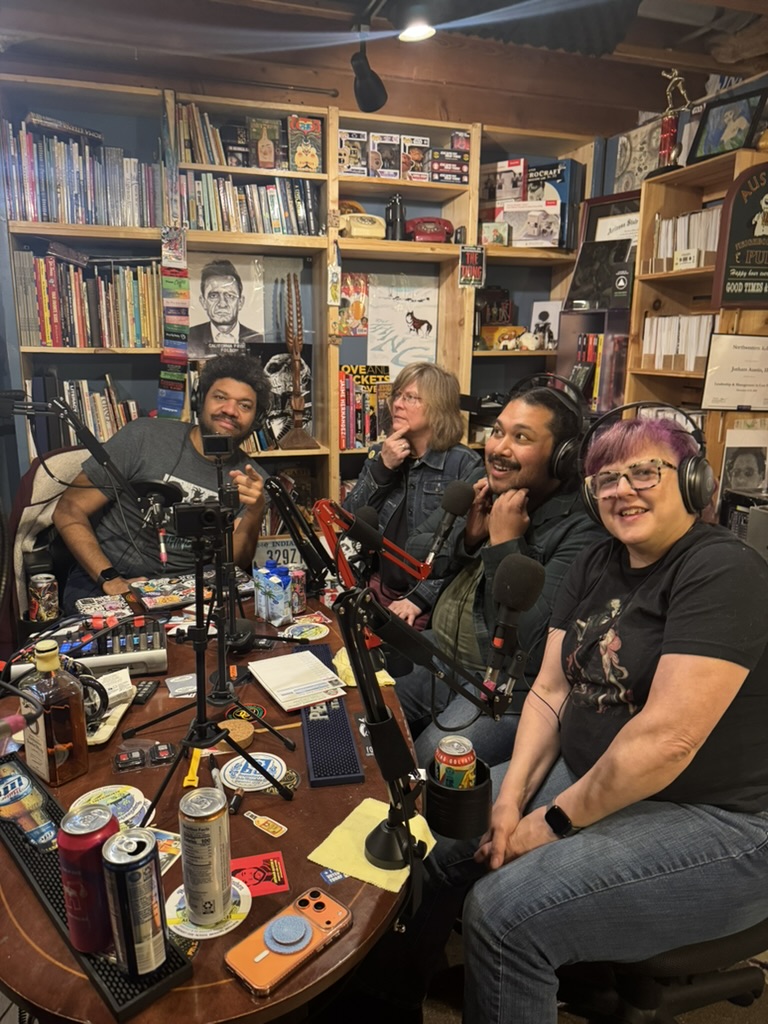
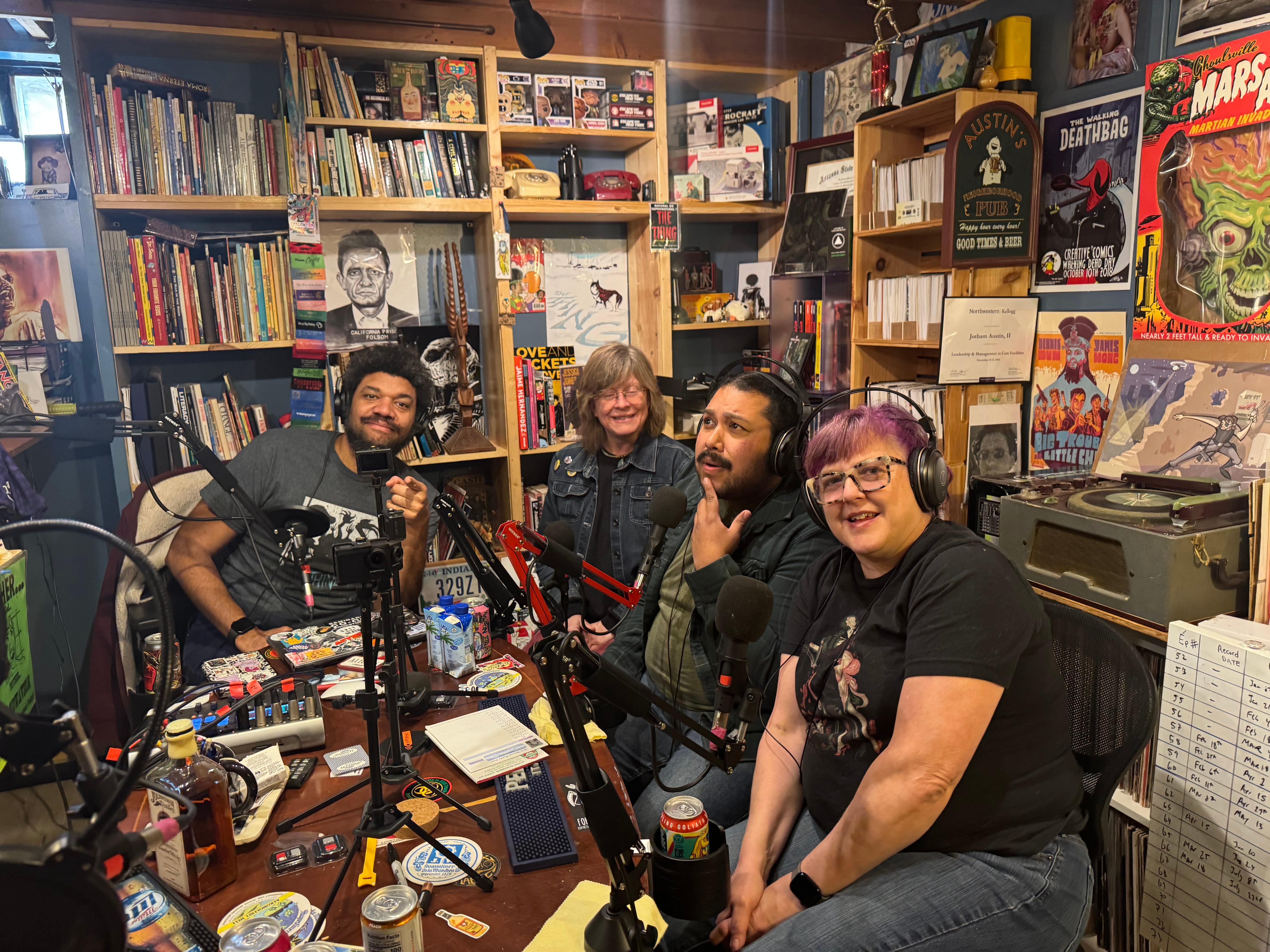
On the day Artemis II launched, the RHR crew with special guest Ernie Bell, PhD, headed down below the Basement Studio to ask the question fiction keeps digging up, can humans live long-term underground?
Substack, Apple, Spotify, YouTube, Amazon
[00:00:00]
joe: Hey Welcome back to the Rabbit Hole of Research down here in the Basement Studio. We are all crewed up. You have me, Joe?
nick: Yeah, I
joe: We’ve got Nick Georgia, we’ve got Georgia.
geo: You’ve
mary: got Mary.
joe: We’ve got Mary and we have a very special guest joining us. Ernie
mary: Hi
Ernie.
ernie: Yeah. I
don’t know what else you’d like me to say.
I guess, currently
Rocket scientist
engineer working on lunar landers
formerly plantar geophysicists, studied lava
tubes and volcanoes and a whole bunch of field work with that so a lot of time on the ground A lot of time on top.
of the ground too.
I guess.
nick: Yeah.
joe: I mean, you make it sounds like Oh yeah. You know, rocketing
nick: Yeah. That,
that, that was the most casual.
joe: That’s like
nick: Yeah.
joe: everyday thing, you
geo: ground
nick: and
rockets and stuff.
joe: Yeah. So, yeah and it’s, your [00:01:00] expertise will come in. This episode is about the challenges of humans exploring other worlds living in caves, underground, terrestrial, extraterrestrial, , we see that in fiction a lot where people are, escaping to the underground.
So thought that would be a fun one to dig into and you
geo: get at, dig into.
mary: yeah,
Oh boy.
joe: There you
geo: go.
mary: It’s so early.
joe: got it.
Yeah.
So usually I start with, not my little monologue to get into the episode but actually before I do that, I do wanna say, and I don’t know to if people know, but today we had went the day of recording our TIMI
mary: two
joe: launched successfully.
And so I just, I mean, for me, I, it was pretty exciting. , it was 72 was the last time we sent people to the moon, so that was a little before I was born. And yeah, I just want to, I’m sure you’re excited, , you still are in the business of sending people into space, and so, how’s that feel?
ernie: Yeah it’s an exciting day for
all of us. like that. I mean, everybody
should be excited about this in my opinion, [00:02:00] but
I personally I’m
incredibly excited. It’s
it’s
I’ve been most
forward to this since I
was a little kid, like,
like you.
Joe we, we
were all born just after
they did this in Apollo, grew up being told that, Hey, you know,
your
generation is
gonna carry on
to the moon and
Mars and all this.
And now
we’ve been waiting 50 years to actually get
the
chance to carry
on with this.
And we’re there, we’re on the, we’re on the doorstep. We got crew of four out there orbiting earth now. The Orion spacecraft. the Second
launch for what’s called the SLS.
NASA’s big, huge
moon rocket.
And,
They rode that off into orbit. They’re gonna stay in orbit around the earth for about,
a, I
think a little
less than a day.
They’re getting, get some rest
and then they’re gonna wake up in four or five hours, then fire
up their engines again. Start bumping their way off to the moon.
And,
but yeah,
I mean, my work
ties directly to this
all goes
right. You know,
we will be,
waiting
for them very soon
In one
of these future
missions.
and one of these Very
soon
next missions. Getting some
testing done on our vehicle on
the lander that we’re putting [00:03:00] together and
you know,
it’s Blue
Origin,
it’s SpaceX We’re both,
Working on lunar landers for the.
astronauts for.
at NASA. And
So,
yeah, it’s exciting. This is, we need this step they’re gonna go out
there gonna go fly out around the moon and
come back
10 days.
And like I say,
next one, hope, it’s
I dunno
if you heard the administrator basically said that
oh, and the next time
that
SLS
with Orion launches, the
idea is to Dock with the landers in Earth orbit.
joe: Right.
ernie: And then the next one after that
would
be the Idea with the land
on the moon and it’s either gonna be US Blue
Origin or
SpaceX, with the lander that’ll be,
waiting for
him at the moon.
joe: Wow, that’s really exciting.
Yeah.
nick: so
cool.
ernie: pretty cool.
geo: it’s,
joe: no, that’s nice. Get your ticket and
The moon base. Right. That’s the ultimate plan is to, is it
nick: is it
gonna be underground?
joe: It’s gonna be,
ernie: So it’s gonna start on ground above ground, on ground above ground. You as about
underground, and actually there’s papers going
back to seventies, sixties. And there are these caves underground,
so I dunno if we wanna
get into that right
[00:04:00] now or not, but yeah there’s advantages
to eventually putting ’em underground on the moon and Mars and other places, but
it’s, it also takes a lot of equipment and stuff there to be able to do that.
It’s a lot easier to set it on the surface and a little bit harder to get it underground. So Yeah. We can get into that whenever you want, but Yeah.
we can,
joe: Yeah. I mean, we can, I do
nick: have to say something before we move on. Is, I watched the takeoff with my daughter today
and she was so enthralled,
like
she was already asking
if she can watch another one and if she can fly one, and I was like, that’s awesome.
This is how you get that obsession.
Like,
mary: mm-hmm.
nick: like I can’t wait to see what, like, what triggers her
and
be like, oh yeah, this is something that’s gonna be one of those lifelong things where you’re just
so enthralled
by
Space.
joe: Yeah. That’s what I thought
we would start the episode there since it’s happening on this day, so, yep.
nick: Yeah. like,
mary: well, let’s continue with that [00:05:00] thread with underground caves on the moon.
geo: Right?
joe: That’s what we’re
geo: and I think Joe, we’re gonna set it up right.
joe: I was, I mean, we can, I mean,
If
people just gonna cut right to the bit, I know Mary’s always
just ready to go,
mary: just boom.
joe: just like, you
mary: get right to it.
geo: Come on, Joe. Enlighten us.
joe: Every instinct humans have was designed for open spaces to scan the
horizon for predators to navigate by the stars in the night sky, to race the wind. And yet every culture has a word for what’s below. The Greeks had Hades, the Maya had Xibalba. Both described the doorways to the underworld, and before any of that, our ancestors were crawling hundreds of meters into the Earth to paint on walls where no natural light ever reached.
We don’t fully know why. We just know they went. Maybe it was for shelter. The thrill of the unknown, connection to our ancestors, a place of punishment or where dark things hide fiction has been obsessed with it forever. From [00:06:00] Verne sending explorers through a volcano to a sea that shouldn’t exist, to Tolkien building entire civilizations and inside mountains to current sci-fi, imagining our first footholds on Mars and other outer worldly planets, and going underground isn’t just Handwavium device. It might be an important survival strategy because on earth and off world, they can provide ready-made shelter, radiation shields, and thermal regulation. But are humans or any other terrestrial life built for a life closed in and isolated from the open?
But what if underground is our last refuge or a new home? What would it actually take to make life find a way in the deepest caves on Earth or the lava tubes of a strange new world?
geo: Yes,
joe: that’s it. That’s where we’re at. So we’re headed that way
geo: We better Start digging. We
joe: better start digging.
nick: I heard Bigfoot likes to live in cave
joe: lives in cases.
ernie: That’s why we can’t.
joe: that’s right [00:07:00] there. , maybe the start and if you like, what is a cave? How’s a cave form? Maybe let’s start on
Earth.
Let’s start there for folks. I did, I looked this up and I really didn’t know
ernie: Yeah. There’s
It’s two
guess put em in
two primary types of caves, maybe say
on earth. One is.
a kind of a kar type cave
Like
a Limestone formation where you have water and precipitates and
it’s basically eroding the volume under
the ground,
That’s seemed like a more damp type of
environment, or you got also the ones that actually
I’ve did all of my research on, which are lava
tubes. They, they’re formed in volcanic wva
flows and there’s a couple different ways.
those are formed. So
they can either be kind of an inflation where the fluid of the, basically the lava comes
out and it basically inflates. and
the
outer skin of it,
because
it’s contacting the air cools faster. So it
actually starts
to
solidify. So you get this kind of a,
basically like a skin
over top the the outer
edge, the outer surface of [00:08:00] the
lava flow,
and
it actually then starts causing an
insulating effect.
So It keeps the fluid
lava
molten
and flowing through
it as
the outer skin thickens and as it thickens gains structural integrity, into the point that it gets thick enough that it’s able to support its own weight.
And then the way that the
tube
in this case
forms is
that
downstream, essentially
downflow of the lava,
There’s an outlet
where the source lava stops producing out of the earth. You know, the molten lava stops
coming out,
but it’s still flowing down the hill. It maintains high enough temperature, that stays molten.
And then this continues to flow all the way down and out the end of the
tube
where
you know, a hole is basically, essentially
formed and then
you just get this
big void of a inflated lava flow
that
you can walk across the surface
and you won’t know
it.
It’ll look Just like any of the other lava flows. And it, assuming
it’s thick enough, you don’t fall through. which is a good thing if you want,
But there
there are
[00:09:00] collapses that’ll
form in it, you know, holes you know, where it’s weak.
There’s even
parts
where when it’s forming, just
won’t solidify
and completely, and they’ll be
called skylights,
so
after a lava
goes out, it’s
there’s these holes
either through collapse, we’ll go
in the formation
that are still there.
And these
can be,
there’s
different sizes. you know,
There’s tiny
little
ones you couldn’t even crawl through.
There’s
big ones that are, you know,
10 plus meters in diameter.
More than that even,
There’s another
way
that
they can
actually form
is that,
Very
high flow
water
flow can form
a trench.
joe: Mm-hmm.
And
ernie: Essentially you get
filled up on either side,
so keeps it
kinda like a river of,
lava. and as it’s it gets the same effect where you get
A cooling across the top.
surface, kinda like a river in wintertime
and
you get that ice warm across the top and it will start building up and it can zipper
up actually from the
edges oh, to
the center line.
And
then
you get
that same effect where you get a
buildup of thickening.
an increase in thickness there
where it’s structurally sound. again, the
lava drains [00:10:00] out of it
downstream.
And those
are, those
can be quite large.
too. I’ve been in Some
that are 20
meters in diameter.
Or even slightly Better here on Earth.
nick: So
is lava, like, does it just constantly flow? Is it like, is
it
flows like water, right? Like,
ernie: well,
I mean
it
flows,
yeah.
Maybe not quite like
water, but Yeah. It
flows.
And
it’s just an eruption from a volcano or, you know,
a vent
basically.
nick: So
it dries out, right? Like
ernie: It, yeah. it stops
flowing eventually.
like volcanic eruption, It
only lasts so
long, And once it
Stops, then
you know, the,
nick: Oh,
ernie: doesn’t have a
way to
drain out. then it just solidifies.
in place eventually and Just the big
lava flow.
at that
point.
joe: So, after the primary tube is made. What’s the chances that another lava flow event will happen? So you put people in there. Are they always like, get out here, what’s the
ernie: Yeah,
No,
that’s
a
good question ’cause actually
They do get reused
basically
assuming that the Erupt Center [00:11:00] has, a source of lava
that can
come
up
and
flow out of it. Magma can come up and flow out lava
and you get an interesting features sometimes when that
happens. So you’ll
get like
benches if it doesn’t completely fill it,
you’ll get a,
A solidifying
effect along the edges.
where you get these things called benches that literally looks like a bench on the
along the edges.
You’ll
get look what looks
like
icicles falling
from the ceiling. It ceiling. It’s just kind of,
it’s
molded,
it’s
dripped down, but
it’s solidified just
like a icicle does.
in wintertime. And you’ll guess they’re called lava sickles.
We Call ’em. I don’t know if that’s really a technical term, but that’s what we like to call ’em. So, and then we get.
Other like, formations on
The surface and that frozen
lava flow It’s might only
be, you know,
a
few inches thick or something on the surface
On
the floor, but
yeah,
But eventually
if
the source of it is
no longer available. then there’s no longer a danger of getting three reviews.
Kinda like on the,
Basically
the volcanic,
so our Knowledge,
volcanic
eruption,
volcanic capability
on the
moon is
basically over at this point. It’s
cool
to the point that
[00:12:00] anything
that’s molten is so far
down
under the
crust.
We don’t
think there’s
a way for it to get
up,
we don’t
see evidence. Of the volcanism.
there’s
some debate on
that. But
in
general,
there’s
nothing
that
indicates recent.
volcanism. So we find these types
of things
and we’ve found,
you know,
skylights collapsed
pits and things like that on the moon.
And We know there’s void space
in either direction,
we just don’t know if it really goes
on
and on
it’s a tube or not, but.
joe: Right.
ernie: There’s evidence on, of Mars as well, eventually. So, yeah they can
most
likely be a
lot
larger
though too.
on these locations. But moon, The gravity
Is
so
much
less.
We actually expect them to
be,
I mean, one
of the re one researcher did
just a structural
calculation on
’em that they could be hundreds of meters
across.
We’re
talking where,
2, 3, 400 meters across
ones that we know, where we see these
collapsed pits. There’s one Mario Hills pole.
And we
suspect that there’s lava tubes there
and there’s these poles where
the [00:13:00] ceiling is essentially like 25 meters thick.
There’s 40
meters
of void space underneath,
and
we know
it will go off
in either direction. We just don’t know if it keeps, if it’s just a hole or if it actually
goes as a
tube. But it’s
compared to Earth, they’re enormous.
it can be enormous. You know, they’re small
ones too,
just like on Earth. it’s a whole range
of size.
nick: How
long have we known that there was like
lava on the moon?
Because
I
Didn’t know that.
mary: Yeah I didn’t know that either.
Yeah.
nick: I always thought it was cheese.
mary: Well,
maybe not that, but
nick: that.
you’re gonna go Harry Carey for that one.
joe: Yeah. Gotta have jokes.
nick: could be, what kind of cheese could it be?
that
joe: was
ernie: Oh, it’s kind. It depends. Was it Swiss pea?
joe: A trip. A trip to the moon, right. In the early 19 hundreds. Then they. They catapulted a cannon rocket there, so, no, no realistic , escape velocity. But they didn’t make it to the moon and they crack in, but I think they go into a cave with the little [00:14:00] creatures in there,
and I think that is, it was like a lava tube.
I mean, I think that’s what that
a cave or did they base
geo: it on that they knew that was on the moon or they just,
that was,
joe: I don’t know when they figured out lava two in there,
ernie: Yeah, that was probably more of a guess.
Just a equating at the Earth than a good,
geo: Yeah.
joe: yeah. It was a good guest though. I mean, that was
geo: think that was just,
the
joe: but I remember that ’cause it, it smacked with, you know, it was like hit the eye or whatever, but
Yeah. That was
nick: very
iconic image. of that.
Yeah.
joe: right. But yeah, it was, they went in they
ernie: that the, or something?
joe: yeah. When that, well, Jules Verne and that was the center, that was
Journey to the Center of the earth.
That was in the 18 hundreds. Right. 1850s or something like that.
geo: I
don’t know. I only know the Brandon Frazier one
joe: to brand
The
nineties. Nineties,
geo: or whatever it
joe: yeah. I don’t nineties. I think, you know, Brandon Frazier was more nineties.
nick: Yeah,
geo: you’re right.
But I’m sure there was quite a few renditions of that story.
joe: Yes. I think they went in through [00:15:00] a volcano. That was a Journey to Center of the Earth. They went in through a volcano, then they went
down and then they found there was like dinosaurs down there and then they had and then they found the river.
Yeah. They had then the sea, they found like a sea and then there was a sun. So it was like there was a sun down there and they had a hole.
nick: I feel like the new,
King Kong film did that too.
Didn’t they? Where
joe: that
and the Ice Age one or was it Ice Age where they had the crack and they went in and then that was like all of the dinosaurs and stuff were down.
There was like a whole nother world. I think it was Ice Age,
nick: I don’t know, I
joe: age three or four or seven. I don’t know where they’re at with that, but
geo: Well, so
nick: I went King Kong, you went Ice Age,
Yeah.
geo: these Lava
tubes
Does
anyone actually inhabit Lava tubes?
nick: Are
you trying to set yourself up for Extremophiles?
mary: Ah,
joe: No.
geo: No.
joe: That Well,
geo: You’re,
gonna take that.
joe: will say that’s one of the things that live in caves are extremophiles, [00:16:00] so especially microorganisms,
geo: would think,
joe: I think there’s more biocarbon mass from living microorganisms in caves than there is terrestrially on the Earth. I think it’s like
not even close.
Yeah. So there’s a lot of life, especially microorganism, like
mary: oh, okay. Organism
joe: life.
It’s
nick: Yeah.
Microorganism life.
Microscopic.
joe: microscopic.
There is, I don’t know
why I was
geo: Go ahead.
ernie: Oh
yeah, I just, I know some of
the
folks
I work with they actually are studying that. You know,
like some of
the,
lava tubes we’ve been in,
it’s there’s actually,
if you.
ever get a chance, Lava Beds National
Monument,
out in Northern California.
it’s this
Beautiful place in near Medicine Lake and
it’s got some of the
Tubes
there.
They’re called,
like one, one of
the names is Golden
Dome.
You go in this place
And the bio
Growth
in there, literally
it just looks like it’s covered
in a sheen of
gold
and
it’s just beautiful, amazing the way. it sparkles in the light and
things like that. So
yeah, there’s definitely,
and there’s,
some folks that work with
are studying
that and studying
other, like,
Like,
you say, microbes.
and,
[00:17:00] Microbial growth and such, And they’re using various techniques
Ultraviolet lighting.
And Things like
that
to
illuminate it and
Record
it,
and study it. So
a
lot of
interesting
things there.
And they’re,
Yeah.
And Actually
you know, you’ll find animals in your bats that’s one thing. You go to these places you gotta, There’s bats.
in gave, you gotta be protective of the bats and such. But
people you know, living
there,
there’s, Native
Americans from way
back
have
lived in
these caves. Lot of bats,
national mine for one. And Since,
you know,
criminals
from the
law
nick: Mm-hmm.
I
joe: Yeah.
I can see that
ernie: them as a good refuge
to hide out into the
lava tubes.
’cause they’re really
hard to get through. They’re really hard to
get into and
they’re really hard
to find, even if you
know
it’s there. Some,
of you know, folks like
that, that
didn’t wanna necessarily
have anything to do with
the rest of society
would,
Wander
off,
cases.
Yeah.
mary: Yeah.
nick: I mean, it’s a good shelter, right? Like,
joe: I, yeah, I mean there’s problems living
in
geo: I was
gonna say, well, if it would, You know, you would, we would think there’d be more people living in
joe: yeah, I you have, you need, [00:18:00] so there’s health concerns. What, so vitamin D so we need the sun
mary: need Yeah, that’s true. Well,
geo: but
that’s any underground.
joe: I mean, I guess, but I’m just pointing out CO2 buildup in cave systems and
ernie: moisture.
in ’em, you know, and such, some of ’em actually have ice all year round too, because you
get this weird. Thermal effects that go where Literally there’s one,
cave I
was
in,
there was literally
I think three to
four meters of
ice
They just, you go in,
you
Have to crawl through it because it’s so,
So narrow.
But reality the cave itself,
is four
meters.
deeper. It gets this completely device, it just, or melts. It’s some amazing.
ice,
formation to find on the ground in these
places.
joe: yeah.
So temperatures, I mean, so yeah.
So
nick: that sounds like fresh water to me,
joe: yeah. Well, I don’t know. There’s probably mineral stuff in that water. Yeah.
So you’re
geo: your bag you’re ready
joe: ready to
nick: to go.
joe: No, so you have radon, a radioactive order less gas that, that can affect you, that, that are found in caves.
So, yeah. So there are.
[00:19:00] Conditions,
You need food to eat. So if you are living in a cave, you have to then grow things to eat. So there are some challenges. It’s not just, go down in a cave and
nick: up I’m
joe: set up shop. But there
are
ernie: the other thing Is
You get your like,
The day, night circuit Yeah. Circadian rhythms.
joe: That’s right. Yep,
ernie: yeah.
European
Space
Agency, they actually have a
program where they’ll take astronauts down in their caves as part of,
like kind explor.
Exploration, kind of
a training
and such, and it’s called
CAVES
actually
It’s a real unique name, but it’s really cool program
to have. And
it’s over to lava tubes over
in the
Canary Islands. And
you go down
and you’ll spend days,
and days
of a week or more down
in the caves
and.
your sense of day night is just completely gone
Because you have no keying of
the
sun, you know, the sunrise, sunset, and all
those types of
things. So,
but
the, it’s really good analog
to just, you know, how to go
and do exploration in extreme environments.
joe: Yeah.
Yeah.
mary: have a question
about that,
if you don’t mind. I want so when, how long does it, I mean, [00:20:00] does it take for people to get off their circadian rhythm when they’re underground?
joe: Sir was, oh,
go ahead.
ernie: I, I wouldn’t be the right person to
ask
mary: Oh, okay.
I
geo: was
joe: say I,
ernie: But it’s it does happen. I know
nick: And,
ernie: one instance I can, I don’t know the researcher’s name, but he did a self study. He put himself down in cave for. You’ve heard of this year, but
a really super long time. I mean
like Weeks, months or something.
And
when
he came
back out,
he was
completely skewed. He didn’t take a clock or watch or anything.
with him, but when he came
back, out, when it was done, he
thought Only like a certain amount of time.
had passed, and it had been, I don’t know, twice that or something. It had been significantly longer time that he thought
It
actually passed,
joe: Michael, Siffre
in 1962. He actually went down with no timepiece, so this is a self sign. This, I think this is a study you’re thinking about. And his internal day extended to 24.5 hours, then drifted to about 48 hours.
mary: Oh,
joe: by the end of the, his two months, he only thought he had been [00:21:00] down there 34 days. Then in 1972, he repeated the experiment for about six months. But he completely psychologically unraveled around month four, he was crying without cause inability to concentrate. Very suicidal coming out this experience, so Yeah.
It doesn’t,
nick: oh, Well, how does he adapt back to
society
after
that?
joe: I mean that, yeah,
mary: his name again?
joe: Michael Siffre
nick: did they follow up on him? FRE,
joe: So
mary: Oh, okay. Wow.
nick: the
follow up? Did they do that?
geo: I
joe: know. It
geo: check in on him,
mary: was just,
joe: he was just, he was
geo: somebody check on him.
joe: it was like a self experiment. Like he just, he kind of,
mary: And we didn’t really tell anybody.
He just like, went in and just did it. Yeah. So it they might have set them back down there,
nick: if something, happened like that today,
geo: like
nick: they’d have their own YouTube channel and
joe: No, you’re right. Like sensory deprivation. So that’s a big thing. 24, 48 hours, you start having full psychosis symptoms. I mean, it is a,
We are [00:22:00] the sun sets and it’s day night cycle that sets a lot of our rhythm and our biology.
So take that away, then you will become skewed. Your biological internal clocks will just get off and then that throws everything in the whack.
So
geo: think about people like solitary confinement and things like that. Like how much that It’s a similar
mary: Underground experience. That’s right. Yep.
joe: Yeah. But
ernie: it’s more similar to the astronauts out space
too. On Space Station
They get 16,
sunrises and sunsets every day on
space. Station going around ‘
joe: cause they’re going around Wow.
ernie: So you have to really make.
Yeah.
You have to maintain that
day,
night
cycle
just by the watch.
And make sure you do
that
and shut down
at the right time. Otherwise Yeah. You’d end up in the same issue
You know, crew
going out to the moon.
They’re not
gonna
have
sunrises and sunsets.
Sun’s gonna be there
the whole
time. for 10 straight days, except
for when they go out around the moon maybe if they were,
I’m not sure
it’s a, or Dynamics completely blocks from the sun even there or not.
but
yeah.
so it’s but there’s plays around. You just, you have to be disciplined.
You have to, you know,
you just [00:23:00] Set
up something,
that there’s a day, night cycle that you follow.
It’s Same thing.
if We put,
this on, bases and,
such on the
moon
someday and put ’em on the ground. It’s a lot of
benefits to actually doing that,
like you said initially, Joe, but
It’s a hard thing
to get them there though.
joe: Yeah. Another
thing you can, full spectrum lighting. I look that up and like I said, that mimics our, the solar, benefits that you would get, the intensity and color temperature of the sun over the day cycle you would get, but only that will only partially compensate.
So, and then you also need significant power
geo: would that give you vitamin,
D?
joe: again, if it has a full spectrum, you would be
able to,
Get
some, but you probably would take
supplements vitamin D work.
geo: Is it something about the sun.
Like
interacts with something in your body and creates it, or I don’t understand how that
joe: Yes.
mary: That’s the next, that’s
the next podcast. Yeah. Yeah. Right. Yeah.
geo: And vitamin
D
deficiency is such a prevail, like a,
what’s the
word?
mary: Prevailing or prevalent. It’s very prevalent in our society.
Yeah. Yeah. And
geo: it causes so many [00:24:00] mental health issues and
nick: and mm-hmm.
geo: Other health issues. Yeah.
joe: Yeah. Yeah.
It’s
. It’s synthesizing the skin. We’re all ultraviolet B radiation breaks down TD hydro cholesterol into Previtt D three, which then is, I thermally into vitamin D three. So that’s the process of
geo: that the only kind of vitamin that
works like that, or is there.
other.
joe: I
think that’s the only vitamin that I know of that works out in humans. But I, once again,
a sorry.
geo: I’m just curious. I can,
So
I was gonna say like when, like in Fallout
nick: I was just about to bring that up,
Thanks.
geo: Right. Or in
like Silo. Is it Silo?
joe: Silo Yep.
Or Wool what’s the,
geo: They obviously create these, that’s all manmade. That’s not in caves, but then they manmade the sun to come up and it seemed like
joe: Right,
right.
geo: In Both of those shows, they have like this,
joe: they have some sort of cycle. They maintain that. Yep. Yeah, [00:25:00] but the other problem with those shows that, I mean, their generational volts or ca you go on the cave generationally your body will start to adapt.
So you will start to have these adaptations. But the funny thing with those shows and the fictional thing is that they just come back to the surface
and
they’re like totally
geo: like,
It’s no issue.
joe: the full sun is right hitting ’em. They’re running around. No muscle atrophy.
They’re, they’ve kind of totally,
they’ve never lost the adaptation, even though true cave adaptation with would take, you know, millennia. But you see no effects, no ill effects of living underground. That’s really not
geo: very plausible.
joe: very,
ernie: Yeah, there’s another
good show. I know you probably have heard
of The Expanse.
It’s that,
sci-fi Show
it set to the others. The solar systems colonized basically.
and set. But there’s
Mars
is colonized and a
lot of folks
live underground in Mars,
so
they’re all ENC closed base
of that to that
point.
of Seeing the sun and things that
show does a really good job of
like when
the Mars, the Martians,
human martians
come to earth
[00:26:00] and
they’re just out in the Open.
they don’t
like
it.
The
nick: right.
joe: Yeah.
ernie: in General. you know, it’s, there’s like this
Adjustment that they
have To
take
Some of ’em just can’t in the show,
They’ve actually
kind of hit on
that that it would be a unnerving
a concern.
You’ve
had generations
essentially living underground,
that now have these wide, expansive open places
and big
skies and It’s,
just, you Yeah.
joe: I was gonna say agoraphobia would probably be a big one, that you’ve been in this tight, confined space and now just, it’s just open. You know everything there. But there are something that’s tr glo bites. They’re,
geo: you say that again?
For blow bites,
joe: They’re
obligate.
I like that. They’re obligate cave dwellers. So they can only live, these are animals that have truly adapted to living in a cave environment.
nick: Moles. They
joe: live
mary: nowhere else. right?
joe: nowhere else. So you have the blind cave fish.
And so
there actually is a fish there has, there is a terrestrial species that’s related, but this the blind cave fish, they’ve lost their eyes and pigmentation.
So they actually don’t have an [00:27:00] optical structure. And they live in their environment. No pigmentation. You have the
om salamanders.
nick: Is
the angular fish on there too.
joe: What’s that?
nick: The angular fish. Isn’t that the one with the little dangly bit on its
joe: lives in the bottom of the ocean? Yes. Yes.
nick: Little
joe: it’s not, it doesn’t live in a cave,
so it wouldn’t be on the list?
No, it lives at the bottom of the ocean.
geo: that’s a similar thing.
joe: I mean, yes, it’s a, it’s nothing like the bottom of the ocean.
Yes. I similar in the fact
geo: it’s dark.
always
joe: Yes. Okay. No, no light. That’s about it. But I mean,
one is Part?
I mean, I think so. I don’t know. There aren’t angler fish Islas. I thought they had eyes.
nick: know. Yeah, I I think they have
All I
geo: I know about ’em is,
the,
joe: some, it’s very, yeah,
Then there’s om salamanders.
They’re really interesting ’cause they can live. It speculated to live like a hundred years and they can go about 10 years without food. So you just can
geo: they’re kind of like extremophiles
joe: they are the, all these animals are like extremophiles. And then Pale Cave Spiders was another [00:28:00] one I saw, which once again, don’t have eyes.
So, you know, there’s species of spiders. We all know terrestrially, but these don’t have eyes. And so yeah, they’re really interesting. But they live , in ca they’ve made a, they made a go at it. So life can find a way as I, you know, as I said. So
nick: do Moles Fund fall under this or no?
geo: Moles?
joe: Oh, I mean, I guess, yeah.
geo: But they kind of come out.
joe: They can come out, right? I mean, they can,
nick: they’re,
joe: live mostly below ground.
nick: They make their own caves.
joe: they make their own caves.
They’re cave diggers.
nick: Yep.
joe: Yeah. But that’s,
geo: you go
joe: through. People have tried to simulate this too, like the biospheres, are you familiar with those tries that
ernie: Out in Arizona.
joe: Yep yep.
geo: Is that
still there?
mary: Yeah.
ernie: Yeah.
joe: A
destruct.
ernie: It actually is still
geo: Oh, wow.
ernie: Yeah.
you can,
You,
you can, It’s maintained.
You can go and use
it for various
types of experiments and such,
but
that initial one where
they tried
that
was pretty crazy
[00:29:00] ’cause they
tried to have
all these
different,
I think it’s biomes if I
got the right.
term there and just one huge
en environment
and it
just
it
didn’t
work.
you know, it was too close
It ran together.
They had I think they had problems with
Insects.
and then They also
had social
Yeah.
was
It
was just, Yeah.
it Was
there
was a lot
of interesting
results that came out of
It and, but it’s still there. It it’s definitely used. You can go out
and see it, even
geo: is
joe: There was one and two. Yeah. They had like, it was like a bad reality show. ’cause I think fractions formed
nick: Oh,
joe: hated each other. Oh. And then oxygen problems, like, so oxygen levels dropped, pretty severely.
Like they totally
underestimated that, So
geo: not underground though,
joe: it was above ground. But I think the idea is that if you are, I guess if you’re in a domed enclosure,
geo: to being underground.
joe: underground. Right.
Because, you know,
geo: they saw the sun
and everything because
it was like, Yeah.
joe: They didn’t,
have to worry about that problem.
I mean, they had a,
Ernie was saying they had a number of other
nick: problems.
Well,
Amazon
is
ernie: of other
nick: that, Show, that’s gonna be [00:30:00] like a Fallout
shelter where
it’s like a reality show where they put contestants in a biome, essentially. Yeah. So it’s like, oh are they trying to.
emulate this? recreate that.
geo: that yeah,
joe: yeah.
ernie: I didn’t hear about that.
joe: Yeah.
nick: Yeah.
Yeah.
geo: It’s,
nick: and it’s like, oh, like, yeah. Fallout in general. Their whole thing
is and
geo: it gonna look like the Fallout?
nick: Oh I hope
joe: they’re gonna have like
geo: no. But
like
nick: the Vault Tech Company in the show is.
Doing different
experiments in each of these vaults? No, I
geo: I
think
joe: the
geo: Yeah.
It’s kind of
nick: in the show. Vault Tech, the company,
mary: right?
geo: No, No. I mean, we went from Amazon reality show,
nick: is gonna be a Fallout
geo: they experimenting. on be inspired,
joe: Are they experimenting on ’em?
geo: No, but like
in Squid, you know, like squid I know I’m saying, but he s Yeah, I’m asking.
joe: So, so they, show. So they,
I’m
asking, are we [00:31:00] still talking the reality, real reality or the fictional Vault Tech? That was my question. Like, have you moved to
nick: Oh, I moved on. Okay. Right. I
joe: I
was clarifying.
Not I got, I
I got everything else. It was just, I thought he had moved on and I was like, is this part of the show still?
Like the reality show
geo: I didn’t move
joe: didn’t move. And then he was joking and then you just kind of went with it and I’m like, let’s take a
geo: us when you Move on.
I
nick: I
can’t,
joe: I can’t, yeah, a little segue would be nice,
nick: but,
joe: but
ernie: train has already left
the
nick: Exactly.
joe: I
was gonna say, but you have the luxury, like the speaking of Vaults I mean the, there people are buying bunkers and having those installed, but then historically we’ve had bunkers.
I was doing this in the Green Breer in West Virginia. It was like the it was this congressional
bunker.
ernie: too far
joe: Yeah. Yeah. So that was really interesting that it was a luxury resort hotel kind of thing, that they kept it operational secret for like 30 years and then it was only decommissioned in the nineties after journalists exposed it.
geo: And [00:32:00] that was
the government?
joe: the government
that was a government funded Oh,
geo: Oh, wow.
But don’t, does it
mary: it
nick: it
ernie: Is that the one though that
after nine 11
actually
got put back into use or was that another, there’s Another,
one Maryland maybe I’m
thinking of, but
there’s a couple.
of them around. yeah
geo: yeah, Because
I was gonna say, don’t they have something like that or they,
and
joe: Cheyenne Mountain is that NORAD has a facility underground.
Yep, yep,
nick: Yep.
ernie: But there is the one that you’re talking
about, Joe and I,
maybe it’s Greenbrier or Maybe
it’s the one
in West in,
in Maryland
here. But they, as far as I know, I
was watching something
They actually
have it still
in
use, I believe, ’cause after nine 11 they realized they, they
need to
have,
you know, continue they call
continuation of government or something.
joe: Yeah.
Yeah.
But this one became like a luxury resort. Like they was more than a last survival bunker. It was,
uh,
geo: I’m sure
there’s some of those around,
that We don’t know about,
joe: no, it’s,
ernie: Out.
west.
some old missile silos
are, if you look, if you look up on YouTube or something, there’s a I don’t
know The guy’s name. But he’s,
he’s
Buying
these
missile silos and [00:33:00] converting them into luxury
bunkers for
the end of the world kind of thing.
And there’s, I don’t know, like 10 or 15 families, whatever.
it
each
one
gets a level
that’s essentially an
apartment. They have
water storage, they have
swimming
pool, they have all the toilet paper
you could possibly
need.
It’s just
They have, it’s just fully
supplied with everything.
and It’s,
just
like I said, I wouldn’t even wanna
guess how much they are, but yeah, this guy
he’s selling ’em out there? People are buying,
them.
geo: I wonder if there’s an Airbnb.
joe: Oh, probably. I mean, that would be,
mary: in a bunker.
ernie: There is, there
joe: aren’t there?
Aren’t
Airbnbs
mary: of
course,
geo: course,
ernie: Yeah. Apparently I spend too much time watching YouTube, but one of the channels there is
joe: not a sponsor,
ernie: couple that go around traveling all
over the place,
And one of their episodes is
Airbnb and
A Bunker. kind of
geo: Oh
Wow.
nick: That’s
pretty cool. kind of
geo: cool. Yeah.
joe: But
yeah, they, I mean it, luxury bunkers is a thing. You can, there’s companies that sell ’em, you can get ’em and Yeah, they hold
geo: well. There’s also
joe: whatever, and,
you know,
geo: well there’s also like preppers,
joe: right? I mean, that’s what, right, right. That’s kind of Yep, yep. [00:34:00] Exactly.
nick: see that they had a missile silo, for
sale recently. I was like, Ooh, that’d
be really
joe: You’re in, I mean, you’re in the lava tube
cave,
so missile silo, it’s
a, that’s
a step up. I mean,
uh,
ernie: but
it’s where, it’s what your means are. You know,
either get the high
nick: exactly.
Like,
joe: Yeah,
nick: yeah.
geo: I mean, it, I mean, been that, like the Paris Catacombs, I mean, so that was one of these natural caves, and it was 1774. They. More than, was it 6 million people are buried there? It was to solve the cemetery, graveyard overflow situation in Paris. And so they have these catacombs that are down
joe: and, um, I mean,
I guess it’s cool,
nick: Sure.
geo: wow. yeah, it’s
nick: Super creepy. But down.
I
geo: I think it’s kind of cool.
Yeah,
mary: I do too.
joe: And then
People get lost. I mean, down, that’s like regular caves. Like they get lost in these catacombs and, cave diving fatalities, like all these
kind
of things where,
mary: Well,
ernie: That’s a thing. Like I say,
going into Cave, that’s one thing.
I Actually,
it’s
[00:35:00] funny,
my mom
is, was surprised
I didn’t up doing so much
research
in lava tubes because
the
only,
there was this
one,
She was a high school
teacher
and
she helped take the science,
Club
to a cave,
one time. She was one of the chaperones as a local
cave. And I went
along with them.
It was just one
of these limestone caves And we had a map,
we
had flashlights, you know, there
was people,
but.
you were directed to, okay, if you
Don’t come out by a certain time.
we come
in, we get you. And we Went
in, we knew where we’re, we got back to where we thought the beginning
was supposed to be, and we
couldn’t find a way out. I was just like, oh my goodness.
It was just bugging me. I’ve got
all this, you know,
we’re perfectly fine. But it,
joe: Wow.
geo: Wow.
joe: Yeah.
ernie: thrilled. I wanted
to Get,
outta the cave and we couldn’t figure out. She was Really amazed. But the,
difference to me, like lava tubes,
you
can get lost in ’em, but
it’s not the same kind of
loss as in, a, in one of these limestone
case where it just
kind of
just, you know, fall down a hole or something.
Somewhere. It’s, you can fall down
a hole in lava tube too, I guess But it’s just the ones I’ve been very just,[00:36:00]
it’s very known which direction you go in, what weighs it out? It’s
very easy to
maintain,
you know, you can get lost and some get very
intertwined, but in
general,
they’re a lot more
linear,
I
geo: Maybe that kind of inspired you,
ernie: What’s That
joe: That
geo: maybe that kind of inspired you.
ernie: Maybe it did, maybe that’s, I had to defeat that fear.
joe: Yeah,
I think it would be an unnerving something. I was I was reading about caves, but this infrasound at 1819 Hertz it was like research in the nineties that it’s a standing waves at this frequency. So this is a sound wind resonating in caves. This in cave. You have this sound this infra sound and it causes anxiety, un ease, peripheral vision, disturbances, sensation of presence.
Like it’s this really.
nick: if I already have that? is it just amplified? then
joe: but I mean, in, in cave especially when it, the lighting is low [00:37:00] you’re below twilight , you’re having this, , is that something you, I’ve never been in a, I’ve not, I mean, I’ve not been in a cave,
nick: Do we have to do a rabbit hole
joe: I know, yeah, we Have
to go field
trip
ernie: you get very far down. I mean, even the
big. ones, It doesn’t take long, until it’s just dark. I mean, it’s just,
You don’t have lights with you. You don’t know what
you’re
gonna smack your head
into something, or gonna trip over something.
It’s just dark.
So Yeah.
You have to, you go with lighting and
it’s,
just, you’re in a
bubble of light basically.
So
depending on how
bright
your light is, it’s,
And lava tubes
say, well, you know, they, some of them go on for a long distance.
It’s,
I really like
the big ones just ’cause they’re so impressive
to me. You know, just physically, I think
that this, there’s this
huge
just empty
space
under the ground.
And
but you can get into some
small ones
too, and
but yeah
you it’s
dark.
There’s no,
natural light down there. There.
joe: yeah. Yeah. That sounds
nick: great.
joe: Yeah. We touched on the caves and why, you wanna do it.
’cause we’re gonna build on surface basis first, I guess. [00:38:00] But, Mars, there’s no, the atmosphere, so radiation,
geo: it’d be easier, it would be easier to control the atmosphere if it’s
joe: it’d be easier to you, you would get radiation protection going underground is one. Thermal regulation, you know, the caves, even though they’re colder.
They are the temperatures
geo: And Are we talking
about caves that exist there because they are already are there?
Or
are we talking about more like the Fallout, Silo kind of thing where you build the case?
Well, I but it’d be really the same thing.
ernie: actually, because Yeah.
Once
you get on the ground
it’s
it provides on the moon, like you’re saying Joe. It’s
joe: a
ernie: thermal regulation, it’s protection from Radiation, and it’s also protection from micro meteoroid. So any kind little, there’s no atmosphere. So anything that’s outer space is just gonna Yeah. So it protects you from all three of those, Which is really key.
On the moon and Mars
eventually too. ’cause there’s
no radiation protection like there is on,
Earth with the
Magnetic.
Magnetic sphere and stuff. so, You Gotta,
have that, but
you gotta
get down
to it.
And
it’s,
it
[00:39:00] would provide a lot
and you can actually get some of that on Earth
if you cover or on earth, On
The
surface of the moon.
If You
take
the lunar regular lift, so the dirt
and
you cover
up your shelter with that.
you’ll
get some
thermal regulation,
you’ll get some
of the protection. like meter, you’ll get Some radiation protection. And it’s the same idea. You’ve got
this,
you know, natural,
Surface on top of you that
just
protects you from that
So
One of some
of the ideas for
underground though, is that
people have
is, you know, one is you put.
in
premium. Paid
habitats. Another Is
that
you
somehow
seal
the,
cave off
so that you can
you know. to maybe Georgia’s
point there, you can actually,
then fill it with an atmosphere.
but then you gotta Fill every little
crack and make
sure you don’t have any leaks or not too many leaks or something like that.
geo: Yeah.
ernie: and
then There’s
concern,
with
On earth you
have earthquakes.
So if
you know, like you have moon, you have Moonquakes Mars you have,
Mars Quakes and
if it,
shakes
and you’re underground, you know? What does that.
mean?
It’s
structurally sound,
Is it not structurally sound? You have stuff falling on you that [00:40:00] you start getting leaks. If you seal it,
It’s all engineering concerns. So it’s geotechnical concerns. It’s
things that you can figure out a way to,
probably
address.
joe: no, I mean, is this a situation where you would combine where you would build a habitat in the cave, , you don’t have to use the natural walls of the cave. Can you build, just have a structure within the cave that would have some. Movement and things like that, or is that
ernie: Yeah,
so you can
Exactly.
You could take a
shelter down there, maybe
like an inflatable
shelter or just say
run through a structural shelter
to maintain your atmosphere
and
then you get the other protection from. the cave, like
you said. So even if it does shake a
little bit
assuming it doesn’t just, well
pull out, collapse on you.
it’s, you’re not
having to worry about the loss of atmosphere. that part of it.
So
nick: do we deal with
the
ernie: do a survey?
geo: and
nick: stuff
on earth with, you know,
underground
bunkers and stuff like that? Like it, do
joe: you put on where it is? Not earthquakes. No
nick: Well, can’t earthquakes happen
anywhere? Like
isn’t that. Like
mary: there’s a
joe: thing.
geo: [00:41:00] some
joe: Some places are a little more Right, yeah.
ernie: yeah, They’re more
likely to happen certain
places than others,
though. Like,
joe: you know,
ernie: around
The where the plates
all can
meet up. So boundaries between plates, tectonic plates
on the earth, Those are,
you know, primary
locations for
For earthquakes,
you know.
where you,
see major faulting and
things
like that. So if you’re in the center of a plate, you’re less likely.
Still there’s other
things that
can cause earthquakes. like
on
the East coast
you can actually get,
nick: there
ernie: there
was some
really severe
earthquake. It was a
very severe earthquake, I don’t know, probably 20 years ago now. or Something
and it
had to do with
The
soil.
And so that’s
really
basically
because of
the structure.
So it was, The earthquake itself was relatively small,
but
the, it was
augmented, as I said by the structure of
the earth itself.
So,
but you could, you would know that you
can study the Earth.
you can say
the moon, you could find those
locations.
There’s not
plate
boundaries on the Moon like
there is,
on earth, but you know, if You need enough studying, you might be able to start figuring
out where
they occur versus where they
don’t. Or just how
it
would be billed to them
Just like
in [00:42:00] California.
nick: Interesting.
joe: I think the other thing in a lot of these is food
nick: I was Gonna ask that. next. really
joe: like, and it was,
geo: you can grow
potatoes
on Mars, you
grow
joe: you can grow potatoes on Mars. I, but I, something was this from nasa, late seventies researched the cells, the controlled ecological life support system project where they were , trying to determine what you would need.
But it was like a crew of four needs, approximately 50 meter squared of agricultural growing space per person to be nutritionally self-sufficient. And so that’s, that’s quite a bit of area , to grow food and crops and a lot of show, , especially fictional, usually they got one little room with some plants in it and they’re like, , they got a hundred, 200 people in this compound.
You’re like, hold on this little,
geo: or like the
train in
joe: Yeah. Or, yeah.
Right, snow. piercer. Right, right.
geo: They had the one car.
joe: have the,
like, you know,
mary: that’s gonna
satisfy everybody.
yeah.
joe: I think they’re, they had like the [00:43:00] little jelly cubes, which is probably like soy green. So for people that haven’t seen that I’m not.
I’m not gonna spoil it.
geo: gonna spoil it.
joe: Not gonna spoil it, but it was grandpa.
geo: I think You just
mary: said
geo: right?
nick: Yeah.
geo: Yep.
joe: Yeah, I know. But food is one and water recycling. Right? ’cause you have these closed environments, waste , and
waste. , hopefully you recycle some of it.
nick: to fertilize your land and
joe: land and like when, I mean, Nick was joking, like on earth with ice, , whatever you have a water source and you can probably purify it and make it potable.
I
geo: I
don’t think, he was joking on,
nick: I was serious
joe: on Mars, on the moon water is a hard commodity to come by. , I think they think there’s ice, frozen ice at the poles.
ernie: So there is,
but Yeah.
And like
as far as recycling, the space station
actually
does that. It Recycles, I just saw it recently
too. It’s some very high percentage of the water.
It’s High.
nineties, I
joe: Yep.
Yep.
mary: Yeah.
ernie: they are able to recycle It’s been recycled multiple times
[00:44:00] now over the years. So it has saved
hundreds, if
not thousands of
kilos of you know, transporting
water to the space station.
joe: right.
mary: right.
ernie: And so
there’s
some of that technology is
actually
getting
developed
you know, carbon,
dioxide side you know, removal,
things like that.
so
a lot
of
regenerative
type of work on station.
is being done.
But, you know, to the point of doing it on the moon’s got,
a, we believe
it has water
or frozen ice, we’ll say it has volatiles. So
anything
that
will freeze
as a, you know
was
there,
but it’s not gonna be most,
if we don’t expect it to be chunks of ice, like
Hey, we,
found a big glacier. It’s
likely it’s just,
imagine a bunch of sand that had some water in it,
Just a little bit of water.
in it. I’m not even talking much.
And it’s just kind of
all
in there. And We have to figure
our way to
process.
it to get it outta there. And It’s gonna take,
it’s
gonna be something that’s on large scale
as far as like most likely
needed
to
get enough to.
provide for any sizeable, type of community on
that.
So it’s gonna have to [00:45:00] be a
real,
it’s gonna
be a problem. that needs to be figured out
is how do you do it efficiently to actually provide,
but
we think there’s plenty there.
It’s just
joe: Yeah.
getting it out, right. Extracting it. Mm-hmm.
Yeah, it’s always interesting when you have stories, what Isaac Asimov’s caves of steel and there was like, hundreds of thousands of people in the cave living doing their best lives.
That structural, how you handle these systems is not trivial. To do it like just the space station. There’s, you know what, at one time, six, seven crew members, or
seven, yeah. Six,
ernie: seven, seven
compliments, seven crew
members now. But they
nick: I gotta throw something at Mary. Hold on.
joe: See I said six in another number and that, that
ernie: Oh no,
this,
nick: Hold on,
in the studio.
Joe, how much do you like that guitar?
ernie: nice, nice. Well played.
geo: Thank you.
mary: you.
joe: Sorry,
I didn’t mean to cut you
off
there.
ernie: It’s okay. But
No
you hit on
a [00:46:00] bunch,
of things.
Joe.
It’s like, you know, even we, the cave is just,
a shoulder. It’s, but it’s
getting, and it
might be large enough.
but then It’s getting the volume
that, that you’ve
enclosed now. You can make it
or to provide, you know,
what you need there. You have food, you have to be able to get enough
WA source water,
or oxygen,
Carbon
dioxide removal.
And
It’s
getting
the area
like you say to support,
you know,
’cause we just, on Earth it’s just, you know, we got
half
us that can grow stuff. Basically
for the population
or probably more, you know, and it’s
having enough on
the moon or Mars or something. It’s
It’s kinda one of those things
like a
science
fiction,
You got
I’ll go back to a movie
or a show that Expanse
It’s, they do Some
of this stuff
really Well, they really thought about it.
in there where they Have
like the
moons of
I think it’s the moons of
Saturn or Jupiter, I forget which that
Is
that they
Essentially
have
as the agricultural bread basket.
of the
solar system and it’s feeding All these
asteroid
communities and all
these
Space stations where if
they go
under,
that’s it.
[00:47:00] Because there’s, That’s
where it
actually comes from
because it, this
is needs to be done on massive industrial scale. So it,
Yeah.
joe: yeah.
I mean that was that was
Time machine with the Morlocks. Remember the Morlocks lived underground, then you had the, what, the Eloy
Lived
above ground.
mary: It’s been a long time.
joe: I mean it, once again, it was a cannibal situation, but nonetheless the people on the surface was feeding the people
mary: the
geo: people
joe: below. That was the idea there. So there, there was you know, some thought to that back in what was that was also late 18 hundreds.
nick: Joe, I think I have a question.
I think it might be for you. Oh,
joe: oh.
nick: Is
there plant life in caves and stuff like,
joe: so
there’s no, because of the light situation, there’s no light. So you’re not you’re not gonna have photosynthesis because you need light to have photosynthesis, but I bet you would have other bacterium that are close to that. But you, you might not have plant, you won’t have frozen synthetic organisms.
So [00:48:00]
nick: if you
grow, like
grow, lights, can you grow stuff underground then? Sure.
Like,
Is the soil gonna be okay enough for it or is
it,
geo: if
joe: you’re bringing the lights, you can bring the soil.
nick: What if you didn’t pack the soil?
geo: Well,
but
joe: I’m sure you can, uh, Yeah,
right. I mean, you’re kind of
in, listen,
nick: I come with lights, no soil.
joe: Well, I guess if you have water, you could do it where you grow with hydroponics you. I mean, other thing we haven’t talked about maybe is doing genetic editing and using some genetic tools to modify organisms to fit our requirements. , be it living out in space and or living underground.
And so the foods we eat, you can modify. So maybe you do things that are more aquatic. So you would then use algae or cyanobacteria and then they would actually produce products. So you get a twofer or a three fer. They would actually make different things for you that
nick: would that also then also
joe: also then can
nick: your CO2 problem.
Your carbon problem. Right. [00:49:00]
joe: It could be a way to scrub the app. I mean, you know the balance is right. Yeah. I mean you would need the balance probably isn’t there? I don’t know if they would use as much CO2 to
geo: You
joe: or get rid of
it or vent
geo: in a lot of stuff.
joe: Yeah.
Yeah. But
nick: I am
just trying to plan my own.
I, Yeah. So
joe: no caves
as is a dark cave will have No, you’re not growing any plants. So be it cyanobacteria, be it algae, be it plants. None. No. Jules Verne Sun
geo: you have your lights or you
joe: or you have like skylights. I guess you could have these pockets where you would have
ernie: but some
of these yeah, some of these latitudes, like
I say, has some sort of, and I’m not the expert on
what type of planet, but it is a, It’s
A
growth of
some sort. Like I say, there’s bold silverish
colored growth, and it’s. But
yeah, you have
to have the right
condition. It’s not, certainly not in
everyone, it just happens like the
moisture’s just right?
The gross, is right.
and it’s just that they’ve adapted
to Growing, and living
and gaining their energy. without the
joe: They would, they live on methane, so like a stream of files. They live on [00:50:00] some other carbon source methane, which is in a lot of caves. So they can actually start growing on other, , materials like, heat vents, and thermo vents in the ocean, right?
So we’re talking about the ocean. We have stream of files there that can actually use those resources and use alternate kind of pathways to sustain their life. But yeah, it’s probably not photosynthetic.
geo: And you probably don’t have enough extre of files to eat. I
joe: know if you should be eating
nick: I don’t. Yeah. What
joe: So yeah,
nick: you just wanted to say
joe: let’s leave those extreme of fouls may maybe the spiders. I mean maybe the, you know,
nick: catch
some spiders and eat
joe: and the you know,
nick: eat a hundred year old salamander.
joe: Yeah.
Little
geo: oh,
joe: hunter year. Other,
Underground refuges the matrix they were down in Zion. That was an underground , they had to go to the core to get to geo the geothermal heat because they were gonna be cold because they blacked out the sun, the, to stop the machines.
And that’s why the machines [00:51:00] used them as batteries, which was it’s kind of dumb. But they did that. And you know, and
they were
down in Zion.
ernie: I hadn’t thought about that movie in a long time. Yeah, that’s right. Underground.
joe: yeah. Yeah. Yeah. once again, they didn’t really touch on the food. They had the, some slop or something they were eating, some sort of mush.
nick: I’m Pretty sure it was just decomposed humans.
geo: Pretty,
nick: They’re just like, these
humans eat human food. And that’s humans.
joe: well, I mean, the people, , they had, I mean, they’re living underground.
Once again, you need like, you know, how would you how would you have this.
nick: humans
joe: are they eating? Yeah. Oh, okay. But yeah, that would be the,
mary: I’m not going to Nick’s world.
joe: Yeah, Probably grow yeast.
mary: I’m all stringy and tough.
joe: Talk about, you know, fungi, but yeast, you could grow yeast, vats of yeast, and
I think that’s what they did in caves of steel, Asimov’s caves of steel.
They had, they made yeast like stuff. Yeah.
Yeah.
nick: then how are you making flour for the
joe: don’t, no, you just eat the
geo: Yeah. You don’t, yeast is right. You’re not making
joe: [00:52:00] products
out of it. It’s
nick: You’re eating yeast. just
joe: you just eat yeast. The yeast. Yeast cakes. Yeast patties.
mary: then
how long are you doing that
joe: for your whole
mary: Years.
joe: Years.
Years
mary: Years and How long do you plan on,
nick: living?
joe: what are we having for dinner today?
mary: Oh,
geo: Yeasty?
mary: Yeast,
nick: yeast.
same
thing. we have every night.
joe: Yeas. This is, this meal is yeasty.
ernie: Makes that decision real easy.
joe: Is that what the, is that what the astronauts are eating yeast
what’s going
ernie: Yeah.
That’s all they eat. That’s all we
send them with actually. Yeah.
geo: No, they have that
ernie: Youas patties we even put it in their water for yeast drinks, but.
joe: You
geo: They have the fun little freeze
dried things.
They
joe: I know. Don’t you get a Smithsonian? A little pack
ernie: They actually got, they have some pretty good food. Yeah. They,
joe: Oh they, yeah.
nick: Is that something that they actually eat though?
Those like,
I feel like those are too
crumbly and.
they’re getting in everything that’s
ernie: all of the ice cream
nick: Yeah.
geo: What?
joe: What?
ernie: That’s just for the,
tourist
mary: is
joe: Is that,
nick: I’m like,
I ate one of those.
joe: you get the freeze dried strawberries. Like that’s,
nick: they get [00:53:00] everywhere.
joe: we
ernie: It’s like the worst combination of a rice cake and whatever else.
joe: it’s
very like artificially tart. I don’t know. I don’t think they’re real strawberries.
ernie: No they’ve got some they,
they
take with,
joe: Yeah,
ernie: Yeah.
They’ve got &. m and mss they’ve got, although they’re, I think They’re
called sugarcoated
candies, you know, I can’t
call ’em m and ms. But then they’ve got other, you know, they’ve,
They have a whole,
you
Just add a little of water
rehydrate it.
and off you go.
You know,
it just like food we have here
On earth.
for the most part.
mary: part.
joe: Yeah. Now, you were involved with astronaut training, so how do they get prepared to go into these kind of extreme conditions.
ernie: yeah. So, yeah,
I was a number
of years trained them for space walks
and just
general,
you know, crew
training
and
then I was
flight
draw console for,
’em. so
but yeah, we
you know, we pretty much
just,
we
don’t train ’em at all.
We just put’em on
a rocket.
and launch em and say Good luck.
nick: I’m so in, let’s
go.
Screw the underground. I’m going to space,
joe: everything’s gonna be fine. Just get some
sun.
ernie: all kinds of [00:54:00] good luck. We’ll see you in a
week.
joe: yeah, yeah. don’t don’t go crazy. We don’t want horror movie here in space. So,
ernie: no, we run ’em through all kind of simulations. Basically
they’ll, we’ll
put
in mockups that look
just
like
the vehicles they’re gonna
be in.
We’ll run through the timelines, the activities, just like they’re gonna do in space, If it comes
to food or something like that.
sometimes
yeah, they’ll have
the actual food there. I didn’t do that
kind, of training, but yeah, they go and
They
actually test out, figure out, I
like this.
and I don’t like that.
And they’ll make up their own
joe: I thought you meant, you taught ’em how to eat. Like you use a fork, you lift it to your mouth now.
geo: Well, it probably is
ernie: That’s right.
joe: a little sippy cup. Like,
geo: well, that
is a challenge because Right.
You See all those
things with like astronaut and then like the water’s like floating in there.
And then
nick: I think they do that as a they do that ‘
joe: on purpose. They’re not, yeah. Yeah,
they’re not, that’s not how they eat their
dinner. It’s like the ice cream
geo: does.
ernie: It’s real similar to down here. Like I say, you re, you rehydrate it and you warm it up and you Fill up your drink bag or you make
some coffee, and
Yeah, it’s just that you have to drink [00:55:00] it
all with a straw
and with the food
you can open up the packet. use a
fork,
spoon, whatever. You know,
it’s
Actually
one, one of the
astronauts, he actually
figured out a way to make a space
coffee cup where
he could put the,
and actually
kind of
drank like
he was drinking from a cup. He used like, surface.
tension and things like
that For,
joe: kind like, yeah.
mary: yeah.
joe: Yeah. So yeah, that’s
nick: I feel like we’ve covered a lot this we did. Yeah. A lot of fun.
joe: I mean, it seems like we’re ready to go live in some caves in space.
mary: absolutely not. like
nick: I’m in actually
mary: I
was a kid.
ernie: the high end ones.
geo: Yeah,
that’s
joe: right. no, when I was
mary: a kid. That’s funny. I actually when I got really excited thinking that in the future we would live in caves on the moon, and I was super psyched
To
live in a cave
On the moon
and nothing could tempt
me away from the planet Earth. I am not,
joe: I thought
nick: thought you were gonna
go with, I used to live in a cave.
Yeah,
joe: right.
nick: No,
mary: but no, I used to
think that was like just, I, you know,
geo: would be Yeah.
mary: if it felt very snug and cozy
and, in the [00:56:00] sixties illustrations,
you know?
so, yeah, yeah.
joe: It’s what they get away
ernie: realistic possibility.
It’s
It’s
got a lot of advantages. It’s just being able to get it.
down there and start it, you know,
and get, finding the right
entrance,
into It
and
make it have enough floor that you can work with
and getting your hardware in
there. It’s there’s
actually
national it’s on this note, national Geographic has a
neat little miniseries. It’s several
years old now on Mars and
the initial
cruise to
Mars and then it basically
evolves into that. They found their whole goal, the initial crew, was to
find
a lava tube
and then they
were able to expand
because
they can use the lava tube for all the
advantages it
has
And then the future episodes actually show how they
expanded
this into a small community living
down into enormous lava tube. So it’s
certainly
down the road
as we get the
capability, to actually an infrastructure in
place.
They could come into play.
joe: Yeah.
mary: Yeah.
ernie: Also just,
Sorry.
Just think scientifically too,
it
got access to
stuff that you’re not gonna have
on
the surface, [00:57:00] that’s gonna have access to things that are
tens of millions,
hundreds of millions, potentially billions
of years old
geologically that
You’re
not gonna have access
to
on
the surface. So From a scientific standpoint, there’s
a lot of
interesting things.
to learn
by getting into these
case as well. So It’s,
you got the practicals end and you got the, the scientific,
end.
It’s,
Yeah.
joe: you think, we’ll, if you get into these caves, what’s the odds life is there? Or the remnants of life? I mean, is that where we would best find it?
I mean, that’s what it feels like. That’s
ernie: Yeah.
that’s a good
question.
though. On the moon, It’s unlikely.
Mars
may
I, would just be guessing, is, you know, it’s,
that’s not my area of
expertise,
but
the
more
benign environment.
Now, it’s
still gonna be very low pressure, just like
the rest of,
Mars, but the benign, you know, thermal
environment you know,
reduction radiation,
geo: Right.
ernie: have no
idea. It would, you would have those advantages. So,
Yeah.
I,
joe: Yeah.
nick: Wait, so you said you work for NASA
and You don’t know if there’s aliens out there? I don’t know, man.
ernie: I didn’t say, I [00:58:00] don’t know, I guess, but
I
mary: Ah,
ernie: you.
nick: damnit.
I thought I was gonna get ’em on that one.
joe: Yeah.
ernie: It’s funny is that, that though, because I
Actually
When I worked at
NASA
I would go to Kennedy Space Center
sometimes
to get ready for the shuttle
launches to help. And
there was this
one
building
that we had all this,
you know, a lot of hardware
and stuff
that’s being processed through,
taken out
to the shuttle
and there’s this one area that’s got this
giant door on, it looks like a
an
enormous
freezer door or something like that
And somebody as a
joke had put a little, like handwritten eight and a half by 11 paper, whether it frozen aliens.
and put a piece
on. Or did Yeah. Or was that, yeah, no.
nick: they wanted it to look like a joke.
mary: Yeah.
joe: Yeah.
geo: Yeah.
joe: Yeah. Well, so I think we’re coming to the end. Yeah, we covered a lot. I mean, we see the, fictional stuff, you, like, we Matrix, you start seeing it, you can think of other environments. One that I, you know, I throw out a Severance the Apple TV show,
nick: [00:59:00] Mm-hmm. They live underground.
joe: well, they live in that building, which is just, it’s no windows.
There’s no outdoor
this
geo: have that little outdoor
Field trip. thing,
remember? Well,
joe: they went well, that’s, yeah. They did go outside somewhere,
geo: that seems like that was Still
on the, in the compound or something It
joe: was like artificial. Yeah. No real light. So, no, it was a very the ecosystem of Severance is like a, it’s, you know, it’s like a building, but it’s, it might be underground.
I don’t, the elevator, they don’t really disclose which way to go.
geo: It’s like
the Back Rooms,
joe: it’s like the Backroom. There
you
Yeah. So, but yeah, you see this in fiction a lot in our fear, the horror of. Being in an enclosed space. Even
geo: just basements are kind of creepy,
scary
joe: Basements.
mary: Except this
basement’s
very cozy. Yeah. Yeah. Yeah.
joe: yeah. So
geo: Our bunker.
joe: Yeah. In the
mary: it is. This is a very cozy basement.
joe: Ernie, do you have some final thoughts
ernie: It looks like it is.
mary: yeah, it is great.
nick: Yeah.
joe: Yeah.
ernie: Oh no. This [01:00:00] has been great.
Really enjoyed talking with you guys. This is a really fun evening. So I appreciate you guys inviting me and it’s
like I say
The
exploration, we’ll see where it goes. you know? there’s possibilities out there. There’s Definitely
advantages.
to caves. There’s
A lot of
benefits
to,
’em, but
you know,
it’s
Gonna take some
time. This is
today, like I say today,
Artemis two.
geo: Yeah.
nick: Yep. That’s
ernie: first step.
Finally Getting back to trying to do some
of this stuff
and going out there and exploring these planets and seeing what we can
do. So it’s exciting.
Exciting day from that perspective,
and
And yeah,
I’ve had a really nice time talking with you guys,
ever. You,
joe: so
ernie: if you
all
deemed me worthy.
enough, I would do.
geo: Yeah,
joe: Yeah, definitely. We’ll,
so I, I do sure
I do have a question. I don’t know if Nick has
nick: I did, but if you have one
joe: no, go for it. I mean, maybe we can both do it. We got a little time, but I was gonna ask, and we can, everyone can do it, is would you go live in the caves of Mars?
So you, you get the you get the option. Are you packing up headed to, is that what you were gonna ask?
nick: No, I was gonna say what fictional.
joe: Oh, we can do that [01:01:00] one too. Yeah. Yeah. But let’s say let’s real life caves of Mars. Like they, we’ve got something, we got a structure and they say, you know, Dr.
Bell, we need you.
ernie: So I’ll be honest.
It’s
why
I don’t
say I
to live in,
a cave is why I do. I do, but well, my, my career,
mary: I.
ernie: I could go live in a cave without doing what I do actually, you know? But
my Career is, you know,
ever
since, even before I met Joe, you know, even growing up, this space exploration was just like, kinda I think Mary, you might have
mentioned
too, growing up. It was just
what
you’re, it was just so interesting and
really
piqued
my interest,
like the
first
shuttle launch.
and
joe: Yeah.
nick: Yeah.
ernie: such.
And so
would I
go?
Yeah.
That’s what I’ve been trying to do,
They keep not giving me a ticket. I don’t know why, but they, I haven’t gotten that ticket yet. So,
nick: But
ernie: yeah,
that’s, I would love
to
go and explore. Yeah. That,
I think that exploration
is just part
of what
humans
Need. And just part of what
as a human society
need to
keep pressing forward. And
It’s
personal level. Yes. But [01:02:00] society level too. I think it’s
just, if we
don’t
we stagnate, we gotta keep. Seeing, well,
What’s
over the next.
hill? What’s around the
next corner? And
this is
part of
It.
and,
You know, would I wanna come back.
to Earth though, to your question? Probably. So, you know, nice
to see you guys.
again.
You know,
people, family. But but Yeah. I think it be an amazing.
adventure.
geo: Yeah.
joe: I would say too, we didn’t mention this at the top, but Ernie and I we went to college together, at Penn State Behrend , and our rooms were right next door, our first year Perry Hall, which was like living in a cave with its unsteady
heat, and we did have windows, but other than that, you didn’t know if you’re gonna have heat some nights or whatever. But but yeah, that’s how Ernie, that’s how
long
ernie: time I was there I actually had a new roof. Yeah.
geo: Yeah.
ernie: So maybe they have heat.
joe: Yeah. Right. So
nick: Joe, would you
go
to Mars?
joe: I think I would. Yeah. No, I think they need electronic microscopist there.
Study the life that, you know that we’ll find. Or maybe not fine. I don’t know. Or we bring the life, right? I mean, no one talks about that. If we start [01:03:00] dropping things on the surface. Or in these caves which can maybe sustain life, do we now create new extremophiles that live on the surface of Mars or any other planet that we send probes to?
The I know when they send these things, they try to sterilize it. They try to do their best, but it’s not a hundred percent.
nick: a theory, Joe. don’t worry.
joe: You
ernie: that’s a whole other discussion. And that’d be a really interesting one to have because
Planetary
protection is this whole
thing and it’s like
joe: yeah.
ernie: There’s two
Sides.
to that
story. There’s, you know, to keep it pristine and then there’s the side, like you’re saying, it’s like, well
Let’s make use of
this
How can we Make
use of it, so.
That would be a Really interesting.
discussion.
joe: Yeah.
And not like they did in Total Recall , they lived in the caves and then they had the oxygen generating machine. Like, it, that doesn’t, that wouldn’t work the way they, if you guys aren’t familiar with that, go watch the Arnold Schwartzenegger
Total
geo: remember their eyes popping.
joe: That’s right. Yeah. Because they were out in the atmosphere and then the oxygen flowed over ’em, and then they could breathe like the atmosphere [01:04:00] created in like , 10 minutes or something. So, yeah.
mary: Lucky for them.
So we
geo: already know, Mary
joe: of handwaving there.
mary: Ab Yeah. Absolutely
not.
No. This
is a hard no for me.
I’m gonna stay
I’m
gonna, stay here
while
You all you kids
geo: a postcard.
mary: Yeah,
joe: now would you, would
you do an earth cave? Would you go into, like, they go, Hey, we’re opening up Cave City and Mary, would you like to join us in Cave City in Utah? I don’t know
mary: oh,
joe: where’s a cave city would be at Ernie.
Like, is that
nick: I feel like that’s a Midwest thing.
mary: It just therapists,
ernie: We’re so.
mary: Ernie
The’s hands gives up?
No,
but I, no I would certainly visit Cave
City.
I have visited caves.
In, when I I grew up in Southwest Virginia.
And then there’s,
A natural bridge, and then there’s cave cave
systems in there you know, all throughout the Blue Ridge Mountains. And they’re really quite lovely. Cool.
Yeah. Very much explored. I am not a, well, there’s the [01:05:00] movie, the Descent, you
know? that, so, yeah. So, the movie, the Descent, is just
like,
this
is why you
don’t
explore
caves. You
you know,
nick: that is why you explore
mary: No, absolutely
not. Is
joe: a spelunking.
Isn’t that the cave? Yeah.
mary: Splunking. Yeah.
But
yeah,
Georgia I’m also a little claustrophobic too. so. Yeah. Yeah.
geo: don’t, think I want it. I don’t.
know.
I don’t, I think maybe if it’s a luxury
bunker
Airbnb,
that
would be Fun.
mary: it would be fun to
visit. I certainly wouldn’t wanna live there.
though.
joe: And we
geo: already know
Nick,
joe: Nick’s ready to go.
mary: Oh, Nick’s
already there.
joe: is packed.
nick: only thing is, I don’t think I’d have enough to offer to
anyone in on Mars.
mary: You,
joe: They need workers, man.
mary: They I don’t do
nick: that. I you
joe: they
mary: need, coffee.
joe: was
geo: gonna
say, they don’t
want you to roast some
joe: Yeah. I mean,
well they have the, and I would see the show For All of Mankind where they go, if you’ve seen, it’s like an alternate history on Apple plus tv and they have that whole thing.
And then Mars spaces are started and they [01:06:00] have, recruited workers from Earth. They come there just to labor. ’cause they’re building these structures under, I think they’re underground. There’s some above ground, but then they’re underground. Yeah. There, there’s a combination of both.
They did have some food pots, which was nice to see. They did actually were growing corn, which.
mary: mm-hmm.
nick: Kind of
joe: an
interesting choice of foods to grow, but it’s interesting to run through and it made a good scene, but I don’t know if that’s the food stuff’s
nick: I mean, I
can cook for people.
Yeah, sure. is that worth my,
joe: My yeah, they had a Domino’s there and they, the, you know, for all mankind had like a Domino’s, they had like bars, I mean, so yeah,
nick: oh, I don’t do corporate stuff. Sorry.
joe: well,
, if they’re punching your ticket, , it’s expensive. Probably to, I don’t know. What’s a per person cost to fly?
I mean, is that, I mean,
ernie: To go to space.
joe: to go to space.
ernie: yeah. Wow.
joe: Not, not a celebrity price. Like for fuel and stuff, like, is there, you know, the weight, I mean, just, is there some ballpark, , bottom dollar not, we’re trying to fund an entire space program, but we’ve commercialized it. Is [01:07:00] there like a number, like,, would it be 10,000.
ernie: remember what
It was.
It seemed like
It’s changed. It was like
I
wanna say, it was in a ballpark of 10,000, or something like that.
per
pound or something like that.
joe: like that. Yeah.
ernie: And it’s
by
an order of almost 10, you know, so
maybe
a thousand. It depends on
the rocket
too.
I
mean, to send something, it’s just, you know, It depends on,
how,
SpaceX, they’re launching those Falcon Nines and they’ve really gotten a price down, You know,
like an order of magnitude probably.
But then
it’s
like the
SLS one that launch,
today, very expensive rocket. It’s you know,
it’s on the order.
of a couple billion dollars, I believe per rocket or
something like that. So it’s it varies widely, but
There’s definitely ways to make it efficient
and SpaceX Orgin starting to do that, to do now, so,
yeah.
joe: Yeah.
nick: I’m just not going on the Spirit airline. version of it,
joe: right. You’re yeah. Yeah.
ernie: It just depends on what, you know. Do you want the oxygen,
Do you want the food? You
joe: Do you want a seatbelt or not? That’s how you going? Let’s hold on to the strap.
ernie: do you, all right. Outside or
inside?
joe: [01:08:00] Yeah. But that’s like a Fifth Element. They had the little pods you go to sleep in, like they put you in and you fall asleep.
nick: I
can do that.
joe: Launch
you off. Yeah.
nick: I’d be down for the sleep, hud Cool. Gimme a good little nap.
joe: Nick, you wanted to?
nick: Yeah. And so what would be the one fictional underground society that you’d want to go to?
ernie: Oh,
underground society.
Boy,
it’s
actually
I dunno about,
underground society,
but
just about fictional. It’s like I
I’m torn between for All mankind.
and the Expanse.
I think that For All Mankind, that
alternate History there would be
so amazing to be a part
of
in, in that
development.
mary: Yeah.
joe: Yeah.
ernie: But
the
Expanse to see actually,
in
theory, what the.
Solar
system has,
become.
It’s not just
from the
technical side for either one of
those, it’s
the social, economic, you know, it’s all those
types of
things.
There’s a really neat series book series.
The Mars Trilogy, the Red, red Mars Green,
Mars that’s right. Blue Mar Stanley Robinson, And it Kind of
fits in that same vein. It’s just,
But
I’d be torn
between those two
[01:09:00] for those
reasons.
Yeah.
joe: Yeah. Joe,
those
are good.
Yeah, I said for all of mankind, I do also appre that storyline, alter it, , where the space race didn’t really end and there was, , we didn’t have that dip off, almost 50 years. Plus that we’ve lagged now to get back there.
So I think that’s fun. I don’t know. I if I was just gonna go crazy. Like, do something that’s totally unsustainable you. The Matrix is fun, I think. Yeah. You know, fighting
geo: Oh, that looks fun to you. Yeah. and eating that gruel,
nick: Didn’t they have that? rave underground
joe: they got the big rave,
right? It’s a big,
nick: Joe. Just admit, you wanna Go to, the
joe: I just wanna
go to the party,
nick: We can do that above ground. We can go, to a rave. I’ll have some, let’s do severe Anxiety,
but let’s go.
joe: But I don’t, cause Ollie, , yeah. Yeah. You have this. Almost, not utopic, but the, , For all of Mankind, Expanse these kind of things where they are expanding out into the universe and put good thought into it.
You have that, or you have, you [01:10:00] know,
dystopian. Dystopian,
right? So,
I mean, either you’re gonna pick the best dystopian, either, either we’re doing it because we’re, we’ve messed up Earth and so now we’re
doing something
geo: it’s not really like, let me daydream
joe: That’s right. Yeah.
geo: Fallout shelter. Right?
joe: I mean, but yeah. So that’s or Silo. I mean, Silo was, or Wool the novel, but silo, I think they had it structured, but you know, once again, there’s classism.
I mean, you, it is also still not no.
So if you’re
gonna go full bore to Scope Matrix, I can file a debit czar or something. I
could do something cool,
you know, maybe
get killed by a machine. But
geo: what do you think
mary: Oh, as a underground society,
nick: like,
uh,
geo: that you would like
nick: fictional underground.
joe: Okay.
mary: I was thinking not necessarily of people, but
Rick
Theo has
has
Been thinking about a a new story and it involves the mycelium network
like
mushrooms, and underground network.
And I think that’s kind of an interesting underground society, you know,
[01:11:00] Not should
joe: become part of.
mary: No,
nick: she wants to be a mushroom. But
mary: I think that’s
a, I think
that’s a,
joe: would like be a mushroom.
mary: I
do think that’s a fascinating,
You know, The way they communicate. You know, why
joe: come to the Matrix?
Yeah. The come to Zion with the big party. That was like mycelium rave.
mary: I think I just need to see some light. I think that’s just
the
God’s honest truth really. I think
geo: hard to
really, I think it’s hard to fantasize about
joe: going
geo: to any of, if you want sunlight, I got you. Don’t worry.
nick: But please, Georgia, go for it.
geo: Like, I, like
I said, I can’t really think of
I.
one that I would like to visit ’cause they’re all like,
into the world
scenarios.
mary: true.
Or
they’re
actively trying to kill you. again, I’ve brought this one up already. Okay. Which one? In the Godzilla King Kong monster verse. They
nick: have the underground that has a sun. it has a whole
joe: Verns.
I mean, I guess you could, if we’re going total hand w
nick: under there.
joe: Okay.
geo: Okay, I’ll come with you,
then. Nick.
joe: I [01:12:00] thought we were
keeping this in maybe a little less hand. W
nick: said
geo: fictional.
joe: No, I mean, and I mean, yeah, I guess,
nick: you wanted to live in the Matrix for a rave.
That’s fine.
geo: All well on that note,
joe: I think that’s it.
Well,, thank you Ernie,
geo: you
nick: so much for
joining us.
mary: thank you for your
joe: you on this day. It was just kind of serendipitous that the launch happened, it went off without a hitch and we’re back. So yeah, that, that was exciting to get your thoughts on that and that geek out a little bit.
I think
It’s just so fun
to be in science and then have people really celebrate that. Yeah. Thanks. I mean,
geo: Yeah.
ernie: No, appreciate
it. Thanks for having me on here. I
Real,
Real fun evening here with you guys talking through.
this stuff and made me think of some things I hadn’t thought of in a while. And
yeah, like you say it’s
Interesting.
though, that it just ended up our, this two launching and it
joe: Yeah,
ernie: kind of tied
In really nice there.
and we think that we might be on the,
verge of,
you know, moving forward with some of this stuff again. So,
yeah. really Great evening.
Enjoyed.
meeting everybody, seeing everybody. And Yeah. Lemme know if you
joe: again. Yeah, we will. we
got, we [01:13:00] have another episode I think we, you called it. So we’re gonna have to talk about that. You know, protecting solar life. What, whatever, what was that?
geo: well,
we’ll
hold
joe: So yeah. Planetary protection, right? Yeah. You have me, Joe.
geo: You got Nick.
joe: got Nick You got Georgia,
mary: you got Georgia. You got Mary.
joe: you got Mary. We’ve got Mary.
geo: And
nick: we
went down some, deep cave hole.
joe: Sweet.
stay curious. Stay safe. We love you.
nick: Bye. Bye.