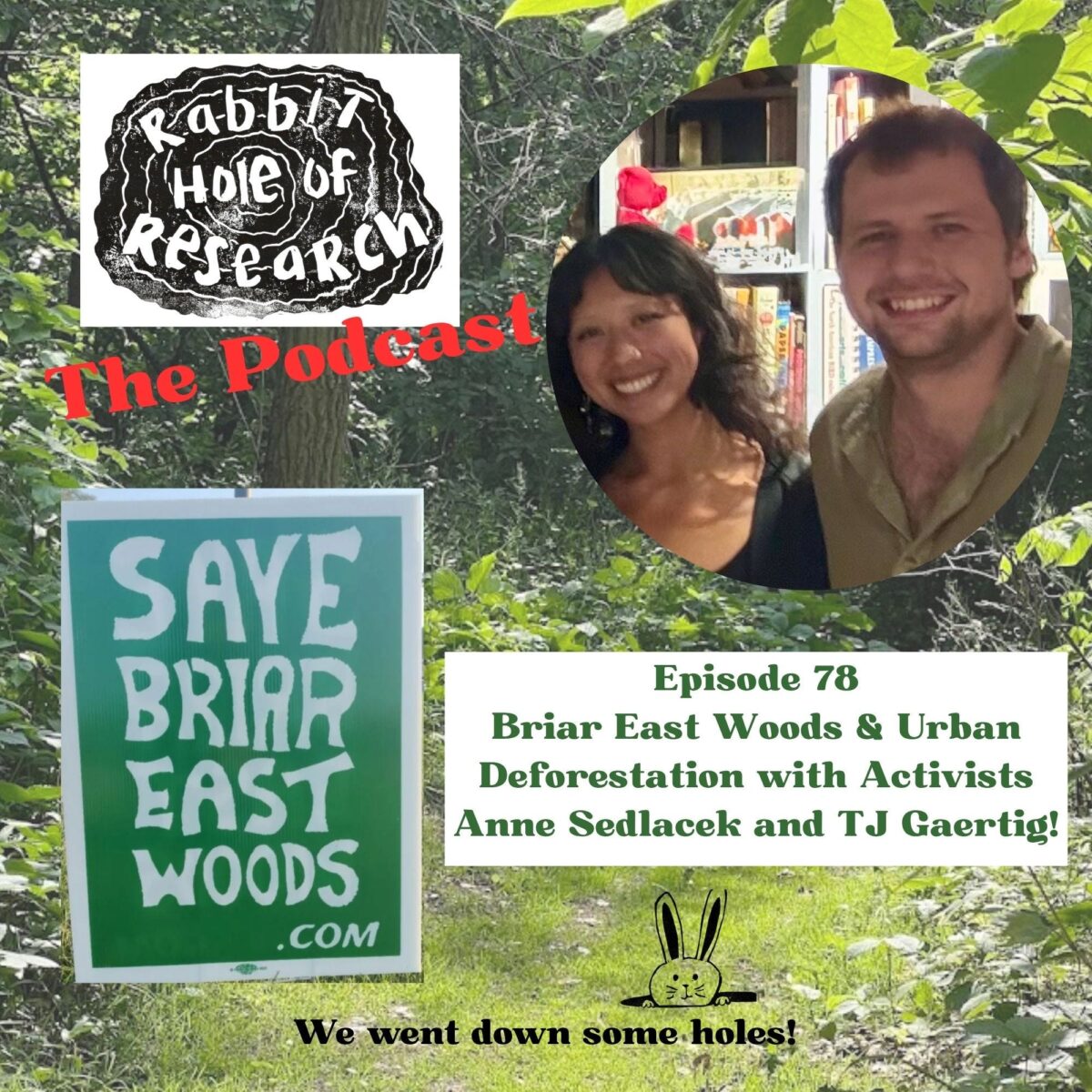
Newsletter and Transcript of Rabbit Hole of Research Episode 78: Briar East Woods and Urban Deforestation

Pave paradise over with a parking lot? Dunes, ecology, nature and neurobiology, and Poison Ivy.

SubstackAppleSpotifyYouTubeAmazon

Episode 78 Transcript


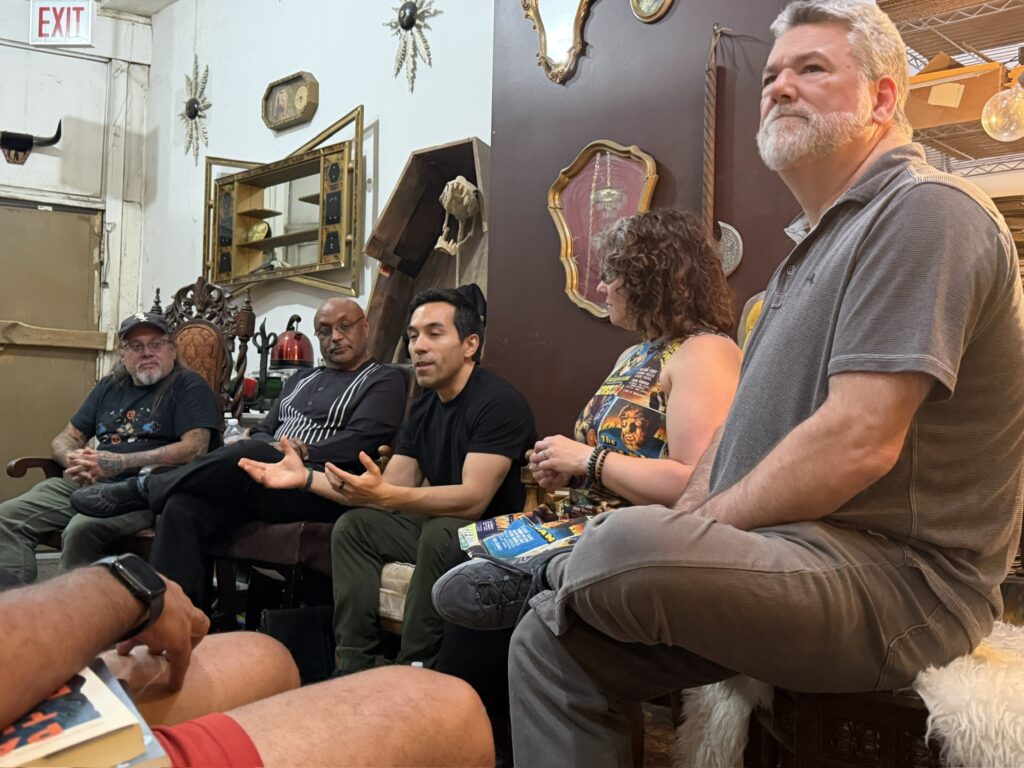
In Episode 78 of Rabbit Hole of Research, Joe, Nick, Georgia, and Mary welcome guests Anne Sedlacek and TJ Gaertig of Save Briar East Woods to explore the 32-acre dune forest in Hammond, Indiana. 

Briar East is the last sliver of a 4,700-year-old sand ridge, an urban forest sitting just south of steel mills and oil refineries, and it’s doing the work of soaking up the stormwater that would otherwise be in somebody’s basement. 

The crew talks about how UChicago’s Henry Cowles invented ecology on these very dunes, what Marc Berman’s walk-in-the-park research says about nature and your brain, why fiction keeps casting tree defenders like Poison Ivy as the villain, and what the forest might actually say if we could learn to speak tree.

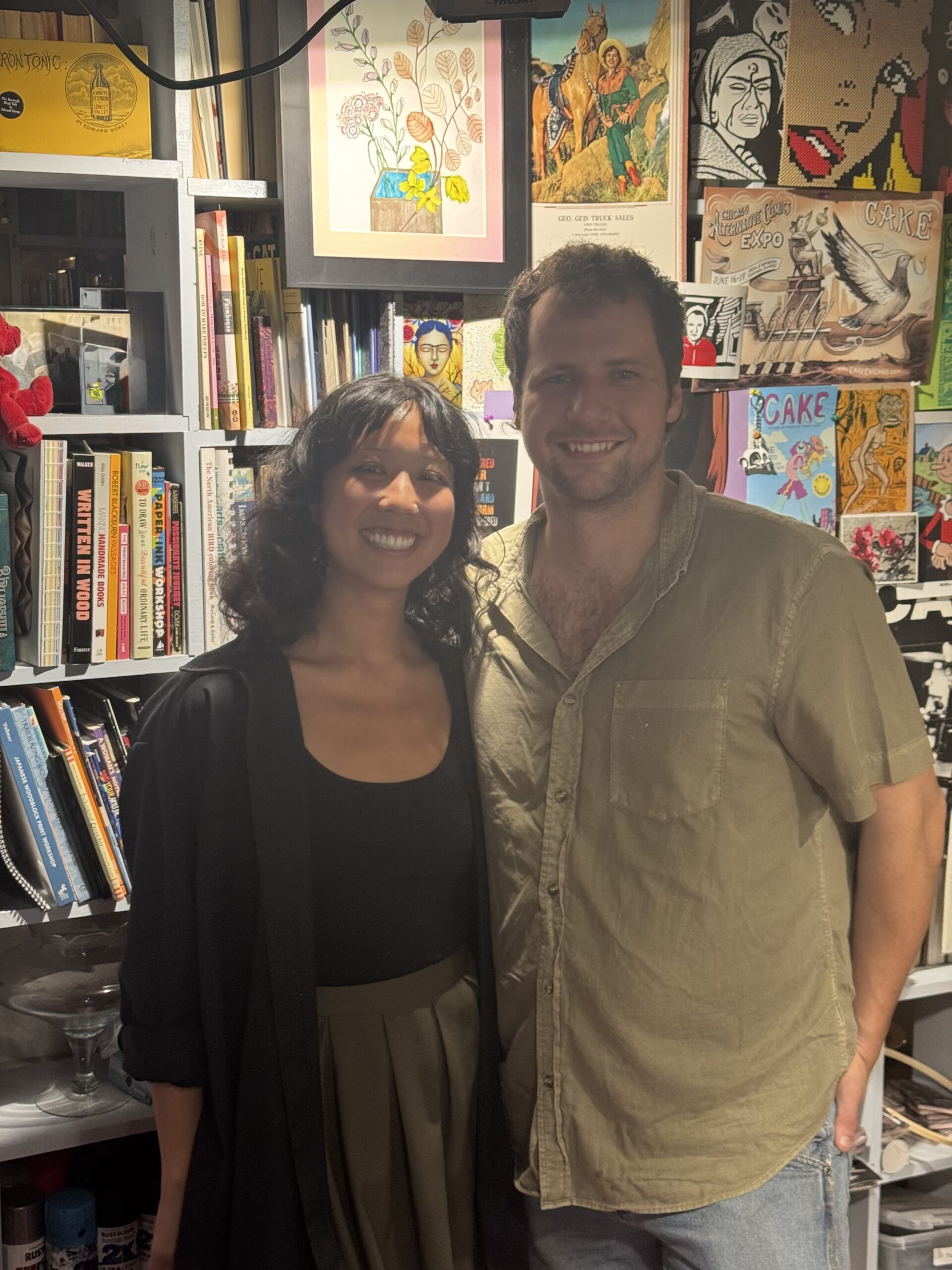
TJ and Anne

GeorgIa and Jim’s Touch of Noir 2027 Wall Calendar —

12 months of all-original art by Jim and Georgia; orders are open now, with mailing expected in September


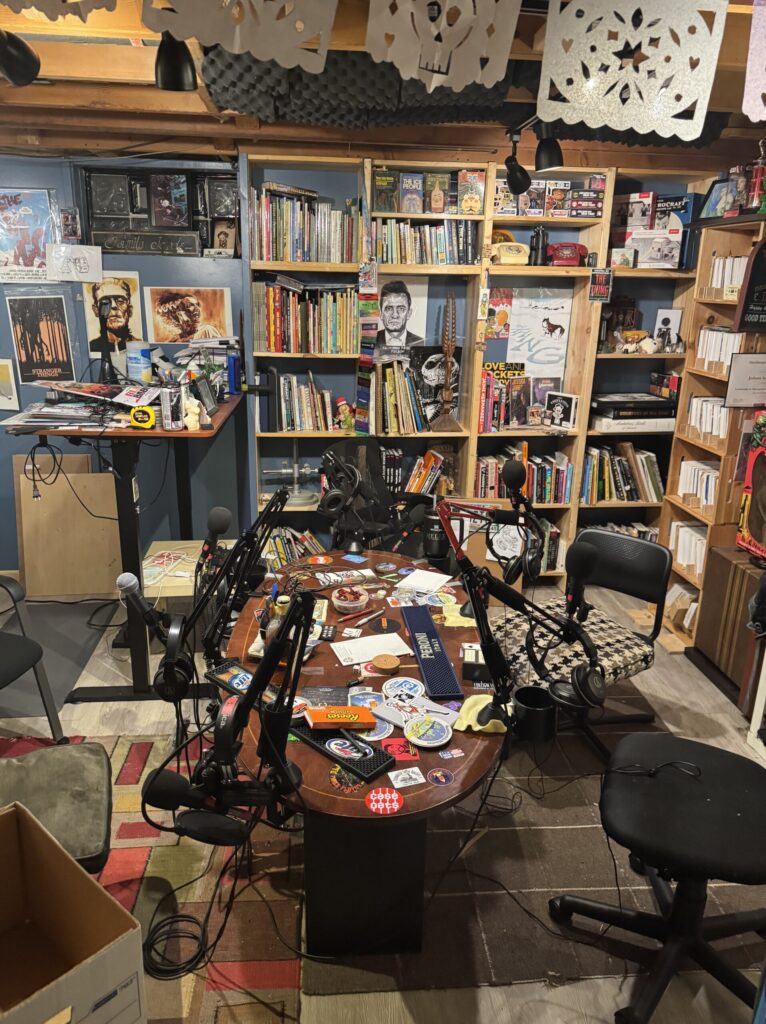
Basement Studio’s New Look:


Check out what the RHR crew is creating:

Joe:


Future Events to Hang with the Crew:

Podcast Cross-Appearances

Events & Conventions:

  • Dragon Con — Atlanta, GA (September 3-7, 2026) – Joe attending as Professional

It’s Science for Weirdos

Want to support the show? Tell your friends. Follow us on social mediaDiscordshare the podcast, and let us know what topics you are excited about. Leave a Comment. And for email alerts sign-up for the Substack newsletter and never miss an episode, exciting updates or the bonus images we talk about on the episodes. 


We discussed these questions on the episode and now want to Hear From You (leave a comment):

  • What’s a movie, show, or comic that villainizes nature, and did you catch it while watching/reading?
  • Is there a patch of woods, a park, or a green space that anchors you to where you live? What would you lose if it were gone?
  • When’s the last time you were really out in nature? Did you feel the difference?

Drop your thoughts in the comments. We read them all, and your ideas often shape future episodes.

Leave a comment


Future Episodes

  • Episode 80: Magic: the Power and Cost of Magic SystemsGuest: B.L.Mostyn
  • Episode 82: Climate Change and Data CentersGuest: David Pincus, PhD
  • Episode 84: ETGuest: Chris Guzman (@theboxinggloveartist)

Share

Leave a comment

For more stuff (Images, Episode Highlights, events, etc), subscribe to our Substack newsletter!


Show Notes & Fun facts 

Stuff crew said they’d put in shownotes


Books

  • When Trees Testify: Science, Wisdom, History, and America’s Black Botanical Legacyby Beronda Montgomery

Movies

  • Avatar
  • The Lorax
  • The Fog (John Carpenter)
  • The Blair Witch Project
  • The Wizard of Oz
  • Pocahontas (Grandmother Willow)
  • Beauty and the Beast
  • Killer Piñata (features The Owl bar in Logan Square)

TV

  • Harley Quinn (HBO Max animated series)
  • Dark Matter (Apple TV+, filmed in Chicago — also features The Owl)

Comics / Characters

  • Poison Ivy (DC)
  • Ra’s al Ghul (DC)
  • Batman (DC)
  • Swamp Thing (DC)
  • Man-Thing (Marvel)

Fun Facts to Impress Your Friends With:

  1. Briar East Woods is old. This 32-acre forest sits on a 4,700-year-old sand ridge, an ancient Lake Michigan shoreline that dried out and slowly built itself into a forest. 
  2. Your brain sees a forest in “low-res.” Nature is full of fractals, repeating, scale-free patterns you see in a snowflake, a coastline, or a tree canopy. Your brain processes them easily, like a compressed image file, so a walk in the woods actually rests your attention. A walk down a city street, where you’re constantly labeling buildings and signs, works it harder.
  3. Eleven trees on your block = a $10,000 raise. UChicago researcher Marc Berman found that adding about 11 trees per city block improved people’s health by an amount comparable to a $10,000 salary bump, or feeling seven years younger. Just put the phone away while you’re out there; the effect doesn’t work if you’re scrolling.
  4. The U.S. loses about 36 million urban trees a year. A 2018 USDA study found American urban and community areas shed roughly 36 million trees annually — about 175,000 acres, or 1% of canopy every five years — almost all of it paved over. When that study came out, Georgia was the state losing canopy fastest.

Episode Highlights

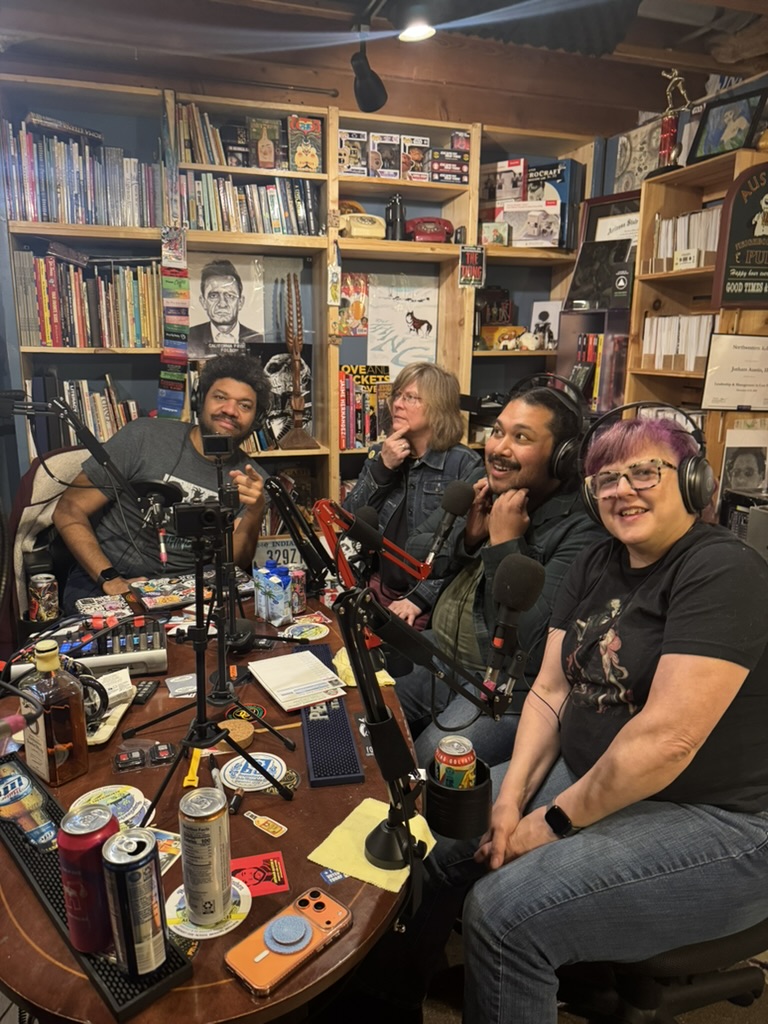
  • 00:00 — Meet the Crew and Guests: Joe, Nick, Georgia, and Mary break in the newly redecorated basement studio and welcome in-studio guests Anne and TJ.
  • 01:10 — Joe’s Opening Monologue: Joe rewinds 4,700 years to the moment a Lake Michigan sand ridge stopped being a beach and slowly became the forest we now call Briar East Woods.
  • 04:34 — Why Briar East Matters: Anne calls it the last sliver of genuine ancient dune ecosystem left, with plants that are thousands of years old and benefits Hammond’s administration refuses to recognize.
  • 07:00 — Bridge Plan Explained: Anne lays out the Governor’s Parkway project — a bridge that would take 12 of the woods’ 32 acres and clear the path for a 68-lot subdivision and two commercial spaces.
  • 08:16 — Urban Nature and Health: The crew digs into research showing wooded areas boost the brain, and why urban green space matters most where pollution and truck traffic are heaviest.1
  • 6:46 — Fractals and Brain Rest: Joe explains how nature’s fractal patterns let your brain process the world in “low-res,” resting your attention the way a compressed image saves space.
  • 20:48 — Trees as Living History: Joe connects photosynthesis to 150-to-200-year-old black oaks that literally hold the history of everyone who’s ever exhaled beneath them.
  • 23:30 — Safety Claims Debunked: TJ dismantles the school-safety pitch — the bridge is a mile from the actual train crossing and would send kids on a two-mile detour.
  • 33:47 — Flooding and Sewage Reality: TJ describes Hammond’s overdevelopment turning streets into rivers and basements into raw-sewage pools, with Briar East acting as the last sponge.
  • 37:50 — Political Pushback Ideas: Mary floats handing out sponges at the Mayor’s Night Out.
  • 39:27 — Council Meeting Reality: Mary describes public expression as wailing into the heavens while officials look down at their phones and refuse to engage.
  • 39:56 — Project Stalled Timeline: The group confirms the project has sat untouched since June of last year — stalled, by some counts, for going on three years.
  • 40:28 — Bears Stadium Politics: TJ suspects a potential Bears stadium could finally distract the mayor enough to let Briar East off the hook.
  • 41:56 — Restoring Urban Nature: Joe points to Seoul, where tearing out an elevated highway to restore a stream brought a ~600% biodiversity jump, cooling, and rising property values.
  • 44:38 — Can the Land Be Bought: Nick asks whether the group could just buy the land; Anne explains that with a reasonable administration maybe — but…
  • 46:01 — Why Green Space Wins: The crew imagines Manhattan without Central Park and revisits Chicago’s Burnham Plan as proof that protected green space can become a city’s legacy.
  • 49:17 — Poison Ivy Debate: Joe makes the case for Poison Ivy, a botanist turned defender-villain, and the crew questions why fiction keeps casting nature’s protectors as the bad guys.
  • 57:24 — Call to Action Links: Anne shares savebriareastwoods.com and the Save Briar East Woods social handles, and TJ’s simplest ask: just go breathe it in.
  • 58:43 — Parks Versus Wild: Mary draws the line between a manicured park and something primal and untouched, with the crew insisting they’re pro-park, too.
  • 01:00:40 — Wildlife and Cicadas: Anne talks about the animals of Briar East nesting barred owls, foxes, hawks, bats, bullfrogs. And Joe asks, would you eat a cicada.
  • 01:02:06 — Forest Screams and Cryptids: Nick asks if anyone goes out to scream into the trees, TJ admits the woods block the sound, and the need for a Briar East cryptid.
  • 01:03:54 — What the Forest Says: Asked to speak for the trees, Anne and TJ answer simply — “I’m alive, I’m still here” 
  • 01:05:50 — Plugs and Farewell: Anne plugs the merch and her music (Shy Bronco), and the crew signs off with:

“Stay curious, stay safe… Love Y’all!”


Join Rabbit Hole of Research on Discord: https://discord.gg/2nnmKgguFV

Subscribe and Share our Substack newsletter to get email updates, never miss an episode, and spread the word!! Don’t forget to give us 5 stars or a like!


Transcript

[00:00:00]

joe: Hey, welcome back to

The Rabbit Hole of Research down here in the basement

studio

Mary: Fully

Nick: loaded …

joe: loaded.

The new redecorated,

reorganized- Reorganized …

basement studio. That’s right,

yeah.

I

don’t know what the…

Georgia: every

mic is full.

joe: every

mic

is full.

Every mic is full.

now. We had to, we knocked some walls out.

We went Iron

Man-

Nick: This is our cave.

TJ: move,

joe: mo- mode. Yeah,

so

yeah. I gotta

po- post, some pictures.

It really looks different in here.

But we, yeah, we have a great episode planned gonna be great.

Nick: it’s

going, yeah

Mary: Yes,

we

do.

Nick: You wanna introduce yourself

there,

buddy? Hi.

joe: I,

am Joe.

Yeah,

let’s get into it. I am, yeah, I’m Joe.

Nick: You got Nick.

Got

Georgia: Nick.

Georgia.

joe: got Georgia.

Mary: You got Georgia. And You got Mary.

You

Nick: You

Mary: Mary.

Nick: and hey, look, we got some special guests … over here.

Mary: In person, In studio …

In studio.

joe: studio.

Nick: In studio. All

Mary: six mics

joe: Are hot right now, so please.

Anne: I’m Anne.

joe: I’m Anne.

TJ: Okay. And I’m TJ.

joe: TJ, yep. And we are here to talk about Briar East Woods and urban [00:01:00] deforestation.

So yeah, so it’s,

Nick: hits- close to home for all

joe: home, yeah. We’re right here, and probably for a number of people in urban settings that, that have to deal with this, and we’ll get

into

a

lot of that.

Nick: Do, do you have a monologue for us

today, Joe?

joe: I have one. I,

This one touched me a little bit, so

I put

something together for y’all. I’m gonna lay it on you

Nick: I’m gonna start crying.

Mary: I’m

joe: start this episode

millennium ago four thousand seven hundred years ago to be exact.

By this point in

geological

time, Lake Michigan had already spent thousands of years shoving sand inland, building ridge after sand ridge, and then the water receded and one of these ridges dried

out, and this is the point it stopped being a beach and started transforming into something else.

Actually, what happened

next is the only reason there’s a forest in Hammond.

On this dry sand ridge,

marram grass came first and their roots formed a complex network that could hold the sand down so the wind couldn’t erode it back into Lake Michigan.

Over the next centuries,

the grass [00:02:00] dried, rotted and made something you could call soil.

That soil brought

Cottonwoods brought

Pines brought oaks, each one building the ground the next one needed, eventually transforming that sand ridge into a forest.

sure if

you’re keeping count, but to create a forest you need a lot of time.

It took

centuries for Briar East Woods to form.

To put this into context, compared to man-made urban jungles, Chicago burnt to the ground and rebuilt itself in 20 years.

To understand how a forest assembles, a little over a century

ago, a UChicago botanist named Henry Cowles walked these same dunes, noticed that walking inland was the same as walking forward through time and more or less invented the science of ecology.

And that ecology, in 32 acres of original ancient dune that is now a forest sitting in Hammond, like all urban forests, it’s

more important than most people realize. It absorbs storm water

that would o- otherwise be in someone’s basement, it pulls the temperature down a few [00:03:00] degrees on a summer afternoon, and it

does all this without sending anybody a bill.

126 years after henry Cowles worked out

how the dune assembled a forest, another UChicago researcher, Mark Berman, is now working out the positive effects nature and the forest can have on the human brain, calling it environmental neuroscience.

And that’s the trouble. All the benefit the forest does for free never

shows up on a city planner’s budget line, and there’s always an overpass that needs somewhere to go or a project to pave paradise to put it in a parking lot. Preach it, Joni Mitchell.

Nick: And if the

joe: the woods could

Petition politic, they’ll argue on their own the way they’re always doing in fiction, they win every time. But unfortunately, they can’t, so in

this episode, we’re gonna make the case for them.

Nick: Wow, Joe

Mary: That was

great. Thank-

Nick: I think

that was your best one.

Oh. That should be

the end of him.

You it.

Mary: That’s it You

guys heard anything? No,

I’ll see. it. We’re done. Pack it

joe: up.

Mary: Okay.

joe: Yeah,

no, I think

that’s

A, I

liked the, the place to [00:04:00] start.

I named a… went over a few things in there, and we’ll probably d- unpack it a little bit more.

But

I’ll go ahead and let the guests dive into the Briar Ridge,

What it is what it’s

Georgia: Briar East.

joe: Oh, sorry.

Briar R- Briar Ridge?

Is

there

a Briar Ridge?

Is that

something?

TJ: is.

yeah.

There’s a lot of Briars ……like Hammond. Oh, that’s right.

Georgia: a housing yeah. housing development. Oh,

joe: right. I

don’t know why that’s a bad…

Mary: Stop.

Nick: That’s where the rich people are. We gotta get

Mary: Briar East Woods. Yeah.

joe: Oh, this will be edited out.

No,

Mary: Yeah. That’s okay.

joe: Yeah,

just to talk

about

Briar East, yeah, and just

Mary: you’re,

Nick: Briar East, what you guys are doing.

Mary: guys are doing. Yeah.

Well,

Anne: retreat to which you guys went Yeah. Well, I really like the historical perspective you put on that.

And I do think that the image of walking forward

from

the shoreline into

the

land

is so powerful

because

it really is such an ancient

place, and

it pales in comparison to,

you know,

the development that’s come up there over the past couple hundred years.

It’s

thousands of years old, 4,700 years old, as

you said. And it’s basically the last sliver of that

[00:05:00] ancient- dune land left, and it is genuine sand dune ecosystem,

which

makes it unique.

So

Yeah, the plants there, they are ancient plants, and they need to be saved because as you were saying as well,

you know,

even for

the

people who are living there, Hammond is a really industrialized-

…overdeveloped area already,

and the benefits of that forest are not being recognized at all by the administration there-

Yeah

For the people who live around it,

So,

yeah.

TJ: Yeah. I, like you were saying, I think, yeah, for the people of Hammond in northwest Indiana, spaces like this that anchor you to, like, the heritage of the land and,

Nick: like-

TJ: something that is real about where you live and not artificial

is is

really crucial for everyone’s psychology.

And Le- let alone it

being an urban

green space Yeah …for people to… With two and a half miles of trails in it that people constantly use until [00:06:00] the city fences it off. But,

Georgia: know-

And Can you give a little background on what is

happening- And why this is an

issue, Like-

Mary: Well, maybe,

like, l- well,

let’s step back a l- just a little bit even more than that.

Like,

We’re talking about Briar East Woods yeah, we,

you know,

We’re Briar East Woods i- in Hammond, Indiana, so- a- and

so,

How did you all get involved i- with this? How did you get started with this project, Anne?

Anne: Well,

TJ and I got involved at the same time- because we went to a

Hammond City council meeting, and we heard, there’s

a public

expression at every meeting,

and Ken Rosic would speak at the meetings every week. And

so we heard him talk,

And and then after that, we ended up running into him at a bar. And he gave us the whole spiel, and then- …a couple weeks later,

I think, gave us a

tour of the

woods. Yeah. And we were

hooked.

And We were hooked. ‘ cause it was so beautiful

to see it, and the idea of it not being there anymore,

It was really distressing. Yeah.

It was really distressing. And

[00:07:00] So yeah.

But,

Ken has been working… The

project has been in motion

since 2018.

So the city of Hammond

has a

bridge project that they’re trying to build

right through the woods. So it would take up 12 acres of the 32 acres of the woodland.

And it’s a bridge that’s supposed to go over the train tracks, but the way that it’s aligned, it basically clears the way for a path for an entirely new subdivision with 68 residential lots and then two commercial spaces,

which is what was included on the city of hammond’s grant application

to the state. And they used to deny that there was gonna be any housing, and then at some points the mayor, Mayor McDermott of Hammond, has slipped up and said, “Oh, no-” well, There might be or, you know, something like that. So they’re

TJ: would never rule it out. He would never rule it

Anne: he would never rule it

out.

Mary: And

if there

were, then just think how much more everyone else’s property values would go up,

Right.

Anne: Yeah.

joe: yeah. Yeah. If that were to happen. Yep. Yeah, yeah. Sounds like the, uh, plot to Avatar, right? Oh, yeah. Just go… Yeah, right. You know, like- Yeah … you just wanna use the natural resources- That’s right … just to, uh, dig through

Mary: If that were

to happen. Yeah.

joe: Sounds

like the the plot to Avatar.

right?

Avatar,

Nick: was just thinking the [00:08:00] exact same thing. I was

like,

Mary: “Wait, you

Nick: guys, you just wanna use the natural resources just to

say screw

Georgia: it'”?

joe: Cut down

a mother tree

and dig out

Nick: Might as well. Look at all the stuff in

there

joe: There’s gold in them there hills. That’s right. That’s right. All this stuff. We’re gonna make

tons of money. Everyone’s gonna make money,

gonna make money. right?

Yeah, no, I think

that’s

yeah

really,

cool. We were talking about the

kind of impact and the neurological part of it that you go and walking in the woods, there’s a lot of research into that now that having wooded area and people going into nature really has that positive effect on them.

And, just spending time, you have that. But the problem is when you live in urban areas the folks who can get to wooded areas is limited. So having this in an area like in Hammond and having that local resource so you don’t have to travel far. I think that’s another point there. So y- you said there was trails and things like that that- Yeah … crisscross through

Anne: Yeah. It’s super important to maintain that urban green space

and the access to it because it’s not only [00:09:00] beneficial for people, but it’s actually harmful living in an urban environment often- with the noise pollution. the air pollution. It is psychologically distressing as well as physically

distressing. And Living in cities with high amounts of pollution like that is linked to, Cardiovascular disease and anxiety depression, all types of things like that. So to take away urban green space in a place that already place has, like, the heaviest truck traffic in the country-

TJ: is directly south of two steel mills

and an oil refinery.

Georgia: and an oil refinery.

Right.

Right.

TJ: Right.

joe: Right. Yeah.

Right.

Yeah,

so

you have that.

But … the Indiana Dunes is an example where they built up industry and they maintained and preserved the dunes, creating a national park, the Lake- national lake shore in ’66, the Na-national park in 2019.

So you had this,

industry, so really a model exists that you

can- But also-

Georgia: that was because of just specific certain people that fought for [00:10:00] that. Yeah …

That’s right.

Yeah.

yeah. Which-

Mary: Yeah. Yeah. go ahead.

TJ: The,

the model that exists is industry and developers wanting all of it.

Georgia: Right,

Mary: Right.

Right.

TJ: is what’s happening i- with Briar East

Woods.

Right.

Georgia: then

someone standing up and saying, “Wait a second.”

TJ: And then, yeah, people

that live there mobilizing against

that-

that, force.

joe: Mm-hmm.

Nick: So are,

Is

your mission to make it a national park, or- wh-

TJ: what-

Hey,

I’m not against it.

Nick: What

is

Mary: Why

joe: right. Right. Why not?

I

TJ: I

think just

a city park, really.

Anne: Or- Yeah.

Or-

Nick: Or,

TJ: be honest with you- just to leave it alone.

I mean-

Mary: Yeah. Yeah.

joe: But

it is a historical site

though, right?

I That’s the

thing. Like for this- it would-

Georgia: would

be

joe: would be nice if it was actually

Georgia: protected,

which- I don’t know what that means these

joe: That’s right. No, that’s it,

TJ: It doesn’t

carry much weight.

right.

Georgia: So

Anne: You know?

Mary: Right. So-

joe: yeah.

Nick: Just ’cause, with

the dunes being a national park, I didn’t know if that would be a-

…beneficial- goal

or if it’s just-

joe: An extension of the dunes, [00:11:00] like in that-

Yes

its

Anne: It is the

same dune ridge.

Like,

you know. The

TJ: high

tallest in shoreline.

tallest in shoreline.

joe: tallest and shoreline. That’s right. Yeah. So ideally, at the end of the day, it would be part of the national park. Right, right. I think the main goal right

Anne: So ideally, at the end of the day, it would be part

of the national park. But I

think the main goal

right now is to

stop

the

development project-

……which

by

the way is called Governor’s Parkway, and then it

would be

Nick: to- Yeah,

I

joe: like

any kind of-

TJ: it

Anne: and

Make sure that it’s a park, make sure it’s preserved,

you know, not gonna be developed in any way, shape, or form. And then maybe

we

can talk state and national level.

But

Yes.

joe: Yeah.

TJ: I’ll tell you what, something I find really interesting about Briar East Woods specifically, as opposed to protected parks that are across Northwest Indiana, is that it’s not a park,

it’s not protected, it’s just undeveloped land.

Mm-hmm. Which-

Right

lends a very unique character to it.

Mm-hmm.

One where it’s not like they close the doors and

shut the fence.

Georgia: organic. It’s

very

TJ: very organically, yeah. It’s extremely organic.

All the trails are made by the people that live there.

Yeah.

[00:12:00] Nothing is maintained.

It’s

only maintained by people that ride ATVs through there that need to chop up trees to fall on the trails.

And,

Anne: And

us

when we clean up. the and-

TJ: and …us. yes.

Mary: Yes.

joe: you mentioned Ken and his efforts,

right? He was a duster, is that-

what was it called, the,

TJ: Yeah. So- The the Dune

Anne: original name of the group, which is now more formally known as Save Briar East Woods.

it was the

Dune

Dusters- Dusters I think The Dune Dusters sounds cool.

joe: That’s Dune Dusters sounds cool.

TJ: I like a bunch of old guys- The Dune Dusters sounds cool.

Nick: I like that … who like to clean. I kinda wish you guys some… Yeah, right. me. the Dune

Anne: more swaggy. we- still use

Georgia: You could say AKA. say AKA. little icon, You

joe: got a little

icon,

like

a little

guy, like with a little duster kind of going through there.

Nick: Oh, I thought it was just a

jacket. How about Oh, a jacket, yeah.

joe: Not A a show, duster in the Dunes? yeah. like the play the album. A dust- a

yeah.

Georgia: There

joe: Yeah, duster can be

a little woodland creature.

TJ: or- it’s

joe: like, yeah, no. Yeah. No, that’s cool.

No, so that’s how

that all started. Community driven. Ken took the charge

Georgia: Now, You said you, you got involved in 2018. When did Ken

First,[00:13:00]

Anne: Ken first get involved? So the

project itself they City of Hammond applied for funding for it in 2018, and then Ken began organizing

in

TJ: a year

later.

Anne: Yeah.

Around

2019,

Nick: Oh, so you guys were, like, ground floor of

this.

Anne: on this. TJ and I

got

involved- in

  1. Oh.

So

it- Yay ……Yeah. It was very localized- before then to mostly people in… It’s in the Hessville neighborhood of Hammond.

so very local issue.

And then,

TJ: And then it branched out to people living in South Hammond.

You’re doing here. And

then

Mary: Those interlopers.

TJ: The whole country.

joe: What are you doing

Anne: And the region at

large, and The Midwest- Yes.

and the coal country. Yeah.

joe: The world.

Mary: world. The

Georgia: all

Nick: The world.

Anne: The world even

joe: What I was

gonna say,

I mean,

we- we’re focused on local because we all live in the Northwest Indiana area, and,

This is important. I mentioned about

The kind of storm water and things like that. Clean air, you mentioned noise control. But

I saw this USDA in 2018 paper.[00:14:00]

It was about US urban community are- areas lose approximately 36 million trees a year. About 175,000 acres, roughly 1% of canopy in five years, and almost all of that is swapped for impervious su- surfaces, so pavements, buildings, parking lots.

So you have this.

And I think it- they noted Georgia at the time was the state with the steepest canopy loss.

And so yeah, This is a serious problem

that- Like I

Georgia: when you think of deforestation-

Mm-hmm

you think of like the Amazon.

That’s right.

yeah.

joe: yeah. Cut and burn, that’s what we learn.

Georgia: Far

away.

Yeah. No, it’s happening-

joe: Here yeah.

And we

don’t think about it ’cause we’re,

We’re industrialized, and so we’re just marching forward with our structures, housing. Instead of going vertical, we like to go horizontal.

And I think that’s a,

you know,

The presidential center, Obama Presidential went up, and it’s a vertical structure. And people are like, “Oh, that’s… Why is it vertical?” It’s

like, and they were giving them a hard time, but really, they dedicated a lot of that space to restoring

[00:15:00] the …area around that, …and the

gardens and everything.

So there was some effort

in a

urban area to actually build a struc- build this museum, and then also have,

These structures that benefit the community- The

Georgia: I think that,

joe: and,

Georgia: I think

that also is a matter of

the community too.

Right.

That’s right. Yeah. Because Jackson Park-

has

Very passionate- people- Yeah. wanting to protect Jackson Park, So I’m sure that had a huge-

Mary: And

joe: I’m sure that

had part of it. I’m not saying

Georgia: they didn’t

listen. Right, Right. ’cause obviously, but-

joe: Well,

that Mark Berman, I think that was his… That’s a lot of his research.

The, the famous one was walk in the park experiments, where he had people go on a 50-minute walk through, the park. And their psychology changed. Their attention they could focus. So people with attention deficit, things like that,

they became much more aware, and they could actually focus on things like that.

Yeah, then he’s gone on to do other studies.

Ones where it’s like if you have just 11 trees, like per block, like that’s enough to actually start… That, that’s as [00:16:00] equivalent to a $10,000 salary raise or seven years of cardiovascular health

It’s really like just these

things. So he talks about that in, in spaces and stuff.

Yeah.

Georgia: There’s a great a

Big

Is it called Big

Brains?

joe: Big Brains. That’s right.

Yep,

Georgia: That’s right. Yeah. It’s a podcast from UChicago, and they had one-

…specifically on his

research Yeah. Okay.

So that’s something to check out- ’cause it’s really good … Oh,

Nick: it’s really good … listened to that other podcast. Oh, what was his name again? After you listen to this episode. after you

listen to this

joe: after you listen to this episode.

Nick: you

TJ: podcast. No.

Mary: After that. after

TJ: episode.

joe: Yeah.

right.

Mark Berman. Okay. Yeah, he’s a University

of Chicago, Yeah … faculty member. Yep. Mm-hmm. Mm-hmm.

Okay.

Georgia: And they,

like you said, like even people that don’t like nature-

right. still got a

benefit like-

joe: did. Yep, yep, Yep, yep, That was some of his

research. Yeah.

Georgia: themselves- they still

got

joe: Even if you’re

there. But you can’t, you can’t be… It was really interesting.

You can’t be on like your phone in there. Put your phone away.

Nick: What

about- headphones? Can you- Yeah.

Is head- are headphones allowed? you

joe: no,

You wanna be immersed in nature.

And it was really

interesting ’cause then it was like, “Why?” and some of the [00:17:00] reasons that they had was that when you go through nature the environment is low res, right? So when you go through and they start this fractal idea. So a fractal is this kind of repeating, scale-free repeating pattern.

So like a snowflake, if you look at it, it’s got its shape. If you zoom in, you see the same shape. You zoom in further, it’s the same shape. So that’s a, a fractal. It’s a repeating kind of a pattern.

And when you’re out in

nature the structures, mountains, tree canopy, they have a fractal pattern. And so your brain can just process that, and if you think of it in computer terms one way you can,

Compress images is take

like, 100 megabit image and make it 10 because your brain doesn’t recognize the condensing

Of the pixels.

So

Nick: know a with me more than what you said before.

joe: learned a lot more from you than you said

before.

Oh, that’s what we

do

here. We

try to give a lot of

examples,

make

it work.

And so that’s kind of the idea, that

when you walk through the forest, your brain isn’t processing. Your brain also isn’t labeling everything. It’s like tree,

you know,

[00:18:00] leaf, grass.

You look at grass on the ground, you’re not counting every blade, whereas when you’re in an urban environment, you are processing a lot of language.

What’s this building? What’s this shop? What’s this here?

You’re going through …and your brain is

mentally mapping your environment much heavier

And your focus is really different.

So you have this kind of focus difference that you’re going through when you’re in nature, and that allows you then to, when you come out, you’re actually refreshed ’cause your brain wasn’t heavily worked in this- … this time period. So really it’s this- That’s interesting … it’s really

fascinating

research and

Going through that and how beneficial this is in, in some of the studies.

And then there was even, they tried to do it with pictures.

So would a picture of the farm nature work? And I think some of the re- th- I think

it was like, yeah, it’s just as good, but I think there’s other blind studies that are like,

eh,

you know,

it’s probably

best if you get out

and go. Yeah. But once

again, it’s

TJ: try. It was

joe: it’s

but it’s access, and

They had things where they did

In some of [00:19:00] the The

Projects and things in urban environments. And

They had it ’cause that’s randomized. You’re just put in whatever apartment. So some looked out to green spaces.

Some looked out to non-green spaces. Same thing with health patients. You’re assigned your

room

Georgia: random.

Just Having

windows.

was

joe: Having windows. Right. Having windows looking

out to a green space, that, that improved health recovery. That also led to

conditions in these kind of different homes,

Nick: So

Would having,

like,

those

windowsill plants

Be helpful, in that case, like if you’re in a

higher

floor?

joe: Right.

Right.

Yep. Yep. There was talk,

I mean, that was the other thing. It was about having indoor plants. So let’s say you’re in a space like the Basement Studio. We don’t get a lot of natural … We get

some

Nick: nothing green down here-

Mary: some.

joe: Yeah,

Nick: that is natural

joe: when I

was reading all

this

and doing

Georgia: we’d need, like, a sun lamp or …

joe: I thought you just need,

You need to have plants, have some artificial plants, because the same fractal- Artificial? Yeah, you can have artificial plants and have those in your

space.

Georgia: easier.

to care for [00:20:00]

joe: You won’t,

get the olfactory,

the smell, the, the kind of sensory, but you will get the visual kind of relaxation there. So yeah, that’s

Bringing,

you know,

These ideas

Georgia: tree

In the basement We

joe: tree we

need, in the in

a Basement Studio. We’re gonna

do like a … We need some more

TJ: gonna do, like, a, we need we can get

joe: a tree

and… the, We’ll just get

tree in a basement will plant one Right here in the middle. of the

Nick: desk.

Adopt, middle Adopt,

Georgia: adopt a tree.

for adopt a

joe: tree. Yeah, you’re gonna

We’ll write your name on every leaf or something. I don’t know. Do something. It’s artificial tree, not a real tree.

TJ: Oh.

Nick: Oh.

joe: Yeah. We’re not gonna torture a real tree that way. Oh,

Mary: Oh, yeah.

joe: But

Nick: We are anti-torturing trees.

thank you

that’s

TJ: our whole thing.

Nick: Oh,

is that what you.

g- Wait, are

you guys the pro getting rid of…

joe: you guys the pro game group?

Nick: guys no.

Anne: the pro guinea

pig? guys no. Yeah.

TJ: the pro getting rid of…? Guys, no.

Nick: Yeah.

Mary: You

guys,

joe: You mentioned

The age of some of those trees, and

I

think there’s black oaks, and they’re, like, in the

Hundreds of years

Anne: Yeah, 150, 200.

years old.

TJ: Yep.

joe: and there’s a…

I

talked about this on the mini, but I’m in the middle of [00:21:00] reading this book called When Trees Testify, so

really interesting. Do you know that? Do you… I see you saying,

“Okay, yeah,

It’s really cool.” It’s called Science, Wisdom, History, and America’s Black Botanical Legacy.

Beronda

Montgomery talks about these tree species through America, through the lens of Black America, and how these trees hold history.

And some of it is

just a process of photos- photosynthesis.

Mary: photosynthesis.

joe: Sunlight converting CO2 to sugars and producing oxygen on the back end that we breathe in,

and we

exhale CO2, carbon dioxide, for the plants to have this process happen.

And

the idea then is that

trees take that in. So historically people that were around a tree, you’re walking through Briar East and you’re breathing these trees are making your CO2 that you’ve exhaled, a part of you, molecules that were in your body then become part of this tree, its bark, its structures, its complex structures, its stable structures as it grows.

And so through [00:22:00] history, 150 years of history, that’s a, a century and a half, two centuries, 200 years old, that’s a lot of time and a lot of people who passed through there.

And both the good

And the bad, if we think

Of trees in American history what they were used for. So

it was just really good. And

so when you think of these ancient trees in forests like that, the history

And the things they’ve witnessed- Yeah … is really just powerful, and I think people don’t think about that, so.

TJ: Oh,

yeah. Yeah. I’m sure

there

are plenty of trees in Briar Woods that are

as

old as the city itself-

Oh, yeah if not older,

so.

joe: Yeah.

TJ: And just the individual tree, it’s been there the whole time.

joe: Right.

Right.

Watching,

Like

Like judging.

TJ: S-

soaking it

in. Yeah.

Georgia: Yeah,

and that sense of place. Yeah.

TJ: Yeah. Oh, Yeah,

joe: like, it’s

a place. I mean- Yeah …

yeah.

Yeah. No, Yeah,

Anne: Yeah, they’re like

monuments

in

a way.

Mm-hmm.

And

yeah, you can tell a lot about what’s happened in

an area

too, like from opening up a tree and investigating the inside-

the

core too. So

they hold [00:23:00] onto all of that.

Georgia: that.

It’s,

s- Yeah, seeing the rings and-

the Oh,

joe: yeah.

the age, right,

Nick: forgot about that. That’s why I was like-

“Wait, what are you doing? opening up trees?” “Don’t do

that. We’re saving these

TJ: torturing trees.” We just went over this.

Can’t wait to crack this baby open. Wonder

Nick: your trees. “

We just went

over

this.”

joe: it’s

like-

Nick: a

tree, Nick.

Georgia: that…

Yeah.

joe: Yeah.

Nick: I wonder

how many-

00 was in can make from this tree.

TJ: Oh,

Mary: make from this. Oh, no.

joe: Yeah,

you’re walking through, “Hey, buddy,

you behave,

okay?”

Nick: Joe,

stop Sherman was here. Sherman- is here. Sherman.

Mary: One

of…

And like for Briar East Woods, the justification for cutting down Briar East Woods keeps changing too.

joe: Yeah.

TJ: By the

Mary: way …Right.

TJ: It j- when- whenever you get ’em.

Mary: so what was… So

I became aware of this issue very late in the game, just only in like the,

the last year and a half or so. But what was the ha- like the justification for cutting down Briar East Woods originally

When Ken when Ken got involved with this? Or…[00:24:00]

Anne: this? Yeah.

So,

Hammond is a city, and especially

the hessville neighborhood, there’s a lot of train crossings. And so there was a pedestrian, or not a pedestrian, sorry. There was a fatality that occurred at the Grand avenue crossing, which is a bit east of Briar east Woods. And additionally there was, a public safety crisis where, and proPublica reported on this in 2023, where there’s five schools on Grand Avenue, and children walking to school would get caught by the train, and so they would start climbing or

TJ: through- A, a parked,

train? parked train.

Anne: Parked

Nick: Oh.

TJ: not

a

moving train. When

Mary: they were there-

they were, like

S- stayed still, like standing,

Stopped trains for, were, stopped so long.

TJ: For Hours or

sometimes days. Yeah. Oh. Yeah.

Anne: up to

like three

days I think- was the longest one. So the idea behind the bridge that is gonna cut through Briar East Woods is to alleviate that issue of the stalled [00:25:00] trains, getting around those trains particularly for school children.

Mary: However

Anne: However…

Nick: However…

TJ: We

can dispute

that

point- …

Well ……very

well.

Mary: Yeah. Let’s ta- yeah.

let’s

talk about, yeah.

TJ: Well,

I mean- Yeah … so

the,

th- on Grand Avenue where the

train

was parked and all the kids are crossing and all the schools are, that’s wonderful. We need a bridge there perhaps. The bridge is a mile away.

Mary: The bridge-

Like, The bridge- in Briar East Woods,

right.

Yeah.

Yeah, Briar

TJ: East Woods. Yeah. Right. Briar East Woods-

The trail it would take the kids on-

…is a two-mile

detour.

to

Nick: what- Whoa. So

it’s always easier-

joe: it’s always

Georgia: they were trying to- make this a solution for that-

Yes …when-

Nick: it gonna be any solution at all though?

Like there-

Anne: no- No.

TJ: No. no.

Nick: all. So,

like-

Georgia: So there’s obviously- some- What? … other reasoning behind- Yes.

Yeah.

joe: happening.

TJ: And so- they… And so then the mayor would just keep on, and the city,

would just keep on spitting out different- “Oh, well the woods are [00:26:00] dirty.

The woods have trash

in them.

Anne: Yeah. The emergency vehicles

can’t get around

Mary: of the children. The children need to cross.

Georgia: That makes

TJ: need to cross.

That

makes

Georgia: Won’t

Mary: anyone please think of the children?

TJ: that’s, like- yeah … there are actual problems that- Mm-hmm … could be addressed, and they got grant money to address it

Anne: Yes.

Georgia: And

TJ: they’re using it on, like a housing development project. just, All right, and we have to throw a bridge in

there.”

Anne: Yeah.

Mary: But like,

it’s

like,

Georgia: a bridge that won’t help. the

TJ: a bridge that will not help anyone. It- It’s

Mary: like over a mile away from where,

like the kids would need it to cross, right? So-

TJ: A

Anne: west of Grand Avenue, the train crossing at Grand

Avenue, which is where all of these issues are happening.

Georgia: then didn’t they say something like,

“Well, the kids that walk to school will still have

to…” have this issue.” Yeah. Will still have to, like- It’s like- Yeah. right …wait a second.

TJ: then

joe: not

gonna walk a

mile out their way then to loop…

Yeah.

Yeah.

TJ: I’ll give you

another funny one.

So the second most [00:27:00] popular one that they use is, well, emergency vehicles need to be able to cross parked trains.” And so

What

happens then? So

we’re

like, “Okay, yeah, sure.” But here’s the thing.

order to build this bridge, they’re coming off of the main thoroughfare

that emergency vehicles use to go north-south through Hessville. And so they’re going to close that road and instead take them on a winding journey through Briar East

Anne: East

Through the new

subdivision. Oh

Mary: my God, that’s, That’s

TJ: Are you kidding? Oh my God. That’s, stupid. and

so,

and introduce two new

intersections.

Nick: Yeah. So wouldn’t it make more sense just to have the bridge go over the railroad tracks?

TJ: Yes.

Like

that. That This is such a simple solution. How am

Nick: I the one able to be able figured it out.

Anne: I-

Georgia: …the one that doesn’t seem able to think this out?

Mary: I feel

like you’re leading it…

Like,

like

Nick: one,

Mary: one solution is quick and relatively less expensive.

Anne: Yeah,

significantly.

less

Georgia: it lead to [00:28:00] a

Mary: less. But it doesn’t lead to- Well, I

Georgia: yeah, a …fancy housing

development?

Right.

Mary: like the Compare…

A- And like the comparison of the numbers. Yeah.

Anne: Yeah. It’s hard to

say what the numbers would be now because the figures are so

old. Oh,

Mary: year- It’s been years now.

Yeah.

Anne: I mean, the last figure for Governors Parkway, I think they recently changed

It to 13 million. It was up

to 16 million at one point.

Mary: Oh. okay.

Anne: So now it’s like 13 million.

TJ: Well,

they’re funding it with different sources, too.

Yeah. You know, it’s

…federal

funds and

state

Anne: state, and then

the s- city

pays 20%.

Yes.

Oh, right.

Of the whole cost. So, so taxpayers. Yeah. of Hammond.

TJ: I think they were gonna try and use COVID relief funds for that-

Yeah.

last

time I checked.

Georgia: time

joe: Yeah, right. Is

that account still active?

Can we check it out?

Well, this

reminds me, you guys are talking some of the political stuff. In Mumbai, India, they had did something like that.

The Aarey, the green lung they wanted to build a metro rail

depot.

So and research, like this was in 2019. They felled [00:29:00] about 2,600 trees And one of the, the government’s, their line was an area cannot be a forest just because it has greenery. And so it was this whole

rhetorical-

Nick: Water is not water even though it’s wet …

joe: It’s like, “Oh a

forest just

because it’s green,”

like, “’cause it’s got green space. So y- like you were saying, TJ, you guys were…

It’s, you get these

lines and It’s like what does

that-

Georgia: like what It’s double-speak.

joe: what does that exactly? Like,

you Are we not supposed to think about that?

Nick: It’s so stupid-

that it makes you go, Yeah. it has to be true.

Right? No

one’s this

Anne: right … say

that? But

joe: But

yeah, no, it’s one of these,

Mary: Oh, right. But yeah, no, it’s kind of

joe: interesting things where pol- they give… They say things and it’s

like,

“Oh, yeah, green. What?”

Anne: Well, it’s so

I mean, people do say that all the time.

Yeah, it’s kind of- And it’s not-

I mean, the city doesn’t look at it as a forest. They look at

it

as-

a place where people dump trash, which isn’t even true, but

Nick: and

TJ: place where

kids go to smoke

weed. Yeah. Which is true.

Anne: is true.

But but

they’re gonna do it somewhere.

Nick: place.

Anne: That’s why- Please

Nick: in the good …environment of [00:30:00] nature …

joe: out spaces in there.

Random forest somewhere, not what an urban forest is

TJ: for? Yeah.

Anne: out

spaces.

TJ: have a little

sign

joe: like, you know, “These are our babies. These are our babies.” The, the-

Nick: Oh,

no.

Joe, no. Legit,

TJ: No.

Nick: And

joe: No.

Legit, That gives them, you

know-

Protection

Georgia: Yeah.

Nick: and then clean it up afterwards … clean it up afterwards.

joe: well

Anne: know,

Nick: Come on,

Anne: Come on, kids.

joe: well,

I

They’re planned, maybe not to,

you know,

like-

your

Anne: Oh.

Nick: your

TJ: hey.

Mary: thing or whatever.

joe: Oh,

Why, Why’s

it gotta be,

Georgia: Be-

Anne: why’s it gotta be me? Look, anything could ha- anything could

happen.

joe: Well,

I think-

Um, yes.

Georgia: I was gonna s-

TJ: Your mother, and

I met, in

Briar East Woods.

joe: Yeah, right. Yeah. Can you

tell me the

story again? It is- you tell me the

Mary: It is weird the way,

like, the

city council while They’ll often cite… the, they’ll often say,

Like, the woods are dirty. Yeah. Like,

well, then we could clean them,

You know? I mean,

if they’re…

If,

like, tra- well,

Georgia: trash blows in So

Mary: trash blows

Georgia: are the sidewalks in

Mary: Yeah. like, if trash blows

into your yard,

you don’t burn down your house, you just pick up [00:31:00] the trash. Right? You know? Yeah.

Nick: I constantly do this, mary. I have a

Mary: constantly burning down your house?

Anne: a

Nick: Constantly burning down your house? I have

Mary: You have to move all the time.

Georgia: entire

house. You have

joe: It’s Like,

Nick: My fridge goes out- oof. That house is gone.

But it

Mary: it does feel very much like double speak, like, like the,

like a woods- Yeah …could be dirty. Yeah, It’s such a strange… Yeah. Anyway. Yeah.

joe: I mean,

it’s also a counterargument, people try to make ’cause you go,

you have the woods,” and I’ve brought up all these, these positives. But then people go if

you got woods, then you could have people, like,

sneaking in there, hiding, crime rates.”

The sight lines are wrong, and people are gonna get…

So you

have

Georgia: Surveillance is hard.

joe: try… Right, exactly. Like,

it’s, it’s- Ugh …

Need

more cameras

in the woods. But yeah, no, I

think you have these kind of counterarguments, especially in urban environments where crime crime gets

sensationalized in, in a lot of places

And there’s an overreaction. And if you have wooded areas, sometimes that’s the first place to get attacked. It’s like, “Oh,

you know, aha,

I know what’s gonna stop the crime.”

it’s like, I

Nick: Is it ’cause they’re [00:32:00] doing crimes out there?

joe: That’s right.

Nick: Can I go out there and find them and- be like, hey, I see you doing crimes”?

joe: It’s

like we know where you’re at, but we’re not… We’re just gonna cut it down.

Anne: That’s the thing, though, is There’s never been a crime reported in

Briar woods. Right, That’s the thing. Yes. It’s Like-

Yes okay,

Like,

…ooh,

spooky scary

woods, like

horror movies. yeah. But crimes really- …don’t

…tend to happen- in natural

areas. You

can-

look-

Yeah … I don’t know the statistics- on it, but-

joe: Yeah.

Nick: Yeah. You

can intuit.

Anne: You can intuit.

joe: right.

Anne: you

Mary: yeah. But,

mean, h- yeah, really. Has there,

You know,

you look back,

you know.

yeah, that’s not something…

Anyway,

Yeah.

joe: And you I, just to pull on a thread, ’cause I was gonna get there in a little bit, but you mentioned horror. And in fiction you have woods portrayed a couple wa- ways, right? You have the trees or you have the defenders of the woods,

And that can be a, a positive entity. But you also have, on the horror side you have entities in the woods which are [00:33:00] protective of their space and people intruding in that space. And

I think that’s, we talked here about some of the horror episodes, that horror is a good way to, think about trauma and explore trauma, explore loss-

Mm-hmm

and things like that. And I wonder if that’s,

you know…

Do, do you, you watch some of these and go, oh, yeah

that’s what it would feel like if you lost, you know, this, this wooded space,

Anne: Yeah.

I think

It’s devastating.

It’s very scary to imagine,

like, single family housing going

up =over- …Such an ancient and beautiful

place.

And

Yeah, I mean it is like,

And not to be dramatic, but it’s

really destructive

to tear down all those trees. I mean, it’s beautiful- …natural

area.

They’re,

massacring-

the woods. like Yes.

TJ: Yes. No, yeah. yeah.

Mary: And then there’s consequences for that too, because,

we’re recording this in late July, and just a, a, couple weeks ago we had some really torrential rains- that came through [00:34:00] this area,

About three weeks ago. And I kept thinking, you know, i, as this was, you know- thinking, how much worse it would be if we didn’t have Briar East Woods

to soak up the water.

Mm-hmm.

And it … Yeah. Go ahead.

TJ: I’ve

always had this,

Dream of a

horror movie-

that I

wanted made about Northwest

Indiana

because northwest Indiana used to all be, like, the Everglades of the north. Yeah.

The Grand ca- Key Marsh.

And you just

keep on draining it and that’s something about Briar East Woods is that it is a sponge- For all the water. And So I have … my dream horror movie is that we pave over the last green space in Northwest Indiana and then the swamp just kinda rises out

of the sewers Yeah,

Nice.

joe: Yeah.

Mary: you go. Yes.

TJ: the

entities of

the forest come back-

to- to

reclaim

all of Northwest Indiana. Oh,

Anne: like

joe: There it is. Like, yeah.

Nick: a

man thing.

Like a-

TJ: yeah, I would …I

wanna

watch it. I don’t

know.

joe: John- Carpenter’s

The Fog where

you had that, where the fog that’s ’83-ish

or somewhere in that ballpark.

Yeah. And you have [00:35:00] the fog rolls in, and it’s

the, these … It was about pirates reclaiming their gold, but it was-

it was a town, like,

TJ: Wait.

Georgia: like, you

joe: was Like,

you

Mary: Maybe there’s some pirate treasure out there, yeah.

who

joe: was a natural phenomenon. This fog would- Yeah … kind of roll in, and then they would

Come out the fog and- Yeah

you know,

gotcha.

Um, yeah.

Mary: Uh, yeah Mary was saying though, that is

TJ: kind of- already

happening in Hammond though. Right.

Because when it rains- they’re… Hammond is so overdeveloped. And it is low. It,

you know, it’s the dunes are right there.

So

joe: Yeah …

TJ: people’s basements flood, and it’s sewage. The streets flood.

Anne: The streets flood. The streets flood, …

The entire street.

Nick: flood, …

TJ: You can take-

…a boat down the street- sometimes. But it is literally

Nick: people

TJ: have raw sewage coming up several feet- in their basements. And this is,

like, the consequence- of that, of overdevelopment. …

Yeah.

joe: Yeah.

And we can … I w- I was gonna say, you had the Hurricane Harvey in 2017 in Houston, and because [00:36:00] of just decades of paving over wooded areas and, this, these areas that can act as a sponge and absorb, naturally absorb water, right? Hurricanes have been happening on Earth.

Mm-hmm.

And, you

Georgia: for no cost and that hurricane was

Nick: yeah,

joe: For

now … it, right and it’s yeah, for n- for

free.

And so a lot of the, a lot of people said that the flooding was worse because you didn’t really have these kind of buffers now- Yeah to these natural buffers for these

storm surges and the amount of water there. So that ju- that then just comes into people’s houses. You are now the sponge. So get your sump pump and,

your insurance claims ready because that’s what’s gonna happen. If you lose these natural kind of protectors,

Nick: that

joe: That buffer you against, the environment

And, you know, the other weather events that happen.

So

yeah,

there’s

Real examples of that

TJ: And,

people suffer.

joe: Yep, That’s

TJ: and they, At, the end of the day-

That’s right … it’s people suffer. Yeah. And

the mayor’s solution to that was

well, buy a backflow valve.

Right.

Anne: Yeah, they have no recourse. [00:37:00] Yeah.

Georgia: Or

joe: insurance.

Like,

so you- you’re in areas which are al- already

Economically depressed sometimes, ’cause these are where some of these places go. So you’re taking the last little forest away. So we talk about all the health benefits,

Nick: Do you think that might be part of the plan though?

Georgia: though?

Mary: though? Like,

Nick: it is a low income area, and being, taking out this forest-

having, it take away this, sponge, Mm-hmm …it can end up driving out the

low income. And then- they can go ahead and build Mary’s Bears Stadium.

joe: Yeah.

That’s right.

Nick: Yeah. I,

Mary: stadium.

Nick: Or…

joe: It’s gonna be

named after you, right? …The, the Mary, uh, Stadium. I hope

Mary: oh

Nick: investor, right? Like…

If it

Mary: it

ends up going into Hammond I’m gonna become a Packers fan for life.

joe: Oh, boy.

Anne: an investor,

joe: dun, dun. I

Mary: right? But so yeah,

well, one

of the things that

I would love to do at the, the Mayor’s Night Out in October, which,

i- in October 28th to be [00:38:00] specific. Check gohammond.com.

For your,

But they do these Mayor’s Night Outs. Oh, gosh. the, the,

last one that, w- that happened in the sixth district last year, i- in the sixth district is councilman Scott Rakos’s district, you know, where he represents this area, which includes briar east Woods. And

we, Gosh, I, yeah, all of us, th- there’s, there are lots of people there that wa- wanted to talk to, about Briar East Woods, and the mayor tried to curate the whole event as this is like a done deal and nobody cares about this anymore, when most people wanted to talk about it.

Nick: it.

Mm-hmm.

Mary: So I think for this year, I think it would be nice if if everyone brought a sponge.

Anne: Mm-hmm.

yeah,

Mary: And gave it to Scott Rakos, just, “Here, you might need this

If you foolishly get your way,” you know?

and, you know, maybe that, w- that, maybe that will be like, “Hi, here you [00:39:00] go.”

Anne: Yeah.

TJ: We can give him a sponge full of raw sewage.

joe: Yeah,

That’s right. Oh. Have a little cup, do that. Here you go. you go. You’re gonna have it in a baggie,

Georgia: that’s what’s

Nick: not

just loose in your pocket,

like…

joe: Is

Nick: Is that the drink

joe: mixing up, …

raw sewage at

the bar? No. No, that’s

not,

Mary: gonna

need

some spon- you’re gonna need some sponges if you do what you do- if you do what you do.

So,

Nick: yeah. Maybe

Georgia: a copy

of The Lorax.

joe: A

copy of The Lorax. Yeah, you could do that. Or, I mean-

Yeah.

TJ: I,

think

Nick: love Danny DeVito … it should have been

TJ: to him-

at one of the- city council

Nick: council

meetings at one point.

Anne: Yes.

Georgia: No,

Mary: but they just kinda, they just

check out during public expression. They Make it by design that they don’t interact un- well, unless they want to. But, you know, they don’t answer any questions. It’s just, you just

wail into the heavens kinda thing. Right.

You know?

But- they don’t really have to-

They just,

usually they just look down Yeah, they just ignore you.

Anne: on their phone. Well, I mean- Yeah.

Mary: Yeah. That’s

Georgia: would say it sounds very hopeful though, ’cause it sounds like- [00:40:00] despite how much they are pushing this, they’ve really gotten slowed down at least.

Anne: They

have gotten slowed down. Their project’s been on pause for over a year now.

TJ: Two years, right?

joe: Three years.

Anne: guess technically three?

But like nothing

has happened

on it since

June of last year.

Georgia: And are they hoping that

people

forget and then, “Oh, we’re gonna…”

I don’t know. It’s

Anne: hard to

say.

I mean,

they haven’t

said a word about

it

in over

a year.

TJ: I’ll tell you what,

The-

I think the

Bears stadium will play a big role in that, to be quite honest

with you.

Nick: with you. I agree.

joe: Right,

right.

Because the mayor is, the

TJ: mayor is v-

like

he

w- it was his thing, Briar East Woods and developing

Governor’s Parkway.

And

Anne: he’s very spiteful.

Yeah. It’s a e-

ego thing.

for very

TJ: emotional.

Mm-hmm

Mary: thing for Briar East Woods- Mm-hmm

Nick: Mm-hmm

TJ: he’s-

very angry ……And unstable.

Nick: Yeah.

Mary: Yeah,

he’s

you see he’s definitely

a temper.

TJ: Yeah, ‘

but-

joe: gonna subscribe from this podcast.

Now, I don’t know. Uh, no perspective. Yeah. And

Georgia: And I

TJ: [00:41:00] think,

you know,

My,

my, reason for saying

that is that

he… I think

it’s a lot of emotional labor for him to

dedicate

I’m being serious.

to like, fighting his

residents tooth

and nail-

…to-

right like hurt them.

joe: Right,

TJ: And And so,

joe: Right …

TJ: When he’s got the Bears stadium going on, I think it would w- just be too much for him.

Anne: It would be… Yeah, and it would be a big enough win for him.

Yeah.

Right

to be

joe: say, “We got it.” Yeah.

And people

will be kinda happy. I was gonna say there

s-

Go ahead

TJ: ahead If he,

Mary: So if he the stadium, you think

Georgia: That will be-

joe: Feather in the cap, like- I

Anne: I

think it would be a good thing for Briarwoods, But

then it w- they would probably

develop Wolf Lake,

which is a whole other- issue.

joe: Yeah.

Then you, I mean, you just move it.

I think

TJ: it’s,

You just move it. Just move it, you know. Say Wolf

joe: It’s just moving,

Mary: Save Wolf Lake.

Georgia: You You gotta,

joe: you know, be, you know- Yeah … The duster’s

gotta dust

somewhere else now. Yeah.

Let’s move it on. We’re, packing

TJ: It’s been brought up.

eh?

Anne: Rebecca It, it’s been brought up. But I

joe: but I was

gonna say,

there’s some…

I mean,

I looked it up

And I…

you know, you can get [00:42:00] pessimistic about it, but also maybe examples where people have done things. So one was in Seoul, and they created an overpass similar to this project, a, a six-lane elevated highway,

and

they buried a stream and with concrete

And it was, like,

And then,

some change of,

you know, kind of a

feeling about that, this green corridor was destroyed. They actually restored the stream-

Oh, wow.

And had this come in, and they had

a a

almost a 600% jump in a local bi- di- biodiversity within a few years, local cooling by several degrees, better air quality.

All these things that y’all are talking about with the Briar East and keeping it there in this urban setting, this is one where they saw property values went up, so kind of the, “Oh, property values go up if we do

This, this project.” No,

they’ll go up if you improve this green space, if you put some effort into it, if you actually…

This is here for free. You’re not… Like you said, no- [00:43:00] no one’s doing anything. The trails, every- it’s not being managed.

This is just nature here. It’s just doing its thing, and people love it. People are getting something out of it, and so you have that here,

where

Nick: said that was in Seoul?

joe: In Seoul? In Seoul,

Nick: yep.

yep.

Are there any examples of those in,

like,

the States?

joe: You mean the United States of

America or like other states?

Nick: or like other

Georgia: States.

I mean- you mean

reversing

something like this? I can see… that.

joe: mean,

I’ve seen other

examples. So in,

Nick: in like New York-

will happen elsewhere

Georgia: hopefully it’s not a reverse

joe: great … I know, I’m just saying.

I’m just saying that you have this in other places- Yeah … that they have made these relationships

urban development.

You know,

their…

A lot of these places and countries

Are much smaller than, you know, america. So

I think we have this thing.

We’re in this expansionist mindset mo- going out west and exploring and taking over and,

you know,

make-

Nick: yeah, we still have That manifest destiny- Right.

joe: And I

think that’s still

part of this whole thing, and when people wanna do something great

And leave their legacy, [00:44:00] I think these are the projects they think of. They don’t think of, “Let me preserve… Let me put my name on this f- this forest

and preserve that.” It goes, “Let me build this concrete structure that will be

my thing that people will come and go, ‘Ah,

that’s what I remember.

I remember the great thing that this politician or this person did in their lifetime.'” And

I think we s- that, that mindset still exists. Instead of going,

“Well,

let

me protect this green space.”

And

there are people that, that do that, but I’m just saying that more, we need more people, especially people with means, people with power, political-

Georgia: But we can definitely

look at examples of communities stopping similar

projects. and- no,

joe: at examples of communities stopping similar- Yeah, no.

Right. That’s right. That’s

Nick: So question:

Would it be on the table

for Hammond to sell the land?

TJ: I think that’s

kind of

a big fear of mine, to be honest. with you.

Nick: No.

Hold on.

TJ: Okay.

Nick: What

if…

like, c- can

an

organization like- Oh

yours- go ahead and buy…

Like,

I know It’s A a dollar amount,

[00:45:00] Yes. But w- what do you think they would give you am- an amount for it?

Anne: No.

No.

No.

I think

that if we were dealing with a reasonable- mayor-

and a city administration that wasn’t totally corrupt,

yes. Like,

I know that,

That’s true

like L- Lakeside

Woods,

Save Lakeside Woods,

was a campaign that I think

was in New Buffalo or Three Oaks, Michigan.

They were

able to do that. They were able to fundraise and buy the land from-

whomever it was owned by. I’m not sure.

But again, like we said, like the

mayor,

it’s as

much about the development for him as it is

about his ego.

TJ: Yeah. Yeah. That’s what-

Anne: And

so I think there’s no price he could

possibly put on that.

Unless he gets the Bears stadium, and then

maybe he’d forget about

it,

but-

I don’t know

Nick: I don’t know. Do you think there would be any- It’s kinda

like maybe

Mary: a pacifier,

you know? Or

Put

Nick: But that’s what I’m saying. Like-

Mary: iPad in front of a toddler.

But,

you know,

I was, and

When Joe was talking

he was talking about,

you know,

like I was thinking about [00:46:00] imagine like

how

different Manhattan would be without Central Park.

Right.

Yeah. Yeah.

If they had paved over every last inch of that because

Nick: it,

Mary: the woods don’t- Yeah …make

any money.

Or, Chicago,

But It’s-

Yeah

you know, but,

you know,

a- as you said in your opening,

In,

you know, when you first talk- or read

that out,

you know,

we there is a value in, in leaving it alone.

There, it’s valuable in its

own

right.

joe: Or reclaiming or appreciating it. That was the Burnham Plan.

So Daniel Burnham he designed the World’s Fair.

And his plan for Chicago was to develop the green space. So we think back when the World’s Fair, and, your kinda late 1800s, you had Gary and Chicago were equally sized cities. You can make some argument that the trains all went through Chicago and weren’t gonna get…

But still, they were both industrialized and powerhouse cities. And really it was this, this plan to develop the lakefront and to invest

In… And a lot of industrialists were like, “What are you talking about?

This wa- [00:47:00] This makes us… Lake Michigan, this beach makes us no money. But if we put this mill here, we put this here, then we will.”

And he goes, “Whoa, you know what? Someday people are gonna wanna come here. They’re gonna spend money to vacation and do,”

Kinda take advantage of that.

And Chicago, that was their kind of pivot. If you look at that, the World’s Fair was that pivot that they began to develop and really

Put effort into maintaining green spaces and interconnected parks along the lake.

And,

you know,

and people still defend that when, I think, was it Lucas wanted to put a museum in?

He, they…

people

rallied against that. Obama pres- They, people rallied and said, “Whoa, you can’t put this here.

This is our green space.” And it…

And

as Georgia was mentioning earlier, they really…

There’s a lot of community came in because

They saw the value in that.

And it’s the same thing happened in Hammond. People are seeing the value. The residents are saying, “Hey, this is important to us. Why can’t we develop this and make this destination,” right? That could

be the

Georgia: even develop it, but just protect it. right?

joe: protect it …and

Make it that destination.

Make it something there. Close by is Gibson Woods, right? That’s just not too [00:48:00] far. I mean,

You have these great green space corridors. Wolf Lake in Hammond also,

like, great… And they have made some investments there. But you could.

That’s

the thing that’s missing, this vision. It’s always concrete and steel-

Mm-hmm

…and

Not

kind of

green and,

Mary: but, it, yeah, but it’s,

Yeah, the value comes

In,

in, the green spa- …in the

green space

Yeah,

Nick: I,

TJ: I think isn’t, the Indiana

Dunes, like the

most

visited

national park in- Wow … the Eastern America

or

whatever?

Mary: kidding. Really?

Wow, that’s awesome.

Nick: don’t know. That’s the only one I go to. though.

joe: I know, Yeah.

right. See, right.

Case in point. Yeah. …Case in

point.

TJ: in point.

Case in point.

Mary: Case in

point.

joe: Let’s name

Nick: I don’t know where anyone else

joe: that he… Yeah,

Georgia: a trendsetter,

TJ: national parks in the- I don’t know where, I don’t go to

parks.

You’re a trendsetter, I

Nick: Listen.

TJ: I, remember

seeing

someone at the Dunes and-

At

like the beach kind of dunes.

And

it was in

the parking lot. They were like, “Yeah,

we’re like lost. We’re like looking. We wanna go see some dunes.”

And I was like, “Oh, well, the beach is that way.”

And they’re like, “No, I’m just interested in

the dunes.”

And

I was like,

…”Well, “Let

me

tell you about a little place called

Briar [00:49:00] East Woods.”

Nick: oh, Jesus. Oh,

you gonna be a little weird. Oh, you wanna see some dunes?

joe: But yeah, I was … It was

I, it’s in thinking about all this, and I, we talk about industrialists and stuff, and

I

like to draw people in. But,

you know, on

a podcast, we don’t give DC

a lot of love, and so

I wanna touch upon a DC character

Nick: Oh,

I thought we

were talking about the state.

DC.

and I’m

TJ: Oh,

Nick: no No.

all right, you’re really

gonna

make

a weird swing here, buddy.

Mary: I

TJ: thought you were talking about the a little about- Poison- Yeah.

joe: Yeah. I wanna

talk a little Poison

Georgia: that we don’t.

Anne: me

joe: Poison

Ivy, ’cause I was

thinking …about

defenders who become the villain, right? That you cross a line and you have this.

And so in fictions we talked about the woods kinda defending themselves, trees, and there’s plenty of movies, and,

that happens. Signals go out and people are jumping off of buildings. She’s,

Mary: Don’t give- Mayor McDermott- …any ideas.

He’s gonna

think

TJ: He’s gonna think that

joe: But I was

saying

Mary: That’s what I’m saying … eco-terrorist or

something like that

joe: Poison

Ivy, [00:50:00] yeah, I mean,

that was the … She was this, she was a botanist, scientist, and then became this defender, had an accident, gained superpowers. She could communicate with the plants and control them, and toxins and all this. But then she was just like, she was ruthless about it. It was just like, “Oh, you were…”

Yeah,

Nick: It’s

joe: like,

Yeah,

where’s that Poison Ivy at?”

What? What? I mean- Yeah,

no.

You had that. It’s it’s very

interesting that you have this, you know,

This pull on it. Like, where is that line?

Right? That’s, it’s

A interesting thing. And it’s in- labeled

as a villain,

whereas

you look at it

now, like,

you

Nick: the s- the way

That you’re reading it, like-

Right, right … the

way it’s being written is how you’re

supposed to

be taking it. That’s ‘

cause Batman’s

joe: supposed to be taking it. That’s ’cause Batman’s supposed to be the hero.

Nick: Batman’s a

rich billionaire.

That’s a- He’s an like- Yeah, right,

Anne: He’s a dungeon. Pro industrial propaganda.

He’s,

Nick: the, crimi- ……the-

mentally

ill.

Mary: Aside from

turning into

Poison Ivy, but like,

like,

it’s

like if

somebody was listening

to the podcast

and think

And they’re learning about

Briar East Woods and it’s in

danger, what

[00:51:00] Is there something that

They

could do?

Or

way that they can get involved?

Anne: Yes.

TJ: I like

the Poison Ivy route.

Nick: Thank you. like, Yeah.

Georgia: I wanna-

Nick: Let’s go back to that more point on that-

joe: Yeah …is that,

There’s … I didn’t know this guy, R’as ghul. R’as

Nick: Ghul. Ra’s al Ghul? Yeah, Yeah, right.

joe: He’s also a Batman villain. Yes.

But

he also was, like,

trying to save. His whole thing was, like,

Nick: His daughter gives- Right.

yeah

Dan- Bruce’s

son.

joe: I

know.

I didn’t- I didn’t realize

all the

I

was like, “Oh.”

But it’s once again

Batman versus,

like, an industrialist

versus kind of a naturalist.

…like- kind of That is all Batman is. And

I’ve said it before, I’m not a huge Batman fan for a number of reasons, but this

is … After

researching a little bit of this, I’m like, “You know what?

Industrialists suck.”

Nick: Let’s

do do

joe: a- So

Nick: I can’t wait for our episode on

Batman. I’m gonna tear into him

so

hard.

Yeah. All

the DC. fans are gonna be

upset with

Georgia: now Back to the-

reality.

joe: back to…

yeah.

not

do Poison Ivy style as, Unless

Nick: you get the powers.

Mary: Yeah. we have to [00:52:00] have the powers,

first.

joe: then yes, use them for good.

Yeah. Know- go out against some industrialists.

Well- But

TJ: I’m sorry, I,

Georgia: to being Poison Ivy. What Are some- things that we could- Are

joe: you a fan of Poi- Are

you-

TJ: I

guess I’ve

never seen it, so I was… I

heard what you were describing and I was like, “Oh, I like

her

a lot.”

I,

I guess I

didn’t- … put it

together she’s… oh, she’s actually a villain. Okay.

Anne: she?

joe: is she,

right? You’re

like- I’m saying, yeah but

is

TJ: know. That’s what I’m

saying, I don’t

joe: maybe

an anti-hero.

Let’s give her, you know, like a Wolverine

or something.

Nick: hero,

TJ: yeah.

joe: Wolverine, oh, yeah,

yeah, It’s like, yeah, that’s a… You did what? Who did that? Oh, you know what? I’ma look the other

Anne: you know what? Let’s go help the other way.” I think it’s

interesting, though, like

all

these media comparisons

you’re drawing, like they really do a good job of

job of

villainizing and demonizing the natural world, and I don’t think it’s a coincidence at

all.

joe: and demonizing the natural world. Mm-hmm. Yeah. Yeah. They do. They do. And it’s a nonsense moral. Mm-hmm.

Mary: Yes. I don’t think it’s a coincidence at all. Mm-hmm.

Anne: And that’s why,

you know,

the

city

of Hammond, for example, is

so good at making the

case for that, ’cause people are

alienated

Georgia: those dirty woods.

That’s

joe: right, yeah. And it’s

that whole thing.

I mean, that’s the point. Even the people trying to save the woods, they become, in media as we [00:53:00] think about it where- where’s the posi- I think the Swamp Thing is

A positive

Man Thing.

So …there’s a

few who are in there who like, a little more positive.

They’re

just, they’re true protectors. But you’re right. Usually the woods get framed in that horror kind of idea. Yeah. We talk about the positive benefits, but then you have,

right, Right.

that you go in, you’re gonna

Something bad’s gonna happen.

You’re gonna

come out with a kid,

right?

I mean,

TJ: I mean,

Nick: I mean-

Georgia: So-

TJ: come out with the

miracle of

joe: Yeah, That might be good for some people. …but, no,

it……

You’re right.

I think that’s something and that’s,

you know, kind of

to

br-

Illuminate

that here so as people read

And watch fiction they can think about that as they’re consuming it,

Like,

what, what are they being taught or shown?

Because these are the examples that we’re gonna go and see.

Yeah. So

how do we counter

That,

you know, in,

these things? And who are these positive examples, right? You… And you were just talking about people can become one of the positive kind of champions of the woods.

TJ: Well,

yeah, not

just when you’re reading fiction too.

When you’re reading the

joe: the

news-

You

TJ: Or

reading-

your

joe: not fiction? No.

Nick: It’s [00:54:00]

joe: I’m a little

confused these

TJ: When you’re reading, when

you’re hearing

what your mayor has

to say about a local development

project listen carefully.

Mary: Y-

You know, what? it’s- …When I talk to people ……about stuff like this it seems like

I’m making

it up.

It’s such- He’s such a,

and it’s such,

a cartoonishly

a cartoonishly-

Just evil thing to do to propose a project that costs way more money than it would cost to solve the problem that you say that you wanna solve.

Mm-hmm. If you wanna make sure that kids get to go to school safely, then just why don’t you just build the bridge? Yeah. Or if, like if you need emergency vehicle access, why cut it off?

Anne: Exactly.

Yeah.

If

you

TJ: want

a housing development, say it with your chest,

man. Come on. Yeah.

Mary: Yeah, right.

TJ: Be a man.

Mary: Say yeah. really.

Dig deep.

joe: don’t use the kid- Yeah. Hide behind the kids.

plenty-

Mary: I don’t know, how many kids.

We got plenty

…of vacant houses in- Hammond. Why don’t they just build the townhouses? If the point is to build townhouse but then the,

but then you don’t get to look at the pretty trees outside the window. [00:55:00] right?

Yeah. I

mean-

a, save

a

couple of those, for the…

joe: But But in a new

development,

you can do that, right? I think

The other thing, and

I and it’s mentioned several times, I think everyone at that you have this four, 5,000 old forest that took time to develop.

Mm-hmm. You

just can’t

pave over that and put some trees in, some saplings.

TJ: Yeah. not gonna

joe: have the same benefits. So I think what you wanna do is go ahead… You’re right. Or why don’t you revitalize other areas? But that means displacing people.

That’s a harder political sell. Cutting through a forest with no voice, that’s much easier, right? That’s the

thing.

Mm-hmm.

Really, it’s about voice.

The trees don’t put up resistance or have a voice, so if you wanna bulldoze through, unless

c-

citizens come up and say, “Hey, this is bad,” no one’s gonna stop that because that’s gonna go. But if you go into one of these areas, even if it’s a economically depressed area and you start bulldozing it, you’ll have people, gentrification.

You’ll have a lot of people rally around that to put up all sorts of roadblocks. So politically, [00:56:00] it is, it’s somewhat easier in your head. The calculation you’re making is this is the easier,

Calculus to do it here and take out this forest. It’s 32 acres. Eh, no one… It’s just trees. Let’s take it out.

And forgetting its history, forgetting about the effects on climate the, the sponge kind of effect

On rainwater. So I think you…

That’s what’s happening in this

When you come into these areas that people aren’t thinking.

It’s

kind of,

yeah, you’re right, that would make more sense.

There’s a lot of places, and we can look in a lot of towns and cities and go, “You know what? This area is ripe for some renewal.”

That’s a lot of political capital. It’s weird.

You gotta go in.

There’s historical things. There’s red line.

There’s

all sorts of issues that come in.

Whereas if it’s just some wooded area, you know what? Hey, we can do it right here and do that and-

TJ: Well-

joe: and take it out,

TJ: so

last month Hammond auctioned off, I think it was veterans Park- for housing.

And so it was a park in a neighborhood,

and

then it’s like, all right, that’s gonna

be housing.

Last year, or two years ago, it was clark

Baseball fields.

That’s [00:57:00] housing.

Yeah. And they’re not,

Nick: Are people

moving into these spots as quickly as they’re trying to build

them? Like-

Yeah, and they’re

We’re about to hit- They’re spending- …

some major economic crisis

They’re

TJ: spending $500,000-

on these houses

too.

Wow, Wow. It’s, they’re not- solving the housing crisis.

I know. They’re… They’re solving

some-

Mary: some-

Nick: Yeah

Georgia: make some money in my pocket. kind of thing. Yeah.

Yeah.

Anne: That’s

the thing too,

is like

what Mary’s saying, it’s

like it’s

so

comically

obvious once you’re aware of the basic facts of the situation.

But

they’re relying on people not

paying attention, and not coming

together, and that’s why

I

think the…

The best thing you

can do,

To save Briar East Woods or to just pay

attention to what’s happening

around in the erasure of green spaces, is to

be

informed and,

like, you know,

listen

to

podcasts like this,

And learn about what’s going on.

Go

to public

meetings and stuff and see what’s happening in your

town, ’cause-

if people don’t know about it, they can just

get away

with it, even if it’s so glaringly

Georgia: you guys have a website

and-

Anne: guys [00:58:00] have a website, Yeah. Yeah. So our website is

called

savebriareastwoods.com, and it has all the information about it. And our social media is all- Save Briar East Woods.

Nick: And-

joe: We’ll put links on the, we’ll put links on the

the show notes and have that.

So TJ, you were saying?

TJ: at all possible, go to Briar East Woods.

Yes,

joe: breathe in that.

Yes.

Contribute

your

Anne: CO2

Georgia: CO2 to

joe: the development- the healthy development. benefits.

Georgia: of being out in nature …You’ll feel

joe: You’ll be smarter.

Well-

I don’t know about that,

Nick: Ooh.

Don’t… That’s…

Mary: that’s-

TJ: be

You’ll see some fences that you’ll navigate around,

and then-

Nick: Are

they jumpable?

They’re,

joe: jumpable?

TJ: they’re walk around able. They’re- You You don’t gotta jump.

Georgia: get a little- getting a little

joe: old there, Nick.

Nick: walk-around-able. You

TJ: stair jinx.

You- It’s on Kentucky Avenue

Nick: Yeah. Whoa.

I got

this still. Don’t worry.

Mary: it’s like the difference between

parks and

nature.

Nick: Yeah, It’s, I mean- Yeah.

Mary: parks are valuable.

Don’t get

me wrong.

I love a park. But-

TJ: Yeah

Georgia: na-

Mary: there’s something

just so primal and just so invigorating about-

Let’s park

joe: nature, [00:59:00] too. I don’t wanna- Yeah … I don’t want that message to get out. I think the park is nature. I think the forest.

I think

Nick: pro all pro parks.

joe: Right. We’re all, We’re all we’re not anti-parks.

don’t wanna destroy it. I

don’t want, you

know- Yeah …the mayor calling

up

like, “

Hey, I

heard on Rebel Research that these parks are fair game now.”

Mary: Well, his,

I don’t think his think they are. yeah.

kids- don’t play sports anymore-

so I think the parks are fair game.

So,

joe: Yeah, I’m

just saying that …I think- yeah …green

space

is, green space should be protected especially… Also, we talk about these areas that are economically depressed, and people take that away.

the,

that the parks are, and it, they’re gonna put things like data centers in, right? Which is even, not even a benefit of housing now. It’s just now something else in poor areas, economically

depressed

Georgia: that’s a different,

joe: that’s

a different

Mary: Yeah, whole different e- yeah.

whole other… But It’s like- That’s a whole other episode … public green space, right?

joe: Right? Because no

one’s there to… It’s just, no one’s there. No one’s using it. Why can’t we just use it, right? So I think that’s the same mentality that I think it’s more about

just

Georgia: But I think

Mary’s [01:00:00] saying there’s even something even more- …because it is

that organic-

spot Yeah that’s been untouched.

joe: Yeah,

Anne: Yeah. it’s

that history you’re

talking about, and it’s the things that are there, you know. Like, you think of a park, and you think of, like, okay, this is

like, a nice place I can walk my dog or

play sports. There’s

lawn. There might be like a

little

wild

area.” But

to

experience

the natural

wild

landscape

and like

all that history and all those plants-

and you learn

a lot

about

the place that you’re in, and I think you feel

a real,

that primal connection that you’re talking about with

like being

in nature-

and how it’s calming- …and how it’s like there’s

something so instinctual

about-

joe: All right. So if we’re in, we’re going to Brier East-

Mm-hmm

what animals, wildlife can we expect to see?

Anne: Well,

my

favorite is that there is

Nesting barred owls

there

joe: nice. Yeah. Nice

Georgia: Nice.

Anne: But there’s

all kinds.

There’s foxes.

TJ: There’s

raccoons. Raccoons.

Raccoons.

There’s- [01:01:00] Frogs,

Georgia: right? There bullfrogs.

TJ: There’s bats

Mm-hmm.

Anne: There’s hawks,

red-tailed hawks.

joe: Cicadas …

cicadas, so cicadas everywhere.

Nick: have cicadas everywhere.

joe: Was

right, so they have the cicada

bloom. Was

That

Was

that a couple years ago? You had everyone, there was

like

the yeah … everywhere.

Nick: All over the place, All over so that had to be exciting. Yeah, a lot of folks. And did you eat, did you try the cicada? Did you go

joe: get

TJ: never.

Georgia: They’re- edible. They’re That

joe: edible.

TJ: favorite animal, bro.

joe: That’s what they’re…

Nick: They like, yeah,

joe: no,

they are edible. Like

you can You

can eat ‘

them.

Georgia: doesn’t wanna hear

that.

joe: one

I’m

just saying.

TJ: chorus, bro.

joe: Maybe it’s

nature’s

snack,

TJ: listen to.

joe: Yeah. I

think I’d

Nick: I think I like crickets more than cicadas.

TJ: joking.

joe: Mealworms

Nick: I love the sound

TJ: crickets. I mean,

uh, look,

I love the

joe: sound- Oh, I thought you m-

Anne: They sound great. I

Mary: sound of

Nick: Oh.

Georgia: We

thought you were, we thought you. were talking

Nick: you. No, I

mean-

TJ: talking about eating. No,

Nick: I’m not gonna lie. You know? you just get

a

little-

joe: some mealworms,

like, so

that’s

a, yeah, okay.

I’ve

Anne: I have eaten Crickets.

It’s

joe: It’s the [01:02:00]

Nick: See? Crickets are

e-

Crickets are

edible.

Thank

you. And- It’s

the other

white meat,

joe: right?

So

it’s like…

Anne: So

Nick: question for you guys. You,

said it’s primal, right? Do you guys ever just go out there

and just scream?

Georgia: Like

Nick: top of your

lungs, just-

TJ: I,

normally

scream?

in Bri- in Brier

East Woods. Ah. Like, copy Cat. I’m always screaming. It’s a very loaded

It’s

a very loaded topic

for me.

No rage out. Like, just a good primal

Nick: rage out.

Mary: a

Anne: rage

Nick: let it all

Georgia: And that can make you feel really

good. It does. That’s what… you know,

Nick: We’re talking about,

like, connecting

with the earth

and sometimes just …getting all of it off of

joe: to go. He’s like, “How, how- I

Nick: wanna go scream somewhere … and no one’s gonna hear

joe: I gotta go?

Anne: a good place to do it, the trees

block the sound. See-

joe: Yeah. See, there it …

TJ: it won’t help the

crime happening

in

Briar East allegations, but

joe: Or, It’s a

good place for serial killers. they’re like,

“Ooh, let me write that down”

Nick: start

a horror story about

me

being- stuck out

there.

TJ: one will move-

into a

haunted forest, right?

Nick: I’ll haunt people. I’m cool with it. He’s got the

Georgia: bro.

joe: got the

Nick: done it before.

Georgia: glider right there.

I’ve

joe: there,

TJ: think

[01:03:00] we’re circling

back to the poison

ivy

tactics.

joe: ivy. Exactly.

Nick: I’ll be the Blair Witch of Blair B- Briar Witch.

joe: yeah …Briar East East.

don’t Make

the mistake I,

made.

Yeah, no,

TJ: poison ivy … I encourage people to

live in

Briar

East Woods.

I…

j- Just don’t

build a

house. No,

Nick: just- in the land.

joe: Yeah.

You’re just

TJ: haunt

Briar East Woods.

It if you want to help

Briar

East Woods,

follow

the

joe: guys need a…

TJ: Just- get the yard sign. Yeah. Go live in Briar

East Woods.

I’m so serious.

Nick: Just

joe: think you guys need, you

need,

a cryptid.

Nick: We

TJ: need That

would be

wonderful. You need, like, a

joe: Bigfoot or something.

like-

Bigfoot’s taken, Pacific Northwest.

But you need a-

Nick: Indiana

has plenty of cryptids.

joe: But they need

one in

Briar East.

TJ: to tell. Yeah.

We’ll And that we’ll go over it

Nick: on a different… the woods? Yeah, On a different episode.

joe: That’ll be

in the show

notes

maybe.

Nick’s

gonna get on that.

TJ: That’s on

the mini. That’s…

Nick: It’s…

Mary: mini. It’s…

Georgia: Yeah

joe: I… So yeah, we’re

gonna wrap up here. But

I do, I wanna- Ask this ’cause

We

touched on fiction a little bit

And fiction in particular [01:04:00] about giving trees a voice in different modes, be it positive, be it horror, be it,

or vigilante, but the, the woods have something.

But I just,

You guys are spending a lot of time volunteering your time,

so

this question’s for both of you. What does the forest say? What does Briar East say to you

that you wish people listening to this podcast, people wanting to build a bridge there,

What, what do you want them to hear from the tree?

You’re s- you’re now the mouthpiece of the trees, so

You

got it

TJ: I’m

alive.

I’m still here, baby.

Nick: Yes.

Yeah,

Anne: Yes.

Yeah, like look at me, appreciate me. They’re so overlooked, or the city wants them

to be.

them…

the neighborhood appreciates it

so much.

Anyone who knows about it and who’s been there can recognize that, But, I mean,

they

are alive and they’re …important, and they provide

so much benefit.

they’re

And I

wish that

they could tell people

I [01:05:00]

all about it.

TJ: They

will-

if you go there.

joe: Yeah. Yeah.

Yeah.

We’re just too stupid humans to understand their language, right? That’s what you’re saying?

Georgia: language, right? That’s what

TJ: right

now. Right.

Georgia: they’re

joe: Yeah. Cool.

Well,

yeah,

anyone else you got?

Nick: That’s what

you’re

joe: were

you saying something?

Nick: something? No,

I,

all I

thought of- when they were saying that is the tree from Pocahontas.

tree-

No?

You guys don’t remember the tree from Pocahontas? No.

There was like, it looked like an old lady’s face.

is just like,

And she talks to

her, and she’s just like old and wise.

Remember

the- Come

on, none of you?

joe: Remember the mean

trees from

Wizard of

Oz?

TJ: Beauty and the Beast? I was just

saying, Yeah,

if you go to

Nick: you go to

Briar East

Woods, ………the trees throw

Anne: More anti-nature if you’re industrialist, they’ll know. You it things at you. Only in and it’s

joe: like

it can see

into your heart.

It’s

like

you know, it’s

like a, soul test.

TJ: lately It’s why the mayor wants them

gone.

joe: Do

Nick: guys

have

anything else to plug before we wrap up?

Personal or about the project? Yeah.

Anne: Well,

you should [01:06:00] follow social

media. We do sell merchandise

also, if you visit the website. So if

you want shirts-

Nick: want shirts-

joe: savebriareastwoods.com.

Same.

Anne: savebriareastwoods.com. We

have

cool new Grateful Dead

joe: Oh, nice.

Yeah,

Mary: Sadly you can’t see

There’s no video- but

I’m wearing- We

Georgia: picture.

it. We are gonna take We’ll

joe: take a picture.

Georgia: Yeah. Rock on.

joe: There, you get it.

Yeah. And

Anne, it’s personally though you do music also, right?

Is that,

Anne: I do music

Nick: go ahead and plug that? As well.

joe: Yeah.

Georgia: I’ll

Anne: give a little

plug.

I

make

music

folk music, singer-songwriter, under

the moniker Tera Firma, Tara Firma, which you

can

stream

anywhere

you like.

And I’m also in a new band called Shy Bronco.

We’re a rock band.

We’re playing on

Wednesday,

August 26th at

The

Owl in Logan Square

joe: Chicago.

Oh, yeah.

I like The Owl. That’s with the winking sign?

Uh, yes. Yeah. Oh, I

love that place.

Oh, yeah, talk about… I’ve never been in there.

Anne: I’ve never been in there.

It’s- it’s a nice spot.

joe: I’ll have to put that on

my

Georgia: [01:07:00] featured in What is

it? The, Dark Matter

The Killer Piñata.

joe: Killer

Piñata.

The

Killer Piñata. Oh. That’s

right,

Nick: I forgot about that.

Georgia: has some outtakes-

like of and The Owl is in it.

joe: Anyway.

Georgia: Interesting. Anyway,

I

Anne: We’ll have

joe: Dark Matter too, the Apple- Oh, yeah … Plus TV set in Chicago,

Georgia: they also, you also see in there.

joe: Owl. It’s a great sign. I

Anne: of iconic, yeah.

Georgia: Yeah. So-

Anne: we’re also playing on

Sunday,

August 30th at The Cellar Door in Michigan

City, Hey. And you can follow us at Shy

Bronco,

shy_bronco

Nick: Bronco, @shybronco,

Georgia: Bronco. Very cool. @

joe: shybronco, shy underscore bronco on Instagram. Awesome. TJ, anything?

You play harmonica or something? No, totally.

He said…

TJ: No?

Nick: He’s

TJ: I play the

accordion.

joe: at me,

yeah. He’s like-

Nick: like-

He’s actually gonna be hanging out in

the forest, haunting it from now

joe: be in a

forest. Scooby-Dooing it. He’s gonna have

the

mask

like, “Aha, it’s just

TJ,”

right?

Nick: I

TJ: I did

record I,

I recorded some, like, ambient field recording music in Briar East Woods,

and it was me and my friend recording.

[01:08:00] And it was just,

like,

long drone sounds, and then I would do,

like, bird noises-

with different-

bird calls.

And, and so it

did, it must

have

sounded

like it

was haunted

that day. Yes.

joe: was-

Mary: Woo-woo.

Georgia: it is.

Woo-hoo. Woo-hoo. Yeah,

right, Very cool.

joe: Excellent. All right.

Well,

I think this has been a fascinating conversation.

Nick: you both

so very much. for being here

Anne: you for having

joe: and- You guys

TJ: are so much

fun to hang out with.

Anne: hang out with. Yeah, this was such a great

joe: Yeah.

Well, you guys

are welcome back anytime. You can talk about something else. We can pick another topic,

TJ: Batman. Batman.

Nick: topic,

Georgia: Batman.

TJ: And Northwest

joe: Batman. yeah, yeah. TJ’s gonna

read up

TJ: He’s

joe: Poison Ivy. He’s like,

“I wanna be “

back for the

Poison Ivy

TJ: wanna come back with Poison Ivy.” I’m gonna come out with a Poison

Ivy manifesto.

Watch

Nick: Go ahead and watch

the Harley Quinn cartoon show on HBO Max.

Fantastic. She’s in it.

All right.

Love

joe: Yeah. There it is. So-

That’ll

be your

next merch. Your

merch will

be like, you know, Poison Ivy. See what happens

there.

I don’t, I

don’t

know. It’s

a mixed message there.

Okay. So since we’re at the end.

Yeah,

so you have me, Joe.

Nick: You got You got

joe: Nick. [01:09:00] We got Nick. Georgia.

We got Georgia.

Mary: You got

Mary.

Nick: You got

Georgia: Mary.

Nick: And

we went down some

ho- Nice

joe: safe, stay curious. Go visit the woods. Go

to Brier East. Check it

out. Breathe it in. Love Love it.

Nick: Bye-bye.

Newsletter and Transcript of Rabbit Hole of Research Episode 77: The Mini: Spider-Man Villains

Taking Spider-Man’s villains down the science holes: SpudCell, axolotl mucus, brain-machine interfaces, and why campfires lower your blood pressure.

episode description

SubstackAppleSpotifyYouTubeAmazon

Episode 77 Transcript


In Episode 77: The Mini, Joe, Nick, and Georgia recap Episode 76: Spider-Man: What His Villains Reveal About Him— the third and final part of their Spider-Man villain series featuring guest Alex Hanes of the YouTube channel Hanes for Heroes (@Hanes4Heros).

The crew briefly revisits the episode, speculates about which villains might show up in the new MCU Spider-Man: Brand New Day film, and Joe adds a thought that Captain America might have the closest hero origin story and moral struggles to Spider-Man’s. Georgia gives her opinion about Spider-Man’s most memorable moment is the Iron Man embrace in Infinity War.

In the Science Holes, Joe talks about:

A NYTimes report about ChatGPT near-fatal health advice lawsuit.

The idea of prediction betting on drug trial results and FDA decisions. 

Connecting Doc Ock’s tentacle arms to real brain-machine interface research and a new study revealing how individual neurons build sentences one word at a time.

And at the buzzer, Joe sneaks in the SpudCell — the first fully synthetic artificial cell that can feed, grow, and divide. And Georgia thinks conspiracy. 

Georgia discusses the axolotl, whose skin mucus shows early promise against drug-resistant bacteria and cancer cells. 

Nick backs up his campfire claims with actual research showing fire lowers blood pressure and reduces stress — a teaser for Episode 78’s dive into the science of nature.

In the Media Holes:

The crew discusses the media they have been digging: Maximum PleasureTryingObsessionMy Favorite Thing is Monsters by Emil Ferris, Pimp My Airship by Maurice Broaddus, and Palworld’s 1.0 update. Joe and Georgia also talks about the author event at Bucket O’Blood in Avondale with eight horror authors.

Bucket O’ Blood author event. In photo L to R: Theodore Van Alst, Maurice Broaddus, Nick Medina, Christina Henry, and Christopher Golden.
Joe and Maurice!

Order the Touch of Noir 2027 Wall Calendar by Jim and Georgia—

12 months of all-original art by Jim and Georgia; pre-orders open now, with mailing expected in September


Words // Friends Aug 26th at 7pm CST: 

Joe will be reading with four other authors on a Zoom hangout. Register now!


Listen to the complete 3 parts of the Spider-man Villain Series: Episode 72, 74, and 76:

EP 72: Spider-Man villains part 1: Lab Safety

EP 74: Spider-Man villains part 2: Scorpion and the other Chimeras

EP 76: Spider-Man villains part 3: What His Villains Reveal About Him


Check out what the RHR crew is creating:

Joe:


Share

Leave a comment

It’s science for Weirdos

Want to support the show? Tell your friends. Follow us on social mediaDiscordshare the podcast, and let us know what topics you are excited about. And to see all the content (studio images and artwork) subscribe to the Rabbit Hole of Research newsletter!

Stay curious, stay speculative, stay safe, and we’ll catch you in the next rabbit hole. Love Y’all!


Future Events to Hang with the Crew:

Podcast Cross-Appearances

Events & Conventions:

  • Words // Friends Aug 26th at 7pm CST: Joe will be reading with four other authors on a Zoom hangout. Register now!
  • Dragon Con – Atlanta, GA (September 3-7, 2026) – Joe attending as Professional

Upcoming Episodes

*The Mini will now be every other episode!

  • Episode 78 – Briar East Woods – Urban DeforestationGuest: Anne Sedlacek and TJ. Gaertig
  • Episode 80: Magic: the Power and Cost of Magic SystemsGuest: B.L.Mostyn
  • Episode 82: Climate Change and Data CentersReturning Guest David Pincus PhD (episode 13 climate change and episode 39 on Johnny Storm)

Share

Leave a comment


What the Crew is Digging, Links, Resources, and Topics Mentioned in mini and/or full episode:

Links & Resources:

Science Holes:

1) AI Health Advice Problems

ChatGPT Led to a Man’s Near-Fatal Health Crisis, Lawsuit Claims

— New York Times

Appears to be the first lawsuit arguing that someone seeking medical guidance was led astray by ChatGPT. Rather than directing the user to seek professional help, the chatbot reassured him everything was fine — repeatedly. The crew discusses AI safety guardrails, legal liability, and Georgia draws a parallel to reference librarians who are trained to refer medical questions to authorized sources rather than advise directly.

Answer to Nick’s question: Yes, giving medical advice without a license is illegal — called the unlicensed practice of medicine — and casual advice can also create legal liability if someone is harmed.


2) Prediction Betting 

Kalshi to Offer Betting on Drug Trial Results and FDA Regulatory Decisions

— Apple News

Prediction platforms are expanding, and Kalshi now wants to let people bet on FDA drug approvals. Joe raises concerns about insider trading risk and whether this is science engagement or just gambling with extra steps.


3) Brain Computer Interface 

Mind-Reading Devices Are Revealing the Brain’s Secrets (2024) &

How the Brain Builds a Sentence (2026)

— Nature

Joe connects Doc Ock’s tentacle arms to real brain-machine interface research already helping people with paralysis move prosthetic limbs and communicate. A side benefit: researchers used that same neural data to discover that individual neurons in the frontotemporal cortex act as specialized linguistic building blocks — some only fire for nouns, others only for the end of a phrase — overturning the assumption that language is a diffuse whole-brain phenomenon.


4) Axolotl Skin Mucus

Axolotl Skin Mucus as a Potential Weapon Against Multi-Resistant Bacteria and Cancer (2025) 

— Phys.org

Identification of antimicrobial peptides from the Ambystoma mexicanum displaying antibacterial and antitumor activity

—PLOS

Researchers identified 22 promising antimicrobial peptides from axolotl skin mucus that destroy drug-resistant bacteria like MRSA by punching holes in cell walls. Three also triggered programmed cell death in breast cancer cell cultures without harming healthy cells. Joe notes Dr. Connors should have been studying axolotls instead of reptiles. The axolotl is native to Mexico and is currently threatened with extinction.


5) Artificial Cells, Life! 

This Cell Feeds, Grows and Reproduces. And It’s Manmade

— New York Times

SpudCell Research Group Website

A team at the University of Minnesota built SpudCell — the first fully synthetic artificial cell that can feed, grow, replicate, divide. Unlike previous minimal cell research that started with living cells, SpudCell was built from scratch. 


6) Campfire Health Benefits

Hearth and Campfire Influences on Arterial Blood Pressure

— NIH/PMC

Why Being Outside Around a Fire is Good for Your Physical and Mental Health

— The Woodee

Nick came back with the research to back up his campfire claims. Studies show fire lowers blood pressure, reduces stress, and makes harder conversations easier. A teaser for Episode 78’s deep dive into the science of nature. And Solo Stove, the crew is still waiting on that sponsorship.


Science Terms

  • Antimicrobial peptides (AMPs) — small proteins that bind to and destroy bacterial cell walls, and in some cases trigger cell death in cancer cells
  • Apoptosis — programmed cell death triggered by the axolotl AMPs in breast cancer cell cultures
  • Brain-computer interface (BCI) — implanted electrodes that decode neural activity and translate it into commands, restoring movement and communication in people with paralysis
  • Connectomics — the effort to map every neuron and connection in the brain at high resolution
  • Frontotemporal cortex — the brain region where language-specialized neurons were identified
  • MRSA — methicillin-resistant Staphylococcus aureus, a drug-resistant bacterial infection and major healthcare problem
  • Representational drift — the phenomenon where individual neurons can change their roles over time
  • Synthetic biology — the field focused on designing and building new biological systems, including artificial cells like SpudCell

Media Holes: What the Crew is Digging:

TV and Film

  • Maximum Pleasure (Apple TV+)
  • Trying (Apple TV+) 
  • Obsession

Books

  • My Favorite Thing is Monsters by Emil Ferris (2017) — graphic novel set in Chicago.

Video Games

  • Palworld — Nick jumped back in after the 1.0 update dropped, noting significant changes to the game.

Live Music

Literary Events

  • Joe and Georgia attended the Carry Me to Your Bookshelf Tour at the Bucket O’Blood Books & Records in Avondale, Chicago Authors in attendance:
  • Christopher Golden, Maurice Broaddus, Nick Medina, Christina Henry, S.A. Barnes, Jonathan Janz, Daniel Kraus, Gus Moreno, and Theodore Van Alst. Several are contributors to the End of the World as We Know It anthology and the Red Line: Chicago Horror Stories anthology (Joe is in this one). And hopefully we will have many of them on the RHOR Podcast!!!

“Stay curious, stay safe… Love Y’all!”


Join Rabbit Hole of Research on Discord: https://discord.gg/2nnmKgguFV

Subscribe and Share our Substack newsletter to get email updates, never miss an episode, and spread the word!! Don’t forget to give us 5 stars or a like!


Transcript

joe: [00:00:00] Hey, welcome back to the Rabbit Hole of Research down here in the basement studio

Nick: Reason Studio

joe: We got the echo.

Nick: Sorry, Joe. I don’t know what happened

joe: know what happened. No, no worries. You’ve you’ve got me, Joe.

Nick: Yeah, I mean, yeah

joe: Yeah, you’re there. We’ve got Nick. Georgia.

Georgia: Georgia

joe: And we’ve got Georgia here for the mini.

Nick: Many

joe: Yep. Last episode, we talked about Spider-Man and his villains, and looking at Spider-Man through the lens of his villains and what that revealed about him.

We had a guest on, Alex Haynes from the YouTube channel Haynes for Heroes. So that was a really interesting,

Nick: It was a really fun episode.

joe: episode. Yeah.

Nick: I enjoyed just us talking about Spider-Man

joe: It

Nick: and just all three of us geeking out. [00:01:00] Oh,

yeah, unfortunately, Georgia wasn’t on this episode. Were you, Georgia?

Georgia: I wasn’t.

joe: messed it. She had to work

Nick: Right

Georgia: you’re excited about the Spider-Man movie coming out, huh?

Nick: I was so excited. I think I’m going on Wednesday night, which is the day this episode drops.

joe: Mm-hmm. Yeah, right. Going to see a premiere?

Georgia: Right. They, it doesn’t come out till Friday, does it?

Nick: A buddy of mine got tickets, so yeah, he gave one to me,

Georgia: Oh,

Nick: and I’m going, yeah, early screening

Georgia: Okay

Nick: Or not early, but a couple days early.

Georgia: You didn’t tell your daughter that, did you?

joe: Mm-hmm.

Nick: I need to go see it first. That way when she does get to go see it,

joe: Mm-hmm.

Nick: I can leave if she needs to.

joe: Right, right. That makes

Georgia: that’s

A good idea.

joe: That, that’s a good idea Mm-hmm. Very good idea

Georgia: Yeah And then you’ll know if there’s, like, some scary spots and stuff

Nick: Exactly. – it’s her first movie. I can’t just, throw her in and hope [00:02:00] she stays the entire time.

Georgia: Right.

joe: Yeah

Right.

Should be fun

Nick: Yeah, unfortunately this episode’s coming out before we’re able to go see it.

joe: Yeah, and talk about it. Yeah, ’cause we had planned originally the original release date, we would have seen it f- before this mini recorded and could have talked about it, but-

Georgia: was close

joe: Yeah, I mean, they changed the date

Georgia: So do you guys, and you guys might have talked about this episode and so, but do you know which villains are in the movie?

joe: We, well- Or-

Nick: I don’t

joe: We don’t. I don’t. We didn’t talk about that in the episode, and I don’t really… People have been speculating, but I don’t know. I, it could be-

Georgia: So it’s been kept as a secret, huh? For the

joe: secret, huh? For the most part, yeah.

Nick: I think,

joe: Do

Nick: I feel like they, there’s been stuff out.

I, I also don’t watch the trailers,

so I refuse

doing that

Georgia: give

joe: I guess, yeah, I haven’t watched any trailers either, but the ones I’ve seen, there was no real indication [00:03:00] of heroes and things like that, or villains, sorry. Or whether the heroes will be in there, right? I mean, I think that’s still

Georgia: up

joe: up in the air

Georgia: Yeah. Speculating

joe: It’s like-

Nick: I think the only one I’ve heard confirmed is Frank Castle

joe: Yeah. I heard, yeah. Or Daredevil might be in it, but I, yeah

Nick: Yeah. So

I don’t know and not even gonna look it up until I go see

it.

joe: Be surprised. Yep. I was gonna add one thing I didn’t mention in the episode was that I thought Captain America probably has a hero origin story similar to Spider-Man in kind of his goodness. That we talked a lot about what makes you good and that line if you do it, but I think he also has that ability to sacrifice himself, you know?

A

Georgia: little bit of innocence.

joe: Right, and that, yeah, that, that innocence. Yep that’s a perfect way to put it.

Nick: I wanna say that [00:04:00] in most stories you’ll see that Cap relates to Spider-Man because of their background

joe: Yeah. But yeah

Georgia: I just think the most, and you guy, the most touching Spider-Man moment was when him and Iron Man were embracing

joe: Mm-hmm. Yeah, we mentioned that.

Georgia: You mentioned that Yeah. I just, that’s the one that really sticks with you.

Yeah. You know?

Nick: I think we did have some theories about the movie, so, but

joe: Yeah

Nick: going forward,

joe: Right.

Nick: and it’s like I, I can’t wait to see how close we are. I mean, everyone who listens to this might already be like, “Oh, I already know.” But yeah,

we’re from the, the past.

Georgia: you can talk about it at the next mini, right? Yeah.

joe: Yeah. Right? Yeah. Yeah, there were some even further out to the Dune movie and things like that. So some reoccurring Spider-Man behaviors, I guess. Yeah. So we’ll see. Yeah, you gotta listen to the episode. [00:05:00] Go

back- Hey, everyone … out episode …76

Georgia: probably obvious that I haven’t listened to the episode, but I have a good reason. I’m in the throes of summer reading, and I… It’s been crazy, and I only have two programs left, and that’ll be it for summer reading 2026

joe: There you go. Go to your local library and get the finale of summer reading.

Georgia: That’s right

joe: That’s fun.

Nick: The values I’m already eating

joe: Cool.

Georgia: There’s still time

joe: still time to do it. Everyone can do it.

Nick: Go read your books.

joe: Reading is good.

Georgia: It is good.

joe: Yeah, so that’s that was that episode. Go check it out if you haven’t already. Go check out the newsletter. We break a lot of stuff down in there, the science and things like that. And with that, we can move right along to our science holes.[00:06:00]

Nick: Scientology. Wow.

joe: We are

Nick: That the… What’s our theme song for that?

joe: I don’t know. I’m not doing it

Georgia: Going down the science hole

joe: right.

Nick: No. I…

joe: Yeah, doesn’t sound right.

All

Right. I had, I mean, not quite a science hole, but something that I think this was interesting. It was an article in The New York Times, and they were covering the story about how ChatGPT led to this near fatal incident health crisis, and this man has filed a lawsuit against the company.

Nick: Oh, damn. Really?

joe: yeah. So

Nick: I feel like they’ve been coming out a lot more often in our minis.

joe: Yeah, so this a- appears to be the first case that argues that someone seeking guidance about a medical condition was led astray by the chatbot, ChatGPT bot. And it’s just really fascinating ’cause they do put in all these safety features which encourage users [00:07:00] to go find a professional and to end the conversation when there’s kind of signs of a true medical crisis.

But unfortunately, in this case because the conversation, the way it went the ChatGPT agent just kept going in circles like, “Oh yeah, this is what’s happening to you. Don’t worry about it. I- we know. Just get some

Georgia: So it was like a rogue chat.

joe: Yeah, I mean, it’s just the idea about it where, there’s some talk that maybe he was using an older version. Like we said, the AIs, they the, especially the earlier chatbots really were designed to please, to be pleasing, and to make you

Georgia: Oh no, you’re gonna be okay …

joe: And so that was the that was the issue there.

And now they’re trying to roll out these health, , ChatGPT Health and things like that. , how are the guardrails? Can they be broken? Can they miss emergencies? So it’s just a fascinating article about that. And once again, if you’re having health issues, , go seek professional help, like an actual human.

Nick: I thought it was against the law to [00:08:00] give un you know, unsolicited medical advice or something like that. Or,

joe: I don’t know if

Nick: Now, what is it called? You can’t give un- just medical advice out ’cause then it could come back to you. So like that’s– who does it go back to?

joe: Yeah, the company, I guess. That’s the

lawsuit- That’s who’s

Georgia: sued,

joe: who’s being sued, so that

Georgia: the,

and there’s no- Reading about it … no, no decisions yet, right? It’s

joe: this is new. Yeah. Yeah. So just

Georgia: I know it’s like working in a library and doing reference, you have to be really careful if people ask about any medical.

And we have a couple different, like, authorized medical websites that we can refer people to, and about medication and also about different conditions. But obviously we can’t give any-

joe: Yeah. Yep

Nick: Yeah, you’re not telling people how to diagnose… You’re not diagnosing anyone

Georgia: Right. Right Yeah, I don’t know what the rules are that ’cause you can tell a friend, [00:09:00] “Oh, I

joe: Yeah, I don’t know what the rules are at, ’cause you could tell a friend, “Oh, I think it’s just a sprained ankle. Take some ibuprofen.” I mean, and you give that advice and someone takes it, and then it’s wrong.

Georgia: I mean-

joe: I don’t- Right … I don’t I don’t know what the law around that. I gotta look that up now.

Yeah, okay. Right. Different rabbit hole.

Georgia: But it does seem like this tool that you’re using for information and it’s giving you that, it does seem like there has to have- Yeah … some responsibility, the person, like, providing that tool.

joe: I think at some point, if you were there talking to someone, giving them your, what you feel is the right advice, at some point you’ll go, “You know what?

Maybe we should go get a professional. , maybe we should go to the hospital. Maybe we should do something and go there.” But yeah it wasn’t even a matter that he didn’t have insurance or things. I think he did. He could have went to the clinic and got looked at, but- Yeah. Right … The AI just said, “No, you don’t have to.

Don’t worry about it,”

Georgia: it.” So. Go see a

Nick: You’re kind of wrong, though.

joe: Yes. Yes. right. Rub some dirt on it, Jimmy. Excellent. Yeah, so that was a s- that was fascinating. Another [00:10:00] fascinating one, not quite the, the science hole, but related is , about these prediction betting sites now.

And so they’re gonna start offering betting on drug trial results and FDA regulatory decisions. And so you can make bets if a drug is gonna be approved or not approved. So it’s just this whole slippery

Nick: Such a… Yeah.

joe: Yeah. Yeah. Yeah. Yeah.

Nick: as all get out

Georgia: Yeah, give me a break …

had it

joe: it where you could predict words in like the president’s speech. and a teleprompter operator had made tens of thousands of dollars ’cause they were taking the bets, they knew, ’cause they could read the speech before they uploaded it into the teleprompter, how the bets were gonna go.

So kind of all this regulatory stuff, there’s gonna be betting on like, delay, flight delays. Like they’re trying to get to all this stuff. So yeah, so- What? Why

Georgia: stuff. So- Let’s regulate that, but not, like, food safety things.

joe: Well, they’re not regulating it. That’s why we

Georgia: funny.

joe: do both, I mean.

Georgia: why would we [00:11:00] regulate it? Why would we regulate anything?

joe: Yeah, so just bet on whatever. So yeah, so you can bet on the next hottest drug, I guess. Yeah, that was in… Those are a couple interesting things. It’s this merge of technology and science, and now you have it where people are betting on, science results and drug trials. But

Nick: Wait, are we in support of this? I’m not exactly sure.

Georgia: even sure. Yeah.

joe: No, I’m not in support of it, no. I

Georgia: I think it sounds horrible

joe: But it sounds warm. Yeah. Yeah

Nick: it does a good thing where it makes people pay attention to science more.

joe: I guess. But it’s just gambling.. Are they really researching it or are they looking for a hot tip? Like, so there’s on Reddit, “Oh, hey, this drug trial’s going well.” And then, “Oh, okay, I’m gonna get on, the, the prediction app and bet money.” So-

Georgia: not to mention buying stock of that company and

joe: right, and company, it’s not separate, but yeah, this is , then how you regulate it. If you work for one of these companies and you’re getting inside do you go and… You know what I mean? , so yeah, it’s just, it has bad written all over it, [00:12:00] but, that said, okay. Well, we can get into some actual, , research holes.

Georgia: I

joe: I had a couple, and I think Georgia had one, so I don’t know if you– I can keep talking

Nick: I do as well

joe: Everyone has one, so I have two. I have one that’s kinda topic related, and then the other one is not top… Well, kind of top. Both are. Okay, never mind. Go.

Georgia: never mind. Go.

joe: wants to go? Jump down a hole?

Nick: Joe, you go.

Georgia: Go ahead,

joe: Yeah. So

this is all about brain machine interfaces, and I-I… It’s related to the topic because we talked about which villain we might wanna be or identify with. It was a fun end cap to the conversation, and I had said Doc Ock and he…

His whole thing, he was making these brain machine interfaces. He had the tentacle arms. And so this is related to that because, they’re making these devices that use electrodes to [00:13:00] implant into the brain, dozens to hundreds of electrodes, that can decode neural activity and restore people’s ability to move, to speak, to control prosthetic limbs type things like that. So it was really interesting and fascinating area of research that’s going on, and that was, I mentioned, I think Doc Ock, he was on that. But then the chip he had malfunctioned and yeah, he became a villain more and probably just needed some help.

So because you have these electrodes and you’re doing this, you’re getting a whole bunch of other data, and you can ask other questions and look at that data and and take that as an opportunity to learn some basics about how the brain works, things we don’t know, and overturning assumptions about brain anatomy and, how jobs are handled in the brain.

And so one, the paper came out, was about how a brain builds a sentence. And,, the short of it is that they found these neurons in the the frontal temporal [00:14:00] cortex part of the brain, that the individual neurons are acting as specialized kind of linguistic building blocks. And so they always thought language was this diffused project, a whole network of…

But really, , you have neurons that are thinking about the noun, the verb, the adjective, and they are, firing as your brain is constructing speech to put together , your sentences and kind of language model there. So it was really just… It was really fascinating at this kind of cellular level.

A couple caveats. One, this was a, temporary snapshot, and so there’s a lot of, evidence already that neurons switch roles. Are they always permanent roles?

And then the other one was that it wasn’t quite clear how you have, this, just a background electrical hum. And so the idea , you could have- one neuron, doing language and the one right next to it is doing something totally else. And so how do you– how is this kind of balance [00:15:00] maintained and things like that.

So yeah, this is really interesting kind of the brain. We’re learning a lot about it. There’s the connectomics projects that are happening to map every cell at high resolution in the brain. Really fascinating work, and that combined with this to give even a higher resolution of the neurons and how they communicate and how they interact.

So yeah, just really– I thought it was really

Nick: Wait, so have they done human trials yet?

joe: Which,

which one?

Nick: For the

joe: So the brain interface, so this isn’t, I don’t know if this is Neuralink, but the brain

Nick: or, uh, you know

joe: the brain computer interface technology, they’re, they are do- using that in patients and things like that. Neuralink, I don’t know.

I don’t follow what they’re doing. Yeah there’s been

Nick: I didn’t– I, I– It was the only thing I could think of the

name for it

joe: Yep. So no there’s actual research people are using to use this technology and to… And this was, this p- this study on how to build a sentence was just they were collecting the data from, , testing these brain computer [00:16:00] interfaces and, that, they said, “What else can we learn from this data?

We’re collecting all this data-” Mm-hmm. “… to do this, but can we use it to learn something else?” And so it’s just kind of asking other questions. Mm-hmm. But, yep

Georgia: It remi- it reminds me of and I’m gonna get this to- like horribly wrong, but about evolution and humans and their use of language because of where we, in the brain, the language center is

joe: Was it because

Georgia: because it was right next to what… ‘Cause w- we use our thumbs and we, and our hands in a certain way, and that’s right next to the language area. And-

joe: may not help

so

Georgia: then that was why humans developed much more language. I can’t remember. Yeah. But then I just think about the more we kind of find out, and then I don’t wanna say mess with it, what else can that lead [00:17:00] to?

I don’t know.

joe: Once you, I mean, like, if you understand how language, then you can make your brain computer interfaces more efficient, right?

So you know exactly where you need to put the electrodes or things like that. Right. So

Georgia: But, like, what could be the next step in, in some sort of evolutionary… I don’t know. I can’t even… My brain, my own- Yeah. My

joe: with other

people,

Georgia: My little puny brain can’t think of what that would be, but…

And the smallest little headways in that type of research could probably make huge differences.

joe: Yeah, especially if you’ve, you’re suffering from one of these disabilities or you have a catastrophic incident that you now need to, you know-

Georgia: And then you think about people that h- have different disorders where they don’t have spoken language.

And then being able to communicate. I could see

Nick: Oh yeah, I didn’t even think about that

Georgia: like a huge effect on that.

joe: Yep. All right.

Georgia: right. Yeah,

joe: put all the [00:18:00] links to all the stuff in the show notes, so-

Georgia: right. Well, I don’t know why I picked this science hole because I have a hard time pronouncing this word. And they give me a hard time about it at my work. But but axolotl. Am I saying it right? Mm-hmm. Oh, wow. The axolotl,

joe: Joe,

Nick: That one looks close enough

Georgia: They found that the skin mucus is actually a potential weapon against multi-resistant bacteria in cancer.

Mm-hmm. They they have been doing this research, Dr. Sarah Strauss,

has found effective an- antibiotic alt- alternatives on the skin of the axolotl, which also fight tumor cells. Mm-hmm. So I don’t know if you wanna enlighten us any more on this, Joe, or-

joe: It was interesting when you sent it my way, but yeah they looked at [00:19:00] thousand or so of these antimicrobial peptides, and they found about 22 which were effective candidates from the mucus.

And, essentially they’re these amino acids, so amino acids make up proteins, with positive charge and have kind of water-repelling components, so… And that’s important ’cause that enables them to bind to the cell wall of the bacteria, poke holes in them, penetrate the cell and bind to molecules within the cell, damaging the cell, leading it to death.

But they also found that these AMPs can also act against fungal and various viruses, so they also have some interaction there. And they found four that had anti-carcinogenic effect.

So in these cell cultures cancer cell cultures trigger kind of a programmed cell death in the breast cancer cell culture that they were using which then would lead to the cells dying,

Georgia: And I think I read something about it’s very effective because it’s can be very [00:20:00] targeted- Mm-hmm … without hurting other beneficial cells- Right … only affecting the cancer cells.

joe: right. Or at least in the cell culture, I think that’s where the studies were at, or at least what I read about it. Mm-hmm. And that’s kind of… Yeah, so limited right now, but, potentially exciting, so- Right

to always

Nick: Yeah, it’s something that can go further

joe: Yeah, exactly.

Georgia: are known, you know, for their ability to grow limbs, organs, and even parts of their brain and heart. So I guess, is that why they were really looking

joe: at-

Georgia: at axolotls in particular?

Nick: are also endangered species as well

joe: That’s right. I was gonna mention that. Yeah, they’re native to Mexico, but they’re threatened with extinction. So I think there’s been efforts to preserve them, but you’re right, their regenerative properties, they’re a model system for that. So- … I think they’re being studied,

Georgia: Maybe similar to a Spider-Man character, right? Yeah. It,

joe: mean, I,

Georgia: who would that be?

joe: talk about was it [00:21:00] Scorpion? Or- King Kong … no.

Georgia: they

joe: liz- the Lizard Oh, yeah ………Dr. Connors

who was trying to regenerate his arm. I always get… They’re kind of all have, yeah, the arm. That’s right. That’s right. Yeah. Scorpion was paid off the, to go through- Yeah … like a radioactive

Nick: I pay you

joe: Yeah. Yeah. The Lizard, Dr. Connors, he actually lost his arm and then he was using reptile DNA, and gamma radiation. It seemed a little hokey, but reptiles, when we talked about that on the ep, reptiles wasn’t probably the way to go. Probably an axolotl was the organism you should’ve been working with and studying and then

maybe not

Georgia: to mention, they’re so darn cute Well, yeah.

joe: So-

Nick: I mean, oh, s-

joe: lizards

Georgia: are- Lizards are cute too. I’m sorry.

Nick: As cute, though. Don’t give up the lizards that much, love.

joe: Yep.

Georgia: Anyway. Yeah,

joe: it was fascinating. No, I think that was really cool. Something I hadn’t heard about, so, mm-hmm.

Nick: All right. My turn, guys?

Is it,

is it,

is it my turn to

go?

joe: have a turn.

Nick: All [00:22:00] right. Well, since we are getting closer to the fall time, and Joe and I were having a fire this past week I had made a comment I just wanted to come and back up what I said to him about how campfires are good for people and stuff, which he should know because he does it all the time.

But apparently it lowers blood pressure and stress and has also been indicated to help with harder conversations.

joe: Mm-hmm.

Nick: It’s just the way that the fire goes with the sounds it makes your brain kind of

Georgia: Huh. And so you found studies that show this?

Nick: Get a nice little recap. I did. And yeah I think it was just like a nice little thing, you know? ’cause

Georgia: Well, Joe’s all behind

that Yeah.

Nick: It’s

a good, unplugging

joe: Yep, and this will tether into our, the little preview of the episode 78, where we get into [00:23:00] nature and the, some of the benefits that nature can provide, so a little teaser here.

Nick: Yeah. You know, it’s,

joe: Which I think we did the fire after recording that episode.

That was

Nick: That was the exact same

episode, yes.

joe: Yep. So,

Nick: Where, you know, ooh, it just had me thinking and I was like, yeah, we is good to unplug every now and then.

joe: now and then Yes.

Nick: get outside

joe: Mm-hmm

Georgia: Get around a campfire around the fire. You don’t need a camp just a

Nick: Got some

joe: the Solo Stove, Not a sponsor yet,

Georgia: I was gonna say you’re still looking for their sponsorship I know,

joe: Solo Stove, hit me up. Rabbit Hole Research.

Nick: Yes, I would like one donated, please.

joe: Smokeless fire pits, so very

Georgia: Smoke I’ll never say anything about the smoke.

joe: smoke reduce. That’s right.

Georgia: very

joe: yeah, very

nice.

Cool. Excellent. Yeah we’ll get those

Nick: So what kind of media have you guys been up to? Watching

joe: I had

Georgia: one more Oh my gosh. sorry. I’m more? One so sorry, Joe my gosh. [00:24:00] Oh, yeah. I’m sorry. One more? One more. One more. So yeah, this one’s- A little one … this one’s kind of… Yeah, it’s, it is a little one. It’s about Spud Cell. Do you guys hear about Spud Cell? No. No. Okay, Sud Spell. It’s Fred McKenzie? despite Mackenzie, no. Spud Cell, it’s what this University of Minnesota team has called their synthetic biologists and, , essentially they’ve m- made the first artificial cell that, that potentially has life.

joe: And to recap what life means biologically, not, , philosophically life usually

metabolism, so living things use energy to run chemical reactions.

Growth and change, organisms can grow larger and adapt to their surroundings.

Reproduction, they create new copies of themselves to keep their species going.

And response, they react to changes in the world around them.

And so synthetic biologists want to create an artificial cell that they can manipulate to make different products or do different jobs that may not oc- occur naturally,

Georgia: [00:25:00] AI.

joe: AI. Well, no, not AI. Life, real life. Oh.

Georgia: I don’t know. They want their

AI more

lifelike, so they’re gonna just make it synthetic fake biology

joe: are you talking about? Okay, stop with the handwavium over there. Yeah, what this

Nick: Oh man, I’m not even there for

this one. I love it

joe: I don’t know what’s happened. It’s like every- AI’s doing everything. Oh let’s just, let’s just- It’s an artificial let’s cool our jets. Yeah it’s an artificial cell but made with bio- biological bits. So what you usually try to do with an artificial cell is you start with a living cell and you purify bits of that, and then you try to recapitulate that and make something that’s living.

What they did here was they said, “Well, let’s do it the opposite way. Let’s get 36, enzymes that work a small genome, make plasmids,” so this is like small bacteria. Use plasmids, they’re like little circular pieces of DNA, and they can do work.

Georgia: So you

joe: Put the DNA in there, and using kind of this very controlled and limited [00:26:00] genome they call it a, a protein synthesis using recombinant elements.

They then can have the– artificial cell make its proteins that it needs to do functional work inside the cell. They figure out a way to have it divide. Most cells need some sort of cytoskeleton or cytoskeletal elements as kind of scaffolding that will help the cells kind of divide.

That’s always been a bottleneck in artificial cells because if they don’t have that, they can’t divide. What they do here is they let the proteins crowd together on the outer membrane, and as they get more crowded, that makes mechanical stress, and then the membranes will split, and you get a duplicate.

They feed the cells with like tiny little liposomes with nutrients, and so they fuse to the– and they make it bigger and bigger. So you kinda have all the elements of kind of life there that, that’s going, and they can sustain themselves do replication, .

So it’s really interesting that they can– they got this to work and can– and has this, [00:27:00] this artificial life in, in a you know, in a test tube. So yeah. So pretty cool. Yeah.

Nick: yeah. I didn’t even think about that being an option for them

Georgia: Yeah, no. So this is,

joe: Yeah, no. So this is, neat. So but yeah, and then they’re… I’ll put the link to their website. They have a paper now going through peer review but yeah they’re just thinking of different things they can do to make the system a little better, a little more self-sustaining.

But it’s interesting. Life finds a way. So cool. So yeah, I thought I’d bring that up, the spud cell. Just kind of neat and probably tethers also to the episode ’cause according to Georgia, you do this, you’ll become a villain. You put AI in it, then, next thing you know, you’re a spud man, woman.

I don’t know

Georgia: Spud man. I don’t know. I just feel like this is how things start.

joe: I don’t know. More than things have already started? This is why we’re talking about it, so people can be aware and know and-

Nick: Wait, is Georgia now the conspiracy [00:28:00] theorist

here?

Georgia: doesn’t know

joe: I’ve been out of the loop years. I know. Yeah, I don’t know what’s happening.

Nick: Normally it’s me. Dang. Georgia, you can’t steal my job.

joe: Yeah, we’re AI

Georgia: Yeah,

Nick: are you, AI?

joe: Yeah, right, there it is. Every- everybody’s AI.

Stop

it

Nick: We good to move on to media hole?

joe: Yeah, sure. Go for it

Nick: What are you, what have you guys been watching? What are you, what’s been good?

joe: What?

Georgia: Well we started the Maximum Pleasure.

joe: Mm-hmm.

Georgia: We’re like on episode four, I wanna say. So not too s- too far in. You finished that?

Nick: Yes. If that was the last episode of the season, then I believe it was

Georgia: Okay, just one season, right?

Nick: Yeah.

Georgia: Yeah, mm-hmm.

Nick: Right now, yeah. We were watching it as it was airing

joe: Oh, wow.

Georgia: Okay. Yeah, so that was, that’s pretty good. Definitely,

joe: Okay. Yeah, so that was, that’s pretty good. Definitely- Mm-hmm. Very good.

Georgia: …definitely tension

joe: baby … So far, Yeah. we’re only a couple episodes in. Yep,

Georgia: [00:29:00] yep. Mm-hmm. Yeah

Nick: ooh

joe: good. Yeah. Yeah, we’re watching Trying, so that’s another one that’s really… It’s got fi- I think the fifth season has come out, but we, I mean, I don’t, didn’t really

worry

Georgia: watching it. We just started.

joe: started it. It’s on Apple+ I believe, and it’s about a couple who are just in a relationship trying to adopt. It’s british, set in London. So yeah, really fascinating, really fun and interesting and

so,

but yeah. Something to check out.

Something a little different

Georgia: But,

Nick: Yeah, I have to check that out. It’s, you like it though?

joe: I do. Yeah, no, I like it a lot. Yeah. It’s really, yeah.

Georgia: It’s light-hearted Yeah Like- Got

joe: some laughs. It tugs on the heartstrings a little bit. I mean,

Nick: I don’t need everything to be just like, “Oh is it gonna be something that makes me cry? Is that what you guys are trying?”

Georgia: I don’t know if it

joe: I don’t know if you’re gonna cry. I mean, you might. I don’t know what your emotional state is.

Georgia: characters are very likable.

joe: Yeah. Maybe if

Georgia: you think?

joe: th- very likable, yeah. Maybe if you’re [00:30:00] AI you’ll cry, ’cause you won’t know. You’ll be like, “I need to cry now.” Do do,

Nick: never know with me. Sometimes I’m AI

joe: what else do you have, Jordan? Or- Oh,

Georgia: you have, Georgia? Oh, I was just gonna say, and then the book I’m reading is the graphic novel, My Favorite Thing is Monsters by Emil Ferris mm-hmm. Right And this has been something I’ve wanted to get for, years. I’m trying to think when this came out. Oh, it actually came out in 2017, and I can’t believe I haven’t read it yet.

So I ended up with a copy of it, and it’s really amazing. And it’s set in Chicago, which I didn’t realize. So yeah, if you haven’t checked that out, it’s really amazing.

joe: Yeah, that sounds really cool.

Georgia: What about you, Joe? Any other books?

joe: I got edits back from

my agent, so, I’ve been working on those.

So after [00:31:00] finishing Pimp My Airship by Maurice Broaddus,

Georgia: Broaddus,

joe: am

Georgia: Who you just- Right … we just got to see- I was gonna

joe: say, I

was

Georgia: an event …active

joe: in the literary community. We went to an event at the Bucket O Blood in Avondale here in Chicago,

Nick: Oh yeah, did you guys have a good

time

there?

joe: a really good time.

Met several, eight- Eight, yeah

Georgia: eight different- Yeah,

they had

joe: were there. Eight.

Georgia: And

joe: Golden, Maurice Broaddus,

Georgia: Golden, Maurice Broaddus, Nick Medina

joe: Medina. Just trying to-

Georgia: Christina Henry.

joe: S.A. Barnes, Jonathan Janz Daniel Kraus, I’ve tried- Oh, he was … I

got to chat with, yeah. Gus Moreno. And Theodore Van Alst. And so yeah, really cool, and it

Nick: Yeah, I am.

joe: fun ’cause Nick and Ted, they had stories in the Red Line, Chicago horror anthology that I have a story in, so it was really neat, And

Georgia: are all, a lot of them are in the,

joe: the, In Stand,

Georgia: End of the World of-

joe: as We Know It.

Georgia: Anthology, so- Yeah … yeah, I think you would … Yeah, if you [00:32:00] check out Nick Medina and,

joe: Yeah. And it was kind of celebrating Christopher Golden’s novel, Carry Me to My Grave, and it was called Carry Me to Your Bookshelf Tour.

So yeah, so and then they

Georgia: And he got all these people together, and then

they- Had

joe: in the- Different … yeah, the End of the World as We Knew It. He was the the editor along with Brian Keene,

Georgia: was really awesome- So,… because I think you could tell most of them knew each other for a while. Yep. Yep.

And they had these panel discussions- … that were really … Yeah.

joe: and I invited a few folks to join us on the podcast. They said they, they would,

Georgia: We’ve asked Daniel Kraus like

Nick: I really gotta read their

joe: Christopher Golden Maurice Broaddus to come,

Georgia: So

joe: Nick ……yeah

Nick Medina,

Georgia: Yeah, that

would be amazing.

Yeah …very interested,

joe: So, yeah, yep. So if they’re listening, hey,

you

know. We’ll you’ll be getting your emails. Season four. We’re hoping.

Yeah, come on out. We had, we have a lot of fun

Nick: And if you can send us over [00:33:00] a copy of a book, that’d be great too

or if there’s any advanced copies

joe: So put a plug in for the library. Go check out at the library. They probably have all these books, and I probably have-

Georgia: did purchase a

few …yeah,

joe: yep, so

a number of their

Georgia: I wanted to buy every book,

joe: Yeah, that would’ve been nice, yeah.

Some of these guys have, like, 20, 20 books. I don’t have all, every book, but- I was like- Yeah … oh, it was so tough to be like, “Oh.” But

Georgia: Some of you guys have like 20, 20. Some have all 20 books. It was like, oh, it was so tough to be like, “Oh, which

joe: we got a few, so enough to get you

Nick: Very cool.

joe: Excellent. Yeah. What else? Anything else you got, Nick, there on the, the media holes?

Nick: What? I know it’s gonna sound bad, but I’m only halfway done with Obsession. I had to stop for the night, but we were watching that earlier.

Georgia: Oh, wow

Nick: It’s really good. I’m enjoying

Georgia: Oh my gosh. It’s just,

Yeah

Nick: I, I think they did a great job with it. It feels like a rom-com that’s been horrified

Georgia: Yeah, it’s just, and-

joe: haven’t seen it.

Georgia: and the main [00:34:00] woman in that show, I really hope she’s up for an Oscar. I really, it’s amazing.

Nick: Yeah. Sh- she’s fantastic.

Well, besides that, I think I’ve been playing Palworld. They just dropped their 1.0 update what, a week or two ago, and I, yeah, jumped back on that. They did a lot of changes in the game. They weren’t bad changes, been playing that. And wow, I feel like there hasn’t been all that much that I’ve been watching lately.

Was able to go see a show this past weekend. Saw Local H and some other small bands for their opener. That was a good time.

Georgia: Very

joe: cool

Yeah, very cool. Yeah. Live ma-

Nick: it was an outdoor one.

joe: Mm-hmm.

Georgia: I

Nick: besides that pretty quiet on my front.

joe: All right. I think that’s yeah

Nick: At the show?

joe: That’s the show?

That sounds like it

Nick: All right.

joe: Well, you [00:35:00] me, Joe

Nick: you got Nick

Georgia: Georgia

Nick: And we went down some mini holes

joe: Stay safe out there. Stay curious. Subscribe. Give us some likes.

Nick: Bye-byeee

Newsletter and Transcript of Rabbit Hole of Research Episode 76: Spider-Man villain series 3: What His Villains Reveal About Him

Peter Parker is one bad day away from most of his villains. We dig into the science, the grief, and the philosophy of why he chose differently.

With Guest Alex Hanes (@Hanes4Heros)

SubstackAppleSpotifyYouTubeAmazon

Episode 76 Transcript


In the 76th episode of Rabbit Hole of Research, from the Basement Studio, Joe and Nick are joined by Alex Hanes of the YouTube channel Hanes for Heroes(@Hanes4Heros) for the conclusion of their three-part Spider-Man villain series, and this one gets personal. Bring some tissues!

The crew digs into what it actually means to be a hero/villain, neurologically, philosophically, and biologically. They explore moral injury and the difference between guilt and shame. Why Spider-Sense might be anxiety on overdrive, and how Peter’s pattern of seeking father figures keeps leading him straight to his greatest enemies, and the crew speculates on what might be coming with Dr. Doom in the MCU.

They debate whether Spider-Man could ever cross the line into villainy, examine Venom and Carnage as the darkest possible mirrors of Peter Parker, and ponder the question Alan Moore spent his career answering: would unchecked power produce heroes?

Plus Joe wows the crew with the science of spider silk, spider-goat milk, and how many calories it would actually take to be Spider-Man. The crew ends discussing which version of Spidey walks out of a cage match.


Check Out Alex’s YouTube Channel:

Hanes4Heros


Georgia and Jim’s Touch of Noir 2027 Wall Calendar —

12 months of all-original art by Jim and Georgia; orders are open now, with mailing expected in September


Check out what the RHR crew is creating:

Joe:


Future Events to Hang with the Crew:

Podcast Cross-Appearances

Events & Conventions:

  • Dragon Con — Atlanta, GA (September 3-7, 2026) – Joe attending as Professional

It’s Science for Weirdos

Want to support the show? Tell your friends. Follow us on social mediaDiscordshare the podcast, and let us know what topics you are excited about. Leave a Comment. And for email alerts sign-up for the Substack newsletter and never miss an episode, exciting updates or the bonus images we talk about on the episodes. 


We discussed these questions on the episode and now want to Hear From You (leave a comment):

  • If you woke up tomorrow with Spider-Man’s powers, what would you actually do: hero, villain, or something in between?
  • Peter Parker is one bad day away from most of his villains. Do you buy that, or is there something in his character that would always pull him back?
  • Who is your favorite Spider-Man villain, and what does that say about what you find most compelling in a good antagonist?

Drop your thoughts in the comments. We read them all, and your ideas often shape future episodes.

Leave a comment


Future Episodes

Three Part Spider-Man Series continues to get ready for the new MCU Spider-Man: Brand New Day

  • Episode 78 – Briar East Woods – Urban DeforestationGuest: Anne Sedlacek
  • Episode 80: Magic: the Power and Cost of Magic SystemsGuest: B.L.Mostyn
  • Episode 82: Climate Change and Data CentersGuest: David Pincus, PhD

Share

Leave a comment

For more stuff (Images, Episode Highlights, events, etc), subscribe to our Substack newsletter!


Show Notes & Fun facts 

Stuff crew said they’d put in shownotes


Comics mentioned:

  • Spider-Men — Peter Parker and Miles Morales crossover written by Brian Michael Bendis with art by Sara Pichelli
  • Superior Spider-Man — Doc Ock takes over Peter’s body
  • Marvel Zombies
  • Spider-Verse — various issues including Reed Richards storyline
  • Spider-Carnage
  • Venomized Spider-Man
  • Ghost-Spider — Gwen Stacy’s universe
  • Injustice — Superman kills the Joker storyline
  • Your Friendly Neighborhood Spider-Man — animated series (2025, Disney +)

Films and TV mentioned:

  • Spider-Man trilogy — Tobey Maguire
  • Spider-Man: MCU No Way Home
  • Spider-Man: MCU Homecoming / Far From Home
  • Spider-Man: Into the Spider-Verse
  • Spider-Man: Across the Spider-Verse
  • Venom films
  • Avengers: Infinity War / Endgame
  • The Spider Within — Miles Morales short film (YouTube)
  • Daredevil: Born Again — Season 2 referenced
  • Luke Cage — Netflix series Season 1 and 2
  • Spider-Noir
  • Your Friendly Neighborhood Spider-Man — animated series

Video games mentioned:

  • Spider-Man — PS4
  • Spider-Man 2099

Fun Facts to Impress Your Friends With:

  1. Spider silk is stronger than steel — and we’ve engineered goats to produce it.Spider dragline silk is stronger than high-grade steel by weight and far more elastic. Because spiders are too territorial to farm, researchers spliced silk protein genes into goats so the proteins are expressed in their milk, which can then be extracted and spun into fiber. The company even put the goats (Sugar and Spice) on public display, and the public did not respond well.
  2. Orb weaver spiders eat their own web every day. Not because they’re hungry — because silk is metabolically expensive to produce. They consume the entire web, reclaim the proteins, and rebuild it fresh the next day. They are running a materials recycling operation in real time, with no waste. Spider-Man leaving his webs all over Manhattan would be, biologically speaking, an absolute disaster for his budget.
  3. A human-sized creature physically cannot wall crawl — the math breaks.Geckos and spiders use surface adhesion to climb, but adhesion force scales with surface area while body weight scales with volume. Double the size of a gecko and it can no longer support itself on a wall. For a human to wall crawl using the same mechanism, adhesive pads would need to cover roughly 40% of total body surface. DARPA actually built gecko-inspired climbing gloves and got a human up a glass building, but it required enormous specialized pads and was exhaustingly slow.
  4. Spider-Sense has a real neurological analogue. The human brain has a subcortical threat detection pathway, the pulvinar pathway, that processes threatening stimuli faster than conscious awareness. You flinch before you “see” the thing. Studies show humans detect spiders and angry faces faster than neutral stimuli even under masking conditions. Spider-Sense may be less fantasy and more a hypothetically amplified version of something already running in your brain.
  5. Being Spider-Man would require an extraordinary number of calories.Factoring in web production, the metabolic cost of a hyper-active healing factor, sustained fast-twitch muscle activity, and a nervous system running on permanent high alert, a conservative estimate puts Spider-Man’s daily caloric need somewhere between 20,000 and 30,000 calories on an active patrol day. For context, Tour de France cyclists burn around 8,000 to 9,000 calories a day. Peter’s bodega sandwich habit is not going to cut it.

Episode Highlights

01:11:25 Guest Plug and Wrap — Alex plugs Hanes for Heroes, his Superhero Pride Month challenge, and his mission to get more people loud in movie theaters for superhero films. Joe floats a future DC episode. Nick throws a sticker on it.

00:00 Basement Studio Roll Call — Joe holds down the Basement Studio solo while Nick joins via Zoom, and guest Alex Hanes of Hanes for Heroes checks in ready to talk Spider-Man.

01:17 Spider Villain Series Setup — Joe sets up the third and final chapter of the Spider-Man villain series, focused on what Peter’s enemies reveal about him as a hero.

01:43 Power and Responsibility Monologue — Joe opens with the question underneath all the web-slinging and one-liners: what actually makes someone good when the alternative is right there and nobody could stop you?

03:23 Why Go Villain — Nick immediately declares he’s going straight villain, Poison Ivy gets dragged into the conversation, and the crew debates the fine line between villain and anti-hero.

05:52 Trauma and Moral Injury — The crew unpacks how grief and moral injury — not just superpowers — shaped who Peter Parker became, and whether Uncle Ben’s death was the cause or just the accelerant.

08:16 Spider-Sense Anxiety — Nick brings up the Miles Morales short film The Spider Within and the crew lands on a uncomfortable idea: Spider-Sense may just be anxiety on overdrive with nowhere to go.

13:14 Villains as Mirrors — Nick makes the case that each villain reveals a different part of Peter — fear, grief, ambition, rage — and that the rogues gallery is essentially a map of everything Peter could have become.

13:54 Father Figures and Betrayal — Joe pulls the thread on Peter’s pattern of clinging to brilliant older male mentors who inevitably become his greatest enemies — and what that says about the wound left by his parents and Uncle Ben.

18:29 MCU Mentors and Doom — The crew traces the father figure pattern through Iron Man and Mysterio and speculates on what a Spider-Man and Dr. Doom dynamic in the MCU could mean — tissues may be required.

22:13 Venom Suit Dark Path — Alex makes the case that Venom is the most complete mirror in the rogues gallery — Spider-Man with the moral injury removed — and the crew debates what Peter liked about the suit that he won’t admit.

26:21 Multiverse Evil Spider-Men — Spider-Carnage, Venomized Spider-Man, Marvel Zombies, and the Peter Lizard all get their moment as the crew asks why there aren’t more openly villainous Spider-Men in the multiverse.

30:47 Holding Back the Power — Joe raises the uncomfortable point that Spider-Man could end most of his villains’ careers permanently if he just took the filter off — and the crew debates whether holding back is heroism or habit.

36:24 Crossing the No Kill Line — Alex uses the Injustice Superman arc to map out exactly how the slippery slope works — and why crossing the line once means there is no line anymore.

39:10 Spider-Man Goes Too Far — The crew examines the Spider-Verse comic where Peter uses Reed Richards as a human bridge in agonizing pain to save a city — and whether the ends justifying the means makes you a villain.

39:56 Where To Draw The Line — Could Spider-Man have a villain rating system? Four out of five villain stars and you get a pass. Five out of five and you’re done. The crew takes this more seriously than expected.

40:25 Crime Leaves New York — Alex points out the obvious: every hero is in New York. Why is there still crime there? The crew agrees criminals should just move to Albany.

42:10 Web Fluid Science — Joe breaks down the real physics and volume problem with Peter’s web fluid — liters per swing, hundreds of cartridges per patrol, and why synthetic web fluid is actually the most scientifically plausible part of his entire character.

43:10 Goat Spider Silk — Joe explains the spider-goat milk experiment, Dr. Randy Lewis, the original company going bankrupt, Sugar and Spice, and why the public display of the goats was a catastrophic PR decision.

47:05 Webs Need Calories — Alex connects web production to metabolic cost, Joe brings in the healing factor and Spider-Sense anxiety burn, and the crew lands on a number somewhere between 20,000 and 30,000 calories a day.

50:26 Spidey Meal Debate — Aunt May’s wheatcakes, bodega sandwiches, and pizza by the pie — the crew debates Spider-Man’s go-to meal and whether he could even finish eating before Scorpion comes rolling down the street.

53:57 If We Had Powers — Joe would capitalize and retire. Nick goes full Robin Hood villain and knows it. Alex would help his community quietly and avoid confrontation. Nobody goes full hero unprompted.

57:27 Villainy and Escalation — Nick’s Robin Hood plan gets stress-tested and collapses almost immediately into the exact escalation cycle that creates supervillains — and he’s fine with it.

01:00:21 Favorite Spider-Man Villains — Joe picks Doc Ock, Nick goes Mysterio and Black Cat, Alex goes Carnage and is still upset about the second Venom movie.

01:06:24 Strongest Spider-Man Ranked — Miles versus Tom Holland in a cage match of powers, sacrifice, and father figure energy, with the crew ultimately split and Spider-Man winning regardless.


“Stay curious, stay safe… Love Y’all!”


Join Rabbit Hole of Research on Discord: https://discord.gg/2nnmKgguFV

Subscribe and Share our Substack newsletter to get email updates, never miss an episode, and spread the word!! Don’t forget to give us 5 stars or a like!


Transcript

joe: [00:00:00] Hey, welcome back to the Rabbit Hole of Research down here in the basement studio, the very lonely basement studio. It’s it’s just me down here holding it down. This is Joe, if you didn’t know that already.

Nick: You got neck

joe: Nick. We’ve got Nick coming to us on Zoom, couldn’t be in the

Nick: Having Joe think he’s going crazy in the studio alone,

obviously.

joe: I am.

Georgia may or may not join us. She had to work a little late this episode. The recording had to get moved a couple times. During one of the storms that came through the Midwest we actually lost power in the Basement Studio, so we couldn’t, I was gonna, I was gonna go for it, candlelight, battery power.

I was ready to go, but everyone else you know, I think it would’ve worked. Yeah. So and yeah, we have our guests here joining us

Alex: Hey, my name’s Alex Haynes. I’m super excited to be here. I was know- heard

about you guys through a mutual friend of ours [00:01:00] who’s

also named Alex Oh, nice. So he’s cool. And said he wanted to talk about Spider-Man, and, you know, that’s just my bag, so I’m really excited for this.

Nick: Hell yeah.

joe: Talking about Spider-Man and, you know, that’s just my bag. Hell yeah. Yeah, definitely. You got the Spider-Man shirt on there. I mean, you’re ready to go. Yeah, and this is we’ve been following along with the show. This is part three of our Spider-Man villain series. And this episode kinda rounding out towards the end is what does his villains reveal about him and just overall Spider-Man as a hero.

I’m sure we’ll touch into his powers his everything.

Nick: you got a monologue? Yeah

joe: I’ve got that, so.

Nick: All right, Joe, go for it.

I’m not,

gonna give gonna let me do it?

joe: Let’s hear it. for a scrappy, friendly neighborhood Spider-Man, he has one of the most diverse collection of enemies in comics, and it’s not because of their mutations, technology, political savviness, or handwavium powers that makes them memorable.

It’s the fact that almost [00:02:00] all of them mirror aspects of him. Reckless scientists who are reckless with lab safety, experimenting without thinking about consequences, personal losses, grief driving their reactions, powers that they thought would make things right but weren’t ready for the responsibility.

Peter Parker is one bad day away from most of his villains, separated by one different choice at one different moment, which keeps bringing the stories back to the same question underneath all the teenage angst, web-slinging, and snappy one-liners. What actually makes someone good? Not law-abiding, but superhero, sacrifice everything good, especially when the alternative is right there and nobody can stop you from obtaining your wildest desires.

Everyone knows the line, “With great power comes great responsibility.” We’ve heard it and we’ve said it so many times that we probably have stopped thinking about what it means. It isn’t saying power makes you responsible. It’s saying power requires you to choose it every single time [00:03:00] against every other option available to you.

So if you woke up tomorrow stronger, faster, essentially beyond consequence, what would you do? Most people say the right thing, and they would do good. But would they? Or would you be more like an Alan Moore superhero, where unchecked power doesn’t produce heroes? It would merely hold a mirror up to our truest selves, and what would you see?

Nick: We already know my answer, guys. I go straight villain. It happens. It’s gonna

be A slippery slope of me thinking I’m doing something right and then all hell breaks loose.

joe: Yeah.

Alex: No why villain? Why villain? Just to s- just to-

Nick: well ’cause… All right.

So, I’m gonna go ahead and go slip into the DC verse right now. You got Poison Ivy, who i- they classify as an eco-terrorist.

She’s doing right by the plants. She’s just trying to restore it. Mm-hmm. But she gets labeled a villain. So when you’re doing things that [00:04:00] aren’t necessarily in line with good neutral, you tend to fall more into evil

joe: But I would consider her a anti-hero, right?

Where you’re- Anti-hero

Nick: is not Considered a hero still.

joe: I think you are. That’s part of

Nick: It’s part of the name,

anti-hero.

joe: right, right. But I mean, you’re still a hero, right? It’s kind of this, it’s a weird,

Nick: Yeah. You,

joe: of these weird phrasings that we use.

But technically you have to be a hero level first, and then you’re just off a little bit. It’s not a 180. I don’t think that’s the true it’s you’re maybe 35 degrees off, if we’re trying to

Nick: Yeah, like,

joe: you know. Like a Catholic.

Alex: good.

Nick: Yes. I’m very much chaotic neutral. Like-

joe: Yeah, there you go

Alex: Or the, Yeah … you also gotta consider, like, what is viewed as what’s considered good in that universe. So like with, in, you know, since we’re bringing up Poison Ivy, like in her case, she’s going after billionaires, [00:05:00] people that are actively destroying the planet. But also in the process of going after them, she’s also putting innocent people

in danger. Yeah. So it’s just like, like in the long run, what she’s doing is helpful, but like we’re gonna need you to

Tighten it up just a little bit, Poison Ivy. I feel like that’s more Batman’s issue with her. It’s just like, “Hey I get it, but like y-

Nick: Is it

Alex: though?

there’s this woman pushing her baby in the-

Nick: He’s a billionaire man. Like he, she’s gonna go after him eventually.

joe: And I think both of these characters, Poison Ivy, Batman, and Spider-Man, let’s pull it back to our topic of, our spotlight, our topic. I know we try to give… We don’t give DC a lot of love, but,

Nick: It’s the only time I give DC love. It’s right now in

the middle of a Spider-Man series

joe: the Spider-Man series. But grief and trauma was the underlying factor in, you

know, kind of what pushed these people on their path. You know? [00:06:00] If you go back to origin stories, they are all mixed up. And it, I guess it depends on which origin story,

Nick: 100%. it’s not necessarily Spider-Man’s power came from, the traumatic event, but it led to who he was, I think.

joe: That was a key component in him becoming who he was. So, right?

Alex: Yeah, absolutely. It’s definitely just that idea where he’s like, “I had the power to do something, and because I didn’t,

This led to my uncle being murdered,” or this leads to bad things happening. So this is like, I honestly feel bad for Spider-Man, ’cause just the trauma of that situation forces him to put everything on his

shoulders, like even at the expense of his own life.

‘Cause, you know, when you think of like great power comes great responsibility, that, that

can be not just like using your literal power for good, but it’s also like taking responsibility for your own life, you know? like looking out for his, for like making sure he’s doing well in [00:07:00] school, taking, help taking– care of his aunt.

But he doesn’t. But he doesn’t. But he doesn’t.

Nick: 100%

Alex: of the time. And it’s just that trauma of like- He puts- … “No, I gotta stop criminals or someone’s gonna die.” And I’m like, “No, boo-boo, I love you. Let me give you a hug. It’s okay.

joe: Yeah.

Alex: You don’t have to.”

joe: And I think that gets at his it’s a moral injury, so it’s almost different than, like, a post-traumatic stress kind of disorder. This grief and then replaying in your head what you would’ve done, how you could’ve done something different, and I think that’s, there’s some kind of guilt, “I did something bad,” and shame, “I am bad.”

You know, I think he walks that line, and he stays in, guilt mode, and I think

Nick: Yeah, he walks through and

joe: about. Yep.

Nick: constantly, like, in the, “Oh, I hear sirens. I gotta go.”

Like, what, the,

I wanna say two years ago they did a series called Spider-Men. It was Peter and Miles, and they made it an active routine to make it Wednesdays a day to go to this coffee shop [00:08:00] and get coffee, and they’re trying so hard to not, do Spider-Man business that day. And, something happens constantly, and it’s like that place became a focal point of someone else getting powers and them having to help figure out how to control it for them. Like-

joe: And I, and I wonder one of the things is, you know, and we might get into a little bit of the handwavium and science-y stuff i- throughout this episode, but, I think that his neurological kind of pathways had to be rewired. And so as part of that rewiring, is he just stuck in, a hyperactive grief state?

So, like, where normal people may process it and they go through their stages and, they would eventually come out of it. Is it because he has these kind of hyper-aware powers, a Spidey Sense, all this is probably tethered into that? Is he now just a loop, you know, this crazy feedback loop of, hyper-grief,

Nick: the s- his Spidey sense actually leads into anxiety. Into the [00:09:00] Spider-Verse did a mini film that was released in overseas and it came to YouTube two years ago or so. I don’t know why everything I know right now is two years ago. But it was Miles dealing with his spider sense being over-driven, and he was just having this super anxious,

like it was anxiety on overdrive.

And seeing that, I mean, this whole conversation’s just gonna be about mental health, I guarantee it. ‘Cause-

Mm-hmm … like if we’re looking at th- them it comes down to them having an overdrive on anxiety and it’s just being that self-aware

joe: Yeah and that grief and anxiety are really intertwined, right? major loss disrupts your whole sense of safety leading to panic attacks, racing thoughts, constant fear and so you, you have this kind of situation, right? I mean, that tethers, and Alex Lee, you wanna jump in [00:10:00] here?

Alex: Yeah. A- and I think, you know, what’s real- what I really like about thi- this point is, A, at the end of the day, though, like, with all this anxiety, all this trauma, all this guilt that Spider-Man’s facing deep down it shows, like, why exactly he’s a hero, that he truly is a good person. ‘Cause I feel

like if, even if he, let’s say Uncle Ben didn’t die. If Uncle Ben didn’t die, would he be the same Spider-Man that he is? I think he still would be ’cause deep down, like,

’cause his reaction to that trauma was to do good instead of

like,

“Oh no, I’m gonna go get revenge on criminals instead.” you know? So I feel like if h- if Uncle Ben

hadn’t have died, if he hadn’t experienced, like,

that severe guilt. It might have took him

longer to get to that point. He, you know,

he’s still a teenager, still,

developmentally selfish, like he’s trying to figure out his life.

But I feel

like-

he eventually would get there on that [00:11:00] good side. So I think that’s what separates

Spider-Man from his villains. Like when they had that moment, that fork in the road, at the end of the day he chose to be good, whereas most of his villains, some of them can’t control it, but most of them

joe: Right. Right. Yeah. Yeah. Yeah.

Alex: go the opposite route

joe: Goes off with that. And I wonder, because we start at Uncle Ben, but we could take it a step back and talk about the, that loss of his parents, right? Because they were tragically killed or we assume they’re- yeah

Nick: yeah. It’s That’s right. There’s, there are lines.

depends. It, it, It’s

a toss-up really. Like, whatever they decide- is what’s gonna

happen.

joe: that’s almost more traumatic, right? Because if you’re raised with this idea and that’s some sense of goodness, right? Your parents were doing something good.

They died, and then you gave up a chance to save your uncle potentially, that, that’d eat at you. Like, “Oh, what would my parents think? What would this…” You know, now you could compound that with the Uncle Ben, and then you move forward into a good state. So what happens [00:12:00] then, and , there probably is a line, a universe line like this, but what happens when, if his parents do show back up?

That just has to throw him and probably wreck him mentally if all of a sudden it’s like, “Oh, guess what? Your parents, they’ve been lying to you, this whole time, and, you know, they were doing their shady stuff and just didn’t wanna involve you,” right? I mean, that, that’s kind of,

Nick: I wanna say that’s the storyline for a few different ones, where they were like, got wrapped up into some bad stuff and they’re like, “Yeah, we-“

Alex: Like weren’t they Hydra agents in one

Nick: storyline? Yes, I think that was it.

Or what, one of them I think they were

working for Osborn, right? The Weeping. Oh, yeah. I think that was… I feel like Osborn was wrapped in one, and it was just like a, such a mind flip.

joe: Right, right, right, right

Nick: And just to pedal back real quick, the

short film I was talking about is The Spider Within.

joe: Mm-hmm.

Nick: Highly recommend- I remember that … checking that out. I remember

Alex: that one. Yes. I that, that [00:13:00] was… That made me cry. I felt bad for Miles.

Nick: Oh, 100%. Like it- But I was right. It came to YouTube two years ago.

joe: Two

Alex: Two

Nick: years huh? I was so spot on. I’m so happy about that. But like,

even his villains definitely do say a lot about Spider-Man as a character. Like, with each one we see a different part of Peter come through. Like, with the Green Goblin, you see so much fear come through with him.

Right

It’s one that hits him to the core, and that’s why they use Willem Dafoe

perfectly for it, introducing to the Tobey Maguire verse, and then bringing Dafoe back, showing that fear again- as he takes out Aunt May. It was just like

You felt the rage that Peter felt.

joe: Yeah. And well, go

Nick: Go ahead, Joe.

joe: No, I was just gonna say you also, and I loop back to parents because I think also Spider-Man, he [00:14:00] falls into the trap, Peter, of looking for a father figure, right? So a lot of the times he gets really close to his, the villain or soon to be villain because they also have mental issues.

We- we’re talking about, , Osborn. He is unstable, split personality, but Peter being young, Alex you brought it up, being young, you attach onto that. You look past those things. You look at the genius. You look at kind of success. You look at, oh, this is the person I wanna be, and he’s looking for that role model.

Both of his male, closest male role models have been, tragically lost, right? And so you go, and then you cling on to somebody, and then all of a sudden, “Aha, I’m actually your nemesis.”

Nick: like that happens so much more often than we would think. Because

it’s like, “Oh, my father

figure betrayed

joe: Yeah, so that, that has to twist you. I mean, and to still come out on the other side and go, “You know what? I’m gonna, do the right thing. , I’m gonna, I’m gonna take a pizza and leave 10 bucks,” right? I mean, it’s kind of, you see him do these small little gestures [00:15:00] that you’re right, you don’t have to do it.

There’s no one would even stop him, and I think that’s truly a character of his. It’s not the big things he does. It’s usually that, the tiny little things that, then they feed those into his storylines,

Nick: that’s why He’s the, your friendly neighborhood Spider-Man. Yep. He, they really bring him down to that street level where if he were to do something nice for you, you’d be like, “Wow, that’s a good guy right there.”

Mm-hmm.

Alex: But I think it’s really cool how, like, when Spider-Man has these father figures that eventually become villains, and you can see that’s like you can see connections- Breaks my heart every time

Every time. But like, he sees something in them that he wants to become at some point. And then at the same time

They see something in him that reminds them of them. So in a way it feels like with these evil father figures, they try to maybe subconsciously get him away from

all the trauma that they’ve experienced. Get [00:16:00] like, “Hey, do this because we want– I want you to…” Like

with

Norman

Osborn, an example, for the original Spider-Man movies, he’s

like, “You know, do

it this way. I can help you get to this point ’cause we’re alike. We’re on the same whether it be intelligence, drive to succeed,” things of that nature.

And then it’s like A road map that

Peter sees

In these guys. So with N- Norman Osborn, he starts– The more he gets to know him, the more

he

understands

like,

“Oh, actually, that is a route I can take.” I especially like how it’s portrayed in the Your Friendly Neighborhood Spider-Man series.

I think. Yeah, yep. The new, the newest one- where, you know,

Norman Osborn’s very much the father figure. in his life, but

joe: Yep

Alex: He doesn’t… Eventually he starts to see the coldness in how Norman Osborn carries himself and it’s just

like,

“Oh, is that what I’m becoming Like, Like, am I starting to act like that?” Like w- with great power comes great [00:17:00] respect, like How he twists that.

Nick: Yep.

Alex: That phrase, that was just like- … That doesn’t feel right.

That doesn’t, that’s not something how…

joe: And create those designs. Yeah. That doesn’t feel right. That isn’t, that’s not something- Doesn’t sit right. Right. Yeah. Are you sitting right? Yeah.

Alex: Yeah.

Nick: Well, I do feel like Peter definitely has a little bit reserve. Like, he tends to give them a more leeway when it comes to these things. In the Spider-Man game that was for the PS4, he does the same thing with Otto, where he- he starts to figure it out, but he doesn’t wanna fully admit it that it’s happening. Like, it’s the rose-colored glasses that he’s wearing

Well, he’s just having a bad

day.

joe: I think he wants it, right? So you want it really bad. You want these connections. You were talking about the animated series. I think that one, it came out a couple years ago maybe. I don’t know now. It feels like a little bit. But

Nick: I think last year, man La- last what is

time? What is time?

What

is

joe: kind of his origin story was cooked in there, and riding that line between, gang life and street and trying to be [00:18:00] part of that. And now with this, these abilities, like

What’s he gonna– I mean, I think, yeah, the next season probably will explore some of that. But that’s also that

Nick: last year

joe: same kind of line that you have in there where, you know… But I do find these things and I I’m jumping a little bit ’cause my head’s jumping. But

Nick: Same here, buddy …

joe: I wanna go, I wanna I wanna pull on his father.

I- there’s a reason I wanna pull on him just one more thread, and that’s in the MCU.

Nick: One more web,

joe: one more web one more web a thread. We’ll talk about those webs in a little bit. But you know, we have Iron Man kind of as the father figure mentor. Yeah.

And now we’re gonna reboot, and Dr. Doom’s coming along, right?

I mean, that, that’s gonna be… Once again, I think you guys

Nick: I can’t wait to see what’s gonna happen.

joe: If I’m right now, you guys, let’s get your tissues ready. I think this is a… I think there’s gonna be a, you know… I think, yeah, that’s gonna be a big tearjerker.

Nick: Joe, you’re gonna see me cry at, in the middle of the night That’s[00:19:00]

joe: Yeah.

Alex: Tommy. That’s not Tommy.

joe: Yeah, that’s right. , that scene when, you know, in, Infinity War when he was breaking apart that imp- almost improv scene, and you get, , this is like that-

Nick: Breaks your heart …

joe: like that father-son moment. Like, and he was clinging to that like, “Tell me what’s wrong.

Tell me it’s gonna be better.” And it was like… And then that guilt, , it drove him in Endgame. That was, Tony Stark’s kind of… He thought about that. That, that was eating at him, and then he went back and then made that sacrifice. But fast-forward,

Nick: with the father figure, he ended up putting that same figger- father figure energy towards Mysterio, Jake Gyllenhaal’s

character. Mm-hmm. And that was such a poor decision of trying to just replace that energy with Mysterio, and it’s just backfiring so hard.

joe: It’s so hard But has he learned his lesson, right? Will that be a trigger point also? Will he reject Doom or, will that

Nick: Ooh, like[00:20:00]

joe: right? Yeah, you know, kind of, yeah. Okay. There we are.

Alex: feel I feel like,

joe: That’s the

Alex: I don’t know, ’cause

joe: I’m just going, I’m just going through. They, no one asked me to write anything, but

Alex: I don’t- I feel like he is so trusting of Tony Stark because,

you know, especially MCU Tony Stark, h- his, just the path that he took to become a hero is very similar to Spider-Man’s. Like, he didn’t use the power that he had responsibly. It caused someone’s death. In Iron Man’s case, like, they were using his weapons for the military, and people around the world were getting killed with his weapons.

So it

was just

like,

like Spider-Man, Iron–

Tony

Stark was carrying that guilt.

Like,

that was the only thing really driving him

to

be a hero.

you know, use his great power more responsibly. And so, like, when Spider-Man

meets Tony Stark,

They just click on that.

Like,

so

They’re,

basically the same person, just different [00:21:00] powers in the MCU. So-

Nick: like, he- I mean,

their energy was just electric. Yeah, exactly. And then if they do this, i- if, I don’t know, like, a part of me is thinking, like, they’re not gonna have Dr. Doom take his helmet off, so it won’t even be like a you look like Tony Stark thing. But

Alex: if they do and they have an interaction with Spider-Man, it’s just gonna be this, with Dr.

Doom, it’s gonna be like this complete betrayal of this father figure that Spider-Man

had.

joe: right? I mean, is that part of it? Because he did have the whole thing where everyone forgets who he is, and so you have this

Nick: But he doesn’t forget them.

Like

joe: I’m saying. He doesn’t forget them, but the other way, right? There would be no connection. So is that the burn, right?

Where you go, “Hey,” you know- I don’t

Nick: gonna fall for the same father figure tricks anymore. After Aunt May dies, I think he’s lost that. Like, he doesn’t have something to go home [00:22:00] to anymore. So he’s just in a nomad land at the moment

joe: Now he can become a villain, right? He’s there.

Nick: Oh, he jumping sides over with Doom over

there?

I mean-

joe: no, he’s

Nick: I wouldn’t be upset by this.

Alex: get the black suit, get the black suit on and Stripped down to his core and just emotionally raw, emotionally angry, Which the Venom suit

joe: The Venom suit. The Venom suit, yep.

Nick: Opposite of Peter. And with Eddie Brock being in it, you have that complete other

side of it. You got the yin and the yang. He can’t sense Venom with his spider sense because it’s so much him

joe: Well, I mean, that’s the thing about the Symbiote, right? That it, it gained Spider-Man’s ability and understands him, but he doesn’t have any of the mental baggage, right? So that it’s almost like that is the what Spider-Man would be without maybe some of the grief baggage, right? And that’s a good

That’s a, [00:23:00] yeah an interesting point, the, to look at that. But, you know, a true mirror image. And then you got, and then you got Eddie, who also has his baggage, right? his life was tossed upside down. He also was at the bottom and, when a Symbiote kind of found him or he found it, I don’t know.

I mean, you can … I don’t know how destiny-

Nick: They found each other, know? They were just Had

joe: a

Alex: a little meet

cute together.

joe: Yeah.

Nick: I want The rom-com of that. This one- Yeah.

joe: that’s right. It’s

Nick: like, “Oh, hello.” I mean, kind- the Venom movies kinda did it

You’re so right. …

joe: I was gonna say

Nick: They were kinda rom-com-y.

joe: yeah, it did feel like a little love fest in there,

but yeah, I think that’s where you have that. So we got Spider-Man. So it, it sounds like if I’m reading the room, the empty studio in the digital room that y’all … I mean, you would have no problem with Spider-Man dipping his toe into a villain, villaindom, I guess. I don’t know if that’s

I mean, would you feel some [00:24:00] way? I see Alex getting a little

Nick: He has in stories before. Like, if it’s what he thinks is right he’s done some very dark things. What, in, wow, what storyline was it? It was one of the Spider-Verse comics where he ended up using Reed

Richards to

hold the

city together, and Reed was in invincible

pain ’cause he shouldn’t be stretched that far and it’s just that Spider-Man took a darker route.

Like, he lost more people and thought that he can’t lose the whole

city if he uses Reed to

you know,

do what he needs to do.

joe: gets back to, like, the Poison Ivy argument, right? That the ends justify the means. Is that, so if you have a few casualties, if you lose Reed. Right, but save the city, I think he also falls into that trap a lot, like [00:25:00] overextending himself and,

you know.

And then hopefully someone bails him out, right?

Alex: Yeah. I, you know, the idea of a Spider-Man dipping, becoming a villain, it,, it, it sounds fun, but also I just, it would break my heart because, he, that’s just not what he’s about,

Especially at the end of No Way Home, like all good he did, like just like to make everyone on the planet forget about your existence, like that’s one

of the most ultimate heroic sacrifices you could do

Yeah. For him to just give up on his morals and ideals, like it would just make all of that just like pointless. Like why do that if you’re just gonna

joe: His morals and ideals would just make all of that just, pointless. Like why do that if you’re just gonna- Well, unless that’s your long play, right? I mean, and now if you wipe the slate clean, no one knows who you are. Now you can go out Just go and let your freak flag fly, right?

I mean, just kind of feel like,

Nick: is “[00:26:00]

joe: I’m gonna do

Nick: Why I do

think that the Venom suit will show up, and that is where it’s gonna have that darker twist. Like, the Venom suit is always that this is the dark Spider-Man that everyone’s always like, “Oh, yeah, this is what we want.” But, like, no one truly wants the

Venom suit to stick around. Like-

Yeah. it’s

joe: multiverse there has to be Spider-Men-

Nick: Oh, 100%

joe: who went down a different path.

Nick: Yeah,

joe: if they’re gonna play that out and have that, we, we accept the multiverse and then it’s different versions of Spider-Man from noir to pig to, you know, whatever then you

Nick: A pig?

joe: that you know,

Nick: the pig becomes the villain.

joe: The pig becomes the villain. But you have that kind of, that idea where you go in and there has to be villainous Spider-Men. I don’t, I, I’m surprised we haven’t seen, that’s, I mean, maybe,

Nick: Peters …

that aren’t always [00:27:00] in Spider-Man suits.

joe: Are always in Spider-Man suits.

Right. Right

Alex: There’s there’s, you know, there’s- ’cause what

Nick: in-

Alex: There’s the Venomized Spider-Man that actually does take out his villains.

There’s Spider-Carnage

joe: Garnets, right. Right

Alex: Which was that, highlights that one

joe: Yeah

Nick: wasn’t there a spider lizard, or a Peter lizard? Yeah.

Alex: that’s like Gwen Stacy’s- Yeah … universe, right? Yeah. That one, where he kills her.

Nick: Yeah. Or was he the lizard in that or was he the Green Goblin? So

Alex: that one he, he was the lizard in-

Nick: Oh …

Alex: Ghost-Spider’s universe Okay. And then I guess if you wanna count- Okay, I was like, wait, I- … Marvel Zombies,

If you count Marvel Zombies-

joe: Mortal zombies Oh, I love zombies. Yes. We count it. I don’t know if he’s a villain then, right? You’re just a zombie. Are zombies villains?

Nick: yeah.

joe: are. I don’t think they are. They have

Alex: They were,

joe: They’re just impulse-driven

Alex: sense of what they were doing

joe: What they were doing- Yeah, I mean, 100%. They knew what They were doing

Nick: They didn’t care You

Alex: can make the argument that the virus was so, like, in- [00:28:00] like, insatiable, like they couldn’t stop the hunger.

So y- y- you can make That

argument, yeah. But also they were constantly aware, like, “Man, I feel really bad about this. I wish we were smart enough to figure something out,”

which they definitely were

joe: then you’re just impulse driven, right? So once the impulse drives you, you’re not, you have no control. So they really don’t have control, right? I mean, I guess if they eat, then they get control. But then, if they eat, you’re saying they’re a villain. So really that’s a loop there that you know but-

Alex: They just gotta jump off a

joe: You gotta jump off

so that’s why I’m kind of, yeah, right, or do something else.

Nick: I forgot

there was

one,

character in there that was eating small bits to keep control of himself. I can’t remember which one it was though.

Alex: Giant man. He had the brothers- Was, yes

tied up And he was just taking pieces

joe: slithers of them, right. Yeah

Nick: And that wa- like, he still wasn’t there. Yeah

joe: and I’m gonna stay, I’m gonna stave off zombieism by [00:29:00] feeding small pieces. Okay. This isn’t a zombie episode. As much as I would love it to be, it is not. It’s a Spider-Man looking at through his villains.

Yeah. So what else we got?

Alex: So yeah I like going- See, wow. Go ahead … just to go back to the Venom one real quick. Like, yeah, like, like y’all said earlier, that’s like the… Venom’s the perfect counter to Spider-Man. Like, they’re basically the exact… They are the exact same character, but just different paths taken. Like, one’s like Spider-Man chooses responsibility and good, and the other one chooses straight up revenge. And like even with the

alternate universe where Spider-Man does

get

completely taken over by the Venom

symbiote, like that’s what happens. He starts taking out his villains. He starts going down that darker path of violence and murder and mayhem complete opposite. So like yeah, it’s just he- Venom is what Spider-Man

could have

been if he [00:30:00] let that trauma of his uncle Pa- getting killed just push him too far, which just

goes to show, like his internal strength. It’s like, ’cause, you know, u- understand like if we

love our family member and Someone takes them out, like- we’re

gonna be angry. If we have the power to do something- Oh … we’re gonna do something. But he

Nick: chose-

Alex: 100% would

Nick: do it

joe: And I mean, it’s one of those

Nick: See, villain path goes really

easy for me …

joe: get there, but I mean, you’re talking about,

, Venom and his taking out. \ He also he feels like he has some moral code. He wants to have fun and he’s kinda silly, but he is kind of in that, I think once again, in that anti-hero frame, and this gets me to, to Spider-Man in some ways.

Is he actually restricting his power, right? I mean, is Yeah … he holds back.

Osborn’s kind of needling? Like, you’re holding yourself back because really if he just un- he took the filter off and the regulator off, he could [00:31:00] end crime. Kingpin, a lot, a number of these people aren’t, are really a match for him, both physically and mentally. He’s one of the smartest, as a teenager, one of the smartest people in the Marvel Universe. I think he would rank

Nick: Yet very dumb with finances. Like

his finances are trash

joe: yeah. I mean,

Nick: He

does not save money.

joe: I mean, and he, but he doesn’t, he also was, you know, he wasn’t brought up with means, so that, that’s it.

So he’s frugal. His dumpster diving, scrounging for pizza, going to the bodega for sandwiches and, bartering. I think that’s just who he is. I think, he’ll always… That’s that I think you empathize.

People relate with that. They go, “Oh, I, oh yeah, if I’m a sp- that’s how I’m gonna be. I’m gonna be in the hood. I’m gonna be like,, ‘Hey, you guys want sandwiches? You want…’, da.”

Nick: what,

in the Spi- in Homecoming they say, “Oh man, I thought you were gonna be Black, man.”

joe: Yeah.

Nick: Oh. Just like- Oh, I’m sorry. Oh man, I’m sorry. Or that was n- that was Far From Home. No

Way Home. No, Way Home,

there it is. I [00:32:00] was like, wait, which one was that?

joe: No, so I, I think you have this where, it does him a disservice maybe. I don’t know. Well, let’s say not a villain. Let’s go anti-hero. Would that, would you just go he’s just bludgeoning people through New York City, cleaning the streets, just a new sheriff’s in

Nick: But then you go with the Batman route. Like, Batman

straight up.

joe: but

Nick: doesn’t care about them being

poor or not, or the conditions that

they’re

in, where Peter does. Peter cares about, “All right, here, what’s the problem?” Like, “Y- I know you’re going through hard times. You’re trying to steal money from this pizza place, but, like, can you just not?”

joe: I mean, I’m

Nick: he tries to reason

joe: You’re right I agree there, right? So in that case, yes, but I’m talking about high-level crime, like

Nick: Oh yeah, take

’em out,

joe: I’m talking about, up there, right? That’s the thing with Batman. I think you’re right. You go to DC and Batman, a lot of the people he’s picking on, they’re mentally unstable.

They got other issues.

Nick: He just

beats the shit out of

joe: should be in a institution, [00:33:00] maybe have a different conversation with them, like a different intervention. Also, he doesn’t have superpowers, right? I mean, we can go through all that. He is not a super-powered individual, so his

Nick: can’t afford to have conversations.

joe: Uh, so I’m not picking on DC, I’m just saying that a- as a character.

So but with Spider-Man, he truly, he does, and he’s equal… He’s as smart as Bruce Wayne, right? I think he would give him bang for his bang for technology development and he also is powered. So on that level, can he have a still a little minor kind of moral code? And Nick’s point, okay, yeah, I mean, you’re starving at home.

You stole a loaf of bread. I’m not gonna crush you down. I’m not gonna beat you just because I’m

Nick: Batman will.

joe: Let’s talk it out. But also, should he be more aggressive on the streets, right? Should he be more laying the lumber down on somebody’s… You know, crossing that line., it’s a fine line, but

I don’t know. He seems to not wanna [00:34:00] cross it. I mean, that’s-

Nick: I think with this actual, super villains, if he goes a little harder, he’s gonna do major damage. Like, this isn’t even saying, unleash the full power of him, ’cause he is a very strong character,

joe: Yes

Nick: but full strength I think he wipes the table. Like, each one of them. That’s why he’s able to go against the Sinister Six with all

Six of them going at him at the same time

Like-

Alex: Absolutely. He took off the scorpion’s jaw when he was

possessed

by a-

Nick: Yeah …

Alex: Doc Ock,

Nick: and-

Alex: Yeah …Doctor Octopus. I’m like, “Oh, no.”

Nick: You’re like, “Oh.”

Alex: It was… If I was a Spider-Man villain, I saw that, I’m like, “All right. I’m retired. I

ain’t-“

Nick: I’m

walking.

joe: I’m checking out. Finding

Nick: think I’m gonna go mess with Wolverine instead.

Don’t

worry.

joe: yeah. I mean, I don’t know if that’s where you wanna go, but

Alex: That- I, but I think that’s a good point. Like, I

feel like he [00:35:00] absolutely can be more aggressive on cri- he’s surely capable of it, and that’s, like, one of the reasons why I’m glad he’s not a villain because if he was he would be an absolute monster. ‘Cause, like- with, like, regular criminals, he doesn’t do too much to them.

Like, he might do a, throw a little kick or a punch, but for the most part he just messes with, like, like, bank robbers, he’ll just mess with them stick them to a

wall, because,

joe: Doop, doop. Yep.

Alex: But like, that, ’cause that’s all he needs to

do. Like, that’s how

beneath they are, and that’s the whole part with, like, with great power.

joe: He doesn’t go any further than he has to, right? And I don’t know if that’s just because

Alex: you’re playing, unless you’re playing the Spider-Man video game where you can just throw people off- Whoa … off the building, right? You’re just giving them the biggest medical bill ever. Throwing sewer grates at shoplifters from a liquor store. But like, but yeah, like, he, that’s part of the whole great power, great responsibility.

Like, he knows he has this power in him and, like, when he meets Daredevil, like, Daredevil himself says, like, he is, like, [00:36:00] tensing up

His muscles so much because he doesn’t need to hurt people that much. He can just,

he can get the job done without doing it. But with the higher level crimes, like I know there’s a couple villains where he’s just, like definitely considered it, like Green Goblin- obviously. Kingpin. He’s just like,

“You know, I could-“

Mm.

joe: Yep

Alex: May- maybe this time I can just let

it go.”

joe: You brought up Daredevil and just the the Reborn season two. I don’t know. I don’t wanna spoil it, but I think he also had that issue and some of that was personal. Like, you- Yeah … the villains define you, right?

And so if you take ’em out, then what do you do, right? It’s like retiring from your 30-year career. You retire, you’re home, you got plenty of time, and then you just feel… You hear people talk about how they just, they feel they got nothing, like their life is meaningless now. Even though they had this great career and everything.

So I wonder if he holds back ’cause he likes the thrill of… I mean, right? I mean, is there some, not just, [00:37:00] you know, Marvel needs to make money, but it’s like

Alex: be a, like a fear of what they’ll become if they cross that line. So

like let, let, uh, if Spider-Man kills the Kingpin then like, oh, there’s no more crime. Oh, I had my point, and it go- I think it was just if he crosses that line, Kingpin’s gone, and then he’s like, “Okay, well now I have to keep going because now…” Like the only reason they don’t kill is because they’re afraid of what will happen once they cross that line. So like, like the o- like so I need to beat up this guy close to death, but as much as possible, or I’m going to kill more people

joe: Yeah. But once

Alex: Because like it’s-

joe: you know, once you push someone like let’s say Kingpin to the brink of death, I mean he has tons of resources, tons of power still. He comes back. He’s gonna now invest in the next generation [00:38:00] of, you know- Villains powered villains, right? He’s gonna try, or technology villains.

He’s gonna try to do that. So you really you’re creating, just go ahead and end it and then, you gotta eat that too, right? I mean, you’re living with all this guilt already. Why not, why is that gonna, why is that the tip over point? I mean, you

Nick: I do think

J. Jonah Jameson does keep him in check though.

Like, if as soon as he does anything wrong, Jameson has him on blast.

joe: just jealous, man. I

Nick: the,

Alex: at that point it’s just

pettiness.

Nick: Like

Alex: it’s- that’s why he doesn’t kill nobody. He It’s just pettiness

joe: Yeah, I think that’s a… I don’t know what the man’s problem is. I think he’s just hating for hating’s sake, you know?

Alex: I feel like it would be similar, like if Spider-Man started killing people, it’s just like, “Okay, well, I killed Kingpin, so like maybe I should also probably kill Mysterio, ’cause he’s messed up.” And then it goes, “Okay, well, Mysterio was pretty bad, and,

Rhino has a whole suit attached to

him … it wouldn’t be too much to, it wouldn’t be too much

we might as well just off him … of [00:39:00] a stretch if I killed Shocker,

you know? And it just, it- Similar to how Superman did in the Injustice series. Like yeah, he killed the Joker. Oh, yeah. The Joker needed to go.

Okay, then he killed Darkseid’s son. Like

that makes sense, and then it just becomes progressively like, oh, now you’re just killing people that disagree with you.

Like it’s just, it’s like a, like that pain that Spider-Man is always in, like that will become an addiction. Like this will be the only thing that soothes that pain, is to take life. So I feel like it just won’t stop. So like he’ll he won’t be Spider-Man anymore. He’ll just be Killer.

joe: Yeah. It’s just

Nick: Killer Man. You know, we got Killer Man over here.

Alex: Killer

Man.

joe: Killer Man. It’s… Yeah.

Alex: Proportional strength of a Killer

joe: which multiverse universe is that? Killer Man. Killer Spider-Man. No, I think that’s a good point. I think you’re right.

Nick: Ooh, that would actually be a really cool series

joe: where would the line, where [00:40:00] would you draw the line, or how would you draw the line?

Or could you draw a line? Would you start to parse through and go, “Well, this is level five. This is four out of five villain stars. This is five out of five. Okay you’re getting taken out.” Right. Right. You, “

Nick: Oh, you’re only on four stars.

You are

so lucky. Oh.”

joe: 3.7. If you tick up, you know…

Yeah. So he would… You’re right. And then would you just escalate? Would then, would that lead to escalation of powered individuals? Like, would they then become… Would you create a power vacuum? ‘Cause once you take out, are you gonna now draw in or draw out? And they’ll just go somewhere else.

Instead of in New York, they’ll be in Philadelphia, right? I mean, I don’t know. You know, no one…

Alex: Which honestly criminals should do

in the Marvel universe. Like all the heroes are in New

York City.

Like why is there

crime there?

Nick: It’s

just better off to just go over

one state,

joe: Yeah. go to Jersey, Philly. I mean, Boston. There’s a lot of other biggish cities there that you can,

Alex: Go, like, go [00:41:00] to,

like, a small town. Go to, like, Albany, New

York

joe: Yeah. Yeah. I mean, I don’t know. Yeah. New York, what, is the second largest city? First, then LA, New York. Philly’s the sixth largest, , that’s a lot of people. A lot of crime there you could get into, so…

Nick: I’ve definitely read a series where what, I think the Vulture went on vacation to Albany with a retreat of things, and Peter just so happened to be there. He’s like, “Come on, dude. Like, don’t start things.” Like, “Just trying to have a good weekend.” And then

obviously things happen and escalate.

It’s just like, yeah what are the chances?

You try to get out of town

joe: Well, like I said, there’s some money in that, those storylines, right? So

Nick: You gotta write it. You

gotta write it now

joe: guess what? Who’s here?

I’m just going to go see the Liberty Bell. Why are you here, dude? What… is your class

Alex: Like I’m,

joe: Yeah

Alex: I used up all my PTO for this, Spider-Man,

come

on

joe: It’s like, [00:42:00] “I just got a day off. Let me be.”

Nick: The benefits suck. I’m sorry.

joe: But yeah, I think that yeah, that’s good. So some stuff, I think. I mean, we talked about… I’m gonna, I’m gonna get a little bit of handwavium and his webbies. I think that’s always a fun one.

Nick: What are you talking about?

joe: the webs he shoots out, right? I mean, that’s kind of

Nick: Listen, I’ve been following someone on

Instagram and they are making webs at home

joe: They’re making webs at home. What kind of web?

What are you talking about?

Nick: They are, they’re making web fluid.

joe: Yeah, I don’t… Okay.

Nick: I’ll, I’ll see if I can send it to you.

joe: I’ll see if I can send it to you. Yeah, no, please do. And there, there’s probably some, I don’t know about at home we talk about bio kind of scientists in their garage doing stuff. But spiders, do form, like orb spiders, they can produce seven different silks depending on the function.

And so they have this process, so really interesting, high tensile strength stronger than high-grade steel. So some of that, some of these ideas, really elastic, much more [00:43:00] elastic than steel. So these ideas are really interesting and that was some of the science I bet to the Spider-Man and his webs.

And to Nick’s point, there’s the goat spider milk, right? You guys hear… This was some years ago

Nick: goat spider milk?

joe: spider milk. So you really can’t… So, like, silkworms is how we get a lot of our silk because they go,

Nick: Oh, okay. I know what you’re talking about now

joe: you can raise silkworms, but you really can’t raise spiders ’cause they’re territorial.

They, you know, there’s a lot of problems with just having a bunch of spiders and trying to harvest their silk. So these researchers, they engineered goats that they would produce the silk proteins in their milk, and then you can extract it out the milk and then sp- and spin it. It’s similar to spider silk, but it’s not functionally as strong, things like that.

But you can use it for fiber, bulletproof vests. There’s a lot of things you can do with it that’s really kind of handy. And so yeah, so they went, and they started, like, a company. [00:44:00] It’s really fascinating, like, that whole thing and trying to do that. But people are trying to engineer kind of silk genes into, E.

coli yeast so that you can produce silk without– spider silk without kind of using spiders. And so that gets into that you could have, Spider-Man synthesizing fluid. Spider fluid is, has some real world, it’s not 100% handwavium, right?

The handwavium part is that to actually eject the web and, to cover, distance to swing through Manhattan you know, kind of you know it would have to support, his weight the gravity force of it, and you’re talking, hundreds of pounds of dynamic load to go there.

So you would be using probably liters or gallons of fluid in a single night. And so if you have little cartridges, you’d probably have, hundreds, thousands of cartridges weighing down Spider-Man. Like,

Alex: That, that’s your whole suit is the web cartridge

joe: just web [00:45:00] cartridges. So I think, yeah, it would be, probably ver- very handwavium that he’s not synthesizing that much.

Or to do the things he does, maybe just to web up a person here or there, okay. But to be actually physically swinging , Tarzan through Manhattan, that’s yeah, probably not probably not,

Nick: That’s so insane that scientists can do that with a

goat spider. That is crazy.

joe: yeah. Check it out. I’ll put the link will be in the show notes on that, but yeah, that was a real thing.

They started a company, but then I think the company went bankrupt because they were, they had the goats, on display. It was a weird thing in public. People didn’t really like that. It freaked them out. Like, it’s just like, you know. But I think they still, they re- Yeah, they re- The original two goats, I think they were, like, Sugar and Spice or something was their names, or something like that.

I’ll look that up for y’all. But yeah, it’s, … But yeah, they, , but now they’ve they’re still doing this and have applications that they do it, but it’s not as public now. Like, they’ve kind of learned their lesson that people don’t like to think about spider goat milk, [00:46:00] so.

Nick: I do.

joe: Um, but yeah, so that was one of the things I’d seen I thought was really interesting, that spider silk does have a lot of cool properties to it, so that part is,

you know, yeah,

Alex: no, that’s gonna trip me out for the rest of the night. I’m just gonna be sitting here like- milk goats and make spiderwebs

joe: that’s gonna trip me out for the rest of the day. They look like little spider webs. Spider

Alex: out of the I’m gonna tell my wife, I’m gonna tell my wife this, and she’s gonna be like, “What are you talking about?”

joe: Not normal goats that, that you you see at the farm. Like, these aren’t those goats. Goats don’t normally do this. Yeah, these are engineered goats, so they engineer genes in. So Yep. So not a … Don’t worry about

Nick: just, I can’t,

joe: Yeah, your …

Alex: I can’t just go up to a goat and don’t go

joe: yeah, no, yeah, no, your goat milk in the

Nick: find a, random goat. Let me web you. Come here.

joe: doesn’t have silk proteins.

But yeah, you could actually … I mean, we joke about this in other episodes, you know, so s- Peter could have his garage lab, and he could be engineering silk proteins and making his fluid and [00:47:00] things like that. So yeah, it- it’s possible. But he would– the amount he would need is extraordinary.

And then you have it where it’s produced biologically, right? That’s the other … So there’s the cartridge Spider-Man, which I think is most, and probably the most, still a lot of handwavium, but we can kind of, we could imagine. But I think actually producing it out of your body, I think, I don’t know.

I just don’t think that would

Alex: must take A physical toll on his

body, especially the more

joe: Yep

Alex: he uses it. Like, I’m kind of s- like similar to how like the Flash needs to digest a bunch of calories, I feel like the same

joe: There it is. Big Mac conversation’s gonna happen.

Alex: Spider-Man

Nick: We haven’t had one of

those

in a while.

joe: talked about calories in a while. Yeah, no I agree. I think the whole Spider-Man biology is gonna be caloric heavy.

Nick: Mm-hmm ……He’s all physical Yeah, So we’re talking about him being frugal. It, this comes up a lot, that I [00:48:00] think his food budget is probably holding him back.

joe: I think

Nick: That makes sense.

joe: That’s why we that’s why I keep saying Wolverine goes back to the mansion, ’cause he’s like, “Dude, I gotta eat, man. I’ll live… Professor’s got

Nick: There’s free food over here, bub

joe: right. Yeah, so, but yeah, I mean, Spider-Man, he has, I mean, besides, if he’s gonna shoot webs out, you’re right.

That’s just gonna be the caloric load there. A, will they be thick enough? Can he hold those? Those are different. It’s gonna be even just shooting out little web, that’s gonna take some calories. His healing factor, , he heals up incredibly fast. Maybe not as fast as Wolverine, but he does have some healing factor, which that mirrors spiders.

They can, during molting, regenerate limbs and things like that. They have this ability. But also, that’s gonna take, I think we had talked in the Wolverine episode, Deadpool episode something about 10,000 calories resting. And if you’re active, about 50,000 per hour, meaning these are per hour calories, where you’re just actively, your body, your metabolic rate is so high.

And that’s using human physiology. [00:49:00] So we also talked about that maybe whatever mutation happened, it also changed the way you process metabolically food and things like that. So, so maybe his numbers come down a little bit. But just if we say, he’s mostly still r- running under human, 1.0, you know, right?

So a thing

Nick: Human 1.0.

joe: that, you know. He, I he could be in, in the 20, 30,000 calories , a day, you know? And if he’s really active, he’s really fighting, he’s really… When you hit someone incredibly hard to do that, to tear their jaw off you are exerting a lot of force and, in a burst in action.

So these thing, these types of activities would also generate, if you’re always on high alert, that anxiousness or spidey sense, that’s also taking a toll. And we hear about that. People that are anxious, they are in a state of a distress and metabolic kind of activity is happening there firing, neurons are firing.

Your mind is going. So yeah I think you’re right. He would

Nick: It always hurts when [00:50:00] my therapist says that it’s not spider sense,

it’s anxiety.

joe: I think he would be eating a lot more, probably most of the time. Which he does, and it… I mean, it- it’s probably one of the characters that has the character eating a lot. And usually, like a whole pizza or something like that.

Like, he’s just munching down in between,

Nick: he does eat a

lot.

That is-

I didn’t realize that

until now

Alex: There’s just their subtle way of saying this, yeah. What do you think is his, like, go-to meal? Like, if it’s a perfect evening and he’s like, “Ooh, I’m e- I’m throwing down on this.” What do you what would you say?

Nick: Is he cooking or is he going out?

Alex: Let’s say he’s cooking. Or, you know, let me rephrase. Like, his I’m starting the day, I’m about to do my Spider-Man stuff, let me eat, let me consume this real quick before I go out.

Nick: I think he what I- it’s always Aunt May’s wheatcakes. Isn’t that

the thing that. he… Does he I wanna say or is that just free food, right? I mean, it’s like, “I need some calories.”[00:51:00]

I think he has

the recipe card ’cause it’s in the

Spider-Man- PS4 game.

that they give you the recipe I love the thing, ’cause w- which movies… Well, I mean, or maybe all of them, but where he goes just down to the bodega and he gets the smushed sandwich.

Yeah. That was, uh, I just see him, doing that, throwing whatever. Make me my special, cheese, meat, breakfast time, maybe a egg on there. I mean, right? You just smush it down and there you go. I think he would eat more than one.

But pizzas are a lot of Calories

and are

fairly cheap.

joe: pizza would be the other thing, right? I mean,

Alex: Got a good amount of

protein.

Nick: Yeah. Like, you could… It’s high caloric intake right

there

joe: Yep. high calorie intake right there. What, three, 300 or 400 calories a slice? So yeah, no he kind of, he’s scarf down one of those. I mean-

Yeah.

I don’t know if

Nick: I’m Keith

joe: I mean, that’s the other problem. You eat… I mean, ’cause it’s not, it’s filling,

Nick: he’s not

eating and swinging at the same time.

joe: think- Wait, maybe you have to.

Nick: He doesn’t. You’re right

he’s got his mask down, like [00:52:00] he’s gonna

joe: But I’m saying you, you’re there, you’re at the restaurant, he’s chilling. He’s two pies in. He’s like, “Man, I’m getting full.” And then there’s something break out in the street. Scorpion comes rolling down. He’s gotta go, he’s gotta get to work, right? He’s gotta

like…

Nick: Can we not do this right now,

guys?

joe: It’s Like, “Hey, can you go…” And so is that,

Nick: do you need an hour, Spidey?

Here, I’ll sit here. Just

give you, give you an hour

joe: why he, it feels like he’s throwing his punches a little bit. Maybe he can’t, maybe he’s still digesting. Maybe he’s like on a calorie load. He’s, after a large meal, you gotta like chill, but he can’t.

He’s gotta get out there and go. And it’s like, you know what? I really don’t I don’t, I can’t do this. Let’s

Alex: what If he had protein shakes

made from goat spider milk? How helpful would that be?

joe: Yeah. It’s artificial… Yeah, the protein he’s making to make his web juice, he just drinks that and that’s it, you know? So he’s,

Alex: He got, he, he got

two of those goat spiders, spider goats [00:53:00] in his ho- at his home

joe: No, but

Alex: he takes care of

Nick: That’s why he keeps getting evicted. It’s like, “You

have the goats here, Peter.” “

joe: Oh, what are you doing in there? What are you doing in there?” no, I think, Spider-Man’s just a really, he’s a fascinating character. I think he’s a favorite of everyone. I think if you go, I think he’s probably one of the most popular-

Nick: He’s definitely been one of my favorites since I was a

young lad. And hell, my little one absolutely loves Spider-Man. It’s an easy c- go-to

joe: Easy to relate to. I think that’s it. I mean, you kinda just a everyday person can relate to Spider-Man, and that’s what … A- and that’s really kinda nice, I think. And it’s … I, Alex, I agree with you. I think if he, if that villain line came out, it would be a fun read or fun mini-series. I think it would be enjoyable.

But some part of you would be like, “Oh, that, oh, I

Nick: Just a little hurt?

joe: Oh, is that, would that, would I do that? I opened the episode up with [00:54:00] that mirror. Like, what would you do? Like, if all of a sudden you, you became Spider-Man. I just don’t, I don’t know.

I mean, I feel like I’m a good person. Feel like I would do the

Nick: There are some files I have to find out the names of.

joe: yeah, I mean,

Alex: I, I’m not saying you should go after people, but-

Nick: Listen, I

Alex: got a whole list … I’ll look over here, Jawn, yeah.

joe: I’m gonna have my

Alex: But what would you do, what would you do though if you had Spider-Man’s powers?

You woke up and you’re Sp-

joe: Yeah, I don’t know. I mean, I would, A, probably have to eat. I mean, that’s, we just talked about that. After my meal,

Alex: Yeah.

Nick: Joe’s already got his- list planned. He’s

like, I’m

gonna grill out for like three hours.”

joe: eat, gotta start making my spider milk extracting my webs.

Nick: Now would you be, would you

want organic or inorganic, though, Joe?

joe: inorganic. N- stop it. No inorganic. I don’t want it, need to stop. All of it’s organic. I,

Nick: No, I want it to be fake.

joe: I don’t know. I think that you, I think [00:55:00] wholeheartedly, deep down, I would do 80% good. I think you’re right. I don’t know.

But, and who’s here to s- I mean, is it just me now, Spider-Man, amongst all of you normal humans? Or is it

Nick: let’s say that, yeah

joe: You know? Yeah, I think, yeah, I don’t know. I don’t know. I would do… I’m, you’re right. I would think of something and I would capitalize on this. I need to make some money, retire, chill.

Nick: Oh, So

You’re, going that route. You’re just going capitalist would be… Yeah, no I think I, some part of me would. Like, I’d assume wake up, you know, take the South Shore, go to the lab, do my normal thing. You have these great abilities. I don’t know, and I’m not sure I would go out and just be like Crime Stopper, right? I, it’s a mixed bag.

joe: That’s not my

Nick: You want celebrity status from this?

joe: Yeah, why not? I mean, what, I mean, you know, do something. Write some books, and make some movies, be there. I don’t know. It’s,

Nick: Didn’t they cover that in Wonder Man?

joe: It is kind of, right? I mean, he [00:56:00] was… That

Alex: Yeah. Like You, You, you’d Wonder Man it. That’s fine.

I

respect it.

joe: No. How

Nick: You could be a stunt double

joe: That’s right, yeah.

I mean, just go have some fun with it. Not do anything malicious. I’m not saying I’m out there doing malicious things. It’s just how’s he doing that? That’s my secret to know, and that’s , that’s for you to find

Nick: I’ll make it all the way to the end

joe: pay the bills,

let’s go. Let’s roll. That’s like, gonna get the jet this weekend? Great. Let’s you know,

Nick: What about you, Alex? Where are you laying in this sit- situation?

Alex: Man, you know, I, to begin, like I’m not even a confrontational person to begin with, so even with powers, I don’t know if I’d go out and fight crime. I de- I definitely- Come on,

Nick: dude. I can’t be the only one

Alex: I definitely… ‘Cause, ’cause like, you know, ’cause think- things are so, it’s, like aren’t black and white anymore, you know? You don’t know what you’re walking into especially in my

city, like stuff goes down, but you don’t know who,

like what side do you

join know? So

I feel like i, I still I would try to [00:57:00] capitalize on the powers, but like kinda do, be a stunt double or be an Olympic athlete, not that they make that crazy money you know, just something to help me out- like- Just The

Nick: recognition

Alex: Yeah.

yeah.

And not even

the

recognition. Like I, I just need some money. and I would use the money to like help my community. Like that’s

Nick: obviously-

Alex: Well,

Nick: I feel like you would need the recognition for the money, right? Like-

Alex: True. Yeah that’s how you get

Nick: that money

Alex: That wouldn’t be, that wouldn’t be my sole goal.

It was just

like,

hey, you know-

joe: mean, the problem is there would… I mean, I just go back that I think there would be escalation that someone would try to figure out to come at you, right? I think that you’re… I asked, that’s the thing in my head as I was going through it, that you’re gonna cross a line. You’re gonna, you’re gonna, something’s gonna happen and I don’t know if you…

Nick: I already know it’s coming

joe: you’ll be labeled as a villain, right? I mean, I think that’s,

Nick: That’s what I said at the start. That’s exactly what I said. Come on.

joe: Yeah, so,

Nick: We just went full

circle with that one. Like They already gonna call me a villain. I

joe: so Nick, you’re just all in. You [00:58:00] are all in. Robin Banks.

Nick: all… No, I never said Robin Banks.

I…

joe: villain, right?

Nick: Does… I

might steal from the cartel.

joe: You gotta define your villainy now. So right, so you’re gonna draw… So you’re gonna do the thing where we talked about that slippery slope. You’re gonna draw the line that these folks are bad, these folks are good. I’m gonna steal, I’m gonna take from, , kinda Robin Hood kind of thing, right?

Nick: Yes, 100%.

joe: All right, I see. Yeah

Nick: that, I- Robin Hood would be labeled as a villain today, guys. We all know

this.

joe: But I think that would escalate

Nick: news would be like, “Oh this person is just stealing from these corporations,” and

it’s like, yep

joe: I think that would escalate going after

Nick: Oh,

100%. I am creating my own villains.

joe: You would begin to do that, right? And I was thinking earlier, Luke Cage especially the Netflix one, seri- part… S- season one and two, and you had this escalation where it was like, “We need to find weapons.

We need to find other people who can match that.” It was kind [00:59:00] of this whole thing where it was like, let’s escalate. Spider-Noir, if people haven’t seen it. It was, the same idea. Let’s escalate, and I think you would get that. I think you would start to generate, people stealing your DNA and trying to, recreate, other Super Nicks and things like that, you know?

So it’s

Nick: Oh my. Thank you.

joe: But I think that would be, that would, that… I mean, I see that’s what would happen. So how do you get ahead of that? How do you capitalize on it and then prepare for that, right? Do you get in and out, like, all right. Do you keep it on the DL for a little bit, you know,

Nick: you try to be sneaky about it. I’m not going, like, full swing, everyone’s gonna hear a big bang and be like, “Oh, that must be Nick over there.” oh, there’s Nick. And of course- There he goes … something to cover the identity, like full on don’t tell anyone. Yeah.

e- exactly. Mm-hmm. I mean, obviously everyone here- Need

joe: I think it’s gonna be you.

Nick: right away. They’re like, “Oh, that must be Nick.”

joe: minute it goes down, I’m like, Nick’s out there . [01:00:00] I read- I see the news story, I’ll be like, “Nick, dude what’s going on, brother?”

Alex: Then quick text,

“Was that

you?”

joe: yeah.

Alex: We had this

conversation- Why aren’t you

plu- … a while ago. You say you’re-

joe: the

Nick: Why aren’t you plugging the pod

out there, man? What are you doing?

joe: Why don’t you do that? You know, why don’t we get some something happening?

Nick: Throw a sticker up there,

bruh.

joe: Rob. Oh, cool.

Alex: But another question to throw at y’all we were talking about Spider-Man villains earlier. Who is both of y’all’s favorite Spider-Man villain? Be a

thick one. Oh.

Nick: That’s a hard question. Joe you got an answer right away, or-

joe: I don’t know if I have an answer. I, like favorite is hard because I don’t wanna favorite villain. But I like Doc Ock a little bit. Like I, I

Nick: to him?

joe: Maybe that’s it. He’s this kind of, he’s trying to do some good stuff. He’s trying to better, I don’t know.

He’s trying to, he’s trying to do something [01:01:00] worthwhile. He’s not necessarily psychotic. I think he’s just, I think he I think, yeah, he had the accident. I mean, I think he kinda went through, and then he was just a thing of circumstance, and he didn’t … When that tragedy happened to him, he picked the path he picked.

He wanted to strike out and lash out, and he was angry. Maybe a therapy session would’ve helped, but once again, once you have the power, it’s it’s hard to put that back in the box and go, “You know what? Maybe we s- have a sit-down, and we’ll work this out.” Because I think that’s all he needs.

I think if he had a little sit-down, get his rage under control, get his kinda … I think he would probably still be doing some really cool things and helping people with disabilities, and right? I could see this whole,

his technology, the brain interface, you know, that’s all brain machine interfaces.

That’s hot stuff right now. He was cutting edge, and, he’s there, so why not use that? You always see Spider-Man kind of trying to be that, but I think it just reminds him, [01:02:00] like, that Spider-Man’s not the person that should be trying to talk him down. Get someone else in there.

Get Daredevil in there, so like

Alex: honestly, like, I feel like both superheroes and villains could use a

lot of therapy. There’d be a lot less issues. If

joe: Yes, no. No,

Alex: they gave Scarlet Witch some therapy there would be a lot less problems.

joe: that problem. That would be a cool… That’d be a really cool anthology. If anyone’s listening to this and they want the, to do an anthology, hit me up, because I think it’d be really neat. I, we had Jonathan Maberry on, he talked about the the Night Nurse in, in Healing Superheroes anthology where, you know, that person that actually tends to their wounds and their…

But I think just the therapy one would be interesting. Let’s have different stories on the couch or wherever you meet them and, you know, working through their psychoses would be would be pretty fun. Okay, there you go.

Nick: I like that I think mine would have to be either Mysterio

or Black Cat. [01:03:00] Like- Oh, good night … I love the idea for Mysterio using, like, practical effects and, like, CGI just to get stuff around Peter, and

the not knowing what’s the reality is with his, you know, he does so many different things just to draw them in. It’s always a really cool, like, story with him. And then Black Cat definitely just has the line of good and evil. Like, she j-

walks the line Yeah …and Peter sees it, and he knows he shouldn’t be into her, and of course he is.

And

it’s just Like, “Oh.” Like, her crimes are minor. I really can’t give her too much shit.

Alex: Yeah.

Nick: Like, what about you, Alex? Where are you at with this?

Alex: You know,

Growing up,

I was always a big fan of…

I like villains that

,like this [01:04:00] nearly un- unclimbable challenge- for the hero. And growing up for me, that was Carnage.

I feel like Carnage. was just-

Oh …was

just, like,

joe: Yeah. …

Alex: beyond what Spider-Man could overcome.

You know, it was just this unhinged, like,

like, no moral whatsoever just pure Not e- not even, like, instinctual. Like, what Carnage does was all intentional.

It was just this, a s- a sick person. And, like, the whole, like, all the comics I read, the cartoons or the video games I played, it just, Carnage was just this monster and he was horrifying.

And Spider-Man almost always dies

when he’s fighting him.

Nick: Oh,

Alex: 100%. And so it’s just … And then, but, like, when Spider-Man, like, either he teams up with someone or he just finds out a way to overcome him, it is just, oh, it’s, like, such a exciting moment for me, and I always had s- like, such a great time [01:05:00] anytime Carnage was involved. And the, you know, the re- the second Venom movie really hurt my feelings on how they portrayed- Oh … Carnage.

Nick: that

was such a rough one. “

Alex: Uh.” It was like- It was even- … it’s not even, it’s not even Carnage. I’m just gonna call him Damage I

Nick: wish they just didn’t need to do it.

joe: I, well, I think if you translate it you’re right. Alex, in some ways that with Carnage, I don’t think that movie comes out the way it’s not the way a hero movie should end. And so it’s , I think that’s why. ’cause it’s… I think when they go at it it’s 50/50. If Spider-Man doesn’t team up or doesn’t do so- yeah, it’s, he’s matched. That’s

Alex: Like, that Carnage,

that is just like pure-

Let’s see …like, I feel like Carnage represents that part of Spider-Man that’s just pure, just unleashed-

Nick: Yes …

Alex: just harm, just violence. And that’s that that’s that moment where if Spider-Man did cross that line, eventually he would just become untethered, where there is no [01:06:00] rhyme or reason why he’s committing violence.

He’s just doing it. And so I feel like that’s the furthest away from his

Morality that I feel like Spider-Man can get to is Carnage

joe: Yeah.

Nick: Yeah. 100%. Joe, have you gone through your list, buddy?

Did, Did, you have a list?

joe: I

Nick: don’t think you actually read it today.

joe: I didn’t have a list. No, I… No, no lists on this one. We go

Nick: Well then I do have one more question- for the table. Who is the strongest Spider-Man? Like, of the film series Of the film series

joe: Film series? Oh, like the old, like the

Strong,

Nick: Like the what?

joe: which way? Sorry. Physical strength or

Nick: Who is h- how do you wanna take it? Like

Alex: Y- you put them in a cage and you just- Who’s

Nick: walking out

alive? Who’s

Alex: last one standing.

joe: yeah,

Nick: wanna start off the

list?

joe: I don’t know. I don’t know. You got the, your guns loaded, so why don’t you you got the barrels ready to go, so why don’t you [01:07:00] just go?

Nick: Think with the whole round of powers that the Spider-Man has, it would have to be Miles. Like, he has more powers than Peter, as well as the strength of Peter. He is able to have that same feat that Peter can, but with that slight upgrade in different categories. He’s got n- not only invisibility, but electrical power, electric powers, and what in the comics, he even is able to force his electricity into a sword?

Like, the- That’s funny … they’re setting it up so hard for him just to be OP even more so than Peter. And what, e- even Holland, Tom Holland is saying that he can’t wait for them to bring Miles in so he could be the mentor to him. Like, I want that so bad, but-

Alex: Now he gets to [01:08:00] be the father figure.

Nick: and that’s what they’re g- that’s what he wants.

joe: What what happened in… Whatever … Right, when they had all of the multiverse Spider-Men, Mans come… I don’t know what the actual plural of Spider-Man. Spi- the Spider-Mans, right? ‘Cause it’s Spider-Man is… Spider-Man is his name, and there’s

Nick: spiders.

joe: Right. It’s like

Nick: The spiders

joe: But yeah they had that kind of father-y self kind of soothing inter- and in Miles, right? So they had that also, where an older Peter comes, and it becomes this almost a more trusted, but then that trust is broken, right? That’s what happens.

That’s Spider-Man’s… I think that’s his stick. Whoever he clings onto is gonna betray him at some point, right? And we all

Nick: it’s one of the beats that they need.

joe: We watch the story, and you guys, we all, “No, he’s not gonna fall for it this time. This one’s gonna be different. He’s gonna, he’s gonna wise up.” I don’t know.

Nick: how many times can he fall for the

joe: we’ll be back. But I w- I was gonna say, you brought up Tom Holland. I think in there little MCU, [01:09:00] that, that love there. But he had the ferry scene where, I mean, his physical

Nick: Oh yeah

joe: he held that together and pulled it there. And then I think mental s- Alex, mental strength to go, “Yes, I’m gonna give up everyone knowing me,” all of the fame he has.

‘Cause he is, I mean, right, Spider-Man, some of it’s the neighborhood

Nick: He’s an Avenger.

joe: is known, right, all of that. And to go, “You know what? Yes just do it.” I’m a… The ultimate sacrifice there. Even his loved o- , everything. I mean, it’s this kind of the woman he loves, his best friend, all that.

It’s this, , so I think mentally and physically I’m gonna have to go there. I… Right, Miles, I think he has, the ability. But I think just package-wise and even Tom’s like, “Oh, I can’t wait to mentor,” that’s also that. But is that a mentor to betray, right? I mean, are we setting up?

Are we following our lines? You know, that would be but okay. But yeah, that’s… I would go with Tom, ’cause I think that, I think he

Nick: Tom’s a good choice.

Alex: Mm-hmm. Yeah, [01:10:00] so yeah I’m I’m divided because I love all the Spider-Men in all the movies, so it’s just like, ugh. But I-

Nick: The answer is yes.

Alex: The answer is yes.

Spider-Man wins.

but I feel like it, for me it’s between Tom Holland and Miles Morales

Just because, like, Tom Holland, I feel like the people he’s fought are, like, higher caliber than the other, like Tobey Maguire and Andrew Garfield Spider-Man.

He fought other Avengers, he fought Thanos, he fought in that big war, he’s going up against the Black Order and all that. And you know, but then you have Miles, who legit-

Nick: Fought

Alex: Spider-Man

Nick: survived

Alex: all the

Spiders.

joe: right.

Alex: He, like

he wasn’t fighting all of them, but he

was at least- It was a-

outmaneuvering- Yeah. however many, all of them, and then able to w- you know beat up Miguel O’Hara, the Spider-Man [01:11:00] 2099, like get him off him. So it’s just, like, so in terms of fighting Spider-Man, I feel like Miles Morales

joe: Yeah.

Alex: the, has the upper… Y- right? He can…

yeah. He’s like,

“You know, I don’t give a dang about

this multiverse thing.

I’m saving my daddy. All of this can burn.”

joe: Yeah

Alex: So I’ll, have to give it I’ll give it to Miles.

Nick: Hell yeah.

joe: Okay. There it is. There it is.

Nick: All right. Well Alex, thank you so

very much for

being here with us today. I know it was a bit for us to get

this arranged.

joe: It’s, alex, do you wanna, you have a great YouTube channel. You wanna give out the deets on that and talk about a little bit about what you do on your channel? It’s just some cool stuff, so.

Alex: Yeah. So, my t- YouTube channel’s called Hanes for Heroes, and pretty mu- my only goal for this channel is to get more people invested in the superhero genre because- Hell yeah … I love it so much. I need more people to talk to about it, and I love talking, and I love being, like, teaching people about it.

[01:12:00] So I like to bring up superheroes or storylines and basically teach people about them and try to garner that interest. And actually

this past month in June, I did my Superhero Pride Month challenge

where every day- Hell yeah … for the month of June I posted a superhero that was LGBTQ in one way or another. And so that was a lot of fun. A lot of people seemed to really enjoy that. So I just want to expand the fandom

and just get as many people in here as possible so we can have, like, those awesome movie events, you know, every time a Marvel movie comes out. ‘Cause that’s what makes this fun, dude.

That makes

it fun.

Nick: You got this

Alex: on point, man. You know, I wanna start having that for DC movies again, ’cause historically those

haven’t been great. So, you know, I’ve like, I want those loud theaters again , I want those lines- Hell yeah … wrapping around the building for superhero movies.

It’s just I love it so much, and I wanna share that with everyone.

joe: No, that’s awesome. Yeah, no, I A- hell yeah, man And yeah, [01:13:00] I think that’s really neat. And you brought up DC. We historically and this is season three for us, we haven’t given DC as much love as

Nick: I brought DC up

more in this episode than We,

ever

joe: had guests come on in the past that are like, “I’m gonna, I’m gonna be DC heavy and we’re gonna talk DC,” and then the episode just goes where Marvel, Image, like it’s like kinda what happened to DC?

Nick: just not easy.

joe: maybe season four we’ll have to coordinate a little bit and have you come back and let’s like dig into some DC. There’s some fun characters in there who deserve some conversate besides the big ones. , Spider-Man. Spider…

There I go. Superman,

Nick: you went, it, you said it. Marvel.

joe: Superman,

Nick: There we go

joe: I think you do have other characters who, are really cool. And you go, “Oh, yeah, they’re really nuanced.” and like a Spider-Man, they’re not just super powered or, , have this incredible backstory, but they’re, they are the everyday person [01:14:00] that we can empathize with.

So yeah, let’s… If you wanna come back we can have you come back on and do something. Do a DC thing, so.

Alex: Just let me know. Just let me know.

joe: Wonder pow- Wonder Twin powers activate, right? There we go, right? Is that,

Alex: there we go.

joe: Well, cool. On that note, you have me, Joe. Yeah.

Nick: You got

Nick

joe: got Nick.

Nick: we went down

some

hole

joe: safe, stay curious.

We love y’all

Nick: Bye-bye

Newsletter and Transcript of Rabbit Hole of Research Episode 75: The Mini Chimeras

Chimeras, organoids, CRISPR epigenetic editing, explosive diarrhea outbreak, Spider-Noir, mules vs. hinnies, and the 2026 World Cup as a disease modeling event

SubstackAppleSpotifyYouTubeAmazon

Episode 75 Transcript


Paste Newsletter In Episode 75: The Mini, Joe, Nick, and Georgia recap Episode 74: Scorpion and the Other Chimeras — part two of their Spider-Man villain series featuring guest Erin C. Anthony, evolutionary ecologist and middle school science teacher — and dig into a few things that didn’t make it into the full episode.

Joe explain what organoids are, tiny, self-organizing 3D tissue cultures grown from stem cells that can mimic actual human organs, and why they are important in biomedical research. Including what happened when they sent some into space on the Artemis II mission.

Georgia wants to know more about the explosive diarrhea outbreak, caused by the microorganism Cyclospora cayetanensis, spreading across 31 states. What you should know about the parasite, and how to avoid catching it.

Joe goes down the science hole of CRISPR and epigenetics. Scientists are now targeting the chemical markers that sit on top of DNA, turning genes on and off without editing the genetic sequence directly. Plus: gut bacteria have a population-level survival trick that might change how we think about evolution.

The episode wraps with the crew going down the Media hole. Kirk Douglas in the 1951 noir Ace in the Hole, T. Kingfisher’s parasitic horror novel Wolf Worm, Maurice Broaddus’s steampunk Afro-SF Pimp My Airship, Beronda L. Montgomery’s When Trees TestifyWatch Dogs 2Widows Bay, and  Return to Silent Hill. Joe talks about his time at Shore Leave 46, and a shoutout from Friends of the Podcast, Alex with a GTA III trench coat wiki, and Liorean Doodles art work.


Last day July 15th: Pre-Order: Touch of Noir 2027 Wall Calendar —

12 months of all-original art by Jim and Georgia; pre-orders open now, with mailing expected in September


Catch-Up on the Spider-man Villain Series: Listen to Episode 72 and 74:

EPisode 72: Spider-Man villains part 1: Lab Safety

EPisode 74: Spider-Man villains part 2: Scorpion and the other Chimeras


Check out what the RHR crew is creating:

Joe:


Share

Leave a comment

It’s science for Weirdos

Want to support the show? Tell your friends. Follow us on social mediaDiscordshare the podcast, and let us know what topics you are excited about. And to see all the content (studio images and artwork) subscribe to the Rabbit Hole of Research newsletter!

Stay curious, stay speculative, stay safe, and we’ll catch you in the next rabbit hole. Love Y’all!


Future Events to Hang with the Crew:

Podcast Cross-Appearances

Events & Conventions:

  • Dragon Con – Atlanta, GA (September 3-7, 2026) – Joe attending as Professional

Upcoming Episodes

*The Mini will now be every other episode!

Three Part Spider-Man Series to get ready for the new MCU Spider-Man: Brand New Day

  • Episode 76 – Spider-Man Villains Part 3: What His Villains Reveal About HimGuest: Comic YouTuber, Alex Hanes (@Hanes4Heroes)The conclusion of the Spider-Man trilogy takes a step back to ask what the science of his villains tells us about Spider-Man himself.
  • Episode 78 – Briar East Woods – Urban DeforestationGuest: Anne Sedlacek
  • Episode 80: Magic: the Power and Cost of Magic SystemsGuest: B.L.Mostyn

Share

Leave a comment


What the Crew is Digging, Links, Resources, and Topics Mentioned in mini and/or full episode:

Links & Resources:

Science Holes:

1. Organoids

Organoids are tiny, self-organizing three-dimensional tissue cultures grown in the lab from stem cells. By mimicking the complexity and functionality of actual human organs, brain, liver, lungs, they give scientists powerful models for studying human development, modeling diseases, and testing drugs without animal testing. They range in size from the width of a hair to about 5 millimeters, so nutrients can penetrate without the need for blood vessels.

Current and future uses:

  • Personalized medicine — grown from your own stem cells to test how your body responds to a specific drug before you take it
  • Disease modeling — studying how conditions develop at the organ level
  • Drug discovery and toxicity testing — a more human-accurate alternative to animal models

On the Artemis II mission, organs-on-a-chip, organoids cultured on a business-card-sized container, were taken into microgravity, returned to Earth, and are now being studied for how spaceflight affects organ function.


2. Cyclospora cayetanensis Outbreak

Outbreak reported across 31 states, linked to fecally contaminated agricultural water

Cyclospora cayetanensis is a single-celled protozoan parasite, not a bacterium, spread through agricultural water contaminated with fecal matter. It infects leafy greens and fresh herbs that are difficult to wash thoroughly, like cilantro, spring mixes, and berries with grooves and crevices where the parasite’s oocysts can hide.

Key facts:

  • Causes gastrointestinal illness lasting approximately 14 days
  • Does not spread person to person. Traced to farms and agricultural water contamination
  • Standard cleaning methods (vinegar, lemon juice, even bleach) are less effective due to the parasite’s thick cell wall
  • Best defense: cook food to 158°F / 70°C
  • Humans are the only known hosts
  • Currently considered endemic, not pandemic

3. CRISPR’s Next Act: Editing the Epigenome

Nature 

A new wave of biotech startups are developing therapies that use modified CRISPR tools, specifically inactive Cas9 (dCas9) fused with effector proteins, to target epigenetic markers rather than cutting or changing DNA itself. By adding or removing chemical groups like methyl groups from specific genes, these tools can switch genes on or off with precision, creating long-lasting and potentially heritable changes without altering the underlying genetic code.


4. Gut Bacteria Have a Genetic Failsafe

The Microbiologist

Gut bacteria use epigenetic changes to hedge their bets against stressors like antibiotics and dietary shifts. Rather than all individuals in a bacterial population responding the same way, some members epigenetically switch certain genes on or off, priming a select few to survive if environmental conditions change dramatically. This gives the population a built-in survival advantage, even if most are wiped out, a resistant subset can repopulate.


5. 2026 World Cup and Infectious Disease Modeling

The Scientist

With the 2026 FIFA World Cup underway across multiple host cities, public health officials are using tabletop disease modeling, similar to the planetary defense modeling discussed with Charles Blue in Episode 66, to prepare for the conditions created by massive gatherings, international travel, and cross-border migration. Potential outbreak risks being modeled include measles, influenza, mosquito-borne viruses, and at the high end, Ebola, with travel restrictions already in place from countries with active outbreaks.


Science Terms

  1. Organoid — a tiny, self-organizing 3D tissue culture grown from stem cells that mimics the structure and function of a human organ
  2. Organ-on-a-chip — organoids cultured on a small flat container, used for portable experimentation including in microgravity
  3. Protozoan — a single-celled eukaryotic organism with a nucleus and mitochondria, distinct from bacteria
  4. Cyclospora cayetanensis — a protozoan parasite spread through fecally contaminated water, causing prolonged gastrointestinal illness
  5. Endemic — a disease or outbreak that is localized, traceable, and predictable within a specific region
  6. Pandemic — a disease event that has reached global scale, no longer contained locally
  7. Epigenetics — chemical modifications that sit on top of DNA, controlling which genes are expressed without changing the underlying sequence
  8. DNA methylation — the addition of methyl groups to DNA to silence gene expression

Media Holes: What the Crew is Digging:

Georgia

Film

  • Ace in the Hole (1951, dir. Billy Wilder) — starring a young Kirk Douglas as a cocky journalist who turns a cave-in accident into a media circus. Georgia describes it as intense, poignant, and relevant to media and journalism today.
  • Obsession — Georgia saw it and says it lives up to the hype. Made by a 26-year-old director for approximately $1 million, it has reportedly earned 200 times its budget. 

Book

  • Wolf Worm — T. Kingfisher — a horror novel set in 1899 following a female scientific illustrator working with an eccentric scientist studying parasitic flesh eating insects.

Joe

Book (fiction)

  • Pimp My Airship — Maurice Broaddus (2023) — an alternate history steampunk Afro-SF adventure set in the Indianapolis area. Joe met Maurice at ConCarolina and talked with him about coming on as a guest.

Book (nonfiction)

  • When Trees Testify: Science, Wisdom, History, and America’s Black Botanical Legacy— Dr. Beronda L. Montgomery (2026), a plant biologist explores how seven trees and a cotton shrubs are intertwined with Black history and culture in America.

Children’s Book

  • Young MacDonald — David Milgrom — a children’s book that explores genetics by reimagining the Old MacDonald song with chimeric animals like a Hig (a horse-pig) that says oink-neigh.

Nick

Video Game

  • Watch Dogs 2 — Ubisoft — a hacker open-world game set in San Francisco. Nick describes it as a good analog for real-world tech dangers and surveillance culture.

TV

  • Maximum — Apple TV, starring Tatiana Maslany (She-Hulk). Nick has been enjoying it.
  • Widows Bay — Apple TV. Nick just finished it and loved it. Georgia mentions a possible bonus episode.

Film

  • Return to Silent Hill — an adaptation of Silent Hill 2. Nick said it was a rough watch with early-2000s-feeling CGI, though it stays true to the source game. Recommends the recently re-released video game over the film.

Friends of the Pod

Liorean Doodles — a Discord community member who shared artwork with Nick.here

Alex sent in the GTA III wiki page on the man in the trench coat:

GTA III Serial Killer Wiki: https://gta-myths.fandom.com/wiki/SerialKiller(GTAIII)


“Stay curious, stay safe… Love Y’all!”


Join Rabbit Hole of Research on Discord: https://discord.gg/2nnmKgguFV

Subscribe and Share our Substack newsletter to get email updates, never miss an episode, and spread the word!! Don’t forget to give us 5 stars or a like!


Transcript

joe: [00:00:00] Hey, welcome back to The Rabbit Hole of Research down here in the basement studio for the mini. You have me, Joe.

Geo: Georgia.

joe: got

Nick: got Nick.

joe: We’ve got Nick. We’re all crewed up for the mini. You know how we do it. A little mini recap of the last episode

74,

74, part two of our Spider-Man villain series, Scorpion and the other Chimeras.

And so we had our guest, Erin C. Anthony. And so she was a evolutionary biologist and science communicator and teacher, and so really cool. It was a great episode.

Geo: And I was just thinking before we started recording but I was just saying, very… it had a lot of science- It did

which is

joe: before we started recording, what I was just saying, very… it had a lot of science. It did. Which is- yeah. Yeah the superhero

Nick: Yes, we are very sciencey this time around

Geo: The superhero

joe: science. I was gonna say the superhero ones, even last [00:01:00] season for the Fantastic Four, the first time we tried this format, we did a four-part- Mm-hmm

series. It got pretty science-y in there.

Geo: mean-

joe: some f- and philosophical at times, so that was,

Nick: do feel like it’s ’cause they’re hu- they’re written by humans. Like it, it has that more grounded feel for us, where we all kinda have that bits to relate, and they were just as curious about science as we are,

joe: Mm-hmm. Or

Nick: and that’s where we all tie in

Geo: Yeah. Yeah. I feel like Erin brought a lot of that. Obviously, that’s a really big passion,

joe: passion-

Geo: to communicate science and, Yeah.

joe: Yeah, so a few

Nick: And it’s always a good jumping off point.

joe: was just

gonna

Nick: was just saying it’s always good jumping off point for everyone to get into the sciences

joe: Yeah, it’s like the hook, hook them in here you go. And you got a little science over here. Don’t look

over here. A little science. Yeah. facts to impress your friends with, right? That’s what we always say, so we try to give it to

you

Geo: Pressure for a minute, right? That’s what they say, so we try to give it to you. That’s what we always say.

Nick: Is that what we always say?

Geo: That’s what, at the beginning of every episode. At least that’s what I say.

I don’t know, you guys don’t say much[00:02:00]

joe: That’s what, at the beginning of every episode, at least that’s what I say. I don’t know. You guys don’t say much on the intro, so.

Geo: Yeah,

Nick: I just say it’s my name

Geo: Yeah, why is that? Why don’t we say anything on the intro?

joe: You guys didn’t take

Nick: I think we need

a re-

Geo: intro

to heart. We need to re-record that intro.

joe: I think Nick’s in the trailer. I don’t know who, if people actually listen to the podcast trailer, but we do have a trailer.

Geo: Oh, yeah. We should revisit that.

joe: Some things to talk about on there and when I went back over and doing it, things that we mentioned. One thing I didn’t mention, we were talking about studies and animal studies and things, but where research science is moving away and using something called organoids.

Geo: And

joe: And organoids are these kind of tiny self-organizing three-dimensional tissue cultures that are grown from the stem cells, right? So, in these cells, they can coax it to mimic kind of the complexity and functionality of the actual human organ they want to study. So they can make like little tiny, [00:03:00] in the order of millimeters brain, liver, lungs to kinda have a model to see how the organ functions and/or drugs, or how the drug would affect the model, how would it affect the organ or doing different things.

Right. So it’s a really cool system that’s been developed and being used now.

Geo: I’m trying to picture that because if you think about the brain- Right … it has all those different parts- Mm-hmm … and they all have different functions. So are they able to model that all in a little tiny-

joe: Or different parts- … of the brain,

Geo: Yeah. Okay. Different parts of the brain. So like, they’re only maybe looking at a certain section. Of the…

joe: right They’re only maybe looking

at a certain section.

Of the… Right. So-

Geo: so then they-

joe: Right. So your study is, it is specific, right? You can’t grow an entire organ and the reason is that the vasculature, and we talked about this in the episode, you have vasculature, you have other structures these the vasculature which brings blood, oxygenated blood in, deoxygenated blood out, to provide nutrients for the tissue.

[00:04:00] So if you get too big, you need the structure. So for these tiny organoids, you keep ’em small so that the nutrient bath they live in, you can actually provide nutrients for the tissue, and that’s how far it can penetrate

in-

Geo: many,

joe: many- … without the vasculature.

Geo: vasculature … if they’re little, like these organoids- Yeah, organoids

joe: Organoids from width of a hair to about five- Oh, okay … Millimeters.

Geo: Let’s say you’re studying… I guess it’s all different. Right. But how many cells would they typically have?

joe: Yeah. You’re probably talking…

Nick: you can count those?

joe: Well, you can estimate, right? So I’m guessing tens of thousands, maybe even millions of cells.

Geo: a hair, then it’s probably-

joe: even from just a hair then. Right. Right, and it

Geo: on

joe: on what

you’re studying, right? So I was gonna mention because what they did is on the Artemis II mission where they went up, they had taken organs on a chip. So they took cultured organoids on,

Geo: organoids on

joe: a little chip dish and took it up

into

Geo: [00:05:00] Not like potato chips

joe: Not like potato chip. Not like a potato chip.

Nick: That’s upsetting

joe: like

a business card sized little container,

Geo: Wow.

joe: and maybe flat. So it wasn’t very big, but you had these functioning kind of mimics of the organs on

Geo: in there.

joe: So you take that

Geo: up- And you could see how they-

joe: microgravity and things

like that- affect

the organ. So then they went up, they did their mission, and they brought these back down, and now scientists are taking this and doing their studies and review.

Geo: I’m just picturing that and how hard that… ’cause you see those pictures of the astronauts a- and everything floating around you. You can see them, “Oh no, I just lost my brain organoid.”

joe: Yeah.

Geo: flying across.” They pick

joe: on a chip, there it goes. Flying across.

Geo: flying across.”

joe: I’m, I think they’re not throwing it around.

That’s

Nick: you sure, Joe?

Geo: I mean- They’re doing…

Nick: it’s something they would do

joe: when

they’re

trying to get people excited about science, they’re probably doing this kind of stuff. Playing. Right, yes. But I think when they’re in there doing their experiments, they’re not… “Throw me the pipette across the [00:06:00] module.”

Geo: a microscope in space? I mean- That, I don’t know. I don’t- Because- I’m unsure … they really have- They could.

joe: could. They could have, a

Geo: very tight for space-

joe: things like that. So yeah, that’s, that’s probably why they’re bringing it back to Earth to do more studies.

But yeah, so it was really interesting. I didn’t mention in there, other uses, personalized medicine. The organoids can be tailored to the person, right? So they can use your stem cells to form your cells to form the organoid and then see how your organ would respond to this drug or something

Geo: you say something like that, specialized to the individual- Right, right

that just, for me, all I see is a giant dollar sign.

joe: Well, yes, that is true.

Geo: is that just mean the only, the people that have lots of money would be able to have- Well, yeah … customized

joe: you’re right because

right now-

Geo: we’re in a w- lot of people don’t e- their insurance won’t even pay for,

joe: know-

Geo: a [00:07:00] certain blood test, let alone I’m, I’m gonna be able to get a customized-

joe: Yeah, no personalized medicine

is exactly that, that, when you take medicines and then there’s some dose that you take, and they go, “Well, let’s start at five milligrams, see what happens, then 10 milligrams,” right?

Because this was tested- on an aggregate of-

Geo: that’s just hopefully a doctor doing their job … of people.

joe: also it’s not tailored to you specifically. So how your body’s gonna respond to that, the side effects that you’re gonna have, it’s unknown until you personally take the medicine.

So you’re right. So here you could have a case where they go, “Okay, let’s take some of your cells, let’s grow up a little organoid and we’re gonna see how this liver drug affects your cells. How does it absorb it? How does it process it? Is it as effective as the control group?” And then come

back and go,

Geo: you don’t have to suffer the side effects

joe: won’t have to suffer the side effects. Potentially, right. You could take it a step further and go, well, after you do that, you could go, “Well, [00:08:00] here’s other information we’ve learned, and so now we’ve used, let’s say, AI to make some custom drug based off the original drug we had. But we found that if we change this receptor,” remember this lock and key, we talked about that in the episode, “that, we change this a little bit, it fits into your, cellular locks a little better, and it’ll be more effective.”

Wow, look at that. So that’s a personalized medicine. It’s just for you. And someone else it may work, but it might not work as efficiently. So really really cool, and you’re right, that leads to some dystopic thinking there. But but yeah. But then you got disease modeling, and I said drug discovery and toxicity.

So those are the things that you use these organoids for. But really really cool because you get away from animal models, so you don’t have to do these experiments in mice or rats or chimps or the other animal models that we use. Sometimes you may have to because if you need to look

at the entire organ, but

Geo: And you use human cells.

joe: That’s right. Yep, exactly. That’s right. So it’s even more direct. But [00:09:00] so yeah. So that was thought I’d mention that. In the episode, Erin talked about medical research on human research and being paid,

and in

1965 Scorpion, he was paid $10,000. And she said, “Oh, what was that in today’s money?”

You can do the inflation kind of calculator. It came out to $106,000. So it was a lot of money for this test to be done. But so yeah, and then we started the episode about Spider-Man. Is he a chimera? And it was like, no, because he doesn’t really have… He, his DNA was mutated to create new spider genes per the lore of the comic. But it was really interesting, and I don’t wanna spoil it, but in Spider-Man Spider-Noir, the Amazon Prime series the way the- they were created was much more chimeric in nature, that they did actually have a fusion of the other animals’, the [00:10:00] spider’s cells in- integrated. And his powers were even a little more integrated.

He had actually, the webs were coming from out of him as so right.

Right, right. So it, it was interesting that

Geo: scenes that were really yeah.

joe: Right. And I know we talked in the last mini about how the Spider-Noir felt a little different than the Spider-Man that maybe we’re used to and familiar with, but, and but that was something I noticed.

We went through the episode, and I was like, “Oh, you know what?” Mm-hmm … that was a little

Nick: Unfortunately, I have yet to finish the Spider-Noir series.

joe: mm-hmm. I-

Nick: I know.

I’m shocked

Geo: I understand your-

joe: Yeah

Geo: Especially when you’ve read the comics and you know the stories, and then you, and then of course the adaptation. Right. And that always makes a difference.

And I had not read the comics. Yeah. Yeah. And I just, I loved the series, but it was based on just the series for [00:11:00] me, so. Yeah.

joe: Yeah. So the other thing I was gonna say the other thing that we in the episode, you had referred to a mule as a Jenny

and,

Nick: about to bring that

joe: Oh, were you?

Nick: just about to bring up how I was

joe: Look at that, we’re

Geo: Jawn.

joe: Ah. It was interesting. And a listener commented, I wanna say on Spotify or think it was Spotify. Spotify.

Nick: it was on Spotify

joe: Yeah, and I had looked this up and so yeah, Jenny is a mature female donkey, and when a Jenny is bred with a male horse, a

Geo: stallion,

joe: stallion, the offspring is called

a hinny.

a hinny.

If you breed a male donkey, which is called a jack, with a female horse, which is a mare, the offspring then is a mule. So it’s they have all these

Geo: names for all these animals. That’s awesome, yeah.

joe: But Yeah,

so, a Jenny is a mature female donkey, and a jack is a m- mature male donkey, and then you have a male horse, sta- stallion, and then you have a female horse, the mare.

I was gonna say the [00:12:00] Italian stallion, but then I went, no, that’s Rocky. But I was like that’s… That’s a mare. Yeah.

Nick: One I don’t see us going down

Geo: Oh,

joe: No, we’re not.

Geo: not right now anyway. Not right now.

joe: right now. Maybe season some other… Season X. Yeah, and then there was some feedback about splicing. One of the questions in the newsletter that I had posed was if you could pick an animal to be fused with as a chimeran.

And Alex, he said the wolf, and he would become a werewolf, a real werewolf. And then we had some banter back and forth about using gene editing to get the best qualities of the werewolf, but not the, insatiable appetite and loss of, kind

Geo: Kinda, you can’t- Right … you can’t really have your cake and eat, and

joe: like we

said-

Geo: you really need to eat

joe: That’s right, yeah. it comes down to calories. So how many Big Macs?

Geo: I just, when you sa- talk about that, all I can picture is Jack Nicholson. Yeah.

joe: you

Nick: Jack Nicholson. Oh, wow

Geo: In The Wolf.

joe: all I can picture is Jack Nicholson. Yeah. In Wolf. In the Wolf. Yeah. Was it just Wolf, right? Just Wolf. Or was it The Wolf?

Geo: I think it was just Wolf. Yeah.

joe: You had a [00:13:00] medallion and

stuff,

Geo: did, I had a medallion ’cause I went to the opening night when that came out.

joe: Yeah.

Geo: don’t know wh- yeah, I don’t know where that is. I’ll have to find it.

joe: Alex also sent the link to Grand Theft Auto III, I believe. It was a wiki about the man in the trench coat. I guess there’s a whole fandom about some man in a trench coat who turns

out to be

a serial killer.

So that fits Nick’s theory-

Geo: we k- how well do we know Nick?

joe: I know. I don’t

know.

Nick: I’m not the one out here in trench coats unlike someone that

has openly said they wear

underwear

Geo: I

joe: I didn’t… I don’t know who that… I don’t wear a trench coat. Mm-hmm. Yeah.

Nick: Yeah, sure, Joe.

joe: Yeah, I was gonna then… Oh, go ahead. Go ahead

Nick: Do you know what kind of animal you’d be fused with, or did we say that on the show? I don’t we, did, did say it on the show. See, if you would’ve listened again

Wow.

joe: if you would’ve listened then So listen to episode 74-

Geo: Go listen to episode 74. No I, you know what, Nick? I was sitting [00:14:00] here going, “I can’t remember” Yeah.

joe: Yeah. You get, and also, I think I mentioned that in the newsletter, so if you read the newsletter, and-

Geo: New- I have to say, Joe, I really enjoy just r- looking and reading the newsletter. I think it’s really well done.

joe: Well, thank you. I’m getting a little bit of assistance on

Nick: Wait, we have a newsletter?

Geo: But yeah. Newsletter? All right. You guys go out,

joe: guys go out,

Geo: know, show notes.

joe: the show notes, but yeah, it comes be- as the episode’s released, you’ll get an email, and it has a digest of what we talked about in the episode.

Kind of-

Geo: like that-

joe: science terms …

Geo: Like that you break it down. Here are those things that you could use to impress your friends at a party.

joe: there, there’s the fun facts in there. Yeah … so

I’ll harvest those. A few, that’s a few. There’s probably many more, but- Yeah

just some really cool ones. But if you’re not subscribed, go subscribe, and then you can also see what we’re up to. You can kinda keep in touch with us, so yeah. Okay. So go subscribe to the newsletter on Substack.

Nick: See, that was such a good way to organically dive into that

[00:15:00] one.

joe: that’s right. Yeah.

Go, go support us, please.

Geo: do this

Nick: We don’t do this often. Sometimes we need to ask for some support.

Nice

joe: Yeah. Anything else before we move on from the episode?

Nick: No I thoroughly enjoyed this episode. Actually, this whole series is just right up my

alley.

joe: good. Yep. We have one more. We’re gonna finish it out, part three with Alex Haynes. So that was that was a fun conversation about the influence of Spider-Man’s villains on Spider-Man himself and how we feel about Spider-Man becoming a villain. So that’s a little tease in there.

We

Geo: little tease of it. We kind of-

joe: went down that rabbit hole. But yeah, check it out. It’ll be out in a couple Wednesdays or

Nick: Yeah. And, uh, again, I think we have a lot of new listeners on this episode too, so it’s greatly appreciated to see everyone, finding us now and go… Hopefully everyone goes through our old episodes.

joe: definitely. And we have, we alternate between a full episode and then the mini here that we [00:16:00] do a little recap, and then we add the science holes, touching on some current science, and then we do the media that we’re digging and consuming and what we like about that to give you guys some long format, media that you can dig into and join what we’re doing.

So cool. Thanks.

Geo: All right.

joe: All right. Now we need a little jingle. Science holes. No.

Geo: for Science Holes. No.

joe: That’s so–

Nick: Science hole. Look at that hole, it’s a Science hole.

joe: All right, maybe not. Well, we’re gonna get there. We’re gonna have something figured out

for a little

Geo: Holes. But

joe: yeah. You guys, would… Does somebody wanna start? I’ve been talking for a while, like I do all the time,

Nick: I believe Georgia had something, right?

joe: don’t know. I was gonna say. Yes.

Geo: yeah … I did. So right now we’re having this I don’t… And I don’t even know, it, I don’t know what to call it. But it’s not like a pandemic. Oh, no.

joe: no. not

No, an outbreak or- Outbreak … endemic.

Endemic,

I think. En- that might be something. I’d [00:17:00] love to know

Oh, right. Yep. are those terms. But a lot of people are getting sick and the big thing that’s happening is explosive diarrhea. And I think you’ve, people feel bad for about 14 days. And to be honest, this has really been freaking me out because I went out to a festival, and then I got some tacos. And I had, cilantro and onions on my tacos, which why wouldn’t you? Then I remember, oh, they said cilantro and fresh herbs is one of the things you should avoid. So I’m eating this, and then in the middle of the night I’m waking up and I’m like, my stomach is upset. And I’m thinking, “Oh my God, I have this.”

Geo: And luckily I felt better by the next morning. But I guess I’d just like a little more science on it.

joe: Yeah, just some facts.

So it’s the cyclospora. It’s a single-celled [00:18:00] organism. It’s not a bacterium, but it’s actually a protozoan, so it’s in this other Kingdom . So you have Kingdoms of organisms like bacteria, fungi, planta, animal ,

Geo: and it’s a parasite. It is a parasite.

joe: a parasite, yep.

So it is in that

Geo: something a parasite, when it can only live if it’s on a host? Or-

joe: So it’s an organism that lives on or inside another organism. Gets its food at the expense of a host.

So we’re gonna give

Geo: just hearing that word parasite, and you said it’s a single cell. Single

joe: Single cell. So it’s a single-celled organism.

But

Geo: if you were to get sick, you have more than just

joe: you’re right. You have more than one…

Geo: cell. If you only had one little tiny single cell-

joe: only have one little tiny little thing no.

Geo: would be it … Then you’d just say, “Get out of here,” right?

joe: the organism itself, that it’s not multicellular.

So you know, something, you are multicellular. Right. So you exist as many cells, and that’s makes you. But this thing can exist as just one cell. So one cell can grow and form-

Geo: so, let’s say, you know how you have probiotics in your stomach? [00:19:00] Yes. Are those single cells? Those are bacteria,

joe: and many, most are probably single bacterium, yes. E. coli, salmonella, those are single cell organisms, but they’re bacteria.

This is a protozoan. So protozoans are eukaryotes, so like our cells. They have a nucleus. They have mitochondria. So they have a thick cell wall, these, so they’re a little harder to kill.

Right, and

then- So it lives in

Nick: Can this go to animals too or no?

joe: You mean the cyclospora itself? I think humans are the only known hosts.

Geo: And-

and it’s in 30 states now,

joe: and this is spread by fecal matter that contaminates food stuffs. And so the reason why, as you mentioned, some of these herbs, leafy kind of herbs that are affected, is because they’re somewhat harder to wash. So just gently washing them, you can’t get all of the material off- The, the- Off of the material, ’cause you got crevices that, that are there that kind of prevent that.

Or if you get a spring mix of vegetables, like washing it is a little [00:20:00] difficult to get all, every leaf of the salad mix clean. So that’s why the, in the fresh kind of leafy vegetables you’re having this problem. If you cook the food, so if you put the cilantro in a something and you cook it to 158 degrees-

Geo: yeah, but then that would be- Then, yeah

joe: Yeah, because now these have- Then yes,

Geo: be so good on your taco.

joe: If you do that’s, that kind of then will kill it. You said onions. Remember, onions have a skin on it, so most of the time you will peel the onion. Yeah.

You’re not eating the onion,

skin,

Geo: onion is as bad, but- No, that, that

joe: my thing. That it’s mostly just these leafy kind of

vegetables that you have.

Geo: the bag- Yeah … the bag salads are really- Salad mixes

joe: it’s hard to wash those, and you can’t get

the

Geo: basically for the last week, I have been like avoiding fresh vegetables just in general.

Yeah, that’s

joe: what I’m saying.

The, you can eat, most of the vegetables and stuff are good to eat. You don’t have to worry about it. And even if you get this, it, it’s- You know- It’s [00:21:00] unpleasant, but you, if you stay hydrated, you’re probably… If you’re in good-

Geo: And then that’s

joe: you’re going to,

Geo: kill you. It depends on who gets this how bad it affects you. But also, okay,

Nick: I’m gonna tell you guys

Geo: What’d you say?

joe: Yep

Nick: I said, “Well, shit, I’m gonna die, guys. I’ve been eating a lot of greens lately.”

joe: I, like I said, you’re probably okay, so

Geo: we have a garden that we haven’t harvest a lot yet. We’re still waiting for that. But if I go out and get the cabbage leaves and, wash them… Okay, so is this something

joe: that

Geo: is going through the water? So, you go out and you water your garden- Contamination

but is it, how is it getting on these plants? How is it getting on this produce?

Nick: On the field

joe: Yeah. It’s,

Geo: so- And then it,

And

then

joe: is it- So yeah, so what happens is that you’re getting-

Geo: to another [00:22:00] person?

joe: it cannot, it doesn’t move from person to person. It’s not like a norovirus or a stomach bug that you’re, like a viral or bacterial infection that does go from person to person, poor hand washing, then all of a sudden you get it, or a buffet line. This isn’t that. And so you’re right.

So it is in the water, but that’s fecal, it’s contaminated water with fecal matter. So agricultural water, field workers contaminate the water that they’re using for that. And so it always, it always goes back to farms. It traces to human sanitation breakdown.

So if there’s some sewage leak or some problem, then you have that. The water that we drink and the water we’re probably watering our plants with out in the gardens, they are treated

Geo: so is this something like-

and you water- … Like a recall? Like a lot of times you’ll get a thing and it

joe: They will recall the foods that- Right … potentially this happens with and if they’re monitoring properly. And then you asked em- endemic and pandemic, just to circle back. Endemics [00:23:00] usually are, localized. You can trace it, you can map it, you can predict it. Pandemic is like the scale changes where it’s more global and it’s no longer a local c- local kind of phenomenon, but it’s more global now.

So this year, maybe endemic, it’s 31 states or so. So you got, so it’s

Geo: something’s going on if it’s happening in that many.

joe: Well, our industrial food complex,

Geo: And people getting– And regulations going down.

joe: I know I’m

Geo: And people getting- … regulations and

joe: yes food regulation can be a problem or,

Geo: that relates to science, and science not getting paid for, so then people not finding out

okay

joe: So yeah, leafy stuff grown in your own garden, you’re probably good to go. You’re not gonna worry about anything. Go to local farms.

You know the farmers. You know what they’re doing. Probably good. But yeah, industrial farming complex that’s one of the problems. Especially if… And like you said, regulations are lax, anything like that. And yeah, things like this can happen, so.

Nick: [00:24:00] Which is always rough for everyone

joe: Rough for everyone.

It is, yep. And I didn’t really know a lot about this organism until I started looking it up a little bit.

Geo: up a little bit. So there you go.

Thank you for that science hole. Yep.

joe: yep. Hopefully. But don’t freak out. Again, just cook it. You’re okay.

Nick: Yeah, just learn to cook.

joe: You

Nick: always a good thing

joe: clean it, prepare it. But yeah

Nick: what about you, Joe? What do you got for us this week

joe: Yeah. So I had a couple things, and one was on CRISPR. So CRISPR always comes up. We’re gonna trying to plan an episode for season four. But one of the cool things, and I’ve talked about this, is the epigenetics. So epigenetics is this you have your DNA, which has instructions for genes to turn on, turn off to do different things, but these are chemical groups, methylation groups that sit on top of the DNA to actually have another level of control that is applied to the instructions of the DNA.

And these things can be [00:25:00] they’re hereditary, so they can be passed on. They can be induced by stress, by poor diet, by your environment. And so you can imagine that once you have an epigenetic change, that this change then will persist through generations. And so one of the things, in, in these epigenetics, they can turn things on, off, maybe things that’s supposed to be on, it turns it off.

So you… And this can lin- lead to health kind of consequences. And so what they’re doing, they’re saying, “Well, can we use CRISPR to modify the epigenetic coding that is applied to the DNA?” And so there was a study, couple research studies, company

companies, startup firms are coming out where they are developing therapies that specifically target the epigenetic markers.

So not changing the genes, where CRISPR cut and paste, but actually changing the chemical modifications that’s put on the [00:26:00] different genes. So really interesting research and kind of you can go in, you can treat things like, high cholesterol or rare muscular disorders.

These kind of companies are going after that are controlled, that are caused because of these kind of epigenetic patternings that are being applied,

so…

Really, so that was really interesting and tethers into the episode with some of the things we were talking about, genes turning on and off, and how would you make a Minotaur, I think, was one we kinda chatted about.

And so, And then the other one that was interesting, once again epigenetics and, so it was a paper, the gut bacteria have a genetic fail-safe. And essentially what happens, you have a population of bacteria, they’re all

individuals- Yeah

all single cell individuals.

Geo: But there’s a lot of them.

joe: But they want to hedge their, hedge their bets, right? So if the environment changes they wanna make sure that they are able to withstand that as a population, maybe not as an individual, which is really [00:27:00] interesting. And so some of the members

of this population will use epigenetics to turn on or turn off different genes so that if their environment changes, a antibiotic comes in or the environmental nutrients change, that even though you might wipe out much of the population, some of it may s- still live because it made these kind of epigenetic changes that it then can modify to actually persist then in the event that something like this happens.

A, a catastrophic environmental

Geo: me…

Basically that’s evolution, right?

joe: Well, kind of

You’re not mutating genes to change the gene product. You’re changing the modification on top of the gene product. So it’s a little different than evolution. You could- It

Geo: the one thing that I remember the moths in a certain area, they were like w- do you know what I’m talking about? Yeah. So yeah. They were, like, gray. England, during the- [00:28:00] Yeah

during the revolution,

joe: they yeah the moths were white, and then when you had the soot built up, the birds could eat the white moths ’cause they could see them pretty easily.

Geo: Were some gray ones or some- Then

joe: ones started. So there were gray ones, and this is that, the phenotype.

So you always had probably white and gray, let’s say, moths flying around. The white ones, just for whatever reason. So then you change their environment- Mm-hmm … and now the gray-colored moths had a selective advantage, and then the white ones were eaten at a higher rate, and then the gray ones could multiply

Geo: So then their genes were more-

joe: their genes were, now became more persistent in the population than the white ones. Maybe they, the white color ones didn’t go away because it wasn’t,

Geo: when- … selected against … when you were talking about what you were talking about, that’s what kind of came into my mind. Right, right, right. Yeah. Yeah. Mm-hmm, mm-hmm. So,

joe: but yeah, so i- in that case, right, so these bacteria, it could be if there was an epigenetic change right there, where you were a white [00:29:00] moth, but then you changed, you got stressed, you saw your buddy get eaten. Then all of a sudden you go, “Oh, man, let me…”

You methylate then your de- your gene, and it goes gray.

Geo: I have to think this is probably thinking about this on way too simple terms or prac- but- Like you were saying, trauma or stress can cause these things, and you said that can cause certain genes or certain things to turn off.

So would, let’s say you’re in a program where it’s to reduce stress and you’re using meditation. Mm-hmm. Mm-hmm. And then that meditation,

would

that be considered what you’re talking about?

joe: Yep. You

Geo: I mean-

joe: yeah. No, that would be, right.

Geo: a- That’s right … bigger practical thing, and then you’re talking about something on more of a cellular

joe: That’s right. Yep.

Geo: But that is, that really

joe: it. Yep. That’s right. Your body responds to that this peaceful environment. You can think of it, kids who grow up in, very [00:30:00] stable, quiet, neighborhoods versus kids who grow up next to an industrial factory.

Geo: Or dangerous or- right.

They’re gonna

joe: the stress, their environment will cause them to have… Their body’s gonna respond to that at a cellular level, and then you go, “Oh, why are these kids sicker?” Or why are they not

as healthy?”

Or, “Why can’t they concentrate as well?” Well, because their body made these changes to fit that environment, not fit this environment now that’s over here.

Yeah. So, yep. Mm-hmm. But yeah, so they’re trying to now, can you use tools to undo that, interesting.

Nick: That’s wild. I didn’t expect them to be able to do that

joe: Yeah, no, that field’s moving pretty fast and, they’re going after, taking these tools and,

Nick: I honestly feel like every time I’m just so shocked by what it can do

joe: Yep. So, but yeah. So that was a couple there and then the tether into

Geo: This

joe: this disease, infectious disease model that, that people were talking about the public [00:31:00] health systems and the 2026 World Cup that’s happening right now. But they were saying how that creates the perfect condition for infectious disease spread, right?

So you have all these people coming

together.

Geo: people in- People

joe: many people, yeah. People coming together and then migrating, right? ‘Cause you might go to a game in Kansas City, and then you travel to LA or Philadelphia, the sites, Miami. And so you get this mix where y- and then you go to Canada or Mexico, so you

have this kind of- Big mix. Right. So you could have stuff, you could have potentially-

Geo: eat the cilantro, guys.

joe: Like, “Don’t eat this lunch.” That’s right. Yeah. So they do the tabletop modeling. You might have heard when we had Charles Blue on talking about for planetary defense, but you can do the same thing for disease modeling. And so, potentially outbreaks of measles, influenza, mosquito-borne vi- viruses.

So you can have, maybe at the high end of risk could be things like Ebola, and actually, they actually would… They limited travel from countries where Ebola, the, this current Eb- Ebola outbreak. And [00:32:00] so they’re actually, denied or quarantined before they can come in because if, they get into these populations, you could have you could have a disaster.

A disease spread event. So-

Geo: But they let the team in.

Do they have to do a special test

joe: did contamina- they probably containment or

Nick: And like what they did during COVID time

joe: yep. I don’t know if their team was in. Sorry. I don’t… Do you know that?

Geo: No, I don’t.

joe: No. I

Geo: was speculating.

joe: not have had a team in. Not every country had a team in the World Cup. So, but yeah, so that was,

Geo: So that was,

joe: thought that was interesting and tethered into what you were talking about, the

Explosive diarrhea.

Nick: We all love toxic explosive diarrhea here at Rabbit Hole Research.

joe: I know. That’s it.

You gotta go.

Geo: a pleasant, it’s not a pleasant rabbit hole.

joe: It’s not a pleasant rattle. No, that was,

Nick: I’m pretty sure that’s gonna be our most popular mini just ’cause we talked about it. But

joe: Yeah, so those are a couple[00:33:00]

Nick: Very good. You guys wanna jump into what media we’ve been consuming?

joe: Yeah, let’s do it up. What are you,

Geo: Yeah

Nick: I think we’re calling this section our media hole

joe: The media yeah, we start naming-

Geo: The media holes.

joe: The media holes … all the media holes.

Geo: it the media

joe: What are we

wasting

Nick: look at media hole over there

joe: Yeah what long format-

Geo: Yeah, because- Unprocessed-

joe: media have you been enjoying?

Geo: w- the holes that I f- find myself falling into are the stupid scrolling on my phone thing

joe: Holes.

We wanna… No, everyone can do

Nick: The doom scrolls.

Geo: Yeah.

joe: It’s just like we try to get out of the doom

Yep. Like you eat food, you gotta have mix it up. You can have chips and ice cream. Good stuff, but you gotta have a well-balanced diet.

Geo: diet. That’s all I’ve been eating lately ’cause it’s not leafy green.

joe: Wash your vegetable. You can… There’s other vegetables you can eat. You don’t need the

Nick: Nope, Georgia’s out. She just wants [00:34:00] chips and

joe: yeah.

Geo: gonna

joe: I was gonna a- we shouldn’t mention it there, but berries too, like things like that, that have

nooks and crannies. Things like that. Right, yeah. That’s

Geo: are really- They’re

joe: hard to clean, so if you get splash on from the water, you get…

Okay. Either way. Or cook ’em.

Nick: if you do get Berries use baking soda. It’s always a good thing to,

Geo: to wash them with? Kitchen towel.

Nick: it’s a kitchen hack,

yeah. Nice t- Just let it soak for 15 minutes. In a, in a water, baking soda-

Yes. Yeah

Geo: May

Nick: yeah, that’s always a good thing to do with it. If you have littles, it helps kill a lot of the bacteria and stuff that’s on it.

joe: Yeah. But, you gotta remember that’s for bacteria. This here is a protist, the cyclospora. So it has a really thick- So that-

Geo: the baking soda won’t work

joe: right. So I thank you. That’s what makes this so difficult. People are treating it like it is a normal bacterium or kind of [00:35:00] cleaning it in normal food preparation.

Geo: it’s scary

but this isn’t, It’s a scary thing …

joe: This isn’t that. So you have these so like the vinegar, lemon juice even bleach might not be as effective- on these organisms. So- Bleach is

Geo: in bleach

joe: so yeah. So it is a,

Nick: you don’t like having your raspberries and bleach, Georgia? I love just drinking the bleach.

joe: Yeah. Yeah. And a b- and a baking soda is probably more, a little more for pesticide removal and things like that. I think folks use it- Yeah … For that. But yeah, for this it, it is

Nick: But you should be cleaning them, yes

joe: So you should clean, but you do have… It’s difficult because of the structure of the leaf or the berries, because they have like little grooves that- Right … the oocysts of this,

Geo: cyclospora

joe: parasite- can get

can get

Geo: and this thing is resistant to that.

joe: Yeah

it has a big cell wall that makes it hard for things to get in. That’s why it’s tough to kill. It’s like Steven Seagal, Hard to Kill. So,

On

Geo: on that note, let’s move it, let’s move into the Media Holes.

joe: [00:36:00] holes. I’m gonna change my title on this now.

Geo: Do you want me to go?

joe: Sure. Let’s do it up.

Geo: Let’s do it.

Nick: Yeah, go right ahead, Georgia

joe: and

Geo: this is actually a segue for a really nice plug that I can do. But

joe: but

Geo: my friend Jim and I are big fans of film noir, you might know if if you’ve listened to the podcast. And we have a calendar that will be our 2027 calendar, and it has lots of movies, noir facts.

And one of the movies that’s mentioned in there, I realized I haven’t watched this movie, and I’ve heard of it several times, so I thought, “I better watch that.” And it’s called, it’s a 1951

joe: movie called

Geo: Ace in the Hole. Have you guys heard of that?

And it stars a very-

Nick: No, I can’t say I have

Geo: we can’t hear that … a very young Kirk Douglas. And the funny thing is Ed Mu- Eddie Mueller, who’s the expert on noir, feels like it’s not a noir because a lot of it happens during the day. I don’t know. [00:37:00] So it could be more noir adjacent, but I’m telling you right now, you need to watch this movie. It is the starkest, most… It has this commentary of about media

joe: that

Geo: never seen before. It w- it’s just, it’s, it sticks with you. I… Okay, so basically, Kirk Douglas is this real cocky young guy, and he’s this journalist,

and

he d- doesn’t necessarily… And it’s really poignant right now because the whole idea is about truth and journalism and media, and he happens upon this small town.

Hunting for Native American artifacts, and this cave-in, and he’s down there under some [00:38:00] rocks and it’s how they deal with getting him out of there. And it becomes, a media circus?

That’s what happens, and

Nick: Yeah

Yeah

Geo: basically it’s how can we make money off of this person’s horrible situation. But you really just, it I recommend this movie. Highly recommend it. It’s not an uplifting movie by any means, but it makes such a great point about how we exploit people and things and how we get caught up in these.

And I just think about social media and media today,

it’s just

s- so relevant. Mm-hmm.

joe: Mm-hmm.

Geo: Yeah, so, so I highly recommend that. And then the other book I read, the Wolf Worm by T.

King- fisher. Yep. And

it kinda goes right with the parasite.

joe: That’s right, yep.

Yeah, The screw worm. Mm-hmm. It talks about

Geo: a parasitic [00:39:00] insect, and it’s set in like 1899. It’s from a woman’s point of view. She’s a scientific illustrator, and it really talks about naturalists and the study of nature and it’s, so I think it does actually have quite a bit of science in it too.

joe: Well, yeah, the screw worms, they’re flesh-eating insects. Yeah. It’s- worms, yep. Yeah.

Geo: Terrifying.

Nick: Oh

Yeah

those things are Yeah

Geo: So it is a horror book but so, so good. It’s so well-written. I love that So that’s

Nick: I- I’ll have to check that one out. That sounds really good

Geo: Yeah, I think you’d really like it

joe: Yeah, I think we mentioned it. It’s a little squirmy. It’ll get under your skin literally. Right. Well, figuratively hopefully, not literally, yes. Yes.

Yeah.

Nick: The screw worm will literally get under your skin.

Geo: Whoa

Nick: I hope

Geo: ho.

Nick: not[00:40:00]

joe: Oh. Very good

Nick: But hell yeah.

joe: Yep.

Nick: What about you, Joe?

joe: yeah, so I’ll just go two books. One’s fiction. I started listening to Pimp My Airship by Maurice Broaddus. It came out in 2023. It’s a alternate history tale kind of revolution and resistance steampunk Afro sci-fi adventure

story,

Geo: that you met?

joe: I did meet him, yep. I met him at Con Carolina.

Geo: And then I… And-

joe: and he lives in near India- Indianapolis, I believe. And this story is set in Indianapolis area, so it’s really interesting. So I’m about halfway through,

Geo: And I saw him at the ALA conference.

joe: that at the ALA. That’s right. Yep, that’s what you were saying.

Yep. Yeah.

Yep. So, and then the other book I’m reading is a nonfiction When Trees Testify: Science, Wisdom, History, and America’s Black Botanical Legacy by Beronda L. Montgomery. 20… And this came out [00:41:00] months ago.

And

so she is a , a PhD plant biologist, and explores the way in particular seven trees and cotton shrub are intertwined with Black history and culture.

And the idea is thinking about how the knowledge surrounding the trees, they shaped America’s kind of history from the beginning of, you know Our time here in America as Americans. And so, and

Nick: I didn’t even know about that

joe: trees live, some trees live hundreds of years.

Mm-hmm. So what, what memories do they have- Right … of some of the events-

Geo: And that really makes me think of Charles Chesnutt- Mm-hmm … and The Conjure Woman.

joe: right.

Geo: And he had a story about the trees on that one plantation- Mm-hmm

had been chopped down, and they, it was like they were using it as lumber. Mm-hmm. And like- Right

joe: That’s what happened. Mm-hmm. And they, and it

Geo: the, some of the spirits and, yeah. [00:42:00] Yeah.

joe: Yep. No, it was… it’s interesting ’cause some of it, plants, they convert they use CO2 that we exhale, and to use that to make sugars and f- for them in the process of photosynthesis, and then they expel plants’ oxygen that we can use, and we can breathe.

So it’s a, a- an interesting thing because people that are around, if a tree lives that long, then you could say if this person was around this tree, then some of their CO2 they exhaled could become part of this tree and their sugars and their bark that they use and make complex structures with those sugars.

So, yeah

Geo: the metaphors are- Yeah … just yeah.

joe: And then, I mentioned a children’s book where they were making Chimeras

Geo: cameras.

joe: like a higg, which is a horse pig that says oink-neigh.

It’s called- Oink-neigh here and a oink-neigh there

Geo: oink-neigh there

joe: Young MacDonald by David Milgrom. And so it’s a really fun book. It explores genetics in a very fun way by [00:43:00] reformulating the classic Old MacDonald jingle song. Yeah, it’s really fun. Young MacDonald. So okay. That’s it for me, my media hole.

What about you, Nick?

Nick: Oh yeah. Well, I have been playing an older game lately. Not all the way done with it, but a good chunk of the way. Watch Dogs 2.

It is about hackers and stuff, and the first one takes place in Chicago, the second one p- takes place in, I wanna say San Francisco.

And yeah,

it’s just a really cool version of what goes on with tech and the dangers of it.

Just ’cause, anything you could do online, it’s there for everyone, and it’s just like a… It’s a good analogy of what’s going on in, with the world and stuff. But been playing that. And oh, what’s the name of the show? Been watching an Apple TV show with Tatiana…

Do you know the, [00:44:00] what’s her name? The one who played She-Hulk

joe: know the, what’s her name? Mm-hmm. The Blade runner. Oh. Is this the one

Geo: Is this the one Maximum, Maximum-

Nick: Maximum Pleasure …

guaranteed.

Geo: I haven’t watched it, but I heard it was really good, and I know they’ve been really talking about how … ‘Cause I think Stephen King was recommending it

Nick: Yeah. I thoroughly have been enjoying that show.

Yeah, been watching that and just finished Widow’s Peak or Widow’s Bay?

Geo: Widows Bay. I lo- I love Widows Bay yeah.

joe: that was really

good.

Geo: was so good. I guess they came out with an extra episode. Did you hear about this? I haven’t loo- I haven’t looked at it. It’s not like a regular episode, but it’s it sounds like it’s almost like a collage of different things that ma- you know, just like the mood of Widows Bay.

It was supposed

joe: isn’t like the Netflix thing, the Stranger Things where it was like, oh, a new ending episode. No,

but I think

Geo: is a thing. I’ll have to

joe: this

really is a thing. I’ll have to look. Okay.

Nick: I hope

Geo: Because it

joe: was like- Yeah … ’cause it was

Nick: If it’s like that, I can’t watch it.

Geo: ’cause it was [00:45:00] like, “Hey, to hold you over until we come out with another season.” It’s like just the ambiance of Widows Bay.

joe: what they remember people remember with Stranger Things- Yeah … the finale, series finale came out, and then people, it was a

little disappointed- Some people

Geo: …flat … some people weren’t. I liked

joe: they said there was another version that was gonna drop, and they gave a date and a time, and then Netflix crashed because everyone logged in at that.

Yeah, so okay.

That’s

Geo: No I’m pretty sure this was… But you’re right. I don’t know if I really read about that on a very official-

Nick: reputable source

joe: Yeah. Right, right. Where was it at?

Geo: I’ll have to do some research. I

Nick: I am on Apple right now and I only see 10 episodes, nothing more than

Geo: oh my gosh. I might have been, I might have been… I thought of something else that I didn’t mention.

joe: mention.

Geo: also, this weekend, saw Obsession, and I have to say, I have to say, we don’t need to talk about this [00:46:00] movie because the billion other people on TikTok and Instagram talking about this movie, but it holds up to the hype.

Let me just say that. H- have you seen it,

joe: Mm-mm.

Nick: No, I have Not

Not yet. Girl, I don’t get to go to the movies.

I’m

Geo: I know.

Nick: I got a toddle.

Geo: I know. I’m just say- I’m just saying you know a lot of times when you hear this big hype and expectations, you go in and then, it’s hard to live up to that. No.

Nick: I do get that 100% ’cause a lot of movies that get super hyped for me, I’m not the biggest fan of.

Geo: Yeah, no.

Nick: Like

Geo: that does happen to me quite often, but this tr- stayed true to what people said. It’s intense. It’s d- and it’s very different. And I think it’s just so exciting that a 26-year-old director is making this movie. He made it for a million dollars,

Nick: Oh, [00:47:00] yeah.

Geo: and it’s… I

Nick: I would highly recommend checking out his comedy stuff too.

Geo: I don’t even know if this is probably, this number probably isn’t even accurate anymore, but the last thing I saw it wa- made 200

200

times its budget. 200 times. So you don’t have to have a huge budget. You know what I mean? You can be young. You can be innovative. And I think it’s

Nick: definitely showing that, yeah the indie space has what it takes for it. You don’t have to have a huge budget for horror movies.

Geo: No,

Nick: movies just need to be good.

Geo: Oh my God.

Nick: it

Geo: That’s … And the acting in this movie, if there aren’t some awards come out of that, that’ll be like a shame ’cause that … Ugh. Anyway, you gotta see it

Nick: on the opposite end of that spectrum, I watched a bad horror movie at home. What I did watch [00:48:00] the Return to Silent Hill, and was a rough watch. I watched it all. I thought for a minute that they were doing some stuff intentionally, like everything just had a video game look, but it was just… I’m pretty sure it was just supposed to be bad CGI. It’s… But it felt like it was early 2000s, and

Geo: ‘Cause that was a video game, right?

Nick: Yes. And this was an adaptation of Silent Hill 2, and yeah, it stuck very true to the game for the most part.

Geo: So does that mean

Nick: it was a rough movie

joe: But the movie-

Geo: Would you recommend it? Or

Nick: I’d recommend the video game, which they had a re-release of that come out last year, I believe. Yeah, that sounds right. And that was a fun replay. But the movie is a rough recommend, recommendation. Georgia, [00:49:00] maybe you guys should watch it next week and let me know about it.

See what you

joe: Georgia, maybe you guys should watch it next week and let me know about it See what happens. Yeah, why don’t we gonna watch bad

movies? There’s a lot of good yeah. I’ll

Geo: see if I can pencil that in

joe: Yep

Nick: Yeah. Y- you got some time. Don’t worry. And then one other thing I’d like to bring up is that someone on our Discord had messaged me, and they sent me some of their artwork, and I just wanted to give them a little shout-out.

joe: Lorene Doodles.

Nick: Doodles. Yeah, they’ve had some really cool stuff and we’re about supporting the small artists and shit like that.

So,

Geo: so maybe we

Nick: just your mom

joe: can

Geo: we put a link in the,

joe: the, in our

Geo: in our

Nick: yeah, sure. If I remember to send Joe it tonight, yeah.

joe: Yes. Yeah, please send it. We’ll get it, if not this one, the next newsletter. Every Wednesday, a newsletter goes out, so we’ll, we can get it into one. Mm-hmm. Yay. Mm-hmm. Very nice

Nick: you just go check it out. Tell them that we sent you over here

joe: Yep. [00:50:00] Cool

Nick: Got anything else for us, Joe?

joe: I think that’s that might be it. I was gonna mention I was at a con, the SHore Leave 46 Con in Lancaster, PA.

Geo: PA.

joe: And one of the things was I went to a panel, it was a adaptation of Fallout. And so it was a really interesting discussion, and the thing came up about the video game, and they’re like, “Oh, Joe, you gotta play this v- you gotta play it.”

So I

Nick: You should

joe: Which I’m surprised, ’cause it came out in ’97, and that was

Geo: you might actually play a- I was playing a

joe: video games, especially, on the Doom, the, that kind of descent right in that timeframe. So it’s really interesting that this one this must have fallen right into where that gap between where I was playing a lot and not playing a lot.

‘Cause I started, I was in, grad school at this particular time. So yeah, very interesting.

Nick: Yeah, you should definitely check out the game

joe: Yep. But it was a good conversation. I really enjoyed it. And but yeah, it was a good con. I gave a talk about the electron microscopy of zombies and [00:51:00] cells. Well received. Maybe I gotta post some of that on there, but yeah.

Cool. Yeah, but that’s it for me.

Geo: Whoa. I know. We went down quite a few holes.

joe: It’s a mini. It’s gonna be

Nick: We go down all the

holes

joe: What- It’s gonna be the

Geo: cha- The maxi We’re gonna have to change- Maxi

joe: the maxi.

Geo: We’re gonna have to change

Nick: the Maxi Mini?

joe: Yeah.

Geo: have to change the name of

Nick: The Maxi Mini Hole. Yeah.

joe: I know. The mini, mini squared hole.

But yeah, I think that’s that’s it. Thanks for listening. Thanks for supporting.

Nick: And don’t forget to tell all your friends, and yeah,

uh, give us a

joe: you got

Nick: a good old high five sometime.

joe: You got a question or something you want us to look into, let us know.

Geo: hole you’d like to go down

joe: it. It might not come in the next episode, but we can, put our heads together and figure it out. But yeah, thank

Nick: We do try to get to everyone’s messages and stuff.

joe: You

got

Nick: just takes time because we are humans with other things that we do.

joe: We got [00:52:00] stuffs. But on that note, you got me, Joe. You got me.

Nick: got

joe: We got Nick. We’ve got Georgia

Nick: And we went down some mini hole

joe: right. So stay safe out there, stay curious and we love y’all

Nick: Bye-byeee

Newsletter and Transcript of Rabbit Hole of Research Episode 74: Spider-Man villains series 2: Scorpion and the Other Chimeras

What if you could rewrite your DNA? The science behind Spider-Man’s chimera villains, CRISPR, genetics, and Handwavium.

SubstackAppleSpotifyYouTubeAmazon

Episode 74 Transcript


In the 74th episode of Rabbit Hole of Research, Joe, Nick, and Georgia are joined by guest Erin C. Anthony, an evolutionary ecologist and science communicator, to continue their Spider-Man villain series with a deep dive into chimeras: part myth, part Handwavium, and recently part reality.

The crew kicks off explaining what a chimera is? And is Spider-Man one? They explore the science behind why you can’t just inject someone with scorpion DNA and call it a day, looking at you waving those hands J. Jonah Jameson.

Along the way they get into CRISPR, epigenetics, xenotransplants, and the very real, and ethically complicated, efforts to grow human organs inside animals. They also talk about the axolotl and salamander research behind limb regeneration, debate whether Frankenstein’s monster would have survived immune rejection?

They also touch on the ethics of brain chimeras, clones as organ banks, and the comic run Flowers for Rhino, a riff on Daniel Keyes’ Flowers for Algernon that asks what happens when a supervillain gets too smart for his own good.

The episode closes with the crew’s answers to the most important question of the night: if you could splice your DNA with one animal, what would it be?


Pre-Order: Touch of Noir 2027 Wall Calendar —

12 months of all-original art by Jim and Georgia; pre-orders open now, with mailing expected in September

Joe will be at Shore Leave 46 — Lancaster, PA (July 10-12, 2026)

Lancaster Wyndham Resort and Convention Center


Check out what the RHR crew is creating:

Joe:


Future Events to Hang with the Crew:

Podcast Cross-Appearances

Events & Conventions:

  • Shore Leave 46 — Lancaster, PA (July 10-12, 2026)Lancaster Wyndham Resort and Convention Center
  • Dragon Con — Atlanta, GA (September 3-7, 2026) – Joe attending as Professional

It’s Science for Weirdos

Want to support the show? Tell your friends. Follow us on social mediaDiscordshare the podcast, and let us know what topics you are excited about. Leave a Comment. And for email alerts sign-up for the Substack newsletter and never miss an episode, exciting updates or the bonus images we talk about on the episodes. 


We want to Hear From You (leave a comment):

  • If you could splice your DNA with one animal, what would it be and why? 
  • Would you accept a lab-grown organ grown inside a pig using your own stem cells if it meant saving your life?
  • Scientists have drawn a hard line at brain chimeras. Do you think that line is in the right place?

Drop your thoughts in the comments. We read them all, and your ideas often shape future episodes.

Leave a comment


Future Episodes

Three Part Spider-Man Series continues to get ready for the new MCU Spider-Man: Brand New Day

  • Episode 76 – Spider-Man Villains Series 3: What His Villains Reveal About HimGuest: Comic YouTuber, Alex Hanes (@Hanes4Heroes)The conclusion of the Spider-Man trilogy takes a step back to ask what the science of his villains tells us about Spider-Man himself.
  • Episode 78 – Briar East Woods – Urban DeforestationGuest: Anne Sedlacek
  • Episode 80: Magic: the Power and Cost of Magic SystemsGuest: B.L.Mostyn
  • Episode 82: Climate Change and Data CentersGuest: David Pincus, PhD

Share

Leave a comment

For more stuff (Images, Episode Highlights, events, etc), subscribe to our Substack newsletter!


Show Notes & Fun facts 

Stuff crew said they’d put in shownotes

https://www.inaturalist.org
  • Radiolab episodes on CRISPR — mentioned by Georgia: 

CRISPR part 1 (2015)

CRISPR part 2 (2017)


Comics

  • Amazing Spider-Man — Scorpion origin (Issue #20, 1965)
  • Amazing Spider-Man — The Lizard origin (Issue #6, 1963)
  • Flowers for Rhino — published in Spider-Man’s Tangled Web #5–6 (2001). Written by Peter Milligan with art by Duncan Fegredo, it pays homage to Daniel Keyes’ sci-fi classic Flowers for Algernon

Books

  • Flowers for Algernon — Daniel Keyes (short story and novel)
  • Never Let Me Go — Kazuo Ishiguro
  • Scorpion House — Nancy Farmer (YA sci-fi novel)
  • The Island of Doctor Moreau — H.G. Wells

Movies

  • The Fly (1986, dir. David Cronenberg) — Jeff Goldblum
  • The Fly (1958) — Vincent Price original: Help Me!
  • Jurassic Park (1993) — Reptile DNA, should have been bird DNA.
  • Spider-Man: The Amazing Spider-Man (2012)
  • They Live (1988) 
  • Invasion of the Body Snatchers (1978)

TV

  • X-Files — The Salamander referenced by Erin
  • BoJack Horseman — referenced during Minotaur discussion
  • Spider-Man animated series (1981) — The Lizard episode the crew watched before recording

Fun Facts to Impress Your Friends With:

  1. Scorpions glow in the dark — and not just under a blacklight. Scorpions fluoresce blue-green under UV light, including natural moonlight. Scientists still aren’t entirely sure why. One hypothesis is that the glow helps them detect light levels. Another is that it helps them find each other. 
  2. Your body can reject your own skin — Skin grafts taken from one part of your body and moved to another can actually be rejected or fully reabsorbed. Your immune system uses a lock-and-key system of antigens on cell surfaces to identify what belongs where, and sometimes even your own tissue in the wrong location doesn’t get the key.
  3. A rat pancreas was grown inside a mouse — Scientists knocked out the gene a mouse needs to build a pancreas, injected rat stem cells into the gap, and the rat cells built a functional pancreas inside the mouse. When transplanted into diabetic mice, it produced insulin and reversed the disease. The blood vessels threading through it were still mouse, but the organ itself was rat.
  4. Baby humans can regrow fingertips — Very young children, within days of birth, can regenerate amputated fingertips. The ability disappears quickly as stem cells deactivate. Salamanders keep this ability their entire lives, and scientists are actively researching how to switch it back on in humans.
  5. CRISPR won the Nobel Prize in Chemistry in 2020 — The molecular scissors technique that can clip out a region of DNA and replace it with another was awarded science’s highest honor just five years after the NIH imposed a moratorium on human-animal chimera research that relied on it. The tool and the ethics have been racing each other ever since.

Episode Highlights

00:00 — Hello From the Basement Studio

Joe, Nick, and Georgia welcome evolutionary ecologist and science teacher Erin C. Anthony, met at MarsCon in Virginia Beach.

01:46 — What Is a Chimera

Erin sets the record straight: a chimera is an organism composed of cells from two or more distinct organisms, not just DNA splicing.

03:48 — Is Spider-Man a Chimera?

Erin drops the verdict: Spider-Man is not a chimera, his radioactive spider bite is closer to a mutation than a true genetic mix.

05:48 — Jurassic Park DNA Detour

The crew questions why Jurassic Park used reptile DNA when the movie itself said birds are the closer evolutionary relatives of dinosaurs.

07:14 — Scorpion Origin Story

J. Jonah Jameson paid $10,000 in 1965 to have Mac Gargan experimentally fused with scorpion traits, because scorpions are natural predators of spiders.

09:30 — Why Adult Chimeras Fail

Erin explains why the Scorpion serum wouldn’t work on an adult: chimeric modification only really works in embryos, before cell paths are set.

10:56 — CRISPR Explained Simply

Joe breaks down CRISPR as molecular scissors that can clip out and replace regions of DNA, winner of the 2020 Nobel Prize in Chemistry.

13:37 — Ethics and the Deafness Case

Erin recounts the real legal case of a deaf couple who wanted CRISPR used to give their unborn child a hearing impairment to share their cultural community.

14:27 — Minotaur Thought Experiment

The crew works through how a Minotaur would actually develop, each cell carrying both horse and human DNA, developmental signals deciding which genes to express where.

16:39 — Growing Human Organs in Pigs

Joe explains how CRISPR knocks out a pig’s organ-development gene, human stem cells fill the vacancy, and the pig’s body becomes an incubator for a human organ.

31:46 — Xenotransplants Reality Check

Erin reports on the two real pig-to-human heart transplants (2022 and 2023), the recipients survived two months and six weeks respectively.

36:09 — Clones as Organ Banks

The crew discusses Erin’s high school read Scorpion House and Kazuo Ishiguro’s Never Let Me Go, fiction that asked whether clones could ethically serve as personal organ reserves.

39:26 — Back to Spider-Man Villains

Nick steers the crew back to the rogues gallery: Tarantula, Rhino, Scorpion, some biological chimeras, some purely mechanical.

40:30 — Atomic Age Comic Science

Joe connects the radiation-and-DNA origin stories of 1960s Spider-Man villains to Cold War atomic anxiety and the dawn of genetic science.

43:22 — Heart Shock Origins

Erin notes that electromagnetic pulse revival of hearts, the science behind defibrillators, first appeared in science fiction before becoming medical reality.

43:56 — Frankenstein Electric Revival

Joe ties it back to Episode 1: Mary Shelley attended parlor events where scientists used electricity to animate corpses, inspiring Frankenstein.

45:56 — Spider-Man Lizard Science

Joe and Erin unpack the Lizard’s origin, Dr. Connors chose reptiles for limb regeneration, but lizards don’t actually regrow limbs; salamanders do.

49:10 — Stem Cells and Limb Regrowth

Erin explains that salamanders keep their stem cells active their whole lives, humans have the same genes, they’re just switched off after infancy.

53:44 — CRISPR Switches and Pathways

The crew debates whether CRISPR could flip the regeneration switch back on in adult humans, or whether the answer lies at the epigenetic level instead.

56:35 — Scorpion Venom and UV Glow

Joe reveals that scorpion venom compounds are being researched as anti-cancer, antifungal, and antiviral agents, and that scorpions fluoresce under UV light, including moonlight.

59:41 — Trench Coats and Chimeras

Doc Ock and Scorpion both hide their modifications under trench coats, a fact that sends the crew down an unexpected and spirited detour.

01:05:30 — Pick Your Animal Splice

Nick asks the big question: if you could splice your DNA with one animal, what would it be? Axolotl, mantis shrimp, pig, bald eagle, and photosynthesis all make the list.

01:09:15 — Xenografts and Farewell

Erin drops one last term, xenograft, the grafting of animal parts from one species into another.

“Stay curious, stay safe… Love Y’all!”


“Stay curious, stay safe… Love Y’all!”


Join Rabbit Hole of Research on Discord: https://discord.gg/2nnmKgguFV

Subscribe and Share our Substack newsletter to get email updates, never miss an episode, and spread the word!! Don’t forget to give us 5 stars or a like!


Transcript

joe: [00:00:00] Hey,

welcome back to the Rabbit Hole of Research down here in the basement studio. You’ve got me, Joe.

nick: You got Nick.

joe: got Nick.

geo: Georgia.

joe: We’ve got Georgia. We’re all crewed up. We have a… Well, no, we’re not all crewed up now.

geo: Now. We’re missing Mary.

nick: Mary.

joe: we’re three-fourths crewed up now. We, the old- Yeah

this is old school here. Mary is not with us, but we do have a special guest. Would you like to, introduce

erin: I’m…

Yes. I’m Erin Anthony. And I am a evolutionary ecologist but now I am a middle school science teacher. I do a lot of science communication and interpretation for the general public

joe: Awesome, yeah. And we met at Mars Con in Virginia Beach, so we were on a panel. I think I moderated the panel we were on. I can’t remember if that was the case or, yeah. Oh, well. That

was

erin: we were on a couple, we were on a

joe: yeah, it feels feels [00:01:00] forever ago. But always a f- it’s a fun time, so if you’re in the Virginia Beach area, or even if you’re not, just take a trip over.

It’s usually pretty nice in January, so. But yeah, we’re here. We’re continuing our

Spider-Man

villain series and- What’s

nick: what’s our episode today, Joe?

joe: we’re gonna be talking about in particular maybe a little bit of Scorpion and the other chimeras in the Spider-Man universe. So we’ve got an evolutionary biologist and, so yeah we’re kind

nick: See I figured this was gonna be the Pokémon episode.

joe: Yeah, that’s you’re right. Pokemon also have a lot of

nick: of chimeras

joe: or chimeras. I don’t know. What is that, like a potato and potato? Sure.

geo: I know

nick: I know the exact definition of the two of them.

joe: Yeah, so I, I can, you want me to get into it? I have my little-

geo: Oh, please … cheat

joe: guide us in.

So every cell in your body contains the same DNA.

Your liver cells, eyes, brain, feet, skin, the same code, identical instructions. What makes them different is which [00:02:00] instructions they’re allowed to read. Cellular machinery silences some genes and amplify others, following their section of the blueprint. All the cells with their different blueprints come together and make us work.

But what if your cells could ignore their blueprints and you could rewrite those designs? Sounds like science fiction or handwavium, but it’s actually not. Scientists have done it. They’ve deleted genes a pig needs to grow a pancreas, injected human stem cells into the gap, and coaxed a human organ to grow, using the pig’s body as an incubator to create organs that could potentially be used for transplant back into a human.

And Spider-Man villains have been riffing on this technology unwittingly since 1963. A man fused with the scorpion traits specifically and why? Because scorpions are natural predators of spiders, of course. A surgeon who lost his arm and decided lizard DNA was the answer to regenerate his lost limb.

A Victorian geneticist who spent over a century building [00:03:00] organisms assembled from the parts of multiple beings trying to guide evolution, and he named his creations chimeras. The Greek used the same word for creatures assembled from parts that weren’t meant to go together, and they thought of them as monsters.

But is that what they are? Or is that just what we call something before we understand it, before we learn to build it ourselves? And as Richard Feynman once wrote on his blackboard, “What I cannot create, I do not understand.” So

nick: Interesting. So, if he couldn’t make pasta, he’d be like, “I don’t

joe: make pasta, he’d be like, “I don’t-“

geo: right.

Well, he didn’t say he had to make it well.

Right. He

joe: is not Mrs. Doubtfire.

geo: This is witchcraft. But,

joe: he would be he would probably be a villain in the Spider-Man universe. That’s a that’s-

geo: So Spider-Man is a… And I’m always afraid of the pronunciation. Can you say it again?

joe: Chimera? Chimera. Or chimera.

I don’t know. Erin do you have

erin: I say Chimera,

nick: [00:04:00] yeah.

geo: Chimera. So Spider-Man’s a chimera, right? Because he’s part Spider-Man?

nick: I think you’re right.

erin: No.

nick: it.

erin: No.

he is

nick: N- what? Okay.

Whoa.

erin: because the… It’s not even possible, but his

DNA was altered with venom, and it’s not that he has another set of DNA

in his

joe: Yeah.

nick: Even when he became the h- Man-Spider?

erin: Yes. So it’s technically like his DNA. It’s not

spider DNA.

So it- people think, or I was reading a little bit about it earlier today and they think it’s more like equivalent to an, a radiation mutation

joe: and that was one idea that it was radioactive. They say a radioactive spider bit him, so that would be DNA, DNA kind of mutation

geo: fact that he’s able to throw webs and- That’s like- And his-

nick: That’s [00:05:00] web shooters.

geo: Oh, it’s not? He isn’t actually.

joe: it depends on the-

geo: I thought,

nick: Eh, th- that one stems off a lot.

Okay. So it’s- not he gets to Man-Spider, that’s when he can do the webs from his body organically. Every other time, he is creating that in a lab.

geo: Okay. Yeah.

joe: So a chimera is a organism with cells from two or more genetically distinct organisms, not just DNA spliced, but generally mixed cell type organisms, is a rough definition. Is that fair to say, Aaron, or

erin: Yep. I was trying to come up with a good definition that would be understandable. So I wrote down an organism composed of cells from two or more distinct organisms

geo: So

nick: Jurassic Park?

erin: the same species

nick: Would that be Jurassic Park then, or no?

joe: There, Yes, Ah.

geo: Ah,

you got me. Yes.

joe: Yes,

Jurassic Park would ’cause they… [00:06:00] Well, I, well, we’ve been, we need to do a Jurassic Park episode ’cause I

nick: of- ‘

joe: cause I still don’t know why, and this is, we’re getting a little off track so

geo: we’re getting a little off

joe: But

geo: I- Already?

Already? Damn them. But I

don’t

joe: I don’t know why they used lizard or reptile DNA because even in the movie at the beginning they go, “Oh, birds are the evolutionary cousins of dinosaurs.” And then they go, “Oh, we couldn’t have the whole sequence so we used reptile DNA.” So I think something nefarious was going on from the start, and because it really didn’t make sense why they made this kind of weird jump.

So it was, like, I don’t, so that’s one of many problems.

geo: pretty successful though.

joe: They were

pretty successful though. They Yes. A

lot of handwavium in that. Yes, they were.

geo: But yeah, so-

joe: but yeah, that’s,

geo: now not all of Spider-Man’s villains

this

fall in this category, right? No. No,

joe: no not all

geo: But, like- Scorpion

a good number of them?

joe: is one. The Lizard probably is another.

nick: I’m trying to remember what The Jackal was. What was [00:07:00] his

joe: I don’t

nick: spliced with? ‘Cause I know he ends up having, he starts doing a lot of cloning. We we’re doing some po- pre pre-talk about, and yeah. Like he… I can’t remember.

We’ll have to go back to that one.

joe: Yeah.

nick: But

joe: know the other ones. Yeah, so

geo: Scorpion

joe: was, like I said, he was made Jameis Jenison, Jane Jenison, Jameson, James

geo: Have another-

joe: a tongue twister there. Am I… Yes. Yes. He wanted to find a rival that matches Spider-Man, and so he was like, “Oh, so a natural predator to spiders are scorpions.” And he said, “Oh, let’s make this a scorpion hybrid.” And tried to create that chimera so that you would have the scorpion with the tail and…

Looks like you wanna jump in there

erin: yeah, I went down my own rabbit hole of research with that because I was like, okay, they said Jamison [00:08:00] paid to have Scorpion participate in a human experimentation. And I, come from an experimentation background, as I know that Joe does as well. I don’t know as much about you guys, but

I was like, hold on. You don’t pay to be a part of a human experiment. You get paid or you just volunteer. And I was like very excited. I was like, yeah, what I think is true. And I was like, how much did Jamison pay for this random man to go join a

human experimentation study? He paid $10,000. And I was

like, Oh

my God.

And that was in what was it, like nine-

1960s?

nick: I think so,

joe: or, yep. yeah,

I

think so, yep.

erin: What’s the inflation?

joe: you had, Yeah, I

nick: really wanted to keep the menace Spider-Man.

joe: did move ahead though, right? ‘Cause then at the Depression, it was a meal in a suit was the going rate to get experimented on in the Reign of Superman, that was the- The hot

nick: was a- Was it- … hot meal and a

joe: yeah. That was , [00:09:00] Jonah Jameson,

nick: J. Jonah Jameson

joe: get it all straight there.

geo: there.

joe: Had that, and this was ’65, that’s before technology, so now one would probably lean on CRISPR, ’cause I think it was like gamma, I don’t know they, it was like injecting DNA.

So a lot of it was either we’re just gonna inject random DNA and then make something work, or we’re gonna use gamma radiation to alter your DNA and fuse. So it was, you know-

erin: I looked a little bit into that ’cause I was like, “Okay, how did he even do this?” And it was ra- a mix of radiation and chemical therapy. And I was like, “Okay, does this even work?” and so I started looking into it, and it really only works when you’re starting to form a embryo. And I was like, “Oh, so it wouldn’t work anyway on a full-grown man to

to all that.”

nick: Wait, so I can’t become the Scorpion? Yeah. What?

geo: But

joe: When you’re in an adult, you’re-

geo: in [00:10:00] adult, in, in- you’re an adult Oh. When

joe: you’re in your adulthood, or even in child… Yeah, every- everything after embryo,

Your cells are reading their instructions and they’re doing what they need to do. So to come in and to make modifications there becomes extremely difficult throughout the entire body. So-

geo: you would just fight things off as a foreign… Is that right? Or…

joe: Well, not nec- A, how do you get all your cells now to adopt this new DNA and replace your original DNA functionally?

Right. Right? So how do you- So- How do you do that? So that’s, you know-

geo: When you were talking about scientists that are doing things like this- Yeah … they’re ta- you’re talking about Embryos

joe: generally.

yep. Yeah. Yeah, embryos where you have fewer cells you’re earlier. So, cell paths aren’t, have not been set.

So a lot of the stuff with correcting genetic defects that’s, a lot of that’s been done in embryos. And so they go in and they use CRISPR. It’s this, [00:11:00] the new technology

that can go in and-

geo: what CRISPR is?

joe: CRISPR I guess best is molecular scissors. So they can go in and they can clip out a region of DNA and then replace that with another piece of DNA that would encode a gene or a correction gene that

geo: That’s just amazing.

Would you say CRISPR’s been around, what 10 years or five years or- Geez … do you know?

joe: I think in the

mainstream

nick: Oh, damn.

geo: I just remember probably, like-

joe: I don’t think… So it’s like a lot of research in science, by the time it makes it to mainstream, there’s been-

Right, many years of…

I, I wanna say like the ’90s or

the- And when was it actually successfully is… You know what I mean? It was probably in- Development … for quite some time,

geo: so

erin: It won a Nobel Prize in chemistry in 2020

geo: Okay. I just remember, this is my background for CRISPR, listening to a Radiolab episode. Yeah. And it was really- Yeah … it was [00:12:00] really cool. I was like, “Whoa.” But that was probably six years ago or something. I remember listening to that, so. Interesting.

nick: Interesting. Yeah. I wouldn’t have thought of when it came about, ’cause I know Joe has mentioned it before, but I’ve

joe: I-

nick: just like thought…

It was a thing. It’s always been a

geo: right? Oh, no, I knew it was pretty cutting edge,

joe: yes.

geo: It is pretty amazing. I can’t imagine how exciting they would it be that worked.

nick: so with CRISPR, i- is it… I don’t know how to put it. So

CRISPR, do they do it for th- people and things that are like actively living or only embryos?

joe: Well, embryos are technically living.

nick: Well, I mean ma- mature.

geo: It be a

joe: Yeah …

geo: can it be a later

joe: that’s a … I mean,

That’s an interesting question. You

know-

erin: it… They do it with bacteria which are already capable of changing their DNA as adults. So they, attach to another bacteria, and they exchange DNA, and then [00:13:00] instead of reproducing with that exchange of DNA, they just change their own DNA, which is how they can adapt so quickly to antibiotics.

joe: Right

erin: So that’s… And their DNA kind of forms a circle before they undergo their cell divisions, so it’s a little easier

joe: Yeah. And smaller genomes but for a fully mature, developed organism, I think is the question. Yeah. Applying CRISPR, it’s targeting to the place you want. And I don’t remember the research, but was that the hearing defects? That was done in children, I believe,

and that wa- but that was a

very specific

erin: there was a really interesting case where someone wanted to reverse that and actually give a child hearing defect because they were in the deaf community and they wanted to have a the child that they were they had in womb. They’re like, “Can I please have this child also be deaf? Because if they’re not deaf, then they wouldn’t be part of my community,” and it’s a cultural thing. And that went [00:14:00] up into the court systems. I don’t know what the outcome of it

geo: That’s, that is fascinating. Yeah.

Wow.

nick: was not expecting that

geo: Wow. Yeah.

nick: I thought you were g- you misspoke and I was gonna be like, “Wait, You wanna purposely make someone deaf?” All

joe: Yeah. Yeah, so you, you can start,

geo: you know- Yeah, who

decides what-

there you go … what is good and what is bad at that point?

joe: But these are very targeted, you’re not affecting whole organism. You just need to affect the cells that, are involved in hearing.

geo: Okay, so a manataur. I know manataurs aren’t real.

But I mean- Sure … that be,

joe: real world to

Do we

geo: they share DNA, or do we ever

never-

joe: they’re all one, it’s one organism

geo: one organism. One organism, right. But it has DNA of a horse and I don’t know, a human.

joe: Y- I presume so, yeah.

Yes I

nick: thought it was just a specific DNA- Yeah … that is horse-human.

joe: horse-human. Horse-human. Yeah, so the way it would work if I had, it’s a manatar. I didn’t, wasn’t

prepared

geo: didn’t- Sorry.

nick: I

joe: But like any of these, I guess, you would need, so you would [00:15:00] what changes would physically need to happen?

So that means that during development there was some mix. You’ve included now a second or a copies of the genome of a horse, so those genes are there to be turned on and off. And then once those genes are there to turn on and off, then you can have developmental programming go and turn those genes on and off.

So for the rear horse butt, leg, hind legs, and midsection, those developmental genes would kick on, and then you would form that. And then in this soup of development, the human cells would then turn on and send their signals like, “Okay, all right, horse stop, cell stop growing, and let me develop now the human part of it.”

And so that’s that’s how you would think about it. But all of the DNA would be in each cell, so each cell would have horse and human DNA, and your, the same, the way your cells are all Georgia cells and DNA, or Nick or Erin or Joe, they just turn on what they need to turn [00:16:00] on developmentally. So as an embryo developing, the cells literally reach out into the space and start to lay the body plan.

And as they lay down, they send signals to the other cells and say, “Okay, you guys, this isn’t, you’re not doing this. You’re not being feet. You now need to be the ankles. You need to be the

legs,” you

geo: then could you have a manataur where it was a human, like a human legs and a horse head? Yes. So isn’t

joe: isn’t that Bo Jackman?

nick: Oh. Isn’t

joe: isn’t that, what’s his name?

Bo something.

nick: Arnett’s character. BoJack Horseman.

joe: Horseman, yeah. Okay. But yeah, that’s how it’d work, and it’s interesting ’cause some of less … So real, let’s go back to the real. I had mentioned in the open the the example with the pig where they’re trying to grow human organs in there.

So what they do with that, they take CRISPR, they knock out the genes that would make, let’s say the, a pancreas or a heart, whatever organ you want to y- fully function, and you replace that with human genes, so you can

geo: it a little- In the pig

in the

joe: pig, in the embryo. So you’re [00:17:00] functionally remove something, so don’t make a pig heart, and you replace that with a human DNA and said, “Make a human heart .”

You, and then you raise the pig up, and it starts making a human heart. So in human research like that, they usually have to stop at day 28 or something early. You’re not allowed to do genetic work or chimeric work on embryos. And so they stop it, but they can see the new organs starting to form.

But they do this in mouse and rat, so two different species. And you go, “Okay, so knock out the mouse. Let’s add rat, and then grow a pancreas.” One of the interesting things is that because you just told the cells to, the mouse’s to grow the pancreas, the rat pancre- pancreas, you gotta remember, organs are very complex.

And so where do you get all the other genes and structures from, the arteries, veins that deliver blood and take away, the used, the deoxygenated blood? They find that those are actually still mouse so the host organism’s cells. So when

you have it, So

geo: but they’re [00:18:00] doing stuff they wouldn’t normally do.

joe: normally do.

Well, they normally would make a pancreas. So it’d be a mouse, 100% mouse pancreas. So that’s because you tell it

geo: make a human pancreas- But it may be a human pancreas

joe: a human pancreas … but

geo: veins and everything … might need different structures than, right

erin: So, that was one problem I was finding with implanting human tumors in mice,

was that eventually the stroma, which is that membrane that attaches the organs to the rest of the body and the blood vessels that attach to it, those are still my stroma.

And they will eventually change the behavior and the drug response of the tumor. So there are some effects

geo: So

joe: a, and one other layer I should mention maybe-

nick: maybe Wait,

joe: as we get into this. Okay, go for it.

geo: So

nick: you’re growing th- like a human heart in a pig- Yes … wouldn’t that have, don’t know side effects for said pig? Well-

Like

I’m

assuming-

geo: I don’t think the pig ha- a different… Yeah. [00:19:00] the pig’s gonna come out of this a-

joe: the heart would still function normally. T- as normal can be

geo: for- Up until the

point, up until the

joe: Yes, when they need to take the heart out and

put it

geo: th- they’re

not gonna save the

pig.

nick: I- I-

joe: That’s right. Yeah

nick: Like I was just saying, i- having that in a pig, like pumping things, pumping the blood- Right

is a different, muscle than what it would be

joe: No, it’s the heart,

erin: pigs and

humans have Very. similar organs. That’s why we use them

joe: Yeah.

nick: Okay. I was And you’re using the

joe: pig- size-wise. Are you thinking more like- Yeah … size-wise? Yeah. Yeah.

think, ’cause the heart- Size

erin: and structure

joe: factor

yeah, and the heart’s a muscle, and this is where I was gonna say this second layer. Because what… the other thing that can… that happens is something called epigenetics, and I know I mentioned this on ep- other episodes. Epigenetics is this a feature- A little

geo: mistress

joe: that your, genetics is a cruel mistress, right?

And so we have the instructions of the cell, I was just saying, on what gets turned on and turned off. So you have those instructions, but you also have then epigenetic kind of [00:20:00] overlaying that. And so that also then can add an extra layer of information to tell certain genes to turn on more, to turn on less.

And you can inherit these kind of factors, and so you go. And so any of your environment can cause certain genes to be turned off or turned on. So when you’re growing these chimeras and you’re trying to do that, not only do you have the situation where you have the cell types, ’cause those other…

You didn’t replace all the genes, so you also have the host actually imparting its, its instructions on that new DNA. So we were saying about size. You could have a case where in the pig there is instructions already, epigenetic instructions, that even though you have replaced this, making a human heart it would probably form it like it would in a pig.

And to Aaron’s point, we use pig because that heart and size is probably close to… You would grow the pig to a certain size. If you need a heart for a [00:21:00] child, you would have a little pig. If you want an adult, you would grow it bigger. But the pig probably would override and make the organ into its, what it needs.

So if you grew it to maturity, the heart probably would function like a normal pig. It probably wouldn’t know the difference ’cause, a heart cell in a pig, a human, a dog, th- they’re identical,

geo: And the like- … in, in how they function … yeah. Like the m- The amount of beating like the times,

joe: be, I think the overlay would

start to control that.

erin: Yeah, they did a l- this is old research now, but with Drosophila, the the fruit fly, they moved different genes around and they put genes from other animals into the fruit fly to see what would happen. So they put a cockroach leg gene on the fruit fly’s back

a- and replaced it with a wing. But what grew was not a cockroach leg.

What grew was a fruit fly leg in that spot where they said, “Hey, make a leg.”

geo: Oh, wow.

joe: Yeah. Yeah

erin: So

even though it’s from a different animal those [00:22:00] instructions it’s gonna be like, “Well, I am a fly. So you gave me a leg gene, I am making a leg

nick: Interesting

joe: Yeah but you do have… There’s the pictures where they can grow human ears on the

geo: Okay, so, so the example of The Fly.

joe: Temple

geo: Je- Jeff Goldblum. Yeah.

joe: That’s a chimera.

geo: that is a c-

joe: Yeah. See, got mixed. Yep. The DNA- DNA

human DNA and fly DNA

geo: But it was only the head that was

joe: That’s the original. In the Cronenberg ’86 version, Jeff Goldblum- Oh … He turned into a complete fly, remember? Yeah.

geo: it’s just the Vincent Price.

joe: Vincent Price one was the head like, “Help me.”

nick: “Help

erin: actually hilarious ’cause I was talking to seventh graders about The Fly today

as we talked about meiosis and they were like, “Oh, could this happen?” And I was like, “One, I’m so proud of you for knowing what The Fly is, but two, it- they- you

can’t breed them together ’cause the chromosome number is different.”

So I don’t know [00:23:00] how that would work for adding in fly genes where you have, the head is a fly. If their chromosome number is different, like how are you splicing those genes in, and what’s being turned on and what’s being expressed? And I don’t know.

That would be more into your ball court, Joe

nick: Yeah

joe: yeah, that’s make it work. Yeah you’re right. We didn’t mention… With the Minotaur, that’s, that was something also. Where does, where do these horse, new horse genes go?

And you could make it where you add chromosomes in, so you just, you wholesale in chromosomes, so you could have multiple sets of… And this happens with fraternal twins, I believe, that they, in during development, they just take in, so they have two sets of genomic DNA. And then they’re essentially a chimera of, their other…

their twin, and so they actually have both copies of DNA in there. So you can have multiple copies, and there’s organisms like a lily, I think. [00:24:00] They can have many copies of their genome. So you can… It’s not metabolically taxing to have more DNA. The problem is when you get to cell division and things like that.

This is… These are finely calibrated systems over millennia of evolution, and so when you’re trying to divide the cell, your machinery’s expecting a certain number of chromosomes, and now if you got more, then you will start to get mismatches where some chromosomes are left behind or, move to different places.

You- then you would develop mutations and probably death. And so probably a lot of these early embryo, you try to do it in embryo, you lose a lot of them because of these issues that they didn’t really… This didn’t

work out

geo: just like, “This is not the way it’s supposed to

joe: yeah. Yeah. So

nick: to be.”

Right. Exactly, yeah. So what about with the horse and donkey, the jinny? W- are they- Yeah … just so similar that having them

geo: Reproduce?

joe: Yeah,

nick: without using any[00:25:00]

geo: Horse

joe: donkey makes a mule. Yes. Mule. Yes. Yep.

geo: A jinni?

nick: I thought it was a jenny

geo: I’ve never

heard that.

joe: Never jenny. I was like, “Do you… Are you…

It’s, like, a pet or something?”

nick: might’ve been someone’s pet. I don’t know. Pretty sure it’s-

geo: I’m

joe: like, I was thinking, I’m like, “What are you talk… A Jenny? What is that?” it might be some term for a female donkey I don’t know. Okay. Yeah, they’re just really close in, in… two close species, but they’re sterile

geo: you know- so then the mule will not

joe: Yep. Yeah. The mule cannot reproduce, no. So you go, and this is… I think it’s a mismatch. I think the chromosome number is close enough that you can-

geo: Oh, interesting

joe: can line up properly that you will get appropriate crossing. But yeah. Yeah. The same thing in some flower specie- plant species.

If they’re close relatives, they can, they can do it. Their chromosome number, like Erin pointed out, that’s close enough that they can actually… Everything can line up, and then you can get division, and so you can actually make the appropriate, cell division and grow into a plant.

But usually [00:26:00] they’re sterile or other issues crop up. They don’t make it to adulthood or, certain things like that.

nick: So doing it in s- CRISPR and stuff, would something be able to reproduce or no?

joe: That’s a good question. No, you probably could… If you really wanted it, could you try to add back in the

genes that were taken out,

the reproductive genes, you might be able to.

Yeah. I… Right. I don’t know if you should, but

geo: I don’t think you should. I-

nick: They said that the dinosaurs wouldn’t reproduce.

joe: reproduce.

nick: because they used Reptil

joe: joking.

nick: DNA.

erin: I teach a class on the evolution of dinosaurs in the summer, and when we get to my genetics unit, we we talk about Jurassic Park, how that can’t happen and why it can’t happen, and we look at then a Paleocene park or Pleistocene park. Blah, sorry. So looking at mammoths and things. But the dinosaurs, we don’t know exactly how they reproduced.

We would [00:27:00] have to use their closest living relatives, birds, to figure it out or just, make assumptions, inferences

nick: What were your assumptions?

erin: the assumptions are that they court like birds do with displays to determine physical fitness. That might, be like you gotta dance for a long time. If you dance for a long time, you dance for the longest you obviously are physically fit more so than the person who had to tap out in five minutes.

nick: I would love to see a T-Rex dance like that

joe: T-Rex dance.

geo: T-Rex dance.

erin: the feathers or the skin color, the more vibrant

they are, the better they are at avoiding predators, or that is even an indicator of how well-fed they are, if they can get certain nutrients that would create those bright colors. So those are what birds do today

joe: Yeah. But I was gonna say to Nick, your point about, trying to modify and use CRISPR this way, I th- I think someone who was ahead of the game is Mister [00:28:00] Sinister because he- Yes … he had the Chimera program where he was trying to create these genetically… He was trying to force human evolution, and so he was– he created and used his wealth from Victorian era into modern times and tried to create, take superpowers from other mutants and then recombine them into-

geo: a Frankenstein?

joe: Exactly like a Fran- yeah, like a Frankenstein,

except- A genetic Frankenstein? A

genetic Frankenstein, right, that would do that, yeah. So ’cause Frankenstein was a Chimera at some level also because he, they, I think they used animal parts in there. I think it was, like, not– I don’t think it was 100% human.

I think they had the–

geo: I think

joe: Dr. Frankenstein had to get some bits, so it’d be Frankenstein’s monster. But yeah, Frank- Dr. Frankenstein. But yeah.

Frankenstein. Frankenstein. Maybe

geo: they were friends ’cause that sounds like we’re about the same time period. Do you think

joe: Y- you’re right, yeah. They

geo: may- [00:29:00] maybe they were, like, buds.

Like-

nick: What was it

erin: body does reject things even from your same species if they, you don’t have the same blood types.

joe: Yep, that’s right.

erin: so Frankenstein’s monster, like the, he would’ve had to figure out, okay, what blood type did this body have? What blood type did this body have?

don’t think they had discovered at that point yet

nick: on

that, like, if something

If

something is completely drained of blood, does it have a blood type still, or can you just start pumping whatever in there?

erin: your T cells, B cells,

I don’t know if they’d already begun then too, but you still have an immune response, and what you’re really looking at is the antigens on the outside of your cell. They’re like keyholes on a door, and you have your own antigens and w- and they recognize each other, and then if your antigens don’t unlock the door, then you’re not allowed in.

You’re not allowed in this body. They need to kick you out and destroy you. So your whole immune system kicks in, [00:30:00] and that’s when you get limb rejection or tissue rejection if you’ve had a skin graft. You can even have rejection of your own skin.

That’s a whole thing.

nick: Wait, what?

erin: but for…

nick: What was

that?

erin: If you… All right.

So if you have, something happens to your face, say a monkey bit you and you have missing face you might have a part of your thigh taken and then re-grafted onto your face so that you have that skin there. What can happen is your body either rejects it or it’s “Oh, that’s not supposed to be there.

I’m not taking that.”

Or it can absorb it completely, where it’s just “Oh, that, I’ll just take that back into the body,” and then suddenly you don’t have it there anymore either but you just wasted part of your leg up on your face. But it’s still it’s a gamble. You can do certain things to, to try and help your body accept it, but ultimately it’s up to your body whether

it’s going to

or not.

joe: Just, well, as you develop, early in development you develop self and so your cells [00:31:00] know self and so they won’t respond to you.

geo: this, And

joe: that that’s why like with cancer it’s so hard to treat because your body sees that as self even though it’s now you

geo: Fighting

against it … the cell

joe: is- Yeah

you It’s just, there’s a genetic mutation generally and that’s causing kind of a runaway cell proliferation and so you have this kind of issue, but your s- your body’s “Eh, this is us. We gotta live with it.” and that’s why it becomes– A lot of the work is to actually, use it against itself and say, “Well, if it’s growing so fast, can you put signals out that will tell your body I think this is wrong,’ and so go start to attack it and clean it up or to get rid of it?”

But yeah that’s why cancer is such a hard

geo: Disorder, disease. So when you grow the human heart in the pig-

joe: pig- Mm-hmm … how,

geo: what are the chances of that to be successfully transplanted? Ha- you know what I mean? Have they had really good success rate of that?

Or [00:32:00]

erin: guy they did, I don’t know,

joe: But I think that was a- I don’t

erin: follow through has been going though.

joe: follow very much … Was that a pig heart, though?

That, it wasn’t, it wasn’t, no one’s… Yeah.

erin: few

joe: Yeah. They haven’t I don’t know if they’ve grown a fully mature organ yet, human organ

in- But,

geo: that they’re just experimenting with and it ha- isn’t really a

joe: practice?

In, yeah, because in, just the rules, ethical considerations, they they, it’s embryo research in, especially in America, is pretty limited, so you can’t have, you can’t do a lot of embryo research, especially with human cells and human kind of work past a certain day in development. And so when it’s pretty ear- it’s like 28, 30, I forget.

It’s really early on in development. But you can see a lot. You can say, okay, you are starting, the cells

geo: then in other countries, are they doing that?

joe: Sh- I don’t, sure. Maybe. Maybe. Hopefully not. Yeah.

erin: did a quick

joe: Go for it.

erin: There have been two people who have gotten a pig heart transplant, but it is the actual pig [00:33:00] heart because they were not eligible for a human heart transplant. Don’t know why. There was one in 2022 and then one in 2023. The person in 2022 only lived for two months after this transplant. And it was linked to possibly a virus that was from the pig. And then the other person survived for six weeks after the transplant.

Yeah, even

nick: these are not

erin: died, Yeah

these not great. Definitely better to have a human heart

transplant. However, I guess they were working with what they could.

And it’s still good for science to be like, “Oh, cool. Well, now we know

what can go wrong and what can go right.” But, not great for

humans.

joe: I think there was, um- It

geo: that it worked for six weeks

joe: but you had, then um,

I think it was in China recently, they had the a liver, a pig, they used a pig liver temporarily. So this kind of a xenotransplant. So they used the liver temporarily instead of using external equipment, they connected a pig liver up until human liver became available I think, and then they transplanted,

geo: then they [00:34:00] transplanted that- And how did that, that

joe: I think That

went well. Yeah, I think that’s, that person was living and

nick: How long did it

last?

joe: did it

last? The-

geo: Or you mean how long was the temporary? Yeah.

joe: Yeah, I think it was, yeah, I don’t know, I

geo: Like weeks?

joe: or something like that. Yeah. It was it’s, it was in lieu of external equipment kind of filtering blood, right?

‘Cause your liver is fl- filtering your blood out, the capacity of your body. So this is instead of having, there’s external equipment and that’s been tested, but this is the first-

geo: a liver would be easier to do that than a heart?

joe: I don’t know if it’s easier, but yeah.

geo: maybe the function of a liver wouldn’t be as- Yeah.

Well, I know, I think there’s still- I don’t know. I’m just-

joe: I think there’s still this kind of issues with that, ’cause you’re putting the pig heart in. The idea of trying to do it with human, and particularly the person who needs the transplant to use their cells, is that, as Erin was explaining, all of these kind of cell factors and external kind of lock and key search and destroy things would be removed, because now this is you essentially.[00:35:00]

But that gets into this other part I was saying, that when you do it that way, you still have all pig… I think it’s still, I think the one study I saw, it’s one human cell per a hun- 100,000 pig cells, so it’s really like a low, is it really human or is it mostly… It’s not even mostly human, it’s mostly pig.

‘Cause a lot of the other superstructure that makes the organ, the veins, the arteries, they are all from pig. And so the epigenetics is all pig. So you have this kind of, yes, it’s human, it was seeded with human cells. It was, you’re trying to grow a human-like heart, but it’s not, so yeah, I think there’s, it, there’s a long way to go.

It’s not like this is… But this is where the field is headed especially when you talk about Chimeras, that’s,

nick: All right, hypothetical.

All right, so say that I want to

joe: Then I go.

nick: a liver in, just a r- a liver ready for me.

Right.

Would I be able to go ahead and be like, “Hey, here are my cells. Can you put this in a [00:36:00] pig and grow this for me?” would it would it-

geo: You look that

joe: there’s a number- I mean, yeah. Are you… Yeah.

nick: book Who do

I

call?

joe: island of Dr. Moreau? What are we doing here?

nick: a…

erin: somebody played around with this as a fictional concept with a children’s book called Scorpion House,

and I read it when I was in high school. But the concept is a young boy who had a lot of siblings, they guessed they were adopted. They live in this old man’s house. Suddenly, it’s every so often his siblings disappear, and then he figured out, “Oh, we’re all clones,

and we’re just… As this old man needs organs, he’s taking them

from us.” it was a really

interesting concept and like hypothetically probably because he’s genetically identical to the old man, his organs wouldn’t be rejected by that body. But of course, there’s always a chance that they could. It would be a very low likelihood of that

geo: Huh?

erin: I know that they are trying to grow organs [00:37:00] in labs. I don’t think that is

financially sustainable for… ‘Cause you do have to grow like a specific person’s organ if they

wanted to like have an organ bank for just themselves to make sure they could live longer. Because that also doesn’t guarantee a longer life anyway.

That’s just oh, you have one specific organ that fails. Luckily, you have six of these cloned and growing in this lab. And, but like you have other issues with growing old, like your telomeres can issue

joe: Yeah, and in growing organs in a lab is also, once again, they’re complex three-dimensional structures. And so how do you get that to grow without all the other information that’s feeding in? So as your body’s developing, like I said, there’s a bunch of other cells coming together, giving a bunch of kind of-

geo: And it all has to work right and work together and- If you’re

joe: a cell, you just got a pile of cells, those are … You go, “I want a heart.” So if you just take heart cells and you just try to grow a heart you won’t… You’ll just get a mass

geo: I have a hard time tr- [00:38:00] growing a turnip. Come on.

joe: need

all the other cells. Like I, I keep mentioning veins and arteries, like there’s a bunch of other connective tissue in there. There’s a, there’s a bunch of other cells that form the structure as we know as a heart. So I think that’s also, how do you make the scaffolding? How do you

Didn’t … So they’re trying to make 3D-printed with biomaterials that you can seed with different cell types that then they may talk to each other and send the right signal and form the organ. So forming a whole organ is difficult, so really it’s probably easier

geo: So hypothetically, no. …to

joe: the person.

So you would clone … It’d be little mini Nicks running around, and then you would just off them when you need them.

nick: Can I just keep them in like test tubes

joe: or something. When there was … And there’s a, there’s also a book, Never Let Me Go, by Kazuo

geo: Ishiguro.

joe: And so that’s the premise was similar, where the clones, they’re, they don’t realize that they’re clones of other people, but they actually have jobs, and they go out.

They’re like, and do things. And then they’re,[00:39:00]

geo: then

joe: they

nick: Is that what doppelgangers are? Am I a

clone?

joe: You’re really a clone,

nick: Oh, I knew it.

geo: But remember that children’s book about the- Old

joe: the- Old McDonald’s- Yeah

geo: Did you- Yeah … yeah, then he made like a dog boy, and

he

joe: are all chimeras. Yeah.

geo: Old

joe: Yeah, was it like Old McDonald’s Far- No,

geo: I don’t know. We probably have it over there … I

actually

joe: looking. I was seeing if I

geo: see if I

joe: my eyes on it

geo: a

joe: But

geo: long time ago.

joe: No, that was fun. It was-

geo: k- kinda creepy, but… Yeah.

nick: So I do think that going back to Spider-Man stuff, there are different iterations where More of the villains are chimeras.

joe: Yeah. We have, like Tarantula, Rhino, Scorpion.

geo: That’s just the thing

joe: And I, yeah-

nick: Some of them, they are more mechanical, where others- Yeah

Like Doc Ock?

They… Doc Ock is

joe: Doc Ock’s mechanical,

nick: he’s not-

geo: He’s not octopus

nick: Not at all, no.

joe: No octopus.

nick: Breaking here, Doc Ock is not an

joe: But that’s like s- the Scorpion though too, [00:40:00] because in some iterations he is a chimera.

It was a genetic kind of DNA, radiation, chemical mutagenesis, DNA. But then another iteration, I think like in the movies, he’s like mechanical. Yeah. Like he has a mechanical s- cute. It’s more technology-based. They wanted to get away from the handwavium of,

geo: Well, maybe they just wanted to… They thought, “This is fun to draw,”

joe: yeah. I guess, or- Yeah … you wanna explain it the science. You’re like, “Let’s get the

science

geo: think maybe they wanted to do the drawing first and then, “Okay, can we explain this?”

joe: Well, maybe that’s… Well, you also had, a lot of these comics, they were done, Spider-Man in the ’60s

erin: Mm-hmm.

joe: so you had fear of other communism,

geo: Fear of science maybe?

joe: You had, well, you had the, at that time, you’re right, the atomic age was in full swing. Mechanical DNA was just starting to be understood as this kind of hereditary kind of, kind of thing, manipulation of that. So you really did have this, and this was being [00:41:00] shown up in comics, as you have across…

We’re picking on Spider-Man a little bit because the Spider-Man series, getting ready for the movie that’s gonna be coming out soon. Yeah. But you do have, in other comics, you see similar he- villains and superheroes that are created the same way, and this kind of let’s mix together the best traits from all these things and create this superhuman or super- villain or to go up

against

geo: Spider-Man Now, Spider-Man’s in the same universe as the mutants.

Yes.

joe: Yes.

Yes. Mm-hmm. Yeah that’s why Mist- Mr. Sinister was,

um, he was trying to yeah. He was recruited by Apocalypse and then

nick: then

joe: to

erin: No, there was a a whole thing. I don’t think… It wasn’t Civil War. It was or it may have been a spinoff of that. I can’t remember. I didn’t read all the comics. They were doing mutants versus everyone else

essentially, but it was- Okay … yeah it wasn’t X-Men. X-Men were a big part of it, but it was across all Marvel Universe, and so, Spider-Man was technically a mutant. And so he was on that side, but he,

Had his [00:42:00] relationship with the Avengers, and it was a really interesting concept. And I was like, “Oh, how are they identifying mutants?” And they were like, “We’re, we identified the X gene.” And I went that’s not a thing.” you get mutations on tons of different genes. And,

Everything can be technically a mutation. I’ve got hazel eyes. That can be a mutation if you compare them to brown eyes or other eyes. So it’s a little iffy. Stan Lee did an interview where he, with was asked “How did you come up with these concepts?” And he came up with some of them, but sometimes, writers would be like, “Hey, Stan I think this would be really cool if this character, the way he got his powers, let’s just say he was bitten by a radioactive spider.”

And he’s “That sounds science-y. Let’s do

joe: Yeah. Yeah. Yeah. Well,

geo: the scorpion,

joe: obviously like the scorpion, like I said, it, it’s a natural predator of spiders, so we went, “A villain, let’s go with that.” A rhino, it was like, “Oh, they got their tough skin like armor,” which really is just their skin’s just really thick in, in [00:43:00] its composition.

But it was like, “Oh, how do… We can make a fusion, chimera with a person, and they can then have it, and this structural thing.” But it was, like, the science where it was at and what was known, there was a lot of hand-waving between that and the actual factual,

erin: But there

are, like, hidden little science-y

nuggets within science fiction. One of the coolest things that I’ve learned doing all these deep dives is electromagnetic pulses of the heart. We figured out… We didn’t figure out, but yeah we had to eventually, but it first appeared in science fiction as an idea of restarting hearts with electromagnetic pulses

joe: Yeah.

nick: Do you think that’s because someone tried it and then they were like, “Hey, word is that if you use electricity it’ll help you get in.”

erin: No idea.

but

geo: Which came first?

nick: Exactly. It’s

joe: Exactly. Yeah. No, them Frankenstein, that was all based on the, they were trying to [00:44:00] revive bodies on…

That was episode one of Rabbit Hole of Research. You can go back and listen to it, y’all.

nick: Wait, I don’t remember

this episode. Was I in

this

geo: You weren’t on that. Oh,

nick: don’t

geo: know.

That was before you.

nick: I don’t

joe: one’s the only episode without Nick, so.

geo: You probably didn’t even listen to episode one, did

you? No, you made me do

nick: Joe forced me.

Okay. Well,

it

geo: but

joe: talked.

It’s, it was a really interesting time where they were doing a lot of experimentation to revive bodies, and that understanding of electricity was there. And a lot of people think that Mary Shelley had… She was friends with all these kind of… Because it was all this kind of elite kind of thing to do.

You would have a dead corpse in your

geo: parlor- It’s a theater

joe: then you would try to revive them with electric shocks and they would move. Laws were created, like what happens if… ‘Cause a lot of times the bodies they had were criminals that had been hung or… And they said, “Well, if they…” And so they made laws like, well, if the body gets re- revived, then they would get hung again.

Like we would we went, it was like, Yeah, and it was

geo: stink? Oh my

God. [00:45:00]

joe: God.

yeah.

erin: thing to do for the elite.

joe: That’s right, yeah.

Not too

nick: Not too

far off from how we are now.

joe: “Come on over. You’re gonna watch us revive this corpse.” And so yeah, there was like these kind of scientists and even was like, different people who, became…

geo: They

joe: stopped doing it and they were like, “This is kinda dumb, but hey this electricity thing is really cool. Let me

experiment with that.”

geo: are some other things we could do?

joe: But yeah, Mary Shelley would go to these events, and a lot of people think that she might have, that’s where the inspiration for Frankenstein came from,

nick: That would make sense,

yeah. So,

joe: Yep. Mm-hmm. Yeah. But yeah,

just kind

geo: can’t quite get over how a monkey bit your face.

nick: I like to just stick my face near I know. What are you doing?

I was trying to get the rage

erin: I was using a real example

geo: Oh my gosh Yeah. was trying to find the rage virus. What can I say?

joe: Oh, no, the rage

virus.

erin: Monkeys are just full of rage regardless. Terrible pets

joe: Yeah. So.

nick: What other villains you got for us, Joe?

joe: Got The Lizard. We [00:46:00] just watched the 1981 Spider-Man animated cartoon about The Lizard and

geo: And he let out the other reptiles from the zoo

joe: had a, he built a weather machine The Lizard, and he was gonna turn New York into a swamp, and he released all the reptiles.

Oh,

nick: this

geo: But it got resolved pretty quickly.

joe: quickly. It did,

erin: He was my favorite super villain. I was like, “Oh, I would love everyone to be lizards.”

joe: I know.

erin: I stand,

with you

nick: So is that where the plot for The Amazing Spider-Man came from then?

joe: Maybe

nick: ‘Cause didn’t he try to do to go up in the air to make everyone lizards?

joe: every- Well, then yeah, I think he’s done a few things. Yeah, and I think that was his idea.

geo: that devious guy.

But he was the,

joe: the, he was one of Spider-Man’s earliest reoccurring villains, was the Lizard.

He was a surgeon, lost his arm in combat. He was distraught. He wanted to grow limbs, and so they picked, reptiles, which actually reptiles don’t really regenerate their limbs. And so

erin: can still read through it

joe: that was [00:47:00] …that’s that’s why it was one of the science things where they thought, ’cause they will regenerate their tails, but they don’t regenerate limbs

nick: Don’t some of them?

joe: Don’t they? Salamanders do. Oh, okay. So that kind of … Right, yeah. Lizards and salamanders are, they look similar, but they are- So- …

erin: and their limbs can

completely regenerate, and it looks exactly the

joe: Yep.

geo: So it should’ve really been-

joe: It should’ve been- Salamander … Salamander. That’s right. Which I think there is a villain called The Salamander.

nick: like there is. There might be like a D-list villain somewhere named the

Salamander.

erin: yeah, I think that was an X-Files.

joe: Oh, what’s

geo: oh.

nick: You are correct. That was, like, early on in the

joe: the X Files.

erin: My husband has maybe watched

X-Files all the way through twice at this point

geo: Oh, my

nick: Only twice?

geo: And now we’re gonna maybe

erin: preparing for a third

geo: we might get a new X-Files, right?

joe: new

Ryan Coogler’s got the new X Files coming

geo: I’m excited about that.

joe: The other thing with the … Oh, go ahead, Erin

erin: Sorry, go ahead. You were explaining something and we were all interrupting,

and

joe: no, you’re

fine.

No,

erin: stem cells.

joe: this is what [00:48:00] happens. No, I was gonna s- I was gonna say the lizard, the other thing is that he had he can control the other lizards.

geo: Right. He was

sending out

signals- He was

joe: then- Right … Spider-Man did something with the power plant to

disrupt

geo: the radio, the radio- Like a

joe: or

something, and he was like, “Oh, I can’t control

geo: was like, “Oh, I can’t control them.”

erin: what would make more sense is if it was like a pheromone

thing

joe: Yes, that would, yes.

geo: no, that’s

joe: but no, that’s,

geo: tongue-ing

nick: Was he tongue-ing the air the entire time?

joe: No, he wasn’t. No. What? No. What am I, Hannibal Lecter over there? With some

nick: don’t lizards talk with their tongues?

geo: I don’t think he did that once. No? Yeah.

I

nick: believe it as a lizard

then. No.

joe: but that would be a snake. A reptile, but- Aren’t

nick: snakes reptiles?

They

joe: are.

yeah. Right. But not a lizard.

nick: Reptiles.

geo: Okay, well. He’d be a

nick: Okay.

What is a lizard other than a snake without arms?

erin: That’s true.

I would know it the other way around.

But

nick: Flip it, reverse it,

joe: it.

reverse

erin: they’re both squamates. They’re very closely related, and snakes do have [00:49:00] vestigial hip bones

geo: Boom.

nick: Thank you.

geo: That’s

exactly what

joe: Yeah, that’s what

nick: that’s, I said that verbatim.

joe: know. Do

geo: to

erin: Oh but going back to the lizard

as a villain, if he wanted to regrow his limbs, he should have been looking at stem cells, and I think he was just looking at genetics and not, the very basic cells. And salamanders can regenerate limbs because their stem cells are still active. Humans, our stem cells deactivate.

They’re still there, but they’re not turned on.

So current research to try and regrow limbs is like, how do we turn on these stem cells? How do salamanders keep theirs turned on? There are instances of very young children, like couple days

joe: Yeah, fingertips. Yeah.

Yeah.

geo: Oh.

erin: their stem cells are still on.

joe: Yeah, they can.

nick: how long does it take to regrow that?

Does

it like-

erin: her fingertips were small,

joe: Not gonna be a fingertip anymore.

geo: kid. We’re talking like an infant, I guess.

nick: Still, like [00:50:00] a fingertip’s a fingertip.

joe: Yeah.

A lot of the, and I was gonna say a lot of that research is in the ox- oxalots. Ox- axolotls. There it is.

geo: it is. Come on, Joe. Yeah. That’s, that’s- I

joe: Hey,

you know

nick: gonna let you flounder with that one. I know how to say

joe: gonna go. Well, say it

then. Jump in

geo: you have a young child and all children- Yeah.

joe: But that’s one of the model organisms for limb regeneration, and at this idea that Erin was just saying about that turned on. So they do have pathways. There’s different genes they know that come on.

Yeah.

geo: And- Aren’t they cool?

joe: and to that point, humans have all those genes and responses, but they just don’t…

They ignore that. So if you lose a limb, it’s like, “Eh, I’m just gonna make scar tissue instead of regenerate the limb.” So it there’s pathways there, and it just says, your body goes, “Nah, you know what? You had a hand. You got it chopped off, so live with the consequences.”

nick: That’s really weird that we have the ability to, but we, our body just stops. Like-

joe: Yeah. And it could [00:51:00] be it could be some evolutionary bits in that,

nick: It would make sense to keep it going then.

Like-

joe: if you had it, if

geo: you- If it was happening a lot, I guess

joe: you… Right. If something, if you lose a limb and you have to keep going how long can you stop and actually heal?

So is it better just to form a scar, peel up, patch up, and then move on? Or are you gonna really attempt to try to reform a digit or a hand or a limb that, won’t work properly or

geo: And how many Big

joe: long will it take to… Right. So how long will it

take

erin: it takes a lot of energy too, and we already divert a ton of energy into keeping us warm and to our brains

joe: So that could be, that could be part of it, that it’s more like the healing process. Let’s just go ahead, cells, get this over with as quickly as possible so that this person can keep moving, can procreate and keep their genetic lineage strong [00:52:00] in moving forward.

nick: Wolverine could do it,

joe: If Wolverine

could do … Yes, Wolverine is our,

nick: Which we’ve already done the episode with him and- Wolverine

joe: do, and Deadpool. Yep.

nick: Yeah. So I feel like that’s something that w- would be cool to see come back, like if science was looking more into the stem cells to be like, “Oh, yeah.”

joe: are. No, I people are studying that. There’s a lot of

nick: I would be willing to cut off a hand to try

joe: like in, like lamprey. So lamprey is this little eel, and so I know people that work on that.

But it’s an invertebrate. It has a, notocord that is like a primitive spinal cord, and it can be s- it can be severed, and then it will fall to the bottom of the ocean and get covered with sand. And then sometime later it will regrow its– It would make another functional spinal cord or notochord is the term for it.

It, and then it will live on, but it needs time to just stay inactive. All it’s doing is just laying there and then healing itself and [00:53:00] regenerating. So

nick: it doing for the energy, though?

joe: It’s n- it’s

geo: it’s just standing still

joe: to go

nick: and

eat as much as it can before dropping down or?

joe: You don’t- It can … you can’t predict when

you…

erin: a different organism. They don’t have endothermy. The, so we are endothermic. We create our heat from the inside so endo, inside, therm, heat. And they are not. They are ectotherms. They get their heat from the outside, ecto, outside. So they’re not eating as much as we are ’cause they don’t need to generate all this heat.

You spend… You eat three meals a day partly because you are a an endothermic animal

joe: Yeah.

geo: You really are.

joe: Thanks.

nick: Thanks? I… Is th- is this an insult, Georgia?

geo: I don’t know.

joe: just a human in you.

geo: good. Oh. But yeah.

nick: Oh.

joe: But yeah, so that’s, there, like I said, people are working on it, and I think it’s since we know how it works in here, can we figure out, and we have all the bits, can we just figure out how to turn it on?

How can we switch all the levers on to get this to work

nick: Can CRISPR help? Do…[00:54:00]

joe: This isn’t, I mean-

nick: Hypothetically, going into the embryo and then being like, “All right, just keep this one turned on.”

joe: I think it’s, right. So I think what CRISPR-

nick: Or would that

like- How

joe: is to add, I think, is, so is to add in functionality.

And what I’m saying is that you have the functionality but it’s not turned on.

nick: Yeah, but if you have to add something in to keep that functionality on.

joe: But it might not be at

the ch-

erin: code, so

joe: Yeah. It might not be

at the,

erin: about it, but

you could possibly splice in an on code

joe: You could, but it might not be at the genetic level. So it could be at this epigenetic level where now you’re having something external click off, which CRISPR it in, so then could you modify that but not screw up all the other developmental stuff, right?

‘Cause now we’re talking about developmental pathways so that f- ’cause at some point in time early on, all this stuff is on ’cause you need to develop, and then it all turns off when you’re done, your body plan is formed, and now you’re just filling [00:55:00] out. Let’s say filling out. And then something happens, an accident, and then now you gotta regenerate.

Now all those signals, now you’re telling it, so it’s a very particular case that you need these signals to come on to now reform a digit, to recreate the body plan. So go, “Okay,

nick: this

joe: what the body plan’s let’s get these certain particular instructions out and build it.” So that’s kinda where you’re at.

So could you have CRISPR come in, get signals to say you’ve lost a digit and now turn on all this pathway? Maybe, or is there another easier way? Just go, what’s the, what is really, what’s the, what is that on/off, and can you control it via drugs or chemically? Can you just dip your hand into some solution and then that will activate the cells and tell them, “Hey, you should be in this state, not this state”?

I don’t know. And right, it’s not my area of research, but yeah. So I’m not gonna s- CRISPR, it could be a way, but then what’s t- I guess you gotta… What’s the mechanism of on/off in that? I don’t know that answer, [00:56:00] so

nick: Willpower

joe: Yes.

nick: Yeah. Yeah,

I’m

joe: Yeah, I’ll use my lizard telepathy to

turn

nick: just will it

joe: That doesn’t work. People always go to reptiles, like anything. Jurassic Park, reptiles. Spider-Man, reptiles. I think they’re just cool. Reptiles

erin: They are

joe: are neat. Yeah, so-

nick: Yeah, they’re crazy

looking. Look at

joe: and,

nick: with their little tongues going…

joe: We need some chianti and fava beans over here.

What’s happening? Yeah

nick: like

seeing snake’s tongues go, “Kill you.”

joe: But yeah, a lot of these organisms too are really cool. Like you, like scorpion venom, it’s like compounds. They’re, have properties, maybe anti-cancer, antibacterial, antifungal, antiviral. When I was diving in, it was like, oh, you read about the scorpion and

it can do.

geo: it can also kill you, right?

joe: There are. I think it’s very few. I think it’s I think it’s a hundredth of the species. It’s not that many. So there’s thousands of species, and I think it’s just in the [00:57:00] 20 20 or 30 of

them that can actually kill you,

geo: the most

spiders.

joe: Most bite, right. There’s so many that they’re not all venomous to you,

geo: Oh,

nick: Oh, I definitely didn’t know that not all scorpions were venomous.

joe: that not all scorpions were venomous. No, I th- Well, they all have, they have venom, but are they dangerous? Will they kill you? Or are they lethal? I think that’s the question, right, so.

Right. Yeah.

geo: They could be lethal to if a dog gets bit

joe: a- Stung, yep

geo: or stung versus a human. That’s right. You know what I mean?

joe: really different and things like that, so,

erin: I was not aware of how widespread scorpions were in the

United States. I look for reptiles and amphibians wherever I go, and I was outside of Portland two years ago, and I flipped a rock, and under there was a scorpion, and I was like, “H- hold on. This is in Portland.” And I was talking to the people there.

We had no idea we had scorpions, and I looked on iNaturalist, and it was the second most northerly record of a western forest scorpion, and apparently they’re … That’s when they’re out anyway. So I [00:58:00] talked to an entomologist, and they’re like, “One, it’s an arachnid. No, you don’t talk to me.” And I was like, “I’m so sorry. I am a fool.” I said, “Talk to somebody else.” And they were like, “Yeah, we don’t care.” That’s when they’re coming out to roam around anyway

joe: Yeah

nick: was not aware that they were not just in the Southern Hemisphere

joe: I think they’re, like, in every-

nick: Or

geo: They were

joe: say they’re, like, in every, on every continent except

geo: they were very prevalent in Arizona.

nick: They were

geo: Yeah. Arizona,

nick: prevalent in

geo: Like you had to check your, you have to check your shoes.

nick: desert areas That’s why you had to check your, you have

joe: You can. And so that’s a fun thing that the scorpions will they have, they will fluoresce their their exoskeleton will fluoresce under UV, under moonlight. It’s really interesting that they have this fluorescing compound,

nick: Now, I don’t think Spider-Man has tried this

erin: Yes, that would be the way to look for scorpions.

nick: it’s

very easy

joe: easy.

And

nick: prevent

[00:59:00] any

joe: Who’s here?”

geo: go to the nightclub and

s- like

nick: You just see him glowing. I

joe: I just think a man-sized creature with a long, oversized… A misproportion. I think that’s the other thing. The scorpion in the comics, his tail is much larger than per body area to a scorpion.

I think it’s, I think

it’s-

geo: You think it’d be hard to hide?

joe: I think barely hard to hide yes. I don’t know. Thinking doesn’t he wear a trench coat and is kinda be walking around? That’s what I think. Yeah. He’s

nick: See? And that’s when you need it- Walks outside … that’s when you need to know.

geo: don’t trust those Is

joe: drastically- It’s at They Live. He got glasses. He’s “Put on these glasses, you’ll see the scorpion.”

geo: No.

joe: Yeah, cool. That’s Chimeras. We

can do it

erin: It was incredible how Doc Ock also wears a trench coat and his back lies flat

joe: Oh, right. Yeah

nick: A lot of people like trench coats

geo: They’re convenient. I

nick: don’t

trust

anyone in a trench coat They’re

joe: A trench coat

geo: Benny Hill. I

nick: I don’t trust them Columbo, didn’t he

joe: wear a

geo: yeah, Columbo did. But I trust

joe: Columbo. [01:00:00] yeah

nick: It’s either a super villain or a flasher, and I don’t wanna see either of

geo: of them. Or Columbo.

Or Columbo.

joe: Or Columbo

erin: Could be both.

nick: Still stands

erin: be, or s- flashers are not considered supervillains

nick: I wouldn’t consider super

villains

geo: might be just a side gig.

nick: Yeah.

joe: know if they’re-

geo: Yeah.

joe: I don’t know if they’re be villains.

nick: be villains Perverts, not villains Yeah,

joe: perverts. You could just have a trench coat on with nothing on underneath.

geo: always have a trench coat on

nick: up-

Are, are you… Hold up, Hold up.

Please

geo: it up, could be. Hold up. Please, oh. Is this

joe: got to

nick: Joe, is this something you’ve tried, like you

joe: No, I didn’t say once again, I didn’t say I tried it. I’m just saying that why do you… All right.

geo: Why are you… ‘Cause the

erin: You can wear it without opening it,

joe: Right.

erin: No one’s judging you, Joe

joe: You can go

geo: you’re not a flasher unless you flash, right? If you keep the trench coat closed and nobody knows you’re

joe: I, I was just saying- that- … flash … you don’t, you [01:01:00] not, you’re not suddenly a villain.

geo: a villain.

nick: Does Joe… Do you have your own special trench coat? Like I don’t

joe: a villain. I don’t own a trench coat. That’s honestly true,

nick: can confirm or deny

this.

geo: As I know.

joe: own one, no.

nick: I

joe: I always

think of Invasion of the Body Snatchers. I wonder if they were, I wonder if they were chimeras.

’cause they became the alien, like the, thing, I think they are they chimeras? They take over. Well, they take over every cell, so they no longer are chimeras.

geo: So you’re now both.

joe: with

the Invasion of the Body Snatchers, you get infected

geo: But I think they’re similar to The Thing, where they take over that.

Well- But then, no, you’re right- Yeah … ’cause they keep, they stay a human.

joe: stay human. They just infect you. So are you now a, the pod person? But that’s because they’ve infected, and that’s one of

geo: And is there any way back? Is there any way back?

joe: A lot of research, I looked, when I was looking this up, they really, there’s a lot of there’s a lot of rules and some of that they won’t like neuro chimeras. So with the pig hearts or [01:02:00] pancreas or other organs, they are fine. There’s… But when you start saying, “Oh, we’re gonna make chimeric…”

Chimeric that sounds like a s- a spice or something.

nick: I was thinking limerick when you said

joe: With with neuronal tissue, brains, then that’s kinda where the big line is at “Don’t cross this line.” And a lot of that’s because of consciousness and things like

that. So if you make a pig human brain and then it’s is it human?

Does it have human

geo: or

joe: or emotions?

nick: interesting. And then- And then you put it in a human body. Will it start

joe: talking? Oh, my gosh. Or will

nick: Oh, I love this idea

erin: That gets into an interesting h- where are your memories stored? And if

Take some of that but then you replace it, will you remember being a pig

joe: Right.

nick: Or will you just start reverting back to your pig-like self? But,

joe: like we s- like I said earlier, that you, the pig to human ratio in these chimeras are, is small, so you don’t have a lot of human cells there. So what cells are important? And I think there was a [01:03:00] episode I saw, Flowers for Rhino. It was the Flowers for Algerron

nick: Alderaan,

joe: the Daniel Keyes story about the mouse who was given super intelligence and then it, and then they gave it to a person who was had learning disabilities and then he became super smart and then they realized that the…

I’m st- I don’t want to spoil it. Maybe people- It, this is a pretty old story,

erin: It’s a very old book, but it’s so good

nick: I don’t think I am aware of this.

geo: it is really good.

Is it Flowers

nick: I don’t think

joe: yeah. You

should. and

there’s

erin: you want a good cry, a

geo: And there’s a good … And the movie

joe: And the movie, like

geo: movie, a

nick: could get me to cry.

Hold up. It’s

geo: So, so-

joe: so-

nick: real easy

erin: the short story version that was in

geo: it’s really good.

joe: the novel? They lengthened it and

then they made

the movie. Yeah, Yeah, it was pretty good. Yeah.

erin: like a 40-page short

joe: movie. Yeah, that’s right. Yeah, it’s like a novella. Yep. Yeah. Yeah. And then the movie was good-

geo: movie I thought was

joe: based on a novel, so they extended it. The more about the relationship, so they they, yeah, they just stretched it out a little bit so you really felt [01:04:00] bad at the end. But yes, it was really good, but they, the, there was a comic run Flowers for Rhino, and that was his whole thing.

So I think part of his thing was to get super smart. That was his- Yeah … that was the goal. Like it’s always like some goal, I guess like you want to do this thing. Is there revenge or some Faustian bargain you’re gonna get super smart or, live forever, so.

nick: always a bargain- … unless you’re a supervil- or a super scientist and you’re like, “Mah, I need to control the world.”

joe: Oh,

nick: Is that you, Joe?

No, that’s I

think I did a spot on Joe impur- impersonation.

joe: coat. I think you got a trench coat.

nick: I

don’t.

geo: A, a science coat’s a little bit like a trench coat. Oh.

nick: indeed.

joe: Yeah. They are indeed. It’s the

scientist’s

geo: probably frown upon flashing.

nick: Are you allowed to go without clothes underneath those coats?

joe: there’s like the safety videos. You’re not supposed to… Yeah, you gotta wear pants and socks and closed-toed shoes. It’s a whole thing.

geo: That makes sense. We’ll

nick: that in lab safety.

joe: That’s right. We, [01:05:00] that, that episode.

erin: at a, I worked at a lab in New Orleans and it was so hot

outside, but then when we got inside it was so cold, and we

only wore the lab coats if there were people we didn’t want to give us money were

around. So we had a separate drawer for every person, and it was just full of cardigans and sweaters and closed-toed shoes

geo: That’s

joe: same thing in, in– I went to grad school in Arizona State University, so it was pretty warm, so we wore shorts and yeah, T-shirts. Yeah. So- But yeah,

nick: question for everyone. If you can splice your DNA with one animal, what would it be?

geo: Ooh.

nick: Joe, you wanna start us off?

joe: I don’t wanna start off.

You you’ve been thinking about this for a while. No. What? No. You in your trench coat.

geo: coat.

nick: I think I’d go axolotl.

joe: You’d go axolotl. Yeah.

geo: And did

nick: I want

the an axolotl … and did you think of that before, or just since this conversation?

Oh, it’s been a long running.

geo: Oh, so you’ve been thinking about that for a long What are you

joe: gonna do as an axolotl? I mean-

nick: gonna become a superhero [01:06:00] and possibly what? I can lose limbs, Joe, and regenerate

joe: but that’s… That’s just a part of it, right? I don’t… What else?

nick: I’ll deal with everything else later.

joe: I don’t know.

nick: That’s the only part I want of it.

joe: Okay. Oh, boy.

nick: I can reg- I- Regeneration, come on.

joe: Aaron, what do you got? Anything?

erin: I don’t know. I was gonna go salamander, and then I was like hold on a second. Let’s think a little harder.” I, don’t know. I, if I was like a full other animal, I would choose bald eagle because then anyone who shot me would be, persecuted and I would owe the avenge.

I’d be

joe: are you

under th- safe bird. it right. Are you in the threat

nick: of being

joe: yeah. What are you, what are you doing? Like you’re a secret agent in your trench coat? That’s a…

erin: But I

nick: a… Another person I don’t trust in a tr- trench

geo: Are you also in a, do you lose a lot of

nick: I will.

joe: know, yeah.

Well, Reese from Terminator. Oh, Mantis. Oh, yeah.

erin: Mantis

joe: Mantis shrimp. Oh. Yeah.

nick: Oh,

wait. Is that not the one that does the snapping that, like-

joe: [01:07:00] Yeah.

erin: That could be my power.

I wanted it

for the vision. I wanted to see.

all these different

joe: see.

nick: yeah. I thought you were like, “I wanna snap at people and make them hurt.”

geo: Interesting. I think

maybe-

erin: be like really psychedelic life.

We’ll see what’s going on

geo: I think maybe a cat.

joe: a cat. Cat.

nick: So you could just lay in the sun all day? You can do that now

joe: I know. Yeah, no.

nick: Just go outside,

Georgia

joe: the

cat?

geo: are cool.

joe: Cats are cool. Not a dog?

geo: I was actually thinking a pig because I th- I really like pigs. Yeah. And they, yeah. A

joe: Yeah. A lot

of-

geo: And we talked a lot

joe: you can go. Yeah, we did talk a lot about pigs, yeah.

geo: yeah. All right. Choke him.

nick: Got it.

geo: got it

joe: got it there. Okay.

joe: I don’t know. That’s a weird question.

geo: All

nick: my questions are

weird.

joe: about the trench

geo: if you needed to fight Spider-Man, what- If

joe: If I had to fight Spider-Man. Fighting Spider-Man. I know. Why am I now a

nick: Lady Pig? Well, because

geo: m- most of these

joe: the villain?

the villains in Spider-Man-

geo: are the villains of Spider-Man, so maybe you could think of it

joe: way. That’s true, yeah. But I, like we talked about, a lot of these mutations don’t [01:08:00] work the way, they don’t work the way we want them to work, so. I don’t know. What am I getting from all this? Maybe I’ll be Octopus and I’ll be like the real Doc Ock.

nick: Ock.

joe: I can

geo: I

nick: I could see that.

joe: I can have more arms maybe. Yeah. You go and you’re like, doing stuff. And I can squish myself into little spaces.

nick: You can

geo: probably- Even camouflage.

joe: Camouflage, that’s right. Got the skin. I

geo: probably have to get a custom-made trench

coat.

joe: But I, you know what?

I’ma go, okay, I’ma go with a plant. I would like to photo- do photosynthesis. I think that’d be cool.

nick: Interesting.

erin: adaptation

joe: Just go, yeah.

nick: So then eating you would become, be vegetarian.

joe: Well, you can’t eat me. I’m part human still.

I’m just, yeah, right. It’s…

erin: and you eat, aren’t you a cannibal?

joe: Am I a plant? Yeah, right. Maybe I can eat plants.

Maybe I can eat you then.

nick: then.

erin: But also you have photosynthesis. You can make your own

joe: That’s right, yeah. You know what? I’m set. I don’t have to eat anything. I

geo: No Big Macs. I

joe: just go. I can have a Big Mac if I [01:09:00] want a Big Mac, with my lettuce. Eating my people.

nick: Eating my

geo: people.

nick: people.

geo: Hold the lettuce.

joe: lettuce. Yeah.

nick: lettuce. Yeah.

joe: Just, mayonnaise. Give me that.

nick: that.

geo: All right, well- Well,

nick: thank you so much for being here with us. Do you have anything to plug?

joe: Or add to the conversation if you’ve… Some research bit that we didn’t get to, you wanna just mention it right now really fast, but yeah

erin: I think we got to everything except for xenografts.

That

joe: are xenographs. Xenographs.

All

erin: to, go. It’s grafting animal parts from one species into another.

joe: yeah.

Yeah,

erin: but I don’t have any plugs for any future events doing some, like maybe some trivia with a science association, but I haven’t fully gotten that sorted out. I’m gonna be at Mars Con next year

joe: Nice. Yeah. I’ll hopefully be there. And I was gonna say with that that, isn’t that if you put pig heart into humans, wouldn’t that cla- wouldn’t that be grafting an animal organ into

erin: you’re right. [01:10:00] You’re right. We d- I just didn’t

get to

nick: so. It’s a

erin: I learned

joe: word,

geo: is a, it’s such a

cool

word. You

joe: say

the fancy word.

That could become the word of the season, like

geo: know. It’s pretty cool. Yeah.

nick: Georgia didn’t actually say it this se- this episode.

geo: Joe did.

nick: Just ’cause he was bringing it up, well, thanks

joe: for joining us. It was a lot of fun and talking about cimeras and Spider-Man and then all that, but you got me, Joe.

nick: You got Nick.

joe: We’ve got Nick. Georgia. We’ve got Georgia.

nick: Georgia. And we went down some holes

joe: mixed up holes, half holes, Chimera holes.

nick: Bye-bye. We love y’all

Newsletter and Transcript of Rabbit Hole of Research Episode 73: The Mini: Lab Safety

We revisit why you shouldn’t lick rocks, dangers of self-experimenting, dark proteins, de-aging cells, and sadly a 1,000-year-old Peru geoglyph destroyed

SubstackAppleSpotifyYouTubeAmazon

Episode 73 Transcript


Joe, Nick, and Georgia are back in the Basement Studio — well, sort of. Georgia is remoting in from the American Library Association conference in Chicago, and Nick is in his office. Joe is holding down the Basement Studio solo. The band is together in spirit.

In Episode 73: The Mini: the RHR crew recaps Part 1 of the Spider-Man villains series: Lab Safety (EP 72) episode featuring Tera Lavoie, PhD, and the ongoing debate over whether Nick should be allowed anywhere near a rock alone.

Past guest Lorena checks in with some unfortunate news from Peru, and in Science Holes, Joe brings three stories. A NYTimes story about self experimentation, rewriting what we thought we knew about the human genome, and can we turn back the clock on aging cells.

The crew closes out with what they have been watching, reading, and playing, a few upcoming announcements, and Season 4 is officially happening (was there any doubt).

Stay curious. But don’t lick rocks or sand (come on Nick!)


Pre-Order: Touch of Noir 2027 Wall Calendar —

12 months of all-original art by Jim and Georgia; pre-orders open now, with mailing expected in September

Joe will be at Shore Leave 46

Lancaster, PA (July 10-12, 2026): Lancaster Wyndham Resort and Convention Center


Listen to Episode 72:

Spider-Man villains part 1: Lab Safet

Check out what the RHR crew is creating

Joe:


Share

Leave a comment

It’s science for Weirdos

Want to support the show? Tell your friends. Follow us on social mediaDiscordshare the podcast, and let us know what topics you are excited about. And to see all the content (studio images and artwork) subscribe to the Rabbit Hole of Research newsletter!

Stay curious, stay speculative, stay safe, and we’ll catch you in the next rabbit hole. Love Y’all!


Future Events to Hang with the Crew:

Podcast Cross-Appearances

Events & Conventions:

  • Shore Leave 46 – Lancaster, PA (July 10-12, 2026)Lancaster Wyndham Resort and Convention Center
  • Dragon Con – Atlanta, GA (September 3-7, 2026) – Joe attending as Professional

Upcoming Episodes

*The Mini will now be every other episode!

Three Part Spider-Man Series to get ready for the new MCU Spider-Man: Brand New Day

  • Episode 74 – Spider-Man Villains Part 2: Scorpion and the Other ChimerasGuest: Erin C. AnthonyThe crew explores the science of chimeras, genetic splicing, and what it would actually take to create Spider-Man’s most dangerous foes.
  • Episode 76 – Spider-Man Villains Part 3: What His Villains Reveal About HimGuest: Comic YouTuber, Alex Hanes (@Hanes4Heroes)The conclusion of the Spider-Man trilogy takes a step back to ask what the science of his villains tells us about Spider-Man himself.
  • Episode 78 – Briar East Woods – Urban DeforestationGuest: Anne Sedlacek
  • Episode 80: Magic: the Power and Cost of Magic SystemsGuest: B.L.Mostyn

Share

Leave a comment


What the Crew is Digging, Links, Resources, and Topics Mentioned in mini and/or full episode:

Links & Resources:

Science Holes:

1. Against Expert Advice: People Using Synthetic Drugs to Self-Treat Addiction

NYTimes

A New York Times article about people self-experimenting with unapproved synthetic compounds in hopes of breaking addiction. The story follows a woman known as Becks, a former biology major and chemistry hobbyist addicted to opioids, who discovered SR-17018 through Reddit after users flagged a 2019 study showing the compound helped addicted mice reduce dependence. With no approved human trials, no safety data, and no medical oversight, Becks ordered it online and kept a detailed diary of her experience. 

2. Revealed: The Mysterious ‘Dark’ Proteins That Might Play a Big Role in Biology

Nature

Scientists have long assumed that large stretches of the human genome are essentially junk, non-coding regions that don’t appear to do anything meaningful. A new effort is challenging that assumption, officially naming thousands of previously ignored short proteins encoded by these regions “peptideins” and adding them to major gene and protein databases for the first time. 

3. Trial to ‘De-Age’ Cells Treats First Person

Nature

The first human participant has been treated in a gene therapy trial aimed at coaxing aged cells to behave like younger ones. The company Life Biosciences in Boston is targeting a form of glaucoma, activating three reprogramming genes in retinal cells using a virus delivery system — with a built-in safety switch that turns the genes off if the patient stops taking a specific antibiotic. The bigger question of whether de-aged cells can truly enhance longevity remains wide open, and the crew is already eyeing it as a future episode topic.


Science Terms

  • SR-17018 — An unapproved synthetic opioid receptor compound being self-administered by people attempting to treat addiction, sourced from Chinese labs and sold online with no regulatory oversight or human safety data.
  • Peptideins — The name for thousands of short proteins encoded by previously ignored regions of the human genome.
  • Junk DNA — An informal term for regions of the genome that don’t appear to code for known proteins. 
  • Retinal Ganglion Cells — The neurons that make up the optic nerve, targeted in the de-aging trial as a potential treatment for glaucoma. Unlike most neurons, they are not normally capable of regeneration.
  • DNA structure — DNA is shaped like a twisted ladder (a double helix), made of two strands of nucleotides that wind around each other and pair up to hold the genetic code
  • Nucleotides (A, T, G, C) — the four chemical “letters” of DNA: adenine (A), thymine (T), guanine (G), and cytosine (C). A always pairs with T, and G always pairs with C, forming the rungs of the DNA ladder. The order of these letters provides the instructions for building proteins
  • DNA sequencing — the process of reading the order of A, T, G, and C letters in a piece of DNA, allowing scientists to compare genetic codes, identify mutations, and trace ancestry

What the Crew is Digging:

TV

  • Widow’s Bay (Apple TV+)— Joe and Georgia finished the series, and Nick has two more episodes.
  • Spider-Man Noir (Amazon)— The crew finished the series. 
  • Afterparty (Apple TV+) — Nick just started the second season.

Books

  • Wrong Place, Wrong Time by Gillian McAllister
  • The Pools by E. Lockhart (advance copy)

Video Games

Resident Evil: Requiem — Nick finished it. No spoilers, so reach out to Nick if you have questions.


“Stay curious, stay safe… Love Y’all!”


Join Rabbit Hole of Research on Discord: https://discord.gg/2nnmKgguFV

Subscribe and Share our Substack newsletter to get email updates, never miss an episode, and spread the word!! Don’t forget to give us 5 stars or a like!


Transcript

joe: [00:00:00] Hey, welcome back to The Rabbit Hole of Research down here in the basement studio I am feeling quite lonely here in a basement studio. It’s just me, Joe, down here

Nick: Oh, well, hey Joe, it’s you got Nick,

joe: got Nick

Nick: I’m all alone in my office too, if that makes you feel any better.

georgia: Hi. I’m here too.

Nick: Who’s that?

georgia: Do you know who I am?

joe: You know, we got Georgia.

Nick: Doesn’t introduce herself.

joe: introduced I know. Yeah. It’s like she’s off

at the ALA

conference

georgia: I need no introduction. No, I’m kidding.

joe: Yeah. All right, Tera

Nick: in, thank you.

joe: I know. That was like Tera, right? She did the same thing. Like, “Oh, you guys know who I am.”

Nick: And they didn’t tell you

joe: but yeah, Georgia, you’re at the ALA. You wanna talk a little bit about that, what you’re doing there?

georgia: Yeah the American Library Association at conference here [00:01:00] in Chicago. So not too far away, but because I have a nice friend that let me stay at, and they live within, like, a 10-minute walk of the conference center, so that’s been nice.

joe: Mm-hmm. Cool

georgia: so I’m missing the basement studio

joe: Missing the basement studio but we’re here.

georgia: Oh, I was gonna say, it’s been really cool. Like, it’s just been this amazing experience. And I was, just before we started recording, like I said, it’s kinda cool that one of our guests was one of the authors at the ALA conference, so. Grace one of our, one of our soon to come guests

joe: right.

Yep. Part of our… Will be part of our horror series in I think it’s before October. So be in there.

We got a few fun episodes, so yeah. Yeah. No, Grace was a good guest, so [00:02:00] excellent. All right, so yeah, last week we talked about lab safety and our kickoff to the Spider-Man villain series, so part one.

It was a fun episode. We learned all about how to be safe in a laboratory and not to lick rocks, so.

georgia: or how not to be safe

Nick: No, it’s how to lick rocks.

joe: Yes. Licking rocks You don’t.

Nick: tell them to

joe: a golem. You don’t lick the rocks. But yeah, it was a

georgia: gotta be a little risky, you know, sometimes

joe: It was a fun episode. We will be two more one on chimeras and one about Spider-Man himself and how the villains have influenced him. So yeah, it should be neat. But yeah. Any thoughts on that episode?

Nick: I can’t wait. I loved it. It was a lot of fun, and Tera’s always a fun guest to come back to. Yeah. What about you, Georgia?

georgia: No I really, I enjoyed it. But I do [00:03:00] have to be honest, I’ve been at this conference and stuff, I haven’t been checking on any of the comments or anything.

joe: Yep

Nick: Can’t believe you.

georgia: I know.

Nick: Alex says yay me for licking rocks.

georgia: He encouraging you to lick rocks?

Nick: Yeah. ‘Cause rocks are cool looking. And if you lick the sand, it’s like licking, like, hundreds of rocks at the same time.

joe: Oh, boy. Let’s not, like… No,

let’s

georgia: That sounds horrible.

joe: That sounds boring. Yeah. Yeah, it does. That sounds like a

georgia: You were at

joe: a fun time

georgia: you were at the beach today.

Did you lick the sand there? I

Nick: was. Always. It just gets in your mouth sometimes- Well- … and you’re just like,

georgia: Yeah.

joe: All right. All right. That’s enough licking stuff. Don’t do

it.

Nick: Stop licking.

joe: Did get something from a past guest. It wasn’t the lab safety, it was from the Nazca Lines Lorena. She sent me an article about the Peru [00:04:00] geoglyphs and how there was a total destruction of the triple spiral pre-Hispanic geoglyph.

The figure is more than a thousand years old linked to water worship, and it was located within a protected archaeological zone in the north of the country. But unfortunately, it was destroyed, so

kind of sad.

georgia: horrible

Nick: Man,

that’s awful

georgia: I mean, here it’s been there for that many years, and then, I mean…

Nick: Humans come by and they’re like, “Oh, you know what?

joe: Yep

Nick: W- let’s just get rid of this.”

georgia: Ugh. Yeah, it’s heartbreaking

joe: and was protected, right? But it was just a bunch of illegal occupants that had built makeshift structures in the zone, and then, “Oh, we accidentally didn’t know,” but now it’s like, “Oh, we can put some pipelines in,” right?

So it’s kind of you know, since it’s gone now, oh, since it’s gone

georgia: that seems suspicious. Mm-hmm

joe: but yep. Yeah. So they’re investigating that and, was it all a big ruse? [00:05:00] But yeah, unfortunate. Very sad. So but it was

Nick: I hate when corporations do stuff like that. It’s just so shady

joe: Always nice to Hear from previous guests on episodes, but then it’s like, oh

georgia: And you don’t wanna hear something like that. No

Nick: we only want good things.

joe: That’s right. We’ll take the other things,

georgia: good news.

joe: Stay aware and stay curious, right? This type of thing came up and now I knew about the Nazca Lines and knew about the geoglyphs, so I was…

You know, when you see something like this, it makes you think about it, whereas before I might have just overlooked this article or, you know, if someone sent it, be like, “Yeah, okay.”

georgia: Yeah, right

joe: cool. Anything else? You guys wanna go on to the Science Holes?

Nick: I I messed up. I di- I didn’t read anything this week. It’s been a

joe: Oh boy.

Nick: I was very very much in planning stages with things.

joe: I know Georgia’s been at the [00:06:00] conference, so I do have three things maybe we could talk about. And two might be… Well, one’s probably related to the episode. It was people using new and unpredictable synthetic drugs to experiment on themselves in hopes of becoming free of addiction.

So this, there was a story in The New York Times about a woman who’s been struggling with addiction and, heard about this drug called SR-17018, and it was on Reddit. People were talking about it. It was synthesized in China and then sold online without any, a- approvals or shown to be safe for potential side effects or dosages.

So you just kinda get these compounds.

georgia: wrong?

joe: Yeah, right. That’s , the thing about it. But you have people on Reddit who are saying, “Oh, there was a 2019 study and it suggested it could [00:07:00] free drug addicted mice of their dependence on the drug. And so you have this woman she just goes by the name Becks in the article, kind of a chemistry hobbyist, a former biology major, in

georgia: Oh my God.

joe: And so she was writing a lot of stuff in her journal and talking about statistics, like 80,000 people died from drug overdoses in the United States in 2024, more than Americans died in the Vietnam War. So she was just really concerned that she was gonna,, wind up dying from her addiction And she was addicted to opioids. So she had a accident, and so that kind of, triggered her addiction. But you know, she struggled with that even in high school, college but this really was the thing. So she kept this diary, and she got the drug just say, call it SR, instead of SR17018, but I’ll refer to it [00:08:00] as SR as they did in the article.

And so she took it, a dose, measured it out, and then she felt really good. Day one, day two, she didn’t have any… The typical withdrawal symptoms, and so she just kinda thought this was working. And then,, she kinda kept recording. And then like day nine-ish, day eight or nine, she kinda started having anxiety and high blood pressure.

So she decided to skip a dose because she didn’t have medical insurance and didn’t wanna go to the hospital being uninsured. And so– And then, day 10, she completely relapsed and

then

georgia: many days?

joe: It was about 10 days.

georgia: Okay

joe: And then after that, she kind of just was spiraling and, she would take SR the drug, and that would ease the withdrawal symptoms.

And then she would just go on these benders, not only to opiate, but heroin, cocaine, and she kinda did this, for several months until she finally went to [00:09:00] rehab. And then through rehab, she finished the whole process.

And then about a year later now she’s relatively sober. She found a partner, fell in love moved to Europe, I think. And so she says that a lot of this, her lifestyle changed, so she only does, drugs maybe five times over this last bit of time. So that’s why I said relatively sober.

But she changed her environment, changed her diet, and like she said, had a lot of luck that she’s still there. And then in the article, the interviewer asked if she thinks SR helped, and she said, yeah, she thinks it did help her go through the rehab process. So really fascinating and,

Nick: I mean, that’s also really good to see someone make it out of there and

joe: yep

yep

Nick: successful

joe: But the, it, I don’t know if taking this SR was the right thing, right? ‘Cause it really didn’t help

her. She really…

georgia: I really don’t think you should

ever take something that you’re, [00:10:00] like, I don’t really get how you think taking a drug is gonna help. I mean, I know that there are drugs that help you…

joe: With withdrawal symptoms, yep. Mm-hmm

georgia: Yeah, and giving up other drugs. But just the thought of taking this totally unknown drug

joe: Well, there,

georgia: try to stop addiction

joe: a paper in 2019 on mice that it said it helped them with their withdrawal symptoms. So that’s the only study you have that

georgia: not enough

joe: Right. Right. Right. It has potential, right? And this is the thing we talked about in the episode, that a lot of the villains, they go from, it kinda works to let’s do it.

Like, there’s no testing or they don’t wait for that. They kinda are desperate. I mean, she’s desperate and, you know, it’s “I’m gonna die if I don’t do something.” And then you read, oh, here’s some examples. People are trying it. It seems to work. They have success stories.

I think you never think that probably you only see success stories because maybe the non-su- r-

yeah, [00:11:00] the non-successful stories, they might have died or not, journaled it. So that’s the problem. Without a peer review study, you don’t really know what the failures were and things like that, so.

But it is, it’s a growing problem that they’re now seeing, that you’re having these science to street pipeline for novel drugs

georgia: Reddit should not be your source of in- info on that.

joe: And he’s like like these these Chiney lab- Chinese labs are scouring science papers for these new discoveries and then pushing them out and building the hype.

Nick: Very cool

joe: Well, the other thing we had touched on, I think in the last mini. Losing track of which mini we talked about

Nick: a lot of minis. I don’t–

joe: they’re starting to build up. Yeah, but it’s nice that they’re building ’cause this shows…

But we were talking about sequencing and finding differences. I think, Georgia, we touched a little bit on forensics, like how do they tell between two people? And I said, “Oh, there’s this, there’s a lot of DNA that we have that don’t really code for [00:12:00] working proteins.” So proteins that we need all the time , and so those areas, can have mutations, and they mutate faster so that, that .01% difference between us humans, something like three million base pairs, it’s usually in those areas.

And so that’s what they sequence and look in these unique areas. And they usually call that “junk DNA” because it doesn’t play a role potentially. And so there was this paper just came out where they’re starting to classify these, junk, quote-unquote, genes, junk genes. And so there are about 20,000 genes that have been considered essential but these thousands of unclassified and ignored, junk DNA and dark proteins with unknown but potentially important roles in cells are being reclassified and studied .

Like, we don’t know what they do. We kind of consider them junk because they don’t seem to do anything in major [00:13:00] processes. And so in a lot of these genes that encode have been excluded from databases. So these tend to be very short in amino acid length. They lack evolutionary relatives in other organisms, which is probably why they’ve been omitted.

And so now they’re making an effort to include these thousands of molecules encoded by the human genome, and they gave it the name pep- peptidenins. And start including them in the major gene and protein databases as something that might have a role in biology.

So it’s interesting that you have these things, and we were just talking about these kind of areas in, that people don’t study or look at because,

georgia: I mean, and then that feels like pretty presumptuous to, I don’t know, is that the right word? To say, “Oh, these are junk.” Like, just ’cause you don’t really know what they do, you’re just assuming that they don’t do anything?

Nick: And that everyone else follows them with that [00:14:00] logic

joe: Yeah, and some of the junk DNA too is non-coding, so I don’t wanna say all the junk DNA is… Gonna be in these peptides. But they’re kinda picking out the stuff that potentially could code for a protein and going, “Oh, hey, this thing might be important.

Maybe someone should look at that.” But yeah that’s how it starts. You rethink about these things. But that’s… Science isn’t, you know, isn’t complete, this study also shows that, where we have a good idea of how we think things work, but we’re still learning how these systems, including us, our cells, work and , go together and make us who we are and what we are.

So I think that’s fascinating ‘ cause I think a lot of people think science is done. Like, you go to school, you learn a textbook pop, and then okay, that’s it. But, you know-

Nick: Wait, there’s more after that?

joe: There’s more after that, a lot more.

Nick: What? I’m shooketh

joe: So yeah, it’s [00:15:00] really cool. It’s kinda cool seeing studies like that and thinking about the implications, so… Yeah, and then the last one I had, which was pretty interesting, and we touched on we, in that episode but there was a trial to de-age cells. And so the first person is a company called Life Biosciences in Boston.

They are- got approval to treat their first participant. And the goal… The idea,, de-aging cells . Maybe we need to think maybe a episode might come out of this. But you wanna take a cell, and coax it back to make it seem like a younger cell?

And so can you-

Nick: respond as one as well,

joe: or

Nick: would it just look like

joe: that’s the idea. That’s, these are all the things that can you turn on certain genes to make the old cell behave as though it was young again? And the idea, if you can make it think it’s young [00:16:00] again, is then you can rejuvenate cells. In this case, they’re testing treatment for a certain form of glaucoma.

You know, glaucoma is an eye disease that can cause blindness. And so if they can rejuvenate the optic nerve, then cells, then that could actually help grow and form, healthier cells, regenerate the neurons because these neurons aren’t normally capable of regeneration.

So that’s the idea. Can we trick it and then nudge it think that the restorative features of the young cells and then, but not too far back. Like, you don’t wanna, you don’t wanna push it back to where it doesn’t know what kind of cell it should be, right? ‘Cause that’s the beginning of our cells, they were you know they didn’t know what they were, and then they, they get signals.

And okay, I’m an eye cell. I’m a nerve cell, optic nerve cell. So you you’re playing in that sweet spot where you want it younger so that it’s healthy and rejuvenating and regenerating, but not too far back. So- Yeah,

Nick: Yeah, you want like a 15 to 20 year gap.

joe: [00:17:00] Sure. And so it’s… Oh, go ahead. Yeah. Yeah.

georgia: No, I was just gonna say, yeah, I’d like a lot of my cells to

do that

joe: Yeah. That was something. So one, we touched on this in another mini is that they’re using a virus that they, it, that’s been used in gene therapy. I forget which study we talked about where they used a virus system to put in these three reprogramming genes into the retinal cells and that would then kind of function.

And what they’ve added a safety feature that the system, the genes are only switched on when the participant takes an antibiotic. And so if the antibiotic is stopped, then the genes all switch off. And so it’s this little control that they have built in. And to your point, Georgia, that was something that came up in this article was that, , when you’re modifying cells, are they truly younger and can they be reprogrammed to enhance longevity is also a larger question.

So these are, [00:18:00] and I think, Nick, you were touching on that also, that they don’t know. And then this is just focused on the eye, so also, you don’t wanna get too ahead, right? Because if, things like this, if it doesn’t work, then that could freak people out and then research dries up or money because it goes, “Well, that was a, you know, it didn’t work out.”

And if it works really well, then people are gonna get really crazy and go, “Oh, can we do this for the whole body and, this tissue?” So I think there’s some measured optimism, and I think they’re trying to expand it to, like, 12 people to really getting it. So

Nick: to do, go on.

joe: Yeah, so

Nick: I f- can already think of a few movies that are

joe: Mm-hmm.

Nick: this vein

joe: Yep. Aging in general is really fascinating, and I know we’ve talked about telomere length and other episodes it’s come up, so yeah. So as season four, I think we’ve been teasing it. We’re starting to think about it and,

Nick: We’re thinking about recording it.

joe: Yes, we’re thinking about a season four now. There’ll be… Oh, pretty sure there’ll be a season four, so . We’re-[00:19:00]

Nick: I think we were already greenlit, right?

joe: That’s right.

Yeah, we got it. We’re there. So, yeah, so that, those are my three science holes. I think they were really cool, and they were relevant to the the episode, which sometimes doesn’t always happen, but yeah. Yep, yep. So cool

georgia: Yeah.

joe: All right

Nick: of media have you guys been consuming lately?

georgia: Oh, that’s a good question.

I mean, I have a plethora of to-be-read books now. Yeah. And I’m super excited because one of my all-time favorite books is We Were Liars. I know I’ve brought it up before. And We Were Liars came out, about 10 years ago, and I read it then, and then there’s the Prime TV series, and I loved it so much.

I just love it. So I got to meet E. Lockhart at ALA, and I got [00:20:00] an advance copy of her new book- Okay, yeah … that’s in the same kind of universe. So, I was t- A- actually, I was trying to start reading it last night, but I was so tired. I did fall asleep ’cause I was just so tired. But I’m excited about getting to read that.

It’s called The Pools. And, yeah.

Nick: Very cool

joe: Very cool. And we finished watching Widow’s Bay, so that was really I don’t

georgia: so good

joe: I don’t

think we-

Nick: How many episodes are there for that?

joe: Eight, I think

Nick: Eight?

georgia: I think

Nick: so Okay. Then I as well finished it.

joe: Yeah. Yeah, it’s like

georgia: you didn’t realize it was the finale of the-

Nick: Well, it felt like it could keep going.

georgia: Yeah. And- Well, I, really hope they, I, well, I can’t remember. Did I read that they for

joe: I think season two is g- is green-lit, so I think that’s happening

Nick: Oh, wait. There’s 10 episodes,

joe: Oh, was there 10? Okay, sorry. We watched all of them. I don- I thought there was eight[00:21:00]

Nick: Oh, then I lied. I have two episodes left.

georgia: Yeah.

joe: See, that’s why it felt like it. It felt like there was a

solid conclusion, but it felt like they

could keep going on with the story. Mm-hmm.

georgia: Right, you could really feel like it could keep going, but it also gets pretty you know.

Nick: Like I, I figured it was gonna be

georgia: like-

Nick: There’s a climax … that’s where season two would be picked up, you know? Like it felt like- Yeah

all right, this is your your end. Oh.

georgia: Yeah.

Nick: Sorry, I didn’t mean to cut you off there, Joe.

joe: Sorry, didn’t mean to cut you off. No, you’re fine. The other thing we finished watching was Spider Noir, so that was, Oh my gosh, it’s so good

georgia: Oh my gosh, it’s so good. I can’t even tell you how good I think it is.

Nick: I have not finished it.

joe: Mm-hmm. Yeah, it was good. I

georgia: Are you enjoying it?

Nick: Yes and no. Like, it’s good. It’s not my favorite. It’s… I w- I would grade it as good.

georgia: Is that because-

Nick: Not

georgia: great … like, I think maybe because I almost don’t even think [00:22:00] of it as Spider-Man.

Does that make sense?

Nick: Yeah.

joe: Yeah

georgia: I think- Like, like of its own thing, I think it’s really good, and I love Nicolas Cage’s performance, and I really love the filming of it, the… And I I like the story, but I have to remind myself that it’s Spider-Man.

joe: Yeah.

Nick: And I keep wanting more of Spider-Man, and-

georgia: Yeah

Nick: it’s just, like, I don’t know. It… Oh, I’m gonna finish it. I just haven’t

joe: And I didn’t read that comic line, so it

was… I think one of the jarring things is that if you know the Spider-Man story, and some of them, and there’s a couple different universes, but they all have similar parallels.

But the Noir storyline was just… It’s so different than the traditional Sp- how Spider-Man became Spider-Man, and then some of the villains, how they became, who they are. So yeah, it was really… That was fascinating, so I think that’s where you get that, is this really a [00:23:00] Spider-Man or just kind of another superhero

movie?” …

Nick: it sort of feels like a knockoff

joe: right. Exactly, yes.

georgia: I guess the

joe: That’s a good way to put it in it, it looks great, and

Yeah. It’s a good story too. I mean, yeah, it’s, if you called it anything else, you would be like, “Oh, that’s a great superhero story,” and, but it’s like Spider-Man, right? It’s like you know?

georgia: Yeah. I don’t know. That’s interesting.

I didn’t read the comics s- at all either, so it’s like, do you feel like the comics of the Spider-Noir gave you more Spider-Man?

Nick: Yes.

georgia: Okay.

Nick: Yes, I

georgia: do. Okay.

Nick: And Georgia, I think you would enjoy those ones. I don’t know why.

georgia: Yeah. I feel like- I have to check those out

Nick: I guarantee at your local library they’ll have ’em.

joe: Yeah, right.

Nick: In a nice collection book.

joe: Yeah,

georgia: I will have to check that out. Yes.

joe: Mm-hmm. Mm-hmm[00:24:00]

georgia: Maybe, or even on Hoopla

joe: Oh, and Hoopla definitely probably has it. Yeah, they have a lot of that stuff. Yeah. Speaking of books, I did read, Wrong Place Wrong Time. It was a really good thriller. A little bit of time displacement, it had this kind of l- a sci-fi-ish element to it, but it was really well done.

It was a good book, so. Gillian McAllister is the author, so yep. But

georgia: Yeah, I, and then kind of to that point was I did read a little bit of that book, and I just wasn’t in the right head space to read it because it does… He, she deals with, it’s a mother dealing with her teenage son, and I think it was just, like, in that way, just a little too hard for me to, read it.

And it, which is kind of like a play on words. It was the wrong time to

joe: wrong time, yep. [00:25:00]

Nick: Oh.

joe: So. Cool. How about you, Nick? What have you been up to watching, listening, playing?

Nick: I have recently beaten the la- latest Resident Evil game,

And I thoroughly enjoyed it. I think the ending Wasn’t trusting itself enough to do what it wanted to do, and so I think they held back on that.

joe: Yeah

Nick: But overall, I thought it was a great game.

joe: Oh.

Nick: But yeah. W- I just don’t wanna spoil the game

joe: right, right, ‘

right, right

Nick: I don’t know, someo- someone out there might be

joe: Might be playing it in the middle of it. Write Nick? Offline if you want more Okay. Apple

Nick: on Apple TV.

joe: Mm-hmm. Mm-hmm

Nick: We even we enjoyed that one. It was a good murder mystery. Kind of always feels like the game Clue. But yeah, [00:26:00] they they I haven’t started season two yet, but season one is yeah, that, that was good. We’re, I think we’re gonna start season two soon ’cause, it’s already available.

Might as well. But yeah, that I really haven’t been doing much. Been trying to do some new work on things. So i- if I can get it to work out the way I want it to, I’ll bring more information about it.

joe: Nice.

georgia: Intriguing.

joe: I know, right? A little teaser. Yeah. Cool.

georgia: All right.

joe: a few things. One, I will be at Shore Leave 46Con in Lancaster, PA, July 10th to the 12th. So come out if you are in that area and say hi. I’m giving a talk on what electron microscopy and cell biology can teach us about zombies.

So something to to come and hear

Nick: you see what I sent you about [00:27:00] zombies on Instagram?

You might need to watch that before going there.

Just for you.

joe: Okay. I’ll check it out and see what you sent me. So yeah, that’s going on, and then don’t forget, if you haven’t already, Georgia and Jim Siergey they have a noir calendar coming out. Pre-orders are up. We’ll get the link. It’s in the newsletter. But yeah, you can find that.

It’s gonna be really nice. Speaking of

noir

Nick: those pre-orders? Can-

georgia: Oh, they’re only $15. Oh,

Nick: wow. $15.

georgia: It’s g- yeah, like, it’s a wall calendar to put on your wall. It’s, like, full of art and- You can see all

Nick: the hottest artists.

georgia: Well, just the two of us artwork, but.

Nick: Okay, maybe I was wrong. You get just two of ’em.

joe: Cool. All right. Well, thought I’d just mention some of the [00:28:00] stuff we’re up to. And Nick’s got a secret project. Maybe he’ll be announcing that, so

Nick: Yeah, hopefully soon.

joe: Coolio.

Nick: cool

joe: All right, well, I think that’s a wrapper

georgia: All right

Nick: You got Joe.

joe: You do have, you, the, no one’s here, so I just feel like I’m floating in the ether. Yes, you have me, Joe.

Nick: You got Nick

georgia: And Georgia And

Georgia

joe: georgia

Nick: we went down some holes

joe: Some mini holes. . Stay safe. Don’t lick rocks. Stay

Nick: some rocks

georgia: Or sand

joe: Stay curious. Love y’all

Newsletter and Transcript of Rabbit Hole of Research Episode 72: Spider-Man villain series part 1: Lab Safety

Spider-Man’s villains are a case study of OSHA violations. We break down the science of lab safety, what goes wrong, and why fiction can’t stop Handwavium-ing the guardrails.

SubstackAppleSpotifyYouTubeAmazon

Episode 72 Transcript


In Episode 72 of Rabbit Hole of Research, Joe, Nick, Georgia, and Mary are joined by returning guest Tera Lavoie, PhD, cell biologist, electron microscopist, and the Advanced Electron Microscopy core facility’s lab safety director. This episode kicks off the 3 episode Spider-Man Villain Series, and we’re starting where it all goes wrong, the lab.

It turns out many of Spider-Man’s villains are a catastrophic series of safety procedure failures. Some intentional and some not, but could have been avoided with proper safety training. We dig into what actually makes a safe lab, why those guardrails exist, and the very real, and sometimes very dark, history behind modern research ethics. 

We also get into DIY biohackers, CRISPR self-experiments, the original Superman’s meteor rock ethics violation, prions, hantavirus, the Radium Girls, Madame Curie’s radioactive notebooks, and whether Nick can lick various elements from the periodic table.


Pre-Order: Touch of Noir 2027 Wall Calendar —

12 months of all-original art by Jim and Georgia; pre-orders open now, with mailing expected in September

Joe will be at the Slay the Lake —

June 27th 3-8pm at SoundGrowler Brewery, Tinley Park, IL (This event will will benefit LGBT Books to Prisoners & Transgender Law Center)


Check out what the RHR crew is creating:

Joe:


Future Events to Hang with the Crew:

Podcast Cross-Appearances

Events & Conventions:

It’s Science for Weirdos

Want to support the show? Tell your friends. Follow us on social mediaDiscordshare the podcast, and let us know what topics you are excited about. Leave a Comment. And for email alerts sign-up for the Substack newsletter and never miss an episode, exciting updates or the bonus images we talk about on the episodes. 


We want to Hear From You (leave a comment):

  • Have you or would you participate in a clinical trial? 
  • Do you think biohackers are bold pioneers pushing the boundaries of human potential, or walking lab safety violations? Where do you stand? Would you experiment on yourself?
  • And the question we all need answered: Would YOU lick a rock for a superpower?

Drop your thoughts in the comments. We read them all, and your ideas often shape future episodes.

Leave a comment


The RHR in The Basement Studio (Left to Right: Joe, Mary, Nick, Georgia)

Future Episodes

Three Part Spider-Man Series continues to get ready for the new MCU Spider-Man: Brand New Day

  • Episode 74 – Spider-Man Villain Series 2: Scorpion and the Other ChimerasGuest: Erin C. AnthonyThe crew explores the science of chimeras, genetic splicing, and what it would actually take to create Spider-Man’s most dangerous foes.
  • Episode 76 – Spider-Man Villain Series 3: What His Villains Reveal About HimGuest: Comic YouTuber, Alex Hanes (@Hanes4Heroes)The conclusion of the Spider-Man trilogy takes a step back to ask what the science of his villains tells us about Spider-Man himself.

Share

Leave a comment

For more stuff (Images, Episode Highlights, events, etc), subscribe to our Substack newsletter!


Show Notes & Fun facts 

Books and Comics Mentioned

Films & TV Mentioned

  • Jurassic Park (1993)
  • The Fly (1986)
  • Outbreak (1995)
  • Contagion (2011)
  • The Stand (miniseries, mid-1990s)
  • 28 Days Later (2002)
  • Pluribus (2025-)
  • X-Files (1993-2018)
  • Planet of the Apes (2011)— James Franco / John Lithgow version
  • Honey, I Shrunk the Kids (1989)
  • Gremlins (1984)
  • The Martian (2015)
  • Iron Man 3 (Extremis) (2013)
  • A Brother From Another Planet (1984)
  • Argo (2012)

Fun Facts to Impress Your Friends With:

  1. The first Class III biosafety cabinet was built in 1943 at Fort Detrick, Maryland during World War II biological warfare research, essentially because researchers kept getting sick and needed a box to work inside.
  2. Madame Curie’s personal notebooks, lab equipment, and clothes are still so radioactive they are stored in lead-lined boxes, and will remain dangerously radioactive for another 1,600 years due to the half-life of radium-226. But they have been recently digitized, check it out here.
  3. The axolotl, not the lizard, is the animal Dr. Curt Connors should have studied for limb regeneration. Unlike most reptiles, axolotls can fully regenerate entire limbs.
  4. CRISPR gene editing kits are legal to purchase with no regulatory oversight. In 2017, former NASA scientist Josiah Zayner livestreamed himself injecting a CRISPR solution at a biotech conference in an attempt to edit his own muscle growth genes.
  5. The FDA does not regulate most nutraceuticals, meaning the vitamins and supplements on store shelves may not contain what the label says, or in the amounts listed.
  6. The Radium Girls were female factory workers who contracted radiation poisoning from painting radium self-luminous paint onto watch dials and hands. 
  7. The Untreated Syphilis Study at Tuskegee — The U.S. Public Health Service (USPHS) Untreated Syphilis Study at Tuskegee was a study conducted between 1932 and 1972. Researchers did not collect informed consent from participants, or offer treatment, even after it was easily available. 

Episode Highlights

  • 00:00 — Basement Studio Roll Call: The full crew plus returning guest Tera Lavoie, PhD.
  • 01:09 — Tera introduces herself: as a cell biologist, electron microscopist, and lab safety director who joked about working alongside Joe for 19 years.
  • 03:54 — Curiosity And Lab Safety Monologue: Joe delivers the opening monologue on human curiosity, the guardrails of modern science, and a Jeff Goldblum quote.
  • 05:41 — Spider-Man As Safety Violation: The crew breaks down how Peter Parker’s origin is itself a lab safety disaster.
  • 09:54 — Safe Lab Basics And Rules: Tera walks through what actually makes a safe lab.
  • 11:57 — Licking Rocks And Superman Origin: Joe talks about the original 1933 Superman story.
  • 16:05 — Human Research Ethics Horror Stories: The crew covers the dark history behind modern research ethics including Nazi experiments, Tuskegee, Henrietta Lacks, and Project Sunshine.
  • 21:55 — Do Safety Rules Hinder Science: Nick asks the scientists if lab safety regulations actually slow down discovery.
  • 26:19 — Back To Spider-Man The Lizard: Dr. Curt Connors skipped animal trials and injected himself with an untested reptilian mutagen.
  • 31:30 — DIY Biohackers Rise: Joe introduces the world of biohackers.
  • 32:35 — CRISPR Self Experiments: Former NASA scientist Josiah Zayner livestreamed injecting himself with a CRISPR gene editing solution.
  • 34:52 — Why IRBs Matter: Joe and Tera break down the Institutional Review Board — the ethics gatekeepers.
  • 37:49 — Spider-Man Villain Logic: The crew compares biohackers to Spider-Man villains, smart, curious people who bypass institutional infrastructure and shortcut their way to catastrophe.
  • 38:51 — Gene Therapy Cautionary Tales: Tera recounts the tragic story of Jesse Gelsinger.
  • 46:25 — Biosafety Levels Explained: Joe walks through BSL-1 through BSL-4.
  • 49:57 — BSL4 Suits And Movie Mistakes: The crew breaks down how most fictional labs are decorated like BSL-4 but operated like BSL-Zero.
  • 52:32 — Real Lab Safety Culture: Tera and Joe share what real lab safety culture actually looks like day to day.
  • 54:15 — Outbreaks, Hantavirus, And COVID: The crew discusses the hantavirus outbreak on a cruise ship and working with COVID in their facility during the pandemic.
  • 56:54 — Prions And Weird Hazards: Tera explains prions — misfolded proteins that cause other proteins to misfold.
  • 58:28 — Fictional Lab Safety Fails: From Gremlins to The Stand to Contagion, the crew runs through pop culture’s greatest lab safety disasters and the rare examples that actually got it right.
  • 01:00:39 — Lab Bench Snack Talk: High school chemistry students melting Reese’s Pieces in beakers leads to a broader conversation about why food and drink have no place at the bench.
  • 01:01:18 — The Stand Miniseries Pick: Mary makes a case for watching only the first episode of the mid-1990s Stand miniseries and calling it a day.
  • 01:04:48 — Mythic Safety Fails: Joe traces fictional lab safety violations all the way back to the oldest cautionary tales in fiction.
  • 01:06:32 — Can Nick Lick It: The crew runs through the periodic table testing which elements Nick can safely.
  • 01:11:20 — Radium Girls: factory workers who licked their paint brushes to keep a fine tip while painting radium watch dials.
  • 01:14:39 — Lab Safety Done Right: The X-Files is a rare example of fiction that actually handles quarantine and containment protocols with some degree of accuracy.
  • 01:17:48 — Animal Facility Lockdowns: Joe and Tera explain why animal research facilities have become increasingly locked down and why letting research animals loose — as in 28 Days Later — is a genuine biosecurity nightmare.
  • 01:21:04 — Curie Radioactive Legacy: How Madame Curie processed tons of pitchblende with bare hands, and the radioactive notebooks that still can’t be put on public display.
  • 01:23:35 — Final Thoughts And Plugs: The crew wraps with a reminder that curiosity is good, peer review exists for a reason, so please be careful out there and don’t lick rocks.

“Stay curious, stay safe… Love Y’all!”


Join Rabbit Hole of Research on Discord: https://discord.gg/2nnmKgguFV

Subscribe and Share our Substack newsletter to get email updates, never miss an episode, and spread the word!! Don’t forget to give us 5 stars or a like!


Transcript

joe: [00:00:00] Hey Welcome back to the Rabbit Hole of Research down here in the Basement Studio. We are all crewed up down here. Even got a guest in studio.

nick: Everyone, every chair

is

joe: chair, every mic. This is the place to be. You’ve got me, Joe.

nick: Yeah, I got Nick.

You got Nick.

geo: Georgia.

joe: We’ve got Georgia.

mary: We got Mary. We’ve

joe: got Mary, and our very special guest.

tera: Tera You

joe: Tara, that’s it? Nothing either, right?

tera: It’s

nick: that up for the whole

tera: hello. Tera Tara, we’re happy

geo: to be like that.

nick: episode has to be like that.

I mean, but

joe: what’s your-

geo: You have to introduce

joe: and things like that in,

yeah …Well,

tera: everybody should know me if they’ve listened to the podcast

nick: been a guest before.

She

geo: a

joe: dun. No. Well, there may be someone-

tera: Oh, no But there

geo: be someone

tera: is true. I mean, God forbid you didn’t like Doctor Who and you skipped my

nick: you still come

tera: I might forgive you

mary: Who’s the best Doctor?

tera: Oh, it’s a… [00:01:00] Oh, it’s hard. Top three would be-

nick: If you don’t say Eccleston,

tera: nine, and 10.

mary: 10.

nick: Ten.

mary: All right. Right

joe: Heard it There and go.

back and listen to that episode. Yeah, Tara was a guest with us before, last season,

tera: Yeah.

joe: seasons

geo: But w- but

nick: two seasons

joe: know.

geo: we need your rundown again.

joe: So yeah,

tera: I’m Tera I’m a scientist. I am a cell biologist and electron microscopist. I get to see Joe five days a week at work, and he doesn’t hate me yet, so it’s great.

mary: All

joe: you’re, and you got a PhD.

I

tera: do have a PhD in molecular medicine.

joe: and in our facility- In-house-

tera: am the assistant director.

geo: And how long have you guys-

tera: I

am

joe: right? I mean, you

tera: safety

director.

geo: How- How long

tera: How long have you worked

geo: together?

nick: Officially

joe: worked

tera: or sort of worked in the lab worked? ‘Cause we’ve worked in the lab worked for, like, 19 years-

Wow … ’cause Joe was on my thesis committee.

joe: yeah. Mm-hmm.

tera: But we’ve worked… Actually, my [00:02:00] workiversary is coming up May 15th. It’ll be nine years.

geo: Wow. Nine years. Very

tera: Thank you.

mary: cheers. Here we go.

tera: to nine.

joe: Yay. Oh, you know what? We should’ve had the world’s second strongest beer.

mary: beer. Well,

geo: that’s okay.

mary: with that.

This one’s eight and a half. It’s fine. Yeah,

joe: this, um, Equilibrium.

mary: Mm-hmm. Equilibrium, very

joe: It

tera: to be able to drive home

yeah,

geo: that’s a good one … it has a very cool label and-

nick: And every cup in this studio is filled with it.

joe: Yes, that’s right. Yeah, well, and

today

tera: thank you. Ooh.

geo: We’re … Yeah,

mary: consistent.

We’re on

joe: We are consistent. Yeah. We’re gonna be

talking about, This is part one of the Spider-Man villain series.

Yes. And we’re gonna kick it off with lab safety- Woo

geo: Woo-hoo.

joe: important to the Spider-Man universe,

as we’ll see here.

geo: Oh, 100% … very qualified

joe: right. She is the

lab

tera: very

qualified to talk about lab safety. I am probably less qualified to talk about Spider-Man

villains.

joe: We

got it. We’ll,

nick: you covered,

joe: there.

tera: we

geo: got you covered, right, [00:03:00]

joe: we got

Nick. I’m a Spider-Man

fan. What’s a villain?

nick: I only know Spooderman.

joe: your favorite

tera: in the movies? Tom Holland ‘Cause that’s… Holland?

joe: All

nick: Hands

down.

tera: I agree.

nick: Yeah. He just brings the whole package of Spider-Man to the screen.

geo: I like Tom Holland.

joe: Yeah.

I I have nothing. I got no beef with him

geo: I was kind of sad I didn’t get invited to the wedding, but … Oh.

nick: Oh.

joe: Oh, you…

nick: I didn’t know you were holding out for that one. Right. You didn’t get your invite?

geo: I didn’t.

nick: M- did you check your spam?

joe: your spam? Yeah, right. That’s where it was at

tera: it was

geo: Anyway,

we digress.

joe: yeah.

Let me… Let’s get… Let me do my bit, and then we can,

nick: bit it up

joe: I go. So, yeah. So I do my little monologue, as everyone know if you’re just listening.

tera: It’s like I’m at work all over again.

nick: He does this all day,

doesn’t he? call me, does he? The let me start with the list.

I

joe: do have a list, though. I do have lists on this episode.

Us humans are curious creatures. We question, poke, and taste things. We [00:04:00] are drawn to picking up the weird rock, the strange mushroom, the glowing beetle, and we experience and discover the world through our senses. And that curiosity is the scientist in us all asking what would happen if. But isn’t there a saying about curiosity and a cat?

The warnings are baked into sayings and the oldest stories we tell, but we would ignore them every time because the wanting to know is louder than the warning. Modern research, laboratory safety, and regulations didn’t kill that instinct. It just built a system around it. Protocols, peer review, safety cabinets, training seminars, ethics boards, institutional reviews.

These are all guardrails around curiosity’s most dangerous quality, the compulsion to find out what happens next. But fiction tears all of that down. Because drama lives in the moment someone decides to handwavium the guardrails. Norman Osborn, Otto Octavius, Curt Connors skip straight [00:05:00] from what if to let’s find out.

And we love them for it because some part of us understands that impulse completely. Nick, don’t be licking those weird rocks. You

nick: I,

you were supposed to bring some

joe: the title of the- And as you explore the world, remember what Jeff Goldblum, the Rabbit Hole of Research Award winner, said in Jurassic Park, “They were so preoccupied with whether or not they could, they didn’t stop to think if they should.”

And curiosity killed the cat, but satisfaction, or should I say lab safety, brought it back.

nick: back. So I-

geo: did

joe: I- Or did it?

Or did it? Did…

geo: First off-

mary: I thought you were gonna talk about the other Jold- Jeff Goldblum … yeah.

nick: dad … Jeff Goldblum- Yes

geo: Okay, so without labs, with lab safety, we wouldn’t have Spider-Man, right?

joe: labs… With lab safety, we wouldn’t have Spider-Man, right? You’re absolutely right.

Spider-Man probably is the original lab safety violation comic. I mean, you know, it’s, so many things wrong and Tara and [00:06:00] I, she’ll… We go through so many trainings. So one, that class, they were all minors going through a lab. So there, there’s all sorts of, you know, kind of paperwork. Parents are notified A radioactive spiders were loose.

So now not only do you have poor animal management, which we’ll probably get into that, you also have radioactive kind of training. Like so that’s double. Two violations right there. Escaped experiment. No one noticed anything. No one reported anything. He just went home. He kinda slept it off.

No one told the parents. I mean, it was just really like,

nick: That’s because he doesn’t have parents, Joe I

joe: so or the a- or the aunt, right?

Well, I mean, it’s his parental supervisors, let’s say that,

Yeah. I mean- Yeah … but no one told all the other kids. I mean, how we know some of those other kids didn’t get bit by spiders if

nick: One of them did

joe: right?

Right. So yeah, so it’s-

nick: One of them did, and that was, Yeah

tera: So- At that point, you don’t know if anything was contagious human to human.

joe: Yeah. And so there’s trainings that we have that are required to work in a lab, and we complain about it ’cause they’re pretty much the same [00:07:00] every year after you do it the first time.

It’s just like refreshers. But you just get a ton of alerts, and it’s like, “Take your refresher. Take your refresher.” And that’s from everything from lab stuff to dealing with minors in, in, in

s- in spaces. In the case of working with minors. Right. Yep, so Yep.

tera: I was gonna say gun safety, but not quite gun

joe: safety. No, it’s the, um, the- ‘

nick: Cause You

guys use guns to

joe: shooter. Active shooter. yeah … active shooter.

nick: the cells, right? Yeah, we- Yeah. You guys are just sitting there-

tera: Well, our see if I can hit

actually does have a

joe: gun.

tera: Yeah.

nick: yeah.

joe: So no, that’s… So Spider-Man really set it up, and I think you have, Stan Lee, I don’t know if he knew that, but he really wrote cases for the scientific regulation and guardrail.

I think almost every villain in Spider-Man, I got a whole list of it. He is- Where are you going?

tera: perfect- Every scientist is a villain.

joe: villain. Yeah, right. Right. Well, there’s a few, but-

nick: but- … Mysterio isn’t a scientist, and he’s not-

geo: It’s the perfect setting for something like this

nick: Oh, yeah.

geo: Oh, yeah. You can explain away so many things,

tera: You know?

Yeah.

joe: But you have the Lizard, you have Electro, Sandman, Doctor Octopus, the Green Goblin, [00:08:00] Vulture. And Vulture was kind of stolen

alien tech. Yeah. But still it was, there was no regulation there. He was just doing some stuff in his garage.

mary: Can I share a sweet Spider-Man story?

joe: Sure.

mary: My nephew, when he was a little boy, he was, he had to have an MRI at one point, and he was very excited about this because he thought that this would give him special powers like Spider-Man.

geo: Spider-Man. That was me-

mary: He was very

nick: every time.

I had to go to the

geo: it’s like, “Stay really

nick: can I start

joe: can I

mary: now?

He was so into it ’cause he was thinking maybe through this, I don’t know. yeah.

joe: It’s My dad asked the same question. Sh- shout out

mary: out to my sweet nephew, Bridger. Yeah. Yeah.

geo: Yeah. Awe.

joe: Aw. Yeah. Yeah, Spider-Man, no, I think Spider-Man, it’s, that’s why we’re doing this series, ’cause I think he is one of the most The fame popular characters in comic book Absolutely maybe S- Superman,

nick: I think it goes

joe: Wonder Woman Right.

Yeah, I mean,

that would

be- … Batman. Yeah.

tera: Yeah, probably those three.

nick: Yeah.

joe: is in mine, okay. Yeah.

nick: in

pop culture-

geo: there been a vote?[00:09:00]

tera: Probably.

geo: we’ll have

mary: in the footages.

geo: edit.

nick: we’ll have it in the

joe: We’ll see how, w- the show

nick: me,

geo: they didn’t ask me, so.

Well, who’d you, who do you have? What’s your ranking? That

nick: with the face.

tera: That one

nick: other… I think it’s a woman,

tera: Oh, stop it.

nick: Oh, stop No fair. I have- It’s

tera: parents. I have-

Definitely the one without parents

Yeah.

geo: have

to say Wonder Woman.

joe: Wonder Woman?

geo: Yeah.

joe: See, she was involved in no lab safety incidences, so she was a

geo: right

was wonderful. ‘Cause she was from a very highly intelligent other planet, which was… Yeah. Planet? Planet,

joe: Planet, no.

No. Like the Amazon.

nick: Yeah.

geo: Oh. She was Amazonian. Earth.

joe: Yep. Like, it was like a isolated-

geo: Oh, yeah. That’s- … a land

mary: Thucydides or

joe: right here.

mary: So

I wanna bring this, I wanna sort of pivot a little bit, so I wanna tap into

joe: Please pivot.

Georgia’s like,

mary: wanna get the heck away from this.

joe: this.

mary: To pivot from, more from Spider-Man and Tim, back into your subject matter expertise, what is a safe [00:10:00] lab? What are some characteristics of a safe lab?

tera: A safe lab will have, will be clean.

nick: be clean. Mm-hmm.

joe: Mm-hmm. Clean.

tera: Will have no razor blades. That is probably the biggest thing we have to look for are rogue bla- razor

nick: Oh, so just not laying

around. That’s right, yeah. Is

So you’re saying my house is

tera: That is a thing.

joe: That is a a thing, like l- with razor blades laying around? Really? Interesting. Well, I mean,

geo: do you cut everything. Okay. do you have, like, a special box, like Sharps, like you do in the

tera: when you’re done, you’re supposed to put them in the sharps. Mm-hmm. But you shouldn’t leave them around, ’cause if someone doesn’t know that the razor blade’s there, then they’re gonna grab it and cut

mary: themselves.

Ooh, yeah.

geo: That,

nick: Ooh, man, I’d be a major problem.

joe: Labels?

nick: everything

Oh

tera: should be labeled appropriately.

If it’s flammable, it should be in a flammable cabinet. There’s only a certain amount that you can keep out of the flammable cabinet. Okay. Acids and bases should be separated and away from the flammable material. Mm-hmm. No food or

drink. No food or

No

joe: lot of- No

geo: no cosmetics.

joe: Yeah.[00:11:00]

nick: All right, so this is gonna sound weird.

tera: no shorts, no open-toed shoes.

nick: These all just sound like kitchen safety rules too.

tera: In a way. Okay. Except- Like- … you’re probably more apt to die in the lab than the kitchen.

nick: I

tera: not the

geo: you haven’t seen When Nick does it. He’s- it’s like, “Is it a challenge? Let’s do it. Let’s go.” Wild. I’ve

nick: had some really close calls, guys. I’ve had bacon grease just go down my arm. Perfectly fine,

though. Ah.

geo: You didn’t even have a scar.

tera: I feel like the biggest rule for Nick is-

mary: the the big rule for Nick.

nick: Nick-

tera: Don’t put it in your mouth

nick: No, that’s what you’re supposed to do

mary: Oh, no.

joe: Yep.

geo: no.

nick: Like- … as I said, you guys were supposed

tera: been warned about this

okay? You

mary: rocks

joe: know. He’s coming, so yeah.

But yeah, so many-

geo: be a special feature when we do video.

nick: it’ll be behind a paywall.

tera: There you go. If

joe: Hey. He doesn’t. If he’s no longer on the episodes, we have a new co-host, you know what happened.

nick: c- rock.

tera: gr-

mary: he’s grown superpowers.

But,

joe: and,

so I wanna be- hold on, I wanna take a little [00:12:00] step back, then we can come back.

But the rock bit actually stems from, I forget which episode. Oh. Oh.

nick: It

was

joe: I think the Telekinesis episode … telekinesis

one. I think that was

geo: one,

joe: But

what was interesting is I did all the research for that and I don’t think I forget the who was on that show with us, the guest, but it was, like, the original Superman.

And so Jerry Siegel, Joe Shuster when they were teenage boys, they created Superman eh, that we know. But the original Superman they created was a short story in a sci-fi zine called Science Fiction: The Advance Guard of Future Civilization, and they made it on their, , the high school copy machine in 1933.

, it was a zine, if you think of that. And Superman wasn’t this hero. He was this bald, telepathic villain that was going around,

like, getting his- way.

geo: point do we say that can’t be the

joe: And so, Right, it’s

not. ’cause and so the

thing

nick: set up Lex Luthor

joe: this this professor, the scientist, finds this meteor.

He analyzes it, and then he starts testing it on lab animals [00:13:00] with no regulation and sees these strange effects. And he goes, “You know what? I should test this on a human.” So this story in ’33, gotta remember, that’s Great Depression time, so he goes to a soup line and he offers some guy a suit and a meal if he will lick the rock or ingest it.

I did read it in the comics. It’s actually behind Tera

nick: tera

joe: And he goes and there was no consent that this rock could do something weird to you or just, he just mixes it. I think he m- he even mixed it in his food. It was like a whole weird

nick: was the hot

joe: like, “Yeah, right, a hot meal.”

geo: soup.

joe: then this guy, he gets the telepathic powers, and then he just goes around and he’s like, “I can dominate the world.”

And then the scientist is jealous ’cause he gave all of the rock, he used it all, and now he’s trying to make new, more. Well, maybe not

geo: smart.

joe: And yeah, and then he goes- Yeah … and so he, but he kills the scientist. And then the power wears off, and he needs more of the rock. But the

scientist is dead And he can’t

get it, and so he just, then he has to return to the breadline in a fancy suit.[00:14:00]

So that was the story.

nick: a fancy suit is the moral of the

story. He

joe: He might have sold it, like, to get the breadline. I don’t know. Right. So but that was the

original Superman story. You know what,

tera: when you first started telling this story Before the superpowers part came up, that could’ve been a real-life scenario.

Oh. No. Because sadly- Wow … that’s the other- Yeah … outside of the lab- Yeah … but human research and the horrors of

geo: Oh, yeah. There’s been a lot of,

mary: Well, Joe-

tera: I’m telling- … of even that, and so anytime you’re doing even human research, now you have even more trainings.

nick: even

joe: Here it is. I got The

Reign of the Superman.

I’m

mary: or- Okay, Joe- … a copy of it … yeah, Joe is holding-

joe: ’cause that’s, like, worth,

geo: He’s holding,

joe: The facsimile. I got a facsimile of

the

mary: a co- you’re holding a comic or- Yeah,

joe: it’s orig- it’s the zine that they had written-

mary: The, oh, the original zine that Siegel and Shuster did.

joe: regular, a re- a replica of that, that I found. It had that story, ’cause I didn’t believe it either. I think it was like, “Is that… Are you real?” I’m like, “Yeah, I did this research and this came up,” and no one talks [00:15:00] about this story which is kind of-

tera: Well,

geo: I think it’s good they went a different way.

joe: I, well, yes, they went-

you know,

with an immigrant

nick: don’t know. I think it would’ve been more, more

popular going this

joe: From another planet,

tera: planet. From another planet, right. Unlike-

joe: And no lab safety violations, it’s just … There’s some maybe adoption law violations, but other than that that’s,

know. I mean, if you’re coming from another planet, how many laws?

I mean, it’s like A Brother From Another Planet.

nick: from another planet. Where

mary: Where did he come How that.

joe: many people will get that?

nick: look at that. Tera It does it’s a movie.

You haven’t seen that?

geo: You haven’t seen that? No, I

joe: A treat. It’s it’s pretty good. I mean, it’s not… Yeah,

it’s-

tera: the only movie I’ve seen with the word brother in it might be Undercover Brother.

nick: the word brother

in

joe: Oh, okay. Any similarities? No. No. No. Brother From Another Planet isn’t a comedy. It has comedic bits, but it’s a social commentary for the most part, you know.

tera: When did it come out?

nick: [00:16:00] ’80s, I want to

mary: Maybe early ’90s. ’80s I think.

joe: Yeah.

Yeah. Yeah. That feels right.

mary: right.

joe: But yeah,

Like Tera was saying, we have these kind of guidelines because human experimentation, , through time people, they do weird things. We have the Nazi medical experiments,

tera: Yep, the Tuskegee. The Tuskegee

joe: syphilis study. Mm-hmm. Henrietta Lacks her cancer cells.

The HeLa cells, which has kinda become the foundation of molecular biology in a lot of the studies we have. They were actually taken without her consent in the ’50s. Mm-hmm. So we do have… We have these instances where you put

geo: And I’m sure, I’m not trying to be

tera: to be,

geo: You know, pessimistic, but I’m sure it is still happening.

But not in an official, from like a university point of

joe: not, but I know Tara, she was telling me about the, building we work in, we’ve renovated a very historic space. Some people may notice University of Chicago had the first self-sustaining nuclear reaction- happen on campus underneath some football bleachers. Then they went to [00:17:00] what’s now Argonne National Labs. Reactor 1 was built, and they moved. On campus though, they built a new building the FMI Building, and in that building they put the first cyclotron, betalinear tron, gammatron, in the early ’50s.

And then Tara, I tell the story about this, but, about… And then Tara was like, “Oh, you know, I heard this program.” So-

tera: Yeah, I actually heard well, it was a YouTube video, but I listened to it like a podcast, about how they did all this study post-nuclear bomb about looking at radiation and they had to compare, like, what was in your bones.

But everybody was on the Earth, and depending on where you’re at, they can kinda measure, and if you die, they can take your bones and check. But they needed fresh bones, and so basically anybody who gave birth and the baby didn’t survive, they would take the baby, and they wouldn’t let the mother have the baby or see the baby.

They would cut off the legs and send it to someone, and they had these mass graves.

mary: Oh,

tera: called it Project Sunshine. It was

nick: crazy. I

[00:18:00] love the name of that. That’s- Like, it just it is-

joe: on top of these- You would know …

tera: It’s e- and- and- Oh

nick: feel like I have, but

like-

mary: Hang

on for a second. Okay, go,

tera: please. Yeah … a lot of women, like, finally were told what happened to their babies’

mary: Oh, my God

tera: and where the locations of the mass graves were so they could finally go and pay respects. Yeah, sure. Like-

geo: And when was this?

tera: this? Probably late ‘

joe: 50s,

’50s, yeah. Mm-hmm, mm-hmm.

nick: The amount of mass graves that the world has from just shitty people-

tera: Yes

so many.

joe: Well, yep.

geo: yeah. Like,

nick: we won’t go into that ’cause that’s a history podcast right there. But yes, they are just the amount.

tera: the intersection of in the name of science, I’m sure, is bigger than we would like to admit. I mean,

nick: take solace in knowing that it’s not as big as the stuff done in the name of religion that have mass graves. Yeah. Like that one, yeah. [00:19:00] Yeah.

geo: And

joe: Or in

the name of I’m right,

and you’re wrong.”

geo: wrong. The name

nick: of-

Well, I have a lot of those

ones too, Joe.

geo: A name, In

the name of

senseless- Yeah … leaders thinking that they’re… Anyway, okay.

joe: Let’s pivot back to, yeah

nick: I do have a

joe: and the macabre really

fast here. I don’t know what’s going on. Science. Science. Let’s get

nick: Science,

morbid,

joe: and

death.

geo: death related to

mary: to science. But what, but but also why th- why we have all of these why safeguards are in place for when you have human subjects is because of if we, if you don’t, then you have s- things like this

tera: And it’s so easy to take advantage of people. Like, when you look at like children, very important to be able to do research on children, but very difficult because they’re not able to usually make their own decisions.

mary: Yeah, they can’t consent.

People-

joe: People

in prison,

tera: prison, another very he- heavily regulated because now you’re kinda holding an advantage over them, and they’ll [00:20:00] take- Right … whatever they can get, and you’re- Yeah,

nick: you hold their life over them being

geo: like- Mm-hmm

nick: Yeah … “Well, you could get a reduced sentence, but you have to go through these-” Right …

you

know- really

terrible

joe: things. Right. That was, like, the Tu- the Tuskegee kind of experiment. So, I was gonna say, yeah, people in p- poor economic situations. So the Superman, the Reign of Superman, that, that’s an example

nick: a very fitting-

joe: Right. Right. Also,

geo: also, not just hard science, but, like, psychological studies. I mean, think about

joe: the- That’s true

geo: the, was it, what’s his name? S- Stanford.

nick: Oh, you’re not going with the

geo: Yeah, the one where you have to give someone a shock, and then you keep giving it, increasing it.

And they didn’t actually shock the person, but the person

joe: thought they were Right.

That’s right. They were being shocked. Right. Right …

geo: That kind of thing is, like, all

joe: Psychological kind of

geo: laughable … all these traumatic,

tera: yep.

geo: No,

nick: It’s not the one I was thinking of.

joe: are you thinking? Are

geo: you thinking of

nick: the- The Stanford Prison Experiment.

joe: Was one was that?

that?

nick: That’s the one where they divided the students up,

tera: So- Oh, yep, yep

you had

nick: prison [00:21:00] guards. You guys are prisoners.” Yeah. And

joe: they all consented to that, right? I mean, was they were

nick: I think

joe: so.

18 or… I mean, they were, right, college kids. They weren’t, like, high s- Lord of the Flies kind

geo: but they had s- They…

It feels like they did do that in, like, elementary schools and stuff. Like, they had people pick because of eye color, what

joe: that was, but that was a teacher. But I think that experiment was a teacher explaining discrimination, and she separated them blue eye, blue eye and brown eye or black.

It was

like some- Yeah, no, same Yeah When you exclude people based on some arbitrary phenotypic feature that it’s not fair, and you feel it there. So it was an example. You’re right, it’s… That’s a psychological experiment. I think you still need rules, and there are rules about that.

But Injecting someone with radioactive materials to see where… Or bio- a pathogen to see how they respond, but mental stress is also a stress, so I don’t wanna discount that. Mm-hmm. But you’re absolutely right.

geo: But yeah, you’re right then.

Mm-hmm.

nick: So question for the two scientists in the room. Do you guys feel [00:22:00] that lab safety, it hinders at all or no?

joe: I’m

gonna go no. Yeah. I think that I- like I said, the protocols are in place. So if you have an experiment that you need to do that involves patients humans, animals of any sort of animal you have to then, go and get protocols

approved.

Um-

tera: why you’re taking that specific subject over a…

geo: right

over a- A different-

tera: only word I’m thinking is lesser, you have a hierarchy. You know, m- a mouse versus a

joe: Yeah, right

nick: Yeah, right … Mm-hmm

tera: versus

a human. Like, as you go up to the more complex, you have to justify why you can’t do it in a simpler organism. Why do you need an animal versus a cell?

joe: animal versus a cell? Mm-hmm. Yeah. The IACUC, the institutional animal ca- IACUC. There it is. Institutional Animal Care and Use Committee. And so, the three Rs replacement, reduction, refinement. So replacement, as Tara was saying, is can you use a different model besides an animal?

Reduction. Use the [00:23:00] fewest animals possible. Like, don’t… We need thousands, and you really can do it with a few. Mm-hmm. And then refinement. Minimize the pain and distress, right? So y- through anesthesia-

Exactly … and housing and things like that. Right. And sample size, all that stuff becomes important.

So, you know, the big one was, like, cosmetic testing. Yes. I think there was a lot in the ’80s and ’90s. That

was a big

tera: they still do it in China. It’s one of those things ’cause I’m also very into beauty YouTube if you can’t tell from my eyeshadow, sorry users. She

mary: It shows a gorgeous

joe: pictures. We’ll have that on the-

mary: It’s very

joe: we’re in studio.

mary: Yeah. Eyes.

tera: And

a lot of especially independent brands are vegan and so no testing on animals, and you can’t sell in China because China regulations, and I think they’re slowly changing, but they require to do their own animal testing before they’ll allow you to sell in China.

joe: in China.

nick: Interesting.

joe: Interesting.

geo: that’s because they’re afraid something would affect…

I mean,

yeah. Yeah.

nick: if you’re gonna sell an eyeshadow and you need to put it in the eye of a rabbit, [00:24:00] then maybe you don’t need to be selling that eyeshadow, if you can’t test it on a person.

geo: Yeah.

joe: I think also too it’s about-

industrial,

Regulations.

Right. And if you’re a little loose on that, can ingredients sneak in that are harmful to humans? And so if you know this happens- … in your, country, then you go, “We need this test done.”

We need it. “Right, because we need to make sure your processing, your manufacturing is really good.” It’s something we take for granted here in America that we are at a point where all these guardrails, and people complain about it. Yeah. But they do actually-

geo: I don’t know, but then- They do more than you, you think …

joe: they do more than you, you

geo: right now … then other countries,

mary: They’re probably being dismantled

geo: I think they do more in some areas. Yeah But look at food.

joe: why I said we take

it for granted

because- we

geo: all kinds of crap in our food- Yeah … that other countries won’t. So,

mary: Paula Poundstone has a little bit in her routine. Paula Poundstone, she’s a comedian.

nick: Oh.

joe: Oh.

tera: And,

mary: you know,

where the cosmetic, where, [00:25:00] “Caution, eye irritant.”

Well, yeah What isn’t an eye irritant? I mean, seriously

geo: an eye irritant

mary: is an eye… Whenever you say caution, eye ir- it’s, yeah, you put cosmetics in some poor animal’s eye, of course it’s gonna hurt. Well, yeah. You know? I mean, ’cause it hurt, …

tera: this eyeshadow on my eye- Yeah

says, “Not for use around eyes”- … on the packaging because the US and the FDA won’t, the FDA won’t pay to test more eye pigments. Mm-hmm. And so they have certain eye pigments, especially pinks and reds, that are banned for use here around the eye, but are perfectly safe in the EU ’cause they’ve been tested.

Okay. And so they have to say it’s a, not an eyeshadow, but a pressed pigment that is not safe for use around eyes so that- you use it as you want. Use it as you want.

joe: Wait, So

nick: wait, So

joe: it, but the US

doesn’t. Right. Because the US

nick: The EU approves it, but the US doesn’t because the US doesn’t wanna spend the money to do it. Correct. So that-

tera: bothers me And [00:26:00] they won’t use the EU’s- Like-

research, or maybe they don’t have access I don’t know. But they have to,

nick: louise.

mary: put ’em…

tera: They, yeah, so they need the testing to make it legal, but they won’t pay. They say that the companies have to pay.

joe: Yeah. Yeah,

mary: Yeah.

geo: To pay. Yeah.

nick: That’s a red

joe: So I’ma, I wanna I’ma touch back. We can get back in the real world, but I’ma go Spider-Man.

geo: We can get back to eyeshadow.

joe: wanna cover a few- I, like I said, a couple lists, but this is the, maybe the villains.

I mentioned a few already. But let’s just go through some. The Lizard, Dr. Curt Connors. He was trying to regenerate his arm. And decided

geo: a doctor?

joe: He was a PhD scientist in a lab. Did his trainings, but he ignored them all obviously. And he was trying limb regeneration and thought you could take a reptile and use their regenerative abilities.

I, I think there’s a little faulty science. I think we [00:27:00] touched on this in another episode. He probably picked the wrong animal to try this with. But there was no institutional review, no animal trials. He just injected himself with some sort of mutagen, and

nick: I thought he did have animal trials, and that’s why he was- confident in

joe: I don’t think he did.

I think it was slim. It was very scant trials.

geo: We may have

nick: we also don’t get the whole backstory

geo: we might have to do

nick: everything he’s done,

joe: still- Pretty sure … It’s very, in most labs, it’s, you don’t just go from animal trial to injecting yourself.

nick: So is it illegal to inject yourself?

joe: It’s not necessarily illegal.

geo: it’s yourself. I

joe: But you are

tera: But you are an N of one.

joe: Yes, that’s right. Yeah. Well-

tera: And you might be dead.

joe: yep.

nick: But, like, if it’s, if you’re already on the brink of, like, dying and you’re like, “I need to test this,” ’cause what,

joe: But he wasn’t dying. He

just- I know, even wanted to regenerate his arm.

I mean, that’s a very… Couldn’t use the prosthetic thing, the little hook. You know,

he couldn’t…

I mean, people-

geo: more advanced things

joe: I’m just [00:28:00] saying that he

nick: when it

tera: when they

wrote that, they did not

joe: Potentially,

tera: I don’t know,

geo: year was that?

joe: I think when Dr.

Connors came online. Early villain. He was, yeah. I mean, he was one of the earlier

ones. Yeah.

geo: probably had something other than the hook.

nick: than the hook. A wood pan?

joe: You know,

tera: if hooks are good enough for a pirate, they’re good enough for him.

mary: good enough for him.

Thank you.

geo: him. We wouldn’t have Lizard Man,

tera: wouldn’t have

joe: Man.

tera: Man. Oh, right. So question for someone who is more into the movies of Marvel and not into the comics, this sounds almost similar to Extremis.

joe: to Extremis.

  1. Nice. Yep.

tera: Yeah. Is that kind of similar to, like, the Iron Man 3, Extremis

joe: regenerating-

Yeah,

I think he was trying gene editing in 1963. You can imagine the state of gene ed. There was no CRISPR. Yeah. There wasn’t really… DNA was just being understood.

So this was really fascinating in what you could do with it. And like I said the science is a little wrong. I mean, reptiles can. They have some regenerative properties, but a axolotl would have probably [00:29:00] been the better pick because they truly can regenerate full limb-limbs.

geo: I see a new super villain coming.

joe: Axolotl man or

woman.

tera: Yeah,

geo: and that would be so

nick: The Axolotl.

tera: Axolotl.

Axo Man. They

nick: have axes. And his sidekick, Lot

joe: Axo. Hey, we need

tera: Lotl Boy. Like

joe: a little flappy face thing.

nick: aren’t really good with the axes, so they end up chopping off their own limbs.

But they can regenerate them. It’s

a really- Can

joe: off and throw them at people.

nick: God, I would love

to

joe: You could do it. There we go. So we need to like– Yeah, we got a lot of ideas on these podcasts.

nick: lot of ideas on this podcast.

geo: this podcast. Somebody write- Yeah … take a note. Take

joe: but

I mean, I, I’m just gonna… I’m trying to point out the scientific lab safety regulations. Like, the way he got to injecting himself, it was… That’s not the way. You just don’t inject untested mutagens into yourself, no matter how desperate

you

geo: not advised. A

joe: should– I mean, it’s, there’s kind of regulation about self-doctoring yourself. If you’re [00:30:00] a doc- like a physician and things like that, in clinical settings or lab settings, there are rules around you prescribing medicine to your… All sorts of things like that because you?

can get desperate and- Well, that’s… Yeah. No, it’s

tera: your name on the prescription- Right … and your name on the to

geo: I guess that

joe: prescription. So Yeah, that’s right. Yeah. Someone

looks at it.

geo: could be a problem.

joe: Who is

tera: And now it’s all digital, so it’s literally coming from you, for you.

joe: Yeah. Right. So yeah, so there are– these things are in place to stop that because you are desperate.

You do wanna try something. You think you have something that’s meaningful. We can look at, once again, Jeff Goldblum in The Fly. Ooh. That’s

mary: That’s right.

nick: I

joe: right. I

geo: that is.

joe: that movie. Yeah Hey.

yeah. And trying to test, he was desperate to prove his technology worked, and he got into the pod after, you know, doing what he was doing.

And

mary: himself, by the way. So yeah, that’s a

joe: no one else. And so like- uh, that’s the other thing. A lot of times in labs, you’re not supposed to be there by yourself. Like, [00:31:00] you’re supposed to have a partner or people know you’re there, or you are staying by yourself and what are you gonna be doing exactly, checking in.

So these are the kind of rules and things that are in place to stop that kind of thing. But I digress a little bit because Jeff Goldblum. But, Yeah.

tera: I mean, and to be fair,

th- this- Yeah. In a real-life setting, how many people do you think are just injecting themselves with

joe: something Right.

I don’t think it

tera: a lot.

Right? Yeah. Yeah. Well,

joe: oh

tera: I

mean, maybe if you’re doing clinical research- Like- … but if you’re in the lab.

joe: So I was gonna, I b- th- nice jumping around here and then

nick: a fly’s jumping around here. So many

holes to

joe: a while … biohackers. So biohackers are one of these things where you have PhD scientists non-PhD kind of citizen scientists who are taking it upon themselves to improve their bodies.

And so you have people like grinders they’re inject- implanting magnets, RFID chips, LEDs under their skin. [00:32:00] harmless to some extent. This body modification, like kind of extreme body modifications to the more DIY biology folks, optimizing diet, supplements, sleep kind of aids.

And, they’re trying to improve their health and, but they’re trying to hack how they work all the way to probably the more serious and more concerning, when I was reading, and I didn’t think about it, but gene editing and CRISPR. You can buy CRISPR kits. There’s no regulation. Like, if you just wanna order one, you can get a CRISPR kit.

You can start-

nick: We’re gonna keep the

link in the bio, right? Or in the footnotes, right? That’s right. Terror your logs.

joe: this person, 2017, Josiah Zayner, he was a former and NASA scientist injecting himself with CRISPR gene editing solution at a biotech conference- Yeah … on a live stream. He was attempting to edit his muscle growth genes.

You know, no clinical trial, no IRB, no follow-up protocols. But then he later came out and said he regretted doing that because he didn’t want other people to try it-

’cause someone could get hurt. [00:33:00] But he has publicly said he wants to be the first person to give himself a superpower. So I’m sorry, Nick, I know you say that a lot on the podcast, but he got there first, so.

Yeah. 12,

geo: you still have time … And

joe: and then

in

nick: open that box. …

joe: you had Trey, Aaron Traywick. He was a biohacker, hacker COO, CEO who injected himself on stage, once again, with a unapproved herpes treatment. He did die shortly after, but in, it was unrelated.

tera: I mean, nothing like calling yourself out o- on stage.

geo: calling

nick: on stage.

geo: on stage.

joe: I mean, that’s more like dying from like a stage

geo: but yeah,

nick: Yeah,

joe: But yeah but this stuff you can have these garage lab setups and they work outside of the regulatory framework. So you have people here who were scientists or science affiliated, probably did trainings and all this.

NASA, I don’t know if he was a biologist. So you have this, engineers, safety is a little different. Like, there are different trainings for people. How do you handle that? Biosafety levels, we n- we probably will [00:34:00] touch on that in a little bit. But you have this whole thing where you don’t have sterile, containment,

No contain- no secondary containment if something goes wrong.

No regulatory kind of protocols in place. But yeah, can you

tera: no sterility of-

joe: Right … your

tera: you’re injecting yourself with.

joe: yourself

nick: So there is a chance that t- they are, there are people out there still experimenting on just random folks. Well,

tera: there were the CRISPR babies. For

joe: themselves, right? I mean, yeah, or the CR- The CRISPR-

right.

tera: Yeah. The CRISPR the scientist who, oh- China, right? Yeah, I think it was, I was trying not to pick on China, so I didn’t wanna say it ’cause I wasn’t sure.

But yeah, he he gene edited to, for certain traits, correct?

joe: Yeah, that was it. Right. Yep. Huge.

nick: Oh, Tara, I just got an email. Jesus. It said that you’re uninvited to China.

joe: said

that you’re uninvited to China.

Yeah. Your visa’s not been

approved.

tera: It’s been revoked.

joe: I threw around IRB, like, and no one here said, “What is IRB?” But that’s the Institutional Review Board, just wanna make sure.

So you have these, [00:35:00] like, ethics gatekeepers that review your protocol. So you write up what you’re gonna do. I’m gonna inject Nick with X, Y, Z, you know, gene editing- Here’s his new- … solution. Nick thinks it’s cool.

and then…

nick: they… don’t care what- The- … Michelle says

tera: committee- They

joe: And then the committee-

tera: says Michelle says it’s not.

joe: the committee… A- and so the whole thing, a committee reviews that. So they go and they look at it, and they go, “Well, what is Nick’s…” You know, they go through all the levels- Which coffee

do you like? … especially if it’s federal funding you have, they have to approve it. They review the science, they review the

tera: the

whole peer review that Joe was talking about to make sure it’s up and up

nick: Do they have to, like, do a mental stability check to see if they’re in the right of mind,

joe: or- Well, they’re checking if the research is ethical- Well- … and, right?

So

tera: but there are regulations on, you know, if you’re in treatment for major mental instabilities, you can’t consent to be a subject.

nick: So, like- someone that has dementia wouldn’t be able to-[00:36:00]

tera: Now, it gets tricky, because if it’s a specific dementia medication, then their next, you know- Okay

their power of attorney

joe: or right, the, the person responsible for

tera: be able to sign, kind of like children. But it has to be very specific, very well planned out, because that person is incapacitated in even more of a way than the average

joe: person.

nick: ‘Cause I was thinking of the Planet of the Apes film with James Franco and John Lithgo- Lith- Lithgow

Lithgow, where Franco was a scientist who was doing

geo: on- Mm-hmm. Which

joe: of the Apes is this?

nick: the Apes was this? This

joe: Oh, the n- the new ones?

the, Yeah, okay. the new ones … Okay. I

nick: With James Franco and John Lithgow. Yeah.

joe: John Lithgow is of age. He could’ve been in one of the many Planet of the Apes you know, Planet of the Apes, Meet the Planet of the Apes, so I was just wondering was he back then or was he more- Recent

tera: It

geo: It was fairly recent.

joe: John Lithgow, right?

geo: Right? I mean- It wasn’t the most No. It was- It was the first one that they started for the new

the r- right, right, the first of the more recent.

Yeah. Yeah.

joe: Louise,[00:37:00]

geo: Trying to

nick: Yeah. Are

joe: You’re trying to get on John Lithgow’s Christmas card list or something?

nick: Yes, I am. He’s a young- John Lithgow … vibrant man. He’s a- he’s old,

joe: ancient. I’m just saying that- … he could’ve been in one of the Planet of the Apes adjacent movies. They went into, like, the ’80s, all those… I mean, it was, like, eight or nine of them, so-

nick: There were

joe: so many …

nick: Now there’s so many more.

joe: There are

nick: I

love them. Hayley, what

joe: what

was- your point?

tera: What was

Did you have a point?

Yeah.

nick: So

he-

tera: ended up-

nick: Franco ended up,

joe: so- So

anyway,

nick: testing the drug on his father without-

joe: Oh, right. Yeah, the memory- Without his

tera: his father? Yeah.

Yes.

Yes. Yeah.

geo: yes.

joe: Young and vibrant, hey? Yes.

tera: Hey, Dad.

joe: Hey, Dad.

nick: were the same age.

joe: same dude.

Frankel was, like, alive. Hey, Dad, I really need, I need the TRITA-SLD to see if we can get you some fat foot.

Yeah, I was gonna, I was gonna say, I had a note in my notes here that biohackers probably are the version of Spider-Man villains. You know, they’re not [00:38:00] necessarily evil to start. Oh, yeah. They’re not stupid. They’re really smart people. They… And they’re curious people, and they have tools.

But they just ignore all the institutional infrastructure and kind of go outside the system to get to their own means and try to shortcut it and then,

geo: But then they-

nick: say

tera: would say

they also have major

joe: That’s right, yeah.

E- except I think in… Oh, go ahead.

geo: Oh, no. Sorry.

joe: No, I was gonna say, just finish that thought.

I think in the comics, they get superpowers and become villains, and they get angry because they feel they’ve been wronged- … by the thing that they’ve done to themselves. But I think in real life you probably just die a painful, horrible death. So let’s not do it.

nick: Wow, you really just dampened that mood. I’m

joe: I know, I’m gonna get, I’m, I’m-

nick: Louise. I

can’t wait till they

joe: we’re not getting biohacker sponsors. We’re not getting- Yeah. The Biohackers … Inc. At the

nick: a

geo: guest.

tera: it’s one of those things you really have to be careful.

When they first started with, , gene therapy and Jesse Gelsinger, , they had all sorts of research to try to use v- an adenovirus to edit your [00:39:00] genes, and this poor- What happened? I’d say kid, but I he might have been an adult, barely, but, died a painful death because it just went bad, and they halted it for a long time.

And really, CRISPR’s the big up and coming for gene editing again because nobody wanted to touch it ’cause they had jumped in so fast and- Mm-hmm …

it was just horrible.

joe: We just talked in the mini about the lentivirus-

nick: Oh, yeah

joe: gene editing for sickle cell anemia- Mm-hmm … they have for bone marrow. So that was, you know, you’re right. The virus models, that was supposed to be the next big gene editing, editing thing. But yeah, it had a slow start.

mary: Did anybody here ever read the zine Guinea Pig Zero?

joe: No.

mary: No. This was a while ago, but yeah, this he you know, wrote a zine about his ex- his adventures in participating in human clini- clinical trials.

joe: Oh, right. Yeah. Yeah. I think I’ve heard about people. I mean, you can make a good…

You can almost make a living doing clinical trials.

like-

if you … really say whatever- I actually did- one … you can- We did that They’re, [00:40:00] I mean- Yeah.

some of them pay really well, like the sleep study ones, and they’re not invasive. You’re not gonna die, but they go somewhere and you sleep for a while and-

tera: veins. I was supposed to have IVs in both sides when I was young. As a technician, st- signed up for, like, a four-night stay in the hospital. They wouldn’t take me.

mary: Oh.

joe: Yeah. Yeah, but there… I remember I read a story. I don’t know if it was- the same

person, but I’ve read stories where you make 40, 50K a year just doing studies, like going around and signing up and saying, “Yeah, you need, you wanna strap some electrodes to my head and watch me sleep, go for it.”

Speaking of electrodes Electro, Max Dillon. Yeah. He was electrocuted while working in the power lines during this lightning storm, and this whole thing

and-

geo: that’s not really lab safety.

joe: Well, I

geo: might be workplace safety.

nick: you’re saying

joe: OSHA

Yeah.

But yeah, so

tera: But

joe: mean- Typically

Nick is thinking about

nick: So the, I mean, they have different iterations of Max, where some of them he is in a lab where, he [00:41:00] falls into something and- Right

a pit, and others he’s that. But yeah,

joe: Yeah. He was alone. He was kind of-

nick: like he’s

joe: I feel like he’s always alone

yeah, he’s always alone. He’s… That was the big thing I had. He’s alone. He has nobody. He’s doing something seriously dangerous, and it’s “You know, I’m just gonna do it by myself,”

it’s me versus the world kind of thing.

nick: gonna stop

joe: Who’s gonna stop me? Right. Who’s gonna stop me?

nick: I don’t wanna have to come back tomorrow. Yeah.

joe: Yep. And there’s some lightning, and then he gets all these electrical

nick: these, electrical- … Cardiac

joe: arrests and lightning, he gets the whole thing, and then he’s he’s like a biological capacitor essentially. And falling in pits. Sandman- Yeah

fell into a particle accelerator.

nick: Which I think they had a fun part in the last Spider-Man movie- Yeah … where Sandman and Electro were talking about, “Oh yeah, you really gotta watch where you

step.” I mean,

joe: Yeah. I mean,

the thing about it and it was, he

nick: they both fall

joe: running from police. Like if you’ve been to Argonne…

I mean, I don’t know if, I mean, people listening has been to Argonne, but there are so many

nick: Wait, where that movie takes place? [00:42:00]

joe: Which movie? Which movie? Oh, the one with Keanu Reeves and,

nick: No,

geo: was at U Chicago.

joe: Yeah, that was at U Chicago. Yeah. With Keanu Reeves and Morgan Freeman. I

nick: it was,

joe: What was that? called? Ben Affleck. Ben

nick: Yeah, Ben Aflax.

geo: Is

tera: Is that the new sponsor? Aflac. Yeah, Ben Aflack’s.

joe: gonna

nick: Aflax. He actually sponsors us because he’s sponsored by Aflax.

joe: know where Oh, yeah I don’t know I don’t know what’s happening now

nick: licking

geo: funny.

nick: rocks,

joe: Nick was licking rocks, and so now he’s a,

he’s

in a

different dimension We

tera: children.

Please don’t lick rocks.

geo: lick

nick: you lick rocks

joe: you- You gotta call Ben Afflax

nick: With Ben

joe: us

nick: Aflax.

tera: for…

joe: You, you- but yeah, if you go there, it’s staffed. There’s big red buzzers. You’re not allowed when the doors close, things like that. –

tera: You’re not allowed to run …yeah. You’re

joe: from police. You’re not falling into anything. And so yeah, it’s a very weird , thing there, so. But you have, like, Green Goblin, Norman.

You know, he did testing on himself. [00:43:00] Self-administers solutions. He you know, he has… He’s, he was

nick: But he- …psychologically unstable

he did have other people in the lab with him.

joe: He did, but I mean, he was also the funder of the research, so no one was gonna

stop him. He was tied to the-

tera: of interest

geo: I

mary: I think

joe: do you got pictures of?

nick: of- Nothing. Ar- Argo is what I was

joe: Oh. Argo. Oh.

nick: Ben Affleck.

tera: Affleck Argo

geo: That was at Argo?

tera: the same

nick: I realize that now.

geo: Oh.

joe: quite the same. No. No, it wasn’t. It was the other mo- It was the one, I can’t think of the name of it. Cold Fusion?

Yeah. Was that it? Cold Fusion? I

think that’s it right.

there. It was… Yeah, don’t watch it,

people. It’s really bad. Yeah. it’s like I think

geo: got Keanu, but yeah.

tera: Wait,

was

joe: Morgan Freeman

tera: at U Chicago,

joe: Yeah, he was a scientist. Him

and Morgan

tera: did he film- I think he- At

joe: it was. Yeah, it was

tera: outside Man, I

joe: It was

like, south side of Chic- it was, like, an offsite lab, and so they were there and…

But

it was in- But they were

already seen at U Chicago … yeah. They destroyed

Hyde Park, I think. Like, it went, nuclear and just-

geo: Yeah.

nick: I’m not trying to knock Keanu, but [00:44:00] I don’t ever see him as a scientist.

joe: as a scientist.

tera: Oh.

nick: Like- Whoa

mary: No, definitely not.

nick: He’s not…

I like him.

He’s just- Yeah,

he was

geo: I

joe: doctor in As Good as It Gets,

right? Seemed like- No, uh, no. a

geo: He was that in the ’90s though? No, it wasn’t it wasn’t As Good as It Gets. It was the other one. Not

tera: as handsome as in

joe: was…

tera: It wasn’t As Good As It Gets.

geo: Oh, yeah. Something’s Gotta Give?

joe: Yeah. Yeah.

Well

geo: was- I was gonna say, it seems like a lot of the villains in Spider-Man, they get more villainous as they go on, right? I mean, they, it seems like they were more like a balanced human being, but then as they have these powers,

nick: Yeah, they have m- a little bit more of a psychological break

where- you

geo: see them go, “Oh, maybe I should rethink this,”

tera: Georgia, think about it.

In order to inject yourself with something or to do that, you’re probably already close to that psychological break. And so it just pushes you to the

joe: edge. It’s either accidental, like Nick was joking- Yeah … you fall into

something- Or you’re- …Or you’re doing something …experimenting … or Spider-Man accid- it was [00:45:00] accidental. True Like, it wasn’t your fault. Now, you didn’t intentionally plan on-

Getting bitten encountering a poor lab safety. So they fell into or wandered into a poor lab safety situation. Or you were desperate in some, or mentally unstable, and just decided at some point, you know what, the hubris of it and your ego gotten away and you said, “I’m, this works. I’ve tested it.” Like you were, we were talking earlier about Dr.

Connor. “Yo this worked. I tested a few things. I’ma go for it. I’m just gonna go. I can’t wait another day with my

nick: I’ll get the approval once they can see that it’s worked.

tera: Yeah.

joe: And my money. It’s like, Honey, I Shrunk the Kids. I mean, he’s building a shrink ray machine in his, attic or whatever, so

it’s,

geo: or the

joe: anyone, yeah. watch it My miniature wife.

tera: Yeah. That looks good.

nick: Oh, yeah.

geo: Yeah, don’t leave their little shrinking device- Right … just in your kitchen for somebody to

joe: plot device. If I wanna, write a good story or have a good show, I’m gonna mix the [00:46:00] shrink material in Nick’s hand putty so that No, put

tera: No, just put it on a

joe: that’s,

yeah.

nick: rock. Yeah. Leave it- “Hey, Nick, you want a suit?” Yeah. “

Yeah, I’d love a suit.”

joe: and a loaf of bread.

tera: Yeah.

joe: Some artisanal

tera: And a little bit of soup to go with that.

geo: so what are some of your favorite

joe: of cheese to go with that. What are some of your favorite lab accidents? Favorite

nick: or fake?

mary: Or just, like, ones that really- It- Not like, “Yay,” but like- Before

joe: we touch on that, are you guys familiar with the biosafety levels? ‘Cause some of this is what we talk about.

So

bio- Low, moderate,

high.

nick: high. Really, really- So no

tera: two,

joe: three, and four … yeah. really? low, scary. I was close. Yeah. So,

so you

nick: I had four of them.

joe: So I just want… Because it was interesting, ’cause this was all… I mean, the first kind of idea of even biosafety levels was back in World War II biological warfare research at Fort Detrick in Maryland where they created some of the first Class III biosafety cabinets in 1943 because they were working with [00:47:00] this, and they said, “You know what?

We need to work inside a box because this is kind of dangerous.” And then in the Asilomar Conferences in 1975, that kind of brought this kind of attention to biotechnology as it expanded into kind of start, the start of molecular techniques, and it was like, we need to actually regulate this. And then in 1984 was the NIH published the first edition of Biosafety in Microbiology and Biomedical Laboratories, and that defined four kind of safety levels. Safety level one, BSL1, you’ll hear referred to, is a basic lab. There’s a wet bench.

geo: what is your lab? Low

joe: risk.

tera: Two.

joe: We are technically a two. I’ll get there. Harmless E. coli strains and protections would be lab coat, gloves, hand washing, open benches.

tera: No

joe: goggles? BSL2. Not, yeah not that I saw.

I guess you could have goggles, but… And two, moderate hazard hepatitis B, salmonella restricted access, biohazard signage, [00:48:00] biosafety cabinets and for pr- procedures generating aerosols goggles would come in here.

tera: All gene editing would

be

joe: BSL2.

tera: a BSL-2

nick: editing

mary: at least- BSL- … a BSL-2. Mm-hmm.

tera: Oh,

geo: Even though you could just buy it

joe: buy it. Buy

it in your garage.

Probably.

nick: its way to my house

joe: know. Nick’s like- “Do

not enter my garage. This is a BSL-2 facility. Thank you.”

nick: Don’t worry, I have lab

joe: goggles. He’s like, “I’ve listened to the

episode-” Yeah,

geo: some

joe: several times.

It’s just like a kitchen. BSL three.

nick: is

joe: Serious potentially lethal agents, so TB, West Nile virus, SARS.

You need negative air pressure rooms, respiratory protection, decontamination of all waste, two door entries, so you’re cleaning in, out.

tera: Tightly regulated. Tightly regulated. Not everybody has access.

joe: cards. And then BSL-4 is the highest level. Deadly, no treatment at all.

Ebola- Well, un-treatment, like

tera: treatment. Like, it’s, it’s- Yeah … if some- When Ebola first happened it was BSL-4 [00:49:00] because they didn’t know what it was, they didn’t know how it was transmitted, they just knew people died. I think

joe: I think it’s still B- BSL-4, yeah. Yeah. I think

tera: But I’m just saying, like, that’s how things start. Yeah. Mm-hmm. If it’s that deadly- Wait, was, was- … it can be a

nick: So is that, was it found in a lab or was it-

tera: it… Ebola?

nick: Yeah. No. So y- you said that would be under that condition, right?

tera: Yes.

joe: Ebola, yes, and Marburg. Yep, Marburg. And they were studying

it. Marburg

And they were

geo: it.

nick: Okay. That’s what… Like, they were actively looking

joe: bring it into the lab to study

tera: for it or looking at it?

nick: At it, for it.

tera: were trying to- ‘Cause they weren’t looking for it

They were Looking at

it. They were looking at it because people were dying. Right.

So So they were trying

geo: to figure out what it

tera: anything emerging at first is probably, it’s going to be a three or a four.

joe: Yeah. Yeah.

nick: Okay. So-

mary: the safeties?

tera: on how- So what

nick: On current events-

The hundred- … as of when we’re recording

tera: this.

mary: this.

nick: What’s that virus?

tera: I was gonna bring that up. Yep. Mm-hmm. Yeah. Let

joe: me… I just wanna go through- The hot zone virus?

Before… Hold on. Pin that, because in the BSL-4, [00:50:00] full body pressurized suits. If your suit is damaged, pressurized air forces outward, preventing any inward contamination. So it’s complete isolated facilities, full shower, out

protocols. That’s from

geo: Hoffman in Outbreak, right?

Outbreak

joe: which poor lab safety because of the centrifuge scene.

Oh, yeah. that’s how it

spread. They got this deadly… They were kind of loosey-goosey with it. It should’ve been immediately a BSL three, four level. But they were in there with their technicians,

goofing- Two … yeah. the,

mary: z- The centrifuge. Yeah.

joe: it w- didn’t stop, and they tried to stop it ’cause they were being rushed, and then it, they get splattered.

And then they don’t say anything. I mean, you get splattered with blood contaminant generally you usually fill out a form or something like that, and you move forward. But here they did not. And so yeah, that led to the outbreak. But right, that’s where you’ll see it. In most movies and stuff they have BSL-4 agents, but they work like it’s a BSL zero.

nick: You know who also has really bad

lab

joe: it’s got,

nick: Yeah. Plubris. Oh, yeah. Oh, [00:51:00] that’s a

great example.

Plubris,

joe: The, uh, P-

geo: And then they’re like, euh, they’re licking.

tera: Oh, yeah. Oh,

nick: Pluribus. Plurbus? I thought it was

joe: Pluribus

tera: I was gonna bring that up, too.

geo: the

mary: Pluribus is one. You

tera: can say it by letter … yeah, at the very

joe: I say blada

tera: I was thinking about it this morning. I’m like, “What was…” I’m Googling. Mm-hmm. What was the- “What movie or show had bad lab safety where they pass the virus by kissing?”

joe: Whoa.

nick: I think that was a hole research after dark. show.

tera: It was-

joe: is. What’d you get on your list? Oh, you got a

geo: we wa- Nothing … we wanna Nothing oh. Was it- We wanna

tera: Contagion is the only thing that came up Well,

geo: Contagion, I did think of Contagion ’cause w- she was at, she worked in a lab,

joe: But there was no… I don’t think there was no poor… Actually, it was a really good movie, and there was no

poor lab safety. The pig ran loose Um, The-

geo: was the sushi chef

joe: The restaurant in-

And

geo: animal. It was transmitted through an animal and then- It was

joe: virus, yep, that, that jumped. So it was [00:52:00] probably a flu that jumped, and they were at the restaurant, and the pork was poorly cooked. Like Nick said, like in a kitchen. You know, BSL-4. I ne- I- Yeah

nick: I’m gonna go on record saying I never got anyone

sick. And

geo: I- That’s

joe: you

nick: My kitchen safety-

joe: have not started a pandemic is what you’re saying? Exactly.

nick: My

kitchen safety was top tier.

joe: How many days without starting a pandemic?

mary: How many days

tera: It

nick: days without hurting

tera: in his household.

nick: was always really low.

joe: But yeah, no. Contagion was that.

But yeah, kissing.

Oh, that’s a good

geo: have a thing in your lab, like however many days since an accident?

nick: accident?

Without- That’s awesome … contamination?

joe: really had no

accidents. yeah.

tera: We’ve… I mean, we had

nick: I don’t think they wanna

discuss that. We had a few.

geo: used properly. But

tera: I

geo: I’m thinking of the actual

tera: nitrogen and accidentally

joe: gotta say what PPE is Uh, personal pro-

nick: Yeah,

tera: protective-

joe: Yeah, equipment. Yep. Mm-hmm. PPE? PPE.

tera: I figure after the pandemic, everybody

knows what PPE is.

joe: It’s a PPE

[00:53:00] thing

tera: You down with PPE? I think, I think-

joe: actual- Yeah, you know me.

It’s that with PPE . Every- Is that

nick: my PPE. Is this-

tera: whole

joe: though that you have

geo: actual thing? They- There’s no PPE. Is that- Is that an actual thing,

tera: No.

geo: you have to have a

tera: No.

geo: No. No. No.

nick: What? There’s

tera: think in some

joe: no s- That’s, yeah. I think it’s like workplaces. The, I can see the

safety.

tera: think- … total haughty derision. No.

joe: the In

some

workplaces. I

nick: I think that’s more warehouses and

joe: I

geo: gonna say I think in some workplaces they

joe: that. Our safety inspector comes in- And the food

where is your sign at? Monsters Inc., Monsters Inc. Joe,

tera: Monsters. You, Joe, we failed. Mm-hmm. We don’t have our

nick: our

tera: No, the signs we have to have are, “No food and drink allowed in this refrigerator.”

joe: That

is.

one. Or microwave. Or microwave or- Yeah …where the eye washes are at, how often they’re tested

so that they, you know,

tera: tested

nick: Labeled everything. Yada.

joe: And

tera: And other things get tested that we don’t. Like, we have the shower, and they test that once a year. They make sure the flow in the safety cabinets are- Mm-hmm … up to par once a year.

nick: to par [00:54:00] once a year.

Mm-hmm. So back to my question.

joe: Oh, what

tera: Which one?

joe: You did ask a few questions. I

nick: know. I had a lot.

geo: That’s all

joe: That’s all right. We’ll get to

nick: the new virus that’s

joe: Oh,

geo: yeah, on the

nick: that be

tera: Which new virus are

geo: the cruise ship.

tera: On the cruise. The

joe: The hantavirus? The hantavirus, yeah.

tera: That’s not new.

nick: Well, it’s new to me. It’s in

joe: to them. Yeah. It’s a

nick: It’s

geo: It’s in

nick: I’m not someone that’s like, “What are these

tera: The new outbreak of the

joe: virus. yeah. Yes. Yeah.

geo: currently being s-

tera: In another lifetime, I would’ve been one of those virus cowboys going out and studying the outbreaks. Oh,

nick: could

still be that. Yeah. No one’s stopping you.

joe: I’m a cowboy. I wanna steal a horse I ride.

nick: is that gonna be, like, a higher level or no?

tera: So they know more about it, although this gets interesting ’cause I just saw today that this is the version that actually can be transmitted between people.

joe: There– I mean, they were trying to decide that because they were saying it might have been a couple that came on, and then they [00:55:00] spread it.

tera: it.

‘Cause normally it’s through rats. It’s through

joe: feces and urine, most strains. But there are a couple that can be passed, and they don’t pass… They’re not transmitted human to human. But this one they thought might be, but it’s still-

tera: don’t know if it’s aerosolized, if it’s- Yeah …

like, something like smallpox, for instance, is, like- Very

crazy contagious.

nick: So what lab safety is this gonna be under?

geo: Oh, four. Wouldn’t that-

joe: Yeah,

probably Three. Yeah. That’s four times.

tera: But they understand it. It’s not unknown.

Oh, okay. All right.

It’s not, it’s, I don’t think the death rate is as severe as- No … Ebola. I mean,

joe: like,

geo: Could be a game, guess the safety level.

joe: Yep. Or even COVID. I mean, you think the cruise ships with COVID. I think everyone on the ship got COVID eventually. Well, they

didn’t clarify

geo: as?

tera: it

joe: it’s interesting ’cause we had conversations about all that, ’cause we had some imaging- Oh,

mary: a good

tera: I think if you, like, true reproductive COVID was

joe: Yeah … it’s a three.

If you’re actively growing it in cells to study its replication, it became a three. But if you were just studying, like, the [00:56:00] spike protein or kind of non– You’re not actively growing it, you just have some in a tube that,

it became a

tera: It was a two

joe: just

geo: So you coulda had it in your lab?

tera: We did.

You did

geo: have it in your lab. We had it. Oh. Okay.

joe: Yeah,

mary: Oh.

joe: did. Oh. Yeah, we did. Yeah.

nick: So how…

joe: There was some work we did during the pandemic. We were in there. We

weren’t wearing the main labs, but

geo: letter, and it got all like worn.

joe: It’s hanging on the

wall. The– It’s right there on the wall in the studio, basement studio.

geo: That means

nick: I

tera: to have the letter because Joe had to come down with COVID himself. yeah. And so then I had to go into the lab instead of him.

joe: then I was like, “You need to go check on equipment and

projects that were going.” Yeah.

geo: right?

It was called an

joe: yeah,

it was an essential. I had to go in

and

tera: so essential for once in my

joe: life.

mary: No, I went, I had, I had

joe: No, I went. I got– I had to go in and, yeah, anything that needed to be loaded or, and, yeah, samples. Meetings, a lot of meetings with safety and how we should handle these samples as they came in. Okay. And we work with other people with BSL2. We haven’t worked with anything BSL3, but we’ve, , I’ve worked with mouse prion samples.

tera: Would [00:57:00] human prions be three?

joe: Oh, maybe almost four. I don’t know. Yeah,

you’re

nick: can you

geo: you a

nick: what that

geo: right?

tera: a prion is? a

mary: humans

geo: think

that makes you a zombie. Kind of prions. Yeah, that’s

joe: Yeah, and

the prions, that is there.

tera: the most common one if you hear mad cow. It’s, like, a misfolded protein that can cause other proteins to misfold, so it almost, like, is contagious in a way. And if it’s in your brain, then it takes over and damages that part of the brain.

joe: So that’s what mad cow was. It was a prion. And they’re really– They’re interesting because why do they cause the other proteins to misfold?

And there’s no cure.

tera: No. And so in a way it’s like con- a contagious protein.

mary: protein. Mm-hmm. The, it’s because- Yeah … sp-

tera: really freak- It’s only two?

joe: But sometimes three.

tera: Wow.

joe: they go two or three. G- I think if you’re like in other species, mouse, ’cause they don’t jump, so, or that we know of. But yeah, so yeah.

Yep,

tera: yeah. Yeah, there are things that I’m surprised are only two.

joe: No there’s all sorts of weird stuff, like, somehow like a one of the flesh-eating bacteria strains, and it was like, oh [00:58:00] yeah, this is a… And I, I started working with something, they were like, “Oh, yeah, this is flesh-eating.” What? Oh, time out. What are we doing here?

tera: But then you have a

yeast that just you’ve put something in there so it just makes less of one protein, and that’s also a two because you’ve genetically modified it.

mary: Oh, I see. Okay.

joe: genetically modified it. Oh, I see. Okay. What do you bring up? The Plubris Pl- Pluribus

Pluribus. Plubus? Pluribus. Oh, really?

nick: Pluribus.

geo: so we won’t know.

joe: Pluribus. That’s right. Let’s say it really quick.

mary: Pluribus.

joe: but yeah, but they had a BSL-4 scene in there. They started it the right.

It looked like They were doing

tera: going- But then they did a terrible job, yeah.

joe: punctured herself, and then it was a whole… It was like, I’m gonna take you out of containment as you’re having some sort of disease episode.

Now, generally, you wouldn’t do that because you know once you take that person out, you would then contaminate every… You know, you could potentially start an outbreak.

So it was really- the

nick: What they

did …I

geo: was gonna say The Stand is a-

joe: In The Stand,

tera: …but

at the same time, they were under very strict guidelines.

If [00:59:00] this happened, you do not leave.

joe: They could not leave. Well, that was the green light. Yeah. The sniffer. And so that was, yeah, if you haven’t read The Stand, and it’s older than 20 years, so- No, but

geo: No, but don’t spoil this.

nick: beginning.

tera: but yeah. Well, I

haven’t finished it. It was a little-

It’s a

little- much for me. I had to step away, but the beginning

joe: but yeah, so Stand was poor. But it wasn’t the lab safety protocols. I think The Stand points

tera: out that- … everyone around the

joe: if you have the best lab safety protocols, if one or one person- Well, I think- … breaks containment

of something very- I think

geo: back to human error- That’s right

you know? Or human stupidity,

joe: Or human

tera: Well-

geo: or I mean, you might just like…

joe: Yeah.

geo: You know

what I mean,

tera: be fair- You know,

you- … his thought was, “I wanna save my family. Crap’s going down.” Right. “I need to get out of here and get my family out of here.”

Right. That’s it. But

that- You

joe: and get my family- That’s right

out of here. Yep. Yep. Right. Definitely. Well, you had the, well, you had the nurse also at the facility, and they had the signs that if you feel sick, right, that you should say, you should report it. So she was a trained professional and had a little [01:00:00] sniffle, and they said, “Oh, this is seasonal allergies,” and didn’t report.

So the whole CDC

tera: I had

joe: went down, right.

nick: Was it from him?

tera: No, I felt like seasonal allergies, and it was COVID.

mary: Yeah.

nick: Yeah.

geo: Well,

I wanna say what it wasn’t really a lab, but one that I find super funny ’cause we talked about it in the Gremlins.

nick: the Gremlins.

geo: Remember the high school science lab, and he’s

joe: sandwich All right, yeah.

That’s right, he’s got his sandwich there. He’s doing an experiment. He’s got the… And yeah, we had a whole conversation. We did the Gremlin episode with Chris Guzman who’s gonna be back for ET. He’s coming back to talk

nick: you- Man, you’re doing spoilers already?

joe: am.

tera: I’m dropping spoilers.

BT. Do

joe: you

follow us along.

geo: It’s a teaser

joe: I know,

nick: even recorded yet. Well, we

joe: I really can’t

spoil it, but yeah. But yeah, we did talk about that scene with the science teacher, and he had his sandwich, and he’s doing the

geo: just

joe: experiments. He had a sandwich. But yeah, then he’s got his sandwich.

He just sits… So you should not eat at the bench while you’re doing,

tera: when I was in high school- … the guys would go in the [01:01:00] back chemistry lab, grab a beaker, take their Reese’s Pieces- Mm-hmm … put them in the beaker, melt them- and then chip them apart and eat them out of the beaker.

nick: them out of the

beaker. Oh yeah.

joe: do that …They

tera: have

superpowers right

joe: they could. They could

be there, Nick. They could’ve beat you there.

geo: other way.

joe: the other way. Yes, that… Right, they could not be,

mary: not be. Before we move too far away from The Stand, I… Well, I read a long time ago, but the… Did anyone ever see the miniseries that came out somewhere in the mid-’90s?

joe: I think we started, but I have not.

geo: The…

mary: Well, you

joe: read the book many times, so.

mary: can s-

Well, sorry, guys, but you can, whoever’s involved in this, but you can skip the o- everything after the first episode because the first episode- That’s good

is

nick: an

endorsement.

tera: Yes,

joe: watch the

geo: But- But definitely

joe: we’re going. If you haven’t watched it-

mary: here, let me- No.

geo: Watch the first

joe: first

episode and the last, and you got

nick: it. Let

geo: Mary finish.

mary: the love of God.[01:02:00]

joe: Jesus Christ. Okay.

mary: Jesus Christ. Okay. Anyway, but it’s cool because for the for two hours it’s you know, you have the massive container breach, and you got the guy that’s

like,

he sees all the stuff going down in the lab, and he’s like, “F this, I’m leaving.”

And, he s- sneaks out of the gates and causes this worldwide… And some people are getting sick, and the very end of that first episode is the scariest scene in the whole thing because all this time, one of our characters is being monitored in this lab that is, looks like BSL 10 or something.

You, you know what I mean? Everything is s- completely locked down. And at the very end, I’m not spoiling anything because this is part of the miniseries.

geo: And it’s only the first

nick: And how many episodes are there? There’s

mary: four, and y- and you can miss all but two, three, and four. But the first…

And then at the very end, the doctor that’s been very very scared of this [01:03:00] guy because, he was exposed and he’s totally fine, and then the doctor walks in and

very obviously sick, and he has something behind his back, and he’s just smiling. You know?

And he’s just… Oh, so scary. Oh, my gosh. It’s good stuff. But, because at that point, like, all pretense of lab safety and containment and, “We need to study you,” and everyone’s gone. It’s just our main character and this doctor who’s getting ready to j- to drop. But, ooh, it’s so…

Ugh. Anyway, d- treat yourself. Just treat it like a whole movie. Right. Right. And just watch that one episode, and you can skip everything else ’cause it’s good stuff.

geo: And then you can read the book. Yeah. But you gotta, like, allow for some time.

joe: it.

Yeats.

mary: It is it is a bit of a doorstop.

Yeah. And

joe: in The Stand, the one military guy who’s making decisions and realizes that the containment, this super- Mm-hmm … this bioweapon has breached. He [01:04:00] was talking about his daughter gave him a book, and he goes, “Have you ever read the Yeats?”

It

mary: Center Cannot Hold.

joe: Yeah. Right, yeah. So that’s right, yeah.

mary: Mm-hmm. you know,

joe: you know, this guy Yeats.

geo: guy Yeats. Anyway.

joe: But yeah I

geo: have

joe: I have a few, you know, kind of,

nick: Joe, did you ever get to your list?

geo: Yes, he’s been going through the list. I have

joe: haven’t

nick: that what he’s been doing?

joe: haven’t got to a list.

I have a couple

lists.

geo: listening and like- I

joe: a list of villains, ’cause this is the Spider-Man villain. Did I miss… I think I hit all the villains. If there’s any you wanna go over. They all breached safety and- No. Handwavium

nick: was experimented on, wasn’t

joe: he, but by someone else though, right?

Yeah. So, right. Yeah.

nick: for by J. That’s right. Yep. So yeah. So that was consent issue.

Know- Yeah … he

joe: up and did it, taken advantage

of.

nick: he definitely wasn’t in his right mind at all.

joe: I was gonna say some of the earliest maybe lab safety in fiction. Mm-hmm.

I was gonna say Icarus.

tera: Oh. Yeah. He tried to build- Oh, yeah

mary: yeah. Oh, yeah.

joe: Feathers and [01:05:00] wax.

He didn’t really test it and- Oh, Daedalus …You know?

uh, Daedalus? Daedalus. That’s right.

Builds the wings of wax and didn’t test it. There was no trials. No. He just kind of take,

you know …

tera: they were trying to escape, so I mean-

joe: saying.

tera: Have lab to test. It was-

nick: Now or never. Yeah.

joe: Prometheus Took fire, didn’t understand it. Dangerous technologies, right? That’s a whole, that is a, that’s still a when someone’s doing something, you know, that goes, and that leads right to Frankenstein, right?

That’s in

the title, right? So you have it and, you know, there was

geo: no- Mm-hmm. A lot of, lot of- The

joe: mother of science

fiction there … Oh, Mary Shelley. And, um, You go through

nick: There weren’t any lab safety

joe: There was no laughter right then.

nick: they

were, no-

purely in the clear. And

joe: we talked about that in episode one, how they would- Yeah … they would take cadavers and just take it into the parlor, and you would try to, they were trying to revive the cadavers.

And it was like a show. Like, you would just have this, the cadaver-

geo: the

joe: and it would go,

right. And it was a whole… Yeah. And at, and Mary Shelley, they [01:06:00] said, had got inspired ’cause she would go to these performances some, nice Sunday afternoon, and we’re gonna see if they can revive the criminal that just got hung and see what happens.

And yeah,

nick: If they revive him, they hang him again.

joe: That is what they s- that is, did we… Yep. Mm-hmm. That they made laws- Yeah … that if they came back to life, what do we do? Well, we hang them again. We kill them again. So yeah, so it was but yeah, that was it. No, I had the list I had,

geo: That wasn’t a list?

joe: It was kind, it wa- that was as a,

nick: a

geo: a- … that was a comment. That

joe: list … there’s a lot of lists. Okay.

But the list I had is can Nick lick it? I was thinking about the elemental the periodic table.

geo: Mm-hmm. Different

joe: And so-

geo: like can it, can we waffle

joe: it?

Can he… So

nick: Isn’t there

already like a outline of the stuff that you can mess with,

and then it gets to the stuff that you c- shouldn’t mess with, to the stuff where you absolutely should not mess with?

geo: with?

So none of it

joe: I don’t think that’s how the periodic

table is

nick: I’m pretty sure it is[01:07:00]

joe: Sure

tera: pretty sure it isn’t.

joe: So I had-

geo: We need to make a

joe: I have,

geo: I think

nick: a-

joe: I got things you

can- lick. You’ve of science before, right?

nick: before, right? Yeah, it’s the stuff that you just do in beakers.

joe: Can s- things you

can lick

very safely. Gold.

tera: Oh, I thought you were gonna quiz them. Like, you should mention things and then-

joe: Oh, you

want me to do it that way?

Yes. Yeah.

mary: Oh, yes,

joe: please.

Oh, okay.

nick: Is it a round table thing or is it just me?

joe: no. I mean, I don’t have a, I don’t-

I

think I- I didn’t have the

whole- I think

tera: I should abstain and let you three.

nick: if he can

lick this

mary: if he can lick this thing.

All right. Yeah. Okay. Okay.

nick: Can Nick lick it? Cadmium.

tera: Cadmium.

mary: that’s like in batteries too. Batteries. Yeah, I’m pro- I’m thinking probably no. Yeah. He’s gonna

nick: gonna say

geo: would say yes.

nick: everything.

geo: He’s gonna say yes

joe: what. Yeah, that’s right.

tera: Is that related to Cadbury? No. It’s not. “

‘Cause that you can lick.

nick: No, thallium.

tera: Wait. Wait.

Is it? Are

you gonna tell them if they’re right?

joe: Thall- I don’t

know.

mary: you gonna wait till we get to

joe: We can.

mary: and see? Okay. And then say

joe: And

nick: okay … we can’t know, Nick’s dead.

joe: Thallium? Thallium,

mary: Oh, no. Oh,

joe: yeah.

tera: Oh,

joe: Absolutely not.

Listen.

tera: Okay.

[01:08:00] You wanna see your daughter grow up,

right?

You

nick: said is it safe to lick, it’s can you lick it.

You can lick

it. You

can lick

joe: You

geo: you lick

nick: go around.

geo: Can you lick it and survive? Thank you.

mary: Thank, oh, okay, thank you for spelling all of that out, Georgia.

joe: Yeah,

tera: Otherwise,

joe: didn’t think I need to. It is… You

lick a

tera: lick the second

one. You’re right.

nick: second one. Right. So

mary: you have to-

joe: how about polonium?

nick: No.

tera: No.

joe: No, yeah. Sure. You shouldn’t. Yeah. And Alexander Litvinenko was famously killed it was a assassination, by this.

A tiny amount. It’s a radioactive. So anything with uranium,

tera: Plutonium

joe: plutonium, you probably should stay away from. Um, how about,

mary: How about, Mm-hmm. Yeah. Oh, my gosh.

This is-

joe: Oh my gosh. Let’s…

How

nick: How about

joe: how about cesium? I was kidding. Ooh,

geo: I was kidding.

nick: Ooh, that one doesn’t sound

joe: sound as bad. Cesium. Which

tera: That-

nick: Which one’s that the, where is that on the periodic table?

joe: It’s in the, like, soft metal area. If [01:09:00] you

nick: gonna say you could lick it. No.

joe: it. No.

No I

wouldn’t. How about, how about, you know-

geo: can

joe: this one? Here, this one here. Little balls. How about sodium?

nick: Yeah.

geo: Yes.

joe: Okay, you guys, you do not wanna lick sodium. So- It’s got to

mary: pure sodium,

geo: what-

tera: Pure sodium … Caesium. Like, what

joe: yeah … cesium- what is it These are,

These elements violently react with moisture, so the minute your tongue touches them, you’re gonna s- yeah, your tongue’s gonna, like, melt off. It’s gonna ex- Oh. It’s

very- Very

bad

mary: table salt

geo: is made so that we can ingest

joe: and

tera: about magnesium? That’s the

joe: chloride. So sodium chloride, that is table salt.

geo: And I’m thinking of

tera: chlorine- Chlorine … you should not lick

joe: Chlorine

nick: But You- could just sniff that

joe: You

You can smell

geo: swim in it …

joe: should not sniff it.

mary: it.

joe: Do not sniff chlorine.

tera: Pure chlorine?

joe: Don’t,

nick: no one said pure chlorine.

geo: Just like the

mary: But

joe: chlorine are we sniffing?

geo: Like the swimming pool

nick: Yeah.

mary: but you said

nick: It’s diluted

mary: magnesium,

joe: that either.

nick: Don’t sniff

joe: let’s not huff chlorine.

Please [01:10:00] don’t.

tera: it out.

geo: Please, no.

nick: there … The most unscientific science

portion we have

joe: that are safe, like gold, silver, carbon- Hydrogen … Silicon, platinum, I mean, you can lick those things pretty…

Yeah, you can- Hydrogen … yeah, go away. Hydrogen, I wouldn’t-

mary: I was gonna say … lick hydrogen, but-

joe: it’s

nick: can huff

it, right?

mary: I heard you say that,

joe: you get it was

mary: that we could do, and I thought- You can lick

joe: can take- “

mary: No, I don’t think

joe: Huff… Well, it’s a gas,

nick: you have to.

joe: you can- I’m

tera: I’m licking nitrogen

joe: atmosphere is, like, 70-some percent nitrogen, so pretty safe. The noble gases, argon, helium, neon, yeah, go for it.

nick: See? I was right. There are portions of it that are safe.

joe: I mean,

it’s safe yeah. But- But you can’t lick those. Those are smellies.

nick: You get enough of it in the air, you

joe: that stink? I mean,

tera: I

guess technically nitrogen you shouldn’t lick because if you’re licking it, then it’s probably liquid.

joe: probably liquid. Oh, yeah. That’s probably pretty cold. Ooh. Yeah. Same thing with carbon monoxide. Right.

geo: monoxide. Brain freeze. Dry ice. So you

joe: Dry ice is carbon monoxide. That’s about minus 80

nick: Tear [01:11:00] your face. Liquid

joe: nitrogen is about negative 196 C. Yep. So you

tera: C. Yep.

joe: shouldn’t lick it. All right.

nick: it. All right.

geo: That- I think you’re dead,

joe: Nick. Nick is very

nick: I’m

joe: dead.

No

superpowers. Maybe some of the the, the eums, the

uranium, plutonium, polonium, maybe you’ll get some sort of a superpower out of that, but,

tera: can guarantee you the radium would not because we have a test sub- Oh … a whole test group of women who licked

joe: That is true …

tera: right …their, That’s

joe: That’s right, yeah … Radium

mary: Paint brushes.

tera: not thank you. I’m like, it’s not a pencil. They made it like- And they licked it constantly and- … like watches- Yep … like clocks. To keep it nice and fine-tipped.

nick: Wait, what?

joe: Yep.

What is it? You know, the, the- glow in the dark, the glow in the dark lettering on the watches.

mary: Mm-hmm. And

nick: And then- And they would lick it?

geo: they worked

tera: their paint brushes

geo: they worked in, like, a factory. They were ‘

tera: cause they’re drawing the

nick: They

joe: to skip the contaminant

geo: out, yeah.

But there’s a book called Radium Girls. But

joe: yeah. And

mary: they didn’t know it was-

geo: Yeah … yeah, they didn’t know. Same

joe: thing as lead.

Lead, [01:12:00] Lead Lead was the other thing. Lead was in,

geo: they had

joe: was in makeup. Plates, makeup, you talk about

mary: about the kids toys.

joe: toys. Kids’ toys,

geo: That’s right. Well-

joe: And that was, some people say that was, were you telling me that, Georgia? But they think the incidents of people in carnival sideshows were because of- Yeah … lead. Mm-hmm. You know, the,

how much lead- that’s right … was in our environment.

mary: Or how much when we reduce the amount of lead exposure- Right … that we have we’ve also seen the decrease in violent crime over the years. Right, right. And people think that maybe that may be possibly something that contributed to that decrease.

geo: a very real thing because the- Mm-hmm.

Yeah … they’re, they have to go in and test the paint in

joe: Soil. I mean- To make

geo: to make sure that they don’t have lead. Yes. That’s, like, a huge thing for kids growing up, having that exposure, you know? And

joe: those, all those heavy metals, lead, mercury- Lead

thallium, cadmium, those are all, osmium- We’re

geo: about Joe, you have this m- this tell- telescope Microscope I mean microscope.

I knew it was a

joe: Yeah, you’re right. In [01:13:00] the ’50s, ’60s, like they would give microscope kits or other kits about and it would have little pieces of, uranium ore, things like that in it.

So

tera: think- A- and little vials of mercury … and

geo: and I think the one

joe: we didn’t talk about mercury. Yep. on

geo: our shelf right now has some, right? Didn’t it have little things when

joe: I don’t know if I wanna be announcing that on the radio. But yeah, no, it

does have a

nick: Oh.

tera: no, I know.

joe: a very little piece.

Very little. So uranium,

I mean,

like radium salts, this probably is uranium salts. We work with that a lot. They’re very low emitters. They’re not high energy emitters

like-

some of the other

ones. oh yeah. Um,

right. You don’t want kids because the… You’re probably fine if you don’t-

tera: grind it and huff

joe: if you don’t eat it.

nick: lick it.

joe: you don’t eat it or inhale it- Yeah … you’re probably fine,

tera: grind it and huff it

geo: Or, and then- Yeah … and then there’s also the sc- the woman scientist that, why am I

tera: Madame Curie? Yes.

joe: Yeah.

yeah.

geo: Oh, yeah. And she would just have, like-

joe: She did, yeah. mean, her- On her desk-

tera: Yeah

she

nick: the,

what are you… Wait

joe: the,

nick: Plutonium?

geo: or what was it that [01:14:00] she had just, like-

nick: like-

tera: Was it-

joe: Was it plutonium? Yeah.

geo: it was plutonium.

Yeah. Just,

nick: was. Oh. You’re just mou- you’re

motioning like it’s a big mountain.

geo: Yeah. On her desk she had this big mound of

tera: her lab books are still so hot they can’t be put in like a museum or anything.

nick: Oh,

Shit.

tera: Like for view because they’re so hot.

geo: Right. Really?

mary: Mm-hmm.

tera: Mm-hmm. Dang.

nick: Just ’cause she just…

tera: Because

they didn’t fully

mary: was working- It wasn’t

geo: wasn’t known that was a- Yeah …

mary: Know what that was. So I wanna ask, because I think we’re at, like, at an hour and a half right now, so it’s

joe: It was like radium and, and polonium.

mary: To wind up … to,

joe: It, that’s what she had. Polonium. Ore,

mary: you know- But- Quickly

joe: looking it up.

tera: up …

mary: I have

a question for you, Tera so what is there a an example in popular culture of lab safety done right? It’s more fun when it’s done wrong I would imagine. But is there

tera: interestingly- Yeah … I was thinking about this because I saw when you’re scrolling through your streaming services and they advertise newly added, and they had X Files. [01:15:00] And I was just a little too young to watch X Files when it first came out. Mm-hmm.

We lived in the middle of nowhere. We only had one TV, no cable. Yeah. We had a giant satellite dish, and so I didn’t watch X Files. And I was like, “I wanna watch X- X Files.” Mm-hmm. And so I’m on the second season right now, and they’ve quarantined them pretty well actually- … twice now, and it’s pretty impressive.

Cool. Yeah, so that was one I actually thought of while watching it just a few days ago.

mary: Awesome. Well, la- later on Scully gets a little fast and loose with her use of gloves, and she’ll clap her…

Yeah. You’ll see this a lot in movies, the actor, express shock and horror will clap their gloved hand over their face.

tera: And so I

mary: always love when they do that, so. I think the

joe: I think the the thing in X-Files that w- you know, I watched it when they were out, was that molecular biology is extremely fast. Every experiment is accelerate… In there they have it right. It is actually what you will do.

Yeah. But then it’s like it only took, what, an experiment that would take you a couple hours is, like, 15 minutes later they [01:16:00] got it. And it was like, hold up.

mary: No. It was like- I

joe: Ho- I hope my PI isn’t watching this, ’cause I can’t do it that fast. Like, that’s not how

mary: Hey, wait a second. Sorry … Scully did this in 15 minutes. How come it

joe: a whole day. That’s right, Yeah. It’s

geo: like a cooking

joe: Yeah. That’s right,

yes. That’s

geo: magic of TV.

joe: Yeah, they

mary: they were-

joe: there. No but X-Files is a really good example. think

nick: feel like they do- Oh, God … spend time, like they, in some episodes they do be like, “All right. We’re gonna go away for this, and then

joe: No, not, it was still not… It was still, everything was- Like- … super fast. No, it was… Even that was fast, right? That would take you many days maybe. It was, like, kinda, you know, yeah,

nick: I was like

joe: I feel like I, I- yeah.

We used to, I used to watch it with a other friend. We were… I was in grad school really when that was at its heyday, so we would all get together on Sundays, and we would go, and this… We were all in the lab. We were all, biochemists, molecular geneticists, so we would all just pick apart that ass, you know.

And, yeah, it was a party. Yeah, we would make baked goods. It was a fun time.

mary: fun times.

nick: Yeah- I think she was making fun of you there, Joe …

joe: gonna say

Contagion was

geo: kidding

nick: I

joe: I think the science in Contagion was really good. Mm-hmm. And touching face, you talked about [01:17:00] that. Touching the

face and things. Yeah. that

came up, That’s right. That came up, and they were trying to contain and you watch that- I think the last time I watched it was actually during the COVID pandemic. It was- Oh, no

it was

like, “Oh, this is it’s radio,” right? It

was- yeah. But that one,

That one did have really good… But you’re right.

In like superhero comic land, I really can’t think of many

tera: I think the point of it is things went wrong … science.

joe: right. Like

nick: Mm-hmm.

mary: Yeah. Yeah. trying to think of what was good science.

tera: Like, I feel like The Martian was good science. Martian, yeah. Even when they put together the probe, they were, you know, in the clean room, in the suits, trying to keep it as sterile as possible. Yeah. Like, they did a pretty good job there.

joe: Yeah. But that wasn’t the plot wasn’t

driven-

tera: Wasn’t driven through the science

lab accident. Like, right, and I think that’s the whole

point of a lot of pop culture is it’s driven, you know, it’s make catastrophe, and now let’s look at the- Mm-hmm

geo: Or think about 28 Days Later.

joe: Oh, right. The animals… Yep. Go ahead.

geo: Oh, no. And the, it was the ki- the kids.

I say kids, I don’t know why. The protesters, and they [01:18:00] wanna free the animals, and it was good intentions, but-

joe: think about… And that’s real serious, too, because there’s a lot of-

tera: I mean- Oh, yeah …

joe: You’re… Well, I mean, the, it’s serious in terms of real practical, so animal facilities are locked down, limited access, and that’s part of our training- And there’s a-

is that- Like

tera: of IDs … yeah … like one ID to get in, and then where the animals are kept, at least one or two more scans,

joe: And you’re not supposed to let people in. Like you’re

tera: to- One scan, one person

joe: so

you’re not supposed to… And you’re trained these things

because of that instance.

So it’s- That’s right.

geo: La- Later

tera: and it’s because of that, but also because, like, you, we have multiple animal facilities, and there’s different levels of cleanliness. And so if you go to the dirty one, you have to wait a certain amount of time before you can go to the cleaner one.

Mm-hmm. So you have to start from the cleanest and go down if you have to visit multiple. Mm-hmm. And so you have to keep track of how many times you’ve entered and left and everything as well.

joe: And fac- animal facilities have [01:19:00] changed over the years. Oh, yeah. So probably in, I mean, the last 10 years, 15, I mean, they’ve gotten much more strict with access and things like that.

So there were periods in time where animal facility, each lab had their own cages, and they would just take care of them. They would feed them, whatever. Which

that would- It was

geo: thing where, like, protesters

joe: They would-

yeah. Yeah. It happened a lot,

tera: I’ve even heard- Let out

joe: out

tera: the university, I don’t know if this was real- Yeah … but they, I remember hearing when they would do the scav hunt on campus for the undergrads, that sometimes one of the things would be to get an animal from one of the facilities.

nick: Oh, damn

tera: And to really be alert.

joe: Yeah. Yeah, I know U- University of Pennsylvania, ’cause, I, I mean, I grew up in Philadelphia, I remember they let out all of the animals, and they were talking about how, like, traffic was snarled because there were, like, lobsters and sea creatures-

like,

tera: kind of- I will

joe: acro- It

was, like, kind of, it’s kind of cruel because a lot of these lab animals- They

tera: suffering and dying

were-

joe: Right … were kind of,

their development, their genetics- Oh, yeah

nick: scared in the wild

tera: for, like,

joe: Albino mice, I mean, they [01:20:00] stand out so much that any predator’s gonna pick ’em off.

So really what kind of life then? And these lab animals, as I said, especially with the conditions, why do you need them? How many do you need? Why are you raising them? But they are, treated as well as possible, and

so-

tera: certain types of food. You can’t have so many- Right … you can only have so many in a cage, but you have to have at least so many in a cage because they are social animals.

So if you need to isolate them, you have to have a very good experimental reason why. I

mary: I see.

nick: Interesting.

mary: M- what’s that Mrs. Frisby and the Rats of NIMH?

tera: Oh, I loved

mary: I love that. Isn’t it? You know, I read it I reread it again a couple years ago. Definitely stands up. Stand, you know? Y- yeah, it’s-

tera: should find that

mary: it’s a, yeah it’s a good one. Yeah.

tera: But I was gonna say every once in a while we’ll be walking through the tunnel, and we’ll find a rogue little crab

joe: we’ll be walking through the ‘

tera: cause it’s food for the octopuses, I believe.

nick: Oh. Wait, you have octopuses there?

I

joe: food

for the

tera: There, there’s

nick: why haven’t you [01:21:00] showed me

these? ‘

tera: Cause

they’re not-

joe: I want

tera: He’s

geo: not allowed

tera: an

nick: not- Oh wink.

mary: I’m

joe: So I was gonna, I, I wanted to, I was gonna go back

to, um- Okay

quickly circle back to Madame Curie, ’cause I did look it up.

And so 1899, 19- 1902 was when she did a lot of her work the Nobel Prize-winning work. She just had a pile of pitchblende, which was this radioact- the more radioactive than uranium alone. It was this pile of ore. To isolate one milligram of radium, so she i- identified two new elements, radium and then polonium, which is named after Poland.

She processed multiple tons of pitchblende, P-I-T-C-H-B-L-E-N-D-E ore through boiling, dissolving, filtering, and crystallization. And so they didn’t have proper shielding.

Oh, boy. Uh, they handled the radioactive material with bare hands. They kept samples on their desks, in their labs, in their lab coat pockets.

That’s nuts. It was very- He-

It

was heavily contaminated with radium-226. The research did lead directly to the 1903 Nobel [01:22:00] Prize in Physics and the 1911 Nobel Prize in Chemistry which was, caused her exposure to radiation. Her work did pave the way for cancer treatment and modern atomic physics.

And as Tera was saying, due to the 1,600-year half-life of radium-226, most of Madame Curie’s personal items, including lab equipment, clothes, and notebooks remain highly Radioactive and are stored in lead-lined boxes in

geo: And how long did she live? Like, I mean, I’m sure she had a lot of health consequences

joe: consequences from, from-

tera: she’s probably lucky she lived long enough to win two Nobels. Right. Because you have to be alive to win a Nobel. and she’s… Yeah. It’s pretty incredible she lived.

nick: And she’s still alive today,

correct?

geo: As long as is sh- Yes, she is. She-

joe: 66

years

old.

nick: she was 66

tera: She was 66.

geo: was

joe: she was 66 years old. Wow. Her death was caused by aplastic anemia a condition resulting from her long-term exposure to radiation during her pioneering

geo: she really lived [01:23:00] older than I would’ve thought. Yeah …

joe: I mean,

a lot of her work, and it’s always- Yeah … joked about is that it was just who can get enough material, who can build a better scale because the measure, kinda the radioactive material, she was in a race with other labs around the world, and they all had big piles of radioactive material, and they were trying.

And so who could build, who can measure the kind of very small, like I said, a milligram of material. I don’t know what’s happening over there. Nick is licking something.

nick: it-

tera: Nick is

geo: is licking something.

joe: but yeah, no, su-

super

tera: an ice cream. Yeah,

joe: Yeah. It’s not ice cream. It’s… And it’s not a

rock.

nick: so-

It was just red wine.

joe: Yeah. So I think this was…

geo: final

tera: thoughts?

geo: Very interesting. Mm-hmm.

nick: I think The Hulk does the best job at, The

joe: Hulk,

I mean, definitely lab violations there,

too.

nick: the initial one, yes. Yes. But after that, I think he learned his lesson.

joe: After the initial one?

tera: think a

joe: I don’t think He

did because even, so-

tera: Captain America was a major lab, you know- Captain America

violation. Was it? Ethical.

nick: [01:24:00] ethically? Yeah, but- he

joe: was… Yeah, I don’t know. His

nick: was a whole

team

tera: there was… Yeah.

joe: Who’d they test that on?

tera: on? Nobody. what are they

joe: at? It was just like, “We got a super serum. Let’s go.”

geo: I

nick: thought they did test it before.

joe: Oh, they didn’t? ‘Cause they wanted to have

nick: Oh, no, it was after that they started testing it … the super soldier

joe: yes. Yeah, after it worked, then they wanted to make it again. Yes. So yeah no.

geo: So there’s

joe: Cap was-

geo: We need a new superhero called Lab Safety Man.

joe: Oxo- Oxalato Man

nick: This guy sucks already. I’m… It’s already

tera: Man and his sidekick Lotl Boy.

joe: Lat-O Boy.

geo: That’s right, Waddle

joe: They did science right.

tera: I’m trademarking that. Nobody’s allowed to take that.

joe: that.

geo: Lab Safety Man. Oh. We did

joe: did science right, and now we’re gonna cool as superheroes.

tera: We should have ended this with a reading of Goodnight Lab.

joe: Good night lab, yeah. Do you got it?

Go.

tera: It’s, that’s in-

nick: How can you offer something up and not-

joe: we should end this episode

We should end this episode. Oh, wow.

tera: Oh. Not to recommend will recommend to anybody with [01:25:00] children, you know, if you get very bored of Goodnight Moon, you should find a copy of Goodnight Lab. Yeah.

mary: I like that. That’s a good way to, Well,

tera: Well- … wrap

joe: and don’t do self-experimentation.

We talk about on the episode, there’s been a few episodes where we talked about the underground caves, the, what Strife went under there and participated in you know, kind of time,

nick: isolation. Leave it to the professionals.

joe: You had Barry Marshall who won a Nobel Prize for drinking H. pylori to prove it caused ulcers.

So people have but that was controlled. It was documented.

geo: not recommend.

joe: yes.

tera: of all of the ones we’ve mentioned- Yeah

that’s probably the only one I’m semi-okay with.

That’s one.

joe: he had a whole bunch of, he documented it. He was, it was a controlled experiment.

He went into it with consent. It was, but yes, most of the

time it’s not.

geo: but don’t- Yeah … take

nick: Lick the

joe: Taste the tape. Yeah. Don’t lick it. Yes.

nick: Just lick the cat … stay curious. You’ll be fine

joe: yeah. Taste

mary: and recklessness. Latex

tera: is your friend.

joe: Yeah. Especially now, I mean, I think nowadays where people [01:26:00] are

trying to- Or not

reject science or science fact and , “Oh, I’m gonna do this, I’m gonna do whatever, and I hear about this drug or whatever.” yeah I think it’s good to be curious, it’s good to be and ask questions, but, , just don’t start testing things on yourself ’cause the consequences

nick: someone

joe: are- Talk to people.

Yeah, I mean, and get opinions, and that’s what peer review is about kind of

tera: does make me wanna put in a plug of, you know, the whole health conscious people and whatnot, that the FDA does not regulate a lot of the nutraceuticals. And so a lot of your vitamins and other supplements are not regulated, so whatever they say is in it may or may not be, the amounts may or may not be accurate, and just please be cautious.

joe: Yep.

geo: There we go.

mary: Very true. There you go.

joe: you go.

nick: Tera do you have anything else to plug?

joe: Besides

what you just said?

tera: said?

nick: That’s why I said anything

else.

tera: No, I mean, my hair’s pretty good. I don’t need any of, hair plugs. Yeah. So I think I’m good.

joe: Nice. Nick, any final questions? I know you guys have a-

nick: I think we’ve we’ve covered pretty

joe: did it? Yeah. Yeah. Awesome.

nick: yeah, like, ’cause what you said [01:27:00] that the X-Files was … Yeah.

mary: Yeah.

joe: yeah

nick: Yeah. But thank you for being here again with us Tera

tera: i, anytime. Just-

joe: a fun time.

nick: We’re gonna have you back all the time now.

joe: We’ll have you there. We- I love it. We have, we, we like having return guests here. On that note, you have me, Joe.

nick: You got Nick.

joe: We’ve got Nick. Georgia. We’ve got Georgia.

mary: got Mary.

joe: We’ve got Mary.

nick: And we went down some holes You guys stay curious.

Some safe holes. Stay safe. I say that every

joe: episode. Stay safe. There you go. And we love you.

nick: Lick rocks.

joe: No, don’t lick them. Please don’t.

nick: don’t. Bye-bye.

joe: you. Cheers.

tera: Cheers.

Newsletter and Transcript of Rabbit Hole of Research Episode 71: The Mini: Geoglyphs

The crew recaps Nazca Lines and Peruvian culture, then explores DNA, fingerprints, firefly conservation, spinach eye drops, AI brain implants, and gene editing.

SubstackAppleSpotifyYouTubeAmazon

Episode 71 Transcript


In Episode 71: The Mini, Joe, Nick, and Georgia recap Episode 70: Nazca Lines of Peru and Crop Circles featuring guest Lorena Salinas, Peruvian artist and owner of Jose’s Family Restaurant in Highland, Indiana. The crew reflects on the episode’s deeper theme, how culture shapes perspective, and how something small can change your entire relationship to a place.

Joe follows up on a comment about fireflies Nick made in a previous Mini and shares some backyard conservation tips from the Xerces Society.

Nick talks about a New York Times story about scientists connected to NASA and alien research who have gone missing or been found dead, and the crew talks through the fine line between correlation, causation, and conspiracy.

In Science Holes, Joe covers three stories: spinach-derived photosynthetic machinery used as eye drops to treat dry-eye disease, AI and large language models improving brain-computer interfaces for patients with paralysis, and a new preprint on more precise CRISPR “base editing.” This spirals into DNA sequencing, fingerprints, and how your iris is more unique.

The crew wraps with what media they are consuming, from the indie horror film Backrooms to T. Kingfisher’s Wolf Worm.


Pre-Order: Touch of Noir 2027 Wall Calendar —

12 months of all-original art by Jim and Georgia; pre-orders open now, with mailing expected in September

Joe will be at the Slay the Lake —

June 27th 3-8pm at SoundGrowler Brewery, Tinley Park, IL (This event will will benefit LGBT Books to Prisoners & Transgender Law Center)


Listen to Episode 70:

Nazca Lines of Peru and Crop Circles


Check out what the RHR crew is creating:

Joe:


Subscribe now

Share

Leave a comment

It’s science for Weirdos

Want to support the show? Tell your friends. Follow us on social mediaDiscordshare the podcast, and let us know what topics you are excited about. And to see all the content (studio images and artwork) subscribe to the Rabbit Hole of Research newsletter!

Stay curious, stay speculative, stay safe, and we’ll catch you in the next rabbit hole. Love Y’all!


Future Events to Hang with the Crew:

Podcast Cross-Appearances

Events & Conventions:

  • Slay the Lake — June 27th event at SoundGrowler Brewery, Tinley Park, IL
  • Shore Leave 46 – Lancaster, PA (July 10-12, 2026)Lancaster Wyndham Resort and Convention Center
  • Dragon Con – Atlanta, GA (September 3-7, 2026) – Joe attending as Professional

Upcoming Episodes

*The Mini will now be every other episode!

Three Part Spider-Man Series to get ready for the new MCU Spider-Man: Brand New Day

  • Episode 72 – Spider-Man Villain Series 1: Lab SafetyGuest: Tera Lavoie, PhDThe science behind Spider-Man’s rogues gallery starts here, with a deep dive into lab safety and what really happens when experiments go wrong.
  • Episode 74 – Spider-Man Villain Series 2: Scorpion and the Other ChimerasGuest: Erin C. AnthonyThe crew explores the science of chimeras, genetic splicing, and what it would actually take to create Spider-Man’s most dangerous foes.
  • Episode 76 – Spider-Man Villain Series 3: What His Villains Reveal About HimGuest: Comic YouTuber, Alex Hanes (@Hanes4Heroes)The conclusion of the Spider-Man trilogy takes a step back to ask what the science of his villains tells us about Spider-Man himself.

Subscribe now

Share

Leave a comment


What the Crew is Digging, Links, Resources, and Topics Mentioned in mini and/or full episode:

Links & Resources:

Science Holes:

1) Mouse Eyes Photosynthesize After Plant-to-Animal Transplant

Source: Nature, May 15, 2026

Researchers harvested thylakoids, the photosynthetic machinery from spinach chloroplasts, and transplanted them into the eyes of mice. The idea, inspired by sea slugs that steal chloroplasts from algae (a process called kleptoplasty), was to see if photosynthesis could help reduce inflammation in dry-eye disease, which is marked by a buildup of reactive oxygen species on the eye’s surface. The transplanted machinery (dubbed “LEAFs”) successfully soothed inflammation in mice, and researchers in China are now working toward human clinical trials.


2) China Moves AI Brain Implants from Trials Towards Real-World Use

Source: bioethics.com, citing Nature, May 2026

Over the past few years, companies, mostly in China and the United States, have added large language models to brain devices, allowing scientists to decode brain activity more accurately than older signal-processing methods. NeuroXess in Shanghai ran a trial in which a 28-year-old man with a spinal cord injury used a brain implant to control appliances by moving a cursor with his thoughts. Development of a BCI-driven smart wheelchair is in development, combining brain activity decoding with eye-tracking to direct movement.


3) An Embryo Editing “First” Is More Complicated Than Headlines Suggest

Source: Science (AAAS), referencing a bioRxiv preprint (not yet peer-reviewed)

Researchers have used base editing, a more precise version of CRISPR, that changes a single DNA “letter” without cutting both strands of the double helix, on embryos. This new process had fewer of the large chromosomal errors associated with standard CRISPR.


Science Terms

  • Thylakoid — the membrane structure inside chloroplasts where photosynthesis occurs; harvested from spinach for the eye drop study
  • Kleptoplasty — when an organism (like certain sea slugs) steals chloroplasts from another organism (like algae) and uses them for its own energy production
  • Reactive oxygen species — molecules that build up on the eye’s surface and trigger inflammation in dry-eye disease
  • Brain-computer interface (BCI) — a system that connects the brain directly to an external device, allowing brain signals to control technology
  • Base editing — a more precise descendant of CRISPR that changes a single DNA “letter” without creating a double-strand break, reducing the risk of large chromosomal errors
  • CRISPR — Clustered Regularly Interspaced Short Palindromic Repeats; a gene-editing tool adapted from a bacterial immune system that cuts and replaces DNA sequences
  • Preprint — a scientific paper shared publicly before completing the peer-review process
  • DNA structure — DNA is shaped like a twisted ladder (a double helix), made of two strands of nucleotides that wind around each other and pair up to hold the genetic code
  • Nucleotides (A, T, G, C) — the four chemical “letters” of DNA: adenine (A), thymine (T), guanine (G), and cytosine (C). A always pairs with T, and G always pairs with C, forming the rungs of the DNA ladder. The order of these letters provides the instructions for building proteins
  • DNA sequencing — the process of reading the order of A, T, G, and C letters in a piece of DNA, allowing scientists to compare genetic codes, identify mutations, and trace ancestry
  • Nuclear DNA — DNA stored in the cell’s nucleus; the main genetic material used in most DNA comparisons and forensics
  • Mitochondrial DNA — DNA found in the mitochondria, inherited only from the mother, used to trace maternal lineage
  • “Junk DNA” — non-coding regions of DNA that don’t produce proteins; these regions accumulate the most variation between individuals and are useful for forensic identification
  • Iris pattern recognition — a biometric identification method based on the unique pattern of a person’s iris, considered even more unique than fingerprints

What the Crew is Digging:

TV

  • Widow’s Bay (Apple TV+)— Joe, Georgia, and Nick are continuing to watch and enjoying it
  • Boroughs (Netflix) — Joe and Georgia finished it; liked it overall but felt it went a little off the rails at the end; noted strong commentary on aging, mortality, nursing homes, and retirement communities
  • Spider-Man Noir (Amazon)— Nick and Georgia still working through it; watching the black-and-white and color episodes in an alternating pattern based on a fan-made viewing order
  • Afterparty (Apple TV+) — Nick just started this murder mystery comedy starring Dave Franco and Ben Schwartz

Movies

  • Kombucha — Joe and Georgia watched it; they both appreciated the commentary on corporate versus creative life, but Joe noticed the “knee-jerk” tendency in the genre to introduce a literal physical creature rather than trusting a metaphorical one.
  • Backrooms — Joe saw it and highly recommends it as a must-watch, calling it a film worth revisiting multiple times; directed by a 20-year-old filmmaker named Kane Parsons, who started the project as a Blender hobby at age 14.
  • We Bury Our Dead — Nick watched this independent zombie film starring Daisy Ridley and felt it offered a fresh perspective on the zombie genre

Books

  • King of Ashes by S.A. Cosby — Joe read this Southern thriller/noir; Cosby is also writing a Marvel Luke Cage tie-in
  • Wolf Worm by T. Kingfisher — Joe enjoyed this novel that follows a botanist/illustrator from the late 1800s, and features flesh-eating worms/fly, including screw-worms, which have recently reemerged near the Mexico-Texas border due to federal science budget cuts.

Video Games

  • Horizon Zero Dawn — Nick mentions that a TV adaptation is in development.
  • Resident Evil: Requiem — Nick is still working through this; describes it as terrifying, in the same claustrophobic vein as the Biohazard games


Join Rabbit Hole of Research on Discord: https://discord.gg/2nnmKgguFV

Subscribe and Share our Substack newsletter to get email updates, never miss an episode, and spread the word!! Don’t forget to give us 5 stars or a like!


Transcript

joe: Hey, welcome back to the Rabbit Hole of Research down here in the basement studio for this episode of

geo: Mini

Nick: The mini.

geo: Maybe,

joe: yes

geo: Last episode episode

joe: Last episode episode 70, we talked about the Nazca Lines of Peru, Peruvian culture, and we touched a little bit into crop circles.

You know, one of the things is we didn’t say who we are.

geo: might know. Yeah. You’re in charge of that, Joe- yeah … and you dropped- I got

joe: right in. It was

geo: dropped the ball on that

joe: Yep

Nick: I mean, if you listened this far, I think you know who we are.

joe: yeah. Yep.

geo: Are you?

joe: I

Nick: I’m Nick, and that’s Georgia

joe: it is. So

geo: And Mar- and M- and Mary doesn’t join us for the mini

joe: here. She might… She said she was gonna come on some minis, but I I wanted just to say that.

Go check that episode out episode 70.

It was a [00:01:00] very fun, lively episode. We had a special guest, Lorena, with us on that one,

geo: And she’s

from Peru.

joe: She was born and raised in Peru

geo: Right.

joe: and has a

Nick: Oh yeah

joe: restaurant here, Jose’s, in

geo: Highlands …Indiana.

joe: So really good food. Go check it out. Cool. Yeah, it was a good, it was a good episode.

Lot of, and one thing I wanted to touch on, it was something Nick had asked about in that episode or was it the mini, last mini? I don’t know. . But-

Nick: like it was last mini be honest

joe: about, about fireflies going extinct, and I was looking that up. But it… They’re not going globally extinct, but many species are severely threatened. In the United States they estimate that up to one-third of North American firefly species are at risk of e- extinction, and a primary threat includes habitat destruction, light pollution, pesticide use, and climate change.

And then there’s

geo: why we can’t have good things

joe: can’t have good things. And there’s a [00:02:00] society for firefly conservation Xerces. They have some practices that you can use in your own backyard.

One is turn off outdoor lights because the artificial light disrupts the flashing communication and mating rituals.

Mow less and leave the leaves, firefly larvae spend most of their lives underground or in leaf litter and decaying wood. And then the third is reduce pesticide use. Avoid chemical sprays, as they kill both the fireflies and the soft-bodied insects they eat. So just wanted to point that out ’cause we talked about the fireflies and wanna spread the conservation efforts

geo: And I think that’s so interesting.

Nick: you did that. Thank you, Joe

joe: you

geo: I think it’s so interesting because let’s say fireflies,

like you said, they’re not going extinct everywhere, but in America. And then it just feels like it’s such a summertime thing? But I don’t think I remember seeing fireflies in Arizona.

I [00:03:00] don’t remember that.

But then living in the Midwest here, seeing the fireflies in the summertime, it’s such a magical thing. I just love it

Nick: it really used to be, like the amount that we see now is very little to none. Hell, I was happy that I saw like three the other day, and that’s ’cause I was just out in my backyard at night

geo: Right. But I was thinking, like the episode itself

depending on where you live and what you’re around, it’s almost like it doesn’t matter that fireflies exist in other parts of the world if you’ve never, if you never see them. Because your, our view of it is just where we’re at.

You know what I mean? Right. And that’s kinda what we talk a lot about in this episode

Nick: That was your pers-

geo: is… Huh?

Yeah, like,

joe: and

geo: but like sharing, like I

think that’s one of the things about Lorena. She was really wanting people [00:04:00] sharing about their culture and their… And then sometimes you think, “Well, what is my culture? I just live here in America.”

I’m not even sure where I’m going with that, but it’s an interesting

joe: I think from some of the comments it had people thinking about exactly what you were talking about, Georgia.

Their culture how do you represent their culture? What is their culture? And yeah it’s an interesting thing that we don’t talk about all the time and that’s what we’re here for, to be curious not only about the hard sciences, but the soft

geo: it

just opens up- Yeah literally opens up all these other worlds. Yeah.

Nick: the small questions. Like, not even a big question, just talking to your neighbor.

joe: Very good.

Nick: What, saw Alex was saying that he’s been wanting to play Horizon Zero Dawn,

and,

joe: Yeah.

Nick: I definitely think you should. I think it’s just a really fun game. I think they’re gonna end up doing a TV show for it, but it’s not gonna take place in the [00:05:00] time the games take place, from what I’ve remember hearing.

I don’t know how true it’s gonna be. But I say check it out. It’s a fun game, games that they have, and I think they have a multiplayer game coming out soon-ish

joe: That’s pretty cool. Yeah, I know you were real excited about that and wanted to get into it. You guys wanna jump down the science holes?

geo: The

Nick: Thus mini hole, mini science, hole

joe: wonderful science holes, I guess. I don’t know.

Nick: I

geo: It’s like,

joe: What is it? We’re going down some science

geo: some science holes. no. Absolutely. No. No. No

joe: I don’t know why you guys don’t like

geo: and I think Alex is saying

joe: likes-

Nick: you…

geo: he likes our, that, your jingle.

I don’t

know. Don’t encourage him, Alex

joe: Yeah. Awesome. But yeah, I had a few things. Do you guys have anything? Why don’t you guys

Nick: Mine is more of a news [00:06:00] story that I was following, and I’m gonna start off by saying that it’s not science story, but it’s in the science verse, right? It is about a number of scientists that have been going missing or have been found dead, and a lot of them are all connected to either a NASA program or silo program or have been a person that explores alien life.

And I thought it would be fun to bring it up here because, , aliens have

been brought up multiple times in that past episode. But yeah, it’s just people making connections on things without truly knowing what’s happening, and You know, you don’t really think about the families that have to go through it and read everything that gets posted about this whenever, a tragedy happens.

joe: Yeah

geo: are you saying that you don’t think [00:07:00] that they really are connected and people are making more out of this than they

Nick: I honestly don’t know. So as of right now, where I stand, it looks suspicious because, we’re in a time where science is a little feared, and that’s why we do this show, to make it a little bit more easygoing for people.

joe: Yeah, I must admit I haven’t been following that. I mean, I heard about it that certain scientists in certain areas

geo: only seen like some headlines, and to be honest I hadn’t really, read in depth

about it, but- Maybe it was sensational,

joe: but it went in one ear and out the other.

I didn’t really, go down any rabbit holes with it. But yeah, that’s interesting. So

Nick: And it’s just the amount that has… It’s been happening. I think it’s like, I think we’re up to 11 now, 11, thir-

joe: Well

Nick: 12? But yeah, it’s just been odd how many have ha- have been, , happening

joe: Yeah. I guess we’ll put the links. You can [00:08:00] send those to me.

Nick: It came from a reputable source, The New York Times.

joe: Yep. Yep

Nick: it’s not just some, Reddit thread,

geo: thread- Right,

joe: right,

Nick: I guarantee you could find one. But yeah.

joe: Right. The New York Times article, they were exploring the conspiracy and the families and their perspective on it.

geo: Which- Yeah

Nick: you know, you, when you’re running through these and posting stuff, you don’t really think

joe: Right.

Nick: about the people who are affected by,

geo: But at the same time maybe that’s what’s motivating you to, if there really is a connection, there is a conspiracy, you want that justice for the families

Nick: Yeah. It’s the old double-sided sword

geo: Yeah. And you don’t want something like this to just get buried in the news cycle. If there,

Nick: under the rug.

geo: right, if that really is something-

joe: I mean, you always gotta be careful ’cause correlation does not equal [00:09:00] causation, right? Just ’cause multiple things are happening, doesn’t necessarily mean that they are related.

So you do– You have to tread carefully, ? And don’t

Nick: Which I think us as humans try to find as many connections

joe: Right.

Nick: that we can, like

joe: yep.

Nick: Through everyday life

joe: and our brains are designed to do that, to find patterns even when a pattern may not exist. So that, yeah. Yeah.

geo: but at the same time, a lot of people are trying to cover up things. I mean, I know that

sounds conspiratory,

joe: yeah, see, that’s the… You get into that, yeah. But-

Nick: it happened so quickly. Right.

joe: Right.

geo: I think there are a lot of things that do get covered up.

Yeah.

joe: get covered up. Yeah.

Nick: Oh, yeah. And , it’s you only know it’s about them once it’s already been established that it happened

joe: All right. We’ll keep an eye on it. Nick’s, keeping an eye on it,

Nick: I have been, yes. I– It’s been one of those things where it’s just intriguing now at this point,

joe: right, [00:10:00] right

Nick: and

yeah

joe: Yep. Yeah

Nick: But what, w- Georgia, do you have anything?

geo: No, I really don’t

joe: Okay. No, it’s fine.

Yeah I have, three kind of interesting things to talk about. And they’re really kinda different, but I just find them fascinating. And one is that they they took the photosynthetic machinery from green plants, that converts sun energy into chemical energy in the chloroplast.

So they took the machinery, which are membranes called thylakoids, and they harvested these from spinach, and then transplanted it into the eyes of mice. And the idea was could this process of converting light into chemical energy that it could help with inflammation in dry eye disease.

’cause it’s marked by the buildup of reactive oxygen species on the surface of the eye. And so by running photosynthesis, which has factors in it to prevent the buildup of reactive [00:11:00] oxygen species that you can use as a solution to this problem. And so it’s really interesting.

And in nature they were inspired by sea slugs, and we talked about this in another episode, that can steal chloroplasts from algae and then use it to generate energy for itself. And so it’s kinda kleptoplasty, is what it’s called.

geo: Such a great name.

joe: ’cause plastids are

geo: plants that- That is like- Are the- It’s a total comic

yeah

and are, and then the slug is the main-

joe: Yeah, that’s– Yeah, he could make a whole little thing out of it cartoon. But that was the that was the idea there. So they just using this as as a model for that and gave it a try and wanted to see if photosynthetic machinery could function in mammalian cells.

And they used mouse and it worked . And so now they want to go and try to do this in humans and start a human trial of this work. And this is in China this

geo: Does that mean in their eyes?

joe: That’s right. They’re [00:12:00] gonna make these eye drops. That’s how they introduced this.

And so if you can make it using spinach, the cost of the spinach leaves

geo: the- this gives- … process

joe: it.

geo: it, so … like a whole new meaning to the whole Popeye and eating your spinach. Indeed

joe: an eating Indeed it does. That’s right. No, it,

geo: that’s right.

Nick: I can’t believe it’s Georgia.

joe: It’s a real Popeye. Yeah. I’ll put the link on that. It’s, it was really just fascinating idea of-

geo: and I have to think that it’s fairly easy and inexpensive to grow spinach.

joe: Right, right.

geo: this might not be a favorite thing for some company. You know what I mean?

joe: mean?

Nick: Oh, 100%.

joe: If you’re a spinach company, then this is great.

geo: no, this is way too accessible and, you know.

joe: We’re not gonna go on that road of

Nick: We’re not gonna jump into full conspiracy in this

episode? Here

joe: right. Right.

We

Nick: go

joe: I think we’ve had other episodes where we talked about the medical industrial complex. But yeah, so that was really that was really [00:13:00] interesting.

The other one that I thought was fun, and we’ve touched on this topic, is the brain computer interfaces. And so there are now companies mostly in China, United States starting to use large language models, AI, in their brain devices.

And so this will help the brain decode brain activity more accurately than can be achieved using signal processing and data – analysis techniques that they were using in the past. And a lot of this is that if you have these implants, you can do it to help patients with paralysis. And so you can put the implant in, put the sensors on, and then the system is connected, and then you’ll be able to communicate with a device.

And so they ran some trials a 28-year-old man with a spinal cord injury was fitted with a brain implant and was able to control appliances by moving a computer cursor with his thoughts to turn them on and off using an app. And they’re also trying to develop it [00:14:00] where you can use your eyes, so if you look at something that would detect where the wheelchair needs to move or how you can become mobile and interact with your world in a different way.

Nick: That’s so wild. Like, I don’t know. It’s not something that I would think of that we can do with that technology

joe: Right. But that’s where, people go, “What’s AI good for in large language models?” But this might be, one of the areas that you can see in helping people with physical disabilities to navigate the world. So yeah, I thought that was cool.

I know we, we had some episodes on brain computer interfaces, or we touched upon it, and this was the next steps in that area.

Nick: That’s really cool. I’m glad you shared that one.

joe: Yep.

Nick: That I’m not glad that you don’t share other ones.

joe: No. I try to pick and choose, and if we have ones where we unless you had other episodes, other questions, or we’ve left a thought.

And probably this will lead to future episodes. People listening to these science [00:15:00] holes, it’s “Oh, these are probably areas we’re gonna touch upon,” because they are really exciting and cutting edge. Try to find guests to come on and really do deep dive into those technologies and how it interacts with us in society now.

We’re seeing fiction become reality, which is real, real exciting, so. And speaking of that we talked a lot about gene editing probably the last several minis it’s come up

Nick: Yeah. I feel like that’s been a

big topic for us.

joe: big topic and going into our Spider-Man series that we’re gonna do a three-part series focusing on Spider-Man through the lens of his villains.

So that’s gonna be coming up. Look forward to that. We’re gonna have lab safety episode and how the villains are created, Spider-Man himself. We’re gonna do one on,

geo: the com- Chimeras

joe: Chimeras. That’s right. Thank you. I’m looking right at it. Yeah. The

geo: it.

joe: Chimeras [00:16:00] and

Nick: Sorry, I couldn’t help you with that one

joe: No, you’re fine. And then the third one we’re gonna be talking about Spider-Man and how he was influenced by the villains in his world, and what that means.

We have three great guests on with us on each, one, one for each episode talking

Nick: They were a lot of fun to record. We I enjoyed them a lot

joe: A lot of fun. And so this one here this story just came out and that’s using CRISPR. We talked a lot about that and how it’s like a cut and paste tool where you can cut out a gene and you can paste in a new one, and it’s really transforming the way you think about curing disease, but then also even maybe enhancing the human condition for whatever that means.

But one of the problems with CRISPR, and the reason that, it hasn’t really taken off, is that when you do the technique it can cut and paste incorrectly. It can cut and paste in the wrong places, and so that can cause then problems. And in some way it’s not as predictable [00:17:00] as you like.

It’s a tool, but it’s still a little rough. And people are

geo: Is that because it takes

too much? It’s not precise enough?

joe: Yes, exactly, it’s not precise enough. There’s a number of reasons. You’re taking a tool that was designed evolutionarily as a defense mechanism to cut up viral DNA or RNA in bacteria and then applying this to make precise cut and replace edits in something else, .

And so what people are working on is how can you improve the tool? And researchers have been creating what’s called precise genome editing through base editing. So instead of taking out the entire gene just to maybe replace a couple letters in that sequence. So remember DNA, the four letters, ATGC they give the instructions to make the gene product, the protein.

And if you have a mistake in one of the letters, then you get the wrong product or it doesn’t form. And if you can just, can go in, instead of changing the whole gene out, you say, “Well, let’s just change the wrong letters,” then you can be [00:18:00] much more precise and track the changes, especially in embryos .

And so people have worked on that and, , a paper has just come out in preprint which means that It’s hasn’t gone through the total peer review process yet.

But yeah, They’ve developed this tool where you can do base editing, and so it’s really exciting. Still premature. People shouldn’t go out and do this in their garages. I know we’ve talked

about you

could buy CRISPR, CRISPR kits and things like that. But yeah,

Nick: I’ve ordered three since this episode.

joe: Yeah, ’cause you can still– You can… Base editing can damage the embryos. You could cause problems. , it’s still one of these things that just like with the CRISPR system, what are the, what’s the risk-benefit kind of analysis? And kind of with any new technology, you have to go through that.

geo: stands for?

Stand… Do you know? That’s like a whole acronym?

joe: It is an acronym, yep.

I mean, it’s clustered regularly interspace short palindromic repeats, so that’s

geo: That [00:19:00] clears it up. Thank you.

joe: Yeah, understood that fully I said, and it’s all

It’s looking for repeated segments in a DNA that you’re going through, ’cause it’s part of the bacteria’s natural immune system, so when a virus or something came in, it could use this system to go find a repeating bit of sequence that’s in the viral genome and then cut it up so that then it can’t reproduce and, kill the cell.

So that, that’s what the tool was originally designed for, we’re using it in a way that we’re going through and using sequences to find particular parts of our genome that we wanna replace, and then using this in that manner, so.

Nick: Very cool

geo: I- I’m trying to picture what it’s like. It’s like, I know this sounds so stupid, but it’s like a computer program and you’re typing in like a code or-

joe: I mean, it would be more like your find tool where you say [00:20:00] find C-A-T in your document, right? And so you go through and you wanna change cat to dog,

geo: and this-

Find and replace

find and replace-

Yeah … right? So cut and

But- … cut and

joe: right? So cut and paste. And so

geo: what’s be- what’s being put in? What data is being put into-

joe: Dog. Let’s say you, you wanna

geo: find

No, but I mean, is it like… I know it’s like the sequencing- Yes … it’s the sequence of the… But what is that l- like?

Do you know what I mean Like, it’s just put into a computer. Like, how do we get that data?

Do you know what I’m saying? mean… So the…

Nick: are you…

joe: You What? Never mind. Never mind.

geo: How we get the No, hold on, we can sequence, so you can sequence the DNA. So the these are molecules. It’s chemical molecules with

know by looking at them what,

which one there is

joe: are ways we can sequence the genome. So you can, there’s different techniques that get the molecular chemical information, represented as letters in the sequence that [00:21:00] makes up this bit of gene,

And so that’s your DNA sequence… That’s what they’re talking about. They’re actually sequencing the informational

geo: everyone has, obviously, a unique DNA. ‘Cause that goes back to, forensics- Yes … how we can find out- So, find somebody …right. And

joe: We’re, you know, we are 99.9 percent % the

geo: as a banana,

right?

joe: no.

geo: We’re- Oh.

joe: we’re not the That’s… It’s the… We’re not… We share, like, 50% of the same genes with a banana, right?

Because our cells do cell stuff. They reproduce DNA. They make proteins. These are these kind of processes have been around at the beginning of evolution as you’ve, as you evolved

geo: And all living things …

joe: Have certain things in common. And they’re changed a little bit, so, but the genes for these are essentially the same.

They’re really close. Like, they, because they’re so important, they haven’t been changed. They haven’t been mutated through evolution. [00:22:00] But, you know, bananas don’t have muscles. They don’t have

geo: brains.

joe: So you have a whole bunch of other genes that make all this other stuff that the banana… You don’t make, you don’t make chloroplasts.

You don’t make things plant, that the plant makes. So they have a bunch of genes that lead to plant things or banana things. So that’s a thing. But we share 50% of maybe same genes, not 50% of our genome. Yeah, it’s gets a little-

geo: It is

confusing …semantics

joe: there, but it is important. But I was gonna say, you know, the CRISPR thing I was using the cat as an example.

When you go in your document, you find cat, and you replace it with dog really fast. You just ba. And you go, “Oh, that’s great.” But the problem is you have words that have cat in it, like catastrophe, and so that’s how a catastrophe becomes a dog-astrophy. Because it replaced a C-A-T with D-O-G.

Then you

would have a

Nick: that supposed to be a joke?

joe: It was supposed to be a joke. It’s a joke. It’s,

like, kind

Nick: it.

joe: it’s a editing… It’s… And I take credit for it. It’s a editing joke [00:23:00] in using find and replace without

geo: without realizing the consequences.

That’s right.

joe: Exactly. And so CRISPR, that’s what’s happening. You’re finding these repeats, and if there happens to be different repeats, it’d be a dog-astrophy. That’s hard to say. But yeah that’s why this more precise is individual base pairs that’s going through and it’s replacing the letter that needs to be changed to correct the problem.

That’s why this here is so… It’s exciting. ‘Cause if you can get that to work, then you can really go in and fine-tune this, right. That’s right,

geo: But I wanted to ask ’cause I’m still wondering, obviously DNA is huge on like forensics and like I was saying, identifying a particular person. Right. But you’re saying that our like finding the DNA, like your DNA versus my DNA It’s they’re super close but I guess I’m still I’m still [00:24:00] wondering about

joe: I mean, like,

The differences between humans is somthing like 3 million base pair differences so if you’re looking it’s all of these together that

geo: interesting

but it’s just- I don’t know

if I can wrap my mind around But like fingerprints, where no two people have the same Fingerprints,

right?

Fingerprints, that’s

joe: That is true. Yep.

Nick: Is that actually a true thing or

is that something that were told

joe: That’s a

Nick: that, um,

joe: Yep. The

Nick: I don’t know, sometimes there’s those things that we learned back then that

like, “Actually, that’s not true anymore.” We found out that

one in every five people have it.

joe: It’s very, that is very true. And

geo: And to think that there’s that many different fingerprints. Yeah. I mean, if you think about it, not just everybody living, but everyone who has lived all have a different fingerprint.

joe: They all have a different fingerprint. And the other thing is- I mean, and- Even more amazing is your,

geo: must be, I mean, obviously people that know what they’re looking for, they can really tell.

joe: really- They can see, yes. But y- you know. Yeah. The thing that’s even more interesting, and [00:25:00] this came up in one of our episodes, is the eye.

That your eyes are even more unique to you as an individual. So no two individuals have the same iris patterns. And so, and so much so that you could have differences between your left and right eye in each person. They could be

geo: that why, like, a lot of security codes-

joe: use the eye.

geo: Yeah. Yeah,

joe: yep. Yep, so it’s super, re- very unique. Even more than the f- the fingerprint.

geo: also

And also sometimes they take, like, a little bit of your blood.

joe: Don’t you have the

geo: Or is that just in a movie?

joe: what’s in GATTACA. Come on, what are you talking about?

Nick: say? You’re referencing Gattaca? Oh, Georgia

geo: That’s what’s in GATTACA. Like at a security thing, like, it pr- it, like, pricks your finger, and then that’s how the security thing works. I guess that isn’t really a thing. Never.

joe: Never. I

Nick: I love this episode.

joe: Yeah, no. And I think it’ll be a fun episode on forensics. And I think we talked about that.

geo: Yeah, [00:26:00] forensics would be very interesting … interesting. And then maybe we could get, like, a true crime expert or somebody that’s into true crime, or maybe even untrue crime, like an author

joe: Right. Right. ‘Cause

geo: That might be a fun- ‘

joe: cause, like, you know, we- I’m talking about the nuclear DNA, but, there’s some tests for mitochondrial DNA.

geo: Can you explain what those

things are?

joe: have organelles in your called the mitochondria. The powerhouse of the cell produces the energy of your cell, in short.

And so it has its own DNA. And mitochondria are inherited maternally, so your mitochondria come from your mom. And so you can trace back lineages through the mitochondrial DNA because the… any changes in that would pass through maternally, so you can trace back and trace people that way.

Other ways forensics, I mean, I’m not an expert on this, but you [00:27:00] mentioned you and I, Georgia and myself you have XX sex chromosomes, I have XY. So if there’s a, you know, sequencing or genome typing, if it’s between you and I, it’s pretty easy to figure out who did it, right?

You can narrow it f- 50%, you can narrow it down. So, you know, some of that’s is, is easy, and so there are differences like that. So those are ones I said there was no gene differences. That’s a whole chromosome difference, right? So you

geo: can-

joe: have big things like that. But you can also then, that’s on the Y chromosome, you could tell between different…

If you’re trying to decide between two men, you could say, “Okay, let’s sequence the Y chromosome and genes on there and see if there’s any changes.” that’s what they’re doing.

geo: And how- It’s basically eliminating things-

You are, right … and then- That’s the

joe: yep. And then comparing. You have a database, then you can have unique kind of sequencers or identifiers, and There’s certain repeat regions. So we talked about this repeat regions.

So you have genes that does all your work, and then, and this might be on the next mini, I think I have it pegged, is the kind of the [00:28:00] dark proteins. So you have a lot of DNA, which people used to call junk DNA because it da- it doesn’t really code for anything.

It doesn’t make proteins-

geo: or maybe we just don’t understand it. That’s

the thing,

joe: And so

geo: you

joe: in those areas, because those genes aren’t doing anything, if they get mutated, it doesn’t really hurt you, right? ’cause they’re not doing anything. They’re kind of, quote-unquote, “junk,” which is a poor word to use.

But they’re not, you’re not doing anything with this, so it doesn’t really matter if it gets mutated. So you can sequence those areas because they’re gonna have the largest amounts of change between two people. So, you know, we talk about this 0.1 percent difference or 3 million base pairs . That’s where the diff- a lot of the differences live at, are in these kind of these regions.

And so you can sequence test these regions, get the code for those regions, and then compare that and then go, “Okay, a-ha. This is your code. This is yours,” because there would probably be enough [00:29:00] differences in there that you can begin to tell against the population.

geo: And you said nuclear

DNA.

joe: where your… So your nucleus is where your… That’s right. Exactly right. I didn’t know that. Versus

geo: is that? So you take- Oh, ’cause it’s in the nucleus. Exactly right. As opposed to the o- Yeah … like so where in the cell it’s coming from.

That’s

joe: in the cell it’s coming from. That’s right. And so the chloroplast of your plant has two organelles, the chloroplast and the mitochondria. In mammalian cells, like your cells, just have the mitochondria, the nucleus.

So those are the two areas for, with DNA in them, so-

geo: Wow.

joe: Yep. Yep.

geo: Yeah, no

joe: it’s super exciting, and like I said, you could probably spend a whole episode on

Nick: Oh yeah, that’s something we could just dig into.

joe: yeah. We’ll have to get, maybe season four we’ll probably have a couple episodes. I’m already talking to some people, see if we can line up some fun guests, so-

Nick: we are planning season four

already.

joe: are.

Nick: That’s our big reveal.

joe: Yes. Yeah, season four. Season three has already been s- is scripted and yeah season four now we’re in that.

geo: you have any ideas

joe: I have so many ideas. You better [00:30:00] write it now or it’s gonna be season five. Yeah. And then I… A little science hole teaser, something that came on my radar, and I just, I think it was we mentioned the intersystem- Yes

geo: Yes …third- fluid space-

joe: space between, the circulatory and lymph node system. So yeah, it was really cool and just finding these new systems.

But the other thing that just came up was this interoception, and it’s this kind of hidden sense of how you feel inside. And so people are trying to decode signals between the body and the brain, and this could have implications to treat kind of different disorders obesity, anxiety, all sorts of things.

And you don’t think about it, but when you’re hungry, you just go, “I’m hungry.” But there’s some signal somewhere that’s communicating between your brain. All this information your brain’s taking in, it goes, “Oh, this is important.” you’re happy, you’re [00:31:00] sad. , all these things, like how do these emotions, how do these feelings come?

Where do they come from in your body? And it was interesting ’cause I was in the middle of the, this article, and one was about touch. And out of all our senses, people really haven’t, didn’t understand touch and how it actually worked because it’s a physical sensation. So how do you go from physical to chemical?

So you think of all our other sensations, they all rely on usually a chemical kind of sensation. Even hearing, we know about the cochlea and the little hairs that vibrate and that translates into some signal. But touch was one that they really didn’t understand how it… So it was really cool in reading about.

And a Nobel Prize was awarded in 2021 for this research on touch and pressure sensing and ion channels that when you press down they actually change shape, and then that’s the signal that touch has been perceived. So it was a really cool and this kind of idea of how signals in us then get [00:32:00] translated,

geo: I’m sorry, but the, my, where my brain went, the movie Inside Out.

joe: Oh, right. Yeah, exactly. No,

Nick: We Will Movie?

joe: think Inside

geo: No. I think Inside Out. The, you know, the animated movie? Yeah.

joe: You know that anime movie? Yeah. Yeah. No, I think this… I think it’s a really interesting area that we don’t really think about these things, right? We just go through our world. But how do we, how does the inside world, , get communicated to the outside world, and then vice versa?

It’s just a really, it’s just a really mind-blowing , thing that I haven’t given much thought to, but it is this, it’s really cool when I started thinking about it. It’s like, whoa, that’s-

geo: And we’ve

talked about that, like, like, how necessary like pain is.

Right. Yeah. Like, it sounds like, you know, it’d be great to not have- Right

pain,

joe: how- Right,

geo: but that’s actually really important. Yeah. Yeah. You know, that type of thing, you know.

joe: Yeah, no, so I’ll probably touch on that and maybe even once again- Well, not touch on it.

geo: touch on it.

joe: Yep. Maybe future, future hole. That’s in my notes here, a future [00:33:00] hole.

W- we have future holes,

yes. future holes, yeah. We have future holes down. We gotta put a pin in it. Excellent. Yeah, that’s what I had. I thought these were three real exciting

Nick: was

Oh, yeah. What kind of media have you guys been consuming lately?

joe: Yeah. Georgia

geo: Well, we- we’re continuing to watch Widow’s Bay

joe: Bay

Nick: It’s good. I enjoy that

geo: Yeah I’m liking that. And then we finish the Buroghs

joe: Finished the Borughs

Nick: how was that one?

geo: I liked it. It was … Again, went a little off the rails at the end. But-

Nick: Oh, yeah

joe: don’t… What

geo: What do you think, Joe yeah,

joe: Yeah, I thought– I mean, we watched another movie, Kombucha-

geo: Kombucha.

joe: and that’s what that’s what you’re referring to. You went off the rails,

geo: the rails, Oh, that one, that one- So … definitely went off

joe: And it was a good movie.

I think it had-

geo: definitely, I think, worth a watch

joe: worth a watch. It had really good commentary on corporate versus creative life, [00:34:00] and so I thought that was really- Right … positive. But then I think there’s some knee-jerk reaction in shows like or movies like this where you have to have a creature,

geo: you know?

joe: It– The metaphoric creature isn’t enough. You have to actually have a physical creature, and I think sometimes, like, if they didn’t have that physical creature, I think it would, it

geo: You, sometimes you need to leave a little bit to the imagination.

And like, I don’t know. But that’s it. But I thought it … Yeah, I think both … And it’s funny ’cause both of ’em, not to give any spoilers away, but they both had mothers.

They

joe: had mothers,

Nick: Oh my.

joe: Yeah.

geo: they, yeah. Yeah. They

Nick: So they’re very,

joe: s- so

geo: They

work k- so

Nick: a time over there

geo: they’re, they are kinda connected.

joe: Bourghs right. It had,

geo: the barrel rain, it had- The barrels? Yeah … it had a lot of symbolism

joe: had a lotta commentary on getting aging, Cal-

mortality nursing homes. Yeah, so you had, retirement communities, retiring kind of family. Your, you [00:35:00] know- Right … taking care of aging parents. Yeah, so-

geo: with grief and-

joe: yep. So no,

geo: I

thought- Yeah

joe: both had really good themes, and both are worth a watch,

geo: kombucha is on Kanopy, and if- Kombucha. So, your local library probably has a subscription to Kanopy, and you

can probably- I love- Yeah movies on Kanopy. I love Kanopy. If you look up like independent films or cult classics or, there’s just like so many things on there.

joe: Yep.

Nick: Always so much on there.

joe: Yeah, and then I went and saw the movie Backrooms.

geo: Backrooms. So I mean- Without me

joe: went with my,

Nick: And me.

joe: He was a, he was, been talking about the Backrooms for many years, and so we were home alone. And so we, we went and saw Backroom. He’d already seen it, and so he was like he wanted to go see it again, which was pretty rare for him to see a movie twice.

So I was like, “Sure.” And it was good. No, I really [00:36:00] enjoyed it. It was it was one of those movies that I thought you could go see it a few times and get something out of it multiple times,

And try to piece it

geo: together.

joe: So yeah, I give it a must-watch. Go check it out. It was good. And then

Nick: Oh, yeah. I mean, having indie filmmakers like that are doing fantastic with horror lately

joe: Yep. And he’s 20 years old. The I’m forgetting the young man’s name. Kane. Kane, yep. So, really he started this when he was 14 as a blender hobby kind of project with his dad, and then that kind of- And it

geo: it really got viral kind of thing … just took off. So,

joe: Yeah, cool. No I look forward to seeing more from him. Yeah.

Nick: Yeah I think he shows a lot of promise. I can’t wait to see what’s in his future

joe: Yep, indeed. So go check out Backrooms. I might go and I’m gonna check out some of the YouTube ones when I find time to do it,

geo: it,

joe: just to

Nick: if

you want me to start sending them to you, let me know, Joe.

joe: So, you know, that’s a couple books. I did read King of Ashes by S.A. [00:37:00] Cosby. I mean, I love Cosby’s work. Just, you know, kind of the Southern

geo: noir,

joe: Thriller.

It’s just really good.

geo: And he’s writing a Marvel- He is writing a Marvel- … novel, right? …Luke Cage tie-in. Yep. So, so

joe: about… I

think

Nick: Riding a Marvel

joe: yep. So a Marvel tie-in. So- Marvel, Luke Cage tie-in. Yep. Nov- he’s novelizing Luke Cage. There you go.

geo: doing. So- And I … And it sounds like he’s probably the perfect person

joe: the perfect choice.

He… Yes, indeed. I think I’ve read a few of the novelized

geo: weren’t we watching … Oh, no, I can’t talk about that. Never mind.

joe: Okay, yep. That’s right. Yeah.

Nick: you’re under,

geo: There- Yeah

joe: yeah. And then I read Wolf Worm. We’re moving really fast

geo: for this

joe: lawyer’s call. Wolf Worm by T. Kingfisher, which I really like-

geo: I can’t believe you already finished

joe: her work. Yeah, no I chewed through these, both of them.

geo: I love her.

joe: Wolf Worm is really good.

geo: And it’s all about a botanist,

right? Female illustrator. A botany,

joe: She was… [00:38:00] Her career started in botany, but then the wolf worm these are

geo: of

joe: flies that eat flesh. So like the screw-worm, which, it- when the book came out, there’s a T.

Kingfisher talks about it, but now there’s

Nick: screw worms are weird, aren’t they?

joe: yeah, a a endemic starting to happen at the Mexico-Texas border.

geo: And this is, like, just happened to ha- k- Just

joe: happened

geo: to be happening right when her book is coming out

joe: usually what happens, the way they fight the screw-worms, is that the females only mate once, and then they don’t mate again.

So you, you only get one shot at it. And so what they did was they introduced sterile male screw-worm flies, and then when the females mated with the sterile one, then- Then they

geo: they

die … off

joe: would, die off, right, and you wouldn’t have a infestation. ‘Cause they’ll bore into cattle animals, farm animals- humans if there’s a [00:39:00] opening for them to do so. And so what happened was because of communication between… You know, you gotta go in, to South America, Mexico, and interact with the farmers and ranchers and the local folks. When you disrupt funding and things like that, then people don’t go down to these communities and say, “Hey, we wanna release…

So what’s going on? We’re to release these sterile males. How can we prevent this?” And when that doesn’t happen- When

geo: mean when science isn’t funded?

joe: That’s right, when science or people who do science or people who communicate science… And so now you have screw-worms kind of showing up in, for the first time in I don’t know how many, you know, however long in Texas in cattle and things like that.

So yeah, it’s kind of, you know, that’s what happens. Screw-worms, they’ll bore into you. But it was cool. It was a good… I learned a lot about, the wolf worm. That was another one of these the screw-worms, and yeah, not for the squeamish if you’re [00:40:00] a, you know, kind…

Nick: Oh, 100% not. It gets

joe: Yeah.

Nick: very

geo: inside.

joe: so that was a really good one. I really enjoyed it. And I like T. Kingfisher’s stories novels. So yeah, there you go.

Nick: What’s the name of it again?

joe: What’s that name again? Wolfworm, T. Kingfisher.

Nick: Okay. I’m gonna check that out. I mean, I know it’s gonna be one that gives me the ick, but, you know, I

joe: yeah. She does a good job describing…

geo: Yes.

Icky stuff

joe: get, you’re feeling scratchy. You’re like, “Hold on. Did something land on me?”

geo: Did land on me? What’s, Oh. See, I love

Nick: Oh, man

geo: love her style of writing Yeah It’s very, , accessible, you know? Yeah. How about you, Nick? What have you been up

joe: Very, like, accessible, you know? Yep. How about you, Nick? What have you been up to?

Nick: I just watched the movie We Bury Our Dead

with Daisy Ridley. Is that her name from Star Wars? Independent zombie film. Very

cool.

geo: think I remember hearing about that

Nick: Yeah, it’s on Hulu right [00:41:00] now. I enjoyed it a lot. I… It gives it, gives zombie films a different perspective, and yeah, I think they just did a really good job with the whole thing of it.

I’m currently still working my way through Resident Evil: Requiem which it’s been a terrifying game. It’s not as scary as Biohazard, but it’s still in that same vein where it truly embodies the horror of, claustrophobia and big, scary monsters where… Yeah. And then we aren’t done with Spider-Noir yet.

We’re still watching that, but I’ve been enjoying it. Have you guys been watching it or no?

geo: we haven’t started yet Yeah, you-

Nick: shocked.

I, thought that would be right up your alley, Georgia

geo: haven’t started yet. Well, no it totally is. It’s fine. Joe is out of town, and

joe: all my fault And then I

geo: then I can’t watch something, I can’t start something [00:42:00] without him. And then we w- then we were behind on other things, and it’s like, “Oh, I wanna watch Spider.”

joe: no, I’m looking forward to watching it, so. Are you watching the black and white or the color version?

Nick: We jump.

Uh, every…

joe: Okay

Nick: I wanna say every other episode we switch

joe: I don’t know who put this out, but there’s somebody that,

geo: Oh, they do both. Okay Yeah Someone said- Every other episode we switch … and I don’t know who, who put this out, but there is somebody that, like, they made the suggestions of watching the first one in black and white and then color. Like, they mapped it all out of

Nick: Oh, yeah.

geo: what you

Nick: there’s all kinds of stuff out there

joe: All this stuff out there

geo: So

joe: Sorry

Nick: I’ve just been going back and forth with it ’cause I just The way my brain works, it’s like, “Okay, this episode, I’m gonna do this.” yeah, we’re working our way through that. And just started another show on Apple TV, which is what’s it called? Afterparty, I think. [00:43:00] And it has Dave Franco, Ben Schwartz,

it’s a really funny show. It’s a murder mystery. Yeah, the crew just really makes it for the show. But that, that’s pretty much all I’ve been consuming lately

geo: Oh, that reminds me. I’m glad you mentioned noir.

Nick: Isn’t there some kind of dated thing that I need to have coming out?

geo: Jim, Sergey, and myself are putting out a Touch of Noir 2027 wall calendar. So if you’re interested, Joe will put in the link in the show

joe: Yeah, you can pre-order it

geo: Yeah, you can pre-order it. Yes. At a very low cost if you wanna pre-order.

Nick: And when will they be released?

geo: So we hope to be mailing out those pre-orders in September, and then they’ll be available at pla- different places

joe: all the artwork and everything is done already, so it’s just getting it ready to go to the printers.

geo: It’s all [00:44:00] original art of Jim and myself. Yeah, and

joe: we did the noir episode last season.

geo: right. You

joe: you can go

geo: You could revisit that, yeah

joe: then see what that’s about. I was gonna say also, if you’re in the Chicagoland area on June 27th, we’ll be doing Slay the Lake at Sound Growler Brewery in Tinley Park.

So yep the links are all up on there. .

Okay, cool.

Nick: Yeah

geo: you’ve

joe: me, Joe

Nick: You got Nick

joe: Got Nick Georgia We’ve got Georgia

Nick: Aaaand we went down some mini ho-o-oes

joe: holes. That’s right. Stay safe, stay curious. We

Nick: Bye-bye .

Transcript of Rabbit Hole of Research Episode 70: Nazca Lines of Peru and Crop Circles

With Special Guest Lorena Salinas

Who drew the Nazca Lines and why? Aliens, offerings, or brilliant engineers? The crew explores Nazca Lines, crop circles, Peruvian history and culture.

SubstackAppleSpotifyYouTubeAmazon

joe: [00:00:00] Hey, welcome back to the Rabbit Hole of Research down here in the basement studio. We’re all crewed up.

nick: Whole team.

joe: got– the whole team in studio. You’ve got me, Joe.

nick: Yeah, I got

Nick. You got

Nick.

Got

georgia: Got Georgia. Georgia.

mary: Yeah, Mary.

joe: got Mary, and- We

nick: a special guest

today

joe: very special guest today, please.

lorena: Thank you guys for having me. I’m Lorena Salinas. I am an architectural drafter and designer, entrepreneur, and most importantly, an artist. So I would say I’m a Peruvian artist, ’cause all the art I create is it tailors to my Peruvian culture.

joe: Nice. And that is perfect because this episode we’re gonna be talking about the Nazca Lines of Peru and crop circles.

So this kind of a

cross-section of pop culture, history, cultural, identity and history.

nick: [00:01:00] So- And this is leading off into our Halloween season, correct?

joe: And this is not-

nick: No, I thought this was

g-

joe: I don’t know why… I mean, it doesn’t have to be horror. I think it’s mysterious.

lorena: There’s many mysteries behind the Nazca Lines. A lot of people have so many questions about who created this, and I don’t know, honestly, I feel like it was us.

And I think there’s a lot of theories just floating out there, that it could be the aliens, it could be, the Nazca people, and then we go back to understand, like, who were the Nazca people?

Yeah. And I can

mary: a good question.

They

lorena: were my ancestors. Mm-hmm. Because I’m from Peru.

mary: So could you let everybody know what Nazca Lines are?

lorena: The Nazca Lines are geoglyphics that were created over 2,000 years ago, and they are in the desert. So if you can just think about these lines being created by humans in a desert area where there’s supposed to be no water and no, no plants or anything like that.

How were they able to create this?

nick: [00:02:00] And

so

georgia: it

lorena: this huge controversy, and I can tell you back when I… ‘Cause I was born and raised in Peru, so then this is what we talked about the entire time. Mm-hmm. About the different… ‘Cause, Peru has a lot of history. We have a lot of traditions. We have a lot of culture, but there are certain cultures that have created this sort of maps for us.

Mm-hmm. And then the Nazca were this group of people that came way before the Incas. ‘Cause a lot of people think the very few people who know about Peru usually associates us with the

Incas. Right.

And we say that ourselves. Even if you ask me, “Oh, am I, are you from, are you a Nazca?” or whatever. I’d be like, “No I’m from the Incas.”

But I can always go back and say, “You know what? I am from the Nazcas,

too.”

mary: too.” Mm-hmm, Yeah.

Yeah,

joe: Yeah, there was several different civilizations that came before the Incas in Peru.

Exactly. And we just… You’re right. They were the- maybe the most well-known and, the most studied. Right. But before that there were

lorena: There was

Moche, [00:03:00] there was Nazca, there was

Paracas, there was Chimú.

Yeah.

joe: Karel or

whatever.

Yep, Yeah, Yep, yep, yep. Another thing about the Nazca lines that were interesting is that they’re, it’s not just lines. That some of these perfectly straight lines where it looked like the, was it the lighter colored pebbles removed for darker colored?

And the other thing that’s interesting, when I was doing my research, ’cause I looked this up, the desert there gets very little to no rain. Right. So it’s a very pristine environment in terms of capturing these historical artifacts. And some people, it’s even, you could see footprints of the workers- Mm-hmm

who actually worked on the lines and the site being preserved. So that’s how- Oh, that’s

lorena: of years ago. Right, right

joe: really interesting. Then you have

georgia: Are you saying they’re still preserved?

joe: They still preserve.

lorena: are

joe: right.

georgia: How could they be preserved over that

many- There’s no nobody- Because nobody else

joe: there. Yeah, no one else has… Right, right. And no weather,

georgia: So

joe: If you

step in the mud, then it rains, your, that, that footprint’s

gone. Yeah,

lorena: away,

especially [00:04:00] with the wind and

rain and all the elements.

Yeah. But that’s how fascinating this is to the entire world, to where they’re like, “Well, how is this happening? How does it not go away? Who were these people?

Was it really the aliens, or was it real people?” And there has been a lot of scientific proof.

joe: Yeah, and there’s, and then the other thing is not just, I was saying not just lines, but there’s the figures, the astronaut, the hummingbird, the spider, the monkey, the dog. There’s

all these

georgia: big are these?

joe: crazy. Yeah.

and they, some of these are, some of the lines stretch for miles, like 30, 30 miles.

Yeah. And then

you have figures that can be, miles, miles big. And you really can’t tell what it is until you get an aerial view. And not just the Nazca Lines, but you know, other sites around the world have this kind of phenomenon where you have

these-

just really large, how’d they do it? How would you plan that? How would you design it? And you can think about-

nick: is this just their way of going and doing like the giant statues, [00:05:00] except it’s laying down, it’s less likely to be torn down. It’s-

lorena: So are you trying to say this is like a 2D version- Yeah … of that?

joe: Like a pyramid. So

lorena: important

first of all

nick: It, I mean, ’cause-

lorena: important to understand that the Nazca Lines are categorizing there’s three different categories.

So we just have the line itself, then we have

the geometric shapes, and then we also have the other shapes that are either human

or animals

joe: Right.

lorena: So then there’s a lot of controversy behind maybe, the straight lines that extend for miles and miles, those were supposed to be some sort of connection to the stars, the moon, or the sun, pointing to the sun and stuff like that.

nick: Giving direction

like a

compass.

Right. Yeah.

joe: people, I’ve seen the- I read when I was doing research, I saw theories about water, the lines would be water

lorena: Leading you to the water,

Yeah.

nick: Yeah. If you’re up

at a vantage point and you’re able to see that, you’re like, “Oh, okay, this makes sense. Something is going this direction.”

joe: [00:06:00] But it’s they’re perfectly straight. That’s the thing. So if you think of like rivers or streams or creeks or nature, when you do landscaping in your yard, you usually try to avoid very straight lines because people go, that’s very a hard line.

In nature, you usually have curves, they’re softer, they meander, and you that’s very pleasing to the eye.

lorena: but you see- so-

In, in Peruvian culture, from when I was a child, they always taught us that we should go for the challenging thing. That’s why

And that comes from our ancestors. Mm-hmm. They will always say like, “Oh, look at the Incas. They build on such high altitude.” So then therefore nothing is impossible. Whatever you think it’s impossible, you can make it happen. And just like if we go back, we can go back to the Nazcas, and then they were in an environment that was so bad that they should have just moved out of there, but no, they didn’t.

They decided to stay there, and they created this whole thing that now it’s being recognized by everyone and it’s being, … It’s this amazing thing. I’m surprised it’s not one of the [00:07:00] Seven Wonders like Machu Picchu is.

Yeah. But

if you think of the Incas being amazing architects, to us Peruvians, when we think of the Nazcas, they were amazing mathematicians.

joe: right. And so that, I was gonna say that a lot of these designs, they’re just, they’re math-based, like when you get down to it. So if you actually calculate it to Nick’s point, like

constructing the pyramids that was a mathematical problem. So you do it. There were, though, technical challenges that we still don’t understand how that was accomplished without machinery, without our modern tools.

And so that’s what makes it really special. Not that can we figure this out, but how would you do it at that time and on this scale? Because it’s not just a, small thing. It’s, these are large, massive. And so if you made a mistake, you would not see it, right? I mean, we could go up now with a drone but back then, how would you tell you made a mistake?

georgia: and just-

joe: and it’s… Go ahead.

georgia: this is a really stupid question, but [00:08:00] they’re still there?

I

nick: still

georgia: the fa- all the designs are still there?

nick: And

the

footprints.

joe: And a footprints.

lorena: designs are still there? yeah. And the footprints. and the footprints. Wow. Yeah. Yeah. They

joe: to find new

geoglyphs.

Yeah. They do. That’s right. They continue to find. Yep, that’s right.

georgia: Like within the last

joe: five

years-

lorena: Yeah, yep … they have

found, I

believe,

keep going.

mary: They

georgia: keep

joe: going. I mean, like even places you don’t expect, like the Amazon jungle you think that’s a pristine, overgrown, but as unfortunately people are clearing parts of the jungle for, different reasons.

They’ve found now geoglyphs there that were made that, so that means that someone at some point in time came through and made this structure. And I wanna say there’s two, two kind of types of geoglyphs. One are ones that are flat on the ground, but there are ones that are kinda three-dimensional, so they’re raised kinda mounds that I mentioned Kazakhstan.

That was one that had raised mounds that when you get in the air, you can see it in a figure of the raised mounds make some sort of shape. But at ground level they just look like regular mounds. That was a thing. It was, like, [00:09:00] on Google Earth that someone was looking for pyramids around

world, and

and they found this, they just saw the pattern and they’re like, “Oh, what is this?”

And it, it turned out to be one of these geoglyphs. So really fascinating. Everywhere, I mean, in America, South America, in Asia, Europe you can find these these structures that have been there for thousands of years old

still persist in, in their environment, so. The ones at, in Peru, the Nazca Lines are probably some of the most well-preserved because of just the environmental factors right, ’cause it’s the desert.

Nazca Desert is such that you don’t get a lot of weather events, and so that helps preserve these kind of features.

lorena: Imagine in this area there are years that you only get one rain a year.

Right. Right.

Just

think about that. Right.

joe: Right.

georgia: Mm-hmm.

mary: to every drop.

lorena: Yeah. And that’s one of the things that is very fascinating. A lot of people talk about the lines themselves, but there was a lot of stuff behind it, like the infrastructure behind it, where they actually built [00:10:00] this round circles that were created by them to lead the water from the mountains and create this sort of tunnels to make the water travel to different places.

nick: Do you think the lines at, like

do the

lines lead to water or no? Is that-

lorena: Is that- I think the lines were… What, my, my personal belief is that the lines were initially created as a way for them to trying to do ceremonial things, because that’s what we’ve been taught as kids.

mary: Mm-hmm.

nick: So not as something as, like, a resource for the people, but more or less something-

georgia: sp-

well,

lorena: we believe we Peruvians, I say we Peruvians, we believe that a lot of the lines were created as ceremonial spaces. And then we also believe other things that were created were to pretty much be given as offerings to the gods, because they had different gods. And if you look [00:11:00] at the geoglyphics,

there were some that were of

georgia: animals,

lorena: animals that were unknown to them at the time.

Like for instance, one of the most popular ones would be the hummingbird. Everyone in Peru knows the hummingbird, and it’s used in, in, in in a lot of different things in Peru. And we always think of the Nazca Lines with the hummingbirds first, then the monkey.

Those are the two that are very popular.

And then people will say like, “Why the hummingbird?” if they had no knowledge of a hummingbird. They’d never seen a hummingbird. But if you think about Peru, the country itself is divided into three different regions, where we have the Amazon, then we have the mountain area, and then we have the desert area.

joe: So- There

nick: hummingbirds down there?

lorena: in there? In the Amazons, yes, we have hummingbirds, monkeys. But where the Nazca Lines are they don’t have any of

it Oh, so it,

georgia: it

nick: just

be word of mouth that was going-

Yeah …down then. Like-

But

lorena: well, when the Nazcas were there, there were also other cultures that were…

There were also [00:12:00] other not cultures.

Tribes?

No,

it’s not tribes. That’s civilizations that were coming

up as well. Civilizations. So then,

they were there, there has been some proof that they were exchanging things. Yeah. Because they have wood and they have other things that they have found nowadays that of course there was no wood there, so they talked to other civilizations and they exchanged things such as wood and plants, ’cause they were able to grow actually trees there, and they were ac- actually able to create these puquios. That’s what it’s called. Those circle things are called puquios. Yeah.

joe: And I mean, they had no– written language established

lorena: It wasn’t …and

joe: like that. So when you talk about communicating the monkey in particular, that wasn’t in that region. So they had to go out and to make this large, geoglyph of a creature that you’ve never seen it is pretty amazing.

And the other thing you mentioned a few other reasons. The other one I saw was for astronomical calendar kind of [00:13:00] ideas, that these aligns, align with, equinoxes and things like that, that might help the spider figure might depict Orion the constellation of Orion.

So there were these ideas that, you know, I think Nikki raised a good point. This is the 2D version of some of the 3D thing, like Stonehenge. People think that also had some of these features in it. But it’s such a… I mean, like the pyramids, you mentioned that the Seven Wonders. It’s just so amazing that if someone said, “Go out here now on a field,” even a little field, a football field, 100 yards,

“and

make a design with your lawnmower on that looks like something.”

Right? I mean, it’s not an easy task, even with tools, to go out and to do this kind of thing to make it look. And you could get a, like some of the things, you get grid patterns you take a little picture, and then you do a grid. But remember, at this time, there’s no photographs, there’s no video, you got no iPhone, you got nothing.

It’s just your memory and drawings. And then to go out there and go,

nick: you also forgot about the guy up [00:14:00] top yelling

joe: That’s right. Yeah,

right. Go

left. “Go

left. You know, erase

that.”

you So you’re scraping your feet against the ground trying to clear it up. But yeah.

lorena: back to the idea how great as mathematicians

they were, ’cause it’s almost like, like, how they…

Even back in their times, they were drawing at a bigger scale. So I am sure they were doing this stuff in small scale and then translating that to bigger

scale.

joe: Yeah. Yep.

lorena: And then a- as far as we know, there have been studies and they have proof that they were actually doing it the way they do it nowadays, where they use stakes and then extend a

string.

Yep. Yep.

joe: I, yep, I read about that. Yep, that you can do it.

georgia: Yep. You can do it.

lorena: there are, there is proof of that

georgia: and how did they prove that? I was just curious.

lorena: Because they did find remains, yeah,

georgia: So they found

lorena: were able to

georgia: and- They were able to trace

joe: Yeah. Over,

lorena: back 2,000

georgia: Wow. You,

joe: and you mentioned Machu Picchu a few times, and one of the things that were interesting, and I knew about it.

I would love to go visit and head down to Peru. I’m… I’ll put it on my list.

mary: [00:15:00] But

joe: But the engineering was so precise that, like, you can take a knife blade, you can’t actually insert it between the the bricks. And there was no mortar used, like with the pyramids just a perfect structure, and it was on a fault line, so actually some of the design, the bricks in the building can move, like we do in modern architecture to, to help buildings withstand an earthquake.

And so you have this kind of movement there. Really fun. I know people say it was a lost city, but it wasn’t lost. The Incas knew where it was at. The Spanish didn’t find it, though. So really fascinating. And there’s some… Then there, you had the archaeologists come down, and they actually found it i- in the early 1900s, I believe to, I think it’s a person name will come to me, who,

georgia: who

joe: Indiana Jones was based off of. Hiram Bingham the third , came down and found… rediscovered. Uh, Right.

That’s

right. Yeah, that’s right. Locals knew where it was. The

lorena: the locals were the ones that were taking

him

joe: that’s right.

Yep. A farmer or someone

took him

georgia: [00:16:00] was from

UChicago, right?

joe: I don’t know where he was.

from. I think He was from

Yale. Yeah, he was taking artifacts

georgia: but there- At

lorena: he was American. We did know that.

georgia: We

can call

nick: You could

joe: lot of, like, a lot of, artifacts were… And you’re right, UChicago, they were mostly in the Middle…

I think in

georgia: Oh Middle East- Middle …Asia,

joe: Af- North Africa. But yeah, I mean, a lot of these Af a-artifacts from places were taken without the country’s permission. And so a lot of these artifacts from Peru went to Yale. That’s where

uh, Bingham was

was funded, his kind of funders were from that area.

But yeah, and that,

nick: why we need

lorena: find

someone to fund us so that we can go to see the Nazca Lines.

joe: them. Yeah, that’s right. Yeah. You hear that?

We need a sponsor. Rebel Mole Research field trip.

nick: I- Is

georgia: that, like, a tourist attraction? Because, and how do they protect it with, so that it’s not

joe: That’s a

georgia: up? You know what I mean?

lorena: Well, this is very interesting because there have been a lot of people that went to Peru, [00:17:00] but to all of us Peruvians, we would say this German lady, Reiche-

Reiche.

she was the one that really made it a point to have Peru protect this civilization. She ha- is primarily responsible for that. And thanks to her, the Nazca Lines were recognized by UNESCO

as Peru’s patrimony in, just in 1994. Oh,

georgia: Oh, wow.

joe: Was that the Lady of the Lines or

lorena: the Lady of the Lines.

She actually bought a house

very close to the Nazca Lines and decided to spend her entire life there.

georgia: Oh, wow. And

joe: the lines to protect them, things like that. Yeah, it was really fascinating. Like, I did come across

georgia: Wow. Wait.

lorena: dedicated her entire

nick: She slept on the lines?

Wouldn’t that-

joe: them,

lorena: she,

it was

nick: That didn’t do any damage to it or?

joe: No. Yeah.

lorena: Well, before

she even came around, people were just walking

through everything, not even thinking it

was anything, because how will they know?

joe: Right. Yeah. Mm-hmm. Yeah, ’cause you can’t tell. Like, so it’s just some random, just a

georgia: messed that up. And it’s been there for

2,000 years. Yeah,

joe: Yeah, that’s right.

nick: right. I [00:18:00] mean, that’s- Who

georgia: I, yeah,

joe: no, I, yeah,

that’s

nick: touch it. I’m gonna sleep here. Thank

you

joe: was a mathematician and in, in her own right to, to maybe see that and

georgia: I wonder what brought her there in the first place.

Like, did she know they were there and went… and

lorena: l- she learned,

she learned

that there, there were those Nazca Lines, and it really intrigued her to the point to where she dedicated her entire life. Oh,

joe: Yeah. I mean, she was like a scientist. I mean, like a

lorena: went there … to study the lines, and once she saw the lines herself, she just couldn’t leave Peru.

Right.

Right.

joe: No, really fascinating.

mary: The Lady of the Lines.

Yeah.

joe: yep. She was a German mathematician, came to. Yep.

No, really fascinating. No, I think

georgia: that’s- And that goes to show how just one person can make such a huge difference. One person can.

mary: such a huge difference

joe: Yes.

nick: Yes.

joe: Yeah. But then, I mean, we have just like the pyramids, people go, “Oh, it’s not earthbound humans.”

I know where Nick was going earlier with his [00:19:00] alien

georgia: with his alien- I like

joe: alienation

nick: love the idea of it because-

georgia: Cause you wanna be an alien. I

nick: I am an alien. Thank you,

joe: He’s going to Mars. He already said that. He’s

going to lava

nick: go there and lick

some

georgia: Then you’ll be an alien on their planet. Yeah. Right.

mary: I know it’s said in jest, but I don’t like the idea that anything that is fascinating or interesting that happened a long time ago was done by aliens.

nick: See,

so the reason they do that

is ’cause anyone

mary: know it’s said in jest. Yeah. Yeah.

joe: I

agree. They don’t have

color,

nick: they just go, “Oh, they didn’t do this. This

was

mary: yeah, no

one- Like- How

could they

nick: the what?

mary: Yeah. Yeah. I,

joe: Yeah. So, but

nick: But yes it’s always one of those- Mm-hmm … rooted in very-

joe: sentiment.

mary: yeah,

exactly I

georgia: like the idea of some- I mean, that was,

joe: was,

um, I mean, not the Lilu aside,

but right? That was like Neanderthals at first were thought to be savage and unintelligent and da. But then when it was found that [00:20:00] European, people of European descent had Neanderthal DNA,

mary: Then suddenly …they

joe: very ingenious and social and

georgia: sure. Thanks …

joe: Very, So yeah, to Nick’s point, you get that in, in, in cultures where it’s like, oh yeah, this great thing that was done, mathematical and genius, eh, maybe aliens came down and did that. So it is a little dismissive of

nick: hold on. What do you have over there? Actually, I think I discovered that.

You guys didn’t discover that. I did that. Thank you. I

georgia: thought you were like, “Wait,

what

joe: is that?” I know, right? It’s

georgia: talking about, Nick?”

joe: it’s like, oh, my DNA is,

mary: That’s really good. oh. That

nick: Yeah

that

georgia: some good acting,

joe: I know. Look at Nick. He’s, he’s on

nick: at me,

georgia: Da. Is

mary: this

nick: new

segment? Oh,

are

we going to an ad

break?

georgia: Our new seg-

joe: got a

mary: new

seg- There you go …our, our new

segment is-

joe: here

mary: was this done by aliens? No, it was not.

joe: All right. I’m

gonna, gonna switch from the

very cool and exciting, and hope, hopefully one day I get to go see the Nazca Lines. I’m really inspired. So after [00:21:00] Lorena, she brought this up we were, we had a little art event.

And we’ll probably touch on that a little later, but this came up. I was like, oh, doing the Nazca Lines. And I started, oh yeah, that sounds great, and Peruvian culture sounds great. Just always like to have that. When we talk about science and curiosity, but being curious of culture and things is truly exciting.

And

so I’m gonna put a pin in it ’cause we’re gonna come back and maybe talk a little more about Peruvian culture ’cause there’s some fun things from Peru that I, in my list, I always have a list we can talk about. But I wanna talk about Maybe more controversial are the crop

circles. Yeah. Which

are,

like the modern day… And so generally it’s this phenomenon that in a field typically a cereal crop like wheat, barley canola, corn, you all of a sudden have this pattern form in the middle of acres.

In the middle, you have this huge pattern form of some geometric pattern, some mathematical thing.

nick: [00:22:00] spontaneously

too.

Pretty spontaneously.

joe: there’s been videos where this happens within, like, an hour or two, and it’s just really… And that lends itself to the alien. And I know Nick-

lorena: Theory

that- Right

Nick

nick: Aliens.

joe: Right. Yeah.

Nick, has been waiting

for this, so I’m gonna give it

to So that’s Aliens.

Or

georgia: be some other

joe: more mundane. Or, or just a hoax …

nick: phenomena.

joe: Dun.

georgia: would be a pretty elaborate hoax. I mean-

nick: I mean-

georgia: yeah … that, a pretty well-done hoax.

Well, and you’re

nick: just destroying your own crops at that point, unless it’s already been a bad crop year and you know that it’s gonna be wasted, so they go ahead and do this and they’re like, “Hey, look at this.

Something happened.”

lorena: Well, I personally think that the those circles that were created were almost like a blueprint for the puquios. Hm. ‘Cause, everything if you

plan things

joe: way, right? The crop circles are-

lorena: The crop

joe: circles.

The p- the, what was it again?

lorena: The puquios.

[00:23:00] Puquios.

Yeah.

georgia: Yeah

joe: Oh, go ahead. Go for it. Actually,

nick: Can you go ahead and

give

a little explanation of what puquios are?

lorena: are?

Yeah, we can talk about the puquios. . I would just say that they are like kinda like blueprints to the puquios, because the puquios is perhaps to us Peruvians, the most important part of the Nazca Lines.

I

mean, it’s amazing

that the Nazca Lines have remained in there

for

so many years, but the puquios are pretty much talk about the Nazca people as amazing engineers,

because they

were able

to get water into an area that’s a desert. And so therefore, when the puquios were created, I assume they needed some sort of blueprint, and I feel like those circles that we see are perhaps, blueprints for

that.

Oh,

joe: these irrigation kind

lorena: Yeah. They, Yeah. they

joe: Oh, I see. right,

lorena: of blueprint …a ho- They do have a hole,

joe: know? Right. right. Yeah. So

That water idea, that’s what… That maybe where that comes [00:24:00] from,

that And that’s what… That, that’s what’s

lorena: the main

thing for the Nazca

people, because they live in such extreme

place

where they get no water.

Yeah,

like, like we discussed, it was… Sometimes they would just get one rain a year. So then therefore, that’s why we all said, the a- the, their like aqueduct

engineers, we will say that. …

joe: we were saying

lorena: Yeah. They were

amazing in that craft, and that’s the most important part about the Nazca

Lines. People think the most

important part about the Nazca Lines is the fact that the lines are still there 2,000 years later, but no.

What’s amazing is the fact that they created this underground aqueduct system to be able s- to survive.

Yeah.

And then not only that, but they created these animals to give them as offerings so that they can get rain. Because if you think about the hummingbird, if you think about the monkey, those were tailored to the Amazons, and the Amazon in the part of Peru is where they get a lot of rain.

It’s a humid [00:25:00] place. So they were trying to talk to the gods about, “Let us get some water.” Right.

georgia: And the

lorena: the puquios were these huge circles that had pebbles all around it, and then they created this, How would you say this? Like tunnel. So it’s like tunnels, and then even though the lines are maybe not as deep, but the puquios are very deep down.

There are thousands of pictures where you can see that it’s almost like a… How would you say when the wind rolls around? Tornado. Like a tornado effect, to be able to have, the wind help the water just travel down and then just bring it around the

whole area.

georgia: Wow.

lorena: Mm-hmm.

georgia: Wow.

lorena: And then even nowadays, there’s a lot of puquios that are still working. They’re functioning.

joe: Yeah.

mary: So It’s more, so

it’s more about water than, like- It

was

lorena: about the water.

mary: it was all about water.

lorena: it was for them. It was all about the water, and ultimately that’s why the Nazca people [00:26:00] disappeared, because of the lack of water.

When they brought the water and then did the, they did the exchange with the people that were in the Amazon area, they brought in trees. And so trees were finally growing, the mor- Moringa tree, and then they felt like the tree was, gonna take a lot of their water. In their belief, they decided to cut the trees,

and

then when they cut the trees- their ground didn’t have, was not stabilized anymore by the roots. And then when the El Niño came, so we call it in Peru El Niño, when there’s a lot of water that came, it pretty much destroyed their crops.

joe: Yeah. Mm-hmm.

mary: And

lorena: once the crops were destroyed, there was no tree. So it was ultimately that’s what led to them just either dying or ending their,

mary: Just abandoning it

joe: diminishing. Right. Right.

lorena: Because the civilization that came after them pretty much found them in a weak state.

Yeah. And that’s where they [00:27:00] ended, and that’s where the next Peruvian civilization

georgia: Yes

lorena: came in. Mm-hmm.

joe: That’s really interesting just to… You’re right, the Nazca Lines are amazing for their structure- … aerial view, but these ancient aqueducts, that’s what you’re talking about, this kind of engineering feat to actually drive water into in pre-Inca.

‘Cause you’re right, people think Inca is the,

you Height of Peruvian civilization, and it was, right? It is, yeah. But they had…

they stood on the shoulders of great engineers and mathematicians who had that knowledge to do that. Yeah. It’s really

lorena: and then we were also thought that, a couple of the people who were Nazcas were able to travel to different areas ultimately where the Inca established themselves.

So there were a lot of people who tho- who taught them about this whole aqueduct system that ultimately helped create the Inca Empire, and which is what we still have nowadays.

mary: Mm-hmm.

joe: That’s really cool. I, and then you [00:28:00] can visit that, right? That’s a… Is that a tour site there that you can go on?

lorena: And it is one of the Seven Wonders of the it is a seven, yeah, because it is, right, right. And Machu Picchu is p- I mean, ’cause Machu Picchu was really like I think people think this, but it’s really like a royal kind of palace, right? Is that the

by the Inca Empire, and the Inca Empire

stretched beyond the country of Peru. Right.

joe: right.

lorena: So it took a large chunk of South America.

joe: Right,

mary: Mm-hmm. Yeah, that, that’s,

joe: that. That’s, was, what was all included in that, do you know? I’m trying to think. What countries? Bolivia and was that, or no?

lorena: It was all around the coast, so it had to be Bolivia,

Ecuador.

Argentina,

joe: your your- Yeah. …Peruvian

history, right? My Are you smarter than a peruvian fifth grader?

mary: fifth grader. Right.

georgia: you.

lorena: Oh, thank you.

nick: thank you. No, but

joe: you.

No, but the aqueducts,

right, so they’re, yeah, this is what the re- we do on the Rabbit hole of Research and talk about that, but the aqueducts, we think of the Romans and their aqueducts, and they’re [00:29:00] moving water around, and how clever they were.

This, gets to Nick’s point earlier that, depending on your cultural background, you get credited for things. But these

structures- were

created in the same time and geographically you know- In South America … Thousands of miles apart the Atlantic Ocean apart.

And you had, these technologies. So there were just creative peoples that did this in many societies. And even With the lines in Nazca, which gets a lot of credit, and that’s what we came for to Zeppos. So but you had the, so bringing that to our attention, that’s really- And

if you

lorena: you think about

the Lines of

Nazca itself-

if you think about the ground that we’re talking

about it, it’s pretty much a whole bunch of, like, little

pebbles.

joe: yeah, they cleared it away,

right. That’s

lorena: fist. It’s like

pebbles

everywhere that are red pebbles.

georgia: Mm-hmm.

mary: that are red

lorena: And

we can go there nowadays and just pick up the pebbles and, use our feet to pull like the the sand out, and

then you will eventually

get [00:30:00] to like a yellow-

joe: That’s right. Yep

lorena: like a yellow dirt- Like an exposed ground, yeah

if you

joe: I call it. Yep,

lorena: Yeah,

like a yellow ground.

joe: That’s how these were created.

They just moved- Mm-hmm … the pebbles, these

lorena: they

moved the pebbles around

joe: iron oxide kind of coated pebbles, ’cause I was reading about this, and they just moved that around. And to put this in perspective the Nazca peoples, that was about 500 BC. Mm-hmm. Right. So that was that was their timeline to about 500 AD.

So, a thousand-year span for the civilization, which

mary: is-

joe: A good stretch of time for a civilization to do things, right? I mean, that’s, America’s celebrating 250 years. So we’re- Yeah … we’re a quarter of the way to you know,

lorena: And

joe: a great civilization. And you know what?

As a

lorena: feel

the big pressure because it’s like we think about, all these amazing civilizations that came before us, but then they always say, “Okay, so what are we doing now?”

Mm-hmm.

“So where do we go from now?”

joe: Right.

georgia: Right.

lorena: Yeah. So what are… [00:31:00] So, so, so that just leaves, I am, I don’t live in Peru. I was born and raised in Peru, and I am here in the States. And so there’s always that idea in the back of my head that, as a Peruvian person We have to establish ourselves where we are. Because they always tell us, “If you are able to leave your country, become the ambassador of Peru.”

Mm-hmm.

So then you can teach people about our culture, you can teach people about things, and that’s primarily what I do. So I am a Peruvian artist.

And then I do showcase a lot of the things within my culture in my paintings. That’s why when I paint something, I wanna give you a little glimpse onto the different parts of the civilizations, cultures, things I’ve seen and it’s very important. Like, I just created a piece that was a hummingbird in homage

joe: to the

lorena: to the Nazca

Lines. I’m, I don’t know if you guys have seen it. We were just, I made a donation of this

little

five by five,

and …it

was a hummingbird.

joe: Oh, nice.

lorena: the hummingbird

in homage to the Nazca

joe: Yeah.

mary: think I saw

that. [00:32:00]

georgia: share them

joe: it on the- Yeah,

lorena: sure.

We will share with

joe: the show

mary: Yeah.

lorena: yeah. And I did that as an homage to the Nazca people.

And then every

painting of mine will give you a glimpse into, my culture and then into my ancestors.

joe: I was gonna, I was gonna note that the Roman Empire was about 20-ish BC to 470 AD. So the, the Nazca-

lorena: civilization

joe: actually outspans that. So

their aqueducts. So like I said, we think about these great

engineering feats

being a very European centric kind of thing, ’cause that’s what, we’re taught a lot of that, right? That’s right.

nick: you to

I know, right? That’s right.

joe: but yeah, when you

lorena: I know you mentioned the pyramids

a couple times,

but we

do have pyramids in Peru

as well- Yeah that

have

been proven

to be older than the famous pyramids that you’re

talking about. Older

mary: than the Egyptian pyramids.

Ah,

nick: What, I, I wanna say there’s pyramids all throughout South America, right?

Right. Yeah. And they’ve [00:33:00] been-

lorena: I know they pyramids in Mexico as well, but yes, but as, a- as far as we know, the py- the pyramids that they found in Peru are older than the pyramids that, the famous pyramids that everyone talks about,

so.

nick: And

they all have the general same idea, too, which I always find so cool that it’s- Mm-hmm

having that same structural,

like-

joe: Yep. The pyramid shape is a very stable shape. And to your point, I mean, the Egyptian pyramids 2700 BC-ish, and I think the pyramids in Peru and South America are in that same timeframe.

So it was just one of these things. So if the aliens came down and gave that, they spread the information wide and far to

mary: the- Hey, everybody, we’re

joe: Hey, everybody, we’re gonna be, we’re gonna equalize this whole thing.”

Um-

nick: a nice level, even playing …

field.

georgia: You have a idea or question about the crop circles?

joe: wanna

get back to crop circles.

mary: I was gonna wait [00:34:00] until it came around or- organically, but now that we’re here.

nick: I think that was pretty that we’re here. Dun, dun, dun, dun. So,

mary: since, since we have this time together crop circles have been debunked.

joe: Yeah, there was the, there was a theory that Doug and Dave confession, right? Is, are you seeing that in 1991?

mary: Yeah. That- Is

joe: Is that your thing?

mary: It’s on JStor.

I don’t know whose store

I want to…

…No, I wanna make this,

I wanna make this clear that it’s, I’m not talking, like, there’s crop circles and there’s Nazca Lines.

so Nazca Lines is something completely different. We’re talking about crop circles, and the crop circles that we’ve seen pretty much since the 1970s have been created by humans.

joe: Well, that’s-

Yeah.

hold on. I will push back a little bit- Mm-hmm … because I think the Dave and Doug con- confessions- Mm-hmm

in

’91. I don’t

But they they show

they had been making these crop circles since 1978. Mm-hmm.

And

they then showed how they made the circles with planks and ropes [00:35:00] and- different signaling guides to, I think N- Nick alluded to that. “Hey, over there.

What are you doing?” “Move left, move right.” Right. And they had that, but they also couldn’t account for all the circles made-

mary: Mm-hmm.

joe: Because some of the circles were made under video surveillance. Yeah. They happened within hours. And the Dave and Doug, they, so no crop circle

has been made, the ones that still are, non-hoax, the 20% or so that we can go, “These aren’t hoaxes”-

They happened in a time period that was too fast. Like, no one can create a crop circle that fast, that large- Mm-hmm … and say that it was done this right and intricate, that, that

was there,

lorena: when you were, mentioning the crop circles, I thought you were referring to the Nazca circles, ’cause we do have Nazca circles. Okay. And that’s why I said that would be the blueprint

joe: Oh r- oh, I see. Yeah, right, right. Yeah.

nick: Oh, I thought

you were talking- I

joe: Yeah, took

lorena: that

you were

talking [00:36:00] about actual crop circles. I thought …that

you were calling it crop circles-

nick: Nope.

but

lorena: circles

mary: that are- Nazca circles … part of

the

lorena: circles.

mary: Oh, that’s a different thing. I

apologize for

lorena: that. No.

joe: no, you’re fine.

lorena: because

nick: I believed it. I was

like

lorena: Nazca

georgia: we’re talking about the Nazca circles- Right. And then-

lorena: part of the, I would say,

blueprint to the puquios.

joe: right.

lorena: now it

joe: I get it. Yeah, that’s what I

kept saying. I was like, “Oh, you mean they were the blueprint to the crop circles?”

Right. But yeah, I

get it. I

get… Yeah, yeah, yeah,

lorena: I’m in the topic of

Nazca, my mind …is thinking Nazca.

Yeah. So, I mean, and that,

because I’m Peruvian, anything

you say I always revert it back to Peru. So then you’re talking circles, and so I’m like, “Oh, okay, we’re talking about the Nazca circles, not necessarily crops.”

I apologize for

joe: We’re just bringing you back to England. where…

lorena: That’s fine. We just jumped somewhere else

and nobody told me,

But

georgia: yeah, But so yeah, we

joe: have

lorena: have circles as far as the Nazca

circles, and I believe those circles in the Nazca circles are pretty much like blueprints to the puquios.

… we

georgia: talking [00:37:00] crop circles in,

like, farmland.

Yeah. Yeah, like in America.

Yeah …

lorena: have crop circles in, like, farmland. yes, yes, yes. No,

georgia: was gonna say water really played a big part in the movie Signs.

joe: right, it

did. That’s right, yeah, Yeah.

georgia: left the cups of water- But aliens were- … out? Yeah … water

joe: sensitive. They were, they had

a… Yeah, they

were.

georgia: were. I don’t know.

joe: Yep.

lorena: I don’t

know. Yep.

georgia: But no,

joe: You had… I mean, crop circles are fascinating because in England that’s I referenced that you get crop circles all the time. I’m gonna go to England now. We gotta give England some love, right?

lorena: fine. That’s Fine. I w- I was just trying to follow

you guys, but,

joe: you’re fine. The rabbit holds shift and we just do it. But yeah,

so-

nick: pretty quickly.

We can hop

joe: pretty quickly sometimes. I try to bring it back.

georgia: This

article you

were about it being debunked. Mm-hmm.

Is it because those guys confessed or- Yes … okay.

joe: Oh,

mary: yeah.

The, and, and they

sh- they, yeah, they’re like, “Yeah, it was us.” “This, and this is how we did it.”

joe: Yeah. Okay.

And they went through, and they actually [00:38:00] demonstrated it on, for live media. Yeah. They did a whole thing. But- But still, there were…

georgia: Some that they

joe: that, yeah, they can’t explain,

um, away. So I think it was like, I think the belief is like 20% of crop circles are legit. They don’t understand how they were made. Like, how fast they were done, the complexity of it, the mathematical, Fibonacci kind of patterns. It’s just the sophistication.

And then the plants, because they’re done in crops, u- unlike the desert, because they’re done in crops and things like that.

georgia: But the

lorena: crop

circles is, are dated to what year? To wh- I think they Around

georgia: I think they first noticed that about in the ’70s.

joe: The, yeah. Oh. That’s exactly right. It’s a modern

phenomenon. Yeah.

yeah. ’70s, ’80s, that was

it. Okay. In England, I think England- was like the place where

lorena: They

first found them? Oh, okay.

joe: right. Yep. And now it’s like over 70 different [00:39:00] countries have had. Wow. But it’s all in these crop species.

mary: So-

joe: Wheat- Because

georgia: ‘Cause it’s all tall

joe: canola, right?

yeah, corn. So right, you have tall grasses, and then the plants aren’t smushed, so it’s not like someone trampled them.

Like the, kinda the leaves and the stalks are broken in a certain way that it’s like something else happened to depress the plants.

nick: I do wonder if it was just- the start of like a tornado that didn’t happen

for some of them.

Like-

lorena: I

mean

it’s-

georgia: that’s-

joe: yeah. I

nick: yeah …I don’t know.

I have no evidence behind

joe: don’t know. Where are you– Did you look this up or are you just

nick: kinda- No, that was just me spitballing. I’m quick from the hip here, buddy. But let’s, let’s-

take it

mary: But let’s pivot a little bit back to, I mean, the Nazca. I mean, I wonder why like Nazca Lines get conflated a bit with cr- crop circles

lorena: I don’t know.

georgia: I think because you can view them aerial, like in

joe: they’re

geoglyphs, right? So you’re just gonna look at [00:40:00] geoglyphs and throw them all in the same kind of-

lorena: Category … category-

joe: there and not take cultural, historical, kind of- Context

context

in there. But yeah, that’s, ’cause geoglyphs are just large designs made on the ground.

lorena: But

you know, there’s a big belief that you can only see the Nazca Lines from the air, and that’s not true. ‘Cause you can always see it from the mountain too. Oh,

right. So

joe: Put you up on elevation, right? I mean, that is elevation, so that’s the same.

lorena: So you can- Oh,

joe: give the same idea.

lorena: You

can almost see it that way

too.

Think that someone could’ve gone up there and somehow, you know- Mm-hmm … See what they were doing and go back and forth. Who knows?

joe: That’s… All right. I mean, but we don’t have technology.

It’s not like you can call them down. So to make that journey and then to move a few pebbles, and then go back up. Hey, you know what? And you could graph it out mathematically figure it out, make a graph. It’s like an art class. It’s like you wanna draw a picture but make it larger. You divide [00:41:00] it up into a grid, and then you make a larger portion of the grid, and you keep going through.

lorena: and it’s nice that you, isn’t,

and it’s nice that you mention art, because there was also a belief that it was just an art expression as well. So it was them trying to express themselves artistically.

mary: Mm-hmm. Yep.

joe: I was gonna say, I mean, part of my list was that there are other countries in South America, Bolivia. You had mentioned that the Peruvian empire had stretched much further, but Bolivia had these kind of lines the Sajama Lines. I looked up there.

The Paracas Candelabra kind of lines. So these large etched figures in the hillsides facing the Pacific Ocean. In Chile, you also figures that were etched into the ground.

lorena: The Paracas was another civilization that was happening at the same time

Nazca- Yeah the Nazca …was

happening. And Paracas is also considered another Peruvian civilization.

Mm-hmm.

[00:42:00] So,

joe: I mean,

as a Peruvian empire, that’s group. Brazil, Bolivia. You had the Amazon geoglyphs that I mentioned earlier that they found as

lorena: And then that’s another thing,

in Peru

they always talk about the Amazon, and, the Amazon is part of Peru and

it’s part of Brazil as well.

But the Amazon River starts in Peru and …it

ends in Brazil. So there,

there has been a

lot of conflict wondering, like, who does it belong to? Does it belong to- The country where it starts or does it belong to

the country

where it

joe: ends?

Country where it ends, right.

mary: Yeah.

Yeah.

joe: Mm-hmm. At one point in time it probably was all one country, and then it got split. Yeah. Right,

lorena: Correct. Yeah.

joe: We can move to Asia. I mentioned Kazakhstan and their geoglyphs, so they also have it, and it’s been referred to as the Nazca of Kazakhstan.

Really? Yeah. So they have 260 colossal figures, crosses, rings, squares,

lorena: they discovered some geoglyphs

too here in the States.

Yeah.

joe: They have, yeah.

lorena: any of my, American friends can,

you know, speak on it

joe: a little? It,

it’s not [00:43:00] anything-

mary: I

georgia: I

don’t, I think. It’s if anything

joe: it came up in, I believe, California. They have geoglyphs are large figures in the Colorado Desert near Blythe, California.

I found that they have human figures about 171 feet long made by Native American cultures

georgia: also a desert,

joe: also a desert. Also a desert that you have that in. And then in Iowa, Wisconsin,

georgia: Iowa,

joe: …about 200, uh, in Iowa-

lorena: And you this is, this is something that, I would

love, you

joe: Mary you, I see you shaking your head. Did

mary: Oh, no, I was shaking and nodding my head in agreement. Yeah.

joe: And these

are actually positive. So, the Nazca Lines are negatives. So they’re flat. Yeah. And then you have positive,

which

lorena: almost flat and concaved into the ground

joe: And so the ones in Iowa and Wisconsin are these piled up structures that would form. And a lot of, I think that they’re associated with the Ho-Chunk Nation, that might have done these designs and made those. [00:44:00] And then in Ohio, you also have like a giant snake.

So still in research on this about, because it was so pervasive throughout cultures around the world

lorena: You know what?

And I think it’s very important because, I live here in the States now, and I would love to hear all these things from, my friends who are from here that can, educate me on your culture, on your things,

joe: Well, I don’t think this is something that…

I

georgia: don’t think

nick: is more

native,

georgia: about

lorena: But

it would be nice

if they did- because

that’s a, that’s

something that we can have

in

joe: Reach out to some people.

lorena: Talk to me and tell me about it, and I’d be “

like, Oh, you know what? We have the Nazca Lines,” and therefore,

georgia: know,

Right … There’s, yeah, some things

nick: probably wanna go to a reservation

…and

they

will end up having more information. But going outside of a res, you’re not gonna find

joe: And, and-

nick: all that many people that have a lot of

joe: And I would say also that, maybe not.

A lot of those cultures have, because they got moved, the Trail of Tears, they got moved off of

nick: of them did get moved

joe: [00:45:00] actual land and their home country, and they were moved to other parts of America with faulty treaties and things like that So again, not to get political and all that, but it’s like, know-

nick: And just getting straight up-

joe: where, right, and so they lose their language. So that, that happened. It, the enslaved Africans that came lost their language. Now you have,

georgia: reeducation tools

joe: Native Americans losing

nick: lost so many of them so

joe: These structures that were created might be lost.

So you’re asking, especially in American culture, like, oh, say these things,

nick: The- They’re still getting discovered America were from Europe, right? So, Europe came and colonilized colonialized America. And so when you’re saying, “Hey, teach me your, the culture of America as a country who was here,” those people might not know that because that’s, as Nick is saying, you have to find different people.

joe: So, yeah. that’s a

lorena: thing,

joe: is. Yeah, no, that’s right. That’s right. I choose to [00:46:00] be-

lorena: I choose to be, an ambassador for my

country. So I’m

sure, …I mean,

I mean, I just met him, but, …you guys know me, and then when you

guys

have a conversation with me, I’m just always trying to throw in there like, “Oh, I’m Peruvian.

You know what? do you know

about this?”

mary: And like

that.

lorena: Try that.”

joe: I, think, what would happen is that I would talk about growing up in Philadelphia, like, and the history that’s there and the birthplace of America, and that would be

lorena: fine, and that

joe: Georgia from Arizona and Colorado in the Southwest.

And that’s, Nick

Northwest Indiana and Chicago.

So talking about that, Mary- and actually, Mary, where, where, what is your… Are you from this area? Sorry.

mary: area? Sorry.

nick: I’m

from…

lorena: Well,

I

georgia: was born in Minnesota. Okay. But

mary: I

grew up in Southwest Virginia in Ro- Okay

in a place near Roanoke, Virginia.

joe: Okay, Roanoke. Oof, that’s,

mary: Not Roanoke Island. Okay.

But Roanoke Island is on the coast. Roanoke, Virginia is in the Blue Ridge Mountains.

joe: Mountains. Okay. Is that the famous Roanoke with all of [00:47:00] the paranormal. Right, the

disappearance of the-

mary: Oh, the Croatan stuff?

joe: Yeah. right,

mary: Oh, Roa- Roanoke Island is on the coast. Okay.

joe: Oh, so that’s…

Okay.

I see. Yeah.

on the coast. You just got the same town name.

mary: yeah, ex- Well, yeah, that’s called Roanoke Island, but Roanoke i- is is a city in the Blue Ridge Mountains. It’s very, it’s, it’s,

a few hours away from the

joe: You’re just like “It’s Roanoke-

Island

mary: Yeah, it, Roanoke,

joe: The other Roanoke.

mary: yeah, the

Star

City of the South.

Oh, wow. So that’s where I, yeah. Yeah. Yeah. If you go up to Mill Mountain, there’s a giant neon star, and you can hang out and- Maybe

lorena: we can go someday.

mary: it’s a

great,

it’s, I-

joe: not the paranormal

Roanoke.

mary: Well, exa- That’s where I’m going … I think I’d rather, I’d

rather, yeah, I’d rather, I think I’d

rather go to the Roanoke City the city of Roanoke and

lorena: leave it up to you, Mary- I would

love- … to take us to the nice places in your area.

Yeah.

mary: Well, I, you know what? I haven’t lived there in about 25 years. 30 years now.

joe: nice areas.

Are there nice areas? You’re

lorena: it

mary: Yeah.

Oh, there

you go,

yeah, but I know

more [00:48:00] places around here now, I think, so yeah, there’s that. Yeah.

joe: No, I think y- you’re right. I think exploring. We

talk

georgia: And understanding where we’re from and understanding our ancestors, that’s something that a lot of people don’t.

joe: I think the other thing in America I wanna point out is that understanding who was here before us. I mean, you pointed out in Peru that you have an understanding that Incas weren’t the start, that there were civilizations before that. People came before us.

And

nick: there’s so many people here in America that don’t- That’s right. understand that

or choose to not

know that part of

georgia: know that part of history.

joe: yeah. So-

georgia: And that is

nick: It’s sad, but the history is still there

lorena: I, no, I know there’s a lot of history everywhere. But, , I think it’s up to the people- Right … to let us know who, the people who are not from here, about your history, because that’s what we’re trying to do. I know I’m …not from here, and I come here, and I’m trying to give you guys, [00:49:00] this, this vision of my culture and my country.

mary: Absolutely. And well, let’s talk about the offerings for a second. Can we? Oh, yes. Available at Jose’s Family Restaurant. Ding.

lorena: downtown Highland,

the only Peruvian restaurant in Northwest Indiana, and you guys should come and check it out, 2934 Highway Avenue, Highland, Indiana

georgia: Highway Avenue,

lorena: Okay. We’ll

joe: Love it. We’ll put that in the show notes and have

that there. And I was gonna say, you brought up food. I think food and culture go together, and I just wanna… People, we go and we eat things in our culture, but the potato, the tomato, quinoa, coca

lorena: Right.

joe: And I was I saw this and the guinea pig-

lorena: pig. Yeah. Those are all

Peruvian. Oh. And I’ll tell you

joe: a guinea pig as

food, not as a pet, because in America a lot of people… Is that true, right?

lorena: It is It is very true. It is very true and it’s very sad to for me to even say this, but in Peru we do grow [00:50:00] guinea pigs as a source of food. Yeah. Right.

joe: I mean,

we,

nick: I mean, that kind of

lorena: And I don’t,

joe: In America we

eat a lot of animals, so don’t be… it’s like,

mary: feel bad about

joe: a surp- I, I didn’t know that. I really didn’t know that till I was doing my

lorena: guinea pig, the guinea pig has also been used for rituals.

joe: Yeah.

That’s

lorena: in my culture

when you know somebody, you have a… When somebody gets sick in our Peruvian household, what we do is we use a guinea pig, and we offer it.

joe: Mm-hmm. Mm-hmm.

lorena: So we will do

our praying,

and we will rub it against your body, and then eventually the guinea pig will take your sickness away from you, and then it will die. So it’s a sacrifice. So we are a culture big on sacrifice.

And then I’ll give you another fact now that we’re talking about that. I know I have a lot of friends here in America, and they love beef jerky.

joe: Mm-hmm. Yes.

georgia: And

lorena: you know beef jerky was a Per- is a Peruvian thing?

mary: Oh, okay.

No, I didn’t.

joe: Really? Yeah.

And

lorena: the word jerky came from Quechua, which is charqui. [00:51:00] We know it as charqui.

georgia: Oh, yeah.

lorena: Yeah, so when a lot of people offer me a beef jerky, I’m like, “Oh, thank you.” Yeah.

georgia: And

joe: then you have, is it a Day of Potato?

lorena: Yeah, we do have

…over f- 400 different

varieties of

potato.

mary: That’s right.

lorena: if anything, we are the

potato

joe: right. That’s right.

georgia: Wow.

joe: And so I have a garden out and one thing I do is heirlooms. And just to clarify what a heirloom is in plant language, an heirloom breeds true. And so if you take a heirloom plant and you actually collect seed from it, you will get the same plant from it. So that’s what’s considered a heirloom versus a hybrid plant, that if you grow it and you plant it the next season, you will get a combination of the parents- A

mary: hybrid … into it

lorena: And

joe: that’s what’s called a F1, then you get the F2s. And so that… And then you can breed it true. If you keep crossing it with itself,

mary: Mm-hmm.

joe: it would breed itself true and become a heirloom. And so [00:52:00] in, in Peru the potato cultivars , people are going back to. And so in history, we think of the Irish and potatoes- In the I- in the potato famine.

And what happened there was they had a monoculture. And so that means that they just grew one cultivar of potato. And so if a disease comes through, then all your potatoes, you lose it. Mm-hmm. If you have a multicultural agricultural practice, which in South America, and particularly in Peru. You would then have this case where you have all these cultivars . And then, so if one disease comes through, you have other cultivars that would keep thriving. And then when the disease passed, you can reintroduce that cultivar there. So,

lorena: is very true

joe: in, in America, we do a lot of monoculture gar- farming practices.

And if a disease comes through, you might hear, “Oh, corn this year is down,” or, “This is down.” And that’s because these crops that we grow are all ones that were bred and selected for particular traits and features that, that help[00:53:00]

mass agriculture.

lorena: But we will never be down because we

have thought about that- That’s right … ahead of time.

joe: agricultural practices are really key and come from… So when we think about the engineering and architectural Nazca Lines, aqueducts, but agriculturally, that’s really… That’s right. Yep. That’s right. That’s right.

Peru is really well known for potatoes … Sorry, a little aside there about,

lorena: I know

joe: there. But it is something to geek out about, and I knew that from, potato, tomato. And

other

other thing, tomato, potato, tobacco, they’re all in the nightshade family.

mary: Oh, yeah. So

joe: that’s eggplant. They all are they grow, they’re all tropical plants. They all grow in this family. And so actually when European settlers came to North America, South America, they were afraid to eat

tomatoes because they knew the nightshade family in Europe

was a poisonous plant. And so when it came to the New World tomato was like, “Whoa, we That.”

That’s right. Yeah.

That’s right. That’s right.

lorena: And in Peru, [00:54:00] we, us Peruvians, I mean, I cook every day. And so I have been taught by my grandma, like my mother and my grandmother, that when we actually deal with tomatoes, we don’t eat the seeds.

Mm-hmm.

joe: Mm-hmm. Interesting.

lorena: Really interesting to me that when I go to different restaurants that are not Peruvian, that they will cut the tomato and serve it to you with the seed, because that is a big no-no for… We don’t do that.

mary: Oh,

joe: no harm eating the seeds of tomato.

lorena: nowadays, it’s not. But you know, this is something that has been ingrained in our mind …because it’s supposed to be considered poisonous.

joe: be considered poisonous.

Mm-hmm.

lorena: So therefore

if

you go to a Peruvian

restaurant and you find a seed, they will refund your money because they should know better then. Yeah. Yeah.

joe: Yeah, no we’re coming to the end of this. We mentioned some movies, Indiana Jones and the Crystal Skull and specifically mentioned the Nazca Lines. That was part of the, there was a clue or something in that movie. It wasn’t one of my favorite of the movies.

But they did have the Nazca Lines in there, and it was [00:55:00] mentioned there.

mary: Out on a Limb, I think, has the Nazca Lines. Yeah. Did you ever see that e- the TV movie? Did you ever see that?

lorena: Which one?

mary: Out on a Limb.

lorena: No. it was,

mary: it

wa- they they took Shirley MacLaine’s memoir- where

she gets really into reincarnation and everything like that. And one of the things she d- ends up going… I- and I didn’t connect it at the first bit. There’s actually, a scene in the TV movie- Oh … where she’s flying over, and she’s seeing the Nazca Lines from up above.

lorena: No, I

didn’t see

it, Mary.

Yeah. Just so you know, I when I grew up in Peru, I grew up in extreme poverty.

So I never… I grew up in the streets. I never had a TV or anything like that. So therefore, even now when I live here, I don’t watch TV or anything like that. But I did see something here that caught my eye. That’s another Peruvian reference, if I may talk about it.

joe: Please, go for it.

Straight

lorena: from me, there’s a yellow book that says Tupac.

Mm-hmm. Okay.

Did you know that rapper [00:56:00] Tupac was named after a Peruvian person?

joe: I did not know

lorena: Oh,

that’s a nice fact for you to know. Yeah. Yeah. So we have this person called Tupac Amaru in Peru, and he was named after Tupac.

joe: Wow.

lorena: Mm-hmm. Really

cool.

Very

mary: So Lore- Lorena is pointing to one of the books on- This is

lorena: that is

mary: o- on the, in the

basement Studios.

joe: Georgia had

georgia: Yeah, he was at the library. I think he was at your library too.

mary: Oh, yeah. Yeah.

georgia: Yeah.

lorena: was at the library. Yeah, but- I think he was at your library too.

Yeah. Oh, yeah. Yeah. Like Tupac, T-U-P-A-C, is a Peruvian name.

Tupac

georgia: we could take a picture of the-

joe: Yeah, we can put that in the

georgia: the show notes … I don’t know

put

joe: that in the show notes.

So

georgia: we were talking about some, several movies-

joe: Ba. Yes

georgia: that featured either Crop circles or other

joe: other Yeah, I mean, the only one with the Nazca Lines was the Indiana Jones

georgia: And the one that Mary

mary: went into TV movie. The TV movie. Yeah. [00:57:00]

joe: Yep,

georgia: really there hasn’t been much else It hasn’t shown up in pop culture as much or- No, I,

joe: you have… I think like the crop circles have been more of the ones, like X-Files had a number of episodes with them in.

nick: and then there’s a new movie coming out in July

called Disclosure Day, and it looks really interesting. It has to do with aliens and crop circles and, I’m excited to see it.

I don’t-

lorena: What is it centered on? Does it say?

nick: I believe it’s gonna be probably America. Yes. But, In

a

joe: corn field in the Midwest.

georgia: Exactly.

nick: Oh, it is

directed by Steven Spielberg

joe: Hey. Oh, that’s right. That’s- Yeah … that’s that movie. Oh, wow, yeah.

nick: where

georgia: and where is this

joe: that? Yeah,

Yeah. Or does

georgia: yeah. Or does it say?

nick: it doesn’t really say. now did Spielberg in Close Encounters of the Third Kind, did that have like, there was… I know the pattern things, but did that have drawings and shapes and the aliens are trying to communicate? I mean, kinda like, [00:58:00] Arrival too had that with patterns and- Yeah. Right, right. Yeah, that idea. Yeah. Yeah. ‘Cause I thought this, the movie, what was it called?

joe: Disclosure. Disclosure. Isn’t that, is that related to-

nick: Close

joe: Close Encounters? yeah.

Kind Like the unofficial sequel or prequel or

nick: Yeah, it’s dealing with the government cover-ups- Right … and all that, and, Government. Always government cover-ups.

georgia: Always.

nick: Yeah. Yeah, it’s gonna be June 12th.

joe: June 12th. All right, this is, this will come out two days before that, so-

lorena: Nice.

mary: We’ll

joe: all ready for,

mary: And

Knowing? Was that

joe: And Knowing? Was that with Nicolas Cage

nick: walked out of that film, so I can’t answer anything about

that.

georgia: just really disliked it?

nick: was

so bored during it. That’s the only movie I’ve ever walked out of and gotten my money back for.

georgia: And it, did, and that was a Nicolas Cage movie? The trailer came out.

nick: Yes, it was. with his very bad hair

joe: And it was like, um, encoded messages left in the

ground.

georgia: [00:59:00] see it, yeah.

joe: It was

like, yeah, a whole thing.

mary: bad.

nick: good. Yeah.

joe: You know how I feel about Nic Cage, so,

georgia: Would you have stayed?

joe: enjoy

nick: have stayed? I

joe: I

don’t know, I watched a video.

so I guess I would’ve. Yeah, interesting, there was a few video games that popped up on my list. Nick’s thinking,

will I get them?

nick: I’m gonna say it was…

Oh, man.

I actually don’t think I have any off the top of my head for this one.

Well,

lorena: had

joe: one

was

Shadow of the Colossus.

Oh. And the whole- That one is B. Yeah, the landscape itself was like a geoglyph is what I, in my research done. ’cause I

kind of

nick: I always thought they were

joe: I would say that is essentially,

like-

lorena: Yeah.

Like

nick: just ’cause of how big they

were

and, moving

joe: Destiny.

georgia: Okay. Yeah.

nick: I can see

that.

Like it’s, yeah

joe: Then had Horizon Zero [01:00:00] Dawn.

nick: Horizon Zero Dawn. That

was That

joe: the ancient civilizations left enormous ground level structure signals that,

nick: the- Which I that one’s kind of a stretch ’cause the ancient civilization is our current day in that.

lorena: that.

Well,

joe: I mean, if it’s- So-

If 100 years in the future- Yeah

then that would be, we would be ancient. Exactly.

georgia: I mean-

nick: but

georgia: like-

nick: saying that they were messages of, yeah.

What

other ones you

joe: That’s it. My re- that was my video game. You’ve played all these?

nick: Yes,

actually I have.

joe: I love this

mary: Oh, awesome.

nick: Really? Awesome. What

joe: He’s awesome. He’s there.

nick: they? Like, what? Shadows of Colossus. I- it’s an old one, but I

would highly …recommend anyone

to go back and try it out.

joe: No, it came up ’cause I, I do this like cultural thing to try to find references to the topic in pop culture and see if I can tether it to it, and so yeah, it’s always awesome to to get that.

No we’ve covered a lot of ground. No pun intended.

nick: intended.

mary: you

lorena: We have.

nick: Yeah.

joe: So,

Yeah, I wanna just, I think we [01:01:00] touched a lot about Peruvian culture.

Yeah. So I wanna give

lorena: ultimately, …I would like

to know what is your belief? Why

do you

joe: What was my belief? Yeah,

lorena: everyone’s. Yes. What do you believe… Why do you believe these lines were created by Nazca people?

‘Cause now we know that they were created by

actual people.

joe: Yeah. Yeah, we’re gonna not

lorena: So to Nick about

aliens … w- I know it’s prove it that it wasn’t

created by aliens.

georgia: I

joe: that- what,

lorena: what is your belief?

georgia: belief?

joe: I don’t, I’m gonna say something here that we talk about time travel and would we go back and explore.

And as people of color, there’s not a lot of time points in history that are friendly- Right … At times to people of color, right? And so,

mary: Octavia Butler wrote a whole boo-

book about it. Yeah.

nick: right. Yeah.

joe: Yeah. And so I, I- I’m

georgia: Not advised. I

joe: I think about

that,

and when we have conversations like this and someone like Lorena, [01:02:00] you come on and you talk about the Peruvian culture, and we, I dig in my own research.

I’m like, that would be, it would be interesting to go back, and I can’t speak the language or anything, but just to see what was going on. Mm-hmm. I think that would be fascinating. So I’m deflecting a little bit, tethering it

to- other episodes.

nick: That was a-

So ba-

georgia: you’re gonna time travel, and then you’ll come back

joe: Yeah, I just think it’s so fascinating, and I just I’m gonna go back to that I think us humans are just really ingenious and creative, and if not constrained by the society they’re in or given the freedoms…

I know, Nick we’ll talk offline. But I think that the potential there is just so great that, we can create so many great things, and we don’t have to attribute that to aliens per se and think about this in that way. But it’s just we can do really great things if we put our minds to it.

lorena: I, agree. So

joe: I just love that. So that’s [01:03:00] my take on it. I’ll leave it to the rest of the crew to give their opinions,

lorena: see what

Mary thinks. What do you think, Mary?

mary: What do I think about Nazca Lines? The Nazca

lorena: The Nazca Lines.

mary: I don’t have, I don’t have an opinion on them actually. I, I-

joe: a hard time about pushing.

mary: Yeah. I, no I think that I think that it’s it is beautiful to, to look back and see what what h- humans have done, h- have done with, and w- we tend to think that

If we don’t have the things that we h- are available to us today, then the things that happened in the past are impossible.

georgia: And

mary: it’s not true. It’s, yeah there, I, and, but don’t know enough on it to comment on it, but I know it was definitely not aliens.

So yes. I know aliens. No, it’s not

aliens. Aliens did it. Yes. Yeah, it we should we should give our ancestors more credit.

lorena: Correct.

joe: Yes. Our stupid ancestors.

nick: They didn’t have

joe: They didn’t [01:04:00] have TVs. They didn’t have TVs,

mary: Wi-Fi or anything. Or

joe: that stuff. Yeah, that’s right.

They know

nothing about the… They

mary: Oh, well, maybe they do. It did land a

long time ago.

joe: they

mary: Okay. All right, go ahead. Oh, sorry.

lorena: do you think,

Georgia?

georgia: Georgia? I,

nick: You had time too. That

joe: was asleep

nick: of anything.

georgia: no, I really, I can’t really comment either.

Like,

I don’t have a lot of background knowledge about-

mary: That’s how I feel. I feel like I

can’t really, com- It was interesting. Yeah, I know.

georgia: I But we have an expert here. We have a do you have

left? I think it’s amazing, and it’s kinda mind-boggling. But I really don’t know, and I don’t know the reason why, but it makes sense to me what you said about that, that was a blueprint for, And,

lorena: offering,

you

mary: know, Mm-hmm so that they

lorena: get more

water.

georgia: Right. Mm-hmm. And that makes a lot of sense to me.

mary: Right. [01:05:00] In

such a, a dry, arid climate, to-

georgia: Do you have anything

joe: But

I, you could, you also, that’s an artistic expression where humans are ar- artistic- Right … people, and that’s that creative, the creative side that I’m talking about.

Sorry, I have to jump back in here.

nick: No, it’s

fine. Okay,

joe: Nick, sorry. Go ahead.

georgia: sorry. Go

nick: I’m gonna go ahead and say that I think that there was an actual reason for them at the time.

joe: And

nick: Yes, artistic creation is a thing, especially throughout all history, but I do think that- … there was something more that they were trying to convey to the people.

joe: But artistic expression is a really big thing. I mean, I don’t wanna-

nick: No,

I’m not downplaying. I’m

saying that I think it kind of had to do with- …something,

at that massive scale- … protection …there was something that they were trying to lead you to or away from. Yeah, I think. Yes. Like, you’re not using-

lorena: maybe bring to us … sure. Mm-hmm.

nick: It wasn’t just- for [01:06:00] shits and giggles. It was-

joe: But, mean, it could be both, right?

nick: It could,

joe: use- It could be both … I mean, the Statue of Liberty.

But

like- It’s a

huge beacon that has a very meaningful context that we have.

So big things can have artistic value, but also- Exactly. You know-

But they have practical,

Yeah, yeah. Right. Exactly.

nick: Exactly. And that’s what I would say

we don’t know the m- the idea of the message.

You’re speculating.

Exactly. It’s all speculation right now.

joe: Yeah, what are you

speculating?

What’s your Speculation.

georgia: 2,000 years later.

nick: 2,000 years

later.

Aliens. I know that’s what you wanted. Sorry. No,

mary: waiting for

it. I, I don’t,

joe: I don’t, I, don’t think- …I

don’t

think it’s aliens.

nick: But I,

as I said, I

joe: because, Oh, I

was gonna say, the reason I don’t think it’s aliens. Mm-hmm. Right? We give aliens too much credit.

nick: Oh, for everything.

joe: Right?

And the problem is that, in, in my mind I know I’m not the first person to express this opinion, but if we take humans as an example. When humans go [01:07:00] to some place new-

Mm-hmm

they don’t go there with flowers and kumbaya. They go and they take over, and they go to take the resources. They go and they extract.

If we think of South America, how much extraction happened from South America to Europe, the wealth

so that’s the point. If aliens came, I don’t think they’re gonna be like, “Hey, guys, you know what? Let me teach you guys some complex mathematical formulas and how to build crazy structures to communicate with

us.” Mm-hmm.

I think they’re coming here, they travel all this way, they’re gonna take the goods and leave, right?

I mean, I, I love

lorena: trying to go. I’m not trying to go. I’m trying to

joe: Yeah, right.

That’s right.

So that’s my anti-alien view. Okay. I’m not gonna-

georgia: Okay. On that note.

nick: get the

georgia: you off, Joe.

joe: okay, on that note I’m gonna leave it. Co-hosts, do you guys have anything you ask or anything? I

lorena: to

end this up. I just wanna say one word: [01:08:00] Tupananchiskama, which is a Quechua word, and it means until life meet us again. Because in Quechua language, we don’t have a say that would say, “Okay, bye or goodbye,” so we would say tupananchiskama.

nick: Tu-

lorena: Two? Tupananchiskama

nick: tupananchiska- kama

lorena: Which means until life bring us together again.

georgia: again. I like

lorena: We

mary: I like that a lot.

I

georgia: do too.

nick: If anyone has any questions about Peru and stuff, is there a way for them to ask you or?

lorena: or? Of

course. Please come find me. I am Lorena Salinas and I wish for anyone that has any questions about Peru to ask me, and I will give you my knowledge based on my experience because I was born and raised in my country and I am very passionate about sharing my culture, sharing my experiences sharing my language.

nick: Very

cool

georgia: if you’re in the area, you can visit.

joe: You got a fabulous restaurant with great Peruvian food. Mm-hmm. Had dinner there [01:09:00] and drinks and just great.

So why don’t you tell the folks listening, get them excited.

lorena: to them a little bit about what I’m bringing as far as my Peruvian culture. Yeah.

joe: Definitely. Thank

lorena: so you

know, I am Lorena Salinas. Once again, I am a Peruvian artist. I paint. I can do many different styles. I love a- abstract work, but I can do realistic work as well. I have a restaurant here in downtown Highland, Indiana, 2934 Highway Avenue, and it’s Jose’s Family Restaurant.

You will be able to enjoy truthful Peruvian cuisine because my father is a chef, my mother is a pastry chef, and we do have Peruvian spirits, so you can try Peruvian beer, Peruvian wine, Peruvian whiskey. And if you let me know ahead of time that you’ll be there, I will meet you there- … to guide you through the whole Peruvian experience

joe: thank you. And we’ll put links to Jose’s, and we’ll put links to any [01:10:00] art shows you have and things like that.

We’ll share that and blast it out, friends of the podcast. And that one’s just been really-

a great conversation. I think we, we went down a lot of different rabbit holes,

mary: For sure

joe: but yeah. So thank you again for joining us and

sharing your culture

lorena: Thank you for having me,

joe: everyone out there, you have me, Joe.

nick: You got Nick.

joe: We’ve got Nick.

Georgia.

We’ve got Georgia. We’ve got Mary. We’ve got Mary

nick: And we went down some

holes

joe: there, stay safe, stay curious. Try some Peruvian spirits and food

georgia: At

mary: right. Ding, ding. Yes. Or a Peruvian restaurant

lorena: That’s

mary: you

if you

joe: Peruvian restaurant near you if you don’t live in

mary: right.

lorena: in

joe: We love y’all. Bye-bye.

nick: Bye-bye.

lorena: Cheers. Adios.

Cheers. Adios.

Rabbit Hole of Research Episode 68: Hive Mind: The Newsletter

with guest: Wes Thorn

What if the scariest thing about a hive mind isn’t losing yourself, but finding out you never had a self to lose? Resistance may be futile.


In the 68th episode of Rabbit Hole of Research, from the Basement Studio, Joe, Nick, Georgia, Mary, and returning guest Wes Thorn (last seen defending the Simulation Hypothesis in Episode 26) dive into one of science fiction’s most unsettling concepts: the hive mind.

It starts with a simple question: is the private voice inside your skull really yours? From there the crew tumbles down the rabbit hole of collective consciousness, exploring nature’s original hive minds, bees, ants, slime molds, and the 80,000-year-old aspen grove that is technically one single organism, before asking what science actually knows about consciousness itself. Spoiler: not much. There are 29 competing theories and counting, and researchers still can’t agree on a definition.

The crew discusses Apple TV+’s new show Plur1bus, (no spoilers) a show about an alien signal decoded as a genetic blueprint that folds humanity into a single collective consciousness. The crew debates individuality vs. collective good, whether a true hive mind can have a leader (Nick is unconvinced), the Borg’s mythology-breaking queen problem, and what separates a hive mind from a cult.

Along the way they get into noetics and non-local consciousness, acquired savant syndrome, yoga philosophy’s concepts, the complexities of fungal networks, and whether the internet is already a proto-hive mind or just a very loud echo chamber.

And at the end, everyone has to answer the question: would you join?

All Crewed up in the Basement Studio with guest Wes Thorn

Come see Joe on several panels at ConCarolinas– Charlotte, NC (May 29–31, 2026 ) 


Check out what the RHR crew is creating:

Joe:


Future Events to Hang with the Crew:

Podcast Cross-Appearances

Events & Conventions:

  • ConCarolinas – Charlotte, NC (May 29–31, 2026 ) – Joe attending as Guest
  • Slay the Lake Chicago Pride Book Fest Soundgrowler Brewing Co., Tinley Park, IL 60487 (June 27, 2026 12PM-5PM)
  • Shore Leave 46 – Lancaster, PA (July 10-12, 2026)Lancaster Wyndham Resort and Convention Center
  • Dragon Con – Atlanta, GA (September 3-7, 2026) – Joe attending as Professional

It’s Science for Weirdos

Want to support the show? Tell your friends. Follow us on social mediaDiscordshare the podcast, and let us know what topics you are excited about. Leave a Comment. And for email alerts sign-up for the Substack newsletter and never miss an episode, exciting updates or the bonus images we talk about on the episodes. 


We want to Hear From You (leave a comment):

  • Joe, Georgia, Mary, Wes, and Nick all gave their answer at the end, would you join the hive? What would it take to change your answer?
  • The episode draws a line between a cult and a true hive mind. A cult has a leader with a motive, a hive mind has neither. Do you buy that distinction, or like Nick, feel that it’s a technicality?
  • Mary brought up concepts from yoga philosophy, the idea that the “you” you think of as yours is actually a collective of everything that came before you. Does that make the idea of a hive mind less scary or more?

Drop your thoughts in the comments. We read them all, and your ideas often shape future episodes.

Leave a comment


The RHR in The Basement Studio (Left to Right: Joe, Mary, Nick, Georgia)

Future Episodes

  • Episode 70 – Nazca lines of Peru and crop circlesGuest: Lorena SalinasThe crew learns about Peruvian culture, explores ancient glyphs and touch on some alien conspiracies.

Three Part Spider-Man Series to get ready for the new MCU Spider-Man: Brand New Day

  • Episode 72 – Spider-Man Villain Series 1: Lab SafetyGuest: Tera Lavoie, PhDThe science behind Spider-Man’s rogues gallery starts here, with a deep dive into lab safety and what really happens when experiments go wrong.
  • Episode 74 – Spider-Man Villain Series 2: Scorpion and the Other ChimerasGuest: Erin C. AnthonyThe crew explores the science of chimeras, genetic splicing, and what it would actually take to create Spider-Man’s most dangerous foes.
  • Episode 76 – Spider-Man Villain Series 3: What His Villains Reveal About HimGuest: Comic YouTuber, Alex Hanes (@Hanes4Heroes)The conclusion of the Spider-Man trilogy takes a step back to ask what the science of his villains tells us about Spider-Man himself.

Share

Leave a comment

For more stuff (Images, Episode Highlights, events, etc), subscribe to our Substack newsletter!


Show Notes & Fun facts 


Books mentioned:

  • Lose Your Mind — Josh Pais
  • Honeybee Democracy — Thomas Seeley
  • The Wisdom of Crowds — James Surowiecki
  • More Than Human — Theodore Sturgeon
  • Last and First Men — Olaf Stapledon
  • The Midwich Cuckoos — John Wyndham
  • Starship Troopers — Robert Heinlein
  • The First Men in the Moon — H.G. Wells

Films and TV mentioned:

  • Plur1bus — (2026) Apple TV+
  • The Thing (1982) — John Carpenter
  • The Stuff (1985)
  • Invasion of the Body Snatchers (1978)
  • Village of the Damned (1960)
  • Annihilation (movie 2018); Jeff VanderMeer (novel 2014)
  • The Matrix (1999)
  • Avatar — James Cameron (2009)
  • Army of Darkness —Sam Raimi (1993)
  • Severance — Apple TV+
  • The Last of Us (2023—)
  • Mystery Science Theater 3000 — The Deadly Bees episode
  • Wonderman —Disney+ (2026) 

Video Games mentioned:

none in this episode. Come on Nick! LOL


Fun Facts to Impress Your Friends With:

  1. Your brain is telling you a story, slightly after the fact. The “you” that feels like a unified self making conscious decisions is actually a narrative your brain constructs after the neurons have already fired. You don’t decide and then act, you act, and then your brain tells you that you decided. Neuroscientist Anil Seth calls conscious experience a “controlled hallucination.”
  2. A single grove of trees in Utah is actually one organism. Pando, a grove of quaking aspen in Utah, is made up of 47,000 tree trunks that share a single root system. It is estimated to be 80,000 years old, making it one of the oldest living things on Earth, and it has no brain, no nervous system, and no central command. It is also currently dying due to human activity.
  3. Slime mold designed a better subway system than engineers did. Researchers placed food sources on a map of Tokyo at the locations of major train stations, then released slime mold. With no brain, no nervous system, and no blueprint, the slime mold grew a network nearly identical to the actual Tokyo rail system, surprisingly finding the most efficient routes through pure chemical signaling.
  4. There are 29 competing scientific theories of consciousness, and none of them fully work. A 2026 Scientific American feature surveyed research published over a decade and found 29 distinct theories of consciousness. The three most published are Global Workspace Theory, Integrated Information Theory, and quantum theories. Researchers can’t even agree on a definition, let alone a solution.
  5. A traumatic brain injury can unlock abilities you never learned. Acquired savant syndrome is a real and documented phenomenon. Derek Amato hit his head in a swimming pool accident and woke up able to play piano at concert level, seeing the music as black and white squares. Jason Padgett was mugged, hit his head, and woke up seeing the world in fractals, he became a mathematical savant despite having no mathematical background. The leading explanation is disinhibition, the injury turns off the brain’s filtering system, allowing access to processing that was always happening below conscious awareness.
  6. Some scientists think consciousness isn’t in your brain at all. Noetics is the study of consciousness as something that can’t be fully explained by brain activity alone. The Institute of Noetic Sciences, founded by Apollo 14 astronaut Edgar Mitchell after his overview effect experience on the moon, researches near-death experiences, mind-body healing, and intuition. The idea of non-local consciousness, that your mind exists beyond your skull, like music stored in a cloud you tune into rather than generate is controversial, but it’s the one framework where a hive mind wouldn’t require any new technology at all. Just a different understanding of what consciousness already is.

Episode Highlights

  • 00:00 Basement Studio Roll Call — Joe, Nick, Georgia, Mary, and returning guest Wes Thorn (Simulation Hypothesis, Episode 26) are all crewed up in the Basement Studio.
  • 01:09 Hive Mind Cold Open — Joe sets the mood asking whether the private voice inside your skull is really yours, and whether you’d even know if you were already part of a hive mind.
  • 03:17 Simulation Hypothesis Update — Wes reveals he has softened his stance on the simulation hypothesis since Episode 26 — “I have my doubts.”
  • 04:46 Nature Hive Minds — The crew digs into bees, ants, pheromone trails, waggle dances, and whether coordinated behavior is the same thing as shared consciousness.
  • 09:06 Plur1bus Explained — Wes breaks down the premise: an alien signal from Kepler-22, decoded as a genetic blueprint, folds humanity into a single collective consciousness with a directive to retransmit.
  • 10:53 Join or Resist Debate — The crew debates whether losing individuality to the hive is transcendence or horror — and whether creativity survives the merger.
  • 12:25 Borg and Cult Comparisons — Joe draws the line between a cult (hierarchy, leader, motive) and a true hive mind (no leader, no scarcity, no competitive edge) — “there is no Jim Jones in the hive.”
  • 17:58 Internet Echo Chambers — Georgia argues the internet already feels like a hive mind; Nick pushes back that it’s more echo chamber than collective consciousness.
  • 21:49 Escaping Big Tech — Mary explains her effort to starve the beast by switching to Ecosia, deleting the YouTube app, and watching without ads — sparking a broader conversation about algorithmic control.
  • 24:22 Studying Consciousness — Joe brings it back to the science: 29 competing theories, no agreed definition, and the fundamental problem of trying to study consciousness using the only tool you have — your own consciousness.
  • 27:55 Noetics and Savants — Wes introduces non-local consciousness; Joe follows with acquired savant syndrome; Derek Amato, Orlando Serrell, and Jason Padgett — and the idea that the brain may be a filter, not a generator.
  • 32:10 Yoga and Inner Layers — Mary brings in yoga philosophy’s model of the body as layers, and the concept of No Self, teasing out what is permanent from what is just passing thought.
  • 35:54 Plants and Fungal Networks — Joe explains the Wood Wide Web, mycelial networks, and Pando, the 80,000-year-old aspen grove that is technically one single organism.
  • 38:05 Plur1bus Ethics and Food — The crew debates what the joined humans will and won’t eat, and whether the hive’s environmental consciousness is the real motivation behind the signal.
  • 39:20 Opting Out of Plur1bus — Nick asks if you can opt out; the crew explains the 13 immune individuals including Carol, the show’s main protagonist, The crew agrees looks like Mary.
  • 40:30 Fungal Hive Networks — Joe tries to science the Plur1bus model, a tuner that allows everyone to focus on the same signal from the collective cloud.
  • 42:28 Slime Mold Intelligence — Joe explains how slime mold with no brain, no neurons, and no command center recreated the Tokyo rail system using pure chemical signaling.
  • 45:04 AI and Collective Minds — Wes draws a parallel between hive minds and AI, both are collective intelligence without individual authorship, and Joe pushes back on calling predictive text “intelligence.”
  • 46:21 Autonomy and Colonization — Nick connects the horror of losing autonomy to colonization, taking over personality, views, and culture under the guise of knowing better, “basically calling them savages.”
  • 50:58 Cults vs True Hive Minds — Mary argues a cult is a hierarchy not a hive; the crew lands on the key distinction: a true hive has no leader, no agenda, and no economic friction.
  • 57:32 No Self and Collective Power — Mary makes the case that the self is already a collective of everything that came before us, and that authoritarians throughout history have banned group gatherings precisely because of the strength in numbers.
  • 01:00:26 Hive Mind in Fiction History — Joe runs through the timeline from H.G. Wells (1901) to Plur1bus, hitting the Borg, The Thing, The Stuff, Invasion of the Body Snatchers, and the first use of the phrase “hive mind” in 1950.
  • 01:05:00 Cowboy Culture and Fear — Mary and Joe dig into why American culture breeds suspicion of collective thinking, “we don’t aspire to be together, we aspire to be the cowboy.”
  • 01:07:57 Final Thoughts and Would You Join — The crew gives their verdicts: Nick is a hard no, Wes wants a 72-hour trial, Georgia is leaning no today, Mary would have questions, and Joe, wants to be king.
  • 01:16:36 Wrap Up and Thanks — The crew thanks Wes, reminds listeners to reach out, and:

“Stay curious, stay safe… Love Y’all!”


Share

Leave a comment


Subscribe and Share our Substack newsletter to get email updates, never miss an episode, and spread the word!! Don’t forget to give us 5 stars or a like!