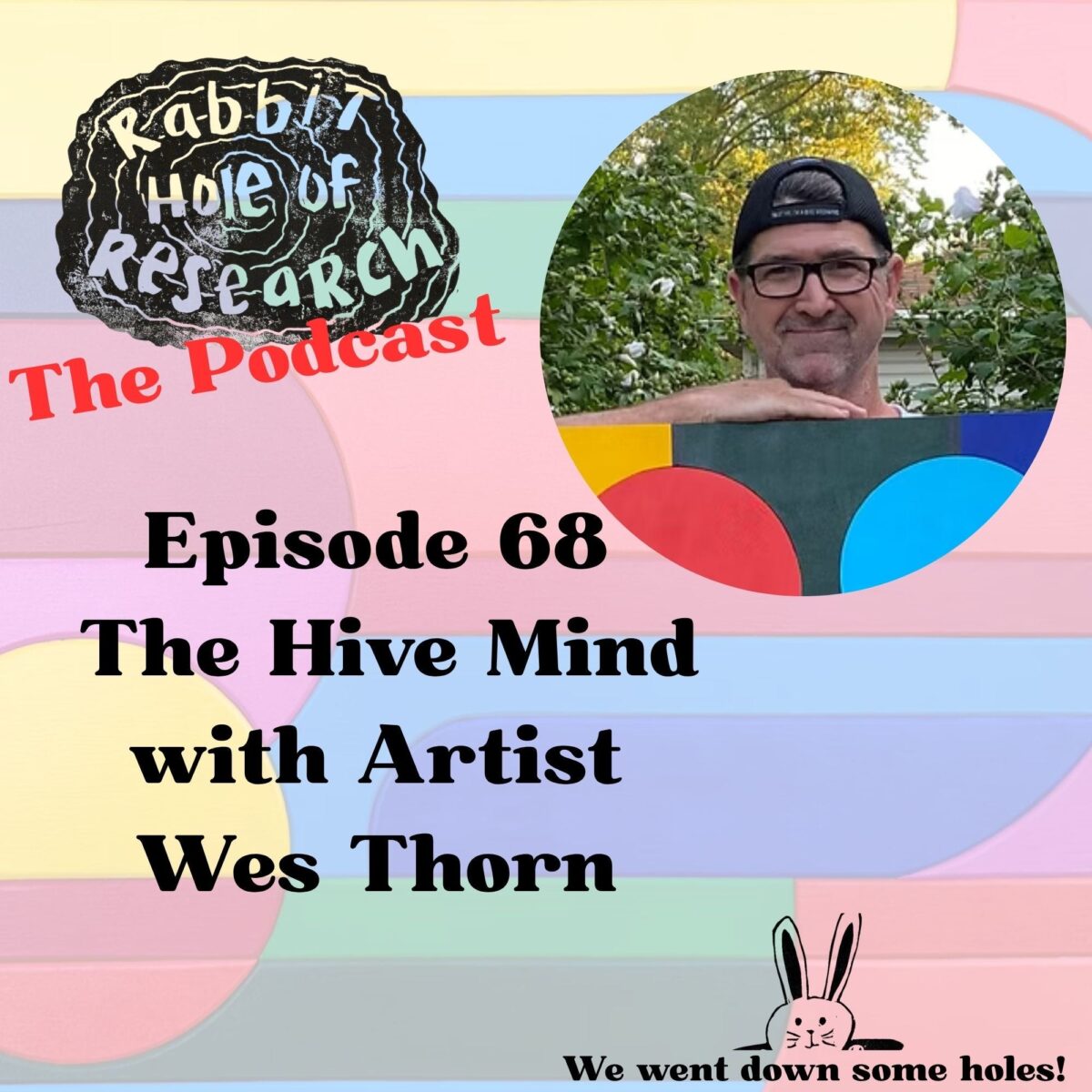
Rabbit Hole of Research Episode 68: Hive Mind: The Newsletter

with guest: Wes Thorn

What if the scariest thing about a hive mind isn’t losing yourself, but finding out you never had a self to lose? Resistance may be futile.


In the 68th episode of Rabbit Hole of Research, from the Basement Studio, Joe, Nick, Georgia, Mary, and returning guest Wes Thorn (last seen defending the Simulation Hypothesis in Episode 26) dive into one of science fiction’s most unsettling concepts: the hive mind.

It starts with a simple question: is the private voice inside your skull really yours? From there the crew tumbles down the rabbit hole of collective consciousness, exploring nature’s original hive minds, bees, ants, slime molds, and the 80,000-year-old aspen grove that is technically one single organism, before asking what science actually knows about consciousness itself. Spoiler: not much. There are 29 competing theories and counting, and researchers still can’t agree on a definition.

The crew discusses Apple TV+’s new show Plur1bus, (no spoilers) a show about an alien signal decoded as a genetic blueprint that folds humanity into a single collective consciousness. The crew debates individuality vs. collective good, whether a true hive mind can have a leader (Nick is unconvinced), the Borg’s mythology-breaking queen problem, and what separates a hive mind from a cult.

Along the way they get into noetics and non-local consciousness, acquired savant syndrome, yoga philosophy’s concepts, the complexities of fungal networks, and whether the internet is already a proto-hive mind or just a very loud echo chamber.

And at the end, everyone has to answer the question: would you join?

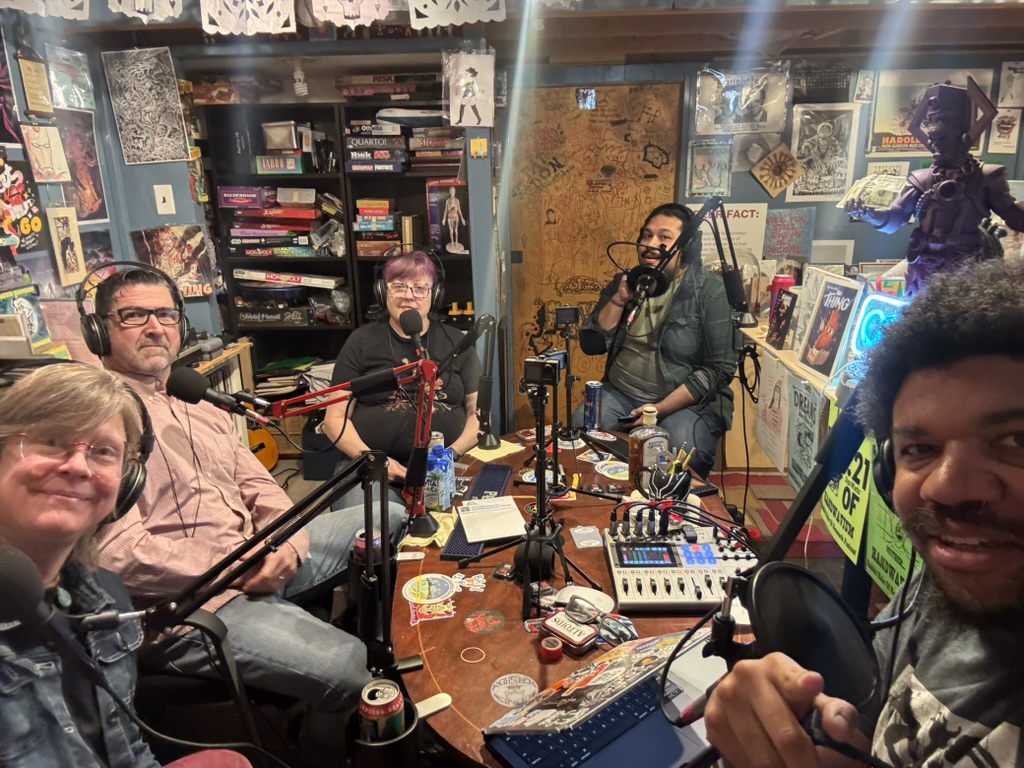
All Crewed up in the Basement Studio with guest Wes Thorn

Come see Joe on several panels at ConCarolinas– Charlotte, NC (May 29–31, 2026 ) 


Check out what the RHR crew is creating:

Joe:


Future Events to Hang with the Crew:

Podcast Cross-Appearances

Events & Conventions:

  • ConCarolinas – Charlotte, NC (May 29–31, 2026 ) – Joe attending as Guest
  • Slay the Lake Chicago Pride Book Fest Soundgrowler Brewing Co., Tinley Park, IL 60487 (June 27, 2026 12PM-5PM)
  • Shore Leave 46 – Lancaster, PA (July 10-12, 2026)Lancaster Wyndham Resort and Convention Center
  • Dragon Con – Atlanta, GA (September 3-7, 2026) – Joe attending as Professional

It’s Science for Weirdos

Want to support the show? Tell your friends. Follow us on social mediaDiscordshare the podcast, and let us know what topics you are excited about. Leave a Comment. And for email alerts sign-up for the Substack newsletter and never miss an episode, exciting updates or the bonus images we talk about on the episodes. 


We want to Hear From You (leave a comment):

  • Joe, Georgia, Mary, Wes, and Nick all gave their answer at the end, would you join the hive? What would it take to change your answer?
  • The episode draws a line between a cult and a true hive mind. A cult has a leader with a motive, a hive mind has neither. Do you buy that distinction, or like Nick, feel that it’s a technicality?
  • Mary brought up concepts from yoga philosophy, the idea that the “you” you think of as yours is actually a collective of everything that came before you. Does that make the idea of a hive mind less scary or more?

Drop your thoughts in the comments. We read them all, and your ideas often shape future episodes.

Leave a comment


The RHR in The Basement Studio (Left to Right: Joe, Mary, Nick, Georgia)

Future Episodes

  • Episode 70 – Nazca lines of Peru and crop circlesGuest: Lorena SalinasThe crew learns about Peruvian culture, explores ancient glyphs and touch on some alien conspiracies.

Three Part Spider-Man Series to get ready for the new MCU Spider-Man: Brand New Day

  • Episode 72 – Spider-Man Villain Series 1: Lab SafetyGuest: Tera Lavoie, PhDThe science behind Spider-Man’s rogues gallery starts here, with a deep dive into lab safety and what really happens when experiments go wrong.
  • Episode 74 – Spider-Man Villain Series 2: Scorpion and the Other ChimerasGuest: Erin C. AnthonyThe crew explores the science of chimeras, genetic splicing, and what it would actually take to create Spider-Man’s most dangerous foes.
  • Episode 76 – Spider-Man Villain Series 3: What His Villains Reveal About HimGuest: Comic YouTuber, Alex Hanes (@Hanes4Heroes)The conclusion of the Spider-Man trilogy takes a step back to ask what the science of his villains tells us about Spider-Man himself.

Share

Leave a comment

For more stuff (Images, Episode Highlights, events, etc), subscribe to our Substack newsletter!


Show Notes & Fun facts 


Books mentioned:

  • Lose Your Mind — Josh Pais
  • Honeybee Democracy — Thomas Seeley
  • The Wisdom of Crowds — James Surowiecki
  • More Than Human — Theodore Sturgeon
  • Last and First Men — Olaf Stapledon
  • The Midwich Cuckoos — John Wyndham
  • Starship Troopers — Robert Heinlein
  • The First Men in the Moon — H.G. Wells

Films and TV mentioned:

  • Plur1bus — (2026) Apple TV+
  • The Thing (1982) — John Carpenter
  • The Stuff (1985)
  • Invasion of the Body Snatchers (1978)
  • Village of the Damned (1960)
  • Annihilation (movie 2018); Jeff VanderMeer (novel 2014)
  • The Matrix (1999)
  • Avatar — James Cameron (2009)
  • Army of Darkness —Sam Raimi (1993)
  • Severance — Apple TV+
  • The Last of Us (2023—)
  • Mystery Science Theater 3000 — The Deadly Bees episode
  • Wonderman —Disney+ (2026) 

Video Games mentioned:

none in this episode. Come on Nick! LOL


Fun Facts to Impress Your Friends With:

  1. Your brain is telling you a story, slightly after the fact. The “you” that feels like a unified self making conscious decisions is actually a narrative your brain constructs after the neurons have already fired. You don’t decide and then act, you act, and then your brain tells you that you decided. Neuroscientist Anil Seth calls conscious experience a “controlled hallucination.”
  2. A single grove of trees in Utah is actually one organism. Pando, a grove of quaking aspen in Utah, is made up of 47,000 tree trunks that share a single root system. It is estimated to be 80,000 years old, making it one of the oldest living things on Earth, and it has no brain, no nervous system, and no central command. It is also currently dying due to human activity.
  3. Slime mold designed a better subway system than engineers did. Researchers placed food sources on a map of Tokyo at the locations of major train stations, then released slime mold. With no brain, no nervous system, and no blueprint, the slime mold grew a network nearly identical to the actual Tokyo rail system, surprisingly finding the most efficient routes through pure chemical signaling.
  4. There are 29 competing scientific theories of consciousness, and none of them fully work. A 2026 Scientific American feature surveyed research published over a decade and found 29 distinct theories of consciousness. The three most published are Global Workspace Theory, Integrated Information Theory, and quantum theories. Researchers can’t even agree on a definition, let alone a solution.
  5. A traumatic brain injury can unlock abilities you never learned. Acquired savant syndrome is a real and documented phenomenon. Derek Amato hit his head in a swimming pool accident and woke up able to play piano at concert level, seeing the music as black and white squares. Jason Padgett was mugged, hit his head, and woke up seeing the world in fractals, he became a mathematical savant despite having no mathematical background. The leading explanation is disinhibition, the injury turns off the brain’s filtering system, allowing access to processing that was always happening below conscious awareness.
  6. Some scientists think consciousness isn’t in your brain at all. Noetics is the study of consciousness as something that can’t be fully explained by brain activity alone. The Institute of Noetic Sciences, founded by Apollo 14 astronaut Edgar Mitchell after his overview effect experience on the moon, researches near-death experiences, mind-body healing, and intuition. The idea of non-local consciousness, that your mind exists beyond your skull, like music stored in a cloud you tune into rather than generate is controversial, but it’s the one framework where a hive mind wouldn’t require any new technology at all. Just a different understanding of what consciousness already is.

Episode Highlights

  • 00:00 Basement Studio Roll Call — Joe, Nick, Georgia, Mary, and returning guest Wes Thorn (Simulation Hypothesis, Episode 26) are all crewed up in the Basement Studio.
  • 01:09 Hive Mind Cold Open — Joe sets the mood asking whether the private voice inside your skull is really yours, and whether you’d even know if you were already part of a hive mind.
  • 03:17 Simulation Hypothesis Update — Wes reveals he has softened his stance on the simulation hypothesis since Episode 26 — “I have my doubts.”
  • 04:46 Nature Hive Minds — The crew digs into bees, ants, pheromone trails, waggle dances, and whether coordinated behavior is the same thing as shared consciousness.
  • 09:06 Plur1bus Explained — Wes breaks down the premise: an alien signal from Kepler-22, decoded as a genetic blueprint, folds humanity into a single collective consciousness with a directive to retransmit.
  • 10:53 Join or Resist Debate — The crew debates whether losing individuality to the hive is transcendence or horror — and whether creativity survives the merger.
  • 12:25 Borg and Cult Comparisons — Joe draws the line between a cult (hierarchy, leader, motive) and a true hive mind (no leader, no scarcity, no competitive edge) — “there is no Jim Jones in the hive.”
  • 17:58 Internet Echo Chambers — Georgia argues the internet already feels like a hive mind; Nick pushes back that it’s more echo chamber than collective consciousness.
  • 21:49 Escaping Big Tech — Mary explains her effort to starve the beast by switching to Ecosia, deleting the YouTube app, and watching without ads — sparking a broader conversation about algorithmic control.
  • 24:22 Studying Consciousness — Joe brings it back to the science: 29 competing theories, no agreed definition, and the fundamental problem of trying to study consciousness using the only tool you have — your own consciousness.
  • 27:55 Noetics and Savants — Wes introduces non-local consciousness; Joe follows with acquired savant syndrome; Derek Amato, Orlando Serrell, and Jason Padgett — and the idea that the brain may be a filter, not a generator.
  • 32:10 Yoga and Inner Layers — Mary brings in yoga philosophy’s model of the body as layers, and the concept of No Self, teasing out what is permanent from what is just passing thought.
  • 35:54 Plants and Fungal Networks — Joe explains the Wood Wide Web, mycelial networks, and Pando, the 80,000-year-old aspen grove that is technically one single organism.
  • 38:05 Plur1bus Ethics and Food — The crew debates what the joined humans will and won’t eat, and whether the hive’s environmental consciousness is the real motivation behind the signal.
  • 39:20 Opting Out of Plur1bus — Nick asks if you can opt out; the crew explains the 13 immune individuals including Carol, the show’s main protagonist, The crew agrees looks like Mary.
  • 40:30 Fungal Hive Networks — Joe tries to science the Plur1bus model, a tuner that allows everyone to focus on the same signal from the collective cloud.
  • 42:28 Slime Mold Intelligence — Joe explains how slime mold with no brain, no neurons, and no command center recreated the Tokyo rail system using pure chemical signaling.
  • 45:04 AI and Collective Minds — Wes draws a parallel between hive minds and AI, both are collective intelligence without individual authorship, and Joe pushes back on calling predictive text “intelligence.”
  • 46:21 Autonomy and Colonization — Nick connects the horror of losing autonomy to colonization, taking over personality, views, and culture under the guise of knowing better, “basically calling them savages.”
  • 50:58 Cults vs True Hive Minds — Mary argues a cult is a hierarchy not a hive; the crew lands on the key distinction: a true hive has no leader, no agenda, and no economic friction.
  • 57:32 No Self and Collective Power — Mary makes the case that the self is already a collective of everything that came before us, and that authoritarians throughout history have banned group gatherings precisely because of the strength in numbers.
  • 01:00:26 Hive Mind in Fiction History — Joe runs through the timeline from H.G. Wells (1901) to Plur1bus, hitting the Borg, The Thing, The Stuff, Invasion of the Body Snatchers, and the first use of the phrase “hive mind” in 1950.
  • 01:05:00 Cowboy Culture and Fear — Mary and Joe dig into why American culture breeds suspicion of collective thinking, “we don’t aspire to be together, we aspire to be the cowboy.”
  • 01:07:57 Final Thoughts and Would You Join — The crew gives their verdicts: Nick is a hard no, Wes wants a 72-hour trial, Georgia is leaning no today, Mary would have questions, and Joe, wants to be king.
  • 01:16:36 Wrap Up and Thanks — The crew thanks Wes, reminds listeners to reach out, and:

“Stay curious, stay safe… Love Y’all!”


Share

Leave a comment


Subscribe and Share our Substack newsletter to get email updates, never miss an episode, and spread the word!! Don’t forget to give us 5 stars or a like!
Transcript of Rabbit Hole of Research Episode 68: The Hive Mind

with guest: Wes Thorn

What if the scariest thing about a hive mind isn’t losing yourself, but finding out you never had a self to lose? Resistance may be futile.

SubstackAppleSpotifyYouTubeAmazon

joe: [00:00:00] Hey, welcome back to the Rabbit Hole of Research down here in the basement studio. We are all crewed up. You have me, Joe?

nick: Yeah, I got Nick. We’ve

joe: got Nick. We’ve got Nick Georgia, we’ve got Georgia. And

Wes: And you got Mary.

joe: We’ve got Mary and we have a very special return guest.

Wes: Yeah.

Yay

I’m Wes, 

Was here for the, what was the episode I was on last time?

the simulate 

geo: right

Wes: the sim the hypo simulation hypothesis.

joe: There you go. Yep. Yep. So, and this one is just as interesting and hard to define and that’s the hive mind. So we’ll be going over

nick: from what I’ve heard this episode is called The Hive mind.

joe: The Hive Mind.

nick: Yeah. That’s what the hive has been telling me.

joe: what the hive’s been telling.

That’s right. Yeah. I was at

geo: trust the hive though.

joe: I was at the door before Nick rang the doorbell.

Wes: Maybe you can,

nick: did ring the doorbell. What are you talking about?

joe: So

Wes: I think the

nick: not my fault the doorbell wasn’t working.

joe: that’s [00:01:00] a different story.

nick: There’s

joe: doorbell in the basement studio.

geo: So

nick: you think

geo: I

joe: my little open.

Let me get y’all into it. Lemme set the mood, okay? Right now you’re having a private thought. Maybe it’s about what you’re going to eat later. Something you never say out loud. Some new project idea, maybe trying to predict what interesting thing I’m gonna say next. But these private thoughts are yours.

That private space, that voice sealed inside your skull, is so fundamental to being human, that we barely notice it. Your body can be touched, your words recorded, your actions watched, but in your head, you are alone. Now imagine that space has a door. And something has its ear to it. Listening, wanting in not necessarily to control you, just to join you, to think with you, to invite you into something larger than yourself.

Would you let them in? Would that be transcendence? What if you had no [00:02:00] choice? Would that be the most terrifying thing you’ve ever heard? But what if I told you that sealed room of a brain isn’t what you think it is? Your brain is 86 billion neurons communicating, making decisions without you. Hello, involuntary nervous system.

And you have little to no say Your gut has 500 million neurons. That’s your enteric nervous system, or the second brain, along with billions of bacterial cells, your gut microbiome making another set of decisions you never agreed to. And that special private voice you think of as you is just a story.

Your brain tells itself slightly after the fact. So if all this communication goes on without you knowing. Right inside your own private cellular space. The question science fiction keeps asking isn’t really whether a hive mind is possible. It’s whether you’d even know if you were already in one.

Wes: Interesting,

Ooh, 

geo: Ooh

nick: I mean, we essentially are a hive. Yeah.

Kind

geo: like the simulation [00:03:00] hypothesis.

That your inspiration?

joe: was, yeah, sure. I knew Wes was coming back, and you’ll probably make our way there, but yeah.

Wes: Yeah. I’ve

geo: what’d you

Wes: may have changed my opinions a little 

bit on the, 

simulation hypothesis since what, over a year ago, but. Let’s talk about the hive mind. 

nick: Wait. What? What changed it? You can’t just, you can’t leave it like that.

joe: Yeah.

nick: that. 

Wes: That’s another

nick: right?

joe: That’s right.

Wes: So for those who hadn’t listened to the episode that I was on, I was pretty adamant about believing we were probably living in a

joe: a

Wes: simulation,

joe: And that was just for folks to catch up. If you wanna go back and listen. And that was the first episode of season two, so episode 26. So yeah, you can go back and check it out. But yeah, Wes was, he was a defender of Yeah, the simulation.

Wes: Well, I just, I don’t know, it just, I try to always look at things, logic based and based on the evidence that’s [00:04:00] available. And I don’t know. I have my doubts, I have my doubts.

joe: Yeah.

nick: So you haven’t completely stepped away from it, but you’re.

Wes: you’re

nick: Taking a

geo: sure. You’re not as like

joe: That happens. Yeah. You gotta be curious.

Wes: Yeah, I’m not, 

mary: I think there’s a good way to test it. 

Wes: Oh, that’s, that would be interesting. 

mary: End Program. 

Wes: Oh, we don’t have access to that. 

mary: Oh,

geo: don’t listen.

nick: I had a joke for this, but I feel like it would be very inappropriate

joe: Okay.

geo: They don’t listen to us. Yeah.

mary: All right. Oh, darn

it. 

joe: No, I

nick: alt delete.

joe: you went in program. I would like cheat codes, please. So that I can 

geo: okay. 

joe: Tomorrow I wake up with the Yeah, it’d be awesome. 

Wes: I’ve tried

nick: to glitch through walls so many times. It never works. Yeah. I just end up like the Kool-Aid

joe: that explains a lot.

geo: Not

nick: enough.

joe: Okay. Right. But yeah, I think coming back to the hive mind and somewhat that gets into consciousness and what is it and how.

Wes: Yeah,

joe: Undefined. That is, there still is no real good scientific explanation of it. 

geo: And there really is [00:05:00] examples of hive mine especially. Right. Especially in

Wes: in nature.

geo: different animals. There,

joe: there are. So I mean, I think there’s, if I can give a, you want me to give a list for jumping right in? So

geo: I’m

nick: bees for one.

geo: yeah. I’m just saying it.

beehive mind.

joe: and they’re, have shared coordination of their activities. Do they have shared consciousness? Right. That’s the, maybe the definition of a hive Mine is that shared consciousness,

geo: was gonna say, is that the definition?

Because

Wes: We don’t even know if insects have consciousness the way we think about it.

joe: right? Yep, exactly.

geo: Or that they don’t,

nick: I mean

joe: that they don’t.

nick: you also don’t know if the person next to you has the consciousness that you do,

geo: Sometimes you, Hey,

Wes: we’re all having our own experience

geo: and I

joe: you infer that your fellow humans have consciousness, right?

By their actions and what they do. So that’s what goes on there. And for those without video, we don’t have video. Nick and Georgia are sitting next to each other, so, 

geo: Thank you, Joe.

Wes: grab ass.

joe: yeah. Well you guys are laughing over [00:06:00] at your own private joke and not letting the

nick: private joke. That was a very open one. Georgia immediately went, Hey,

Wes: not appreciating,

geo: appreciating it. I think

Wes: the

joe: mind has a unified brain, right?

So they have a unified.

Wes: So in a, the model that’s most in the pop culture right now, in the pluribus model, it’s just one consciousness.

And you can think of all the humans that are in the hive, mine as just appendages of this one consciousness. That’s what it is.

geo: It’s a single

joe: like your brain. I think you have many neurons, many cells that make it up, but really they’re coordinating themselves to, to act. And the insects use social colonies are ants and bees. And so that’s there, their behavior is coordinated. 

mary: They’re just

geo: very good at communication is what

joe: That’s exactly right.

And usually through pheromones, wiggle dances or waggling their bodies to direct 

nick: so going to a club, you just see a bunch of people wiggle dancing.

That’s it.

joe: it. Wiggle hands on.

geo: that’s what we’re missing. We need to do more

joe: and the waggles.

geo: wiggle [00:07:00] dances. See the

mary: the Mystery Science theater episode with the Deadly Bees? 

geo: No.

joe: no, I haven’t seen that one. And

mary: Mike Nelson dresses in the bee costume. Oh

geo: Oh

mary: yeah. He said, well, bees communicate through movement and odor.

joe: That’s right.

mary: And then there was a little pause. I’ll just be using movement.

joe: So, and he’s just adorable. He gets, he’s, he little bee costume,

geo: bco,

mary: You can see it on YouTube and all his little bee costume. And he wiggles this way. And he wiggles that way. That’s so,

geo: so cool.

mary: yeah.

joe: I think the other one is the networked intelligence. So we think of the web, the worldwide web, the internet distributed computation across many nodes that come back. And then, as Wes was saying, you have the sci-fi kind of model where you lose yourself and you just become one shared mind, one shared, consciousness.

And we can get into consciousness and what

geo: and the n thing about pluribus and,

nick: I mean, you have to go to no spoilers, don’t forget. Right.

geo: I think the interesting thing about Pluribus is you’re questioning as you’re watching it if the individual still [00:08:00] has their individual consciousness, or is it just completely a group consciousness?

And I’m not saying that I could tell by watching yet I don’t think.

Wes: there’s no individual consciousness in the. Human appendages that are part of

geo: I dunno. I think there’s, I think

Wes: there’s one consciousness,

geo: but they’ve showed a few hints at maybe

joe: I

nick: army of darkness. You get a hand that has its own consciousness that gets cut off and then turns into a whole nother body.

Wes: Well, sure. I mean,

nick: saying 

Wes: That’s a different universe. I was just talking about that. 

joe: Like you have disembodied limbs, so, The Thing on Wednesday, right? That’s a disembodied kind of entity

nick: or phantom limbs, bringing it into a more grounded reality where I had a great uncle who lost his whole leg and he was like, I have an itch on my knee.

And I’m like, you don’t have a knee? And he goes, I do. And I’m like, I don’t know what you’re talking about anymore. It

joe: [00:09:00] back to your brain that’s making up that story for you.

Like it’s something should be there and you should feel something. And now it’s having that there. But yeah. And we’re talking about  Pluribus and that show was Apple Plus. You probably

geo: highly

recommend it

Wes: probably

joe: should go. You maybe stop here, go watch some episodes. ’cause we, I can’t guarantee we won’t spoil something.

I watched

nick: I mean, I’ve watched absolutely none of

joe: Yeah. So Nick he’ll yell at us. But the show essentially is we get a message from some other species in the universe. We decode the message it leads to some sort of genetic code. We synthesize that code. And then that leads to everyone who gets access or gets infected with that code.

This piece of genetic material. They didn’t join this hive mine. And the hive’s goal is for happiness, everyone to be maximum define happiness.

Wes: I think that’s a byproduct of it, but I think their genetic imperative is to retransmit the signal. That’s, again, that’s their

joe: Under the guise of happiness [00:10:00] is to, right.

So the conflict in the show is that there are 12 individuals or 13.

Wes: there were 13, but the Kasama decided to rejoin a young Peruvian girl.

Sorry about the spoilers,

joe: but yeah,

geo: It’s okay. It’s still,

joe: show then is you have the main protagonist Carol is, I don’t know, one of the angriest

geo: So it really is a, I think it’s really a character study of Carol

joe: It can be. Yes. Yes.

geo: And then there is other characters, individuality. There are other characters that haven’t been that are also immune.

And now, and at certain points, these people that haven’t been taken into the hive mine are interacting. And that, that also, that’s interesting. It’s very, it’s a really well made

joe: Yeah.

Really good and explores. Yeah. But

geo: does bring up all these interesting

Wes: debates about would you prefer to be unjoin, that’s what they call it, joined or unjoin, 

geo: right?

Wes: [00:11:00] Or would you prefer to be part of the hive mind? I see this, I see some upside to it, 

geo: right. So you’re go leaning more into joining.

Wes: I don’t know. I’m like, the questions come up. Well, you’ll lose your individuality. And I’m like, well, I’m an artist and I don’t know doesn’t, but you

joe: you lose your creativity,

Wes: I lose

joe: is no creativity. I mean, that’s the, that’s it. That’s the thing about AI and generative

geo: do, I dunno If you lose your creativity because all those people’s skills and thoughts 

joe: but it’s not

geo: there. They’re part of the hive mine. So could it also be that everyone in the hive becomes more creative,

joe: the hive just directs their energy?

Wes: all they’re doing. At least in the pluribus model is working towards their goal

joe: Mm-hmm.

nick: And

Wes: And putting the planet back to Right. So

nick: so is this, is that far off of a cult? Like

geo: except it’s

nick: end up getting more hive mine, yes. Than anything

joe: do

geo: That’s a really

joe: The problem is that with the cult, it’s, you don’t truly merge. So at [00:12:00] any moment you can. Am I thinking you can actually unculture yourself and go, hold on. What am I doing?

nick: But like the likeliness of getting into a cult and then getting deep into a cult, you tend to not have that ability

joe: are people And that do though, right?

nick: yourself from the

joe: a small number.

geo: Look at Jamestown, right?

I mean, how did all those people do what they did? It really was like a hive. Mine still

joe: I think that goes more to the Borg model.

So the Borg aren’t. Well, so

geo: okay. What’s the Borg model? So 

joe: is a race in the Star Trek

geo: was gonna say Star Trek.

joe: and they’re very technologically advanced. And what they do is any new species they come in contact with, they assimilate into this kind of cyborg ish hive neurological, wet wear hive mind

and you have no, so that it would, initially, it was a true hive mind, but in the, I think it was the First Contact movie, they had a queen all of a sudden, and that [00:13:00] queen had an independent thought outside of the hive. So therefore that’s following more, the Bee model, this u social kind of model, not a true hive mind model.

So BBIS actually is following the true, there is no leader, there is no queen or that we know of. I mean, I could come up not spoiling anything. There could be more things coming later on, but really we haven’t seen that. So in a model presented that’s more true hive, the Borg model

geo: is like a commune, right? Like a, like everybody is equal,

joe: right? So I think

geo: the.

joe: the cult is more like that, that you, where you have a queen

nick: there has to be a main head though. For there to be a hive, someone has to have that central intelligence.

Wes: No,

joe: that’s the whole thing. It’s spread out. Yeah. No head.

nick: there has to

joe: There has to be. So you just have a directive.

Your directive is, and

nick: giving the directive?

joe: It’s

geo: it’s 

nick: So something inside you has that directive

joe: and it’s an everybody, so it’s a shared conscious effort.

nick: So it’s a body inside everybody that has

geo: There’s no Jim Jones in the

Wes: There has no, there’s no [00:14:00] cult leader.

joe: There’s

nick: I don’t believe it.

Like I, again, I haven’t seen the show, but I’m already like, there has to be something. Why

geo: it is hard to wrap your mind

joe: think you’re filtering that through, see this is that individual you want. You’re wanna maintain that and you’re like, there has to be a leader because secretly you want be that leader.

Wes: We should have watched

nick: I would make a great cult leader, guys like I understand

joe: and go get episode one, watch to come

Wes: should. We should just go watch it. 

mary: Nice cold. There’d be lots of coffee and art. 

nick: Well, 

mary: It

what

nick: what

geo: think is so interesting is.

Everybody gets everybody’s knowledge, right? So you don’t need to worry about getting a plumber. ’cause every single human being has the plumbing knowledge

Wes: Or fly the space shuttle 

geo: or a rock, yeah.

Wes: Perform surgery. Anybody could do it. 

joe: There’s no scarcity. So you,

geo: there’s no I wanna say class system, but there’s no hierarchy because everyone is the same.

nick: this is only season one.

Yeah.

joe: season one. Yeah. I wonder what

nick: it two seasons,

joe: a friend [00:15:00] of the show Amron, who did the finance of the future in this kind of hive model, what’s the friction, right?

Because he said every society, you need to have that fri economic friction to move goods and move trades. So in a hive, you actually, we were trying to think of, examples where that broke down and we didn’t in the episode. But now the hive, a true hive mind as set up wouldn’t, you don’t have any economic friction.

You just do whatever you need to do. Oh, I need to,

geo: it’s 

joe: a plumber, you just do it.

geo: there really truly was communism or is it Marxism? I get confused on my isms. But this would be the true communism. Like every single person is exactly equal and you know what I mean?

joe: If you a community, yes.

So if you’re

geo: And think about that. And for this show, it’s not just a little community, it’s the whole entire world.

joe: Oh yeah. Whole world here on Earth. But it seems to be connected to their whole Right. Universal seems

geo: to be an alien 22,

joe: Yeah, that’s right. Yep.

Wes: We don’t even know if the [00:16:00] Keplers are still alive. They transmitted that signal 600 years ago.

geo: Wait, can you refresh my memory about what that is?

Wes: So the we know that the Pluribus, the signal or originated from Kepler 22 solar system around that star, and it

geo: that a real star?

Wes: It is. Okay. And it’s 600 and some odd light years away. So we know that the signal has been traveling for at least that long. So, yeah. And we don’t know if the people,

geo: if they’re even still there, if

Wes: the species that sent it is even still alive, we don’t know.

nick: the people or the species on Kepler

joe: Yes. Mm-hmm.

nick: Have this hive mind as well.

Wes: Yes. It’s I

nick: so that means assume that

Wes: that, yes.

nick: Okay. So there,

geo: it could, there could be a leader.

nick: like there’s a leader, Joe.

geo: Oh right. He’s really fighting

joe: don’t know if there’s a leader. No leader has identified themselves. It’s the same. I think if we go back into, my favorite. I’m wearing a shirt, is The Thing. Right. I [00:17:00] think the thing that it is still, it’s functioning under the hive mind mechanism.

geo: don’t think like one Thing is different than another

joe: No, I think they’re all the same Thing. And I, and

geo: We dunno that though. That could be a very

joe: you all were the things, you would just attack me, but you guys are conspiring to hold back. And so that was part of the psychological effort in there that you, The Thing didn’t actually, and that’s why I think the ending kind of reveals itself because if one was The Thing and

geo: the interesting thing about that

why would

joe: attacked?

I think they both were human or both Things.

geo: Okay. You had to get that in.

joe: I got

geo: Okay.

joe: anytime I can. Yes.

geo: Yes.

I think the interesting thing was obviously that story, that show was called The Thing and then we have The Things

joe: right. From their perspective 

geo: and

was their perspective.

And obviously there’s not a single thing. There’s many things and it’s like these crazy humans and all their fricking Yeah. Weirdness

joe: us for no reason. We’re here just chilling. We just wanna be friendly, make, 

geo: I do think the internet [00:18:00] does feel like a hive mind. Yeah.

nick: Is it a hive mine or an echo chamber

geo: Yeah. I know. I just feel like sometimes, like you were talking about private thoughts and I feel

nick: like

geo: My FI know it’s when you say something out loud and your phone hears it and they send you ads and stuff, but it feels like they even can hear me like when I

joe: It doesn’t work. I’ve asked for particular ads to show up and they didn’t show up.

’cause I wanted to rewatch a commercial and I’m like, show me

nick: are you trying to find?

joe: I don’t know. It was, I

nick: What? Why are you looking for a commercial?

joe: Commercial. Some commercials. They’re, yeah. Or they, something happened. Remember we were watching, I forget what the Tratiors I think,

geo: are you talking about the one where the animals like the car?

I

joe: I don’t know. Okay. That’s a different

nick: All right guys. We’re not sponsored by whoever this commercial is.

geo: right.

joe: I don’t wanna, yeah. They drop us some coins then. We’ll 

geo: it happens all the time where you just, it feels like you’re just thinking something and all of a sudden that it’s on your phone.

joe: Yeah.

geo: But I really appreciate like Mary, you’re not on social media.

No. And I think that [00:19:00] is so amazing. That’s so great at this day and age to be like unconnected

joe: would be the Carol of our group.

geo: Yeah.

nick: So

joe: So in the

geo: Carol’s the

joe: pl she was the one that,

geo: Caroley.

she

joe: so you haven’t seen it either, so Yeah, we, 

geo: I’m a blank.

joe: All right. You two need to watch episodes by the mini, because that’s a, would really

geo: would like,

nick: for a

geo: would like, you would really Carol, I think. Don’t you think Mary would like

nick: Find it in our budget.

Wes: kinda looks like Carol too.

geo: Okay,

mary: I think so. The thing

joe: boy. Yeah, actually you do.

mary: I don’t deserve, I

joe: don’t deserve that

mary: praise.

geo: Are you Carol?

joe: right.

mary: I’m miming

nick: of you

mary: mask off of off of my face. I don’t deserve that much praise because I’m on YouTube all the time. So that’s basically

joe: social. Social media. Yeah.

geo: Yeah,

joe: but you limit in it. I mean it is, it’s gotten that way.

They want that model where you go and you feed into the

nick: Are you using the, like the

geo: it feeds you an A

nick: feature and all that?

joe: I,

geo: so I,

nick: or are you just watching the long form videos?

mary: I stumbled upon, [00:20:00] so I use Echos as my browser. I

joe: delete the YouTube

mary: app and I watch YouTube through the SIA browser on

geo: I’ve never even heard of the SIA app and

mary: no ads.

geo: ads.

joe: Don’t do that. I

geo: Wow. I don’t know

mary: why, but there are no ads when

geo: I then that definitely

nick: Some browsers do let you do that. So 

geo: that

mary: will let you

joe: that. DuckDuckGo

nick: Opera DuckDuckGo, these are all very

geo: These are the ones everybody should be

joe: They’re to tor browsers, so they go, they don’t track you.

Also, they I know DuckDuckGo, some of these other

nick: opera has VPN 

joe: they have ai, generative AI kind of features defaulted off versus the other ones Firefox, Google Chrome, that you have to go in and you can turn

Wes: is interesting. I’ve been put off by YouTube because so much content is obviously just AI generated content is

joe: Yeah. Well you get that, right, right,

geo: Yes. 

Wes: No, not ads. I mean the whole videos. Yeah. Yeah. So I’ve been avoiding YouTube.

nick: I mean, it really depends on like [00:21:00] you. Knowing your creators

joe: That’s right. Yep.

nick: This is a show that you can contact us and we will message you back. Not even like trying to plug us, but we are real people.

Like we will talk back to you, we will give you very human

joe: are real.

geo: us.

Wes: Please

geo: contact us.

nick: But 

joe: Reach out. Yelling us. Tell us what we got

nick: just one of those things like knowing the creators that you’re watching the videos of. And yes. We don’t have video right now, even though we’ve promised that a

joe: Yeah, we did. Yeah.

geo: we have these little cameras

joe: We do. Yeah,

Wes: Hey, I forgot

mary: can see how beer I drink during podcast. 

geo: Mary. I wanna get back to the internet thing.

nick: Oh, I thought we were talking about Carol. I

geo: back to the, well in a minute. I want, okay. Mary slash Carol. Yes you can.

mary: Right.

nick: Right? I.

geo: So the fact that this browser is one of the browsers, like Joe talked about, that it’s doesn’t default to generative ai right?

Content. Yes. Do you feel that, do you [00:22:00] feel like most of the things that you get. On your feed and YouTube is real creators or do you feel like there’s a lot of ai?

mary: I think that’s

joe: yes, it’s a browser, not it’s a browser. Not sounds like when you type in a Google,

geo: but do you say that it defaults to the fact that

joe: So when you do Google now you go and you go, tell me something about, hive mind. Let’s use that. Or episode you’re doing some searches, trying to get some research done.

You’ll get an AI generated summary of content that pops up and that then directs where you should go and what you should look at. It has things, there’s ads sometimes embedded in there. The top hits the, with these kind of factors. SEO factors that, that bump up a page, that’s what you get first.

And you usually have to move that out the way to get to the true search results. Research papers,

geo: So like the browser

joe: these other browsers, they don’t pop that up. You get the true search, you get the pages that come up. That’s right. So

geo: it doesn’t affect what you get on YouTube. So you go to 

joe: yeah, YouTube is its own

geo: on the browser. [00:23:00] Yes. And that’s where you are watching. So,

mary: and I just noticed that, well, I just noticed that I’m trying

to, I’m trying to wean

myself off

of

of the more egregious 

big tech that’s out there.

geo: Mm-hmm. So, including 

mary: Gmail and

joe: And Google.

mary: So instead of

geo: using Chrome,

mary: I’ve been using Ecosia. 

geo: Mm-hmm. 

mary: And Ecosia, when I li and I deleted the YouTube app. I’m trying to,

joe: in my own small

mary: way to starve the beast because

it’s a,

yeah. They’re,

I they a

disproportionate 

joe: level of influence.

mary: over.

Yeah, everything right

now.

and and I can’t, we can’t stop it all, but I can do my part

Yeah.

In that to sort of, pull the legs out.

So one of the practical effects is I’ve been able to finally listen to YouTube, like the things I like to listen

joe: to mm-hmm.

geo: without it giving you an a, a,

a, oh,

how do you say that?

Algorithm?

nick: Algorithm?

joe: Yeah. Well, the [00:24:00] algorithm

mary: is still there,

joe: It is.

geo: Okay. I’m not getting

mary: the ads.

geo: Okay.

mary: And I just noticed it. I was, as I was listening to, as I was listening, I usually listen to YouTube.

I like, I put it in my pocket and just

nick: do chores

mary: listen to long form podcasts

joe: like this, like the rabbit hole of research, rabbit hole of research. You can find us.

nick: Wow. We’re really plugging ourselves this

joe: I was gonna, yes.

I’m sorry, go ahead. No, I was gonna bring it back a little bit because one of the things when I did my, the research and.

oh, down

Through my own rabbit holes was coming back to consciousness because I think you have to define that. And that led me to thinking about the, some of the science of Plubirus risk.

How would you have an interlinked hive mind? How would you really do that? That is through this idea of consciousness. The problem is, as I said, there is no real. Definition, there’s 29 theories or so. Some reports have come out Yeah. Of consciousness. Mark Bitman had a

geo: like a single

joe: There is not. It is very, it’s one of the most unsolved problems [00:25:00] in science and

geo: Wow, that’s so interesting.

joe: as well. The problem is like the simulation hypothesis with Wes coming back, going for this, when I started doing my research, it was like, oh, this is a nice end cap because that it, it’s hard to study something if you’re in it.

So our only tool to study consciousness is our consciousness. So you really can’t get outside of that to actually study it. So if we’re in a simulation, we really can’t study if we’re in a simulation because you’re in it. So it that’s always a problem. If you’re in the thing you’re trying to study, how do you study it?

So usually you gotta send something outside of you. And then do it, but Right. We don’t have that. So why, 

geo: like science,

a lot of times things, these big breakthroughs come from people that might have been trained in other areas, in

joe: Look at it in a differently way. Right. Different tools. They’re applying tools, but the tool we have really, our consciousness is what

geo: like an, we need like this alien group to come and study us. And then, but would we

Wes: a whole nother

joe: that’s right. Yeah. That’s, would that,

geo: would we trust their,

joe: that’s right. [00:26:00] Their judgment. Are they telling us what’s right? Are we looking at those results? So you’re, I mean, it’s like trying to study.

geo: Would they care? That’s a

joe: that’s the other, it’s like studying, trying to study the water in the ocean.

If you live in the ocean and water is around you and you, what tools do you use to actually figure that out?

nick: like we study the air and we live in the air.

joe: We have a lot of tools, but air is made up of other elements that we have tools to actually monitor and measure what those elements are. So we truly do have other tools to measure these other physical properties.

geo: some, what are some ways that scientists are trying to study consciousness? Can you tell us that?

joe: Yeah, I mean, I think some of it, and what I found was you go and you start, Wes you look like you’re about to jump in or you got

Wes: go ahead. I’m wrapped. Wrapped with your attention.

joe: I was like, you look like I look up and you were like, you’re ready to jump in there.

But I, I think a lot of it is this idea of consciousness that we’re having, these internal thoughts. Then do we have. Techniques that we can [00:27:00] record our internal thoughts or record what we’re thinking or how we’re processing

geo: how certain things in your brain light up

joe: Yeah.

So exactly. And so functional MRI, so this is a magnetic resonance imaging but functional part of it is that they can actually follow blood flow, see different parts of your brain light up, use this as a tool to go, okay, you are, you’re having some conscious thought, you are having some kind of, a higher thought there, 

geo: a lie detector?

nick: It

joe: would not be a lie detector

geo: Isn’t that trying to figure out if your thoughts are true. 

joe: Well, we, we did an episode on the truth and lie detection. Yeah. That’s measuring, right? That’s right. Yeah. So it’s not measuring consciousness per se, it’s measuring kind of an outward projection of how you’re feeling.

Heart rate breathing rate, respiratory rate. So that’s where you get there. So your fear of 

mary: not

being believed.

joe: Right. So, 

geo: it’s like your blood 

Wes: there’s a whole subculture of people that think that consciousness is non-local.

That it’s [00:28:00] not located in your brain. It doesn’t depend on your brain to be generating it. And

joe: And that’s a noetics

geo: what group? Yeah, 

Wes: he said it Noetics

geo: noetics is the

joe: idea that there’s non localized consciousness, that your brain activity alone can explain our conscious behavior. And so Noetics is this kind of idea that all the consciousness think of it like a cloud for your iTunes or Spotify.

So all the music live somewhere and then you recall it and you have recall of that, and you can bring it down and you have access to it. And so Noetics is like your consciousness, everything you know and learn. Are floating somewhere in the uni, in the ether, and then you can pull it

geo: Ah that’s hard to,

joe: That’s hard, dude.

And so one hard, two, two areas where it, people have backed this One is near death experiences and people experiencing things that they see. And there’s a lot of, it’s, there’s some interesting studies where like people have, they describe things and [00:29:00] then some, doctors, they’ll put like signs or papers.

They started putting it on top of a tall shelf. So you go, I’m floating off. Then they go, what was on that paper that was up there? And then they go, what paper? So there’s some interesting things

geo: looking down onto their

joe: but the other interesting. One I found was this what’s called acquired Savant syndrome. And so these are cases where someone had a traumatic brain injury Yep.

Recovered, and then had a phenomenal ability so they could speak perfectly. Another language. They became a a maestro of piano playing or an instrument. And so there was no they couldn’t play before, couldn’t speak the

geo: is somehow they tapped into

joe: That’s right. Like a radio, like they, like a radio station.

They tuned in. Their brain had an opportunity to tune into it.

Wes: Yep.

joe: And so you could, their brain tuned into the frequency that was just right to get that information. And then when they woke up, they all of a sudden could do this amazing thing. Yeah. So I had a few. Derek Amato, he hit his head in the [00:30:00] swimming pool accident and he woke up.

He could play piano at a concert level, never having any lessons. He sees the music as black and white squares flowing through his head. Orlando SRO got hit with a baseball at 10 afterwards. He could remember every day’s weather day of the week, personal events moving forward with perfect AC accuracy.

So yeah, Jason Paget. There’s, I mean, a couple examples I got hit in the head, woke up seeing in fractals and became a mathematician savant. So he had been a fur, a furniture salesman before, no mathematical background, so woke up and he just could do this amazing thing. So this idea of noetics that’s it.

And the, I, the other thing is that our brains have suppressors. They’re actually, we take in a phenomenal amount of information and we really can’t process all that information. And function. And so your brains are actually actively depressing, right?

geo: out this stuff,

joe: What’s happening? So maybe the signal is coming in, but your brain is just filtering the signal out because there’s so much noise.

If I

geo: But I [00:31:00] wish my brain would realize, I would love to do concert p be a concert

joe: That’s why I think in ris, maybe that’s what’s happening. Maybe the genetics signal that got sent this kind of genetic thing was a tuner that allowed it to tune and focus. And so now to focus, now you’re only focusing on one particular thing out of the cloud.

And everyone’s focused on that. And then if that message changes, then everyone focuses on that. So we gotta go and do repair some infrastructure. We all then tune in. Everyone has the skills to do it. We know our jobs. There is no hierarchy. So you just show up. And you were performing heart surgery one minute.

Next minute you’re digging a ditch and fixing the sewer line. And this goes to the, I think the ARC episode where we talked about that. Where at point at Nick, ’cause we had that conversation and I think you had brought something up like this. If you’re the surgeon, then go build a barn. Like we

geo: I

nick: finish the surgery first. Don’t go start digging that.

geo: want the surgeon to hurt their hands, so.

joe: Well, that’s the thing. And this universe,

geo: It doesn’t matter.

Wes: a surgeon. Anybody’s a ditch

geo: I’m, yeah, but [00:32:00] that’s usually not the case.

joe: There’s,

mary: there. Well, when you were talking about consciousness, you know how hard it is to. Study yourself

nick: while you’re

geo: in this

mary: thing. I’m thinking about this through the lens of yoga, which, 

I’m

joe: I’m interested in it.

geo: And

nick: wait, is this because you went to yoga today?

joe: No.

mary: I

geo: She actually teaches the yoga.

Wes: Yeah. 

mary: So,

joe: Yeah. So, yeah. She’s a yogi. Is that term? Yeah. Yeah. Oh,

mary: I’m a yoga

joe: Okay.

mary: And in, in yoga philosophy the human body is thought of as

joe: layers. 

mary: Mm-hmm. 

joe: There’s 

mary: your physical layer of your body, and then there’s the sensations that body has your level of

joe: attention and your thoughts and feelings.

And then finally, your

geo: consciousness. And

mary: yoga is very interested in teasing out

what is permanent and what is temporary what is your fleeting thoughts and feelings versus your consciousness. Huh.

And you do that through meditation through

geo: practicing

mary: the [00:33:00] postures.

joe: So you know, when you

mary: see people, like through, through movement and through also through

geo: breath, like the wiggle dance,

mary: that’s, what’s that?

geo: Like the wiggle dance?

nick: Absolutely.

mary: Through the wiggle dance.

joe: Back to the wiggle dance through the wiggle dance. What, through, through that you, you sort of tease

mary: out you, yeah. There’s ways to separate that may, not, maybe not

nick: as, is that like the chakras or is that a different

joe: That’s a, that’s more

mary: of a different thing, but it’s more there’s like yoga is yoga philosophy thinks

joe: of the body

mary: Thinks of us as layers.

And like the final, the most inner

joe: layer is the consciousness. And then 

mary: you tease out what is your thoughts versus what is real versus

What are your thoughts, which are

joe: are transitory? Interesting. Yeah. Yeah.

nick: No, but I mean not, so your thoughts aren’t real in this, right? So what are your thoughts? Like just

joe: your thought,

mary: your thoughts

nick: Just like fleeing

mary: your thoughts are temporary and what you do when, because we can get overwhelmed in thought, get lost in thought, and

geo: confuse

mary: our [00:34:00] thoughts with reality. And one of the rea and one of the things that we can do to step back from that is to use our breath and, to consciously just remember

joe: To take a breath,

mary: What does it feel like to take a breath end out Right. Right. Probably a warmer exhale

and something like that. Just, it’s almost like a timeout for your

joe: body. Yeah. It reminds me, yeah, go ahead. Go ahead. No, appreciate that. And then

mary: With yoga, we

we get control over our thoughts so that our thoughts don’t control us.

joe: Yeah. It reminds me of the book Lose Your Mind, and I’m slipping on the author right now, but he’s he’s his dad worked on the Manhattan Project and he became like an author actor and he is now an actor coach. And the whole idea is that when you’re going for an audition, you’re going on stage, you’re doing improv, you’re doing all sorts of things your body can take over and sabotage you.

And so he’s teaching people how to take your thoughts and how to use your breathing,

nick: Is this, ’cause you watched Wonderman recently?

joe: this was [00:35:00] not, but it was, we thought about Lose

nick: you watched Wonderman and that’s where you’re getting this

joe: But it

geo: It’s a really good book.

joe: Yeah.

geo: It’s a really good book.

joe: he had that whole premise, and that was the whole thing about breathing, about channeling your thoughts, 

geo: taking

joe: letting go

geo: and looking at something in a different way so you realize, oh, that’s my, you know what I mean? Like just your thought shift,

mary: your focus from

geo: thoughts.

Exactly. Back to, and he has a lot of, he has a lot of exercises to do this and stuff. Mm-hmm. Like it’s really good. Yeah.

mary: Oh,

joe: awesome.

geo: I, thanks Sarah. I’ll have to check that

mary: that out.

joe: out.

nick: out.

joe: Yeah, by oh I just looked it up. Josh pe

geo: PECE. I was gonna

joe: lose your mind.

The path to creative invincibility is the

geo: this would not have been, this would not have been helpful at all, but I’m like, his name starts with a J but that would not

joe: would,

nick: man, you really gotta tap into that.

joe: it’s a j Dave High. You had a high mind. Let me pull from the universe. The conscious cloud. But the interesting thing about con, ’cause we talked about it and we do this ’cause we’re human, so [00:36:00] we always have a human-centric point of view, but there are other organisms and one are our plants.

And one can question are plants conscious? Not because like bees ants, they all have a nervous system. They have a brain, so you can make the jump. Okay. Yeah. They are doing things in a court and they do have a consciousness. But plants don’t have a nervous system as we understand a nervous system.

And so are they conscious or do they have conscious thought? Are they, this kind of awareness of their environment? And there’s a lot of evidence that they do.

geo: it does. And it does seem like they’re collective because you have all that root system going down. And I think, I’m especially thinking of mushrooms and fungi.

joe: mushrooms are different. They’re

geo: all, oh yeah. But they have that, they do, they have that interlocking system of roots, and it seems like they all become one.

Mm-hmm.

That’s correct.

joe: Yep. Yep.

geo: much like

the,

joe: they’re

geo: the pluribus. 

joe: But then they

nick: becoming one or is it just one?

joe: It’s just one. Usually it’s just one.

[00:37:00] That’s right. And that’s 

nick: because what if you replant a different part of it elsewhere? It’s not like it’s still connected. It’s a separate entity.

joe: Now those are two, so there’s two concepts there. One is cloning. So if you, and that’s asexual cloning. So if you take a piece of the plant or the fungal and try to regrow it, then it’s a genetic copy of the original and you’ve made a clone and they could be separate and they’re not there.

I think what George is referring to is the interconnectivity of the actual organisms themselves to form one kind of thinking organism or being, and so in Utah you have the grove of quaking aspen, and it’s considered one. Single organism and it, but it’s like 47, 40 some thousand tree trunks share a single root system.

Wow. And so they go, it’s 80, 90,000 years old, something like that. The oldest living thing on earth. And it’s just there’s no brain, no nervous system, and it, but it’s a unified kind of a organism. And it’s, and sadly it’s currently dying because of [00:38:00] human activity. So, that’s that’s, that there,

geo: It’s gonna,

nick: another AI data

geo: and that’s, I feel like that’s really the motivation of the pluribus. Beings, or however you would say being is to save the world. Like they, they’re really like want to save resources and they wanna be more,

Wes: they won’t

geo: environmentally conscious won’t, they

Wes: even pick an apple.

Even though they picking an apple won’t kill the tree. They won’t,

joe: part doesn’t understand that because there are fruits like that.

So you’re not killing it, but you are. There

geo: are, you’re actually helping

joe: apple. So even if it falls to the ground and you eat it, you still are ingesting, right?

geo: They’re

Wes: with picking up windfall.

joe: know, but it’s still a living. It still is living as it was on the tree. So I think that’s a little, ’cause the cells in the apple are still doing stuff.

I mean, when you have an apple in your fridge, you pull it out, those cells are still biologically active. They’re not, you’re not eating a dead thing.

nick: Can they eat bread? Because bread is yeast and yeast is living,

joe: the yeast is dead in the bread.

nick: But you [00:39:00] had to use the yeast to

joe: did have to

nick: so that means you’re killing it to eat it.

joe: Yeah.

geo: they will

Okay. We’re not gonna go too much into what they eat. Okay.

nick: Wait I have a whole discussion

joe: Yeah, I think so. Yeah, you’re right. 

geo: We’re

Wes: Not in the show,

geo: We don’t wanna do,

spoiler. 

Wes: No,

joe: this certain a

Wes: not much of a spoiler. They will eat any processed food that already existed prior to their

joe: arrival or create.

Yeah.

Wes: So they’re okay with that.

nick: Are you able to opt out of being part of their cult?

geo: No.

we, you gotta watch the show. You gotta watch

nick: are you then killed? Or is it

joe: No, they don’t kill,

geo: you gotta watch the show because

joe: people, 13 people who originally were not susceptible to this

geo: they didn’t get so

joe: they could not be, so Carol, the main protagonist she did not become

geo: so she is the main character and she,

joe: figure out

geo: struggle is how much does she wanna fight against this? And how much did, because her, yeah. So,

nick: no matter what she does, they [00:40:00] won’t retaliate or No.

geo: no, 

Wes: they won’t retaliate. 

geo: There’s

fine, there’s some fine

joe: She pushes the envelope.

geo: There’s some fine lines and some interesting, I don’t wanna say blue

nick: for some good anarchy. Carol

geo: say, I don’t wanna

joe: would have a lot in common. I think. So it’s like you would love Carol.

geo: would love Carol. Yeah. Yes. Interesting. And there’s some loopholes that she’s trying to

joe: to exploit.

geo: but then they, but the chive mind is trying to exploit some kind of loopholes

joe: and that this questions okay. I don’t

geo: don’t, yeah. No,

joe: But I was gonna say back to the fungal point, that’s the Mical networks that they have underneath.

And so I think there’s a number, I think organ, there’s one of the largest interconnected fungal masses.

geo: makes

joe: makes that you have

geo: the last of us so scary because that’s fungal based.

And fungi, the

joe: controlling like a hive mine

geo: and that is like as far as like organisms of the earth, they have the greatest Right.

right.

nick: Fungal

joe: Organisms. Yeah. Greatest one. Sorry.

geo: [00:41:00] That is the greatest number of. Beings on earth is fungal. I

joe: know. I

geo: I

Wes: don’t know. There’s a lot of insects.

There’s a lot

joe: of insects, but

geo: I don’t know. I think fun. I think

joe: would be, but microbial just has, I think they have the numbers there because even in like us,

geo: are you talking about an extreme of

joe: We have no, this normal files,

nick: you just had to get that one in. Didn’t.

joe: But even, I mean, so it’s funny

geo: We’re a normal file.

joe: even in like insects, they have microbes that are live on them and interact with them. Fungals. So every species has their own group of kind of microbes, their own

geo: the highest percentage, but I could totally be wrong.

I don’t know,

joe: Per species, I think you’re just

geo: maybe, could you say the more complex they’re the most,

joe: I don’t know. I mean, all right. I don’t wanna offend the fungal

nick: I do, let’s go burn them all down. No

geo: No,

joe: no, yeah.

geo: fungal is our friend. A

joe: a lot of, I mean, there’s a lot of. Organisms on earth that have a lot of numbers and they’re just smaller so they can reproduce.

Are we [00:42:00] talking about, do you take each cell of the being and say, that’s a

geo: so easy to grow.

joe: So

geo: if you just get a

joe: per volume

geo: you get a dark like a box and you just a little, 

joe: they need to eat though. Yeah. Everything needs to eat.

geo: and that’s true. 

joe: Fungi

geo: I feel like they were pretty easy to grow. They are.

They are.

joe: they are,

geo: they’re tasty.

joe: easy to grow. Yes. I’m not gonna say that. And then people write those. These are the hardest things I’ve ever grown in my life. So, okay.

geo: I had an idea, but, oh my gosh. I’m, I think I might have forgot. Sorry.

joe: Some other interesting things I had that I thought was cool and still lack nervous systems is the slime mold.

And their problem solving, how they can come together at these they will go and sort of the most famous thing was that they took the a map of Tokyo and they put food sources in all the major stops.

geo: Okay.

joe: Okay. And then they put slime mold on, and then the slime mold found the most efficient route to all of the.

Food sources that they put on all the stops. Darn. And that [00:43:00] mirrored the actual subway the station their transportation system. So they were looking, so they used that as a, can we figure out a more, they were trying to figure out a more efficient way. ’cause the slime mold was going to,

nick: what is a slime mold? What is this? I’m sorry.

Did you explain that? 

joe: I didn’t. Yeah. So I

geo: No, you didn’t.

nick: Okay. I was like, yeah, wait I have slime in my car. Can I go get that and it’ll eat things? Well, 

joe: It’s a single cell

nick: What? You don’t have slime in your

geo: Oh, you mean

joe: on a sec. Go ahead. No, they can.

nick: is

mary: explaining. 

joe: Slime mold is a single celled organism. Amoebas are slime molds they were originally classified as fungi, becasue they make spores, but they’re not. So that’s hence the mold part of

geo: they’re not extremophiles,

joe: not extreme of files their family would be Protist the kingdom of Protista

so there’s different kingdoms instead of fungi, animal, or plant . And so that’s

geo: what do they look like? Can we like post a picture when the show notes

joe: picture. They’re these little, I mean they’re like amoebas these little. Slimy things. I’m showing everyone in

geo: oh. They’re colorful.

joe: They are colorful, and they will, [00:44:00] they’ll, they’re individuals, but then they’ll come together as a multicellular organism at differnt parts of their life cycle . especially when food is scarce or replicating They’re they’re predators, so they actually will engulf other organisms to eat them. They’ll form a slimy kind of mass. They’ll find food and they’ll act like large amoebas. They’ll come together, but they’re just an individual selves and they’ll group together communicate and then do their work and live their best lives.

So

Wes: so we could make an argument that these are hive mind

joe: That’s exactly right. That was my point. But I guess I gotta explain what a slime mold is to you. Sorry.

nick: didn’t know what

geo: I’ve never heard of a slime mold.

joe: but they have no kind of central command.

geo: so cool.

joe: have one mission. That’s to live, that’s to survive, that’s to eat, that’s to replicate.

And they just move. They just move forward. So it was really

Wes: perfect harmony. Yes,

joe: harmony. And they mirror, so humans figured out this is the most, efficient, railway system. And then you actually ask them, oh, go find it. They’re not going to, they can’t, they don’t have, they’re not gonna dilly [00:45:00] dally.

They wanna make the straightest easiest line to these kind of

Wes: Yeah. It’s almost like we asked an AI to figure it out for us. I mean, and in, and a hive mind is a Georgia mentioned, it’s like communism.

It’s also like an ai intelligence.

joe: It is. And ai, we, I mean, I wanna be careful ’cause we always say intelligence and it’s a predictive model based on math and

geo: what you put in is what you get out’s, right?

joe: you put in things and then it’s going to go, what’s the highest, what’s, if it’s making a sentence, it goes, what’s the predicted word that should come next? Right. So, if you go the, excuse me the ball bounced down the stairs as it’s writing that sentence, it goes the ball.

Then it has to choose what did that ball do? It’s not gonna put Bumblebee in because that doesn’t make sense. So it’s predicting you rule things out and then you construct a sentence that way. And that sentence is just based on the information that was put in. So the material that was put in the point at what humanity had contribute to that information.

[00:46:00] That’s it. But it has no sensory, it can’t create it, can’t look

geo: say slim old over ai? That’s what I’m, 

joe: are I

nick: I

geo: I vote slim. Old.

Wes: At least it’s organic. Right?

joe: Different organ, different episode I think. But yeah, that’s you can

nick: versus ai.

joe: go there. Yeah, let’s set it up. That’ll

nick: be our next episode. We’ll win.

geo: So, I did think of my point. I think the biggest thing is the question of individuality. And if we wanna lose our individuality and our consciousness, and this makes me think of. Invasion of the Body Snatcher. And I think that’s very similar to Plubirus.

That idea of, and actually they could be fungi ’cause they’re plants. Well I know fungi iss not plants, that connect. I know. But that connective thing, and then they make the pods and stuff. Right. 

joe: I was gonna say, avatar also follows the world of avatar.

nick: The last Airbender

joe: No, the Avatar. James Cameron, avatar with the planet. It’s all in connected.

And they [00:47:00] can take their little hair loops and connect into the organism. It’s, but this a tree and it’s the whole planet is 

geo: I guess that gets into the whole thing, like connecting in with nature.

nick: I thought you were going with the colonization view of that. I was like, wait, where are we going with this?

joe: No, but I think that’s the horror of all this, and in a psychology and fiction is losing your autonomy,

nick: but that’s colonization, like to a T what this

geo: is. Mm-hmm.

nick: you’re taking over someone’s personality.

You’re taking over their views, you’re taking over their. Do

geo: you think you know better and you think that you should take over, oh this culture that doesn’t know

nick: to America, calling them savages. Right.

geo: Which, when they’re actually have a lot better take on how

nick: And is that is that where this pleis is coming from?

Are they thinking that the way we were now that we are savages and that we need to be changed? If not we are going

geo: but

nick: to these

joe: in here and say something, is that in those models there that you’re [00:48:00] bringing up, Nick, where we went somewhere at, other humans went to another place

nick: I was gonna say we

Wes: I was gonna say we,

joe: and they did it.

Us right now, we,

nick: Joe, I think you and I had, it’s been a long ride,

joe: have been along for the ride, but not in the way we weren’t making decisions. 

nick: Yikes. Joe. Gotta dodge that bullet.

geo: Yeah. Which side of a colonization were you on? I’m

joe: what I’m saying there. But I was gonna say that those decisions in those narratives were set up. To justify doing something that people would find morally objectable.

Right.

geo: And taking over the land. Taking over what

joe: Reason to kill ’em. Right, right. That was

geo: take over their land and take over the resources and make, basically make money.

joe: not necessarily hive. I think that’s, that goes into this economic friction.

nick: the idea

joe: you don’t have that

geo: But

nick: is getting the people behind you,

geo: the motivation of the pluribus

nick: entity is gonna be with a problem taking over.

geo: So you are back to the there is some [00:49:00] alternative motive.

nick: Yes, I am. That is a very hard stance for me not to get off of.

Wes: Yes, you’re right. In the pluribus model, we find out, I’m gonna try to do this

nick: without

Wes: spoilers, that the hive mind is, they say they cannot lie, but they didn’t say they cannot manipulate.

So we think that maybe the hive mind is manipulative even though it can’t lie or kill. So

joe: yeah,

Wes: what you’re suggesting is not out of the question.

nick: Thank you. That’s all I need to hear.

joe: But you gotta have, you gotta have some motive, right? So that motive has to be there. ’cause you go through all this and you want to have some, even cult leaders had a motive to do what they did that could be powered, that could be for, free love or whatever

geo: mentally ill and they

joe: they wanted something out of that. So that’s the thing about the hive mind and this consciousness when you tap into it and when people join it. And then can they unjoin? ’cause you do, that’s this idea of Indi[00:50:00] 

geo: And I think that can be, like Nick said, very difficult to unjoin a cult

joe: and we’re at bread, I mean, we are autonomous at some level.

Like we do come together we do. Work together. I think, what is it, 150, you’re gonna have close relations. Everything after that is in the periphery. So we do work, we are social organisms and animals, right? But we are, we also have our own thoughts and we

geo: But I do think that you could be in maybe a cult-ish religion. You could be really in it deep.

You’ve been born into this and this is all, that affects how you think

nick: And then trying to get out of that religion, you have people that will just disown you,

geo: right?

nick: that same, your problem. So

geo: your whole being relates to

joe: your sense of

nick: you need,

geo: Yeah.

joe: selfhood is that question. And is your self hood, do you ignore yourself hood or do you join group hood? I guess if we’re gonna, 

mary: would argue that AOC cult is [00:51:00] not a hive mind. It’s a

hierarchy.

geo: Exactly. Yeah,

joe: Touched on that.

Yeah.

nick: it emulates a hive Mine. They have the person at the hi art.

geo: they want there to be a hive mind and they’re controlling it.

joe: it. So I think that’s why it separated Hive. I said that I think hive minds, there is no controller, so I think you just have a collective group, so a you social kind of group. And in a true hive mind, there is no.

Wes: agenda,

nick: don’t think there can ever be a true hive

geo: but I think going back to Nick’s point, and going back to Wes’

nick: has to have that main,

geo: he’s saying there has to be some sort of end game.

joe: like the slime

nick: a motherboard

geo: there has to be a motivation.

nick: your computer.

You have to have the motherboard to, run everything through it. To run any process. It has to go through

joe: I think you’re thinking about this from a very humanistic point of view, human-centric point of view.

nick: we are humans as far as I know,

joe: the problem with studying any of this. Our consciousness is that we are filters through, we, our tools are limited.

And [00:52:00] so really it’s about let’s, what would it look like outside of that? What would it be if we didn’t have selfhood as our driving factor? You’re our driving impetus

geo: But I do think it’s cultural. I think there’s certain cultures that are very much more into the collective than the individuality. I do think 

joe: but still at some level I think money. I think status, I think you, you start off with these very high moral morals. And then what happens is these things aren’t factored in and they corrupt the system. It’s one of the reasons I think communism as it’s set up, it failed because certain people then will take advantage of the system.

geo: And there’s always,

nick: which is what a,

geo: the wealthy part.

joe: is a little better because it factors in that everyone can make it

nick: oh, I thought it was initially corrupt

geo: it’s It has a lot,

joe: unless you run away.

geo: of problems too, right.

joe: Unless capitalism runs away and then a few people take everything and then they keep telling people that they have a chance to get things right.

So

Wes: I think we’re there

joe: are right. We are there and all these systems

geo: the

joe: we’re [00:53:00] going up against.

nick: I feel with capitalism, you get the corruption already ingrained into it to begin with. So you walk into it with the idea, alright, this is corrupt from the start,

geo: You 

nick: but at least we know the corruption.

joe: right.

That’s the idea. Yeah, that exactly. But. But once a few people

nick: is where the hive mind comes from, the corruption is ingrained in it,

joe: But no that’s not a hive mind, I mean a hive mind. Right, right. Let’s say that now you collected in with someone else, so you share their thoughts. Really, you’re the same body, you’re an autonomous body, so you go and you’re just doing, you have the same mission, the same idea as the same knowledge.

There is no, you can’t get ahead. You can’t fall behind because anytime I learn something new, you’ve learned it. So I really don’t have a competitive edge. I

geo: really hard to wrap our mind around that,

joe: that’s the thing you have I think if it’s 

nick: thinking of something having, just being all so good and nothing wrong. I’m so sorry, Wes. I feel like we’ve just cut you up for a minute. But, having that idea that this pleiss is [00:54:00] so above all that it does no bad, that it’s only thing in life is to do good.

Add something to

Wes: to this. She one of the joined members gives an analogy to one of the Unjoin people. Carol. She says if you saw somebody drowning, would you. Ask for consensus. No, you would just save them so they see the unjoin humans as drowning. Okay. So

joe: Right. Right.

Wes: that’s the analogy they give.

joe: They don’t have, I mean, as in the show, as it’s

nick: by the way, I do that you, when you said Carol, you gestured at Mary in

joe: our video here.

nick: That was a great just,

joe: but that’s the hive mind. As a setup you’re really just one. So we all would be on this podcast with equal knowledge and then just taking turns talking

nick: this conversation would go nowhere.

joe: would probably be a very boring, ’cause everyone else would know, right? I mean, that’s so let’s say you had micro hive minds.

So you had your close [00:55:00] associate group and you 20 people would all have the same knowledge, the same

geo: I think that’s what a co-op is supposed to be.

joe: That’s exactly it. Except you go one step level where every thought, every decision is innate. It’s just should we play Scrabble tonight?

There’s no question. It’s not even asked. It’s yes, we’re setting up the Scrabble board. We’re playing. That’s the level, I think in the you social kind of model where there is a queen or king leader. Then they dictate, then you go to them and they go, yes, we’re playing Scrabble tonight. And then everyone plays Scrabble.

So the right, the Scrabble, the cult of Scrabble. But then,

nick: if someone initiated that idea and everyone else agreed right away, because it’s already, that idea is that one person that’s initiating that

joe: The idea is just, and there is not an

nick: that you think that’s, it’s the unknown.

joe: the idea.

There. There is no thought, there is no thinking. You just do. 

mary: I love when 

joe: you get choke up on this.

nick: Yeah, this one is great. This one is like one of those ones where it’s 

joe: I 

mary: love it. 

joe: You gotta suspend [00:56:00] your brain for a second and just go

geo: is like Carol, I

Wes: I’ve had a lot of conversations with people and this is where people get hung up on this show, is they cannot wrap their brain around.

nick: Who would wanna be in part of this? Don’t think

Wes: about it. They give you something to do. They give you a place to sleep. They give you three squares a day.

geo: I don’t know. You

joe: know, they don’t give you squares.

They’re just, it’s just

nick: is this jail?

geo: I think.

No, watch

joe: filtering it through

Wes: jail. You’re out in a world doing

joe: I think western’s still filtering it through human experience really. They just go to gymnasiums, they lay down when they’re tired and then they go, right. Yeah. They come together and then when tasks are required in their area, they just go, I’m gonna go do this task.

I’m just gonna go. Right. And they eat. They don’t eat. Eating isn’t time. It’s when you’re metabolically needed to eat. So you have this whole process. So really you disassociate all of our human social constructs into just existing .

geo: And I think it’s funny because I think, I’m sorry, Mary. No, it’s [00:57:00] okay. Go ahead. But I think it’s funny because I think this show really brings out, like some people would be like, oh yeah, I wanna be in the I mind and other people.

Oh no, that’s horrible. I do think it just really gets at this like very unique thing that some people like, and some people don’t like.

joe: Right. Exactly.

geo: And there is

nick: a benefit to

joe: collectively or are working collectively. There is. 

mary: Mm-hmm. 

joe: One of the lines of capitalism is that you

nick: can do

geo: everything all by yourself.

joe: And that’s

mary: just,

geo: and that’s just not true. And

joe: going back to yoga there’s a con, there’s a concept in yoga that’s called No Self.

geo: And it’s hard to, it’s hard to explain exactly.

joe: But

geo: it,

nick: the way

geo: I see it, and I,

joe: and forgive me, I may be wrong, but we are,

mary: This being called Mary

Jones is the product

of everything

nick: that

mary: came before us. Mm-hmm. Mm-hmm. Back to the

last

universal, common ancestor, who’s,

And so

we, [00:58:00] so what I

of mine, mine own, it’s actually

just a collective of

my ancestors.

right?

We,

and then as a collective,

well it’s, it is beneficial for to do things collectively,

people, our resources and to be more social.

One of,

one of the exact, and of things

that’s that dictators or

authoritarians like to is to ban groups of people.

And

some that would, extreme strength in numbers, There’s strength in 

numbers 

there. Author authoritarians love

to ban large gatherings 

or

or even

any gatherings. There’s 

are, 

I me the name name, but of them, like

More

than two people

together

together outlawed. Mm-hmm.

Because

if get

people together.

it’s

not so much in that

the mind.

We, we think

of it as some like just a [00:59:00] thought that originates or throughout the 

But there 

ideas life that 

hold and we of them as sort spontaneously generating. But what is somebody generated they think they either wrote

it down or they 

it somebody else, and for whatever reason it, boy, it

just.

catches on like wildfire.

But some, in,

in 

a human model, has

express it. They can’t just think it.

joe: Right, 

right. We don’t all have that. Right. But I would like to, yeah.

mary: before we leave

nick: today, 

mary: I would like ask people what their. like to see before we, I’m gonna, I’m gonna do go viral so to speak.

joe: I’m gonna do before we do that. Sure. And final thoughts. ’cause I think there’s a couple probably people have a couple questions asked a group we’re not, we don’t share hive mind. But I wanted go through the literature. I like to do this the example of the hive [01:00:00] mind because I think in fiction and narrative fiction you do set this kind of individual versus, loss autonomy.

And so I have some, my little list

geo: and then there’s a whole other rabbit hole that we can’t go into ’cause it’s too late.

But mind reading and mind control.

joe: Oh yeah. Like the episode we did on that. So,

geo: cues. Yeah. Anyway, sorry. Go ahead Joe.

joe: so I had, and if someone has something earlier, please chime in. I had the first men in the moon HG Wells literature in 1901.

I think that was the

geo: oh no, I knew about one that was in 19 hundreds.

Sorry. It

joe: the yeah,

geo: just kidding.

joe: it had the it had insect like aliens with kind of a biological caste system. They weren’t exactly emerged it consciousness, it was more like a u social kind of environment. And it was really the first kind of where fiction biology, came together to form to see what the society would be like. 

We move forward by the last and First Men. Olaf [01:01:00] Stapleton, 1930 first known use of the term group Mind in science fiction. And it goes through billions of years of human evolution and they develop some sort of telepathy kind of thing where they’re going through and, this, the group mind is an evolutionary endpoint of humans that we get there.

And then we’re all running there. 1950 James h Schmitz, second night of summer, first use of Hive Mine as a science fiction concept. What year was that? Excuse me. And so 1950 and it was originally in the Galaxy of Science Fiction magazine. And so that was the.

Official people’s official birth a year that I found of that where you go in there you go forward, you have a lot of these are more insect base. The Mid Witch Cuckoos by John Windham, who also did the Night of the Triffids my favorites of 1957. This book alien Children Born in a Small English Village, share a [01:02:00] collective mind and use it to protect themselves from the humans around them.

That might sound familiar because that was the premise for Village of the Dam. So that was the same story there. So we jumped the film and TV Invasion of Body Snatchers, classic pod people emotionless. Collective kind of mind they go through, almost like ris, they just have their jobs, they do what they do and they go forward.

You have a few humans left that they want to assimilate The Thing we mentioned that 82. Yeah, go for it.

nick: Is severance the same model or No, it’s another show I have not

joe: no. Severance is not No,

Wes: that’s a totally different thing. But I am very eager to talk about that one too.

geo: That’s, we keeps

joe: ping me about a Severance episode. We’re waiting for the next season to drop and then we will probably jump into

nick: actually watch that one. I swear. I mean, I’ll watch this one too eventually. But yeah, if we just need to get that subscription,

joe: Where’s our Apple sponsorship? A

nick: collective mind

geo: subscription. I think that

nick: the 

mary: Thing is an, the thing I was gonna say, 82 the [01:03:00] Hive Mind. Absolutely. That’s right. Because every single part of it is its own distinct. Yeah.

Feature that they all come together 

joe: and I think like Georgia pointed out the thing John Carpenter’s, the thing is told from the perspective of the humans trying to assess out who is become a thing, who’s actually losing their autonomy and becoming part of the collective. Peter Wells did The Things where it was from the things point of view.

So a really different take on how that would look and feel for that story. So, 

oh, interesting. 

Yep. Then The Stuff, one of my favorite B sci-fi movies, 19 five. It’s about a parasitic organism that people eat and then they become a collective

geo: marshmallow goo

joe: marshmallow go very similar to Plumas.

’cause people have, they eat or ingest the genetic signal the Star Trek Borg that, that’s in there. The X-Files, the black oil, remember that’s there. It’s an alien

nick: oh, I forgot about that.

One episode

joe: infects humans and works towards colonizing them. The matrix [01:04:00] is part of humans are farmed and they’re tethered into a collective mine.

So you have, right, so you have collective kind of hive thinking and a simulation, so that merges into

Wes: with a high, yeah, with high poss

joe: Yep. So those are ones that we go all up to a pls on Apple

nick: you missed Rick and Morty too,

joe: I’m sure I missed quite a bit and

nick: go

joe: maybe people will write in and let me know where, but I’m just hitting some highlights, the big.

A landmark, a merging of ideas, I thought. But you’re right. I could go on for probably another 20, 30 minutes of listing.

nick: I thought that was your whole thing today. You were gonna go

mary: through

nick: everything that’s ever showed up.

joe: Oh boy. Yeah, that’s right. Yeah, no, I just wanna get people some things to think about go back, watch the movie, think about what we’ve talked about.

And even getting to, I think Mary’s question on that you were trying to lead into, I wanted to have that so people can go out, watch RIS and see what we’re talking about. Give us your opinions. I think it’s

geo: kind, and hopefully it’ll come out on DVD and you can get in the library. Not just apples, but Exactly. Ready for physical media. [01:05:00] But

mary: yeah. One the things

I is interesting,

especially in our culture, the

thing that fear, at least

been the big fear

for

the last

70 plus years at least, is working together collectively.

Right. seems to

to 

because we would cut out a lot of middlemen, we would cut out a lot of people that are like money grabbing

Yeah,

Yeah, they

entities in our culture, the, this, the, don’t know what

we aspire

to

is to be cowboy, to 

be alone. to be 

self-sufficient, 

self-sufficient, self-contained 

and 

then,

then 

the culture is giving little things like

working together is suspicious.

I won’t, 

joe: right, Yeah, 

mary: right. Yeah, yeah.

nick: exactly.

joe: Yeah. So socialism collective, collectively working together, it just, it sparks a fear in people. And I think that’s very interesting. I think the thing that it’s fearful is that you’re gonna miss out, right? Because, I mean, ’cause we are, we live in a capitalist. I mean, we’re all we’re all good Americans.

We all were born as [01:06:00] capitalists. We’re good. That’s our society. Maybe you’re

nick: man,

joe: you’re a good capitalist also. You spend your dollars buying things. So, but that’s who we are. And so in that type of society. You can really then take people and even some of our divisive politics, I think, I don’t get into politics that on this show we can talk in private,

nick: You don’t? I thought we had a whole episode of that.

geo: I

joe: don’t, but you know, you have people. I think the thing is that you see people at the top of the heap and then they say you one day you could be like me. And this is why you shouldn’t do these things that could benefit you right now to get you on your way to that.

And it’s really interesting because we bought into this kind of, this group, think that this is the path, this is the way we

geo: to be successful.

joe: we become successful. And individuality is a lot of that. Like we can do it on our own. We can beat a lone wolf, we can beat a cowboy. And that’s bred into American kind of almost all narratives breed into that.

And it’s this journey that we are [01:07:00] stronger as an individual. Then as a group. And that’s, it’s really interesting. And in movies, the horror of a lot of them is losing that and what happens, right, right. When you lose that and it is, it’s scary. You don’t trust That’s right.

geo: the

joe: It’s a Nick point that someone’s in the lead position so we all know that happens.

Right.

nick: bad

joe: and it’s a,

nick: There are no,

geo: so, Mary, your question is, I don’t know if I totally understand your question.

nick: is your question? That’s not

joe: a question. I, it’s not more

geo: of

mary: a question. Were you asking me if I was a cowboy?

think it’s, 

joe: I’m not a cowboy. It’s okay.

mary: I 

geo: mean, I think it’s

mary: right to be suspicious of

nick: my mother was a cow.

geo: Well, 

nick: I think it’s

joe: and my dad was a boy.

geo: that q that people shut up

mary: are suspicious of

of of things believe of cute

theories are 100% into something like you anon

where see

who is 

actually 

feeding

this into thehy V. It’s 

and there’s.

joe: no,

geo: no. Incred incredulity

joe: that.

But anyway, but what I

geo: wanted to say is there any [01:08:00] idea

joe: or

geo: any bit of self, any bit of expression that you wish that you could

joe: send out into the world that that would catch on into

geo: the headline? Empathy. Empathy. Yes.

joe: Research podcast. The Rabbit Hole of Research podcast.

geo: We Wish.

nick: Yes. Third plug for this episode.

geo: We

nick: I think it’s at

geo: of listeners

Wes: Smash that subscribe button. That’s

joe: right. Yeah. The get us out there. Well, how about

mary: you, Wes? 

joe: What, what

what, 

mary: would, idea

do you think that

should be out into the wider world?

Wes: Yeah. Empathy. It’s the thing that we’re missing right now and the divisiveness in our country right now is at an all time high.

I don’t think it’s been this divided since Vietnam. Sure.

joe: Yeah. Civil rights movement, I think. Yeah.

Wes: Civil rights movement. Vietnam, I think Vietnam and civil rights movement were happening at the same time. It’s just, okay I’m biased and I don’t wanna, I don’t wanna scare away people that aren’t necessarily thinking the way I think, so

geo: that’s okay.

joe: Yeah. We’re not a, we’re not a conscious mind. So that’s a, this is what we are here for. Be curious.

Wes: Yeah. [01:09:00] There’s a lot of things going on that I think the brute problem right now is nobody really knows what’s true and what’s not true. I think the way the information is right. Distributed now that nobody really knows who’s telling the truth.

Right.

joe: Yeah. And

geo: And that’s a good plug for our one episode.

joe: Yeah. Our pro. Yeah. We

nick: Our only one

joe: Episode on,

nick: only have one

geo: no. We have an episode on

joe: we do.

geo: Yes. That I think you will enjoy. I think you’ll enjoy that one. Wes. I

joe: enjoyed it. If you haven’t,

Wes: I’ll have to check it out. I’ll listen to it on the way home.

geo: but

I think, yeah, more or less. Accept acceptance and understanding of others.

But I’m merely excited. Like this year we’re going to, well we’ve, we have been doing a garden, but I think that’s a perfect example of different people coming together and have a goal in mind and growing things and sharing, yeah.

nick: Our own little commune.

joe: Yeah.

nick: Our own little cult. Is this the beginning of our cult? You will

joe: first Yeah.

geo: will not be the leader. Okay.

joe: I think

I’m the leader. Alright.[01:10:00] 

nick: Alright. 

Wes: All

joe: I was gonna say, yeah.

geo: about you, Mary? Did you say

mary: I added something more, more specific in mind.

was thinking I actually

heard say

this wouldn’t have you,

the last time that they had the Powerball was hit a billion dollars.

It did, yeah. A couple times now.

yeah. A couple times then 

A couple times though. 

and then they

talked about, this person

is gonna such such money after taxes. someone said, why just tax all billionaires like lottery winners. Yeah. think Yeah, help that. That’s to my point, that, yeah, we don’t do that because people go, one day I’m 

joe: be 

geo: people have the

joe: And I don’t want to get taxed like that. Oof. And then they don’t think about it though. Even if you get taxed like that. So you get taxed at whatever, even 50% of all your money go, you still have 500 million bucks in a bank. That’s it’s so you’re not gonna be struggling like the rest of us here.

So it’s one of these things that, it’s really, yeah.

geo: I can’t afford that planet I was gonna buy.

joe: that’s, it’s one of the things. It’s so much money, the numbers are so big. It’s like talking about the speed of light. It’s such an astronomical number that our brains really can’t [01:11:00] comprehend. When you start thinking billions, trillions of dollars in money,

geo: you have way,

joe: you really can’t

nick: And how are you gonna spend all that? You’re not gonna do anything with it. And we’re very

joe: deferential to the people at the top That’s right. This hierarchy. And at the same time, the suspicion is being bred that 

mary: we start to work together. 

joe: Mm-hmm. 

mary: Wrong. 

joe: Well, I think it’s I

nick: like Bernie Sanders when I go the top 1% Exactly. Of all the,

joe: Well, I think it’s like any, 

mary: yeah, 

joe: anything.

When you look at or try to model, and I think Andy J Pizza talks about this in this podcast Creative Pep Talk is that when you try to model yourself your creative career, art, writing, whatever that may be, any career it’s very hard to, we wanna look at the one hit wonders and go, they came out the gate, they did big stuff, they got splashed around.

They made, it became

nick: became a

joe: but really, you should be looking at the people and not even the people. You look at a Stephen King, he’s here, but look at his early career. What was he doing at the beginning of his career? Cocaine where you’re at. [01:12:00] Okay, let’s

nick: is that not where we were going?

Is that not where we were

joe: I’m talking about building his craft, building his

geo: He 

joe: Working. He worked to earn where he is at. So if you look at that point and go, I’m gonna do that right now, then you would fail. So everything, so really that’s the problem that we have. We don’t look at where people started. Even these billionaires and trillionaires, no one looks at, oh, they got a super head start.

Like they, they inherited a hundred million bucks. So of course they’re gonna have a, a trillion dollars by now. Later in their life. They inherited this money. They inherited something that was done. Go back to that person that they inherited from. What did they start from? How did they work their butts off?

How did they use the leverages of

geo: and is that really, should that really be our goal to be this,

joe: If it that. Well, but if it is your goal, go back there and understand that. But that’s I’m just saying that’s the thing that we don’t do. We look at, and the thing that’s propagated and put in front of us is the shiny coins, and that’s what you should go for.

But really to get to that [01:13:00] level,

geo: but really there’s so much more to life than having all this wealth and making those human connections, 

joe: I, Georgia a

geo: making those memories segue,

joe: ’cause I got, I do have the a question.

geo: Oh.

joe: would you join? Did the Hive?

geo: I haven’t

joe: the show yet. I mean, that’s just what we talked, you, we

Wes: I want a 48 hour trial. Please gimme a 72 hours or

joe: it’s one and done. You join.

nick: I’m causing a

joe: Or you look out like you, I

geo: think you’re No right Nick.

nick: I’m a definite No. I’m causing ruckus for everyone involved,

joe: Nick’s being taken out?

nick: I probably would. Yeah. Yeah.

Wes: just speaking question. In the pluribus model, no, because there was a ton of stuff I would like to do

joe: I think that’s the, that’s a true hive. I actually, I think, I mean, give credit, I think that’s a true hive model. I like the Borg model, but the true hive model. We know in season one, season two could have some

geo: I think, to be

nick: I’m giving all the spoilers

joe: talking about, no, there is no leader. [01:14:00] Everyone shares consciousness.

Everyone shares, thought, everyone shares. There is no kind of economic, financial gain or scarcity. We are all in one, essentially one body with different appendages. As Wes, he laid that out perfectly earlier.

Wes: Well, they talk about, everybody’s happy. Right? But

joe: right.

nick: what is happy at

geo: what does that mean? 

Wes: What concept of happiness are they?

joe: it’s all, it’s a monolith. Right? It’s, there is no, everyone’s happy because you all think the same. So whatever pleasures me, pleasures you, pleasure. It’s all a very,

geo: once you are the hive mind, you don’t even care then at that point?

Wes: point. Right.

geo: And people who, and I wanna

joe: mind, take advantage of this and get.

geo: some days I would

nick: Yep.

geo: some days I don’t wanna join.

nick: pleasured by everyone over here.

Wes: No, there’s a guy that like has a harem.

geo: I said some days I would wanna join and other days I wouldn’t.

joe: So you gotta decide right now in the episode.

We had a good discussion.

geo: I’m in the more, not join today.

joe: maybe the mini will [01:15:00] do it. I

nick: feel like, I think I’m giving everyone

geo: needs to

joe: to be had. Mary, how about you and your yoga? Are

geo: have enough info, I think. Think that I would like

nick: to,

mary: I would like know more about the collective.

Yeah. I would have some questions. I like joining collective. I like joining collective efforts. The rabbit hole of

research is a collective

effort. It is, we are Stay

nick: no, we’re a cult. Thank you. But

joe: one idea, but.

Wes: And Joe’s the leader, or Nick’s 

mary: the

nick: he’s only the puppet man.

joe: No. Right. But I love it. I it people don’t have video. Yeah. But I noticed Mary for the whole episode, had a name tag on it

nick: thought I saw that and I’m like,

joe: talking about individuality and joined a collective.

She rips it off

geo: Well,

joe: yeah, I wish

nick: there from the start?

geo: I

joe: was, yeah,

mary: I realized they still had

my name tag down Midwest

slide.

I car show. noticed it. I was like, that this is being recorded. If this

joe: survives is, if this survives

the edit. This thing that, that got me in yeah, exactly. It was really funny

Wes: I thought, where’s my name tag?

joe: right name. And I just

nick: realized, I thought she put that on for the pictures before the [01:16:00] show

joe: that I still had

nick: it

on and I’m

mary: like, oh, 

geo: heaven’s sake, 

mary: why do you still have this anyway?

But, and so just to be fair, I’ll answer. Right. I would not, I don’t think I would join

nick: Wow. I’m shocked consciousness. Yeah. You

geo: you like being an individual too much.

joe: do. I love being an individual. I’m sorry.

nick: Joe, I thought you

joe: I would’ve to go with

geo: he’s a cowboy

joe: a, if it’s a centric, the u social model of collective, then I would want to be not a drone worker, but the actual, I’m gonna be the king.

geo: oh.

nick: you wanna be, all right. There we go.

joe: Alright.

nick: why you’re trying to get everyone into on it.

geo: on that.

mary: in though. It’s be

gone on that

joe: note. Start a cult. Yeah. The cult of Joe.

nick: Well thank you so much Wes, for being here again.

Wes: Thank you for having me.

nick: Sorry, I had to cancel the last episode,

joe: I’m

nick: that last recording day

joe: Norovirus. Norovirus is trying to get you into the collective probably,

nick: but I won.

geo: He fought. He fought that

joe: and 

nick: gave it. Hell.

joe: Excellent. All right, so you got me, Joe?

nick: Got Nick still

geo: Georgia

nick: still[01:17:00] 

geo: you

mary: got married still.

Wes: and Wes is your guest Today we, and

nick: And we went down some

geo: some

joe: and we’re still US

geo: some collective holes. Stay or whole Say you we.

joe: We love y’all.

nick: Bye-Bye.

“Stay curious, stay safe… Love Y’all!”


Subscribe and Share our Substack newsletter to get email updates, never miss an episode, and spread the word!! Don’t forget to give us 5 stars or a like!
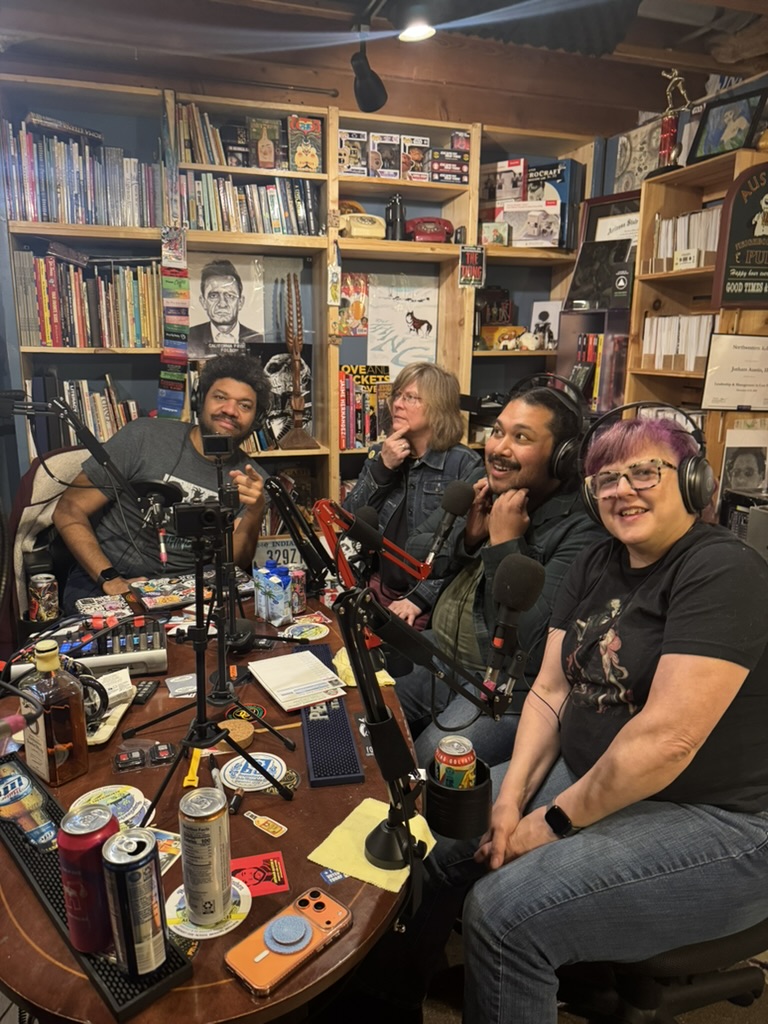
Episode 67: The Mini: Planetary Defense: The Newsletter

The crew revisits Near Earth Objects, Dante’s Inferno maybe the first asteroid impact story, and “Science Holes” about smart fart-tracking underwear and a newly discovered space inside us.


In Episode 67: “The Mini,” Joe, Nick, and Georgia recap Episode 66: Saving Earth From Other Worldly Impact. The crew talks about, Episode 66 guest, Charles Blue’s First Light Con, the world’s first science and engineering fandom convention coming in 2027, Joe’s upcoming panel schedule at ConCarolinas in Charlotte (May 29th-31st), a correction from Nick about Bruce Willis, and a May 23rd DIY podcasting event at the Lake County Public Library. Joe shares a typewriter poem written for the show at the Final Girl Bar, and the crew plays back street interviews from the 5th annual MaiFest in Blue Island, IL where they asked the public the hard questions: Mars or lava tube?

In Science Holes, Joe discusses the history of fictional asteroid impacts all the way back to Dante’s Inferno, smart underwear tracking farts in real time, and a newly discovered fluid network that scientists are calling the interstitium. Nick talks about research that shows monkeys are eating mud to cope with tourist junk food, and the crew debates whether humans should do the same.

The crew closes out with what media they’ve been consuming: Widow’s Bay, For All Mankind, Daredevil: Born Again and the Punisher: The Last Kill, Nick is two episodes into Severance, Georgia is reading Pachinko by Min Jin Lee, Nick has been playing Borderlands 4 and Marvel Cosmic Invasion, and the crew suffers from a case of the Mandela Effect. 

And don’t forget to wish Joe a Happy Birthday on May 21st!!


Listen to Episode 66: Planetary Defense: Saving Earth from Other Worldly Impact


Check out what the RHR crew is creating:

Joe:


Share

Leave a comment

It’s science for Weirdos

Want to support the show? Tell your friends. Follow us on social mediaDiscordshare the podcast, and let us know what topics you are excited about. And to see all the content (studio images and artwork) subscribe to the Rabbit Hole of Research newsletter!

Stay curious, stay speculative, stay safe, and we’ll catch you in the next rabbit hole. Love Y’all!


Future Events to Hang with the Crew:

Podcast Cross-Appearances

Events & Conventions:


Upcoming Episodes

*The Mini will now be every other episode!

  • Episode 68 – Hive Mind: PlubrisGuest: Wes Thorn (returning guest — Simulation Hypothesis episode)The crew dives into hive minds, collective intelligence, and the blurry line between the individual and the swarm.
  • Episode 70 – Nazca lines of Peru and crop circlesGuest: Lorena SalinasThe crew learns about Peruvian culture, explores ancient glyphs and touch on some alien conspiracies. 

Three Part Spider-Man Series to get ready for the new MCU Spider-Man: Brand New Day

  • Episode 72 – Spider-Man Villain Series 1: Lab SafetyGuest: Tera Lavoie, PhDThe science behind Spider-Man’s rogues gallery starts here, with a deep dive into lab safety and what really happens when experiments go wrong.
  • Episode 74 – Spider-Man Villain Series 2: Scorpion and the Other ChimerasGuest: Erin C. AnthonyThe crew explores the science of chimeras, genetic splicing, and what it would actually take to create Spider-Man’s most dangerous foes.
  • Episode 76 – Spider-Man Villain Series 3: What His Villains Reveal About HimGuest: Comic YouTuber, Alex Hanes (@Hanes4Heroes)The conclusion of the Spider-Man trilogy takes a step back to ask what the science of his villains tells us about Spider-Man himself.

Share

Leave a comment


What the Crew is Digging, Links, Resources, and Topics Mentioned in mini and/or full episode:

Links & Resources:

  • First Light Con (world’s first science and engineering fandom convention, 2027)
  • Final Girl Bar (Kenosha, WI)
  • Van Rung — typewriter poet and performer
  • Environmental Encroachment — New Orleans-style marching band, Chicago, IL
  • Blue Island Stray Dog Project — Facebook: Blue Island Stray Dog Project /Instagram: @BISTraysAlex’s art to Georgia for Library Month:

Science Holes:

1) Meteoritics and Dante’s Inferno: Examining Satan’s Fall as an Impact Event

Timothy Burbery 

Timothy, a researcher in the field of geomythology, argues that Dante’s Inferno (written 1308-1314) may contain the earliest fictional depiction of a large-body impact event. In Dante’s vision, the Devil is so massive and falls at such velocity that his landing creates Hell: a massive, circular, terraced crater reaching to the center of the Earth. The modern study of meteors wasn’t established until the 19th century, following the 1833 Leonid meteor shower, making Dante’s intuitive grasp of impact physics roughly 500 years ahead of its time.


2) Smart Underwear Tracks Farts in Real Time

Research presented at Digestive Disease Week, Chicago, May 2026

Researcher Brantley Hall at the University of Maryland developed a gas sensor that attaches to the inside of underwear to continuously monitor gut gas production. The study found that people with lactose intolerance produce significantly more gas than they realize or report. The device offers a new continuous method for studying gut metabolism and could improve understanding of conditions like irritable bowel syndrome (IBS).


3) Monkeys Eating Mud to Offset Tourist Junk Food

A two-year study found that monkeys in highly populated tourist areas were eating mud after consuming junk food given to them by tourists and locals. The mud appeared to create a protective barrier in the gut or replenish minerals disrupted by the processed food. When tourist activity decreased, mud consumption dropped proportionally. The crew connected this to broader research suggesting that soil exposure and dirt contact may actually benefit human health, particularly in children, by supporting immune development and reducing allergies.

4) I knew we were all Plants: 

https://nl.nytimes.com/f/newsletter/dtl4rtId_CfNXeh6lSIpHw

Scientists have identified a third fluid system in the human body, distinct from the lymphatic system (discovered 1622) and the cardiovascular system (discovered 1628). The interstitium is a large interconnected network of fluid-filled spaces found throughout the body, forming pathways between organs and allowing fluids, cells, and molecules to move between them. The discovery came partly from studying tattoo ink biopsies, where researchers noticed ink particles traveling deeper into tissue than the known systems could explain. The crew noted that similar interstitial spaces are well known in plants, raising the possibility that this is an ancient, evolutionarily primitive transport system that humans share with other organisms.


Science Terms:

• Bacteriophages — viruses that infect and replicate inside bacteria, playing an important role in the gut microbiome

• Cardiovascular system — the system of heart, arteries, veins, and capillaries that circulates blood, first described in 1628

• Carcinogens — substances capable of causing cancer in living tissue

• Fascia — the connective tissue layer beneath the skin through which interstitial fluid was observed traveling in tattoo biopsy studies

• Geophagy — the practice of eating earth or clay, documented in humans across parts of Africa, Asia, and South America

• Geomythology — the study of geological events and phenomena as they appear in myth, legend, and ancient literature

• Gut metabolism — the chemical processes by which the gut breaks down food and produces byproducts including gases

• Gut microbiome — the vast community of microorganisms, bacteria, and bacteriophages living in the intestines that help process food, regulate metabolism, and influence overall health

• Interstitium — a newly identified network of fluid-filled connective spaces throughout the body sitting between and connecting other tissue layers

• Irritable Bowel Syndrome (IBS) — a common gastrointestinal condition affecting the large intestine, characterized by cramping, bloating, and irregular bowel habits

• Lactose intolerance — the inability to fully digest lactose, the sugar found in milk and dairy products, leading to gas, bloating, and digestive discomfort

• Leonids — a recurring meteor shower occurring approximately every 33 years in the constellation Leo; the 1833 shower was a turning point in understanding meteors as astronomical events

• Lymphatic system — the network that removes excess fluid from tissues and plays a role in immune function, first described in 1622

• Teratogens — agents that can disturb the development of an embryo or fetus, potentially causing birth defects


What the Crew is Digging:

TV

• Widow’s Bay (Apple TV+) — Georgia and Joe describe it as Stephen King mixed with Twin Peaks, with a creepy old town secret vibe. Released weekly, four episodes in at time of recording.

• For All Mankind — still working their way through the current season

• Daredevil: Born Again — finished, with the Punisher special The Last Kill

• Severance (Apple TV+) — Nick is two episodes in

• The Mandalorian — upcoming, mentioned with excitement

• Obsession — upcoming horror film, crew excited about the marketing campaign which included a phone number and an evolving billboard

Books

• Pachinko by Min Jin Lee — Georgia is halfway through and loves it

Video Games

• Borderlands 4 — Nick has been playing

• Marvel Cosmic Invasion — Nick describes it as an arcade side-scroller beat-em-up, tries to recruit Joe

• The Thing (PS2 original / remaster) — mentioned, along with an unresolved debate about whether Nick ever actually gave Joe his copy


Share

Leave a comment

Love Y’all! Don’t forget to Rate the show!

Transcript Episode 67: The Mini: Planetary Defense

The crew revisits Near Earth Objects, Dante’s Inferno maybe the first asteroid impact story, and “Science Holes” about smart fart-tracking underwear and a newly discovered space inside us.

SubstackAppleSpotifyYouTubeAmazon

joe: [00:00:00] Hey, welcome back to the Rabbit Hole of Research, the mini here down in the basement studio. You’ve got me, Joe. We’ve- We’ve got 

nick: I got 

joe: Nick. 

We’ve got- 

geo: Georgia We’ve got- But Nick’s not in the basement studio Nick is not in 

joe: in the 

basement studio. He’s not usually- here for The Minis

geo: see how he’s like- Yeah … 

you’re 

misrepresenting yourself. 

joe: from home.

And What do you

nick: I get to work from home one

day a week. 

geo: One 

day. 

joe: from home one day a week. Work

from home. Oh, boy. Yeah, we last episode was the Planetary Defense. We had guest on with us, Charles Blue. 

nick: Very good 

joe: yeah, a very good episode. He, 

Talked about his tabletop exercises that simulate responses to near Earth objects, NEOs, as a what we would do if a giant asteroid was approaching [00:01:00] Earth on a collision course, and it did not include sending a bunch of 60-year-olds up on a last, hurrah mission.

Yeah, if anyone, 

nick: anyone was 

gonna be sent up 

joe: up

there, I would want it to be 60-year-olds. Yeah, that’s right. 

geo: You know 

what? Do it. 

Now that, now that… I mean, 60-year-olds, that sounds 

young compared to- Yeah …compared to some 

people. 

joe: yeah. but yeah, it was a great 

nick: Who said that?

joe: It was a great episode. I’m just gonna Move along. I’m Just moving along. I don’t know What you guys are talking about here.

Yeah, it was really fun, so you guys got anything you wanna add to that, or people should go listen to it? and 

check it out. 

nick: I do have to say that I have a correction to make. 

joe: a correction to 

nick: I thought Bruce Willis had passed. 

joe: He has not … it 

nick: brought to 

my attention that he is still alive. 

joe: that’s ’cause Bruce Willis Dies Hard, man.

Come on, you know that. 

nick: Exactly. I don’t know why I 

thought he passed last year. [00:02:00] That 

was a mistake on my 

joe: my end. Yeah. 

when you said it- “I apologize 

nick: to the Willis family … 

joe: I didn’t think 

of it ’cause I thought you were just saying about his medical condition, his mental decline, and he can no longer communicate via speech.

And so that’s what I thought you were referring to. Not that he actually passed, but he was no longer in full capacity of, his health. 

nick: No, I think After that, I kinda just… 

geo: Roney. Yeah, And

joe: After 

nick: where my brain made the jump, where I was like, 

joe: just… Yeah, 

nick: he passed, obviously. 

joe: Bruce Willis is still there. 

nick: things.” 

geo: there. 

joe: Yeah. There you go.

all right? Georgia, you got any corrections? I have no corrections, I was, 

geo: not that I know of- but I’m sure there was probably a few things I probably 

should have 

joe: to talk about.

Yeah. I would like to 

think- 

nick: bring out the list?

joe: Yeah. 

geo: I was 

hoping somebody e- somebody else would let me know what that 

was. Put 

joe: We’ll just have some handwavium, That’s handwavium by the way.

geo: handwavium, 

joe: highlight from the episode Charlie, Charles Blue, our guest, one of the things he’s [00:03:00] doing, I put the link on, is the First Light Con. And it’s really exciting. It’s gonna be the world’s first science and engineering fandom convention. Trying to bring that to y’all in 2027. And unlike other conventions where science is a…

And at the end of that episode, if you listen, he hinted at this, but now I think it’s got some real momentum. And the idea is that most conventions, Dragon Con C2E2,, Mars Con, which are great cons, but the science usually a afterthought. And you have scientists like myself or Charles, science communicators go and then we participate 

on panels. 

nick: scientist. 

joe: Yes. not only… 

I try my best. 

And 

so the idea here is that to have science be the main focus and then the fandom, like our podcast a little bit, that the science sometimes- … as 

Georgia pointed out, on the episode. We try to be science forward and bring in our pop [00:04:00] culture.

And yeah, super exciting. I think maybe here in Chicago might be the home of that, at least for 

geo: And hopefully The Rabbit Hole can- Yeah … 

participate. Be a, 

joe: Be there. and- 

geo: You know. 

joe: Kind of, 

Support and 

I, it’s a really great. So yeah, keep your ears and eyes on the podcast and the newsletter and we’ll bring more about that.

and I think it’s a really great project, 

nick: make sure we post about it and we wanna make sure we support it, 

joe: Yep, yep. 

geo: And I- Events 

nick: and stuff. 

joe: I- Yep 

geo: I think that’s come out in the last few episodes that we’ve done, is just like how you can really geek out about science and, of course the space travel, 

the- Or Tim S 

joe: and- How that, 

geo: How that, was like that feeling of, awe about, but just in general, you know?

Thank you. Yeah. Being curious. Is gonna make it easy peasy 

joe: Yeah. Yep. 

geo: to get science 

joe: Being curious.

nick: it’s– we try to make it an easy beacon into getting into science by [00:05:00] using the pop culture and everything.

Yeah. 

geo: And 

sometimes you don’t even need the pop culture. The science is, 

joe: That’s right. Yeah, 

geo: It, the science- It is … by itself, so- Yeah … I guess that’s kinda what- Yeah

joe: Yeah

geo: what the idea is. 

joe: is. Yep. You go down a rabbit hole and, before you know it, you’re talking about epigenetics and gene modification and- 

geo: CRISPR

CRISPR and 

joe: CRISPR, and black holes and 

nick: to our podcast. You know, you’re already here, just listen to it.

joe: yeah.

through. And speaking of podcasts we will be hosting or being hosted by the Lake County Public Library in Merrillville, Indiana talking about DIY podcasting this Saturday- may 23rd. That’s 

geo: That’s in 

Merrillville. It, it- 

joe: This Saturday? 

geo: Oh my gosh, Nick. 

joe: I forget the time. Is it- 1:00? It’s 1:00. 1 PM yep And-

geo: Central

joe: Time

geo: Time … We’ll probably be recording some of 

that. Maybe. So maybe that’ll be something that we can offer something 

about. 

joe: see Maybe [00:06:00] we’ll have that. 

geo: who all the- Or- 

joe: listen 

to it and 

nick: We’ll see how it 

joe: what we say,

geo: what we say. Exactly. 

joe: Yeah. We might not. No, 

geo: promises … a

nick: have 

joe: hear from it. Well, 

geo: And I hope that nobody 

brings like tomatoes or- 

Yeah … especially, 

joe: in tomatoes? I mean- 

geo: canned tomatoes. Like they don’t throw that at us. 

joe: What is this, The Muppet Show? What? are you 

talking

geo: I was

joe: was- Yeah, right. I 

was thinking 

geo: thinking 

more 

Road- Road House, but- 

nick: not doing 

joe: Road House. Yeah. I I mean- Although Road House, they threw the bottles. 

What happens at the Lake County Public Library?

I mean, libraries are supposed to be calm 

geo: fancy? You, you know what? If they’re not happy with what we’re saying, 

they, it could be a riot. 

joe: Yeah.

maybe.

geo: It, 

I feel

nick: I feel like I need to set up

some material for 

joe: I know. right? Yeah. Could bring some armor. 

Maybe a less rowdy crowd, I wanna say that I’ll be in, at the Con Carolinas starting May 29th to May 31st, and that’s down in Charlotte, North [00:07:00] Carolina, so it’ll be a lot of fun.

I have a bunch of panels. My schedule just came out. I’ll be talking about medical science, fact versus fiction, Putting the science in your sci-fi, and I’m even on an after dark panel, superpowers. Ooh. in the 

geo: Yeah. Oh, geez. I know. How did 

you qualify for that? Hey.

joe: Jeez Louise. I’m teasing. I’m

geo: I mean, geez louise. I’m 

nick: a 

geo: I’m teasing. 

joe: I did. See that, See, I know. I- that’s one of my 

favorite graphic novels. 

Yeah, and 

geo: I don’t know that 

graphic 

novel. 

It’s one where, when you have an 

joe: orc, there’s…

Yeah, a lot. Oh, I didn’t know 

geo: that was the name of it. Sorry. 

joe: And then I’m doing the dark side of science you know, licking rocks, and living in a science fiction world, fantasy zoo, and if you could live in any sci-fi 

geo: Wow. These are all- 

joe: fun 

panels. I’ll be 

geo: on. Yeah. 

If you 

joe: are down in the Charlotte area, 

geo: some ideas for episodes. 

joe: That’s right. Yeah, no, that’d be fun. and Maybe some guests coming to y’all How many

geo: you [00:08:00] guys coming to y’all. How many panels is that? That’s a lot of panels in a short time. It’s- Three … 

joe: two, it’s three on, yeah, three on Friday, and then two Saturday, two Sunday. so.

geo: Whoa, they’re getting 

a lot of- Yeah, 

joe: Yeah, usually seven. Six, seven is what 

geo: of work out of you. 

joe: To these type of conventions, and- so I get enough time I can enjoy other people’s panels, and then say hi 

geo: kind of- And have you been to this con 

before? My 

joe: time.

down in… My first time to Charlotte, so if Charlotte fans listening to this podcast, you know,

come say hi and tell me what’s cool to do I’ll go check it out. I got some North Carolina friends, so. 

geo: There you go. 

joe: Yeah, so that’s it. Cleaning up a few things. A couple weeks ago when Phrique was on the Splatterpunk episode, then we Slay the Lake 

happened.

And we actually went to Wisconsin to The Final Girl Bar, which is super cool. Go check it out. They’re really supportive of the arts and, LGBTQ+ authors and writers and [00:09:00] events, so really cool place. But we actually had, there was a Von Rung, a writer, typewriter poet and performer was there, and they actually did a poem for us.

So they had their typewriter and they would, you give them a topic and your name and things, they write this poem, and I asked them if I could read it to y’all so you could share, in this. it was really cool. We’ll hang this up in the studio so whoever come visit you can see it. 

“A Salvo Fragment for the Rabbit Hole: of Research Podcast.

Have you 

ever considered the scientific basis for telepathy? 

Or if 

vampires existed, what their genetic code would look like. Then friend, you have found your home. Dive down the rabbit hole. Down there you’ll find a strange biome. Abandoned lighthouses and neon-colored mold. Time warps like a Doppler. And Edith, horrors unfold, and we’ll attempt [00:10:00] to crack the code.

So

geo: Very good. Very good. Yes, 

joe: nice. That sums it up. I thought that was… That felt 

like- 

geo: felt like I 

was …in the 

middle of a Jeff VanderMeer. Yeah. Oh, yeah. That’s 

right … 

No- a novel 

joe: Jeff Vandermeer. 

Yeah. Oh Jeff Vandermeer is an author … 

You know 

all of them. Sci-fi author. Annihilation. 

geo: Oh.

nick: Oh,

okay. 

joe: Yep, yeah. Was 

geo: didn’t it remind…

gave that kind of vibes, I thought. 

Yeah, it 

did. I li- I liked it. South of Hell or something. Yeah. Cracking the code. Yeah. Yeah. no, I thought that was 

joe: Yeah, no, I thought that was super fun. So very nice. Thank you. That was well worth it. A lot of fun time.

And speaking of fun time, we vended a show, Mayfest at Blue Island we saw some of y’all that listen to the show, came out, supported us.

It was great seeing you as always. and We had a fun time. 

nick: a really good 

time. 

Absolutely. 

joe: It was a great day. Little windy, but, you know, JOhn Streets Alliance was one of the sponsors. They’ve been… They are… He’s real- Jawn is really good and [00:11:00] friendly to artists, so if you’re an artist of any type, 

you 

should look him up and get involved because he puts on great shows around the Chicagoland area, and as always, we had our podcast equipment there. 

geo: And 

joe: and we asked some questions. We asked we had two questions for people to answer. Would you live on Mars, or would you live in a lava tube? 

geo: Non-active lava 

joe: A 

non-active, 

Yeah, I had to explain that ’cause people. 

geo: That does sound really- Yeah, dangerous.

nick: lot of questions about That one. 

joe: yep, But yeah, let’s let’s hear what people had to say. And there was a a New Orleans-style marching band, 

geo: It was awesome … called 

joe: the Rabbit Hole. 

geo: So- Was it called the 

Rabbit Hole? Yeah, he talked about rabbits. 

I thought it was called something else, but he was really into 

rabbits. 

joe: and they weren’t called Rabbit Hole? 

geo: them? You know what? I have the card, I have the card upstairs, but he also is one of the people to talk. 

joe: He did. He did. 

geo: So he’ll- 

joe: about rabbits … 

geo: we’ll just keep an ear out 

for what- Okay … the name of [00:12:00] it is. And- 

But it was awesome.

Speaker 5: Hey, welcome back to the Rabbit Hole of Research down here at Maifest in Blue Island, May 9th, 2026. We are feeling good. We’re all set up at our booth, and we can’t wait to chat with y’all. We have two exciting questions today. One is, would you move to Mars? And the other question is, would you live in a lava tube underground?

Can’t wait to chat with y’all. Peace. Or as Nick would say, bye.

Speaker 6: This is Meg and I would move to Mars why? It just sounds nice up there. Give it a shot. 

Speaker 12: my Name is Yuvia, and would you live in a lava tube underground? I would say yeah. Why not? 

I feel like, yeah, I feel like you need to try new things, and I think that was a new thing for me, so I would say 

Speaker 13: yeah.

[00:13:00] Sorry.

Speaker 2: My name’s Amy, and I don’t think I would move to Mars because I like being able to go outside and not die. 

Speaker 23: My name is Adolfo. Beyond the, so would you move to Mars or would you live in a lava tube underground? Oof.

I think I would w- I think I would live in a lava tube underground. Yeah, for sure. I love it. All right. Cool. Thank you.

Speaker 9: Hi, my name is Liz. Would I move to Mars? Yes. Views would be beautiful, and it’s all climate controlled, which I’m a big fan of. 

Speaker 15: Oh, Nicole, and I would live in a lava tube. Because it was my last chance to live. Wow. 

Speaker 17: HeLlo, my name’s Lisset Leon. Would I live in a lava tube underground? The answer is yes. Yes, I would. I’d rather not risk being on the- On the Earth’s surface. Yep.

Speaker 19: My name’s Bradley. And if I would rather move to Mars or live in a lava tube underground, I think I would rather live in the lava tube. Mars just [00:14:00] seems so far out still. I can be on it. Would you want- Lava tubes, decommissioned, I think I can get down with. I’m a lighting technician, so I’ll figure out a way to bring some space and, you know, light it up down there.

It’ll be all good. 

Speaker 20: Cool. 

Speaker 19: Lava tube’s way better. 

Speaker 20: Thank you. Yeah.

Speaker 24: Oh, my name’s John. I would probably go Lava Tube just ’cause you mentioned Matrix Rave, and that just seems like a hell of a time. So it, it’s- Sorry sOmething about Mars freaks me out. So I’m down with that. 

Speaker 30: My name is Blake Crawford. I’m from Chicago, Illinois, and the question I’m answering is, would you move to Mars? Honestly, I wouldn’t.

I couldn’t see myself living in a desert. I think that just looks terrible. Also, there’s no trees or no green. It’s just all red. That’s like living in the worst part of Nevada You know what I mean? So I’m not really a big fan of that. Thank you so much. Thank you, man. That was good.

Speaker 21: My name is Chris. No. I’m not moving to Mars now. There’s no stuff there. A Total Recall [00:15:00] Mars, maybe. No other Mars seems appealing. Would you live in a lava tube underground? Only the Legend of Zelda 64 Ocarina of Time, ’cause there’s Gorgons, and those guys seem pretty dope

Speaker: My name’s Kim. I would definitely not move to Mars. I’ve watched too much media. There’s too much unknown and no colonization. I would definitely live in a lava tube underground. 

Speaker 26: Sweet. Let’s- 

Speaker: I just feel that’s a safer bet ’cause you said that it was non-active, and I consider myself a bit of a prepper, so I think I could.

Speaker 4: Hey, I am Julian Esparza, and the question I wanna talk about is would you move to Mars? I think it would be fun to move to Mars. I think it’s a little bit different from, I mean, of course, here on Earth. I think I would like to see the difference in I guess the gravity and the differ- If Earth fails, maybe there’s life on Mars.

So I feel like that would be the question I would ask myself. Would I be able to live on Mars? And, I mean, that’s [00:16:00] about it, yeah. 

Speaker 28: My name is Sherry. Would you move to Mars? I have just finished reading the book The Martian, and no, I would not move to Mars. It seems like a lot of work. .

Speaker 32: Hi, my name is Mike Smith. That is my real name. I am from Chicago, Illinois, and I would like to tell you something about rabbits. There is an event called the Billion Bunny March, which is a real event, and it attracts a lot of animal control, and carrots, and people in crazy costumes.

And the band that I’m in was the official band for the Billion Bunny March for many years, and it was a really good time. I would suggest anybody… And we made friends eventually with animal control. They tried to cast a huge net on us. There was like 200 or 250 of them, and but they couldn’t, you can’t stop that many rabbits no matter what.

It was like the furriest little cuddly fun bunch, and that’s, [00:17:00] we hope to bring the Billion Bunny March we wanna bring it in small versions everywhere, including to Chicago. We have a annual it’s called BunnyCon. It’s a pub crawl on Good Fridays. So if you’re in Chicago on Good Friday, you can count on a great rabbit hole, BunnyCon, carrots, everything you would want in an Easter march.

We could bring it to Mars. We would love to take it to outer space, the Billion Bunny March. There’s certainly enough rabbits. If you need to populate outer space, I think rabbits and cockroaches. I think we’ll have enough population for the whole Mars. And thank you guys for having these incredible zines and artwork that’s made out of woodcuts, and real homemade DIY cool artwork.

This is exactly the kind of roots culture that I love about Chicago, and thank you for having such a good time with us today. I’m in the band Environmental Encroachment, Chicago, Illinois.

Speaker 31: Hello, my name is Kathleen, and the [00:18:00] question is, would I move to Mars, or would I live in a lava tube underground? No. I’m going to stay here on Earth where God designed me to be. And I’m with the Blue Island Stray Dog Project, and we’re on Facebook at Blue Island Stray Dog Project, and we’re on Instagram at BISTrays.

We help dogs who are found loose in this city. We get them homes. We feed them. We care about them. We get them homes, medical care, the whole nine. Please follow us on social media. Thanks. 

Okay, would I move to Mars if Donald Trump is still in office? Yes.

Speaker 33: My name is Sharon Powers, and the question is: Would you move to Mars? And I would. I would rather move to Mars than live in a lava tube underground, because I’m thinking I’d have a little more room to space out. I didn’t- I told you my intro. I didn’t realize.

No pun intended, but, you know, to go outside and enjoy the world, [00:19:00] and to see the stars and all that good stuff. . 

joe: Hey, we’re back here So- And we got 

geo: some great comments. Some- 

Some 

great- … 

joe: comments, yeah. Very 

geo: interesting comments Yeah And if we didn’t, if you didn’t catch the name of the band, it’s Environmental Encroachment.

The ma- the Magic Circus Band, unique entertainment, music, costumes, acrobatics, and raw

nick: the whole card.

geo: energy 

joe: Circus Band.

Unique entertainment. Music, costumes, acrobatics, and raw entertainment. I know,

geo: lots of rabbits he went

joe: ’cause he talked about rabbits and, 

Of rabbits yep. He went all about the rabbits and- … rabbits on Mars and all sorts of stuff, yes very, very- Very 

geo: pro rabbits

nick: That’s what

joe: Yeah, so that was fun.

I always, lo- I always enjoy the live events and bringing the little recorder and capturing people, getting them interested in the science, and they’re usually a little hesitant, but then we kind of, “Hey, come on, you can do it.” And Nick was out there handing out [00:20:00] cards and getting 

people to 

geo: He ha- He handed all the f- all the bookmarks that you had 

joe: I did.

So really fun. So- great

geo: I’m 

nick: do, you know? Talk 

to 

geo: great 

joe: Looking forward to next year. It’s always a fun time, the May Fest. We’ve been to all five, so looking forward to 2027.

Something,

I

guess we can… This might be science to science hole segment segueing into that.

Do. 

geo: And sometimes it’s more than one 

joe: It is more science holes. But this one kind of tethers to the planetary defense because usually I give the list and I talk about the references and fiction that may tether to the topic. And since this one was about planetary defense, asteroids, and things crashing to Earth, I had the earliest examples, and I think it was, like, H.G. Wells and The Comet, W.E.B. Du Bois in the ’20s. And I think Nick [00:21:00] said Greek. And I, that, I said no. 

geo: So 

joe: it, it wasn’t Greek, but 1308, 1314, a little ditty was written, Dante’s Inferno. And so a paper came out by Timothy Burberry, and he said, “Although Dante was not a scientist, he was one of the first persons in history to think through the physical effects of a large mass slamming into the Earth at high speed.

And in Dante’s vision, the devil’s size and velocities are such that when he lands,” i.e. the devil, “he instantly creates hell, a massive circular terraced crater that reaches to the center of the Earth.” And he’s speculating that Dante was talking about, the devil is so big crashing down onto Earth like an asteroid, it would cause all this destruction and crater, and create hell on Earth, [00:22:00] which would probably happen if an asteroid hit in that time for whoever’s on Earth.

And just to put this in perspective, the modern study of meteors was not firmly established until the 19th century, and that’s what we talked about in the episode. So even some of those early stories we talked about Halley’s Comment and the fear, I think Charles brought up like cyanide was found seen spectroscopically in the gas cloud behind Halley’s Comment, and people thought it was gonna, poison everyone.

So you had all these phenomena that were still being understood in the late 1800s, so this was, 500 years or so beforehand when Dante’s Inferno was written. It was, 1833 that was the first kind of meteor shower that was studied that astronomers realized that meteors were astronomical events.

So, yeah, so that might be- we can push it back, maybe Dante’s Inferno was the first kind of fictional account of, of meteor and asteroid impact

on Earth. So 

yeah, so I thought that was cool. [00:23:00] Just ‘

quickly cause this we got long episodes we did a few fun things. Of the things I saw and I just thought it was really fun, it was a research presented at Digestive Disease Week. and that was in, earlier 

this month, 

in 

geo: That’s a con you might wanna go 

joe: even wanna know. Yeah, And it was smart underwear tracks farts in real time. 

geo: time. And 

joe: And, 

nick: I don’t know what the fuck I can say about that one. 

joe: you part of this research study? or…? The 

idea was 

currently- 

geo: he has 

dumb underwear 

he has 

joe: some underwear.

It doesn’t- 

geo: Rocks

thank you 

nick: Rocks thank you 

Joe. 

joe: Yeah. He doesn’t, 

it’s and so currently, kinda the idea that there’s no way to objectively measure continuous gas production in the gut for lactose intolerance or other digestive conditions. And and it limits researchers learning about the connection between gut metabolism and these symptoms.

So Brantley Hall, a gut microbiome [00:24:00] researcher at the University of Maryland, and a microbiome- Just for folks, that’s all of the microorganisms bacteria, bacteriophages that make up our gut, that, that live in our intestines to help process food, digest, control metabolism, things like that.

And there’s a lot of research that your gut microbiome is important to your overall health. So- like a second brain 

yes, and 

nick: So 

joe: the inter- nervous system your gut has- 

geo: it

joe: Go 

ahead. 

nick: find it so 

funny that you chose this one because the one I chose also has to

do with the stomach. 

joe: do with the stomach. 

and his smart underwear has a gas sensor that attaches to the inside of the underwear, and the researchers found that people with lactose intolerance fart much more than they think. It was a new insight in how people perceive their own 

geo: Or maybe admit 

joe: And a continuous way to monitor gut [00:25:00] metabolism, which could help scientists better understand gastrointestinal conditions like irritable bowel syndrome. So I thought that 

geo: That is inter- I think we talked about doing a digestion 

joe: We did. Yeah, I think up, I think season four we’ll have to maybe- 

geo: And 

maybe we can reach out to somebody at this, Yeah … digest- 

Brent Hall 

joe: Hall was at the University of 

nick: See if we can get ourselves a pair of those underwear for all

of us. 

geo: wearing those 

joe: We can- … test it. we 

geo: we have to do a test of that too, 

I wonder if they’re comfortable. 

nick: Probably not 

joe: I don’t know how the sensor, how big…

I mean, you’re right. I don’t know. I didn’t see a picture of this, So maybe we gotta get some, do a little more 

digging in. Research. 

But no it’s fun. I mean, a lot of these sensors now, because of the size and what they can do, I mean, this just goes to how we’re really investigating interrogating our biological systems, and there was a, there was another paper.

Maybe I’ll… Nick, you said you had something related to gut? Or, 

I don’t, I don’t wanna spend too much time. I mean, we’ve… It’s a, we’re getting a little long 

but- 

geo: this

quick. make this one quick. 

nick: I’ll do a summary. [00:26:00] It’s 

monkeys that are eating mud to

avoid

upset stomachs from- 

tourist junk food.

joe: junk food. Oh, 

wow. 

geo: And 

nick: so these 

monkeys are in highly populated areas,

and anytime they’re eating

The chips

or the

chocolate or ice cream, whatever the tourists and locals give them,

they

end up

eating, mud to help create a barrier or get the minerals that- they need in their micro.

geo: people in their microbiome, too.

joe: Probably, 

geo: a barrier or get the minerals that they need. Yeah. Interesting. Probably their microbiome too, probably. And who, and then so mud is digestible for monkeys. 

joe: I 

don’t know if it’s 

geo: digested.

Or, or it’s just being used as a- 

nick: it passes through.

geo: it’s ki- it’s kinda like dogs 

eating grass, right? 

When they 

are, when they’re upset, like they’re stom- you notice they’ll try to eat grass 

and stuff, they will. I don’t know. That’s what 

it may- 

nick: The,

joe: Yeah. Yeah.

No, I could see that.

nick: something that they watched for 

two years. And it’s 

Oh, anytime a monkey’s [00:27:00] eating that stuff, they’re eating

mud too,

and 

if the ps- tourist season was lowered, they wouldn’t be eating the mud as often. 

joe: Interesting. 

geo: Yeah. 

nick: And it was like, oh, that’s 

geo: maybe, we all need to eat some mud to help us with this, our terrible diet.

joe: Your microbiome. Or 

geo: Our, 

terrible American diet. Is 

joe: you can eat 

geo: Can we eat mud? 

joe: Some kombucha, yogurt, things that have, fermented foods are are what humans should eat. Don’t- … The 

RevHella research does 

not recommend people eating 

mud. But it-

nick: actually say that humans around the world eat soil, particularly pregnant women in parts of Africa- Asia, and South America, where it is 

consumed to help with naza– nausea. 

joe: with nausea, Nausea, Nausea, 

nick: a- and/or

to provide critical minerals. 

joe: I can see the minerals.

yes. I mean, 

that 

part I can see. 

nick: listen to Joe. Go ahead and eat some 

joe: No, just don’t eat dirt, 

Please Please

not eat… Yeah. 

nick: of parasites [00:28:00] 

joe: there’s lead. 

You’re 

right. 

geo: It depends on where you’re getting the 

mud. Yeah, probably. 

joe: Right. I, just don’t…

I’m saying just don’t 

go- 

geo: But there’s more 

research m- maybe needs to be done.

joe: Yeah. 

I know. 

nick: once you’re in there a little bit, 

joe: I’m going to still, I’m gonna disclaim this the RevHella research. 

geo: We are not condoning this, right? 

joe: Random muds. But yeah, 

you probably don’t, 

nick: one, make your own. 

joe: you, probably don’t have to freak out about it.

I know people with kids, they want them to be really clean. But I think there’s a lot of research with on the same idea about digging in dirt, being around animals, things like that helps with preventing allergies

and being allergic to different foods and different environmental factors.

So ‘

geo: ‘Cause you, ’cause it’s something about exposure. If 

you’re never, if you’re never 

exposed to certain things. 

joe: Yeah. Especially when you’re young. I think that’s when- you really your body is still developing. 

geo: depend, it really depends on where though. ‘Cause 

environ- Ed 

Marcus. 

joe: Denmark was- 

Mm-hmm 

nick: sorry, 

geo: I was just [00:29:00] gonna say environmentally there can be some very hazardous- 

Yeah … do you know what I 

mean, 

joe: carcinogens, 

teratogens, lead, things like that. 

geo: So depending on where the kids are playing, I guess. Yeah, 

If you… 

Right. And And then we’re gonna have, 

joe: and we’re gonna have episodes on that where we talk about different things and environmental factors.

But you’re absolutely right. 

geo: What were you gonna 

say? 

Denmark 

nick: that Denmark was switching their

plastic

parks over to

wood

parks with dirt mud-

as the bottom,

and

it’s

actually already started to improve the children’s

Health. 

joe: Oh, wow. Really good. Yeah. 

nick: of everything. 

It’s oh, that was a really cool thing that they just- put out there 

joe: that they just- Yeah. Yeah. Yeah. No, I think it’s, I think it’s important, and it’s something that especially more industrialized and living in cities, you get away

from

kind of those activities, but no it’s nice. Got the garden, get the kids out digging in dirt getting a little dirty. It’s good for them. Yeah. The only other one I had, which is really [00:30:00] interesting, and this is, we’ve been running a few minis. If people go back, I think from this episode, a few minis Nick and I, we got in Georgia.

We kinda had to hash out what small meant and 

from small in, in 

imaging to… 

Yeah. Because this is– And then the next, I think the next mini, then there was the whole newly discovered bacterial defense mechanism where it was using a protein to make DNA.

Instead of usually you go DNA to protein is what we’ve been taught, and it’s kinda dogma. And it, this system was actually doing a reverse, which is really fascinating. And there’s another discovery that’s coming out is this interstitial space. And so- 

geo: three times fast. 

Yes.

joe: We have two systems in our bodies that circulate fluids. One would be the lymphatic system, which kinda removes excess fluids from tissues, and that was discovered way back in 1622. And then just six years [00:31:00] later it was discovered the cardiovascular system which pumps blood through our arteries, veins, and capillaries.

So it’s these two major systems for fluids. And the idea was that these two systems are they’re not connected. Like, they act inter-independent of each other, and they go. And so it was in 2021 that some scientist researchers, they were looking at skin of people with tattoos, and they saw in the biopsies that the ink particles had traveled deeper into the body than they expected if you have two different systems.

And they said, and it was they realized that this travel was through the skin and this interstitial space beneath it. And so the space is like a connective A material that was connecting these kind of layers there. And So this was a big surprise, and it has a lot of implications for our health.

Because understanding this this kind of interstitial space it can allow pathways between organs, allowing [00:32:00] fluids, cells, molecules to move between them before reentering the lymphatic and cardiovascular system. So a space in between. And scientists are calling this large interconnected network the inner system, which is-

probably even harder to say three times. And one of the really fascinating things is that in other organisms in particular plants, which people always think are, lower and less complex than humans, but this is how, the, it’s been known that their system passing fluids and things, that they have this kind of interstitial space that functions to actually transport materials between different parts of the plant.

And so in some ways, in, in the headline was that in this is that, “I knew it, we’re all plants.” and so a lot of people are saying this interstitial space might be a primitive- 

geo: seems like, so a whole- …kind of 

a- It opens up a whole new area of study 

joe: Indeed, it does. Yeah, so really [00:33:00] exciting.

And this space has existed , maybe through evolution, that this isn’t some new, this isn’t a new human thing. This is actually maybe a primitive system- of 

geo: analogous- Just

that we didn’t 

understand 

joe: So really, that it was really exciting. So I like that because I think Nick’s, your whole point in that episode was have we under- do we understand everything about our, physiology and things like that and how cells work?

And I said, “No, I don’t think we do. We don’t understand everything,” and there’s still things to learn. 

geo: And that’s a pretty big thing. 

joe: And this is a big one, right? Our anatomy, right? 

And yeah, and we’ll… And I think there’s episodes where we’re gonna touch on this later in the season, women’s health in particular.

I think we’re gonna touch on that in a few episodes and how little that research has been done in disabilities, things like that. So yeah, it’s ex-exciting and this is current, this is new, this is today. So people, And you might not have seen these stories. I’m about to link to the article.

There’s a nice New York [00:34:00] Times article about this research, and they got graphics and stuff, so I’m gonna throw that in the show notes And y’all’s can check it out you can- 

nick: So, the lesson I’m learning from this is 

more tattoos, right? 

joe: more tattoos, right? More tattoos. That’s right. Look at tattoos and research. 

geo: I mean- Yeah

joe: get more. I don’t have, I don’t have any tattoos, so maybe I have to get

a we go get a tattoo I gotta get a Rabbit Hole of Research tattoo. I know 

geo: I know 

nick: a place we can go. go. Let’s do it. Let’s get our Rabbit Hole of Research tattoos.

Nice. 

joe: Nice.

Georgia, are you getting one?

geo: are you game? Sure. 

joe: There it is. You heard it 

here.

geo: already tattooing.

nick: We are

all getting

tattoos, and We will post

them online.

geo: them 

joe: That’s Nice. 

geo: I’m sure that, that’s gonna get people excited. 

Yeah. 

joe: No, this 

is cool. This interstitial space is really 

it’s really 

neat. I really, yeah, I was fascinated by it. 

Just how long. I mean, you think 16, 1622 [00:35:00] 1628, 

geo: 1628 

joe: that’s when the two major, systems, lymphatic and cardiovascular, was identified And

learned. And now, 400-some years later 

geo: we- You find the in between …find another 

joe: the in between … 

geo: In between. It’s 

nick: so wild. 

joe: Yeah. And that’s like imaging tools. All our tools are being, you know, being developed, and the research that, that goes in, and the public funding of research leads to these types of things, which will have real health and scientific outcomes for the betterment of people.

So I think Charles that was the other thing in that episode. 

geo: you can keep people- 

joe: about that … and that’s right, curious and understanding 

geo: understanding the world Problem-solving And, 

joe: That we haven’t figured it all out. That’s the issue. People think science is at its , end.

But really we might be, you know, at our beginning in terms of what we’re learning and understanding. So, yeah. 

nick: Oh, yeah. I mean, we’re still surface level. 

There’s so much more. 

joe: only know[00:36:00] 

nick: So much. 

geo: No,

joe: level. There’s so much more. Yeah. So much. No,

it’s really cool. So yeah, we’ll keep bringing you the 

science 

nick: The science holes. 

joe: The 

science holes …and yeah.

if 

geo: I don’t know if there was any comments or anything that we didn’t address or- Not 

joe: or- Not that I have. You had something though, from a fan, I believe. 

geo: I got a nice piece of artwork from Alex, and and it’s celebrating libraries and librarians. 

joe: librarians.

Yep, Which you 

geo: And, yeah. So very nice, and it even says, “Georgia, you rock,” 

joe: you 

geo: which is so sweet. Yeah. So, yeah. 

joe: Yeah. thank you. 

geo: So 

nick: have to post that on the 

geo: I will. We’re running out of space here where Joe has, 

joe: Studio?

nick: in the Basement studio … 

geo: studio 

joe: yep.

Yeah, cool. Yeah, this is awesome. Yeah, we’ll put a picture. We’ll post it Yeah, 

fans, you got comments… you got comments, questions, episode ideas you know, send it our way. I know

Alex has … [00:37:00] We’ve gotten other questions about so many episodes and, yeah, it’s been fun joining the conversation, so we love it.

nick: Yes, thank you for commenting and talking about us to your 

friends. Please continue that so We

have We, we’re, we’ll do this whether 

you listen or not, but, 

geo: We’re, we’ll do it so many listeners, but, you know- 

Right … give you more bit more incentive. 

joe: fun if you actually listen. Yep. Cool. I think that’s, 

nick: Do you… Oh did you guys wanna

cover anything media that you guys have watched and consumed? 

geo: Guys have been into? Yeah. We’re watch- On this one. No, you can- If you want. No we’re watching Widow’s Bay- Yeah … on Apple TV, and it’s, of course, being released once a week, so there’s only three episodes so 

far. Four. or maybe Four, 

nick: How do you guys like 

joe: Yep. 

geo: Oh, it’s so 

good.

It has a 

very Stephen King quality to it, like Stephen King mixed with a Twin Peaks kind of quality. 

joe: And I think a couple minis ago I said The Fog ’cause it had- Yeah … that reference. But yeah- Yeah … that, that [00:38:00] kind of creepy old town secret. yeah, 

geo: fun, like kind of A quirky- A lot of fun. Yeah … yeah. And 

joe: in it. So no really fun.

And then we’re still in, in the middle of For All Mankind- I think we’re making our way almost to 

geo: the 

end 

It’s almost over 

joe: We finished Daredevil Reborn 

geo: and- And 

watched-

joe: really 

geo: watched the special little, 

Punisher

nick: For sure. so we got that one. The Last Kill. 

joe: So that was really, 

really fun.

And that’s gonna… The tease of an episode, we’re doing a disability and horror episode. That’s gonna come in the end of September with Grace Daly as our guest Bram Stoker nominee. But we’ll know by the release of the episode if she wins or not ’cause that’s in June StokerCon. But yeah, it’s it was really a great episode and I thought about when we watched, it, I was like, man, that will tether right into that episode.

So I’m sure we’ll talk about it again because it was it was a really getting- 

geo: was a very emotional, very- PTSD 

joe: Yep, yep, PTSD kind of, 

geo: and, 

joe: just dealing with that, 

geo: showing [00:39:00] how smart 

nick: a human he is. 

joe: They humanized it really well. Yeah, so that’s kind of

digging

into that, those shows or finishing the shows.

geo: I’m reading Pachinko

nick: I’ve been

geo: and I’m sorry, but I don’t remember the author. Min Lee, I think. But it is so good. I’m only halfway through, but so really good. How about you, Nick?

nick: watching a lot of the shows that you guys

have, 

the Daredevil, The

Punisher. I started 

Severance. 

joe: Severance. Oh, very Nice. Oh. Yeah.

Very good. yeah. 

geo: How far are you in that? 

nick: like two episodes.

joe: Two episodes. Okay. Very good, 

geo: No, it’s really- 

We 

gotta do like- … really good …a whole space episode, maybe episode, maybe season four. We’re starting to think about season four if you’re listening to this. 

to this, 

There’s so much 

there. it in for when The 

nick: Backrooms comes out, 

joe: comes out and- Yeah. I 

don’t– Season, season- three 

geo: that’s coming up next week I wanna [00:40:00] say.

joe: Yeah.

nick: No, not next week, is

joe: No, not 

geo: I don’t know. I think it is, the end of 

May. 

joe: Yeah. Yeah. 

geo: And Mandel- and 

Mandalorians next week. Mandalorians. It’s so many… And then 

I wanna see that- Wait 

a second. 

joe: Day after my birthday. 

geo: I wanna 

s- That’s right, Mandalorian. Yeah, you… Hint, hint. 

nick: mean,

I already 

said happy birthday to Joe like a

joe: What are you talking about? In your time machine. And then- … going on 

nick: guys, 

geo: th- 

nick: don’t know what’s going on. Space and time are combining.

geo: Oh, have you seen the trailer for that movie called Obsession? 

Have you seen… Oh. 

nick: I know

the

writer-director ’cause he used to 

do YouTube videos and shorts that were always really funny, 

geo: it looks really good 

nick: Yeah.

I– that’s

what I’ve heard.

geo: Yeah.

I was like, “Oh my gosh, I wanna see that.” And they did a really fun like marketing. Did you see, like they did 

that- 

nick: it’s 

the pho- phone number for 

geo: [00:41:00] ph- Phone number 

for Nikki 

Y- yeah Did you get my text?” And also there was this big billboard, and it starts out with, “Oh, I love you,” you know, da. And then they just keep adding like, “Did you get my text?”

And then this billboard just keeps adding more stuff to it and anyway, I think that’s, that looks like a good one too.

nick: Oh,

yeah. The those two are gonna be some heavy-hitting

horror films 

for the year. Very excited for those.

joe: Yeah. 

nick: but yeah. 

joe: Yeah. 

nick: Think, the last thing did I say I was playing Borderlands four? 

joe: 4?

No, you didn’t 

nick: I’ve been playing That lately, 

joe: might be- Cool. 

nick: And- Marvel

Cosmic Invasion,

joe: Marvel Cosmic Invasion. 

nick: Is, like,

an arcade 

side-scroller beat-em-up. 

joe: up. Nice. 

nick: of fun with 

joe: My favorite. Joe, I’m 

nick: Joe, I’m gonna need you to get on that. 

joe: I know. I gotta do that.

I love side-scrollers, 

geo: No, I gotta 

do that. I love side-scrollers.

don’t e- I don’t even know what a side-scroller is. That’s 

joe: my [00:42:00] jam. 

geo: I don’t even know what that is.

But that’s okay. You don’t have to explain it 

right now. 

joe: now. 

geo: But 

also- Yeah … did you 

check out another game from, not to be telling what you check out, but there was another game. 

nick: Oh, the thing. 

geo: thing. Yeah. The thing reboot. 

nick: Being remastered. I think I actually bought Joe the original copy of that for

the PS2, I wanna say

two years ago

or so. 

joe: I don’t think so. 

nick: Yes, I did. I definitely did. 

joe: You It must still be at your

house ’cause You didn’t get it. Really? Yeah, 

it ‘

is. No, it to you man. I thought you bought it outside Fuzzy

nick: Line, ’cause I had found 

joe: I’m telling the truth. You didn’t. I thought you said- you didn’t. Wait, that sound 

geo: familiar, Joe … you 

talked it, but I don’t have- 

I don’t have- Oh. We don’t 

have the, you don’t have the 

c- no. 

joe: no. I didn’t get it, man … 

geo: you don’t have the cons- that 

joe: Yeah, and 

geo: console, right? 

joe: somewhere. I don’t have

it. I would probably Just put it up. Yeah. No, you didn’t give it to me. It’s still at your house. 

geo: somewhere. I don’t 

have 

nick: truck. 

joe: Check my truck. yeah.

[00:43:00] I 

don’t think you put it in there. It’s 

geo: give it to me. It’s still at your 

joe: like Santa in a 

geo: might suck, 

yeah.

Like a, like Jenna and the stockings. I thought I gave it to you 

outside. 

nick: could have sworn I gave it to you 

outside of Fuzzy Line. 

joe: didn’t. I 

don’t think you did. Way, man. 

geo: I don’t

nick: I

joe: Yeah. I don’t have it. You didn’t we’ll have to get back

to that.

nick: I 

joe: Yeah, 

nick: am in

a different timeline. What 

joe: are, yeah. That’s

geo: I am in a different timeline You are, yeah. That’s why I’m not expecting it.

That’s why 

you and me. Can I 

joe: Didn’t I give it No. 

Yeah. you’ll… 

I mean, you come to the studio all the time. you know what’s here. It’s not here. 

nick: I just assumed you never put it up. 

joe: No, why would… I got all this other Thing stuff 

geo: Oh, 

wow. Yeah, you still have it. It’s just in your house.

house. 

joe: All

right. Okay

geo: is

we’ll 

have to 

revisit. 

joe: Yeah. 

Yeah, Yeah, let’s let the fans go. What 

side you 

on? 

nick: to 

geo: to do. 

joe: universe are you in?” 

geo: in? 

joe: [00:44:00] Nick gave Joe the Thing game, PS2 game, or Nick did not give Joe the Thing 2 game. 

All 

so with that, let’s, we’re gonna say goodbye.

Hope you enjoyed this Mini. 

geo: Was a

Very small- 

joe: Yeah, you got me. 

Joe. Nick. 

We got Nick. 

geo: Georgia. 

joe: We got Georgia.

And we went down

some 

nick: And we went down 

some holes. 

joe: We went down many holes. Y’all stay safe, stay curious. We love 

y’all.

“Stay curious, stay safe… Love Y’all!”


Subscribe and Share our Substack newsletter to get email updates, never miss an episode, and spread the word!! Don’t forget to give us 5 stars or a like!
Episode 66: Saving Earth from Other Worldly Impact: The Newsletter

With Guest: Charles Blue

Near-Earth Objects, DART, tabletop defense games, and Starship Trooper conspiracies. The Rabbit Hole of Research crew heads to the Basement Studio to ask what happens when you look up.

SubstackAppleSpotifyYouTubeAmazon

In Episode 66 of Rabbit Hole of Research, Joe, Nick, Georgia, and Mary welcome Charles Blue, a science writer with over 35 years of experience in astronomy, Earth science, and science communications. Charles serves as Executive Communications Strategist for NASA’s Exploration Directorate, and has participated in tabletop exercises that simulate real government responses to potentially hazardous near-Earth objects (NEOs).

The crew digs into the difference between asteroids, comets, and NEOs, why objects approaching from the sun’s direction are nearly impossible to detect, and how impact risk changes dramatically depending on size, composition, and warning time. Charles walks through the global network of observatories tracking these threats, the communication challenges of telling the public something might be coming, and what those tabletop scenarios actually look like when the cone of uncertainty lands on the place he calls home.

From altering an asteroid’s albedo, its surface reflectivity, with paint, to kinetic impactors to the politics of nuclear deflection, the crew works through what we can actually do, and how NASA’s DART mission proved that moving an asteroid isn’t just Handwavium. Charles also discusses next-generation detection, and Joe asks about the dangers of asteroid mining liability, and pulls on the Starship Troopers conspiracy thread.

The real science of planetary defense is more interesting than anything Hollywood has thrown at us.

And yes, we’re looking at you Armageddon.


About Charles:

Charles is a science writer specializing in astronomy and Earth science. He has more than 35 years of strategic communications experience in science, engineering, and technology.

Charles currently serves as Executives Communications Strategist for NASA’s exploration directorate. He also served as the Writer/Editor for the National Science Foundation’s Directorate for Engineering and as public information officer for the National Radio Astronomy Observatory.

When not getting himself and others worked up about science, you’ll find him playing the Irish tenor banjo, haunting social media, exploring Colonial Williamsburg, and singing sea chanteys.

Joe will be one of 4 authors opening for a Blues Band: Avondalia Night Out – Rosa’s Lounge in Avondale, Chicago IL (May 14th 2026 7-8pm)- Joe reading


Check out what the RHR crew is creating:

Joe:


Future Events to Hang with the Crew:

Podcast Cross-Appearances

Events & Conventions:

  • Avondalia Night Out – Rosa’s Lounge in Avondale, Chicago IL (May 14th 2026 7-8pm)- Joe reading
  • Creative Arts Summit – DIY Podcast Workshop at Lake County Public Library (Merrillville, IN) on May 23rd, 2026
  • ConCarolinas – Charlotte, NC (May 29–31, 2026 ) – Joe attending as Guest
  • Slay the Lake Chicago Pride Book Fest Soundgrowler Brewing Co., Tinley Park, IL 60487 (June 27, 2026 12PM-5PM)
  • Shore Leave 46 – Lancaster, PA (July 10-12, 2026)Lancaster Wyndham Resort and Convention Center
  • Dragon Con – Atlanta, GA (September 3-7, 2026) – Joe attending as Professional

It’s Science for Weirdos

Want to support the show? Tell your friends. Follow us on social mediaDiscordshare the podcast, and let us know what topics you are excited about. Leave a Comment. And for email alerts sign-up for the Substack newsletter and never miss an episode, exciting updates or the bonus images we talk about on the episodes. 


We want to Hear From You (leave a comment):

  • If you knew an asteroid was on a collision course with Earth, would you want the government to tell you? Or would you rather not know?
  • DART proved we can move an asteroid, but who should have the authority to make that call? One country, the UN, everyone?
  • What’s your favorite fictional take on an asteroid or comet impact, and don’t worry about the science, they all use a healthy dose of Handwavium?
  • The Starship Troopers conspiracy, did the government let Buenos Aires happen? We want to know where you stand.

Drop your thoughts in the comments. We read them all, and your ideas often shape future episodes.

Leave a comment


The RHR in The Basement Studio (Left to Right: Joe, Mary, Nick, Georgia)

Future Episodes

  • Episode 68 – Hive Mind: PlubrisGuest: Wes Thorn (returning guest — Simulation Hypothesis episode)The crew dives into hive minds, collective intelligence, and the blurry line between the individual and the swarm.

Three Part Spider-Man Series to get ready for the new MCU Spider-Man: Brand New Day

  • Episode 70 – Spider-Man Villain Series 1: Lab SafetyGuest: Tera Lavoie, PhDThe science behind Spider-Man’s rogues gallery starts here, with a deep dive into lab safety and what really happens when experiments go wrong.
  • Episode 72 – Spider-Man Villain Series 2: Scorpion and the Other ChimerasGuest: Erin C. AnthonyThe crew explores the science of chimeras, genetic splicing, and what it would actually take to create Spider-Man’s most dangerous foes.
  • Episode 74 – Spider-Man Villain Series 3: What His Villains Reveal About HimGuest: Comic YouTuber, Alex Hanes (@Hanes4Heroes)The conclusion of the Spider-Man trilogy takes a step back to ask what the science of his villains tells us about Spider-Man himself.

Share

Leave a comment

For more stuff (Images, Episode Highlights, events, etc), subscribe to our Substack newsletter!


Show Notes & Fun facts 

Link to the Vera Rubin Observatory data portal


Books mentioned:

  • Lucifer’s Hammer — Larry Niven and Jerry Pournelle
  • Footfall — Larry Niven and Jerry Pournelle
  • The Hammer of God — Arthur C. Clarke
  • The Conversation of Eiros and Charmion — Edgar Allan Poe
  • The Comet — Oliver Wendell Holmes Sr.
  • La Fin du Monde (Omega: The Last Days of the World) — Camille Flammarion
  • The Star — H.G. Wells
  • The Comet — W.E.B. Du Bois
  • When Worlds Collide — Philip Wylie and Edwin Balmer

Films and TV mentioned:

  • Armageddon (1998)
  • Deep Impact (1998)
  • Don’t Look Up (2021)
  • Moonfall (2022)
  • Meteor (1979)
  • Starship Troopers (1997)
  • Seeking a Friend for the End of the World (2012)
  • Greenland (2020)
  • Melancholia (2011)
  • Salvation (CBS, 2017-2018)
  • The Thing (1982)
  • For All Mankind (TV series)
  • Cosmos (Carl Sagan, 1980)
  • Cosmos (Neil deGrasse Tyson reboot)

Video Games mentioned:

  • Asteroids (Atari, 1979)
  • Planetary Annihilation (2016)

Fun Facts to Impress Your Friends With:

  1. The asteroid that killed the dinosaurs hit the worst possible spot, or best spot for us humans: If the Chicxulub impactor had struck open ocean or solid land, the dinosaurs might have survived. But, it hit a shallow limestone shelf off the Yucatan Peninsula, vaporizing millions of tons of sulfur-rich rock and pumping toxic chemicals into the atmosphere. Five seconds later in Earth’s rotation and Velociraptors might still be running around Chicago.
  2. DART changed an asteroid’s orbit NASA’s DART spacecraft didn’t just push Dimorphos, it triggered a massive ejecta plume that acted like a thruster, amplifying the push far beyond what the impact alone could deliver. The mission needed to change the orbital period by 73 seconds to be considered a success. It changed it by 33 minutes.
  3. The Chelyabinsk meteor injured 1,500 people and nobody saw it coming In 2013 a 20-meter asteroid exploded over Russia. Most injuries came from people rushing to the window to see the flash, just before the shockwave hit. Lesson: if you see a bright flash in the sky, get away from the windows.
  4. Painting asteroids is a proposed, low-cost planetary defense method It involves altering an asteroid’s albedo—its surface reflectivity—to change its orbit via the Yarkovsky effect. By coating an asteroid with a highly reflective material like white paint or alkali metal, solar radiation pressure increases, creating a faint, consistent thrust that can nudge it off a collision course with Earth over roughly 20 years
  5. The asteroid sample that may rewrite the origins of life Samples returned from asteroid Bennu by the OSIRIS-REx mission contained complex organic molecules including the nucleotide bases of DNA. The parent body may have had liquid water 4 billion years ago. It is entirely possible that the building blocks of life on Earth arrived via asteroid impact, Panspermia, meaning we may owe our existence to the very thing we are trying to defend against.
  6. The Vera Rubin Observatory is already changing everything The Vera Rubin Observatory in Chile is photographing the entire sky every three nights in high resolution, essentially creating a movie of the universe. Named after Vera Rubin, one of the discoverers of dark matter, it is expected to dramatically accelerate the discovery and tracking of near-Earth objects.

Episode Highlights

  • 00:00 — Basement Studio Roll Call The whole crew is back together, including Mary, who had to knock on the door to get let back in.
  • 00:41 — Meet Charles Blue Charles introduces himself as a science writer with 35 years of experience, including a stint working with NASA’s Planetary Defense Coordination Office, home of what he calls the coolest job title in the world: Planetary Defense Officer.
  • 03:45 — Why Planetary Defense Matters Joe delivers the opening monologue, setting the stage with a string of real impact events and the question of what happens when Earth’s luck finally runs out.
  • 05:18 — What Counts as a NEO Charles breaks down the difference between asteroids, comets, and near-Earth objects, and explains why the planetary defense community tracks potentially hazardous objects rather than just rocks.
  • 07:41 — Small Impacts, Big Consequences Charles walks through the Chelyabinsk event, explaining why 1,500 people ended up in the hospital — mostly because they ran to the window to watch the flash before the shockwave hit.
  • 09:41 — Global Tracking and Public Alerts Charles explains why keeping an impact threat secret is essentially impossible 
  • 11:45 — Tabletop Impact Scenarios Charles describes the real NASA tabletop exercises that simulate government responses to a potentially hazardous object, including one scenario where the cone of probability landed squarely on Washington DC.
  • 14:29 — Budget Cuts, Tools, and Sun Blind Spots The crew discusses the challenge of detecting objects approaching from the direction of the sun, which is exactly why Chelyabinsk went undetected, and raises concerns about what budget cuts might mean for planetary defense.
  • 20:39 — How We Deflect Asteroids Charles walks through the real deflection options, from painting an asteroid white to change its albedo, to the kinetic impactor approach proven by the DART mission.
  • 23:30 — Nukes, Rubble Piles, and Treaties The crew digs into nuclear deflection, the composition problem illustrated by the fluffy rubble pile asteroid Bennu, and the political complications of the 1967 Outer Space Treaty.
  • 27:13 — Movies, Aliens, and The Thing The crew takes a brief detour into favorite science fiction depictions of impact events, with Charles declaring his love for Don’t Look Up, and the entire crew confirming their love for The Thing.
  • 29:27 — Asteroids and the Origins of Life Charles and Joe ponders what it could mean that the Bennu asteroid mission returned samples that contained complex organic molecules including the nucleotide bases of DNA, raising the possibility that asteroid impacts may have helped kickstart life on Earth.
  • 33:28 — Chicxulub and the Dinosaur Extinction Charles explains the Chicxulub impactor hit the worst possible spot on Earth, for dinosaurs, a shallow limestone shelf that vaporized into toxic chemicals, and five seconds later in Earth’s rotation the dinosaurs might have survived.
  • 35:26 — The Oort Cloud and the Heliosphere Mary asks about the Oort Cloud and the heliosphere, and Charles explains the difference between the sun’s protective bubble and Earth’s magnetic field 
  • 38:24 — Cosmic Hazards and the Magnetic Shield Charles explains how a gamma ray burst from a distant galaxy was powerful enough to compress Earth’s magnetic field, and why red dwarf stars make terrible neighbors for life-bearing planets.
  • 41:57 — Asteroid Mining Risks Joe raises the question of whether commercial asteroid mining could accidentally nudge a rock onto a collision course with Earth 
  • 43:51 — The Psyche Mission and the Gold Rush Fantasy Charles traces the origin of the viral story that asteroid Psyche contains hundreds of quadrillions of dollars of metal, and explains why the engineering reality of actually getting to it makes the headline considerably less exciting.
  • 46:15 — Tabletop Scenarios Revisited Nick asks whether the tabletop exercises are basically just a very serious game, and Charles confirms that the participants control the policy response but not the physics — and that he brought a twenty-sided die just in case.
  • 47:25 — Next-Gen Asteroid Hunters Charles previews NEO Surveyor, launching no earlier than 2027, and the Vera Rubin Observatory — which is already photographing the entire sky every three nights and discovered over 2,000 new asteroids in its first ten hours of observations.
  • 51:52 — How Fast Can We Actually Respond The crew asks for a realistic minimum response time for a deflection mission, and Charles explains that the faster the launch capability, the more options open up, but orbital mechanics still require time that a last-minute discovery doesn’t provide.
  • 53:52 — The Starship Troopers Conspiracy Joe lays out the theory that the Buenos Aires asteroid strike in the 1997 film was a government-engineered false flag to justify war — and Charles is completely on board.
  • 56:07 — Comets in Classic Literature Joe walks through the surprisingly deep history of fictional comet and asteroid strikes, from Edgar Allan Poe in 1839 to Arthur C. Clarke’s The Hammer of God, with Charles adding the story of the 1910 Halley’s Comet cyanide panic.
  • 01:00:23 — Impact Movies and Games The crew runs through the full pop culture timeline from Deep Impact and Armageddon to Asteroids on the Atari, with Charles sharing the story of Seth Shostak’s rejected line from the Deep Impact script.
  • 01:04:38 — Becoming a Science Communicator Charles traces his career from picking up fossils in Pennsylvania coal country to writing about astrophysics, and explains how he ended up getting a butt dial from Vera Rubin herself.
  • 01:08:53 — Curiosity and the Jargon Barrier The crew discusses why scientific curiosity seems to get beaten out of people around middle school age, and Charles makes the case for putting science on the main stage at conventions rather than hiding it down the hall behind the water cooler.
  • 01:16:43 — Black Holes and Big Questions Mary raises the theory that black holes might be wormholes to other universes, and Charles confirms a recent paper suggests this might not actually break the rules of physics.
  • 01:18:41 — Telescopes and Sacred Lands Mary raises the tension between astronomical observatories and indigenous sacred sites, and Charles shares his direct experience working on the Thirty Meter Telescope site selection between Hawaii and Chile.
  • 01:21:53 — Funding Science — The Final Word Charles closes with a call for sustained public investment in planetary defense, noting that having to justify funding for finding asteroids that could end all life on Earth — so someone else can afford a second yacht — is a sentence that should not need to be said.

“Stay curious, stay safe… Love Y’all!”


Leave a comment

Share


Join Rabbit Hole of Research on Discord: https://discord.gg/2nnmKgguFV

Subscribe and Share our Substack newsletter to get email updates, never miss an episode, and spread the word!! Don’t forget to give us 5 stars or a like!
Transcript: Episode 66: Saving Earth from Other Worldly Impact

Guest: Charles Blue


Tracking Near-Earth Objects, DART, tabletop defense games, and Starship Trooper conspiracies. The Rabbit Hole of Research crew heads to the Basement Studio to ask what happens when you look up.

SubstackAppleSpotifyYouTubeAmazon

joe: [00:00:00] Hey. Welcome back to the rabbit hole of research down here in the basement studio. We’re all crewed up. You’ve got me, Joe,

nick: you got Nick.

joe: you got Nick.

geo: Nick Georgia,

joe: we’ve got Georgia.

mary: you got Mary.

joe: And we still have Mary leaning way back from the microphone, so,

nick: look,

geo: but the good news is she came back.

joe: did? Yeah,

she come back. 

mary: I knocked on the door and you let me in 

joe: so we did. Yeah. 

mary: you know. Sorry about

nick: that. There was a little hesitation there.

joe: Yeah, It’ll probably seem like a bigger gap because I think there’s some episodes in between where

geo: Oh, right, right.

joe: Nevertheless, that’s all the podcast magic. We also do have a guest with us because today pretty excited to talk about this topic, planetary Defense, saving Earth from other worldly.

Impact And so

Charles: Hi, Charles Blue. I am actually a science writer by, I won’t say training. I don’t know if you can ever be fully trained for that, but I’ve been [00:01:00] doing it now for about 35 years in some way, shape or form. Much of it in astrophysics, engineering, a little bit of biophysics. And most recently for three years at NASA and I did have a little stint in the.

Science Mission Directorate, which includes the Planetary Defense Coordination Office, PDCO. And if you wanna hear the coolest job title in the world is Planetary Defense Officer. I just, I love the fact that somebody at NASA has that title. So yeah I worked with the team for a while got to help out with one of something called the tabletop exercise, which is when they sort of do the what if scenarios of a potential potentially hazardous object that is going to get way too close, like actually enter the atmosphere and how that would be responded to.

So I’ve had the pleasure of learning about it, talking to these people, and I’m happy to give you the information I know, but I do have to say I’m [00:02:00] speaking. As myself, as a independent citizen who just happens to be a bit of a duffer on topics. And anything I say beyond what is referenced in my, my publicly available resume is , purely speculation on my part.

So I’m not speaking on behalf of any organization, but I’m delighted to talk about a really cool topic.

nick: I think this is the first time we have had a disclaimer 

joe: I know. Yeah. It’s 

nick: It’s like, you can’t

geo: You know 

joe: didn’t have a 

geo: what? We should have a disclaimer like that every 

joe: I should disclaim myself too. I don’t know. It’s

like,

I’m not speaking for any No, yeah.

No, that very good. Oh, 

yes. 

Charles: had some people that I’ve worked with get in trouble for not saying

joe: really? Oh, wow. There it is. This is, 

we are we’re stepping up here.

geo: Yeah.

joe: Well, yeah, they get going. I have my open if you guys like,

geo: what if we said no?

joe: I don’t know. I’m

why I offered that up as

nick: I don’t know.

geo: option,

joe: but I feel like I should, I feel like that’s

a good host. We we’re in the story time and we go, what are we gonna, let’s do you guys wanna do this again?

geo: And then there’s that one [00:03:00] kid that goes, no,

joe: Yeah.

See you’re out 

nick: me.

geo: sorry. Or

joe: us.

mary: is it done? 

joe: we done?

Yeah. Okay. 

mary: All right. But I know, scientists, being very scrupulous, , you want to make sure that you don’t talk out, out of turn and, make it clear that, 

geo: well, 

mary: necessarily your opinion, but it’s. It’s gonna be fun to talk to about, especially because I wanna hear about all the cool near, near misses that we haven’t heard about.

You’re gonna tell us about those right? 

geo: first we have to let Joe do his 

joe: know. Are 

mary: he gave us the option not to. So we said no, right? Oh no. Okay. Darn it. 

joe: to nod and say

Yes. That’s 

mary: Okay.

joe: Yeah. I mean, come on here,

but you’re showing me up. All right. I’m just gonna go.

geo: Okay.

joe: Somewhere out there in space, there was a rock on a collision course with Earth. It’s and Earth has the scars to prove it. 66 million years ago, something came out of the sky and ended the age of the dinosaurs. 115 years ago, [00:04:00] something exploded over a remote Siberian forest with the force of a thousand Hiroshima bombs.

And in 2013, while scientists were busy tracking a completely different asteroid, doing a close fly by a rock nobody had seen coming, emerged over a town in Russia and put 1500 people in the hospital, mostly from broken glass. We got lucky. We kept getting lucky.

But luck

isn’t

a plan to have a plan. We need to see it coming. Whoever sees it would have to decide whether to tell anyone. Countries with the technology to act would have to agree on what to do. And once the plan is in action, hope that our best intentions don’t accidentally make things worse. NASA has proven it can actually move one, and makes saving earth look easy.

But what would really happen when the universe stops missing? And we have to rely on more than Handwaving to save us from Armageddon.

geo: Oh, [00:05:00] nice.

mary: Damn.

Charles: That’s a great lead in.

joe: very good. Thank you.

geo: I’m so glad we did skip it.

joe: right.

mary: I think it was fine.

I’m just 

joe: Yes.

Charles: don’t know how I can possibly improve on that,

mary: Okay. 

joe: No. Yeah so

I mean, 

I think I’ll throw it 

to you, Charles, just to maybe to expand on it and maybe give, what would we be defending ourselves from? What are, what should we, , there’s a lot of terms out there, , asteroids, meteors, comets, 

geo: alien ships.

mary: Alien, 

joe: Alien ships?

Yeah, that’s, yep.

nick: I heard alien shit. You know,

joe: Let’s start with the actual factual, then we’ll get into Isha. 

mary: NASA here. All right. 

joe: we’re, what’s an area 

51?

mary: We’re gonna go, right? We’re gonna go right there. Okay.

Charles: The same thing that’s in the basement of the Alamo

mary: Yes,

Charles: Peewee spike.

joe: please, Charles.

nick: that’s.

Charles: But that’s a great question. You know, that’s one of the things that people who are in the planetary defense community [00:06:00] are very careful to say. We’re not looking at comets and asteroids. We’re looking for potentially hazardous near earth objects, NEOs so they could be things like something they could be an asteroid.

These things could be metallic really hard.

hard, dense, they could be carbonaceous, they could be any of the mixes that you can get that form the asteroids that are out there in the solar system or maybe from a different solar system. But also we have these comets, which are essentially dirty snowballs.

They can come from far out in, beyond the kuer belt out, out in the ORT cloud. And, unlike some of the comets that have these regular periods, like Haley’s Comet these things could be, they’ve never been here before. So, how soon we detect them is really an important question.

So really if it’s anything that’s out there that is somehow gonna make its way into the inner solar system, the idea is to find it, [00:07:00] catalog it, track it. See, is there even a remote chance? And I will say one of the reason that I can get to sleep at night is knowing that as far out as calculations go, which is about a hundred years, there’s really nothing that has been discovered in catalog that poses a significant, that poses a risk.

Certainly there are smaller things, but we’re talking about something that’s say up to a kilometer which will give Earth a really bad day if it were to enter the atmosphere. But currently, you know, at least for the people in the planetary defense community, they don’t go to sleep and feel like, gosh, I hope I don’t

get 

joe: it. Yeah. 

Charles: by an asteroid.

joe: So I mean, you mentioned something interesting and that was size, so you said that like kilometer wide, it we got it. They’re all tracked. There are things smaller, so should we worry about those smaller things that could slip through or appear too late, and we’ll probably get into some of our defense mechanisms that we can use, [00:08:00] but, , is that something

Charles: Yeah. Yeah. Well, you mentioned the bins asteroid, and this is one that blew up over Chilean’s, Siberia. There, there really wasn’t a considerable amount of warning on this. We’re talking the order of hours that something was you know, being tracked. And when this thing exploded in the atmosphere, you mentioned the how powerful it was.

And yes, people got injured. That’s because there was this massive bright flash in the sky. So what’s the first thing people do? Well, they go look out the window. So they’re putting their face right up to the window, and then there comes the pressure wave, and suddenly you got glass flying everywhere. So when you see a bright flash.

I think it’s pretty cool, but get away from the window. 

There, there are things of all sizes and the Earth is constantly accumulating dust size grains. Tons of it per day is actually, you know, running into earth or earth is running into it as it goes around. So it’s a constant stream and you can get things from the size of sand grain [00:09:00] to something the size of the, what was some of the Simpsons, the head of a chihuahua to, to things that are much bigger.

But when you’re talking about things that are like up to the size of, let’s just say a hundred yards you’re talking about something that would. Really be dangerous to something along the order of a city. So yeah and those things are obviously harder to find the bigger they are, the easier they are to spot.

So, you run everything from, yes, you’re gonna have a bad day in this localized region to, it’s gonna be a bad day on a seaboard, or it’s gonna be a bad day for everybody on the northern hemisphere, depending on the size.

joe: And that’s how, oh,

nick: if 

you guys notice something coming, do you give that area that you think it’s gonna hit warning, or is it just like a We’ll see how they turn out.

Charles: Mercifully. There, that hasn’t been an issue. So it, it hasn’t happened. But the idea is that keeping things [00:10:00] quiet is not. It’s impossible because it’s not one group, it’s not one organization. This is a global network. The data are instantly uploaded to

nick: and they’re all working together

joe: Databases.

Charles: There is, it’s a really great community of researchers and observers who try and like, keep that flow of information going because obviously as Earth turns, you’re not gonna be looking in one direction.

You wanna have other telescopes around the globe being able to track and study this thing. And also we’ve got, you know, detections being made by satellites in space by, by other ground-based observatories. So it’s not something that you’re gonna be able to keep quiet. It’s not like, what was on was it Deep Impact or the

joe: What else? Armageddon? Yeah. Yeah.

Charles: Armageddon, that was, 

yes, it was, it. Yeah, it, so, there there’s no hiding it because it’s not one government or one agency that’s tracking [00:11:00] these things. 

geo: I mean, but 

joe: that gets into though, would when do you tell the public, because if something, let’s imagine something’s coming or you think something’s coming, the headlines could get really sensational and then it’s not, was it Apophis? I think that was that the one that it was like, oh, this might hit Earth and then people freaked out.

It was kind of big splashy headlines and then really, more refined calculations. It was like, no, this is, it’ll get close, but it, we’re in no, pretty much zero danger of anything happening. And so you have this kind of cry wolf moment where, if it happens too many times, and people, guess it’s not happening all the time, 

but people,

They don’t pay attention to it. And , should they, maybe it’s like kind of one of those things

geo: Or there’s panic, right? Right.

joe: Or panic. That could happen too. So is there a

Charles: tell you what, let me, this is a great transition into a little exercise that NASA and other organizations do every two years or about every two years, and this is called the tabletop exercise, which is [00:12:00] you get all the invested parties. This is from various government agencies, different science organizations from other countries into a room.

And you say, okay, here’s the scenario guys. We’ve got this object and we discover it and we’re observing it, and we get some initial data just as it goes behind the sun and we lose it.

geo: Mm-hmm.

Charles: be able to see it again, but it’s gone. But from that initial observations, there’s a 10% chance that it might hit Earth.

And this, again, this is an exercise hypothetical. None of this stuff exists, but it helps people say, okay, what are we gonna do? And that’s interesting data. So yeah, that would not be withheld. There would be

nick: So what’s the time span with that? They would have like in that 

Charles: this one. It’s a mul in that scenario, it was a multiple year time span.

So, there was enough time to say, okay, we’re gonna wait till we can actually get telescopes on it again, see where it’s at. [00:13:00] And then this tone of uncertainty of what might happen gets clearer and clearer until finally you say, okay, the chance of a. Entering into Earth’s atmosphere is getting a bit stronger.

That’s when you also have to say, okay, now what do we do about it? Is this big enough that it’s going to be a global catastrophe? Is it something that might be a danger to a small area? And what you really wanna be able to do is say, okay, well it’s going to hit the earth. Most of Earth’s surface is water.

joe: rain, right. Yeah,

Charles: yeah. So if this thing is on the order of a kilometer, yeah, you could get some tsunami and coastal problems from it, but it’s not going to be. A major danger. Like something is gonna be hitting like, oh, let’s the last one, the last tabletop exercise you saw this potential cone of it going across the east coast of the United States, and it was right in the middle of, it was Washington DC And I’m like, I wonder if they planned it that way.

No, that was just kind of the random, like the way the dice felt. But I was like, [00:14:00] wow. 

joe: yeah. 

mary: Let him crash.

nick: That’s right.

joe: Yeah.

geo: some daydreaming

joe: yeah,

geo: happening.

joe: I,

Charles: You can cross your fingers and hope, but

geo: That’s what darn.

joe: it’s,

Charles: A lot of the planning is how do we better track what it’s doing? And that could be by launching a something that is many of the other planetary emissions from NASA is like, okay, let’s get up close to a comment. Let’s get up close to an asteroid.

We’ve got the psyche mission that’s heading out to that asteroid,

joe: Yeah.

Charles: but do you have enough time to do it?

geo: speaking of.

mary: of

geo: Washington, DC like I know that there has been cutbacks, like with weather people analyzing weather in different 

mary: organizations 

geo: and departments. I mean, is there any chance that this department will 

joe: cuts to nasa?

I mean, I think 

the budgets have been hit all over. I don’t know if Yeah.

geo: And no pun intended.

joe: Yeah, 

nick: just hoping that we don’t get hit with,

joe: But yeah, so

geo: I don’t 

joe: know.

what 

Charles: it’s, [00:15:00] yeah that’s a tough thing to say. I mean, at the moment fortunately this is not, again, just nasa, it’s a multinational. Program, but NASA does have a really strong role to play in it partly because of the instruments it can bring to bear. there there’s really some wonderful ground-based absurd, but this is also National Science Foundation as

joe: Yep, that’s right. Yep.

Charles: the four meter dark energy camera at Sierra Tolo and Chile is perfectly designed to look for these dark, distant objects. I, my favorite one is it found a very distant planet like body out past Pluto that they nicknamed Didi that distant dwarf. I just thought that was just a cool name.

But it can also, these things are also really good at looking at stuff that are coming from like the sun side. So you, when you have that really narrow timeframe where you can actually look for eos near earth objects. Inside the orbit of Earth, inside the orbit of Venus, which are really hard to spot.

The something [00:16:00] like the the Blanco telescope in Chile is good at that. And also space observations. Hubble does it from its data, not directly looking for them, but the singles are in the data. And there’s also a new mission that I believe is supposed to be launching in the next year or two that is specially designed to look for these things and study them because it’s been a

joe: So, Charles, can you you know,

Charles: yeah, go ahead.

I’m sorry.

joe: 20 the kind of strike that happened, the explosion in 2013, it was missed because it did come from the sun side and that’s why. So can you maybe expand on that? What’s the difficulty of something seeing something coming from the sun?

Like you 

geo: haven’t you ever tried to drive and that sun’s hitting in the wind?

I mean, it’s hard.

mary: Are

joe: I put my hand up? Can we do that? Just like the space

hand, block the glare? No. So, yeah. ’cause you 

would imagine things would be, 

yeah, go 

ahead. I, I. 

If you

Charles: yeah, you would think that it’s like, oh it’s all bright and wa and clear. We should be able to see this. No problem. Well, actually no, because pointing a [00:17:00] telescope in the direction of the sun is kind of a defeats the purpose. It really

mary: yeah. Right, right, right. You just

joe: wash out 

this, the detector is kind of it. Yeah. Okay.

Charles: right. And it just makes it a very difficult thing to do in the planet. And the tabletop exercise, the idea was you know, we’re like so many things that you’ve got orbital dynamics. Sometimes they’re a, they’re visible, sometimes they go on the other side of the sun. So you have to kind of wait for it to come around.

That particular non just pulled it up, but the exercise was looking at an. An asteroid that had a 72% chance of hitting Earth in approximately 14 years. And that’s a nice lead time. But on the other hand, that’s only 14 years. So we have to know what to do about it. And it’s it’s question of who’s gonna take the lead?

How fast do we have to launch? How long will it take orbitals to get to this thing?

nick: Yeah.

joe: If you’re doing [00:18:00] di 

I was gonna, 

oh, I was 

gonna, I

geo: was gonna ask what are some of the ways you,

joe: can I ask one thing before that? ’cause I think, ’cause it, I think that’s good. What should we do? But I think one of the things you mentioned was that, let’s say it’s gonna come, it’s gonna smash into the ocean.

72%. It’s gonna hit the ocean. It’s just gonna be some tsunamis, all these 12 countries, we, you know, I don’t, no one cares about, you know, or 

nick: I mean,

joe: I’m just 

saying,

nick: Philip Joe,

joe: you. well, geopolitically they might be. I’m not saying I don’t

care, but I’m just saying

that the,

you know, when you now have to go 

and say, well, let’s now send rockets, let’s launch things to def and we’ll get to Georgia’s question, like the things we can do if you’re in a country with the technology and it’s not gonna affect you, I mean, do you have any, I mean, is that talked about like, oh we feel 

we should spend 

tax dollars to 

do 

X or Y, I mean, is that a consideration or does it come up in these tabletop kind of scenarios or

Charles: to make the estimate of where it might actually hit on earth. If you’re waiting to find that out, [00:19:00] it’s too late to launch a mission. So like, if you discover, oh, okay, we finally got the calculations, yes, it’s gonna land directly in

nick: East,

Charles: Podunk, some city. In the center of the United States. Well, by the time, you know that there’s no chance of doing anything about it.

So at that point it becomes the issue of how do you handle things from it used to be fema. We don’t know what FEMA anymore to deal with

joe: a different

Charles: yeah what can you do 

joe: yeah. 

I’m saying if this was gonna hit 

somewhere that isn’t, are

geo: are you saying you kind of do a cost 

joe: Yeah. Right. So if it’s not us, it’s not a US territory. 

It’s you know,

group of 

geo: said, this is not just us, this is.

joe: Right. But if it’s gonna hit the ocean, I mean, that’s a scenario.

Like you, you’ve kind of, now you know it’s gonna come in 12 years. You think it’s gonna hit somewhere in the Pacific. There’s not a lot out there, but it might cause a tsunami that then rolls, you know, or is that 

still taking too much of a chance? Like it’s, you better do something.

Charles: there’s no, it would be [00:20:00] far too difficult to figure out where it might strike earth at that point. And again, with 72% chance that little bit of it that 28% uncertainty, there’s so much that you just can’t calculate as far as where on earth. So if you’re waiting to find out if it’s really going to be a risk to your country before you send anything up, it’s too late.

So, yeah, the idea is you would have to marshal resources, you’d have to make the decision what to do well in advance of really knowing where it is. And that’s 72% chance of something big hitting Earth. Yeah, I think you wanna, I think you wanna put some money 

into that.

nick: Yeah. Yeah. 

joe: Yeah.

And 

hopefully you have political 

cooperation. Right. And that gets into George’s question of what options are available, 

what 

can be done?

Right. 

geo: Like we shoot it out the, or do we get 

joe: like, the dart 

geo: or do we get like a group of old retired men to 

joe: where are we going Army getting, 

nick: Or do we get a bunch of trash and then shoot that rocket of trash to deflect it?

mary: Use

joe: [00:21:00] missiles?

nick: Futurama, no.

Charles: Yeah, I know. I think, you know, a giant slingshot

mary: that’s 

joe: right. Yeah.

geo: right. Yeah.

Charles: Wonderful thing about this, particularly you if you’ve got years the angle of deflection that needs to be done is so incredibly small compared to what you would need to do if it were a month out. So really there, there’s several things you can do, but some of them can be fairly seemingly. Not all that impressive. If it were something that is gonna be doing a couple of orbits that gets close to the earth and eventually starts to zero in on it, well, you know what, if you just paint one side of it a little brighter than that extra albedo would give it a just a little bit of push, push it right out of the way.

If it’s something though that you really need to give a push to, if we are saying we don’t have that much time, but we have enough time to marshal something. Yeah. You were mentioning this the dark impact, and this was an a, a kinetic [00:22:00] impact or it was basically let’s hurl something really hard at it and see what happens.

And this was done by an asteroid that actually had another, like, like a moon. This was the asteroid moonlit was dim

joe: Dior, yep. And

Charles: The idea was just to hit that and see if it changed the orbit. And it did. It was a brilliant success. And it, to your listeners, you can actually see the video of this thing getting closer and this little dot getting bigger and suddenly no signal.

And then you hear everybody in control room just cheering, like cheering for losing the signal. No, precisely.

geo: Wow.

Charles: And there’s been some, there’ve been some really intense reviews of what happened. Both ISA is sending a probe there to get a really close look up, look at it to isa, the European space agencies sending probe.

They’re gonna be able to see really kind of what happened to it. Some of the debris that came off of it. Well, it’s possible some of that’s gonna be hitting Mars, but it’s not like it’s a risk anything on [00:23:00] Mars. ’cause this is considerably smaller than the stuff Mars normally gets pummeled with.

geo: Mm-hmm.

Charles: But things you’re finally, you’ve got a test case of one, which is.

nick: really 

joe: nice, right.

Charles: So much better than zero. And the tech, the technology works and if we needed to have it getting something up there that, that is just sheer force hitting it. Nothing that sophisticated about hitting something with a spaceship. We’ve done that unintentionally a fair few times in the past.

joe: yeah. You have that. 

Charles: But yeah.

joe: yeah, I was gonna say, the other, is like conventional nuclear weapons that you, you see that portrayed in Hollywood. I know there’s risk of putting it into one. One is to put it into the actual asteroid and then detonate, and the other is to get it close and detonate.

One’s probably a better idea than the other 

nick: are these plausible options?

geo: ho hand, William Holly?

joe: yeah, I’ll it looks like they’re considered, but 

I don’t know. 

Charles: [00:24:00] They have been considered, and it certainly is a viable option if it’s necessary. I mean, if you don’t have enough time to get an impactor up there and you need that you need more than like the force of a, a VW bug hitting a hunk of rock. You need something that’s gonna be a nuclear blast.

Yeah,

yeah That’s the, 

joe: what would the size 

difference be? Would it be, you know, at this size range we can use the VW bug at this size range. We need to, hit it with something considerably larger. Is there, is that part of the consideration or is it you

Charles: That’s part of the cons. That’s absolutely part of the consideration. Other is, what is this thing made out of it?

One of the reasons why when they’re doing the table exercise, it’s like, yeah, we can like send up all these things. We can set up an impact. Or maybe if it’s necessary, we’ll put a warhead on it, but we don’t know what it’s made out of.

So there was a sample came that came back from the asteroid. Benu. Benu is just a rubble pile. It is fluffy, it’s loosely compacted. [00:25:00] When the Cyrus Rex mission actually just grabbed a hold of a hunk of it to bring it back, so much was blown off the surface and they realized this is a real loose collection of rubble.

Well, you hit that with an impactor. It’s. Probably gonna blow a park. You hit it with a a nuke maybe that will have something different. So you have to figure out what this thing is. If it’s pure iron, that’s different than something that’s rocky as well. So getting a mission there first to look at it, it’s like, oh, okay, we couldn’t tell this from earth.

Now this thing is this type of object. Yeah. That is really important to know. I mean, if it’s, again, if it’s mostly ice maybe an impactor is not going to be the most effective thing. Maybe you need something like the heat from a nuclear blast to melt a bit of the side of it. So it changes its trajectory.

But again, so much of what you need to do is based on how much time you have. The more time, the more options.

joe: That’s, I was gonna say the other, [00:26:00] but the nuclear option, we do have a, isn’t a nuclear space treaty. We’re not, you’re not allowed to actually have nuclear weapons in space. So to, to use this option, you would have to come to some geopolitical discussion.

Or you have a secret nuclear platform that was in the movie Meteor, I think a

Charles: Mer. Oh, yeah. I actually got stuck in the front row of that when it played in my hometown, tilting my head up. I was like, oh, I had a headache for a week. But yes, that, if you haven’t seen Meteor, it’s actually a, an excellent sort of

joe: I was just.

Charles: deep impact Armageddon type movie.

joe: Yep. I was just watching it just a little bit ago. Yeah. And and that came up 

and I was like, oh, look at that. This came out, I

Charles: when did that come out? Like It would’ve been like late seventies

joe: it was 79, I believe. It had Sean Connery and Henry Fonda.

Henry Sean Connery was the scientist, and Henry Fonda was the. President.

nick: I can’t see

mary: Oh man. He is

nick: a scientist. Like [00:27:00] I look at that man, and I don’t go, he’s a 

mary: scientist.

joe: scientist. 

geo: Is that because you’re thinking of like, Zardos?

Charles: If you could see him in Zardos can see him in anything

joe: Yes.

geo: What were you gonna say, Mary?

mary: was just gonna, yeah I thought it was like a fun little side diversion rabbit hole. Yeah. Into no, de definitely not 

joe: but in 

mary: like, media depictions are there any favorite media depictions that you have besides media depictions besides media that you enjoy?

Charles: I got Gotta say I. I loved Don’t Look Up

joe: Oh, yeah. Very it wasn’t about the asteroid. It was about,

yep.

geo: Right. oh, that was so

you,

mary: yeah.

joe: Yeah. And

mary: Mm-hmm.

Charles: but again, the, the end result of it was like sitting there, having dinner, having a toast, and suddenly vaporize, like, yeah, probably pretty close to it.

geo: Right. And I, and just everybody’s reaction and their attitudes. It was so [00:28:00] appropriate.

joe: how it goes.

Alright. 

nick: I’ve got a very important question.

mary: Yes.

joe: a list? 

I do.

nick: I don’t want the list. No. Yes, your honor. That’s not even close. If you guys discover that there is some kind of life form on the media or whatever.

Charles: my God. Or if it’s like some sort of like tip technology that came from another solar system is passing through.

nick: Would you that would be cool. I would love to have that problem.

is this just something you can’t disclose? Like

geo: maybe it’s like, how big is that organism if it’s just like a little teeny, tiny organism

nick: what if it’s

venom? 

mary: Well, some something Charles you might not know, but we’re all obsessed with the movie The Thing. So this probably, you know, this probably fe features a lot into why we’re asking you about these things,

Charles: I think

mary: but creatures from

Charles: a movie that tank, for a movie that tanked at the box office that has legs, it is so good.

mary: is. Yeah.

joe: a, it wasn’t understood at the time, I think [00:29:00] people thought it was one thing and it came out and it was, you know,

mary: Are we five for five for the thing? 10 out you better be, 

Yeah. Okay. Yeah. 

joe: don’t 

mary: we go. Yeah.

Excellent. Still be the, 

geo: he’s just gonna turn it off.

mary: there’s a 

joe: there’s a

bust of John Carpenter here,

so,

I it’s a, that’s

geo: not to mention your thing 

joe: and 

a thing. Yeah. So it’s

a, 

nick: golden 

mary: book. Yeah.

joe: Just, you know,

mary: ish,

nick: Joe tried to model his life that way.

mary: Mm-hmm.

Charles: I can, I could take a little bit of a digression on that. And I did mention this the asteroid benu and the samples that came back from a Cyrus Rex. As people are analyzing this, it really is incredible how many organic molecules, complex organic molecules have been detected in the sample.

And I’m not the first to propose it or think about it, but the parent body of this thing was likely out in the distant solar system 4 billion years ago, had a lot of radioactive material in it, so it was able to have some semi-liquid [00:30:00] water. And the fact that these things like all the base bases nuclear basis of DNA a and cytosine were all detected in this.

So it’s. And also it was shown that it was in this acquiesce environment. It had some other elements to it that suggests that it could have been packed with organic type molecules. Wouldn’t it have been interesting that the plant, the original body, had enough water and heat that it may have produced?

Life. And then that’s a real speculative thing to say, but it is interesting how much the universe really wants to create the building blocks of life and to find it. And that just shows that

it’s it. Who knows what type of life

joe: that adds to the I

see. 

geo: can I say

joe: The, I Well, you go ahead.

geo: Would that be an extreme, a 

joe: It would be. 

mary: But 

joe: I was gonna, I was gonna say

though, that is one theory of panspermia, right? [00:31:00] Is that the building blocks of life actually originated extra terrestrially and arrived on Earth through asteroid meteor strikes.

Bringing organic material into Earth. And then that was the spark that led to more complex, organic, , RNA world the RNA soup kind of theory, and then what we consider modern life. So finding some of these samples now adds a little more a credibility to these theories of the start of life and how that could have been much more universal.

And if it can happen here and in other planets with similar, 

nick: goldilock, Goldilocks,

joe: the Goldilock zone it might 

also 

Charles: you don’t even need a gold zone so much. I mean, if you’ve got something like Ence or Europa, which have sub. As oceans, maybe that is you certainly wouldn’t have looked at it as gold galone. And we’ve got Mars and Venus technically in the Goldlock zone,

joe: That’s right. Mm-hmm.

Charles: Not a great place to be.

It. It’s, and if you go back a little bit further, we’re talking about asteroid [00:32:00] impact back during the Haiti in period. This is very early in Earth’s history. It could have been that there were some, you know, life existing there, and then it got completely wiped out. So the impact that it created, the moon that was a situation where it would have sterilized the planet.

nick: right.

Charles: But to really cr to make a nurturing environment at the time, it required massive asteroid impacts, perhaps to keep this reducing environment quote, reducing it. It’s good for certain chemistry to create organic molecules. And it was quite likely that Earth’s atmosphere was only mildly reducing, only mildly good at creating complex or getting molecules until it gets smacked by some really large asteroids during this heavy bombardment, nearly history of earth.

Not enough to sterilize it, but to keep reenergizing this atmosphere. So this thought that, you know, we need to [00:33:00] be wary of asteroid impacts, yes, absolutely, but we should also be kind of grateful for them in a way, because that may have helped to kickstart life on earth in the first

place. 

joe: probably led to us having, talking on this podcast because 

if the dinosaurs ain’t getting wiped out, mammals may not be the dominant species on, or if we 

geo: that might have been the better thing for earth, but not for us in the podcast.

joe: Yeah.

Charles: Here’s a little bit of a science writer history in my part, and that is back in the day, back when I was kind of a wet behind the earth science writer, I was working for the American Geophysical Union. And we had this little press conference about the detection of a impact in the Chub area.

The, essentially the smoking gun the impact from the the asteroid that was the end of the dinosaurs. That was really a bad day for a lot of reasons, because if it had not hit that [00:34:00] area, if it had either landed on land or if it went into the ocean, you know, the deep ocean, yeah, it would’ve wiped out phenomenal amount of life.

But it may not have been end of the dinosaurs because this thing hit in this limestone area that was not too deep underwater. So it vaporized this, it created an amazing amount of just. Toxic chemicals that also went up into the atmosphere. So it wasn’t just the initial impact, it was now we’ve got an atmosphere that’s chockfull of sulfur pared coals and the materials that were thrown up from hitting this particular type of rock.

So it was really a unique set of circumstances. Five seconds later when the earth would’ve turned and it came down elsewhere, there still might be Velociraptors running around Chicago. Well, we wouldn’t be around,

but you know it. 

joe: that area, that’s the, that was that the Gulf of Mexico area. Is that, 

Charles: Yeah. It’s off the Yucatan [00:35:00] Peninsula. Yes. And actually it was discovered before it was sort of announced at science conferences because the oil companies that we’re drilling for going, well, we’ve got all these fractured rocks here. Yeah, it looks like this big type, like something was there, but eh, we don’t care.

No oil. So we’re gonna go somewhere else.

geo: Oh, wow.

joe: There you go. Gotta make that money.

geo: I 

nick: mean,

mary: his name.

joe: Gotta get there. 

mary: I wanted to ask about, oh, go ahead.

Charles: go ahead. yeah, yeah. 

mary: I wanted to backtrack a little bit because Yeah, exactly. Ep beep. You were talking about something called the ORT cloud. And I just for folks, it what is the ORT cloud?

Charles: there’s a lot more to this solar system than you could possibly imagine. But this is kind of like the very outer edges of what would kind of be the solar system. And we’re talking about a light year away. So this is really out there. But [00:36:00] beyond Neptune and beyond the other like icy bodies like.

Pluto and Aris and all the rest of things that are out there that are big, icy things and small, icy things. There is this distant area where some of the comets that we observe are, and we see this around like proto-planetary discs. If you the observations from the alma telescope and others that are seeing really young forming solar system see these same things as well out beyond the planets.

There is this it’s not even in the plane of the galaxy. It’s sort of like this shell of icy bodies that we’re just kind of part of the formation of the solar system, but they were too far out to really kind of get in with the main planet forming process. So that exists, it’s out there. And will we ever be able to see it directly?

Eh, it’s pretty far out there in dim, but, hopefully, you know, something will get out there eventually, but yes, that is part of the solar system is [00:37:00] perhaps the most distant 

particle part 

of the solar system and some of the comets that come our way that we haven’t seen before, that aren’t like the regular returning ones are likely coming from the org cloud.

joe: Okay. Interesting.

mary: Oh, I, is that, is the OR cloud the same as the heliosphere I was reading about like heliosphere, like, You like protective barrier.

Charles: is, yeah. The heliosphere is, there’s the helio pause, and that’s about the point when the pressure from the solar wind is. It hits the point where the interstellar medium kind of outweighs it. And the Voyager spacecraft has passed beyond that. So it is kind of outside, they call it technically a, leaving the solar system because it has passed beyond the heliopause.

It’s gotten to the point where the density of stuff out there isn’t from our sun, but it’s from the interstellar medium. And this is not really related to that because it’s not related to [00:38:00] the difference in pressure from the

sun versus interstellar medium, but it is technically part of the creation process that made the sun and the earth and the other elements in our solar system. So same parent, same parent collapse of dust and gas that formed our Sun created that it’s just really distant, leftover icy building blocks.

mary: Nice. Oh, okay. Cool. Thank you. Thank you. I just, I think it’s amazing just how our solar system has these natural, barrier we’re sort of in this bubble, so to speak.

Charles: Indeed we are. Yes. And as a matter of fact the, our solar system, few others are kind of in this region of the Milky Way galaxy that is not quite as dense as others. So going back billions of years, I, sorry, I don’t have the number in front of me, but it’s likely that there was a supernova explosion that kind of cleared out this area, or perhaps a series of them.

And when you look [00:39:00] at stellar nurseries, these supernova explosions sometimes can be the kick necessary to jumpstart the collapse of dust and gas to form new solar systems. So one star dies more are born.

geo: It’s 

Charles: but yes. 

geo: yeah.

Charles: Yeah. But here we are in the, in our solar system. And yes, our sun does kind of push out this interstellar medium.

But it’s not a protective shell. It’s just a bubble. The protective shell is earth’s magnetic field. And let’s, hoping that doesn’t go anywhere in the near future.

mary: Okay. Is that also like the magnetosphere? Is that the same? Is that what that is too, or, yes. Yeah. Okay. All right.

Charles: We yeah. We the power of earth’s magnetic field to protect us from ev the suns radiation and also stuff in space. There was a gamma ray burst in a very distant galaxy, and the force of that was enough to actually push [00:40:00] down on Earth’s, magnetic field. So 

the universe is a pretty dangerous place and it really, once you dead, I hate to say it, but but it is earth’s magnetic field that has you know, made it kind of safe to live on.

If you take a look at our nearest celestial neighbor when it comes to stars, you’ll at Proximus Ari that is a red dwarf star and red dwarfs, unlike our Sun they don’t have quite the layers like, you know, we have the mantle and the core on earth. These stars are small and they churn and they mix so well that they can create these solar flares that completely strip atmospheres off planets.

So when you hear that there’s a planet in the habitable zone around a red dwarf.

joe: it

Charles: depends because

the, this, you may be getting just the right amount of normal heat but these things are really quite dangerous when it comes to things like solar flares. So yeah. Complex relationship [00:41:00] of planets and their hosts stars.

geo: Wow.

mary: like as the Star Ages then, is it like, it would be like provided like an extra, would there be like an extra level of danger for like the planets around it? Right. You know, possibly.

nick: right? 

Charles: it, well, yes. Eventually you know, come back in, what, 3 billion years? I’m trying to

get that

mary: I’m setting 

Charles: our sun gets We 

mary: timer now. Okay. All right.

Charles: Earth will actually be inside of the

joe: Yep. 

Charles: We, where 

you’re sitting now will be in the outer area of our sun, but things like red dwarfs they burn.

There are fuels so slowly that some of the smallest ones could burn for longer than the current life of the universe. We’re talking, you know, 14 billion years of just slowly being stars.

We’re in the one we’re at.

Yeah. Just sip 

nick: what better way?

Charles: rather than gulping.

nick: Yeah, it’s a nice little sipper for the drink.

joe: I was gonna,

Charles: Yeah.

joe: something that Nick had raised in Georgia [00:42:00] about these, you know, kind of asteroids and what was in them life or other, but you know, there are

mary: Superman 

companies. Superman. 

joe: companies

mary: Yes.

Superman

joe: Starting up to mine asteroids to go out and, ’cause they have valuable resources that, or at least commodities that on earth we value.

geo: Oh, can we 

joe: so if you go, 

geo: with them?

mary: them? 

joe: potentially, but if you 

go mining 

and there’s an accident, can you change a trajectory? Now

mary: Now 

joe: that

wouldn’t 

give us enough time. That makes sense.

Charles: It everything kind of makes sense and, you know, if you want to

be like, blowing things up on the surface of an asteroid to get a few rocks good on, I would not wanna be the insurance company on that

particular situation, but it is 

joe: it’s that planned for it. My question like the tabletop, are you guys, like company XS mining, the there was asteroid that was 24 carat gold or whatever. So someone decides to go up, send some rovers up there, [00:43:00] land starts 

drilling into it. Part of Was 

geo: that part

of, was that part of the Don’t Look Up?

joe: They 

had

Charles: That was kind of part 

joe: part of

it. Yeah, they

did have 

some sort of

mining. So, but that was yeah,

mary: Also,

geo: I think that was in the.

mary: the,

geo: For 

joe: For All of Mankind. They had, it, right? Yeah. They captured an asteroid that had, I forget which, you 

geo: Yeah. 

mary: kind 

joe: rare earth element in it, but it would, it could create a potential hazard, right?

I mean that’s,

nick: well, mining in general I think would have some kind of side effects of,

joe: I mean, if you push the asteroid now into the path of Earth, Wow. Unintentionally 

geo: somebody uses poor judgment when it comes to making lots of money.

mary: Wow. 

joe: No one ever does that.

Charles: Never in the history. Well, it’s kind of funny because one, one of the joys I have in life is to read some stuff in the news that I look at and just shake my head ruefully. And you never know where this stuff originally comes from, but at the launch of the psyche spacecraft, which is on its way to the, this asteroid which is kind of cool because [00:44:00] it is sort of what the core of a planet should be like.

So this is like the metal core of a planet that planetesimal planetary body that kind of got blown apart. We have a mission headed to that, and for reasons I can’t understand, someone somewhere threw out a monetary figure for how much that metal would be, and it’s in the like hundreds to thousands of quadrillions of dollars of iron, nickel, gold, platinum, and 

joe: yeah 

Charles: it’s, 

joe: yeah. So a couple companies started to mine asteroids, I think. I think one might be the funk now, but it was 

you know, that was

their, it didn’t work out so well. No, but that was their plan. They go up there and, harvest

mary: somebody was being purely cynical and saying, listen, don’t cancel this project.

Look how much money you could get. You know, that kind of thing. I don’t know the possibility.

geo: the We can bring the asteroid into our orbit and then mine it for [00:45:00] forever.

nick: We have the asteroid crash into earth.

joe: That’s right. Yeah. In

the ocean.

you can guide it into the ocean. 

Now in, in the 12 countries that get the tsunami, Hey, you know what, but we got now giant hunk of, , rare earth metal 

kind of here.

Right. So can

we not even you know? 

geo: metal,

joe: Yeah. 

geo: other

planet metal.

Charles: getting in it is gonna be kind of tough. I mean, these things are you know, two and a half, three and a half times the more than earth’s distance from the sun. So it’s a bit of a you know, the idea of these asteroids being a gold mine is, it’s kind of fun. You know, it’s like, I wouldn’t mind getting a, you know, a big hunk of that.

But it’s just

joe: yeah.

Charles: scientifically the engineering aspect of it, I just, I can’t.

joe: This.

Charles: I don’t think we’re there yet. But it is a, it is an idea and you know, the idea of why, let’s take a look at the moon. That’s easier to get to and it’s not gonna run into the earth. So maybe that would be a, [00:46:00] I think that would be 

joe: First target.

Charles: First.

Yeah. Let’s ing let’s make it

easy on 

geo: made of cheese though. 

joe: Yeah. It’s just cheese. 

geo: Right? Wallace and Gro Wallace.

Charles: Common

bear. 

geo: Wallace

and Grommet has have verified that. So,

nick: so.

mary: so That’s right.

So, 

nick: quick question

Charles: I love it. Love it. Yeah.

That 

nick: scenario tables.

Charles: Tabletop.

nick: you tabletops? Tabletops, yes. Is it essentially just like a game for everyone, but like a more serious version of it?

Like, are you guys just out there drinking beers and 

joe: you like,

you You

need, a 14, uh, 

nick: can I join? Is what I’m really

geo: asking? 

Or are you asking, is this something that we could all play like on our own? Like

Charles: I honestly I brought my 20 sided die, but did not need it. 

nick: You needed the a hundred sided 

joe: we’ll hit DC or Chicago. 

Come on.

Charles: oh, and I tell you I roll a one no matter what I do, but

mary: I’m bu okay.

Charles: there is one, it’s, it was very interesting in the fact that you don’t control the the physics. You don’t [00:47:00] control what’s going to happen. You control how you respond to it policy wise.

And that’s really kind of the important thing is there’s the, our limited ability to change the solar system is yeah. Our ability to do that is really small. Our ability to do something with politics, well, that’s harder, but it could be done basically getting past that it’s. I think though that, that, you know, if I’m to speculate about the future, I think our ability to track these things is just going to get phenomenally better.

There was a

joe: if funding stays

Charles: well funding stays, but there is one that I in June of 2028 NASA is planning to launch and it, you know, it all looks good for something called neo surveyor. And this is going to be the first space-based 

telescope that 

was originally designed specifically to make discovering and categorizing these [00:48:00] hazardous, potentially hazardous objects.

So suddenly we’ve got capabilities that we never had to really. Identify a potential impact threat. I think that’s brilliant, that we’re actually making that investment, that it’s being built, that it’s playing for launch in about two years from now. There was something called I’m completely drawing a blank, but that’s just, that’s life with

joe: yeah, no, 

Charles: was, there, there was a previous mission that did look for these things as well, but it wasn’t designed for that. It was kinda like, oh, this telescope has lost its infrared capabilities. Well maybe we can use it for looking for asteroids. And it really did have a phenomenal boost to identifying them.

But again, it was sort of off market usage. And this one will, will be specifically designed to make that, you know, an observing powerhouse. So what we’ll find from this, you know, the science will get, will be amazing. I [00:49:00] think it’s gonna be a genuine I don’t wanna say relief, but going to bed three years from now realizing that we really do have a good handle on this, but we have something now that is going to be amazingly beneficial.

And that is the Vera Rubbin telescope. This thing is taking the entire sky about every three nights in high resolution, high depth, and it’s unlike other telescopes which kind of hone in on specific objects. Okay? We’re gonna spend three nights, we’re gonna observe this particular distant star system. Now this is creating sort of a movie of the universe.

It’s showing how things change over time from supernova, gamma ray bursts to anything going across the sky that. Could be a near Earth object. So this is up, it’s running it’s making phenomenal observations. The data is a [00:50:00] fire hose of content.

nick: Is that something like we can see, or is it just for you guys?

Charles: No, Absolutely. You

can take a look at the the data.

mary: pay 

joe: It. 

We’ll

nick: put the link to that 

joe: Yeah, we can. Yep. Yep. And the dash will do that too. The DART will put that up

Charles: Yeah. Please do. Yeah. But that’s actually being kind of run by something called No Lab, which is the NSF funded ground-based observatories, and named after Vera Rubin, who is credited with as one of the discoverers of dark matter.

joe: Mm-hmm. 

Charles: Funny thing, I actually got a butt dial from her back in the day.

geo: Oh wow.

Charles: I,

geo: That’s awesome.

Charles: My my phone number was up on a website and she was trying to reach someone and she goes, hello, this is Vera Rubin. Can I speak

to? And I’m like. Okay. Totally geeking out on the phone. 

joe: You’re

geo: wait just a minute,

joe: Yeah. Charles, 

question. Go ahead. 

Charles: Yeah, go ahead.

nick: Oh.

joe: No. Alright. Finish your thought again.

Charles: Well, I’m just saying the Reen Observatory is in the, is in Chile.

It’s [00:51:00] outta sight with a number of other astronomical observatory. So it is one of the best sites on earth. The atmosphere is dry, it’s clear it has specific ocean on one side and the Andes. So what you’re looking at is really if you wanna look and see the entire universe and see if there are these near earth objects, track them, categorize them, as well as any transient thing happening in space. is going to be, you know, really, I think it’s just going to change observational astronomy in the years coming, because it will bring. To astronomers and people who are just fascinated in it. The ability to look at data in a way that we’ve never been able to view. This is the universe as it’s changing, as we’re observing it and we can finally take a look at that data.

So yeah, anything going across the sky, it will see it.

nick: Hell yeah.

joe: I was gonna ask this follow up. What. What timeframe do we need to take action? You could say a hundred years out, [00:52:00] great. But what’s, the closest timeframe? Are we talking

nick: the least amount of time

geo: That you could are we, we can actually mount of defense, realistic defense, not, you know, Hollywood style.

joe: It could be range you don’t gotta pin it down, like to the day that’s 

Charles: I really wish I had something better, but you know, again, the longer, the better is always great. But if we have, if we have a heavy lift vehicle that can get first something to get out there and take a look at it, it’s really remarkable. I will say for the commercial launch companies that are out there, the amount of launches they can do in a year is phenomenal.

Psyche Spacecraft was launched on a Falcon Heavy, and again it’s putting it out in that direction. But here’s the thing, it’s not a direct trip. This has to do these gravity boosts. It has to come back around the earth, make a couple of passes till it finally gets to where it’s going to need to be.

So this was launched [00:53:00] in cycles launched 2024. It’s gonna get there. 2028

joe: Okay, 

so that’s four 

Charles: let’s say. Yeah, design build. Unless you really have something like let’s say the SLS, the space launch system that’s going to launch the the Artemis two, you know, if you get something that heavy, yeah you can sort of power through some of it a bit, but

uh, 

joe: have nothing to sitting there waiting, like, just kind of just in case, like break glass just in case you’re gone. Like, so, okay.

nick: so like a year 

Charles: if we, if we had one in 

joe: Yeah. 

Charles: Yeah. not a lot you can do there, there are also speculations of things like if you had a ground-based lasers and you

could, 

if it were making a pass by Earth before it came around 

again,

geo: laser 

joe: directed weapons. 

geo: Oh

Charles: Or just hitting it and the heat from this

joe: Would move a little bit.

Charles: The, just a nudge at the right amount of time is fantastic. 

joe: And I was gonna, this brings me to I do have my list and I want to get to it ’cause I like going through it, but one 

of my favorite 

we talked about this as the Starship [00:54:00] Troopers and especially the movie, not the novel but the movie 97 movie and the bugs are accused of launching the asteroid, which hits Earth

from

other, halfway across the galaxy.

It was, I close several solar systems away.

And during our discussion I just kept thinking about it and it was turning in my head that to. Launch a rock 

and hit Earth travel through 

the 

universe,

and then hit Earth is is you know, and then I, the conspiracy theory was 

that we actually allowed that to hit Earth because we wanted to go to war.

Right. Because it was a political sa, it was a 

military satire. Are you leaning that way? Are you buying into the 

conspiracy?

Charles: oh. oh. I absolutely, a hundred percent. Now, if you can send Starship troopers off to another planet, but you can’t push an asteroid. Oh, please. Yeah. No, it was

joe: So they would just take, have seen that.

Charles: a false [00:55:00] flag. 

joe: Buenos Aries city killer, 

Asteroid probably we, we should would’ve seen and we would’ve deflected and, moved along. 

My other favorite theory is that it hit when I forget her name, change the flight plan of the ship.

mary: Mm-hmm. 

joe: And that hit

the asteroid, that sheared off the communications deck, that tipped it enough to actually hit Earth so that the bugs actually didn’t, it was actually, that

was the

tip. 

So, all right. So I’m conspiracy theorying now

Charles: I like that. No I’m a hundred percent behind you on that. I was like, oh, come

mary: I think we’ve, I’ve established that. Yeah. We all have, I think we all have impeccable taste in movies, I think when we’ve discovered this about this too. So we all love Starship Troopers. Come on. Now

joe: I’m gonna segue 

into my list, which I always promise, and yeah, because

I did I put this together, but it’s the, I try to go back and find the oldest references to some of these kind of ideas and fictional literature, and I’m always surprised, like sometime how far you go back and the state of knowledge.[00:56:00] 

nick: Is 

geo: I

joe: Is It was not. No. Really? Or maybe 

I didn’t, that didn’t 

come up with my 

list,

nick: so you’re just wrong. Okay. Got

mary: I’m

joe: am wrong.

but have 1833 the Comet by Oliver Wendell Holmes Sr. And this was a poem depicting the terror and pain caused by an approaching comment. So that was coming because this was still a time where these kind of astrological events were, still, you know, people didn’t understand them fully and it was some paranoia.

And it was in 1839, the conversation of Aero and Charman by Edgar Allen Poe. And this was a short story told from the afterlife by two souls, recounting the destruction of Earth by a comet.

mary: What was the name of the does story again? 

joe: The conversation

of and Shean.

mary: Charman Charmian. Oh, okay. I have to look that one up in my yeah, my door stop that has all of his stuff in it.

Its great. 1893. All right.

joe: LA

mary: Ladu,

joe: The End of the World by [00:57:00] Camille Ion translated to English in 1894 as Omega the last days of the world. And actually it was interesting ’cause he was a scientist. He was a French astronomer and wrote about a comet strike that hits earth. And the physical consequences and humanity psychological and philosophical response to a certain extinction.

It was later adopted into a movie in 1931.

geo: It’s

also a really good beer

joe: And it’s a very 

good

beer,

That’s right. Like, you know, 19.

geo: throw that in. 

joe: Yep.

1887 you had The Star by HG Wells, and that was about a rogue star inter solar system causing cata, catastrophic tidal waves, earthquakes climate disruption. And then 1920, you had the Comet by WEDB Du Bois.

It was a short story about a comet striking New York remarkable in his time because it was about a black protagonist and using the catastrophe as a lens for examining race in America. ’cause he was like one of the last people alive and interacting

mary: with,

joe: People. [00:58:00] So

mary: really

joe: good. And so then you go on 1933 When Worlds Collide, that was a collision course with Earth in a rogue planet, 

you had Lucifer Hammer in 77 Larry Nivan and Jerry Pero, and by the same two authors, Footfall. And these were really a lot of science and really good science about a one was about a comet impact on Earth and the other one was about an alien kind of aliens use asteroids to modify Earth’s environment so that they can take over.

So you use, it’s dual purpose. 

One 

Catastrophic, wiping out humanity. And then landing and , terraforming Earth or extra terrestrial forming, I don’t know what you would call it in. And then Hammer of God by author Clark.

And so that was one of the most scientifically serious kind of treatments of planetary defense and something that Clark worked out kind of actual mechanics and things like that. So. 

And then you go 

into film and tv early 19 hundreds you had The Comet there’s a lot of [00:59:00] stories called the Comment.

They weren’t very 

creative 

with these days.

nick: Just makes it easier.

joe: just, 

Charles: But accurate. That’s a

nice

joe: And That was,

nick: You know, what you’re getting into.

joe: It

was by the Edison 

Film Company. It was one of the first films depicting an apocalyptic comet impact. So that was released during the 1910 appearance of Haley’s Comet. You had 1916.

Charles: Oh, good. Good story on that too, is that there was quite a, his, there, there was a hysteria on Earth because of the 1910 Haley’s comic that. Spectroscopic observations of its tail detected signage and gas, which is related to cyanide arsenic in the comet’s tale. And that created a panic on Earth that has Earth passed through the tail of this comet.

It would’ve caused death, you know, snuffing out of all life on the planet

mary: Oh wow.

Charles: sensational things. I think. I think there were socialites in New York who actually had a comet party or something like that. But yeah, that was a that, that was a,

joe: yeah. Be more terrifying. Yep.

Charles: yeah.

joe: no. [01:00:00] So in 19 16 Burden’s underg Gun Danish film, I know my Danish isn’t as good as it my English, but 

mary: you 

give 

nick: one more time?

joe: It 

was known in

English

as The End of the World. And so that was the same kind of idea about a comment, Haley’s comment When Worlds Collide, the kind of film a adaptation.

1979, we mentioned this one. Meteor Sean Connery Henry Fonda. And, the US and Soviet, they have been secretly building nuclear kind of platforms in space, and now they have to admit that they were doing this to kind of take out a Meteor 97, jumping ahead, the Starship Troopers.

geo: you had to throw that

joe: 98 was a 

banner year for 

planetary kind of defense with both deep impact and Armageddon.

And both were scientifically flawed. Maybe, Deep Impact might have had a little more scientific grounding, but,

nick: oh, I thought you were gonna say 

joe: It didn’t

have it didn’t have probably, you know, both were just cinematic[01:01:00] 

geo: that’s a new word.

joe: summer block that serious. 

And it’s interesting, Deep 

Impact had Robert Duval, who recently passed away and Armageddon had Bruce Willis as their kind of their lead stars.

nick: RIP Bruce Willis.

joe: And then you had you know, then we go through seeking a friend for End the World. More focusing, I think Charles had brought this up on humanity in the face of kind of the final weeks leading up to the impact Greenland in 2020. Don’t look up in 21 and Moon Fall in 2022. And I haven’t seen that one.

The moon is knocked out of orbit and falling towards Earth. Nonsense. Tons of handwaving,

But kind of interesting

geo: Interesting. What what would happen

joe: if a big, you know, a moon size thing hit Earth. I mean, 

mary: would, it’d 

joe: probably

be 

the end of us all. I don’t know. Is 

that true? Am I

Charles: Yeah, no, that, that’s what you call a non-viable event.

geo: so

nick: we shoot a nuke at that?

Charles: I do have a funny personal story on Deep Impact. This has to [01:02:00] do with the world of science communication, but Seth’s Schack, who works at the City Institute, he’s an astronomer there, been involved in the search for extraterrestrial intelligence.

Way back in his career, he was hired as the science advisor for Deep Impact, and he is looking over the script and they asked him specifically, does this sound right? Would a scientist say, excuse me, Dr. But recent calculations based on this particular trajectory shows a bo lag with a 94% chance of intercept at this particular point.

And Seth responded to the guess it was the producer, and said, no. They would say, Bob, there’s a goddamn big rock. headed this way. Unfortunately Seth Edit did not make it in the movie, but I still love it.

joe: Yes. I,

geo: I

mary: they missed it. They missed out on that 

joe: you know, scientists speak and it’s, no, it just usually cuts to the point.

It’s, um, I, 

mary: Well, yeah.

joe: and I missed Nick. I didn’t leave you out ’cause I like to mention video games, but I had two on my

nick: what do you have 

joe: 1979 [01:03:00] Asteroid. 

Yep.

geo: Oh, there you go. Yes, of course.

joe: and went my lunch

Charles: money. 

mary: one 

joe: I didn’t know was Planetary Annihilation where

it’s a strategy 

game where you 

players crash moons and planets into other, each others as weapons. 

And it kind of, project Thor 

was used or the, you know, the Rods of God extraterrestrial weapon. And that was kind of inspiration 

geo: What year was that?

mary: that? And

joe: was 

2016, so pretty recent. So I didn’t know if

nick: know. That one

joe: can play that. And just the Rods of God, that was the idea that you could use telephone pole sized tungsten rods put ’em in space and then drop them 

and just use gravity to generate kinetic impact , enough to destroy a city.

And so, and this was a real, I think the Navy and the was it the sixties? Actually with Jerry per Pernell, who 

was the author of football, co-author football in it First Hammer kind of was developing. He was a Navy officer, was [01:04:00] developing. This as a technology, as a kind of a weapon.

As real,

As a real weapon. Yeah. A lot of 

problems

is, It’s hard to 

get 

that much tung in, up into space,

mary: works. 

So 

it worked

geo: So it worked as fiction, 

Charles: probably cheaper not to do

that, 

joe: right. Yes.

Charles: science is

joe: Yeah. 

Yeah. 

nick: But like the idea 

joe: yeah. No, right. 

I mean, the targeting is a little, 

’cause if you’re in a major conflict, you gotta wait for Earth to rotate around to drop this thing.

So you’re like,

nick: the planning behind

joe: there 

nick: I’m all for it.

joe: something, 

we’re gonna do. 

geo: now

nick: No, if someone wants to do that, I think it should be acceptable.

joe: Someone goes to the bathroom and gets to push a button, no, man, that’s another, you know, so,

mary: But yeah,

geo: I wanted to change the subject if it’s appropriate at this point.

joe: point.

I don’t, sure.

geo: I wanted to ask you more about science communication and how you ended up in this field.

And I just, I, we try to bring in science here on our podcast. And sometimes we’re much [01:05:00] more successful.

nick: Wait, we have 

joe: do.

Science is in, we bring

in a science. But go ahead,

Charles. 

mary: glad you asked that because I was also curious too, I think like what a cool job, , I mean to be able to explain science to people.

Charles: And it’s fun too. I really enjoy it. I, it’s a long story and I could never recreate my career even if I tried. But it, it started way back when in the 1970s. I was always interested in geology and my my grandparents lived right in the middle of the anthracite region of Pennsylvania.

So from a young lad, I was out there picking up fossils of terrifies and phyco. And you pick up any piece of shale, it’s just packed full of fossils. And I was fascinated by this. So I did undergraduate at Dickinson and did all things Spanish and geology. But one of the field trips we took was to strip mine outside of Schmo in Pennsylvania where they removed the top layer and it created this gorgeous anticline.

This folded. Bit of rock [01:06:00] after they stripped the coal off, that was plunging down into the water and it looked like the back of a whale. So they called it the humpback anticline, but along the walls there were cite nodules, there were tree trunks, and it was just packed full of this, that, and washers and cars that people drove out there to, you know, ditch and shoot guns at.

But thought it was really amazing. So I was working as a. Lowly editor indexer at the American Geological Institute. They had a magazine called Earth Science, and I flippantly said, boy, I’d love to write for that someday. And they said, well give it a shot. So I went back out to the well, black Anticline, took some pictures, wrote a few things, and by God they published it.

I had no, it was gobsmack and I said, oh, I like this a lot better. So, went in and got a degree in a communications degree at American University and got lucky. I just kind of, I think my passion for science is what allowed me to convince [01:07:00] people who, whether I was truly worthy or not, that I would be a great publicist for geophysics.

And it was kind of downhill from there. Did a lot of work in engineering, but I. What really took me down this astronomy path was the National Radio Astronomy Observatory was looking for a public information officer. So I had the background in communication and I had the background in engineering, and it’s like, well, that’s a nice combination.

Sure. Come out here and do it. And it was fantastic. That’s really where I think I learned

nick: virtually

Charles: everything I know about the universe, because every day it was like taking a small course in planet formation or how stars form or what is the nature of these high velocity clouds that are smacking into the plane of the Milky Way galaxy, forming new stars.

And let’s look at the back of the cosmic microwave background radiation. How can we detect that with satellites? So every morning it’s like spring of my step, ready to learn more [01:08:00] about it, and it got me where I am. So it was more of a. place, right time, and just unquenchable desire to not shut up about it.

When I learned something, it’s like my parents had enough, please stop. 

joe: Yeah.

Charles: but it it taught me that if you can say something interesting about science and make it so approachable that there’s no jargon necessary, it captivates a lot of people and it’s been a blast.

joe: yeah.

Yeah.

I think especially this time, you know, being a scientist

trying

to do this and communicate and have fun with it and we bring in a lot of pop culture, as George said we try to, we get off track because it is fun. And yet we have fun talking about conspiracies of Starship Troopers.

But

mary: but

joe: I think the other thing we 

I think what’s missing a lot right now in this period of time is people’s curiosity. And I [01:09:00] think it’s, that’s something that as a communication science communicator. How do you see that going and getting people, getting that across people to be curious about their world?

I think that’s, that feels like that’s changing a little bit. 

Charles: Okay. I gotta say it, it seems to get beaten out of people at a certain age. Boy, you know, if you go to these science festivals, they are so targeted at the very young, and anyone who’s middle school or older they’re set aside in this participatory role that it’s, you have to supervise, you’re a chaperone, but the hands-on things really aren’t for you.

And. That’s a problem. So you and I we met at the science fiction

joe: we did. Yep. 

Mars con 

Charles: amount of people who really love science but don’t have degrees in science, this is a place where it’s like, okay let’s talk about how it’s pop culture. If you go to something like Dragoncon, you know, 85,000 of your closest friends packed together with no deodorant, but they get [01:10:00] around, I think they get around 12,000 butts in the seats for the science part only.

So one, well, I’ll self-promote, but it’s not really a thing yet, but I have the idea and have them pitching and am starting to build a little momentum for a fandom convention for Science and Engineering. So it’s,

let’s, Let’s get people involved having a good time. Let’s have all the fun stuff like the dances and the parties and.

geo: Right?

Charles: Science is always like, oh, the science track. You’re down that hallway to the left. Go behind the water cooler down in the basement. Yeah. And let’s put it on the main stage. And I think anyone who just wants to have fun with it and learn, if you go to a science conference, it’s great stuff, but it’s really hard to unpack it all.

So let’s 

unpack it and 

joe: if you’re coming if you’re coming at it, so I focus, I a lot of stuff. I do. My thing was to focus on adult science, and I have a story, and I’m not gonna tell it, but I [01:11:00] realize like you’re just saying, Charles, that adults A, their science knowledge is low, but they’re, they, and then their curiosity can hover.

And then you got people whose curiosity is high, but then they feel shy about getting into and talking about science.

nick: yeah. It’s intimidating

it, 

joe: It’s like, 

oh, 

geo: I don’t know anything about science. And

nick: and what you and I have talked to people about like science stuff, and they’re like, yeah, it’s just so intimidating. But coming to our podcast, they’re like, oh, you guys make it easier to compose and like,

joe: Yeah. Think about it and ask questions and get involved. And I think you’re right. I think it’s, it would be nice to,

geo: I think that there is an issue with scientists in general. Like just, they, just 

specifically 

you, Joe.

No, I’m kidding. But getting so high up in your field and you’re basically just talking to each other about, and there is a lot of lingo, there is a lot of, you know, things that other people wouldn’t understand. And you [01:12:00] just, you’re in that world, but you don’t think, oh, maybe I should be letting other people that aren’t.

Here know about this. And so the whole idea of communicating those kind of ideas and thoughts, that’s just so important. You know what I 

joe: Yeah. And it’s hard.

, even, talking about scientists communicating with non-scientists, but even within disciplines of science. The jargon is so steeped that it’s sometimes hard to communicate with other scientists. Just another discipline. So a biologist,, which I’m a cell biologist and a physicist their terminology and their jargon is so off that it doesn’t work.

And it’s really nice to see programs at the undergrad, graduate level start to have co sponsors where your PIs your principal investigator your boss, your mentor is one’s from biology, one’s from physical science, chemistry, 

And I and that way

then you start to develop new language to communicate.

But 

it’s really not even, it’s within the science 

community. And [01:13:00] then it’s even harder then to go out because, you know, you’re at some point and you’re just used to talking, , it’s like texting now with a teenager, like the, 

Charles: If you don’t know it, you’re 

not 

joe: right. Yeah. So that’s kind 

Charles: it’s really interesting too. One thing I’ve also noticed, if you go to let’s say you’re an astronomer. You’ve got your PhD, you know your stuff, you go to the American Astronomical Society meeting your specialty. Maybe in, say let’s say supernovas. You walk into a session on let’s say pulsar timing arrays.

You’re lost. You can’t understand a thing. You’ve got a PhD in astronomy. You’re an astronomy talk, and the language that’s being used is impenetrable. So that’s the problem is problem precision is so important in science, but precision is the enemy of understanding

joe: Mm-hmm.

Charles: the more precise, the fewer people you’re talking to.

So how do you beat that? Well, 

joe: Yeah. 

geo: And figuring out what is the point? What is the needed thing to be [01:14:00] said? And we 

Charles: I’ve got a, I’ve got a question. I got a question for anybody sitting around the table, what is the coolest thing you have ever heard about the university? Something that you’ve read or heard or saw? What’s one thing you were like, okay, that is really cool. Can you name something that just blew your mind when you heard about it?

nick: I’m gonna start off. I absolutely loved learning about Supernovas when I was younger, and just space in general has always been a. You know, overshadowing thing that I love reading about. So that’s why like, talking to you right now is just like a, 

joe: it’s 

nick: of the higher points for me right now, but just the idea of a star coming to its death and fully exploding the rest of its energy out is, has always been so fascinating to me.

joe: Yeah.

nick: What about you?

Charles: And I have. Yeah. Yeah. What? What is like, it doesn’t even have to be astronomy. Is there something about the natural world science that you just like, wow, that’s really cool. I like [01:15:00] that.

geo: I don’t think I could think of like a specific thing that makes sense right now, but 

joe: the, our guest is asking

geo: we,

joe: of questions now.

geo: we did go it, we did go see Neil. Neil. Oh my gosh. 

joe: Like, Christ. 

geo: Yes. And it was at like Chicago Theater and it was so cool. And we took our two sons and well, one was very young and he did fall asleep, but

Charles: I fall asleep in his talks too. But

geo: But our older son was pretty engaged about it. And I just remember that feeling of feeling and this sounds horrible, but feeling very insignificant, you know, like realizing how huge the universe,

Is and how tiny we are, and just that perspective of it. But at the same time, something really cool about that too.

Yeah.

Charles: well there’s a follow on question that I can give and I don’t wanna, if you wanna answer that question initially, but when I’m talking to an audience, particularly if I lucky enough to get to a [01:16:00] school, I’ll ask that question and then I’ll follow on and go. Okay. If there’s one thing you ever really wanted to know about space, you wanted to really know about it, what do you want to know? And you see like the sea of smiles and hands shoot up and we have to capture that. So again, starting with what did you learn that was really cool. If you could know one thing about the universe that would just be cool, what would you like to know? And I would always be sure to at least try and answer in some way of those questions or say, wow, we don’t know, but wouldn’t it be cool if you found that out?

joe: Right. Yeah.

nick: Were 

geo: Were you gonna say something to 

joe: Yeah. 

mary: oh yeah. Oh gosh. So many. But one of the things that I think about is you, are we alone in the universe? , I always like to think about those things. , talking about Neil deGrasse Tyson when he did the Cosmos redid the Como Cosmos series.

And there the part where he was talking about the black holes [01:17:00] or pe you know, talk, even people talking about different theories of what, what maybe , lies on the other side of the black hole. And it may be that like, it just, maybe, forgive me if I get this wrong, but there might be another universe on the other side of that black hole.

Like it could be , like we are. Like wherever we’re at, we’re on the, I don’t know like there could be like another universe on that, , something very fairly mundane. You get to the other side and like Neil deGrasse Tyson sitting in a parking lot. It could be this, who knows, , but I just

Charles: just came out on that too,

mary: Yeah. Oh,

Charles: blew my mind when I ran it too.

mary: Oh, wow.

Charles: yes if you get to it, like the very, very center of the black hole, this thing that’s like a point so dense that it has no shape and time doesn’t exist, that just

totally screws up a whole bunch of physics thoughts.

But the newspaper says no. See, that’s actually the wormhole to the other universe. So information isn’t lost. We don’t break the rules of physics. [01:18:00] This is it. You look at it and go, you know, it fits in with physics and it, there’s no reason to say it’s impossible, no evidence to support it. But

nick: There’s a

mary: non-zero chance possibly. Yeah, that’s right.

Charles: not as, there’s a non-zero 

joe: that’s right. We gotta do it.

mary: Yeah. 

nick: me my suit and 

joe: all right, we’re we’re coming up to the end of this. so we probably should wrap 

any 

Charles: virtually every topic in the scene or

joe: I

know. Yeah, right. We’re, we’ve 

done it all. 

mary: Okay. Well, I, you know what I mean?

I’m saving, I wasn’t saving a question, but I did have a question about 

joe: till the end. to 

mary: waited very, the very end

joe: It seems a very 

weighty thing. 

mary: you know, the other, and Ira unravel another universe. But I do, I did wanna ask about the telescopes that, that we use to, to monitor this activity.

I know some of the telescopes are welcomed by the countries that are there. And some of them, sometimes. Like I’m thinking of in ho Hawaii, there was, [01:19:00] so there are and I wanted and I wanted you to talk about that a little bit, about,, sometimes the telescopes are not wanted by the people that live there.

Charles: And I have a very direct relationship with that. I was working for the 30 meter telescope when they were selecting between Chile and Monica and Hawaii. It was Hawaii is one of the best sites in the world to study the universe. It also is the most sacred point of this particular culture.

So I will say there was a lot of weight put on astronomy from, you know, the essentially forcing Hawaii to become part of the United States to long history of just colonialism and. Past pe past observatories back in the day, who would bulldoze over the the poos, which were the, these the cider cones?

Or if there were shrines erected, oh, well we need to put [01:20:00] another table. We will just go through that. And, 

joe: Yeah.

Charles: now the idea is let’s work together. Let’s try and be as caring and cultural as possible to provide value. But it just doesn’t look, you know, Hawaii doesn’t look like it’s on the table.

Other. Countries, Chile thinks of it as it’s an industry and it’s a heck of a lot better than another copper mine. And they love to have it there. And it’s another great spot. You know, Spain, you’ve got tenor reef that has observatories there. You know, it’s still very well received. But even in the United States, continental in the United States, you have the national optical astronomy observatory in say New Mexico, but that’s not it.

Arizona yeah, it is on land that is owned by the one of the native tribes there. And the rules to get on it are very strict.

Um, and you really do try to be very sensitive about that and culturally aware that you are being allowed to do this. [01:21:00] And

geo: Right.

Charles: you know, even things like that mountain over there, don’t take a picture of it. Okay, you can take a picture of everything else, but not that. So knowing that in advance is a huge help. But yeah, it’s, but and you can, if you’re interested in telescopes, go out and see one. There are so many that have great visitor center from radio telescopes in West Virginia to, again the ones in Arizona.

They have visitors programs here. The ones in Chile have visitors programs, and it’s

joe: Field trip to

Charles: mind blowing to see them in person. Really

mary: Oh, I’m sure. Yeah.

That’s awesome.

joe: So kind of, wrapping up Charles do you have any last thoughts? I mean, we, like you said, we’ve covered a lot of, went 

down a lot of rabbit

holes. But if

you

have a last kind of parting comment we will give you the final say.

Charles: Sure, yeah. Final say is all of this is because of public support and investment, [01:22:00] and that’s not a guarantee. The fact that something like trying to find an asteroid that might wipe out all life on earth seems kind of silly, that you have to worry about funding being taken away from that. So other people can get tax breaks on their second

yacht, but

really everything we can do to really instill in people that this is really the best use you could ever have for your resources. For the long term you know, yeah, go science and it’s not cheap, but it pays for itself a thousand times over.

mary: Well, that’s right. Your job is,, God bless the science communicators. Right. To be able to articulate why we, have well-funded people on one side, and we also need someone. If you don’t articulate, if science communicators don’t articulate that point, then that vacuum gets filled by other people who have other ideas, I guess, or other, you [01:23:00] know.

Yeah. Or agendas. Agendas. Yeah.

Yeah.

geo: Yeah. 

Charles: Yeah. 

joe: Cool. 

Charles: That’s it. I take it as a responsibility and a privilege.

mary: Oh, thank 

nick: you so much for being here with

geo: and I’d like to know, like, could you be on our call a friend list?

Charles: Is that Oh, the phone A friend. I swear 

if I 

ever got into 

Truvia program, I would be dead. Yeah. It’s been, it is been a, it’s been a delight. You guys are great. We gotta get together. Have a nice glass of wine

joe: we will. That’d be awesome. Yeah. So you have me, Joe?

nick: Yeah, I got Nick.

joe: We’ve got Nick Georgia. We got Georgia.

mary: You got Mary.

nick: And

joe: We got Mary.

And

we

nick: we went down some Space. Holes 

joe: Look Stay curious. 

nick: Bye-Bye.

joe: love y’all.

Cheers.

“Stay curious, stay safe… Love Y’all!”

Subscribe and Share our Substack newsletter to get email updates, never miss an episode, and spread the word!! Don’t forget to give us 5 stars or a like!
Episode 65: The Mini: Living Underground: News Letter

The crew revisits living underground, lunar lava tube safety, and drops into a science hole about a Stanford discovery that rewrites how we think life produces DNA

SubstackAppleSpotifyYouTubeAmazon

In Episode 65: “The Mini,” Joe, Nick, and Georgia recap Episode 64: Living Underground: Terrestrial and Extraterrestrial and still talking about their excitement for the Artemis II mission, which successfully flew around the Moon and back, with only a minor toilet malfunction along the way. They preview the upcoming planetary defense episode with guest Charles Blue, and break down what comes next in the Artemis program on the road back to the Moon.

Joe talks about the Catacombs of Paris, where a major renovation effort is modernizing one of the world’s most macabre tourist destinations, and the crew discusses lava tubes, moonquakes, and Georgia wonders what an atmosphere even is.

In Science Holes (the name of the current science research), Joe dives into a Stanford discovery that is challenging the foundations of molecular biology, a newly discovered bacterial defense system that breaks one of biology’s most fundamental rules. The crew connects it to CRISPR, bacteriophages, and Georgia has questions about gene editing approaches to treating sickle cell disease.

The crew closes out with what media they been consuming: For All Mankind season five, Daredevil: Born Again season two, Widow’s BaySpaceballsCommunity, the video game Phasmophobia, Free Comic Book Day at 10th Planet Comics, and books including Strange AnimalsStrange BuildingsThe Art CureHavana Hangover, and Absolution by Jeff VanderMeer. And Joe celebrates being named by the Guild Literary Complex as one of the 35 Writers to Watch!

The crew will be at the 5th Annual Mai Fest – Blue Island, IL (May 9th 12-5pm)

Joe will be one of 4 authors opening for a Blues Band: Avondalia Night Out – Rosa’s Lounge in Avondale, Chicago IL (May 14th 2026 7-8pm)- Joe reading


Listen to Episode 64: Living Underground: Terrestrial and Extraterrestrial


Check out what the RHR crew is creating:

Joe:


Share

Leave a comment

It’s science for Weirdos

Want to support the show? Tell your friends. Follow us on social mediaDiscordshare the podcast, and let us know what topics you are excited about. And to see all the content (studio images and artwork) subscribe to the Rabbit Hole of Research newsletter!

Stay curious, stay speculative, stay safe, and we’ll catch you in the next rabbit hole. Love Y’all!


Future Events to Hang with the Crew:

Podcast Cross-Appearances

Events & Conventions:


Upcoming Episodes

*The Mini will now be every other episode!

  • Episode 66 – Planetary Defense: Saving Earth from Other Worldly Impact

    Guest: Charles Blue

    Exploring asteroid detection, planetary defense systems, and what it takes to protect Earth from cosmic collisions.
  • Episode 68 – Hive Mind: PlubrisGuest: Wes Thorn (returning guest — Simulation Hypothesis episode)The crew dives into hive minds, collective intelligence, and the blurry line between the individual and the swarm.Three Part Spider-Man Series to get ready for the new MCU Spider-Man: Brand New Day
    • Episode 70 – Spider-Man Villain Series 1: Lab SafetyGuest: Tera Lavoie, PhDThe science behind Spider-Man’s rogues gallery starts here, with a deep dive into lab safety and what really happens when experiments go wrong.
    • Episode 72 – Spider-Man Villain Series 2: Scorpion and the Other ChimerasGuest: Erin C. AnthonyThe crew explores the science of chimeras, genetic splicing, and what it would actually take to create Spider-Man’s most dangerous foes.
    • Episode 74 – Spider-Man Villain Series 3: What His Villains Reveal About HimGuest: To Be AnnouncedThe conclusion of the Spider-Man trilogy takes a step back to ask what the science of his villains tells us about Spider-Man himself.

Share

Leave a comment


What the Crew is Digging, Links, Resources, and Topics Mentioned in mini and/or full episode:

Links & Resources:

Science Holes:

1) Can a Renovation Breathe New Life Into Paris’s Home for the Dead?

For more than two centuries, tourists have descended beneath the streets of Paris to visit the Catacombs — a labyrinth housing the remains of up to six million Parisians. Over the past five months, architects, designers, technicians, and masons have been renovating the vast tomb, installing new lighting and ventilation systems, restoring the bone walls, and preparing new audio guides. Some areas previously unlit will now be visible to visitors for the first time.


2) Scientists Stunned by ‘Fundamentally New Way’ Life Produces DNA

Protein-templated synthesis of dinucleotide repeat DNA by an antiphage reverse transcriptase Authors: Pujuan Deng, Hyunbin Lee, Carlo Armijo, Haoqing Wang, and Alex Gao Published: April 16, 2026 

A Stanford University team discovered a bacterial enzyme, Drt3b, that synthesizes DNA using its own protein structure as a blueprint — bypassing the traditional DNA→RNA→Protein central dogma entirely. Found in a bacterial defense system called DRT3, the enzyme protects bacteria from viral infection by producing repetitive DNA sequences without a nucleic acid template. Senior author Alex Gao called it “a fundamentally new way that life produces DNA.” The discovery could have practical applications in creating customized DNA strands and advanced biomaterials like DNA hydrogels.


3) Lyfgenia — FDA-Approved Gene Therapy for Sickle Cell Disease

Source: Infectious Disease Advisor 

Lyfgenia (lovotibeglogene autotemcel) is a one-time FDA-approved gene therapy from bluebird bio for sickle cell disease in patients 12 and older. Unlike CRISPR-based approaches, it uses a lentiviral vector to insert a functional modified beta-globin gene into a patient’s own stem cells, which are then reintroduced into the bone marrow to produce healthy red blood cells.


4) The crew also noted that a separate CRISPR-based medicine for sickle cell was approved by the FDA in 2023.


Science Terms:

  • Amino acids — the building blocks of proteins; humans produce 11 of the 20 needed, the rest must come from food
  • Atmosphere — a layer of gases surrounding a planet, held in place by gravity, that provides protection, insulation, and the ability to retain water
  • Autosomal recessive — a pattern of inheritance where two copies of a mutated gene are needed to cause a disorder; sickle cell anemia is autosomal recessive
  • Bacteriophages — viruses that infect bacteria
  • Central dogma of molecular biology — the standard flow of genetic information: DNA is transcribed into RNA, which is translated into protein
  • CRISPR — a bacterial immune defense system that recognizes and cuts viral DNA; adapted by scientists as a precision gene editing tool
  • DNA (Deoxyribonucleic acid) — the hereditary material in cells that carries the genetic instructions for life
  • DNA hydrogels — advanced biomaterials made from DNA strands; a potential application of the Drt3b discovery
  • Drt3b — a newly discovered bacterial enzyme that uses its own protein structure as a template to synthesize DNA, bypassing the traditional rules of base pairing
  • Gene therapy — a medical technique that introduces, alters, or replaces genetic material within a person’s cells to treat disease
  • Hemoglobin / HBB gene — the protein in red blood cells that carries oxygen; a mutation in the HBB gene causes sickle cell anemia
  • Lentiviral vector — a modified virus used to safely deliver new genetic material into a patient’s cells
  • Lyfgenia (lovotibeglogene autotemcel) — an FDA-approved one-time gene therapy for sickle cell disease that uses a lentiviral vector to insert a functional beta-globin gene into a patient’s own stem cells
  • Messenger RNA (mRNA) — a molecule that carries genetic instructions from DNA in the nucleus out to the ribosomes where proteins are made
  • Moonquakes — seismic activity on the Moon, caused by factors including tidal forces from Earth and thermal expansion; different from earthquakes in origin and intensity
  • Phenotype — the observable physical traits of an organism resulting from its genetic makeup and environment
  • Protein — large molecules made of amino acid chains that carry out most of the work in cells, including building structures, catalyzing reactions, and regulating processes
  • Reverse transcriptase — an enzyme that synthesizes DNA from an RNA template; used by some viruses to replicate inside host cells
  • Ribosome — the cellular machinery that reads mRNA and assembles proteins from amino acids
  • RNA (Ribonucleic acid) — a molecule involved in coding, decoding, regulation, and expression of genes; messenger RNA carries instructions from DNA to ribosomes
  • Sickle cell anemia — a genetic disorder caused by a mutation in the HBB gene that causes red blood cells to form rigid crescent shapes, blocking blood flow and causing pain and organ damage
  • Stem cells — pluripotent cells that have not yet specialized and can be coaxed to develop into many different cell types; used in the Lyfgenia therapy
  • Transcription — the process by which DNA is copied into messenger RNA inside the cell nucleus
  • Translation — the process by which ribosomes read messenger RNA and assemble a corresponding chain of amino acids to build a protein

What the Crew is Digging:

TV

  • For All Mankind — Season 5, Apple TV+
  • Daredevil: Born Again — Season 2, Disney+
  • Widow’s Bay — Apple TV+, just started; described as atmospheric horror comedy with Twin Peaks vibes. Joe compared it to John Carpenter’s The Fog
  • Community — NBC sitcom starring Joel McHale, Chevy Chase, and Alison Brie; set at a community college. Nick highly recommends it

Film

  • Spaceballs (1986) — Nick rewatched it and the crew loves it

Books

  • Strange Animals — Jared K. Anderson; Georgia gives it five stars, Nick just started it
  • Strange Buildings — Uketsu (anonymous Japanese YouTube creator, identity unknown — described as a real-life Banksy situation); third in a series following Strange Pictures and Strange Houses; Georgia is currently reading and recommends it
  • The Art Cure — Daisy Fancourt; Joe is reading — about how art can be used as medicine for mental and physical health
  • Havana Hangover (Book 1) — Randy Richardson; Joe is reading; second book Another Havana Hangover just released
  • Absolution — Jeff VanderMeer; Book 4 in the Area X series (the series that began with Annihilation); Joe is working through it slowly alongside the other two

Video Games

  • Phasmophobia — Nick downloaded it again ahead of a big Alan Wake 2crossover event
  • Skate — Nick picked it back up

Share

Leave a comment

Love Y’all! Don’t forget to Rate the show!

Transcript of Episode 65: The Mini: Living Underground

The crew revisits living underground, lunar lava tube safety, and drops into a science hole about a Stanford discovery that rewrites how we think life produces DNA

SubstackAppleSpotifyYouTubeAmazon

joe: [00:00:00] Hey, welcome back to the Rabbit Hole of Research down here in the basement studio for the mini.

Nick: The Mini.

joe: you have me, Joe. We’ve 

Nick: You got, Nick. 

joe: we got Nick.

Nick: Georgia. We’ve

joe: Georgia here, kinda coming at y’all. Last episode, we talked about the challenges of living underground, both on Earth and or other worlds, other planets.

Nick: planets. 

joe: had a wonderful guest and friend, Dr. Ernie Bell, who was part of NASA for some time

Nick: and,

joe: currently with Blue Origin working on their landers and taking us back to the moon and, or taking to Mars. So

Nick: I don’t think I’ve been as excited about space stuff as I have this year in a very long time.

joe: [00:01:00] Yeah.

Nick: I don’t know about you guys, but I have… I, yeah, I don’t know. I this has just been very space-heavy.

joe: been very spacey. Yeah, it has been. Yeah. And then I, we have this mini, then a episode after this will be planetary defense kind of, 

Nick: Yep, 

that was another one 

joe: yeah, large rocks that could be on a collision with Earth. And so there are people and scientists who are looking out for us and making sure nothing is headed our way that we don’t know about.

So that’s gonna be a fun one with Charles Blue. So yeah.

Nick: a fun

Yeah, that was another fun one, talking about s- all the space stuff. So if you’re on a space kick like me, it is going to be a good time.

joe: Yeah, very good time. Artemis II went to around the Moon and back successfully. I think the only little hitch they had was with the toilet not working properly, but it seems like that, , they were– it’s a learning mission, so hopefully Artemis III, but yeah.

Nick: ’cause what the first mission was just to [00:02:00] see if it can… That design can make

joe: The rocket, yeah, it was unmanned un-personed. I don’t know what the

Nick: The third one is also gonna be,

Awesome. 

Without people, I thought, right?

joe: I think the third one will have people, and that’s the one where then it will, 

Nick: will

joe: have the lander? Will that the second 

Nick: was just the delivery truck next time, pretty much.

joe: No, it will be the the SLS Orion and docking with the lunar landers. I thought that was three, and then four was gonna be landing on the Moon. I think everything is with people from now on.

Nick: Oh,

joe: Yep, I could be wrong, but I guess we should put that in the show notes.

Nick: W- we’ll add that onto the show notes. Yeah. So it’s… Is it the footnotes then?

it’s in the notes section.

joe: It’s still the show notes. Yep, and just quickly look in. It’s targeted for twenty twenty-seven, and it will be a crewed mission. So it’s the Orion capsule with– it’ll have a commercial lunar lander, so either from SpaceX or from Blue Origin. So [00:03:00] in any episode,

Nick: gonna be

joe: Ernie 

Nick: a regular 

joe: the episode.

So

Nick: you

joe: you can go back in here. Yeah he kinda went over the next steps of this mission. So it’ll– we’ll put it in the show notes, but also you can go back and if you listen to the episode, you would’ve heard Ernie speak about that. Now, Joe, do you know if this is gonna be like a more regular thing for space travel?

Like, are we going to

Nick: Thank you. No judgment at all.

are we going to continue going to the moon and,

joe: I think that’s the idea, that once we get there that we’ll start to have regular missions that, you know, that, that felt like the idea with the International Space Station, and we had this kind of way station there, then that would keep the momentum going.

But we had, some delays, and now we’re getting back to that. So my idea is the, , the Moon first and then Mars would be the next goal was the long-term plan that I’ve heard and seen,

so.

But [00:04:00] yeah, we’ll see what happens. For a little bit of a better

Nick: happens.

Yeah, I feel like just sticking to the moon for a little bit is a better idea. Get comfortable with the moon and then start going further.

joe: how long

Nick: ‘Cause

Yep. 

I

what, how– it’s been how long since we’ve been to the moon?

joe: How long since we’ve been to the Moon? Was it ’72 was the last Moon mission?

Nick: That sounds about right. So it’s 

like, 

joe: have a rough time since we are

Nick: give it a little time since we are just getting back into it. 

joe: Yeah, the other thing I had in there was I talked about the Catacombs of Paris that episode, and so this is where about six million remains are buried in this kind of this dark labyrinth catacomb of bones floor to ceiling. And so tourists can go and visit and walk through there.

there.

it’s, over time things degrade, so there was an effort, I was reading about it just in April effort where they were going down architects, designers, technicians, masons to renovate the [00:05:00] tomb.

So add new lighting, kind of ventilation systems, restore the bone walls new audio kind of guides, modernize it so that you can have this experience as a person going through, but, be a little more lively. So.

Nick: So. But

joe: yeah, so that was really cool.

Nick: yeah. And well, I think we didn’t have too many comments this week and about this this episode. I think Alex was the only one to comment on the episode from what I saw.

joe: episode from what I saw. That might be right. Yep. I

Nick: Yeah, that’s right.

feel like that’s right.

joe: Mm-hmm. Mm-hmm. 

Nick: You know, it’s interesting. I

answering the episode’s question. Ernie mentioned that the moon’s volcanic activity is essentially over, making its lava tubes potentially stable for billions of years.

Does that make you more or less interested in living in one? You know Nick will be there. He’s right. I [00:06:00] would. He said it’s too risky for me. And am I right to be cautious? I wouldn’t try to live there, but I might visit. Which I think, yeah I think it would be a s- I feel like I feel like it’d be a safe place to live after it’s not active, right?

Like…

joe: Right. No, I think that was what Ernie’s point was out on the moon there’s been no lava flow activity measured, and they suspect there’s been no activity for millions of years. Once they– once the lava tube source, the lava source is dormant or non-existent, then the lava tube is essentially safe.

So that was my take on it from what he said. But yeah, so

Nick: a good one.

I’d be there. 

joe: But I think there’s still gonna be moonquakes, so there might not be lava, but the moonquakes or something. But also that activity they could predict where and, not use this tube versus this tube. So that was something we talked about.

Nick: question that I forgot about asking on the episode. [00:07:00] Since the moon is smaller, would you feel a quake a

further away from where… Like, are they…

it’s a larger mass of land at which point- 

joe: I mean, the moon 

Nick: because of 

joe: smaller, but I think it’s still very large. I mean, it’s not insignificantly small, so I don’t…

Nick: No, I, you know, since it is a smaller mass,

joe: Yeah, I don’t– I think it’ll be the 

Nick: know if it would be… Okay.

joe: I think it’ll be distance dependent because you’ll have these kind of whatever plates they have are moving if it’s the same. I don’t know much about moonquakes, tell you the truth. And so if it’s the same as on Earth where you have kind of movement of the tectonic plates that causes these quakes

to happen, then it would have some distance depending on, , 

Nick: The intensity 

joe: of the kind of shift.

But that would also be probably distance dependent, just like on Earth. And you probably wouldn’t, like if a earthquake happens in [00:08:00] California, you don’t feel it in Chicago. Like the–

Nick: it if it goes to a tsunami, no?

Not or Chicago.

Does… Do earthquakes 

joe: Yeah. I mean- Earthquake

Nick: into s-

joe: into a tsunami.

Nick: tsunamis or

joe: If a earthquake is under the, on the ocean floor, that’s how you get a tsunami. Yep. I don’t know why in my brain

Nick: I don’t know why in my brain it’s just like, yes, these two are always connected if it’s

on the coast.

coast. All right. 

Geo\: The moon doesn’t… The moon, this is a stupid question. Have like bodies of water like the ocean?

joe: The moon has no wa- well, except some ice at the poles.

Geo\: That’s what I was thinking, is no-

joe: There is no- There’s no ocean or lakes or rivers or anything like that, no. No. No. So that’s… There is no atmosphere on the moon, so water would evaporate out into space.

Nick: What’s the 

definition of an atmosphere? Don’t even know if I [00:09:00] know exactly what an atmosphere is.

joe: Atmosphere would be the layer of gases surrounding the planet held in place by gravity.

that’s

like Earth, our atmosphere is primarily nitrogen with some oxygen, and that provides this kind of pr- protective bubble. We can breathe. Insulation- Yeah … protection from UV- Yeah … Protection from UV radiation, so you think of ozone layer, all these kind of stratosphere, those are part of our atmosphere that we have.

Nick: Hey, Joe do we wanna jump on over to the next section

of our episode? Our… What are we calling this

joe: Science holes? Science

Nick: Science holes.

joe: I don’t know. I thought

Nick: over 

to 

were gonna-

joe: Hop into. Hop down our science holes. Science holes.

Nick: Hop into? 

joe: I think down, right? ‘Cause we’re… I don’t know.

Nick: [00:10:00] drop into our science holes.

hole. 

joe: The…

Nick: you had something big

joe: Yeah, it was I mean, very

Nick: You said it was gonna be groundbreaking 

joe: I think it’s very, yeah, it’s the way we think about how life produces DNA. So we’re familiar with DNA as a hereditary material. It’s the instructions for life. And, this is something that we study and we have a process.

You have DNA. DNA it’s translated To RNA, which is also kind of information. So in the nucleus, your DNA’s there. It needs to give instructions. RNA then, which is called messenger RNA, goes out into the cell, and then you have ribosomes translate that mRNA into proteins, and then protein can do work in the cell and make us function.

And so that’s how we

Geo\: And we all have our own unique DNA

joe: Yeah. I mean, the building blocks of DNA is the same, [00:11:00] and the instructions are relatively close to same for all humans. But you’re right, we do have some obviously-

Geo\: Because that’s how

joe: in

our to find

find different

Nick: Like in crimes and Yeah

joe: I… But you’re talking very small. Very out of, millions and millions of base pairs, it’s a very small difference between humans. I mean like point one percent or something like that , different species, you would have differences there that, that would be larger. But for humans it’s very close. 

And what’s interesting is we… Just last mini, we got on the whole thing about small and how that wasn’t probably the right adjective.

Nick: that. I was like,

joe: And we go and… But it was really more about process. Like, has, have all the processes of, , biological life, , been identified or do we– what’s our handle on that? And was like, “Well, you know, we have a lot.” Do I think there’s still novel stuff out there? Probably, and that’s why we do science and we fund science to find these things similar to how the CRISPR system was found as this defense mechanism.

[00:12:00] So this team in Stanford have also now, in bacteria, found a enzyme that does something really peculiar. It actually will use the protein

the, bacteriophage as a template for creating DNA.

Nick: What? Really?

joe: so instead of the process I explained where you go from DNA to RNA, sometimes you can go from RNA to DNA, so there’s reverse transcriptases where you can do the reverse there.

So some viruses have RNA. They go into our cells. We need– it needs DNA, so then reverse transcriptases will make the DNA, so our cells then would make the RNA, then

Nick: And that’s why you get sick

joe: That’s– Well, viruses infect you. Yes, ’cause they’re replicating using your machinery, and at some number, they burst your cells open, and then they spread out to other cells, and rinse, wash, and repeat.

And so then your body has an immune response , your sickness is your body responding to that [00:13:00] fever, that kind of thing. 

But in this in bacteria, as we talked about, the bacteriophages, so the CRISPR system was one mechanism where when the bacteria put its genetic material in, the CRISPR system could recognize that and then, like scissors, the Cas clip it and snip it out, and chop it up, and you can’t make the…

The virus isn’t made. You stop replication, cell lives, cell’s happy. Great defense.

Nick: Wait, that’s so wild.

joe: So that’s how CRISPR works, so we had talked about that.

Nick: Are they trying to stop it before it

joe: It replicates, yes. Yep.

Nick: Whoa.

joe: So that’s what– That’s its job. That’s what it 

Nick: is a major thing. 

joe: what this, that’s what that system does, CRISPR. That’s not this what I was talking about.

This is even crazier. That’s there. That’s how CRISPR works, and so that’s why we use CRISPR because CRISPR goes in and finds a DNA match and says, “Oh, here’s the piece of DNA I need to cut,” and then use a editing system in our cells to then replace it with the piece of DNA that you wanna replace it with .

So that’s how we manipulate that system. But in the bacteria, [00:14:00] the way it uses the system is to have these kind of repetitive repeats from, viruses, and then it uses that as a template, goes, “Oh, I’m being infected,” and then, “Ah, I see this piece of DNA. I’m gonna cut that out and chop it up.”

And then it doesn’t replace it with anything. It just cuts it up, and the virus can no longer replicate itself and make new ones in simple terms.

This newly discovered system here is a defense where it doesn’t use the nucleic acid as a template. It uses the protein itself, and so the protein comes in, and then it says, “Ah,” and then it takes it and makes a DNA strand out of that to then use and help protect from viruses that are infecting them, right?

So if you chop up all the DNA, how do you make the repeated sequences that CRISPR can use? Well, one of these ideas is that if you have something like this, you can– the protein that was left behind, you can now copy off of that and then save that [00:15:00] as your template, right?

So you can make your own blueprint to fight the next infection event more efficiently.

Nick: absolutely bonkers that can help cure a lot of things before it gets too bad,

joe: Yeah, you could start making, in the paper they talked about this using this to make customized DNA strands to make advanced biomaterials or DNA hydrogels or things like that.

So you don’t need DNA to make protein. You can actually go protein to DNA which is really quite fascinating that you can go that way. So- Yeah … yeah. I

Nick: like 

joe: eventually

Nick: I think that’s absolutely wild that we were talking about stuff like this last week. It

joe: Yep, yeah.

Nick: Or not last week, the week before,

joe: Yeah, and I thought, ’cause this is, it’s really a dogma shifting ’cause you don’t think about this, like I said, we usually go, from, DNA to RNA to protein. You don’t really think- Well- … go protein to DNA, so

Geo\: that’s- Right. Well, I think many people probably don’t think about that at all.

at

It’s one of those things, like, how does that [00:16:00] work? You know what I mean? Right. But the implications can be really big. But again, it’s like having that understanding at that level. Right.

joe: I guess people, A, may not know how proteins are made in their

cells- Not 

Geo\: think protein, oh, I need to eat more-

joe: Protein,

Geo\: protein, you know? Yep. And I don’t even know how that relates to DNA. you’re,

joe: You need– Well, you’re eating protein for the amino acids, right? The building blocks of protein. So all the proteins use the same what are called amino acids. And so when you have your DNA code, it’s instructions to build something.

What you’re building- Is protein … is a string of amino acids, and these amino acids make proteins, and proteins build your muscles, they build all your cells. So you have proteins on all the work of your body, but you need these things. So- … 

Geo\: That’s interesting. I saw something that might be related, but I’m not even sure.

joe: sure.

Nick: But this is something I just saw a headline, and then you’re always interested, [00:17:00] f- first patient cured of sickle cell anemia. Did you see that show?

joe: Yeah. Did that happen a little bit ago with CRISPR, right? Yeah. It was CRISPR gene

Geo\: then it was interesting because this is an article, Infectious Disease Advisor, only because I Googled it because I saw this headline, like, on Instagram or something.

Like, oh, that’s interesting. But it says “For 21 years, Sebastian…” I cannot pronounce his last name, but he lived with the chronic pain of sickle cell anemia. Now, thanks to groundbreaking genetic treatment- Mm-hmm … the first person… Now, this is the thing. In this article, it says he is the first person in New York- to be cured of the disease. Before, it made it sound like first person, but this now says first person in New York, so I don’t know.

And it says that the hospital used an advanced therapy called Lyfgenia, [00:18:00] L-Y-F-G-E-N-I-A, which modifies a patient’s own bone marrow to produce healthy red blood cells.

joe: interesting. Oh, okay. So they didn’t actually

Geo\: Oh.

joe: repair the mutation in the hemoglobin gene,

Geo\: No, it was… Yeah. They, 

joe: they- 

Geo\: They didn’t, they- … modified the bone marrow. And it says, “When we could use this Sebastian’s own sim- stem cells to do this therapy, we were delighted.” And I thought that was really interesting. I guess sickle cell anemia was first described in 1910.

Mm-hmm. I just thought that was here we are over 100 years later, and this is the first cure we’re seeing in this way. And I just thought that was fascinating.

Nick: Yeah, that actually absolutely

Geo\: but I don’t… Yeah. I don’t know how that relates to, like, CRISPR and stuff. [00:19:00] That’s really totally a different thing, right, Joe?

Well,

joe: , so with CRISPR, what you would do is actually… first lets take a step back. So sickle cell anemia is a it’s an inherited autosomal recessive, so autosomal means non-sex-linked gene. And so this is a genetic disorder that causes hemoglobin to form kind of stiff crescent-shaped red blood cells.

Your red blood cells usually are like they’re disc shape and they are indented in the middle. And so they look like a flat thing with a little indent in the middle. Mm-hmm. And they’re nice and round, and they go around, they travel around-

… through your veins, your arteries, and in your capillaries in the tips of your finger or your lips so blood can get to every part of your body.

So in sickle cell anemia, if you’re a recessive gene, that means you have two copies of every gene, and so if one is normal- And one is the sickle, the HBB mutation, then what happens then is that you won’t show a phenotype [00:20:00] for sickle cell. 

Geo\: To- And what you mean by that is you don’t show a symptom?

joe: right, exactly. But genetically you do, so in most sickle cell people with sickle cell are f- of African descent. And so if you’re having, if you’ve had a kid or you’re about to have a kid, they might do genetic testing to see, ’cause there are different genetic disorders which are culturally more prevalent, and sickle cell anemia is one of these.

And so if you were a mom and a dad and you did genetic testing and you both have a recessive gene, there’s a chance 25% genetic probability that your baby could have two copies of the mutated gene, which then will lead to sickle cell anemia. And now sickle cell anemia doesn’t mean that you die or anything. I mean, you can live, but what’s painful about it is that under stress, when your blood has to really flow these small capillaries, these sickle-shaped red blood cells will get trapped in, in, in these areas [00:21:00] and won’t leave, and so cutting off blood flow and that can be pretty…

That’s pretty painful. So that’s the idea. Anemia, all sorts of things that can happen when you have these kind of weird weirdly shaped crescent red blood cells trying to work its way through your body.

that

if we have this set up now and we say, “Oh, well, CRISPR, what can you do with that?”

We just said, “Well, you can go in, and you can have it find some piece of genetic material and then cut that out and then replace it with another piece of genetic material.” The idea then is can you use CRISPR to go in and find the sickle cell gene, that has a mutation, cut that piece out and edit the new piece in, and then you would have a healthy, you wouldn’t have you wouldn’t have that disorder the syndrome, sickle cell anemia syndrome. So that’s the idea that you would

Nick: different than what they were doing.

joe: That’s different than what they were doing. Yeah, so this one sounds like they used this patient’s own stem cells, and we’ve talked about stem cells in the episode, these kind of pluripotent, they can become- any part of [00:22:00] your body, like they, they are just kind of– They have no identity, and they can be coaxed to become, you know, eye, a ear a heart cell or whatever.

In this case, bone marrow cells. So it sounds like they took someone’s own stem cells added a funstional gene using a molecular technique , and then you put that into their bone marrow

So I looked it up quickly while we were talking. 2023, the FDA does approve a first CRISPR-based medicine for sickle cell anemia, and that’s probably what I had seen about,

Nick: so did that lead to this other-

joe: totally

Nick: different

or they’re totally 

different. 

So- The

joe: person wasn’t cured- So- … with CRISPR. Mm-hmm.

Nick: so it’s oh, there’s these two different cures. Right. And if it’s cured, so they’re both good. Mm-hmm. But I guess- And CRISPR,

joe: you can think of it that the CRISPR editing can happen in embryonic state. instead of doing a bone marrow graft, can you actually just go in, target these cells in the bone marrow of the patient and with a CRISPR system can directly edit the [00:23:00] gene.

Nick: But not 

later on.

joe: on. Well, I mean, later on also. You could do it. Yep. Mm-hmm. Mm-hmm. So 

Nick: is it could do it or have we done it?

joe: They have done it with deaf children, but no one’s done it with sickle cell. But, 

Nick: I feel like we need a whole episode on this, dude.

joe: like we need a 

Nick: the amount that goes into it all, I want to know so much more.

joe: That’s the whole idea now is that you can have these tools. 

Nick: I can’t wait to see more of that comes from it. 

and, kind of

joe: the power of that and now you have this other tool now that I’m just describing that’s just been discovered where you can go from protein.

So you can actually do different things in the system. So how can you manipulate DNA and create other structures and other ways to help, with gene editing or with other materials that we might need bio- biomaterials that we might have. So very interesting.

This is why science is important and reading and learning it. And yeah, we’ll break it down. I mean, let’s– these are complex topics if you’re not with it all the time, [00:24:00] the terms and terminology, RNA transcription, translation. Everyone’s learned this probably in some high school biology class, but, you know, it’s been a while for a lot of people and going through it

Yeah, it is fun.

So proteins. I was gonna say you, Georgia, you had mentioned we’re eating protein, but we only make, I think, 11 of the amino acids that we need and the rest we get through food, so. 

Nick: Interesting.

joe: Yep. 

Nick: I didn’t know that.

joe: Yep.

Nick: I should have known that, I guess.

joe: that’s why protein’s important ’cause you, you can’t do without it.

So yeah, so people even tell you eat these foods,” and you’re like, “I don’t know why I’m eating the food, but they tell me it’s important.” That’s why. Your body’s using protein all the time that’s why 

Nick: how many Big Macs is that, Joe? 

joe: right.

Nick: That might not be the best- There’s a- That might not be the best source of

joe: of- There’s always like my– a fun joke or bumper sticker.

I forget where I saw it, but it was like, ” I may look like I’m doing nothing, but molecularly, I’m very busy.” So it’s … 

Nick: It’s always like

joe: It’s always like that because so much goes on inside of [00:25:00] ourselves. Yeah, but

Nick: what kind of media have you guys been watching, consuming lately? Oh, I’m sorry, Joe, were you…

joe: No I was just gonna go just like on the other side with Artemis and going back to the Moon and space. I know we get super gaga over that ’cause it’s something we can see. It’s a big rocket. It’s blasting off. We got the astronauts in space kind of communicating with us, and it- it’s just exciting to think about that ’cause we see so much of that in sci-fi.

But on the other hand, inside of ourselves you know, there’s still this wonderful kind of machinery that’s being used and we know a lot about it, but obviously there’s a lot we don’t know, and that’s cool. So on the same kind of both spectrums, both ends of the small and big scale that, that you were starting

Nick: starting 

joe: we, we have this you know, that inside of our inside of us, there’s still a lot of unknowns and,, I think people go, “Well, we got all this figured out, don’t…”

No. You know, “Why are we doing all this research?” And- There’s so much that

Geo\: that we don’t figured out. Yeah. And that also makes me think of the [00:26:00] oceans- 

’cause I always think of space- and, like, the uncharted, you know, things about space. But if you think about the deep oceans and not understanding what’s going on there either. You know what I mean?

joe: Yep. No.

Nick: space. 

Me

don’t know why. 

No, I think I’m exact- I’m there too.

joe: Yeah.

Nick: Like, it… Just something about it, it doesn’t sit right with me, and maybe it’s ’cause it’s, like, right underneath us and I’m like 

Yeah, and 

anything could be down

joe: be down there Right. 

Geo\: I was gonna say, maybe it’s just the un- the fact that it’s unseen, you know? But-

joe: Yeah. If you

Nick: and it’s just like, “Wow,

joe: the surface, just look up there. Right.

Nick: I wanna go there.”

So

joe: It’s so

Nick: It’s so peaceful up there. But [00:27:00] sh-sh-should we move on to media consumed?

joe: Definitely, yeah. Yep. You

Nick: yeah.

what kind of media have you guys been consuming since we’ve talked on the podcast last?

joe: think still kind of going through… For All of Mankind, Daredevil third season, making our way through that. Fifth season I think of For All of Mankind. Third season for Daredevil on Reborn, .

Geo\: that’s kind of that one.

Mm-hmm. 

joe: Yeah, so kinda watching that. This week was kind of strange. We had… I mean, I mentioned it on here, the the Guild Literary Complex had named their 35 Writers to Watch, and so they had the reception-

Geo\: and who was one of 

those? 

joe: Happened, my name happened to be on that list. Yeah. So that was real exciting, and meeting all the other wonderful writers who were there and I’ll put the link and you guys go check ’em out.

They were just… They’re incredible. So I was really honored to be mentioned as part of this kind of, you know, crop of writers. So yeah, that was in the middle of the week and then Saturday was Free Comic [00:28:00] Book Day.

So went out to a comic book shop.

Geo\: a big shout out to 10th Planet- 10th Planet,

joe: 10th Planet.

Nick: because they were really generous with their free comics. They

joe: out, nice layout, nice store. Yeah. Jon Parish was there who, you know, a comic book writer and

Nick: And from- … saw a

joe: great stuff in,

Nick: the Northwest Indiana region, so.

So 

joe: I’ve seen his career grow and over the years. So yeah, I’ll put links to him. He’s got a nice running newsletter he’s had for a while talking about the challenges of being,

an artist or writer, cr- comic creator, both, going through indies and different publishers and rights and, imposter syndrome, the whole thing.

So really good. No, I like John, and so it was good. He hasn’t been out at shows in a while, so it was nice to go out and see him, and he was being hosted by 10th Planet as part of the Guerrilla

Nick: I didn’t get to talk to him much, but he seemed to be a pretty cool person.

joe: cool person. 

Nick: So yeah, [00:29:00] I– We were all there together. 

right. Having 

joe: hole of

Nick: that was a fun

Mobbing around.

all went to go get free comic books.

Nothing better than that.

Geo\: And actually, I do think that a free comic book day is such a cool thing because I know for a fact, like I can think of two or three times where I wasn’t familiar with the comic, and I went and I got the free comic book version of it, the sample, and then it was like, “Oh, I need to check this out,” and it was like s- some really cool stuff.

So I think it is a great way to get exposed to a lot of different comics and

joe: Yeah. No, I

Geo\: novels and stuff. So, I, I don’t know if I, how much I ta- I don’t think I had finished the last mini. So I finished Strange Animals by Jared K. Anderson, and I I would [00:30:00] give it a five-star rating, and really good.

Have you started that, Nick?

I have not.

Yeah. It’s, yeah, very well-written and I guess we’ll talk about it later when you finish, Nick.

Yes I have been slacking on my reading 

joe: on 

Geo\: lately.

then I’m not quite done, but I’m reading Strange Buildings,

joe: Mm-hmm.

Nick: and now I’m drawing a blank on the author. It’s a Japanese book, and the author is actually, his identity is unknown. But his writer’s name, I c- I’m sorry, I don’t even have that right in front of me.

joe: How

Nick: all right. It start- It starts with a U.

I know that.

joe: Well, you wanna… You can look it up. I got a few

Books that while you’re looking that up for the author. I’m re- I’m in the middle of… Well, edits are off with my agent, so I’ve got a little bandwidth, but I’m reading The Art [00:31:00] Cure by Daisy Fancourt.

It’s a book about how art can be used as medicine and help mentally, physically help us recover and adjust. Reading Havana Hangover book one in in a series by Randy Richardson, so

really 

Geo\: got a lot of reviews … reviews,

joe: And he just came out with a second book, An- Another Hangover, I think it’s called.

Geo\: called. Another Havana.

joe: Another Havana Hangover, yep. And then I’m reading Absolution by Jeff VanderMeer book four in the Area X trilogy. Well, now it was a trilogy and now this is

Geo\: Now this Area X.

joe: what that makes it, a quadrilogy or something like that. Yeah. No, I love Jeff

Geo\: and that’s the Annihilation that the movie- Yes … is 

based and everything. 

joe: So yeah, that’s a few things that I’m reading at the same, and they’re all, I read at different times, … So these… Actually, Absolution is a little… I’m reading the other two a little bit more, and that one is kind of in the background.

Kind of a [00:32:00] mix between audiobook and physical book.

Nick: So

joe: Yeah. So just waiting to hear back, I think soon, so I’ll probably not be reading for a while.

Geo\: so I’ll probably be moving forward on it.

joe: Be writing.

Geo\: His name is Uketsu, and I’m not positive I’m pronouncing that right.

U-K-E-T-S-U. And 

joe: And 

Nick: he has, 

said the writer was unknown.

Well, that’s like his pen name, you know what I mean? That’s

joe: That’s like David

Geo\: His 

true identity is not known. Kinda like a Ba- like a Bansky, which didn’t they come out with Bansky’s true identity? I’m saying his name wrong. But yeah, didn’t they come out with his true identity recently?

joe: did. I 

Nick: I thought it still wasn’t 

joe: him. Yeah, I don’t know if they confirmed it, but they think they have him. I was gonna say it’s like, David Wong,

Nick: But they’ve been doing that for a while, though.

Geo\: Who has?

Nick: Just different people have been pointing fingers at a few different people on who he is.

joe: Oh, okay. Right. Yep. Right. Yep.

Nick: But I’m under the group that thinks that

[00:33:00] Banksy is a, not just a single person, but a group of

Geo\: a- yeah, like a collective.

Nick: Yeah, which would make more sense for how big the pieces be- get.

Geo\: I mean, how spread out they are.

joe: Yeah, different locations. Yep. Yeah. Mm-hmm.

Geo\: Mm-hmm. Well, and so this, and he Ukitsu ha- started out with Strange Pictures, then Strange Houses, and now it’s Strange Buildings. But I recommend it. They’re very different than any other books that I’ve read.

But I really like them. Yeah. 

joe: Mm-hmm. 

Geo\: I think that’s about it. 

Yeah.

I feel like we … Did we watch a movie? I don’t know.

joe: Have we watched a movie? Probably.

Geo\: movie. Probably. My brain is, like, having a hard 

time recalling stuff. Yeah. 

joe: Yep.

Nick: We’ll probably pick it up next week or 

next time be like, [00:34:00] “Oh yeah, we 

We’ll

joe: move along. It’s just kind of go

Geo\: Yeah, unless it’s 

joe: like, Yep 

Nick: oh my gosh, I really needed to mention that, then I’ll mention it, right?

joe: What about yourself, Nick? What have you been up to? Me, I’ve been

Nick: up to?

Me? I’ve been watching just some old movies lately. I just rewatched Spaceballs 

joe: Spaceballs

Oh 

Nick: I love it.

joe: watching the show Community. Mm-hmm. Oh, I don’t remember

Nick: a lot,

Oh, I don’t remember that. What 

really been getting into… Community is a TV show on NBC. Joe McHale Chevy Chase, Alison Brie.

Community,

It’s a really good show. Highly recommend that.

joe: college, right?

Nick: thing I

joe: I remember when that was. I don’t think I watched, I didn’t watch it, but I know what you’re talking about.

Nick: talking about.

joe: Yeah. Mm-hmm. Yep. Oh, cool.

Nick: But yeah, besides that, I’ve just been playing some games. Skate, I picked that back up again. Just downloaded Phasmophobia [00:35:00] again ’cause they’re gonna have a big Alan Wake update crossover. So yeah, we we’ve been waiting for that to happen, which Alan Wake is a really cool one. But yeah, that’s about 

all I’ve Been 

joe: for this for- Yeah. Oh, you, you know what else we started watching? That Widow’s Bay. Yeah. We

Geo\: Yeah, only one episode,

joe: reminded me of John Carpenter’s The Fog, I think the, you know, it’s Apple+? It’s

Geo\: on TV. Yeah, Just, It, 

just came out, and people are kinda ex- comparing it a little bit to Twin Peaks, and Yeah … like, supposed to be, 

Nick: yeah. 

Geo\: it’s supposed to be like a horror comedy

joe: probably a little atmospheric kind of

Nick: Yeah.

joe: character-driven thing. Yeah, a little twisty. But yeah, I from the first episode, I’m like, “Oh, this is like, The Fog.”

But I’m just a John Carpenter fan,

so.

Geo\: No. 

joe: Coolio. All right.

Nick: all right. Well, that was another mini episode.

episode. Yeah,

joe: that was another mini episode. Yeah, definitely. The mini. Coming to Maxi. Coming to Maxi. [00:36:00] All right. Well, you got me, Joe. You got me.

Nick: You got

Nick. 

joe: Nick.

Nick: Georgia.

joe: We got Georgia.

Nick: And we went down the mini hole.

joe: y’all, stay safe, stay curious. We love y’all.

Nick: Bye-bye.

Bye-bye

“Stay curious, stay safe… Love Y’all!”

Subscribe and Share our Substack newsletter to get email updates, never miss an episode, and spread the word!! Don’t forget to give us 5 stars or a like!