
Who drew the Nazca Lines and why? Aliens, offerings, or brilliant engineers? The crew explores Nazca Lines, crop circles, Peruvian history and culture.
Substack, Apple, Spotify, YouTube, Amazon
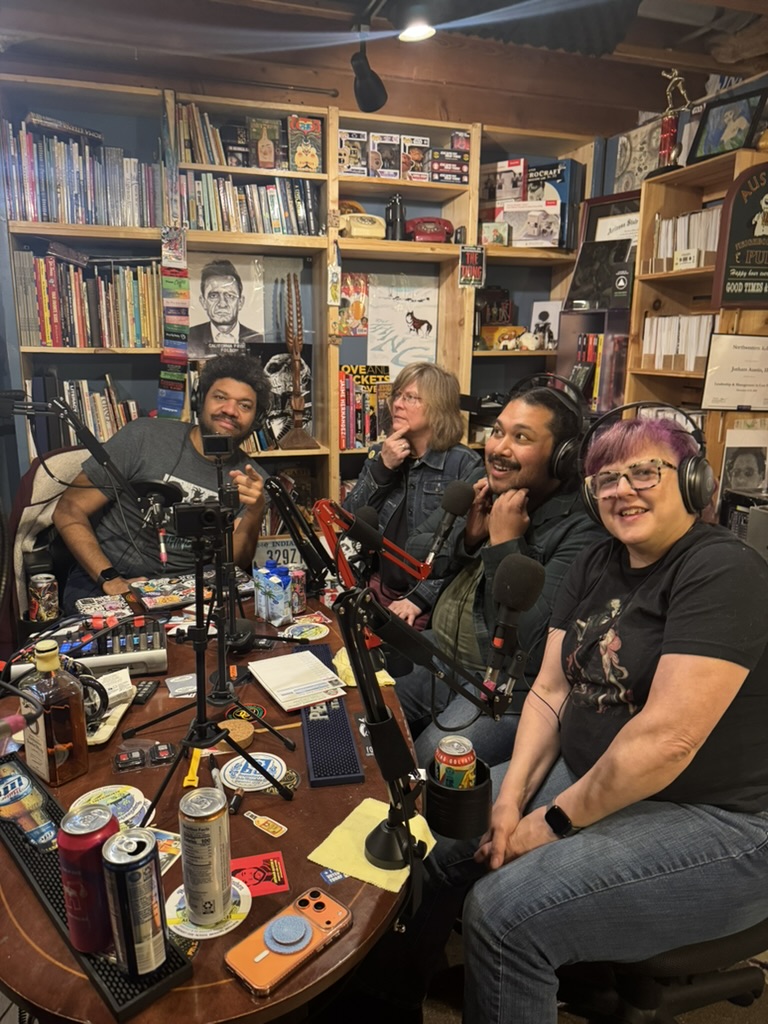
In Episode 70 of Rabbit Hole of Research, Joe, Nick, Georgia, and Mary welcome special guest Lorena Salinas, Peruvian artist, architectural drafter, entrepreneur, and owner of Jose’s Family Restaurant in Highland, Indiana, to dig into one of archaeology’s greatest mysteries: the Nazca Lines of Peru.
Lorena, born and raised in Peru, shares her unique cultural perspective and walks the crew through the Nazca geoglyphs, and explains why, as impressive as they are, why to Peruvians, the real engineering marvel isn’t what you can see from the air. It’s what’s underground. The puquios, ancient spiral aqueducts still functioning today, represent the Nazca people’s extraordinary engineering response to life in one of the driest places on Earth, a desert that sometimes sees only one rain a year.
The crew explores the theories: ceremonial offerings to the gods, astronomical alignments, mathematical precision without modern tools, and the deeply human impulse to create something vast and beautiful that you’ll never fully see yourself. They push back on the alien narrative, not just because the science doesn’t support it, but because attributing ancient genius to extraterrestrials is, as Mary puts it, a way of not giving our ancestors the credit they deserve.
From there the conversation shifts to crop circles; their emergence in 1970s England, the Doug and Dave confession of 1991, the 20% of formations that still don’t have a clean explanation, that a plank and a rope can produce.
As always the crew dives down many rabbit holes including, Machu Picchu’s earthquake-proof stonework, the German mathematician who dedicated her life to protecting the lines, the Nazca civilization’s rise and collapse, Peruvian food and ritual, the word jerky, 3000 varieties of potato, and a Quechua farewell .

Jose’s Family Restaurant
2934 Highway Ave, Highland, IN 46322 — the only Peruvian restaurant in Northwest Indiana
Lorena’s Upcoming Events
- Highland Arts Walk — Saturday June 13th, 11am–2pm; Georgia will be at this event also!
- Promise You Arthouse — June 13th, 12pm–4pm; Flora, Fauna, Fungi three-person show with Julie Miller & Joseph Perryman; 15+ new original paintings
- Crete Creative Gallery & School Art Market — June 27th, 11am–2pm; 1177 Main St, 2nd Floor, Crete, IL
- Solo Show — July — Laura Maychruk Real Estate, 911 S. Lombard, Oak Park, IL; every Friday in July 4–8pm; opening reception July 10th
- Glenwood Avenue Arts Festival — August 14, 15 & 16; 6900 N. Glenwood Ave, Chicago IL 60626

Check out what the RHR crew is creating:
Joe:
- Named by the Guild Literary Complex as one of the 35 Writers to Watch!
- Red Line: Chicago Horror Stories Anthology featuring a story by Joe!
- Joe’s Sci-fi physiological thriller Novel: Will You Still Love Me If I Become Someone Else?
- Joe’s Rom-Com Novella: Tomorrow May Be Too Late
- Essay by Joe: From Beyond Press: Specific Knowledge: Jotham Austin, II, PhD on Transformations in Fiction
Future Events to Hang with the Crew:
Podcast Cross-Appearances
- Joe on GoIndieNow: 21grams with Joe Compton talking about villains.
- RHR Crew on This Podcast Will Change Your Life with Ben Tanzer
Events & Conventions:
- Highland, IN Arts Walk — Saturday June 13th, 11am–2pm; Georgia will be at Fuzzyline Brewery
- Slay the Lake Chicago Pride Book Fest — Soundgrowler Brewing Co., Tinley Park, IL 60487 (June 27, 2026 12PM-5PM)
- Shore Leave 46 — Lancaster, PA (July 10-12, 2026)Lancaster Wyndham Resort and Convention Center
- Dragon Con — Atlanta, GA (September 3-7, 2026) – Joe attending as Professional
It’s Science for Weirdos
Want to support the show? Tell your friends. Follow us on social media, Discord, share the podcast, and let us know what topics you are excited about. Leave a Comment. And for email alerts sign-up for the Substack newsletter and never miss an episode, exciting updates or the bonus images we talk about on the episodes.
We want to Hear From You (leave a comment):
- The crew landed on human ingenuity over aliens, but what’s your take? Were the Nazca Lines ceremonial offerings, astronomical calendars, engineering blueprints, or something else entirely?
- The alien theory gets dismissed a lot, but as Nick points out, it’s a hard idea to shake. What is it about unexplained ancient structures that makes us reach for extraterrestrial explanations, and what does that say about us?
- Lorena says that as a Peruvian living in the States, she sees herself as an ambassador for her culture. Is there a culture, heritage, or place you feel that kind of responsibility toward? How do you carry it with you?
Drop your thoughts in the comments. We read them all, and your ideas often shape future episodes.
Future Episodes
Three Part Spider-Man Series to get ready for the new MCU Spider-Man: Brand New Day
- Episode 72 – Spider-Man Villain Series 1: Lab SafetyGuest: Tera Lavoie, PhDThe science behind Spider-Man’s rogues gallery starts here, with a deep dive into lab safety and what really happens when experiments go wrong.
- Episode 74 – Spider-Man Villain Series 2: Scorpion and the Other ChimerasGuest: Erin C. AnthonyThe crew explores the science of chimeras, genetic splicing, and what it would actually take to create Spider-Man’s most dangerous foes.
- Episode 76 – Spider-Man Villain Series 3: What His Villains Reveal About HimGuest: Comic YouTuber, Alex Hanes (@Hanes4Heroes)The conclusion of the Spider-Man trilogy takes a step back to ask what the science of his villains tells us about Spider-Man himself.
For more stuff (Images, Episode Highlights, events, etc), subscribe to our Substack newsletter!
Show Notes & Fun facts
Books Mentioned
- Legends of Hip-Hop: 2Pac: A 1-2-3 Biography — Written by Ken Pen, illustrated by Saxton Moore. Lorena shares that Tupac Shakur was named after Tupac Amaru, a historical Peruvian figure.The book Lorena pointed to on a shelf in the Basement Studio.
Films & TV Mentioned
- Indiana Jones and the Kingdom of the Crystal Skull (2008)
- Out on a Limb (1987 TV movie) — based on Shirley MacLaine’s memoir
- Signs (2002, M. Night Shyamalan)
- Close Encounters of the Third Kind (1977, Spielberg)
- Arrival (2016)
- Knowing (2009, Nicolas Cage)
- Disclosure Day (2026, Spielberg)
- The X-Files
Video Games Mentioned
- Shadow of the Colossus
- Destiny
- Horizon Zero Dawn
Fun Facts to Impress Your Friends With:
- The Nazca Desert is so stable that 2,000-year-old footprints from the workers who built the lines are still preserved. The desert receives almost no rain, sometimes only one rainfall per year, meaning there has been almost no erosion to erase the evidence of the people who made them.
- The Nazca people were ancient aqueduct engineers. Their underground water system, called puquios, used a spiral funnel design to harness wind pressure and drive water through underground tunnels across the desert. Many of these aqueducts are still functioning today, over 2,000 years after they were built.
- The Nazca civilization outlasted the Roman Empire. The Nazca flourished from approximately 500 BCE to 500 CE: a thousand year span. The Roman Empire ran roughly 20 BCE to 470 CE. We talk a lot about Roman engineering. We should probably talk more about Nazca engineering.
- The word “jerky” comes from the Quechua word “ch’arki.” Quechua is the language of the Inca and is still spoken by millions of people across South America today. So every time someone reaches for a gas station snack, they’re using a word from one of the great civilizations of the ancient Americas.
- Peru has over 3,000 varieties of potato. The Irish Potato Famine happened in part because Ireland was farming a monoculture, one single cultivar known as the “Irish Lumper.” Peru’s ancient agricultural practice of maintaining thousands of cultivars means that if disease takes out one, the others survive.
Episode Highlights
- 00:00 — Basement Studio Introductions The whole crew is in the basement studio and introduces special guest Lorena Salinas, Peruvian artist, architectural drafter, and entrepreneur.
- 00:41 — Nazca Lines Overview Lorena introduces the Nazca Lines as 2,000-year-old geoglyphs created in the desert by her ancestors, a civilization that predates the Inca.
- 03:05 — How They Survived So Long Joe and Lorena explain how the extreme aridity of the Nazca Desert, sometimes just one rain per year, has preserved the lines, and even the footprints of the workers who made them.
- 05:12 — Types and Theories Lorena breaks down the three categories of Nazca geoglyphs, lines, geometric shapes, and animal and human figures, and the crew debates astronomical, ceremonial, and water-related theories.
- 08:08 — Global Geoglyph Discoveries Joe expands the conversation to geoglyphs found worldwide, from the Amazon jungle to Kazakhstan, noting they continue to be discovered to this day.
- 10:20 — Ceremony and Offerings Lorena shares what Peruvians are taught about the lines, that they were ceremonial spaces and offerings to the gods.
- 22:45 — Engineering the Puquios Lorena makes the case that the puquios, ancient spiral underground aqueducts still functioning today, are the true engineering marvel of the Nazca civilization, not the lines themselves.
- 25:54 — Nazca Decline and Legacy Lorena explains the collapse of the Nazca civilization, and how their engineering knowledge was passed down to the Inca.
- 30:59 — Peruvian Identity and Art Lorena talks about being an ambassador for her culture through her art.
- 33:53 — Back to Crop Circles Joe pivots to crop circles, the modern phenomenon of geometric patterns appearing overnight in cereal crops, primarily in England beginning in the 1970s.
- 37:22 — Crop Circles Debunked Mary presents the Doug and Dave confession of 1991, while Joe pushes back noting they couldn’t account for all circles, and that roughly 20% remain unexplained.
- 39:43 — Nazca Lines vs Geoglyphs The crew clarifies the difference between the Nazca Lines and crop circles, and why the two get conflated.
- 41:17 — Geoglyphs Around the World Joe runs through global geoglyphs including the Sajama Lines in Bolivia, the Paracas Candelabra, the Kazakhstan Steppe Geoglyphs, the Blythe Intaglios in California, and effigy mounds in Iowa and Wisconsin.
- 44:11 — Native History and Displacement The conversation turns to why American geoglyphs are less documented, and how colonization, forced displacement, and the loss of language erased the knowledge of who built them and why.
- 49:04 — Peruvian Food and Rituals Lorena reveals that jerky was a Puritan culinary invention, that guinea pigs are used in healing rituals, and that a Peruvian restaurant will refund your meal if they find a tomato seed on your plate.
- 54:45 — Pop Culture References The crew runs through fictional appearances of the Nazca Lines and crop circles, including the upcoming Spielberg film Disclosure Day.
- 01:00:58 — So Why Were They Made The crew shares their personal theories, Joe argues for human ingenuity and creative genius, Nick suspects a practical purpose beyond art, and Mary lands firmly on “definitely not aliens.”
- 01:07:56 — Quechua Farewell and Wrap Lorena closes the episode with the Quechua word Tupananchiskama — “until life brings us together again” — because in Quechua, there is no word for goodbye.
“Stay curious, stay safe… Love Y’all!”
Join Rabbit Hole of Research on Discord: https://discord.gg/2nnmKgguFV
Subscribe and Share our Substack newsletter to get email updates, never miss an episode, and spread the word!! Don’t forget to give us 5 stars or a like!
