Transcript of Episode 63: The Mini: Splatterpunk

The crew revisits fear and horror, Georgia watches Blair Witch for the first time, and their Slay the Lake road trip. Science news: CRISPR defenses, semen-derived eye drops, and airborne eDNA.

SubstackAppleSpotifyYouTubeAmazon

joe: Hey, welcome back to the Rabbit Hole of Research down here in the basement studio for the mini. 

nick: The mini

joe: mini. Yeah. Yep. So here we are. You got me Joe,

nick: Mia got Nick.

joe: got Nick.

geo: Hi. And we’ve

joe: And we’ve got Georgia.

nick: Wow, great

energy. 

joe: enthusiastic.

nick: Hi, I’m here. I’m Georgia.

geo: didn’t

joe: say the name. It’s as people know her

nick: she 

didn’t. 

joe: by the hi. Like, you know who else is gonna

nick: You know who? You know this voice. It’s Georgia.

joe: You know this voice. Yeah. So, last episode, we talked about splatter punk when Terror becomes Entertainment. We had freak was our guest splatter punk author.

And yeah, it was a good conversation.

nick: [00:01:00] It was, and you guys went to the Fest right this weekend.

joe: We did. Yeah. So we went to Slay Lake in lay the lake. That’s what it was. 

Yep. Yep. LG, BT Q Plus Horror Book Festival. So it was a really fun time taking a road trip. To Wisconsin in Kenosha. It was the Final Girl Bar in

nick: Oh, 

joe: themed bar.

So really cool. If you’re in that area, 

geo: That’s fun. 

joe: it out. It was really neat. Yeah, had a good time. So met a lot of cool people. Authors

geo: while,

joe: and while we were there, unrelated to fear and terror was we went to the Milwaukee. Zine Fest also. So we, we went there and then , on our way back, stopped in Kenosha.

So a twofer.

nick: Oh, very cool.

Because yeah, you guys were just there on Saturday, right?

joe: That’s

nick: was a one day event. Saturday. Yep. It was just a one day[00:02:00] 

joe: event.

nick: least you guys were able to make the most of it.

The episode itself, I thought it was a good one. It’s feels like it’s in the Halloween spirit, but out of the Halloween time,

joe: Halloween in the spring. I don’t know.

geo: Well, it’s always a,

joe: it’s like,

geo: it’s always a good time for h horror

joe: Always a good time for horror. 

nick: There’s never a bad time for murder. Yeah, I get it.

joe: there is not.

nick: Is that the message we’re.

joe: that’s it. Phobias. Yeah. No, it was really good. A good episode we had, listener comment, Alex, he suggested one of the Body Horror novels that he enjoys Reading is someone you can Build a Nest in. The title Sound it familiar, but yeah, I’m gonna check that out.

geo: out.

That’s interesting. So 

it seems 

nick: who’s that by? Do you know?

joe: It’s by John wiswell,

nick: John Whi. Well,

geo: and it’s a new book.

joe: Yeah. 2 20, 24.

geo: [00:03:00] Okay.

joe: Yeah, it’s like a shape shifting.

Queer fantasy Romance novel Wow. Is what it’s 

geo: that’s got like, everything

joe: is known for its dark humor, gruesomely wholesome tone and exploration of themes like love, family identity from a monster’s perspective.

geo: That sounds interesting.

I kind of remembered Alex, 

joe: Award for best novel and a Locus Award for Best first novel and was a Hugo Award finalist.

geo: Wow.

joe: So, yeah. 

nick: Very cool. 

joe: I

geo: remember Alex say. He doesn’t watch horror.

joe: I guess he

geo: But yeah, and I was just talking to someone at my work and she’s really getting into horror books and reading horror, and then I asked about some movie and she’s like, oh, no, I can’t watch, I can’t watch horror movies, but I

nick: Oh, off mic. We’re gonna talk about who this is so I can tell them some good recommendations.

geo: But I, like she was saying like, I can read horror, but I can’t watch it. And I thought that [00:04:00] was interesting. So yeah. It

joe: Yeah. That kind of goes, I mean, I think that maybe you can distance yourself in reading it. Maybe the 

nick: I feel like seeing it might be, yeah, that might be the problem. It’s, yeah, you could hear the gruesome stuff, but seeing it actually acted out by humans

joe: Right.

geo: But 

nick: might be where it’s like, oof.

joe: begin to feel it a little more. It’s like you see like leg injuries or arm, like you see people get hurt.

geo: Some ways though, I think your mind sometimes comes up with more gruesome than, it feel, it feels it in even more so than what they might’ve came up with.

joe: Yeah,

nick: I can completely see that. ’cause then that’s where you start seeing it reenacted in your head and then it just stays there because you read it. Yeah.

joe: Mm-hmm. Yeah. I was gonna say, we had watched a Netflix series. Something Bad is Going To

geo: Something Very Bad.

joe: and so was it very bad?

geo: had a very bad, it [00:05:00] had a very bad, yeah. 

nick: I dunno. You guys have said it both ways

joe: I know. Yeah. Yeah. It’s on Netflix. It’s really good. It’s eight episodes, I believe.

Mm-hmm. But on the episode, the splatter punk episode that we did, the one movie that came up was the Monkey,

geo: Mm-hmm.

joe: we hadn’t seen The Monkey Georgia and I know we hadn’t seen the Monkey, and we watched it. It was really good.

geo: It was really good. 

Something bad

joe: is gonna

geo: Something very bad

joe: gonna happen. Had the same,

geo: it really kind of had that same

joe: yep.

Yeah.

nick: Vibe.

joe: Yep. Yeah. Kind of this generational horror passed 

geo: and kind Had to do with a curse and,

joe: Yeah. Yep. It was really good. Highly recommend both of those. The mokey was really good. And something really bad is gonna happen.

geo: Very bad,

joe: Which really bad did happen because I was in the cleaning the kitchen

geo: And that was because you were joking around and 

you said that 

joe: something really bad’s gonna happen and then I shattered the, yeah 

geo: shelf 

joe: [00:06:00] really bad. So,

geo: So 

don’t be just 

running around saying that willy nilly.

nick: I mean, that’s always the turning point in a story. And you go, oh, I have a bad feeling about this.

geo: Right,

nick: like, or I have, I feel like something bad’s gonna happen.

geo: right,

nick: always does. 

geo: right, 

nick: You’re loading that gun.

joe: Yeah. Never show a gun if you’re not gonna use it. Right. Exactly.

nick: Exactly.

joe: Coolio. All right. Yeah, I think that was it. It was a good, nice tidy episode. Not a lot to rehash. I mean, I guess we could, but probably that’s a whole nother episode.

nick: Yeah, exactly.

joe: Not the mini. Well, cool. 

nick: Should we move on to new new territory of studies? What are we calling the segment? I can’t remember. I thought we had a 

name for it. 

geo: segment.

joe: Yes, 

nick: I thought the whole thing is a science.

joe: no,

nick: Come on, Georgia.

joe: science podcast. 

geo: No, but this is the [00:07:00] specifically science

joe: I don’t know. We still have a name for this. Just, we 

nick: Oh, we gotta find a name. 

joe: we’ll awkwardly, transition into this segment.

geo: well, we gotta come up with a name

joe: I thought we had something.

geo: and maybe like a

nick: thought we did 

geo: and maybe like a little jingle that we can put in 

right now. 

joe: I’m, I put it out there for jingles, like, maybe I have to make something.

I’ll have to do

nick: it’ll go bum.

joe: No, that’s,

nick: No, you don’t like my freestyle Jazz, my mouth Jazz.

joe: Well that’s Usman. What do you got? What do you got? What you been checking out? What’s, 

nick: I was reading something a couple days ago, it was a study where they were finding bacteria that fights off viruses using different. Ways, but, alright, so I was reading this and then I don’t know what happened, but I got really distracted and I had the question for you. How small

do things go [00:08:00] and do you know when it stops? Like how far, when is it the very furthest you can go?

joe: I don’t

geo: in smallness

joe: What do you mean by smallness? 

nick: Well, I mean.

geo: Joe is an expert

about small things,

joe: What’s your question about size?

geo: He’s saying it’s something like, is it like go on infinitely small. small?

nick: yeah, like when Do you know? It’s the very smallest it can go. Nothing else is gonna be on top of that.

joe: You mean living things or like atoms and quirks and subatomic particles? 

geo: You’re talking like ant man

joe: is our, like a quantum round mean what, I guess,

nick: there a quantum realm? Yes, there is.

joe: Yeah. No you get, you can get pretty

nick: really. 

joe: Yes. There. I mean, yes, there are subatomic particles, so you can get down to. The atom, and then there’s

geo: that anyone’s ever seen, like with a microscope?

joe: I think [00:09:00] folks have somewhat imaged electrons and you can look at atoms, so you can see that.

But yeah, I think, you know, I don’t actually, I don’t know, like if there’s some quantum tunneling and things like that, some other techniques where you can image, but what’s the real question? Like why do you know what, how small something,

geo: that is a question. what do you like Not, that’s not 

joe: off like with bacteria and viruses and how small, because I’m trying to get to why what size, where are we getting at? 

geo: Think that, I don’t know. I

nick: ’cause they’re saying they found new things in it, even though they had used the same gene editing system to. Make to discover CRISPR and DNA sniping, snipping proteins.

geo: snipe

snip. 

nick: Sorry I had to look that one up real quick and I was like, wait, reread that. But yeah it made me think, well, if you can find that already in what we see, can we go deeper and find [00:10:00] better? Tools.

joe: So I think what they did. Those are all genetic tools, and so you’re just that’s at the level of DNA, which isn’t at the level of the smallest particles in the universe. So it’s

geo: pretty small though, right?

joe: I mean, it’s subcellular,

geo: it’s cellular.

joe: But DNA is a complex molecule, so it’s not even individual atoms.

And so what they’re doing, and I don’t know if this paper at all, but these systems, like crispr, they were originally designed for the bacteria. To cut up genetic material. So bacteriaphages, so these are viruses that invade bacteria. You know, the bacteria needs some defenses against these bacteria, these viruses that will infect them.

The bacteriaphages.

And so they developed a system, the CRISPR system that we hear about in gene editing now. And that’s, it was originally used and they use it to actually cut up the genetic material. So when a virus attaches injects its genetic [00:11:00] material to be used and used a cellular machinery to make copies of itself to make new bacteria fas the bacteria goes, hold up.

It has some defenses. Uses CRISPR cas and then identify, destroy the invading viral genetic material. So that’s how that system works as a bacterial defense mechanism against viral infections and the idea there. And then after you cut up this DNA, this viral DNA, some of that can linger around and even be incorporated in the bacterial DNA to actually be activated as a, maybe like a genetic memory.

That it can then block new infections that comes along. So the bacteria has complex mechanisms to protect itself against viruses that might be trying to in invade and destroy them. 

nick: That’s as far as we’ve made it so far. Yes. Like we [00:12:00] haven’t gone deeper into the smaller structures or No.

joe: So I’m trying to reframe, no, I’m trying to reframe what, yeah, it’s kind of ’cause Yeah, I think small is the wrong adjective.

nick: Is it.

joe: I’m, yes. Complex.

I’m trying to figure out the question like, so the mechanism, so this is 

nick: weird of a question. We can skip it. It is 

okay. 

joe: I guess we can try to hash through it. Yeah. ’cause these

nick: real bad that 

joe: no, 

nick: you. 

joe: these are all gene mechanisms, so these molecules that do work, so are proteins and they do work on things in the cell. So when you say small, it’s not a matter of going smaller. Y you know what I mean? So maybe if i can reframe the question or the idea is are there other systems like the CRISPR system have they all been identified genetically? 

Right? There’s probably [00:13:00] bacteria using mechanisms that are to protect itself from bacteria phases. That we might not have identified. So have we identified all of the systems that bacteria uses to destroy invading viruses? I don’t know. And I would venture to say no. So I think we’ll still find and mechanisms of how these systems work and, you know, that’s why we do research and explore and try to find that.

So I think that’s how I’m interpreting your question more like. Have we

nick: That actually goes closer to what I’m trying to, ‘

what I’m 

joe: like you’re saying, there’s some new research saying, oh, we just discovered this new system. But bacteria have been around for a long time and viruses have been around for a long time.

And so 

geo: so it’s more a matter of, we’ve figured out a way to actually.

joe: understand the system

geo: and manipulate

joe: and 

manipulated for our

geo: with That’s right. Using CRISPR yep.

you’re you. And then, but wasn’t CRISPR discovered in a really unusual way like. And I [00:14:00] can’t remember, I just remember listening to a really good radio lab episode, but it was probably 10 years ago and it felt like,

nick: think it was 10 years ago. I think I know the one

you’re talking 

geo: And it was so good. I’ll have to revisit that. ’cause it felt like,

nick: that was recently though, like within the past five years.

geo: I think it was longer.

joe: Yeah. I mean it probably, CRISPR was, I think if you timeline it, probably the late eighties, early nineties. So, yeah.

geo: to really use it and stuff.

joe: use it. Right. I think that was mid two thousands, so Yeah. So you’re 

geo: just, I know that it was a few years before the pandemic. Yeah. That, I remember listening 

to

joe: think that’s when it, that’s when it really hit and

geo: And there was, seemed like there was some real interesting like.

That it does have a very interesting scientific history, you know? Yeah. That whole, 

joe: I think it was just discovered in bacteria as part of their immune [00:15:00] response and these clustered repeated sequences and they didn’t know why they were repeating and the purpose of this genetic repeats. So I think that was it. And I think it was a little bit later until people figured out how this could be acquired immune.

Kind of, we were just talking about earlier, that is taken in these snippets of viral. Genetic material and then using that as a memory, genetic memory to then, when you see that pattern the viral genetic material comes in, it sees the viral DNA or RNA pattern in that, and then it uses this protein CRISPR to cut that up, right?

So you’re matching a pattern and then cutting it. And then what we use this system for gene editing is that you can then go through, find a pattern and then. Cut out and replace with a different piece. Mm-hmm. Of DNA,

geo: So we are basically using something the body already does, bacteria, and then, okay, something that bacteria already

joe: This is a bacterial system. [00:16:00] CRISPR is a 

geo: within our, within our

body, within our right, 

joe: right, because DNA is DNA. The molecular structure of DNA . The same nucleotides as they’re called are used in bacteria and viral, fungi. Plant, like every life form on Earth that we know of uses DNA.

nick: Oh, I 

like 

joe: it has the same

nick: that we know of.

joe: right. I mean, I’m not gonna, I’m not gonna paint myself in a corner. There’s always something, but what’s the odds of that? I don’t know. I’m not going as far as the universe either. Right. ’cause we haven’t done that. 

nick: Not 

yet. 

joe: but that’s kind of how this works.

And we have in our own bodies, we do have mechanisms to cut and remove DNA, the same thing. 

geo: But to be able to realize that and then use it in these clinical,

yeah, it it 

joe: took decades of work. I mean, like I said, I think it was eighties, late eighties when they first realized this pattern but didn’t understand what the purpose was.

And then you had all this research and then utilize this and then make it a tool and now push it like how far can you push this tool to not only, we were talking not [00:17:00] only to remove DNA and go and edit and. and

Replace DNA, but to epigenetic kind of changes. So epigenetic remember are these kind of overlays.

So you have your genetic information and then you can have other molecules that will turn things on and off called methylation. So you add, specific markers that say, okay, turn this one on, turn it off. And those epigenetic kind of traits can be.

Passed on. And now they’re, you can use CRISPR to actually modify epigenetic kind of marker. So can you turn genes on and off like that, so not replacing gene, but kind of going in and say, okay, let’s turn these on and off and then get some

nick: just, you know, doing slight changes where it’s not gonna be something crazy.

joe: Yeah. So I think it’s really cool 

nick: I think the whole idea of CRISPR is really neat. Like every time we talk about it, I am.

geo: it is fascinating. Yeah.

nick: something that sounds like it’s science fiction.

joe: Yeah. No, I think that’s, in that book Change Agent had it, that was crispr, gene [00:18:00] editing was a big thing and then especially epigenetic changes.

Because you think mostly of the changes happening embryonically, when you have fewer copies of the gene, you know you’re early on, you change it, and then the cells as they replicate will have the new, quote unquote healthy copy of the gene you’re trying to edit and replace. Epigenetic can, in a adult, can you modify gene expression and

geo: And is 

joe: regulation?

Can 

geo: is prob, this is probably a dumb question, but is that related to certain, like illnesses? Like certain, like, so is that similar to being predisposed to something

joe: So like epigenetics has really, like environmental stresses can cause, so really what you’re doing is you’re modulating gene regulation, so you’re turning on and off or how much to produce you’re actually turning on and off a product, the protein. And that protein is doing some work into cell. So 

geo: could lead to some 

sort of 

joe: could lead to [00:19:00] disease stress, anxiety, neurological disorders.

So if you can now go in, understand. What’s being epigenetically controlled? Can you go in now and 

geo: and purposely, yeah. 

joe: Something that should

nick: really weird? Michelle had said that word earlier and I did not know what it meant until, what, 40 minutes ago?

joe: Epigenetic.

nick: Yeah.

joe: Yeah. We’ve

nick: was really weird. 

joe: podcast quite a bit,

nick: Yeah. I feel like we do, but I never grasped what it

meant. 

joe: me.

geo: Right, right,

joe: Yeah, no it’s really interesting.

nick: Believe you. I’m just takes a, it just takes a few times for it to sink in, right?

joe: Yeah.

nick: She actually gave the definition and it was like the only thing I was learning at that moment.

joe: Yeah. Yeah. And I think we talked, touched on this, swing all the way back to bacteriaphage and why kind of the interest in it and how bacteria use their systems to fight that. Because, [00:20:00] as we overuse antibiotics, you might need alternate therapy to fight bacteria.

So can you use bacteriaphages to actually, , attack and kill. Bacterial infections that you may have , this research is leading to something, beyond even this crispr.

nick: Sorry, I think I threw us off

joe: No. Yeah. When you said small, like you were. I think you were yeah. It’s not a matter of size. ’cause that wasn’t the key. So, sorry, I just had to, we had to unpack,

nick: yeah. 

joe: Terminology there, which is okay.

You know, so,

nick: Words are

joe: then we got, yeah. ’cause then we got into like quirks and stuff, and that’s a different, that’s a different area of science. But I think you want it to be more in the biological, cellular function. 

geo: Very

nick: cool. Did you have one, Joe? I’m sorry Again.

joe: No. Yeah. I had a couple that, that I saw that were interesting and I think some, because the title was like interesting and then poked around. But one was harnessing semen, derived exosomes for non-invasive [00:21:00] drug delivery. And so, yeah.

So a little bit. The un unpack , so exosomes. Are these kind of very small vesicles. So vesicles are like these kind of lipid droplets that cells excrete and they can have information, they can have genetic information, protein information. And that transports between your cells.

And they use this kind of as a way to pass notes, some DMs so they’re just passing these little messages between each other, these kind of exosomes. So they’re exo outside, somes cellular or body . So every type of cells make ’em. And so what’s interesting is that in this particular study they’re using this to make these eye drops. For a tumor growth in the retina and in particular retinalblastoma, this rare malignant eye cancer really really prevalent in children. And so how do you treat? This kind of eye cancer. [00:22:00] And so the way they do it now is, chemotherapy, injections, radiotherapy, all these pretty invasive procedures.

’cause you have to get in through many different layers of the eye to get to the cancer. So what these researchers hypothesized and tested. Was if you take exosomes from tissues that have to pass through many different signals, through different tissue types, so in this case semen used to for fertilization.

So it’s gotta go to a different system through different female reproductive tissues to reach its target and fertilize and do reproduction. So they said, well, can we use these exosomes that can have these abilities? Do they have any special properties that allow them to pass through different cell types and different tissues to get

nick: the people behind this talking about it. 

Like just to come up with this idea. They had to say [00:23:00] some weird shit before they got to this joke,

joe: So, yeah. So they, do that all the research you get there and yes, they do have special properties that will allow them to penetrate and move through, just like they do the female reproductive track.

And so can you use this in the eye in kind of the same system? Can you kind of, once again, like the cast system, the CRISPR system we were talking about, can you take a system that has another function and then repurpose it for some other biological purpose that, that you need? And yeah it seemed to work that in, I believe this was done in mice , where they tested it, that they could actually.

Take these kind of

geo: it’s kind of like a superhero, super derived

joe: Endo, exosomes, SEVs and 

nick: wait, what was that Georgia? 

joe: No.

geo: No. Don’t you picture ’em like little superheroes that can

joe: exosomes, superheroes? They can

geo: can like bust through different structures and get, it’s like.

joe: I don’t think they’re busting through. I think they’re just passing through.

Yes. Yeah. Right.

geo: think they’re like little suits, 

joe: semen. 

geo: [00:24:00] They’re just like 

joe: vesicle. So they’re isolated

geo: little superhero vesicles.

joe: It’s no. Weird. I, yeah. These are isolated, so they take it they’re purified. These are what the semen cells are excreting, the exosome. So then you collect that and you’re not.

Putting sperm in someone’s eye. So let’s clear this all up, Nick, because I see you giggling in the back of the class. Yeah, it’s a really cool cool study. Yeah, that they have, so it’s really promising because you can deliver now, can you take these exosomes, load ’em up with anti-cancer treatments and then deliver it, deliver them without kind of.

These kind of very invasive techniques. So can you do this and have high efficacy so

geo: I do agree with Nick. It is fascinating how, not just scientists, but anyone working on a problem, you know, solving a problem and to get to the point. You know what I mean? Where they were able to think [00:25:00] about this.

That’s like, that is

joe: and it’s a lot of, and a lot of research has went into that. So from these other systems, like how do exosomes work in their natural environment? How do they work there? And then go, oh, can this,

geo: okay. And I can just see somebody like waking up like first thing in the morning, like, oh my gosh, I got an idea.

You know, like, I don’t know. It’s really.

joe: Yeah I don’t know. I’ll put the show notes.

geo: And 

joe: everything in, show notes

geo: similar, like you said, it’s similar to like, like architects or engineers looking at like things that happen in nature and then saying, oh, that’s a great system.

Let’s try that. Could like solve whatever.

nick: it

joe: good, right? Yeah, definitely. 

geo: So then this has taken that same idea, but on 

this much cellular level. Yeah, it’s very, you were 

joe: You were gonna say small level?

geo: Well, no, I was not.

nick: I am sorry.

joe: No, you’re 

geo: it’s 

joe: were, they are small, right? That’s why, yeah. So that’s why where we headed with the smallness. But

nick: Small [00:26:00] things are small. 

joe: yes. They’re small things. Yeah. The, another one I thought was. Interesting. And once again, this was it’s, the answer’s blowing in the wind detection of birds, mammals, amphibians, and with airborne environmental, DNA.

And so they did this survey, this group, and this was a couple years ago, and it’s just coming back up again and the idea is that. Everything you do and every organism is leaving some genetic information, it’s just being, you scratch your head or your skin cells, , it’s just out there in the world.

And so this team, they went and they tried to collect this airborne dust and then say, well, can we tell what organisms. We’re in there, like what animals, what plants what things pass by this patch of ground and kind of catalog that, like is it sensitive enough? And so it was really cool ’cause they could do that.

But it raises other [00:27:00] questions like, and they put point this out in the paper, ’cause you go, you see some, I think one of the study areas and there’s been several groups doing this, but one of the groups did this and they found, salmon, DNA, some miles away from where, the water source is at.

And then just realized this was carried, you know, you know, so rain. Or how did it get there? So, you know, ’cause the salmon didn’t walk

geo: ate the salmon and 

joe: have happened. It could have just, blown through the wind. It could have been rain, you know, all sorts of things that could have passed this DNA around.

So when you do these studies and you do these surveys, you do have to be conscious of that. If you find. , you find traces of rat in, in some area, , was that rat there? Did it come in the feed? So did it pass a year ago? Like, you don’t know. There’s no timestamp on this.

So how long ago did this thing pass? Like,

geo: right, like, you wonder how long does this stay around?

joe: it’s really cool. And you’ve 

geo: but

what’s the practical, 

joe: So you’re doing surveying, like, so if you’re looking for invasive species. So is this [00:28:00] organism invading in this area?

We don’t see it now, but was it here? Is it moving? You could think about it. They did this a lot with COVID and they started looking at municipal wastewater, and then you could look for spikes. So you do a study of the wastewater and you can see what. What genetic materials in there, and if you see a lot of COVID genetic material, then you know you’re going to have a spike potentially in this area because now you’re seeing more wastewater that has viral kind of DNA in it.

So you can use it for population surveys to get some idea of what’s happening in an area. But as naturalists you can, like I said, you can be out looking for a species. Is there an endangered species? Do we see any trace of it?

Has it been here? What’s its movement?

geo: it just really does seem like looking for a needle in the haystack.

joe: Well, I think it’s the, I think using this technique is saying that you now have a way to find a needle. Like before, if you go, so how [00:29:00] else you set up cameras and you look and if the creature happens to go by, oh we see one I think here.

You can now go out and do the survey and go, okay, what do we see? Oh, look at this. We do see. DNA of whoever, X, Y, and Z, 

geo: guess, I guess 

joe: I think that’s how you can think 

geo: tell you to look in this specific area in the first

joe: Well, you just, you could just be surveying, right? That’s a nice thing of it.

You can just survey even more areas. So, right, you set the cameras up in the wrong place, you never catch it. So here can you survey and then know where to actually look for the thing you’re looking for. So how do we make the haystack smaller? Mean, you can think of it that way. So yeah, I think there’s a lot of, 

geo: searching for certain, like maybe missing people or or a forensic kind of application.

joe: Yeah, I guess 

I mean, like, biological weapons might be one where you can use it and get a handle and, but yeah. Yes, you could. I think people are already doing DNA stuff like in the crime scene where people are

geo: Well, right,

joe: Oh, right. Because you would need to know where they’re [00:30:00] going. I mean, that’s even more like you’re, to your point, like if you’re just sourcing down the street.

I mean, if you happen to

geo: what are the chances 

that

joe: Yeah. Or false positives. Right? So if you, okay. They follow you in your coffee shop, , workplace train, these places you go a lot. Then if you’re taken from one of those places, then it really, now how do we find a new trail?

So if you’re looking for a person, I think, but yeah I guess you could, like, if it was like, we think you’re in the field, maybe they can do sources or something. Yeah. Interesting. Yeah.

nick: Yeah I mean, I could see it having other uses

joe: Yeah. I think it’s more like this pa this paper is mostly like monitoring.

Species level 

kind of thing. So not individuals in 

geo: the I know population it was kind of a far reach,

joe: Yeah. Oh, maybe like a science fiction novel or something. Cool.

nick: I, I think that would be fun.

joe: Yeah, that’s we’re right.[00:31:00] 

nick: So, what kind of media have you guys been consuming?

joe: Oh, go ahead, Georgia.

geo: Oh no, I, what kind of media? Yeah, I’m sorry. I’m drawing a blank on anything.

joe: Want me to finish Something Very Bad? Really bad. Oh wow.

geo: we already talked about that. We already talked about that.

joe: Yeah. I kind of watched that. Oh, you, oh, you should say you, you know what? Georgia watched? She hadn’t

geo: Oh, yeah.

joe: And I was like, okay, we just gotta watch it. You go ahead. Oh

geo: yeah. I watched Blair Witch.

nick: Oh, really?

You’d Never seen

that? I had never seen that.

What did you think?

geo: no, I thought it was really good. I think I had so many. Preconceived notions about it that I thought it was very interesting what it really was. You know what I mean?

nick: Wait. What? What? What were your notions about it beforehand? I need to know now.

joe: Well,

geo: Well, I mean, 

nick: [00:32:00] just say you had them.

geo: I mean, I guess I’m, I won’t be spoiling it. 

joe: No

geo: It’s pretty old,

joe: was 99, so feeling

geo: so old right now. Oh my God. But,

I think, I thought that it was gonna show more like. Like we were talking about, like maybe show more gruesome things and like, and then it’s like the whole movie I was waiting for kind of these jump scares or these like more gruesome, like, 

nick: Oh no. It’s more atmospheric. 

geo: It is definitely more what you make it in your mind which I thought was really good. So I was surprised that. That is what it was. 

You know what I mean? it picked up 

joe: really well.

I hadn’t seen it in a while. I saw it in the theater when it came out the, to my neighbors, they were going to see it, and I just, I had no clue what Blair Witch was about. And I went in and it was really yeah, it was good. And then watching it now, because it’s been a while since I’ve actually seen it, so putting eyes on it again. And going through it, it was like, oh, this really [00:33:00] holds it was done well. And I think the simplicity of it 

geo: mm-hmm. 

joe: That you aren’t relying on kind of gadgets and graphics and, practical effects.

It’s more just these people, they’re just trust. They’re kind of,

geo: that does hold up, but in a way it’s like we’re so used to like things getting more like mm-hmm. What we talked about in the episode,

joe: Mm-hmm.

geo: how.

Now it’s almost like you really have to make something like extremely gruesome or extremely out there because you’re trying to like,

joe: and I don’t know if

geo: And then I think that’s a good reminder that you don’t have have to, you don’t have to. I was

know what I mean? 

joe: that. I think there’s something to be said with skillful writing, acting, putting people in these positions and then having them, limit the information that the viewer has, and then using that to drive tension and suspense and, the horror of it all, and putting yourself in that situation, if you’re in the woods.[00:34:00] 

With your map, that’s not right. Your friends, their association was loose, so they weren’t like, best buddies or a couple or some serious partnership. They were just going out there to do this project and help a friend out and now you’re stuck in a situation that how easily these things fray and come apart and yeah, it’s, it was really, it was cool to watch.

And if you haven’t seen Blair Witch project, go check it out. The first one in 99, or

nick: Honestly, the third one is as Well, It’s actually, uh, 

joe: any other ones,

geo: The third one is really good.

nick: yes, it’s not labeled the third one or anything like that but. Because what, after this one, after the original came out Season Of The Witch and that one I don’t remember,

joe: Yeah, I didn’t see

nick: so I’m assuming it wasn’t Great.

geo: uh, 

nick: but the one that they did in 2016, 

that was pretty good where they brought it to a more current day setting. [00:35:00] So they had technology and that was failing on them. And it was really cool how they were able to. Still bring that

feeling

of alone

and 

geo: they, yeah, I think they called that Blair Witch Two right?

nick: No, 

it was just called Blair Witch.

geo: a, 

yeah. Oh. 

joe: of a Witcher, something like that.

geo: we noticed the

joe: there was a two or something. Yeah. I don’t know. Yeah. One of, we

geo: said like had

nick: It was the Blair Witch is the first one.

geo: Yeah. I don’t know. Mm-hmm.

nick: And then the second one was, oh, Book of Shadows, Blair Witch Two.

geo: Okay.

nick: That’s what it was.

geo: Okay.

joe: Yeah.

nick: And then just Blair Witch. Yeah.

geo: it’s funny ’cause that kind of gets back to that whole thing about watching a who.

Movie as opposed to reading it, or reading a horror book. And that kind of gets back to that whole thing of how much do you show. Yeah. And then I think of those movies I can’t even think of the name of them. Is it Myst or [00:36:00] those movies where there’s some sort of creature out 

there,

joe: Yeah. Myst it. That 

geo: and then they show this real cheesy thing and then you’re like, oh, well that’s it.

You know, 

it’s just 

joe: on the special effects budget.

geo: And it’s like, no, just don’t show the thing. You know what I mean? And then 

that 

joe: the mind kind of

geo: fill in those. Yeah. But.

joe: Yeah.

nick: Blair Witch did such a fantastic job with that. Like I remember seeing that as a child on 

VHS. 

geo: Oh, wow. Yeah.

nick: with you because you’re like, oh, you don’t know what this creature is or what’s going on.

joe: right,

nick: Yeah. And then they also had a video game too. 

That was pretty good.

geo: Oh, wow.

joe: Yeah. The other thing think I own that

geo: at

nick: on multiple systems.

joe: go ahead. Yeah. At the Slay the Lake at the Final Girl Bar. We were sitting there eating a little food and chatting with a friend who happened to come down for the festival and yeah, they had Friday the 13th. [00:37:00] eight, Jason takes Manhattan. And that’s my fa one of my favorite scenes. And we started watching close to that scene where you have the the black guy, he’s in this like track suit and he like starts boxing with, Jason on the roof.

And they go and then they, he gets, he’s winded, he’s gassed and he is like, take your best shots. And then Jason punches his head off, like it’s like one another. I just, it’s just that over the top. And I think that’s,

geo: my God. And like we were talking about that real, that movie isn’t even a horror movie,

really. mean, it’s 

joe: of 

geo: scary, It’s just silly. 

joe: I think it was like you got 

nick: you get in that whole range. 

joe: How can you kill people?

Like what’s the funniest and most unique way? What haven’t we done yet? I think that, and Freddy Krueger did the same thing when you got. Into the four or five. It was just how do we, , how do we kill somebody with a, a spool of scotch tape or something, you know?

It’s just being silly.

nick: have to up the [00:38:00] antes because it’s just,

joe: right. Yeah.

nick: yeah, and that’s what it just becomes, which,

joe: but it

nick: I like it’s a comedy at was, fun. I hadn’t watched that in a while, like I knew it and it was like, oh, I think that scene’s coming in this,

geo: and we were debating the year it came out based on how high the hair

was. And,

but me and Glen were totally right on about the. Yeah, about the 1980. 

I said late 

eighties.

It came out 1988 or 89. Yeah,

joe: I said it was I said early nineties . ’cause the hair wasn’t as

geo: no, 

you said 

joe: said early nineties

geo: You said nineties. 

joe: I said early nineties ’cause the hair and it was 88.

nick: don’t know. This one feels like something that Joe didn’t say, but he’s saying, he said.

joe: Yeah. They know I was right. 

geo: Yeah, 

joe: yeah. What are you watching? Anything?

nick: What I have been watching the new SNL UK been enjoying that a lot. I think they just had episode four [00:39:00] is what came out. I think they crew did, is doing a great job. Yeah, definitely recommend that. 

geo: And what do you watch that on?

nick: We’ve been watching that on Peacock.

geo: Okay.

Mm-hmm.

nick: Yeah, it’s nothing too much to do, but yeah, it’s yeah it’s been an enjoyable show so far.

geo: Nice. And

nick: then we have also just refinished Brooklyn nine.

joe: I’ve never seen that.

nick: That was a good show. I mean, it’s a show about cops, but it’s. One that is a comedy show with Andy Sandberg. So if you are a fan of him, they do a good job.

And then I have just jumped back into playing the game Fasm phobia,

Ghost Hunting game where they had announced that they are going to be doing a, crossover event with another really good game that I like Ellen Wake too. So yeah, just [00:40:00] just been trying to jump back into that whole series.

joe: Cool. That sounds really fun. Mm-hmm. 

nick: And then yeah, just just trying to get my readings done. Georgia had recommended a book to me that I just started

geo: Oh, you have started it.

nick: I just started it.

geo: Okay. Yeah, we’ll talk about that later. I mean, I think I’m

nick: the name of the book again? Georgia.

geo: it’s strange animals,

nick: And what did you think of it?

geo: oh my gosh. I’m loving it. I’m loving 

nick: a book that Georgia recommended to me. 

So, 

geo: So,

does that make it, are more, 

is that 

good or bad?

nick: we’re gonna find out now, aren’t we?

joe: Yeah. The pressure.

nick: I mean, I recommended a book to you before, so you know.

geo: Yeah.

joe: And

geo: then I’m about 70% done and it, I really like it a lot.

nick: Oh, I thought you finished it

geo: No. Because

nick: to finish it?

geo: no, when I recommended it to, to you, I was only like on the [00:41:00] fifth chapter, so it was kind of a risky recommendation, but I was that. But I was that confident in it. It was that good. It was like, and I was that confident that you would like it, that I recommended it that early on, so, yeah.

nick: risky one right there.

geo: know. And I think it’s gonna pay off, but

nick: Good. But yeah, that, that’s where that’s where I’m at.

joe: Yeah. So I was going just mention maybe people seen this online, but I was recently named one of the 35 Writers to Watch by the Literary Guild Complex.

And they’re having a celebration event April 30th at the Epiphany Center for the Arts. So

geo: it is kind of a fundraiser for the, you

joe: And you’ll meet all the other writers that are there and other folks in. The area, I guess, that are gonna come. So yeah it’s gonna be a

nick: [00:42:00] Are under 35, right?

joe: That is not the requirement of the list, but yeah,

nick: Under 35. just 35 writers to watch, so gonna be doing it. So yeah, no, 

was 35. 

joe: kind of a surprise and honored. So, yeah, I’m looking forward to the event, but don’t I throw it out there. Folks are looking for

nick: buddy, you deserve this. 

joe: 30th and they can come on down.

Say hi to have a toast and, celebrate all these wonderful, I’ve been looking them up and, , just really honored to be named among them. So, yeah, throw out, throw that out there.

nick: As I said again, Joe you deserve this one.

joe: you. Thank you.

nick: Not all your awards you deserve, but you know this one you have.

joe: it’s, I get myself.

nick: Oh, I’m gonna give myself this Rabbit hole research award.

joe: that’s right.

geo: I think

the 

joe: I give awards out. I 

geo: was gonna say, 

I think the only person that’s gotten a rabbit hole research award is Jeff Goldblum

joe: jeff Goldblum. That’s right. 

nick: I thought we agreed [00:43:00] it was S

joe: No. It was Jeff Gold. We hashed this out.

geo: Yeah. 

In the end.

joe: Amy and

geo: Jeff Goldblum was the

joe: we had a word and we

geo: debut, 

award

joe: I don’t, yes. And then we had a word of the season,

geo: Mm-hmm. Well, that’s a given

joe: Yeah. So

nick: What was the word for the season? I can’t remember. I think it was what?

geo: Shut up. You remember,

joe: I’ll put it in the show notes,

geo: notes, Extremo files. I kind of like this new word. What is it? I don’t remember. But I still see the exomes,

nick: think it be a.

geo: Exosomes. And they’re like little superheroes. Exosomes,

joe: Exosomes. Yes.

geo: I just see ’em like with a little teeny tiny cape.

joe: A little fist extending out.

geo: Right, right.

joe: through

nick: Flying behind it all slimy and whatnot.

joe: Yes. Okay. [00:44:00] Well you’ve got me, Joe, on

nick: Yeah. Got Nick

joe: Got Nick,

geo: Georgia. 

joe: Got George. A little more enthusiasm at the end.

nick: and

joe: Oh.

nick: we went down some tiny hole

joe: Went down The Mini. Stay safe. Stay curious. We love y’all.

Episode 62 Show Notes: Fear, Phobias, and Splatterpunk: When Terror Becomes Entertainment

The RHR crew explores the neuroscience of fear, the psychology of disgust, and the genre brave enough to find out exactly where terror ends and entertainment begins.

SubstackAppleSpotifyYouTubeAmazon

In the 62nd episode of Rabbit Hole of Research, Joe, Nick, and Georgia welcome splatterpunk author Phrique to the Basement Studio to dig into one of horror’s most primal questions: what separates a debilitating phobia from a Tuesday night movie with friends?

Starting with the ancient alarm system wired into every human brain, the crew explores the neuroscience of fear’s two pathways; the lightning-fast response that bypasses conscious thought entirely, and the slower response that keeps you in your seat when the monster appears. From there the conversation spirals into why disgust and fear are more deeply entangled than most people realize, how the brain’s prediction engine works to build suspense, and why humor isn’t just a break from the tension, it’s a way to reset the fear dial.

Phrique breaks down the difference between extreme horror and splatterpunk, shares the political allegory and queer subtext running through his work, and explains why, no matter how hard he tries to write something purely for shock value, a moral always finds its way in. The crew also tackles the uncanny valley of flesh, the Cronenberg principle of gradual bodily transformation, the crew’s personal phobias, and why enjoying horror might actually be good for you.

Plus a stack of recommendations across film, books, video games (check the newsletter), and a spotlight on the Slay the Lake LGBTQ+ Horror Book Fest at The Final Girl Bar in Kenosha on April 18th.


Where to Find Phrique:

  • All things Phriquehttps://linktr.ee/phrique
  • Phrique writes phoolery, not at all plain & far from simple. For legal reasons, he only writes what the voices tell him to. He willfully abuses alliteration & injects innuendo where it ought not be, with the intent to make the reader giggle, gasp, and gag at his gaiety. He wants you to laugh at things you shouldn’t, so he’s not the only one being stared at.
  • Phrique’s books: Gig of the DamnedScissor Me TimbersCurse Me By Your NameRearranged Guts, In The Club We Are All Monsters 

Slay the Lake 

LGBTQ+ Horror Book Fest | The Final Girl Bar | Kenosha, WI Saturday, April 18, 2026 | 3PM–8PM | 18+ Event Ticketed early entry $15 (2PM–3PM) includes tote bag, blind date with a book, and early access. 10% of early entry sales go to the Transgender Law Center. Tickets: slaythelake.com

The event is also collecting book donations for LGBT Books to Prisoners — a trans-affirming, racial justice-focused, prison abolitionist project sending books to incarcerated LGBTQ+ people across the US. Check lgbtbookstoprisoners.org for their current needs list and bring donations to the event.

Check out what the RHR crew is creating:

Joe:


Future Events to Hang with the Crew:

Podcast Cross-Appearances

Events & Conventions:

  • 35 Writers to Watch: Celebration Party – Epiphany Center for the Arts 201 South Ashland Ave., Chicago, IL, United States (April 30th 7-9pm)
  • 5th Annual Mai Fest – Blue Island, IL (May 9th 2026 12-5pm)
  • Avondalia Night Out – Rosa’s Lounge in Avondale, Chicago IL (May 14th 2026 7-8pm)- Joe reading
  • Creative Arts Summit – DIY Podcast Workshop at Lake County Public Library (Merrillville, IN) on May 23rd, 2026
  • ConCarolinas – Charlotte, NC (May 29–31, 2026 ) – Joe attending as Guest
  • Shore Leave 46 – Lancaster, PA (July 10-12, 2026)Lancaster Wyndham Resort and Convention Center
  • Dragon Con – Atlanta, GA (September 3-7, 2026) – Joe attending as Professional

It’s Science for Weirdos

Want to support the show? Tell your friends. Follow us on social mediaDiscordshare the podcast, and let us know what topics you are excited about. Leave a Comment. And for email alerts sign-up for the Substack newsletter and never miss an episode, exciting updates or the bonus images we talk about on the episodes. 


We want to Hear From You (leave a comment):

  • Fear without control is a phobia. Fear with control is entertainment. But where is YOUR line? Is there a horror movie, book, or game that pushed you past it?
  • The crew shares their personal phobias; crowds, deep water, beaches, hobos, and clowns made the list. What’s yours, and did a horror movie give it to you or did you already have it?
  • Phrique, Joe, Nick, and Georgia all have a soft spot for practical effects and the gritty texture of 70s and 80s horror. What’s a modern horror film you think actually gets it right?

Drop your thoughts in the comments. We read them all, and your ideas often shape future episodes.

The RHR in The Basement Studio (Left to Right: Joe, Mary, Nick, Georgia)

Future Episodes

  • Episode 64 – Into the Deep: Humans, Caves, and the Final FrontierGuest: Ernie Bell, PhD (NASA and Blue Origin)What can living underground on Earth teach us about surviving on other worlds?
  • Episode 66 – Planetary Defense: Saving Earth from Other Worldly Impact
    Guest: Charles Blue
    Exploring asteroid detection, planetary defense systems, and what it takes to protect Earth from cosmic collisions.
  • Episode 68 – Hive Mind: PlubrisGuest: Wes Thorn (returning guest — Simulation Hypothesis episode)The crew dives into hive minds, collective intelligence, and the blurry line between the individual and the swarm.

For more stuff (Images, Episode Highlights, events, etc), subscribe to our Substack newsletter!


Show Notes & Fun facts 

Movies, TV & Pop Culture Mentioned

  • Phenomena (Dario Argento)
  • Trilogy of Terror: three segments each based on unrelated short stories by Richard Matheson. (3rd segment has the Zuni fetish doll Joe was talking about)
  • The Thing (John Carpenter)
  • Event Horizon
  • The Fly (1986)
  • Invasion of the Body Snatchers (1978)
  • The Blob
  • The Stuff (1985)
  • Monkey Shines (1988)
  • The Monkey (2024, based on Stephen King short story)
  • Cabin in the Woods
  • Rosemary’s Baby
  • The Shining
  • Evil Dead / Evil Dead II
  • Blood Beach
  • Cheerleader Camp
  • When Evil Lurks
  • High Tension
  • Blood and Black Lace (Dario Argento)
  • Deep Red (Dario Argento)
  • Barbarella
  • Annihilation
  • Overboard (referenced jokingly)
  • Dorian Gray (referenced in Phrique’s collaborative story)
  • Junji Ito (artist referenced in relation to uncanny valley and body horror)
  • David Cronenberg (body horror principle)
  • George Romero (zombie films as political allegory)
  • John Waters (disgust as art, boundary-pushing storytelling)
  • Chuck Palahniuk (cited as a Phrique influence)

Books Mentioned

  • The Stand — Stephen King (Franny referenced)
  • Haunter — Charlee Jacob (recommended by Phrique)
  • Works by Clive Barker 
  • Works by Grady Hendrix (mentioned by Georgia)
  • Only Good Indians — Stephen Graham Jones (recommended by Georgia)

Video Games Mentioned:

  • Dead Space
  • The Callisto Protocol
  • Resident Evil 7: Biohazard (recommended by Nick)
  • Doom (referenced by Joe)
  • Toxic Commander (upcoming — John Carpenter scoring)
  • Fallout (Pip-Boy radio referenced)

Fun Facts to Impress Your Friends With:

  1. Your brain has a fear shortcut that fires in about 12 milliseconds.Neuroscientist Joseph LeDoux mapped two pathways fear signals take through the brain. The “low road” bypasses conscious thought entirely, shooting straight from the thalamus to the amygdala and triggering a fight-or-flight response before you even know what scared you. That’s why you jump before you think.
  2. You can’t logic your way out of a phobia, and neuroscience explains why.When a phobic stimulus hits, the amygdala fires an emergency signal and the prefrontal cortex (your rational brain) partially goes offline. Stress hormones flood the body. Thinking your way through it in the moment is nearly impossible because the thinking brain has literally been sidelined.
  3. Horror enjoyment follows an inverted U-shape. Researchers at the Recreational Fear Lab at Aarhus University studied 110 haunted house visitors wearing heart rate monitors. The finding: too little fear is boring, too much becomes genuinely unpleasant. The sweet spot in the middle, just enough arousal without tipping into distress, is exactly where horror lives.
  4. Disgust and fear are more entangled than you think, and splatterpunk exploits both. The anterior insula, your brain’s disgust processing center, doesn’t just react to gross things, it also processes your awareness of your own body. When body horror describes flesh transforming or boundaries dissolving, your insula doesn’t just file it as external information. It recruits your own body-awareness system. That’s why body horror doesn’t just look disturbing. It feels disturbing.
  5. The uncanny valley was first described in 1970, and horror has been using it ever since. Japanese robotics professor Masahiro Mori coined the term to describe the deep unease triggered by something that looks almost-but-not-quite human. Body horror, transformation narratives, and creature features have been weaponizing this response for decades. Something fully alien can be processed as “other.” Something almost human forces your mirror neuron system to engage, and when the simulation hits a violation, empathy flips to horror.

Episode Highlights

00:00 — Basement Crew Intro The whole crew is in person and accounted for: “We’re all crewed up down here. All in person. Surviving. Living.”

00:26 — Meet Phrique Splatterpunk author Phrique introduces themselves: “In that year and a half I put out like five books.”

02:17 — Fear vs. Fun Monologue Joe sets the stage with his opening monologue: “We seek out the exact sensation that in any other context we’d call trauma. Same chemicals, same brain regions firing, same body braced for horror.”

04:08 — What Is Splatterpunk? Phrique draws the line between extreme horror and splatterpunk: “Extreme horror is literally for shock value, splatterpunk is basically all that, but for a reason, with a moral, with some kind of commentary.”

06:23 — Stories With a Message Phrique breaks down the allegory running through their work: “When you hold things in, it manifests.”

10:43 — Fear Psychology and Tropes Joe connects splatterpunk to the brain’s ancient fear hardware: “Our brain, our hardware and software… it’s pretty ancient. A lot of our fear structure is based on keeping us safe.”

17:38 — Humor as Misdirection Phrique explains the strategic use of comedy in horror: “I like that the humor takes you… I’ll usually do it right after I just killed like 12 drag queens and I make you love them.”

24:39 — Creepy Toys and Old Horror The crew riffs on childhood horror memories and cursed toy movies: “Don’t remove this tag… and then it comes to life.”

28:55 — Final Destination Phobias Phrique connects the log truck scene to real workplace anxiety: “I work in a steel mill, they tell us someone dies there probably about once a month.”

30:13 — Defining Phobias and Disgust Phrique offers a working definition and connects germophobia to evolution: “A phobia would be when it causes distress, when it affects you and causes you to go out of your way to avoid it.”

35:26 — Music Sets the Mood The crew unpacks how music rewrites a scene’s emotional DNA: “You go to a minor key versus a major key, it could be the happiest scene ever, but you feel it internally.”

40:28 — First Horror Memories Phrique recalls their earliest horror experience: “I knew you are not supposed to be watching this. This is going to mess you up.”

41:34 — Favorite Horror Classics Georgia names her all-time favorites: “Rosemary’s Baby. And The Shining.”

42:38 — Why We Love Horror The crew lands on horror’s core appeal: “It’s almost like a rollercoaster… I survived that. And now I know don’t run upstairs.”

44:50 — PhD Dreams and Fear Research Phrique reveals their abandoned psychology path: “My dissertation was going to be on basically what you talked about when did we take this emotion that is literally built into us and turned it into something we seek out?”

47:13 — Splatterpunk and Body Horror Joe introduces the Cronenberg principle: “Make it slow, make it last, you begin to buy into that transformation happening in front of you.”

49:37 — Retro Creature Features The crew geeks out over classic creature horror: “The Stuff is one of my favorites, people just eating some stuff that bubbles out of the ground.”

52:04 — Sci-Fi Horror Crossovers Phrique shares their reluctant foray into sci-fi horror writing: “Dead Space is one of my favorite games ever, I played all of those.”

54:47 — Uncanny Valley Explained Joe traces the concept back to its origin: “Japanese robotics professor Masahiro Mori in 1970, when you look at things that are personified in human form but not quite human, it triggers that deep unease.”

58:35 — Art Covers and Romcom Gore Phrique reveals their new book cover and genre mashup: “It’s literally an office romcom about Bloody Mary, but I’m calling it a romcom with a body count. The body count is 29.”

01:03:35 — Slay the Lake Community Phrique reflects on finding their people: “It’s a safe space, but also you’re being basically celebrated…yep, we’re going to, we got stuff to say, we have books to put out.”

01:10:07 — Phobias and Top Picks The crew shares personal phobias and recommendations: “When Evil Lurks, that’s my new favorite. It was High Tension before, but When Evil Lurks was just great.”

01:16:02 — Wrap Up and Slay the Lake Event Plug Joe sends everyone off with the details: “Go out, support a lot of great authors. You’re supporting a lot of good causes going there.”

“Stay curious, stay safe… Love Y’all!”


Join Rabbit Hole of Research on Discord: https://discord.gg/2nnmKgguFV

Subscribe and Share our Substack newsletter to get email updates, never miss an episode, and spread the word!! Don’t forget to give us 5 stars or a like!

Transcript of Episode 62: Fear, Phobias, and Splatterpunk: When Terror Becomes Entertainment 

The RHR crew explores the neuroscience of fear, the psychology of disgust, and the genre brave enough to find out exactly where terror ends and entertainment begins.

SubstackAppleSpotifyYouTubeAmazon


joe: [00:00:00] Hey, welcome back to the Rabbit Hole of Research down here in the basement studio. You’ve got me, Joe, you

Nick: you got Nick.

joe: got Nick

Geo: Georgia, 

joe: We’ve got

Georgia. We’re all crewed up down here. All in person Surviving Living.

Nick: Yeah, we’re we’re just making it through.

joe: Hunkering down.

Nick: Just trying to make it through the winter months.

joe: it through the winter months. That’s right. That’s right. So, in this episode we do have a guest with us. Hello there. Over here. So if you’d like to introduce yourself so people hear your voice. Know who you are.

Phrique: Hello everyone. I’m Phrique I am a splatter punk author. New-ish. We’re in that space where it’s it’s been about a year and a half, so well, intermediate, I guess. Yeah, so kind of new. But in that year and a half I put out like five books, so

Nick: Yeah. Oh,

Phrique: yeah. 

joe: Cranking ’em out.

Phrique: I’m having fun obviously, that.

joe: yeah. So yeah, we’re gonna dig into fear [00:01:00] Phobias. Psychology and splatter punk, how these come together a little bit. So it’s

Geo: it’s

Nick: kind of unusual for us to have a horror episode outside of

joe: I know. Yeah, this year, just the way the calendar works, we only get to release two episodes in October.

So we gotta find other places to Yeah. To get our fix in.

Geo: could always talk about horror 

joe: I guess 

Geo: yeah.

joe: can talk about whatever we want. It’s our podcast.

Geo: That’s right. 

joe: That’s right. That’s 

Geo: Those sponsors. Those sponsors are gonna start protesting and leave us

joe: All our sponsors here. No sponsors, Nick. Yep.

Nick: Yeah.

Geo: We We gotta, I think we got a new one coming out soon.

joe: Oh my gosh,

Phrique: I heard the episode about the hot sauce ones and I’m like, now I gotta look these

up. So you guys,

Nick: those are Sauce. Yeah. Jesse and

Geo: Oh, those are, yeah.

Phrique: guys did a very good job with marketing ’cause I’m like, damn, I don’t even need hot sauce like that, but I need to

look Yeah,

joe: And they’re really good. Yeah.

Geo: they are one is really tasty.

joe: So yeah, I think we’ve pretty much gone through all our yeah.

Nick: I am fresh out. Yeah,

Geo: Yeah, not fresh

Nick: out. 

It’s been out for a

joe: We gotta have ’em on again. Then we get some free hot [00:02:00] sauce. All right. Well I got, you know,

Nick: you got a list.

joe: I have actually this episode. I don’t really have a list. I know how, but I do have my, oh

Geo: have? He’s got a monologue.

joe: mine on. Oh, you guys wanna hear little,

Nick: terrified of this.

joe: right? So here we go. Let’s get into

this.

You’re reading in bed.

The house is quiet. Dark door is locked. Safe. You know the book in your hands is just ink and paper, but your heart is racing, palm, sweating, skin goose, fleshing. Every muscle in your body is tensed for a threat that doesn’t exist.

Nick: I, what kind of book are you reading?

joe: You could close the book, turn on overhead light, but you don’t.

But you creep closer to this feeling of fear that is supposed to protect you. It’s an ancient alarm designed to keep you alive. It screams at you to run from the snake, away from the cliff, the predators in the dark, or to flesh that squirms with maggots, but sometimes you run towards it instead, paying to be [00:03:00] chased through popcorn, buttered fingers held up to our eyes.

We watched a scene we know will make us sick. We seek out the exact sensation that in any other context we’d call trauma. Same chemicals, same brain regions firing. Same body brace for horror but one is. Debilitating phobia. And the other is a Tuesday night movie with friends. So what’s the difference between terror and entertainment and what happens when a genre decides to find out how far you can push it before the difference disappears?

Geo: That’s good question. 

Phrique: So lovely.

Nick: yeah.

joe: Thank you. 

Nick: Y you’re posing some questions there, I think at the end. Yeah. 

joe: What do you think?

Nick: I

think once you see it right there in front of you, that’s when it becomes the major difference.

joe: Yeah.

Nick: Like

Geo: What do you mean?

Nick: Well, I mean, if I see something on the screen, I’m not scared.

I, I watched horror movies enough to where I’m like, yeah, that’s fine.

Geo: So it’s more the things you can’t see. [00:04:00] It’s, More the things that are physically in the room with me.

Nick: Like 

joe: you’re afraid of people.

Geo: People are pretty scary. Yeah.

joe: So what do you think Phrique you write in the genre?

Do you wanna define splatter punk for folks who aren’t familiar with that genre? Sure.

Phrique: Sure. Well first off, the, that was, like I said, lovely. You literally hit like all my, like brain buttons that like every little thing. Just like I have an, I’m an evolutionary psychology nerd, so like, all perfect. So, splatter punk, everyone that doesn’t know is basically like a genre of extreme horror, spider punk, similar, of like

brother and sister, maybe cousins.

But extreme horror is literally for shock value. You know, they’re just trying to get as much sensory and to just really just rev up everything. And splatter fun is basically all that, but for a reason, [00:05:00] like with a moral, with some kind of commentary. There’s more allegory, nuance stuff like that.

And it’s very funny because, I even find when I’m trying to not write but I’m not trying to put a moral in there still is one there. And personally, I have OCPD, so it is not normal OCD, it’s actually like more foundational for me, where the minute I see something, I already know my brain already, is it categorized where it’s going to be.

And it’s just kind of one of those, you know, it’s not the worst mental illness to have, but it’s it’s very it’s even in my writing you can tell because 

joe: my

Phrique: first book was called Gig of the Damned, which is a like a jello about drag queens. And so I’m telling you, I’m killing these 12 drag queens on the back.

There’s a kill list, so I’m telling you they’re gonna die. Like we’re not mincing words with that, but it’s very, the first chapter is my main character is Gambled on a Fart. [00:06:00] And then, which is my favorite drag queen name ever. And and then the next chapter is Dina Fire. And then the next chapter is ga Fart.

Next chapter. It’s Reba Dichi. So everything’s just my brain, just, that’s kind of how it needs to go back and forth. Like my tattoos are all the same on both sides, like they mirror so I have to have everything symmetrical. So it’s just funny ’cause it’s like it’s, but it’s so, like even there’s two stories I’m working on now and I’m like, this is gonna be more extreme horror because there’s not much about, I can talk about it ’cause I’ve talked about it before, but it’s called Rearranged Guts and it’s going to be about a basically a serial killer who uses Grinder to find his victims. And he basically explodes them. Like he gets in there and then he finds ways to just, yeah. He really likes to see their, he likes to see their inside.

So, 

joe: right. But, and 

Phrique: and so I’m thinking like, this is just gross. This [00:07:00] is just, you know, but then the more I’m getting into it, it’s like he has a lot of internalized homophobia,

You know, father did X, Y, Z and so it kind of made, so I accidentally put a mortal in anyways. ’cause it’s just see what I mean? A lot of my stories is very, when you hold things in, it manifests,

joe: Right, right.

Phrique: Timbers was about nun mother Superior who.

Had these urges and she was told by the church in so many words, you can’t have these urges. And then it just so happens a lesbian lumberjack falls into the convent and has amnesia. ’cause of course she has amnesia and the only way for her to get her memory back is to have sex with all the nuns. So all this is going on in the 

convent 

joe: go.

Phrique: and most superior.

joe: Oh, hold on.

Can we put a pin really quick here? Sure.

Geo: true.

Phrique: Sure. 

joe: Is that a known cure to amnesia?

Is that you know, when I watch Overboard today have Goldie 

Geo: Is that scientifically proven? 

joe: Have I missed [00:08:00] that research

bit like in there, like where it’s, you know,

Nick: wait, sex with nuns cares everything,

Geo: It couldn’t hurt. Right.

Phrique: funny you say that too, ’cause like thinking of like old TV shows. ’cause I love, you know, I watch all the old you know, 1980s, 1970s movies

and stuff like, 

joe: stop calling seventies and eighties old. Just, 

, when I go old,

I think you’re gonna go forties 30. You’re like, I’m like, geez man.

Nick: I agree with you. Sixties and seventies is old.

Phrique: late 1900, the late 1900 movies. I will, I’ll go. But like they always talked about someone had amnesia and there was like quick send, you know, things that don’t really come up nowadays, but for some reason that’s kind of what I was, I kind of wanted to more of a grind housey field.

So I, I had to bring that back. But then, ’cause we’re introduced to the character whose name is Paulina, and so she’s a lumberjack, I was legit trying to go for Paul Bunion, I think her last name is Bunion. Yeah. Because that was, I had to do it. But yeah, like that’s, she’s, we [00:09:00] meet her where she’s basically like a lesbian.

S douche bag. She’s just known for sleeping with everybody. So that’s kind of was her mo but she’s a lumberjack, so she’s also, you know, chainsaw in hand and just she’s in the convent and she lost her memory and just little ticks of what she used to be was, she was 

handy. 

She was handy. So,

joe: So,

Phrique: But yeah, that’s just, but it was mainly about Mother Superior is she’s like the like she would flag rate, I don’t know what the word’s not coming to me, where she would, you know, what they beat themselves with rope and all that.

She was part of that,

But she took it a little too far where it became a little s Andy, like where it’s that line where it’s are you enjoying this?

So meanwhile, 

Nick: much enjoyment outta your swings.

Phrique: right. So that’s what I want to touch on that. But then also all this sex is going on around her when she’s trying to like, keep her urges at bay.

And it’s just kind of what [00:10:00] happens when you keep stuff, you know,

joe: kind of buried

Phrique: bottled up, it’s gonna come out way or another. So I, that was a really long explanation, 

Phrique: but that is, that splatter punk is whatever you want it to be. But I have, I said from the beginning, I’m gonna write the gayest shit ever because one thing about splatter punk is that it’s very, there’s no rules.

You can say whatever you want. I’m a big fan of the punk part of it, where we’re kind of being told to be quiet, to not not make a fuss. You know, don’t don’t wave that rainbow flag too much. So then that’s why my covers literally say violent f bloody a FK, a F, because I’m

not

I’m.

joe: , from the evolutionary point of it, the brain, our hardware and software.

It’s pretty ancient, , it’s a hundred thousand years old. , it hasn’t evolved that much. And a lot of our fear structure is based on keeping us safe. That was hinted at that. And so to fight or [00:11:00] flight, , that’s our quick response, 12 10, 12 milliseconds you gotta go.

And then we have longer responses to threats. And so really the idea here in, in some ways, splatter punk. My thinking also is that you’re trying to funnel modern day issues through this and hijack this very primitive kind of fear structure. Your studies and in your writing, are you playing with that line?

Do you see the line or, 

that. 

Phrique: It’s almost like when I hate to go back to the nuns again, but like when you,

joe: we’re not gonna get sponsored by the nuns. I

Nick: I

thought this episode was sponsored by the Catholic Church. Is that not right 

Phrique: so you guys know you’re, we’re in the same area. I was forced to go to Andrea and so I was forced to go to Catholic school and and it shows because that’s what happens when you force when you force the Pisces to do anything. Oh, I’m gonna fight. But but let think about when a nun is like slapping someone’s knuckles.

’cause they wanna get that message in there. So I [00:12:00] guess I have to get your attention. And so that’s kind of. Like a big slap on a slap on the knuckles. ’cause it’s well I’m trying this is what I’m trying to say. This is, I’ve done like a bunch of short stories that are more bizarro. And I did one called, oh no, I Got Exploded Baby All Over My Favorite Sweater, which one of my favorite titles, but, and it’s 

legit all, and I kill five babies in it.

That’s, that sounds horrible. Like I should be ashamed, but I promise you I do it in the funniest way possible. You will laugh

joe: They’re a funny way to do that. 

Phrique: Feel horrible for laughing. But it is an allegory for, these are terrible like influencer parents who aren’t paying attention to their kids.

They literally put them in front of this baby monitor that basically watches them and it also a little, some their, it wasn’t tested all the way and they put something in their brain that makes the babies want off themselves. But to get away from parents that they shouldn’t have.

been born too, because Roe [00:13:00] versus Wade and all that.

So again, no matter what, there’s always gonna be a reason for it, whether I like it or not, but 

Nick: I feel like horror has always had that underlining political,? Yeah.

joe: No, you’re right. Yeah.

Geo: Yeah.

Nick: throughout all of it. It’s always had something behind it.

joe: No,

Phrique: Romero

joe: I mean, you,

Nick: like,

joe: go ahead.

Phrique: yeah, it’s like with, he wanted the zombies for like I, I, when I read about all that, I’m like, okay, so I feel less crazy because that’s just what my voice is, but I know how to get your attention with lesbian nuns and then I’ll get 

my message in there that way.

joe: and I think horror does give that space to experiment in because you’re pushing it to the edge and you’re towing that line. You know? There’s studies where, , you have to have enough of this kind of fear in it to, to engage and keep people there. The brain active, so you’re not gonna tip over to the running out.

When the people come for Nick in the theater, [00:14:00] he can stay on the edge of his fear and ride it. 

Sorry, 

I’m pointing you out. You called it out earlier.

Nick: Was that on? Were we recording during that one?

Geo: I

joe: I don’t know. Maybe. I don’t 

know. People all here and the post edit,

Nick: They’re gonna be very

joe: but Yeah.

Well, Nick said that he doesn’t get scared in movies, but the people scare him.

Geo: No, that was, we were recording

joe: Well, we have a little aside here. No, but as you go forward, oh, the point I was making, you guys screwed me up now. 

Nick: Oh no,

joe: Yeah. You guys did this on purpose. This is my phobia.

Geo: This is your greatest fear, isn’t it?

joe: sleeping. I’m gonna wake up and be like, poof, man. I was on, I was recording. And had that there, so No, but I was saying about the kind of, you, you ride that line between the fear keeping the brain engaged, , the cortex there funneling through and the person is well, I’m safe.

I know I’m safe. And so I can experience this very scary or very fearful or [00:15:00] situational scary, right? Because we see a lot of that with, social issues where you’re putting into that and then empathizing, right? So if you, especially with body horror not only that kind of gets your brain engaged and you begin to empathize with that character and you not, you go to the next level of actually feeling what they’re feeling and having that very visceral experience as you’re watching and your skin is crawling and you’re in that moment.

What would it be like? And your mind starts going, what if I was in that situation and you then everything washes away. 

Geo: I think it’s a way to, like you said, safely look fear in the eye. You know,

joe: Yeah.

Nick: I love seeing the parts where it’s oh, you just messed up and I know you have, without even going forward in this film.

joe: Right, right, right.

Nick: Like having those, what I mean, they are reactions that people would have, but it’s always something that’s like

You know, you messed up. [00:16:00] I know you messed up like everyone knows it, but would that be something that you would make that mistake during the moment, or no? Well,

joe: Well, I mean, right.

And that’s also, that’s the craft of the writer, right. And or the storyteller that will they, show their hand too much? Right? So if you show too early, and the audience can guess, right? Because really we’re, you also have your brain’s a good prediction engine. So your brain’s predicting what’s gonna happen.

And so this is where the fear comes in. And so if your brain can predict what’s happening and you’re not gonna be fearful of that, you’re not gonna think it’s even. You’ll probably start laughing at it because now you’ve realized, oh, I know exactly what’s gonna happen. So if you’re writing to that and you’re really gonna show and lean into the comedic value of it, then great.

But if you’re really trying to build suspense and the fear, then you really actually want to, not you, you want to fool people by doing the thing. I expect the creatures in the closet ’cause that’s what I expect. [00:17:00] And then when it’s not, and then it jumps out somewhere else, that’s when you go, oh crap.

Like I, I had this all wrong. So that’s when that’s a, I think that’s a good writer versus a lazy writer that goes with tropes

Nick: which I think Cabin in the Woods is the perfect example of this. And I think I’ve mentioned it

Geo: have something,

joe: bringing this up

Nick: I

love

this film 

so much. It

Geo: Okay. P, pause this. So we can’t go watch this movie and we’ll be right back.

joe: be right

Nick: listening. Immediately. Go watch Cabin in the Woods. All right. All right. They’re

back.

I think

joe: Yeah. Yeah. Woo.

Geo: That 

was great.

joe: No, I’m 

joking. 

I,

Phrique: saying.

joe: what was that 

Phrique: I get what you’re saying just about that especially pattern recognition, like we are, we’re geared to notice patterns. I feel sometimes that I.

Nick: I,

Phrique: My brain notices them more. Like I am legit a quality inspector, so that is my job is to, I can be reading, writing, whatever at work.

I [00:18:00] work like 12 hour shifts. I work with steel mill, unfortunately, and I’m legit looking for defects in the steel. And my brain will, I can be in this book and my eye will notice the little blip and I know, okay, I just did my job. So good job. But I think that we all do that. And so, especially when I’m writing, I know, and I’ve watched so many, I literally do basically watch a horror movie a day if possible.

Or jello, which, ’cause I’m a nerd for those, but I know what I would expect to happen and sometimes I want that. I want the trope because I wanna kind of see, give an homage. I love an homage. But then also. I know what you’re gonna expect. So then part of me wants to do a little yeah, I’m gonna mess with that.

So I’m gonna throw a red hand again. I’m gonna make it, you think that something’s gonna happen. And one thing with me that I don’t know if it’s a bad thing or not, but I laugh at everything. I literally make it, I shouldn’t, you should not be laughing at things that I’m writing about. And I’m the guy that like, [00:19:00] I will laugh during a giggle during a funeral.

I’m in trouble. ’cause it’s just, nope, I gotta get outta here right now. And then I’ll laugh even more because I know I’m not supposed to. So it’s just, but

joe: that reminds me of the character of Franny in Stephen King’s, the stand. And that was her, that was like her character flaw that she would laugh during these very serious moments. And so when you said that, I was like, wow, that’s a, i, that’s a character in a classic horror, 

Phrique: I mean, that would be me. I would be, you know, my, my final words are gonna be, are gonna be something smart Alec that I should not have said, but

joe: yeah.

Phrique: I gotta get it out. So, but yeah, that’s a lot of I do throw a lot of humor in even when, like I tried to do when my first stories was it was about like a priest that were getting hunted down by this girl that they had locked up.

And said that she was possessed when it was just, she knows their secrets. So that was supposed to be my most I really [00:20:00] wanted grind house. I wanted to be very just, you know, gritty and we’re not joke, no jokes, we’re not laughing. And I said something about the priests, like pancake ass or something.

And people like, like that’s the funniest thing I’ve ever read. And they’re like, that was, you weren’t

supposed to laugh, 

joe: there.

Right, right, right. Well, you gotta have

Phrique: what my brain does. I have to throw those. It’s just, but a lot of people, I like that the humor takes you, I like I’ll usually do it. I just killed like 12 drag queens and I make you love them.

And people, that’s one of the things I get a lot of compliments on is that I gave you 12 characters, but everyone has their own voice. Everyone knows what they look like. They’re very distinct and you know, people get connected to them even knowing I’m literally going to kill them. I told you I’m going ahead of time.

So then I usually throw humor in. And the, so in Gig of the Damned, it’s the killer is wearing a bedazzled ski mask. So it’s like hot pink, bedazzled ski [00:21:00] mask with leather trench coat, the gloves, the straight razor. ’cause it’s a gilo. And, ’cause I thought, you know, drag queens, if you put a ski mask on a drag queen, they’re kind of gonna look the same.

You won’t really know who’s. Under there. So, but each girl, before they die for all 12 of them, I worked in the joke that they all say in one way or another, someone got A bedazzer for Christmas. And so like I, and it’s purposely there to kind of throw you off and kind of make you like, oh, I’m laughing, I can relax.

They get the base sliced off. So that’s kind of, yeah, But I think

it’s handy and I like doing, but yeah.

joe: Yeah. Using humor to break the tension, once again, to throw off that your prediction, you’re trying to, your brain’s working to figure out and when’s the next horrific thing going to happen? And then. If you have something else, look over here. Brain. And I was waving my left hand. Is

Nick: for hand waving him?

That’s [00:22:00] what

normally 

joe: hand wa that’s right.

Nick: Yeah. I wasn’t sure.

joe: yeah, you’re right. Okay. I’ve better get, I gotta get some other symbol. Wave my foot, you know, 

Nick: the diversion of it is over here.

joe: It’s over here. But yeah, no, that’s, yeah. I think the horror part of it is interesting because you see that, in some horror, some of you don’t like it.

Nick: It really depends like on who, what kind of horror they’re going for.

And for the more intense ones, you do find comedy in it like. Just because of how over the top they can get. Yeah, 

joe: that’s right. Yep.

Nick: Like the more over the top, you want to have something to cut through it. ’cause it helps you keep going, keep reading, keep watching.

Geo: And it’s like the absurdity of it. Yeah. 

Nick: You know, if you’re having already something super absurd with the amount of killing getting done you want something like

joe: well, also if you’re riding that, if you’re riding that fair the fair, the fear train

Nick: fair Fear.

Fear, 

joe: fear, the fairy fear, fair [00:23:00] train.

Nick: fairy fear.

joe: but if you’re on that line and you could easily tip over to where you can’t watch it anymore.

You have to leave, you have to cover your eyes. You can’t enjoy the story. You gotta put the book down. Then I think it’s that intensity, there, you gotta actually throw in his humor that bring, ratchet down a little bit and give the person’s mind, the viewer or the reader a chance to catch up with everything and then have that.

And if you’re throwing this, you said you throw in a line, oh, you got bedazzler for Christmas. Then you know that repetitive line, you’re almost expecting it. And you won. It’s like the cheesy one-liners and it’s oh, like what’s gonna be the one liner?

And you then it tamps it down to a level where once again it brings your, the energy down and your fear, your brain your cortex can catch up so that you don’t hit a fight or flight response and freaks you out. So your brain can then go, okay, let’s process this. Let’s, take advantage of the machinery [00:24:00] that’s you know, running Windows 93 and, and then you go and,

Nick: oh, is that what you’re running over there?

joe: That’s what we’re running.

Nick: I thought they were the big flat disks.

joe: A floppy dis.

Geo: The big

Nick: Oh, that what they’re called. Oh, they’re called my bad.

I thought they were flat discs. actually five and

joe: a quarter floppy.

Dis. Yeah. The little, I had to explain a little save symbol that you see the little icon of save.

It’s like that’s, that was actually this, we used to save on like the floppy disk the three and a half inch, five and a quarter. Okay. This is, that’s a fear here. I’m fear fearing here a

Nick: That, that was all I was going for is let’s just hit the fears for Joe.

joe: Yes.

Geo: fear of

Nick: of that.

joe: That fear. Yes. That you have. 

Phrique: Of absurdity, what did, have you guys seen the Monkey and what did you guys think of that, if you did?

Nick: I thought it was funny. I was enjoying it. It, as I said, like I, I love the horror and I can get some good humor out of it.

joe: The Monkey, sorry.

Nick: Yeah. That came out what, like a year or two ago now.

Phrique: yeah, year or two ago it was I wanna [00:25:00] think that it was based off of a Stephen King short story.

joe: Oh, a Monkey Shine. That, that’s the 

Phrique: was just, it’s just The Monkey and it, I think it’s, it has the little like toy monkey on it and, I wanna say it was about a year or two,

Geo: Yeah. 

Oh

joe: Yeah. I think that wasn’t a story. Monkey Shines was that or that the other horror movie?

Geo: Well, that’s the older one

joe: Yeah. There was an

older one Monkey Shines that, sorry. Jesus. Louis Wee.

Phrique: Yeah, that

joe: Yeah.

Nick: The Monkey is

joe: the late eighties. Yeah. Yeah. 

So Monkey Shines was like the late eighties.

There was a movie called Monkey Shines, but Okay.

Geo: And now is this one related to the Monkey Shines?

joe: I don’t, I think it’s

Geo: I think it’s different. It’s totally a different,

Phrique: a cursed, it’s like a cursed little like monkey toy. Like 

Geo: Those are creepy.

joe: like 

Geo: all you had to show

Nick: about getting Jo that for Christmas, actually.

joe: doesn’t freak the Trilogy of Terror.

Do you guys remember that was the, that was good. That was the mini series back early eighties, I think. Late seventies.

Nick: I think my dad owned that on DVD. 

Geo: a [00:26:00] theme 

joe: thing was a little 

the doll, the

Geo: it was like a wooden 

joe: wooden, doll. And it had the little tag on it that if you, it says, don’t remove this tag, and then it comes to

Geo: Of course you remove 

Phrique: Was that the Karen? The Karen 

joe: yeah.

Phrique: Karen Blackwood. Yep. I’m not doing it because I’m on camera, but I remember seeing that as little kid and I when he did that,

joe: Right,

Nick: right. That’s

joe: That’s right. Yes. Yeah, it

almost think, 

Geo: freaked out. They 

joe: banned it 

like they had it. And so it was the first time where I think a lot of sponsors backed out.

And so the network just put it out and they had to change the ending to make it more resolved that, but that episode in particular, that series, yeah, it’s pretty, it holds up. We were just watching it not too long ago and it’s, it was like, wow, that is, that’s, , probably not something you should watch when you’re a little kid, but

Nick: I mean, I did 

Geo: I went 

joe: see The Thing in the movie when I was seven, so, you know, that’s that’s where I go in.

Phrique: Yeah, there’s like that’s first thi this is again, I try my best to not come off as such, like a pretentious douche bag, but [00:27:00] unfortunately it’s kind of in my DNA that it does. But ’cause you guys, if you grew up out here back in the day on Channel 50, they would play horror movies on the weekend.

It would just be a random one and like my mom would be working and my dad would just 

joe: Oh, hold on something.

Phrique: put it on. And one of the first horror movies I can ever remember watching was Daria Magento’s phenomenon.

And It was on, but it was, and and I mean I was, I wanna say I was probably about six or seven and I knew, ’cause I was getting so scared that you are not supposed to be watching this.

This is going to mess you up. You watch this, don’t tell mom or dad. And of course like I’m seeing. Girls getting their head shoved through windows and then off, and then there’s like a monkey, and then there’s gigantic scissors, and then there’s a guy with a messed up face. And of course my mom comes home and I’m trying to explain all this to her, and she’s just looking at me like he’s gonna need so much therapy.

[00:28:00] And which is true but but that’s very, but it did it had a lasting effect because here I am and like, that’s one of my favorite movies now where I’m like an Argento nerd and you know, I watch JS all day and I love the old, like any horror from like the seventies and eighties and even some like late sixties ones I could watch all day.

It could be the most terrible. And I still enjoyed my time.

If you show me a movie from two years ago, I’m like, I want my hour and a half back be. It was just, it’s not.

Not, it’s not there. Like we, I make fun of the 19 hundreds all the time, but that’s also like one of the best movies were so I can’t, but that’s why I said The Monkey was great because it was just so absurd.

And it’s, the deaths were so just almost like a Final Destination type deal where it’s just, they’re so absurd. So,

Nick: love The Final Destination. They’re so funny.

Phrique: I mean that, that’s one of my favorite ones. But,

so I work in a steel mill Yes. 

Nick: Every one of

Phrique: they don’t 

joe: I think I [00:29:00] only seen the first one.

Nick: Oh. You can stop

joe: I got stopped after that.

Nick: Like the, that, that is one movie that did give me a phobia from, I wanna say it was Final Destination three 

Phrique: yep, that’s the one. 

Nick: The log coming off the truck and just smashing the guy in the face.

I’m like, the amount of times I’ve been behind a truck that has a bunch of logs on it, I’m like, this is the day 

Phrique: And then for

the new one. 

joe: That

Phrique: new one they had trucks driving around with the logs and that was

joe: Oh wow.

Phrique: like, it’s genius. That’s ’cause

of course that, and it’s just, you see that and it’s nope. Yeah, the Final Destinations, a lot of people don’t like them. Those are the ones that like, I have to mentally prepare myself for them because I know my anxiety is going to be amp.

And again, I work in a steel mill, they tell us die there probably about once a month

Nick: Oh yeah. Those places are terrifying, right?

Phrique: like we literally have a memorial when you drive past because told that’s [00:30:00] why they get paid the big money and all that. ’cause people die there all the time. So the final destination ones hit me all the time. ’cause I’m like, there’s 

so many of these things that could just, yeah,

but I mean, but I love them though. But yeah.

joe: I was gonna say but with phobia, like kind of the way fear without control is a phobia. Fear with control is entertainment. And so it’s funny at that moment you’re saying with the logs, like you, you have these, I generated this phobia, and so you have this, now you’ve lost control.

’cause when you get behind a. You’re now your brain’s I’ve seen this. So instead of, and this raises a really interesting other point is that, you know, people think, oh, exposure will desensitize you, but it can have the other effect where you become sensitive 

and you 

can generate, you can go into the movie thinking, oh, I’m a, 

Geo: oh, I had never thought about that danger.

Oh, great.

joe: And then you have it, and then all of a sudden you’re, now you come out and it’s hold on I’m actually more freaked out and you [00:31:00] can’t, how do you remove this fear like this very modern fear and a lot of it really, it’s interesting and this is that, the old, I mean, I keep saying old software, our brain, old hardware, old software, because, you know, a lot of our phobias are related to, spiders and,, fear of falling heights.

You know, these things that would literally kill you. But now. More people die from, car accidents, guns not spiders. And so really why aren’t we, you don’t see people with phobia of guns or phobia of, you know, of

Nick: well what we have shark week now. Like people used to be terrified of

joe: right. 

Geo: Isn’t.

joe: it, 

Geo: I don’t know the definition of phobia, but is it phobia?

Nick: I know Joe didn’t give a list.

Geo: I know you need 

joe: no list. yeah, 

Geo: needed more definitions. But is that like when it’s a phobia, it’s not realistic? Is that I don’t, the part of it, or

joe: my am I? Well, we have a, you know, don’t Phrique you, you’re here.

This is your 

Phrique: A [00:32:00] phobia. I would, A phobia would be when it causes distress, when it causes, when it affects you and it causes you to go out of your way to avoid it, then it would be considered a phobia. And yeah, I agree with what you said about how so,

the, like a lot of people like Germophobes, we have this like I love.

love to be repulsed. And I love to write like repulsive, gross, nasty. And that’s kind of one of my claim to fame is the details that I put in, like Think Of The Damned is actually pretty tame. But the amount of detail that I go into with the deaths and the injuries, that’s just when I muting powers I guess.

But that’s what I’m known for. But when it’s like the disgusting, the ’cause and it’s coming from inside because I’m such a neat freak germophobe, and again, I work at Male and that they think it’s the funniest thing in the world, but like my re my repulsion level is so [00:33:00] easily triggered. And that’s another one of those that’s evolutionary 

because yeah, dirt equals you can, that’s how you get the plague.

That’s how you can get X, Y, z. That’s how you get food poisoning. You know, when you’re watching, I think they just redid it fear factor. And they had making smoothies with rotten bile and like brain matter and all this stuff from just like pigs, coagulated pigs, blood. And it’s I mean, then that’s it in our,

it’s in our d that you 

joe: Disgust. and Fear are kind of, they get tethered. Yeah. Yep. 

Phrique: Yeah. It’s there for a reason. 

joe: you know, our jom, the germ contamination phobias, disgusted. That’s our primal, that’s where the disgust comes from. And 

in fear 

Geo: and that’s a safety thing because then it’s supposed to keep you from licking rocks and

joe: That’s right. Don’t lick rocks, Nick.

Nick: You should lick rocks. This is for science.

joe: get superpowers that way 

unless you get a suit. No, you get a suit and a meal, then you look the rocks and you’ll get superpowers.

Nick: Hey,

joe: Hey,

Nick: suck on a rock. Don’t worry.

Phrique: There’s some people [00:34:00] that would think, okay, well then, but if I do go lick like a CTA handle 

joe: Yeah. 

Hold up. 

Phrique: Strengthen. That’ll strengthen

my. 

Nick: all, you just have to grab the gum from underneath it. It’s free gum under every bench. Guarantee it still has a little flavor in it. Yes.

Phrique: I mean, now that

could strengthen your immune system and make you 

healthier, 

joe: it could

Nick: Makes you a superhuman. Yes.

joe: But that was like Elf on Elf, the, which is a comedy when he starts eating the used gum, that, that disgust it, it was like, you were like, oh my, oh, I don’t know if I can watch this.

It like, oh my God. You’re like, oh, what is he doing?

Nick: the childish childishness of him, like really cut through on that moment, because if it was a child doing it, you’d be like, yeah, that totally makes

Geo: He was just totally naive.

joe: and you have that. I mean, it’s also the context of it, right?

Because that was, that’s a comedy. And you go, if you change the context in any way. That can easily be like this horror that’s the killer. That person there.

Nick: but you could do that with [00:35:00] damn near

anything. Right? Right.

Have you seen Friends? Without the laugh track? It makes Ross seem like an absolute psychopath.

Sorry,

joe: Don’t watch Friends.

Nick: just watch the clips of it without the laugh track.

joe: I’m trying to make me watch Friends,

Nick: It makes it

joe: look like

Nick: 10

Geo: right?

joe: Yeah, I 

can 

Nick: hundred folds better. Like I would not watch it if it wasn’t that funny. Because you’re like, he is psychotic.

joe: Yeah. 

Phrique: my teacher just made us watch the Star Wars ending with the music and without it to test that out. ’cause I’m in a this semester I’m in mass, mass communication mass media and communication, and then the psychology of marketing, which both great classes. Like they’re, I like, I’m a nerd for this stuff.

So, it just so happens I need it for my degree also. But yeah, she’s having us do all that stuff where it’s like, yep, once you take the music out, they’re just kind of standing there in front of these, like they’re getting the, and then of course I don’t chewbacca’s still making his random noises.

joe: Right, right, [00:36:00] right,

Phrique: does, but I mean, yeah, it, it does make a, I mean, it, it makes the movie, it makes the moment, so I get it. I

joe: Yeah.

You add all that. I mean, music really does, I mean, so if you change, you know, you go to a minor key versus a major key in music that changes the whole scene. So it could be the happiest scene ever, but if they, the music isn’t a minor key, which is, traditionally thought as sad, depressing, tonality.

You then feel internally our bodies and we will kind of respond to that and set that context up for you. So really, in movies, that’s why in the award shows , people that do sound and all that. You know, they should get their flowers because that, that sets, , as Nick’s saying that and re this sets the tone of the scenes that have that impact.

And that’s, in movies, when you have a book, you don’t really have a soundtrack. So you, your words are,

Phrique: I’m writing, like I’m trying to, I do wanna set the mood where it’s okay, is this happy and upbeat or is this, you know, making, but then at the same time again. [00:37:00] I’m a weirdo, I’m a freak, so I’m gonna I’ve had deaths come in the middle of just oh, yay. You know, this is a, you know, baby shower.

joe: Yeah. 

Phrique: But but it’s like, I mean, 

joe: I was gonna say, that’s what you do with music too, so you can have, you can be very happy, uplifting. And then, a head goes rolling across the floor and everyone’s looking at it like, what just happened? We were just playing, good time. 

Good time,

Nick: I think this is where the Christmas horror comes in perfectly.

Which horror? Christmas horror. Like Santa Slay

I know we passed it already, but it always has that jolly music and then

Santa’s putting something through someone’s head.

Geo: Well, that’s a, that’s a new thing that they’re doing a lot of, like on Fallout, like they have these scenes where it’s these just really horrible things are happening, or really scary things.

And then the music is like 

Nick: just the game

in general.

Geo: But I, and I love that. I love that like where it’s at. You know, 

joe: because

Nick: what, when you’re playing the game, you have the radio [00:38:00] on your Pit Boy, so whatever’s playing while you’re doing these crazy things. Is just how the scene is.

Geo: I just love that. Yeah.

joe: I was gonna say like also, you were saying about the eighties in horror in the eighties, back

Nick: back when,

joe: when, stop it, man. All right. Stop it. In our, but you, I think the, you had the psychological, I mean, a lot of ’em were much more psychological.

That was the story. You weren’t reliant on CGI and other effects like that. A lot of practical effects. So it felt a little more, visceral and real. I’m gonna go to my man, John Carpenter and The Thing , and so you go there and the music just to the tone of that music, just go through there and you have it.

It wasn’t any, there was really no upbeat. It was winter, it was depressed. You have that. The other one that comes to mind is a Event Horizon, which is like a horror ghost ship in space. And the music. But you had the coloring of that wasn’t that puke greeny just [00:39:00] haze that hung over everything, like in those scenes.

And it was like you felt sick a little bit like going through there. And so I think you had that, , these kind of, when you play with that, you have the story. And I think a lot of movies now, they’re in high def, they’re very bright. They don’t have that grit to ’em, and you , then it pulls you out of the horror a little bit.

I don’t know. That’s my opinion there. And I think you’re getting back to some of the grit. I think we’re starting to see that a little more. Well, like in movies,

Geo: the Duffer Brothers came out and said, you know, change these settings on your new

Phrique: Oh yeah,

I heard about that. 

Geo: TVs because it’s messing up. Yeah.

Nick: Joe, I’m so glad you brought up John Carpenter because he’s writing and conducting the score for a video game.

Toxic Commander. I think I sent it to you. I am so excited to see how he. Translate to a video game because he has such an atmosphere with him

joe: Except the thing he didn’t do to music.

Right. So that was he didn’t, that was was it Ennio Morricone,

Morricone 

Geo: Morricone

Nick: don’t remember. [00:40:00] 

joe: But yeah, like that is something that I think will translate so well because he’s a whole world to build.

Yeah. I’m gonna get my Thing fan card taken, but

Nick: Yeah, probably.

Phrique: Video game nerd too. I’m excited for that then, ’cause I didn’t even hear about

Nick: Yeah. I sent it to Joe on Instagram. He doesn’t look at anything I send him

joe: Oh, well I get, I just go on Instagram now. So little that’s like a horror show in itself. But it’s a different topic there. But

Nick: Georgia, I do have a quick question for you. Oh

Geo: Oh yeah.

Nick: When was the first time you saw a horror film? I.

Geo: That’s a good question. 

Nick: Because I know Joe’s seen horror, young

Phrique Frank has 

seen horror Young. I have 

Geo: I don’t think I saw too young. 

joe: You say you went to see, didn’t you Alien ?

Geo: I did. Oh yeah. I did go see Alien, but I didn’t watch it. 

Nick: What? It was

Geo: What? I was so scared.

No, I was so scared that the whole I, yes, the whole time I was like this and I was [00:41:00] watching and I was watching other people reacting 

joe: But You got to hear it though. You got to experience it. 

Geo: were worse than anything else. All those,

joe: the atmosphere and Alien. Is, haunting as you go through it. Yes. But yeah, I was like I

Geo: Yes I did. But seriously, I was like, I might as well not have been there because I couldn’t watch it at all.

joe: Evasion of Body Snatchers. That’s,

Geo: I, that was yeah,

joe: see that 

Geo: fairly young. Yeah. But obviously a rerun. 

joe: Yeah.

Geo: don’t I want,

Nick: I wasn’t gonna ask How old you were 

joe: and that’s a, like a,

Nick: any of these, like

joe: body horror. I think

Geo: I can tell you my favorite well, one of my very all time favorite horror movies.

Well, I have a couple and they’re very traditional. Everybody’s favorite, but Rosemary’s Baby.

joe: Yeah. definitely. That’s just like it. 

Geo: And The Shining,

Nick: But like, how is your relationship with horror?

Geo: What do you mean?

I don’t think,

Nick: do you seek it out? Is it something that you’re like, oh, if something [00:42:00] is there, I’m gonna go see

Geo: I think I might have been well to movies. That’s, hands down, those are like my favorite movies, you know, I do, I love scary movies, but I just 

Phrique: to see if you got messed up. Like we got messed up.

Like 

Nick: I 

didn’t know if there was any correlation.

Geo: No, I, but I probably, but as far as reading horror, that’s where like fairly new for me. And it’s and I wanna put it all on on Grady Hendrix, I started reading his stuff and then I just kept reading all of his books and stuff.

And then it led to I, so I’m really enjoying horror right now.

joe: I think also a lot of people don’t get into horror because they are worried about kind of the grossness of it.

And it’s not all I, I was talking to someone about The Thing and I was like, , there are scenes in there and they are emotional. But that’s really, you get caught up in the psychology of these people trying to figure out who’s who’s real, who’s not. And horror

[00:43:00] there is this kind of the splatter, there’s this splash air. I mean that genre exists, but there is a heart that comes down The Shining. You know, it had its scenes, but really it’s a psychological examination of cabin fever to someone. Then they have the ghost story kinda aspect in there.

But really, horror has this kind of play and I think that’s really exploring fear and creating a safe space is tell people, oh yeah, there are horror movies that you can go into.

Geo: Well, there’s 

joe: really, um, you 

Geo: so many horrible, like monsters and things

real life that it is nice to be able to watch. Monsters on, 

joe: and those monsters are usually personifications of human real fears. Right. 

Geo: But there’s something comforting about being able to see that and I don’t know.

Phrique: So that’s where my little nerd flag flies up because that’s one of the main things, like whenever somebody asks in a little, you know, books of horror group or whatever, that’s when I jump in because I’m like, so. My theory [00:44:00] is like the denr of well, that’s happening to them and not me.

So that, that gives you a little brain. And then it’s almost like you get, you are giving yourself anxiety as you’re reading, watching, but then you know it’s gonna come to an end and you know the lights are gonna come on and then you get to a leave intact and fine. So then it’s almost like a rollercoaster where, okay, so I survived that.

And for the little anxiety balls of nerves like me, like now I just learned, don’t run upstairs. And if there’s, if you see like a glinting knife on a cabin, on a countertop let’s put that away.

Nick: If you could see them, they can see you.

Phrique: right. So you, like I, so I take little like I say, I’m gonna write that down, so now I know.

Don’t ever do that. For certain PI think there’s also ’cause I was gonna do I was gonna go for mys ID before before this whole writing thing came up and it this a lot more. And then I also found out you have to like [00:45:00] intern for four years and just

joe: oh, so that’s for folks who aren’t familiar with the jargon. What? What is that? It’s ID

Phrique: a ID is just basically a PhD in 

psychology. And, 

but it’s a lot of work and

honestly it’s kind of, it’s kind of doing it so I can be doctor Phrique and it’s I’ll just be Phrique and I’m just gonna write books about Lesbian

joe: It’s kind of cool, the doctor part

Nick: Octa Park.

Phrique: but I wanted to do, I mean, I was gonna say I mean, you 

know, 

joe: I, yeah.

Phrique: research, I looked up the, I saw the, it said botany and then, like all that. I’m such a science nerd that would be so cool. But then when you have to get down to the nitty gritty and like the random the random testing and all that, I’m just like I just wanna find like the results. It’s just, yeah. It’s 

Nick: I don’t 

Phrique: I’m like, 

Nick: Do it all. 

Geo: Just cut to the chase.

joe: academia is there. No I think there’s some amount of love and horror involved in getting your PhD and making it through there,

Nick: you saying that it was a horror [00:46:00] story to getting it, or what?

joe: Yeah, sure. 

Let’s go 

Geo: Those long nights,

Nick: those

joe: it’s, no, it’s a,

Phrique: anybody who is a doctor, I completely, I give them all their flowers. I’m like you went through some that, so I commend you for that. But just and then my dissertation was gonna be on basically what you talked about. Where, when did we take this? Emotion that is literally built into us and turned it into something that we are, we’re going on rollercoasters to 

try and 

bring things that our ancestors got when they were trying to like, run away from like a Saber two tiger.

Like, why would we, they’re looking at us like, what’s wrong with you? Just stay in your house and you know, hoard, hoard, grain. You know, don’t like why would you do such a thing? But I think it’s interesting to show that what we’ve done with it. But then I also think, like what you talked about, I think we’ve almost over

overs sensitize ourselves, where the movies from the eighties, they were more subdued and you were able to get more quiet [00:47:00] horror moments in where now it’s if you’re not like, you know, splitting someone’s head in half then, and I’m talking about me I’m the,

I’m guilty here.

’cause it’s if I don’t see someone get their face ripped off, then I’m gonna sleep.

So. 

joe: right. 

Geo: It’s like that’s the whole kind of that’s how splatter punk really came out, because isn’t it just like how far can we take this? How much can we show? And how, you know,

joe: that line of, of fear and horror and disgust and kind of

Geo: and is it also maybe because of like attention spans now you know what I mean?

Or that there is such a big kill count and almost, every movie you see. You know, you like a John Wick movie when you you can’t keep track, so you’re just, you have to make it more and more.

joe: Well, I think you have also with lot of splatter is the body horror and kind of that aspect of it and going in there and that [00:48:00] transition as you go through, was it Cronenberg principle about, make it slow, make it last, make it very and so you begin to buy into that.

And I think that pulls you in watching this transformation happen in front of you and in your own mind. You know, it’s I should look away. I don’t want that. Like the moral, like I said, the moral, these morals come in this is not what I want. This is not the path I’m gonna take.

I’m gonna be a better person for seeing this and 

Geo: I hope so. I hope that,

joe: I mean, I guess you could come out I’m gonna go do that.

Nick: Oh, I’m gonna go Dexter someone.

joe: let’s go. But I think the body horror is really that aspect, and it doesn’t, I mean, it’s, it is, it’s a look away thing. I should look away, but really you’re like, you know,

Nick: it’s watching a train wreck,

joe: right. That’s right. Yeah. Yep. And, you see it, , The Fly with Jeff Goldblum and Tina Davis, one of, you know, one of my favorite kind of, once again in the ni I think that was in the nineties, somewhere in 

there.

Nick: long ago.

joe: dude, can you stop, can you

just stop?

All right.[00:49:00] 

Phrique: Did they have to crank the movie? The 

projector, 

joe: Someone’s back there

Nick: You have to keep saying the year. I mean, oh,

Phrique: mean, but I can’t, like She supposed to Fly. I’m gonna 

Nick: that 80? No,

joe: I didn’t think it could have been late eighties.

Phrique: yeah, that sounds about right.

Geo: I think 

Nick: was, early 

Geo: no, I think it was eighties. 86.

Nick: 0 6, like 

Geo: I’m like mid eighties.

Nick: When did the Fly Two come out?

joe: Oh man, come on. No one knows

Phrique: Yeah.

joe: dude. Don’t

do that. 

Don’t tell anyone. 

Don’t 

watch Fly two dog.

Nick: I say watch

joe: it.

Geo: Can’t

Nick: promise anything.

Phrique: Google it.

joe: Yeah. Right. It’s 

Geo: I do remember seeing the original fly when I was fairly young and that yeah, that ending, oh my gosh.

Nick: The

joe: original is that fifties? Yeah. Yeah. Right. Late fifties. Yeah. And Invasion Body Snatchers. The original, the 70, the seventies

one 

Geo: one always freaks me out. Yeah. One, it

joe: was cool was like The Blob, like I haven’t seen a new Blob movie in a while.

[00:50:00] Like you had that kind of,

Phrique: The colored one. The colored version of it. The ’cause the black and white was the original and then they made like the first color one. I remember watching it on fox, like way back in the day and then Yeah. On that messed me up. Any, anybody who I 

love, but just, yeah. Those are the ones where just 

joe: Some gelatinous

thing just takes you over it’s like Jello attacking you. 

Phrique: or like the 

joe: I went to Jello. Just, oh, I love The Stuff. You’re the first person to mention.

The stuff is that is one of my favorites where, I mean, it’s also like people just eating some stuff that bubbles out the ground. It’s let me just 

Phrique: Yeah. Like, I 

mean, 

joe: up on here.

Phrique: I kind of wanna know where the sausage, how the sausage is made. Let me, I’m looking for this before I know you know, it makes me think of Cool Whip when that was like 

joe: yes. Or the, what is it? Fluff? The marshmallow whip stuff. Was

Geo: Oh 

Phrique: yeah, the, 

joe: yeah.

fluff. Fluffer, 

fluffer, whatever. Not fluffer. That’s something else.

Nick: Joe. What? What was that? One more time?

Phrique: yeah I watched that I wanna say a couple years ago, and then it’s just yeah, [00:51:00] that’s that’s gonna make me look at food differently. And it’s just and it’s funny too because so I was gonna be a nutrition major before way back, so then I’m like, I’m looking at cool if oh, the hydrogenated oils.

It’s then you watch the stuff and I’m like, okay. So now I’ve just, that’s a whole other thing I gotta worry about.

joe: yeah. And when that movie, when I came out once again, I think that was in the late eighties, ultra processed foods, things like that, hadn’t reached a kind of the xge of consciousness as it has now. And people are really thinking about and oh, these are unhealthy.

Maybe we shouldn’t be eating these things or putting, crazy dyes in everything.

Geo: Although we went ahead and did 

Nick: The nineties, they had some crazy dyes and

joe: We did. That’s what I’m saying. I

Geo: but he’s 

joe: it was 

the moral warning oh.

Geo: and we did not take the warning and we should have, it

joe: it. 

It was 

a B movie, so, eh, you know,

Geo: I don’t think enough people saw it.

joe: no Avatar. So that’s a

Nick: people see an avatar, what,

joe: The $1.5 billion worth of [00:52:00] people have seen it.

Geo: Yes.

joe: Yes.

Phrique: difi, but I just, that’s it. It’s, I’m such a I’m a stickler in my ways where it’s just, I can’t do sci-fi like I did in my

first like, scientific 

joe: what’s wrong with sci-fi.

Phrique: But I don’t, that’s where, again, I’m a nerd, like in disguise, but sci-fi is just I play Pokemon. I, you know?

joe: We have a lot of sci-fi too that cross over in the horror. So it’s not like you just have, you gotta be straight sci-fi. So I think sci-fi gets a bad rap because of like hard sci-fi. Where, you know, a author or whatever move they’ll spend many pages describing the engine design.

And it’s not plot driven or not character driven. I think there’s a lot of sci-fi that now, you know, especially the speculative, if you wanna separate it out, where you 

do have these kind of, dystopian where you do have these stories that kind of go and you have all the crossovers where you’re mixing with horror, you’re mixing with fantasy.

And so I do think it’s, I think sci-fi got this kind of bad rap, but really it’s a very horror, [00:53:00] you know, I was just talking about horror, right.

Phrique: like, Dead Space is one of like my favorite like games ever. I played all, 

Nick: game.

Phrique: I played like the Callisto other one

Nick: Oh, Callisto protocol.

Phrique: Like I played all those like Annihilation was great. That’s and all that. And it’s funny, I had to write, so I had to write my first two sci-fi horror stories.

And the first again, movies from the 19 hundreds I did the son of Barbarella so I made Barbarella’s 

joe: Barella’s, 

Phrique: very love friendly son. He has the same taste of his mother. We’ll say that. So it’s basically that. But then I threw in like a ulu tie in with that, where it’s like he’s trying the story called, who Is My Space Daddy?

And it’s just trying to go back and find out it’s, who’s trying to find out who his actual fatheBarbarellacause Barella

got around, so like I tied that in. And then I did a story called when the Moon Hits Your Eye, and it’s about an asteroid [00:54:00] that. In 1969 in Hollywood, it just broke apart and it hit five different people at the same time.

And it’s basically done in like a news like a newspaper. But I somehow found a way to make it really scathing. Like one of them happened to be, you know, a woman was she’s at a her garden party and she just got done kind of making racist comments towards her maids. And it just so happens the asteroid flies through her head.

So, that I mean, that, that’s the kind of stuff that my brain comes up with. I don’t know. Good, good is kind of one of

those, 

joe: gotta be good, right? I mean that’s, you know, we don’t have to put it in a binary category of good or bad. That’s I think it’s just, 

Phrique: the CPD where I’m like, okay, so we’re gonna be quiet. We’re just gonna, it is 

what it. 

joe: it. Right. So I want, I was gonna touch on one other aspect while I was doing some research for this, and it was just, I like the phrasing. The uncanny valley of flesh is kind of, and so you guys know. [00:55:00] Uncanny Valley of Fish. And so it’s this idea that when you look at the things that are personified in a human form, that they’re not quite human, and it triggers that deep unease.

Oh. And so you go, so that’s what it’s called, the uncanny valley of flesh. And so, yeah. 

Geo: Who, who coined the

Phrique: just thinking about it. Yep.

joe: I don’t know who,

Geo: Well, I mean, I’m just curious like where that 

joe: it. 

Nick: can you give examples and Yeah.

joe: I mean, a lot of it, it starting out with like robotics, 

Phrique: Well, human sex, human sex dolls is what, right now is what,

joe: sex styles. There you go. I mean, if we get back to it,

Phrique: on where it’s yeah, I, there’s, when you said that, I think I might actually know of the scientist who was, she was studying that, where kind of, she was mainly talking about these human sex dolls and the uncanny and she was saying uncanny, uncanny valley as in like a sex innuendo.

But yeah, it’s kind of, it’s in that it’s in that

vein. 

joe: the Japanese robotics professor [00:56:00] Mahi Moori in 1970.

Geo: Wow. And then that is just so poetic when you’re thinking about now talking about AI and things, that’s just, yeah.

Phrique: Well, so 

Nick: Yeah.

Phrique: talk about Un Valley 

joe: what 

Phrique: Well, 

yeah. ’cause I mean, when you see, when you look at AI and you can tell that one eye is lower than the 

other, 

joe: right. Yes. Yes. It’s almost it, and it, I mean, I guess the thing also is that if you just had a purely alien creature that comes and it looks humanlike, you accept it, and you begin to think, okay, this is a humanlike thing. But then any, even movements, like if the weird, like the weird you have the weird girl in the hallway that runs kind of weird at you.

That Why are you looking at me like that, Nick? know what I’m talking about?

Nick: Yeah, totally.

Geo: Yeah. Or like the weird running in Weapons. That’s

joe: In weapons. Right. Any kind of 

that 

it gives you, it causes, like this une [00:57:00] it causes this kind of, you’re like, hold on, this isn’t, something’s not right.

And your brain’s like processing it. Maybe we should get ready to run ourselves or to fight. You know, you’re starting to process that and think about it. And it is that play where you go and the and the body, heart, once again, you get into that, this kind of thing where you’re right, you have offset features or eyes or other weird appendages aren’t quite placed.

Right. And you go, hold on. They’re almost, they’re 90% correct, but you know, that, that part of it, but yeah.

Phrique: Well, before you jump off that, and I know I just, I even asked you beforehand, please don’t let me say something. I’m not supposed to give away something I’m not. But I already talked about the story I did called when the Moon Hit Your Eye, one of my art pieces that I’m showing off in. I’m gonna post it in two weeks so you guys can we’ll call it like a little bit of a preview, but this is the art that I did for it.

joe: Oh, nice. 

Oh, wow. Yeah. That has a very Juni Ito 

Phrique: I was going for meets [00:58:00] our,

so, that’s, 

joe: Yeah.

Yeah. Like 

Geo: Like a

Phrique: basically the story where I said there was like, that was the garden party lady where she just got done and, you know, everyone looked, look at me and then, and that’s part of the story where it’s just, but that uncannyness of just so she looks fine, but where’s that other part of her head?

But it’s just 

Phrique: that’s the part that it makes my skin crawl, but also I write it and I like it and I want to make other people suffer with it. So I don’t really know what that says about me, but but I keep at it ’cause I think I’m pretty good at it. So, and even with the art, like I love how, I think it’s beautiful, but also, you know.

Geo: are you are you working on any like graphic novel? Like since you are an artist and you write the stories? I mean, is that,

Nick: that,

Phrique: I would love to. I just, this really just started popping up because I just started doing my own book covers. So I ’cause I had two, my first two covers were done by other people. And then I did my cover for Shiver me Timbers, which you can kind of see the poster behind me. But, so I did [00:59:00] that one, and then I did I

joe: some of that in the show notes.

Phrique: this is my new one that I just did the cover for, so it’s called Crisp By Your Name.

So I did cover and then that cover

joe: Yeah. Very cool. Yep. Really neat.

Phrique: so 

this is one of the, that’s, and that’s just a it’s literally an office romcom about bloody Mary, but I’m calling it a rom-com with a body count. And I, it literally just it’s a rom-com but

joe: body count. As in 

Geo: people dying.

joe: dying, not people you have relations

Phrique: count

is 29 29. 

Nick: Maybe both.

joe: both.

Phrique: 29 minor and seven co-eds suffer gruesome deaths in this many abominations.

joe: There you go.

Phrique: it is a romcom. You’re gonna laugh and you’re gonna feel heartstrings, but also

joe: Yeah.

Phrique: bloody Mary. So,

joe: Kinda like a like John Walters Waters.

Waters. 

Geo: having a hard time tonight. John 

joe: Yeah.

John. That’s what I said.

Geo: said Walters. I said,

joe: I correct it. I self-correct it right immediately and said, Waters,

Geo: [01:00:00] No, I, yeah, no, and I love him. And he’s the leading,

Nick: say, I didn’t say anything.

joe: He

Geo: the leading person about disgust and like making things as revolting as possible.

And he, I don’t know if the quote, but basically you can’t kill people in real life, but you can write about it. And that’s a lot more, that’s a lot more

joe: or, I mean, it’s safe.

Yeah. Yeah. But yeah,

Nick: I

Phrique: I, my uh, style and writing is basically John Waters meets Chuck Puk meets Clive Barker. That is 

joe: Nice.

Phrique: like I, I mean I just, I still savor that because it’s that’s, that is, it’s very close because, and they’re big influences to me. But yeah, I would love to do the graphic novel. That’s gonna be something that’s probably down the line, but I have so many things going on that I should not be, like, I have I have six stories I’m supposed to be working on.

I, you know, there’s, I have to make gig of the damn two Electric [01:01:00] Boogaloo and I literally, that’s like a joke. I keep saying Electric Boogaloo, ’cause that was a horrible movie, but, so now I have to call it Gig of the Damn Two Electric Boogaloo because I did it so much. But I did the artwork for like I did in the books.

Now I’m starting to put artwork that I’ve done in, so we’re almost there. Like I may have to get there, but. It’s just weird because I was always an artist, like growing up, and then I had to stop ’cause of work and all that. And this just kind of started up again, and I didn’t realize it until someone told me like, oh yeah you’re an artist now.

But I’m still new that it still even feels kind of weird to call myself an author. Kinda is, but that might be like a little bit the imposter syndrome, but it’s five books, so I guess you could

Geo: Yeah. Right, right.

joe: Yep. It happens,

Phrique: but but we’re getting we’re getting there. But yeah, I just, I have so many ideas and it’s just, I gotta spit ’em out.

So I’m having fun doing it and I’m getting a lot of grief feedback on it. So people are praising my brain. I’m like, Hey mom, just so you [01:02:00] know, say my brain is great I’m not, he never said JJ your brain is bad. But she kind of gave me the little, you know, the mar noises, the like I sent her this and she’s that is.

She’s I’m afraid to say that. That’s beautiful, but it is. But also, you know,

Geo: right.

Phrique: kind of secretly waiting for me to so when are you gonna start writing? Like normal, nice things. But 

also 

she has, I’m reading her Siam Timbers and she needs to know what happens. I told her, I’m not reading you the sex scenes ’cause it’ll, that was my first throw around a corner.

But like that.

joe: That’s a horror in itself, right? So 

Phrique: Yeah, exactly. I’m just like, 

joe: that’s a, that’s kind of,

Geo: That’s a whole new genre of horror.

Phrique: me and my friend wrote a story, my first collaboration, it’s called In the Club. We’re all monsters. And it’s literally me and my friend Asher, we’re both dating Dorian Gray and it’s like the boy is mine where we don’t find out till we get to the club that we’re dating him.

And then it just [01:03:00] becomes like a bloodbath because there were party favors involved that tap into our biggest fears. So my biggest you have, we have to basically fight our biggest fears. So. Spiders, hobos and clowns. That’s mine. And so we built it into a big, gigantic story. And I mean, it’s very funny because it’s just, yeah, that’s, I’m doing stuff you’re not supposed to.

’cause I love breaking a fourth wall. I love writing stories. You’re really not supposed to, but that’s kind of what my claim to fame is. So I’m just gonna

Geo: That’s 

Phrique: keep doing it. Why not?

Geo: And now you guys, you met because of Slay the Lake, right?

That was the

event that you were, and

joe: give, yep, go ahead.

Geo: No, I just, I, for people that don’t really know about

joe: Yeah.

Phrique: I mean, The Slay the Lake one is the one that, it’s local, so I love it. But they. They reached out to me and said, you know, would you like to? And I’m [01:04:00] like, yes, this is, this sounds like right up my alley.

And you know, their whole thing is that they, you know, in everything it’s hard to see diversity, it’s hard to see, you know, they’re very LGBTQ plus because again, like I said at the beginning we’re kind of told in uncertain terms, you should be more quiet, kind of tone it down. And so that’s when I think, well then guess what?

I gotta be like 

extra gay now. 

Geo: right,

right, 

Phrique: up for it. So but that whole thing was like, they wanna be inclusive, they wanna celebrate diversity and they wanna support the community. And that’s, I’ve, I did their first event and basically all their events. So I’ve kind of become like their new mascot which I’m like honored to be because like.

I’m not even allowed at like family weddings or like funerals. So it’s to know that like I’m being like invited to these is just,

Geo: That’s awesome. So how long have they been.

Phrique: I wanna say now it’s been about it’s been over a year and then [01:05:00] so they’re doing the next one is I wanna say it’s the April

joe: 18th, I think.

Phrique: Yep. I think that’s it. April 18th, 19th.

joe: April 18th. 

Phrique: Okay.

Geo: And that’s in Wisconsin, right? Kenosha.

joe: Have you guys

Phrique: been and you’ve been to the Final Girl bar?

Geo: Uhuh.

joe: I have not. No. No.

Phrique: It is. So. Okay. it’s like a horror movie.

Nerds, wet Dream because it’s just there. There’s the walls, like I’ve,

joe: I

Phrique: I have all the pictures posted, like each bathroom is like, one of them is themed with just, it’s all red. And then with red lights, and then the other one’s green, and then there’s murals everywhere. There’s pictures of they’ve got all these different the pinball games with Jason it’s just all horror themed.

That’s where

Geo: That’s so cool.

Phrique: two events there, and that’s where the next one’s gonna be. And they’re,

I’m

there to work, but it’s fun

Geo: Yeah, I wanna go. Yeah, I

joe: think 

Phrique: and then it’s like again, [01:06:00] like I kind of learned I like pedaling my nonsense. So it’s like I get to walk up and then people walk up to me and I’m just like, you know, killer drag queens, lesbian nuns.

I don’t know how to sell 

Geo: that’s all you had to say. That’s

joe: it. Right?

Phrique: Yep.

Oh, and then, I mean, 

joe: Yeah. 

Right. 

You had me at drag queens. No.

Phrique: yeah, I was gonna say, I got my fan that I had to get

joe: had there. It is.

Geo: That’s awesome.

joe: So

Phrique: so that’s kind of, that, that’s kinda what I’m known for, so. Yep. But

it’s been, it’s been. 

joe: Yeah. 

Geo: And be around that kind of that community and people that are, you know, fans of that, that just has to be just such a great,

joe: yeah.

Yeah. We’ll put all that we’ll put in the show notes that comes out so people know where to go and go make it up there in episode, you know, just a couple 

Phrique: the one. I wouldn’t have thought, you know, you think when you’re gonna become an au an author that you’re going to, you don’t think about the social aspect. You gotta be on social media. You have to do all that. These are the one things where I’m just like, this is, it feels

joe: nice because

Phrique: because it’s like you’re being, it’s a safe space, but [01:07:00] also like you’re being basically celebrated.

’cause it’s like, yep, we’re going to

joe: right.

Phrique: We got stuff to say. We have books to put out. And it just, they’ve been very supportive. And au the the authors that we’ve had like AJ Humphreys, we’ve had Cynthia Plao,

Geo: Uhhuh,

Phrique: mean, there.

Geo: yeah, I just finished her book.

joe: Yeah. I was at the, it was at in one in Tinley Park more recently. 

Yeah. So last 

year 

Phrique: That one was awesome. We always have a We always have a drag queen there. We had a drag queen that did that was Krampus

Geo: That’s awesome. Yeah.

Phrique: they just I even told ’em like, and you guys are new at this. You guys are doing a great job. So

just, 

Geo: awesome.

Phrique: lucky.

I’m very lucky that, you know, they, I kind of became a mascot.

So it’s been anyone that I can get to that I can don’t have worker’s school, I will be there, but I will, yeah. It’s so much fun.

joe: Yeah, as Georgie, I mean, that Jesse Rose, that was who? That’s who I knew from and Connected Phrique and

Geo: and I That’s nice. Yeah. She

joe: [01:08:00] So yeah, she was doing that and, 

Phrique: and Reeb just they’re killing it. So now, like I said, I’m the little, I’m the mascot, 

so why not?

joe: Cool.

Geo: From Beyond press was part of it too, from

joe: Press was there, right?

Yep. Yeah. So Mike was

Geo: So that’s a nice connection. Yeah.

joe: Yep. Yep. So, and

Phrique: So, I mean, the whole thing is that it, the, I think we had 200 pounds of like food that we donated from the Crapes market. A lot of them, one goes towards the, their L-G-B-T-Q Center lake County, then the Trans Law Center. I mean, it’s

joe: Yep.

Phrique: really can’t, I mean, I, it sounds like I’m giving a commercial, but it’s like I’m proud to be, I’m writing such terrible, horrible things, but I mean, it’s been, it’s giving back too.

So

Geo: Yeah.

joe: Yeah. That’s what it’s about. I mean, I think that’s that’s part of it in the community and writing and art can be a very solo isolating event when you get in your creative space. So to go out, like you said, and find like-minded people who in a [01:09:00] safe space, you can celebrate your work, celebrate other people who are, you know,

Geo: And has a diverse message,

you know, it’s screw it.

We’re not gonna be afraid. I mean, that’s Yeah.

Nick: Especially in these times

joe: Especially these times.

Nick: it’s a real horror story. Now,

joe: the real horror story. We’re living

Geo: And they want

joe: from the eighties, seventies, and eighties. Movies have prepared us for today. We’re ready to go.

I almost need some

Geo: I don’t know I am not feeling very 

joe: zombies show up. 

I’m in my, I’m in my mode, man.

Phrique: So think,

take the but that’s what

Nick: I

Geo: mean. But that’s what everybody, everything is telling you be afraid right now. Right. And that’s, and so, you know, if you can give people this kind of

joe: kind of gotta be, you gotta be the one that’s you know what, it’s gonna work

Geo: Screw it, we’re gonna

joe: up. We, that’s all we gotta make it to, is the daytime. That’s what the horror movies have taught us that make it to the daytime and you’re gonna be the final person.

Geo: and there’s gonna be,

Nick: gonna roll really suck.

joe: All right. We’re gonna

Nick: to [01:10:00] come

joe: the end of this horror fest.

Geo: yep.

joe: Any last thoughts, Nick? You always

Nick: yeah.

So, what would be your the one phobia that has happened in real life for you?

Geo: Do

Nick: Do you, how open are you feeling? Do you want to share your scared times?

Phrique: I mean.

Nick: Have you had any?

Phrique: gonna come off looking terrible because again I have hobo phobia, which is fear of hobos and I feel terrible ’cause it doesn’t make any sense. But in, I, I mean I, it’s almost like they know it. So I, in the city, it just so happens they kind of seek me out and it’s just, I kind of lock up.

But no, I like no clowns. You know, it’s kind of one of those I’m the type where if you scare me, I’m not like, Ooh, I’m scared, like I’m gonna punch you. it’s one of those getaways from me. Luckily, no, but I’m not gonna go to these haunted houses and have someone jump out of me ’cause you’re 

asking me. 

joe: Right. That’s right.

Phrique: But no, 

that’s, I will say [01:11:00] luck, luckily. And I hope, knock on wood, I got wood.

joe: They have a, for the listeners, you have a horror movie book that you would go, here’s a couple you should just watch. If you’re not, if you’re not into the genre, maybe let’s say that, you know, something that,

Phrique: Just off the top of my head The Monkey was great. I love When Evil lurks. That’s one of my like, that’s like my new favorite one now. It was High Tension before, but When Evil Lurks was just great. Diallo wise, like old stuff, Blood and Black Lace is great, you know, deep red, any, but again, I’m a nerd.

Don’t get me started on that stuff. Cheerleader Camp, like if you want like a perfect this is what a slasher like epitome. That’s, yeah, that’s that. And bookwise, I would just say Hunter by Charlie Jacob Clyde Barker. Anything like I, for someone who makes fun of the 19 hundreds so much Sure.

Like all that stuff, self.[01:12:00] 

Geo: What about you, Nick?

Nick: I’m gonna go video game route. I’m gonna say Resident Evil. Which one? I’d say seven, which is Biohazard. That

joe: You didn’t say Doom, man. Come on, let’s go classic

Nick: I, again, you know, I’m not on the floppy disc, but I do love Doom,

joe: It was on

Geo: So do you have a phobia? 

Nick: Honestly I think it is just major crowds.

Never been one to be

like, oh, I ha I can feel that. Yeah. 

I’m good with small crowds. So once it gets real big, I’m like, all right. My anxiety’s up,

joe: Yeah.

Nick: I think more than four people.

joe: Georgia.

Nick: I

Geo: I don’t know. I think one of my greatest phobias is being in water over my. 

Nick: my. 

joe: Mm. You 

know, deep water. Mm-hmm. 

Nick: I’m 

Geo: really I’m really scared of that. Yeah.

Nick: Media.

Geo: Well, like I already said, Rosemary’s Baby and The Shining, but

Nick: what about you, Joe?

joe: Yeah, phobias. You know, I’m [01:13:00] not a big crowd person either.

I don’t know. If I don’t know if I have a phobia. 

Nick: it, It’s a weird

joe: it. Yeah. It’s like kind of, I, but you’re right, I don’t seek it out. Like people go, let’s go

Geo: yeah. You, but you like these big cons. Yeah. And 

joe: Right? So I go right. I do go to places with a lot of people. There’s things I don’t like and probably a lot of it is watching horror movies too young.

I was just telling Georgia I don’t really I don’t like beach. I like going to the beach. Let’s say that. I don’t like hanging out at the beach and, but when I was younger, Blood Beach, if you know that movie from the eighties. Yeah. So go check that out. If you wanna, you want some beach or,

Nick: or 

joe: but you know, it’s one of these things, so it is kind of, but you go, you get over it.

I think like heights in a little bit I don’t like the VR game where you gotta walk off one that plank. Ah, oh, that freaks me out. And I know it’s not real. Like the, I mean, talk, we didn’t talk about VR and virtual stuff, but you go out, but it was, but it actually helped me, like when I go clean gutters now, I did that game a few times and it desensitized me in my head.

I was like, you know, I’m okay. I’m okay. But yeah, I don’t really I don’t really like [01:14:00] heights, , it’s kind of, that freaks me out except I wanted to go skydiving. It’s kind of weird.

Nick: You wanna go skydiving?

joe: I do. Well, I

Nick: Are we gonna do,

joe: now, I don’t know. I’m kind of, I’ve passed the age. 

Come on. Of skydiving.

Phrique: Not test

joe: yeah, that’s right. Yeah. Let’s

Nick: Let’s see how well that ticker’s going.

joe: That’s right.

Let’s go. Yeah. And then media wise, you know, you guys know. 

Yeah.

Everybody knows 

listening to show knows. It’s gonna be The Thing.

Nick: Oh, that’s not what I was going to think you were saying.

joe: I mean, there’s, oh, what’d you think I was gonna say,

Nick: don’t worry about it.

joe: Oh, I’m worried now, not with phobia.

Phrique: the remake, like the addition,

joe: Oh, the pre, the prequel version of, oh, , it wasn’t bad. I think it added, I think it, it added to the canon, but it wasn’t, yeah, the original is it, go watch it, it has its moments. I think even if you’re not a super hard horror fan, I just think the psychological aspects of it, that’s what horror it, it kind of embodies that.

It sets a tone, I think four to eighties horror and what horror could be. I think that is, it’s a [01:15:00] classic for a reason. It’s got into the National Registry of Film, so, so yeah. So it’s now taken its place as a classic. So.

I really do, but if you’re gonna go like more comedic, you know, Evil Dead, I’m gonna go, I’m just gonna run in there.

And that’s another one you can watch. And it starts out super serious. I don’t think, I don’t think,

Geo: I don’t think, Evil Dead meant to be funny. I

joe: I don’t think it meant No, it did

not.

And they’re, I think Bruce came Yeah. And they, that they said that. 

Phrique: Do.

joe: Yeah. But it was like the first one, you could tell they were really trying to be serious, but it went off the rails, and when it went off the rails and then Evil 

Dead two, three. Yeah. It was just, this is a horror comedy, let’s, and let’s fool into it 

and go for it. And, you know. Yeah. 

And splat, I mean, then you had that, you started getting into the splatter, punk kind of elements of it, especially in a later one. So, yeah, no I think from there, but yeah, I can go on.

Geo: probably say like book.

More recent? Well, there’s probably tons, but o Only Good Indians. Oh God, so good. 

joe: Yeah. Yeah. But [01:16:00] yeah. Cool.

Nick: Hell yeah.

Geo: I had to get

Nick: Well, thanks Phrique

Geo: for, 

joe: Yeah. Yeah. Thank you.

Nick: Georgia had to go back to her. Go

joe: So once again Slay of Lake April 18th. So go out, support a lot of great authors. Artists are gonna be out there.

It’s a fun time. I’ve been to the one Slay of Lake, so there’s is a really fun kind of event. So, and support. So you’re supporting a lot of good causes going there. So yeah, check it out. But it was great having you on and come back when you have some more time. You get done. You wanna talk some psychology of horror again, you know, 

Phrique: I’m a nerd. I

joe: we can do it.

Yeah. So, 

Phrique: I appreciate it.

joe: yeah, definitely.

Nick: absolutely.

joe: So you’ve got me, Joe,

Got Nick. You got Nick Georgia. We’ve got Georgia

Nick: and

We went down to

joe: He. Stay

Nick: He is. Stay

joe: stay safe.

Nick: Bye-bye.

joe: We love y’all. Peace.

Transcript of Episode 60: Lassoing the Truth Serum

with guest David Detmer, PhD


SubstackAppleSpotifyYouTubeAmazon

joe: [00:00:00] Hey Welcome back to the Rabbit Hole of Research down here. That is

nick: is a true statement. 

joe: down here 

mary: here in a 

joe: basement studio.

You’ve got me Joe. Feeling good.

nick: You got Nick.

mary: You

joe: got Nick. We’ve got Nick Georgia. We got Georgia.

mary: We got Georgia. You got Mary. We got Mary.

nick: Hey, I think we got a special guest with us today.

mary: What you

joe: do have a special guest please.

david: My name is David Detmer. I’m a retired philosophy professor from Purdue Northwest, where I taught for 35 years.

joe: Nice. That’s gonna be perfect. ’cause today we’re gonna be talking lassoing the truth serum. 

nick: Thank you for being here with us today.

joe: Yeah.

nick: Actually live in the studio as

joe: Yeah, we get in the studio, not Zoom or some other

mary: Yeah, it’s great.

joe: Mistruths 

nick: great. We have a full

joe: So yeah, full table. this is a pretty cool space, so I’m glad I’m here rather than some remote location.

Yeah. Whatever it is. 

mary: Yeah,

joe: Yeah.

Yeah. You ready to get into it?

nick: Yeah 

geo: I would thought you were gonna start.

You’re a little monologue.

joe: I am. I’m not [00:01:00] even

nick: she’s not even lying about that.

geo: You know what, if it’s up to Mary though, she’s gonna Yeah. Cut

mary: that’s right.

geo: Cut you off.

joe: unless she has one ready to go and

mary: No. I’m here for the ride.

joe: Yep. It’s just set the stage a little bit.

Wonder Woman has a golden lasso that forces anyone it touches to tell the absolute truth. And depending on your perspective, this is either the most powerful weapon in the comic universe or the most terrifying, because here’s the question, no one ever really asks, what if the person she lassoed is telling her the truth completely, sincerely with everything they have, and they’re still wrong.

The question isn’t whether you can tell when someone else is lying to you. The real question is whether you can tell when your own mind is.

This was shown in the most extreme way, a man with a very specific kind of brain damage, connection and communication between his left and right hemispheres were severed.

When scientists showed his right brain and image his left brain couldn’t see, then ask him to describe [00:02:00] it. His left brain didn’t say, I don’t know, and invented a perfectly reasonable explanation, and he delivered it with complete confidence as absolute truth. The researchers called this the left brain interpreter.

It’s a system your brain runs constantly making sense of the world by reconciling new information with what was known before, stitching your experiences, impulses, and reactions into a coherent story. It doesn’t always wait for all the facts and fills in whatever fits and keeps the narrative moving. We all have this, it’s running right now.

As you listen, your own brain is interpreting reality, not as a faithful recorder, but as a writer, making things up for you to believe as truth.

geo: And trust me.

joe: So

mary: I don’t know whether to believe you. That’s right.

joe: Me.

You

gotta believe yourself now.

nick: I mean, we do tell ourselves lies all the time, and eventually we will start believing them and it. It comes to the point where is this a truth or not? Like [00:03:00] your brain reiterates what happens in the past from your own perspective.

joe: So 

mary: what 

nick: one person’s truth is, it’s not always someone else’s. ’cause if they’re watching the same thing, they’re seeing it from different angles and 

joe: mm-hmm.

nick: I think that would be where it would get the gray line of, right, you telling the truth? Yeah, you are, but it’s only in your own eyes.

joe: But I guess , it also lines up with fact, right? ’cause how do you prove something is true? And once that proof is established, then if you keep believing your own reality or your perspective is that where it becomes a falsehood. I think there is disinformation and misinformation, right? So I think that’s where that line Nick, you’re kind of getting at a little bit.

nick: Yeah. I was actually thinking about that episode of Malcolm in the Middle, which Yeah, I know, throwback right there.

joe: I know.

geo: Can you give us a little more about that

nick: Yeah. So I think it was I can’t remember her name.

It was the mother, she ended up [00:04:00] getting into a car accident and no one believed her that she was not at fault. And they pulled from a security camera that didn’t prove her right, but she kept fighting for it and fighting and then they found another footage from a different angle and it actually proved her right.

And she was like, no one was believing me, even though I know I was right. I, she didn’t think that she was going crazy, but everyone else saw what they saw and thought that she was wrong and it was like, oh yeah. 

mary: Interesting. 

david: I would say that we don’t want to go too far with this and Georgia I thought your comment was right on the money when you said to Joe, why should we believe the story he was telling

is true?

You know? 

It can’t be a kind of complete skepticism. There has to be a way of trying to figure out what the proof, sorry, what the truth is, and we’re living in a period when, especially in the political realm. It’s just full of [00:05:00] lies. And it seems to me there are many cases where you can figure out what the truth is and we don’t have to be worried about, you know, the left brain, right brain stuff.

You know, it’s very transparent. So here’s an example I like to use ’cause it goes sort of right back to the beginning with our president, Donald Trump. So he has claimed repeatedly that he graduated from the University of Pennsylvania tops in his class.

Now he’s never released his transcript and it would be illegal for the University of Pennsylvania to release it without his permission.

But we have the program from when his class graduated,

and so it lists the people who are Summa cum loude he’s not on that list. People who are magna cum loude he’s not on that list. The people who are CU Laude, he’s not on that list. Remarkably he is on the list of graduates. So there is

that.

And moreover, there’s a dean’s list that would come out [00:06:00] regularly and he’s not on it. So it seems to me, if you put those facts together. We know with something very close to certainty that he in fact did not graduate. first in his class. So yeah, there are all sorts of reasons to say that certainty is hard to achieve.

There. There’s always possibility that, you know, you’re being fooled in one way or another. There are all sorts of not just the one that Joe mentioned. There are lots of things about how our brains work that make us prone to error, but there’s also such a thing as learning some techniques, learning some skills to fight that a bit.

It’s not like you can completely say, oh, now I can determine the truth of everything, you know, but there, there are things you can do to try to overcome some of those cognitive problems that we all have.

geo: And I, so is it

nick: possible that he’s told himself that he’s topped his entire time and like he [00:07:00] actually truly believes it At this point?

david: possibly.

But one thing I’ve read now here, I guess is not something I can claim. I know for a fact. ’cause it’s just something I’ve read that people who know him have said that he has, you know, told his lawyers and everything and other people in his circle to sort of do everything in their power to not have the university ever release his his grades.

So I suspect he knows that he wasn’t a great student but nonetheless, it is a phenomenon. You know, that sometimes when people lie to themselves over and over again, they start believing

it. 

nick: I do that all the time.

david: Oh, okay. 

joe: Oh,

Okay. 

nick: For the longest time, I didn’t know what Tums did, and I told myself that it did everything.

mary: Tums

nick: cured everything for me for the longest time

geo: a longest time. It’s kind of a placebo.

nick: yeah,

geo: placebo effect,

nick: I placebo myself knowingly. And it worked

mary: That’s fantastic. 

geo: I guess that’s a good point.

Like the grades are the thing that is the known thing that we don’t know, [00:08:00] but it’s like he either got a C average or D average, or. A average, whatever it is that it exists. Yeah. He had classes and grades and that is the thing that exists. So it doesn’t matter what our perspective is, that is the truth.

nick: I mean,

geo: you know what I’m saying?

joe: truth, right? Yes. But I think you didn’t have just tethers into , the social truth where you can start to convince and people then will buy into that as true, even with compelling and overwhelming evidence because they want to fit into some tribe, they wanna fit into some societal kind of norm and fit in.

So I think that’s the other thing that we’re playing with, especially at, in a super kind of social media playing this oversized role in media, playing this oversized role in culture. Now you’re seeing this kind of amped up that if you can get into the minds of people get your quote unquote truth out there, then you can, no one’s even asking [00:09:00] for these documents.

People are just going along and saying, okay you know, and some of that could be, there are bigger issues to at hand then if your first, second, third, or last, you know, who cares when people are, being mistreated. The economy is, not doing well and bigger political geopolitical kind of the world at large.

So I think that also factors in some of this is,

mary: although

david: would say that the example I used, even though it’s nowhere near the most important issue, it gives you a framework for viewing everything that Donald Trump does. So you’ll notice he’s constantly claiming, oh, he’s created the greatest economy in the history of the us.

He’s been the most transparent president in the history of the US et cetera, et cetera. And so he’s just always lying. He even cheats at golf regularly. There was a whole, there was a whole, there was a whole book written about that and maybe some of you saw in the news a few months ago he was caught [00:10:00] cheating at golf right on camera or on video where his caddy got ahead of him.

And then as he’s walking along, he just sort of casually drops a golf ball

And

then Trump comes

up and hits that ball,

you 

mary: know, so

david: Mm-hmm. So he’s just a huge cheater and liar. And there are all sorts of barriers to exposing that the media kind of doesn’t know how to do it. Because if they were to report on things objectively and accurately, they would just be saying that all the time.

And the media ethic is sort of, oh, that would not be objective. You know, that would mean we’re being one-sided and so on. So I think there historically, maybe it’s not as much true Now. The media landscape has changed, but historically the media had this ideal of objectivity, and I think they got objectivity wrong.

If you think about the concept of objectivity, it has to do with [00:11:00] fidelity to the object. You’ve described the object accurately, whereas the media tended to. Interpret it as being fair to both sides, being sort of in the middle, being neutral. So if there’s a one-sided phenomenon and you describe it accurately, they see that as being not objective.

’cause you’re not kind of arriving in the middle, you’re not describing both sides sort of evenly. So

the,

nick: do you, 

geo: it’s hard to describe something like. Picturing someone doing something that’s so black and white as, you know what I’m saying? Yeah. 

nick: You guys think that it’s because all the news corporations are being conglomerated into like major networks?

We don’t have that local news as much as we used to. So back then we were able to have local newses that some might be absolutely bonkers with their reporting, but a lot of [00:12:00] them had very straightforward facts on what was going on. Yeah.

mary: Yeah.

geo: the facts, ma’am. Just the facts.

david: Yeah.

That’s an interesting point.

There’s a book I would recommend, it’s by Ben Bagdikian he was a journalist and a journalism professor, and he wrote a book called The Media Monopoly, and the first edition came out, I wanna say 82 or 84 or something like that. And he was pointing out that like the 500 biggest media outlets in the country, and that includes newspapers, magazines, television networks, television stations, movie studios, et cetera.

The 500 biggest ones, they were all owned by, I wanna say something like, I don’t know, 22. Companies. And so the next edition came out two or three years later. Now it’s 17 companies, two or three years later it’s 12 companies.

And I think the most recent edition, it was something like six companies. So they, the big corporations keep buying up the smaller corporations, and that does hurt with the diversity of [00:13:00] opinion, especially to Nick’s point about the local news, because there, you know, the big power players aren’t quite as concerned about what’s going on locally, so there’s more room for accuracy. And so one of the effects I remember reading, I think it was in his book or somewhere else at one point, there was some weather disaster hitting South Dakota and South Dakota had no radio stations where people were in South Dakota.

They just played tapes that came in from some big sort of thing. So I think the, you know, these media issues go into the obscuring of truth quite a bit. Yeah.

joe: Yeah. But I think, I mean, the other thing is this money that factors in quite a bit, especially when

geo: you’re, oh, money, always money

joe: And news and media, because, that was the other big change was that news was independent of advertising. The night the news would just come on, it would run, and then, commercials and things were in the other programming.

And then at some [00:14:00] point that switched. And so money then became the big factor. And having these kind of putting out these truths or even now editorializing the news, I think then opinion comes in, and Dave, you, me mentioned that about opinion and how that isn’t truth.

Mm-hmm. You know, that it, I mean it can be, but generally that’s your opinion of the truth

or of, 

mary: can be,

geo: But it can be, but it can be an informed opinion. Yes. You know, and I mean, 

joe: It’s still the observation, right? So you’re making an observation of something and then drawing conclusions and then that’s, that’s technically your opinion, right?

That, I mean, you can do that. So you can go out and say the sky is green. And then go about

nick: That’s just like your opinion, man. 

joe: That’s

right. Exactly. And so

Is that, where’s the truth? And that, you know, that gets in, I think misinformation, disinformation, and malformation. You start to play with those kind of

Using

truths and non-truths at this, shell game.

And if it’s about making money, I think then you’re gonna play it up. 

nick: That’s where the 24 [00:15:00] hour news cycles came through.

joe: Mm-hmm.

geo: And that also money even gets into like scientific discoveries. I’m sure. Now, I mean, you right? I mean, you’re supposed to be doing your science blind and not have a agenda.

But I, my guess is money is getting more and more something

joe: some point that’s when it’s careful to look at studies, especially like I would say nutritional studies. So if it, someone comes out and says, grape juice is the greatest juice of all the juices, and they publish on paper. I would look at a, how many people were in the study,

uh, and then B like look at who funded it.

So if, you know, I’m not picking on any company.

Exactly. If they, gave the money to the researchers, then you gotta imagine there’s some level of pressure to massage the data. Maybe not outright tell a non-truth. And this gets into that.

Was this malformation, so it’s true and that, but that spreads harm?

Or is it misinformation? Was it truly false? And, you know, it doesn’t,

geo: you keep you are bringing up [00:16:00] several words, disinformation, misinformation. And what’s the other one? So disinformation I

joe: I have as false and accidentally spread disinformation, , false, and deliberately spread and malformation as true and used out of contect and spreads harm.

david: So you can say something that’s true, but also deliberately quite misleading.

You could,

uh,

And example, since I was picking on Donald Trump I’ll.

Try to be fair and pick on a Democrat

now.

nick: I mean, you don’t have to, we’re not getting paid by anyone

joe: yes. We 

have no sponsors yet. But if that could change

david: Bill Clinton was really good at this. And one example is in, I think it was when he was running for his first term in his debate, his opponent was accusing him of being a big tax guy.

He’s gonna really tax you like crazy. ’cause that’s always the Republican playbook against Democrats, that they’re taxers. And so Clinton’s response was to say the people of my state, [00:17:00] Arkansas. On average, they have the second lowest tax burden of any state in the nation. And this was completely true, but what he left out of that is the reason they paid so few taxes is that they were desperately poor.

You know, it was a po poverty stricken state. You know, it used to be that politicians were sort of masters at that saying things that were technically true, but totally misleading. And one of the things that’s interesting about the Trump phenomenon is he doesn’t go in for that kind of subtlety.

It’s just bold faced lies and typically things that are obviously lies. And yet somehow he’s able to fool millions and millions of people. It’s an interesting

joe: I think he’s a, I think he’s just a personality, right?

So I think he’s this very showman actor kind of mentality. And so if you’re a showman, that’s, if you’re like an actor, that’s their job to go in and convince you that, you know, to be empathetic with them, to hate ’em, to whatever. And they can be a totally different and usually are in real life, but that is their [00:18:00] job.

So if you put someone that into the political arena, and that’s, I mean, that’s an attribute of it, that you have to be a good showman. You have to sell yourself, you have to be likable, you have to, and , you can start to get, and people will. Overlook or you know, or not really pay attention to these things.

And especially if they see ’em as minor that’s just a minor. You fudged a little bit. It’s not a lie. Okay. You were 10th instead of first, eh. Okay. I mean, it’s a long time ago. People forget a little bit. 

geo: He wasn’t,

I’m 

mary: saying that.

Well, I’m 

joe: just saying

once Once you have that kind of narrative, people are gonna point out other people because as you said. That this is a game Politicians play is massaging the facts. So can you then go, and if you got the better personality, the more you’re more bombastic. People seem to like that. 

nick: See, but on the opposite end of that scale are comedians. They will tell the truth and have you laughing along with it to the point where you don’t know if it’s the truth or not.

But they have openly said some of the most hidden secrets in [00:19:00] public, and we just laugh at ’em as, oh, that’s funny. ’cause it’s a joke. And it’s 

geo: I think you’re able to put people like, kind of let their guards down. You’re more accepting of it. You’re Yes. When it’s like a comedy and like someone’s giving this, it’s not so much in your face, I’m yelling this I’m making you laugh.

I mean, oh, some of them

nick: them are yelling it,

geo: but maybe I’m really telling the truth. You know? And I think the great example is the Great Dictator by 

david: Charlie Chaplin. Yeah. 

geo: I mean, so

nick: I mean, I was gonna go John Stewart over here, but Yeah,

david: George

joe: Carlin, I mean,

nick: exactly. All

geo: but, but Charlie Chaplin was telling like these very important things about what was happening at the, at that time.

But I think the way he was able to do that is he was kind of a clown and people were laughing, but it’s wait, what are he saying is really. True. You know?

joe: Yeah. 

mary: [00:20:00] I have a question. I wanted I more of a comment. So you were a professor David for many years. 

david: That’s right. 

mary: So what kind of criteria did you develop for your students to help them? Figure out whether something was true or not.

david: So one of the courses I taught was just called Critical

Thinking.

And so we would do various things. We would talk about the classical logical fallacies that have been developed since the time of Aristotle, know, so, And logical fallacies are common mistakes in reasoning. And so one thing I would say is, and this may shock some of you that I would say this, most of the time people think fairly logically and we kind of don’t notice that. ’cause we take it for granted.

mary: Mm-hmm. People 

david: are able to walk down the street and not smash into each other. People are able to put their clothes on in the morning.

You know, people are able to navigate most things thinking rationally. So logical fallacies are common mistakes in reasoning. So we talk about some of those and we [00:21:00] talk about some things in scientific reasoning, like I mentioned before, not confusing correlation with causation. Yeah. I have a rich fantasy life.

I sometimes would love to question RFK Jr. And just ask him what’s the difference between correlation and causation. Because I notice almost all of his arguments are just based on a very uncritical application of correlations. Mm-hmm.

So we do that. Then we do a unit on. Sort of psychological fallacies, you might say.

Like one of the most common ones, probably most of you’re familiar with this, is what’s the word I’m looking for? A confirmation bias. And one of the things that makes that so insidious is one version of confirmation bias. It has to do with simply what you notice. So when you’re out in the world looking at things you’re gonna notice some things and not notice other things.

So like a lot of prejudices, racial prejudices, gender prejudices, ethnic prejudices are sort of based on [00:22:00] that. So if you’ve got some kind of bigoted view about a certain group, so anytime you see a person in that group who’s doing something that fits that stereotype, you notice it that way. Ah, there, there’s another one.

Doing that thing,

mary: you notice it more because you’re primed to notice it, 

david: And so when

When you meet someone in that group who doesn’t fit the stereotype, you don’t notice it as say, that’s a counter example to my thinking.

mary: It’s And aberration.

david: Yeah, it’s an aberration. So we go through these sort of psychological fallacies.

We do some stuff about the media. Sort of some media criticism about what are some of the distortions you find in the media and so on. And we talk about certain sort of things you can try to discipline yourself to do. So going back to confirmation bias, one of the things I try to teach is that it’s a useful exercise to think in advance what would count as counter evidence to my views on various subjects.

And then actually look for that, you know,

[00:23:00] because you can always find evidence to support any belief you might have, you know? And so the important thing is to try to look for counter evidence. Just one more example, I realize I’m rambling on a bit

nick: No, you’re all

mary: not at all. This is great. Thank you.

david: So there’s a famous experiment that sort of shows this problem where the experimenter will tell people, I’m gonna give some numbers.

In order, and I’m following a certain principle in the order, and I want you to guess what principle I’m using as a person will say, okay, here we go, 2, 4, 6, 8. And then what’s the next number? Everybody will say 10 and and he says, okay, that’s right. What might the next number be? They’ll say, 12. What’s the next number?

  1. So they’ve already decided that the right principle is you’re going up by two. They don’t even test if it might be another principle. So in fact, the principle I’m following is I just give a larger integer, you know? So [00:24:00] 15 could also be, but they won’t test to see if it might be that. So I try to suggest, you know, that’s a good tool.

You’ve got a belief, you find evidence that supports it. Now consider some other hypotheses and also go with that. And also what would count as sort of counter evidence. So those are some of the things. 

joe: You’re nailed there with the scientific method, right?

Yeah. Because that is the idea that you would iterate through testing hypotheses to see if it checks out and didn’t do experiments to actually test if you’re right or wrong. So you would ask, you would say 15 and get a wrong and then you would move on. But I think the other thing is that people in general like to be right.

david: Oh, sure.

joe: And so if you’re telling someone that they’re right they’re not gonna challenge their own belief system because they’re being told that they’re correct and you’re doing this, you’re doing a great job. Keep it up. And if the if the instructor or the examiner is saying, good job, then they’re just gonna keep.

They’re gonna go, yeah I’m a genius. I got this. You know,

nick: Thank you. 

joe: first try, I, I’m the best of the best. 

geo: I think [00:25:00] that gets at the reason it’s so hard to convince someone that they’re believing something that’s not true.

That’s right. You know what I mean? Because they’ve put stake in the fact they believe that is true. Do you know what I mean? Yeah.

mary: wrong. You know that you feel that, you know. Yeah, exactly.

joe: So doing some research, what is, what exactly is truth? And came up with these three, maybe four-ish theories.

And maybe, one is the correspondence theory, that the truth matches reality. And this kind of theory, it requires you to independently. Assess your perceptions to check your own match, that what you’re actually seeing is what really matches reality.

Which is hard to do

david: well 

geo: because

nick: so many people nowadays get stuck in an echo chamber.

Right? 

Like you get on social media and you’re part of

geo: never gonna

nick: you only see what goes on between the same people of your like mind.

joe: So have the

mary: yourself sometime and go to somebody else’s house and go see what their [00:26:00] YouTube Algorithm looks like.

joe: don’t do that. I don’t know if you wanna

do that. 

mary: it’s, I know it granted, I mean, yeah.

You might think different things about your, but no. You get to see somebody else’s reality and like the things that, that they get

geo: might never wanna talk to that person again.

david: from,

joe: oh, so I just sometimes you could just watch goofy stuff and then you’re like, oh, oof is what you watch.

nick: watch some wild shit on there.

joe: I didn’t have the co coherence theory where your truth fits a system. So it fits consistently with the system of other beliefs. And so you fit in there. That’s sounds nice, but a well-constructed delusion is inherently coherent. So you also can make this construct.

So trying to find this truth and the pragmatic theory, the truth

nick: Wait, can you give us ex an example of the other one? Is it like the people who believe flat earth?

joe: Yeah. I mean it’s just, your access to reality. So if something is true, if it doesn’t contradict everything else, you know, so you’re right.

So Flat Earth would potentially fit that because everything you [00:27:00] know about Earth probably if you don’t really assess it that much, you can convince yourself that the earth is flat. 

nick: Don’t even know how they do that anymore. They keep using words like round. People all around the world know

mary: but David, you wanna

nick: and it’s you know, you just said round, 

joe: goes

against the correspondence theory. That matches reality. Yeah. So you have these, so

mary: you wanted, you, David, you wanted to, and I, you look like you wanted to say something there.

Yeah. I

david: to say something about the flat

mary: earth.

joe: Oh, go for it. 

david: So, So

I read a book a while ago by a philosopher named Lee McIntyre, where he took it upon himself the project, if you will, of attending conferences of various people who have wacky beliefs like that.

Okay? And so one of them was a Flat Earth Society conference. So first of all, I learned something fun. I wanna see if any of you know this. What word do the flat Earthers use for people? I assume all of us who think the earth is round, what’s their name for us?

mary: Oh gosh. It can, it can’t be good that

joe: The

mary: [00:28:00] theist

david: Globe tarts. So that was one thing. And the other thing that I thought was really funny, in a way, I have a kind of respect for some of these people because, you know, it’s an actual conference where they’re getting up and making arguments and so on. And so one guy, he had a proof, if you will, that the earth is round and so sorry that it’s flat.

And here was how

nick: it’s okay. That’s just how they said it too.

mary: right? Uhhuh?

david: Exactly.

mary: I knew it. So

david: they said we all know that most of the earth is covered with water. We all know that. I’m gonna prove to you that water will not stick to a globe. So he took a beach ball and spun it and poured water on it, and sure enough, the water came off and went to the

ground.

So it, it wasn’t factoring in the whole gravity

thing. you know, but 

joe: That’s right. Yeah.

geo: I have I know you’re in the middle of your list, but this is making me think of something. And Joe,

joe: the list is for.

geo: That’s a lie.

david: You, you you sent me something on Instagram and I’m not gonna be able to [00:29:00] like, credit it at all. I mean, we hopefully will put in the show notes, but sometimes I lie and sometimes I lie and say it’ll be in the show notes and it isn’t. But it was this woman going over the map, the world map and talking about the sizes of the different,

joe: That’s been done by a few

geo: And that blew my mind because I just took the, I took the regular map as just, that’s as true as

joe: and usually

geo: true can be the story

mary: They,

geo: But the con but the continents the Latin American continents were much smaller and they really should have been bigger. And I mean, I don’t remember. That’s

joe: is much larger as a continent than, you know, Greenland is huge. It sits there and it’s like you, 

geo: Yeah. And it was, United

joe: States is usually the lar like one of the largest, you know,

nick: they try to put it right in the center

geo: Yeah. And it was just so fascinating. It’s wow I just, that was, that really opened my eyes that like

nick: that gets through 

geo: something

that’s been around for a long time and just [00:30:00] always just assumed is right.

And it’s no, that, you know that who, that’s

joe: who tells the story. And they can perpetuate their truth, right? So that’s like any, , historical event. If you get to write the book, if you’re the,

nick: you’re alive to tell the story, you’re putting yourself as the hero,

joe: as the hero, right? The winner always writes the better story and the loser muley they lost, they’re losers

nick: They’re probably not around. 

david: Well See,

this is why you need people who will make a conscientious effort to put in what’s not there. So

joe: that’s 

right.

geo: And that’s why so much of like history and everything else, people want to, , erase it or not tell those stories, you 

joe: think this, The third kind of theory was the pragmatic theory, and this was it’s truth that works. William James and John Dewey. They argued that a belief is true if acting on it produces useful results. And so that’s a, it’s a pretty powerful philosophical statement when you think about it, that if you can do it, but it really means that something can be true in one [00:31:00] context and very false in the other.

And this probably more fits the political arena where this happens a lot. But it is if it leads to a great, outcome Yeah, let’s roll with it. 

geo: I’m

david: I’m dying to respond

to this. 

joe: for it. No,

mary: Yeah. I 

joe: I, can,

see that,

mary: I, I

joe: I’m, that’s why 

I was like, 

I’m going to wait.

That’s,

mary: Oh I’m right here in the splash zone. I can’t wait. 

joe: this is a list.

david: So, So here’s what I would argue you, you are absolutely correct. Those are the three major theories of truth that we find in the history of Western philosophy.

joe: have one more, but you

david: Oh, no, go ahead. With the fourth one.

joe: Oh I was gonna, and I don’t know if it’s a theory, but it was deflationism.

Oh yeah. And it’s really it’s, I mean, it’s kind of basically saying that True isn’t a deep property at all. Yeah. That it’s just a made up construct. And an example for Nick here, the one that in reading this, it is true that the sky is blue.

It’s nothing to the sky is blue. And so stating truths is meaningless. And so we should just, and I guess it could make you, it’s your word and you use it any way you [00:32:00] want. It’s like love, like we, , we don’t, we need more words to parse through all the emotions, 

mary: wanted. You wanted to talk about the three theory or the theories.

Yes.

david: I’ll leave the fourth

joe: can lead a fourth one. That’s 

really not a theory. It was just a fun.

david: So what I would argue, so the correspondence theory, the first one you mentioned, where a statement is true, right? If it accurately reflects reality, that goes back to Aristotle.

Aristotle, over 2000 years ago, he said, to save a thing that is, that it is true to save a thing that is, that it is not, is false. He sort of goes through stuff like that. And what I would argue is that the other two theories, the coherence theory and the pragmatist theory unwittingly. D really rely on the [00:33:00] correspondence theory, because if you think about it, if you wanna say, okay, my belief is true because it coheres with all these other beliefs, what’s the status of the claim that it coheres with them?

It looks like that’s gonna have to be the correspondence. I claim that they cohere, that’s only accurate if it does go otherwise, you ha you get, you go off on a on an infinite regress. And that’s easier to explain with the pragmatist theory. So let’s give an example. So somebody like William James, he would say that Chicago is east of here.

It’s true what makes it true, if you act on that belief, you’re gonna succeed. Whereas if you think it’s south, you won’t

But notice the claim that it’s useful to believe Chicago is north of here. That has to be true in the correspondence sense. Otherwise you have this regress. It would have to be.

It’s true that Chicago is north of here because it’s useful to think it is. Alright. How do we know that it’s [00:34:00] useful to think that it is? We have to think that it’s useful to think that it’s useful to think it is. And you’re off on an infinite regress.

joe: You could, I mean us to add something there, you could think and give a truth that it’s useful because north is the shortest distance.

Like you could get to Chicago going south ’cause it is a globe but it’s not useful to go south. So could you make the argument then, so you can find maybe a reason you could say that, that

david: The two u the two usually align, in other words, believing things to be true that actually are true in the correspondent sense is usually also useful, but maybe not always.

And so you mentioned William James. He has a famous piece called the Will to Believe, and he essentially defends religious belief on the, those grounds. He’s kind of admitting you can’t get there using regular evidence, scientific or otherwise. So it’s, he’s gonna argue it’s useful for many people to believe in God in the afterlife.

And so that’s just true, you know? So that’s sort of where he [00:35:00] wants to go with it

joe: And define that.

But then I was there, one other thing kind of looking all this up was the Tars ski problem, the Liar’s paradox and it’s a statement. So this statement is false, so logically, if it’s true, then it’s false.

If it’s false, it’s true. And so you get this kind of logical kind of mess with statements like this and this kind of you know, these very interesting brain twisters that you can kind of go through and,

david: Yeah, there are lots of things like that. I used to have a t-shirt that said this shirt contains three errors and it did have two spelling errors, but no other errors.

So then you can say, ah, that’s the third error. But then if that’s the third error, then it’s true

that there are three errors And

so you go back

geo: forth

joe: You

nick: but couldn’t it also be the person wearing it?

Is the error There you 

david: you 

go. 

Yeah. Yeah. 

nick: I’m not calling you an error, but like[00:36:00] 

david: no,

nick: just saying, if I saw that, I’d be like that’s a third error.

geo: I think this

joe: But I think this opens up that

idea of handling, kind of handling truth is very, ’cause you get into these kind of paradox

geo: You know what I was, I thought you were gonna say that. That gets to hand wa

david: w

joe: you. Does get the, it does get the hand hand Rium fixes these problems, right?

’cause you, we can hand wave ’em away. Like something like the Mandela Effect,

nick: you know what isn’t a hand waving him? Mk Ultra conspiracy stuff.

mary: Some what,

nick: MK Ultra was the truth serum that the what was it the CIA that was trying to create, why are you shaking your head at me?

part of that is a lie?

joe: I mean, I think a lot of the truth serum drugs,

nick: it was a, it was them trying to create a

joe: They were trying, right? Yes. But they

geo: probably were trying.

joe: they were trying, 

geo: then that’s the true thing.

joe: ’cause they didn’t get it.

nick: I mean, they didn’t get it, but they gave a lot of people drugs.

joe: drugs make you feel just more relaxed, right? So that’s kind of all the classic truth serum kittens into that little [00:37:00] area, because I think that opens up, truth is hard to define.

But then actually, how do you make someone. Tell a truth in, you know, in, in the

geo: like, how did Wonder Woman’s lasso really 

joe: That’s right. How did It how did it work? That’s

mary: it was full of LSD

nick: and I will believe this until DC tells me otherwise.

joe: it could it could work something like, I mean, you’re right, but it was one interesting thing I’ve found was the bogus pipeline and it’s a it’s kind of a psychologist trick that if you tell someone that this thing will do something, so if you go, this device will tell me if you’re lying.

mary: Mm-hmm.

joe: And then the participant will go, really? Then you have set this all up with kind of other anonymous kind of forms and things and then you can bait ’em in, give ’em a little bit of juice ’em up, you know, give ’em a few facts and prove them out in lies. And then they get convinced that they are, that this machine can tell the truth and they better not lie because [00:38:00] that you’re gonna find out.

So the lasso can work. It could be more psychological trip that this lasso will, you know, give me the truth and then bait ’em in. And then they just tell their truth. Also, because it, , as I, in my opening, it might not be the truth.

geo: So that’s kind of like a lie detector.

nick: just seems like a lie in general. Joe, I’m sorry.

joe: Yeah. And the lie, I mean, a lie detector is interesting also, right? Because that really just measures physiological response to kind of, 

geo: and you get more nervous when you’re telling a lie.

joe: And that’s FMRI. So functional magnetic resonance imaging.

Most people are familiar with MRI going in for DI Medical Diagnostics once again using magnetic information as your imaging source. Talked about that. Some of that in the electromagnetic episode, a little plug in there. But, functional, you’re actually looking at blood flow so you can actually have people and question them and do imaging.

So this very real time imaging and see how their body’s [00:39:00] responding at the kind of internal level to see if they’re lying and things like that. But they’re all these have problems because Georgia said, if you have white coat syndrome, and so you get nervous when you go and interact with medical people that’s gonna skew the result.

Or if you’re just really good at controlling your, physiology, you know you’re breathing and you got meditation and you can do that, you can, probably lie your butt off and pass money.

nick: Or if you’re constantly fidgety just like 

joe: or if you’re constantly fidget

nick: even tell

joe: or if you really believe the thing that you’re being asked about, right?

So we’ve talked about all these little, paradoxes and theories and loopholes, but if you really go in believing at some core level that you were number one at when you graduated, then you’re probably gonna pass the lie detector test. I mean, you’re probably not gonna, you know, and being lassoed the lasso was really had a lot of power.

david: Yeah.

I read that this isn’t exactly what you’re talking about, but it’s sort of close that supposedly a different part of your [00:40:00] brain li lights up when you are seeing a place you’ve never seen before, as opposed to when you’re seeing a place you’ve been in

before. And so there’s a controversy as to whether this should be allowed in crime investigation. So like the suspect says, no, I’ve never been to that person’s house. You know, where they were murdered. Supposedly you could take ’em there and see what part of their brain yeah.

pictures

joe: of it. Yep. That’s right. And that’s how the functional MR mri, I think it works 

similar to that. Yep. Yep. That you go on and you’re doing that kind of analysis to see, but you’re right, the brain is weird and wired and as we talked about, , that right and left, like your right is like reasoning. The left has a

geo: no.

That left right thing that sounded a lot like hallucinations in AI like you just make something up. You don’t just say, I don’t know you, you make up an answer.

joe: you’re, I mean, so hey, they get the AI and we could probably touch on deep fakes also and how that impacts all this. But remember, AI is a prediction machine, and so it’s [00:41:00] just making mathematical predictions.

So really the underlining is this math. And so it’s just even with writing a sentence, it’s just with the training data, it knows which words are closely related enough that they should go

geo: But what about would do that when it makes up stuff about things,

joe: right? I mean, it’s making it up because, so some of that I think, , you get into and we’re, we have a episode, on chat bots and talked a little bit about this, but just to rehash that is that you’re a lot of the AI they want to please and they’re designed to please the human, person is asking the question.

So if you ask it for 10 things. It is gonna try, its best to give you 10 things, even if it has to make up seven of them. It’s just going to, it just wants to give you that list. And then it assumes that you, as the human will be able to go, no these are all wrong. We should scrap these seven and move along.

And so you do have this thing where that’s some of that [00:42:00] hallucination that it’s asking. You’re saying, give me that. The other part is that it is predicting. So if you put in, give me, all of David’s publications and then it gives me a list, and then some of ’em are right. Some of the dates are, titles are right, but the dates are wrong.

It’s just predicting what it should go there. And it didn’t really do an exhaustive search of all the data and figure this out. It’s just now predicting that, you wrote this book in, 1999, you know, you wrote this one in 2000 and Oh, I see, , it has the information or it’s missing.

But it wants to give you that information, so it’s gonna make it up. So I think you have some of this hallucination is just it, trying to predict what you’re looking for and then fit that in if it can. If it doesn’t really know, then it goes, you know what, this is what I think you, this is what I’m predicting you want.

And 

david: so toward the end of my teaching career was when those AI chatbots really came in a big way and they were a real problem.

More so than just the ordinary kind of plagiarism where a student might just, you know, [00:43:00] download something off the internet. They take my prompts and put ’em in the chat bot. And the big problem with that in philosophy is that the way philosophers often write is they’ll mention some theory and then go on to critique it.

And the chatbot cannot figure that out. It just sees, here’s the name and here are these ideas. And so they’ll frequently, the essay that the student will turn in fraudulently claiming it’s theirs, it’ll have the philosopher defending the thing that these violently arguing

You know? So it’s sort of comical.

geo: accountable.

mary: I wanted to ask you, David, about, critical thinking. Yes. And you were a professor. So you taught undergraduates, right? Correct. 

david: Uh, yes.

Yeah. At P N W they don’t have a graduate program in philosophy, so undergraduates 

mary: you know, and so in many cases you’re talking to many students who are quite young or early in their career.

Yes. So you have a unique opportunity to help them [00:44:00] develop their critical thinking skills. So how did you go about doing that?

david: It I used the techniques I was describing in my earlier answer. Mm-hmm. But I’ll just say this. I would say that I had. Only medium level success.

So let’s take the logical fallacies, for example. Okay. Okay. One of the really common logical fallacies, it has a Latin name, it’s called ad hominem. Most people are familiar with that. And so the fallacy is when you try to dismiss someone’s claim or argument by simply attacking them personally, right?

Okay. And so I found I had tremendous success at getting the students to understand that basic concept, but I tried to go one step further because these are common mistakes. And the reason why they’re common, I think is that. For most of them, there are occasions where something similar to it is [00:45:00] not fallacious.

It’s legitimate reasoning. So I tried to emphasize, look, it’s a crucial component that they’re trying to dismiss someone’s claim or argument by attacking them personally. But what the students would do is, let’s say someone applies for a job as a cashier. And so when he says, no, we shouldn’t hire you, you’ve been in prison three different times for theft.

They say oh, ad ho fallacy. And it’s not a fallacy because you’re not trying to refute a claim or argument. That’s not the issue. And so I found that pattern over and over again. I could get them to understand the basics very well, but most of them had real trouble with sort of the second level.

And that might be because it’s just the one course and as you say, they’re primarily young students, But you know, what I would do is in class we would go through lots of examples, you know, sort of real examples and sort of analyze them. And one of the papers I assigned was I asked them to [00:46:00] monitor what’s going on in contemporary rhetoric in the world, in politics, in advertising, articles on the internet, whatever it might be, and identify logical fallacies that you find.

Mm-hmm. And they tended to do a good job of being in the ballpark, but they would sort of miss these sort of subtleties, you know? So I think it takes more than one course of study to really get there.

mary: Absolutely. And I think it’s something that we develop over time.

I mean, I’m not the same person that I was at 18th, thank God. You know? You know, we’ve had a chance to grow and change and we have more life experience and we have more things to compare it to. Yeah. I wanted to ask, oh gosh. I wanted to ask you too about this, not even ask out, I wanted, it’s more of a comment about when I was a kid or when I was in high school, grad college do you Mortimer Adler?

david: Oh, yeah, 

mary: yeah. I remember at the time, you know, he was very, I think he was very into talking about objective truth.

david: Yes.

mary: [00:47:00] And. I remember that as a kid just really wrangling me.

david: Oh, is that right?

mary: Yeah. Like the idea that I felt like his truth, you know, I felt like maybe some of that might be also opinion.

On his just a for folks out there. Yes. And even myself. Who was that?

Mortimer Adler. He’s a philosopher. Oh, go. He’s a philosopher.

david: Yeah. So he was what do I wanna say about him? He was sort of a popular philosopher, you know, he’d go on PBS and things like that.

And most philosophers tend not to think of him as a very good philosopher in an academic sense. He was able to speak clearly. He was able to communicate ideas well.

mary: Mm-hmm.

david: But what I would say about that most of the things that he thought were objectively true, I thought were not true. So in

that, and so there’s that, but I do agree with him that the concept of an objective truth is a legitimate one and a very important one.

Yes.

And basically all it means [00:48:00] is. You have accurately described the object. So whatever object you’re talking about, you’ve described it accurately, that would then be objective truth. So when I say Donald Trump did not graduate first in his class, that is objectively true. That’s

mary: That’s correct.

david: So in other words, so it’s always possible to be mistaken in thinking that something is objectively true.

We all make mistakes like

that, But

that doesn’t discredit the general idea of objective

joe: It be your subjective truth then that it’s what you believe to be true.

david: Yeah. Yeah.

That, 

joe: that would then, so you would have that and you would defend that, as if it was objective.

geo: And that gets back to perspective, 

joe: right, and

I gets back to

geo: and and perception

nick: also go along with the un unreliable narrator,

joe: Unreliable. And then memory errors. So our memories are very malleable. And so every time

nick: I brought up earlier in the episode, 

joe: you recall a memory?

geo: Oh, I don’t remember that.

nick: Oh, of course neither of you two do. I

joe: remember

geo: that.

david: But see what I would say, all of those [00:49:00] kinds of causes of error in my view, should not discredit objective truth. They rather simply show how hard it is to come by it, you know?

joe: Yes. right, But, but it can lead to defending it. So that’s the problem with it, that if you’re there, you will dig

geo: that’s why the scientific method is so important. 

david: See,

there, there

are some people who are really good at this. So Bertran Russell, he was, you know, a very important 20th century British philosopher, also won the Nobel Prize for literature, which is pretty hard to do if you’re a philosopher.

So he was a really good writer and so he was world famous. And one time he published an article with some new theory in logic. He did a lot of work in logic and a young unknown assistant professor found a flaw in his reasoning and wrote a critique and sent it off to. Publication that Russell had published in and they published it, and Russell immediately sent the guy a letter and say, thank you so much for finding the error in my [00:50:00] article.

I will notify the publication. You know, they should put a big announcement that I now recognize he’s right and I’m wrong. So that’s admirable, but rarely found, you know? No

joe: The problem, you also have that in that issue in reporting especially about like science stuff that, , their article comes out that has, misrepresent something and says, oh, this is, , the end is near, you know, dah.

You know, big font and the follow up. Oh, we were wrong on that. It’s usually like in the

geo: this little tiny,

joe: not, you know,

nick: isn’t this something we do all the time with our Mini episodes,

geo: is 

joe: We try to

nick: We call Joe out anytime he’s wrong.

joe: Yes. So we

try to be

good about that because I think it is important because that’s not done enough where, you know, the splashy headline comes out, you know, we found life on wherever, and then it’s no, we didn’t.

That’s a, that’s usually buried, like no one, and everyone goes along and just says, oh, we found life already. No, we, we didn’t, 

david: And I think here again, journalism is partly to blame because if there’s a scientific study [00:51:00] that is published that has some splashy conclusion, they’ll run with that.

And then when subsequent studies fail to replicate it, that’s not news. And so people get this idea of scientists, they’re just wrong all the

time. 

And they’re not understanding that one article. Is not science. Science is a whole process, which involves replication and so on. 

joe: Peer review, the whole nine.

Yeah. That

geo: me think of back, I think it was in the eighties or the nineties, there was this some study and it was about math and women learning math. Mm-hmm. And then they just wrote all these articles about this, about, and I’m not representing this totally accurate because I don’t remember, but it was like they picked up on just some very small random study and then they made this huge deal and it was like on Time magazine and all these things, and all these women felt like, oh, it’s just nature that women are not as good at math, you know?

joe: Yep.

david: You know, the [00:52:00] president of Harvard a few years ago, Larry Summers. He made a comment like that at a scientific conference. ’cause he was challenged on why are there so few mathematicians who are women at Harvard? And he said something like it probably has to do with the differential ability at the highest level, or something like that.

So I took a certain amount of pleasure that he’s in the Epstein files and had to had to resign from a bunch of,

joe: Oh, you have

mary: you know? I wanted to ask you too David, about this is something that I’ve noticed. Many times over the years when somebody has caught out on a lie, they’ll say it was taken out of context. Oh, yeah. Yeah. And I don’t think that they don’t know what context means. 

david: I was just mentioning to my wife the other day ’cause Jesse Jackson died

and I remember one little scandal he got into was, he was in New York City, this is when he was running for president.

And he was talking to a reporter and he referred to New York City as [00:53:00] Jaime Town, which of course is a slur against Jews.

Mm-hmm.

And I remember seeing a talk show where somebody was just vehemently defending him, and she kept saying that comment was blown out of context. And my thought was blown out of proportion would mean you’re making it more important than it was taken outta.

The context would mean it doesn’t exactly mean that when you put in the context

mary: like putting the bigger picture. Yeah. Yeah. When you put in the bigger picture, what does it say? Yeah. Yeah.

david: so

something being taken outta context, that’s a real thing, but people just indiscriminately use it without any kind of explanation.

They’ll just say it was taken out, it, you know, it’d be helpful if they said, look, here’s how it was taken out of context. 

mary: How did you, how did we take it out?

Yeah, exactly. And yeah it, I think maybe we’re getting at like the idea of not a truth, but a process of discovering the truth.

joe: Mm-hmm. Yep. I was gonna say too, with the, just to go back to the lasso or devices to get ah, [00:54:00] truth out of people, the other thing is

mary: going back to LSD again.

joe: get some,

nick: can’t wait for that episode.

geo: Hey, was that the test they did that the Duffer Brothers based inspired Stranger Things? No,

nick: but it’s one of the tests that probably did help with that.

geo: Oh, okay. Sorry.

mary: No. Anyway, no mo moving forward. Okay. Okay. About Lassos, right? Yeah.

joe: I was gonna ask, of the legal and ethical kind of considerations if you did have such a device. So David, you now have the truth device, you’re gonna just go

geo: lasso it.

It’s a little tricky to use.

mary: truth.

joe: out. Yeah.

It’s a 

nick: be slightly

geo: You gotta get in around the person. 

joe: knots. I mean, there’s books about how to do that, but that’s a,

the 

nick: bondage books.

joe: but yeah, I mean there’s, , the Fifth Amendment, self-incrimination, , coercion, there’s all these kind of things. I mean, it is interesting when you start getting down to truth and how you would navigate that.

Would it be, could you even use something like that? I’m looking at David, but it’s an open [00:55:00] question you know,

nick: are you having a lawyer do this or is it the justice system 

joe: I don’t know. I mean, or is it Judge dread us out in the street? You know, or

nick: wait, the judge, head of the lasso.

geo: vi vigilant,

joe: A vigilante, right?

mary: What were you gonna say? You had a 

david: you 

mary: at, you’re gonna say something

david: you’re really good at knowing when I wanna

say something.

I’ve noticed that

mary: I’m 

joe: sitting right next to you, so

mary: Yeah. That helps too.

david: I I was just gonna say, and I think you indicated that in your commentary, there are ethical questions about compelling someone to tell the truth.

However, there are things short of that, that I think should be done. So one thing that I find absolutely infuriating is at these when people are testifying in Congress, how they will just evade the question and say something irrelevant. So this,

nick: Dow is at $5,000. 

david: We should

be talking about

the Dow.

Yeah. You wanna talk, to the attorney,

general about the Dao. But even going back to that, to [00:56:00] her confirmation hearing, someone asked her, this is Pam Bondy, we’re talking about the attorney general. Someone asked her. If you become Attorney General and President Trump asks you to prosecute one of his enemies, but there’s not any evidence they’ve committed a crime, would you go ahead and prosecute them?

And so she said that would never happen. He would never ask me to do that. That’s not answering

the

So then the person said you know, suppose that he did, as unlikely as that may be, hypothetically, she said, I would follow the law. And again, that doesn’t answer the question.

You know, we don’t know what she thinks or might claim the law is. So in a criminal trial, if you’re a defendant if a, you can be compelled to answer. You can be ordered by the judge to answer and be held in contempt of court. If you don’t, and there’s a legal sanction for that, and if you give an answer that is non-responsive.

The lawyer will say, objection, nonresponsive. And the judge will sustain it. So they ought to do that in the Senate. So

Yeah.[00:57:00] 

You know, Pam Bondy will say something completely nonresponsive and then the questioner will say, you’re not answering my question. And just say you just don’t like the answer.

No, it was not an answer. You know,

nick: I think we need to start bringing rotten tomatoes to these, start throwing ’em every time they do this. 

david: You

remember the guy who threw a subway sub

and they couldn’t convict him. 

joe: Yeah.

david: I 

mary: I would like to make a plug for a book that first of all, David, first of all, David has a book here that did you wanna talk about?

david: I brought it along just in case I needed to refer to it. It’s a book called Challenging Postmodernism Philosophy in the Politics of

mary: Mm-hmm. Very cool

geo: and written. Written by yourself. Yes. Oh,

Oh 

mary: yep. This this book I was thinking of is, it’s called Killer Underwear Invasion. And it’s a book about the about critical thinking for little kids. Oh, nice. It’s a really cool

geo: underwear invasion. Okay. And

mary: And the title is Provocative on [00:58:00] Purpose because it talks about this idea where we can take things that start to start with a half truth, and you marry a half truth to another thing.

And, you end up with some amorphous beast, and it talks about,

nick: so the game of telephone.

david: Yeah. 

mary: a little bit like telephone and it also talks about white why do people spread so much?

disinformation

or misinformation on social media

nick: it’s fun

mary: and it’s profitable. It’s very, it makes a lot of money,

geo: And usually the most interesting,

joe: And no one follows up either. So

nick: one’s going back and Yeah,

mary: but this not actually, yeah, but it, yeah. But this book is about critical thinking for a little kid. Like the, kinda like the, like a first start, you know, of that. And I think that it’s really great just for a, just an opening, argument for

I

geo: I

mary: just truth. I maybe we’re, and also tagging onto that. I feel like maybe we’re gonna go [00:59:00] through, every movement is a reaction to the one that came before it. Maybe someday we’ll just, , end up into this, , scientific, like this golden age of critical thinking because we’ve just been drowning in bullshit for so long.

joe: I think people have to be curious, right? To go and investigate their world and the ideas that are presented to them.

Yeah. And the another thing, they need to be able to understand how to navigate the changing landscape of information

geo: be scared of,

joe: I think that’s, that, that’s gonna be a bigger hurdle. So you are curious. You go, you do Google searches or whatever if you have the right SEOs in there. You are, you’ll come up to the

mary: What’s an SEO?

joe: Search engine optimization.

Okay. And so it’s things you can put into your website

geo: like what Google wants you to see. So the top results.

nick: even though even if you do Google it, you can still find misinformation.

geo: That’s right. 

nick: Just because someone [01:00:00] goes, is the earth flat? They can skim through and then be like, this one agrees with me.

I’m gonna click 

joe: click this.

Yeah. No. So I think it’s also, it’s just questioning and using common sense, thinking about the sources

geo: don’t be scared of science.

That’s

joe: right. Don’t be scared of science,

mary: of science or the s Yeah. The scientific method.

joe: challenging your own ideals.

david: You know, going back to your point just a moment ago about how you have to be curious, you have to want to know the truth. So we were talking earlier about how people don’t wanna be refuted, you know, they take that very personally, but also I’m inclined to think a lot of people aren’t particularly interested in knowing the truth.

You know, they might wanna believe something that, you know, is comforting. Something that makes them feel good. And also, you know, we were talking about the pragmatist before, and I was criticizing them an earlier pragmatist, Charles Sanders Purse. He made the argument that people are just very irritated by doubt.

And so they just want to have a belief. You know? So it’s if I have a doubt about something or I don’t know, I might [01:01:00] just grab the first belief that comes at me because then I can feel like I know something, you know? Oh,

joe: You know? 

mary: Some like some something. Sure. You know, something stable 

joe: and your brain, 

mary: even if it’s wrong,

joe: Your brain then will start to filter through that and we, that’s what we’re talking about, that your brain’s really good at that. So once it latches on, then it will fill in all the rest.

So it’ll make the story for you very pretty and

happy and comforting and Absolutely. You’ll love it.

david: it. I

geo: Mary, a fellow children’s librarian, and that would make making me think about some of the earliest things that make us question things.

Our picture books. Yeah. And they do such a great job because you’ll have a picture and then the words on the page don’t match the picture at all. And then it’s okay, how do I navigate

mary: Mm-hmm.

joe: you can watch the Beast Games. And so

mary: You could do that

nick: you plugging that again? Jeez, Louise.

mary: No. So

nick: doesn’t he have enough money, Joe?

joe: Maybe he’ll just sponsor. We can be the Beast Game [01:02:00] sponsor.

david: So

mary: I have a, I another question for David. Have you, did you ever have a flat Earth in your class without naming names?

david: I don’t think it ever really came up. I mean, I did tell that thing about Globe tarts just ’cause

joe: it’s funny.

mary: Sure.

david: but We never had a serious discussion about flat earth theory, so I have no idea if I did or not.

mary: or did you ever have a student and you were like, oh, no, you know, did, or do you, would you, I guess just,

david: okay.

mary: Talk about the scientific method or critical thinking or 

david: here’s

the scariest moment I ever had in teaching.

mary: Okay, sure.

david: So a student. And he was a big muscular guy and he was recently in the Marines.

He was a scary guy.

And he he said as Einstein taught us, we only used 10% of our brains. So I knew that Einstein had never said that, And it’s not

true that we only use 10% of our brains. And so as gently as I could, I said actually, you know that that’s not [01:03:00] right. He didn’t say that.

And to try to. To ease that. I did say that’s a very common misconception, so I can understand why you might think that a lot of people say that, and he just argued back, no, it’s absolutely true. Einstein did say that, and it is true. And then I made the blunder of using the word myth. I said it’s something of a myth.

And he got up out of his chair and took a couple of steps toward me,

mary: Oh my 

david: you know, are you calling my belief a myth? You know?

And but fortunately he thought better of it and sat back down. So that’s the closest I ever came to something like that.

geo: Wow.

nick: Very

mary: Yeah.

joe: yeah, that’s 

nick: David, we’re we’re gonna be wrapping up here in just a moment. Do you have anything you’d like to plug for us?

mary: Sure.

david: So my most recent publication, it’s on a completely different topic. It’s on the 1960s and seventies, singer songwriter Phil Oaks. Have any of you ever heard of him? He’s not that well known, is he? It

mary: he the, it

geo: sounds familiar, but

nick: is he part of Hollow Os 

david: No.

no.

mary: [01:04:00] Is he for the 

joe: You’re right, yeah. He

mary: It’s not the fogs, right?

joe: Not

david: No.

mary: no. Okay. Don’t, no darn. 

nick: The

mary: No. I

nick: glad you did that.

david: so it’s, you could easily find it if you’re interested. It’s in current Affairs magazine. Oh, And it’s, it’s, it’s not behind the paywall. So if you like type in current affairs, Phil Oaks, OCHS, you’ll find my

joe: put a link to it in the show notes for 

people to find it. So of send it, then 

david: And then I guess the other book that I might recommend that’s a magazine article, but we’re gonna recommend one of my books that’s sorta of, related to some of what we’ve talked about. I have a book that came out in 2018 called Xenophobia, and it’s about the historian Howard Zi.

You guys familiar with Howard Zinn? He wrote a People’s history of the United States.

geo: Oh,

nick: Oh, I do know him.

david: Yeah. Okay. And basically the genesis for that book is that Mitch Daniels, who was the president of Purdue, he an email he had written, surfaced where he had said, we’ve gotta ban this book.

We can’t let it be [01:05:00] taught anywhere in Indiana for credit. And so I wanted to just first write an article about the censorship angle, but he then tried to justify it by saying, oh, there are a whole lot of, you know, great scholars who say, Howard Zinn is terrible. You don’t have to take my word for it. So I started looking into what those guys wrote, and it was all wrong, you know, lies or fallacious arguments or what have you.

So I wrote a book called Xenophobia, sort of exposing that. So I recommend that one.

nick: Absolutely. I can’t wait to read that one. Yeah, 

mary: yeah. 

nick: Sorry I, that one was me geeking out.

joe: I know. Yeah. And then just also in the wrapping up, like kind of one of the missions of the podcast, we probably mostly adults that listen, it’s kinda getting them to be curious.

Do you have any advice, like from your teaching experience that the listeners out there they can take with them as they listen to this podcast or other podcasts or other truths and kind of, navigating the philosophical truth

david: that, that’s a tough one. It really is. I mean, I would say, especially [01:06:00] since we were talking about the media landscape, you know, be mistrustful of what you find on the web.

There’s lots of true stuff, but a lot of fake stuff, a lot of false stuff. So try to check it out. Don’t just rely on one source, you know? And there’s a lot of AI generated photos and videos and everything, so it’s very tough.

nick: it’s getting good.

joe: getting good.

david: Yeah. Yeah. Yeah. So they

geo: They don’t have six fingers.

joe: Yeah, that’s right. Yeah.

nick: I mean, you still can’t talk for anything, but, you know.

joe: Yeah.

geo: Yeah. Yeah.

joe: But yeah, no, this is a great conversation.

nick: Thank you again so much for being here 

david: Oh, my pleasure. I enjoyed it.

joe: So thank you. Yeah. We’ll have to have you back and I’m sure there’s other, we probably get talk for another hour or two on

mary: Oh, it’s a fascinating subject. Yeah.

joe: cool. All right. You have me, Joe.

nick: Yeah, I got Nick.

joe: got Nick Georgia. We’ve got Georgia. Yeah,

mary: got Mary. We 

joe: We’ve got Mary.

nick: And we went down some holes.

joe: We went down some very truthful holes. We really did. We love you. Stay [01:07:00] curious.

mary: e.

joe: Be safe.

Transcript of Episode 56:Medicine of the Future: From Fantasy to Patient Care

With Guest: Davis Ashura

SubstackAppleSpotifyYouTubeAmazon


joe: [00:00:00] Hey welcome back to the rabbit hole of research down here in the basement studio, take two.

geo: Oh,

nick: you said it. I was gonna, I was gonna do a clap.

joe: Yeah. Yeah, I had a little incident with the soundboard. But yeah, we’re here for another exciting episode. Thanks for joining us. We’re gonna be all crewed up.

You got me, Joe?

nick: Yeah, I got Nick.

joe: Yeah. Got Nick. We got Nick 

geo: Georgia. 

joe: We’ve got Georgia. We’re gonna be talking about medicine of the future from fantasy to patient care, and we have a special guest with us

Davis.

Davis: Hi. I am Davis Ashura I’m a physician by training. That’s what I do every day. And I also write Epic Fantasy novels.

joe: Awesome.

nick: thanks for being here, David.

joe: Yeah, thank you

geo: Davis. Davis.

nick: I left off the ending part.

Davis: yeah, everyone calls, it calls me David, but the name itself is a little bit of a joke. It’s my pen name, but if you say it correctly, Davis Ashuras, angels and Demons and Hinduism. So

joe: Oh, [00:01:00] wow. That’s really cool.

nick: See, we didn’t get that

geo: first take.

Okay. 

joe: No, we didn’t.

nick: Whatcha 

joe: you bringing it up? Why

can’t we let my mistakes just fade away? So I have a little monologue to get us into the episode, so can’t be

geo: I can’t wait.

joe: A healer waves their hand and the wound closes A character drinks a potion and broken bones knit whole.

Lifeline rejuvenated. Every culture has told stories about miraculous healing From sacred springs to revival spells, we’ve imagined a body that could be fixed as easily as armor in a forge, and for centuries, that’s where these ideas lived on. Pages and games in myth. But reality has been slower.

Cells hesitate. Tissues resist. Healing is measured in years, months, weeks, not seconds. Every cure is a negotiation with biology, and biology doesn’t take orders. But something has started to shift. We’re programming immune cells, like video game characters growing, organs prolonging life medicine. I [00:02:00] can adapt faster than disease, evolve.

The gap between what we imagine and what can be done is thinner than it’s ever been. We’re here to explore the strange middle ground where magic starts becoming reality and science starts feeling mythic.

nick: like science always does feel mythic. Like if you don’t understand what’s going on, it just seems like you’re doing spells over there.

geo: It’s like magic. Yeah. Yeah.

joe: yeah. No, I mean, I think that’s that’s always a gap between, the science communicator and a physician who’s trying to explain complex kind of things and terminology. So in your practice, you are Davis.

Davis: I’m an endocrinologist. Sorry about that. I’m an

joe: no, you’re fine.

Davis: which which means most of what I deal with is is chronic long-term diseases like diabetes type two, type one, gestational what, whatever, hypertension, hyperlipidemia, the sort of things that happen as we get older. And one of the interesting things [00:03:00] about a lot of those spells that you mentioned that instantly heal wounds those are acute injuries.

And like I said on take one, a trauma surgeon would probably be able to handle that better than I would in terms of explaining some of it. But if you think about like all the things that have to be healed when somebody has their arm nearly severed. It’s not just flesh gets knitted, it’s what flesh gets re knitted.

It’s their arteries, their veins, their capillary soft tissue any bone bruises, but also tendons and ligaments, which don’t have good blood supply. So it’s like the spell is hyper intelligent at figuring out what needs to be fixed. And and so that’s interesting. I hadn’t really thought about that until just now, especially the la lack of good blood flow to tendons and ligaments.

Then what I was also saying was one thing that I like to think about is how does the pain affect the person, because. In the real [00:04:00] world when a person is repetitively injured, they shrink away from the pain. And, there are cases of that you see in football violent sport where running backs when they’re young will get to the hole and hit it hard and go far.

But just three years later, they’re still young, they’re 25 years old, they’re not hitting that hole quite as fast and their career is done and it’s because they can’t take the pain

anymore. 

joe: Yeah. And that, I mean, that’s just due the repetitive wear and tear on their form. 

geo: And I think a lot of literature like pop culture and things don’t necessarily talk about the pain behind. Yeah. You might talk about these miraculous healings, but not talk about the pain.

nick: So a football player wouldn’t get used to the pain after a while, or like

joe: you mean get

Davis: I don’t think they would.

joe: to the

pain? I think it would just, yeah. Gradually get worse and worse. that’s why you can [00:05:00] turn to addiction and addictive painkillers and things like that, so to, to try to, numb it.

But at some point the pain will. Override it be, it is gotta be a throb. I mean, that, that’s a constant. 

Davis: I mean, I suppose if they were perfectly healed after every season and that punishing shot from the linebacker to their shoulder, which is probably hitting some, previously injured spot that no longer would be an issue. ’cause they’re perfectly healed. If they had that magic potion, maybe they’d still be able to perform as well as they always have.

But something about

It’s not even the pain, it’s the anticipation of the pain that causes them to pause.

joe: When you think of athletes their mentality is a bit different than the average, couch potato watching the game that goes, I could do that.

Like, I. And

nick: Oh, why didn’t you go for that?

geo: that? And then you think

joe: about it the player who was on the bench, rides the bench. They’re not the [00:06:00] star. They’re not, they don’t come into the game. They just, they’re the last person picked. They still, their mentality is so different than just an average person going along that stubs their toe potentially, because there is some, to Nick’s point, I think there is some tolerance of pain that you can shove that out your head.

And you’re right. I mean, what you’re getting to is that at some point that those skills don’t work any longer. That the injury then, and the repetitive injury, the repetitive getting hit, you just start thinking about that. And once you start thinking about getting hurt you actually are more susceptible.

Susceptible at some point. Because you can, you’re now protecting yourself to, to not take a blow, which then exposes you potentially to take even a harder blow or set you up to, not perform well

nick: thought that would do the opposite, like, all right, you’re anticipating this, so you’re gonna be able to go ahead and go this way a little bit to avoid that, to get through it.

joe: Yeah. I mean, the other thing is that you are [00:07:00] getting older and there is this natural aging that starts to happen. So at some point yeah. Father time is undefeated.

nick: Is there a potion yet for anti-aging? Like, is that.

Davis: there, I think y’all would know more about that than I would. I know what’s available on the market and I think y’all are working more on cutting edge what can be available. And I that’s pretty exciting. I just read on the edges about what can potentially happen. But just in terms of, my own field, one of the,

one

of the things that we, I mean, everybody’s heard of it now, GLP one

joe: That’s right. Yeah. 

Davis: They’re the first true drug that we’ve had that has actually helped with weight loss on a long-term basis. We’ve had drugs that have helped a little bit, maybe five, 10% weight loss, but you can’t stay on ’em for very long. And this is the one that, that these drugs are the ones that are the first, that allow for sustained weight loss on a long-term basis.

Now, the weight itself is [00:08:00] less important to me than what that means underneath. So then we talk about physiology. And so with loss of body fat, then there’s probably lower blood sugars and not just. A lower hemoglobin, A1C or a monitoring of your diabetes, but maybe you actually normalize your blood sugars, you normalize your blood pressure, you normalize your lipids, and you lower your risk of heart disease and kidney disease because of all of those things.

So it’s pretty exciting and there’s a ton of money being poured into all these different GLP ones and other aspects of the entire I guess intestinal endocrine system. The GLP one, the glucagon-like peptide is just one, but there’s also GIP gut intestinal peptide and, blocking glucagon itself.

It’s it’s interesting. It’s cool, but there’s a lot of research being poured into it. But in terms of anti-aging, that’s the only thing that I know of that sort of reverses aging because, those are chronic diseases. [00:09:00] To not have them would be pretty, pretty phenomenal.

joe: I mean, I think the research on all of the diseases associated around aging, mental, physical there’s a lot of progress that’s happened. And we have seen life expect expectancy increase, with more modern medicine, from 30, 40 years to now, 70, 80 years.

So a significant increase there, and I think that will probably continue to increase. And with aging, you have things like, as telomere length, so you have caps on your DNA that, shortened as you age and Dolly the sheep that was cloned and you go, oh, it’s a new clone.

That’s age zero. So you took it from an adult, sheep made a, baby sheep, that’s identical. The thing that was interesting was that the telomere length actually stayed the same as the adult. It didn’t reset. So that’s because you clone yourself.

geo: does that mean then it then they’ll [00:10:00] age faster?

joe: not fasterr, but technically their cellular age would be equivalent to the adult, but they’re a youth.

geo: stinks.

joe: yeah, it does. So that’s

Davis: I would stink, 

Right. 

joe: in, in,

in sci-fi fantasy, when you get clone yourself and you go, oh, it’s a younger clone, but really genetically in cellular they’re probably the same age as the, among other handwaving things we have to figure out with cloning.

But

nick: So would you have to take that bit as a younger age?

joe: Yes. That’s the idea that you would, if you could harvest cells, which people are doing that at a young age, then you can create. Now organs you can create kind of body parts. That’s the idea

geo: You replace your body part with a younger body part.

And it’s based on your own DNA, your own.

joe: So this kind of idea of personalized medicine, feeling that’s way outta my price range.

Yeah, that’s, I was gonna,

geo: I don’t think my insurance [00:11:00] covers that.

joe: I was gonna, I was gonna and you on your Davis, not together, but on your about page, I’m gonna you go check out Davis’s webpage, put the link on the website on the newsletter when it comes out.

But you have, if the insurance lets you do it like, so it’s this whole idea 

Davis: I have to plead the fifth about insurance companies or every seven all those seven words, I’m not allowed to say will come out. I cannot stand

nick: How trash they 

Davis: say that much and end it there. that?

nick: I said how trash they are. Oh.

I think

geo: but either confirm 

Davis: have no 

idea

joe: But, and not to get you in trouble, but I think you do get into some really interesting ethical kind of questions where you do get, money starts to come in and scarcity of kind of these technologies and a have and have nots.

Like who actually gets GLP? You mentioned that there’s a lot of insurances that won’t cover that if you’re not diagnosed with pre-diabetes or diabetes. And so that’s ’cause that’s its primary,

Davis: is only, it’s only for type two diabetes right now. [00:12:00] It’s supposed to also be for fatty liver disease. For one of them. One of the GLP one’s got that indication. And we can get into the weeds of those kind of things, but you’re right, they’re not, unless they’re also covered for weight loss, but not all insurance plans cover weight loss medications, particularly GLP one agonists.

So yeah, it’s, they’re great drugs for lots of things off label, but you know.

geo: But then 

Davis: write for them and then they go to the pharmacy and it’s $1,800. That’s like, who can afford that?

geo: There’s reality that going

joe: too far, I mean, you just talk a little bit about what GLP is for. A lot of folks aren’t in the

Davis: Oh, I’m sorry. 

It was actually originally discovered, was actually discovered back in the 1990s. It’s called glucagon-like peptide one. It had and. In humans, it normally is metabolized within a few minutes. But what we found was that it has a plethora of different effects.

It slows gastric emptying, it potentially increases [00:13:00] insulin release, and it seems to have an effect at the level of the brain to increase your sense of satiety. So you don’t want to eat 

as much. And it also causes a little bit of nausea, and in some people a horrific amount of nausea and other GI upset.

But in terms of the good effects, it’s slowing gastric emptying, increasing insulin production from the pancreas, and increasing your sense of satiety so you don’t eat as much. There may be. Other things that we’re still learning because there are receptor sites at other locations where it might have a beneficial effect in terms of cardiovascular health in a direct way rather than just through improved blood sugar and weight loss.

It might have direct effects at the level of the kidney, but the first GLP one that was synthesized was actually was discovered in the spit of the Gila monster,

geo: The

nick: what?

Davis: the spit of the Gila monster. You know the

joe: The lizard. The big lizard. The Gila [00:14:00] monster. 

nick: Oh. 

joe: Not a Sesame Street character. What do you think?

nick: I’m just so that was in

geo: Wow. And then to discover that I’m really curious how that

nick: they licked it.

Davis: I have no idea how they discovered it, but that was exenatide.

geo: I’m like, oh, I think I’m gonna check this.

joe: I could have been doing research on the he a monster. I mean, I think there are a lot

Davis: that’s

geo: But then to translate that into, that’s fascinating. There’s a

joe: lot of cross species where you’re looking at another organism and then you discover something like that, and then that translates

to Human kind of biology.

So yeah, it happens a

bunch. 

Davis: I think that would be interesting if that’s how potions work too. Like magical potions. Like somebody is trying to figure out how to heal something and they’re like, oh, the sharks heal pretty nicely. There’s there’s arctic sharks and

joe: I think 

Davis: grab something from them.

joe: that gets to you 

Maybe Nick’s point about that line between science and [00:15:00] myth and kind of fantasy

nick: where it all sort of blurs

joe: sometimes you have something where you really don’t understand the science a hundred percent, but it does this function, and then you can manipulate that to work and you don’t necessarily, like potions, you don’t necessarily have to understand all of the science around it.

But it will heal up the bones or, a

nick: this makes you feel better.

joe: Yeah, exactly. 

Davis: think in some, either some video games, some literature, that is how these potions are created. They take these different plants, fungi, whatever, moss, and they just know that if you mix them, ’cause they have certain properties that they’ve investigated, and if you mix them, you heat them to the right temperature.

It’s basically chemistry at that point. But they call it alchemy. Then they create this tablet or this potion or whatever that has the properties that they want. It’s it is interesting how science has seeped into that in a lot of ways.

joe: Yeah, no, and I think that was one of the, always one of the issues [00:16:00] with deforesting these star, these forestation in the jungles and things like that, that there’s a lot of botanical species, insect species that we just clear through that have been human, humans have devastated, which potentially hold pharmacological compounds that might be useful in disease prevention therapeutics and these functions.

And so it is, it’s one of these where you have a lot of these e eco ecologists going in and then taking samples to actually process later and see what compounds are in or what they do because tribal. Communities have been, they didn’t suffer from this disease.

Why not? Oh, they are used to, they may tee out the bark of this plant. And now it’s gone. So now no one knows why. 

nick: So on that one I was watching the show’s Common Side Effects. It’s on Adult Swim where this guy comes across a mushroom that ends up being like, I heal all [00:17:00] video game style, mushroom. I don’t know what you’d call it, but it was a whole story about the big pharma not wanting that to become a thing.

Is that like an, is that something that they would, I don’t know if you could speak on this, but is that something they would put a stop to.

Davis: \ So if there was a naturally occurring substance that could. Do the same thing, let’s just say of of a GLP one help you lose weight. And you don’t have to take it in a tablet form. You don’t have to have it created in a lab. It’s just something that you can grow in your garden, right? Don’t think that they would want that to be available to the public.

I don’t know if they could control it, but they, I don’t think they would want it available to the public because your best health has always been and always will start in your kitchen, not in your doctor’s office. It’ll start in your kitchen and what you eat is gonna be the most important determinant

nick: So we’re going back to witchcraft over here. 

Davis: Yeah, we are. That’s right. Witchcraft.

They [00:18:00] knew it.

right from.

nick: it. 

geo: But Right. But then, yeah, but then they’re not making money

Davis: So that’s why there’s not a lot of research that is done on a, I mean, the amount of money spent on pharmaceutical research compared to research done on just proper nutrition it’s it the pharmaceutical research just dwarfs the research that’s done on nutrition. And it’s because you can’t patent a diet, right?

You can’t say, this is mine. Nobody else is allowed eat this kind of food the way I do.

joe: Yeah.

geo: So really medicine of the future can just be. Some really simple basic

nick: soup. Chicken noodle

joe: chicken

geo: Yeah. I mean,

joe: So I and Nick will, last night I watched Idiosyncrasy.

Is that, is it Idio with the, 

geo: what’s his name?

Mike 

joe: Judd.

nick: Oh, Idiocracy.

joe: Is it Idiocracy?

Is it Idiocracy? Okay. There it

geo: What did you say?

joe: Idiosyncrasy.

nick: Idiosyncra. I don’t know what that 

joe: I don’t know what that is. 

nick: That’s why I was like, 

Davis: not quite the same.

joe: Yeah. [00:19:00] Idiocracy.

nick: that is such a fantastic film. But

joe: this point about where they were using the Gatorade, on everything. And it was like the electrolytes,

nick: It’s what plants crave.

joe: so it’s that whole idea.

’cause they bought the cd, the CDC, the FDA, and then they made it like their company logo and it was like, just everything and the, yeah, so 

nick: I love that film, but it scares me so much. Yeah.

joe: But that’s to this point here about industry and, capitalism converging and the good of that and that I gets to that ethics question, like, when, where is the line 

geo: Right. And it gets back to the money thing. Yeah.

joe: So Yeah.

nick: Yeah. WWW with the way they were doing stuff in that film, having everything so commercialized and very capitalistic was absolutely bonkers. Like the way that it does simulate what we are doing here in America [00:20:00] now. It’s,

all very like, okay, you can have this, but we’re gonna do this and then we’re gonna brand it this way.

geo: So it’s all about the spin.

joe: Yeah.

So

Davis: It’s also all about commodity, right? I, it’s like what can you make off of somebody else’s whatever problem or issue that they have?

joe: Right. Yeah.

I mean, we touched on pain and football in reality or sports, but in fiction, how’s that? I mean, how do you navigate that, squared at that circle with your characters and they’re dealing with, 

Davis: So there is a certain amount of hand wam. ’cause I do injure my characters and I do want them healed and I do want them functional. But sometimes the healers don’t know what they’re dealing with. Had a patient patient, not a patient. 

nick: In your 

Davis: I had a,

joe: Right. 

nick: patients. I get it.

Davis: I had a character who had [00:21:00] hyperthyroidism and it was it was, there’s a type, there’s different causes of hyperthyroidism.

This one was triggered by basically a cold.

joe: mm-hmm.

Davis: And so he was unable to train whatsoever because anytime he tried to exert himself, his heart would just race to, 180 beats a minute. And he had no stamina and nobody knew how to fix him because they didn’t understand what was wrong with him.

And the healing didn’t work ’cause they didn’t know what they were trying to heal. This is the handwaving part. One of my, I almost said patience, again. One of my characters recognized the symptoms and she was able to heal him of of what was going on with his thyroid. It actually was a fun little thing to write it in that way.

And it’s a it’s also cool because. We actually don’t have a cure for that particular issue. It’s you have to just wait it out and it’ll, you’ll get better on your own. But she healed him of it, so she sort short-circuited [00:22:00] the process and got him better, much quicker. So that’s part of what I do is I want to use diseases that are a little bit esoteric, but something that I know about and that the reader might not know about and even the healers might not know about.

And it’s not just, whoosh, here’s the spell and everything’s cured. It’s whoosh. This is the spell that will fix this particular problem because we understand what the problem is.

nick: So are there any side effects for using a potion? Or a cure for something that isn’t the correct diagnosis or ailment.

Davis: I mean, I think that would depend on what the author or the creator. Wants to do. Like if they want to give you a penalty for doing something wrong, 

joe: Right, 

Davis: then yeah, there should be a side effect. Or if they’re like, no, that’s just gonna slow down the plot, then there, it’s just gonna be an [00:23:00] effective, ineffective treatment.

joe: I was gonna say like in, maybe not in fiction as much, ’cause you’re right, you are limited by word count what you’re gonna throw in there. But you know, in the video game LAN is the nod to Nick here who probably has played more video games than I have in the last decade or so.

nick: In the last week I’ve played more.

Yeah.

joe: Yeah. 

Davis: I think you probably have played more in the last day than I my entire life.

joe: But yeah, I mean, ’cause I, I think of older video games like in that the eighties, and Wolfenstein, a Doom Descent, like where you had a health bar, you’re going around, you’re collecting med kits and things like that, and you go, but , video games now that are multi-dimensional, character driven.

I mean, you could start introducing some of these things where you, a you’re, to your point, you’re penalized for taking the wrong potion or picking up the wrong rusty a needle you find off the ground and jabbing yourself. But you can also have long-term [00:24:00] diseases maybe that you are suffering from repeated injuries and the mental kind of strain of that.

And so you really need, you need a different type of healing all the way to, could you have a more long-term. Diseases that are affecting you. Your sy I mean, I don’t know. Is

nick: Joe, I’m gonna need you to cut this bit out so I can write it all down. 

geo: We cannot 

nick: let this go out.

Davis: I think that would be actually pretty cool. Like, if you’re injured in whatever way you’re injured. You took the, like in the real world, if you have some sort of disease, like your urinary tract infection and you were given the wrong antibiotic, one, you’re still gonna have a urinary tract infection and two, you might end up having a secondary infection.

Not likely, but it’s possible. You’re certainly gonna not feel great ’cause you’re, you might have, a bad reaction to the drug that, that didn’t cure the initial disease. So I think that would actually be cool that if video game developers [00:25:00] or authors incorporated the mistakes of medicine into the healing so that there is penalty, I think that would actually be pretty cool.

nick: I think that would be,

geo: of any examples

nick: I can think that would be good in like a d and d session, like Dungeons and Dragons would be a very easy start for that. Yeah. But as far as video games go, as of right now, I can’t think of any because it’s very, this one thing is gonna help you.

geo: Unless you go

joe: to carry on through, I mean, a lot of these games are mission driven and they, you’re just, you’re checking off the boxes, 

geo: and do you have so many lives that

nick: much anymore.

I was 

geo: say, is that even a thing?

nick: that was a thing more of the 

joe: the pass. The pass, when I mean, 

nick: so 

joe: when the games I played, you would, you got three 

geo: Right?

joe: There would be a Turkey leg along the way that you would eat or an apple, and that would, that, that was your bonuses for making it through to levels like Streets of Rage I’m referring to, which is one of my favorite, the Sega Genesis Theresa Rage.

one,

two and three. I spent a [00:26:00] lot of time on those. But yeah you would have, it would be a random chicken, a chicken on a road and you just, they eat the whole thing, bones and all, and your health bar recover. So it’s always yeah, you always have that. But I was, when I was, when you mentioned UTIs, for whatever reason I thought of Grand Theft Auto.

Like that would be where you would

geo: like, would that be the name of the game? UTI

joe: Ut that 

nick: such a good game. UTI. What? 

joe: Hey mom, 

nick: can you get me UTI for Christmas? We

joe: the

UTI. 

Davis: Yeah. Urinary tract infection. Those are always fun.

joe: Yeah. No, I just I think of it because it was our oldest son and he he wanted to play Grand Theft Auto with his friends, but we were like, I don’t think you’re old enough to play that game. And so he said, no, let’s play it. I’m gonna set it up in the living room. I’m gonna play it. You’ll see it’s not what you think.

And I was like, oh, I think it’s everything. I

geo: friends to join in. He

joe: got his friends to join in. But to start the game, you have to like perform a drug [00:27:00] deal. And so he’s trying to do it. Yeah.

geo: or you have to, yeah, you have to rob someone. 

joe: He’s

trying to do it like 

geo: and he goes, look, I can get a job and I can like earn points and stuff.

I’m like, 

joe: are sitting here for about an hour and we’re like, just please just rob the bank. And so he robs the bank and the game starts in earnest and then he is there and he starts, oh, I’m gonna get a job. And I’m working at a store. He’s on his all this on, he is got a, and then just like, Porsche or something pulls up and they’re like, Hey Max, we’re glad you’re in the game.

And then and then they’re like, he is like, yeah, he is like, oh yeah, I’m going to my job. And they’re like, no, I got this. I beat up this old man. We took his condo and da. And so we’re like yeah, I don’t know about this Max. So it was

nick: I got my nine to five to go to guys. I can’t, and I’m tired after do it. So So

joe: I just, I thought

there with the real isn’t quite as fun of game,

having these kind of disease modalities, that would be that type of interface where you’re [00:28:00] there where.

right

geo: Aren’t you playing the game to escape all that?

joe: Yes,

nick: There are some people that are not like the amount of role playing that goes into those games.

I, I know a ambulance driver who. Plays as a policeman in the game. He goes, yeah I go in and I’m just, breaking up fights in the game. And I’m like, why? Yeah, why are you,

joe: are you

geo: Because maybe it’s all the stuff he wishes he could do in his regular job.

joe: Is it Nick Cage? Yes. Yeah.

nick: I’m not even gonna attempt to done

joe: He ambulance driver, was he? Yeah. In Was it?

Yeah. What movie was that? Bringing

the Dead? Waking the Dead, or one of those?

Davis: we, are we talking about Nicholas Cage again or

joe: Yep. Yep.

Davis: There was a one of my, so did you go to the did you go to the oh, what is it called at Dragon Con? They have this big parade with all these people. 

Cosplaying. Did you go to that, 

joe: I saw a part of it. I had a panel to get to. Like, while it’s like

Davis: [00:29:00] so I, I’ve seen it twice, but the funniest thing I ever saw was this group of people dressed up as Nicholas Cage from all his different movies,

and they just had like this little cardboard face on their, your, this

geo: Oh my God, that would be so amazing. 

joe: would be fun.

Davis: It was hilarious.

joe: that would be fun.

geo: would be so I missed that. No 

joe: I saw a part of the parade. I had to make my way through it. ’cause I was like trying to, get to a panel. But yeah,

Davis: Yeah. It’s a lot of fun.

joe: is, Dragoncon is a it was a ton of fun. So

geo: maybe we’ll get to go sometime

nick: I know we weren’t invited.

joe: You were invited.

Everyone’s invited. I wasn’t.

Davis: You should go. thing that just hit me is it’s not really an anti-aging that you guys are doing anymore, but it’s more of a life extending,

Yes.

like it’s Yeah. it’s not just life extending what you’re trying, I wanna see is

Quality, of yep. Exactly

So it’s not just you live more years, but the years you have, you can [00:30:00] still do the things you wanna

geo: That’s huge. Huge. If you want,

nick: a pain or suffering

geo: now. That’s huge.

Davis: right or limited because of constantly having to go to the doctor or co or your health just doesn’t allow you to go up the, go up a flight of stairs or go for a walk with your grandkids.

That’s what you want. You want those kind of qualities where you can go with your grandkids to the Grand Canyon if you have the money and show them the Grand Canyon and you’re not bogged down 

nick: Not

just showing it to them on the tv. Man, look at 

Davis: Yeah, there you 

nick: Grand Canyon right here, ain’t it? A Butte.

Davis: really cool in real life too.

joe: And I was gonna say some of the, that, the other thing about medicine and is that’s changing a little bit is disease prevention and that goes to this quality of life.

Like to actually not wait until you’re actually in disease state. 

geo: Goes back to the thing about nutrition and how you’re just living your daily life and how much that is a matter of prevention

joe: and [00:31:00] working out.

I think we under es estimate our activity levels and we get very sedentary in our daily lives and I think moving and being active.

Davis: Yeah. I mean, our bodies were meant to be used not to sit at a desk all day. I think you’re absolutely right about that. We’re healthier when we’re moving.

joe: And we talked about on other episodes where, we’ve evolved to be, these kind of long distance creatures that can stalk prey.

I think in the heart of the superhero episode, si he was talking about that. And in the performance episode we had, we talked about those things about how just a human body we’ve evolved to go long distances and to, endure. Through that,

nick: And now we’re just hunting deals on 

joe: hunting deals. Yep. Getting our thumbs of work out.

that was 

nick: a hard time

Davis: Or looking for the closest Chick-fil-A.

joe: That’s

nick: man. I gotta go on a scavenger hunt to the [00:32:00] grocery store.

geo: I always think of Wall-E 

joe: yeah. 

geo: I always think that, like, that being the future.

nick: Is that your movie of the season?

geo: Yeah. I just feel like, like we think that, I think that’s just that’s exactly what’ll happen if we just continue to just look at our phones, our little screens and just ride around on little motorized vehicles.

You know what I

nick: Do you have one yet? No, they’re coming in the mail.

joe: A motorized 

nick: Yeah. The little 

joe: A scooter. Oh,

Davis: A little hovercraft. Yeah,

joe: Yeah.

With a 

Davis: go play golf. 

joe: can

watch.

That’s right. Yeah. 

nick: I mean, you could still bowl and it won’t make a difference.

geo: and you’re totally distracted just looking at your little screen and you don’t even know at all what’s happening.

joe: I think we talked about character in game and all the attention or protagonists, the attention’s usually focused on them, but I think in real life we are moving towards personalized medicine and 

Davis: That’s the goal.

joe: that might be,

Davis: it’s.

joe: Yeah.

Davis: Whether it’s cancer therapy or [00:33:00] anything, you’re looking for medications that will target that particular cancer with particular receptors and no other receptor sites so that there’s not a bunch of side effects that you have to deal with. And we’re getting much better at that every single year, which which I think is like, one of the best things that so when I was in training, the whole thing about chemotherapy with cancer, it’s like, what’s worse?

The chemotherapy or the cancer, know? 

And now when I see some of my patients they go to the oncologist and they’re on their chemotherapy agent. They’re tho those side effects are still present, but nothing like they used to be. it’s just been wonderful to see.

joe: Yeah. I’m even thinking of pushing beyond that where you were talking about some of the GLPs and how per person one can have, very intense nausea and some have very little. And so this idea of personalized medicine really personalized that each individual,

the 

geo: a different formula.

[00:34:00] Exactly. 

joe: it would be tailored to their genetics, their cellular makeup.

So that when you give it to them, it, the dosage, everything is so finely tuned that it, it does that. And we’re, and that’s part of this longevity

geo: And I feel 

joe: of life. These things are starting to come where

it’s gonna be. help 

geo: but be cynical and think going that, going back to like the dollar

joe: Yeah. That’s,

geo: Who’s gonna be able to afford that kind of,

joe: Un unfortunately,

nick: I

feel like that wouldn’t be that bad though. ’cause if they, I know we’re gonna bring it up, but AI if that goes around and is supposed to be personalized to your, like genetic makeup, they can have these, alright, this is what the formula is, what is gonna be the perfect ratio for this body.

joe: I think people are working on it, but to as well, to George’s point and Davis, you can jump in, but to George’s point, I think some of the drive is [00:35:00] about money.

So to entice research, especially as government funding is now amorphous and weird, we’re in some weird state. That means private sector has to pick up the tab and they’re only gonna pick up the tab if there is profit, right? Because that’s, we’re all a good, we’re all raised good American capitalists.

And so that’s the way it works. And so with, to your cynicism I think it’s well-founded that the driver of the technology is going to be people who can pay for that technology and a pharmaceutical company see a buck in it, and then after they make their money back, then they will.

Start to lower price or as technologies develop. So things that might be difficult and expensive that comes down. We sequencing the genome really expensive. The first one was really expensive, took a long time, and now you can take a cheek swab and mail it in and get genetic information back. So that’s what happens.

But you need someone to [00:36:00] say, I can make money in this industry, and then they do it. And that’s the way a lot of progress unfortunately has propagated, was can I make a buck off this? And if I can, then let’s throw two bucks at it. If I’m gonna get three bucks back, if I’m gonna get four.

So it is 

Davis: I mean, that is, that is, how pharmaceutical research occurs. It’s driven by profit. There’s nothing necessarily wrong with that, but you don’t love it when you know that somebody can be of, can be, can benefit from something and they can’t afford it ’cause the drug costs too much. And I don’t think that’s because of the pharmaceutical industry.

That’s actually because there’s three layers of bureaucracy between where the drug is made and the pharmacy where you pick it up. And all of those bureaucrats or those companies that really, I’ll stop there

nick: I feel like this is our most anti-capitalism episode ever.

Davis: So I’m not against pharmaceutical research or capitalism, I just, I feel [00:37:00] for my patients that.

I can’t afford drugs that I know that they could benefit from. And I know where the problems are. A drug company actually provides benefit. They’re developing stuff that can help

geo: right. 

Davis: but there’s other players that get their fingers in the pot that I don’t think they really, shouldn’t be there.

joe: yeah. And to your point, Nick and Willie, but , AI, I think at that kind of the cutting edge of technology, especially drug discovery, we’re starting now to see a lot of AI look at protein structure, try to,

Davis: where I think that’s gonna be where the personalization comes from, and that’s my hope for why the limitation on cost or affordability, I should say, won’t be as much of an issue because the thing that. I would hope the AI can do as far as pattern recognition eventually. If it’s as good as we are at pattern recognition, it’s gonna be able to sweep through [00:38:00] receptor sites.

’cause receptor sites, they’re 3D hodgepodge is that are really amorphous and it’s really difficult to understand what’s supposed to fit in that thing. It’s hard to visualize it, hard to model it. And if you have a program that can model it and it can look for that particular receptor within somebody’s cell wherever it happens to be looking. If that cost comes down, which we hope it does, since it always seems to come down with technological innovation, then at that point you would have compounded medicine that’s specific for that individual, which would hopefully be far less expensive than some pharmaceutical company producing a huge amount of the same drug where they have to make a

joe: I, I each vial. 

using, so Open AI is the one that, that does protein structure. And as a structural electron microscopist this is something where [00:39:00] you talk to pharma folks and the AI models are nice. But they still have to, go to the experimental, I think that’s still, we’re still building all the experimental data up that you start seeing, errors in the AI models.

And so it’s really now this handoff, we get a model that’s close, go to experimental research, refine it, actually figure out the right structure the ligand binding sites, and then go to AI and go, what can fit what actually makes sense to go into this ligand binding site make a hundred, go through pharmacology and just make wild stuff.

And then we can make that synthetically to fit in that pocket. And so I think then you build that up. Then you can look at what are the differences in your protein structure and Nick’s protein Davis mind, and then go, okay, these are the same, but your pocket’s a little bit. And this, like, this key doesn’t fit in [00:40:00] this lock as well.

We need a different lock. And I think that’s what you’re getting at. Now. We can find the lock the key to the lock a lot faster if we know, we can get to that protein structure. ’cause that now has become faster to get to. And now can we find keys to the locks faster?

geo: And a totally unscientific thing popped into my head when you’re talking about this, but it makes me think of like, like publishers going to like print on demand versus just printing like thousands and thousands of copies and then we’ll see how many, but no, this specific person wants this specialized personal thing, you know what I mean?

So you’re only gonna print it when they demand it. So like that with medicine.

joe: No, I, yeah, sure. I know.

that works. No, I, yeah. Anything. But I mean, the thing that you fear is that personalization, because it’s unique to you, will cost more.

And it’s like, how do we bring down the cost [00:41:00] of this 

geo: But you’re only printing it when you need it. But do you see

Davis: print on a unit basis a print on demand is gonna be a lot more expensive than if you do a large print run.

geo: oh, 

Davis: for instance, if you do a, a print run of like 5,000 books, each unit might cost 

$3 to print, 

Print on demand. Each unit will cost around if it’s trade paperback, it’s gonna be around.

Depending on how

long it is, it may be anywhere from eight to $12.

Yeah, I know it’s, 

geo: so it’s the total opposite of what I just said. Okay.

joe: Yeah. Personalization usually drives, yeah. Because you’re making something that’s 

Davis: I it’s like if you hired somebody to build you a car versus going to a dealer and just buying one of their cars.

geo: Yeah. Anytime you customize something,

joe: Yeah. And then you have all the people that were involved, so that didn’t add tax on to that final

Yeah. Your final cost becomes, yeah. Just higher. Yep. 

Davis: But I mean, those are different sort of [00:42:00] examples I think because there’s a lot of material cost into building, printing a book or creating a or making a car. There’s just a lot of material on that, whereas there might not be quite as much material cost to create that medicine that one particular person needs.

I don’t think we have a, we won’t have a handle on that for a long time,

joe: yeah 

Davis: as to what it actually is.

joe: lot of the costs might be the first, because if, you know the drug works in this pocket receptor, it, it will do

what it 

geo: you figure out 

joe: then

making derivatives of that tailored to different people. That process should be going through all the, the checks and balances should be faster and easier for a drug company, making product, the derivative B is cheaper than making, the alpha.

geo: Okay, that makes sense. Yep.

joe: so that’s where you could that’s how you save

Davis: that’s the hope 

joe: and getting that so you don’t need to do as much chemistry. You don’t have to keep trying to reiterate and reinvent the [00:43:00] wheel every time. You can just jump to making, 

geo: got

joe: A different color wheel.

nick: So this is what AI should be used for.

joe: Yes. Among other things, I mean, doing taxes or something like that.

I can, 

Davis: Joe, you’re a writer, aren’t

you? 

joe: I do. Yep.

Davis: There’s a, there’s an AI program that I’m using that sort of, you can upload your PDFs into it and then it just lets you, it sort of uses that as a database where you can interrogate your previous work so that you don’t have, I have trouble remembering my kids’ names sometimes, and so 

I’ll call them the wrong names all the time, or I’ll call my cat, my, my dog’s name and vice versa.

So that is that. I’ve found that to be extremely helpful since, the series that has the fewest number of named characters in my series is at 155. 

So 

geo: Wow. 

Wow. 

Davis: there’s 155 named characters. I’m [00:44:00] never gonna remember all that. The most I think is 280 in 

one 

joe: I think there, I always, I mean, that’s the touch on this. I mean, not a little bit to do with this episode, but, I always say I think there’s different things and we always gotta separate that ethical, moral bit out of a lot of this, even medicine, but the AI creation of the large language models and how that data was curated.

There’s a great argument to be made. I’m glad to see some compensation starting to happen with the, it’s the endoscopic case that was, that’s settled philanthropic case that was just settled. And so I think that’s one discussion. But like a lot of these technologies, we’re not putting the genie back in Pandora’s box.

It’s out there. It’s gone. It’s loose. And so I think to your point, Davis is how to use the tools

to

best aid us in our craft. And that’d be medicine, that’d be science and not a replacement for the things that we enjoy doing, right? We enjoy writing for writing’s sake. [00:45:00] AI really is bad at that, so don’t use it for that at all.

But for something like this where you’re curating your characters and saying, I can’t remember, what character interacted with what character, and then it’s, it has this kind of, you fed it your own personal data. You’re controlling out what you’re feeding it, controlling that chat box.

I, I think that’s the perfect example. Of how these things, these tools should be used. The Nick’s point. This is how you should use ai in there.

Davis: where it’s it’s a wonderful feature and a wonderful aid to the creative process rather than a replacement of the creative

joe: Yeah.

geo: Yeah. So Davis when did you start writing your novels?

Davis: Oh gosh, I’m old. So I’ve wanted to be a writer probably since 1985, when I was much younger than I am now. But

things got in the 

joe: older than some of us in 

geo: retreat. I then notice how he looked at me.

Davis: Y’all look a lot younger than I do.

joe: I, I, yeah 

geo: [00:46:00] no.

joe: we can talk off offline, but Yeah. I think we’re, it’s surprising sometimes, so Yeah.

Davis: so I, things got in the way, my career going to college, med school, that sort of thing. And so I didn’t really, I tried my hand when I was a teenager. Really tried when I was about starting when I was about 38 years old and then published for the first time in 2014. I’ve been a published author for 11 

nick: Congratulations, man. 

joe: Yeah.

Davis: It’s a long journey.

geo: and always fantasy. Always.

Davis: Yeah it’s always been fantasy because that was always, it was science fiction and fantasy have always been my first loves. I would love to write science fiction but I’m caught up in a couple of long series, so I don’t know when I’ll be able to do that. But I would love to, to write Space Opera or write First Colony.

I would love to write a first colony story. And I just don’t know if I’ll ever have the time to do those kind [00:47:00] of things. But those are my br bread and butter. I’ve been reading a lot of Freedom McFadden lately, though. I don’t know if you know who she is, but she’s she’s very popular. Everybody in my office absolutely adores her and she’s they’re about to come out with the movie, I think with Sidney Sweeney the House housemate.

I think is the name of the book in the movie. But yeah, I’ve been reading a lot of hers and now I’m kinda like, gosh, the show would be fun to write a thriller too.

joe: Yeah.

geo: Right, yeah. 

Davis: and is actually a, is also a physician. I think she’s a neurologist by

geo: Oh, really? Yeah.

Yeah.

joe: Yeah.

yeah. A lot of,

Davis: So go Frida.

geo: That’s awesome. 

joe: it is. I’ll put that in the show notes.

nick: So what’s been your biggest inspiration for your books?

Davis: So I wanted to be a writer when I read Lord of the Rings. That was my biggest inspiration wa for wanting to be a writer. ’cause I wanted to create something that epic that, and some books by Arthur C. Clark was ki and also Robert Heinlein was what [00:48:00] Spur. That’s what I, why I wanted to write sci-fi, especially as Heinlein’s, a young explorer series of books, like The Moon is a Harsh 

Mistress. 

joe: good one.

geo: Mm-hmm.

Davis: And so those would probably be the biggest inspirations for why I wanted to be a writer. In terms of the books I’ve wanted to always have an homage towards would be Wheel of Time.

Um, I absolutely loved Robert Jordan’s books, even the slow ones that everyone complains about. The middle book syndrome, I guess you could say.

But those were the books that I always gravitated towards those big epics where something world shaking is about to happen.

joe: happen. Yeah, and it’s funny, the, you mentioned Moon is a Harsh Mistress, but that one, it had the AI component on there that, that helped the the moon colonies fight for independence. So I thought, it was all through telephone lines, kind.

It’s been a while since I read it, but I still remember that. And it was one of these, books. I mean, that was the early de sentient self, the [00:49:00] computer had self-agency and was intelligent and then made a decision of who they thought was right and wrong.

No, it was a great read in there. Cool.

geo: And just like a question more on like process creative how do you find the time? Because it sounds like you have quite a few books and series and then also to have such a, i what’s the word? But your job, 

nick: a 

geo: a, right?

Your job takes so much. How do you find the time to.

Davis: It’s it was easier a few years ago before COVID where the stress of just being in healthcare wasn’t quite as much. So I’d have plenty of emotional energy when I got home. I’d be able to spend time with the family and my kids, and I’d have a few hours of writing that I could do. I didn’t read much and I didn’t watch much TV at that time. And that’s really how I found the time to be a writer was because I sort of had to [00:50:00] sacrifice entertainment because I was wanting to write the books that I wanted to read.

And that’s how I found the time. It’s been more challenging more recently to get that balance, just to be emotionally ready to write at the end of the day compared to how it used to be. hoping that’ll

change. It’s one of those doctor healed, I sell things, like stop stressing so much.

nick: Then

joe: in your writing, I think you touched on it, but the inner kind of the real medicine, fantasy medicine how do you strike that balance in your, in your own works, 

Davis: want injuries to feel real in terms of recovery, even if it is, the recovery is shortened in terms of the physical healing, I want the mental healing to, to occur and not just be hand waved away. So that’s one of the things that, that. I draw from as a physician, is that you have to recover, you have to [00:51:00] grit your teeth and fight through to do physical therapy.

Like if you have a knee replacement , that’s the beginning of your journey. That’s not the end of the journey. The knee replacement, the surgery is the surgery, but afterwards comes the physical therapy and that’s where the work happens. And so when my characters get injured, I want them healed, but I want them to work for recovery. and so that’s part of what I, how I think about things. Other people. It’s, and that’s not to say that you can’t just hand wave it and say the person’s healed and off they go to do whatever they need to do. Because it all depends on what kind of story you’re trying to tell too, right? I mean, when you have those video games where you just have to eat a loaf of bread and you’re get to go that the game developers don’t want you to slow down 

to, to, heal.

They want you to be able to eat that loaf of bread and then get right back into it. And that’s the journey they want the player to involve themselves in [00:52:00] rather than what we were talking about earlier. Like, that was a, that was the wrong loaf of bread that didn’t do anything. That was,

nick: that just made me 

Davis: had a protein, A protein meal.

joe: You’ve lost a

Davis: That’s not the journey that they want you to take. So it, it just depends on what you want. But that’s what I want.

joe: Very good.

Awesome. We’re coming to the end here. Nick. You got something? You got, it looks like you’re,

nick: I’m trying to piece on how to put it together. What is something you think everyone should do to be healthier? You mentioned that having it starts in the kitchen.

What is one thing that you’re like, oh yeah, this is something that I would recommend people do to help with this? 

Davis: Well 

nick: I’m looking for free medical advice, is 

joe: how do people live forever is what he is asking though.

Davis: that is a good question. I did mention there’s not as much research done on nutrition as there is on pharmacy or pharmaceuticals. And one of [00:53:00] the things that is challenging is that there’s all these diets that have come whether it’s the Mediterranean diet, the keto diet, high protein diet, or Atkins diet, whatever you want, all these different things. What’s interesting is that and Joe was talking about this before we were all talking about it, same diet is not necessarily applicable to every single person in terms of their health. For some people, for me, for instance a low carb diet does nothing for my glycemic control. It doesn’t help a high protein, moderate carb, lots of exercise.

Does wonders for And so it, giving nutritional advice isn’t really something I can give because I, that’s something you almost have to discover. But there are some basics. Processed food is not good food. So if you go to the grocery store, stay along the edges, not in the aisles where the food is processed and [00:54:00] in a box.

So fresh food is your friend not the food in a box. If you get the majority of your food along the edges of the grocery store, that’s where you should get the majority of your food. In terms of exercise, it, it depends on what you’re trying to do, but a half hour of walking every day is a wonderful thing.

If nothing else, it’s almost meditation. And so that’s always a good thing to, to have that space to. Let the stress of the day sort of empty out of you if you can. If you wanna maintain muscle mass as you’re getting older, weight training is fantastic. If it’s done safely, you don’t need to, try to lift like Arnold or Ronnie Coleman or something.

You’ll actually probably hurt yourself if you did. So moderate weight training would also be good. But if you can’t do any of those, shop at the, on the perimeter of the grocery store and eat fresh foods 

nick: Oh yeah,

joe: I [00:55:00] got a lot and really interesting to tether earlier that, I talked about genetic sequencing, but some of that’s now tethering into nutrition and kind of your own genetic background. And as that becomes a bigger thing, getting that information that can guide your nutritional, like what should your diet be? How should you eat? And things like that. So really there’s a lot of convergence of these ideas. But

geo: yeah,

this and this, I’m trying to pull this up outta my mind. This is coming back to like memory issues and that type of aging, but this guy, he was spending like, he spent like $2 million.

He’s like trying to like figure out how he can like, live much, much longer. And, but it was interesting some of the things that he was doing and one of the things was. He was taking his sleep so serious, like he was like gamifying it. Like, okay, like I have to, and all these different techniques to get better sleep.

And [00:56:00] that’s huge. I mean, that’s just another part of it.

joe: And there’s also genetic factor in that they just found that there are people who only need four or five hours of sleep genetically, that they’re coded that way. And there’s other people that are the extreme other end that need eight, nine hours of sleep.

And so once again, it’s like nutrition. People give the average, but really you have to listen to your body, I think. And I, and go with it. And, even disease states and things like that, body wisdom is a thing that, I don’t think people get enough credit to you that you know what your body is doing, how it feels when to speak up and advocate for yourself.

But yeah, so what I didn’t mention is the. Oldest piece of fiction with healers in it. Nick, you wanna take a

nick: I’m going to say it goes back to one of the first writings where it’s on a scribbled on a cave wall where they’re like, Ooh, eat this. It makes you feel better, right?

joe: It’s our to [00:57:00] Epic of Gilgamesh.

nick: I’m gonna say that you’re wrong. It’s gonna be cave drawings.

joe: Yeah, no, that’s, it has healers

Davis: What was it in, what was it in Gilgamesh that they talked about? I don’t remember

joe: it was the the link, it was plants and herbalist and healing that, that relationship to that. But yeah, almost a lot of

geo: And what was the year 

joe: in there. 

geo: that?

joe: At 2000 BCE yeah. Yep.

geo: been a while. Is that 

Davis: to be 

geo: can get print on demand? 

joe: print?

Davis: supposed to be a hieroglyph. One of my one of my attendings, he’s he’s from, he was from Egypt. He was telling me that there’s, there was a hieroglyph from one of the pharaohs one of the sons of the Pharaohs died, and the inscription or hieroglyphic said he lost his life through his urine. And so the question, the, what he thought of, ’cause he is an endocrinologist, was he had type one 

diabetes. And so with type one diabetes, your blood sugars are really

joe: high. Yep.

Davis: You’re constantly thirsty and you’re urinating [00:58:00] all the

time and you waste away through your urine. So he thought that was the first documented case of type one diabetes.

So I

nick: That’s hilarious. I would not have thought of that.

joe: Yeah, that Egyptian mythology at 1500 BC also talked about the healers and healer goddesses and things like that,

nick: I’m pretty sure mine was right though. Cave drawings.

joe: Oh, I don’t know. I don’t think so.

nick: We’ll put it in the show 

joe: I said fictional writing, so that’s a drawing yeah.

nick: yeah.

joe: Yeah. Yeah. Potato. Potato.

Cool. All right. Davis, you wanna tell folks about your books? I know you, we had a little bit of segment here at the end about your writing process, but just in where we can find you online. 

Davis: Sure.

So I’ve got a set of books that are all interconnected called the Anchored Worlds. There’s four series. They’re actually separate series. You don’t have to read any of them to any of the other series to appreciate the one you’re on. But they’re all interconnected, [00:59:00] kinda like, I guess Brandon Sanderson’s, Cosier.

The books are available on Amazon and most of them are also available on other stores like Cobo, Barnes and Noble, Google Play, Apple. And then the audio books are available on Audible. And I got great narrators. I got Nick Podell as as the narrator for most of my books, and Travis Baldry for for three of my books.

So I got great narrators.

nick: And we can get those personalized, right?

Davis: Yeah. Just send them to me.

I’ll send ’em back.

nick: Thank you so much for being with

joe: And you said you had a new book coming out in the summer, was that

Davis: Yeah I have a series called Instrument of Omens and four books are out right now and I am working on book five and I promise it’s gonna come out.

joe: Cool. Let us know when it does and we’ll send that out to everyone to grab it. 

Davis: Absolutely. 

joe: Davis, thank you for joining us on 

Davis: you for having me. This was awesome. I appreciate

nick: sorry about our earlier 

Davis: you having me.

joe: Yeah.

Oh, [01:00:00] that’s hopefully we didn’t get you in any trouble with insurance companies I work I work in a medical, institution, so I don’t maybe I

I’m

sure 

geo: you’ll be in trouble.

Davis: to say, but that’s okay.

joe: Awesome. So yeah. Got me, Joe.

nick: you got Nick,

joe: Got

geo: Georgia,

joe: We got Georgia

nick: and we went down some holes.

joe: Stay curious. Bye. Stay safe. Eat healthy, love y’all.

geo: Get sleep.

Transcript EP 52: The Physics and Biology of Extreme Performance

Guest Hayley Reese Chow

SubstackAppleSpotifyYouTubeAmazon

[00:00:00]

Joe: Hey, welcome back to the Rabbit Hole of Research down here in the base-

ment studio for Season Three

coming at you. Yep.

Nick: I’m shocked.

They haven’t canceled us yet, Joe,

Joe: we

haven’t been canceled. We’re here.

No one’s raided the Basement Studio and dragged us out. Yeah, so

Geo: don’t

give em any

ideas.

Joe: Yeah, so you have me, Joe, of course.

We’ve got Georgia.

We’ve got

Nick: you. Got Nick.

Joe: Nick. And we actually have a special guest with us

Nick: Oh wait. Hello there.

Joe: So if you would like to introduce yourself really fast and

Hayley: Hi, I’m Haley. I’m an author of Science Fiction adventures.

And I’m also a full-time

engineer, so I’m super excited to be here and thanks for so

much for inviting me.

Joe: Yeah,

definitely. Thank you. We got an engineer on here

Nick: So do you Look at human bodies as a piece of engineering, like

Geo: Yeah.

you’re, you [00:01:00] just,

are.

Joe: know you went

right in. Did, I

Nick: I mean, I didn’t know that

Joe: List. No

Hayley: I’ve never had that thought, but I was sitting next to an engineer that was

talking one time about the flap in your throat and how

Joe: throat. That’s right. it was because it was

Hayley: not robust enough and

5that’s why he was Choking

Joe: and not that flaps the epiglottis,

Geo: Oh, thank you

Nick: I thought about that.

Is that what it’s called? That’s

Joe: what the little flap is called. Remember that

Nick: the little dangly bit? I thought that was a, no,

Joe: the dangly bit. That’s called the Uvula, but There’s a flap that covers up your

windpipe when you swallow.

Oh. So that you don’t choke to death all the time. Yeah. The epiglottis.

Hayley: down the wrong pipe. So it had gone down the wrong pipe and he was

criticizing the

Joe: Yes.

Nick: I constantly do that. It

Joe: is. So I, we didn’t even, you jumped right

Nick: in. I’m

so sorry. I didn’t hear. I didn’t,

Joe: it.

But

this episode

we’re gonna be talking about the physics and biology of extreme performance.

So that’s it. And Hailey didn’t mention, she’s also an ultra marathoner,

right? Is that true? Yes. Yep. Yep.

Hayley: So in, in my twenties

I did ultra

6marathons and adventure [00:02:00] races and actually I still have I, I have two sis-

ters. One is a professional triathlete, and then I have another one who still does ad-

venture races

Across the globe in Fiji and Africa and South America. So

Yeah. we have Kind of an

a athlete family.

Joe: Yeah. Awesome. And you were in the Air Force, is that, did I do the

Hayley: Yes, I’m still a reservist

and I was active duty for a few years.

So,

and I mean, while we’re putting it out there, I guess I

was Also

A

fencer in college actually. So I got ultramarathon after I got out of college.

Nick: Oh Damn. There it is. Were you trying to go for like the Amazing Race?

Hayley: No, it, yeah I.

just, I had a lot of time on my hands after I got outta college and I didn’t have to

like do fencing or homework. and I really, didn’t know what to do with myself, so I

Nick: wait like fencing as in swords?

Damn goods.

Joe: are you talking about?

Nick: I

wanted to make sure

Geo: Yeah, like

Nick: she’s got a nice

7Watch this.

Joe: You What? Talking about,

Hayley: A common question

Geo: she

Nick: could be out there putting fences together and be like, yeah.

Geo: Oh,

Joe: a, fencer.

Oh, I

see.

[00:03:00] Like,

Nick: Yeah. Like, I

don’t know.

Joe: Stop it.

Hayley: you would have.

Nick: This

is the energy I’m bringing.

Hayley: I have fielded so many phone calls to the

Louisville Fencing center.

that say we do not sell fences. So many phone calls.

Joe: right. Well, as you guys know, I have I have my little opening,

Geo: have a little intro.

Joe: I have a list too to get us started. I have a few things here, but I’ll just do that.

Get us. I

Geo: I think

8Nick: before I derail it anymore Yeah.

already got

Geo: started. Right?

Joe: trying to hawk goods or something.

Nick: I actually I am trying to swindle people with things. Yes. .

Joe: So the human body is an experiment in balance, a lattice of muscle and

bone, electricity and chemistry, rhythm and rapture. Every stride, every breath, every

heartbeat is a predictable calculation between energy and entropy.

And yet no equation fully captures the human will. Physics and biology tells us

what is possible. Endurance tells us what we refuse to accept as impossible. [00:04:00]

What is the biology and physics of pushing past a red line? The second wind beyond

the pain and the signals from the brain that whisper stop. What happens when muscle

meets meaning and the human condition becomes a question mark?

Is there a limit?

Nick: I

feel like I’ve hit the limit

with drinking before.

where it’s

Like I know it’s no ultra marathon, but you know,

Joe: an ultra marathon. It’s the opposite

Geo: What do you mean?

Nick: You know, you drink hard that you just black out. You know that it’s, pushing

your body to the limit of uh,

Geo: how much you can drink?

Nick: Oh, yeah.

Yeah. before

9Geo: I don’t think

Joe: oh no, that doesn’t

Nick: no, no. I,

Geo: about.

Joe: endurance.

Nick: thought that was the exact same

analogy. That’s a different kind Like athletes train with their

Geo: bodies.

Nick: train with my liver?

Joe: know. Your liver. That is

Nick: not your

Joe: liver.

That’s killing your liver. yeah.

Nick: Gotta kill it to make it stronger, right?

Joe: Yeah. Yeah. That it doesn’t kill you, it makes you stronger. Yeah. Maybe a

good thing for you to, liver is the

only organ I can regenerate. [00:05:00]

Nick: See,

Joe: What were you saying, Georgia?

Geo: Oh, I thought that was very poetic.

Yes.

Joe: I

Nick: or

him

Hayley: the same thing. That was awesome. It

was pretty sweet.

10Nick: keep

people

Joe: a little hype. And I do have, some biological ideas that I think makes en-

durance, and maybe we’ll add a more physical, from a engineering perspective Nick

kind

of

led

into

Nick: that

Joe: earlier.

So

one right in.

But an endurance is sustained, maximum output, maintaining power, speed, effort

over long durations without catastrophic failure of key systems.

And so I have six areas. We have anaerobic metabolism, energy generation with

oxygen, cardiovascular delivery, heart vessels, blood flow, muscle efficiency, fiber type

mitochondria, fuel utilization, thermal regulation, heat balance, neural reregulation,

the brain’s control of effort and kind of our control center and then repair and stress

signaling.

The hormonal and cellular feedback loops [00:06:00] that, during training and

things like that prevent us from over training or should. So these are six areas I had

from a biological perspective that you can think of conceptually controls endurance,

and you have to train your body, your mind for all these

Hayley: yeah, endurance is just a, it’s a really interesting thing. So I, got into ultra

marathoning because I always thought I

cannot go very fast, but I can.

11keep going. And

it, It was

And it’s interesting because it’s very much

A mindset

in so many ways about what the human body is capable of and what essentially

that we

were

originally designed to do, right.

We’re so far removed from it

in this day and age, but if you can kind of tap into

it and have that

confidence that you know that your body can do that,

especially because, you know,

when we

talk about.

Our kind of everyday performance, right? And then you, but

then there

is the very high adrenaline performance.

right, Which is completely different. Like you may think that you are done or

tapped out, but then if your life is in danger and you have [00:07:00] that adrenaline

response then you can tap into a whole new range of essentially a performance that

you may not even consciously be aware of. And I think even knowing that exists is a

huge part of mindset for endurance runners. And actually, it was interesting. when I

got into, when I started Dec decide, deciding how I wanted to see my experience with

Ultra Marathon was trying to see how far I could go. Really, I was trying to find my limit

as a person. And I read this article, which was kind of my gateway drug into. ultra

12marathoning, which said that if you could run a certain amount of disc, like a certain

mileage that you could

Go twice as far not necessarily running. So like if you had run a marathon, then

you are already ready to go 50 mile to do a 50 miler. Like you might not be able to run

the whole time. but you can go And then, so I essentially, I did a 50 miler and then I

was like, well, if I could go, if I ran the whole 50 miles right, then I could go a hundred.

miles. [00:08:00] And so it’s that. It is really interesting, I think, how the brain and the

human body are interacting sometimes,

Even and a c part of it, too is pain management, right? Because If you’re running

for a certain amount of time, a time, there’s going to be, pain. and so you have to be

able to mentally essentially ignore the pain, so.

Geo: right.

Joe: No, for sure. No, I think that’s, really interesting and you raised a couple

points. I was thinking of flow state and I think we as creatives, you think of flow state,

you get into this mode where you are in writing and your flow and you’re, or you’re

creating, but also and performing, , the flow state where you get into that and you

were , I think, alluding to that where you get into this kind of mental state where you’re

now in this equilibrium between kind of the pleasure runner’s pleasure, they call it the

second win where you’re now, you’ve trained and so now you’re maximally using your

oxygen efficiency , depleting the lactate, lactic acid in your muscles, [00:09:00] re-

freshing that and you’re cruising along.

Before you have to hit this, next gear of a, this kind of very mental zen kind of

state. And then I think you go and I have the Berserker state where now you go into

this next phase where you are pushing yourself, you said that flight or you’re like, oh, I

got, can I make that last 20 miles?

13Or whatever. Or we think of movies, you know, John Wick, when he goes in from

flow state, like you almost see it where he is in some flow state, and then he goes into

a berserker mode where he is, it’s a, it’s physically taxing mentally and physically. And

he goes and it’s just, you shut everything off.

The whole world dissolves around you.

Nick: I think that movie actually does a really good job at showing that berserker

State. Like it makes you focus in on exactly what he’s seeing without being like that

POV view.

Joe: Yeah.

Geo: that’s a good point. I,

I read your blog and I was well, I was reading about when you did your marathon

and you hurt your ankle like very early on, [00:10:00] and I’m just like I was so im-

pressed that you were able to, like you said, mentally push past that. I can’t even imag-

ine. I’ve I have broken my ankle before. and I just can’t imagine. I mean, I can’t imagine

it just in the best possible scenario being able to do it.

Nick: I mean, I trip just walking. I don’t know.

I

don’t understand how you, do it.

Joe: you don’t, you are not, are you a you’re not a big sports guy.

Nick: What are sports?

Joe: Yeah. And Georgia,

I know you haven’t, you’re not, but when you play, like, so I’ve played like basket-

ball ultimate Frisbee, and you go and you do get, you have these injuries and things

and the, and I’ll say the longest run I’ve ever done was a 10 miler, and that was by ac-

cident.

14Because it was a 10 k 10 miler, and I just got the signage wrong and I just went

along. And that’s that whole point that if you can

do, and it’s even

in

training

because like when you train for a marathon, you don’t actually run a marathon.

You actually run 70% of it, , and then you know you can do the rest.

And I think when I ran, I’m just going [00:11:00] along and then, people, and I

read the sign, I’m like, 10 miler. And I’m like, what? Hold on. I’m in the wrong, I’m

Nick: running the wrong

Joe: route.

But, once I was in it, I was like, I can do this. Like, you know, I’ve

Nick: looks like I’m, just going, yeah,

Joe: right. And I finished and I had a good time.

Geo: But I can’t imagine rolling your ankle and then still running.

Geo: How Did you overcome that?

Hayley: So for

me

it was definitely the feeling of necessity because in some ways I was

like 22 or 23 when it happened and when I was doing

the. a hundred Miler

And so at that time

For that a hundred, a

hundred

mile ultramarathon Ultra marathon. So it’s essentially five 20 mile loops and you

can bring in a safety runner for mile 60 through a hundred.

15So I had also flown in my sister and my mom, who were gonna do essentially the

last two 20 mile laps with me. And so I was thinking, I was like, well, I’m never gonna

get them to

come out. Like I’m never gonna be able to fly them out here again. Like I spent all

this money to fly out here and fly my parents out here and I don’t know if I’m ever

gonna do

this again.

And I’m already here. So

even if I have to walk, there was a lot, this was my [00:12:00] exact like thought

process ’cause you know, you have a lot of time to think in a hundred mile

Nick: I don’t understand how you do

that alone, just being stuck with your own thoughts.

It’s like, oof.

Hayley: There’s a lot of thinking. Yeah. So

I, was basically, you know, I’m just gonna try my best. I’m going to, ’cause I’m try-

ing to find my limit. I wanna see, I’m just going to go until I can’t Anymore. And I’m

gonna see if I can, just because I knew that even if I walked right, a 20 minute, mile

pace, I, you know, I would finish in the 24 hour In the 24 hour, or actually 30 it’s a 30

hour in the

Geo: Oh my gosh.

Hayley: So I felt that need of necessity. And actually it’s a, it’s interesting. I have a

friend who’s an army ranger who talks about who, and we would talk

about how difficult the Army ranger test is to

pass. You know, it’s also very

physical and there’s this mindset that you get in that is this,

16this is terrible. And it is just this acceptance that this is terrible. But I never felt like I

couldn’t do it. And I would just knew that I could keep persevering until I couldn’t.

And it was interesting. It’s interesting you talk about being alone with your thoughts.

Like one of my mindsets, and I think someone else had said this [00:13:00] too, is real-

ly just keeping yourself happy. Like knowing how to keep Yourself upbeat and positive

is a huge part ’cause as soon as you accept that you can. Quit, you will. So you really

have to kind of almost trick yourself into saying, I cannot, it’s, and it’s very much the

same, It’s like also like, I think one of the toughest ultra marathons is actually in New

York and why? It’s

very tough. It’s a hundred miles

and it’s around one

block and they run. the same block

Joe: My

Geo: gosh.

Hayley: thousands of

Geo: Oh my

Hayley: difficult because it’s so easy to just walk away and

quit

Geo: Oh my gosh.

Hayley: are doing an out and

back, Right? If You were to run. 50 miles out, well Once you run, the 50 miles out,

you have to run,

Joe: right? Yep. Yeah.

Yeah. I think of the scene in

GATTACA

GATTACA

17where, you have the brother one is genetically enhanced and he’s put on the

pedestal perfection. Versus the other brother who was natural born. I don’t know why

it wasn’t his parents didn’t spring the money for him, but maybe I missed that part

when I got cut out the movie. [00:14:00] But but yeah, it was interesting because then

you had, he was trying to achieve this goal of going outer space,

and so he was struggling against the system of genetic perfection in that you

could force yourself. And I remember they would swim and his challenged, his brother

and his brother was like, I can beat you. And so they went swimming. And his brother,

who was his perfection, was built to do this and they swim out and they go and go.

And then the brother fails. A genetically a perfect brother runs out and turns around

and starts going back, and then they get back, and then it’s like, well, where were you

doing? And he goes, I didn’t expect to come back.

I was just gonna keep swimming until. We either swam and died out in the middle

of the ocean, or you turned around and that was it. And that’s that whole thing. A

minute, you can quit. Like you have nothing to gain or lose. You go, well, I’m just

gonna head back. I don’t know what I’m doing here.

I don’t wanna die. That’s same idea of you just running around the block, a hun-

dred times and it’s like, you said Hayley why am I doing this?

Hayley: Yeah,

it’s [00:15:00] actually, it’s

interesting

so, and Malcolm Gladwell has this book called Underdogs, and he talks about

what.

I, you know,

Underdogs can win, right? And in odds where it seems like they

can’t. And it’s like, even when it comes

18to

like things, like war, right? Like when a better, equipped, you know, more powerful

better funded military will lose against a smaller one. And it definitely, a part of it is

that

mindset of

having. Nothing. to

lose

of just of, you know, they don’t,

They have something to prove, and it’s a do or die situation.

And underdogs are able to to to harness that. I think it’s really

Geo: I think it

like just

the psychology of doing an ultra marathon or even a marathon, I think that proba-

bly just people with certain

mindsets

can do it in the first place. Do you know what I mean?

Joe: Yeah.

Well, I mean

there’s probably components, physical components that people that do it, they,

they have something, , the lung capacity, they’re what is called VO two max. How

they’re much oxygen in your lungs. So [00:16:00] there’s physical things that probably

start to separate, but then what separates those people from the people that actually

finish?

And I think that’s the intangible. This will, this mental kind of drive that I’m gonna,

I’m gonna do this, right? What anybody that succeeds, , they push through and they

have this kind of thing in ’em. And so even if all things are equal, you still need that

19drive. And I think that is important and forgotten in some of these things when you

see people do that.

So, because I know there was a documentary or something where you watched

about an ultra marathon through the Rockies in like Colorado

Hayley: is it the Trans Rockies run?

Joe: I think that was it. And they were showing people in the little tents

Hayley: I’ve done that one.

Joe: did you? Yeah. And they had

the blister, like

the one person

they had their feet were like just all blistered up and

bloody

and they were just running and it was like, I keep going, I gotta go.

You know? It was like this thing, like you said that, and you can almost see it where

it was like I can’t quit. Even though he had a good valid reason. Like your feet. Or

shredded, you should probably [00:17:00] stop. And it was like, now this banty is up

and we’ll take care of it at the finish line. And it was like painful to watch, but it was

also inspiring a bit to, to see that and have them push through.

And so, yeah, I think that mental capacity, that’s a big component. The will to do it,

the drive to do it.

Hayley: And there’s also a knowledge, component too, because I feel like there’s

also You know, when you get hurt, when you get hurt like that, I think you are doing

the mental calculation of.

What is the

worst that.

could happen?

20You know what I mean?

Like

it, you know, Is this going to get any, wor like, is this going to Permanently injure

me and not, , 99 times out of a hundred, the answer is no. That it’s a, it is a temporary?

it’s a temporary pain that will ,

go away. And it’s interesting ’cause you

especially see it in children, right? When

children are hurt

and a

lot of times

when they’re crying, it’s not necessarily because of the pain, but it’s the fear that

The pain will never go away.

So once.

Joe: Yeah.

Nick: I still get that. I’m like, this is my life now. Great job. Wake up from [00:18:00]

sleeping weird. And You’re like, oh, this crank. This is just my life. This is where this is

the new are you’re

Joe: talking about you or your 4-year-old?

Nick: Me now? No, this is straight up. Me

Joe: a little.

Geo: I do think

there’s certain times where you just go, is this gonna be permanent? Like certain.

Nick: So have you, is the idea of like the invisible wall, an actual thing?

Hayley: I have not encountered that. I personally have not encountered the wall

sensation in any of.

21Joe: Know for those listening that might not be familiar, Nick, you wanna or Allie

to explain the invisible wall? Yep. To our,

Hayley: So the wall, as I understand it, is that in, in any sport, and specifically

actually in

running, is that you get to a point where you feel like you cannot go any farther.

And but if you break through the wall, then a lot of people think that is when the

runner’s high actually kicks in is once the wall.

Is broken.

And Nick, I don’t know if your understanding,

of the wall is [00:19:00] different.

Nick: My understanding of it is through the movie that Simon Peg did in 2007,

which was called Run Fat Boy Run, where they actually had a wall show up in front of

him in his like head and he broke through the wall as like the big conclusion of the

movie.

It’s like, oh wow. He made it through and actually finished the race. ’cause he was

someone that. Didn’t finish anything he ever started and that’s pretty much what I

thought it was.

Hayley: And you know, what it could be is it could be the the si like a kind of a

less, even less literal of the expectations of

what you think your body can do. you, it could be D, that could also be the wall,

right, is that you think that you can only perform up to what your mind thinks that your

body can perform. And that is the wall. And you have to essentially break yourself out

of that. You have to trick yourself once again into thinking that your body can do more

than you’ve ever thought that it could. And I could see that being the wall. as Well, un-

fortunately, I think I was born with a lot [00:20:00] of hubris, so I am much more likely

to take on task.

22Joe: Yeah. I mean, that’s like the runner’s high. you have this mix of hormones,

your endorphins, the, endocannabinoids kicking in as you go and hitting your blood-

stream. So once again, I think that’s part is flow state.

And so you have this kind of your brain chemistry and you’re getting this pleasure

sensation from that. Some of this is pain suppression, calm euphoria, so all these kind

of feelings that you have, and like you said, make yourself happy. And so where you

might not feel this wall approaching is because you’ve set yourself up to actually have

those thoughts to go, oh, let me get in the good space.

Let me find my good space. Let me be mentally sound. I’ve trained, I know my

body, I know I can do it. And then you do it. I think if you go in doubting yourself, I

think that’s when you might hit walls or if you’re, I. Writing for effect a movie or a story,

then it might even come in more because that, that adds dramatic quality to it.

Nick: [00:21:00] Well I think he did go in doubting himself. Because like through-

out

the events of the film yeah it all led up to

Geo: sometimes

there’s

just like a switch and like you just get to that point where you Oh, I can. do this.

Like you Might not always.

Right. You might not

go into it even feeling like

you can. But maybe at some point then that just,

Joe: yeah.

Geo: But also I think, as far as the human body , isn’t it also about age? I just feel

like especially at my age there

Nick: you kinda talk about, but you know

23Geo: know what I mean, like the body is there only a certain

window where your body’s

like.

In the right sh Shape,

Joe: I think

there’s, for training and recovery, being younger, that is, that’s an advantage be-

cause your body metabolically still on a growth curve if, let’s say that. And I think if we

think about that as you age, your body just heals. It takes longer to heal naturally.

So if you twist your [00:22:00] ankle when you’re 20, you could be back out run-

ning the next day, just a sprain. Whereas if you’re in your thirties, eh, you might, not go

as hard the next day you hit your 49 and fifties, you know, I just hit 50 this year.

Geo: I’m just thinking of everything like lung capacity,

Joe: So, but lung

Geo: like

Joe: some of those things.

Geo: the stress, on your, you know what I mean?

Joe: So flexibility

in your cartilage, your tendons, all that as you age will stiffen up. But if you were

training, you know, you

Geo: I’m sure there.

are people that do it.

Nick: It’s not like you’re gonna go out tomorrow. and be like, I’m gonna go

Joe: an ultra

marathon tomorrow.

Geo: But, I feel

Nick: I feel like

24I,

Geo: that is kind of a limiting factor maybe.

Hayley: So the oldest person to complete the bad

water, 135

ultra.

Marathon was 80 years

old.

Geo: Wow.

Joe: I

Nick: I don’t know why I was hoping you were gonna say, like a hundred and

something. I was like

Hayley: Well, for a marathon maybe, but this is for the Ultra

Joe: Ultra

Hayley: 135 [00:23:00] miles.

Through the desert.

Joe: Oof.

Yeah. And you might gain advantages mentally. And I think Hailey, you mentioned

this knowledge of self knowledge of. What you’re doing as you get older you, what

you lack in physical capacity, you gain somewhat in, mental capacity and the knowl-

edge that you’ve seen a lot.

You’ve done a lot, you’ve pressed through a lot. And you can press through this

here. And I was gonna say the other thing, you might have an innate natural advan-

tage of being a woman both LA and Georgia. It’s a lot of research now when you talk

about physical activity that usually men are thought to be dominant, , just longer, larg-

er lungs.

25Oxygen capacity, muscle strength, just built to be stronger, quicker, faster, , equal-

ly trained, athletic man, woman, the man will generally outcompete the woman.

But

more recent research is showing that in short, quick burst [00:24:00] activities,

man has the advantage, but women start to gain the advantage when it goes to en-

durance sports.

So a lot of research is coming out, is that as you stretch out past the marathon lim-

its to ultra marathons, women now are competing equal. And if not, superseding men

ability, equally trained, equally competing. And so it’s really fascinating that kind of

that the long game, favors, the, women and their biological makeup to persevere and

to push through.

And I just thought that was, am I researching this topic? I thought that was really

fascinating to see that kind of research come up. So,

Hayley: and it’s interesting too, ’cause I feel like part of that might also have,

to do with the pain. right,

And it’s interesting. ’cause my

Joe: Mm-hmm.

Hayley: does these these multi-day

Adventure

Races where They’ll be going for like, she did the

bear grill’s eco Fiji race, which was like actually wrote it down. it was like 11 days,

and it’s 417 miles.

Nick: Oh

damn.

Hayley: Yeah, It’s wild because they also

they’ll sleep

26and I don’t know [00:25:00] if this was for

that particular race, but I know that they do in other races. ’cause

They have to first of all, navigate often through the wilderness, so not, so

they’re choosing the path and then they’ll also sleep

in like

crazy

short bursts, like

20 minutes

at a time. And I mean, yes, it, is wild how little they sleep. And then once again,

dealing with the pain. And I think there are studies, about, women

and I feel like I’ve seen, I have to fact check me, but I feel like I’ve seen studies on

women. and pain. tolerance. So I think that might play a role as

Joe: yeah, no, I think I mean you’re probably right

Nick: Honestly,

I feel like this would be the best thing for if you’re in a horror movie.

Like the endurance you’re surviving

right?

Geo: right?

Yeah.

The ultimate Final

Girl,

Joe: girl,

right?

Nick: You’ve succeeded. We found our final girl for

the season. It also

Geo: reminds me, it reminds

27me of the extreme of us.

Joe: Well, that’s no

Nick: you’re just pushing

this one in. Come on.

Geo: No, but it’s extreme. You know, I

Joe: I had on, I was just looking [00:26:00] up my notes on this topic.

One is , fat metabolism that women they have estrogen, upregulates enzymes for

ma fat metabolism. So that might improve mitochondrial efficiency during these long

endurances fatigue resistance.

Women experience less muscle damage and faster recovery under repeated

strain.

So that was one of the things thermal regulatory advantages. Women can regulate

their kind of heat management better than men.

And then hormonal modulation, so this kind of, I just mentioned the estro estro-

gen pro estrogen help with mitochondrial biogenesis antioxidant capacity, so you get

better cellular endurance through this kind of process of running these really long dis-

tances.

So, yeah, so really fascinating,

Hayley: About time we won

Joe: That’s right.

Nick: Hell yeah.

Joe: It’s, yeah. People start throwing research on women find out

Nick: offering them

Joe: Amazing. So That’s right.

Nick: And a meal

with and

28Joe: a suit and a you’ll get superpowers. [00:27:00]

No,

Geo: I do think of that show that, I

think

Stanley Lee did and it was he found

Nick: people

Geo: that were able to do like,

Nick: Yeah.

Geo: Like real life superhero,

like the people had been able to do,

Joe: oh, thing about the guy

and I could like punch through melons or something with the finger.

Geo: I

don’t,

Joe: the melon puncher, I don’t know.

It was so weird. Yeah.

Nick: Was it Jet Lee? ’cause I feel like that was, him.

Joe: it

Geo: It was so, and it was supposed to be

like people that you hadn’t heard of, like, you know what I mean? Not necessarily

famous people that were able to do these.

Nick: I think I’ve heard the show or heard of the show,

Joe: so maybe, you know, you Georgia, you had a point about maybe you’re not

ready to go do an ultra marathon, but maybe this is where the engineering can come

in and bio-engineering to enhance or have enhancements that could go on

Geo: Are you talking bionics

29or?

Sure.

Joe: Sure. Let’s talk bionics. Yeah.

Just cut

right

to it.

the

Geo: bionic [00:28:00] woman, Yeah.

Joe: like the bionic woman.

Geo: Yeah.

Joe: No, I

Hayley: you know, it is interesting

’cause like we talk about why humans continue to, get faster, right? Like why we

continue To break records

because, you know, shouldn’t at

some point we be optimizing the potential of the human body. Is it the shoes,

right, Is it like these braces, is it the material

of

the track that we’re running on?

Or is it our nutrition or is it, the fact that are we really just as, , humanity getting

stronger? So that is, it is a interesting thing

as well,

Nick: yeah, that is actually really interesting. Like

that is,

you would think that older generations of humans would be faster due to, , being

closer to the. Pri,

30Geo: right?

Like having to do a lot of that physical

Nick: Like having that danger of Right.

Having to run like,

Geo: hide, right.

Joe: Yeah. But we’re also designed, if you’re talking about when we were. More

prey than predator. [00:29:00] Endurance was our game. Like we’re designed for en-

durance.

So like a cheetah only can go fast for a very short distance. Like you can outrun a

horse over, a 5K or a marathon. You would, the horse will give up at some point in time

and it’s

Geo: because They’re not

Joe: you just keep going.

Right?

Geo: they’re like,

Joe: don’t think about that. So really all you gotta do is outcompete for x amount

of time and then you’ll win.

And that, that also then what makes us like really good predators, because then

we have this ability to stalk the hunt to go around. So now if you combine that ability

with weaponry and strategy, that gives you a very tactical advantage over things that,

you know, a, they’re gonna run out of energy. So all we gotta do is to.

Wear ’em down. We’re hunting a herd of, mastodons and, we know then we could

strategically wear them down stress ’em out, and then we can overpower ’em. That’s

our designs, our design isn’t actually sprinting. It’s the opposite

Geo: but I think that’s

31still a really great point because the way [00:30:00] our lifestyle is now is very sedi-

tary and a very, like,

Nick: we’re not in the same mindset of

fear.

Joe: I don’t wanna be like I was gonna say Hailey, when you were saying like, how,

why are people getting fast here? And I was just gonna throw in that there is prizes

and money and all sorts of accolades that come your way if you train yourself to be a

physical specimen and push yourself to that limit.

So if you have the. Physical makeup, so you have the genetic makeup to actually

run fast, and then you give yourself that extra advantage of training and working on

that then, and taking advantage of modern materials, outfits. You look at what people

are wearing now, when they run, it’s, , they’re pretty naked.

It is got like a little thin, I don’t watch the Olympics. I’m like, whoa, we need to blur

out some stuff on this. Like, you know

Nick: oh, I was just thinking of

Hal from Malcolm in the middle with his speed walking.

Joe: Yes.

Geo: Yeah, So,

Joe: but I think there’s been comparisons with like Hussein Bolt and Carl Lewis

and, some of [00:31:00] the greatest sprinters that we’ve had.

And you look at their stride length and things like that, and they’re really close. So

you go, you know, maybe Hussein Bolt, you do it. Maybe he’s got like a little bit of

stride length.

But if you do these comparisons through time, you do see these sprinters, they all

are from historical sprinters are, close, like they, if you give ’em some of these advan-

32tages and training, diet, lifelong kind of effort, like you’re gonna, this is what you’re

gonna do

Geo: could get in We could get into nature versus nurture

too. You could,

Joe: yes. That is,

Geo: you know. there’s probably some just innate abilities. sure. No, and then

Joe: that point,

Geo: And then at what

point do you, what things

in your environment was able to

Right.

You know?

Joe: You know? Yeah. No.

Hayley: And it’s wild these days too, ’cause kids specialize in sports so early. They

are like, they are going after these goals like the six year olds and the 8-year-old run-

ners of today that are breaking records. Starting that young. And then I feel like also in

[00:32:00] some ways we almost have like. This I don’t know, I guess ath this athlete

Social, structure, right? Because we have athletes that like go to college and, they

do sports there, and often they meet other athletes or, like two

basketball

players, right? Someone

from the WNBA and someone from the NBA. And then they have, they’re kids and

who are even taller and have the benefit of both of those genetic those.

lines. And I do feel like

in some ways

we

33are creating this environment where we are, you know, I guess incentivizing

This fascination. Maybe just this honing

Of

human ability and, in the extremes, right?

Joe: yeah.

And that’s what sells, right? I mean, you’re gonna go and look at it, then you’re

gonna pay good money to watch sports. Then you wanna watch the best of the best

compete. Not

Nick: I have to disagree. I want the worst of the worst.

Joe: there’s, want to see

there’s

Nick: the space jam in the first part.

Joe: Yeah, I think there’s probably

some

something there. you gonna

go to [00:33:00] the rec league and you’ll get your

fill of that for free. You don’t even have to, and I know we’re talking running, but

swimming distance, swimming for, near these long distances.

Looping back to the women versus men. Women also start to outcompete men as

a distance extends in any endurance sport. So, really kind of fascinating, but yeah.

But genetics you mentioned you get, you know, two W-N-B-A-N-B-A player and

they meet, they can have a very short kid with no athletic ability.

Right. Genetics doesn’t quite work out the way we, like, we

Geo: cruel, Mister.

Joe: we’re not engineering yet. We’re not GATTACA level, crisper you know, gene

Nick: you, wait, hold on. We, she does engineering.

34Let’s,

Hayley: extinct animals. Jurassic Park is happening in

Texas

Joe: Well, the thing is

they’re not,

Nick: I can’t wait. I’m going

little bit.

Joe: they’ve not actually brought back an extinct animal. They brought back

things that were close to the extinct animal because they had to like do a little bit of

trickery there to get it [00:34:00] going. So it is, it’s interesting.

Nick: Weren’t they bringing back the dojo bird?

Joe: The dodo bird. They’re trying, I think, but yeah, there’s no,

Geo: that hand waving, ma’am?

Joe: I mean,

Geo: it’s

Joe: so a

it’s

Nick: not ‘

cause it’s happening.

Well,

Joe: like the DNA isn’t all intact, so they gotta like, they kind of, they’re finding

something that’s closely related and then they’re kind of, you know, kind of smudging

the

Hayley: Wait a minute, wait a minute. in Jurassic Park they used, the frog DNA to

fill

in the gap.

35Joe: I,

I

just wanna

say

that is, that was a mistake in that movie because at the beginning of the movie,

now we’re off topic

Nick: Wait. You’re saying they made, mistakes in Jurassic Park.

What? a whole Jurassic

Joe: I’m this. But one in particular was weird because even at the beginning of

film, it’s like, oh, birds evolved from dinosaurs. Great. So, why in the heck are

you

Geo: using

Nick: frog DNA,

Joe: the, to

reconstruct

Geo: they use birds? They

Joe: Spurd?

DNA? I don’t get it.

So that could

have saved them some trouble, but it would, the plot wouldn’t have worked

[00:35:00] probably as Well, having

Geo: they seem to do

Joe: female male, uh, yeah. Of messing things up. Like,

Geo: well, they did a good job of bringing back some

dinosaurs.

Joe: No. All right. That’s a different topic.

36Nick: I have so many things.

to say about Jurassic

Park. Okay, so,

Geo: so,

what kind of

Hayley: the dire wolf. I think

Joe: Yeah, it was a dire wolf.

Hayley: up. The dire wolf. is

Joe: Yeah, that’s right.

Hayley: animal to have been successfully

Joe: Yeah. Yeah. But if you read the details on that, it’s a little, there’s some fudg-

ing in there. Yeah. It’s interesting.

Geo: wa I

was gonna ask what kind of engineering.

do you

Nick: actually the one working on the dire wolves. That’s right. Joe is calling her

out for no reason. I am so sorry about

this. This wasn’t supposed to be a Gotcha. piece.

Joe: is how we

get

Geo: started.

Joe: down.

Hayley: I’m a mechanical engineer, so

I work for the Air Force.

So I test testing

weapons

37Geo: Okay.

Joe: Nice. Are you working on anything fun or are you

Nick: that’s classified?

Joe: no. You know,

Hayley: When I was

younger, when

[00:36:00] I,

was younger, I we tested like, go eights and, missiles was our thing. So it was cool

to,

To do the 30

mil bullets and the

40 mil bullets. So

That was always fun And then when I got.

Then I also tested fuses, which is cool because you put the fuses in like this big,

like Metal.

cylinder and you shoot it out of a canon.

So that’s all.

Joe: So you were like, you’ll be the one attaching the gun to the War Machine, the

Iron Man suit.

Nick: So how far off are we from the Iron Man suit. It should be the

better question.

Hayley: You’re, we’re probably not as

far as

you think, if I had to guess.

Nick: what’s the

Joe: So I mean

38The, in my mind, the farmer and this tethers a little bit, what’s the power source?

Because that’s always, that’s a, because the arc reactor was the hand avium power

source that didn’t generate a lot of heat. It gave out tons of energy. But that we don’t

really have an equivalent or do we?

Hayley: I agree. I don’t see, I don’t think we

have an equivalent.

And actually It’s interesting

when the movie iRobot came out, like back in whenever that was [00:37:00] actu-

ally I come from a family

of engineers, So

all three

of my sisters are engineer. My dad’s an engineer. And

Nick: Oh, damn. Wait, is your mom an engineer too?

Hayley: What’s

Nick: Is your mom an engineer too?

Hayley: Nah,

Nick: No,

Oh, I was gonna say like, did they? Right.

Joe: Yeah.

Hayley: it’s a STEM

family. But yeah, we were talking about the A power source.

right? That That could go around that. And I still don’t think that we have that

battery technology

is advancing. and I think,

You know,

We joke about ai right? And all the

39evils and good evils

that come with that from a creative perspective,

I think that are we definitely

hear a lot about that in the writing. community, But

I

do think that they are, they’re able,

to use AI to look at the optimization for batteries, and I think they are

doing that,

Joe: Yeah. Yeah.

Nick: Which I think is a good idea to use it for like certain things. Ai. Yeah. I

want AI to test that,

but like, I don’t want it to be being the actors in the movies. It’s

Hayley: There is an ethical use of AI.

agreed, and

I hope [00:38:00] it

is to Make our lives.

better.

so that

we can make more art.

Joe: That’s right. Yeah.

Nick: Not having it do the art. Yeah. Degree

Joe: and taxes.

Well, unless you enjoy doing taxes, but

yeah,

Geo: laundry.

Joe: yeah. Or laundry. Yeah.

40Nick: Don’t get me started on

the taxes.

There’s

Joe: Yeah.

Nick: It’s gonna get us shut down.

Joe: No, yeah, no, I meant suit,

Geo: so

Joe: Yeah.

But yeah, no, that’s yeah, that I was thinking about because we, the biomechanical

kind of outfits Aliens, Ripley, , she had the, you know,

get away from

her, you bitch.

Yeah. Yeah.

Nick: oh man,

if only we had video. I did a great

interpretation of this,

Joe: video’s coming soon. And you’ll get to see Nick do whatever he was just do-

ing. Yeah, no, it’s

Geo: and

the, speed walking.

Joe: the, I mean, the other

area where we think about endurance is actually flight and going to other planets

and.

Everything involved in that because we think about going, you know, there’s some

endurance to G-Force things that are applied to your body as you go. But then

[00:39:00] if we think about being in space just your body undergoes in

41A zero G kind of environment. All sorts of losses, muscle loss, mechanical loss.

And then if you’re actually on other planets with different gravities or like our

moon or Mars,

then

Geo: Right.

Joe: your endurance, everything changes. So like I was thinking, like running a

marathon on like the moon would be really wonky ’cause you really wouldn’t run,

you’d be kind of hopping along. Am I right here?

You’re an engineer Usually.

I’m just sub

biologist. So,

Hayley: so it’s, well it’s funny.

so like

into,

so.

my book Into The Turn they do a race, right. That’s

part of it is inspired by, ultra marathoning and

it is what

that’s actually brought up is the level of GForce on the different

planets and how that affects Is,

the people from those planets, you know, their endurance.

And actually

I looked up, I actually, in that journey of doing that, I was looking up what toler-

ance that

humans have,

to live at different GS for a certain amount of

42time. because I don’t know if you guys are ever dragging ball Z

[00:40:00] fans, but like.

Nick: Yes.

Hayley: But like, Viji and Goku, they

train at like three times.

G and

I was like, is that

possible?

Like, and the answer actually really is

no, that humans really cannot survive

very long Outside of one G without external

intervention. We’re just, not made for that. We would Have to alter our bodies in

some way. The bone Density, and I think the show or the book series.

the

Joe: Mm-hmm. That’s right.

Hayley: of showing them altering the

body in order for Them to be able to survive long term in different. G environ-

ments.

Joe: Yep. There’s a lot of, there’s another movie where they were trying to create.

Humans modify human genetics to live on other planets. And conversely living under-

water, like leviathan, like creating humans that can withstand the pressures of deep

sea mining, of rare earth, elements.

So, but yeah, the spacing and it’s just interesting that you go and then what would

happen? So let’s say you train on, a lesser G or a [00:41:00] greater G and then come

back to earth to run.

43Nick: So going from two Gs to one G, is that gonna make you faster? Like, isn’t

that what, sorry? I might be wrong for Superman, Isn’t he in a different, like, coming

from a different amount of Gs?

Joe: We don’t know. I don’t. Actually, I don’t know what the,

Nick: because isn’t that why he could fly and stuff?

Joe: Alright, that’s, hold on. That’s a different, yeah, that’s why he could jump high,

right? That ’cause originally he only could jump. Yeah, really high. He didn’t really fly

Nick: falling with

style.

So

Joe: yeah. So if you’re on, if, I mean if Hayley, maybe you’ve said you’ve done

some reason, but if you’re my mind, biologically, if you’re on a greater g training your

bone density, muscle density, I mean, almost be like very vigorous training with like

backpacks full of weights, like all the time in training there.

So your body would try to adapt to that your lung capacity. So yeah, if you trained

at two G and then came back to one G, you would have [00:42:00] potentially more

endurance, but you probably wouldn’t have more speed. You probably would lose

agility. I mean, in my mind, because you would just, your bone density, your muscle

density, everything.

So usually if you. If you think of a big bodybuilder dude or woman they usually

lack flexibility.

Oh yeah.

And they’re not,

Nick: I know, that for certain, I have a buddy who’s a professional

Joe: I didn’t know

Geo: I was like, wait, a second,

44Nick: He can’t reach. his back.

Joe: Yeah. So,

so

that

Nick: would

be Jared martin, go ahead and look him up and give him all the hell in the world.

Joe: You hear

that out there.

Um, tell him Nick sent you. but yeah. Is that, I mean, Hayley, does that sound right

Hayley: Yeah, that that sounds right to me.

So, so in my book I did, so that’s actually one of the reasons why the main charac-

ter has an advantage is that she did grow up on a on a

planet that

had

A higher G and

then she came to this planet

with, that had a lower G that has this race. So that’s one of the advantages that

she does bring, and for her it is a high, she’s a, she’s kind of a hybrid. ’cause She

has also spent like [00:43:00] five years in this new environment as well, which has giv-

en her the ability to adapt. So I think,

I mean.

I love

That idea of doing that. But it’s funny ’cause I think humans are

so

much more like goldfish than we really want to admit that we are where we cannot

survive outside of these very limited super conditions.

45Because I mean, even

when we talk about diving, right? You just talked about

diving and like, So I’ve

I’ve done

some dives,

Myself and I have a lot

of friends that dive and, I mean, the

bends is just,

Joe: yeah, that’s right.

Hayley: So That’s like where, you know, you come up too fast. From how I think. I

think that’s like what

Anything below 60 feet and you have to, you usually have to hang out at around

15 feet to give your, for like a couple minutes to give your body time to

acclimate before you

go up.

And if you don’t, you get the Bends, which can be very life threatening.

Nick: Wait, can you go ahead and explain the bends?

Hayley: What’s that?

Nick: Can you go ahead and explain what that is?

Hayley: So

I think I’m trying to think, I’m trying to think of the the science behind it other than

the

pressure [00:44:00] on your

brain

and like the

Nick: oh

46Hayley: your brain it me it messes

Joe: yeah. It’s like nitrogen bubbles in your blood that cannot escape. So it, They

can’t be safely exhaled. So you get all sorts of joint pain, dizziness, all of the air spaces

in your body just are extremely

Hayley: It can get like in your joint,

Joe: Yeah. So, right.

Hayley: joints, in your brain,

and like, and it

can kill you. It can last a

lifetime.

It can. So, and it’s

kind of wild, Right, because we do diving for fun, but it is like, it is super. danger-

ous and We’re not even going that far down. Right? Like humans can only safely go

like, you know,

our.

I mean, if you go any further than a hundred feet, then

you’re, you can Only, stay down there, right? There’s a whole table. So if you dive,

there’s a whole day table for how deep you go and how long you could stay.

and if you’re going to about

a hundred feet, you can only stay for about five to 10 minutes before you have

to start,

your at a set up.

So when we’re talking about doing Gs, like we can’t even, we can’t even

[00:45:00] go a hundred feet down,

Joe: yeah,

Geo: no,

47Joe: we’re, I mean we’re designed for, we’re not extremophiles. So that’s, we

are

Geo: Wow.

Nick: y’all are really shoving that

in.

Joe: If you have your drinking game card and that’s it, extremophiles.

Nick: So wait, why do whales get to go up and down? Like, do they have some-

thing in them that allows them to. Go to such depths and then come right back up.

Joe: They don’t usually, they, when they dive, they usually don’t, in my under-

standing, I’m not I’m not a whale biologist, but my understanding is when they dive

they continue to dive, and then when they ascend they actually ascend slowly back to

the surface. But yeah, I don’t know if they make quick

that jetting because of

Geo: because of that very thing.

Nick: So

they’re they’re not just going down. grabbing something and

Joe: no, but I would’ve to look that up and put that in the show notes, but I, unless

Hayley, do you know, I mean, I

Nick: sorry, I didn’t mean to interrupt you there, Hayley

either.

Hayley: I’m not I’m actually not sure

Joe: I think when they, I think when they [00:46:00] dive, like they don’t, once they

start diving, they they continue their descent and then when they ascend, they kind of

yeah.

Yeah. I don’t think it’s a quick, if

Hayley: If I had to, guess too, I would assume that.

48their girth also

provides some protection that they’re just

a Little less fragile, but

I bet that’s just a

Joe: yeah. The cardiovascular system could be a little different. They probably to

ascend, they have to use, air sacks. I’m trying to think of modifications they would

have that would be special for them to their boy that, to control their buoyancy.

Hayley: Yeah.

I think we, if we were truly to go to another planet, or even for long-term space,

flight, I actually,

think that a suit would, and once again in, in my

book, they also have

suits that help them to acclimate. That I think a suit to, to assist your body like, like

an exoskeleton to adapt Would be helpful.

Joe: Would the suit be integrated? Like, so would it be kind of like a cyborg kind

of thing? Would it integrate into. You know, or would just be truly external? Or do

[00:47:00] you think it would become part of the human to actually to have neurologi-

cal control, have all these kind of features?

Hayley: That’s a good question.

It is funny because

I

feel like

as an it’s tough because like, I

feel like, you know,

It’s funny ’cause when

I think

49one of the, one

of the things

that I think will become a thing in the future is like a chip, right? Like, oh, eventual-

ly that will have it a

chip in some, you know, that we’re able to implant some way in our brain to ac-

cess essentially the internet, right. And information and in a, at a thought speed. How-

ever, and I think that technology would be better if it was implanted.

However, I think that you’re gonna run up against the willingness of people to per-

manently modify their body with technology in a way that they don’t have. a control

over and they don’t understand.

’cause then I think you’re going to get into a lot of the cons, conspiracy and

And paranoia.

Nick: The subscription fees and all that.

Joe: You know,

Money seems to [00:48:00] be a driver, so I’m sure there’s people that are now,

you know, there’s companies that you know, oh, if you implant mag chips to open

doors and things. So there are people who are doing that at particular companies.

So I think there are people who are biohacking themselves. So I think there will be

a

group of people who jump in to the deep end and to see what happens.

Hayley: That’s just kind wild too, because, I mean, then you’re talking about the

obsolescence of technology, so you’re talking about having to update and then you

know,

you talk about having to insert

Joe: Can you be hacked? I mean, what’s the hacking, what’s your all these kind of,

yeah, no, I think once you start to.

50Biomechanically alter yourself. And then

Nick: I think cyberpunk, 2077 ends up talking about that. Where you’re able to

hack other people. Right, And it’s like, oh Now we’re that, that’s a good possibility.

Now that’s stuck in my head.

Joe: No, I think you right. I think you’d have that in it.

Would you take control of someone or can you control ’em? Can you run ’em like

a drone then essentially [00:49:00] for your work hours you’re just gonna be biome-

chanically, , running an ultra marathon.

Nick: Well, even with heart monitors and

stuff, if that, stuff can be hacked, then Like,

you can end that person’s life pretty easily.

Joe: The, like bio quantum and things like that, where now you’re using quantum

technology and quantum sensors that can go in and do monitoring of your biological

activity inside.

So as you are doing these things, as you are trying to push the limits of your hu-

man condition you’re getting instant feedback. It’s not even delayed, like where you

gotta, oh, do blood draws or temperature? No, it’s just, second by second you’re get-

ting a readout of core temperature of pH of all these kind of factors that are control-

ling.

And then can you actually modify it? So can we take someone, run ’em on the

treadmill, get this information, and they go, okay, here’s what you need now to be

modified. Genetically and to be compatible with your bio mechanical suit. [00:50:00]

Right. So that’s, that would be the ultimate, where you’re really like, so we’re headed

towards personalized medicine.

What about personalized, bio modifications both genetically and mechanically

Hayley: That’s always like, where it gets

51so Scary for me because

like I, when I think about that, of course.

at first I think the cost, right?

And So then of course. you

Joe: Mm-hmm. Mm-hmm.

Hayley: all of These

technologies would be for the extremely rich. And then

you would think, well, okay then what kind of like case are we creating?

In which case we

have, I mean, so I, the

The show with the evil superheroes, Why is it

not coming

The Boys?

so right. It’s like,

so

I mean, then it’s okay, if we have this case of very rich bio modified people, you

know, it’s like,

how

does.

that gonna

Affect.

us as a

society?

Is like what? So that’s where it gets wild for,

me,

is how that,

52Joe: yeah. I mean, you have the movie Repo Man,

Nick: Yes

Joe: the Forest Whitaker one. But where they had artificial organ, mechanical, bio-

mechanical organs that [00:51:00] people were getting, and then if they couldn’t

make the payments, then they had to, the repo men would come and repossess their

heart or liver or whatever organ was put in.

So yeah, it was, it’s a, actually, if you haven’t seen, is a really great movie, has a re-

ally twisty end at the end. So, but that, that plays that dilemma out. Like what happens

when, you’re buying modifications like. Used car,

Nick: Well, then you also get the black market that opens up with that, right.

Like

Doing underground modifications. And it’s like how safe is that gonna be? And

then gets real sketchy.

Joe: Yeah. Especially if you, I mean, like I said, you include the biomechanical,

Nick: can’t wait to do this episode

Joe: and you go and you have that, so, yeah. No, so it is very, and then you’re

right.

Then, the ultra wealthy they’ll get theirs and then you’ll have people doing it for

work. Like, are you need to be an underwater miner. So you need these modifications

to be successful at your work, but that means you won’t be able to live on [00:52:00]

land unless you, we take it away. After you earn so much, right?

So you start to set up these

Nick: paying the company. back.

Joe: That’s right. Yeah. We gave you these modifications, you’ve made money and

now you need to pay to have them undone. To start a normal

Nick: sounds like the Waylon corporation.

53Joe: Yeah. There you

Hayley: Or Yeah.

Or you can even go, I mean, kind of bringing us back to

like the bi the bio designing, right? Like there are, I know there are a couple books

out there, like the one of them I think of is the House of the Scorpion, where they use

clones,

right? Where They’re

growing these clones for the very purpose

of using their organs as

Joe: Right,

Hayley: For their original hosts.

But then if you

start Thinking, about, well, if we’re gonna go down this path, of, you know, this

thought path of the clones, Then you could start thinking of, well, are we, go, can we

alter the genetic makeup of a clone? Is it easier rather than to alter someone that’s al-

ready grown? Or is it easier to you know, adjust those embryos in in, in the beginning

Joe: Yep. Yep.

Hayley: Grow [00:53:00] specialized Mm-hmm.

space, or to go to the deep.

Joe: Yeah, that right. And that’s where I think their the movie I mentioned

Leviathan, but that was The Deep Sea one. It was a b horror movie, but one, one of my

favorites where, but they put the gene modification.

In

the vodka that they weren’t supposed to drink.

54Like they found it on some Russian UNK ship, and then they brought it back, and

then they started turning into these weird sea creature things. So yeah. No. Did you

see Leviathan?

Nick: No. I don’t think I have.

I feel like, that’s going on my list though.

Joe: it should be. Yeah. It’s got

Nick: it sounds familiar, like Peter,

Joe: is it Peter Wells, the Robocop actor?

He’s the main guy in it. And yeah. That was part of my childhood. And then it, I was

thinking of the book never Let Me Go. That was the one. Yes, that was it. Yeah. Yeah.

So, and they were growing clone.

You

were cloned at birth and then your clone was living a life, but it didn’t know it was

the replacement.

For some counterpart,

Geo: we need that heart. Sorry.

Joe: Yeah,

that’s [00:54:00] right. Yeah. No, that, that’s

exactly what it was. So, yeah, no yeah, and I just recently finished watching Firefly,

the

Nick: Yes,

Joe: and there was the last, was it the last episode where they had the or no, the

Geo: next are you gonna spoil it?

Joe: well, they just had a, the guy that was there, he was transporting organs.

So they were growing the organs in him, and then they were they would then, they

would go deliver ’em, then they would put his original organs back in. So they were

55like gene modified organs. That had to be transported in the living human. And so

they had live human mules running organs. So yeah. Yeah, you’re getting all these

weird,

Geo: that sounds like a fun, job.

Joe: Yeah, that’s right.

Yeah. All right. So we’ve touched a lot, I think of The bleak biomechanical future.

Nick: I mean, I do have one more question.

Joe: Go for it.

Nick: Have you thought about like actually putting together the suits that you

made for your book?

Hayley: Oh

my gosh. [00:55:00] I think, you know what’s funny, I

always used to say that the bioengineers and chemical engineers were like the

most difficult engineering because you were, like, I, don’t know. There’s just some-

thing about

taking

the bio part of science and Putting,

it

together. with engineering.

That was just

blew my mind. So that’s definitely not my area

expertise. ’cause like

in,

in my book. The suits that they have

The way.

56that they explain that the energy is they actually harvest the energy from the body.

So as

long as You’re continuing to,

replace the energy like that, you’re, that you’re expending

Nick: oh, like Jason Statham and Crank, is that Crank?

Joe: I don’t know. Maybe

I didn’t.

Hayley: that one,

Nick: I think that’s the one.

Is where he has to keep his heart rate going.

up,

Joe: Yeah. That is Crank. That’s that. That’s the line. Yeah. Yeah. I, no one ever does

photosynthesis. That’s a very efficient

Nick: I’m so sorry.

I didn’t mean to compare you to that. movie. I don’t know if you

Hayley: good. I know that humans, we

usually think

about how much

energy that

that we

expend, that we just have, you know,

are essentially

these Human batteries, right?

And If we could harness

our Energy

[00:56:00] and in,

57in some kind of and the suit could take advantage of that along with the nanana.

I think I have

a nanana, it’s made of

naite lattice, which actually probably does exist somewhere like, but Having to

make that biomechanical

link with the suit I think would be the tough part.

And also

in my book, we, they actually, they have these gogs that also links in. Once again

there it’s a it is like the chip that I described earlier that I thought is

One day gonna have. But it’s removable because I think, you know, that

people

like

to try to,

preserve their autonomy in some

ways, and

that linking

the thought to the suit

as well,

Is an amazing technology that I think is still belongs in science fiction, but would

be

Nick: Hell yeah.

Hayley: I.

Joe: Definitely. Yeah.

Cool.

Nick: Any last questions, Joe?

58Joe: I think that’s that’s it because it will, it’ll just keep going , we’ll just keep talk-

ing about stuff. ’cause Yeah. You raised that point, but now they’re doing things. With

folks who are amputees that are getting prosthetic limbs, they’re reconnecting those

back into their, [00:57:00] brain and then using AI to filter noise out to make the signal

very pure and controllable.

So that’s that’s now that’s, now technology not even sci-fi in there. So, yeah, no

some, so there’s cool things like that where, , it’s not pushing the body to extreme, but

you I think when I think about that you could start imagining a world where people

make decisions about removing their natural born limbs.

To replace it with a biomechanical limb that has some special feature, doesn’t feel

pain can have incredible grip strength. It doesn’t fail. So will people start making that

decision based on, , I have the money, I have the resources. You know what? I really

don’t, I don’t want a left arm, normal biological left arm.

I want the carbon fiber, nano lattice, mechanical arm. They now can plug that into

your brain. It’s not controlled by another chip it’s still you. You have a filtering device

or whatever that is, it’s tuned to you. [00:58:00] Okay. Get that off. And now you have

this extremely powerful, limb attached to your body that I can do incredible things.

Or will sport be that I want to be a basketball player? Okay, modify my legs, my

arms. Okay.

Nick: Now

I’d watch sports if that

was the case,

Geo: Well you

don’t get to watch. a modify,

Joe: that’s right.

Nick: No. I want them to be who

59wants straight up modified.

Joe: it. No,

so I think you could start thinking of this thing like pitchers, like I can throw now

ball 200 miles per hour.

’cause I’ve, you know, ’cause I’m making a hundred million dollars a year. That was

worth it to me to replace my arm to get, you know, so

Geo: that, but then there may be restrictions.

Right right.

Nick: None. I’d want

Joe: Nick will not be allowed to get, that’s the restriction.

Number one

Nick: No,

Geo: he won’t be allowed to compete if you have a bio,

Joe: Hayley, you got, looks like you’re,

Hayley: I mean, it’s just, it, is amazing ’cause I mean, there are even

today, there are leg lengthening

procedures. I mean, I know that people can

go and get, leg tion, and when we talk about,

enhancing

the human body,

I mean steroids, right? I mean, there are, there people take

[00:59:00] steroids And that is essentially,

you know, a, an enhancing drug that has costs.

But that obviously that, that people take. And whenever we

talk about those big technologies. I think it is amazing. I think people don’t realize

the

60amount of technology

and the futuristic things that do

exist right now.

And

The hurdles that

are,

that the reason that we don’t hear about.

them as much as, you know, we probably would like to, except on those, you

know, on the extreme is trying to make them producible, right?

That they’re trying to make

it Producible and affordable. and like that. I think That’s like the really, like, oh, it’s

always like the drag part of,

being an engineer is that you’re like,

oh, you know, here’s, this, like, we could

do all these amazing things.

It’s like, okay, well, can you make more? than one?

Joe: And

Nick: you

make Where it doesn’t cost Yeah,

exactly.

Geo: Right.

Hayley: Right.

Geo: realistic.

Yeah.

Joe: Yeah. I was gonna mention that I feel like we can’t have an episode without

mentioning kind of the birth or the idea of the marathon In Greek mythology in . Fip

61Nick: is

this, the first mention of a marathon? [01:00:00]

Joe: it was, see that, that ran a marathon at Anthems to develop, to deliver the vic-

tory message. And then he, and he died when he did that run.

So that’s that was the marathon. And it was supposed to be like 26.2 miles or, and

that was the distance, but he ran from Marathon Anthem, so that became the

marathon. So yeah, so.

Nick: have

you ran that amount, right? Like

Joe: she’s ran ultra

Nick: So

that’s what I’m saying, like

it

Joe: more than that

Nick: She’s doubled that

like.

Hayley: So, so I have run 26.2, but

I think it’s really interesting too, because there is an

ultra marathon in Greece that runs the route that he was

supposed to run,

And I,

for whatever reason, it’s way more than 26.2. It’s like, I think it’s like 125

Miles or something.

Even the Greek mythology, right? It is 26 point 20.

But, and, but They say, you know,

the, they say

62this was the route that he ran. It was actually,

a hundred and like 25,

and you have to do it in a ridiculous amount of time. It’s like 40. It’s like

It’s like 20, 20 hours ’cause it is supposed to be in the [01:01:00] amount of time

that he ran it.

And

if

I’ll have to

I’ll send you,

I’ll send you the link

To

this race ’cause it is wild. And yes, when I look at that, I’m like, yeah, I can see how

someone would die.

Because you’re also not talking about running

on roads, right.

Joe: That’s right. Yeah. That was,

Hayley: Greek

wilderness.

Joe: There was no yeah, no nicely paved streets. That

Nick: running from a bear a little bit, you know,

Joe: running from those dinosaurs, Jurassic Park, get that , you’re not running that

poorly constructed, genetically constructed dinosaurs wreck. So just let’s keep that in

mind.

When those dodos come back, they’re

Nick: I can’t wait.

you.

63I’m getting one as a pet.

Joe: Yeah. I don’t wanna mess with those birds.

Leave those birds

alone. Okay. I think that’s all I got. All right. I mean, I got more, but that’s all we got

time

Nick: We can keep going, but

Joe: I

could

Nick: going.

Joe: It’s a fun, yeah.

Cool.

Nick: But

so what

is the one movie that you think would use, should use more running in it? Like

Joe: there’s more

Nick: if,[01:02:00]

All right, so let me propose

this one better. question

running would be the answer in this situation for a movie like Jurassic Park, run-

ning away from them for a long time is gonna get you away from them, like

Joe: it’s gonna get you eaten.

Nick: Is it?

Joe: I think so,

yeah.

Nick: I think,

Geo: what do you mean? Like a zombie movie? That’s

64probably a good one.

to run

Nick: probably, I mean, it

follows is the first one that comes to mind. You know

Joe: Jason part six, the ultra marathoner, and he just follows you the whole thing.

Like he

Nick: He’s

trying to get me.

Hayley: So like, ’cause I mean in like in stuff like you know, world War Z,

you know. the zombies are Like super. supercharged

Nick: Those are, Joe’s

favorite. Those

are Joe’s

favorite zombie.

Joe: Don’t

get me started on fast zombies unless you’re biomechanically engineering them.

They’re not fast. You so

I wanted to

Nick: get started Nope. Nope.

no. because, and I’m

you can keep going.

Let’s just point that

Joe: the zombie in a [01:03:00] decay state cannot be faster than the living state.

I just find that hard to believe. So that’s it. Unless all those zombies were Hussein

Bolt before they turn to zombies,

they

65shouldn’t be running that fast. You know? It. So

Hayley: yeah, they can’t be decaying. They have to be rabid. It has to be rabid hu-

mans of

Joe: that’s, I would go if it’s like the, if 28 days later rage virus. ’cause they weren’t

technically, I mean, some were, I mean, it was a

Nick: weird

Yeah, it’s,

Joe: Yeah.

It was, they, it was fast and loose. Who was dead and who was just kind of infected

and angry. I will say that, but you shouldn’t be running full speed like that there,

there’s all sorts of problems. But there

Hayley: there is so there’s a Nike, there was an old Nike commercial where.

like Jason or someone was

coming after her And she just started running and she was running so far that Ja-

son just got tired and gave up. And like,

I honestly think if in any ghost movie where like the house is haunted and anything

where there’s a

guy in the house, like my solution is to run out of the house.

Joe: Yes. [01:04:00]

Nick: Right.

Geo: Right.

Joe: That’s probably

Nick: it’s a good,

instinct.

Geo: Yes.

Right.

66Joe: Yes. And your fight or flight will kick in, you know, you’ll break through any in-

visible walls and make it through.

Yeah.

Nick: Well, Thank you for being here with us.

It’s absolutely great.

Joe: Have any things you wanna plug? Any events, books, your

Nick: marathons

Joe: of your many books, your series? You got a couple, so do you wanna quickly,

Hayley: just wanna say thanks so much for having me. It’s been

a, it’s been a wonderful conversation. I’ve really enjoyed,

it. I always love talking science fiction. I

am, once again, I am a I.

have a science sci-fi series out, it’s called Into the Churn. It’s a completed series.

It’s about a girl an that she’s trying to save her mom’s terraforming lab by

entering this deadly.

race through a planet of storms.

And

It’s a lot of fun.

I usually pitch it as

like, hunger Games meets Twister, meets like Rogue One. So

it’s a good time if you’re interested

in something like that Into the Turn. Like I said, include series is out now,

so I really, once again, really appreciate being on the

Joe: Definitely. And congratulations. Right? I saw in Publisher’s Marketplace you

had [01:05:00] a,

Hayley: Yeah.

67So I Also,

have a

a very

Quirky young adult paranormal that we pitched as.

Adam’s Family

meets

Gilmore Girls meets like

Spirited away. That’s coming from Charlesburg

publishing.

but not till

Joe: Seven. Yeah. Cool.

Nick: We’ll have to get you back on for that when that comes out.

Exactly. Right? Love So you’ve,

I’m on my, first watch

through.

Joe: Yeah. I’ve watched Gilmore Girls a couple times. I’m on my second or third

watch.

I don’t know. But yeah, so. Awesome. Well, no, thanks for coming on. This was a

great conversation. I don’t always like running, but it was fun talking about it, so,

Nick: I

mean,

Geo: I’d

Nick: can’t say I I huge on running, but I think I might try to pick it up again.

Joe: Yeah, gotta do it. Let’s

Nick: Georgia, we’re gonna do a marathon.

Right?

68Joe: know what I

always wanna do, I’m not

sure.

Geo: maybe a walk the, race,

Joe: one of the

races I wanted to do, I had it on my race, like bucket list some years ago, but they

have these multi state city races. Like, so there was one where you run from Madison,

[01:06:00] Wisconsin to Chicago, and then there’s a route and it’s a overnight race

and you have a team of like five people and you usually match up the people, you

know, if someone’s really good at running hills for, 10 miles, 20 miles, and they run

that section and it, there’s a following van that you know has bandaids and,

Geo: I’ll drive the van. yeah,

Joe: I, and there’s a few, like the one, but there was a, the one that went from I, I

think Miami to the Keys and you run the final leg is the run out onto the, you know,

across the bridge onto the keys you know, and so, and there was one on the Pacific

Northwest and I was like, oh, I gotta get a team and do this.

And so, but I never found the other. Five people the Adidas with, so,

Geo: I don’t think,

Joe: am,

you don’t count me in,

so, but no it’s a cool,

Nick: I mean, maybe if I get really hi Joe, I can try. We’ll have to see.

Joe: Yeah. So, okay, that’s something fun. I’ll put that, I’ll put in the show notes if

anybody wants to

do

Nick: that.

69Joe: Cool.

All right, well you have me, Joe [01:07:00] here.

Nick: You got Nick.

Joe: got Nick,

Geo: Georgia,

Joe: you’ve got Georgia.

Nick: And we ran down some holes,

Joe: Oh, really long. Way down these holes.

Nick: runny holes.

Bye-bye.

Cheers.

Transcript EP 51: Season 2 Recap: What Makes A Christmas Movie (And Is Die Hard one?)

SubstackAppleSpotifyYouTubeAmazon

[00:00:00]

joe: Hey, welcome back to the Rabbit Hole of Research. Down here in the base-

ment studio in the throes of winter here in Chicagoland. It’s

NIck: the cold.

Mary: first day of winter.

joe: Is it the first day of winter?

7How are we there? It’s the first

Mary: day of winter

joe: or recording day’s. The first day. Not to release

Mary: Oh, That’s true. That’s true.

joe: Yeah.

NIck: Oh, Mary. Straight

up lying to the audience immediately.

joe: Alright, well now we,

well I mean

Mary: isn’t going

out live.

joe: Not live. No not yet. Yeah. Maybe in, in the future we’ll do a live

Geo: that, oh boy.

joe: With that we are already hearing some different voices. But you got me, Joe,

NIck: you got Nick. You

joe: Nick Georgia, we’ve got Georgia and a familiar voice.

Yes.

Mary: My name is Mary Schoons And I’m lucky enough to get to come back

joe: back you

NIck: Thank you for coming the multiverse I’m coming Season one Multiverse

episode. Yeah. And we have another

joe: too. And we do have another guest. Now our guests are introducing other

guests.

Mary: Yes.

joe: This is, to feel very comfortable.

[00:01:00] It’s like, let’s get whatever you want out the fridge here.

8Mary: Woohoo.

Kat: We got this

you guys can all kick back.

So,

My name is

Catherine.

Disturbance. You can Call

me Kat. And

My relevance for this topic tonight is that

I am the Chief Comfort and joy officer of the Virtual Nation

of Snow Globia, which

is a, virtual nation that currently is housed on Facebook and

joe: and

Kat: dedicated to

living

in the spirit of Christmas.

You have a sense of humor,

but we’re also very strict and there is no

joe: okay.

Mary: Alright,

Well

Nick, you’re on

NIck: cotton headed ni nuggets on there,

Mary: So yeah.

Thanks.

NIck: will get booted. Got it.

9Mary: Well

remember Santa’s watching.

Yeah.

joe: Oh. Or

Geo: listening.

joe: Listening.

or

Mary: Santa is

listening.

joe: listening. I mean, it could be

Mary: the podcast. That’s

audio Only Yeah. Yeah. Okay.

joe: Yeah.

A little strange that he is

watching all

NIck: Considered a Demigod?

joe: Yeah. Well, we’ll get to that. Let’s not jump the gun here.

NIck: I,

joe: I [00:02:00] yeah.

NIck: was a segue.

I

had to

Geo: question.

joe: was,

But

10what yeah, so if you haven’t guessed we’re gonna be touching on holiday movies

in particular Christmas movies. I think we got little Jingle Jangles. And it’s also our re-

cap.

So we’ll do a little recap of our season, ’cause this is the last full episode of the

season. And then , as we do, we have a mini that will come out New Year’s Eve and

we’ll just really wrap up the season.

NIck: Dang. We’re on New Year’s

Eve for that one.

joe: It is New Year’s Eve. That’s right. You gotta come in with

NIck: Are we gonna do a countdown

Geo: party

joe: hats and we’re not li I guess we could we have time the episode, like you start

this episode?

No. Okay. Exactly.

NIck: That’s exactly.

what we should do.

joe: so I, I do have a little, intro at that this season. I started that , my little mono-

logue at the beginning seems like people like it, Soma.

Got one here.

NIck: you really want to go for that late night talk show host, don’t you?

joe: That’d be nice.

I’m listening. Now I’m talking over the course of season two. We explored a lot of

science through the lens of [00:03:00] fiction. We asked How fast is too fast, what hap-

pens when time is misbehaves, when ecosystem, societies and technology buckle un-

der pressure from noir to kaiju, from superheroes to slashers, from hearts to stretched

and juiced organs.

11Every episode, we separated the science from the hand waving. And as we close

this season, we wanna unwrap a little of that Christmas magic.

Christmas is opposed to be comforting, silver and gold decoration, blinking lights,

hot chocolate, familiar stories, the same songs, same movies every year on a loop.

But if you actually look at Christmas movies, they’re not about comfort. They’re

about pressure. People force together deadlines. You can’t move systems push to the

edge when you expect everything to feel magical. That’s why Christmas is the perfect

setting for movies, action, horror, comedy, sci-fi, and even monsters because it’s uni-

versally understood to be a stressful time.

But a [00:04:00] movie set during a snowy December day isn’t an automatic in to

the Christmas movie club. So in this final episode of season two, we’re pulling the

wrapping paper off to see what stories were built to go on a loop and which ones

were only held together

by Christmas. Handwaving him.

So, alright.

Mary: Very

nice. Very nice.

Kat: nice.

Mary: So,

I’ve been really looking forward

to this

For Kat to

lay out

her arguments about,

I guess it’s

Now an age old question. Is Diehard a Christmas movie or not?

12And I really

am looking forward to Kat

talking

about

why you have now you have a, you have criteria why the why does die Hard is a

joe: movie. Mary’s the

host now. Yeah. She’s taking over.

Mary: I am. I’ve totally, that’s what I do. You

give me a, you give me a mic

and I’m like, whoop.

joe: There you go.

I, there you go.

Okay.

Geo: She

does programming. I

joe: I know. Yeah. I see that. You

Mary: can tell.

Sorry.

joe: No, you’re fine.

Kat: I very much have criteria.

Should I delve [00:05:00] into my criteria? Well, there’s a little business. All right. I

think we should take care of.

Okay. Do it.

joe: Do it. Folks who have listened. We may remember from season one recap, we

sampled the world’s strongest beer.

NIck: And then we did that again, pre-recording this.

13joe: the

Geo: Some of us

joe: which was 75%. It was a Scottish strong,

a blended with spirits.

So for this episode, I start to follow up in our

second season that we’ve completed or completing,

maybe after

this we got the world’s second strongest beer at 67.5%. It’s a fortified scotch beer.

And the fortification is, they concentrate it through freeze distillation. So you freeze it

and you separate the alcohol from the beer during the freezing ’cause the water will

freeze

before the alcohol.

Geo: That was a way to get science.

into the

joe: Indeed

it is. There

Mary: There you

go.

joe: And

then they blended it with some Scottish spirits also. So

that’s

what we have. It’s called a [00:06:00] snake venom.

NIck: By blending it, they just kind of. Threw a few. drops in and they’re just

joe: a few drops. That’s right. They did. And a little taste like, you know,

Geo: and cats Like, thank, goodness I’m not

joe: not,

14here.

Geo: in the studio.

Mary: lucky. You’re so lucky.

No, first

of all, I wanna say as somebody who has stamped the world’s strongest beer,

it’s

absolutely disgusting.

joe: And

Mary: I

knew it was gonna be, as I,

yeah, I was warned about it. And

listen

joe: to the, that episode.

Mary: What was it Nick?

You said it was like nail polish remover.

it’s,

it is.

it, I think

it,

joe: I

NIck: my inside’s so clean

Mary: Yeah.

joe: the tone

NIck: episode though.

joe: episode, though.

Mary: That was amazing episode.

15joe: So,

Mary: yeah. I love

that episode.

joe: Kinda want to some cheers and, we’re gonna get into the holiday movie Kat is

like just champing at the bit right now,

Mary: Oh, we are

so ready. We’re

joe: going. So I’m

Kat: your business. Do your business.

joe: but

just quickly

before we, we do our toast. Yes, please. , I just wanted some stats really fast and

like I said on the mini episode we’ll touch upon us again. But season one we had eight

guests.

Geo: Season

joe: season one, we had eight [00:07:00] guests.

Season two we had 25. Mm-hmm.

So almost

every episode,

At the end of season one, we had 3,823 downloads. But at the time of this record-

ing, we’re at 12,672 total downloads.

So we have listeners, someone has listened to this podcast on six outta the seven

continents. So Antarctica is the only one that’s because it’s

Probably, you know, that’s all right. Yeah, no yeah. There’s still,

NIck: why there are

scientists that live there.

16it.

Why? aren’t they listening?

Geo: Come on. We even

joe: We gotta get it

Geo: a shout out.

joe: Yeah. We’ll make it, that’ll be our season three goal. They

get,

Mary: they seen, have they uncovered the thing?

Are they things,

joe: or might, you know, the problem was to the map they gave with the stats on

Yeah. Didn’t actually have Antarctica in it, so maybe

that could,

Geo: could be, the reason

joe: there wasn’t, a spot for Antarctica, so maybe I’ll have to push

Geo: we need to, they need to have

joe: some better stats

Geo: Yeah. They need to be on the map.

Yeah. So

the,

podcasting,

met I think so.

There,

joe: There’s, they’re

folks

Mary: in that Antarctica.

Geo: Yeah.[00:08:00]

17So I,

joe: I just wanna thank.

Like I said, we’ll do this probably again, but all the guests that came on with us

made it a great show. We’ll probably dig into names and name drop on a mini one,

but, and thank the co-hosts. I mean, it’s this

show wouldn’t

NIck: we have to thank you for doing all the

joe: kind of a,

NIck: and So

Georgia and I

Geo: All

the

work

NIck: bullshit our way through.

Mary: And

joe: so yeah, with that, thanks. I also as I did last year, I like to give out the Rabbit

Hole of Research Award without

Geo: Oh, I didn’t even know.

NIck: Oh. Without consulting

anyone with anything.

Geo: So

joe: last year, Jeff, go, bloom won.

NIck: We’re gonna argue so hard right now. Actually,

joe: this one I think we’ll get consensus.

I think I’m gonna give the Rabbit Hole of Research word of the season. Extremo-

phile.

18Geo: Ooh. okay.

Well, I,

NIck: Georgia shoved that

in

so

many holes

Geo: we,

joe: that’s what

Geo: time

joe: out. Okay.

Geo: I

Mary: thinking,

you

know what, when you said the secret, when you said the word, I was

thinking [00:09:00] that because I’ve been watching the Peewee Herman’s Christ-

mas special a

joe: lot.

Right.

Mary: Which is awesome. It’s free on YouTube,

the secret word.

So if I hear Extre Aile

anytime in

2026, I’m

gonna

scream real

loud.

19joe: should,

yes. That’s what I want.

Mary: Remember,

Geo: always hear

joe: Rabbit hole hear secret

Mary: word,

Geo: and it really deserves a lot.

joe: Yes,

we might. a, It’s such a great, we might talk

about Extre Aile in this episode, but

that’s a little tip.

But yeah.

26 cheers. With the world’s strongest. Do

we

Mary: a beverage for cad? Are you ready? All

joe: Have a beverage. Here we go.

All

right. Cheers. Let’s do it.

Cheers.

We got some little clinking, Holly. We. Nice. Clean

Geo: last

NIck: Oh. One more joke.

Geo: All All right.

joe: Down to hatch people.

Mary: glug Goodbye.

NIck: Bottoms up.

20Not as bad.

joe: That’s actually

NIck: as bad.

joe: That’s a good, That’s a good, sipping.

Mary: You know what it, this is, some, yeah.

This is

not a beer.

I mean,

it

joe: no.

Mary: it’s like,

it’s

joe: a little heat behind it.

NIck: Oh, you guys didn’t shoot it? like A shot?

joe: No. It was a sipper.

NIck: Oh.

joe: What are you doing over there?

Mary: Uhoh.

joe: Uhoh. He’s gonna fall out. He’s got [00:10:00] this tall seat now, like he’s the

king of the studio.

Mary: paralytic in the corner. over There,

joe: But at least listening

Mary: one doesn’t

have a bad aftertaste. It’s slightly.

joe: No, it

doesn’t

21Mary: almost at the end.

Geo: right here. though.

joe: warms your

chest. Like, like if you were

Sitting

out by a fire trying to decide who was The Thing.

Mary: Mm-hmm.

joe: is the drink you want. Yeah.

This is what you want.

NIck: the drink you’d give it everyone.

Absolutely. And the one that isn’t human it’s gonna just freak out.

joe: There’ll be

Mary: the world’s

Geo: I have a,

NIck: I have

joe: people. Now I, now that’s my segue and we’ll get back to you, the others. But

it, there’s a petition going around and this might, this will lead to for you Ka while we

oh,

Geo: now, how the hiccups Is that

gonna be a problem?

Kat: I heard

Mary: A few more.

a few warming

drinks will turn us stiff as a board over here.

22joe: So there’s a petition online, and I don’t know if you’re familiar with the movie

The Thing, but there’s a petition to have it class reclassified as a Christmas movie. And

no.

Yeah. Yeah. The Thing, yeah. So really and there’s some fundamental [00:11:00] I

think there’s some fundamental problems with it that I have.

But,

NIck: what the movie? The Thing.

Geo: like

joe: the thing Yeah,

the movie

NIck: a, you have problems with that movie

Geo: being class. No,

joe: as a Christmas movie.

Yes.

NIck: movie. Oh, I was like, Joe, well, this is Oh, has

no

Geo: with the

movie. No,

joe: I actually, I was like, yeah, let’s do it. Let’s make it a Christmas movie. That’s so,

I could give Christmas movie lovers a hard time, but but yeah,

NIck: it,

Mary: And who

Geo: who’s

joe: you were

Geo: the, who do you petition to like, who’s the ultimate,

Christmas

23joe: It was authority. Was it Internet? Internet movie database? I think it was I don’t

know. The inter internet movie database. Whoever does the previews,

Mary: it was in the snow.

joe: Yeah, so Right. That’s when the cold

Geo: but it’s always snowy and

cold there.

joe: The thing that, that they said, , in the movie is, the first damn and week of win-

ter.

And so I think a lot of people, as you said that today’s the first day of winter, which

is a week away, so that would make it a Christmas movie. But you gotta remember

they were in Antarctica, which is in the

Southern Hemisphere. So actually that wouldn’t be December. You would be

more like. Is that March?

So it’s actually not [00:12:00] Christmas time. It’s more a an Easter movie maybe.

Geo: Okay. you have to tell us where to write in.

Where do you write in?

joe: Where do I write in?

Geo: Yeah.

To say that you think you are asking people to do this

petition

and you don’t even, I’m not,

joe: people to do the

petition. I said the petition?

is out there that you can do.

Geo: Well That should be in the show notes,

24joe: that in the show notes. But what I want to get to you is to hear Cats’ Rules of a

Christmas movie, please.

And we could see, not die hard, but let’s start with the thing like a easy one.

Maybe because I already kicked a leg outta that table, but may maybe, let’s see what

the rules of the road are. Yeah. Yeah,

Mary: let’s

do it.

NIck: Well,

Kat: Well, yeah. So I

I’m only, I just barely

remember

the thing,

but

I’m just

looking at

like people’s

arguments for

the thing. It’s like takes

place in wintery weather and

Kurt Russell has a Santa like beard.

I mean that is the

Geo: Yes,

NIck: well.

Mary: Oh, you know, that beard is hot,

joe: there is a, okay,

Mary: Let’s,

25joe: so you, you brought that up. But [00:13:00] there is a an alternative theory, so

go ahead and then I will

I’ll swing back on that,

Mary: but yeah, go over the criteria, right? Yep.

joe: Yep.

Kat: see how

it fits with

that. Okay. So

criteria on

judging

whether something is a Christmas movie,

it’s number one

does the movie

prominently feature

joe: Mm-hmm.

Kat: That is one of the criteria it’s not like, doesn’t

require all three of the criteria,

but it should have at least one of the criteria. And that is a large one. Number two,

does it feature Christmas and also have

a redemption and forgiveness theme,

Mary: Mm-hmm.

Kat: like you

were hearkening to that

you know, with like everybody’s under

pressure,

There’s like these

26ridiculous, illogical Christmas, Eve deadlines for things

that really, have nothing,

to

do Eve

and

yet. that’s when they’re happening. Number three for me, number three came up

because people sometimes refer to things that really have nothing to do with Christ-

mas, but traditionally occur

in

December.

Geo: Mm-hmm.

Kat: Now, for me, this doesn’t make it a Christmas movie, but [00:14:00] the clas-

sic example is the Sound Of Music, because whoever owned the rights to that for

decades always aired it in.

December. and that always made it

like

it was on

the TV when we decorated the tree and stuff like that. So

for some people, that’s why

the Sound of Music is a

Christmas.

movie.

that’s why my favorite things is a

Christmas song, even, though it’s

really not.

And

27you know,

thematically.

so.

those

are the general

joe: Mm-hmm.

Kat: I

have more specific Diehard rules, but those are the,

those

are my general rules.

So,

let, yeah.

let’s see

how that applies.

to The Thing,

joe: Yep. No, I have similar, that was my similar

Geo: Right. Christmas Doesn’t come up at all.

joe: Christmas doesn’t come up,

NIck: I’m pretty sure Joe’s right.

Geo: Yeah

joe: it’s not set in Christmas.

Geo: Yeah. You don’t even say the word, Christmas. once. Right.

NIck: There’s not even a tree.

joe: Yeah. I mean, am I my cri I mean that, that whole thing about the plot collaps-

es have moved to another season. That’s a strong point. Like you mm-hmm. You need

28the Christmas there, so, but yeah. No, I, the [00:15:00] thing doesn’t fit. I looked it up.

It is internet movie database and letter boxed. That’s

where you petition until December 24th. you can, okay.

If you choose to petition

and

NIck: do have a problem, Joe. You keep saying the whole name. Instead of just IM

db.

joe: Well, ’cause people might know what IMBD is.

That

Geo: is a good point. Come on, we’re old.

joe: Yeah. You

can find, but you know, I, speaking of season

two

Mary: information super highway,

joe: we are, we, I

Geo: and I was just talking about Jill and

joe: I

was looking if

NIck: movie

joe: I was looking this up a few more

Geo: The Royal the podcast.

joe: We,

are now listed in the I am db. I am

Mary: db. ‘

joe: cause I had, I’ve had the snake. Ve but yeah, we’re the

Mary: world’s second strongest

29beer is pretty

joe: can go on in there and write plot points and stuff.

Geo: Getss us back on point.

We never even discussed this or Yeah, we

did.

NIck: Yeah, we did

joe: What?

NIck: Georgia’s drunk

joe: guy. I know. She’s done, she’s had

Geo: wondering.

joe: Yeah.

NIck: she has shitfaced

joe: [00:16:00] think the

thing fails on a

number

Geo: hiccups,

NIck: boy,

joe: A number of points there, but Die Hard. Let’s assume that’s always a favorite

one.

NIck: I got one, that I don’t

think is gonna be brought up, but I’ll wait till the Diehard conversation.

joe: Right,

So Diehards a Christmas movie. It

Mary: It’s not a Christmas movie. It is

joe: It’s solidly

Geo: Oh my

30NIck: A hundred percent

Mary: but

would you

like to hear the rebuttal?

joe: Well, I guess, yeah.

NIck: I mean.

Kat: another

criteria though is does it

have like

The Christmas

bling is

what I like to

call it, and I do look the lousiest,

Most

terrible anemic

plots on Hallmark and a lot

and

fantastic.

Wonderful.

Interior

and

Exterior bling, which Diehard

does have

but I am curious to hear. I’m Curious to hear, the no thing

Mary: Okay. This, is, I do not

think that

31Die Hard is a Christmas movie.

Die Hard is an action movie set at

Christmas time.

joe: That’s

so,

NIck: I mean that, sounds like

joe: Yeah. I mean, yeah,

it sounds like Christmas.

NIck: Yeah,

Geo: Eh,

joe: if you,

Mary: okay, hang on.

Geo: Alright, [00:17:00] so,

NIck: so,

joe: so,

Mary: so

Die

hard’s original release date is July 22nd. 1988.

NIck: Christmas in July. Yeah,

joe: if

you’re in Antarctica.

NIck: Okay.

Mary: Alright.

Now

Kat: now.

32Mary: Now take a look at the, okay. So take a look at this movie poster. So, folks I

know, right?

It is very riveting to be told about a visual

thing

on a podcast,

but

you can look this up on yourself. Google image, the diehard movie

poster. If you saw this poster,

Geo: it

NIck: should be on every tree.

Mary: Where

Kat: I wanna

Mary: If you saw this movie

poster, where

would

you put that movie

Without

knowing anything about

it,

W would you put this in the

Christmas section?

or

would you put this in the action or action movie section?

joe: I mean, you could

Mary: if

joe: you wanted to.

33Kat: mean, as a criteria though. As a, as.

NIck: going on.

joe: Yeah. We

Weird area

Kat: though. I think that would take out a lot.

of movies that are considered generally Christmas

movies. It’s a Wonderful.

Life.

Arguably that could have [00:18:00] happened.

I,

could have

happened on the 4th of July.

that that is not That’s not a Christmas

dependent

plot.

It’s got a great redemption theme. But the poster is probably what all those guys

standing around a big table of money at the end.

Mary: it’s, yeah.

Well, anyway, it doesn’t feature anything in Christmas,

however, so I wanna talk about this because

I

watched, I rewatched Diehard for this.

And I came away, well, first of all, I almost just didn’t even finish it because it’s very

eighties, very machismo, you know,

blah,

blah.

34joe: blah.

I love it. Hold on.

Geo: getting,

joe: I know? geez, you just don’t like, I mean,

NIck: do you have your email so we can have all the hate mail go there.

joe: If you don’t like the movie, that’s one thing,

but now

Mary: hang on for I,

I’m

not finished yet.

All right. So I started this and then I almost didn’t finish it.

And then I get to that amazing scene where he’s talking about,

he’s talking about his wife and

you, he’s

talking to Al.

On

the ground, his other love

interest in the movie. [00:19:00]

And

He’s just saying, you know, I,

she’s heard me say it a million times, I love you. But yeah, she’s never heard me

say I’m

sorry.

And it’s. The movie itself plays with different

themes. It’s

kind of easy to miss with all of the bullets and, blood flying everywhere.

35But the reason he’s on such

a tear

in this movie is because he’s

scared about losing his

wife.

NIck: This sounds like a Hallmark Mart movie.

joe: It does, yeah.

Mary: But,

can we also talk about the insanity

of having a giant

Christmas party, a work Christmas party on Christmas Eve? Can we talk about how

crazy that

is?

joe: Man, it happens. They just closed a big deal. So they were working at that, in

that culture. Yeah, they were working through Christmas.

They just had, that was a whole thing in a party. It wasn’t just Christmas, it was also

Christmas. And they closed a deal before everybody went on holiday. So it was kind of

pressure there that they weren’t still in the office. They still were super excited

and instead of us leaving,

Mary: how do you get a live [00:20:00] band to play a work party on Christmas?

Eve?

joe: I mean, yeah. And it’s not

Kat: Oh, hey.

NIck: I mean, if someone pays me enough money.

I will leave my family.

to go play.

36Mary: and they,

If

they’re cha,

joe: me up. We’re good. Yeah.

Mary: a lot of cash back

joe: in catering, but

Mary: but

can you imagine? I

joe: they had

NIck: and the amount of cocaine.

joe: I think they had, I think they were planning this party, but I think it just also it

because they had more people stayed.

They were there because of that event. And they all kind of congregated there be-

cause they were working hard to finish close the deal. Mm-hmm. And then they were

there on that floor.

Mm-hmm. And Then

they kinda locked the building. Right. So it was a very private thing if you did that

other times of the year.

Other offices in that building could have been occupied. It wouldn’t have been as

clear. So setting it at that time, you actually cleared a building. And then these people

who are business people closing a deal in a different country, like in Japan and other

countries with different work cultures, they were, that was part of that whole thing.

And so they were there working hard,

and then it was oh your family’s here. Yeah. Let’s give him a place. And so when

John was coming, John McLean was coming. It was this whole idea that family might

37be there or show up [00:21:00] because you’re missing that time. Mm-hmm. And this

was, and she was the right hand woman there.

So,

Mary: and that

explains his fear of losing his wife because the head of the company, he saw that

what ha happened to the head of the company. He knows his wife is

second in command

And is very noble. She’s, you know, he

knows that. I think he’s

just trying to, I realize after that scene, like that’s

hi. why he’s on such a frantic tear.

I would argue that diehards more of a slasher than a Christmas movie, actually.

’cause he’s just boom, W him out.

He’s scared about, it’s a love story. It’s a,

love st

joe: But all that could be a Christmas story. Right. I mean, that’s the thing.

Well,

I, I’ll counter every love okay. Not every, okay.

Mary: Now every Christmas story has a bit of redemption. but Not every redemp-

tion story is

a Christmas movie. Otherwise, the Shawshank Redemption would be a Christmas

joe: movie.

Must not

NIck: does it take

joe: though. Well,

yeah. See, that’s

38Mary: it Has

redemption in

it.

joe: I think it was

said

NIck: That’s just because it’s in the name you can’t get.

Mary: okay.

Yeah.

It’s got,

yeah.

Yeah. So, [00:22:00] but the I

and

oh, so, and then one of the things that and this is, I swear this is relevant because

we’re drinking.

joe: And

Mary: When I

was a

when I was

an undergrad, one of the things I did I worked in restaurants to get through

school.

I.

And at that time I think my, I could probably count on two hands how many times

I’d had alcohol. So I had no experience whatsoever with it. And I was at this restaurant

and I’m

tasked with

making mixed drinks from time to time. , I’m like, okay, shot,

39mixer,

steer, here you go.

And

then people would keep complaining about my drinks

not being strong enough.

joe: Mm-hmm.

Mary: Mm-hmm.

And so one day the bartender says, Hey, look, listen, I’m gonna handle this for

you.

She goes, okay,

put a little bit of alcohol in,

then put your

mixer, then put your alcohol

on top. Because if you finish it with the alcohol,

they’re gonna think there’s more. In fact, you can actually put in less alcohol.

And the,

the bar,

the bargo were, and.

we’ll think there’s more. And sure enough, it worked. I started getting [00:23:00]

compliments, like finally I got my drinks right. I was actually giving

them less alcohol, but because I finished it strong. And that’s kind of how Diehard

finishes. The

diehard, diehard, it’s an action movie.

There’s a couple of mentions, , there’s

some pivotal moments where they have the Christmas tape where he is able to

hide the gun.

40joe: Mm-hmm. You know,

Mary: but it ends super

Christmas-y.

joe: Super Christmasy. I like it.

Mm-hmm.

Mary: it does, it didn’t, this body,

joe: body where he has ho, ho. I got a gun now

and he’s got the hat on and ferry play, which, you know, he probably shouldn’t

have done that.

I mean, he shouldn’t have tipped off the guys that he was there. So if he didn’t do

that, he could’ve just got the gun, got the walkie talkie, and then Oh yeah. Just went

around. So really he wanted

Geo: but because it was Christmas,

joe: he wanted to show it

then

Geo: and he had Christmas spirit

NIck: I mean

Mary: I mean,

It’s the Spirit movie

set at

Christmas.

joe: I will say He did

have Natalie,

Mary: it

NIck: So it’s a Christmas.

movie, Right. No,

41joe: He had a really strong redemption arc. Yeah. Family stakes. Like everything in

a Christmas movie [00:24:00] that you would cook in there,

NIck: It’s like saying Jingle All the Way is in I mean you would just put

joe: that in so you would have it

Mary: check out the the.

I’m just saying it takes place at Christmas.

I’m not, obviously I’m not gonna change

any minds here. And you’re not, you’re definitely

not gonna

joe: change mind. No, we’re not.

Mary: But I did come

away with

a new

appreciation of Die Hard because I think, oh yeah. It’s actually a

love story.

He’s scared about lo losing

as he’s scared about losing his wife. I

was kind of a bummed though, at the end of the movie, you know, after he has like

the big,

Embrace with his wife, and so

we’re, I think we’re

probably all of age, we probably saw the movie like the first time in the theaters,

right?

No,

not

Okay. some of

42us are young. Okay.

So

I just,

Geo: I

joe: I remember,

Mary: like, I still remember this one.

joe: We’re watching

Mary: it and like, there’s like the huge embrace at the end, and Bruce Willis is just

covered in mud and blood and ugh.

Geo: ugh.

joe: ugh.

Mary: And

this one person

in

the audience, you could just hear going, Ew,

Geo: they’re just

Mary: going.

but

like when he got down

At the end they had the climactic,

meeting [00:25:00] with Al, I was like,

why didn’t he kiss him like that?

joe: Well, that would’ve been a different movie, maybe. I don’t know.

Kat: I’ve heard arguments that it’s like a reverse,

hallmark plot

because in the

43Hallmark Lifetime movie, the woman

Is the workaholic, with the Christmas Eve deadline and winds up getting sent to

the

Podunk Town where she meets the guy, the overalls with no visible means of finan-

cial support. And then she winds up giving up the big city.

But in this case,

she

actually

went

to the

big city. She’s got the really demanding.

career and her sort of

patriarchical,.

toxic husband

follows her to the Big city and supports her career

which is a funny take on it.

Mary: At the end of the movie, he realizes he’s wrong to stick with

he was and be stuck in the old ways. He moves out to

LA to be with his wife

and

his

wife, takes back, their married name.

They have a, like a reconciliation of

joe: sorts. Yeah. Nice. Redemption art.

Mary: Yeah. Yeah. It is a very nice redemption

44joe: So I’m gonna put another movie out there that Mary’s probably not

[00:26:00] gonna think, but Trading Places another one of my

favorite,

Mary: I no

joe: Christmas don’t know that much about Trading

Places.

Yeah. Eddie Murphy.

NIck: that was a good movie. I just re-watched that recently.

Geo: you feel Like

the fact it was set at Christmas, had a big part of it.

Kat: And

the redemption. theme

also

joe: redemption, moral, the moral story in there, like that all cooked in and then

being set at Christmas did add that consumerism, that greed.

I think if you said it at other times, it may not have landed as well, but yeah, that

one I always think put it in

there.

Geo: don’t know. I have to get back to

What

a Wonderful Life.

Mary: Oh, I

love that movie. I

Geo: think that could be said at a different time.

I think it has to

be said

45at

Mary: Mery Christmas. movie house.

joe: I think you could set it at a different time. I think the problem with that, you’re

right.

Geo: I think that one

Kat: I could.

joe: he, He’s

Mary: through the snow

going, Merry Christmas. I’m back. I mean, come

joe: It could just be like, you

know

Geo: that

scene

joe: Happy 4th

of July.

Happy 4th of July. you

can see

Geo: somebody

their wings. I

joe: Yeah, I know. I mean, you, you have a lot of [00:27:00] elements, but that one,

maybe you can,

Mary: a

Christmas movie.

NIck: a quick rewrite to make that not

a Christmas movie

joe: I mean,

46Geo: what’s that

NIck: quick rewrite to make that not a

joe: Christmas

movie? Yeah.

Mary: Okay.

So Die Hard is a Christmas movie, but it’s, a

joe: gonna go Home Alone also. That’s Home Alone.

Kat: not gonna die

on that hill, but I am gonna say, if You’re gonna be a purist

and really A stickler, if It can’t be two kinds of genres at the same time. Or, , if it’s

not feel good. enough or if it’s

too Violent.

which I have never considered

an

acceptable

criteria to rule out a

joe: No, you shouldn’t.

NIck: What about too sexual

Kat: Christianity and the Nativity are so violent that it’s like, well, you can’t use

that as a criteria, but what did you say Two?

I mean, there’s,

joe: Yeah. Go for it.

NIck: Eyes Wide Shut. Christmas movie.

joe: Yep.

NIck: There’s,

Kat: can’t even,

47Mary: bless

Kat: what? what? are the criteria that makes it a

Christmas

Geo: yeah,

I’ve seen

NIck: I it takes place during Christmas and there’s Christmas decor in

Mary: be arguing that [00:28:00] Halloween is a Christmas movie. I

don’t know.

joe: No, Halloween is set in Halloween, so, yeah.

No,

But

I, I,

was gonna say I would say for moving, shifting, maybe I’m popular, you could

move Home Alone. Like, there’s a lot of structural questions in there. Like why? I

Kat: oh my

Mary: I think Home

joe: you didn’t need, obviously

Christmas. No, it could be

Thanksgiving. Very easy. People

Kat: now that I’m so glad you said that.

joe: it’s, you know. Yeah,

Kat: so Glad you said that.

Home Alone is

but Diehard is not,

Mary: right?

NIck: Yeah,

48Kat: I don’t think you can have it

joe: that’s right.

Kat: because

Home Alone,

Mary: have it anyway I want.

Kat: Home Alone is like Die Hard for kids.

Home Alone is so

joe: Super

violent.

Mary: no,

I

Kat: insufferable brat and , he like sticks, nails in their feet and like third degree

burns and a

blown torch on the

head

NIck: could have killed every one of them. I think

joe: they probably

did die.

Geo: Yeah. no, I

joe: they’re like ghosts. They’re

Stalkers, right? They’re like

incompetent

Geo: I

joe: Jason. I think

Myth Buster [00:29:00]

Geo: did a whole thing about what would be the injuries of all those.

49joe: They all

were fatal. 100%.

They all were fatal. Yeah.

Yeah.

Mary: Oh,

did you ever hear the, Or the internet

to rumor

or? No, not rumor, but it’s not a real thing. But people saying that maybe Kevin

McAllister is actually, grew up to be

jigsaw.

from the saw

joe: I did see something like that.

Yeah.

Yeah. The

Mary: ages wouldn’t be right at all,

but,

I thought that was

hilarious.

joe: What I was gonna swing back to the

Mary: Kurt Russell, Okay.

joe: I, we can always, and really we can always swing back to

Kurt, be old

Geo: that dreaming beard.

joe: I mean, I, you had the ending of The Thing. They’re out there in the frigid

cold,

and

50then in, oh, love this movie,

Kurt Russell’s filmography.

He has was in the Santa was it the Christmas Chronicles? So he became Santa

Claus.

What is this? So

can you actually make the line between The Thing and Christmas Chronicles

where he was now abandoned in this cold weather environment, taken in and became

Mary: That’s his origin [00:30:00] story.

NIck: this pre or post Tim Allen

joe: That is Saw that somewhere. And I was like, you know what, that’s, yeah. That’s

Santa Claus’s or Origin

story. he’S not the Thing. He became Santa Claus. The

Kat: Goldie Hawn.

Mary: Mrs.

Kat: Hawn as Mrs. Claus,

You’ve got your redemption theme

joe: there it is.

Mary: I love it. Yeah. Oh, can

joe: we

also where’s Child’s at?

He’s gotta get in there.

Mary: Okay.

So Swing. okay.

I wanna swing back to Die Hard for a second, not to

debate it, whether it’s a Christmas movie, ’cause it’s not. But

we can talk about,

51joe: wow.

It is,

Mary: I

NIck: love this is almost as

joe: I

Mary: Christmas.

I love Diehard. It’s just not a Christmas movie.

Anyway. Oh, yes, please. Thank you. Actually after I finished the world’s second

joe: with this nice Candy Cane ale, if you remember the Gremlin episode.

But,

But

s Hans Groove is, says he’s an exceptional thief. He is a terrible thief. He is proba-

bly the,

Mary: maybe possibly the worst

thief.

joe: He did a good job. I mean, he got in there.

Mary: Got in there, I mean, he got in there. Why did he wait till Christmas day?

Why didn’t he wait till

joe: we needed the building empty.

I mean, there was a whole, that’s why the heist couldn’t happen. You had to have

the building empty.

You [00:31:00] had to have people there.

No, but he needed,

Geo: And they were, he needed and they were like, He He needed the hostages

because that was part of it, that they were gonna blow the roof. Yeah. And they think

he died in that explosion, but then got out through the, you know, drove away.

52joe: And so that was a whole setup that so you had to do it with the people.

I

understand. And not a lot of people, you couldn’t have a whole building full of

people because then they, you would have more than one John McLean hero. You

needed the building pretty much empty. One security guard maybe watching the

door.

Mm-hmm. Because there’s still some people in the building. So that’s where, be-

cause probably that guy would go home. Right. And you would just not have any se-

curity. You’d just lock up the gates and everything. So really that, I mean, you had to

have this whole thing where you had to have a holiday where you could actually, you

would have a party.

Mm-hmm. You would have the celebration to keep everyone there. Right. And

then have the heist happen. So really it was the, and then you also have probably.

We’ve learned from other movies like Gremlins, the security during holidays seems to

be drunk or a little lax, a little bit.

So when it’s, when the cop came, with the suit and tried to do things. He did

[00:32:00] everything that Hans wanted them to do because he probably had a little

at the you know, at

the station and, Showed up. Pretty confident. Yeah.

Mary: I

just feel,

joe: Al, Al was very.

Kat: strongest beer.

Geo: Yeah.

joe: Al was really more on top of it. Al should just been in charge ’cause Hans Gru-

ber

53would’ve got stomp a lot

Geo: would’ve been like 10 minutes long.

Mary: you know, also, Al would,

Al

is so fired after

this movie. He is so 100% fired.

joe: theory about that he went. That’s where his

boss Yeah,

that’s when, that’s where he went to. Was it the whole theory. That’s where family

Matters comes in.

Mary: Oh, I haven’t

heard.

joe: so he goes,

he

loses because he shoots another person. Right.

And then he kind of goes psychotic and then he winds up in a mental institution

Where

he’s haunted.

Yeah, he’s haunted

Geo: horrible.

joe: Urkel Kel is the kid that he killed originally. And so he kind of loses it. And so

he’s being haunted by this figure who always comes out and he goes, did I do that?

You know, it’s kind of this whole thing, his whole life. And so this whole story of how,

and his said,

Kat: Wow.

joe: and

54so they went through you.

Look what?

Look it up. I’ll [00:33:00] put the

Geo: is it like a website for Really? obscure random storing?

joe: YouTube. Awesome.

As you guys noted, I do

research. It’s like

Mary: I love it. I

love it. Okay.

I

love this.

I, I,

Geo: I wanna say, I think the whole debate about whether something is a Christ-

mas movie or not, right? It’s all how you define it, it’s all my definition.

And I think Christmas movies are that way.

joe: I, I think

Geo: If you watch a movie and you feel like it’s Christmas.

It’s very subjective.

And I think it should be subjective.

Mary: No.

I love, it.

Well, Ebenezer Scrooge said, you keep Christmas in your way and I’ll keep it in

mine. Yeah. If someone thinks that Diehards a Christmas movie, absolutely.

NIck: Unless they talk to you.

Unless

they talk

55to

joe: I think

Mary: well, they

won’t be able to convince me, but if they think it’s a Christmas

movie, absolutely. Go

joe: I think that

you actually secretly agree and you want to you’re

arguing about it

because you keep it alive, you keep it fresh, and then you get, then

you go and

then you

go I watched Die Hard just to make sure.

And you know,

so you

NIck: it wasn’t the [00:34:00] Christmas season, so,

joe: yeah.

Mary: I

was watching it in

joe: When do you, when do you watch, when do you watch it? Usually in the win-

ter, probably right.

Mary: when, I actually can’t remember the last time I watched Diehard. Honestly,

it, I don’t really watch a lot of

action movies,

so

Geo: gonna say, it didn’t sound like she was really like, she went out of her way to

watch it for this.

56joe: Oh, okay. Yeah.

Yeah.

Mary: I watched

it for this

joe: mm-hmm. Heman.

Kat: Shoot him up things. Well I’m a huge fan of Bruce Willis’ Abs and Die Hard.

joe: really, I didn’t even know he abs. Yeah. I didn’t even know he had abs. sense

of

Kat: humor. He

Mary: did in

this movie.

Kat: have, and he does have

nice abs and They are on they washboard. Oh. And can we talk about to s Gruber

and the sexual chemistry

Mary: between Hein Gruber and

John McLean’s wife?

Holly.

That was there were, there was a couple of times Holly was giving Hans the look,

and I thought, you know, John, if you wait a little if you don’t kill all those guys in

enough time,

you are gonna lose her, man.

I’m telling you Alright.

joe: All right. How

about the, Okay.

Kat: gonna, I

57am gonna say that when the topic of, you know, for this [00:35:00] podcast came

up And I started going down my own. Rabbit hole of what constitutes a Christmas

movie. And I started running

like

lightning rounds in my head and talking about it too much until people got un-

comfortable. looks on their faces.

and, you know, things like that.

But I was like,

Okay,

criteria,

Let’s do this.

And I was like, it’s a Wonderful.

life. No.

it’s

not Christmas dependent. I love it.

even a Christmas Carol. If you take a Christmas out,

of the, that, those ghosts could have visited

anytime any holiday.

They don’t have to be Christmas

ghosts,

joe: you got The

redemption. The redemption arc though holds a

little bit.

Geo: I would,

joe: so that’s what saves

Kat: As for sure. I’m just

58joe: yeah. you can,

Kat: with some rewrites. It does

Geo: I wish you could see Mary’s

joe: face.

Yeah,

Kat: Now

I

have three examples of

NIck: you. That’s the great

Kat: I have, so listen, I have three examples of each. Not Christmas dependent.

I had, It’s a wonder, It’s a Wonderful Life.

Mary: that’s

Kat: Carol White Christmas could totally have happened on Thanksgiving.

They didn’t have to save the generals in on

Christmas. But [00:36:00] the ones that are

Like indisputably Christmas Dependent

Plots Miracle on 34th Street,

all about Christmas

Christmas and Santa and all that Elf, absolutely completely about

Christmas from a start to finish and a

Charlie

Brown Christmas, but

also special.

Completely. A hundred percent. A hundred

percent

joe: Rudolph Reno’s, reindeer.

59NIck: Santa

Slay. Krampus. Krampus. I was

joe: Krampus. I was gonna say. Yep.

Krampus.

Kat: yes. Krampus

joe: Christmas

NIck: movie.

Yeah. The, These movies are

Mary: Silent

Night. Deadly Night

NIck: Oh my God. I love those movies. yeah. Garbage day.

joe: gotta

Geo: go,

I gotta go back though. I really, I can’t let, I It’s A Wonderful, life is a Christmas

movie. It’s

joe: Absolutely.

I’m, it’s in my list, but I can make it, if Mary’s gonna make her argument, I can go

up against it. is not a

Kat: that’s exactly what I’m saying. Yeah, I mean, it’s just like you

said though, Georgia, it’s

completely Subjective.

So

for me, I love,

it. I can’t get, you know, I watch it Actually at all kinds of, ear because I am a prac-

ticing

Christmases, you can [00:37:00] just

60gimme a blue pen. I can make, yeah, I

can make some

joe: is that, Kat? You a Christmases

Kat: a, yeah. So

I realized that I had

accidentally, kind

NIck: over that one so much.

Kat: I am made up,

My, I kind of created my

own spiritual practice

because most religions I can’t really connect

with, but I, As I reflected on Christmas.

spirit And.

The

elements that come up in Christmas,

books

and movies and other content.

You know, it always, it, It like highlights the highest form of human behavior. You

know, it’s generosity, sharing

forgiveness.

kindness. No, not

capitalism.

That’s not a spirit of Christmas.

That’s

kind of the bottom line

of Christmas. But you. know, it, you know,

61So as a matter of fact, oh, as a matter of fact, get this,

so

I wrote this small book,

right?

And

it’s the eight tenets of

Christmas. ’cause I figured, well, if

like Catholics, which raised,

I am a recovering Catholic, and it’s like, well, if

you guys can have commandments, then I need to have,

[00:38:00] something cool. So I

have the eight.

tenets of Christmas

and in this book, okay, the fourth tenet, this is relevant, I’m bringing it back around

The fourth tenet of Christmas is

forgiveness, laying down of arms acceptance and redemption.

And my, one of my examples

in the book is Ebenezer Scrooge, John McLean, another popular fictional symbols

joe: Yes. A

Mary: That was written in a book, so it has to be true.

Kat: it has to be

joe: Yes.

Let’s

Mary: was written down.

Kat: Yes, exactly.

It’s

62Geo: how long have you Been a

Kat: Christmases.

Geo: Yes.

Mary: That’s, a hard one to say.

I’ve

Kat: I have been a practitioner of

Christmas

for almost 11

joe: Yeah. How’s that?

Kat: Yeah. Yeah. That was the year That I decided that since humans really are at

our best

behavior in

the Christmas season, that I don’t know why we think we should stop, celebrating

Christmas ’cause things aren’t Going well. So I think anything that we can do to

[00:39:00] try to clean up our behavior I am all for.

but of course that was before the wheels came off and the dumpster fire.

joe: I was

gonna ask,

does Christmas

Geo: cyst is

joe: overlay with like Festivus,

NIck: for the rest of us?

joe: is it, is there

any overlap? It feels like there’s some overlapping kind of ideals.

Kat: Absolutely. I mean,

Chris Christmas.

63is open

to

anything

that embraces the spirit

of Christmas. and for.

me, that is

Absolutely inclusive

of humor.

joe: Okay. Nice. Not taking yourself too serious.

Kat: Right. So,

you We

celebrate.

any holiday

that has some

overlay

with

Christmas in

snow

Glo, my virtual nation. And so we

do Celebrate

Festivus. I just was

recommending

to someone right

before I came on here that they get their

airing of grievances

in

64order, because That’s coming up on Tuesday, stay after Tomorrow. So, you know, I

Got get your poll.

out

joe: Yeah.

NIck: It’s already ready. [00:40:00] Joe,

Georgia, you guys are ready for this, one?

joe: and diehard, she’s gonna be airing her grievance.

Kat: Ramadan, Hanukkah,

joe: Kwanza.

Mm-hmm. Mm-hmm.

Kat: Have overlapping tenets

for sure.

So, you know, I’m super cool with all of those things.

Geo: So basically you,

that’s

what you do is bring Christmas

to

the,

for

the whole year.

Kat: Yeah. So I try to practice

the spirit of Christmas every day. I have.

jing, I have. jingle bells on my rear view mirror so that when I want to

road Rage on somebody’s ass, I will be like

just like jingling the bells

NIck: you ever

65wrap your finger in like red yarn? and give them

the middle finger so it’s

joe: red,

NIck: cane?

joe: You need red and white. like a candy cane?

Kat: just men. I’ll be like,

I’ll I’ll unleash a three A

stream of

expletives, and then I’ll, and then my jingle bells will ring and remind me, and I’ll

be like, right. Okay.

joe: Christmas in, the glass.

Kat: my brother.

Yeah,

joe: Yeah,

Geo: I do. I really like that. I like that thought

about.

Kat: my book.

joe: Yeah. [00:41:00] Awesome. That’d be

Geo: really like that because

I think it’s so easy. To get to your point, Nick, it’s so easy to fall into

the

expectations and the capitalism

and

Feeling like you’re living up to these expectations, and I think that really comes out

at

Christmas.

66time And do like focusing on those things about Christmas that we should be fo-

cusing on,

NIck: Wasn’t like this whole holiday season started because it was a really de-

pressing time for people where it was cold, people were dying like

Geo: sun.

NIck: And you just had to have a reason to get around together and to,

make yourselves happy by

the

company that you’re with.

Yeah. Like you all here with us.

Absolutely. Man.

Turn that one around.

Mary: I love it. of the tenets. hot damn. tenant, the third

Kat: tenet is gathering with

loved.

ones. you know, To

your point though,

Nick, I mean [00:42:00] the Christmas as it

is today.

is like this ridiculous

mashup of things. It’s like pagan

rituals and

joe: Religious. Yeah.

Kat: agricultural festival of ell and

it’s like whatever Prince Albert brought in to Queen Victoria and all that stuff,

joe: Yep.

67Kat: yeah, Prince

Mary: Albert.

joe: Oh, boy, shees. let out. All right. Yeah.

Kat: Yeah. I’ve also

Mary: the second strongest beer, so

joe: Yeah.

Kat: There you go. Uh, with a non-alcoholic beer, so it’s

joe: like, and a candy cane stout, Oh, and

Mary: candy cane

joe: That’s like Christmas in a can.

Mary: can.

It

is, it’s,

it is absolutely I chased mine with some whiskey and some white claw.

joe: I know

that’s, Oh, mine. Hey, I have a few

Kat: things. I have a few things The

topic of Die Hard. I have a few things

joe: Back to diehard. No, please.

Kat: found when I was, that I, when I was

researching, which I found hilarious. Okay, so the first one is Somebody Posted

Die Hard Isn’t a Christmas movie because

it occurs on Christmas. It’s a Christmas movie because

It’s about a social obligation with a family member that you didn’t [00:43:00] wan-

na participate.

in, but spirals more and more into an unending nightmare.

68joe: Yes. that’s it. You know, That

Mary: might be the most convincing argument that I’ve heard for it.

NIck: There we are.

joe: it is.

NIck: The end of the,

joe: you got Mary. She’s done. a

Mary: Okay.

no, but

I,

I have, a,

NIck: I think we started the season with an argument And

Mary: I have

a rebuttal as well. So, go You have some, What is this? This is like, yeah,

Oh, It’s like a, it’s like a rap battle here on a, you know, a The oddest Yeah, that’s

Okay. So, Kat, what’s the next one?

Kat: Okay.

Uh, well Are you rebooting that one? Is that point for Kat? We give the win

do you wanna,

do

Mary: a Absolutely. It’s Christmas time. It is Christmas. It’s the season of miracles.

That was

joe: Is that your

NIck: Ooh,

joe: point? What

Mary: Oh, my rebuttal.

Okay.

69So,

joe: It’s happening.

Mary: Okay. This

is

another person

who thinks that Die Hard is not a Christmas movie.

Kat: Okay. Bring it

on. Let’s have it do it.

Bruce Willis: careful.

carefully.

Die

Hard is not

Christmas

movie.

NIck: That’s not fair. He has [00:44:00] dementia

Mary: He

didn’t.

NIck: then.

Bruce Willis: It’s a goddamn Bruce

Willis movie.

joe: That’s

because he it be a Willis movie.

That’s a droll. is. droll.

Kat: is to the point of is it a Christmas

movie or an action movie.

It’s like, well, it can be both Bruce.

70Mary: It can

joe: Well, he actually, he said it’s not an action movie either. It’s a Bruce Willis

movie. I mean, he’s a brand.

Kat: take his,

joe: a brand so that he’s disqualified out of this conversation. That’s, well, that was

Macaulay Culkin. He said that Diehard wasn’t because home Alone is, but like, as we

said, Home Alone’s an action movie, essentially.

Violent.

Mary: No, it Home. Malone’s definitely a Christmas

joe: you could pull

it

Kat: Ah,

Geo: Christmas

joe: season.

It’s,

NIck: but you can pull it out. I actually, it doesn’t have to be on,

joe: it

Mary: but it’s

NIck: parents leave their kids

at home all the time.

Mary: A movie

Kat: yes, exactly.

joe: he redeem himself? Because in part two he was still a brat,

Mary: a movie.

Oh, no, he’s, well, he became Jigsaw, so I mean, he

never learned anything. So

71NIck: I see we’re calling him a brat, but like.

those

parents are trash. they have left his child

[00:45:00] alone. did you hear multiple times? Mo

joe: the uncle was in cahoots with the what do they

Geo: Oh, they a, he actually threw, Yeah, he

actually threw

away his plane.

joe: That’s right. Yeah. He actually, he was actually the villain in the whole thing

that he actually wanted him left there. So that, and he wanted to split the money

’cause he was kind of poor. Like they made

comment of that and they were going to actually do that. So really it was a, he that

was a heist job, but they were just bad.

Kat: I am, I’m surprised honestly, Mary, because I really can’t, I have a hard time

getting through Home Alone because it’s a kind of a bummer that family is so mean to

each

other. I yeah, they are. Yeah. it’s got great bling, but the house gets trashed

joe: It does. Mm-hmm. Again, at It together.

Mary: well, like, well, like going back to family members who make things weird

for everyone.

Geo: Well,

joe: I don’t know why they

Mary: That’s also very much

in the spirit of

joe: My

72other issue was that they decorated all that, they put all the decoration, all that

bling up, but they were leaving for a week or two

weeks.

That’s so weird. So I

don’t understand why they even decorate it. I mean, that’s the whole thing.

[00:46:00] They forced hollow Chris Halloween. They forced Halloween

because it could be Halloween. They could have decorated for Halloween, went

on a trip, and then he got

Geo: Halloween would’ve

made it

such a different movie. I

Mary: know

Geo: Gone so so far

Mary: off the

rails, right?

Kat: Well, I mean, honestly, yeah. The only relatable part of Home Alone for me is

when he gets a lovely cheese pizza all to himself, because

I also am from a large family,

joe: Yeah.

Kat: like I don’t get to have the Yeah.

Mary: How many brothers and sisters do you have, Kat?

Kat: have five of each.

NIck: Oh so I’m the, I’m the Damn.

Mary: You’re

the youngest of 11 children.

Kat: 11.

73Yeah. So

Mary: you were like, in the were at alone family,

joe: right? You were at a Macaulay Culkin of your family.

NIck: How

many times were you left home alone?

Geo: Did

NIck: Did your family

forget

you?

Like,

Kat: Are you kidding? I

would’ve

paid to be home alone. to be home alone. Yeah. See, of my experience.

joe: All

right.

I wanna touch on a few. Oh yeah. Solid. Probably non debatable, but there’s some

of the science in them. I have

On the ice way. Is Frosty

the Snowman.

NIck: Wait, what

is, what did you say before that?

joe: What

NIck: you start off with?

joe: That [00:47:00] they’re, I mean they’re Christmas movies.

Oh,

74okay. Solid Christmas Frostiness Snowman. I think that’s a solid Christmas movie. It

could happen some other time in a winter.

Kat: like

joe: It could happen.

Kat: of a winter

joe: Yeah, I guess it’s like The Thing, right?

Geo: or It could have taken place in Antarctica at other times.

over year, but it

NIck: take,

joe: no, I guess he’s a winner. Maybe you’re right. Maybe I just got winter movies

’cause I got Jack Frost here too, so, you know, maybe I’m back off of that.

But the science is interesting. A lot of hand wa on because Frosty. So a Frosty gets

the silk hat and he comes to life, right? And then in the animated feature, the magician

is actually built as a villain. But really the kids stole his hat.

NIck: they did not.

joe: The hat blew

off. Yeah. And he

has

the hat.

Geo: it’s

NIck: finder’s keeper’s rule.

That is exactly how it No. You come you lose your hat.

and I’m driving down the street and I’m like, oh, that’s a nice hat. And I pick it up.

no, you drop

joe: your car

75keys, someone picks ’em up and they start your car and drive off. You’re like, oh,

hey, find his key

for this guy.

Just keep it. That’s

an, that’s

from a No of It’s Always Sunny in [00:48:00] Philadelphia.

is it? I watch that show.

Mary: Yeah,

Yeah.

There

was like something

that flew away and

he, she immediately picks it up like, Hey, wait a second. That fell out of her

hand. She,

that’s not yours

And again,

NIck: to I now it’s exactly how it

joe: But he wasn’t, I think he had some right to get his hat back and

Absolutely. And get that back. So, yeah. I’m gonna put that on record. And then

Jack Frost, who was just,

NIck: wait, What Jack Frost are we talking about?

Kat: The one,

the, the Michael Keaton one, I.

joe: I

NIck: the horror movie, Jack Frost.

joe: Jack Frost. All of those entities have the same biology, particularly

76NIck: Well, I just wanted to make sure which one we were talking.

joe: could talk any of ‘

em. I’m talking

more

NIck: like the serial killer one.

joe: Yeah. He wasn’t, he was a human right. He was Right. I’m talking about the

embodiment of Frost Ice. Water turning into ice.

Kat: Are you talking about the,

Michael Keaton movie?

joe: I’m talking just the actual legend of Jack

Kat: Oh, just the

joe: spit. Right, right, right. An

Geo: Well, is there an, there’s

an animated, right? there’s an

joe: animated one also

where he’s just ice, like he’s an ice person, like frosty.

And it’s kind of, the question is, how would you get [00:49:00] to an ice person?

Because when you form water into crystalline ice it actually is destructive to cells. It’s

something that in, in, in my line of work, my research we try to create vitreous ice and

there’s a whole process to do that.

Mary: So what’s vitreous?

joe: Vitreous Ice is glass like ice, so it’s non crystalline. So when we free cells

quickly you remove heat so fast about 10,000 degrees per second that you form not

crystalline ice, but you form a different phase of ice, which is called vitreous ice. Or a

glass glassy ice.

Geo: So do you think Jack Frost was glassy ice?

77joe: I mean he, that he would have to be, or, you know, in that magician’s hat, the

reason he wanted it back so badly was because I think it was nano machines and AI.

So you had that there, that he was skid it

Geo: oh

joe: an AI hat. But

this would be a, this would almost like,

this

would be like an Iron Man suit hat where it’s this nanoparticle, you’re laughing. But

I mean, frosty, we think of fro let’s F folks on Frosty. [00:50:00] He had no skeleton. He

had no structure to make sound or throat. He had nothing. He had he, , so he is an em-

bodiment.

That’s just a snowman. The hat lands. Mm-hmm. The nanoparticles then infiltrate

and then he he resets every time. Like a bad computer, like happy birthday. , I’m think-

ing

NIck: also dunno how he does.

half the things I think.

Geo: I think he’s an

joe: extreme.

That’s right. Yes. told you it

would come Look, I did my job

NIck: and Georgia’s plugging in so many.

Geo: Oh, I love it.

joe: it. It’s a word.

NIck: every hole we can get in Georgia’s like Extreme Ohio,

Geo: you know?

Mary: What’s another girl.

78Great Christmas movie? Grumpy

Cat’s. Worst Christmas ever

NIck: with Aubrey

Plaza.

joe: the Grumpy Cat thing.

Mary: I love, that

NIck: Never seen

joe: Yeah. It’s so

Kat: Never seen it. I never seen it. Either.

joe: Either. Yeah. Oh, it’s,

Mary: Oh, it’s such a,

NIck: didn’t, that

Geo: like a number one?

Mary: Yeah. Rest in peace. Grumpy cat, yeah. Grumpy cat.

RIP. Yeah. That’s a bummer.

But we have this, and it’s great because [00:51:00] Grumpy Cat spends like 90% of

the movie just like in a cat bed sleeping,

you know?

And Aubrey Plaza’s, voiceover that. So like, the cat’s clearly

Geo: Being a cat,

Mary: Just

joe: So it’s really, like the real life, Yeah. No. Nothing like that. No, It, but it’s it’s

Mary: dumb as all get out. I love it

so much.

joe: Now, George and I, we watched a really interesting movie, Dead End, and it’s

a

79is it horror movie?

I think it billed as a horror

movie

or a

thriller

maybe. And

Geo: think it was billed as a Christmas movie

though.

joe: and it was billed as a Christmas movie. It comes up on list as Christmas

movies. And so on Christmas Eve, they’re driving to the mother-in-law’s house. The

husband’s driving.

Mm-hmm.

Geo: Mm-hmm. And

joe: then it’s this whole scene where they take a different route

Geo: Well, you don’t wanna

joe: yeah. I, I’m not gonna spoil it. I don’t know how old it is, but I’m not gonna

spoil it. ’cause it is a really good

twist at the end.

Mary: I’ve had

this world’s second.

joe: Yeah.

It’s like a So

mind eraser.

NIck: Yeah.

joe: And they drive this, they and little be,

Mary: got my little bell.

80ding.

joe: they drive down this road [00:52:00] and they’re lost on this road.

And then as they go parts of the family are getting taken and killed.

Oh wow. And it’s really it’s very interesting. Yeah. But it was, and we watched it and

at the end I was like, well is that a really

Christmas movie? But then after some thought I think it what it had to be set at

Christmas.

’cause that’s why they were trying to get there. Any other holiday you were just

like, let’s go back home. Like we went, we have to get there at this day. It had a re-

demption arc. ’cause it did have that at the end. It was interesting. It had the kind of

the moral buildup. So it had all these elements in here and I can, you described at,

had a similar list and I started playing with that and it really fits.

We talked about it’s good if you haven’t seen Dead End, check it out. I

mean it’s

Geo: In a strange way,

there’s part of the movie, like, I’m watching and I’m like,

oh, I don’t know. Do I like this movie?

But when it’s all over. It’s still, I’m still thinking about it and we’re still talking about

it.

So That’s

just the sign of good

joe: move. Very, it’s the sign

of a good

move. Very David Lynchian. I think it has that kind of that feel that atmospheric, I

it’s not

Geo: yeah. not, to that [00:53:00] level.

81joe: not his level,

but to that level, it, it’s in

Geo: The main character is a twin Peaks cast member,

and I can’t

remember

his name.

joe: Yeah, it’s all right. We’ll put it in the show notes.

NIck: Ray, Wes,

Geo: Um,

It’s

the dad.

NIck: Lana or Lauren’s dad.

Geo: Yeah. The dad.

NIck: Ray Wise.

Mary: Oh,

okay.

joe: Did you see Deadhead Nick? Yes. Yeah.

NIck: It’s been years and years, but I had to look it up.

joe: Yeah,

Kat: I’ve never heard

of Dead end. I was telling somebody

that I was gonna be uh, having this discussion about

Geo: about

Kat: uh, diehard and and

this guy this person who’s in

our weekly silent writing group, he said you know, McLean basically

82spends the whole movie, hiding from Alan Rickman in a building.

So basically it’s a Harry Potter movie, which

that’s the only person I have ever heard make that point, which I thought was

hilarious.

Mary: Oh, rest in Peace.

joe: Harry Potter is not a Christmas movie. set at

Kat: does have fantastic bling

joe: You’re right,

it does. But no, it’s not even close.

Yeah,

Geo: [00:54:00] like, okay.

Kat: hall with the

Yeah.

joe: Yeah. It has a

Geo: It has some scene, but it’s not a Christmas movie. Oh, no, absolutely. Well,

and then it was funny because we try to watch Christmas movies. Around Christmas

time. And we’re trying to be diplomatic and give our kids a chance to put in their sug-

gestions. So we write down on piece of paper and then we pick ’em out.

And

what was the movie

joe: that Daddy’s Home with a, and

Geo: and it was like,

it was set in the summer, but then there’s

one

scene

that is

83like

Christmas in

July or

joe: a, it’s like

they have like they’re separated the mom and dad and the, and then the wife is

Remar, is it Will Ferrell and John Cena?

NIck: No,

it’s not John Cena. It’s like Will Ferrell and Matt Damon

Geo: Oh,

joe: Oh, Matt Damon. Yeah.

Right. John Cena is Matt Damon’s like, yeah, there’s a whole thing. I think he

comes maybe

Geo: I think he’s in the there’s a couple of the movies. Yeah.

joe: yeah. And it was like, we watched this thing. I was like, well this isn’t Christmas

movie at all.

And then because the Matt Damon character wants to give hi, he didn’t get to do

Christmas ’cause he [00:55:00] was in jail, I think. He then plans this big Christmas day,

and so there’s like scene, a scene of Christmas of him planning that and it was like,

oh,

this doesn’t count. This is not, yeah, right.

Geo: we gotta make some more rules for this

Christmas

movie thing

joe: unless Anna, and the apocalypse, like Christmas musical, zombie Christmas

musical.

Have you guys seen that? Oh, yeah. I haven’t heard

84of it. It’s really good. I heard that

Mary: of that one.

Geo: We haven’t seen that

joe: did, but you

know, I think, oh, I’ve seen it. Yeah.

Mary: think for me though,

like when

you guys were talking about Harry, because I agree, I don’t think Harry Potter is a

Christmas movie either,

Kat: Oh,

no, Absolutely.

Mary: But I but it, but by those rules, I feel like Harry Potter

and Diehard shared

like the same

things

joe: eh,

Mary: Yeah.

NIck: boo.

joe: no.

Kat: No.

Mary: even worse

because Diehard, Diehard came out in

July. You know, and so,

joe: keep, you keep movies don’t Come out and, they’re, you

have to come out at Christmas time to be a Christmas movie. Like I think that’s a,

that

85Geo: that’s an inter some nothing rule there.

joe: But you don’t, I mean, because

that’s all [00:56:00] based on money and when you make money on a movie

is in a

Mary: you You would

Kat: Hollywood to

joe: A Christmas

Mary: movie in July.

In

joe: Yeah.

In the,

Mary: In the eighties when

NIck: it’ll be on DVD, Like by the time Christmas comes around it’s on vh,

joe: right?

That’s right. Yeah.

NIck: So that’s why they add it like that far in advance.

Geo: Well,

Mary: then every summer Blockbuster would be a

Christmas movie

NIck: I mean,

joe: No, no. But dude, no, that’s not,

NIck: they want it to be

out around that time so you can have it at home so you can watch it with your fam-

ily. To

Geo: To be honest, I think it’s an unintentional Christmas movie.

I

86think Christmas just happened to be

in Diehard, and I

think enough people are watching it and.

then

picking up on that and It becomes like

people’s favorite Christmas movie. I

joe: to do to

Geo: think It was intended

For

a Christmas.

joe: the

writers who wrote it, who haven’t come forward, or that Bruce Willis, who was the

action star, making a brand for himself to go.

This is Bruce Willis movie. Okay, great. Yeah.

NIck: Bruce Willis, who didn’t

write the film. It’s a Bruce Willis movie

joe: they [00:57:00] were going through their plot and their plot holes, Uhhuh

they purposely made that movie at Christmas time,

Geo: but they didn’t think it was gonna be a Christmas.

like

joe: they don’t know How do you know? I mean,

Kat: That’s, no, it’s the,

Actually one of the writers is on record,

or Possibly.

the writers is

on record, saying,

87he did write it to be a

Christmas

Geo: Well, there you go.

there you go.

joe: Yep. and

Mary: one more, and one more thing about Die Hard. It’s not

related to Christmas, but I love

this.

This thing about Die Hard is the undershirt.

cool

is the undershirt

Geo: as

Mary: a metaphor?

I do. I love it.

Kat: This is like an

abs adjacent,

uh,

Mary: But

NIck: I’m not sure what’s going

joe: I know I don’t either.

It’s like Rabbit Hole of Research.

Mary: Do you

guys remember?

Like he starts off in the movie. At first he starts off

with a white pristine,

undershirt.

88but

Making fists with

your toes. I don’t know. I don’t,

I think legs up the wall or legs up the chair personally

is better for, you know,

joe: What the heck are you talking about?

Mary: Anyway, remember the

reason

joe: know why he was

barefoot.

Mary: [00:58:00] The reason why he was barefoot

joe: is, The guy

took, he had to be barefoot, so that was a plot device there.

That’s right. Toes. And I thought, what? I thought Quentin Tarantino was involved,

you’re right.

Mary: Right.

Geo: Right.

Mary: So,

exactly. He

might’ve well

Geo: been,

NIck: but like,

Mary: as

the

movie goes

on,

89it gets

progressively Dirtier and by

the end,

like the troll, the

trappings are just

like his straight

and narrow. My way or the highway way is ended,

Like the,

Geo: he’s gotta just go with it.

Mary: completely gone.

at that point. yeah.

Geo: Yeah. I

Mary: just, I love that as a metaphor

joe: metaphor.

The

Geo: the

Mary: for

how,

John McClain has changed throughout the

course of the movie.

Geo: See

joe: his redemption

Kat: great. I have one great regret. One great regret about Diehard that they have

a hugely pregnant woman front

and they have Argyle in the parking garage.

If they had.

90just had her have to

try,

to go, like

give birth in

a garage parking spot, or they would be so open and shut.

Christmas movie, it’s So, like

Merry

and the not a Christmas movie. Yeah. Okay. [00:59:00] Anyway.

joe: But they might have cut that out in the editing floor. It might have had an

edit scene Well, they, but the problem is if she gave

Kat: had it right

joe: then

she would have to leave and ar guy who waited to bust out mm-hmm.

Until the end. I mean, you know, there’s a lot of little f flowy flaws in there where

this could have been shut down a lot sooner.

As Georgia said, it would’ve been a 10 minute movie if you fix all the plot

holes. Oh my gosh.

Mary: Yeah. This movie

would never,

ever happen. But let’s talk about the other cool thing about Diehard is

all of

the

joe: really liked Die Hard, it

sounds like

I mean, you want it to be a Christmas movie.

Kat: Bruce

91NIck: started off really hard.

joe: Yeah, yeah,

Mary: know, I you

Geo: I

joe: You came out like, I

NIck: I don’t like Die Hard. I hate

Bruce Willis. No.

Geo: ab

joe: if he didn’t have nice abs, I would’ve been like, don’t even watch that movie.

Mary: No, but you can

joe: look, I stopped watching him when he put the shirt on.

Mary: a Christmas movie, right?

That is

Geo: true.

joe: true.

Mary: true.

I like

joe: watching the movie when he put

the We wanna hear the one more point that Mary has

Geo: about

joe: now? How much she loves Die Hard. Yes,

Mary: Yeah, I

do like it.

So we’re talking like 1988, so, you know, you don’t have

[01:00:00] black protagonist like the, as the action star.

But you have, Argyle,

92joe: He’s mm-hmm. You know, he’s

Mary: Driving the li, This guy Christmas Eve, he

just has nothing else to do, but hang out in that limbo and hang out with, you

know, like, man, oh man,

Geo: most he’s so Carey about. it.

Mary: That’S the world’s most dedicated Limmer driver.

Right. Can You imagine anyone sticking around that long

for you?

Really? That

Kat: That

is one

thing

I did notice

though, you know?

it’s classic in action movies.

that the black Character goes first and horror.

movies. In this case, you have

the

safe.

joe: Mm-hmm.

Kat: Argyle.

Mary: Yeah.

joe: And

Kat: Al.

And I was, I was especially waiting for the safe

cracker

93to, go down in a hail of

bullets or

Mary: but he doesn’t,

Kat: three of ’em, all three of ’em make it through the

Mary: but don’t Well.

Geo: just

Kat: white guys.

who take it in the

face

and get ho, ho, ho on and, know, all that.

joe: Well,

the

white foreign, the,

Mary: The Germans,

joe: the yeah, the immigrants.

Kat: Oh, You’re right about that. Damnit. You’re right.

Mary: let’s,

also

talk about rest

in [01:01:00] peace. Agent Johnson, I thought he was unfairly

killed. He was awesome.

He was

amazing. Not the other agent Johnson,

Who cares about

him, but

the other guy, remember he was he had such a dry wit.

94And he ended up getting wiped out in

the

helicopter crash,

joe: think, right?

Mary: I thought that was a wrong note for me.

I was

waiting for

them

to survive the helicopter crash.

NIck: And I’m gonna circle back

though real and like

Mary: maybe like they would start in their own in their

NIck: Yes.

Batman

joe: and

Mary: their own action

movie series.

NIck: But the idea that a limo driver wouldn’t

wait around,

that’s They’re getting

joe: paid. Yeah. They are

NIck: like, it’s

money.

joe: Yeah.

I’m

NIck: to wait

95for

money. if I just have to sit somewhere.

Mary: He was really gonna wait.

NIck: Yeah. I’m just gonna sit

there. Yeah. I’m getting paid.

joe: and a timeframe.

Kat: relaxing

evening down

there. He was,

joe: was, out like hours. It wasn’t.

I mean, we didn’t get a good picture of that timeframe, but it wasn’t like that. He

didn’t wait like days down

Mary: I wanna have someone that dedicated on my side,

NIck: you wanna pay me enough, I’ll do

joe: Right. I, I, agree.

NIck: I will do it. and a tip.

joe: [01:02:00] So he is waiting for, he get paid and a tip that he is gonna get

when he comes out there.

And it’s like in a, you know, they’re gonna be taking a little extra especially ’cause

they’re That’s right.

Mary: It’s Chris.

Yeah, a

joe: hundred percent. I’m waiting.

They got a ban on Christmas Eve to show up. I mean, you know, they got, they’re

rolling in the Clearly nobody in this

Mary: movie. Yeah. Like you can have a, you can have a

96holiday.

Yeah. That blows

my mind. Yeah.

NIck: I mean it’s an extra toy for my,

Mary: if the, if, our

work had us a Christmas party, at Christmas Eve night.

oh

my God. I lose my mind.

Kat: what’s gross about

capitalism. though. I just saw a commercial tonight about one of these poor, stu-

pid box stores. You can leave your Christmas

Shopping

till Christmas

Eve.

joe: Mm-hmm.

Kat: I thought You

bastards,

you know, let these People

go,

home.

joe: yeah. Yeah.

Geo: Right, right. Well, and I

Kat: I listen though.

Geo: oh,

yeah.

Kat: Oh, I just have one question.

97I

just wanna, I have, because after this lovely experience is over, I go back to the

land where people look at me funny and start inching away. When I talk about this too

[01:03:00] long,

But I

just have to know

Mary,

why

is

Home

Alone a Christmas movie if Diehard is not

joe: On the is it about? Yeah. Why

Kat: Home Alone? well, it’s not the, it’s not the violence. I think. I think that,

Mary: Some people in here think that, I don’t think it’s a Christmas movie because

it’s violent. I just think that

it

just happens to be said

at Christmas, but it’s not a, it doesn’t really, it just doesn’t feel Christmasy to

me.

Yeah.

it just doesn’t

Geo: part

the whole

NIck: I’m I’m pressing tonight.

Mary: Oh

NIck: yeah, I’ve had A few

98Mary: What, What part doesn’t,

feel

joe: And it has the coolest Christmas song Run, DMC Christmas in Hollis

, you know? Yeah. I

Kat: Uh, that’s

Mary: I

think it ends super Christmasy. Right. It has the loan paper or the bond papers

floating down like snow

and

joe: Yeah. it

Mary: it ends with the

limo.

Yeah.

joe: Snow in la Right. I mean, I was, it’s

Mary: at Christmas. But

I feel like it’s

fairly

joe: Mute. I mean,

Geo: I think that this is one of those things that we just can’t solve, you know?

Well, like we,

just

joe: probably not this episode, we’re [01:04:00] running

against the clock here.

Yeah. What,

NIck: we

started on an argument this season and we’re ending on an argument.

99this season on

joe: What was the argument we started on? We,

Geo: Wes.

joe: oh what’s that? We about

the simulation?

Was that the That was our first, no, yeah, no,

NIck: that was the first episode. The season, wasn’t it?

joe: No, the first episode of the season was exploring Utopia and Dystopia.

NIck: Really? I thought

it was with Wes.

joe: No, that was the last, that was the,

Mary: was

Geo: season

joe: that was season one.

That was season

NIck: That was the end of season one.

joe: was towards the end of season one. And Mary,

Mary: like

for

Home Alone, Christmas is more prominent. It’s a thing you have to get back to,

your kid for s , to celebrate Christmas

together

joe: you gotta get back to your kid if you leave them.

Yeah. And you’re in France. I you just gotta , make a return

NIck: it doesn’t matter what time of year.

that is.

100Mary: Honestly, I, ,

joe: If I, that could be any, that could be a Tuesday

, March. How about,

Geo: Planes, Trains and

Automobiles? That’s,

Mary: it’s

a

joe: movie. Thanksgiving yeah. I said a Thanksgiving. Yeah.

It’s a, it’s

Kat: that does go back though, Joe. That goes back

to Your point [01:05:00] that

Christmas,

you’re under pressure, know, goes, oh God, we have to go to Paris. We’re late,

the flight, blah, blah, blah,

blah.

Mary: I

would’ve just like put, him

joe: well,

Mary: I would’ve

joe: trip anywhere to Paris or any trip you take, you’re under pressure to get to the

airport in time, especially when you have that large of a group of people.

So you pick any of the

other, right. That’s right. Yeah.

But I think

Geo: Christmas just makes it even

more,

101NIck: but it could have been Thanksgiving.

and it

would’ve been

just

as bad. Right.

Geo: And the busyness, of the airport and Yeah.

Kat: 4th

of July.

joe: Fourth or

July.

Okay.

Kat: have been Thanksgiving.

Geo: guess we should wrap this up pretty quick. In a Christmasy

kinda way. Oh,

Nick, what’s your favorite? I

know you’re not a big Christmas fan. Do you have a favorite

Christmas movie?

NIck: have the most sentimental. Christmas movie and that is Santa Slay because

every year Michelle and I will go ahead and make a gingerbread house.

Aw, While watching Santa Slay. Aw, I sweet. And I absolutely love how stupid and

gory [01:06:00] and violent that movie is because it’s something absolutely bonkers

going on.

Well, we’re just making a

nice, you know, gingerbread.

joe: Now think about gingerbread houses in people. Now is the house. Made out

of flesh or is it gingerbread person made out of house material? I

102NIck: the house being made out of flesh.

Kat: I have

a perfect cartoon for that I gotta send you.

NIck: it is

Flesh.

and

that is the only way I will eat it.

I like to know that my gingerbreads

are

full on just

trying

to survive, so they had

a bigger civilization until

joe: it’s a

call back to season one in the That’s amazing. Tortillas that tastes like flesh.

Mary: Well,

NIck: I

joe: I forget what episode

that was.

NIck: Was it taste like flesh or

joe: it

was like, tastes like Yeah, it was it corn?

NIck: Corn tortillas.

joe: Tastes like flesh. Oh, we gotta look back.

Yeah. Oh wow.

Kat: a cartoon. There’s a cartoon,

103my sister posts every year. That’s a

four panel and it’s a gingerbread [01:07:00] man sitting in a gingerbread house

and

it says A gingerbread man sits in a gingerbread.

house. Is the house made of,

flesh or is he made of?

house He screams for, He does not

joe: know.

Oh man. Look at

that.

Kat: Very

Mary: that’s in,

joe: I’m there, right? Someone’s got it. Yeah. Send me a link. I’ll put that in the

show

Kat: I will, I

NIck: What

about you, Georgia?

joe: All right, move along. Well,

Geo: my, I think my favorite,

I don’t know.

I have quite

a few that I like, but I, my favorite I think is Christmas in Connecticut.

joe: Oh, come on.

Kat: Oh fun

joe: thunder.

Now I gotta come back.

104Geo: God. Who

made you,

Who

made you

Kat: one? The original

Mary: also like

Christmas in Connecticut?

joe: I do like Christmas in Connecticut, but I’ll

pick a different one. yeah. It’s really good. You should stay here. We can watch it.

Let’s get it on. I’ll watch it

any time. Even in July,

you go.

Geo: you didn’t even

know about Christmas.

in Connecticut until I

joe: don’t like romcoms. It’s a nice romcom. It is. And I do

like, I like romcoms. Yeah.

Yeah,

too. Stand there. Okay. I mean,

Mary: can like some,

Geo: It’s, yeah. go

joe: Muppets Christmas or whatever. Yeah.

Mary: Oh yeah. Wes Christmas Carol.[01:08:00]

joe: Yeah.

NIck: Yes.

joe: Look at that.

105Mary: I have

a soft spot. I have a soft spot for the George C. Scott, Christmas

Carol. I really like

Geo: that one

Mary: That’s

a great one.

joe: I like Scrooge. Scrooge. That’s one of my favorites. I do like that a lot. I don’t

know. I mean, it’s

probably just, ’cause when it came out and I was of that age and that 88.

Mm-hmm. So I was an impressionable, what,

Geo: Young man. 15-year-old? 13 old.

Mary: Mm-hmm.

joe: I somewhere in that ballpark.

Mary: Yeah.

NIck: What about you? Kay.

joe: Kay.

Geo: Okay.

Kat: Uh, the, the, Muppet, the Muppet, I’ve had a few drinks. Okay.

NIck: I’ve just shortened it completely.

Kat: that. I am flexible.

Uh, Muppet Christmas Carol

is one of my Very favorites. It’s a wonderful life.

but I, but

I have to say, there is a

30 minute

British cartoon

106That was popular. At the same time.

as a Charlie Brown Christmas. It came

out Around the same time, and it was an annual tradition on British tv. It’s called

The

Snowman,

and if you

haven’t seen it, you can find it on YouTube.

It

is like [01:09:00] It is beautiful

and soulful. Uh, there is a piece, there’s a song

that

requires like a,

boy soprano and a choir,

and it’s like basically they’re frosty the snowman, but it’s

so

British. Classier.

yeah. I,

Highly

recommend

Geo: Yeah. Cool.

Mary: Thanks.

Kat: a, Yeah.

Mary: Yeah. Well, mine is the George C.

Scott.

Geo: She already

NIck: She already said this.

107Mary: really like That one.

Geo: I think Joe’s had a

joe: No I missed it. Well, everyone went around and then we foreclose in, so, okay.

Yeah.

Mary: there and,

of course, and right

now I’m just have PeeWee’s

holiday

special

joe: Right. You said that right? Right. Rotation.

NIck: I do. have to say off that. Yeah. TV shows have some of the best Christmas

show like

joe: Specials.

Geo: Ooh.

Like

Kevin Bacon on The Guardians of the Galaxy. Yes.

joe: There

NIck: I just finished up Gilmore Girls Gilmore Girls love it. Oh, that’s a nice

episode. They have. every time I just feel like it’s like, oh, this was great to have on dur-

ing the season. And Bob’s Burgers as well, always [01:10:00] have very solid

Christmas

episodes.

Mary: Oh, yeah. You know, the other one riff Tracks has also put a lot of their

Christmas shorts and

some of

joe: their mm-hmm.

108Mary: their Christmas movies on, on

YouTube for free.

NIck: Interesting.

Mary: And

for free.

Yeah. And they’re excellent. And If you get a chance, watch Wizzo of the Clown.

It’ll scrub your

brain

clean as a whistle.

You

won’t

NIck: remember Oh, good. ’cause I have so much rotten. in there.

Mary: Okay. Yeah.

joe: Or Snake Venom, either one.

Mary: Yeah. It’s, it is like, if you

can’t have Snake Venom, watch Wizzo the Clown.

You won’t remember

your own name after it. Okay,

joe: cool.

Geo: Did you, oh, did you say Joe?

NIck: Yeah.

joe: no, I was letting everyone

go.

NIck: wait, I thought you already did.

joe: No. I mean, Christmas kinetic is a favorite. I got, I Diehard Gremlins Scrooge. I

Scrooge I love Scrooge. I

109Christmas Carol adjacent.

I say Scrooge ’cause that’s a, just a derivative of Christmas, Carol. Yeah.

Those are my favorites. We did a whole gremlins episode, so go check that out.

Mm-hmm. I was gonna bring up the Grinch. I do, I mean the animated

NIck: Oh, not the Jim Carrey one.

joe: I love the Grinch. And [01:11:00] we did in the Heart episode, Heart of a Su-

perhero. We touched on Grinch in his heart condition. ’cause a heart de grows three

sizes too big. probably Not good for

you, you know? No, it’s, it is not good at all. Yeah.

Yeah. So, or something.

NIck: Okay.

joe: yeah. But yeah. Anything else?

Mary: Did we, Christmas ourselves out?

joe: think we’re Christmas out until next year. Well, to come back and debate.

Mary: I know.

joe: Die hard again.

NIck: Oh, I thought next year is the year of Santa Verse Krampus.

joe: We could do that. Yeah.

I have in my notes Yeah. The Biology of the Immortal Santa Claus.

We

NIck: I got Notes about that.

Yeah,

joe: I have notes on Rudolph’s bioluminescent nose also. So, I mean, there’s some

sciencey stuff we could touch on, but we didn’t get there.

Kat: well, my

license plate is X MSS 3 6 5. So I’ll just be waiting here. for you

110guys anytime you wanna come back to

joe: On that note, Kat, why don’t you go ahead and plug your deets.

Kat: Oh, yeah. Well, I

just have really two things. to plug. one is of course the virtual nation of Snow,

Glo, which you can find on

the evil Facebook

for now, even though it exists.

[01:12:00] everywhere at all times.

And

then also if you live,

in

northwest Indiana

I

manage

a

silent writing group under

The

international

Organization. Shut up and write That meets at Tinies in Gary every Saturday morn-

ing at 10 15. So

you can find us on Meetup.

That’s

uh, where I,

got the

comment about , Diehard as a,

as an

111overlap.

uh, in

the Harry

Potter, omniverse,

joe: I’m

Mary: you could do this.

This is

Geo: Yeah,

It’s

NIck: Thank you you for so much for being here with us.

joe: It’s all Oh, thank you. do

Geo: you know the the Tree Twins?

joe: What

are we,

Kat: yes. Do I know the, Tree?

Twins? Yes.

are, are that the Tree Twins.

are our cover photo.

Geo: Oh.

Kat: OG Glo

Geo: I had no idea.

Kat: I

do a

joe: What are the Tree Twins for people who aren’t?

Geo: Well Kat can probably speak to this better than

joe: I

112Geo: did meet the Tree Twins.

And I

have a picture. I got

Kat: You’ve met the Tree Twins [01:13:00] and Octavia Butler. My God, you were

like the greatest human being I have

ever known.

Unbelievable.

NIck: going on. Her

Mary: is

joe: awesome.

Wow. There it is. Yeah.

Kat: Okay. The Tree Twins just quickly are, it’s a married couple of men in San

Francisco. They’re on Instagram as the tree twins and they wear lit up Christmas tree

costumes and they go and they just dance all over

the city.

Geo: so,

you can’t

Kat: they go

on.

joe: Yeah. Wow.

Kat: they’re

Geo: cannot be sad if you,

yeah, if you see the Tree Twins, that sounds,

Kat: That’s why they are our

NIck: All right. That

Kat: mascots of Snow Glo.

113Yeah.

Geo: That’s awesome.

Kat: of Snow Glo is those two. Those two guys, they’re amazing.

NIck: You gonna put those in the show notes. Show

joe: in

the show notes. Yeah. That’s no hand waving on there.

Mary: Tree

Kat: They’re on

NIck: And they’re actual trees, right?

Geo: Yes,

They’re like Groot. Oh,

NIck: Oh, okay. I’m down.

All right. I’m here for

joe: right. Well maybe it’ll a costume

Mary: next year for Halloween.

I’ll dress

up as [01:14:00] a

Christmas

NIck: tree.

Oh,

you and

you Georgia,

Oh,

Mary: Oh, we can

NIck: well, hot damn.

Mary: twins. Yeah.

114Kat: also the tap dancing Christmas trees.

in the Bay Area. There’s the tap dancing Christmas trees, which is a dancing

group of women

who are

wearing Christmas tree outfits,

and uh, they tap. So we

could do that too. I could hit you

Mary: I’m here.

Kat: meet you there

Geo: That’s awesome.

joe: there you go.

Geo: Yay.

joe: Yay.

All right,

NIck: well, thank you, Mary. as well for being here with us

Mary: much. This is so great. I’m so glad I got to come

back.

NIck: I’m sorry. We just had to yell at you.

joe: Oh,

but

Mary: You know, yell away.

That’s I’m, That’s

what

I’m here for.

I’m here to ruin everyone’s Christmas.

joe: It’s all in the spirit. It was

115ruined

Mary: Christmas.

joe: It’s not Christmas though. Hans Gruber falls out of a window, so, Oh.

NIck: He’s on my tree.

Mary: Oh, he’s,

Kat: You know, there is a, There’s an advent calendar out there,

You’ve probably seen it,

which is, it’s the

Nakatomi building. uh, Tabletop size

And

then Hans,

Gruber is flying and you just lower him down. There you go.[01:15:00]

joe: Oh, nice.

I love 24th day he hits the ground. Oh my God.

Kat: Yeah.

not Christmas till Hans Gruber falls off the Naoma

joe: it is.

Mary: Oh my gosh. I love it. I, yeah, anyone who wants to get me

a diehard advent calendar is welcome to do so.

NIck: there.

joe: Whatever it is.

Mary: I mean, it’s still not Christmas movie, but Yeah, you

Geo: do that.

joe: It’s an advent calendar.

Mary: Love,

advent calendars. Anyway, it is ebbs adjacent. yeah

116joe: you’ve got me, Joe.

NIck: Yeah, I got Nick.

joe: I got Nick. You’ve got Nick Georgia. You got Georgia. a merry,

Mary: Merry

Christmas Yeah. everyone. And

NIck: And

Mary: And

NIck: we went down some holes,

joe: some tinsel holes,

NIck: Some

sparkly

Geo: Christmasy holes.

joe: Stay safe.

NIck: Ding, ding. Bye.
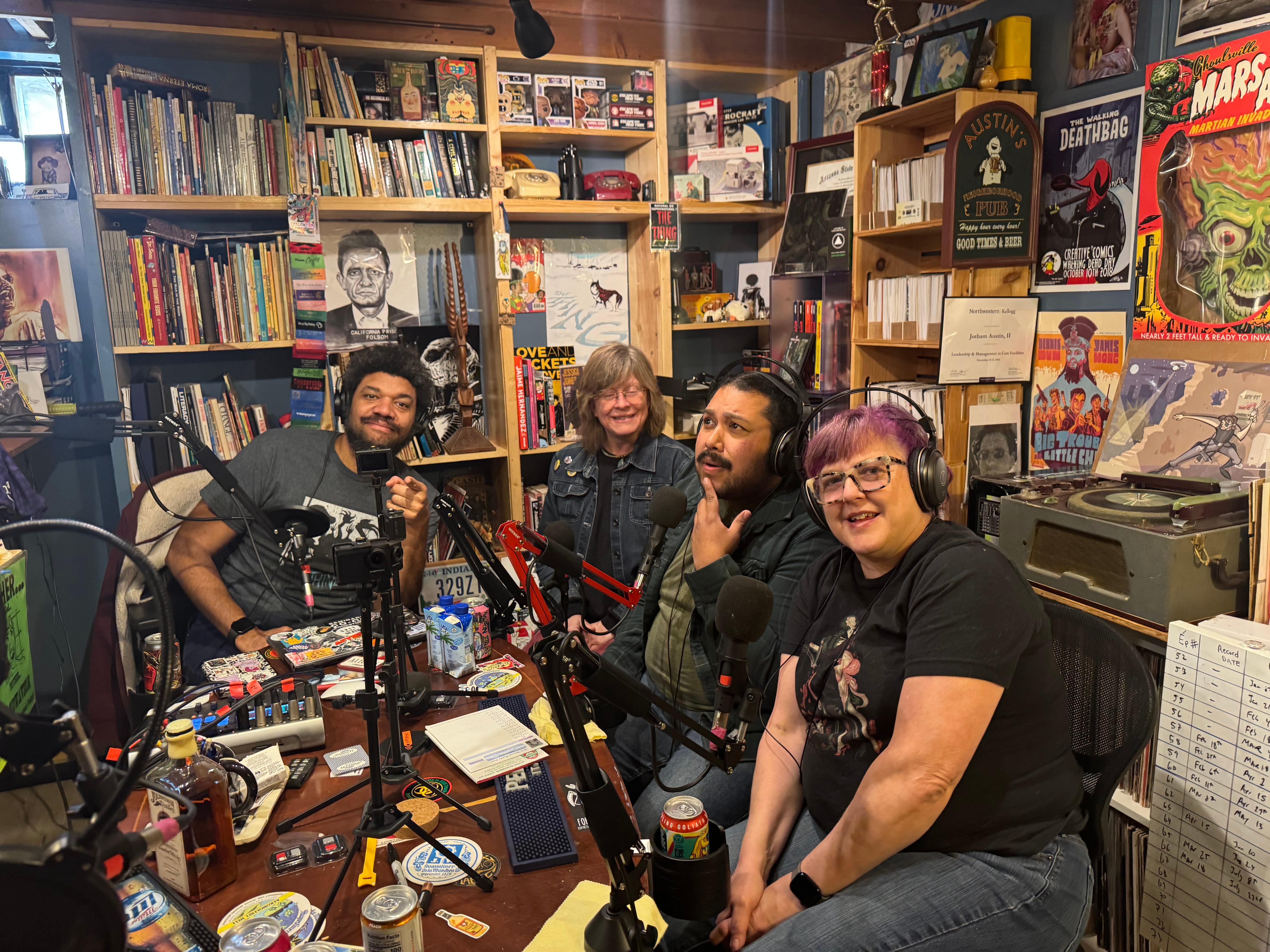
Episode 48: Perception vs Perspective.

Is Your Brain Lying to You?

SubstackAppleSpotifyYouTubeAmazon


Joe: [00:00:00] Hey, welcome back to the Rabbit Hole of Research down here in the basement studio.

got me, Joe,

Georgia: You

Joe: you got Nick. We’ve got Nick. We’ve got Georgia, and we actually have a special guest with us.

Nick: well, hello there. Hello.

Joe: yeah. Yeah.

Katie: My name’s Katie.

Joe: We got Katie. Hello. Katie.

Katie: Coming all the way from Dc

Joe: From DC to the basement studio.

We got a full house here. Yeah. Every Mike’s occupied, so

Nick: is it? Yeah,

Joe: There’s a, there’s a fifth mic,

Nick: I was like, I thought we had more

Joe: We There are more, but that this is all we have set up in the basement studio. People that’ve seen pictures

Nick: I mean, I thought the fifth mic was given to the ghost

Joe: Yeah.

Nick: we had summoned

Joe: That’s right. Last, last month. Yeah.

Nick: I

Joe: Whatcha talking about? I don’t know what Nick’s talking about the other day we’re

Nick: It’s okay

Joe: talk about perception and perspective.

Nick: Georgia got [00:01:00] that one,

Joe: So that’s what we’re talking about. So, yeah. Cool.

Nick: Do you, do you have a list here, Joe?

Katie: I,

Joe: you know, I have lists, but I like going in with the definition ’cause perception and perspective.

They’re kind of sound close. So maybe I, I’ll,

Nick: I’m pretty sure we also had the same discussion

between

you, me and Georgia

Joe: have been one of the few

Georgia: Well, because I think I had the one word, I think now I don’t remember which one. And then all of a sudden I’m like, wait, no, that’s not what we’re doing. We’re doing perception, not perspective.

And then Nick was like, yeah, well what’s the difference?

Katie: Yeah. Yeah.

Georgia: So here, Joe, tell us. Yes.

Joe: So I

Georgia: do,

Katie: Oh,

Georgia: should we have, Katie, do you wanna tell us where you like where?

Katie: don’t know.

Georgia: I don’t

Joe: Didn’t she do that already? I

Georgia: say Washington dcs. Nevermind. Sorry.

Katie: It’s all good.

Joe: don’t, I don’t know what’s happening.

Nick: I, I dunno,

Katie: Dunno, my

Joe: perspective of this is, no, it’s just your percept. Let me, lemme get some definitions here. [00:02:00] We’re already in the episode. Yeah, so perception I guess, is the process of interpreting sensory information. The immediate, often unconscious filtering of sensory data through which we view the world influenced by biology, attention, memory, and context. You can think of it as, what am I seeing or what am I aware of? 

Perspective is the interpretive framework or worldview applied to what we perceive influenced by beliefs, culture, experience, and ideology. Think, how do I understand or interpret what I see. 

Other ways to think about it. If you’re more computer literate, is that perception is the hardware, the senses gather data, but they are imperfect, easily tricked and biased and perspective is a software, your mental framework interpreting the sensory feed.

And a play between your perception and perspective is where tension and really good stories can lie .

Nick: How do you mean?

Joe: Well, I mean, so one of the easiest ways is just if you think about you have a shift in your perception, [00:03:00] so new data, oh, altered states, things like that, then that will start creating tension in the story as the protagonist is going through and us as readers or viewers going through that story with them and interpreting the data on our own versus how the characters, , 

Six sense.

That’s, we can go there. It’s a very easy one. I mean,

Georgia: don’t spoil it.

Nick: Wait, what’s this movie about Joe? I don’t think I’ve seen it. What

Georgia: not,

Joe: It’s about a kid that sees dead people. Yeah, that’s, that’s kind of it. But yeah, you had that in there where , we had the perception of what was happening and what we thought was happening, what the character thought was happening, and then you, you, and along we were making perceptive kind of judgments about the story, and that tension was building, trying to figure out what was going on.

And then you get at the end, you get that nice twist where, oh, everything

Georgia: more information.

Katie: right. You

Joe: that different information. So I think that’s one way that you could set it up. And there’s a number of movies that Yeah. That do not go. Yep.

Georgia: Oh. Speaking of writing and [00:04:00] books and how this is, falls into that is point of view, you know, and that’s your perspective, right?

So a book could have several point of views in the same book. How you look at and you’re looking at the same

Joe: situation. Yes. Yep.

Georgia: yeah, yeah. I can

Nick: Yeah, I can see that.

Joe: Mm-hmm.

Katie: My first thought was art, like maybe it’s ’cause I was staring at the Gallery of art as I was like doing research for this.

But yeah, I then I ended up pulling up a few books about like perception and art and I went too deep. So many notes

Joe: you went deep down a

Georgia: is good.

Katie: Mm-hmm. Mm-hmm. Yep. Pulled out some children’s books about perception, such as I Hear A Pickle. It’s a great book. If you haven’t read it. I don’t

Georgia: I don’t know if I’ve heard that

Nick: that

Georgia: one.

Nick: Where did you pull these out of? I’m sorry.

Katie: The public library. Okay. Mm-hmm. Of

Joe: public

Nick: to make sure

Katie: the thing I work at. Oh, okay.

Nick: okay. Yeah.

Joe: So this is the second episode. We’ve had two librarians on

Nick: I know. This is

Joe: this. Is it? Yeah. So,

Nick: It’s like

Joe: trying to think

Nick: to support librarians or something.

Georgia: the [00:05:00] best.

Nick: best.

Katie: We know what we’re doing.

Joe: what was the other episode that

Georgia: It was Mary. Yeah.

Joe: I know. What, what was the topic? Not who, right? Multiverse. Oh, multiverse, yeah. Perception

Nick: of them

Katie: them.

Nick: how?

Georgia: of very similar in that

Joe: Yeah. I, I was trying to remember. I, I knew who was on it was like, what, you know, I, I knew Mary’s name. It was

Georgia: what was the topic? Yeah, multi.

Joe: Yeah, because the board doesn’t go back that far. 

Georgia: Was season one wasn’t that. Season one.

Joe: it was the,

Nick: see my, wasn’t it Version of time does not add up

Georgia: that not, is that not what you perceived?

Joe: not, yeah. Right. You’re not your perception of,

Nick: I don’t know. When I am, apparently Georgia.

Katie: What year is it? 

Nick: Who am

I? What am

Mm-hmm.

am I,

Joe: What am I seeing? Yeah.

Georgia: What were some of the other books that you,

Nick: Hmm.

Katie: No Shade to the author of this book. [00:06:00] But I was reading something called Key to Perception, and it was a little like woo woowee for me. And it just like I’m, I will say like I scanned this book mostly and like they really got into the weeds of I don’t know, it’s like kind of like witch adjacent and I’m like, you go girl.

But this is not what I was expecting when I was, when it was like the

Georgia: It was like, it was

Katie: was Yeah. Key to perception. I’m like, oh, oh,

Georgia: a different rabbit hole altogether.

Katie: yeah, yeah. That of spiritual. At one point I was reading about

Nick: is that why you were telling, telling me

telling me that? 

Katie: Yeah. That’s why I texted you that the yeah, I got weird, weird thing.

At one point she was talking about end toning of E I OOs dunno if you’ve ever heard of that. Apparently it’s like a breathing technique that you’re supposed to like get, get your perception going and like into the spiritual world. I don’t know. I know too much about this now. Oh, wow. Yeah.

Joe: There you go.

Georgia: e

Nick: Where is the science in this one?

Joe: yeah, I know, I

Katie: I know. 

Nick: Can you bring science to this?

Katie: to

Joe: that in the show notes. No, I got nothing but no Eio os

Nick: it[00:07:00] 

Georgia: I actually,

Joe: like something else.

Georgia: actually, it reminds me of like, when I was an undergraduate, one of the first years, like it might have even been the first year and I was at A SU and it was a huge. Seminar class and it was like human sexuality 1 0 1. And the guy that taught it was like, I’m serious.

I think he was like 80 years old.

Katie: Same. I had someone,

Joe: fun

Georgia: And he’d been teaching it for many years, but he had the ooh, ah, yeah. Method. Mm-hmm. Yeah. Yeah, it was very

Nick: what is it specific, I,

Georgia: If you’re enjoying something, you wanna you know, let ’em know. So you say, Ooh, ah,

Joe: and that would, that would affect the,

Nick: What? That

Joe: would be the perception that you’re enjoying it and the perspective. Then the other person would’ve, their perspective, just so that, that would fit into your perception and perspective. 

Katie: Mm-hmm. 

Joe: Mm-hmm.

Georgia: It’s about communication. Communication. Unless

Joe: you’re faking, and then that’s a,

Nick: wait, so what are we talking about now? I’m sorry.

Joe: we’re [00:08:00] talking about perception and perspective and how easily your senses can be fooled.

Georgia: And very

Joe: by saying Ooh and ah,

Georgia: there’s some very scientific Ooh, ah, research.

Joe: ooh, ah, research.

Nick: need to get into this research.

Joe: Well,

Nick: How do I find this?

Do

get a suit at the end?

Joe: Yeah, you, you’ll get a suit. Yeah. You get, you get something. I don’t know.

Katie: No, at the end, you actually get feeling the presence of spirits and energies.

Georgia: Woo.

I

Nick: I mean,

Katie: ew on and you’ll get there. Always. Mm-hmm. Yeah. 

Joe: Don’t, did you got anybody do that? The dress thing? The dress challenge?

Georgia: Oh yeah. What color

Joe: and it was like one was blue or gold or was it something like that.

Katie: like that. White

Nick: gold, right? Or black and gold.

Katie: thought it was gold. I don’t know. I thought it was blue and gold.

Nick: Maybe. I don’t

Joe: perception that was the same idea. Your perception and perspective shifted what you are preloaded to think dictated what color you would see

Katie: [00:09:00] mm-hmm.

In the

Joe: dress.

And so, but then that led to all these debates over truth and identity, , generational divides. , it was really fascinating. That was like 2015

Katie: Mm-hmm.

Joe: when that was big. So one of the, not maybe one of the early kind of internet phenomenons

Nick: I kind of forgot about that. I feel like

Joe: Yeah, that

Nick: that happened so long

Joe: Yeah.

Georgia: Yeah.

Katie: I had a resurgence recently, but it was like something else similar. Yeah. Like in the last year. Yeah.

Joe: But the Harlem, 

Katie: globetrotters.

Joe: didn’t come out.

Georgia: The Harlem Shake. What does that have to do? What? I

Joe: I don’t know. It was like the same time.

Nick: talking about,

Katie: Oh my God. Yeah.

Georgia: Harlem

Nick: No.

Joe: never remember.

Nick: What’s the

Georgia: where they

Joe: to do one and it was

Georgia: You’re like video. And then,

Joe: and it was a perception and perspective. Yeah. Where you go and you’re doing one thing and then the music shifts and then all of a sudden Yeah.

Georgia: to you

Joe: know, yeah, there’s,

Georgia: everybody’s like dancing.

Joe: the beginning scene, there’s one person that’s kind of in frenetically in motion, and other people in the scene are like frozen in time.

And then as the song goes it, I think it drops the [00:10:00] beat or something like that. And then the screen blacks out and when it comes back on, the person who was in motion is still, and then everyone is just

Georgia: everybody’s

Joe: nuts around them.

Katie: Everybody,

Joe: It’s, they’re really fun. I mean, you never, you never,

Katie: you know, yeah. I don’t,

Georgia: you miss that.

Joe: it was, it was easily 10.

I mean, it was, you know, and then gun style was like, came right out. It was like all in this

Katie: I know, you know, some of these

Joe: of Yeah,

Nick: know Gunna style.

Joe: Yeah. Harlem Shakes was, yeah, it was the, it was like one early YouTube kind of, you know,

Nick: you have a video of you doing it, Joe?

Georgia: No, but he

Nick: I mean,

Joe: I really, really wanted to do one.

We could do one, like a Rabbit Hole of Research.

Georgia: I’m,

Nick: I am.

Joe: It’d be our first video. That’s it. We’re bringing it back. Oh yeah.

Nick: this something that needs to come

Joe: It was still like, I mean like a vine. I mean, remember Vine? I mean the Vines, like you would have those Yeah. No, that was in that same

Katie: see

Nick: was never in Vine.

Joe: Yeah.

Katie: I wasn’t, I watched the like YouTube.

Joe: Yeah.

Nick: compilations.

Katie: it. Yeah. I

Joe: was there at the original vibes though.[00:11:00] 

Georgia: I

Joe: I made a vine, a couple vines, I think at a coffee shop.

Nick: Oh

Georgia: yeah.

Joe: that’s,

Katie: what

Nick: Was that part of the oohs and ahs, I’m sorry,

Joe: No, there was no, not,

Nick: the guttal, right? Yeah. Groan. Oh.

Joe: I, I think easy, easy. Two easy move movies,

Georgia: You okay there?

Joe: His, his perception has changed. We’ve, I will, I’ll comment on this, that the basement studio is, is currently under some sort of renovation.

Georgia: All you did was shift the table a little.

Joe: That’s, that’s enough to change

Katie: threw Nick off.

Joe: right?

Nick: throwing me off

Joe: perspective is now shifted and so Nick and in a new spot and, and I think it’s all gonna change again ’cause we are really trying to get ready for video. So the, a little aside on this episode and then you can see our perspective and of

Georgia: no. Well, they would [00:12:00] see their perspective of us.

Of us,

Joe: this is

Georgia: right?

Joe: deep. Well

Nick: them see what we want

them,

see. Okay.

Joe: Your perspective will be controlled. , but I was thinking two. Examples came right to mind and we don’t have to spend, a lot of times, I think a lot of people have is the Matrix and the other one is, is Alice in Wonderland.

Mm-hmm. I think those are the two biggies where

Georgia: perception, the original rabbit

Joe: are. And Alice in Wonderland definitely, one of the originals there. 1865 Louis Carroll had that, so

Nick: was it really? 1865?

Joe: it was

Georgia: Yeah. I

Nick: why I thought it was like,

Katie: yeah.

Georgia: And I think the thing about Alice in Wonderland in general, is always associated with was there drugs involved?

And so that’s an interesting take on the Perce perception perspective because drugs can definitely that

Katie: Yeah.

That alter state.

Georgia: Yeah.

Joe: your state. And, and, and at some level, the matrix, he chose the red and blue pill.

Georgia: Right.

Joe: So it also had the [00:13:00] kind of drug, you’re un, you’re untapping some extra,

Nick: the full

Joe: That’s right.

Yes. Yeah. To become the one, the one not the,

Nick: be one. Oh, wait and wrong

Joe: That was That’s right. I was gonna say that

Nick: was

Georgia: There can only be one.

Joe: right.

Nick: No, that was the Highlander. Right?

Joe: That it also had a one. But in the one, the movie, the one by Jet Lee, he says that at the end, or I don’t know if he ever says that.

Georgia: think he does. There can only be one.

Joe: No, he says something else

Nick: I feel like we’re going off on a weird hole.

Joe: Well,

Katie: talking about.

Georgia: There is no such thing. Every, every hole is

Joe: but it

Nick: weird hole

Katie: it up.

Joe: I, I think it might be 1951 was the animated movie that came out, so that probably shifted your

Georgia: Oh yeah. Perspective. The Disney.

Nick: Yeah. Yeah. I thought that was the original.

No,

Joe: no. It was least don’t

Georgia: Very.

Nick: Oh my God.

Georgia: Went way back. Yeah.

Joe: about getting canceled. Yeah. Don’t do that.

Nick: With two 

Katie: library folks in the room. [00:14:00] What? What are you doing?

Nick: I thought it doesn’t become real until it’s a movie. Is that not

Joe: Oh boy. Disney movie. Disney

Nick: movie 

Katie: for the Alice in Wonderland. Like I had an actual, like in-person experience with this where I was a little drunk.

I was in London and we, it was like a experience where you’re like going through the Allison Wonderland story,

Joe: right.

Katie: right? And like an old, like underground, like I think it used to be the tube but it was empty, so they were doing like live performances and just like it. The way I was interpreting Allison Wonderland drunk while also like it being in front of my face Right.

Was like, it was honestly more scary. I

Joe: imagine. Right, right. 

Katie: Yeah, it was, I was not anticipating it to be scared

Joe: you drink things and eat things while you were going

Katie: Yeah. So did

Joe: they have little

Katie: Yeah, they had a little, yeah. At the same time

Nick: at the same

Katie: there, there were actual like perceptions like that, like how they actually did the scales of the room.

Yeah, yeah, yeah. [00:15:00] And at one point you’re like at a dining table, like with teacups and it was another alcoholic drink that changed colors. Yeah, it was, it was really cool if I really hope to do something like that again, but maybe

Georgia: cool.

Katie: That’s really

Joe: that made me think when you were talking about the rooms. Was the Museum of Illusion in Philadelphia and they’re, I think they’re around, they look like they’re kind of chain. Yeah. Right.

And so, but I think

Georgia: and we went to the Wonder Museum

Joe: Museum, but the Museum of Illusion had the rooms where you get in and all sorts of things where you get in and it really plays with your, per your perspective of everything.

Georgia: perception.

Katie: Hmm. 

Joe: Well, 

Katie: I think

Joe: it’s skewing your perception.

Georgia: how you perceive the room.

Right.

Joe: right. So it’s messing with both. I think they, they interplay with each other. Right. ’cause the perception of how you look at things is your interpretate your in input, and then you, you interpret that through your perspective and you go, oh, ’cause your brain is saying that I know that this, they’re not smaller.

You know, you know, the relatively, they [00:16:00] might not be shorter or that short. And then, you know, you’re trying to, you know, kind

Katie: like those carnival spinning wheels, like it’s fair season. But you’ve never been to, like at the fair, they have these houses that you have to make your way through.

And at one point there’s typically like this spinning tunnel that you have to just walk straight.

Georgia: Is that the like house of Mirrors kind of

Katie: Yeah, yeah, yeah. Mm-hmm.

Nick: had it spinning.

Katie: Yeah.

Georgia: I

Joe: Museum of Illusion, they had one, they had a, a little tunnel you could go through and it had that, and it was really

Katie: Yeah.

Joe: the ramp.

You’re not, you feel like you’re

Katie: you feel like you’re spinning, you feel like you’re spinning. It made me like car sick, almost

Joe: It’s really crazy. Like you go in and it, it feels like you’re just going, you know, in a dryer, tumbling around.

Nick: weird question. If you have bad eyesight, which I think at least two of us here have bad eyesight, does it affect the way you see the things in those illusion museums? Or what? I mean,

Joe: if

Katie: don’t have a current prescription, probably. Right?

Joe: Yeah. I [00:17:00] mean, if you got blurry vision, I mean, yes. You’re, you

Georgia: you,

Joe: real, I mean, I

Georgia: see double

Joe: it’s

Nick: listen, my eyesight’s great.

Katie: Mm-hmm.

Joe: You’re like, yes. No, that, I mean that that changes everything. Right? I mean, I think if you.

Nick: like, I mean the, the seeing things that are bigger and smaller is that

Joe: Right. Yeah. I don’t know if,

Georgia: I think bringing science into it, that’s a great point. Like. How we, we use our eyesight for, and how, how much do we compensate for like bad eyesight, you know what I mean? 

Joe: Well your brain does a lot of the heavy lifting. If it knows, it will try to fill in the gaps that they do have.

One where they have. They show pictures of like famous people that are really recognizable. And then when you, if you actually flip the image, you realize that they’ve, they’ve screwed the eyes up, but it’s upside down. And so because the face is upside down, your brain fixes it so you recognize it. It’s called the Thatcher effect. But then when you flip it to the right side [00:18:00] view, you see the eyes, nose and mouth were manipulated, but your brain will fix it. And actually, that’s probably one of the reasons why our perception

Katie: can

Joe: be, you can be tricked.

Our brains can easily tricked into believing things because they’re trying to present the world in the way you expect it to .

Nick: your brain is lying to you.

Joe: Your brain is lying to you.

Nick: Is is that gonna be the name of this episode? Your brain is lying to

Joe: Well, maybe it should be. Yes, it’s right. Yeah.

Nick: Is this the episode we go

Georgia: think that your brain is trying to help you out? I don’t think it’s being malicious.

Nick: I mean, I don’t know if it’s, if it’s not letting me see what’s wrong with the world. If there was something going wrong. And like I look at it and I’m like, what is is is, I mean, it could be saving me if I was, you know,

Joe: well, your, your brain has, you gotta think like humans from some evolutionary point of view. You were very, it was very advantageous to look at things and make very [00:19:00] quick decisions based on that quick look if it’s safe or if it’s dangerous.

And so your brain is making all these assumptions based on other patterns. And so our brains are really good at finding patterns, very good at organizing things in the categories, you know, safe to eat, not so safe to

Nick: eat.

Joe: you know, makes you,

Nick: by licking it,

Joe: yeah

Nick: at

Joe: don’t lick it.

Nick: No, that’s the way you do it. We’ve already been over this, this is why we

Joe: all that’s a different episode.

I just, that’s

Georgia: Do not lick it. Don’t lick it.

Joe: It’s really it’s really fascinating that, that how your brain, and there’s actually. While I was looking up different things was a predictive coating. And it’s this neuroscience theory that says your brain isn’t a passive recording instrument, kind of recording things that come in the sensory information.

It’s more like a predictive engine that constantly guesses what’s out there and only updates when it’s really surprised. So your brain is [00:20:00] actually trying to figure out what’s going on before you get there. So it’s giving, it’s delivering you information that says, well, this is what I think is happening.

And then when you get surprised, that’s when your brain, oh, we were fooled. And that’s why I think. Fun houses, things like that. You know, kind of, what do they call the at Halloween time, you go through the, the haunted houses. Mm-hmm. Right? I was trying to think. I was like, what is those things called?

Yeah. Haunted houses where you are, your perception as you go through has one thing, and then you get surprised and it, it, it freaks you out even though you think, oh, this is fake. And your brain is yeah, this is fake. And then you get boom. Like, why, why did that really surprise you? You knew going in there, what’s gonna happen, but you are caught off guard by those things.

So your brain is trying to predict the situation and how best to navigate it.

Nick: So doesn’t your brain try to predict a lot of things though too?

Like people with anxiety, they tend to be able to try to predict the next words coming outta someone’s mouth and then. Right? I don’t know. Is that that might just be me. I

Joe: it.

Nick: I know I do it,

Joe: I think we do [00:21:00] it. Yeah. Everybody

Nick: I’m constantly like trying to figure out what’s Joe gonna say next so I can have something funny to say back to him.

And then he just looks at me like, why are you saying that Nick?

Joe: and you’ve trained improv and you are trained, really trying to train the perceived signals how people are, are motioning their, they’re

Nick: their face, how, what’s exactly,

Joe: Yeah,

Nick: what’s the next look they’re gonna do.

Georgia: But then that gets into like stereotypes and That’s right. You know what I mean?

Katie: making right, starts

Joe: making bad assumptions and then they stick. Right. Because

Nick: wait, how? How so, I’m sorry. I was,

Georgia: Are you serious?

Nick: Yeah, no, I’ll, no, I’m

Georgia: saying that’s also what gets us into trouble because it’s that’s how stereotypes are,

Nick: Oh, I thought you were saying like people had an improv just stereotyping

We moved past

are

Georgia: No, no, no. I’m just saying,

Katie: I was like,

Joe: he’s about to

Katie: defend

Joe: improv community.

Nick: Oh no, I’m not gonna defend shit for that. No, I was just trying to figure out, oh

Georgia: no, I’m just

Nick: how

can be mad at them. No,

Georgia: No, I’m just saying. You understand what I mean?

Nick: Yep, yep. No, I do. Our brain[00:22:00] 

Georgia: jumps to conclusions or, or they fill, it fills in these things that maybe shouldn’t be filled in, you know?

Joe: and that, and that part, that’s your brain’s not processing ever been information that, that’s why it’s easy to gloss over things. You’re like, oh, the, you know, the, the cup is right there on the counter

Katie: Oh yeah. You’re like,

Joe: I don’t see the cup. What are you talking about? And you’re like, it’s right there.

And you go,

Nick: so is this why the Mandela effect comes in? Because people don’t pay attention to shit.

Joe: That’s probably, yes. That is and this is just a theory and this isn’t proven that this is why

Nick: no, this is a hard fact. These people can’t see shit.

Katie: was

Joe: that your, that your, the way your brain is processing information is a theory of how that works.

So this is kind of as predictive coding, it’s one, it’s one of the ways to explain a lot of these phenomenon.

Georgia: think it’s interesting ’cause we’ve talked about this before about AI compared to a human brain and how the human brain works versus how ai, but in, in this way, I think AI is doing that same thing.

I think this is what they wanna hear. So I’m just gonna throw all this crap

Nick: I do.

Katie: [00:23:00] ChatGPT Yeah. Yeah. The kid. Yeah. I worked with teenagers and they would always talk about oh, I gotta this paper and then go throw it into the ai. I’m like, no, no, no, no, no, no, no. Use your brain. 

Joe: That’s right. Yeah. So I, speaking of AI, did you guys see the story about how a chatbot’s conversation convinced a man he was a superhero?

Nick: No. What? That’s not what I thought you were gonna

Georgia: think

Joe: yeah, no, it was this

Georgia: this guy was very impressionable.

Katie: Yes.

Joe: No, it was interesting. So the New York Times, just this guy he was from Toronto Allen Brooks. He was 47. And he thought he had discovered with using chat, GPT, this kind of a novel mathematical formula. And it started out with this kid asking him to explain pie you know, the mathematical expression pie.

So he put in a chat, GPT, and then he got going on this conversation. And at the end, the Chachi bt was like, wow, you’re really, you’re really thinking about this in new ways. Here’s this idea. [00:24:00] And they kept going on and on and at some point it was like he could harness sound resonance to talk to animals and build a levitation machine.

And then the formula turned out that if anyone got this formula that he could take down the internet and, do all this weird stuff. People could make force field vests. And he was sending it to his friends Hey, is this crazy? What’s going on? He kept asking ChatGPT, Hey, is this, are you really pulling my leg?

Are you fooling me? This sounds a little, you know, I’m writing. He started writing experts and they were like, not, they were ghosting. I’m like, you know, ’cause this, you know, he is you know, this kind of crazy talk. And he was not getting speech. He’s no one’s writing me back. Oh, they’re, they’re, their minds are closed to innovation.

And it was this whole thing. And so chat, GPT just got him going and he was just going for about three weeks. He thought that he was trying to

Georgia: was he sleeping? Was he he eating? I mean, that, I think he had some,

Joe: He

Katie: He stopped just there. Yeah, yeah, yeah.

Georgia: going on.

Joe: he was smoking pot

Georgia: Well, there

Katie: down.

Yeah.

Joe: was just going, so he had over, there was like 2000 messages that were passed back and forth between him and chat, CPT.

So finally, and he was [00:25:00] asking friends, he was trying to invest money ’cause this, these ideas, he was like trying to get money and startup capital.

Georgia: gosh. And so,

Joe: he took the information from chat GPT and put that into another chat box, I think it was Claude, and said, Hey, what do you think about this idea? And it was like this is nothing 

And so the whole idea was that when he moved the chat, GPT had built up this conversation with them and they’re designed somewhat to be pleasing. Like they, they don’t wanna call the human an idiot. Mm-hmm. So they’re like, oh yeah, that was a great idea. Yeah. You’re, you’re doing great.

You’re thinking like, no one else has thought this before. And he went and club was like, nah, this is, this is all garbage. Like you shouldn’t invest any money. Because it was, it was a new conversation and it was coming at it. What do you think of this idea? And it was like, eh, this, this idea is dumb.

You know people

Katie: friends and family didn’t stop him or check on him. He was

Joe: yeah, they were like bought into it. ’cause

Georgia: I know. Did he live by himself?

Joe: he, I think it was him and his son. And so New York Times did a great piece where

Nick: and [00:26:00] he’s 47.

Joe: 47 and they, they analyzed the

Nick: fuck’s sake

Joe: and he, he was just fine.

And so I read through the me, it was kind of interesting. It was like, if you’re writing like a science fiction story, it was cool. But if you’re actually like, I think this is the way the

Georgia: living through that.

Joe: yeah. So you had this very limited science knowledge. You went to this chat, this predictive engine

Georgia: generating

Joe: kind of text for you that’s tailored to your conversation and you go down this, he went down this rabbit hole and he thought he was gonna save the world from this, you know, he figured out this mathematical formula if it fell into the wrong hands.

Bad things will happen. And he also could make a lot of money if he invested in it now, got on the ground in, he would be ahead of the curb. Yeah. His brain just got tricked, his perception and then his perspective went down and he started buying into it.

And during to conversation, he had doubts. He was like, I don’t know about this. How come I’m the first to think about this? You know, I don’t have, I didn’t even finish. I barely finished high school. So how am I thinking of this great novel formula and no one else has?

And it was like, well, it’s ’cause you’re asking the right questions. You’re, you’re actually [00:27:00] challenging the, the paradigms and you’re going at it. So yeah, it’s like very it was interesting, but I, I thought that fit perfectly in what we’re talking about and how, a predictive engine could get you in trouble just like your brain and get you in trouble, you know, go down these rabbit holes.

Katie: so, right. I mean, honestly, that’s a better AI story than the one I read, which is like top 40 jobs that can be replaced by AI.

My job was on there archivist. I laughed very hard.

Georgia: Yeah,

Katie: and it was, it was biased though. It was like it was a Microsoft study, so I’m like, like that. One more.

Joe: yeah. You should ask it if you’re gonna be a superhero archivist.

Katie: That’s it. How can an

Joe: save the world?

Katie: Yes, that’s a

Joe: point. You’re awesome.

Katie: Yes.

Nick: Oh,

Joe: give you, what’s the, what’s that movie with Nick Cage?

Nick: Which one?

Joe: The one where they were going to artifacts,

Georgia: narrows it

Nick: National

Treasure. Thank you.

Joe: National Treasure. That’s it. Thank you. Yes, yes.

Nick: I

wait till the third one.

Katie: That’s a thing.

Nick: hopefully, oh my gosh.

Katie: There’s no way. There’s no way.

Georgia: Don’t get your hopes up.

Katie: Yeah,

Joe: I just [00:28:00] had to, I just had to mention Nicholas Cage. My,

Georgia: I was gonna say he had to be in mentioned at

Nick: I mean, I can pitch a third one if we want.

Joe: And he was in upper percept Face Off.

Georgia: Yeah,

Joe: That was like kind of a perception perspective. I

Katie: only watch that once.

Georgia: that’s been a really long time

Joe: it’s been a while.

Just came up and I was

Georgia: I’d like to see that again. Actually I couldn’t.

Katie: I couldn’t. It’s too Gru. What you

Nick: what do you mean it’s too

Joe: it wasn’t,

Georgia: It’s John Wu, right? John Wu. He, yeah, I’m pretty sure that

Nick: Is it

Georgia: John Wu,

Nick: the one who did

John Wick?

Joe: No, I don’t think

Georgia: I thought, no,

Joe: he did hard boiled.

Katie: Yeah, you’re right.

Georgia: Yeah. Hard boiled. He did he was from China and so there’s Likehow

Joe: who did John win?

Nick: did? John Wick. Katie, I see you’re on your phone.

Joe: We’re doing research as we go

Nick: as we go on the fly,

Joe: making sure your perspective stays intact

Georgia: because he did all the, the ones what

Katie: chapter one

Chad Alki.

Georgia: Oh yeah.[00:29:00] 

Joe: there it is.

Now another movie that involved hallucinations blending and we just wa is Jacob’s Ladder

Georgia: Tim Robbins,

Joe: this, this very 1990

Georgia: have, oh my gosh.

Joe: Messed

Georgia: That’s the movie that I saw it many, many, many years ago and it’s still just, it’s kind of haunts you after you see that

Katie: Yeah. See, that’s what I’ve heard. That’s why I haven’t watched it.

Georgia: It’s, it’s really good. But yeah. Intense. But it’s totally yeah, that idea of not knowing what’s really real. Mm-hmm. Real reality. And what’s the perception?

Katie: Yeah.

Georgia: Yeah, sleep

Joe: deprivation comes in that one.

I mean, he is

Katie: when

Joe: of going, he is dying. I mean, so

Georgia: post-traumatic stress because he was in Vietnam and then was there extra drugs given and that’s the whole idea that Yeah.

Nick: And this is Jacob’s Ladder.

Joe: Jacob’s Ladder. Really

Georgia: put that on your list. Yeah.

Katie: Yeah. Yeah.

Joe: I mean, think of, I mean, we’ve [00:30:00] centered a lot of our conversation around sight, but our other senses can also feed into this.

So hearing and , a lot of movies where you’re hearing sounds and they’re triggering kind of audio illusions of what’s going on. Or Nick got something to say, so I’m gonna stop right there. So,

Nick: Would it be all right? All right. So this happened the other day. Someone was talking to me and I don’t know what I was doing, but they were like right in front of me and I did not hear them until I heard like something drop. And I’m like, what? Is that under this whole perspec

Georgia: now do is, was that a matter of that you just tune them out or you

Nick: I

Georgia: couldn’t, or you just couldn’t

Joe: ’em? You were like,

Nick: I think

I think it was because

Georgia: I’ve done that before where all of a sudden I realized, oh, I’m not listening.

Nick: Like I didn’t know that. Like they started talking and then by the time I realized, they were like, oh, you didn’t hear a word I said, did you?

And I’m like,

you 

Katie: were 

Nick: talking.

Joe: Yeah. And your brain, I mean, right. You could be, if that’s, if we go by this predictive coding kind of [00:31:00] theory in your brain, could just be making assumptions that this is this person. They’re not doing whatever. You’re doing something else that might need more attention.

And you’re just kind of filling in the blanks of a person. Oh, this person’s there, but not really paying attention. What else were you doing? Were you doing something?

Nick: Nothing. I think I was just, I looked at my phone and then went off. I think I just walked

Georgia: It’s like, it’s like in iron Man. It was, it’s like in

Nick: Oh,

Georgia: which, which MCU movie.

Is that where he tells him the whole story and then he

Joe: oh, that was, that was

Georgia: he hadn’t listened at all

Katie: three.

Joe: I can’t remember which one. Yes, he was laying on the couch and

Banner was like, I’m not that kind of doctor.

Katie: Oh, oh yeah, yeah.

Georgia: he goes, you haven’t heard anything I’ve said, have you?

And he

Nick: I think that was the

Katie: Avengers movie.

Joe: that the Avengers movie? Yeah. Okay. Yeah. So, and he was like, I’m not that kind of doctor.

Katie: Well,

Joe: hearing is one where you can go and you can play around, you know, kind of false cues and

Katie: all.

Nick: of Tron

Katie: Hearing gets me in my house all the time. Yeah. My cat thumps and I think someone broke

Joe: right,

Nick: Oh. [00:32:00] Just like how you thought my old house was haunted.

Your old house was haunted. It

Joe: Oh

Georgia: She didn’t think it. She knows

Joe: knew

Katie: And my bones,

Joe: you feel a touch? ’cause that’s also

Katie: Oh, I left once in the middle of the night.

’cause I got two spooks

Joe: Oh, I think you got touched. And I was like, all right. This is, we need to edit that.

Georgia: You got some friendly ghosts?

Joe: right. Yeah.

Katie: I just kept hearing noises in the, the corner of the room and I’m like,

Nick: thought you said it was in the kitchen that you heard

noise. Maybe it was. It was both.

said it’s, didn’t you say there was something on the fridge?

Katie: Yeah. And I left

Joe: Get

Katie: out.

Nick: mean, that house was weird.

Katie: Yeah. Yeah. I would never go in that basement.

Nick: There was no basement. Katie,

Katie: thinking your current house. I’m thinking your current house.

Nick: Are you afraid of my current house?

Katie: I’m afraid of your current house. Yeah. Sorry. That’s why I only come back once a year.

Joe: get

Georgia: Aw.

Joe: But touch we, yeah, touch. I mean, that’s in VR takes advantage of [00:33:00] that haptic kind of signaling and things

Nick: like ready player one, where they have all

Joe: Player one.

Ready Player one. Yeah, that’s one. So yeah, so, smell and Taste. This came up another episode.

Nick: vision,

Joe: Oui. And the food memory. That was one night that came up. And that was in I think the, the time. Crimes and time

Nick: Oh yeah.

Joe: We did that right at two. Yeah. Yeah. But that’s, that’s one where your perception, your memory, all that’s being recalled,

Nick: The reviewer just,

Georgia: I think that’s why it’s, I think that’s

Joe: different hypothesis of what happened. Sorry.

Georgia: I think that’s why it’s so easy for us to. Imagine like the matrix or ’cause we have the sim simulation Hypothesis. Hypothesis. Hi Wes.

Nick: You know,

Georgia: and I think that’s why it’s so, it’s so easy for us to kind of, and even like conspiracy theories, I mean, it’s so easy for us because our brain is able to kind of imagine all these other,[00:34:00] 

Nick: make connections where there are none.

Georgia: Well, I didn’t say that.

Joe: No, that’s, I mean, I think you’re right.

Georgia: did we prove that simul, the simulation

Nick: Yeah. I’m pretty sure Joe and I did

Joe: Yeah, we did. It doesn’t

Georgia: doesn’t, it could exist.

Nick: there’s too much going on in anything to have enough memory space to do this.

Georgia: Alright, well

Joe: yeah.

Nick: sorry Wes,

Joe: Yeah, we’re, we’re out. I think he’s got some new evidence he sent.

So he is, he’s gonna come back

Nick: We’ll do a part two. We’ll

Joe: do a part two, we’re gonna do a part two. Next, third, third season. We’ll, we’ll try to find space

Georgia: And we’re gonna talk about,

Joe: I think severance is the, severance is what the, the one where severance does a great job.

Georgia: Yeah. Talk about perception and being able in your brain to switch something on and off, you know,

Katie: So mad at that series right now. Yep. I have opinions.

Nick: I haven’t seen it.

Georgia: Oh. Oh, you gotta

Nick: are you shocked? You knew this.

Georgia: I know what I forgot.

Katie: It’s so good.

Georgia: It’s [00:35:00] so good.

Joe: But speaking of that, a lot of shows we, we have these five senses. You know, they usually will remove a sense to kind of really build tension in the story.

So a quiet place is one that does that where you remove hearing. You know, and, and you kind of take that sense away and, and write. And so you kind of then has this, you know, the bird box with cite you know, Daredevil, you know, so you have this, did you say Bird Box? No.

Nick: I said Daredevil. I was just,

Joe: no, I was, I was amplifying Dar I mean, because I got, I was getting

Nick: I forgot about Bird, bird Box.

That was such a, what? That was, that was

Georgia: that was a while ago. Yeah.

Nick: 2020. That was early pandemic. Right? That’s why I was like, I

Joe: can’t, yeah,

Georgia: you can’t remember that far back. No.

Joe: No, you’re like,

Nick: have a very limited,

Georgia: very

Nick: limited memory space.

Joe: you have shows where they add.

Katie: you know,

Joe: a sense, so you get telepathy,

Nick: Mm.

Katie: Mm.

Joe: you know, and

Georgia: you got the We or John Waters, you got the Scratch and Sno.

Joe: Well scratch and that’s

Katie: Yes.[00:36:00] 

Joe: Scratch that

Georgia: That really changes your perspective

Joe: Yes. Not to go to the John Waters scratch and sniff movie. 

Georgia: If you could that, I mean, I don’t think they do that very often, so if that’s available, you should

Joe: I think he’s still an eBay can find some unscratched sniffers.

Georgia: that’s probably pricey.

Joe: I don’t know. I mean, it might be worth the smell of some dog poo and puke. I mean, I don’t know.

Katie: I’m good. Thank you.

Joe: Yeah,

Katie: It’s okay.

Joe: familiar with John Waters, right? So Yeah. His movies. Yeah. So you can imagine what was there. Yeah. But, but you know, you have that, or if you could see an ultraviolet or infrared, like you had different senses that would come in, new information now would be available to you.

And, and how would that affect

your. Perspective. Mm-hmm. Okay. 

Georgia: And I think it’s interesting talking about it from like a social, ’cause we talked about prejudice and stereotypes, like how willing are we to change those set ideas that we have when we do get new [00:37:00] information.

Do you know what I’m saying?

Nick: Yeah. It, it really depends on how you take it. Like not everyone’s gonna be able to take new information and be like, all right, I understand this and I will adapt.

Georgia: Right. Or you or, or, yeah. Or it’s that doesn’t fit my worldview, so

Katie: Or they’re just unwilling,

Georgia: so I’m just not gonna, even,

Nick: This is

different from what I grew up believing. Mm-hmm. I refuse to change.

Joe: I also think how’s that tie into empathy and things like that, these kind of emotions that you have, because that also your perspective perception skews and probably depending on your empathy and and how empathetic you are, that’s probably a little more accepting to

Georgia: much can I really relate to what you’re going through, even though I’m, I mean, it

Nick: on how much is in my bank account.

Joe: Yeah. Is that, that it

Georgia: well, you can empathize and not be able, you can empathize and not be able to help somebody. I [00:38:00] really feel bad, but I’m sorry. I

Nick: the 1% that have no empathy.

Georgia: Exactly. The ones that could really,

Joe: I mean,

Katie: they

Georgia: could spend a lot of money, right?

Joe: And then some, some probably do. That’s not fair to all. The one percenters. I mean, she’s

Georgia: There’s maybe 1% of the 1%.

Joe: Yeah. 1% of the 1%

Georgia: 1%. And if you are listening,

Joe: yes.

Katie: you’re the 1%

Joe: that cares, we are trying to get video here and redo the basement studios.

So step in. Thank you.

Georgia: So, 

Nick: I had a new suit

Joe: Yeah. And Nick’s willing to lick some sort of food item.

Georgia: Okay. That could get us

Nick: you be

Georgia: wrong kind of sponsorship.

Nick: No, no, no, no. We’ll, we’ll, we’ll leave it, we’ll run with that.

You

Georgia: all ideas.

Joe: Yeah.

Katie: I’m gonna go foraging when I go to Washington, I’ll bring you back some mushrooms to

Georgia: please. Ooh.

Katie: Mm-hmm.

Georgia: And then we’ll have,

Joe: we’ll have a mushroom

Katie: Mm-hmm.

Nick: We’ll have to get Molly back for that one.

Yes,

Joe: Molly. Or get a, or get a [00:39:00] mycologist. Not a

Georgia: Pedro Pascal if he’s a Wil.

Katie: mycologist.

Nick: Who’s that?

Joe: Somebody.

Oh my god.

Somebody who studies.

Nick: I know, I was joking. I was,

Joe: ’cause Mycology is better than urology.

Katie: couldn’t tell if you were joking or

Joe: I know. I couldn’t tell either. My, my

Nick: I couldn’t tell either. Lot of

Georgia: a lot of times we’re not able

Joe: my perception was he is not joking. But he’s such a fun guy.

Georgia: Ah,

Katie: You, you’re talking about Nick.

Georgia: so this is a little heavier,

Katie: Mm-hmm.

Georgia: but the movie The Voices and by Ryan Ryan Reynolds. Have you seen that? Oh yeah. And that movie really got me it. It’s such a well-made movie. Have you ever seen it?

Katie: No.

Georgia: And it stars Ryan Reynolds and it’s where he hears voices and one of the voices is from his cat and one is from his dog.

And the voices tell him to [00:40:00] do certain things. But that movie is I’ve never watched anything that I think really.

Katie: It

Georgia: Makes you feel what a mental illness would feel like. And I guess his, his diagnosis was schizophrenia

Nick: Mm-hmm.

Georgia: and I actually found that at this one conference, they did a whole study about it, the voices in schizophrenia, a critical multi-model modal analysis.

But it’s talking about how through movies we’re able to get a perspective of certain things, and this was getting a perspective of schizophrenia and. This will be in the show notes. ’cause I’m gonna send it to you, Joe.

Joe: No guarantee. But, but

Georgia: But it’s just really, it was very interesting and I don’t wanna talk too much about it because I don’t wanna spoil it at all because it’s one of those

Joe: really good. Yeah. The twist is really

Georgia: you just watch it, you [00:41:00] just go

Nick: but the twist,

Georgia: It’s intense. It’s intense. But, but I think getting the viewpoint right in a movie is difficult

Nick: definitely do think that is one of those that it’s oh, ’cause having that schizophrenia view, which is such a powerful thing to see, which I don’t know if Katie, you’ve played the game hell Blade as well. Mm-hmm. Where that’s a another, that’s a game where you’re going through and you’re hearing all these voices

tell 

Joe: you mm-hmm.

Nick: so many mean and hateful

Georgia: things. Mm-hmm. And

Nick: you’re the player who’s taking this

Georgia: game, I, I feel like I would never wanna play that game. Well, I

Nick: It’s such a good game. It’s like

Georgia: That’s entertainment

Nick: and the game lies to you.

Katie: like

Nick: straight up lies to you at the beginning saying, oh yeah. You can die so many times, but you don’t know how many times you can die before the game just deletes itself.

And it’s that’s a lie that it starts off telling you just ’cause you were in this mind space then.

Katie: Wow. And boy, do you believe it? 

Nick: [00:42:00] Oh yeah.

It took me five ever. ’cause ’cause I stopped playing ’cause I was like, Hmm, I don’t know how many more times I could die. And then I was like, you know what? I’m just gonna keep playing.

And I died a lot and I,

Joe: because now you’re spoiled it,

Nick: Honestly, I’m okay with that one.

Joe: Well, it

Nick: I want people to be able to finish this game because it’s that good.

Katie: Mm-hmm.

Georgia: Right. So a tip, keep playing.

Joe: playing. But you had mentioned you did a thought experiment where you had the headphones and the voices. Was that right? Yeah. I can’t remember what episode you talked

Nick: I don’t know. That was a

Georgia: I was a long

Joe: the listeners. They might, we had some new listeners maybe. 

Nick: Yeah. So I, I, I, I hung out in Chicago one day with headphones in. I had the schizophrenia like voices in your head. And that that definitely messes you up. I don’t suggest doing that.

Joe: Yeah. You were walking around downtown Chicago and there’s tons of people, Chicago’s

Nick: headphones in and

Joe: And voices. Yeah.

Nick: Voices talking in your ears and you’re just like, huh.

Joe: So your perception is being

Nick: this is really weird.

Georgia: Right? Wow.

Joe: No. [00:43:00] Yep.

Georgia: Something like

Nick: what Katie,

Katie: Oh, I just I, I’m thinking about like myself trying to do that and I, there’s no way, like I am so anxious as it is.

Georgia: last long. I’d be like,

Joe: now, do you have it loud or the voice is coming anywhere to the

Nick: loud enough to be able to hear the outside, but it’s not loud enough to block out everything.

Joe: But were the voices at different levels? Yes. In there.

Georgia: And is this, was this, somebody had a recording that would simulate Yes. Schizophrenia,

Nick: audible hallucinations.

Georgia: Okay.

Nick: Yeah.

Georgia: you just saw that and said, Hey, I think I

Nick: I think I looked it up for something.

Georgia: Okay.

Nick: And if I can find it again. Yeah. I’ll,

Georgia: we could put it in the

Nick: we’ll, we’ll make you

Joe: so I, yeah, we touched on it. Yeah. They aren’t Nick liquid jump on it, but

Nick: what did, what did I miss?

I miss paranormal?

Joe: How, how your perception,

Nick: already talking about paranormal.

We’ve definitely hit

We hit

Georgia: We had, yeah. We talked about ghosts

Nick: We were talking about my haunted house.

Mm-hmm.

Joe: oh, [00:44:00] that okay. Yeah. But you didn’t go any further, man.

I thought, okay,

Nick: I mean, we, I, what did you have?

Georgia: Okay.

Joe: We, we’ll

Nick: And we talked about how we have a ghost in the studio now.

Joe: Was it ghosts in his studio?

Nick: Yeah. ’cause we, we summoned it.

Joe: I don’t remember that.

Nick: That was the last month. Joe, how did you already forget?

Georgia: you know, Halloween we, we did

Nick: that Ouija board, you know, we, you know.

Georgia: He, he’s time traveling right now.

Joe: I know. Don’t time travel. That’s not good. By the, we went the perspective to

Georgia: We may be lying to you.

Joe: I mean, yeah. Now go back and listen to the other episodes that happened last month and then

Katie: and

Georgia: then another movie that I’ve seen a couple, I don’t think I’ve seen the trailer, but I’ve just seen like poster ads for it. It’s called The Good, the Good Dog or the Good one.

And it’s a point of view of, it’s like a horror movie, but the

Nick: Oh yeah.

That

Georgia: from the dogs

Nick: a

Georgia: of it’s a, yeah. That seemed like I

Nick: The Good Boy, right?

Georgia: The good boy. That’s it. Yeah.

Katie: Does the dog died at [00:45:00] the end? It,

Nick: It had, it’s not

Katie: on yet.

Georgia: We hope not.

Nick: I’ve not seen it. No, but I want to,

Georgia: I think it comes out like in a week or two.

Right? It hasn’t come out yet,

Nick: later this year.

Georgia: Okay.

Nick: I think, but yeah,

that, that, that one, I cannot wait to see what, what other horror things were you talking about, Joe? What, what did you have?

Georgia: I

Joe: mean, nothing. I, well, we can move on.

Nick: No, I need to know Now you,

Joe: Oh, no, it’s all

Nick: you’re gonna skew my perception of

Joe: Well, that’s fine. You know, your perspective can be skewed. Sorry. No, you’re right. No, I had nothing, those polar geist, things like that. So,

Katie: love some Poltergeist.

Nick: I mean, I’m always down for a Poltergeist

Joe: classics. So

Katie: I mean, Nick is gonna call his trash. But while my husband was out at Jen Conn I just watched all of the Conjuring movies and that definitely, they were good. Yeah. Not all of them. Not all of them, but I still wanna watch all of them. Many. Are they

Georgia: many, how many were there?

Nick: Three

Katie: the Annabel’s? 

Nick: [00:46:00] Bels Plus the Nun. There is two of those. And LA

Katie: Yeah. Talk about 

Nick: so there’s eight movies in total. Nine, yeah. Plus the new one coming out

Georgia: and you binge watched them like one right after the

Katie: Uhhuh. Mm-hmm.

Georgia: See that right there messes with your

Katie: Yep. Perception

Georgia: when you binge watch something really intense.

Katie: And when I, yeah, when I say I could not sleep, I was up every single hour, like listening, like deep into my house. I’d have to get up, go down all three floors. I’m like, is there anything here?

Georgia: Well that guy, that guy died. The guy Oh

Nick: yeah, the

Georgia: the Annabelle doll died.

Katie: Yep.

Georgia: Yep. And he was like 40 something,

Katie: Yeah.

Nick: Yeah. Heart attack.

Georgia: Oh my gosh. That’s

Katie: He should have known better.

Georgia: That’s just, yeah.

Katie: Yeah. But that that just changed my whole, like my house felt safe until that point where I’m like, oh God, now haunted. And it is built in like the thirties, so. Who knows?

Georgia: Yeah. Probably don’t binge

Nick: say about them.

Katie: movies,

Georgia: poor movies. [00:47:00] Our ghost horror movies When you’re

Katie: it’s just me and my cats.

Nick: Just listen to horror podcast. Yeah.

Katie: So Nick has suggested so many horror podcasts to me, and I can’t because I will listen to them like at night when I’m trying to fall asleep.

Georgia: And then you do fall asleep and they’re

Katie: and it’s still going. Yeah.

Nick: That’s actually what I fall asleep to half the

Katie: I know.

Yeah. Or like when I was like home alone, because I’ll listen to ’em when I’m home alone mostly. ’cause Alex is like, ghost start real demons are real, blah, blah, blah. 

Nick: Which is correct.

Katie: And yeah, I can’t, I can’t do it. I just I’ve listened to some of the ones you wanted me to no. Was it no sleep?

Oh yeah. Yeah. And I just 

Nick: mm-hmm.

Katie: Creepy. Yeah. Creepy. Very creepy. Like I slept on my couch Creepy.

Nick: Because

Katie: I was like central.

Nick: so you can run out of the front door. Yeah. Or a serial killer can come in and That’s right.

Katie: Yeah. Actually, fun fact, none of my doors in my house lock, so 

Nick: Katie,

say that on the air.

Joe: world.

Katie: Oh no. It, no, it, it’s an old house.

Yeah. Like the, the [00:48:00] front and the back

Joe: be in the show notes.

Katie: You need an antique key. And we don’t have the antique key. So key. Yeah, we need to

Nick: you need one?

Katie: Wow. Apparently. Yeah.

Nick: I can find one.

Katie: I can find one. Okay. And the

Nick: have one at my

Georgia: but will it be the

Joe: door is a skeleton key.

Katie: No, it’s all the doors in my house. Other within the front door.

Joe: Other than the front

Katie: Mm-hmm.

Joe: Mm-hmm. Okay.

Katie: So like bedroom, bathroom you can’t

Joe: it sounded like that. The

Katie: oh, no, no, no. The front door locked. Oh God. I wouldn’t live there. Are you kidding me?

Joe: like, what

Nick: what

Katie: I live in a city.

Joe: you said.

Nick: say your front door

Katie: sorry. Did I? Okay. Yeah. No, no,

Joe: We can go back and, and listen again, but yeah, it’s like

Katie: Back door’s

Joe: are you living in? like

Nick: I just locked the bedroom doors.

Joe: you know,

Nick: You know.

You can come into the front door, but don’t dare try to find the

door.

Joe: I’m guessing you’re the serial killer.

Katie: That’s it.

Joe: Like it’s how come you got your door’s always open? Come on in and find out.

Nick: on 

Katie: in and find out. I mean, it’s okay. I will say I have an ax next to my bed. Not gonna lie, you know. There you go.

Joe: well there. It,

Katie: that’s [00:49:00] leave person

Nick: We’re gonna have to edit that out later, Joe.

Katie: Mm-hmm.

Joe: I sleep with one eye open and the Ax

Nick: I listen to enough horror podcasts and movies.

Katie: I’m ready. Come at me.

Joe: That’s right. Come on, Abby. I’m ready. I’ll get the door unlocked for you.

Katie: Come

Joe: Come on. That’s crazy. Yeah. See, that’s my perspective of you. It changed greatly. I was like,

Katie: mm-hmm. You sleep

Joe: the house, you scared of Nick’s creepy house

Katie: Yeah. I run out of there.

Joe: I sleep with the doors

Katie: the doors open.

Joe: Just wide open

Georgia: Wide.

Katie: My husband would, if he could, quite frankly. 

Nick: Yeah. Joan,

that how you guys used to live back in the day? Just

Joe: never, I grew up in Philadelphia.

We ain’t never left a door unlocked. Yeah, no, that’s,

Katie: yeah, I live in the city. I don’t do that.

Joe: Not in Philly. And the doors, they lock

Georgia: my day.

Nick: day.

Katie: I have three locks. I, I promise I have three locks on my front door.

Joe: What about the back door? Also

Katie: Also? Three locks. And one of them is like a wrought iron screen

Joe: [00:50:00] Oh, wow. Someone those big, yeah.

Katie: Yeah. Those are, you’re not

Georgia: no one’s getting, no one’s getting in.

Katie: No, no.

Georgia: You

Joe: as well break a window. Yeah.

Georgia: Yeah.

Katie: And then that’d wake me up and then I’d, then I’d go.

Joe: But yeah. Cool. Anything else in this

Nick: best

Katie: perspective?

Nick: Katie, did you threw your notes?

Katie: Mm-hmm.

Joe: I know.

Katie: oh, I know, that’s what I’m checking out. Hold on.

Nick: Oh, okay.

Katie: So the last like bit was, have we read this? Yes. Oh yeah. Okay. See, this was my first time.

Nick: so we don’t have video,

Joe: have

Katie: oh,

Nick: can you go ahead and tell

Katie: Sorry. The Sirens are Titan.

Georgia: I don’t think I, I don’t think I’ve went. I’ve read it.

Katie: am really, I own

Nick: That’s like high school reading.

Georgia: No,

Joe: know if it’s high school, but yeah. I didn’t read it in high school. I read it on my own. Yes,

Katie: I would like to say the condition of this book is not mine. Is my spouse’s the low.

Joe: good condition. Whoa.

Georgia: We

Katie: see that? Yeah. We have a coffee. We mysterious stain in the bottom.

Georgia: would not be happy if you [00:51:00] returned this book to the public library.

Nick: Tell me about it. I’ve tried a few times.

Joe: What happened? Do you guys, they have to buy a new one,

Nick: You just have to pay a fine. I’ve done this at

Georgia: Well, you

Joe: you cane ’em or something?

Georgia: You

Joe: a

Georgia: could have to pay for pay for

Katie: pay for 

Joe: the book.

Georgia: pay for a replacement. Yeah.

Katie: Yeah. Listen.

Joe: if he did that, like he did physical like. You know, public displays a

Georgia: Right,

Katie: Right.

Joe: You would, you would not have

Georgia: You’ll, you’ll

Joe: a public shaming.

Georgia: We do have public shaming

Joe: perspective would change.

Nick: no shame.

Joe: No shame.

Katie: that is true. That is true.

Nick: We have the one person that

Georgia: Anyway, let’s get back to the sirens

Joe: anyways,

Georgia: of Titan.

Katie: Yes. I only made a quarter of the way through. I want to, like Vonnegut get so bad. I, it’s not that I don’t like him, it just takes so much focus for me on the, I don’t know.

I was talking to Alex about it. I’m just like, why am I not understanding the perspective of this book? ’cause it like, it feel like it bounces too much for me. Maybe. I don’t know.

Georgia: I’m gonna, I’m gonna try,

Katie: I mean, I’m reading [00:52:00] romantic right now, so I think my, that’s

Joe: Cradle is I mean, V Cat’s, cradle Slaughterhouse Five, those were, I mean, you know, classic those were, yeah. Right,

Nick: Classics.

Georgia: But I get

Joe: I wonder what he had his rating at

Georgia: that are just really hard to

Nick: do you mean rating?

What?

So 

Katie: yeah, I just really think I’m in my like, romantic era, like my Easy Ya romantic. Oh

Nick: Oh,

Katie: what? I work at a public library. Leave me alone.

Nick: What is it?

Katie: Anybody can read ya. It’s for everybody. 

Nick: Right? 

Katie: That wasn’t,

Nick: that wasn’t, that wasn’t the

Katie: what the face you gave me.

Nick: that wasn’t the,

Georgia: It was the romance part of it.

Nick: Yes.

Katie: Yes.

Georgia: Okay. Yes. That’s what you’re saying.

Katie: to be fair, I thought it was just a gothic academia book and then it got real s muddy real fast and I’m like, well, I’m in it now.

You

Georgia: just gonna go with

Nick: on the Train, right?

Joe: What?

Nick: I don’t 

Katie: think

Nick: the book you recommended to that old lady?

Joe: Ohoh.

Oh. Oh, it was Joyce car os it was which book was that?

It

Georgia: The

Joe: Gothic, 

Georgia: I love [00:53:00] YA though.

Katie: Thank you.

Georgia: You like ya too. Yeah. You read ya

Katie: I just, I really felt like you were judging me for that. No, you used to all the time. It

Georgia: a Total romance thing. Yeah.

Katie: Yeah.

Georgia: don’t read romance, Nick

Joe: No

Nick: romance. No. I read children’s books.

Katie: See, but often I’m reading law horror books and there’s romance in

Georgia: You read other

Nick: stuff. I do. I, I mean,

Georgia: but you know what, to be honest, it

Nick: takes a hell of a lot longer for me to get through any book.

Georgia: To be honest. I don’t, I don’t like romance books and I don’t know why

Katie: Straight Romance.

I do not. I can’t. It’s gotta have something else like a horror. I read a horror book, I can’t remember the title right now, but it also had like lesbian romance in it. I’m like, hell yeah. This is great.

Georgia: Right. I, yeah,

Katie: it has to have, if it’s a side bit

Georgia: right. I can’t go and 

Nick: which is fine. I, I just don’t like having like fool on rom

Katie: No, me neither. Yeah.

Nick: If it’s a rom horror, huh?

Joe: You don’t like romcom?

Nick: That’s a romcom.

Katie: that’s different. Oh, [00:54:00] okay. Yeah. That’s different.

Joe: That different. All right.

Georgia: That’s Joe’s favorite.

Joe: I do go, I enjoy, I get

Nick: are great.

Georgia: It’s one I, I’m not a big romcom

Joe: I do

Georgia: and I have to watch ’em sometimes, and then I like them. Yeah, yeah. And then I’m surprised

Joe: I just wanna swing back. So I was looking it up, but Kurt, I was making sure right. Kurt Vonnegut did rate all of his books from a. You know, a plus 2D

Katie: in a order.

Joe: And so he, he actually gave the Sirens of Titan a in his own category. But here’s the,

Katie: Oh.

Georgia: what, what did he, what, what did he base that on

Joe: it was his own

Georgia: assessment on? And so did he

Nick: he rated his,

Joe: rated his own books

Georgia: he give himself a D?

Joe: He did. Yeah, he

Katie: He did.

Joe: he did. Yeah.

Nick: what book did he give

Katie: A B minus.

Joe: he gave himself plus and minuses.

Georgia: Oh, wow. What,

Joe: it was interesting. Yeah. Yeah. I

Georgia: Cat. I gotta say I haven’t even heard of the Happy Birthday. Wanda Jones Slapstick that got the D.

Joe: that’s probably why you haven’t heard of

Georgia: There’s a [00:55:00] plus is Cat’s Cradle. Cat’s Cradle

Joe: is prob is one of,

Georgia: Slaughterhouse five A plus. Welcome to the Monkey House, B minus. Happy

I have to read more. 

Nick: Bon

Joe: yeah, I have a bit up there. I got on a big vate roll and I started reading through his books there

Katie: Okay. See, I should have, I lived in Bloomington and like they used to have a Vate

Joe: right. Yeah. He’s from, yeah. And he, he did his think he wrote Cat’s Cradle as this master’s thesis. I U Chicago, so, yeah.

Nick: that’s a good one.

Katie: Yeah. 

Nick: He only

it Breakfast of, of Champions. A C. What?

Joe: Well, there it is Kurt Money. Yeah. No, he did.

Nick: I

Georgia: that he that he did that. That’s kind of cool.

Nick: I didn’t know people did that. I, when you said that, I was just like,

Joe: people, I mean, but it’s 

Georgia: I don’t think a lot of people do that. No.

Nick: No.

Joe, how would you rank all yearbooks

Joe: A.

Georgia: plus

Joe: A, the exactly. Well, you still tell me if becomes someone else. My only novel, I got nothing to compare it to. So it isn’t a A plus. after I have a couple more [00:56:00] out there that, that, that grade could go,

Katie: That’s

Joe: way to go. So maybe I should put it at an A and that could, you know, I was gonna say the Joyce Car Road story on the train was the Accursed. And that’s because it’s a, it’s a gothic fiction. And I didn’t real, I mean, I didn’t, I didn’t look at the genre, but, you know, Gothic has a blend between horror and, and that romance that you get

Georgia: and can get pretty.

Joe: and it gets, it can get fairly raunchy

Katie: Pretty fast.

Joe: And

Katie: So

Joe: there was a older woman who rode our train and, she was older in her sixties.

I mean, this was something, so I was, she was probably 20 years older than me and she saw me read all of the time and she asked me what book was I reading? And I said, oh, I’m reading Joyce Scott Oates, one of my favorite novelists. And so she was like, great.

She was like, getting a knee replacement, surgery is gonna be out recovering. So she was gonna get some books to read and I was like, great. And so. [00:57:00] Some weeks go by and then I see her on a train. I go, Hey, how’d your procedure go? And I said, oh, great. And then she goes to tell me, oh, I read that book. And she was like, I’m no prude, but I really struggled with that.

And I was like, oh, yeah. I was like, you know what? I hadn’t gotten to that part yet. Or I would, I would’ve.

Katie: she was

Joe: she was like, oh, it’s okay. Then she never asked me for another book recommendation. So I guess that’s yeah. So,

Georgia: yeah. So,

Katie: But yeah,

Joe: so that’s my, that story there that Nick was referring to.

Mm-hmm. 

My perspective’s.

Georgia: And I think that’s a great point. Like you kind of, this almost bookends you brought up how this topic is so good for writing stories and storytelling in novels, but also the reading books is so good.

It’s like one of the best ways to get other perspectives.

Katie: right. Mm-hmm. You know? Mm-hmm.

Joe: Yeah. Yeah.

And off, I mean, we talked about that in lot episodes where stories offer safe spaces to [00:58:00] explore trauma, to explore future outcomes to

Georgia: Jonathan

Nick: Mayberry with the Thing

Joe: the Mayberry and the Thing, right?

Nick: the Black Panther.

Joe: Panther, yeah. He’s told that story. And the the thing,

Katie: marvels the thing. Mm-hmm. Fantastic

Joe: Florida thing. because ’cause we,

Katie: That’s, that was the

Nick: episode he was on.

Joe: the episode he was

Nick: what I

Katie: what I was, yes.

Georgia: Right. Right. And I think that is so important and that that is why you have the book. Bands that’s people are trying to, you know,

Joe: you wanna stop that perspective from

Georgia: but if you really wanna get lots of different perspectives, you need to read

Joe: you can understand other people’s worldviews and ones you agree with and disagree with. I think it’s important to go. The other thing is just be curious.

Katie: Mm-hmm. And

Joe: And yeah, kind of what we do in our episodes and, and shows is, you know, ask, ask questions critically.

Think about topics and what goes on. So that’s

Nick: doesn’t matter if your question’s stupid, someone’s gonna answer it.

Joe: no

Georgia: No. Yeah. No stupid

Joe: question.

Georgia: Right.

Nick: No, there are[00:59:00] 

Georgia: some, some stupid

Nick: stupid questions. I ask

Georgia: I think there, I think there

Nick: I ask them all the time. Question. Yeah.

Katie: Yeah. Some

Georgia: Yeah. Some stupid answers.

Joe: especially if

Georgia: if you’re using AI

Joe: AI admit yourself. You’re a superhero. Yeah. Once again, ask. Yeah. I mean, right.

Nick: Ask an adult.

Joe: Yeah. They’d be, be if the experts aren’t writing you back to your great greatest idea ever, maybe it’s not so great. And I, I’m surprised and I will say that those experts should have wrote back and at least commented and said,

Georgia: and then said, maybe, maybe you need to, can

Katie: help him.

Georgia: Yeah. Maybe you need to take a break from the,

Joe: I mean, I know personally I get, I get really whack ideas that come and people really pull lot of effort. And sometimes you write back and be like,

Nick: but how, again, hold on. How, how long of a timeframe was this? Like maybe they just didn’t have time

Joe: three weeks. Okay. Three weeks.

Georgia: I mean, no, no. What he’s saying is the expert did they get it and then didn’t write [01:00:00] back, and it was just a few days that they didn’t

Joe: mean, I think he, he wrote a number of experts over this three week period,

Georgia: So there was a little bit

Joe: There should have been time, right?

Georgia: email or text

Joe: his was like emails. So he should have, I mean, you could easily write back no, I think

Nick: the amount of times I don’t answer emails.

Joe: Yeah. I mean, that’s said that is true.

Same.

Nick: I

part of my job. Everything. 

Katie: Yeah.

Joe: Yeah.

Katie: But,

Joe: but it is, it was an, I thought it was fascinating how easily your perspective can be skewed.

Mm-hmm. Your perception of things, perception, that you now have discovered something great. And you can feel very empowered by that feeling. And then that really skews your perspective, is you wanna believe, then you wanna believe that you are awesome, you are great. And it’s, it’s a fine line between hyping someone up and then believe in the hype.

Katie: right?

Mm-hmm. I think that’s always, you know,

Georgia: There’s a great children’s book called, it Could have Been Worse. do you know that one? Mm-hmm. And it’s I think it’s a mouse, and he is going along and like [01:01:00] all these things that he perceives as being kind of negative happens.

But if you look at it from the bigger picture, he he almost gets eaten by some other animal, but he doesn’t, something

Nick: good happens and then

Georgia: He doesn’t even realize that he actually almost got eaten. You know what I mean? It was like, and so the name could have been worse. Yeah.

Joe: His perspective was, yeah.

Georgia: So

Joe: Yeah. Well, cool.

Nick: Yeah. I, I,

Katie thank you for being on this episode. Katie

Joe: got anything?

Nick: Yeah, 

Katie: thank you for inviting me. I do, so I am the, I guess, the official archivist now for the DC punk archive. Please follow us on Instagram at, I think it’s DC Punk Archive.

Nick: We’ll have that in the show notes. Joe. Joe, will this actually make it to the show notes?

Cool.

Katie: Yes, it is DC Punk Archive. I was right.

That was,

Georgia: the best choice for that.

Katie: Trying to post some more like fun things from our collection. If you’re, for some odd reason, the DC area, we do [01:02:00] volunteer stuff. Come see us. Yeah.

Georgia: Very

Joe: cool. Yeah, that is very cool.

Katie: Yeah.

Joe: So yeah, I think that’s, that’s it.

Katie: Mm-hmm. Yeah.

Nick: Yeah.

Georgia: You did, you, you had something else to say, Nick,

Joe: know, I don’t know. You look like

Georgia: like

Nick: waiting for you to

Georgia: are you listening to those voices on the headphones right

Joe: I know, right?

Katie: Oh my God,

Joe: happening. That’s,

Nick: I am.

Joe: is looking at me.

Nick: I actually have a little

Katie: have a little well

Joe: I think this is Joe. Maybe this is Joe. Is this

Georgia: Nick?

Nick: Nick?

Joe: maybe Nick and Georgia?

Nick: Was that Katie?

Joe: maybe not Katie. I don’t know.

Nick: I think we went,

Joe: who’s here

Nick: down some hole? Maybe.

Katie: Mm-hmm.

Joe: Depends on your perspective of a hole. It might be a, might be a tunnel or a tube.

Nick: Bye-bye. Bye bye.

Katie: bye. Stay.

Joe: Definitely stay safe, stay curious.

Georgia: Read a book. Read a book

Joe: book 

Katie: questions,

Nick: Read them

Joe: everything.[01:03:00] 

Nick: Love y’all. Bye.

Joe: Except rabbit hole research. We really do love y’all.

Episode 47 Transcript: Who Goes There?: The Thing and The Shape of Paranoia

SubstackAppleSpotifyYouTubeAmazon

Joe: [00:00:00] Hey, welcome back to the Rabbit Hole of Research down here in the Basement Studio for another fun episode, part of our October, month of horror. So

Bill_H: yes, I finally

Nick: I mean,

Joe: tasty episodes for you. So this one

Nick: here we are known for our horror. 

Joe: we

are, . And the Breaking News.

Nick: Breaking news. 

Joe: news. Maybe we’ll get another Breaking News this year. I don’t know

Nick: if something big happens. We’ll find out here first.

Joe: This episode has been a long time in the making, probably for me, since 1982. And we’re gonna be, you know, Who Goes There, The Thing and the shape of paranoia.

So all things creature related there. So we should have some fun. We have actually, not only the full crew, we have a full house, every mic in the studio,

Nick: is hot

Joe: plus zoom. So we have five folks. 

Nick: I’m sorry, who are you?

Bill_H: And how many of you are actually human? That’s

Nick: right. Am I sure you are who I think you are. Maybe none of us are who we are,

Joe: we [00:01:00] are, but I am Joe

Nick: You got Nick. 

Joe: got Nick. we’ve got Georgia and guest number one.

Bill_H: Hi, I am Bill Haller. I’m a artist and designer, work in television and film and comic books.

And I’m here for the horror 

Joe: here for the horror.

Here

Bill_H: here for the, I’m here for the horror. Yeah.

Nick: Oh

Joe: Yep. Here for the horror and our other guests.

Todd_T: Hi, 

I am Todd Thyer, and I’m a designer artist letterpress printer.

And I make books with my letter presses, I work in fiction predominantly,

but then I also do a lot of social justice, work as well. But who goes there?

and The Thing are like my favorite story. And they’re a big part of Who I am today.

Joe: awesome. Yes,

Bill_H: Yeah. You know what I’d like to say? Just at the top here. Thank you for giving me any excuse to rewatch The Thing. Reread Who Goes There. Go through my comic bin thinking, I know, I read a comic about this. I don’t care if [00:02:00] the internet says it doesn’t exist. Yeah. And I found it.

Yeah.

Nick: damn. 

Joe: There’s a few,

Bill_H: Yeah.

Joe: Horse? Dark Horse Did

Bill_H: I found a straight up adaptation that I read. When I was a kid, I’m pretty sure it’s the first time I came across any of this material was a 17 page adaptation that was published in like 73 or 74. Okay. Company called Whitman Comics. They had a magazine 

Todd_T: think I have 

Bill_H: yeah.

Georgia: All right. That’s awesome. I was gonna say edit, bring it for show and tell

Bill_H: own it. I couldn’t find it. I tracked it down on the

Georgia: Oh, I gotcha. You verified.

Bill_H: I do have CBRI can send you guys if you guys read Digital Comics, but I went through that because there’s a piece in there that I always remember when I read the books or watch the movies that.

Aren’t, it’s not anywhere else. And it’s like, where am I getting 

Joe: that 

Bill_H: from? And it’s from this comic. Yeah. Yeah.

Georgia: And I wanna mention too, that this is a second episode for you, Bill. Yeah.

Joe: it says [00:03:00] Yes,

Bill_H: Coming

Georgia: You’re only the second person to come for a second time, really. So it’s pretty, that’s pretty big. That

Bill_H: is, I feel.

Thanks

Joe: But

all

it all depends on the order of these episode releases in

Georgia: that’s true.

Bill_H: I guess I didn’t do so badly last time.

Joe: No, yeah, that’s right. So

Nick: were you able to find it? 

Joe: Oh,

Todd_T: So I’ve, I picked this up at a

comic show recently? It’s Quest Star?

Bill_H: yeah. That collects all those, yes. Yeah,

Todd_T: It’s like by Golden Press, but it’s got Who Goes There in it.

Bill_H: that’s the one.

Todd_T: this is the One. You read as a 

Bill_H: the, that’s a collection of the ones that I read as a 

Todd_T: oh, gotcha. Gotcha.

Bill_H: the one from the, apparently the magazine at the time was called Star Stream or Slipstream, I believe, and they only did three issues and then they co, somebody other company years later bought those issues and collected it into that graphic novel there.

So that has. That

Nick: oh damn

Georgia: ah, that’s so cool.

Joe: we’ll put that in the show 

Bill_H: But yeah, that one really, you know, I stumbled across it at a [00:04:00] Goodwill when I was probably 11, you know, and it was

cost me costing me a quarter or 

Todd_T: here’s the title. 

Bill_H: Yeah.

Nick: Oh damn.

Bill_H: And

Joe: nice

Bill_H: that

one Blair falls asleep on the block of ice that they just cut out and they’re transporting back to their base and he’s so tired that he falls asleep on the block of ice and has nightmares maybe psychically transmitted by the alien within.

And I always think of that and it never comes up again in the movies, and it’s not in the book. They just made that up from, you know, inferences and stuff in the story, but. My mind is wait, where is that

Georgia: You’re like, I know.

Bill_H: fall asleep on that thing?

Joe: Yeah,

Nick: Yeah. Hasn’t anyone taken a nap yet? Yeah.

Bill_H: Not enough naps in John Carpenter’s movie.

That’s where it falls down for

Joe: You need naps.

Bill_H: I’m gonna,

Joe: I’m gonna take a step back because

Georgia: because we probably need a list or some sort of you know, very. We’re just,

Joe: I wanna give my definition

Or my grounding and I have a list.[00:05:00] 

Georgia: We’re just really excited to talk about this. If you

Bill_H: so exciting.

Joe: Humor me a little bit, and then I do have a list and we can add and argue, but actually this has been a while since I’ve given a list right off the top.

But I’m gonna do this thing here, because 

Nick: I

Joe: I wrote something special because The Thing is special to me. I think as Todd said. I saw in 82, I was like seven. My dad took me to see it. Probably not advised to take your 7-year-old to see The Thing, but it did. It truly did.

Nick: But a 4-year-old is cool for this right

Bill_H: I can imagine.

Joe: Take a 4-year-old. So I have, The Thing is a self replicating polymorphic organism composed of functionally autonomous units capable of simulating and replicate, replicating the form and behavior of other organisms at a molecular and cognitive level. The Thing is, a horror made flesh, an unknowable, uncontainable intruder that weaponizes biology and identity by undermining the metaphysical distinction between self and other, revealing the fragility of human [00:06:00] perception, trust and cohesion who goes there.

And on this episode, we’re gonna find out who’s who.

Georgia: Ooh, Ooh.

Joe: And then, you know, just to ground everything I

Nick: there’s grounding in this

Joe: all, there’s gr, there’s grounding in the handwavium soup. We will, we’ll try to ground it and get someplace safe. I as rules and assumptions, watching the movies, the stories you know, the Carpenter Watts just going Campbell.

And so I have these kind of eight, I only had seven and I ran a list, actually passed my youngest son

and he added the

eighth Nice.

So I’m gonna give, I’m gonna give him credit for the eighth one because I was like, oh, what do you think it is? And didn.

Georgia: He loved the movie. He did love movie. We went What? What anniversary? It’s

Joe: The 40th

Georgia: Was it the 40th? I think like we recently went to the movie theater, you know, whenever it was re released. And we took Xavier and he’s oh yeah, I think we need to watch that again.

Like the next day. Yeah.

Bill_H: is

Joe: [00:07:00] he is like

Bill_H: a dream come true. That’s so cool.

Joe: I’m gonna figure out who’s who. He was like, really? He is I, you know, he’s mapping it.

Bill_H: I’m like,

Joe: wow, you should focus on your schoolwork like this man you know. 

Todd_T: How young did you expose

him to it?

show him at seven as 

well? 

Joe: was not seven. No, he was, it

Georgia: he was,

Joe: it was a few years. Either it was 12 or 13. Something in that 

Bill_H: ballpark. Well, Perfect. Is 

Joe: that right? Yeah.

Georgia: Yeah. If it’s even been that long, but like

Yeah. No,

in the last couple of years it hasn’t even been that long, has it? Yeah. So he’s 15 right now,

Joe: right now. Yeah. So we can do the math

Nick: later. 12 or 13 sounds

Joe: yeah.

Georgia: yeah.

Joe: I

Bill_H: that’s the kind of stuff that’ll stick with you.

Joe: right after, it was like right after the pandemic. It was a good time to go see The Thing. 

Bill_H: Oh man.

Joe: it of we can go to a movie theater with a mask on. So I have these eight kind of rules and assumptions that I, and we can add to ’em or you can, you guys can scratch some of ’em if you like.

One, I have any biomass can be assimilated, not just humans. Two. Each assimilated host becomes an independent replicator. [00:08:00] Three replication is cellular. No need for the full organism to act. So it’s, it really happens at the cellular level. It can spread via blood aerosol or tissue. Contact detection is difficult, especially early on and.

Assimilation time ranges from 10 minutes to a few hours. Depending on proximity and complexity. One fragment can start over like a viral pandemic with perfect self replication and the one that Xavier added, it can survive extreme cold temperatures for extended periods of time and heat fire.

Those 

Georgia: an extremophiles.

Nick: extreme. Oh, you’re bringing this one back,

Joe: we’re ringing it back from the Fantastic Four series, if you haven’t checked that out though. But yeah,

Nick: months ago, Georgia, months ago, as

Georgia: As many times as I could say that

Joe: did.

Nick: Yes.

Georgia: I like to say it. Thing

Joe: foul. Yes.

Bill_H: Now I have this unholy union of The Thing and a water bear like in my head right now.[00:09:00] 

Joe: Yes. That, so we The tardigrade We were like, oh, it doesn’t come up that often. And now 

Bill_H: no, it’s everywhere.

Joe: everywhere you go, the tardigrade. Yeah. So that’s what I had for the assumption, the assumptions of the thing and maybe rules. I don’t know. So I don’t know if I missed something or you guys, the one I held on after I read it was the actually, I don’t know now.

Nevermind. Detection is difficult. Especially early. I think at

Georgia: think detection is difficult, even not early on.

Wasn’t that the whole point 

Joe: Right. Yeah. Well, I 

Nick: I mean, there are certain ways, it’s just depending on what scientist is figuring it out. Yeah. Because what, in the prequel, the 2011, The Thing they were looking in everyone’s mouth. Let me see your fillers.

Joe: For the

Bill_H: that’s right. Yeah. For the fillers,

the fillings, right? Yeah, that’s

Joe: Or you have the clothes rip open, like that was the theory that you shred your clothes, like you lose ’em. But no one’s running around naked.

So I don’t know if 

Bill_H: a lot of that.

Nick: that was,

Joe: that’s not it. They got 

Todd_T: [00:10:00] Despite, Yeah,

despite the different deaths, like

everybody always seemed to, their shirts 

Joe: That’s right. They had pants on you know.

Bill_H: That 

Todd_T: They were no longer bloodied 

Bill_H: In Watt’s story. That he addressed a little bit that I thought was very interesting. His take on that the longer that it’s been in you and how much of it you’ve been exposed to. It may just be in there hanging out, learning things, you know, and not really affecting anything else. Yeah. Until maybe it’s all you and then,

Georgia: so it’s almost like it’s dormant a little bit, or not dormant, but

Bill_H: It was sneaky in his

Joe: Or which percentage.

Because I think the one thing that no one talks about is that not only is The Thing mimicking human cells

And function, but also we have a lot of other organisms that live in US, bacteria, fungal, and on us. So there, there are these other species. That’s why that any almost biomass can be converted then technically, because if your gut is still filled with [00:11:00] bacteria that, you might just have a lot of intestinal kind of 

Bill_H: mm-hmm. down 

Joe: as the thing comes in. So it is it’s fascinating. 

Bill_H: some, you,

Todd_T: yeah. If you can

subsume any sort of creature that you on the planets you land on, like you can

certainly do their microbes as well. 

Bill_H: That’s

Joe: Yeah. 

Yeah.

Bill_H: I basically watch The Thing once a year at least it is a part of my DNA. 

Joe: trying

to find a 

Nick: h Oh, wait, all the way down to your DNA?

Bill_H: Yes. All the way down.

Nick: man.

I gotta in you

Georgia: yeah. Is there a certain time of year you find yourself going over more in the winter times, you know, or maybe winter, like it’s really cold yeah,

Bill_H: I usually get a call to watch all like his unofficial apocalypse trilogy Carpenter’s Apocalypse, Trilogy with the the thing. And then what’s it? 

Todd_T: From New York.

Bill_H: no 

Todd_T: Oh. 

Bill_H: the lemme say I wrote this down

Nick: because

Bill_H: knew what would go outta my head the second I needed to remember

darkness. the one in the middle is

Joe: yeah, I’m trying to,

Bill_H: the one I always

Joe: you said darkness, and now I’m [00:12:00] like,

Bill_H: yeah. Now 

Georgia: now you’re stumping us. So it’s

Bill_H: The Thing, and it’s Prince of darkness. Prince of, and it’s

Georgia: it’s

Bill_H: of madness. Okay. And if you extend a little bit, there’s Cigarette Burns years later that like sh short film he did.

Georgia: So do you watch ’em like boom,

Bill_H: Yeah. Like one sort of initiates the other in my memory and I’m like I

Nick: gotta watch

Bill_H: other one. And they all have, they all harken up to the, end of the world in some way in different ways, but Right. They’re really interesting together, which I like sort of the ideas that they bring up and then play off of each other.

But so I’ve, I watch The Thing all the time, but I haven’t read the original story. Who goes there in ages? I’d forgotten quite a bit of

Georgia: there, there’s a really nice letter press copy that you could, it’s beautiful.

Joe: Yeah,

Bill_H: I will be getting one.

That’s what this is all about. It’s selling you a bunch of these books, isn’t it?

It worked damnit

Joe: That’s why we have people [00:13:00] on the podcast. So that’s

Bill_H: so there was quite a few things I forgot about the story. I was pleasantly surprised how much of even dialogue I recognized, you know, that Carpenter used in the film. But there was a bit in there where they’re talking about the cows that they have

and they go to check on the cows and then they’d come back and say, the cows are all dead. We killed them. They were all. Things. And one of the guys sitting there freaks out and rushes out into the Antarctic, apparently, to die. ’cause he just drank a bunch of the cow’s milk. Cow. That wasn’t a cow.

Nick: Oh, 

Bill_H: and then they test the milk and they say, it is. It is. As cow’s milk.

As cow’s milk is cow’s milk. And I thought that was a really interesting thing that the cow wasn’t a cow anymore, but it was such a perfect. Adaptation, you know,

Joe: and it made milk

Bill_H: that it made milk and the milk was okay. 

Nick: So that guy pretty much doomed the world though.

Joe: But I don’t

I don’t understand [00:14:00] why in that scenario that the milk wouldn’t have Thing

Bill_H: Things in it.

Georgia: That you could de

Joe: like it’s a convenient

Georgia: about detection. You should be able to detect something. This was

Bill_H: the fifties. They didn’t have, you know, quite as high levels Exactly.

Georgia: analysis of their milk and 

Joe: who’s you know, who’s

Georgia: and then at what point does the cow stop being the cow and become The Thing?

Joe: Yeah. And I was gonna ask,

Georgia: and I think that’s like your point, like at what point, do you know what I mean? Is the host.

Todd_T: I’ve always thought it’s more, almost like viral or it needs to reach a tipping

point before you’re like, especially in the original story of Who Goes There, he talks

Or no, I guess.

it’s more in the things because

You’re hearing through Peter Watts. you’re hearing the viewpoint of the alien,

but he’s trying to you know,

gain control. and how sometimes he’s just I just feel like I’m

wearing this

skin.

And then, you know, so it’s, so maybe it is that up

until a certain point.

like so many [00:15:00] hours or

whatever where it can multiply and Take over

The cells,

but yeah. You think the milk would go bad?

Bill_H: I 

Joe: wonder

Georgia: Or it tastes funny.

Joe: that kind of to play on that idea a little bit. If, does it matter how The Thing gains entry? So if it actually takes over the brain cells 

Bill_H: first. mm-hmm. 

Joe: Does it have now cognitive control versus if you you know, get a cut on your foot or something like that?

And it takes some time for it because it has now to assimilate all the foot cells, come up to leg cells, you know, you have this whole process. I mean, once it gets to the bloodstream, potentially, then you would have this kind of movement. But it, it’s then would you be as a human cognizant of it?

Oh, something’s wrong with me. You know, 

Georgia: I can feel it coming. 

Todd_T: It burns. 

Joe: is being disconnected from my body. All the neurons and everything aren’t firing correctly. I got a dead leg now. Why you gotta limp there all of a sudden?

Georgia: I’m trying to remember, I’m trying to, is there a clear way that The Thing [00:16:00] infects someone that’s not really, that’s not really,

Joe: it’s fast and loose. It’s it’s kinda like zombie biology you know, it’s like sometimes one little particle can do it. Sometimes you got your hands, you know, arm deep into a carcass and like pulling out organs and everyone’s watching.

It’s like everyone, there’s infected now. Just, I just wanna say the scientists there, they have no they’re,

Bill_H: every time it’s

Joe: and fast with you know, 

Georgia: not a, Not a good representation of the scientist.

It’s like a 

Joe: videos every year for training about biosafety, like what to do with needles and how to do this and how to take gloves off.

Nick: Is it bad that caught my attention too. I was like, this is definitely gonna be a Joe thing, where he’s they shouldn’t do that. Like they should be wearing some kind of sleeves going in and

Georgia: protective, yeah. You’ve got

Bill_H: Wilford Brimley, Blair walking around pointing out this still steaming carcass on the table. It looks hot and I know people say if you look really closely, his pencil doesn’t touch it, but he like [00:17:00] taps at it. He points at it and then almost immediately puts the pencil against his mouth and I’m screaming inside the whole time, oh my God,

Joe: Do not do that.

Bill_H: stop that. It

Joe: Hmm. It

tastes like raspberry.

Bill_H: I’d

Nick: would rather him just start licking at, I love just being like let’s see what this tastes like.

Joe: The one with the dogs, they go, they burn the dogs all up, but then they go in and he’s just cracking stuff. Look at this. There’s a, I mean, there’s particles

Bill_H: nitrile gloves.

Joe: It’s yeah. And he’s little, the thinnest gloves. One could get.

It’s for your pleasure. It was like, God

Nick: I’m not

Joe: there. Know. It’s like just,

Nick: they might as well just

Joe: yeah. It was like

Bill_H: Brimley 

Todd_T: don’t have to guess. When they lock him up, you’re like, oh

yeah, right. Yeah. 

the 

Joe: he was done. Really, I’m looking at everyone that’s around who gets close oh, let me see that second intestine that you pulled out there.

You know, it’s as he is going through the whole, you know, just really digging in there.

Bill_H: He’s really getting his hands

Joe: was just like 

Bill_H: I read that, I think that might have been something to do with the effects guy Rob Botin, who was like, originally they had this gonna be this creature.

We, we don’t know what it is yet. [00:18:00] We haven’t made it yet, but there’ll be this creature stalking around and he being like young and crazy was like. How about it’s like different every time we see it to partially in between changes and this and that and so it’s never the same creature. It’s always a different one.

And I can make, I can drive myself to the point of exhaustion making, you know, multiple different versions of these things every time it’s a new horror, you know? And that might’ve been where that sort of came from. And that does, it is nice, it does leave open

Georgia: think that

Bill_H: I don’t

Georgia: works perfectly with the story.

Yeah. The fact that it, that. It does shape shift and goes to all these things so it makes sense that the creature itself would be do you know what I mean?

Joe: but it was also that thing. If Blair, let’s say Blair got

Nick: that thing pretty

Joe: on

Bill_H: Kind of Thing.

Joe: and then he goes, lock this, lock the body up in a little coat closet with, you know, then you have the next couple people in there with it.[00:19:00] 

I mean, is it now, you know, like really thinking and strategizing, how do I spread myself to others? Because it, yeah, because The Thing does a great job at hiding itself, and it does a really poor job at hiding itself. And it usually breaks out at the most inopportune time. It’s you should really just stay quiet.

This is the time you stay

Nick: quiet. How are you making it through the galaxy like this, like you are going gungho. It’s just what? Why

Joe: Here I am now. Like when he went in the dog kennel, he could just chilled out. Yeah. But then it was like, oh, there’s four other dogs in there.

I’m gonna get ’em. This is my time. Like there you go now. And it’s and he obviously, or I’m saying he, it obviously had dealt with dogs before and understand that once you rope the dog with your coily, stringy stuff and juices, that they’re gonna freak out and then humans will come. And it, is that a strategy, I mean, is that the strategy? Once the humans come, then I can spray them and it was an interesting thing. Like what [00:20:00] was the strategy with the dog kennel? ’cause he could have just laid back and then went and bit people and licked them and really just, it could have, I keep saying he, I don’t know. 

Todd_T: I think it’s I think that the theme is

like universal bad decisions. Like just

later when you see like people going out into the dark by

themselves or you know, don’t go up

there, there’s a killer in the basement or whatever.

It’s yep. Even brilliant space creatures are like

Joe: Yeah.

Georgia: right,

Nick: That makes me feel good about the

Georgia: That’s right. We all have

Nick: can just do it. 

Todd_T: you’ve got a chance. Yeah.

Bill_H: I don’t know, for the listener, we are drawing from three, like major texts here, right? Yeah. Like you got the, who goes there

so 

Joe: I can, who goes there by John W.

Campbell, 1938, right? We have The Thing From Another World, 1951. That was the

Georgia: Okay. And that was the movie. Yeah.

Joe: we 

Todd_T: the Howard 

Joe: Howard

Hawkes. We have The Thing 1982 by John Carpenter. And then we have The Thing, the prequel 2011 there,

Nick: but it’s also just called The Thing,

Joe: called The [00:21:00] 

Nick: It’s 

Bill_H: A Little Confusing

Joe: the Things by Peter Watts in 2010.

That was a short short fiction.

Bill_H: which

was fantastic

Joe: from the perspective of The Thing. I

did 

Bill_H: not read

that one and it knocked my socks off. I seriously, the last sentence knocked some wind out of me. I ver I was like, oof. When I read the final sentence of that story, 

Todd_T: it hits like a punch. 

Bill_H: it was a physical punch into my guts.

But there he deals with a lot of some of these ideas in a very interesting way. And the original story does too, that you can’t quite get across in, you know, action horror film. But there are some interesting things in there about in Watt’s specifically that the things he the creature is letting those things happen as, you know, sometimes as distractions, right?

So that, you know, it can continue to do other things while everyone is rushing around trying to track down a monster. It’s still a dog somewhere or one [00:22:00] of these other guys, and it’s doing things, you know, many Blair in the movie is in that hut for days building a spaceship.

Joe: so

Bill_H: you know,

Joe: I mean, at the dog scene, and I’m gonna go back

Georgia: dog scene in

Joe: thing 82 Carpenter, the dog actually splits off

Bill_H: So

Joe: then goes out somewhere to either assimilate into another dog.

Or do something out in the wild. And so you had that scene. So not only was Blair out there, but there was another fully formed thing that was out there running around and running off somewhere. You’re right. It was one of these things where it actually, it never really, no one ever said, where’d that thing go?

Like it was just gone. Like they flame thrower. Childs came up with the flame thrower. They flame

Georgia: That’s probably a good thing to ask. No one

Joe: let’s go out and find it.

Georgia: Either that or just let’s not worry about that. Let’s pretend that didn’t happen.

Joe: But this gets to, to a point that it’s [00:23:00] not just assimilation either because that dog it developed a lot of biomass that it just is.

So there’s some, you know, rapid growth factors that’s happening. I mean, it was, it had arms. I mean, it really reached 10, 12 feet. I don’t know how tall it was, but it reached up with strength pulled itself out. So you had all these scenes where it wasn’t just, I’m making another Bill. It’s like I can actually do other stuff on the fly.

And is that’s probably pulling from some historical DNA, is it, does it have like many copies of species DNA that it can pull from in some conscious. Way. I mean, it really I started thinking about that as a, as an organism.

Bill_H: that’s always what I imagined like the things we were seeing, especially in that scene. Yeah. Where we get that at the end we get that like flesh flower that blooms that’s right from the head of the

Joe: that. Yep. Yeah. 

Bill_H: Oh my, this is some sort of alien creature that it is assimilated eons ago and is just referencing from, its [00:24:00] like memory banks of anything it’s ever been and if it’s got enough.

Biomass, it can just recreate whatever that is. 

Joe: I mean that dog wasn’t, didn’t have a lot of biomass. No. I mean, it, I think if we did

Bill_H: technically he was also attached by its tendrils and

Joe: stuff. Yeah. But he wasn’t, I mean,

Bill_H: and could have been drawing in.

Joe: That was a lot. I mean

Bill_H: a lot. It was

Joe: that was

like 10 dogs worth

Todd_T: But that’s where in The Things like, so when I talked to Peter Watts about this, he was just like, that was one of the things that he was, try he tries to,

fix some 

of those little errors. 

Like he was in, in,

the Things he refers to it, like eating all their food

In the background.

and then not knowing it.

But yeah, it does certainly grow

exponentially.

Joe: Because you not only have the biomass, but you also need the energy to calories. So even though you’re eating all the food, and we can,

Nick: how many calories does a human have, Joe?

Joe: how many calories does a human have? Yeah.

Nick: If you were to eat a human body.

Georgia: we’ve talked about this I feel like we have, but I don’t remember.

Joe: think it was like, was it like a hundred thousand?

I mean, it was

Georgia: it was a lot.

Joe: Yeah. It was enough [00:25:00] for someone to turn into a werewolf.

Nick: Oh, that was last Halloween episode. Episode last h geez.

Joe: That’s right. 

Georgia: I’m just thinking about in nature. Like creatures that are para parasites. And that can and then also there’s creatures that can change.

Like I, I don’t know. I’m not, I don’t have anything specific, but it just seems like something in nature is similar to that.

Bill_H: Yeah. Like a butterfly over its lifespan does completely physically transform at some point. 

Joe: And actually will it juices itself down and then it reforms out of that, , so it uses that biomass, it converts it down to basic, like a soup and then

Bill_H: which is amazing forms

Joe: out of it. Yeah. So that was something there, but yeah, there’s no real,

there’s nothing

on earth that we can directly compare to the thing.

Georgia: that we know of.

Joe: unless we are right. No, we’re there. But there are, there were a lot of things, and I I mean, just thinking about it , we’ve formed , relationships or with things over [00:26:00] time at the cellular level . So mitochondria and chloroplast, those are organelles.

And you carry our cells. So our cells have mitochondria, plants have chloroplast or those photosynthesis, but those organelles used to be free living organisms that were eating, eaten by something else and then incorporated to do work for the cells. And then they became larger, more multi complex organisms.

You know, that type of thing happens in nature. We have mind controlling organisms.

So we have, you know, corti opus is all of age right now you know, the parasitic fungus, you know, you know, the wasp, 

Bill_H: that can,

Joe: as they get infected, they do things. Toxoplasma Gondii.

That one’s really cool that can actually infect mammal brains.

It’s

Georgia: It’s cool unless it happens to you

Joe: particular, it, if people don’t know it, infects rod. So lifecycle is multi organism, so it infects rodents and then the rodents can become infected and then they become attracted to cats, which will kill the, and eat

Nick: what kind of attracted to cats? What 

Joe: [00:27:00] it aggressively goes after the cat.

Bill_H: Not sensually.

Nick: Oh, okay. It’s not,

Joe: I mean, 

Nick: I was like, is it like, Hey cat?

Todd_T: seen that? You 

don’t 

Nick: that’s right. The rat 

Joe: doesn’t live long enough to really get his

Bill_H: I’m not a scientist. I’m not a sexy scientist. I shouldn’t have, I’ve, I’m

Nick: Hey kitty cat whatcha you up to

Joe: Toxoplasma will, it actually can infect human brains. It actually will.

So if you have a cat on, like an indoor outdoor cat and you change litter, you probably are infected with Toxoplasma

Nick: Oh, Joe, you didn’t tell me

Georgia: they weren’t, they warn a lot about Yeah, if you’re pregnant, you really are not supposed to change

Joe: and that’s why yeah, if it’s an indoor cat, you probably don’t have a lot to, you probably don’t have to worry unless you got a, you know, a rodent problem, then you probably do.

Especially if they’re playing with the cat. I think like in Tom and Jerry, I think Jerry was infected with Toxoplasma.

Bill_H: Definitely. That makes really

Joe: challenged Tom a lot. I mean, he was in his face

Bill_H: just left him alone. It

Joe: right. It wasn’t, it was like The Thing, it was like, what are you doing there, guy?

Come on let’s back off of him. Yeah. So Toxoplasma is [00:28:00] one there we have organisms that do gene transfer, horizontal gene transfer, so different species, so agrobacterium. So Agrobacterium is really well known in the molecular genetics community, especially with plants. It’s a bacterium that can transfer.

DNA from itself to a plant. So it’s used for a lot of modifications. So gene modification of plants, GMOs. That was the kind of breakthrough technology understanding and hijacking that for our purposes. But in the wild, it does it all the time. So it will have these kind of transfers like that. So we have things like that where you can move DNA

Bill_H: Between

Joe: different species.

You know, we have cell mimics, so there’s things that will digest other organisms and use their bits. So there’s , the sea slugs that will eat algae and then use the chloroplast to do photosynthesis in itself. And so we you know, so we have all these things. We have bits, we have all the makings of it, so we just get some funding, get in the lab, and we can do

Bill_H: it, stick ’em

Joe: you [00:29:00] know,

Nick: in the 51 film. They said something about the material of it being plant-like.

Bill_H: Yeah.

Joe: Yeah.

Nick: so they said that it could pretty much be a intelligent carrot.

you go. So is the thing a carrot?

It’s it’s a carrot.

Joe: That’s what they had. It’s eight feet tall. It had arms and legs.

Nick: I just wanted to be 

Joe: It came out. It was like, I am Groot. It’s it.

Nick: Oh,

man. Gro has a lot of, that’s

Joe: Gr fruit is a thing.

Bill_H: That was an interesting take. It was an interesting take. They really did make, they changed a lot of the story.

Nick: It was just like, why, what?

It’s coming.

Bill_H: which is funny because really I, for me, I lo I love the special effects and the thing visual guy, I draw that kind of thing all the time. Tentacles, , twisting veins and things like that. But the real scare of the story for me is the like. You know, that whole who you can’t trust anybody

Joe: Yeah. That

Georgia: It definitely

Bill_H: who is who, and that story [00:30:00] doesn’t need any special

Georgia: effects. None to be told.

Exactly. In the fifties, That’s they still could have made a very convincing version of that story without, with very few special effects. You know, they didn’t need a big monster rampaging through the hallways. They could have just, you know, hinted at a couple of things here and there, and then let your imagination go with, now who

Joe: was gonna say that in, I’m, I’ll have to look it up and put it in show notes, but Invasion of body 

Bill_H: Mm-hmm. 

Joe: That was the fifties, right? That was all in that time. Paranoia. It wasn’t the fifties. It was in the sixties, but yeah, you had that, , if it quacks like a duck, it looks like a duck, then it’s a duck. You know, you had that same idea. That’s, and then they remade it in the seventies, the Donald Sutherland movie where it had, you know, but the special effects wasn’t I think in that one, the Donald Sutherland Spock and Jeff Goldblum, they were all young.

A very young Jeff Goldblum, I believe. I don’t know if he was young. I don’t know

Georgia: They all were

Nick: than you.

Georgia: They all were pretty young. Yeah.

Joe: was the idea, the paranoia, because you work your way through that movie, who to trust, who [00:31:00] can’t you trust? And the special effects wasn’t besides the big green pods with some, you know, vines hanging off of ’em.

It wasn’t, and no big monsters 

Georgia: really. 

Joe: at the end when he opened his,

That, like you said, that gut punch of an ending that was yes. Yeah. But

Todd_T: In, in doing all the

research for these books and just knowing what was.

what had come before and not wanting to do the same.

Like I just learned a lot about him and that apparently it’s

really supposed to be about

communism. Like they’re, you know, 

Joe: Yeah. The book one, that’s right.

Todd_T: and 

Georgia: right.

Todd_T: Make it an alien 

Bill_H: Yeah. That makes 

Georgia: It was really like that post World War II kind of, and this whole idea about the Atomic Age and not understanding, the atomic bomb and all the, I think that had a big influence on that.

That’s But

Joe: it was the 51 movie was set in Alaska.

To

go with that same, that paranoia from world the post-war kind of paranoia and communism that was very different than the other ones were set in

Georgia: And [00:32:00] I love that. John Carpenter was a young boy and watched Yeah. That watched the 1951 movie, and that had such an effect on him.

He loved it. Yeah. Yeah. 

Bill_H: Yeah. Not

so much the monster, but 

Georgia: And then when he did his movie, we had Reagan. And we had the kind of, you know, and also the Cold War kind of thing. So in some ways, those. Those themes were repeated, you know? Yeah. I wanna

Bill_H: muddy the waters with one more extra story.

Georgia: Oh, please.

Bill_H: in looking back into this stuff, digging through it, right? I started checking out was it Campbell? My, my brain is shot. Yeah. 

Joe: Campbell wrote the story. 

Bill_H: He wrote a story a couple years before who goes there. He wrote a whole bunch of stories.

He’s a very prolific author before he became an editor. And there was apparently a very famous author who he either died or he quit, and the magazines asked Campbell to fill the hole by writing a similar kind of story, sort of like upbeat, humorous [00:33:00] stories about a couple of like scientists who like, you know, go out doing things.

And so he came up with these guys named Preston and Penton and Blake, and he wrote a couple of Penton and Blake Adventures, and one of them was called Brain Steelers of Mars.

and in that one it’s it is a great read. It’s pretty

Georgia: that one needs to be made into, it’s very,

Bill_H: It’s pen. Penton and Blake are these like, seriously two fisted atomic scientists who are, they’re on the run from earth.

Because it’s illegal to do atomic experiments on Earth. And they did it anyway man, because they know what they’re doing.

and they,

not only did they do it at the beginning of the store, they’ve done it, they’ve cracked it and they’ve used it to power their spaceship. So now they can get to planets that no one have been able, hadn’t been able to get to.

And they, which is good ’cause they have to get away from Earth. ’cause they’re 

on the lamb, and they land on Mars and they start seeing trees that look like trees from [00:34:00] Earth. And it’s weird. Until they go look at the trees and then the trees are different than they were when they saw them at first.

And then they run into centar. The, these are the creatures that live on Mars, these centaurs. And it turns out that those trees are another creature that lives on the planet. A shape shifting creature that, eats their children and takes their pl the place of their children. And

Joe: Wow.

Bill_H: they used to have a problem with it, obviously, but since they can’t tell the difference between the children that were real and the children that are the reproductions, they’ve stopped worrying about it.

And for generations have just lived alongside these other creatures, these mimics. And they’re just like,

Georgia: do?

Bill_H: Alright. And, but our American boys, that’s where the

Georgia: how I stopped worrying it. They’re

No,

Bill_H: we are leaving now. And it [00:35:00] becomes this huge deal where suddenly copies of Penton and Blake start showing up and they’ve gotta get away from the planet and get back to earth without these mimics coming back to earth.

And there are sections in that story. I don’t think they make it into the published version of who goes there, but there’s that, Frozen 

Todd_T: Frozen hail. 

Bill_H: There are passages in there that are almost word for word where they’re like if a thing got stranded in the desert, it could just make itself a cactus and get along just fine.

If a snake tried to bite it, it could turn itself into something that couldn’t be bitten by a snake. And, you know, he rattles off these great things that this creature could do to avoid, you know, dying and live basically anywhere. And I was like, I recognize that. I just read that.

Georgia: Oh my gosh.

Bill_H: But that was definitely where that like where he

first had that idea and was playing with it in a much more comical, but still really right, freaky way.

And then a couple years later, he dusted that off and went at it [00:36:00] from a different angle for who goes there. But I’m interested in what you think about this idea that like, all right, the things here, some of us are things. 

Georgia: Let’s just deal with it. I can’t prove you’re not, you’re

Bill_H: the thing. And if even if you are you’re just as good a Georgia as you were before,

Georgia: maybe better.

Bill_H: you know? In the Watts story, it’s that the creature is going for advancing species. It’s like taking things over and bringing in its mind, bringing the worlds together and bringing them to a higher, you know, more perfect organism. And in this story, it’s it’s perfect Camouflage in, in a, like a really disturbing way to me that I, coming to terms with that was super

Georgia: That’s the feeling you got at the end of body snatchers. You know what I mean? I don’t know,

Joe: almost, you start talking like a Ship, of Theseus kind of thing where you’re going like after some point almost doesn’t matter.

Bill_H: right?

Joe: It’s, are you still the same or have [00:37:00] you changed enough to be something different? Are you really a different Joe

Georgia: And I think 

Joe: or Bill,

Georgia: idea that we’re losing our humanity and we, you know what I mean? We don’t wanna lose our humanity,

Joe: Yeah. And you have that. I mean, that was the anime Parasite

that you had that, so that was the same thing.

Alien species comes and it infects people. If it goes through like the nose, mouth, ear, it gets to the brain and then they become. A parasite, whatever the, this alien creature, but the protagonist of the story, the alien goes into the arm ’cause it was like dying or sick, I can’t remember that. But it went into the arm and then just the arm was the alien, but the rest of the body and the brain was human.

You, you get some mixing and stuff and the episodes go through and that, that’s really it. What is humanity? What are you struggling for? And that’s that same kind of idea looking at where does, where do you draw the line between humanity and other, you know, the thing like, you know, so at some level, [00:38:00] but if you are cognitively making copies and assimilating, are you assimilating?

And then using that and maintaining that level of humanity in, in yourself Or are you know, bringing other things to the table that you have.

Todd_T: Just the themes of that

Just

were

so

reminiscent of,

colonialism, of just Oh you’re an uneducated,

heathen, 

let me introduce you to the ways of the universe.

Bill_H: Yeah. Wa that story, man, that final line in Watt’s story just blew me away. And I, he did a beautiful thing there. And that, the paragraph leading up to that, the creature is musing and sort of like contemplative and things sort of ease off and chill out a little bit. Oh, okay, this creature’s okay it’s I see.

And then bam, it’s all,

Georgia: can you see that story being adapted to a film or something visual?

Like

Bill_H: It’s all internal. And I don’t know how you would [00:39:00] do 

Georgia: so

Bill_H: Somebody could do it. Maybe somebody great or

Georgia: something. It’d have

You know? 

Bill_H: But it would be really hard to do, I feel visually, I don’t know.

What do you think?

Joe: yeah.

Todd_T: I haven’t

thought about that, but now that, yeah.

It’s it’s all it is. I mean, that’s what the, that’s

what my Illustration. challenge was with my 

additions. How, you know, it’s the alien talking and thinking and trying to understand why these people are so bad to you know,

you Woke me up.

and now you want to kill me.

What? I just wanna sh I just wanna show you what I know. Don’t know. 

I’d love to see it in a film.

Bill_H: Yeah.

one 

Joe: one of the interesting things is after The Thing assimilated somebody, let’s say Blair, ’cause he probably was the fir or to, I think Blair probably was the first fully assim assimilated. If, let’s go with that. Let’s say one of them. But why the thing. Could have spoke through Blair and communicated with the humans in some way because you would have

Nick: but humans are brash and they’ll

Joe: But [00:40:00] you could have pulled I think you, it probably could have chatted with somebody and be like, Hey, guess what? Or given, be

Bill_H: aside,

Joe: tipped off with the

Georgia: what? Instead of going crazy. Because

Joe: that’s, that was the thing about Blair and I pick on Blair because I think he was digging in and he should have been assimilated if he wasn’t.

So when he destroyed the 

Bill_H: mm-hmm. 

Joe: and went crazy and they locked him in the shed, I guess the assumption was he had not fully assimilated maybe. So he might’ve been struggling. His humanity versus a Thing in his mind, maybe he was this, his intelligence, he could actually parse that, was thinking about it and knew, oh crap, I’m infected, I’m going down.

And then when he got to the shack and was like, Hey, I’m okay, you can let me back in. Was that now the thing like, Hey, you can really trust me again. 

Bill_H: I love that

Joe: I was just

Bill_H: that part

Joe: really one of those things. It was like, Hey I hear noises and

Bill_H: I’m really much better

Joe: right. Yeah. I’m really,

Nick: oh,

Bill_H: I’m

Georgia: ao

Joe: a okay

Georgia: now buddy. 

Joe: You know. Yeah, you’re a hundred percent thing. Now. Maybe back then you were 50 50 and you were really [00:41:00] struggling against you know, this entity in you and couldn’t communicate that you just raged up because you were with the lizard brain. Might have been all that was left of the human the humanity was reduced to the lizard brain, and that was, let me protect, you know, he had all those numbers in his head, which

Bill_H: I always thought that was inter, that was possible. I don’t know. Oops. I always thought it was possible. They, because in the book they make a, they kinda make a big point about not destroying.

The radio equipment and even go so far as to talk about creating fake broadcasts back so that everyone thinks that they’re okay and nobody sends out a search party because a search party, until they deal with it one way or another, even if that means death until they deal with it,

A

search party would mean infection for the world.

So they were, there was a bunch of stuff

Georgia: So like the reporter was wanting to get out there, the

Joe: the word out.

But you, but you also had, which was really clever in a narrative device [00:42:00] in that story, was that you had the paranoia still of the Cold War and keeping secrets. So really it was like,

Georgia: you

mean of the

Joe: Yeah. In there. And so

Georgia: of the,

Joe: were they thinking of this as a weapon? Can we weaponize this?

Because you always you know, like the alien, we need to weaponize it, right? Let’s you know 

Todd_T: Go.

Bill_H: You know, we,

Joe: you know, t rexes weaponize it. You know, that’s

Nick: can I put a machine gun on it?

Write the

Joe: weapons. Can we make a weapon out of this thing? Then let’s go your green light.

Nick: Can we put a laser on a head and have it attack

Bill_H: Like 

Joe: anything. It’s man, this thing’s gonna eat everybody in the world. How can we turn into a weapon?

Bill_H: It already is like, It just, we need

Georgia: That sounds like a good weapon.

Joe: I think we can control this uncontrollable weapon. Okay. Eh, yeah. Let’s do it.

Okay. Yeah. No I wonder if that was part of that and a really nice narrative kind of setup that you had, whereas you’re in Antarctic, you know, Antarctica.

You know, you, you have people coming in probably to check on your supply drops and things like that. I had friends when I was in grad school that would go down and [00:43:00] stay at the science center there studying an Antarctica plant life.

And so they would go and stay down there for months at a time and then come back and they would talk about the supply drops and things like that. Did

Georgia: Did they ever watch The Thing while they were there?

Joe: I don’t, I didn’t

Georgia: ask

Joe: but the other thing is that alcohol was banned. So you, you weren’t allowed, I mean, people smuggled it in, I mean, like anything.

But you weren’t supposed to, it wasn’t actively encouraged. So I always think when I watch The Thing and he’s got his JB and he’s just I’m gonna go to my shack and get drunk. It’s just with his sombrero you know, it’s this kind of,

Nick: I actually do have a problem with one of the first scenes in the thing, the John Carpenter one chess, no. So when they were doing the that was funny too.

But when the Norwegian guy came in, the guy inside busted open the window to shoot him,

Joe: Oh, yeah.

Nick: Windows aren’t easy to come by out there, right? 

Joe: Yes. Yeah they

Nick: I’m assuming they would be thicker than that. You

Joe: mean they’re Swedish?

Nick: I thought it was Norwegian.

you. I was like, wait.

Joe: [00:44:00] that’s what

Nick: I was like, I watched the movie.

I know the film.

Joe: I was hoping I got the do that. But yeah. So thank you. Thank you very much.

Nick: But yeah, I’m assuming

Georgia: been that easy to

Nick: He just busts it over him with his hand and it’s 

Joe: and quick shot too. Yeah. I mean that was,

Nick: very little aiming.

Joe: Oh, aim. I mean, you know, he didn’t even do

Bill_H: you

Joe: twist, neck twist and side it up. It was just go for it. Yeah.

Bill_H: I don’t know. I would imagine they would have thicker

Joe: glass. Yes.

Georgia: Yeah. But,

also 

Nick: frowned upon to just break open a window

Joe: not open it and go out and this Yeah. I don’t 

Nick: he walks out the door, the very next scene like. Seconds later, he’s out the door.

He’s

Bill_H: He’s gotta, he’s gotta protect his men, you 

Todd_T: But there was an active shooter

situation. You don’t know what you 

Bill_H: already shot in the

Georgia: lake. Shot in the lake. The dog’s

Joe: A dog’s licking him. 

Todd_T: Yeah. 

Joe: It’s right there. You can, you get student, the count right there, like pop, all these folks are infected, but then they’re really not, like when they did the [00:45:00] blood test, which once again, can a thing, if it’s a conscious organism, can it choose to display pain or not?

Like you were saying, and you know, Watts version that it was doing these things to be a distraction. Was it really reacting to the fire or was it just putting on a display? Because now it set people up, they’re all tied to a couch and things like that. They got ’em lined up in a row and this is it, you know, distract here.

Palmer can split his head open and juice blood flies all over an aerosol. But, you know, the 

Bill_H: original story, they talk about the possibility of it leaving them sort of. As food for later, like having taken over a couple guys, it knew that they’re in the middle of nowhere and it knew that it might not see any more people for a little while.

So it could just not, it didn’t have to take over everybody. It would just take over people when it needed to eat or when it needed to do something.

Joe: eating?

It wasn’t eating, it [00:46:00] wasn’t feeding off people.

Bill_H: It’s that was their conjecture. They were still talking about it at the

Joe: Oh, I see.

Okay. How it worked.

Bill_H: yeah.

Joe: yeah. So I was like, that’s not it. It would just eat regular food. I would imagine like a can of beans, like whatever they had in the pantry,

Bill_H: or It could, we could, I mean, as you know, we use our stores of fat. Maybe, you know, it could use our stores of fat as well to,

Joe: or did it use the store as a fat to assimilate?

Fat cells are human cells. So are they now? Thing. Sell and Thing. Fan. Yeah, the thing fan, it’s the new,

it’s the new weight loss plan.

Georgia: the whole idea about the com, this communist scare and who’s a communist and who’s not. And there’s those scenes, where there’s those posters about venereal disease and who could have it.

And they’re official, like from the government do you know you know, so it like completely feeds on that home, like paranoia and that.

Joe: I love it too, that they have those [00:47:00] signs up in the base where it’s all men.

What does that say?

I mean, so little progressive there. It’s like 

I was 

gonna, I was gonna add something because we had the, the Campbell story, I was 38 in, in there. But DNA as a hereditary agent wasn’t really known until 44. So when that story was written, it still wasn’t quite, how does DNA,

How does that, how’s that functioning?

How does it act? I think people had idea, but the actual DNA molecule, and that’s a thing in the cell that’s doing the job. That was round then and I’ll put that in the show notes that date and make sure that’s right. And another movie from the nineties and The Stuff

The stuff a little bee a bee movie. And it was these guys are out mining and then they discover something’s bubbling and then they eat it for whatever reason.

Bill_H: I remember. Really? I remember very

Joe: ice cream. Yeah. It’s 

Bill_H: a homeless

Joe: no, that’s

Bill_H: stumbling around and there’s just [00:48:00] white stuff bubbling up and you Yeah. He makes that sound like, eh,

Joe: Just

Bill_H: a bite, loves it.

Starts digging it out of the ground.

Joe: They go, yeah. It’s like the whole thing. They start mining it and it’s just this random stuff coming out the ground. And it’s similar. It takes over the, it’s a parasitic kind of organism that takes over and does that. So I, that came to mind as we were talking, that you have this and then who’s who who’s infected with the stuff and who’s not.

And then it’s just out in the store. It’s like the grocery store. It’s gotta get The Stuff. There’s like a jingle in my head. I can almost hear it still if you haven’t seen The Stuff.

Georgia: It’s a cautionary tale.

Todd_T: I 

have not. 

Joe: fun watch. Like it’s just, if you’re gonna take over people, The Thing needs to do that.

Just getting ice cream, man. That’s you’re

Bill_H: and you’re in

Joe: milk, the cow’s milk. It added

Bill_H: Just

a little sugar, a little vanilla. That’s

Joe: right.

You’ve got it. You’ve got it there. 

Georgia: This

totally doesn’t have to do with The Thing, like the science of the thing or anything, but I didn’t even realize it was Howard Hawks that made

Bill_H: [00:49:00] Oh, yeah.

Georgia: And the 1951 version. And when I read that, he’s one of my favorite, I mean, he made so many movies, but Bringing Up Baby is like all time favorites. And I think to myself, how did that same person make bringing a baby? And, 

Bill_H: he was like the producer of it, but there’s a lot of talk about, he did a lot of, A lot of directing of the film. He was on set and making decisions and

Georgia: And The Big Sleep,

Bill_H: it feels like a lot, all that, like people talking over each other, you know, moving around as they talk and, you know, the even a little bit of sexual tension between the secretary and

Was the captain, you know, like that’s all very hawk and,

Georgia: Yeah. It totally, once I like it came to me, I was like, oh my gosh. And I didn’t know, but Howard Hawks was born in Goshen, Indiana. go.

I didn’t know that. So anyway, I just thought I’d throw that off. You should

Bill_H: have known it. Yeah. Hoosier you all along.

Joe: out. I mean, I really, I enjoyed a movie 51 because there’s just like [00:50:00] two botanists in there on the team.

I mean, botanists were very revered scientists back in the day. And if people don’t know, I, my PhD in botany. So that’s we’re that’s it. So

Bill_H: they’re the real smarties

Joe: when it’s there. You know,

Bill_H: I had a real question for you. The head scientist sort of makes a turn, like in the story the 

Joe: or Who Goes which story?

Bill_H: in Hawks’,

Joe: Okay. Yeah. Okay.

Bill_H: The thing with

Nick: The guy with the turtleneck, right?

Georgia: the

Bill_H: with the turtleneck, he starts off okay, he’s a scientist. You know, and the government rushes in and just starts taking over. And so you’re a little bit on his side, you know, Hey, he’s out here doing his job, trying to figure things out.

These guys come and just start telling him what to do. But then he slowly, he’s his he’s the quintessential sort of crazed scientist where like the science gets in the way of everything else till at the end he’s like telling everyone that they should all, we should all die. It’s more important for this thing to continue living so that it can be studied.

By, but my, [00:51:00] I, there was a real disconnect for me. Eh,

Joe: If

Bill_H: if you are all dead.

Nothing’s going to stop the next group of people from also being dead. Somebody’s gotta survive so the information can serve. The science is great. I love it, you know, but if you don’t have someone to pass that science on, this thing’s just gonna kill everybody, you know?

Joe: I think also in that generation of movies, the scientists, A, they knew a whole lot about the alien

With very little information. And B, they always wanted to communicate, be friendly, you know, the idea that if you travel, light years, you have the technology to travel light years away, arrive on earth, that you’ll have transcended the follies of mankind.

You must

Bill_H: be an advanced species of some kind, except, 

Joe: you know, if we humanize them then and we go, they’re gonna act just like any other advanced species. When they go somewhere new, they [00:52:00] usually go with guns a blazing. Like they don’t show up like, you know, peaceful usually. I mean, we haven’t, so I don’t know why we would expect, like what is this expectation now?

Oh, they’re gonna be so much more different out there, have seen so much more and traveled. Why are they traveling all this way to get here? You know? I mean some, there’s this exploration, so you have this thing where, and I think a lot of the scientists were like that in those movies where they were like, Hey, let’s give ’em the benefit of the doubt.

Maybe they have something they can teach us and you know, yeah, they can teach the takeover. You know, it’s I dunno if that’s like it. So I do think it’s funny that’s. You still see it and I think Mars attacks poked fun of that. Yeah, that was a very

Fun, because that was like that whole hum homage to that genre of sci-fi movies and stories that the scientists were always Hey, let’s let’s be friends.

You know, they can teach us something about something that we don’t know, but I know everything about their anatomy. Got it.

but Yeah.

Todd_T: Is an interesting Contrast

between the two, the Hawks version and the

[00:53:00] Carpenter version.

I mean, not like the original had so Many people.

I mean, it was just like this big

military base versus what, like 12 or 

Bill_H: mm-hmm. That’s

Joe: right. 

Todd_T: Carpenter’s, which just

makes it feel So much tighter,

and more

paranoid ridden.

Bill_H: Yeah. Isolated claustrophobia really 

Todd_T: Yep. 

Georgia: and also all men.

Joe: All men. Yeah. Yeah. The original the 51 movie had at least one

Bill_H: I think there

Nick: were two, and the prequel had, yeah. Two. 

Bill_H: The

pre

Joe: had the couple. Yeah. So yeah, I think they could have used a couple women there that probably would’ve, Hey, you knew you should wear different gloves, bud.

You know, 

Nick: Are you sure you wanna be looking that? What are you doing? That’s right.

Bill_H: It’s fine. It’s imitation.

Todd_T: The eraser, Ugh.

Bill_H: Yeah.

Nick: You just lick your eraser 

Todd_T: no. I was just like

making the motion

Nick: Oh, I thought you went ahead and did it anyways. I was like, you shouldn’t do that. Yeah.

Joe: Todd, we need some blood for the Petri dish test. Come on, flame. Throw it up. That’s an official test we do at the lab. That was in the videos [00:54:00] I watch. It’s if you got questions, just do the Petri dish test.

Go ahead. And so Todd as a question, as you went through and you put together these stories, I mean, did you find, what was the connection or threads and things like that? Bet you know, between the thing as a creature because they, it’s presented different in so many stories. I mean, were there threads?

, I gave my list of what it can do, maybe from a cell point of view, but from a, narrative point of view. I think that’s

Todd_T: of, was a pretty comprehensive list. Like for in doing The Things I wanted to,

I spent some time

In a phone call.

or

I asked Peter Watts a bunch of

questions and,

I. To hear a zu I think he’s a zuo biologist.

Like I, I love the the amount of science that he’s bringing to

his science fiction, like Adrian

Tchaikovsky, you know, like his living creatures just feel so

realistic. You know, it’s like my take from the stories is just like this Thing

Seems it’s like the pinnacle

of evolution even though it’s not [00:55:00] evolution. It’s you know, something different. But

you know, talking about the the distributed 

intelligence and

how would that work?

If the beast gets too big now, you’ve

got latency issues with communicating and just,

I don’t know, as an artist

like hearing, like just

learning so much about this about biology was just, I don’t know.

I found like pretty amazing. 

Joe: Yeah, no I think, I always think of fungal slime molds. 

Bill_H: I was thinking a lot about fungus this time ever. I didn’t know about it much as a kid, but since then I’ve learned a lot more and it is very fascinating and. Yeah. The,

Joe: Except from your beer drinking

Bill_H: Thing?

Joe: a lot

Bill_H: No, it’s just, it’s growing in the corner of my

Georgia: studio.

Bill_H: and don’t look at it and no one will worry.

Joe: Yeast is a a fungus for people out there in the world 

Bill_H: But I thought Watts really brought some really cool things to the table. Yeah, definitely to think about. And talking about,

The way he embodied this intelligence it seemed to have come across [00:56:00] obviously vast distances. It’s come across who knows how many planets and assimilated them or gone through them in some way.

And a big surprise for it was how different this planet was and the creatures on it. And it seems like hundreds of planets that it’s been on. It hasn’t come across that. And I was trying to wrap my head around what that other Thing was. Obviously, you know, it’s marveling at the idea of a brain, a centralized brain kept up in a inside of a skull and like being protected.

And it’s that is a weak failure point. That’s, anything’s gotta just attack that head and the whole rest of that body is done What terrible design, you know? So what’s, what is the opposite of that? What has it come across? I mean, it obviously has some way to think in every cell right? In some way.

So each cell is its own thing. Each cell has its own brain of some [00:57:00] kind. And then when they link up, they commune and share what they’ve learned when they were apart and they grow and you know, their knowledge grows that way. What does a planet of creatures. That look like. You know, what does a planet of creatures look like where there aren’t things with heads or brains where things change shape as needed for?

Joe: and do you have to be? Do you have to be multicellular? Like you could just

Bill_H: just be one big cell,

Joe: a biomass, right?

We think about bacterial mats

Interactions. There’s cheats in there. There are suppliers, they have communities, there are,

Nick: or are they just nomads?

Joe: right? And they just go around. So maybe on their planet they could be the microbes and the high, you know, the hu the quote unquote evolutionary higher organisms.

You know,

the humans 

octopuses, whatever you want. They have evolved that they maybe are gut bacteria they just live in. And it’s so they’re a gut bacteria. So they went to some planet, someone pooped, and then now they’ve infected, and now [00:58:00] it’s oh, hey, we’re free.

We can do all this stuff. That’s, if humans go to other planets, exoplanets, and we do that we’re not careful with our waste, then we would release organisms that may become you know, symbiotic like chloroplast and mitochondria so they could then go in and now co-op cells and become part of the organism.

And do that. And so these Things had to come across other intelligent species that knew how to fly spaceships and travel across the galaxy.

Nick: Didn’t you have a theory about it being connected to a

Joe: Predator? Yeah. Yeah. I had the Predator. I think any of these creatures that come to Earth, they have, was this ship that crashed, could have been, you know, a Predator ship potentially.

So you have your predators going to all these planets hopping around. Would it not hop it, it went, found the Alien. Why couldn’t it hop to a planet that had been completely assimilated by The Thing in this way? And then it became itself. So we got back in a ship, it’s going to this next They go crazy like [00:59:00] in Antarctica. You know, now it’s 13 predators in a ship that’s you know, killing each other in a crash land. They’re eight feet tall, they’re ugly looking and

Bill_H: You know,

Joe: one of ’em thaws and there you go. You got it. You know, a hundred thousand years ago, they’re whatever that, that timestamp,

Bill_H: man, you gotta think that is a heck of a trophy for a Predator

Joe: That’s right.

Bill_H: Planet size, intelligence. You know,

something 

Georgia: yeah.

Joe: yeah. Didn’t, it didn’t work out so well. Probably it’s like they’re coming back. Hey, we got it. We did it. 

Todd_T: So you’re saying there’s essentially one portal to Earth and like all these aliens, like ET went through

it 

Nick: right.

Georgia: Yeah.

Todd_T: of 

Joe: right. 

Todd_T: So they’re all, you know, they might run into each other. We could. have 

Predator against ET and that’s just gonna be 

Joe: You know, planet a

Nick: ET is gonna destroy predator. That thing is a predator in of

Joe: What’s the mini chlorine of The Thing, I mean, I mean,

Nick: Is

Joe: is there a Thing Jedi you know, out there it’s are you, I dunno, are you the are you master Jedi?

Or, you know? Yeah, no, you have that no, I think you could see the thing. I mean, if it’s out there, if [01:00:00] doesn’t take a lot, so that means if, you know, if the, let’s say The Thing ship luckily crashed into the Antarctica, but if it crashed into, 

Nick: Nebraska 

Joe: else, right? Yeah. I’m trying to think a hundred thousand years ago.

Yeah. Nebraska or some

Bill_H: would be dug up

Joe: America, or near the equator where it wasn’t frozen. It might not have died. I mean, you then you have all the biomass. So every plant, all this biomass would convert. So that means anything that came across as biomass would all of a sudden be infected. Yeah. So I mean that’s, you know, so if it just landed in an isolated jungle, all that biomass is converted.

So when you go through exploring, so all these explorers that went out looking for gold or whatever, and they didn’t come back

Bill_H: disappear

Joe: Maybe they became The Thing, they just slaughtered each

Nick: So

Joe: So you can start really spinning that off,

Bill_H: But yeah,

Joe: it crashed, landed in Antarctica, which was smart because then it froze and, you know, was resilient enough to actually be thought and then come back.

And speaking of that, I [01:01:00] had thought about some numbers.

Bill_H: of

Joe: I like thinking the

Nick: He just likes numbers.

Joe: Blair had 27,000 hours. I dunno why he doesn’t say approximately three years, but that’s about three years to infect all life. On, on Earth. And so that, you know, sounds like a lot of time, but I think just looking at it, that started going through different scenarios, the pandemics we’ve lived through now, and ones that have happened in the past.

Kind of a few different models, maybe like the one in Antarctica, you would have this infection, probably containment would happen pretty quick. It would burn itself out kinda like the Ebola. So Ebola is one of these that viruses that you get, you bleed out, you see people bleeding out, and you go, whoa, let’s get, you know, contain.

And you can actually isolate it relatively quickly.

Bill_H: Keep your pencil away from him.

Joe: It unlike, you know, a very successful virus like HIV or , chicken pox, I mean, they hang out and you get shingles later in life. I mean, right? They’re very good [01:02:00] viruses.

Sexually transmitted viruses are extremely good in humans ’cause they just hang out and do their thing.

Nick: Wait. What? Good. Why do you think Good?

I’m

Joe: they’re good at what they do.

Bill_H: doing what they

Georgia: They’re good at being viruses.

Joe: at being viruses.

Nick: I was like, they’re good virus. You know, I enjoy having

Georgia: because if the

Joe: presents itself too fast and actually then, you know,

Georgia: kills everybody and then it can spread and

Joe: and within hours, you know, someone has it, then

Georgia: it can be

Joe: to isolate.

Georgia: isolate. So

if you have 

Joe: something like COVID where it COVID was perfect ’cause it was like, I don’t know if you’re sick or not. You might be a carrier, you might be infected it, you know, have this latency period where it was like you just could have it for, you know, a week and spreading around

Bill_H: moving all over the place, dropping it

Georgia: so

Bill_H: and there and

Georgia: good means it can stick around and spread perspective easily

Joe: the human’s

Georgia: Yeah.

Joe: not from the infected.

So I had 

Todd_T: And then you’ve got, oh, and then you’ve got half of the

Population.

who’s just [01:03:00] oh, I don’t,

Joe: That’s right. 

Todd_T: not worried about that. 

Joe: Yeah. I know they’re not,

Bill_H: let’s have a party.

Joe: so I, I had, you know, there that if the outbreak is misidentified as some sort of neurological viral in this, instead of being truly The Thing that’s assimilating you start doubling every 1224 hours based on some of those assumptions earlier.

Governments are slow to respond, which we’ve seen on an action. Due to human mimicry, right? We could have it to higher top so that The Thing might infiltrate way up. Po politicians. And next thing you know, we’ve got you probably

Nick: wait, they aren’t already.

Joe: there might be mad cow. That’s the mad cow’s conspiracy, right 

Todd_T: would think they’d be better than this.

Joe: Have 50% of Earth’s population, probably 50, 60 days. And in total global assimilation, maybe nine to a hundred to 20 days, you know, a few months, you know, six months.

Bill_H: that’s not a lot.

Joe: You know, and then you would, society would collapse, you know, people would be in bunkers you would start.

But yeah, once, if biomass can be converted, [01:04:00] then the minute you start, like everything then goes all the trees. Like you’re,

Once you do that,

Nick: but what about with those all the toilet paper, tape paper people are stocking up on? I mean,

Joe: I don’t know. I’ll still be there. I don’t, I think the things would eat and still poop.

I mean, I, if they assimilate completely, I think they would use our, if, are they using our biology or are they now? You know, like you said, it’s a, I feel like in a skin suit.

Bill_H: You know,

Joe: and so that’s it. So they have a different internal structure maybe, but I’m sure everything poops. There was a book about it and everything.

Yeah. Yeah. That’s a,

Georgia: I don’t know where this is going, but 

Bill_H: Yeah,

Todd_T: Quoted Everybody Poops.

Bill_H: I

Joe: to eat. That’s right.

Georgia: the

thing to Everybody Poops though and accelerated, you would, if you get to a major city. So you land Chicago, New York, LA, Tokyo, Shanghai, some huge city doubling every four, six hours and you’re really just spreading this around.

Joe: You know, probably a billion infected you, you start getting the numbers, you know, 15, 20 days maybe total assimilation, [01:05:00] maybe 45 days. And the total biosphere collapse. You know, so you would have just complete Thing. This would be a thing, planet, know, it’s a bug planet. It’s a dead planet.

Bill_H: Like that last scene in society where

Joe: That’s right. Yeah. 

Bill_H: Flesh. A waves of flesh.

Joe: it very similar to we, we had an episode, we the grey goo model

Of, of nanoparticle kind of assimilation where you would wash over you know, and just once you have self-replicating uncontrolled assimilation of some, , very small, microscopic particle it would just take over. You wouldn’t be

Georgia: Like you said, it’s a, it’s apocalyptic.

Bill_H: But

that is also

Georgia: a vision

Bill_H: it’s not intelligent. If it is, if it’s intelligent enough to stop and just Yeah.

Joe: I

Bill_H: then that can change Things

Joe: Two things. One could be your scenario that it’s intelligent and it doesn’t really want to be all.

But the other one is maybe it is intelligent and it does want to be all right. 

Bill_H: [01:06:00] Absolutely.

Joe: Or it could be just unintelligent and just mm-hmm. 

it, you know, the thing does what the thing do, I mean, it’s 

Bill_H: That’s

Joe: you probably have three. That’s right. And you

Nick: The Thing does what the thing do love that.

Todd_T: It is I know I should stop. Just like we know we

probably shouldn’t, 

drive so much, but we do. 

Bill_H: I shouldn’t have another cookie. But you know what,

Nick: It looks so damn tasty.

Joe: down this forest, but we need a few more cows. I mean, that’s a, so that’s a that’s you have that. So I think those are but would you be able to tell the difference if you’re.

If it’s happening, Bill, would you be able to go, I think the thing’s really, so you’ll be that scientist, like I think The Thing’s intelligent I can reason with it.

Bill_H: to it. I think it likes me. Hey

Joe: Hey buddy. Hey Joe. What’s going on down there? Hey Bill. I’m doing really fine now. Let me

Nick: Let me out buddy. I’m good

Joe: maybe it’s time for me.

Todd_T: all good.

Joe: Yeah,

no. Yeah, and we, we come to the end the how the horror episodes always go a little longer, so it’s all right.

Bill_H: There’s a lot to dig into.

Joe: I know I, you know, I have a question and maybe [01:07:00] Todd you might lead us off or maybe you’ll pass it. I don’t know. But I

Nick: I’ll

Joe: the 

Nick: No, I don’t wanna answer that.

I’m good. The

Joe: Carpenter Stro Cat, and I think that’s the last scene of the 82 movie.

We’ve got childs, we got MacReady ready there, we got Max sitting there. And, you know, it’s you know, why don’t we just wait here a while and see what happens. So we have the three maybe you can say four, but pretty much three. Everyone thinks Mac is human. Right? We can argue that maybe he’s not.

And I have, so three theories. One is, Childs is a thing and there’s different reasons, and I can mention some of those if you want. Both are human, they’re just there doing their thing, or they’re both The Thing. I think those are the three scenarios that I guess you could say Childs is human and Mac is the thing, but that never, no one ever says that.

I don’t know why, but we could throw four in there

Just for fun. And if there I’m missing one, just go and throw it in there. But yeah, I mean, [01:08:00] what do we think there? 

Todd_T: I’ve

always thought

that Childs was the

thing and that Mac wasn’t you know, just, he’s the protagonist He’s the man of bronze essentially but I

know, Yeah.

I know. There’s all sorts of. theories.

and 

Joe: Yep. Yeah. Bill, what do you got? You not thought you 

Bill_H: Over the years I’ve vacillated back and forth, , I’ve even thought about Mac being The Thing, ? Yeah. But I like the questions. I like the possibility, , the ambiguity is great for me. It’s taken me a while to come to that when I was a kid.

Ambiguity really got on my nerves, but as I got older I started to see how great. The ambiguity makes it stick.

Georgia: I think that’s the beauty of that ending. Yeah.

Bill_H: You keep questioning it. You can’t because it’s

Georgia: and everybody can have a different Yeah. You know what I mean? You could talk about it. It’s,

Bill_H: and you can trot out why you think McCready’s not the thing or why Childs is and you know, and Yeah, 

Georgia: And [01:09:00] I think you can, and you all, you all get the feeling no matter who you think The Thing is, we’re screwed.

Bill_H: I still, there

Joe: that, I just gave

Georgia: numbers there. 50 days, man.

Bill_H: Yeah.

Joe: Because, you know, some scientists are gonna bring it back you know, bring these people.

That’s, you know what, yeah. I think we can make a weapon. Georgia, do you have an opinion or are you’re

Georgia: No I really don’t know, but I actually agree. I like the fact that you don’t

Joe: you wanna keep it ambiguous, Nick, you got something, you

Nick: I think they both are.

both

I really do. But it’s like still dormant enough to where they’re fighting. But they’re like, oh,

Joe: the Blair? He the early Blair.

Nick: Early Blair right now

know exactly you know, where? it’s dormant, but yeah. It’s there. They’re gonna go and, know, we got 50 days, let’s figure out what we’re doing with that. Yeah.

Georgia: Get out that survival guide.

Bill_H: I read that there was a couple different endings filmed. Yeah. And that they tried them out [01:10:00] in a couple test audiences too. They filmed one where it jumps ahead and a plane shows up and McCready’s there, and it was like, thanks guys. I’m real hungry.

You know, let’s get outta here.

Joe: Need to eat

there it is. The response wasn’t enough to the good endings, the happy endings to like. Say, this is definitely the one we should go with. So they were like, let’s stick with the ambiguous one, because

Bill_H: A little more fun. People can mull over it, you But studios are not cool with things

Nick: like,

Joe: they 

Bill_H: not today.

Joe: No. You gotta,

Bill_H: When you spend,

Joe: want tighten it up, this

Bill_H: spend millions of dollars on it, you definitely have to, you know, stick it. And

Joe: unless you got part two coming 

Bill_H: yeah. Then 

Joe: Then you can do

Bill_H: you can do whatever you

Joe: It’s like, all right.

You know,

Georgia: what about you?

Joe: Yeah, so I’m almost think that they’re both human, 

Nick: really. 

Joe: come out and I set this up earlier, there’s a thing running around out there. I don’t think he killed it. I don’t, I think he killed the Big Blair thing.

But I think there [01:11:00] was still some other Thing out there.

So I, I do think there’s two humans and one Thing still out, out in the wild. And I think Mac. I think m knew, knows that. And he’s sitting there and I think Childs, also has his suspicions and they’re just gonna go and they know it’s the end. And those two protagonists, the heroes that was, you know, Todd mentioned that they’re there already.

You know, neither one wants to really go down,

Bill_H: They know

Joe: they’re going down. Yeah. And so it’s can they stay long enough to warn somebody? Can they stay long enough to go there’s something still out here and you should leave it alone.

Bill_H: That’s a good question. How do you do that? 

Joe: Yeah. You’ve 

Bill_H: You’ve got two men in this situation. Everything is destroyed.

Everything’s

Joe: gonna die. I mean, it’s

Georgia: and

Nick: what did you guys

Georgia: they’re in and

Bill_H: Anna at best, a couple of hours before they freeze to death. How do you warn the people that are coming

Joe: right. That’s right. That’s right.

Bill_H: to 

Todd_T: You pee your message in the 

snow. 

Joe: right.

Bill_H: That’s right.

Todd_T: Do not.[01:12:00] 

Joe: Yeah. That’s in English and in Swedish

Todd_T: Yes. 

Georgia: it was 

Bill_H: the thing.

Joe: in a region. 

Nick: Alright.

I do have one more thing before we wrap up.

Joe: You wanna how many Big Macs it takes? No,

Nick: Yeah 

Joe: I do, I did have that. But

Bill_H: Oh boy.

Nick: don’t. The dude who at the Norwegian base who slid his wrist and the blood froze. Is that possible for it to freeze going down like that?

Joe: Depending on how cold Yeah. No, you can, yeah. It will freeze. You can do it, but yeah. So

Bill_H: what I, okay. What I didn’t think is possible. His throat is 

Nick: cut.

Exactly.

Bill_H: That’s okay.

That’s 

Joe: Hey you potentially could cut your 

Nick: both wrist and

Joe: your throat. Yeah, I think you could.

Bill_H: That is dedication.

Joe: That is a lot of

Nick: it’s 

Joe: Yeah,

Nick: I wanna be dead. Yeah.

Joe: yeah.

Georgia: wanna make sure.

Todd_T: is, there’s no

hesitation marks

Nick: no, the problem 

Bill_H: is 

Joe: that they, the, [01:13:00] this Norwegian base, they didn’t get as far along in their science as Blair did

Bill_H: And was it? Yeah. That, that oh, every particle can do this because then you would know blood letting isn’t the way to

go, isn’t gonna help you.

Joe: That you don’t need, you know, you’re still gonna be there pretty much freeze the death. And, you know, that was interesting that they had it

Bill_H: I know we’re running along

Joe: Or I think the other thing, did he kill himself not to become the thing?

Bill_H: That makes

Joe: That was probably

Bill_H: I’ve seen what’s happening and I want to be out of

That’s something that the movie doesn’t really do a lot with, but I was really interesting in the book is this sort of how does the cells communicate so that it, if it’s gonna become McCready, it’s got to very quickly. Know what McCready knows to pass itself off, right? It’s not just a dog or a lion.

Someone’s gonna say something to it and it’s gotta answer back.

Joe: But I think that’s that whole thing about time that it needs to

Georgia: at what point? At what point it may. And is

Joe: the brain or is it just the body? Because if your body is just being converted and not your head, 

Bill_H: taking [01:14:00] over 

Joe: thinking you, and you can still answer questions about your life and everything.

But once The Thing takes over, you’re right. What amount of memories does it get? What command of memories does it have? Things like that. Which some, someone say it, it has

Bill_H: It’s got everything. 

Joe: Yep. Okay. You were saying what was your 

Bill_H: so in the book, there’s a lot of talk, there’s talks about nightmares, people before they’re infected,

Just being in proximity to it are having, starting to have nightmares and have weird feelings and images in their heads and stuff. There’s this. Possible psychic

Joe: Yeah, that’s right.

Bill_H: Yeah, that’s right. You know, that is a very interesting piece that is really hard to do in a film, , but does show up.

The idea is in that a Prince of Darkness Carpenter’s next apocalypse movie, you know, where they’re like getting the dreams from the future, this idea that it’s psychic and even when it’s frozen there, it’s still active mentally in some way. Even if it’s not doing it, it’s it could be [01:15:00] dreaming and we are receiving it’s alien dreams and just driving everybody a little crazy, you know?

Joe: Yeah. That some psychic kind of ability. Yeah. I also think at that time, like ESP was like huge. I mean, that was like, it was like, we’re gonna weaponize what’s

Todd_T: Oh, 

Bill_H: Gonna

Todd_T: yep. 

Joe: I think

That was the talk like that they’re gonna do LSD 

Todd_T: Randys. 

Joe: Yeah. LSD and you know, and ESP that, that was it. That was like the, that was the rage. We’re gonna develop all these new age weapons, but yeah, no, that’s yeah, but you’re right. The book and the 51 movie both had that kind of psychological telepathy. Yeah.

That you have this higher organism that can manipulate across mental distance and, you know, have this kind of control. But yeah.

Bill_H: it was great in this story how like this, all these guys, these scientists were just like. If it’s anything like the look in its face, it’s evil, then we must destroy it. Yes. Look at that face. It’s the face of pure Evil. they were so [01:16:00] quick to judge that thing. Look at those eyes.

The look in his eyes. If I’d known that was in those eyes, I would’ve just destroyed it.

Joe: Yeah.

we would’ve blew it up.

Bill_H: Wow. Okay guys. Yikes.

Joe: Yeah. I mean it is The Thing evil, right?

That’s it. Exactly.

Bill_H: all judgment.

Todd_T: You know,

Joe: Cool. Yeah, so probably wind down a little bit here. You guys wanna get anything cool coming out or anything? Folks, you know, they’re all hyper excited. 

Todd_T: I’m 

Georgia: Around 

Todd_T: yeah, so I just I just sailed to Antarctica in

February and so I’m working on some books from that. And

one of them is basically a, I have a goal to now that I’ve made an,

addition of Who Goes There and The Things I’m writing and gonna illustrate essentially like my own story

in that 

universe. 

And it’s going to take place in the early 19 hundreds. So it’s sailing ships

and people crashing on shore and stumbling into [01:17:00] things weird.

Georgia: Oh wow. 

That’s awesome. Yeah, you guys have to

Joe: out and your website is,

Todd_T: Angel bomb.com.

Joe: It is. So yeah, go check it out. Check out

Georgia: that’s amazing.

Joe: Really fabulous. Work the, you know, letter press work and things like that. You know.

Nick: Yeah. You absolutely have to check out these books.

They are, they’re phenomenal. So fricking cool.

Bill_H: There are pieces of art and awesome stories on your shelf.

Joe: Bill

when you got anything coming up

Bill_H: have anything particularly interesting going on. I’m sorry. Just your average, you know. No. We’ve got some talk about the new cryptic closet coming up, but that’s not for another, that’ll be out next October,

Joe: gotta have a, we gotta have a thing s story in there, right?

Bill_H: that would be great. You know, I missed my chance when we did the 3D story. In, in, in one of these books here, The Thing is revealed by some UV light, right? Yeah. Is it in the thing? 

Joe: yep. The Things, yep. 

Bill_H: It’s awesome.

It’s invisible to the naked eye. You black, [01:18:00] you put the UV light on it and you can see it.

Joe: Yeah.

Georgia: Yeah.

Bill_H: We did a 3D issue Yeah. That I wrote a story for, but I just didn’t have the time to work on, and me thinking was like, how can I do this differently than just.

And a 3D story I gotta always make it harder on myself for no particular

Joe: You gotta do

that. That’s what artist 

Bill_H: so I, I wrote a story ab about a interdimensional infection where a character becomes infected by something that he can’t perceive.

And the idea was 

Todd_T: Ooh. 

Bill_H: When you, the red and blue would be printed on the page, you know? Yeah. But you wouldn’t be able to like, suss out what was going on there with the naked eye. And when you put on the glasses, it would like, you know,

If you look through one lens, you could see things normally and through the other lens you could see that he’s actually covered in invisible interdimensional parasites.

Georgia: I love that.

Bill_H: And I’m working on

Georgia: put on the damn glasses. Yeah, another

Joe: Carpenter [01:19:00] favorite. They Live, yeah.

Georgia: Yeah, exactly.

Joe: Put on the

Bill_H: Fantastic.

Joe: You are gonna wear these glasses. Yeah. Cool.

Nick: Thank you again guys, for joining us.

Bill_H: Thanks so much for having me 

Todd_T: you. Thanks for having me. 

Joe: Yeah.

Bill_H: reason to rewatch these movies definitely. I mean, any final thoughts, Todd? Bill, as we come, we’re gonna wrap up on anything we missed or you wanted to really say about The Thing and The Thing universe.

I’m much better now. I’m fine. I can come back in.

Todd_T: Clark.

Clark. 

Bill_H: right. Yeah.

Georgia: It’s

Joe: Sweeds. Cool. You have, we have me, Joe, you got Nick.

We got Nick Georgia. We got Georgia, we got Bill, we got Todd and

Nick: we went down some hole. Are you sure we went the hole? Wait, I think we went the 

Georgia: hole. Which hole? Which hole?

Joe: Who? Who Goes There

Bill_H: Is that next week?

The witch [01:20:00] hole

Nick: That’s next year’s witch hole.

Bill_H: Oh, I want to be on that one. Yeah.

Joe: We love y’all. Stay safe, stay curious.

Nick: Bye-bye. Cheers.

Transcript for Rabbit Hole of Research Episode 46: Slashers

Recorded at Reed’s Local


Joe: [00:00:00] Hey. Welcome back to the Rabbit Hole of Research down here in the not so basement studio.

Nick: we’re away today.

Joe: above ground today

Geo: are we?

Joe: we’re here at Reed’s Local. If people remember last year during our month of horror, we were hosted here at the Reeds Local in Avondale, Chicago, Illinois to record our fabulous episode, and we are back today to talk about Slashers here.

We’re all crewed up. You got me, Joe,

Nick: you got Nick.

Joe: got Nick. From

Geo: Georgia,

Joe: and we have Georgia here. We have our 

Melissa: Melissa. Melissa, 

Joe: Melissa. Melissa’s here. Do you

Nick: you for having

us.

Melissa: course.

Nick: hey, we got some new people down at the end of the table.

Jesse/Alana: I am Jesse. 

And I’m Alana.

Joe: and Alana from

Jesse/Alana: oh yeah. We are the from slasher sauces, the hot boutique, Chicago [00:01:00] boutique hot sauce company,

Joe: Nice. There you go. All things slasher all the time here on this episode. So yeah. I

Nick: I don’t even have to bring up Robert the dah this episode. It’s great.

Joe: gosh.

Oh,

Jesse/Alana: Oh,

How

dare you.

Is it 

still recording? Did 

Geo: oh my

Joe: We’re still recording. A little flashback

Nick: It’s ’cause I don’t have

Geo: No. Yeah, thanks. Last

Joe: year’s horror

episode. it. I knew

We we mentioned that particular doll and then we had recording difficulties. Our recording cut. So if you remember, you go back, you can listen to you to five minutes that did get recorded and then.

The noise that happened. Yeah, it was a whole thing. So I say go back if you wanna get freaked out. yeah, today we’re here to talk about slashers. So I do have, I have my open and I have a list. I’m gonna do 

Nick: You have lists today, one. 

Joe: It’s it’s been a while since I’ve done both the open and the list, but

Oh boy. 

Geo: We’re in for a treat.

feel

Joe: I would like to give the list right up the top and then

Nick: I mean, list it up.

Joe: And

then we got a lot of people. So let me, lemme do my open about slasher. A slasher [00:02:00] film is a sub genre of horror centered on a relentless killer, usually human, sometimes superhuman or supernatural who stalks and murders a sequence of victims, often with a bladed weapon or other intimate means of killing.

Unlike supernatural horror, slashers thrive on physical pursuit, vulnerability, and the illusion of in inevitability, no matter how fast you run, the killer is just behind you. But it’s slasher isn’t just a horror film, it’s a ritual of fear. A mass predator, a string of victims, a final survivor death delivered up close, not by fate or monster, but by a human hand that refuses to stop.

That’s what makes Slashers different. They aren’t about what lurks in the shadows, but about what’s chasing us in the open. The slasher isn’t just a genre, it’s a mirror each, every decade we watch as it kills who we used to be and warns us about who we are becoming.

So that’s a

Jesse/Alana: spooky. Spooky.

Joe: Whoa.

get us [00:03:00] grounded a little bit further. I kind almost give the brief history of slashers, get that

Nick: have a history of slashers slasher,

Joe: a

Come on, Joe.

Nick: Oh, we aren’t gonna slash this.

Joe: I come, I’m slashing

we’re slashing this

of time. 

Jesse/Alana: I wanna know 

Joe: So I went back and I tried to find what’s the, like the oldest, you know, like I do here. And it is, it’s not the Giles or.

you know, 

Nick: I’m shocked. I thought you were gonna 

Joe: no, but the oldest proto slash year that iconic Could Source and Vine. 1846 Sweeney Todd. And these are novels here. We’re gonna start in novels before we get the film. The string of pearl novels series. They were the first kind of human serial killer archetype.

Then we had Dr. Jekyll and Mr. Hyde Robert Lewis Stevenson in 1886. Kind of a 

Nick: Wait, so 

Sweeney Todd was before Dr. Jekyll, Mr. Hyde.

Joe: It was by 40 years, according to my

Nick: Wow. I did not realize that.

Jesse/Alana: I didn’t know Johnny Depp was that

old. 

Nick: Yeah.

Joe: He

Nick: just like Nick 

Cage, he’s a

Joe: looked damn good for that age, you know.

You know? You live [00:04:00] forever.

No. Okay. And then we had the, No, you’re fine. Yeah. Yeah. And then we had the lodger Marie Ock Landis in 1913. And that was based on Jack de Rip. And it followed like a mysterious lodger suspected of murdering women in London. Those are the novels that probably set the kind of the proto slasher.

And then we go into film Proto Slashers,

and we start with the lodger, A story of London Fog, 1927

Nick: I love that drink. Yeah.

Joe: Now that’s often called the first slasher film prototype. And then we have M 1931 by Fritz

German, A masterpiece about a child murderer, hunted by police and criminals. Introduced a concept of a sym sympathetic killer in psychological realism.

And then kind of the oldest slasher movie. Georgia was quizzing me like yesterday about this, and I couldn’t think of it, but it’s Psycho in 1959. Once again, Albert Hitchcock. And it was adapted from a novel Robert Blanc Blanche 1959 novel. And it was [00:05:00] inspired by the real murderer of Ed Gein.

You got something.

Nick: I love that

Geo: that, I don’t know if that date’s right,

Joe: Not 1959.

Geo: I’m not sure.

Joe: I’m not sure. Okay. We’ll check. We’ll fact check here. 

Nick: It’ll 

be in the footnotes. Don’t worry guys. 

Joe: show notes.

And then there’s some debate on what with the oldest modern slasher film be. And there were kind of two. One was black Christmas in 1974 Bob Clark with anonymous killer terrorizing women in sorority house.

And then you had the Texas Chainsaw Massacre in 74. Also Toby Hooper. And it replaces a suburban voyeurism with rural kind of brutality and murder. So kind of switching that flipped there switch there. And then we have in 78 probably the master, the standardized, the genre, and that’s Halloween by the Great John Carpenter.

Yeah, so that’s that, that’s my list there to

you know what, it was 

Geo: actually 1960. Oh,

Joe: it 1960? Not 1959.

Geo: Sorry that’s splitting hairs. I’m sorry, [00:06:00] but I knew for sure it came out in the decade of the sixties,

Joe: in the sixties. Oh boy. Did I get that? How did I get that

Geo: but 1960, you’re only a year

Joe: all my dates 

Geo: I’m sorry.

Melissa: And

Joe: know the theme while you’re fact checking I did do, like I do a hundred word movie review every month in the zine.

Melissa: And this month was Halloween.

Oh.

It is like a trite thing to review. However, I was like, I did it because we just got the Halloween pinball machine and I think we might be the only bar in the city with Halloween pinball right now. It’s from spooky pinball and it is so fun. I’m not doing this to advertise pinball, I’m doing this to advertise that after this, we’re all gonna have to play each

Geo: Oh I am totally down for that. Yes. Oh my gosh.

Joe: the novel was 1959, so I had my, sorry. That

Nick: I can’t believe you got this wrong,

Joe: out. I did, I got it.

Nick: Joe. I don’t know if I could trust your words anymore.

Joe: I gotta redo

Geo: in my head. I thought it was later in the sixties to be fair.

But

Nick: surprised you aren’t blaming Robert the doll right now.

Joe: Steve, [00:07:00] stop talking about Robert. Ow. This 

Melissa: is the

this is the contest to

Geo: Why are you gonna keep doing

Melissa: or librarians.

Nick: It’s like Beetlejuice. You have to keep bringing it

Geo: No. Stop it. Stop.

Joe: that. Yeah.

But

cool. Yeah, so that’s the list. Now I gotta, now I’m like, I gotta check my other dates now, but there’s a book and a movie and I had the 1959.

Okay. Nevermind.

Geo: I would say Halloween never gets old. The movie Halloween. Yeah. 

Melissa: No, But

so which is your favorite Halloween movie of the 19? No, there’s 13. There’s 13 of them I think.

Geo: Yeah, 

Jesse/Alana: there’s

so many, there’s so many different cats. Cats. You can go down to, God one’s amazing.

No, I’m just

kidding. I

hate the 

Melissa: unpopular opinion. Halloween three,

Geo: really? I

Jesse/Alana: I am, 

we are actually very big fans of Halloween three. We are working on a Halloween three hot sauce for sure.

Very nice. I to be the model with the pumpkin on

Melissa: Oh,

Wow.

Nick: You wanna go a little closer to the

Joe: Ain’t the mic?

Jesse/Alana: Oh, for the reference picture.

Joe: Yeah. 

Just,

Geo: You don’t really I’m

Jesse/Alana: learning microphones over here.

Joe: Yeah, you’re [00:08:00] fine.

Jesse/Alana: Yeah,

I get to be the Halloween head for the. Hot sauce Image,

Melissa: Ference. That’s Yeah. She smelled like a child, so it’s perfect.

Jesse/Alana: Put me in front of a TV and I’m good to go.

Nick: Hell yeah.

That you,

Geo: tell,

Melissa: Is it gonna be a pumpkin based one

Jesse/Alana: We haven’t decided the recipe yet.

Sure.

Joe: Pumpkin

Geo: Now it’s decided right now.

Jesse/Alana: I like that. That a really good idea. We’re just like, we’re tweaking some stuff, but Yeah.

Geo: so tell me more about slasher sauce and when did it start And

Jesse/Alana: so it started loosely back in 2015 in North Carolina, but then we picked it back up during the pandemic.

Al and I. It’s, we’re like a Chicago, like boutique horse, so like we company, so so we kinda make ’em like small batch and stuff, like from, you know, just a try and trend as, as small as we possibly can and just like we do markets and stuff like that. But it’s started out like small.

We just like finding it different recipes and like building stuff. Like we’re all new. I’m a terrible cook, Alana, we’re all terrible cooks in our family. 

I set off the [00:09:00] fire alarm when I make a grilled cheese. It’s awesome. 

Yeah so we, we just we’re like,

okay, why don’t we just make like sauce that is. That we can cover up our mistakes and our food, you know, kind of deal. So we started really like working on that and trying to come up with some stuff and like trying to like, challenge ourselves to get hot and hot. But we focus mostly on more flavor overheat kind of deal, you know?

So it’s like we’re not trying to like, murder you or anything, even though like our hottest sauce is classified as murder.

Um, Soon

it’s gonna be open casket or closed casket as our as our hottest sauce. Hottest. Hottest,

yeah. But they’re, yeah. 

Geo: you’re out front about it, you know? 

Jesse/Alana: Yeah, for sure.

Yeah, it’s mostly it’s mostly like medium based, so it’s good for grandma’s is good for anyone, but like the hot heads and stuff are gonna have trouble with kind of like dying for it, but like the flavor is absolutely where it is.

So 

yeah, more focused on flavor than heat. 

Yeah.

Joe: I think that’s good. No,

Jesse/Alana: No, and then 

Geo: every flavor is based on a slasher movie. Yeah. So 

Jesse/Alana: every bottle has its own little lore to it. So like we have, our first sauce we did is a called Green Inferno. It’s based on cannibal Holocaust, which are most mild hot [00:10:00] sauce, but we tried to make the most brutal possible, you know, so so we did that one.

We’ve got a Texas Chainsaw Massacre one. We’ve got the Shining it’s called like Overlook Orange Sawyer Family Brew for Texas Chainsaw Massacre the Forbidden that is our Candyman hot sauce. We’ve got FCIs Fire, which is our zombie hot sauce, zombie jerk sauce, and then fruit Cellar, which is our evil Dead.

Okay.

my personal favorite. 

Oh yeah. That’s fantastic.

Melissa: so good. I was, my two favorites are the fruit cellar because I love hot sauce, but I also wanted to have flavor and that was awesome. And then they told me a pro trick for the F juice fire one, which I couldn’t figure out what to put it on.

And then they said, Thanksgiving dinner. And I’m like, so anything that is could be Thanksgiving dinner. It’s amazing. On

Geo: Wow.

Jesse/Alana: oh, it’s so good. Yeah.

Joe: Is that just a, you think about Thanksgiving dinner and you put it on so you could be

Melissa: I mean, yeah,

Jesse/Alana: You envision

Thanksgiving and then you’ve got it. Yeah.

good.

Just drink some hot sauce and think about Turkey.

Yeah,

Nick: got it, of course there is the [00:11:00] Thanksgiving movie.

Jesse/Alana: Yeah,

That’s

right.

Geo: you go. So there

Jesse/Alana: then than killing. And then there’s, you know,

Joe: Yes. That’s

Jesse/Alana: poultry

Melissa: met them because of the hot sauces. ’cause some friends of mine, the friends you met at the last PO podcast, Steven from Killer Pinata, I saw that they had posted that they had gotten some of these hot sauces. I’m like, wait, there’s horror movie Hot Sauces in Chicago and

I don’t have them

yet in my collection.

So I put in an order and then Jesse and Alana were like, oh, we know Reed’s. And then we became 

Jesse/Alana: We literally

lived right around the corner at the time. So we’re like, we’ll walk by and bring you some hot

sauce. 

Joe: And I think you know, hot Sauce is interesting because like a good slasher movie when you try it, there is some anticipation mm-hmm. of the heat. And that fear and that moment before you 

Jesse/Alana: is great. 

Joe: you know, to try it. You do have

this, and 

Geo: then you have the chasing you afterwards, if we all know what you mean.

Joe: that’s not I talking 

Jesse/Alana: to the bathroom. Yeah. Got that little heat that sticks with you for a while. You keep looking at the

hot sauce is you 

Joe: [00:12:00] one drop or do I put like the whole bottle on? Like where do I need 

Jesse/Alana: It’s always lingering over your shoulder

Melissa: Wait until they come out with that neon green when they’re working 

Jesse/Alana: Oh yeah. Good point. Yeah. Mm-hmm.

Joe: I do think that’s a, go ahead. No, I was just saying that’s a, it’s a cool

a good tie in. Yeah. 

Jesse/Alana: it. 

Joe: Yeah.

where you’re going and

Geo: and I was gonna say, I we went down a rabbit hole, but but to answer your question, I think just the traditional Halloween one, I just, that’s mine.

Yeah. What about you?

Nick: Oh. 

You to come back to me ’cause I have to think about this still. It’s a hard Is it H2O and you just don’t wanna

Joe: I know. Yeah.

Melissa: Yes. 

Nick: It’s trying to justify it.

Jesse/Alana: Okay. Wait, I have to, yeah,

Joe: you’re good.

Good. There’s no 

Geo: judgment. No judgment. 

Nick: So what about you guys? What’s your go-to?

Jesse/Alana: I mean, I think one still for me, like it’s classic, you can’t beat it. What we do every year is a spooky, we, it’s every, you know, 31 movies and in Halloween to, to Halloween, but you can always repeat Halloween.

On Halloween. It’s it’s a super important film. Like it really broke the mold for [00:13:00] a ton of films after that. So you gotta pay Hom much to where you can, 

I’m still torn between one and three ’cause one is classic so good. And my first time seeing it was at the music box, so that’s hard to beat.

But then I love the season of the witch. It’s so good and it’s just different and I love it.

Joe: Yeah,

Jesse/Alana: That’s me.

Geo: You didn’t answer Joe.

Joe: Yeah I, once again probably the, and I would go with the classic probably more that I remember it. It is like in ingrained it was early on, you know, so I was probably a young, I’m not sure if I saw the thing or Halloween first, 

Jesse/Alana: Oh yeah 

Joe: I probably was in, in between those.

But yeah, no I saw it when I was young and so that’s just stuck with me and probably just carried on. And all the other ones were good. The first three I think were good, but I, my memories all come back to Halloween and that’s the one I probably have seen the most. So you always kind of gravitate to that.

And none of them, [00:14:00] I don’t think, in my mind, as in people on the podcast have heard us have this discussion. I don’t think any of the other ones were better than the first one as good maybe, but not better. So in that, I’ll go with the first. But

Jesse/Alana: I 

agree. 

Joe: Okay. that, 

Nick: pretty good. Like I’m looking through them and I’m like, I can’t say I don’t like any of them. Like they aren’t as good as some others, but yeah,

Joe: Yeah,

Nick: it’s they’re all watchable and I’m gonna enjoy the hell out of it.

’cause it’s

Jesse/Alana: The original’s hard to beat though.

I fell off when Rob Zombie made the second one. I was like, okay, I’m done. I think the white horse running through everything. This is far from Haddenfield.

Geo: I might have missed that. It must have met, I haven’t seen

Joe: the last 

Nick: Halloween. end. 

Joe: Halloween

Jesse/Alana: Don’t waste your time

Joe: okay. There

Jesse/Alana: personally.

Nick: it was just a, it was something

Jesse/Alana: The first in the series was great. Like Di Debbie Gordon Green’s fantastic. But yeah, it just, ah, it fell off hard. Yeah. So hard.

Joe: Yeah. I mean, and then this swing back a little bit, like [00:15:00] why we enjoy I figure everyone here enjoy is a good slasher. Movie. And so kind of that get to that core and what’s it actually doing for people when you watch it? And so there’s a lot of psychological cues that we get out of it.

We talked a little about anticipation. We talked a little bit about kind of suspense and going through it and somewhat as we go through and you think about our favorite movies and putting us that as you go through that really your brain is testing scenarios.

And

as you go through the best of the slasher movies, you have some testing of the scenarios as you go through until you get to the final, usually the final girl 

Geo: Wouldn’t you say that’s true of pretty much all horror movies? Or are you saying that there’s something specific about slasher horror movies? I 

Joe: think puts the spotlight on it more than maybe other horror movies. Because I mean, a slasher movie, ’cause it’s a, yeah, it’s a sub genre in a slasher movie.

Usually it’s more intimate in the [00:16:00] killing,

Nick: and it’s more of a humanoid

being coming after you. So it kind of grounds it a little bit closer to your own reality, 

Jesse/Alana: Closer to home. 

Nick: Yeah. Like the anxiety of that person walking a block behind you, but you can still see them staring at you, even when you turn the corner and they turn that same corner.

You’re like are they following me? Are they gonna kill me? But it’s that more human aspect that Slashers have,

Joe: yeah. 

Jesse/Alana: And I think the incapability just the kind of no matter how fast you go or loud, you yell at them or anything. They’re just going to keep coming. And you can’t reason with it. And it’s terrifying.

Joe: Yeah. And you have usually have a start where. Everyone’s unaware, right? So you go in, in a scenario and even your own self, you put yourself in that spot. The first maybe one or two people that get it get killed. They really had no plan. ’cause they weren’t planning it before anything like that.

So they went, I mean, there’s some slashers where they do something like, we’re gonna go to [00:17:00] this place that’s haunted, do a Ouija board in the haunted basement. And then you know, and then

so you know,

someone becomes they,

Nick: I don’t know why you guys have not let me,

Joe: because

gonna happen. We see that movie. But other than that, most time you go, you’re unaware, just doing your life or whatever, your event, and then the first couple people get killed, and then you have that next phase where , it’s a, the fight flight, 

so you have the unaware, the surprise, and then you have, are you going to run or you gonna fight, right? And you have that stage and it’s really clear.

I think 

Geo: The odds go up if you are a teenager having sex,

Joe: of getting Send, send Sin dies first.

Nick: oh yeah,

Joe: Yep. I

was gonna say somewhat, that’s that’s could be the decade, 

right? Because I think that’s 

got played upon more than other decades where we have it.

And now it’s just become a trope that we expect that, early on you gotta see some boobies and a blade and that’s it. That’s a yeah.

Jesse/Alana: Yeah. You gotta look what’s going on like in America during the time For sure. Like the moral police and stuff during you know, all that [00:18:00] stuff. Yeah.

Joe: So yeah.

But,

Nick: so I do have a thing where I believe that everyone knows the song. Every breath you take, like by

Jesse/Alana: Yeah. Yes.

Nick: It’s about a serial killer. 

Jesse/Alana: Yeah, yeah, for sure.

Nick: Okay. ’cause 

Jesse/Alana: stalking people.

Yeah, exactly.

Nick: like that song I think does wrap up the slasher genre. Like this being is watching you in every position, every time that you’re doing whatever.

It’s oh, cool. That’s the exact feeling that you get when you’re in a movie.

Jesse/Alana: I mean, he’s got a name like Sting. Yeah. So

Melissa: it’s a 

Jesse/Alana: he’s already made for it.

Joe: I mean, if we’re,

Nick: a good name for it. 

Joe: You’re talking about stalker songs, I think Lionel Richie 

Melissa: Hello,

Joe: you know, that’s he’s essentially, 

She’s blind and then she makes a model

talking about the, of you’re 

Geo: talking about the music video. So

Joe: model of his face and she’s blind.

So that means she’s not making it outta admiration. She’s this is my stalker. This is [00:19:00] like calling me up, breathing on the phone, like hanging up with me. It was like kind of a weird video. If you think about,

Nick: were the 

eighties, just the time for,

Joe: I

he was a serial killer and she was gonna be the next victim.

I think it was just lining up and she’s trying to warn people, like she’s the one making a model. She’s the final girl. This is it. 

Jesse/Alana: And this is who did it?

Yeah. 

Nick: believe you. We blind.

Joe: is a great love story. No, this is gonna end.

Jesse/Alana: police sketch. Yeah.

Joe: Yeah. 

Jesse/Alana: Have you seen this leprechaun?

Joe: no, it’s so yeah, that one there is low key kind of slash air.

Like he was, you know, he didn’t do, he didn’t do thriller, so he had to come up with his own kind of low key slash air video. Lionel Richie, I love Lionel Richie, so don’t take this. We’ll get him

Nick: get ’em on the show and have ’em,

Joe: You’re welcome to come on, defend that video. 

Melissa: I think to backtrack too, another reason why slasher films stand out in the horror genre, like you were saying. There’s so much to it. There’s so much more intimate and my favorite genre of horror movies is actually creature features. My second one is really [00:20:00] bad.

Oh, the Conjuring series. I love to hate watch it so much. Oh yeah. I love ultra serious bad ghost movies, but slasher

Nick: that super religious overhanging of

Melissa: they’re so bad. I love them.

Jesse/Alana: So

Melissa: Love watching that shit. But slasher films are the ones that like, they’re the only ones that actually terrify me because it’s like, you can reason with ghosts or get an exorcist, you know, creature features, I mean,

Joe: hold on. You can reason with the ghosts?

Melissa: Troll

two kills you.

Like you go to nil bog, you’re like, these things are kind of 

Jesse/Alana: Wouldn’t be the worst way to go

Melissa: a plant and eat you. But like slashers they’re terrifying because some of them can be so realistic. There is no compromising with the killer. They have one mission and that’s just stab stab.

And that’s,

Nick: See, but

The part that makes me laugh so much.

Jesse/Alana: step

Melissa: how it’s

Joe: And I think that’s what separates like the predator.

Yeah.

From Being

a slasher. Because he does com if you’re [00:21:00] pregnant or you don’t have a weapon or you’re not engaging in, he, there’s some moral

Geo: also he doesn’t use, he doesn’t use a knife.

Joe: he does. I mean, yeah, he does a lot of times. 

Geo: Okay. I was, I guess, I think I can picture everybody holding guns in that. I guess that’s where the people against the predator. Yeah.

Joe: I think there’s like some, from his point of view, there’s some honor in kind of the hand to hand going in, just killing, and he is stalking, he is almost unstoppable. And so that is fits almost.

But then you go, as Melissa was

Jesse/Alana: like a career. A career breaks it, you know, if you’re like a hunter or like a assassin, like that’s, those aren’t slashes, they’re still killing people. Like brutal ways.

Yeah, exactly. Yeah.

Joe: And intimate. Usually you’re very, you’ve been tracking, you’ve been following, you’ve been, you know, stalking in that way.

But the real horror is that you can’t reason. So you are being chased. You can’t reason, and you don’t really, at some point you don’t know why you’re being hunted. Like usually in all these other scenarios, you know why at some point you go, oh yeah, you know, I’m a mercenary. I see why someone’s coming after me, or I used to do this, I know why.

But [00:22:00] here you’re just kind of at the camp trying to get your freak on, and then you get a pitchfork through the chest, right? 

Jesse/Alana: There’s no reason, there’s no rhyme. It’s just random, but it’s you and you’re gonna die.

Joe: Yeah. 

Melissa: And I think also, it’s also probably, ’cause I’m reading it right now, finally after years, I picked up Helter skelter to 

Jesse/Alana: Oh wow. Yep. And

Melissa: and you know, I, oh it’s so good. I’ve listened to podcasts about the Manson murders and all this, but you know, like you were talking like about a moral code.

And I’m like, that’s why I think slasher films are so terrifying because it’s like they had no moral code. It was, you know, it’s disgusting. It’s horrifying. But I still do love slasher films even though they scare the shit outta me.

Disgusting.

and I do love reading about horrible things that happened out of like a anthropological perspective and historical perspective.

Geo: And I think body count, there’s usually a lot.

Yeah. A high body count.

Jesse/Alana: That’s a reason for

sure. Yeah, two Because like psycho, that’s why Psycho

Geo: is

more of a pre [00:23:00] slasher. ’cause 

Joe: they’re, I mean,

Nick: have sequels. I’m pretty sure he ups his body

Geo: I’m just considering the first psycho,

Joe: guess you don’t, I mean, do you need a high body count to be, I mean, if you kill four people

I think that’s a 

Geo: characteristic of slasher movies. Go is a higher body count.

Joe: yeah.

I think you need a higher body count to go through those phases. Kind of the unaware, the, flight and then the fight. And so I think you have that. And I think in psycho, I mean, I guess you did have the fight at the end. I don’t know if you went through all the stages, you only, you didn’t have enough characters to make your way through that psychological kind of climb.

So Yeah. So I agree. You need numbers, but 

Jesse/Alana: He did have a two body count, didn’t he? Did he kill his mom? I thought he killed his mom.

I think it’s just kind of open-ended and we’re not told. Yeah, but so it’s potential two body count two, which is better than one for a slasher, I guess

Joe: three.

Nick: See the having just one for a body count, that’s just you’re kind of a lazy slasher, you 

Melissa: That’s just a mistake.

Nick: It’s

Jesse/Alana: we’re gonna 

gate

Geo: You need to [00:24:00] get out more.

Jesse/Alana: that’s not enough to be a

Nick: those are rookie numbers. You

Jesse/Alana: Yeah. You gotta bump those numbers away. Way

up 

a candyman, I mean, it wasn’t particularly high body count in that movie. We just watched it. 

Nick: I assume that he has a higher body count that you don’t 

Jesse/Alana: From previous. 

Joe: I know,

maybe, But 

Nick: that’s not 

Joe: the murders they were talking about, they, it was very limited and it was, and there was some,

Nick: wait, what movie are we talking

Joe: Candyman.

Nick: Candyman. 

Jesse/Alana: Candyman.

Melissa: in front of a mirror

Jesse/Alana: Oh no.

Melissa: in

Joe: Ow. 

Nick: a mirror right there. I was hoping it would work.

Jesse/Alana: Stop it. Five.

times I still don’t do

it.

I don’t do

Melissa: Me neither. I don’t do that. I 

Jesse/Alana: I do 

Melissa: bloody Mary,

Jesse/Alana: Buddy Mary do that in

the Caprini Green, like target. Yeah, 

Melissa: oh, I’ll do Beetlejuice any day. That’s fun.

Jesse/Alana: I don’t

do Bloody

I don’t do that. chaotic gifts. I do all of it. I just, you know,

Geo: Do you do Helen something? 

Jesse/Alana: They never Do 

Geo: Helen? 

Jesse/Alana: do. something. Never.

Joe: I think the other thing with the slasher kind of the other unique thing is the point of view. ’cause [00:25:00] oftentimes you get both the point of view of the actual killer. And then you also get the point of view, which in movies usually don’t switch to the protagonist and antagonist.

Usually you follow one through. But in a lot of, in most slashers, you do get the other viewpoint of the person being slashed and doing the slashing or the actual hunt like your, the prey, 

Nick: so would sleepaway camp be considered a slasher then? Like sleepaway camp?

Joe: away 

camp?

Melissa: Yeah. 

Nick: Yeah.

Really 

Jesse/Alana: it would, yeah, she could, she got high body count, I’d say. So

Nick: like it. It does fill most of the, I didn’t see the sequels. I know there’s. 

Jesse/Alana: I didn’t know there was a sequel. Oh, there’s a 

Melissa: of ’em.

Nick: Yeah.

Joe: Sequels and slashers usually fall off like there’s a steep cliff. Like you have the first one you build

Nick: It really depends

Joe: You throw in everything

Nick: heard good.

I haven’t seen the second or third Terrifier, but I’ve heard great things.

Jesse/Alana: Mm. Yeah.

Melissa: Listen, you guys are dissing Scream for, and I’m not gonna stand for that.

Nick: I didn’t think anyone did Scream. We haven’t even

Melissa: broad.

Nick: Scream up. 

Melissa: Yeah.

Jesse/Alana: I know 

Nick: [00:26:00] does that one count? ’cause isn’t it a different killer?

Jesse/Alana: I think that

Joe: Well, you can be a different

Jesse/Alana: Oh, that’s 1000% clashes. 

Joe: Scream. Definitely. I didn’t see Scream four. I didn’t see

I didn’t see screen four. Like I said

Melissa: four is the bad one. I still have a soft spot for it.

Jesse/Alana: I was wondering, does It Follows count as a slasher or 

is that more supernatural? 

Yeah. Or is that more of a supernatural horror?

Nick: I’d consider that supernatural.

Jesse/Alana: Yeah, like a supernatural

slasher because you can’t stop it. It’s ans TD that

Geo: That’s that’s kind of like Freddie Kruger. Is he? Because

Jesse/Alana: he’s a dream.

Geo: he visits you in your dreams.

No, but the way he kill you. Yeah. I dunno if that would count. I mean,

Melissa: I 

Jesse/Alana: oh spoiler. Oops. Fred Cougar, die movies,

Nick: slash concert. Yeah. I 

Melissa: think they are supernatural horror. They’re more psychological

and they’re also better than the Friday, the 13th series.

Jesse/Alana: I do agree there. Yeah. Same. But going back to your like the perspective of the killer and stuff, I think it’s super important film. When I like opened my eyes a little bit was Behind the [00:27:00] Mask Rise of Leslie Vernon. Have you seen that one where it explains like you follow, it’s a kind of a mockumentary kinda thing where you follow the slasher and it talks about oh, this is what I gotta do.

Oh, I like, I have to cut the branch a little bit because I don’t wanna fall down. Like I don’t wanna break my leg and I gotta like still, I gotta get my pacing down. I have to run. Cardio is hard to make yourself look like while you’re walking, but you’re actually running kind of thing.

And that’s like a, you get the whole behind the scenes of why they do it and what makes the Final girl like I always thought it was a super important film with that. It’s really good deep look.

Joe: Yeah, we’ll put that in the show notes. I was gonna say too, that. I mean, thinking fast forward, I had this generational thing, I’d had some notes on that going through the decades and made mention.

But even as we come out, you’ve seen a lot of more movies now with the slasher, much more digitally based artificial intelligence, Megan, which I haven’t seen, but I know the premise of it. And so when you mentioned it follows, that was one also that came like in this other category of its, decade where you are looking at this kind of self as the monster and the likes and the social [00:28:00] aspect, but still fits our definition of slasher or have to modify a little bit.

And I mentioned Supernatural and Freddie Kruger was part of that because people usually throw that in as a slasher, 

Nick: do feel like a lot of the slashers do have a supernatural ability. 

Joe: Yes. I mean, the Candyman we was 

Nick: yes. Uh, they all have something that is like. Mike Myers should not be able to move as fast as he does, like he is, as you said, sprinting across these fields and just walking

Joe: teleportation.

Nick: like Exactly. He’s essentially teleporting. He’s got these supernatural abilities where he’s what died a few, handful

Joe: Also he must have healing fact, right?

I mean, so we start going through it because the 

Jesse/Alana: Yeah, he shot Yeah. stuff. Yeah. 

Joe: it. It is one of these levels where you go and you’re right, we have to keep it at human because then you start to, other things can, you know, I was thinking like The Crazies,

Jesse/Alana: Oh yeah. Yep.

Joe: it’s not necessarily [00:29:00] a singular person killing, but in some ways, especially the remake, it was much more you were following just a couple people killing and, but really the community was degrading there.

So you had That’s

Nick: the Strangers Too, not the number two, but TOO.

Joe: I didn’t

Nick: they, no, they go into a house, they kill people. It’s just it’s a repeat

Joe: Okay. I see. Yeah.

Nick: that one 

Jesse/Alana: Is that like funny games?

Joe: Yeah.

Melissa: Yeah.

Nick: Yeah.

Jesse/Alana: es 

Joe: Yeah.

Melissa: Yeah. Would that be a slasher though, because it’s all targeted at one location? They’re not.

Nick: they do move around.

Melissa: I mean, I haven’t seen that in a while and I didn’t like that, and I was like, I guess most of them are like stalking at a teenage house and stuff.

I just, maybe it’s because I don’t like The Strangers that I just blocked it outta my head as a slasher 

Jesse/Alana: yeah,

yeah.

Nick: Like it definitely has. I, from what I remember, it’s been five ever since I’ve seen it.

But they were going to different houses and doing this

Melissa: Oh, okay.

Jesse/Alana: oh, that’s [00:30:00] right. 

Joe: Okay.

Nick: Like I could be wrong. Someone can fact check me, but

Joe: we’re fact 

Jesse/Alana: it’s been a while.

Nick: is there what Yeah it’s one of those movies where it’s oh, I seen that. I know what the hell goes on, and

I don’t care to go back to

Jesse/Alana: it. Yeah.

Joe: Yeah. I

Jesse/Alana: I feel like the only one that doesn’t necessarily have some kind of supernatural ness to it is probably psycho.

’cause that’s just Ed Geen based, and that’s just almost even scarier that there’s not a supernatural aspect to, it’s like just human Texas

Oh yeah, that too.

Yep. So that’s a whole family. Yeah, you’re right. 

Melissa: Christmas, which I think is like one of the first slasher films. And I love all three versions of it. I think it was the latest one where there’s, it’s not really supernatural. They’re more just like in a cult. 

Joe: Black Christmas was the one where you really, you didn’t know the killer at all. I mean, it was still at when that ended, you didn’t know who, like usually there’s some resolution of that aha, that’s, this is the person that’s chasing.

But there was, it was very anonymous. [00:31:00] Had a, an idea, but it, you weren’t sure 

Melissa: and

Joe: I didn’t see any other one.

Melissa: The other great Christmas slashers. Oh God, why am I blanking on?

Jesse/Alana: Night.

Deadly night. Oh, my silent night. Deadly night.

Nick: The second one. Oh yeah. Oh, for sure. Yeah.

Jesse/Alana: Oh my God. That’s my favorite Christmas sweater. yeah, super garbage Day.

Yeah, we should do a Silent Night Hot sauce. That’d be fun. Oh yeah. 

It’ll just be called Punish.

Nick: punish. 

Melissa: Good 

Jesse/Alana: I think Lan 

Melissa: I mean, Lya, Quigley’s death. And then 

Jesse/Alana: oh 

oh. So good. I think 

wherever Lan Quigley lives is my wife equals a slasher film. He’s my wife. Yeah.

Joe: and I think the other thing in the slash movie I had in is the the, that predator prey kind of response. That you have. And we look at this real life, you know that predators usually are they’re camouflaged, they go slow, they hunt, they stalk.

Then you have the prey who you have. Once again, I keep going these stages because I think that sets, that helps that, that can help us distinguish between some of these horror [00:32:00] films that kind of are on the edge between the kind of sub genres and, you have the prey, you have the startled, freeze response.

Then you do have a run response, and then you do have at some level a fight response and you have this kind of situation that you go through in, in, in these kind of phases. So you can also start filtering and maybe through some evolutionary. I have a few other thoughts about evolution,

Nick: What’s the thing in the brain that makes people make terrible decisions during these things?

Jesse/Alana: stupidity.

Joe: no, 

Nick: I mean, most of the time they’re sober. Like in more recent ones they’re pretty sober. Yeah. They’re just, every character is just so 

Jesse/Alana: I mean, if they all listen to me, they survive the movies, but they don’t,

and that’s just rude. I

Joe: I think you gotta blame the writer the writing of convenience.

’cause even in Halloween if you just lock a door, right? I tell like the, my boys is lock the door because if you lock the door, you probably would stop most they would just move along. Or they break it down, you hear it, you get some [00:33:00] audio , cue that something’s happened at your, , your secure entry and maybe you should be on alert.

But usually the door’s just left open. It’s I’m just gonna walk in there and sneak in there, you know?

Jesse/Alana: Yeah. Michael’s got the mind of a child. You can just lock a door.

You’re fine. He doesn’t know how to use it. 

No open. No go

Joe: Yeah. They don’t have pick locking skills. That’s not it. You know, they’re not

Nick: stop it.

Joe: you know, picking a lock. But yeah, no, I think you’re right.

There’s some plot convenience that has to happen in a lot of these that people have to go into a particular room or a particular place. And it might not be logical, but that’s also, as viewers watching that, are we learning about these situations? Are we learning about 

Jesse/Alana: I was gonna say, like I, I look at slasher movies as like a learning experience. What would I do in this situa, not that, but like

Melissa: yeah, 

definitely don’t separate,

Jesse/Alana: never hide for the whole movie. Hide till they walk away. Then run the opposite direction.

Like 

Nick: you can see them, they can probably see you.

Jesse/Alana: That’s

Joe: right. 

Jesse/Alana: That’s usually the life. Yeah. Always run. Yeah, that’s 

the [00:34:00] thing. Never hide because they have all the time in the world you don’t 

And you don’t, yeah,

just run 

Joe: on you, you’re kind of locked. They’re gonna keep, you know, once they identify this group of people, then it feels like that’s 

Jesse/Alana: they’re locked in.

Joe: once again. That’s also written that way. Maybe in the real world they’ll see some other group and then wander off that way.

’cause is it just a killing? That’s the motivation, right? So we’d say they’re unmotivated, but maybe there is some motivation to the killing. And usually sometimes there is some moral thing. A parent was abusive or a mom didn’t love them or they didn’t get hugs or a girlfriend dumped ’em. And so you have this whole thing where there is some thing where they would specifically, they’re just hunting out women, let’s say or men for let’s say.

And then you have this thing, but you just got in way, you were just a casualty of kind of the hunt.

Jesse/Alana: I mean like In a Violent Nature, I think. Was that the movie?

I think it’s like the one that’s a POV behind the slasher. Where Oh, 

that’s one of my favorites. 

Yeah. That’s fun. And it’s

Where someone else would make a noise and get in the way and it’s okay, I’m going over here now. So like [00:35:00] it’s just on this full brutality force.

Yeah. No rhyme or reason. Yeah.

Joe: Yeah. Once you start, then are you just down

Jesse/Alana: Yeah. You cut my eye and now you dead. And then That’s it. until something else

Yeah, Oh, my March two awards, my ultimate goal, right? It’s you’re hiding in that. Oh, 

cool. Sounds good.

Joe: You’re done. So you have that.

So I,

Jesse/Alana: found you I have to say, Kevin Bacon was one of the first

Dreamboat

Geo: first people victim of a Yeah, he was, Yeah, that’s right. 

And anytime I can mention Kevin Bacon, I do. That

I know 

Joe: there

Jesse/Alana: that was my second Kevin Bacon movie ever. And it was

Joe: yeah.

Jesse/Alana: well worth it. I loved it.

Joe: Good old Kevin Bacon.

And Friday the 13th, if people are wondering. Yeah. Do you got the dates on that?

The

the 

Geo: first Friday the 13th,

Joe: anything which didn’t have a, Jason,

Jesse/Alana: Was that 19 80, 81

said 

Joe: something in there. Yeah, that sounds

Geo: I’d have to look. Yeah. I could look

Joe: my year? So I

Geo: I could look.

Jesse/Alana: shorts on. That’s all I know.

Nick: But [00:36:00] yeah I do feel like even in like horror video games, they have started to make it

harder for you to think rationally. Okay.

Love the what resident evil games. They’ve been doing some fantastic games where it’s like, what was seven was absolutely terrifying. And you’re stuck in this what swamp house?

Louisiana. Where you are trying to get outta this house and find Mia, which is his fiance

that was kidnapped and then, yeah. I don’t know. Story. It’s taking a minute to remember, but yeah it’s definitely giving you more of a, okay, you can’t just do exactly what you would in real life, so we’re gonna make sure that you have to do this puzzle to get through this door so you can get this

Jesse/Alana: Can’t progress the story. Yeah, for sure.

Joe: yeah.

Nick: you can’t just go that’s all terrible. I’m just gonna walk outside and leave.

Joe: I 

Jesse/Alana: scream the whole time 

Joe: door or whatever. Usually the movie will be over relatively quickly. If you could, if you sealed off these things, you would kind of end it. If the [00:37:00] campers listen about the haunted story and go, you know what, maybe we’ll go the other way to the other lake and 

Jesse/Alana: but then there’d be no movie.

Joe: you know? That’d be a very teenagers 

Geo: listening. I don’t know if that’d be 

Joe: it’d be a very different movie.

Jesse/Alana: Then also overkill.

Whenever you catch the slash air, they always just hit ’em once and run

like no. Like we’re always like, overkill. Overkill. You need to overkill.

Nick: Make sure they’re 

Jesse/Alana: Please. I’ll take the jail time. I’m doing overkill. 

Nick: I think you would avoid jail 

Jesse/Alana: it. 

Yeah.

it’s self defense. 

Nick: I’m

Jesse/Alana: I’m not playing with

that. dismembered 

Self-defense. 

Joe: have to you probably need to cut a hand off or ankle. I mean some feet, I mean something. I mean you really, you, but

Nick: burn the body,

Joe: then is 

Jesse/Alana: let the body stay in one piece

Joe: If you do that, what should be a, I don’t know if there’s a movie like this where you go and you actually have this real thought of dismembering the slasher and you become the next slasher.

Melissa: Yeah, so if they thought about it though and actually killed the killer at the end of the [00:38:00] movie, there wouldn’t be sequels. 

Joe: Wait,

what? The, so what The person who killed them

Melissa: Oh, they

Joe: become the new slasher.

They all, they’ll become psychologically. Now I need to write this. I’m just gonna go, you 

Melissa: You should write that. I

Nick: You should write that because this is gonna 

Jesse/Alana: they got the taste for blood now and it. 

Joe: yeah.

I wanna write this story. 

Melissa: I like that.

Jesse/Alana: Do it. I’d watch it. That’s a fun one. That sounds like fun.

Joe: Yeah. I don’t know any story where they do that, 

Jesse/Alana: I know there’s like bloodlines like there’s like bloodline ones are for sure ones where they continue, but not like where you kill it and you become

Joe: Because to ultimately kill the, hunter that the actual 

Nick: killing the hunter. You become the hunter, like

Joe: almost dismember.

You really have to go crazy. And you’re right, people usually stop short of that, and then they get up and the hunt keeps going on for the sequels. But if you actually go and you’re that psychotic then you become the slasher.

is that what happened in Grady Hendrix’s Final Girl?

Melissa: Oh yeah, that did happen.

Joe: It didn’t happen there.

Melissa: I love that

Joe: I love that book. Yeah, that was a good book. But I’m trying to think, is that the,

Yeah, God, 

Geo: I love [00:39:00] that too. But

Melissa: killer is, you give away the,

Joe: I no, I’m

Geo: not, I’m trying.

Joe: but I’m like,

Geo: Yeah, no spoilers.

Joe: okay. All right. But yeah, 

Jesse/Alana: then I feel like that killer would have to, You should 

Melissa: write it 

though.

You should write it.

Jesse/Alana: That killer. The killer Who killed the killer then.

Would already have to be psychologically like predisposed to pick

it up or unless that 

was, a 

Melissa: of us are going

Geo: I was gonna say the possibility of becoming a slasher at this point is really

Jesse/Alana: and closer every day. 

Geo: It really 

Jesse/Alana: I mean They

framed Sidney Prescott and and scream too of you’re the killer because you did that.

Yeah.

but it wasn’t true. thing to tip you over.

That

sound you become

were they already crazy or did that make them I How many times on this show have I said that if I had superpowers, I’d become a villain? It’s

Joe: most people would. I think you

Jesse/Alana: Yeah, you have to be. 

But growing up is learning that the villains weren’t necessarily wrong. Like Magneto.

Melissa: You a villain or are you

Nick: mentally

Geo: right. Mentally challenged. The people that people say are the, I’m

Nick: beat up this [00:40:00] poor person.

Geo: The people that they say are heroes are actually no villains.

Jesse/Alana: immediately. Thought of Batman. I’m like going around, beating

up

Ill and

Joe: but that’s the thing about the slasher is that there is no moral, you watch it, you, there’s no redeemable qualities generally. I’m trying to think, is there any, but no, I think usually you go, no, I know who’s good in this situation and who’s bad.

And even it could be marginal, right? Because the people that are being killed, you might not think they’re the most redeemable humans. But then you some of them are kinda dicks,

Nick: I mean, what about Dexter? Is he considered a slasher then? Like he’s constantly,

Joe: constantly,

Geo: a well, yeah. Yeah. But he, I think

He definitely,

Melissa: a moral

Nick: He

Geo: was gonna say he makes those decisions. 

Joe: And he cleans it up. I mean, he has a whole process like slashers. They don’t, they go in

Nick: I’m just gonna,

Joe: and there’s gonna leave the scene buddy and then walk off 

Jesse/Alana: there’s a clear divide between serial killers and slashers, it sounds yeah. Like it’s brains basically.

Geo: I don’t know. We’re splitting here into this

Joe: else.

I mean, that’s what I’ve been given some kind of thing. But the other [00:41:00] thing that was interesting and looked at the ecology of fear, and it’s this concept that, you know, based on this prey predator kind of thing, where the prey modified their behavior because a predator exists nearby. And so you have this whole kind of situation so that the setting, the campsite, the house, the high school, wherever you have this predator, and then that changes the whole dynamic.

It, it increases. Now the fear, some space that wasn’t necessarily you should be fearful of or have fear to be in now becomes this very heightened. And so the psychology of fear kind of cooks in. And so most all slasher movies have that. In there versus a serial killer movie.

Geo: I think a lot of times, I mean I guess if nobody knows there’s a serial killer, then they wouldn’t be.

But that goes back to, but for a lot of communities, if there is a serial killer that hasn’t been caught, that’s exactly what it’s like.

Joe: right. You get that kind of mode. 

Jesse/Alana: Yeah. Somewhere that should [00:42:00] be safe is not anymore. Yeah.

Nick: Now do you guys think technology will start to affect. You know, we the new serial killers,

Jesse/Alana: Oh, I,

Nick: everyone has a cell phone I have a fun fact on

on that. Oh, what you got?

Jesse/Alana: There’s actually more serial killers today. Then there were in like the sixties, seventies where we get all of our serial killers, like from 

Nick: it ’cause 

Jesse/Alana: the night stalker and everything, because

Nick: we’re able to know about it 

Jesse/Alana: Yeah. It’s kind of like they, we have the knowledge and the technology. Now. So there are actually way more serial killers in the United States now than there were like, where we get all the famous serial killers from. We just 

catch ’em faster. Is that it? 

No, they just don’t tell us. 

Oh my God.

One in Chicago right now, actually.

Nick: Are they just not were the old ones not known about

Jesse/Alana: I think so. Or it was like

known more ’cause it was a newer thing. Like I just keep going back to the night stalker and how he terrorized [00:43:00] LA and everything. And everybody knew that it was happening, but they didn’t know who it was.

But now I think it’s just more like on the down low and people can cover tracks easier. I don’t have all the science or the facts

behind it, but a, I mean, we live in a surveillance state

Yeah. You’d think it’d be harder,

but like there’s more right let us know. Let us

know how you’re doing it. 

Use an email at Yeah.

Nick: rabbit hole of research.com.

Melissa: another like tangent or rabbit hole of that you can get down to is technology creating more serial killers or can it, and then also will that change. Slasher films like you had said, Megan, is it gonna be more technological based?

Is it gonna be like an AI 

Jesse/Alana: or like, like Scream and

stuff?

Yeah. Yeah. 

Melissa: yes. Are we gonna have an actual Terminator wasn’t a slasher though. 

Nick: A, he

Joe: He had one 

Jesse/Alana: he had a job. That’s the thing. He had a career and that was, yeah.

He’s a man. Yeah. 

Joe: with the house, like they have the AI house and they [00:44:00] kill the family. 

Melissa: Killed the

Jesse/Alana: Yeah. Yeah.

Nick: t2. I mean that

Joe: why it’s doing it.

It is 

Melissa: Chopping Mall was a good one.

Jesse/Alana: Yeah. That is that is actually one of our hot sauces, I forgot to mention, bought blood. It’s called Bot Blood. It’s Chopping Mall. That’s 

Melissa: slasher, but I mean maybe, I mean, it was, it had a single purpose and that was just to kill.

Joe: I wonder if you’ll have these crossovers where you have like now, like a bio horror will that come back and people out for vengeance or something’s been affected.

They now go through and kill targeted, applications. 

Jesse/Alana: You can say The invisible man. Remember that movie that was like 20 pre pandemic, was it? Or it was The one where he used like the skin suit

the yeah. Technology to go kill.

Yeah. 

Joe: Yep.

Which, that’s what you do if you’re invisible. 

Jesse/Alana: Heather doing it now. Yeah.

That’s it. So I think 

Joe: you would have

this. Didn’t Kevin 

Geo: Bacon play a role like that?

Joe: Kevin Bacon was in Hollow Man.

Geo: Hollow man. That was it. 

Jesse/Alana: Man.

Man. 

Joe: and yeah, 

Geo: Oh, and it was 1980,

Joe: Yeah.

Geo: Friday.

the 13th, 1980. I was like,

Joe: no, Hollow Man didn’t

Jesse/Alana: Nailed it. I was like Hollow man.

I saw that in

theaters. [00:45:00] Whoa. I’m not that old.

Joe: Yeah. But I mean, and so you, you have this and you know these kind of points where you go. Then I had the final girl when the really maybe think about that and why it is a final girl and had some kind of an evolutionary terms that you have this person that at the end of this journey have now shown resilience have shown sexual selection in terms of evolution, that you have this person now that there would be a good mate.

And so you have this kind of thing where especially for a woman to have survived this very traumatic thing and come out on top, they are now then even extra , they stand out in a community of women like, oh, this is a person we need to. Reproduce with and get some good genes resilient genes to pass on’

Jesse/Alana: There’s

so much growth with a final girl. Yeah. They’re normally super meek and then like they become That’s right. Yeah. A lot. By the 

end of

it, there’s no holds bar. 

Joe: about we, that’s [00:46:00] calling back to our very primal, 

Geo: and I know that you watch a movie, so you see the whole story, but in a way you gotta have a final girl. To tell the story. To tell, you know what I mean? 

Joe: Yeah.

You never have afin, I mean, there’s few movies with the final 

Jesse/Alana: Do. maybe.

it’s, I don’t

know 

Joe: because 

Jesse/Alana: Final I’m the final boy. The, 

Joe: gonna,

keep the, we got Girl and I’m gonna go with boy. Not,

I’m not gonna

Jesse/Alana: No, it’s an, it’s a yeah. You can’t just jump to Final Man.

That’s disrespectful. That’s 

just rude.

Joe: They’re the final man.

Jesse/Alana: Tell me, tell me what happened. I’m the final boy.

Melissa: What do we

Joe: that’s a different movie.

Melissa: makes the final girl? Like I, I always joke, I’m like, I’d like to think I have final girl energy because I’m not dumb enough to run up the stairs where there’s no exit. And you know, I’ve trained for marathons and stuff, but I’m like, I liked that the guy had final ground energy.

But I also know me and I know I’m crazy and I’d probably go try to be like, everyone get the hell outta here, I’ll fight him. And 

Jesse/Alana: I [00:47:00] feel like that 

Joe: on 

Melissa: end 

Jesse/Alana: Yeah.

Joe: it depends on I, I brought

Jesse/Alana: probably

not 

Joe: depends on where you’re at in the scenario, right?

Melissa: I mean, I’m also crazy enough, maybe I could be,

Joe: if you’re in the cooler looking for a beer, and then someone comes out the bushes, you’re the first of the first good

Jesse/Alana: Oh, good

point. 

Joe: you’re not, 

Jesse/Alana: the mercy 

Joe: this, you don’t have the opportunity to

There’s these phases of the slasher.

Nick: I’m pretty sure you’ve also been killed already, 

Melissa: yeah.

Jesse/Alana: yeah.

You’ve been killed in Kili pinata.

Melissa: Oh yes I have. And I did come 

Jesse/Alana: back,

That’s right. Yeah, that’s right. You did come back in too. And part of the chain gang, you and I are in the chain gang.

Yeah, really 

Joe: a slasher. You’re on the wrong side of the fence. You keep talking about how you’re the

Jesse/Alana: ooh,

Mel. 

Nick: the slasher? 

Joe: The

I, 

Jesse/Alana: Okay, so

Melissa died and then she came back in the second one. So maybe you are the final girl. No, we’re talking about how you’ve gotten the energy of talk to Steven. I had

Melissa: I had a different idea for the third movie for Killer Pinata that I told him about, but I’m like, I think we need to evolve it.

Geo: And the third

pinata. the third killer Pinata was supposed to feature our podcast. Yeah, [00:48:00] too. 

Joe: We’re gonna

have a chest busting scene with the

Melissa: And then

Joe: bursting

out during an interview about

Melissa: And then the pinata’s 

Jesse/Alana: amazing. Amazing, amazing.

Joe: gonna be, we’re gonna be talking about the Handwavium of the Killer Pinata and it’s gonna yeah.

We had we’re in it. We wrote ourselves into that. So we do that course. This whole

Melissa: this whole thing works and ties in because if the pinata is part of it and I am the slasher, like kind of the working with the pinatas

Jesse/Alana: the Wait, is the pinata a slasher real talk? Oh,

Nick: Oh,

Joe: yeah. I say so.

Interesting.

Yeah. 

Jesse/Alana: pinata. Can’t 

stop it. 

Angry. Angry Mule Productions Killer. Pinata Is the pinata. Slasher

Joe: all the elements there. I think that we’ve talked

Nick: can we get ’em on the phone?

Joe: Let’s call him 

Jesse/Alana: Let’s call. Yeah. It’s like 

Geo: wasn’t there 

Jesse/Alana: humanoid. 

Geo: I was gonna say there’s kind of super, I mean, we’ve determined that Supernatural gets into there 

Jesse/Alana: I do feel like Jason too. I mean Jason Boy in the lake.

Joe: Yeah. 

Yeah.

Jesse/Alana: I

do feel like for Final Girl, there has to be like some kind of. Like she, she [00:49:00] was meek and all this stuff, but she like kind of finds herself through the terror. That’s like what makes the final girl.

Joe: That’s why Melissa’s out already. She’s coming in too confident. 

Jesse/Alana: I don’t think you and I are the final girls. I think we’re, I think we’re the ones who died because we’re like, let’s get ’em like 

Joe: you’re in the middle, you’re in that fight phase or you’re gonna be caught off guard

Jesse/Alana: Don’t worry. It’s gonna I’ll be with you. We’ll fight ’em

off. yeah, fine. 

Melissa: little flight in me.

Joe: fi. We’ll find a final 

Jesse/Alana: Oh, I’m a big, I’m a 

big

throw what’s ever in my hand and I book it. That’s my 

Joe: We have the final girl and or final boy will reveal themselves when Melissa wants to go fight. And it’s say, you know what? Why don’t you go do that?

I’m gonna go 

Jesse/Alana: yeah. I 

think I’m gonna go call 9 1 1 really quick.

Joe: aren’t you supposed to be a man? No, I’m the final 

Jesse/Alana: Listen, I’m a boy. I’m just a boy.

So what a boy. Just a

final boy. 

Melissa: of this later.

Joe: later,

down.

Yeah, I’m done.

Yeah.

All 

Nick: right.

You guys have any plugs you wanna hit up? That was a weird way of putting that

Joe: say [00:50:00] final, like can you ask the question again?

Jesse/Alana: Like, my favorite Uh, well, yeah. He

comes on Saturdays. Mark

Nick: You got any plugs you want stab in?

Jesse/Alana: Yeah, we I think what we have, we mostly just kind of do markets now.

We’ve kind of died down a little bit. We used to have a web store for slasher sauces but DM us on Instagram and stuff. But the only thing we have, I think coming up is the Krampus market which is December 7th at old Irving Brewing Company. And I think we’ll be selling markets so you can test all the hot sauces.

Everything’s, all of our bottles are $8 regardless. We try and keep it low so 

you don’t have to choose between price and flavor. You can, and you can taste them all before you buy ’em. We provide the chips

Nick: and you’re not even murdering us with the price.

Jesse/Alana: No, not today. not today happening 

Geo: With the sauce. With

Melissa: isn’t it? If you buy all of them, you slash the 

Jesse/Alana: price. 

my

god. My god. You’re right. 

Yeah. If you buy a full run of all eight, seven, 

Six now I think, 

sorry, six of the hot sauces. Sure. Then you we cut you a deal. We’ll slash you a deal. [00:51:00] Yeah.

Joe: Lemme put all those links in the show notes and so

Jesse/Alana: Yeah. And we deliver to anywhere in a 6 0 6 area code for free, so 

If you’re Chicago land, we’ll drop it off at your doorstep.

Land Chicago area, not land. 6 0 6 only. We’ll drop it off at your doorstep.

Melissa: it is.

Geo: we’re out. We’re out.

Jesse/Alana: Work if you’re 

Melissa: in Burwin,

Jesse/Alana: we don’t drop to Berwyn anymore. 

No more Berwin.

Joe: No more. Cool.

Geo: How about Melissa? Melissa?

Melissa: We’ve got October is like our biggest month, so we’ve got a few things, but ones I would love to highlight some of the shows coming up. We have Black Mariah Theater and they are definitely like spooky awesome. And they’re playing here on October 23rd. They’re a touring band. We have Cartoon Graveyard with Chicken Happen and Homicidal October 17th.

And then we have some other fun stuff coming up. We have a cycling club the day before Halloween where we’re gonna ride out and look at all the haunted houses in Avondale. And that night there’s a show [00:52:00] where bands play other bands. So we have King Sands as the White Stripes, a band as the Hives, a band as Ween.

And then I’m doing a vinyl DJ night where I’m doing like spooky dance party in between the sets and afterwards. So that’s gonna be really fun. And then actual Halloween, we’re just doing karaoke. 

Jesse/Alana: I’ll see you on actual Halloween. We’ll be here.

Melissa: Heck yeah. 

Costume party with cash prize for best costumes.

Geo: Nice. 

Jesse/Alana: We’re We’re

going as a Peewee Herman Munster and 

Gorilla,

Melissa: I love 

Geo: that

because

Jesse/Alana: got a Gorilla costume from Spirit Halloween.

Joe: Very good.

so

yeah. So then we can go around, maybe get everyone’s, and the one thing I was gonna say is that the horror slasher genre, it had some, but has become an international kind of 

Jesse/Alana: Mm-hmm. 

Joe: And so you have slasher movies, this genre, you know, which probably started out mostly American and rooted in our.[00:53:00] 

Ultraviolent, culture has now spread out into others. Yeah. Really cool. 

Jesse/Alana: Infiltrated 

Joe: show notes, but yeah, if we have wanna go around favorite slasher movie or one you’ll recommend to the listeners out there, like what they should check out and we mention a lot, so we, if we repeat, that’s okay.

But yeah. Wanna start to kick us off, 

Jesse/Alana: Yeah.

I said it before. I really recommend Behind The Mask, The Rise Of Leslie Vernon. It’s everything that we were talking about, they discussed, they explain like what makes a final girl, how it works, all that stuff.

It’s kind of like a deep dive into the slasher genre. So I recommend that one. I like it a lot and I have the mask.

Joe: And you’ve got the mask.

Jesse/Alana: Ooh, I’m still torn. that. Yeah. I think I might have to go with Creep actually, ’cause I like how it’s, yeah. I feel like

that works. And it’s dulo. I gotta go with the Dubo bro. Dubo brothers, Dubo whatever. Mark 

Dubois 

Dub Dubo. That’s a good one. No, yeah. I like how it’s also kind of like behind the scenes you get to see into the [00:54:00] killer’s mind and see how it happens.

Also, it’s kind of just, it’s ridiculous and funny and stupid and I love it so much. So that’s probably one of my, one of my toughest Creep. Yeah.

Joe: Yeah. Yeah.

Melissa? 

Melissa: This is a tough one. It’s kind of, I do love Scream. So Scream will probably be my number one. 

Jesse/Alana: That’s what I was torn between. Yeah.

Melissa: scream is more of a parody. So if we’re going for like traditional, I would go with Black Christmas.

I

Joe: oh yeah.

Melissa: absolutely love that movie. It gets back to the basic slashing. And then also at the end of this, I forgot to plug the Midnight Movie Trivia. So I’ll send you the link for that

Joe: definitely. We’ll put it all in the show notes there. Have that for folks. Nick, you’ve been studying hards.

Jesse/Alana: Sorry, but you took my Creep and I’m thrown off,

so many movies out there

that’s I’m like, oh yeah, I want to say something else then.

Nick: Because you know, there are so many good horror films that are just I

Georgia

go ahead and I’m gonna go, I’m gonna go in a

Joe: You’ve been bouncing.

Oh,

Nick: I’ve been bouncing all 

Geo: Yeah.

[00:55:00] You know what, I was actually gonna say. Black Christmas.

Melissa: It’s a good one.

Geo: It’s really good.

Yeah, it’s,

Yeah. And of course Psycho. I mean Psycho. 

Joe: Yeah.

Go check it out. See what you think about that body

Geo: But I think it was so fascinating that you said Alfred Hitchcock made the first Yeah.

Proto

Joe: That’s

Geo: Slasher the Lodge, which I don’t think I’ve seen it, and I’m even know when

Joe: When I saw

Geo: I’m huge Alfred Hitchcock fan, so I’m gonna go watch that. 

Joe: Yeah.

Nick: Joe, what about you?

Joe: How’d it come to me? I’m like last, I’m no one.

Nick: Yeah, go for

Geo: it. You’re the final boy.

Joe: I’m the FI

Jesse/Alana: are you the final

boy? The final boy? 

Nick: the final boy 

Jesse/Alana: is the final boy right

here, 

Nick: the,

final boy. So

Joe: right. So there, it’s no surprise to listeners of this podcast that I’m a John Carpenter fan.

so Halloween,

of course, but I’m gonna throw one out The Fog

Jesse/Alana: Oh,

It

is, 

Joe: It is one of my, I think it’s just such a fun movie. And they did have, they were actually after something, but they, the way they just went through that town,

Jesse/Alana: it was slash

Joe: [00:56:00] it was very

Geo: I don’t know if that

Joe: It was, yeah. No, they came, they were the pirates, you know, it was, yeah.

They back. 

Jesse/Alana: I

could see it. I agree.

Joe: what I’m saying. And the

not the first 

Geo: movie that would come to my mind. Flash. I

Joe: Halloween already. John Carpenter, he has,

Geo: I’m just giving you a hard time.

The other one 

Joe: was Hellraiser. Oh yeah.

oh.

Jesse/Alana: Oh yeah.

Nick: oh, I

Joe: I think that was the other one I really love. Yeah, that’s right.

Clive 

Melissa: Barker. 

Joe: And yeah, I think you have that. And both of those, you watch Clive Barker movies or John Carpenter movies in their horror you’re gonna have a good time. They, they know how to make a good movie. So I,

Nick: I, I think I am gonna end with Sleepaway Camp though, so I know it’s a little bit of a problematic, like the, if you go through and watch it again right now, you’re like, ah, that ending yeah. But I hope they’re they’re remaking it right now and I hope that they tweak the ending a little bit.

Jesse/Alana: like it was maybe needed for the 

Nick: Yeah. 

Jesse/Alana: So it’d be like, Hey, there’s, everybody’s body’s different, you know, 

Nick: but I feel like it nowadays it

Jesse/Alana: maybe didn’t roll over [00:57:00] so well to

2025. 

Nick: why I’m like,

yeah,

Jesse/Alana: it did have some really good kills.

Nick: Like I, it was just a fun,

Jesse/Alana: that’s all that counts.

Nick: it was a fun 

Jesse/Alana: a Yeah.

Nick: it’s weird to say.

Yeah. 

Jesse/Alana: Yeah. So it came, it was funny.

Yeah, it was fun. 

I think all slasher movies are fun. I think that’s, we all agree on

that. Yeah. 

I’d say, I’d say they’re fun. 

Joe: Yeah.

I mean, I didn’t mention, but like someone watching that it’s almost like microdosing fear. 

Jesse/Alana: Yes. 

Joe: start watching it. Yeah. And you get kind of desensitized and you do have to amp it up.

And I mentioned this 

Jesse/Alana: No, I agree. 

Joe: watching like horror, The Thing when I was six, seven. And so like now for a horror movie to really do it, it not only has to have all the kills, but it also has to be written really well, filmed really well. It has to be a really good 

Jesse/Alana: I need a Hereditary to scare me now.

Like 

Joe: you

Geo: oh,

Jesse/Alana: Yeah. oh,

he got me.

Geo: I the ending. 

Joe: Yeah, 

Geo: know 

Jesse/Alana: ending.

didn’t get me, but The but the leading, but 

Geo: move. Oh yeah. [00:58:00] Oh my 

Jesse/Alana: didn’t,

realize my shoulders were up to my ears till the credits

rolled and I, was like, oh, relax.

Geo: I have to agree. Yeah. Yeah. And Tony Collette is,

Joe: I know you’re a huge Tony Colette. George

Melissa: I love her.

Joe: Tony Collette all the time yeah. So another fun month of horror. We have this episode here you’re listening to, and then after this we are gonna do the thing, John carpenter’s a thing.

We have Bill Haliar or Todd Berg going as guests with 

Nick: Hopefully we’ll get that Ouija board done.

Joe: We’re not doing Ouija board,

Jesse/Alana: I have one you can borrow.

Joe: so No, we’re done

Melissa: They’re looking for a spot to do it. And I said, absolutely 

freaking 

Jesse/Alana: go to the Labile Woods. You can

do it there. Before 

Joe: cut off though, in our last episode, we wanted to know you, you had mentioned, Melissa, that the ghost of Reed’s Local likes gin.

How did that come about?

Oh,

Melissa: okay. So we had some ghost hunters here and they this is part of the reason I refuse to do a Ouija board is every time I’ve gone ghost hunting, they’re always like, oh, it’s [00:59:00] you.

You’re the conduit. We never see as much activity as we do as when you’re here. I’ve had my hair pulled out of my head and like the radio frequency thing, it goes, I like her. And I’m like, I’m getting the fuck outta here. Absolutely

Jesse/Alana: like you. No

thank 

Melissa: I’ve heard like an Oculus box, one of those things where it like spits out words and like I was holding it.

There was no activity, so they turned everything off. This wasn’t here, this was at another location. They turned everything off and then, I said, okay, I guess there’s nothing happening. And it says, no wait. And then all the lights started to flicker in the room after they turned off 

Jesse/Alana: Oh, that’s cute. 

Melissa: And then I threw the Oculus and it said, sorry. And I’m like, are you kidding me? And they’re like, oh, that’s ’cause of you. So here at the bar, there was no activity. And I said, okay, there’s nothing happening, but you know, thanks Ghost for letting us like bother you. I’m gonna pour you some whiskey.

And the Oculus box said, no gin. And I said,

Jesse/Alana: oh geez.

Melissa: Okay. So this ghost is a 1920s ghost. Got it. Because I think I told you like this has been a [01:00:00] bar since the thirties, but it was a mortuary before that. And that’s something we found out a few years Right.

Nick: I just thought 

Jesse/Alana: at the height of gangster 

Nick: other are living here.

Thank you again, Melissa for 

Melissa: Thank you

Nick: hosting

us 

Jesse/Alana: and thank you for having

Joe: Yeah. I can’t wait. I can’t wait to try. 

Geo: I can’t.

Melissa: I have some here. You guys can sample

Joe: Oh, definitely. 

Jesse/Alana: Oh, no, they’re all getting bottles, so I brought some.

Yeah. 

Joe: Oh, thank you. Thank you. You got me 

Nick: you got Nick?

Joe: got Nick? We got Nick. 

Geo: Georgia. 

Joe: got Georgia.

Melissa: Oh, 

Jesse/Alana: Melissa,

Jesse and you got Alana.

Joe: got Al, and we got Alana.

Nick: And we cut down through some holes, down

and we slash some holes.

Joe: All right, y’all stay Curious.

Stay safe out there,

Nick: Goodbye.

Joe: and we love y’all.