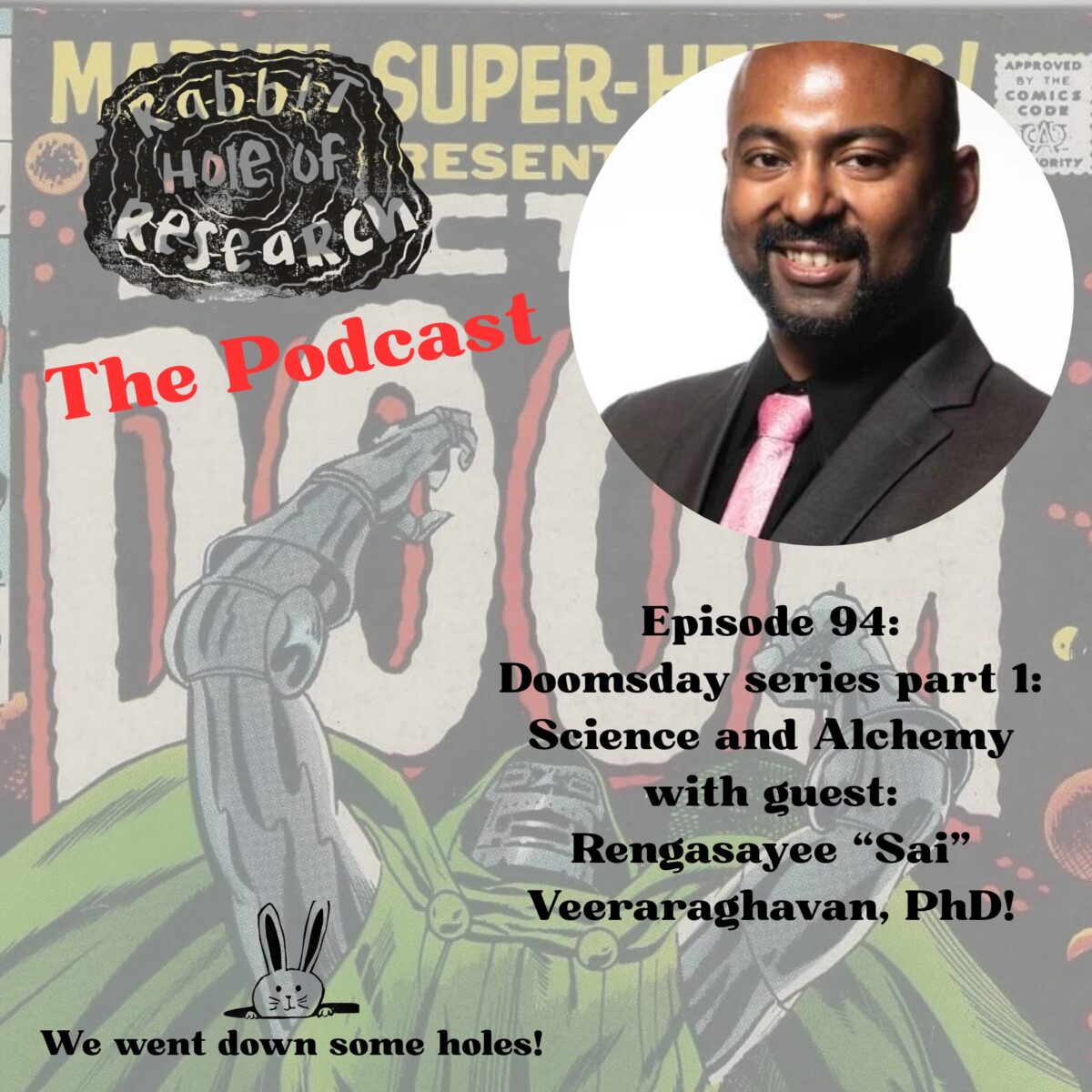
Lead into gold, robot clones, and a villain who rules with both science and magic. We explore the history of alchemy and the fine line that separates it from science
Substack, Apple, Spotify, YouTube, Amazon
Episode 94 Transcript
In Episode 94 of the Rabbit Hole of Research, Joe, Nick, and Georgia are down in the Basement Studio for Doomsday series Part 1, joined by return guest Rengasayee “Sai” Veeraraghavan, (from a fan favorite episode: EP 49: The Heart of a Superhero) to walk the fine line between alchemy and science.
Is alchemy just science we haven’t figured out yet? Can you really turn lead into gold. Why does mom’s cooking and comfort foods seem like magic. What’s “dipole-aligned” water, and do chlorophyll supplements and drinkable silver improve health, or are they snake-oil Handwavium.
The crew keeps digging until they reach Latveria and talk Victor Von Doom: scientist, sorcerer, and dictator. The crew goes down the rabbit holes, from Stalin parallels, Reed Richards’ questionable lab safety record, what Ironheart’s magic-powered suit might set up for Doomsday, mirror molecules, Ant-Man’s physics problems, the smartest minds in the Marvel Universe, the All Caps Madvillian, worthy-weapons, and can someone tell Joe how exactly you pronounce “alchemy”…What???
And the Crew Wishes you a very happy Thanksgiving day and weekend!
- The Punk Rock Craft Market at Reed’s Local (3017 W Belmont Ave, Chicago, IL 60618) returns Thanksgiving weekend on Saturday, November 28 (Joe will be there with art, books and stuff) and Sun 29th
Georgia and Jim’s Touch of Noir 2027 Wall Calendar —
12 months of all-original art by Jim and Georgia; orders are open now (Limited supply)
Check out what the RHR crew is creating:
Joe:
- Words // Friends with Sara: Replay on YouTube
- Jump to Joe’s Reading (But you should listen to all the amazing authors)
- Named by the Guild Literary Complex as one of the 35 Writers to Watch!
- Red Line: Chicago Horror Stories Anthology featuring a story by Joe!
- Joe’s Sci-fi physiological thriller Novel: Will You Still Love Me If I Become Someone Else?
- Joe’s Rom-Com Novella: Tomorrow May Be Too Late
Future Events to Hang with the Crew:
Podcast Cross-Appearances
- Joe on GoIndieNow: 21grams with Joe Compton talking about villains.
- RHR Crew on This Podcast Will Change Your Life with Ben Tanzer
Events & Conventions:
Joe:
- The Punk Rock Craft Market at Reed’s Local (3017 W Belmont Ave, Chicago, IL 60618) returns Thanksgiving weekend on Saturday, November 28 (Joe will be there with art, books and stuff) and Sun 29th
- Art and Science lecture about the Science of Zombies at Parlour and Ramp Art Gallery, 2130 W 21st St, Chicago, IL 60608, Dec 10th, 7-10pm
- Physics with a Bang at the University of Chicago. Joe will be giving tours of The Advanced Electron Microscopy facility. Dec 12th, 11-4pm, Kersten Physics Teaching Center, Rm 106
5720 S. Ellis Ave. Chicago, IL 60637
It’s Science for Weirdos
Want to support the show? Tell your friends. Follow us on social media, Discord, share the podcast, and let us know what topics you are excited about. Leave a Comment. And for email alerts sign-up for the Substack newsletter and never miss an episode, exciting updates or the bonus images we talk about on the episodes.
We discussed these questions on the episode and now want to Hear From You (leave a comment):
- What’s your favorite mix of magic and science in a movie, book, comic, or game?
- Joe and his lists, LOL. Do you agree with who he named as the smartest characters in the Marvel Universe, did he forget someone, and is there a non-scientist he missed?
- With Thanksgiving upon us: What’s your comfort food that feels like magic?
Drop your thoughts in the comments. We read them all, and your ideas often shape future episodes.
Future Episodes
- Episode 96: Doomsday series 2: Building Dr. Doom and His WorldGuest: Julio A. Guerra (@artedeguerra)
- Episode 98: Season 3 recapGuest: Alex and others TBA
- Episode 100: Season 4!!!
For more stuff (Images, Episode Highlights, events, etc), subscribe to our Substack newsletter!
Show Notes & Fun Facts
Comic Nick Mentioned about the mirror bacteria:
Fantastic Four (2022) #6, Marvel Comics, April 12, 2023
- Written by Ryan North, art by Ivan Fiorelli, colors by Jesus Aburtov, letters by VC’s Joe Caramagna, cover by Alex Ross.
- It follows the end of #5, when the team came back from a mirror dimension where they had “un-mirrored” themselves but brought mirrored bacteria home with them. In #6 the bacteria spread. The team sterilizes the nearest affected lake but can’t stop the spread, and Johnny suggests Sue to make the sun invisible, since the bacteria are photosynthetic. It’s one of the few story lines where Reed doesn’t save the day!
Comics and graphic novels
- Fantastic Four #5, “Prisoners of Doctor Doom!” (1962). Written by Stan Lee, art by Jack Kirby. First appearance of Doctor Doom.
- Fantastic Four (2023) #6 The mirrored-bacteria issue; setup in #5.
- Fantastic Four (vol. 3) #67–70, “Unthinkable” (Marvel Comics, 2003). Written by Mark Waid, art by Mike Wieringo. Collected as Fantastic Four by Waid & Wieringo: Unthinkable (Marvel, August 2025).
- xkcd (web comic by Randall Munroe, launched 2005).
Books
- Thing Explainer by Randall Munroe (2015).
- What If? by Randall Munroe (2014).
- What If? 2 by Randall Munroe (2022).
- The Da Vinci Code by Dan Brown (2003).
- The Lord of the Rings by J.R.R. Tolkien (1954–55).
- The Berenstain Bears by Stan and Jan Berenstain (first book The Big Honey Hunt, 1962).
Movies
- Avengers: Doomsday (December, 2026)
- Avengers: Age of Ultron (2015)
- Doctor Strange (2016)
- Ant-Man (2015)
- The Sorcerer’s Apprentice (2010) starring Nicolas Cage and Jay Baruchel.
- Fantasia (1940). “The Sorcerer’s Apprentice” segment Joe mentioned
- The Cabin in the Woods (2012)
- Barbarian (2022)
- Weapons (2025)
- The Fifth Element (1997)
- The Lord of the Rings film trilogy (2001–2003)
- The Fast and the Furious (2001)
- Star Wars (1977)
- Kazaam (1996) starring Shaquille O’Neal.
TV
- Ironheart (2025)
- Something Very Bad Is Going to Happen (2026)
- Star Trek: The Next Generation, “The Measure of a Man” (S2E9, 1989)
Video games
- Pokémon Red and Green (Game Freak/Nintendo, 1996 in Japan and released in the U.S. as Pokémon Red and Blue in 1998).
Music
- Operation: Doomsday by MF DOOM (Fondle ‘Em Records, October 19, 1999; reissued 2011 with new cover art).
Fun Facts to Impress Your Friends With or Win Trivia:
- Gold nanoparticles change color with size. At around 10 to 20 nanometers, gold looks reddish in solution, which is why a lot of red stained glass is colored with gold. Butterfly wings can get their color from the chitin scales that act as diffraction gratings rather than from pigment.
- Mirror life would be invisible to our chemistry. Biology on Earth is built from left-handed amino acids and right-handed sugars. A mirror bacterium would have the same molecules but in reverse, so an antibiotic that kills the normal Earth version wouldn’t work, and a scientist or superhero facing one might think it was magic.
- The double boiler is an alchemist’s invention. Maria the Jewess (also called Mary the Prophetess) of Alexandria is credited with inventing the water bath heating method. Labs still use it, and so does anyone making chocolate ganache.
- Alchemy’s dream came true, we can turn base metals into gold, for about a microsecond and a billion dollars. Between 2015 and 2018 at CERN, lead nuclei collided at nearly the speed of light. The collisions knocked three protons off lead’s 82 to leave gold’s 79, producing an estimated 86 billion gold nuclei. That adds up to only about 29 trillionths of a gram, and each nucleus fell apart after roughly a microsecond. Earlier versions of the trick turned mercury into gold at Harvard in 1941 and bismuth into gold at Berkeley in 1980.
Episode Highlights
- 00:00 — Basement Studio Intro
Nick tries to take the lead, Joe calls it “the mirror world.” - 00:26 — Special Guest Sai Returns
Joe welcomes Sai back. - 01:36 — What Is Alchemy
Sai calls alchemy “the comic book version of science,” and Joe defines it as an ancient proto-scientific tradition chasing gold, cures, and elixirs for long life. - 03:29 — Pronouncing Alchemy
Sai explains the word has an Arabic root, so it takes a short “a” rather than the long “a” of French or Latin words. - 04:09 — Mysticism Versus Science
Sai says science is the quest to understand what we don’t yet understand, while mysticism projects far past the data, like blaming storms on a god with a hammer. - 06:27 — Alchemy Across Cultures
Joe traces alchemy through Egypt, Asia, India, and medieval Europe, highlighting Zosimos of Panopolis and Maria the Jewess, whose double boiler is still used today. - 08:31 — Cooking Feels Like Magic
Sai explains that his mom’s spice blends feel like magic because 8,000 repetitions of skill add up to emergence. - 12:31 — Snake Oil And Scams
Joe warns about modern snake-oil sellers, and Sai describes a $30–$40 bottle of “dipole-aligned” aquarium water that was almost certainly just water. - 15:08 — Comfort Food Medicine
Nick asks about sick-day comfort food, and Sai explains why lemon rice soup or his tamarind, black pepper, and cumin broth really does make you feel better. - 16:42 — Turning Lead To Gold
Sai says particle accelerators can really make gold, and Joe walks through the process. - 20:31 — Gold Nanoparticles Explained
Sai explains that gold nanoparticles change color with size, and Joe adds that gold at 10–20 nanometers gives stained glass its red. - 22:03 — Pym Particles Handwavium
Joe explains the Pym Particle idea of compressing the “empty space” in atoms, and it’s Handwavium because an atom’s electron cloud isn’t really empty. - 24:56 — Superheroes Break Physics
Sai points out that shapeshifters like the Hulk and a sleepless, fast-healing Batman require setting aside real limits, which Joe calls “the magic.” - 27:15 — Weird Longevity Remedies
Sai tells the story of a soccer player’s horse-placenta knee treatment, Elizabeth Báthory’s rumored blood baths, and edible gold leaf, and Joe remembers Goldschläger. - 29:50 — Victor Von Doom Origin
Joe walks through Doom’s origin, from his first appearance in Fantastic Four #5 and his witch mother’s bargain with Mephisto to the lab accident that scarred him. - 32:44 — Doom And Stalin Parallels
Sai asks how much Doom is a comic book echo of Stalin, pointing to the Lysenko affair as a regime embracing both science and nonsense. - 35:02 — Science And Being Wrong
Sai says there’s no shame in being wrong in science, and Joe notes that Doom treats magic and science as two toolkits rather than competing explanations. - 37:33 — Mandela Effect Detour
Georgia’s search for a half-remembered book on science and superstition starts a conversation about the Mandela effect: the Sinbad genie movie and the Berenstain Bears. - 39:59 — Alchemy In The MCU
Nick says Ironheart laid the groundwork for Doom by having Riri build her suit with both magic and science. - 40:43 — AI Ghost Memories
The crew discusses Ironheart’s AI “ghost” of Riri’s friend, and Sai connects it to the Star Trek: TNG episode “The Measure of a Man.” - 41:44 — Science Versus Mystic
Joe wonders whether the MCU will set up Reed against Doom as science versus the mystic. - 43:34 — MMA Rule Change Analogy
Sai talks mixed martial arts, where adding grappling to striking turned pure specialists into well-rounded fighters. - 44:32 — Mirror Life Chemistry
Joe explains that a mirror-image bacterium would shrug off the antibiotic that kills the normal version, which could make a creature look magical to a scientist. - 47:40 — Ant Man Physics Rant
Sai airs his “one big beef” with Ant-Man: shrinking to electron size would make the strong force and surface tension a big problem. - 48:34 — Smartest Marvel Minds
Joe shares his list of Marvel’s smartest minds, from Reed Richards and Doctor Doom to Moon Girl, Peter Parker, Bruce Banner, and Mister Sinister. - 51:00 — Magic As Performance
Sai marvels at sleight of hand and performers who sell it as real, and Joe adds that magicians exploit how our brains fill in gaps. - 52:33 — Teaching Science As Wonder
Sai argues science class should teach people to understand their world, like the physics of how to drift on a rainy day, which gets Nick pitching a Fast and the Furious episode. - 55:04 — MF DOOM And Doom
Joe talks about MF DOOM, the masked rapper who drew on Doctor Doom’s persona, and how rappers like Dr. Octagon and GZA wove science and comics into hip-hop. - 57:51 — Favorite Alchemy Picks
Sai picks DC’s thousand-year-old alchemist villain Ra’s al Ghul, while Joe goes with The Da Vinci Code and Fantasia’s Sorcerer’s Apprentice. - 01:01:03 — Worthy Weapons Debate
Sai asks whether the sword in the stone counts as alchemy, and who decides who’s “worthy” of Thor’s hammer, Excalibur, Odysseus’s bow, and Doctor Strange’s cape. - 01:10:29 — Randall Munroe Plug
Sai plugs Randall Munroe’s Thing Explainer, which explains science using only the thousand most common English words, along with the What If? books and Munroe’s YouTube videos. - 01:11:58 — Final Thanks And Signoff
The crew thanks Sai and Georgia calls “Heart of a Superhero” one of her all-time favorite episodes
“Stay curious, stay safe… Love Y’all!”
Join Rabbit Hole of Research on Discord: https://discord.gg/2nnmKgguFV
Subscribe and Share our Substack newsletter to get email updates, never miss an episode, and spread the word!! Don’t forget to give us 5 stars or a like!
Transcript
[00:00:00] joe: Hey, welcome
[00:00:01] Nick: back to the Rabbit Hole of Research podcast. Down here in the Basement Studio. Was this not what you were talking
about, where me taking the lead? Oh, no,
[00:00:10] joe: yeah.
no. I see what’s happening now. We’re… It’s the mirror world. Yeah,
no,
[00:00:15] Nick: yeah.
[00:00:15] joe: yeah. Yep,
so I’m just gonna… So no one gets confused, that was you got Nick.
[00:00:20] Nick: You got Jotham.
[00:00:22] joe: You got Joe
[00:00:24] Georgia: Georgia.
[00:00:26] Nick: And hey, look, we got a special guest with us today.
[00:00:28] joe: with us today. Do we have a special guest?
[00:00:29] Sai: Hey, it’s Sai. I’m back
[00:00:30] Nick: Hi,
[00:00:31] joe: return guest
[00:00:34] Nick: here.
[00:00:34] joe: Heart of a Superhero, that was the episode. You joined us last season and it was a fun discussion. Yeah, Sai is back.
[00:00:42] Nick: That was a really good episode. And
[00:00:43] joe: episode. And we’re getting ready, we’re doing…
We did, you know, a Spider-Man three-part series earlier
[00:00:50] Nick: And I think we all had a lot of fun with that one.
[00:00:52] joe: And this one, we’re now doing a Dr. Doom- Going
[00:00:56] Nick: all Doom
[00:00:56] joe: Doing a two part series on DOOM and [00:01:00] Sai is here to join us to talk about science and alchemy. So it should be a really fun-
[00:01:06] Nick: I think those two go hand-in-hand.
[00:01:08] Georgia: Do
[00:01:08] joe: Do
they? Do they?
[00:01:09] Nick: 100%, right? Like, every, every…
Alchemy is just, what? A step away from science?
[00:01:15] joe: step away, I know.
[00:01:16] Georgia: I’m sure you’re gonna enlighten us, right?
[00:01:18] joe: But I’m sure you’re gonna enlighten us. Yeah, I am. I don’t have, I didn’t do a monologue because you heard Nick take over, ’cause this was his… When we do our episodes and plan it out- Oh
Nick was really like Dr. Doom, and he was like-
[00:01:31] Nick: “You gotta do it.” I don’t remember saying about a monologue.
[00:01:33] Georgia: You- I- You were supposed to
[00:01:34] joe: Yeah, yeah, you go
[00:01:35] Sai: I will say this, right? Alchemy is something we should definitely be talking about and alchemy and science when we talk about comic books,
[00:01:41] joe: Mm-hmm.
[00:01:42] Sai: because alchemy is the comic book version of science. You suspend one or two laws of science, and then the things that you think might be possible under that framework, that’s basically what alchemy is to me
[00:01:54] joe: You
[00:01:54] Georgia: I was gonna say, do you have a definition?
[00:01:56] joe: so I kinda thought about this and put a few things together, [00:02:00] and alchemy is this ancient philosophical and proto-scientific tradition that was originally aimed at purifying, transforming materials, so kind of base metals into gold. We hear that
And then finding cures for diseases, and the other big thing was elixirs for long life or immortality. That was kinda the ideas, and we’re still, besides the transforming metals, I think we’re still probably exploring these things for human kind of
activity. So this is alchemy is generally considered to become chemistry, and we’ll go over, history points. But as practitioners adopted control experiments, the scientific method, quantitative measurements, and rejected, a- and this is the big one, the mystical causation. So they kinda removed that element out of it, and then that’s when it became the science. And you can peer review it, you can explore, you can repeatable, data- Observe it and observe, right. So y- it’s That, idea that, that framed it. So [00:03:00] I think that’s a good place to start
there. Alchemy,
[00:03:03] Georgia: alchemy is like science but more fun.
[00:03:05] Nick: It’s like
[00:03:09] Sai: is fun. We get to blast things with real beams
and have real effects happen
[00:03:13] Nick: I’m just kidding, ’cause- I always thought alchemy was more just,
like, science that we don’t understand yet. I- is that-
No,
I, I- … too far out of belief?
[00:03:23] joe: I don’t, I think it’s, I think alchemy becomes, when you add that mystical bit to it-
[00:03:29] Nick: alchemy or alchemy? Oh, okay. That was a legit question.
Yeah. I didn’t know if it was something I was saying
[00:03:34] Sai: I’ve always pronounced it alchemy.
[00:03:36] Nick: I’ll
[00:03:36] joe: I’ll go … And I said alchemy.
Alchemy.
Alchemy. Alchemy, yeah. I think I said alchemy.
[00:03:40] Nick: alchemy. Yeah I just didn’t know if that was how you were supposed to say it or
[00:03:44] Sai: I wouldn’t expect the long A because it’s of an Arabic root,
so it would be al, which would have become al in English rather than the long A, which would be of a French or Latin origin
[00:03:55] joe: There it is.
[00:03:55] Georgia: there you go All right.
[00:03:56] joe: Okay.
Alchemy. Alchemy it is. I don’t know why I said it the other [00:04:00] Alchemy. Sorry.
[00:04:00] Sai: The short, the, the accent today, not the long
A. Alchemy
[00:04:04] joe: Sorry,
[00:04:04] Georgia: Yeah.
[00:04:06] Nick: Sorry I know I took
[00:04:06] joe: confused now
[00:04:07] Nick: was just like-
[00:04:08] Georgia: I
actually love
[00:04:09] Sai: I will say this, like, to Nick’s comment about is it science we don’t understand yet? No, that’s what science is, right? The quest to understand the things we don’t understand yet.
[00:04:18] Nick: So-
Right … science is al-alchemy.
[00:04:21] joe: Yeah
[00:04:21] Sai: is when we paint a target way ahead in the distance where we can’t yet see and say, “That’s a destination.” That’s where we get into the realms of alchemy, right? If somebody says, “I want to have indefinite life,” well, there’s things like DNA damage and thermodynamic you know, kinda cost to things that we do in the way of staying alive that say otherwise. And so it’s sort of ignoring that little chunk of what we already know to project ahead
[00:04:51] Georgia: So you have to burst everybody’s bubble basically.
[00:04:55] Nick: Yeah,
[00:04:55] joe: and I think too,
[00:04:56] Sai: am available for children’s
[00:04:58] joe: Yeah, that’s right.
[00:04:58] Sai: them early, [00:05:00] disappoint them often
[00:05:00] joe: Yeah, and I think that’s that whole thing. It is that mystical side of it where you’re trying to explain the gap, and you’re filling it in with something that is, maybe universal, and you just…
You’re attempting to get from point A to point B, not through methodical experimentation, but by handwavium.
[00:05:20] Nick: So let’s just get there.
[00:05:21] joe: So let’s stop there. And that’s kinda the way I look at it. Not we don’t understand it, because the understanding part is why you do the experimentation, and you go through to figure it out and set up your hypothesis and questions.
[00:05:33] Georgia: that you wanna answer
[00:05:34] Sai: Well, and one other thing is in science we try to, when we define that point B, we don’t step too far ahead of where the data takes us,
’cause then we fall off a cliff and we might go into complete nonsense, which is what mysticism is not barred from doing, right? It projects way out from what we know.
It’s one thing to say, “I am, you know, in this primitive Paleolithic civilization. There are suddenly storms. I [00:06:00] don’t understand why.” It’s another thing to say, “Yep, there’s a god in the sky and he’s slamming his hammer down and that’s why there are storms.”
[00:06:06] Georgia: Mm-hmm. Yeah,
Thor.
Yeah, There, there’s Thor
[00:06:10] Nick: I thought we already agreed that he’s a real person that lives among us, right?
[00:06:14] joe: He’s a real person that walks to earth. And it’s funny ’cause alchemy, I think I’m always, like, worried I’m saying it wrong now, but
[00:06:22] Nick: It’s okay. The comments will get at ya. right.
[00:06:24] joe: That’s right. We’ll have all sorts of folks in here.
[00:06:27] Nick: But
[00:06:27] joe: yeah, its roots are through a number of different cultures. You know, from the, the Roman Egyptians to Asia to India to A- so you have this kind of widespread
[00:06:39] Georgia: ideation.
[00:06:40] joe: ideation. Europe, , it spreads in later when transcripts, things are transcribed, texts from these other places are transcribed into English, then you start getting a renaissance of it in the Renaissance per- medieval Renaissance period- Don’t-
of that, cultures have a version of alchemy to begin with?
You mean ancient [00:07:00] cultures? Yeah. Yeah. I mean, somewhat, yeah.
Right.
[00:07:02] Georgia: so alchemy is always fictional, or do some people believe… Is it things that people believe to be true, or is it understood to be fiction?
[00:07:15] joe: I- Do you know? I think now it’s understood to be fiction. I think people can… Like I said the alchemy tr- turned into chemistry at some level.
That, that’s its root. So people were trying to do these things, and then that went. And if you look through, Egyptian Greek philosophers’ … Mystic beliefs you had all this stuff. So like Zosimos of Panopolis in 300 CE Egyptian alchemist, earliest whose surviving writings we have describe the early distillation apparatuses.
So this is a real scientific thing we use in labs, but… And they were actually creating tools for scientific, research that we have. So Maria the [00:08:00] Jewess Alexandria or Mary the Prophetess credited with inventing the double boiler water bath heating method which is still used in labs and in cooking.
So we use that in, different applications. So- … you have this,
[00:08:12] Sai: Yeah, every time you make chocolate ganache,
[00:08:14] joe: That’s right.
[00:08:14] Nick: yeah I was honestly just thinking, like, only reason I think I know double broiler is ’cause of cooking
[00:08:19] joe: is right. Yeah. Yeah.
[00:08:20] Nick: But I didn’t ever think, oh yeah, this is a science thing as well But
[00:08:23] joe: is right …well- Mm-hmm
[00:08:25] Georgia: there’s a lot of people that, that do natural herbs and- Yeah. That’s right … different plants and-
[00:08:29] Nick: different
[00:08:30] joe: right. Mm-hmm …plants and- Mm-hmm …
[00:08:31] Georgia: I don’t know if you’d call it potions, but that’s like a form of alchemy. But-
[00:08:39] Nick: is cooking in general
So it’s not- Like, cooking is that blurred line where science meets- Mm-hmm … food, and- Mm-hmm … you know, the, y- you always think of the witch with the cauldron, and I feel like that every time I’m making a stew during the winter
[00:08:54] Georgia: and we talked about that in-
[00:08:56] Sai: can I inject a piece of mathematics here? [00:09:00] Because I think it’s actually pretty cool. What we’re talking about here is where it’s of a known explainable scientific mechanism, for example,, you use clove oil for toothache because, it contains an analgesic, that’s why it works.
It’s not woo-woo, it’s not…
You know, it works. But when we get to things like cooking or maybe combining herbs in a way that achieves the s- better outcome than , some of us who don’t know much doing it, it feels like alchemy. Like when,
[00:09:32] Nick: Mm-hmm.
[00:09:33] Sai: My mom puts together the same spice blends that I think I know because I’ve made it 100 times.
Turns out 8,000 repetitions gives you a different level of skill, and that looks like alchemy to us. But you know what it is? It’s emergence. We’re dealing with a complex adaptive system in a mathematical sense, and what we’re seeing there are the subtle differences along the in- at the initial conditions level, sort of measuring out ingredients, sort of the [00:10:00] technique with the mortar and pestle, all these little factors.
And then the trajectory diverges. By the time there’s a dish on a plate,
You taste the deep expert, my mom’s version, and go, “Oh my God, that’s magic.
[00:10:12] Nick: I got a question for you. When your mom is cooking, she’s not using measuring spoons or anything like that, but when you cook, are you using the measuring spoons and stuff? Yep. Okay.
[00:10:22] Sai: I measure by sense of smell, sound, eyeball, hand
feel.
[00:10:27] Nick: just the feel of it, you know? You just go I feel it in my bones.” And I’m like, “Oh yeah, this is just…”
[00:10:32] Sai: Right, but there’s also some science there, right? I do listen to things like how is… If I’m throwing things into hot oil, I listen to the rate of bubble formation ’cause it’s telling me something about the reactions happening in my pan. So I will still try to take that magic of my mom’s cooking and strip it down to what are, what’s the physics of it?
There is a physics behind it. Sometimes I can identify key factors, and the rest of it is the little, secret sauce, the emergent part [00:11:00] of I’m just gonna practice this and let my senses the way we’re using AI or m- you know, deep learning to optimize a lot of things, we’ve, you’ve got deep learning networks running that are optimizing your skills based on what your palate’s noticing in the pan or on the plate
[00:11:15] Nick: Interesting
[00:11:16] joe: Yeah.
[00:11:17] Sai: so it’s all just math with lots of numbers that most of which we are not aware of ’cause we can measure all of these parameters, so it looks like magic to us.
That is a kind of alchemy that I absolutely adore. This is what separates the great musician from the skilled musician, the, the great cook from the skilled cook
[00:11:36] joe: Yep. And I think you have… I mean, you mentioned some of the herbal stuff. I think a lot of that there are, and Sai you touched on it, compounds in there
[00:11:43] Sai: I was gonna say.
[00:11:44] joe: that…
[00:11:44] Sai: eMergence, Right, Everybody can put the basic ingredients into a still and distill it, but
[00:11:49] joe: right.
[00:11:49] Georgia: we talked
[00:11:50] Sai: whiskey
[00:11:51] Georgia: medicine. We had the one episode about medicine, and, like, our guest was talking about the best place [00:12:00] for the medicine is in the groceries, in the fresh produce.
[00:12:04] Nick: It’s all from the outside- It’s all- … outer rings.
[00:12:07] joe: that was Davis
[00:12:08] Georgia: And so there is a lot to that. But But I think,
like, sometimes that’s, like, not as recognized because it is more oral, traditions and things passed down.
Exactly. And- It
[00:12:22] Nick: like it’s not science even though the amount of science that goes into cooking is abundant.
[00:12:31] joe: But you also can get in trouble here because you have, , the snakeskin oil salesmen and especially
[00:12:38] Georgia: now-
[00:12:38] Nick: out right now?
[00:12:39] joe: you have,
[00:12:40] Nick: Joe.
[00:12:40] Georgia: trying to
[00:12:41] Nick: sell you oil. Where
[00:12:42] joe: Trying to sell you that … people are selling remedies for,
[00:12:45] Georgia: Fine …
[00:12:46] joe: Increased health or lifespan or, , sexual prowess or whatever.
Well, that-
And they go, “This
[00:12:51] Georgia: is
[00:12:51] Nick: natural … You buy vitamins.
We do. Vitamins are the, I’m gue- I’m guessing, gonna be fairly similar to what they were selling.
[00:12:58] joe: But some of it’s not.
[00:13:00] Some of
[00:13:00] Georgia: it’s just- Some of it really was just-
[00:13:02] joe: you eat this bark or
[00:13:03] Georgia: whatever … a total placebo thing. A placebo. YoU know? Like- A placebo effect, right. Yeah.
[00:13:07] joe: You know, you
[00:13:08] Georgia: have this kind of…
[00:13:09] joe: And now people aren’t thinking about the science. People aren’t really looking at these things and,
, go down these,
which can actually harm them, right?
[00:13:17] Sai: This one’s not medicine, so it’s just outright funny. But one of the
[00:13:20] Nick: seems like just outright funny
[00:13:21] Georgia: seems like it’s just outright funny.
[00:13:21] Sai: most ridiculous, actually two things I wanna mention, two products like that. ’cause this is where, you know, when we start conflating real science with alchemy and things, like, this is sort of the rabbit hole one could fall into.
One was as a, when I used to have a saltwater aquarium, I used to, you know, troll websites for various products to optimize my little ecosystem. One guy was, I kid you not, advertising a reagent that he claimed would align the dipoles in the water molecules to better enable light penetration into the tank If you’re above zero Kelvin, they’re not aligning those things.
They’re [00:14:00] moving. That’s the definition of a liquid phase, right? This was so stupid, and yet it wa- he was selling it. It was 100 mils of, I am sure it was just water. This dude was selling 100 mil bottles of water for like
$30, $40 a Oh. Right.
[00:14:15] Nick: Oh, I wish I was so good at that. Because it’s how you sell it. Yeah. It’s how you spin it and then a lot of people, you know, “Oh, that sounds…”
[00:14:23] Georgia: Right? It sounds good. I mean-
[00:14:24] joe: there’s
a lot of things- Yeah … I always think, like, when they’re people are selling chlorophyll and it’s like, “Just eat spinach,” or, i- it’s like, there’s many ways to get chlorophyll, and it doesn’t do, it’s not giving you extra energy.
Like, the chlorophyll molecule isn’t boosting your, energetic state like it does a, a leaf, right? That’s
[00:14:40] Sai: Two words, right? Gut acids.
[00:14:42] Georgia: Right.
[00:14:42] joe: It’s a,
[00:14:43] Sai: That protein structure meets gut
acids and endostructure
[00:14:46] Georgia: and I mean
[00:14:47] joe: that was
part of the alchemy, right? That, this kind of longevity and im- immortality that we still cling to, and I think people get taken advantage of because they’re looking for
that easy [00:15:00] fix. Like, instead of,
[00:15:00] Georgia: you know-
Or
[00:15:01] joe: the gym- Easy … going for a walk, right?
[00:15:03] Georgia: even if
it isn’t easy.
[00:15:04] Nick: Yeah. Yeah,
[00:15:05] Georgia: Yeah, Right. right, If it’s m- if it’s mortality and like, yeah.
All right.
[00:15:08] Nick: So I know this is gonna be a very Midwestern thing,
[00:15:13] Georgia: but any
[00:15:13] Nick: time I’m sick, I think, “Oh, I want a bowl of lemon rice soup.”
[00:15:18] Georgia: Is that
[00:15:19] Nick: something that you guys have the same experience with? Like, is there something that you guys go to make you feel better and you-
[00:15:27] joe: Yeah,
right.
[00:15:28] Nick: I Like, it’s not medicine. It’s just-
[00:15:30] joe: Yeah. It is, right.
[00:15:32] Sai: Th- you’re also imbibing a broth which has starch and electrolytes in it, so
of course it’s gonna make you feel a little better. It’s easy nutrition. And you’ve got lemon, which, you know, is gonna overcome that sort of distasteful feeling that you have when you’re unwell, and it’s gonna, you know, g- help you get the food down, and it’s gonna make you feel better
psychologically and physically. So yeah, that’s gonna feel a lot better
[00:15:55] Georgia: yeah
[00:15:55] Nick: I know that it doesn’t actually, like, have anything in it that’s gonna be like, “Oh yeah, [00:16:00] I feel better.” But like, the, the just the ingredients
[00:16:03] Sai: engine that is our body will tune it so that you said lemon rice soup, for me it’s a tamarind, black pepper, and cumin broth that I just love.
[00:16:12] joe: Mm-hmm.
[00:16:13] Sai: look at all the things we gravitate towards. Nobody’s gonna say, “When I’m unwell, you know what I want? A medium rare rib eye.”
[00:16:20] Georgia: I was
[00:16:21] Sai: body won’t ask for that.
[00:16:22] Georgia: you know what I want? A medium rare Right, right. Yeah.
I like
hot and sour soup from a Chinese restaurant. Chicken noodle soup. I mean,
[00:16:28] joe: People
have- I
[00:16:28] Georgia: shot
[00:16:28] Nick: of
[00:16:29] joe: these all have these… Yeah, shot of Malort
does do it. That, that’ll set You straight.
[00:16:33] Nick: And,
[00:16:34] joe: and so
yeah, you
[00:16:34] Georgia: had,
[00:16:35] joe: I think
that part of it, we carry on.
I think the part of the alchemy that, you know,
[00:16:41] Georgia: you know, we’re not
[00:16:42] joe: talking about, and I think people have dropped, is the kind of metal, base metal to gold. That’s something that has fell by the wayside. And I think even early alchemists- Can you explain what that? what- So
[00:16:54] Georgia: even- Can you explain that? what do you mean? So the idea
[00:16:54] joe: that you could take a base metal like lead.
So gold is really valuable. Yeah. It’s somewhat [00:17:00] rare. And so the idea was that can you take one metal and use some hoodoo, , kind of whatever, and then turn that into a precious metal like gold?
[00:17:10] Georgia: Oh.
[00:17:11] joe: And that’s kind of most
[00:17:12] Georgia: stories. I don’t know if I’ve heard it though, but- That’s
like most stories
yeah …that’s what
[00:17:15] joe: they’re trying to do, is they’re trying to change- The-
Base metal into, you know,
[00:17:21] Nick: Or just changing most things into something else,
[00:17:23] Georgia: or
[00:17:24] joe: Or mercury. Yeah. Mercury was the other one that they used a lot, was mercury was the other metal that… And I think in India they had a lot, there was a lot of mercury to gold and other base metal kind of res- So when I was looking this up I saw that and-
[00:17:37] Sai: there are a couple of things there, right? One is mercury will readily form an amalgam, so it does s- kind of give the illusion of changing its nature into other substances, but really it’s just a quick alloy formation. And the other thing is for very… This was also used by medieval armorers to achieve this beautiful gold deposition effect on armor.
But the way they do it is they [00:18:00] deposit a layer of gold mixed with mercury, that alloy, they paint it on, and then cook this thing under enough heat to vaporize the mercury. By the way, you don’t wanna be a medieval armorer doing this. You don’t… It will right.
produce some incredibly beautiful armor, though, with, like, a very fine layer of gold.
So y- you can see sort of how somebody starts to think based on the real technology to go, “What if I could just make gold out of not gold? I’d be rich.”
[00:18:27] Georgia: Mm-hmm. I knew this,
[00:18:27] Sai: truth is today we can with particle
accelerators
[00:18:30] joe: I was gonna say that. Yep.
[00:18:31] Nick: Wait, wait, what? Whoa
[00:18:33] Sai: we can do it, it’s just we can’t do it in a way that the budget
works
out. more money making that f- the few atoms of gold than that is worth by
[00:18:41] joe: think in 20- 2015 at CERN, I mean, I think the first paper, ’cause I looked this up ’cause I had the same idea, Sai 1941, the Harvard cyclotron they actually bombarded mercury with fast neutrons and produced radioactive gold isotopes there.
So that was the first laboratory transmutation [00:19:00] into gold using
mercury,
[00:19:01] Nick: Can I get bit by this gold and like turn into gold man?
[00:19:04] joe: Yeah.
1980 they a group at the Lawrence Berkeley
Laboratory used an accelerator to
transmutate a small number of bismuth atoms into gold. And then in 2015 to 2018 at CERN lead nuclei collided, colliding in these accelerators 99.9999% the speed of light collisions produces these kind of intense electromagnetic dissociations, knocking the three protons off lead nuclei, which has 82, to produce gold nuclei and 79, and they produced an estimated 86 billion gold nuclei were created totaling about 29 trillionth of a
gram-
Wow
existing for roughly a microsecond before fragmenting. So to
[00:19:51] Georgia: Sai’s
[00:19:51] Nick: that’s…
[00:19:52] Georgia: point- …
that’s,
[00:19:53] joe: you do
[00:19:53] Georgia: not very- I mean, you know- Well- … a billion
[00:19:55] joe: to build this
[00:19:56] Georgia: if you could use the
[00:19:57] joe: and you go-
[00:19:58] Georgia: in, like, Ant-Man-
[00:19:59] Sai: when [00:20:00] you said that number, Joe, the number of gold atoms they made, all I could think was Avogadro chuckled softly
[00:20:06] joe: Yeah.
[00:20:07] Georgia: you said that number- … know, the gold atom came in, I like, I looked at her and chuckled softly. Yeah, no,
it’s like 80, 86
[00:20:09] joe: billion gold nuclei and that’s it. So that’s, and that’s not a lot. That’s,
[00:20:13] Georgia: Could you actually see it?
[00:20:15] joe: That’s a good question. They might have been able to see it. I, that’s
[00:20:18] Nick: didn’t last- Under a microscope? It didn’t last very long. so
[00:20:21] Georgia: But maybe you could use the technology in Ant-Man and make it big. Oh,
[00:20:25] joe: maybe
[00:20:25] Georgia: gosh.
[00:20:26] Nick: No. You- you’re talking about the Pym Particles? Yeah. No, I’m good. You’re… Hey, Sai, can you get
[00:20:31] Sai: T- by the way, Tia, your question about could you see it, right? It really depends on what we mean by see it.
[00:20:36] Georgia: Oh, that’s- Right. That’s a good point Normally when you
[00:20:38] Sai: normally when we think of stuff, what we mean is reflected light from that object hitting our eye and we see it. But gold, if it’s in nanoparticle form, we’ll see it be- a different optical phenomenon.
It’ll diffract the light. It’ll change color of the fluid that it’s in. So this is why like you, yeah, we have these gold nanoparticles in the lab. We have them in every color.
You just pick [00:21:00] one different size and you get a different color.
[00:21:01] Georgia: Yeah … and you get a different color. Wow. Yeah. That’s so
[00:21:03] Sai: seeing it in the same way as you normally see. It’s a different optical effect
[00:21:07] joe: gold nanoparticles, when you have it like 10, 20 nanometers, it’s, it actually has a reddish color in, in solution.
And actually a lot of stained glass that, that’s what’s actually used is gold. The red coloration is actually gold nanoparticle, you know, gold nano kind of composites and paints that they
use- … and
you get that color,
so.
[00:21:27] Nick: Interesting.
[00:21:28] joe: yeah. Yep, yep. As you go down to Ant-Man size, things happen. Things change, so
[00:21:33] Sai: you know, insects, butterflies, that’s how they get color in their wings. They’re not painted the same way a moth or other species are. They’re basically flapping around their big diffraction gratings and we see color,
[00:21:45] Georgia: Wow
[00:21:46] Nick: And you said they have gold on them?
[00:21:48] Sai: it. No, but it has the same sort of
optical effect as gold nanoparticles.
Yeah
[00:21:54] Nick: the same visual
[00:21:54] Georgia: Yeah …visual
[00:21:55] Nick: like we can’t let the public know
[00:21:57] Georgia: this.
[00:21:57] joe: You cannot. Yes, that’s right.
[00:21:58] Sai: do not harvest [00:22:00] butterflies for
gold
[00:22:01] joe: not, yes. And I will say that you had the
You me- you mentioned the Pym Particle, and the idea beyond that,
behind that
in the wrong science is that
[00:22:10] Georgia: the,
[00:22:11] joe: it’s compressing the empty space in atoms.
And so there’s this idea, it’s kinda like the we only use 10% of our brain idea, but the idea is that 90% of an atom is empty space, and then you can compress that space and make something big, small. There’s a whole bunch of
[00:22:28] Georgia: it-
So kind of like the thing that you use to, like, s- vacuum up your air mattress or- That’s you’re actually removing air-
in a
space, but
[00:22:34] joe: what you use to, like, vacuum up your air mattress? Well, that’s… You’re actually removing air in a space. But here you really
[00:22:35] Georgia: can’t. The
[00:22:36] joe: electron cloud is filling that space, so it’s not really empty as we think. It,
Once
[00:22:41] Georgia: again, it’s like It doesn’t work … with seeing, it’s not empty in a way we think of empty. It’s like a term we use. It’s like saying small or- It’s like saying small … it was just like saying- Right, right, exactly
when we had
[00:22:44] joe: in a way we think of empty.
It’s like a term we use.
[00:22:47] Nick: Is this like when we- Like saying small or-
I was just about to say, when we had that whole small-
[00:22:51] Georgia: Small
[00:22:52] joe: or like
Sai just touched on, seeing. Like, oh, what do we mean by seeing?
Because that, that
to scientists and to lay,
you know,
[00:22:59] Georgia: jargon it, [00:23:00]
[00:23:00] joe: that meaning changes. But
they use that in the Pym Particle.
That’s the idea behind
[00:23:04] Georgia: it.
[00:23:04] joe: But it’s actually,
[00:23:06] Georgia: Handwavium.
[00:23:06] joe: yes.
[00:23:06] Sai: Thing, right?
[00:23:07] Nick: yes. Handwavium.
[00:23:08] Sai: being without gear or a scientist with equipment, ultimately everything we do to sense reality involves taking some physical phenomenon that happens out there and turning it into a change in an electrical current.
[00:23:23] joe: Mm-hmm.
[00:23:24] Sai: It could be your detector, it could be your optic nerve, but at the end of the day, everything is transmuted into electrical current
[00:23:30] Georgia: Oh us to interact with it.
[00:23:32] Sai: So when we think about, you know, seeing or something like that, well, there’s different ways that light can interact with matter, produce whatever effects, and then all we get is light hits sensor, electrical current goes to brain, we read that. So sometimes we don’t think about what did the light do before it got to my eye, and how am I seeing whatever I think I’m seeing
[00:23:55] Georgia: And speaking of electrical currents
[00:23:59] Nick: Where are you [00:24:00] going with this? No,
[00:24:00] Georgia: we’ve been out… We were out of power- … for 10
days.
[00:24:03] joe: Oh. This is
back in August
[00:24:05] Georgia: really been… Oh, back at- At the time of recording.
[00:24:06] joe: the time of recording, yes.
[00:24:08] Sai: this would’ve been a time for one of those lost threads in alchemy, right? Perpetual motion machines. Just one of those little things in a box somewhere
[00:24:17] Georgia: Yes,
[00:24:17] joe: time
travel. Right. Georgia.
[00:24:19] Nick: But at the time
[00:24:20] Georgia: recording, we just barely got our electrical currents back. Yeah. So.
No,
[00:24:26] joe: the time of recording, we just barely got our electrical currents back. Yeah. So. No, you’re right. That’s
[00:24:27] Georgia: yeah,
[00:24:27] joe: very timely talking about it and thinking about. And we did a, earlier this season, we had the episode with BL where we talked about magic-
[00:24:36] Nick: Oh, yeah …
and
[00:24:37] joe: cost and the power. And we spent some time in that episode talking about the magic and what become the understood as magic, and like turning on the lights.
And I thought
about
episode- And how does it work
think we lost power right when that episode released. So yeah, go back and check that out. But yeah,
[00:24:55] Georgia: that’s,
[00:24:56] Sai: Really, speak- speaking of that, the magic and alchemy and [00:25:00] transmutation and stuff, right? Every superhero who changes form, like especially somebody like The Hulk,
[00:25:05] Nick: Mm-hmm. Yeah
[00:25:06] Sai: gotta be an element of magic there because
where did you just produce all this new matter from? Or, Yeah
[00:25:13] Georgia: As
[00:25:14] Sai: dense as titanium when you’re in normal human form, which should make you even scarier to supervillains, right?
Bruce Banner’s punch scares me more than The Hulk’s if that’s true, if he’s The Hulk just compacted to a high compacted to a heightened- right.
[00:25:27] Georgia: Right, in Bruce Banner’s size
[00:25:28] joe: Right, yeah, no, I think you have that where you, I mean
characters change and I- is this handwavium, right? That is the that’s the magic.
[00:25:37] Sai: it gets all the way even into my favorite character, Batman.
[00:25:40] Georgia: And
[00:25:41] joe: Batman, there simply, “I’m sorry, sir, your wound healing responses are not gonna speed up beyond a certain limit.
[00:25:46] Sai: You need a certain amount of s- ni- sleep every day to function and have cognitive, like, clarity.” There’s so many things that we just like, “Eh, we’ll just set that limitation aside.”
[00:25:56] Nick: right.
there.
[00:25:57] joe: People heal, like yes, they get pretty banged up. [00:26:00] And the thing with Batman, I mean, he is not
super powered.
He’s just human, so- Right …He’s actually suffers the same…
He’s got a, what a Bacca- what is it? A Bacca tank in Star Wars, the Bacca tanks.
[00:26:14] Nick: I
don’t know. The
[00:26:15] joe: healing tanks. Is it they call it Bacta tanks?
[00:26:17] Georgia: Bactas? Oh, I don’t
[00:26:18] Nick: know. You
[00:26:18] joe: guys know what I’m talking about?
[00:26:19] Nick: know what I’m talking about? No. Not even a little bit.
[00:26:21] Sai: Question is, can something like that heal CTE? ‘Cause that would be the other thing all these superheroes would have copious
amounts of
[00:26:27] joe: yes yep, the impact inju- injuries in the head that we see with football players in in sports, so… And I think we talked about that in the episode
[00:26:36] Nick: feel like we talked about that recently, yeah
[00:26:38] joe: would you start pulling your punches because of the injury and the fear of getting hurt or having concussions and things like that?
And so like, like athletes at some point in their career, they don’t hit the hole as fast, or they won’t drive the lane because, , those, those injuries last and you have it. And, unfortunately, there is no alchemist there to [00:27:00] give you the magic potion and have you heal up and move along,
so…
[00:27:04] Nick: There are people trying to sell them things to do to deal with it. Well, that’s what, yeah- Right … what we talked about.
[00:27:08] Georgia: Like-
[00:27:09] Nick: whether they work or not-
[00:27:11] joe: So I’m a- … I don’t
[00:27:12] Nick: I don’t know
[00:27:12] joe: I, I do wanna… I’ll go ahead, Sai.
[00:27:15] Sai: a a European league soccer player who was having his injured knee… He went to Switzerland for some weird specialist doctor to incubate his knee with horse
[00:27:25] Georgia: to intubate his
[00:27:28] Sai: help him, like, seize and to, overcome his ligament injury
[00:27:32] Georgia: Wow So
[00:27:33] Nick: How did it work?
[00:27:35] joe: Worked
[00:27:35] Sai: Not very well
[00:27:36] joe: It healed him completely. Now everyone’s eating horse p-
placenta or
[00:27:41] Nick: In- injecting it?
[00:27:42] Georgia: Mm-hmm. No.
[00:27:44] joe: You’re having
[00:27:44] Georgia: it. We have to have a disclaimer. We
[00:27:47] joe: to have a disclaimer. We do need disclaimers. It’s like the, the blood of
[00:27:50] Georgia: virgins
[00:27:50] joe: or something that people u- use, used to bathe
[00:27:53] Nick: works. Don’t worry.
Yeah,
[00:27:54] joe: That was in, that was the,
[00:27:55] Nick: Have you looked at me lately?
[00:27:56] joe: in New Orleans, right? I can’t remember her name.
[00:27:59] Sai: famously [00:28:00] also Elizabeth Báthory
accused of
Exactly that in Hungary in
[00:28:02] joe: Yeah. So
[00:28:04] Sai: yeah
[00:28:05] joe: people had all
sorts of ideas like
That
would keep them young
[00:28:08] Georgia: or-
[00:28:08] Nick: ’cause a- again, it works
[00:28:09] Sai: Oh, here’s one, a more benign thing that is still in practice in places like India and the Middle East where people will take very finely b- beaten down gold leaf, mix it with their food, either in desserts or in rice or whatever, and eat it. Like, in Asia, Middle East, this has been a belief for a long time that it will g- prolong your lifespan, it’ll make you literally look shinier and, improve your general glow.
[00:28:37] Georgia: But
[00:28:37] Nick: something that you can find in fine dining as well
[00:28:40] joe: Yeah.
[00:28:40] Georgia: Right. I can see that.
Or, like, that’s something
[00:28:42] Nick: that is still- Yeah. You can al- … being used even here in the States
[00:28:45] joe: can also
[00:28:46] Sai: Oh yeah,
[00:28:47] joe: at parties on college campuses in Goldschläger, if we remember that. It had the gold flakes in
[00:28:53] Georgia: it. I
[00:28:53] Nick: I do reme-
[00:28:54] Georgia: Yeah. I don’t know if they
[00:28:55] joe: still
make that, but it had the gold flakes in it. Yeah. And I remember there was some discussion, like how much gold’s [00:29:00] actually in there? Can we like filter out the gold that’s
[00:29:03] Georgia: in our drink?
[00:29:03] joe: Mm-hmm. I
don’t think it’s a lot,
but yeah.
[00:29:06] Sai: Th- this has… So and there’s the old sort of superstition of throwing silver coins in wells to supposedly purify the well and whatnot.
[00:29:15] joe: Right.
Yeah
[00:29:16] Sai: there are companies that have taken that idea and just sort of written up the storyline of, “Therefore, it must be releasing silver nanoparticles into the water,” which we know can have antibacterial effect when, you know, applied topically.
But if it’s good on the surface, must be even better inside, right? And so there are nutraceutical companies making solutions of silver nanoparticles that are meant for people to drink, and th- they have contracts with, for example, like the US military. They were just, like, forcing large numbers of people to take these things.
[00:29:50] Nick: So I wanted to, though,
[00:29:51] Georgia: go, because
[00:29:52] joe: we really haven’t talked about the man of the hour, Victor Von doom.
[00:29:57] Georgia: Von Doom. I was gonna
say,
how
[00:29:58] joe: go in. Yeah, [00:30:00] so he, you know, his origin in the
[00:30:03] Georgia: comics, the Fantastic
[00:30:04] joe: Four, that’s where he started. His first appearance, number five, 1962, way back then.
[00:30:10] Georgia: Stan
[00:30:11] joe: Lee and Jack Kirby did the artwork.
So that was the original doom. His mother was Cynthia. She was a witch who bargained her soul with
Mephisto. Mephisto? Mephisto? Mephisto. And she died young. His father was a healer killed by noblemen. And so Victor then kind of fell in with his mother’s kind of occult – relics, and built a machine to try to free her soul and it failed.
[00:30:41] Nick: Mm-hmm.
[00:30:42] joe: And so you had this whole thing where he kind of combined magic and science. Then he went, got a scholarship to State University in New
[00:30:51] Nick: Where he met Reed.
[00:30:52] joe: He became friends with Reed, and rivals. Like, they had this relationship.
Yeah were and then
there was a lab accident, so he was [00:31:00] really pursuing science as a, kind of scientific method.
[00:31:05] Georgia: Lab accident,
[00:31:06] joe: he blamed Reed, which Reed has a history of kind of, subjecting people to unwanted experimentation. See the other three of the Fantastic
Four. But we covered that last season and so, and you… You know, a lot of people think it was a spell gone wrong then, but it was really a, a scientific thing.
[00:31:23] Georgia: And
[00:31:23] joe: he gets disfigured.
And so… And this is where the science accident, then he uses kind of ritual mask branding to cover his face with that classic mask that he has. And that’s where his two worlds begin to merge back again.
[00:31:39] Georgia: Did he stay in science?
[00:31:41] joe: he stay in science? He did. So he tried to explore kind of-
[00:31:44] Georgia: He’s
off-
[00:31:45] joe: got- healing
And try to figure that out. So he went to, like, Tibetan monks explored everything, and then he met his lover Morgan Le Fay,
[00:31:53] Georgia: and then
[00:31:53] joe: later has a three, uh, demons who then… you know, it, that, that’s a… I think
there’s a difference. There’s a couple
[00:32:00] storylines
here. Yeah. But yeah, he kind of-
[00:32:01] Nick: He’s also become- Sorcerer Supreme.
[00:32:03] joe: That’s right, yep.
[00:32:03] Nick: yep. Which I do believe might have the the new Doom- Yeah … be Sorcerer Supreme of this other world.
[00:32:11] joe: that was the, that was Unthinkable was I think that line of Fantastic Four ’67 to ’70 and 2003, where Doom, abandoned science for pure sorcery
to
… defeat, defeat Reed, ’cause Reed is 100% science. Like, if there’s a
[00:32:26] Georgia: scientist in
[00:32:27] joe: comic, it is Reed. Like, I think he
[00:32:29] Georgia: embodies that.
Not the
safest
scientist. Not the
[00:32:31] joe: safest, no. He needs to get, talk to OSHA because he’s He did it on purpose. I
don’t know. Either way,
[00:32:37] Georgia: I- Mm-hmm …once again,
[00:32:38] joe: I think he had I think Doom l- grievance against Reed is legit.
So, but yeah that’s kind of the
[00:32:44] Sai: After through this, like, origin of Victor Von Doom and sort of the time when it was published, how much do you think Dr. Doom is a comic book echo of Joseph Stalin?
[00:32:56] joe: Oh, yeah.
[00:32:57] Georgia: Oh, yeah. Oh yeah.
[00:32:58] Sai: starts out as somebody who [00:33:00] espouses the cause of the wor- the oppressed classes against the ones in power, ends up transmuting into, again, a bit of alchemy happening of the soul.
[00:33:08] Georgia: thing he rails against-
Yeah … uh, with respect to sort of science and magic. Well, under Stalin you had the embrace of science in various ways, the space race and whatnot, but you also had the Lysenko thing. Mm-hmm. Like, they said, “Oh, you know, no, no, no, seeds can be subjected to conditioning using communist ideology.”
And while they killed- Right, right, right. Yeah
which is nonsense and millions of people died. Which again, like, there, I see
[00:33:09] Sai: becomes the thing he rails against Uh, and with respect to sort of science and magic, well, under Stalin you had sort of the embrace of science in various ways, the space race and whatnot, but you also had the Lysenko affair. Like, basically said, “Oh, you know, no. Seeds can be subjected to conditioning using communist ideology.”
And well, they killed a bunch of people by espousing this nonsense, and millions of people died, which again, like, there … I see some very nice parallels to Dr. Doom. I just wanted to throw that out there
[00:33:41] Georgia: I
[00:33:41] Nick: do think Doom was more about his people than Stalin was. ’cause Doom
[00:33:47] Sai: It depends on what they wanted to do to the people. Stalin was worried about the people, it’s just the intentions weren’t good on what he wanted to do to them
[00:33:53] joe: right,
right.
[00:33:54] Nick: I mean, unless you’re one of the Doombots you’re not getting treated well there.
[00:33:58] joe: And Doom
also- … he was he was the [00:34:00] only person who could help the people. Like his vision of humanity, saving humanity, it was very like, “I’m the only one. Who could do this? Like, who can help and make everything right? If everyone would
just fall in line and follow me, we would be good. We could do everything.” So I think you had that, that same kind of a dictator mentality, and he became the of Latveria,
right? The fictional Eastern europe- It was Latveria.
Livaria?
Is it Livaria?
[00:34:27] Georgia: lot of pronunciation- Latveria.
[00:34:28] Nick: Latveria. Latveria?
[00:34:29] joe: yep. Latveria.
yeah.
[00:34:30] Georgia: some pronunciation
issues.
No,
[00:34:31] joe: I’m having something, man. It’s
[00:34:32] Nick: really- Well, honestly, a lot of these words I read in a comic
[00:34:36] joe: You r- Yes … but I
[00:34:37] Georgia: I
[00:34:37] Nick: say them out loud. Right. And that is the biggest fear I have, that like- Right
someone’s gonna be like, “No, you’re saying that wrong.”
[00:34:44] joe: And I’m like, Right
[00:34:45] Georgia: That’s what I’m-
Do I …
[00:34:46] Nick: sounds right in my
[00:34:47] Georgia: it, that’s what it looked like.
[00:34:48] Nick: it looks like.
[00:34:49] joe: I’m just going for it,
[00:34:50] Nick: I just know English, okay? I’m sorry.
[00:34:52] joe: I know. That’s
[00:34:53] Nick: But it’s like- It’s an hard language.
[00:34:54] Georgia: it’s
[00:34:55] joe: like Bruce Willis in , Fifth Element.
“I speak two languages: English and bad English.” [00:35:00] That’s it, so
[00:35:02] Sai: I mean, that’s also one of the things you learn in science is what’s the shame in being wrong? You just gotta learn how to do it right.
[00:35:08] Georgia: it. Yeah. So, I-
[00:35:10] Nick: I think a lot of people do have a problem with being wrong about things. Like, it’s-
[00:35:15] Sai: W- which is fundamentally a misunderstanding of
reality
[00:35:18] joe: There’s some shit in
[00:35:19] Sai: being wrong is unavoidable
[00:35:21] Nick: unavoidable I love being wrong. It means I’m learning something new.
[00:35:24] Georgia: Right, and you’ve
gotta-
yeah
you’re not
gonna go and figure out something unless- Don’t
[00:35:29] Nick: be a dick about it. Like, that’s all I
[00:35:32] Sai: and don’t be wrong the same way too many times, right? That’s the one thing I ask of myself
[00:35:36] Nick: Just learn something every time. That’s fine.
[00:35:38] Georgia: I, and I wanna
[00:35:39] joe: just touch back here with Doom, and I think one of the things I had made a note in kind of reading and thinking about him, is that he never really treats magic and science as competing explanations for the same phenomenon, and I think that’s something that’s really…
I think the alchemists that we were talking about earlier, they were actually, they were [00:36:00] competing with their ideation of how things worked. He actually, just
two different
toolkits at his disposal that he can use, and I think that’s,
[00:36:09] Nick: And guess what?
[00:36:10] Sai: I
think there’s a historical… Sorry, this one’s, there’s a historical, like, nar- derivation, der- there’s a historical thread that leads to that, right? Which is y- you had people trying to understand reality, so mysticism and rational inquiry really developed in the same pool, and then started to diverge later.
The mysticism piece branched into two further elements, one of which is unstructured, what you could think of as mysticism alchemy, Gnosticism, whatever you want. And then there are these more organized threads of spirituality and religion that come across. And what used to be a two-way sort of, tussle for, of ideas became a three-way thing.
And this is where we start really seeing this sort of separation [00:37:00] really get spotlit and access- or accentuated of, , the, these things are competing with each other. That until you had these… I mean, that’s a long-running thread in human history and prehistory. The shamanistic forces have always want…
Like, it’s a mechanism for people to control other people. It’s useful.
[00:37:19] Nick: Mm-hmm
[00:37:21] Sai: you’re gonna use real things, like, “Yep, I can predict an eclipse. I’m gonna use that to shut down this battle.” Sometimes you’re gonna make up some things ’cause it’s convenient, expedient, whatever we want. Just wanted to say they come straight out of human history
[00:37:33] Georgia: out of human history. Right. Right. I remember when, and this was many years ago, and I was an undergraduate, and I read this book, and I’ve been trying to find this book ever since ’cause it was so good. But it was basically about science and superstition.
[00:37:47] joe: superstition.
[00:37:47] Georgia: And it was that whole idea about a lot of the things that we didn’t understand, we had these superstitions for and then science.
And it was such a good book, and I haven’t been able to find that ever, so [00:38:00] I’m remembering
it’s- Maybe
[00:38:01] joe: it’s like the Mandela effect and really-
Maybe I’ve remembered- … it never
[00:38:03] Georgia: maybe I actually never read
it,
[00:38:05] joe: remembered it, It’s like Sinbad the genie, right?
[00:38:07] Georgia: I’m looking for
that book. I legit
[00:38:08] Nick: thought that was a thing.
But then
[00:38:10] joe: too. I … I …Okay.
[00:38:12] Nick: I also-
[00:38:13] joe: I
[00:38:14] Nick: was young and never saw the movie to begin with. Never saw that
[00:38:17] joe: I saw that movie. Do you know this Mandela effect with Sinbad the
comedian?
Wasn’t
[00:38:21] Nick: it Shaquille O’Neal?
[00:38:23] joe: It was really, I think, Shaquille O’Neal, but everyone thinks it was Sinbad the, the comic,
[00:38:29] Georgia: but it
[00:38:29] joe: really
[00:38:29] Georgia: wasn’t.
[00:38:30] Nick: I think he did other things
[00:38:32] Sai: Oh, I didn’t realize Sinbad got, like, mistaken for doing that
[00:38:36] joe: Yeah.
Yeah, did. Yep,
Yep, that’s the Mandela it’s one of the, the fa- most famous Mandela effect, I- … …
[00:38:41] Nick: On that note,
Most Mandela effects I think are just people misremembering things.
[00:38:48] Georgia: Well, yeah. I don’t know why.
[00:38:49] Nick: The amount of things- But mass.
[00:38:50] Georgia: but mass… I
mean, but
[00:38:51] joe: you can…
One
person, but we’re talking-
[00:38:55] Nick: But never- populations of
[00:38:56] Georgia: people never something that,
it’s never something that, like,
[00:38:58] Nick: really stands [00:39:00] out.
[00:39:00] Georgia: It’s
[00:39:01] Nick: things that are like, “Oh, is there is, does Pikachu’s tail have brown on it?” It’s like,
I don’t know, man.
[00:39:07] joe: the Berenstain and the-
[00:39:09] Nick: Berenstein …
[00:39:09] joe: Berenstain Bears, right. Yeah,
so
[00:39:12] Sai: I think this is where sort of the way we encode memories
[00:39:15] joe: I think this is just the way we encode memories. Yeah,
Well, that’s also,
yes.
[00:39:17] Sai: Into a factor, in that we’ve had an experience, we haven’t narrated that story to ourselves yet. In that moment, if somebody frames the question a certain way, if instead of saying, “Hey, did you see a bird in your backyard?” If they said, “Did you see a robin in your backyard?”
[00:39:33] Georgia: I might
[00:39:34] Sai: suddenly remember seeing a robin
where I really saw a crow
[00:39:37] Georgia: Yeah. Yeah. Right.
[00:39:38] joe: yeah. Right. In any event, if it’s a global phenomenon, then everybody gets the same cue and haven’t really… How many people knew how to spell Berenstein either way
before-
[00:39:49] Georgia: still don’t
[00:39:49] joe: don’t …it came up?
[00:39:51] Nick: I can’t spell it worth a goddamn. You could put a gun to my head, I won’t be able to spell
[00:39:55] Georgia: it.
[00:39:56] joe: Oh that’s alchemy there.
[00:39:58] Georgia: But
[00:39:58] Nick: I think. But I… All right, so [00:40:00] back to,
[00:40:00] joe: Alchemy
[00:40:00] Nick: alchemy and MCU. They’ve already introduced it with the Ironheart series. We have seen Ma- It’s canceled. Is it canceled? Well,
[00:40:10] Georgia: I don’t know that for
sure. Okay.
[00:40:12] Nick: I legit don’t
[00:40:13] Georgia: I thought I heard that someone said that, but I ne- I w- I would not verify it.
[00:40:18] Nick: But at the end of that show, spoilers Riri does make her suit with magic and science, and it’s- I love that they did it ’cause it’s such a good introduction to what Doom can do now. Right.
Like, the groundwork’s already been made. Let’s see where it’s gonna go.
[00:40:38] joe: Think that was the… Also in that Ironheart, they had the whole AI
[00:40:42] Georgia: Yeah
[00:40:43] joe: embodied spirit
of
[00:40:46] Georgia: which was really like- Yeah, right … kinda like a ghost, but-
[00:40:48] Nick: Which
[00:40:48] Georgia: was- she was a
[00:40:49] joe: that’s right … but yeah. Yep, yep, yep. Yeah, so
[00:40:51] Georgia: Yeah it was kinda
[00:40:51] joe: passed through AI. So here, her best friend had died, and then she was creating kind of the remnants of, an Iron Man suit. [00:41:00] And then, this
[00:41:02] Sai: Shiva company for a Jarvis equivalent
[00:41:04] Nick: Yes
[00:41:05] Georgia: say. That’s just like Jarvis … with Projecto
[00:41:07] joe: as her friend, and it had emotions.
[00:41:10] Georgia: it had, full- And It had memories too memories
[00:41:13] joe: right.
It had memory. It was, like, this amalgamated, somewhere between science and the mystic meeting here. And it was really, it was, you
[00:41:21] Georgia: know-
[00:41:22] Sai: Star Trek:
[00:41:23] Georgia: Yeah
[00:41:24] Sai: TNG. That episode where the guy wants to take apart Data’s brain, data dump it, shut it down, and power it back up, and Data says, “No, my memories will lose that ineffable quality.”
[00:41:34] joe: Yeah. Yeah.
[00:41:35] Sai: it’s The Measure of a Man. That’s what the episode
[00:41:37] Georgia: Oh, wow. Right.
[00:41:39] joe: Yeah.
[00:41:40] Sai: Little plug for that.
Go re-watch that
[00:41:42] Georgia: that. Oh, yeah. No,
[00:41:44] joe: I think that’s yeah, I don’t know where they’re gonna go with, I mean, ’cause they have you’re
gonna set it up between Reed and Doom, I guess, and it’s gonna be between science and mystic. That would be, and you got Dr. Strange who is all mystic.
[00:41:58] Nick: he Mm-hmm.
[00:41:58] Georgia: mean- He practices no [00:42:00] science.
[00:42:00] Nick: He was a medical
[00:42:02] joe: Yeah, but he abandoned,
[00:42:03] Georgia: he a- That is true. yeah …He does
have
[00:42:05] Nick: he
He, does have… He will,
[00:42:08] Georgia: Yeah …
[00:42:09] joe: you
know- I don’t know. He does not, I mean, i- as the show, he doesn’t apply any scientific rigor
[00:42:15] Georgia: what
[00:42:16] Sai: you don’t
him say like, Oh, you don’t need magic, you just need
[00:42:19] Georgia: right.
[00:42:20] Sai: out of him anymore
[00:42:22] joe: Yeah, he
[00:42:22] Nick: never- But like, at what point, like, he doesn’t need to use medical stuff on anyone there. He could be like, “Oh, my magic can heal you faster than any of the other stuff you can find on the market.”
[00:42:35] Georgia: Yeah.
[00:42:36] Sai: actually b- brings up sort of the the pros and cons of Riri having magic integrated into her suit,
[00:42:42] Nick: Oh, I love it.
[00:42:43] Sai: Like, i- if Iron Man goes up against a magical villain, on the one hand he might be completely powerless to stop the magic ’cause it magic
whatever comic book logic that is, it doesn’t interact with his scientific technology, doesn’t interact with the magic in a meaningful way.
But equally the [00:43:00] reverse could be true that he could be protected from some of the effects by the same thing.
You kind of say, Okay, I’m gonna build this bridge and whatever goes…” Like, there’s two-way traffic. counter magic allows Riri potentially to counter the magic deployed against her by Doom or others, but it also creates an open window through which she could be attacked
[00:43:20] Nick: I mean, yeah. I mean,
she, sh- she’s definitely leaving herself open in a whole new way now for the amount of
[00:43:27] Georgia: people that
[00:43:28] Nick: know her that she has this power now and will go after her for said power
[00:43:34] Sai: Funny thing, like, it, one way to encapsulate this is look at combat sports and look at how the addition of grappling or wrestling into striking changed how people responded to things. Because all of a sudden… Initially it was like a superpower, right? Like, you could just take somebody down and choke them, and they didn’t know what to do.
[00:43:52] Nick: What sport is this? I’m so sorry
[00:43:54] Sai: We’re talking about, like, any kind of, you know, vale tudo in Brazil, like some of the competitions in Japan, what became [00:44:00] mixed martial arts.
[00:44:00] Nick: Oh, okay. Mm-hmm.
[00:44:01] Georgia: Mm-hmm.
[00:44:02] Sai: you had pure specialists, and then it became sort of a realm of no no, the, the people who were kind of, are pretty good at everything are gonna dominate.
And now it’s no, you want all that plus your specialty in one area. And y- that’s just a basic dynamic of if you suddenly said tomorrow in a sport you’re gonna add a new dynamic, you’ll see the same thing play out. It’s just the basic dynamics of competition when you change the parameters of the contest
[00:44:31] Georgia: contest.
[00:44:32] joe: I was gonna, I was gonna say you had made me think of something, and you were talking about if someone came with someone who was scientific here and then something approached them that seemed magical. But that made me start thinking of biological chirality mirror life, and so molecules have a handedness. And so in biology, we usually most what’s called the L amino acids and D sugars, and [00:45:00] so these are things, all of life is made up of these molecules, and it all interacts with each other. So
can do though, in chemistry, is you can make a mirror one, so you can actually have a flip mirror molecule.
It’s the same structure except it’s reversed. And that reverse structure, your body and biology can’t interact with in any meaningful way.
if you create an organism say a bacteria, and you can kill it with an antibiotic that we have here, if you form a mirror bacteria, so it has all its molecules are now in reverse in kind of a mirror shape but the same molecule, the an- the same antibiotic won’t work.
You would need
[00:45:41] Sai: Oh, that’s cool.
[00:45:42] Georgia: Yeah. Right?
[00:45:43] joe: you could
have… If you had a creature come to
Earth, and then now you had
an Iron Man or Reed Richard go against that, they would see this creature as magical because
[00:45:54] Georgia: they-
[00:45:54] Nick: That was a
actual issue …chemicals
[00:45:56] joe: can’t work, and it’s really, they could be, they could just be a [00:46:00] mirror creature that’s come in.
And now, it’s kind of there. So magic, this alchemy
can,
which is chemistry manipulation, this kind of ties in, but then you have it, so, okay.
[00:46:10] Nick: I can confirm that Reed has come to face this before, and it was polluting a lake. So they ended up having to cut off like all streams so
wouldn’t spread throughout all of it. Of the,
[00:46:25] joe: a mirror organism. Interesting.
[00:46:27] Nick: And so he was just trying to do it. I forgot how he was able to work through it, but
pretty much did complete isolation of- … that lake where it had happened.
[00:46:36] joe: happened. Yeah. What were you saying, Sai?
[00:46:39] Sai: No, that, that was really fascinating actually . So I had no idea Reid had countered encountered
[00:46:45] Nick: will try to find the issue and we will, Definitely … hopefully put it in the footnotes.
[00:46:50] Georgia: Show notes.
[00:46:51] Nick: Footnotes?
[00:46:52] Sai: The thing I was gonna say was like in sort of writing comics or creating fiction, right? That you can take the same rule change because we’re now [00:47:00] talking about a fictional universe where you can change the rules of reality, which is really what all comic book reality, magical reality, fantasy, everything is.
You can apply the same rule change at different length scales, which is what Joe just did with like saying, “Okay, the handedness of the molecules has changed.” It’s no longer just sort of macroscopic mirroredness, it’s molecular. And it’s, it gets a really, it gets really fun at certain length scales to
play with those kinds of ideas
[00:47:28] joe: right. right. Which would seem like m- magic, right? It would have a magical feel to it. And if you’re under attack, you don’t have enough time to maybe apply the scientific method in any meaningful way, right? So
[00:47:40] Sai: And this might be the place for me to air my one big beef with Ant-Man.
[00:47:44] Georgia: It would have a magical feel to it. And if you’re under attack, you don’t have enough time to maybe apply the scientific method i- in any meaningful way, right?
So it’s you know?
[00:47:45] Sai: Ant-Man changes
[00:47:46] joe: We’re
just really picking on
[00:47:48] Sai: problems are always those of macroscopic physics, right? It’s “Hey, there’s a ball flying at my head. Now I’m the size of an electron, there’s a ball flying at my h-” No. You’re gonna have [00:48:00] different forces.
Like, come on, talk about the strong force all of a sudden being a problem for you. Surface tension is gonna ruin your life if you get it wrong
[00:48:09] joe: Yes, no I think Ant-Man. Ant-Man has a lot of issues. We’ve, it’s just kinda, let’s–
That’s a lot,
it’s a healthy dose of handwavium particles there. That’s…
[00:48:18] Sai: I’m just also being a rabid DC fan getting some licks in to some Marvel characters
[00:48:23] Nick: a … Listen, Sai, we’re gonna have to have you on for the Batman
[00:48:25] Georgia: why- … the bad episode.
Yes,
[00:48:26] joe: Season four, we’re gonna do a DC episode or
[00:48:28] Nick: I’m gonna make you upset with me, and I’m so sorry in advance.
[00:48:32] Sai: No, it’s
[00:48:33] Georgia: So we’re coming here
[00:48:34] joe: to… I mean, this one here, we really covered, science stuff. But I… So a fun one is, and I have this list and different people on it, but the smartest
in the Marvel Universe. I’m gonna limit it to the Marvel Universe here. We can– we do the DC episode, we can expand it, but this is Marvel.
Reed … so we got Reed, we got- Doom … Doctor Doom. Moon
Girl.
[00:48:56] Georgia: Yep.
[00:48:57] joe: The Maker, the– who’s the ultimate [00:49:00] evil universe Reed.
[00:49:01] Nick: can’t count that one, that’s just Reed. Well,
[00:49:02] joe: I’m just…
You That’s Reed. You can’t just-
The High
Evolutionary. No. Tony Stark, Hank Pym, Peter, Bruce Banner, Mister Sinister. I think that’s kind of
my
list,
and you have a mix of science, so The High Evolutionary, and Mister Sinister, and he’s geneticists and, they’re using strict science. You got Pym
Who’s
doing something that’s, you know, we just said maybe a,
a little alchemy in there. Peter Parker, Bruce Banner.
Kinda
[00:49:31] Nick: forgot about Mister Sinister being smart.
[00:49:33] joe: yeah. No.
I mean,
he’s been around
for a long time, right?
[00:49:36] Georgia: He- Now, are you
[00:49:37] joe: era
[00:49:37] Georgia: smart
[00:49:38] Nick: Now, are you
[00:49:39] Georgia: as the same as science
[00:49:41] joe: no,
I’m
[00:49:41] Nick: just- Their intelligence
[00:49:43] joe: their
intelligence level,
right. Which so they can use…
And mostly
[00:49:46] Georgia: many of them are scientists Most
[00:49:48] joe: But many of them are scientists. Most of them are scientists yes. Or science adjacent. Mm-hmm.
Interesting.
[00:49:52] Georgia: Mm-hmm. Interesting.
[00:49:53] joe: yeah. Do
you know non- who’s a non-scientist smart…
[00:49:56] Georgia: I guess you can
[00:49:57] joe: could be– You could…
[00:49:57] Georgia: There aren’t smart- Punisher … non-scientist.[00:50:00]
[00:50:00] Nick: he falling on
[00:50:00] Georgia: this? Right, right, right,
[00:50:01] Nick: How about Wolverine? He’s been around for a long time.
[00:50:04] Georgia: been around
[00:50:04] joe: for a long time
and There we go … I
[00:50:06] Georgia: my question to him is, There’s wisdom maybe …right, right.
[00:50:08] joe: Yes. Yeah.
[00:50:09] Georgia: I understand the wisest- See, I’m gonna go after Magneto.
[00:50:11] Nick: I’m full of
[00:50:11] Georgia: metal.
[00:50:12] Sai: of what do you call it? That brings up a class of, again, I’m gonna… I don’t know if there’s a Marvel equivalent. So is there a Marvel Comics equivalent of Scott Free in DC Comics?
[00:50:24] Nick: Who’s ‘
[00:50:25] Sai: Cause you’ve got somebody who’s, he’s an escape artist. He’s the ultimate escape artist in the universe.
That’s his thing, right? Like, he was,
[00:50:32] Nick: Right
[00:50:33] Georgia: artist in the universe. That’s his thing, right? Right, right. He enables. Mm-hmm.
[00:50:33] Sai: like, held prisoner by Darkseid and Granny Goodness, raised under extremely harsh conditions, so he learns to escape, and that becomes his power. He can escape anything, pretty
much.
[00:50:46] joe: Yeah. Interesting. It feels like there is
[00:50:49] Sai: brings up sort of
the Harry Houdinis and
the
sort of,
[00:50:52] Georgia: that.
Right, yes. I’d like to do an escape artist episode. Right,
[00:50:57] joe: we gotta do an escape artist episode. Thanks, Sai.[00:51:00]
[00:51:00] Georgia: There’s alchemy
[00:51:01] Sai: But in terms of alchemy and stuff, right? Like, sort of when we talk about magic as entertainment, there are different splits. You have your sort of Dai Vernon’s DJ, where like we’re conjurers, we- it’s just sleight of hand. They tell you what it is, and then they still fool you with it. And then there are others who sort of the presentation is different.
It’s sort of scented as real magic.
[00:51:25] joe: Yeah. Still sleight of hand. I mean, still a lot of
it, and lotta that, the setup is it, right? Because they put a lot of effort into the-
[00:51:34] Nick: Lying to you?
[00:51:34] Georgia: The
[00:51:35] joe: lying to you, yes,
[00:51:36] Sai: Yeah
[00:51:36] joe: yes,
[00:51:37] Georgia: lu- The illusion. The
illusion, right. The
[00:51:38] joe: illusion. The illusion,
[00:51:38] Nick: illusion,
illusion.
Michael.
[00:51:39] Georgia: Yeah,
[00:51:40] joe: understanding the psychology, too, of the brain, that the brain can be easily fooled.
Like, we’ve had other episodes where we talked about that. Our brains are processing a lot of information, processing it fast, and making, kinda
taking a lot of
[00:51:54] Georgia: in a lot of- Yeah, filling
[00:51:55] joe: in the gaps, taking shortcuts. And if you know how that works, you can, [00:52:00] you get manipulated, and it seems magical.
Da-da-da, and you’re
like, “Whoa.”
[00:52:04] Georgia: Well, and I do think you can do that as a scientist, and I’m looking at our special guest tonight because
[00:52:11] joe: a
[00:52:12] Georgia: a lot of people don’t know all these… And I just, that’s why I’m always amazed when you go, “Oh, but it’s this, blah, blah,” you know? And it’s like,
[00:52:20] Nick: I think she wants you to start doing magic shows for everyone.
I, it- Can you do that for us, Sai?
[00:52:24] Georgia: for us, Sai? It is just so cool, you
[00:52:26] Sai: don’t want me doing, I can’t even shuffle a deck of cards. I, when we play
card games at home, I have to watch the deck on the table every time
[00:52:33] Georgia: Mm-hmm.
[00:52:33] joe: I will say, I mean, I’ll put it in this per- to Georgia’s point, if you went back and the tools and things we have now, and you could time travel back to when you were a grad student or your mentor was a grad student, and then talk about the things you could do
now, that would seem totally made up and fantastical.
Like, what do you, I mean- even myself,
when I
[00:52:56] Sai: student me about wind flux,
[00:52:59] joe: That’s right,
[00:52:59] Sai: I [00:53:00] wouldn’t believe you.
[00:53:00] Georgia: But also,
[00:53:01] Sai: nanometer, one nanometer resolution with light?
What? No
[00:53:06] Georgia: to time travel. You just need to talk to
[00:53:08] joe: to them- Well,
[00:53:08] Georgia: I’m saying- … that are not
[00:53:09] Nick: yeah,
[00:53:09] joe: in modern times. I’m not saying yourself.
Uh, I mean,
that’s why I said just as a scientist or myself, you go back and what
you know now,
It does sound, you know, it would be unreal.
It would be, like, kind of, “What are you talking about? What do you mean we can do these things? What
do you mean?
It’s just a,
a fun thought
thing, and you’re right. It,
And I think
thinking that way, then that leads to, how do you explain these things with someone who has no scientific background isn’t, stopped at some point.
Like, they, you know, you guys all stopped-
[00:53:36] Nick: At high
[00:53:37] joe: high school
at high school or maybe a
college class.
you know? A- and,
biology for non-majors. So how do you then cross that gap now, you know, 30 years of not thinking about it? And that’s
where I think that-
[00:53:47] Sai: think that really speaks to how we teach it, or rather how we should be teaching it.
We shouldn’t be teaching physics to get through the
physics
[00:53:55] joe: right
Yes.
[00:53:56] Sai: physics so you know where to brake and
where not to brake when [00:54:00] taking a sharp right-hander on a rainy day.
[00:54:02] Nick: on a rainy
[00:54:03] Sai: that is why physics class is
important. Biology is important so you go to the
doctor and you ask the
[00:54:08] joe: And you understand, that’s
[00:54:09] Georgia: Right, Right, right. You understand
[00:54:11] Nick: Are you
telling me that I can’t be drifting? Is that science? Is my drifting science?
It is science.
[00:54:16] Sai: Yes, of course. You wanna drift rather than slide off the
road.
[00:54:19] Nick: So sh- are you
[00:54:20] Sai: understand the physics of
[00:54:21] Nick: for Fast and the Furious? Are we doing a Fast and the Furious episode now?
[00:54:24] Georgia: We’re
[00:54:24] joe: a Fast and the Furious
[00:54:25] Nick: Fast
[00:54:25] Sai: Oh my God, that might be fun.
It
might be the most
ridiculous one
[00:54:29] Georgia: the Furious episode. Yes. Are
[00:54:30] Nick: Sai’s in. That’s season five, we’re locking it in.
[00:54:32] Georgia: We got it.
[00:54:34] Nick: Yeah. But like- That’s dangerous … the
[00:54:36] Georgia: Physics with a Bang, you
know, the- Right.
That’s right. Yeah … the people at U Chicago, and they do the Physics with a Bang, and- Mm-hmm … they,
[00:54:42] Nick: always a fun time … and
[00:54:43] Georgia: it’s, like,
showing these things about science that’s really, fun and exciting. And so science can be fun. I know that. You’re
also missing
[00:54:53] Nick: the biggest one that we have, this show.
[00:54:56] Georgia: Oh.
[00:54:57] joe: Research, that’s
[00:54:57] Georgia: right.
Oh, my
[00:54:59] Nick: Georgia, [00:55:00] way to not plug us on our own show. Speaking of fun,
[00:55:04] joe: and I don’t know if they’re gonna do this in the movie I’m hearing rumors, but our, one, one of my favorites, MF Doom. MF Doom. The,
the
musician, the kind of
[00:55:15] Georgia: beat
[00:55:15] joe: creator, know-
hip hop,
[00:55:17] Nick: RIP
[00:55:17] Georgia: Underground,
[00:55:19] joe: The underground music, , if you’re a lover of, you know, kind of stuff.
But yeah,
[00:55:23] Nick: The musician for musicians.
[00:55:24] Georgia: Yeah.
[00:55:25] joe: he was a rapper. Kind of was in a, a tragic car accident, and then he created a mask and kind of had a villain rebirth and that was
his whole schtick and went and drew on kind of the Dr. Doom persona for half that.
And, And
[00:55:41] Georgia: And you think he might be in the movie?
[00:55:43] joe: I think it’s…
[00:55:43] Nick: he Music …passed
[00:55:45] Georgia: in- Oh …2020
[00:55:46] joe: at- Oh …at-
- That would
be
[00:55:47] Georgia: alchemy. That
[00:55:48] Nick: That’s- why I said RIP.
[00:55:49] joe: that
[00:55:49] Georgia: be-
That would be hard to explain.
[00:55:51] joe: would be… Or, yeah, or
[00:55:53] Georgia: or even- But his music, you feel like- His music, right … okay. ‘Cause
[00:55:55] joe: it was tied into…
He did cover art, Operation Doomsday, [00:56:00] kind of these things where
[00:56:00] Georgia: He probably- So It was really,
will they give a nod
[00:56:03] joe: Will they give a nod? Will they give a nod? And I’m
hearing
[00:56:04] Georgia: that, hope they do … you know, they
they do
[00:56:06] joe: that, that. so so much joy to me
[00:56:08] Nick: I don’t know. Are you familiar with
[00:56:09] joe: MF Doom, Sai or
[00:56:11] Sai: M- maybe in passing. I think I’ve heard a little bit
[00:56:14] Georgia: Yeah.
[00:56:15] Sai: before,
but yeah
[00:56:16] Nick: and just, like, fill your soul with that, man. I
[00:56:18] joe: no. It’s-
[00:56:19] Nick: It hits so hard.
[00:56:21] joe: It has this, he did something where he combines, like, kind of the science, The Genius from Wu-Tang does it, where they have this kind of science infusion in there and s- science lingo, but he took it to that level.
Dr. Octagon did the same thing, where he has, like, kind of this, this very hip hop, freestyle in , but science is wove into it,
And you’re listening to it, and you’re like, “Hold on. What did he just say
about Drosophila?” And
[00:56:47] Georgia: comic book stuff. Right. And then comic
[00:56:48] joe: stuff adds in also, so you have this whole kind
of mishmash. And
it was in, it was like this, the late ’90s, early 2000s. It was, like, people who kind of weaved in the science [00:57:00] and made it interesting.
You’re like, “Oh, hold on. What did it say about, you know, DNA and kind of
sequencing?” “Why is
this in a rap song?”
Like, you know, and it’s a kind of a
Yeah. But
really
[00:57:09] Sai: a century ahead of them, I guess Jules Verne and H.G. Wells were doing that with writing, right?
[00:57:14] joe: No, right. Exactly yep
Okay. So you had that. Yeah. Yeah.
[00:57:18] Georgia: No,
[00:57:18] joe: but
I th- I thought I would mention that because I don’t know if we could start off this series with, what are you over there
[00:57:24] Nick: drinking? Ju- just remember
all caps when you say the man’s name. Oh. Yes
[00:57:34] joe: Victor Vaughn. Yeah. What do you guys what are you thinking?
[00:57:37] Nick: so- else, Nick? It’s your episode. You led us, you started it, so I don’t know. I’ve done a lot of talking, you know. No,
[00:57:42] Georgia: good about it?
[00:57:43] Nick: I love just…
[00:57:46] joe: love just…
There’ll be
more other episodes, so that’s, Yeah
[00:57:48] Nick: We got Yeah,
[00:57:49] joe: yeah, we got more for you, but…
[00:57:50] Nick: So sorry. What is your favorite mix of wh- you know, your Alchemist movie of choice?[00:58:00]
[00:58:00] Sai: I’m, it, okay, not a movie, but I’m gonna go back into
DC Comics.
[00:58:05] Nick: No,
[00:58:05] Georgia: yeah
Official ghoul.
[00:58:06] Sai: Ra’s al Ghul
[00:58:08] Nick: Oh, Yeah.
[00:58:10] Sai: He’s basically taken the other thread of alchemy, the longevity
thing, and there’s even, I think Greg Rucka or somebody did a… So there’s one storyline where Ra’s is from ancient Egypt, so there’s sort of one storyline that builds him out of there.
But another one that presents him as a Middle Ages alchemist continued that thread. And I like it for a couple of reasons, right? One, phenomenal villain, but also a really lovely nod to some of the more important but overlooked scholars from the sort of Central Asian region from about 1,000 years ago that did a lot of work in the sciences.
I work in optics. Ibn Al-Haytham’s book is like, it still reads like a really sharp textbook on basic optics. And so when you have that plus sort [00:59:00] of this ultimate martial arts mysticism aspect as well combined in there that’s just really great character
[00:59:08] Georgia: Hell Yeah
[00:59:09] Sai: And his dialogues. I mean, the man’s deservedly cocky, right?
Like in a way that you don’t get when somebody’s not 1,000 years old
[00:59:19] Nick: Hell yeah. There you go. What about you, Joe?
[00:59:23] joe: Favorite… Oh, man. Yeah it’s interesting, yeah, I don’t know.
I think the way it’s used, it adds in and it flows in different things. One of the things that came on my list was Da Vinci Code. I think they kind of have a lot of the alchemy in there and
[00:59:38] Nick: The Da Vinci Code?
[00:59:39] joe: Da Vinci Code? Da Vinci Code, yep,
[00:59:40] Nick: So- Really?
[00:59:41] joe: But I don’t know. Or maybe I just made that up may- maybe in my head.
[00:59:45] Sai: There, there’s a lot of allusions in his writing,
[00:59:49] joe: Yeah.
[00:59:49] Sai: Writing with divination at least, right?
[00:59:52] joe: The,
[00:59:52] Sai: If not outright alchemy, there’s definitely a lot of divination in
there
[00:59:56] joe: How about the, a
classic- Or synchronicity maybe
animation, [01:00:00] The Sorcerer’s Apprentice? So Disney classic.
[01:00:05] Nick: The one with Nick Cage?
[01:00:07] joe: one with
[01:00:07] Nick: No. Yeah. animated.
[01:00:08] Georgia: It’s animated. Nic Cage did do one, but this animated
one. Oh. It- It’s a fan… It’s like,
[01:00:12] Nick: Georgia, you were ready to
[01:00:13] Georgia: Mouse, right? Yeah.
Right, right. Yeah. It’s, Yeah. Oh, ‘
okay …That
[01:00:16] joe: of ’em. It
[01:00:16] Georgia: them. It was,
[01:00:16] joe: It… I’m
thinking of the one part of
that, but it was called,
[01:00:21] Georgia: Fantasia? Fantasia. Yeah. right, that’s it. Yep, yep. And Sorcerer’s Apprentice was in, like, that was the one scene. But yeah,
Nick But yeah, Nick Cage- … did do, was in that also. Yeah. So, ’cause he was training the apprentice, the Nicolas Cage movie.
[01:00:28] Nick: Was training Jay Baruchel.
Yeah.
[01:00:29] joe: in one also. Yep, yep.
So, ‘
[01:00:31] Georgia: cause
[01:00:31] joe: he was
trained in The Apprentice, the Nicolas Cage movie.
[01:00:34] Georgia: it. Was training Jay Baruchel? Right, right. Right, right. Yeah.
[01:00:37] joe: Right.
But I’m thinking of Fantasia. I think it’s Fantasia,
[01:00:40] Georgia: I think that’s right, yeah.
[01:00:41] joe: Which I have a funny story about. When I was in grad school we went to a midnight showing of that in IMAX, but I’m not gonna talk about that on air, so.
[01:00:48] Nick: Yeah. We- were there drugs in use? Is that what you’re trying to go with? Just-
[01:00:52] joe: There
was
some al- some alchemy. Is
[01:00:54] Nick: is it alchemy?
[01:00:56] joe: that what you’re asking? I don’t know. I can neither confirm nor deny. [01:01:00] Animation and chemistry.
[01:01:03] Sai: but speaking of this, would you consider the Arthurian legend to have elements of alchemy? We talked about Morgan le Fay and the whole sword in the stone. Like, is there not some element of material transmutation when one person can suddenly pull the sword out
[01:01:19] Georgia: pull the sword out?
[01:01:20] Nick: Right. I
mean- I’d say,
[01:01:21] Georgia: yeah … yeah.
[01:01:22] joe: Right, right, right.
Or you tapped into some strength or something happened, right. I mean, yeah, no I think that’s… I think a lot of stories you have that, and the folks go back and you can listen to that episode with BL the Cost and Power of Magic, but we talked a bit about that, about this kind of intuition.
Is intuition now
[01:01:44] Georgia: m-
[01:01:44] joe: magic in some way, and is magic then breached into alchemy? And you have this whole cycle there of things happening. But that’s the same idea there, that if you have some event, have you tapped into some, [01:02:00] alternate,
place of power and ability? I don’t know.
Yeah. Yeah.
[01:02:04] Sai: Lately I’ve been having this weird question about this sort of theme that occurs in literature and mythology everywhere, right? There’s Thor’s hammer, only he can pick it up. There’s Arthur’s sword. There’s any number of these things. But there’s also…
I, and I wonder which of these stories is the older, because,
There’s Odysseus’s bow, which only he can string.
But if you actually read into that, that one has a very simple logic to it. It turns out he was using a reverse curve bow where if you unstrung it, the wood would curve the other way,
[01:02:37] joe: Interesting.
[01:02:38] Sai: and so it’s just counterintuitive to string those things. It’s not that, “Oh, nobody else can do it.” You can do it from what looks like the wrong side of the piece of wood and flex it the other way.
So it started off as something very practical, just a trick technique that only an expert would know,
I wonder if there’s some connection from that to that
getting
lost [01:03:00] of magically only you, had, no, you, you had in, you know, Thor’s hammer and Exta sword, Excalibur’s sword,
[01:03:09] Georgia: they
[01:03:09] joe: were enchanted
[01:03:11] Georgia: to
[01:03:11] joe: only be able to be wielded by someone worthy, right?
That was the idea
[01:03:16] Georgia: the idea
is that right? Or is, was that the story there?
[01:03:19] joe: were-
Right.
[01:03:20] Georgia: I guess it- You know?
who
[01:03:21] joe: de- who defines worthy, right? I mean- Right … so now you’ve given this inanimate object the objectivity to like feel the soul of a
[01:03:29] Georgia: person. Mm-hmm. and
[01:03:31] joe: how is that judged? It felt very subjective, so maybe it’s
[01:03:34] Georgia: Like it’s
like it’s, It’s like the
[01:03:36] joe: the Dr.
[01:03:36] Georgia: what I’m thinking
of …your true- Right …
your true love, ‘
that whole thing. it’s his
[01:03:40] joe: c-
well,
[01:03:41] Georgia: the- Yeah,
[01:03:41] Nick: like- What are you two going on about now? What? I don’t know. Remember the,
[01:03:44] Georgia: But like in a lot of fairytales, like something’ll happen if you have the kiss of your true love. Oh,
[01:03:49] Nick: right. But that’s a very- Oh, that’s
[01:03:50] Sai: Oh, yeah
[01:03:50] Georgia: seems
[01:03:51] Nick: as all get out
that seems weird. Yeah, that is. I’m so-
[01:03:53] Georgia: or that Netflix show- No, wait. Yeah … that Netflix show that we recently watched. The one Something Very Bad Is Gonna Happen. Oh. [01:04:00] And the whole thing was the curse was not gon- The whole plot line, yeah … the only
way that, the
only curse, the way the curse wasn’t gonna go through is if you actually married your soulmate.
[01:04:10] joe: Right.
That’s right.
[01:04:11] Nick: That’s
[01:04:12] joe: who the hell knows? Right. That was the whole idea of that, but yeah, no.
[01:04:16] Georgia: I forget
[01:04:16] joe: what
we started on, ’cause I had
[01:04:17] Georgia: a- I’m
sorry.
[01:04:18] Nick: Oh, That was- You just gave me such a weird
[01:04:20] joe: Dr. Strange’s cape ch- picked him, right? He, his artifact chose him and that’s why the cape came and they knew he was, like, that was his cape. Like, that’s it bonded with him, like that was-
[01:04:31] Nick: I don’t remember that.
[01:04:32] joe: It was in the first movie when he got, he, or yeah, when he got the cape, ’cause the cape chose him.
That was how in there.
[01:04:39] Nick: I think it’s just been a
[01:04:40] Sai: isn’t there even some indication or some implication that the Eye of Agamotto opens for him because it wants to?
Like, it almost teaches him how to open it.
[01:04:49] Georgia: Yeah.
[01:04:50] joe: Right, right. So it’s
[01:04:51] Sai: you do wonder what are the metrics, or can I
see the rubric
it
[01:04:54] Georgia: this- Can I see the robot like- Is
[01:04:54] joe: Is
this
[01:04:55] Nick: Can I see the robot, like-
[01:04:56] Georgia: down somewhere? It feels very
[01:04:59] joe: loose and [01:05:00] fast with these who can do what. No, I think that worthy…
[01:05:03] Sai: think of all these hypotheticals, right? Three characters, morally all of them are equivalent. They’re exactly the same. One’s a tactical genius, one is a strategic genius, and the other one is just neither, but pretty damn good at both.
[01:05:18] joe: Right.
[01:05:19] Sai: Who does the cape pick if they’re morally all equivalent?
[01:05:22] joe: right, right. Well,
that, that happened in the– I mean, it’s all storytelling too, because in The Avengers they all took turns trying to pick up Thor’s hammer, and it was a great little movie thing because you had at one point Captain America almost got it. He, it lifted a little bit, it moved
[01:05:41] Nick: Who later then did- It later- … use, wield
[01:05:44] joe: But the, the interesting thing was the hammer, it was about this worthiness
[01:05:48] Georgia: worthiness
[01:05:49] joe: and goodness in their, in, in your soul or your heart or your mind. And when Vision came and they were trying, “Do we trust this AI [01:06:00] amalgamation biological thing?” And he picks up the hammer and goes, “I think we, it’s time to go.” You know, he says that line. They all fall in line then. They all go, “Hey, you know what? He
[01:06:10] Georgia: mu- th- this
[01:06:11] joe: mu- th- this thing must be worthy now. It must be good. It must have best intentions.” And they
[01:06:16] Sai: Hammer becomes a shibboleth.
[01:06:17] joe: The
[01:06:17] Sai: It kind of explain- it
kind of qualifies Bonpeda.
[01:06:20] joe: right, right, right,
[01:06:22] Georgia: right.
[01:06:22] joe: So I think somewhat in these stories the worthiness
of the inanimate object i-
It’s a shortcut.
Like, you save, like, a good 10,000
words
explaining why someone’s healthier yeah.
[01:06:33] Georgia: hat. Right?
yeah. Right? The hat.
[01:06:34] Nick: I don’t
know anything
[01:06:35] Georgia: Yeah. or whatever,
right. The
sorting hat. Anyway. Yeah. Yeah.
[01:06:37] joe: I
[01:06:37] Georgia: think- I don’t know … I think somewhat in
[01:06:39] joe: story it’s like an, it’s a quick shortcut if you just go, “Oh yeah, this…” Yeah.
[01:06:44] Sai: Yeah. Th- this brings us back to the whole thing, right? Like, I think the reason we l- we gravitate towards these kinds of devices in fiction is it gives us certainty.
hat pick- the hat is unbiased. The sword is unbiased.
[01:06:57] joe: right.
right. But the bigger [01:07:00] is it presupposes the existence of an unbiased definable criterion by which you could pick out the worthy, that it presupposes the existence of the worthy.
[01:07:10] Sai: Not that, well, the person was really good at these decisions, and then they made a blunder here, and then they’re really good again
[01:07:18] joe: Yes. There’s no
checklist, like you
don’t gotta prove it out,
[01:07:20] Georgia: using
[01:07:20] Sai: dehydrated and made a bad
call on
that one. That doesn’t mean Georgia. Oh,
[01:07:25] Georgia: I was gonna say they’re not using the scientific method. Yeah, they’re not using the
scientific method.
[01:07:27] joe: using the scientific Well, awesome. Yeah. So
[01:07:33] Georgia: think we’re-
Oh, well, my fave- Well, I don’t know if this would count, but-
[01:07:37] Nick: Always.
This is what comes to my mind is- Is it
[01:07:39] Georgia: This is what comes to my
mind,
[01:07:41] joe: Gladys in Webbs.
[01:07:42] Georgia: Aunt
Gladys in Weapons.
[01:07:46] joe: Oh, yeah. Right,
right. Yeah.
[01:07:48] Georgia: She was
[01:07:48] joe: using some sort of magic
[01:07:50] Nick: Yeah,
[01:07:51] Georgia: to, like… yeah, The sticks and the- Yeah.
Yeah.
[01:07:54] joe: That’s right. Yeah.
[01:07:55] Nick: Yeah. Mm-hmm. I forgot about that.
[01:07:56] Georgia: Yeah.
[01:07:56] joe: I love that. Yeah, that’s a good one. I like that. Did
[01:07:58] Sai: Oh, this is, actually this is [01:08:00] something that comes up a lot in anime, right? It’s not so much in our Marvel and DC comics, but weapons that transmute into multiple forms, as well as characters who do that. Because, and it’s not just sort of free transmutation or transformation, it’s very specific. Yeah, I’m thinking of, for example if anyone’s into Flame of Recca, which was this old anime from the ’90s there was a hidden character who had a weapon called a Kouganeki, which had, like, five different forms.
It would turn from, like, in one form it was a giant scissor, suddenly it was a
bow and arrow.
[01:08:33] Georgia: can smoke?
[01:08:33] Sai: And you’re wondering, like, “Wait a minute, there’s mass lost every time you shoot an arrow. How… But never mind.” But it transforms into all these different forms
[01:08:40] Georgia: Oh, wow. Yeah.
[01:08:43] Nick: Yeah, that’s
[01:08:43] joe: right. Objects
transform,
[01:08:45] Georgia: you, Nick?
[01:08:45] Nick: I’m gonna go with one of my favorite films, and that would be Cabin in the Woods, where they use,
You know, they’re a bunch of scientists who are also using sorcery to keep the world in in [01:09:00] check.
[01:09:00] Georgia: That’s a good
one. To,
[01:09:01] joe: That’s a good one. Interesting. Still haven’t seen that movie.
You, you’ve- No. How, how you haven’t. We have seen it. Oh, wait, you did?
[01:09:06] Georgia: Yes. Oh my gosh.
never mind. How do you not remember Cabin in the Woods?
[01:09:09] joe: I don’t know. You where they go and it’s like a typical hor- There’s time travel
[01:09:13] Nick: is in there … like a
typical
[01:09:14] Georgia: horror movie, but then you see behind the curtain.
They
[01:09:18] Nick: have a whole- I
[01:09:19] joe: There’s a whole- Sorry.
[01:09:19] Georgia: I don’t wanna give a bunch of
spoilers.
[01:09:21] joe: You’ll spoil it for me. I don’t remember seeing
[01:09:23] Georgia: it. How… I sa- I watched it
[01:09:24] Sai: it’s, Joe, if it appeals to you, it, it’s like Lovecraft and,
[01:09:29] Nick: so good. Like-
[01:09:30] Georgia: Yeah.
[01:09:31] Sai: What’s his, like, H.G. Wells
somehow collaborating on a project. It’s wild
[01:09:35] joe: might have seen
[01:09:36] Georgia: it. I don’t know. Yeah. No, you did see it. We saw it
[01:09:38] joe: Was I
awake? Yes, we saw it recently, and we were talking about it ’cause it’s one of Nick’s favorite movies- Yeah … and then we watched it.
[01:09:45] Georgia: 100.
[01:09:45] joe: We watched Barbarians, Barbarian or whatever. Barbarian? Yeah.
[01:09:49] Georgia: was
[01:09:50] Nick: a good
[01:09:50] joe: We did watch that.
[01:09:51] Georgia: No, but that’s not it. it.
[01:09:53] joe: That’s, That wasn’t what I was talking about at all. Yeah.
it. But yeah they mix-
Yeah.
[01:09:58] Georgia: Yeah. No, I totally see [01:10:00] that, ’cause it’s like- Right.
See, I didn’t, Yeah
[01:10:02] Nick: just, I better go.
There’s an elder god in it. Yeah, a whole
[01:10:04] joe: I watched Lord of the Rings, all right? You guys,
[01:10:07] Georgia: That’s
[01:10:07] Nick: What’s Lord of the Rings?
[01:10:08] joe: Yeah.
[01:10:09] Nick: Erin, I think we
[01:10:09] Georgia: or, yeah,
I
[01:10:09] joe: I think we
[01:10:10] Georgia: think you
should- Cabin
[01:10:10] Nick: in the Woods, my go-to.
[01:10:12] Georgia: Okay.
[01:10:13] joe: Probably start wrapping up. Yeah.
[01:10:14] Nick: Sai, do you have anything to plug for us or anything you wanna talk about?
[01:10:20] Georgia: Good thing
I stayed in front of the thing.
[01:10:24] Sai: the thing
I said at the start, right? Like, if we’re really talking about science and how to get more people to engage with it and see it as not just that faraway thing in classrooms and labs xkcd comics, the guy who writes it, Randall Munroe, has a bunch of books. The Thing Explainer is fantastic. He goes through various scientific and engineering concepts using only the thousand most frequently used English language words.
So a rocket is no longer a rocket ’cause that’s not a frequent word. It’s an up-goer.
And he explains the physics behind a rocket without diluting the principles one bit, but using just simple language. And I also love his YouTube channel where he has these cute little animations [01:11:00] and he explains sort of…
He gives serious scientific answers to ridiculous questions,
right?
[01:11:04] Georgia: Yep.
That’s awesome.
Oh,
[01:11:06] Sai: if
somebody pitched a
[01:11:07] joe: He wrote the What If series. Yes.
[01:11:10] Georgia: Yes. That’s it.
It’s
[01:11:11] joe: here behind me. that- I actually
[01:11:13] Georgia: that’s- I actually have- … that’s a different-
[01:11:14] joe: said he explains things, yeah,
[01:11:16] Nick: same person
[01:11:16] Georgia: It’s
[01:11:16] joe: same person. Yeah, What If? He has What If 2, when you said that’s the answer. Where, right there, yeah.
Yeah, I love that book.
Yo, I know what you’re talking about. Okay. I’m not, I haven’t read The Thing Explainer, but What If? They, it goes through all these kind of very, what if a baseball player, what if you threw a ball, , at the speed of light, and you h- and you hit it. Yeah.
It goes through all these weird questions that’s been asked. So yeah, no.
[01:11:38] Georgia: Oh, that’s a
[01:11:39] Sai: child asked him a question recently on what if the Earth were made entirely out of protons and the moon entirely out of electrons. I’m not gonna spoil it, but go watch the YouTube video. The outcome was fantastic
[01:11:52] joe: Yeah, it’s
[01:11:52] Georgia: Seattle Metro. I’m not gonna spoil it, but go watch it. outcome was a fantastic game. Yeah. Yeah. That’s awesome. No, that’s a very good- Hell yeah.
[01:11:54] joe: Oh, yeah. Yeah. Thanks for bringing that up. Cool.
[01:11:58] Nick: All right. Well, thank you so [01:12:00] very much for being with us again, Sai. Can’t wait to see you again next season. Yeah. And
[01:12:05] Georgia: I do have to say, if I’m asked, like, what’s one of my favorite episodes of all time, I say Heart of the Super, and I wasn’t even on that episode.
so that just goes to tell you how much I liked it. I was like, what are
[01:12:21] Nick: a second … Sai and everyone loved it. I was like, “What are you ta- what show are you possibly talking about right now?” show with Sai on it. .
[01:12:26] Georgia: Well, with that,
[01:12:29] joe: you’ve got me, Joe. We’ve
[01:12:30] Nick: I got Nick.
[01:12:31] Georgia: You’ve got Nick. Georgia.
[01:12:32] joe: We’ve got Georgia.
[01:12:33] Nick: And we went down some hole
[01:12:36] Georgia: alchemy, alchemy,
[01:12:39] joe: alchemy
holes. Stay safe. Stay curious. Pronounce your words correctly.
[01:12:44] Nick: Bye-bye.
[01:12:44] Georgia: We love
[01:12:45] joe: We love you.
