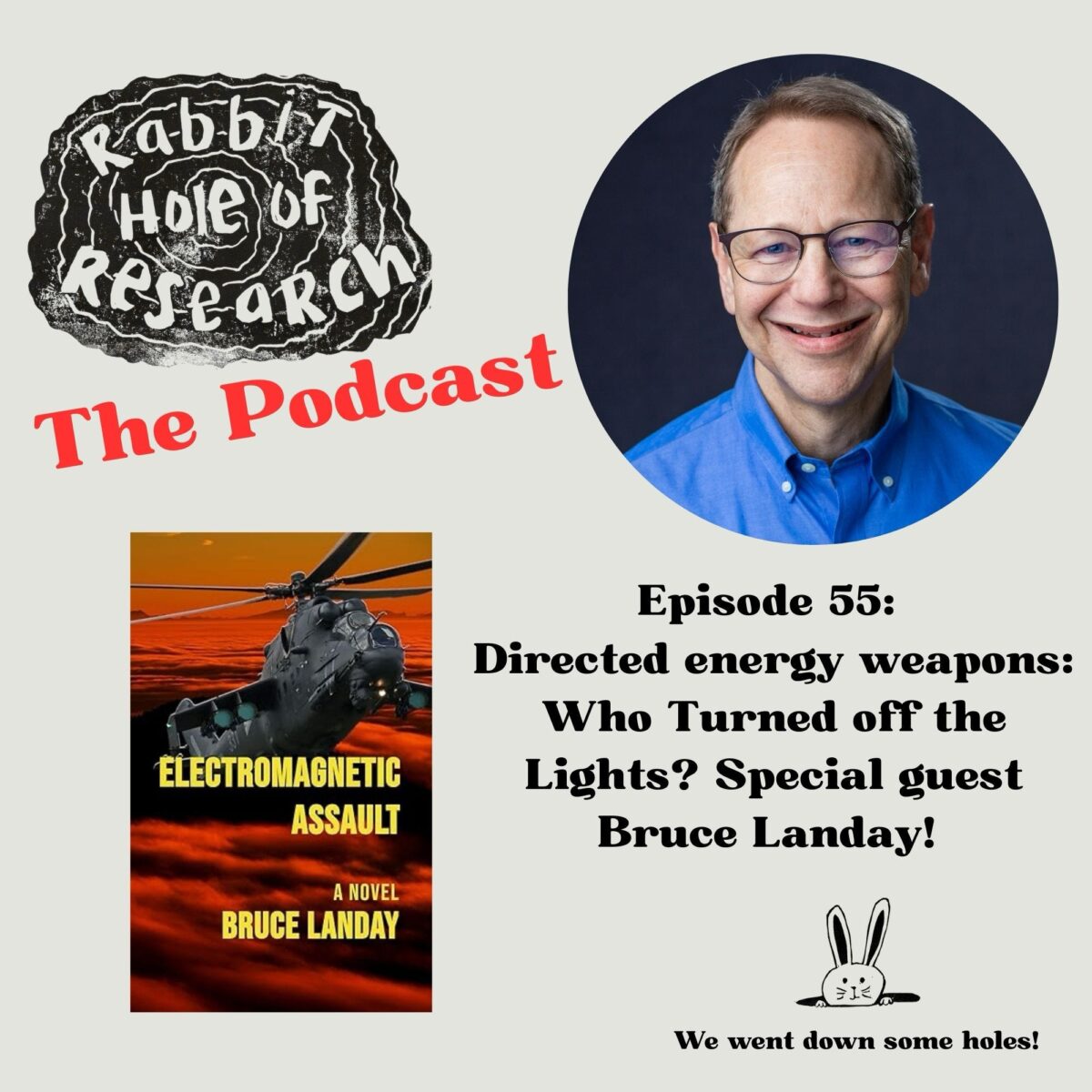
With Guest Bruce Landay
Substack, Apple, Spotify, YouTube, Amazon
joe: [00:00:00] Hey, welcome back to the Rabbit Hole of Research down here in the basement studio. You’ve got me, Joe, here on this fine recording. night we have
Nick: You got Nick.
joe: We’ve got Nick here.
geo: In Georgia. Yeah,
joe: Georgia, and we have our newest co-host who will be joining us for
You got Mary here, she’s been
geo: she might sound familiar.
mary: Mm-hmm. That’s
joe: familiar. And we do have a guest joining us.
mary: Would
joe: you like to introduce yourself?
Bruce: Sure. I’m Bruce Landay I’m a former US Air Force officer, and I write near future military political techno thrillers. I’ve got a new book that out on April 7th, Electromagnetic Assault, and I also write a weekly substack column, future Trends in Science Fiction, where I look at emerging technology and how it was previously shown in science fiction books, movies, and tv.
mary: Yeah. [00:01:00] Wow.
joe: Yep. It’s a nice substack, I tell everyone. Go check it out. Give it a read.
geo: That’s awesome.
joe: today we’re gonna talk about directed energy weapons who turned off the lights?
I guess that’s a fun one. So yeah, as
Nick: So, do you have a list for us tonight, Joe?
geo: Or definitions.
joe: I have all of the above. I
have lists, I have definitions, I’ve got all sorts of goodies here lined up for this exciting topic. But I do have my nice little opening monologue. ’cause
geo: we can’t wait. I just love
joe: it.
Nick: can’t wait.
joe: All right, then I’ll get into it. Light is the fastest thing in the universe and for centuries in fiction and reality, we’ve been trying to turn that speed into a weapon because speed is power. A bullet works because it delivers kinetic energy to a target faster than a target can get out of the away.
But why light? Because like I said, nothing moves faster. [00:02:00] Point, click, hit, no muzzle flash, no noise, no projectile arching through the air, giving away your position. Just an effective way to transfer energy from one place to another. The perfect weapon, perfect except for physics. Light might be fast, but it’s also weak.
Photons and other accelerated particles have little mass and can be reflected, scattered, absorbed. They spread out over distance and they require enormous amounts of energy to do what a chunk of lead can do for pennies. But it’s not all Handwavium dreams. There are real weapons that use lasers to shoot drones out the sky microwave systems that make your skin feel like it’s on fire without leaving a mark.
And I imagine there is ongoing research to weaponize every part of the electromagnetic spectrum in pursuit of that perfect weapon. But just because something is possible doesn’t mean it’s practical. And with a little bit of handwavium, you can put your phasers [00:03:00] on stun
Nick: Oh, phases on Stunned.
joe: little. a MF Doom there. So,
Nick: Hell yeah.
geo: yeah.
joe: So
geo: I
mary: have to say thank you, Bruce for being here today too, and Well, thank you for having me here. I I have to say though, I was talking about EMP and the pulses, and I thought, maybe this is just what we need, just wipe it out.
Start over. I’m like, okay. So Bruce, please tell me why that’s a bad idea.
Bruce: I’ll have, there’s another author that actually did it in a trilogy. His name is William Fortune. And he wrote three books. One was called one, the first was One Second After the second, One Year After, and the third was the Final Day. And it’s all about an electromagnetic pulse erupting over the us.
And basically that happens when you do an airburst of an atomic bomb, where you don’t have a bomb blast per se, that destroys things. But the electromagnetic pulse will destroy [00:04:00] anything with a microchip. So all the things in our modern society aiming with a computer chip, most of our cars our electrical systems, everything just grinds to halt.
And when all that happens, society breaks down very quickly. It’s a really bad
geo: Mm-hmm.
Nick: could totally see that happening. Yeah.
geo: Well,
mary: be a real shame if society broke down.
joe: Yeah. So it bad things usually happen. Yeah.
mary: Yeah. Okay. All
joe: Yeah. You’re
Dark,
mary: alright. Anyway,
joe: this trial’s over. Bye.
geo: But
Bruce: especially
if you live in, if you live in I’m out of here.
geo: But as far as talking about reality, this is what recently happened in Venezuela. Right?
mary: I was gonna ask about
geo: I think we used the EMP to remove the leader there, which
mary: Maduro?
Yes. Thank you. Okay. Do you,
geo: And I believe that’s what we used.
mary: Did
joe: don’t that don’t know.
mary: know.
geo: I could be wrong.
Bruce: I don’t think so. There may be in a very, they may have used like a point weapon because usually what [00:05:00] we worry about and what’s been written about considerably is these large EMP bursts and those are very difficult to control. And, for example, if you drop a 1.4 megaton bomb, 250 miles in the sky over Kansas, that would take care of the whole us, which is really scary.
They do have things that are called ebos that are non atomic ways of creating this electromagnetic pulse. And so, I didn’t read anything on it, but they may have used something like that for a much, much narrower application. I mean, we didn’t drop it. We didn’t do an airbus of atomic bomb Venezuela.
joe: I mean, there are other disruptive kind of weapons that we had like,
Nick: Not all of them have to be some
major
geo: I,
joe: EMP. Right.
geo: That is something to do some research on, because someone had mentioned that.
joe: right? You have like things like the active denial system. Which is used in crowds almost like a heat ray. And that is something that’s actively used. And it works [00:06:00] by heating the surface of the target.
So you feel kind of pain. And it’s used for crowd control or perimeter security where you can have this weapon. And it was deployed in Afghanistan, but I don’t think it was used. So it didn’t actually.
geo: What do you mean?
Nick: It was sent there.
joe: sent there, right, right.
Okay. But it wasn’t actually, it was kind of,
geo: it was kind of, it was like
joe: withdrawn back. Yeah.
geo: Was it used as a threat of using it?
joe: I don’t know. They don’t, I’m not in those meetings, so
it’s
Nick: Joe, you didn’t get those emails?
joe: if I am, I probably can’t say that over in the podcast, so
mary: but
Bruce: it’s
it’s.
joe: this technology, I mean, it’s this kind of and I mentioned phaser.
That’s probably as close you get to a stun setting on a phaser, because that’s one of the very implausible. Things in the Star Trek world the stun of a phaser, like, how would you modulate that to actually stun people? And so this kind of technology here, would could actually work,
geo: the plausibility is pretty high
joe: for this. The phaser
geo: well in, in [00:07:00] general, like everything we’re talking about is pretty much something that can be used, right?
Bruce: It is because I mean, there are, we do have actual weapons that exist. As do other countries. I work with several military advisors and one of them said, oh, Bruce he had directed energy weapons is very hot right now. But he said that virtual well classified, he couldn’t talk about it.
But if you, but just even looking on the internet there’s a this is one of columns I wrote in Substack was on directed energy weapons. And the Navy has what’s called a Helio shipboard laser weapon. And it’s a lot like a Starship Phaser, phaser Bank. And the one thing about it is that it’s got they need this massive electric generator to power this thing.
That’s one of the biggest problems with the weapon.
But it can, take out real ships, real missiles do a lot of damage and we’re not the only country that’s been developing these. The us, China, Russia and Israel are kind of the biggies, but there’s other countries as well that there are real [00:08:00] weapons that exist today
joe: Yeah. And so they kind of use energy. So like the Israel’s iron part of their Iron Shield or Iron Dome uses
Bruce: I think Iron
Dome. right. Yeah. So they, the shoot down missiles, ’cause it’s, it is cheaper than using another missile to intercept.
joe: And so a lot of countries will try to overwhelm your missile defense systems by sending dummy weapons. Like, so if you send, this, a fake number, 10 missiles in, you, five of them are fake, then which ones do you shoot down with your very expensive other missile to intercept it?
So, and if you mess up and you don’t hit
geo: so this basically stops all of them.
joe: This helps, this is another aid in that, that, that type of platform.
geo: So I have a
Nick: Without sending something out,
right? Like
joe: something Right. Or Right. This kind of
Nick: something that is physical out into it. Yeah.
Bruce: It’s also from a cost standpoint. These missile intercept systems, they’re a million bucks. They’re a million bucks a throw every time you punch the button. If they work [00:09:00] and if as you said, Joe, if you’ve got another country that is, throwing 10, 20, 30 of these at you you go broke in a hurry because you just, you don’t have ’em.
Where if you’ve got something that just recharges and you just need a, this humongous generator and then you can blast out as many in the sky as has come at you, it’s a much more effective, much more cost effective weapon too.
joe: And that was the big con in the Star Wars program in the eighties. In the Reagan administration.
mary: real
geo: Star Wars.
joe: Yeah, the real Star Wars. Was this kind of the
geo: movies
joe: space? Platform
Nick: was real,
joe: Movie was, yes.
mary: Oh, Nick,
geo: We have
Nick: happened a long time ago. In a galaxy far,
far away.
joe: need the chat. Yes, need to have the talk. But yeah, that was the idea that we were gonna build this platform, this space platform that would be able to shoot down, incoming nuclear warheads into the United States.
And so if you’re escalating. And you’re have an arms race where you’re building weapons and then you tell, your [00:10:00] adversary that now we can shoot down 50% of your weapons. They now need to make double to make sure that they get enough and they can deliver payloads.
It was a great strategic con that we were and maybe it was a con, I don’t know. We could have a roving platform. I think that was the basis of one of the movies. Was it Space Cowboys where the,
geo: not Star Wars?
joe: No. It was where like a old Russian intercept, nuclear, missile bank went defunct and it was gonna release like its payload over United States or something. And they sent like a
geo: oh, that was the story in Space Cowboy. I didn’t remember.
joe: Was that Clin Eastwood, he
geo: No.
Yeah, it’s like all the older guys going
joe: were the only people that knew how to code and Fortran or whatever it was coded in, or some Oh,
mary: Oh, so they knew like the legacy systems. That’s right. Oh, okay.
joe: So it was a, oh, okay. Sorry. We’re getting,
geo: So I wanted to
mary: I, we went
down a
hole. I
Bruce: the other
geo: Yeah,
joe: ahead Bruce.
Bruce: gonna say, the other scary thing is, now they’re developed, countries are developing and Russia has ’em today are the hypersonic missiles, they go a lot [00:11:00] faster. And so again, trying to intercept into those down is even harder, with a traditional
joe: Weapon. Exactly.
mary: If you don’t mind me asking what I don’t know what a hypersonic weapon is.
Bruce: My limited knowledge is all is just it’s just fast. It travels at far faster speeds than anything today. Like, I think, two or three times the speed of sound. But I’m not, I just know that they’re super fast. But that’s about all I know about. But
geo: I would, and
joe: That’s my understanding also that it’s, it is a very fast at least Mach 5, and it’s a small target. So you combine something that’s really fast mm-hmm. With something that’s small. So it’s like hitting a fast pitch baseball With a baseball.
So if you’re
geo: accuracy is pretty Bruce
joe: a basketball, which is big, you can knock, as Bruce was saying, you can knock that down with conventional weapons. But if you have something out that can move much faster, like a
geo: baseball and a smaller
joe: it’s smaller, it becomes a harder target to hit. And if you throw a bunch of
Nick: changing directions, right? It’s not like
it’s like
joe: no, I think it’s
Nick: right [00:12:00] mid
air.
joe: when they go, they usually pick a direction and go
Nick: Yeah. So then it’s just picking the trajectory that it’s flying in and then trying to time it out to where your
joe: well, you also have to have, you have to have knowledge of when the weapon was launched, right? So you won’t know that until you, you pick it up on something.
And even these weapons can evade, I believe they can evade like our detection. So that’s, they’re moving so fast that they evade detection. So by the time you realize that this thing is coming, it’s already too late.
Bruce: well, yeah. The other thing is a lot of ’em they’ll come in from orbit, they’ll shoot out, very high, they’ll come back down. And then they had the old, I think they were called Merv basically multiple reentry. They break up because the one missile and then 10 things would shoot out of them.
Oh, damn. And then would target individually.
mary: Can I
geo: ask a question?
joe: Yeah,
geo: I kind of, this is kind of like going back, but real basic because I’m trying to, [00:13:00] so this is using electricity,
joe: It’s
geo: like, like similar to what you use in a microwave
joe: A microwave. So we’re talking about weapons or I Bruce, you can add on. But weapons that are along the electromagnetic spectrum, and you’re absolutely right.
Microwaves would be on that spectrum. You also have radio waves or electromagnetic wave source. You have x-rays, visible light, UV light, infrared, gamma. And they’re separated by their wavelength. And so the wavelength is the, is the physical distance between the wave peaks.
Think of a, an ocean wave, like it has some periodicity where you kind of. Fluctuates up and down. And so the distance between those peaks is called the wavelength. So like a radio wave has really big waves and they can travel really far. They can travel through distance.
That’s why like your radio, you can be driving many miles away and still get signal from the radio wave [00:14:00] microwaves, so I think, radio waves are like house size. If we’re thinking of the wave that’s penetrating microwaves I think are like a foot or so, so they’re modulation.
And then you start getting down to very tiny waves and the smaller wave the more energy that the wave will have in it. And if you think about it, that, that makes sense. And so that’s kind of the idea. So these are photons. We always think of photons and light, but all these in electromatic spectrum, so that means they’re affected by electricals and also magnetic flux.
Does that help?
geo: Yeah. Yeah.
joe: So you can think of weapons. You can have sonic weapons. So we talked about, so you can have weapons, which
geo: know is Sonic Boom
joe: And a sonic. Yeah. Sonic.
geo: or
mary: Sonic.
Nick: the
Hedgehog,
right?
geo: or Sonic the Hedgehog. That’s pretty much all I,
joe: boom is the noise, when something breaks the sound barrier.
So when something moves faster than the speed of sound about 750 mph or Mach 1 , then you get that audible noise that you hear. And Mach one is the speed [00:15:00] of sound. Mach two, Mach three,
geo: 1 4 would be, so would you say that, so this is really the future of
mary: warfare.
joe: Yeah.
mary: And if I get this right then these these weapons disrupt the wavelength.
Is that what they do? Well,
joe: interact in, so they’re delivering energy. Okay. So the idea is that you would send this as a packet, let’s imagine a packet of energy. Mm-hmm. So, one photon of light is nothing, but when you turn on the flashlight, that’s, billions of photons that you’re optically seeing
mary: like light particles or something, or, yeah.
Okay.
joe: And you’re right yeah. That gets into photons can both be a wave and a particle. Mm-hmm. So the idea here is that you have a weapon, as Bruce alluded to, you have to generate a lot of energy
actually
create a lot of the, electromagnetic energy that you wanna deliver. You have to focus that energy. So you have to have coherence. So they gotta be focused. They all gotta leave the point source at the same time, the same wavelength. And then they have to travel [00:16:00] some distance without interference. And you have to overcome all these kind of variables to actually have an effective weapon.
So as Bruce said, the weapons that we have now that can deliver such a powerful strike, they’re usually on ships or they’re mobile units or ground structures that can generate a lot of power. So in fiction when people have a handgun that, or a laser ray, a ray gun that generates
geo: Or like a particle what do they call the particle accelerator?
joe: So like a ghostbuster proton
geo: Yes, exactly.
joe: That would
mary: be
joe: a backpack particle accelerator.
geo: So that’s
Nick: So we’re gonna start using those to
joe: we’re gonna start
geo: and those basically work kind of like a lasso,
joe: I don’t know what the science of why
geo: these, I think they catch it
joe: particles caught
mary: went to Wet Wonder Woman. Ghost.
joe: I don’t understand.
Yeah. But if we think about particle accelerators, so Argon National lapse here near Chicago the synchrotron that to accelerate particles, that’s a big mile, few [00:17:00] mile diameter kind of structure. That the cer in Europe. I think that’s, seventeen miles . Do you know Bruce, how big the particle
Bruce: Um, no, no, no. I know they’re
big.
joe: not fitting it in the backpack. Even linear accelerators are room size. So
geo: were way ahead.
joe: The Ghostbusters were way ahead with their Handwavium them. Yes. Or
mary: Or maybe it was, maybe like their mom and dad, like, they really wanted to have like a, well here you go dear.
Here’s your own little special pack just for you. Doesn’t really do anything.
joe: do anything. Yeah.
geo: oh, you meaning like a fake jet pack.
mary: It’s kind of like the time that I saw like a dad, like the a dad is mowing the lawn and his little boy behind him was with a little plastic mower. Maybe the Ghostbusters thing worked on the same principle.
joe: Alright, let’s, well,
mary: Okay. Now, all right, now I’m definitely getting fired for sure. Now,
joe: a favorite, do you have a favorite directed energy weapon that you want to kind of,
mary: promote? No. Okay.
joe: Right.
mary: So,
joe: Microwave, [00:18:00] some of those are really cool. The
Bruce: me I’m, I my personal favorite at least the half real half fictional would be the electromagnetic pulse because it just fries anything with a computer chip.
geo: Mm-hmm.
Bruce: It will disab, it will disable vehicles. And so that’s something I’m writing a book now, a different, very different world than the, than Electromagnetic Assault.
But they also, electromagnetic pulse weapons play a big part there. But even Handwaving aside just in , in industrial plants for years they’ve had laser
cutters.
geo: Yeah.
Bruce: I mean, you think back to the old Bond movies where, you tie the, James Bond is tied down and, they’re about to slice a giant piece of steel in half with him bolted to it.
But I mean, those things are real and we use ’em in factories all the time. And so there are, real weapons and again I think you hit it well, Joe, when you talked about just the size, just because whether you need I’m not exactly sure how lasers are created. I know it’s, it’s essentially light waves, super amplified.
But you need obviously electricity or some [00:19:00] other, way of generat generating this if it’s an electromagnetic pulse. It’s either an atomic blast or there are some other methods for generating this. These types of pulses. And so it’s a matter of getting the weapon sized and then getting it targeted and getting that targeted delivery.
Nick: So do EPMs have effect on the human body or is it just electronics? Like in general?
Bruce: I don’t know. I can’t imagine that, that they could be possibly be good for people.
Nick: Like, I, I can’t, yeah.
joe: the source. Right. And a couple things too. I know Bruce mentioned about cars, but I heard there is a little bit of controversy that does it actually affect cars, like the, a distance, , they’re shielding on things, so a lot of like airplanes and stuff.
So I think there was one, I can’t think of the show where some sort of EMP hit and then planes were falling, but a lot of those are shielded against kind of EMP,
mary: oh, planes are now the, these days they’re shielded against E mps.
joe: I mean, I don’t know when it started, but Yeah. But
mary: really, no. Okay.[00:20:00]
joe: you have, like I said
Nick: don’t go on a
plane. You know you’ll be, safe.
joe: so some of the protective things are using absorptive materials that can absorb kind of the energy like a Faraday cage .
So, or you have layers that would be ablated off and then preserved. So if you have a missile and someone has a directed, deterrent for your missile, you would then go ahead, add shielding on that so that when it hits it, the shielding kind of ablates off. But then the missile keeps its current trajectory.
So you, these weapons do have limitations. If it’s rainy,
it’s a laser, that will deflect it. So you have to then consider that the weapons effectiveness could be diminished in the time of need.
geo: But getting back to Nick’s point, the physical body, the human body, like what is the effect of that?
Right? Because think about x-rays and when you get an x-ray, those people are, those people that give you x-rays are terrifying. They have to go and run over and get behind something [00:21:00]
and then give you the, so, so, maybe that it’s like radiation.
mary: if
joe: get hit with, I mean, if you get hit with a directed electromagnetic weapon, there could be effects, right? So if it’s a microwave generated, that’s just like a microwave, so all
geo: you would not want a
joe: your water molecules will begin to vibrate and
mary: boy. Yeah.
joe: And that’s how the that’s how the deterrent works to the heat rate kind of deterrent I was talking about earlier that’s that same or Havana syndrome that people get that they thought, they think that’s a microwave
Nick: I thought that was an I thought that was a sound-based weapon.
joe: I think they’re thinking microwave.
Nick: Are they saying microwave now? I thought, I always thought it was sound because of
joe: that,
Nick: yeah,
Bruce: but even things like, like a radar dish is is very bad for the human body. When I was a Air Force officers, a communications officer was out the radar site and at one point I started walking.
I was about to walk in front of one of the radar dishes and one of the sergeants grabbed me and said, you don’t wanna do that, lieutenant.
geo: mm-hmm. Yeah.
mary: What, what would happen to what? I mean what did he just said [00:22:00] don’t get any near, I mean, did he go, did he say, what would happen to you if you did that?
Bruce: If I wanted to be a father, I would probably have a difficult time being a father. Too much exposure.
joe: Oh, okay.
mary: okay. So if people, that shouldn’t be fathers, we should just like, take ’em on a little trip to the, okay. All right.
joe: ’cause radar,
mary: nice walk in the woods, sorry. Walking. Okay. Yeah,
joe: it’s using radio frequencies. High powered radio. So we talked about anything electromagnetic
geo: Mary’s getting some ideas
joe: can be used as a weapon. So radar, you’re sending out signal and then you’re, that’s deflecting back to let you know something’s coming.
So it’s gotta be pretty powerful to go out. So if you get in the way of that, then yeah, you’re gonna take a high dose of this, which will probably heat you up. Like, ’cause it’s going to deliver energy. The
mary: energy, those energy is hitting your body, right? It’s gotta go somewhere, right? Yeah. So
joe: I think that would burns eye damage, all sorts of weird things probably I imagine would begin to happen if you got hit by full bore of a radar signal there.
So, [00:23:00] but yeah,
mary: I’ll
try to,
I try to avoid those.
joe: What was
Bruce: anything that’s a microwave. I mean, think of what microwave, does, we cook with it, it would cook us too.
joe: Yep. Yep. Yeah.
geo: Yeah. I wouldn’t wanna be, I wouldn’t
Nick: You’re gonna become the human sized hot pocket
mary: Oh, no. Yeah. On
Bruce: thank you.
joe: out. Inside out, yeah. Oh, that sounds,
mary: Oh, that sounds dreadful.
joe: saying, I was kind of being funny, but like the phaser, if you think of stun, because it had different modes and I like stun and it killed and had disintegrate.
And so if you think about how you would actually put together a phaser, because the way they described it, I forget the nat on particle, I forget what kind of particles. It was all Handwavium on top of Handwavium.
But if you try to make it real and you go, well, microwave could be it like, right? So you can modulate the signal and energy source, and so you can have a stun where you just kind of hit people and they get a little sensation.
Their nerve endings kind of tingle. They seize up and they fall over. You could have kill, you could ratchet that up and just melt them from the inside. Okay.
geo: Okay. All disintegrate. The
joe: one that’s hard, right? Because when they disintegrate on the show. They just [00:24:00] disappear. But there’s mass involved, like where does all your blood, your organs, your guts, your bone matter?
I feel like that’s,
geo: like putting a grape
Nick: what’s the difference
geo: in the microwave.
Nick: and disintegrating?
Like
geo: Have you ever put a grape
Nick: wanting
to deal with the body afterwards?
joe: Disintegrate is like,
Nick: don’t need that
around.
joe: don’t want any evidence. Yeah. I want no evidence and hand. And so, yeah. So really the phaser in, in Star Trek was just this kind of all purpose handwaving, and it was like, well, we don’t wanna deal with the consequences of killing whoever.
Let’s disintegrate ’em. We need to take ’em back for questioning. Stun ’em, like, we just, we’re in the struggle for life and death. Right. Kill. Right. So, I mean,
geo: that could have actually been like, you are be like beaming someone up. Maybe you were beaming them away, far away and you just didn’t have to deal with them
joe: You could, you’re right. You could beam someone to the vacuum of space. Like, I don’t, I’m unsure why they just sit and do that. Like, hey, that, what are we
Nick: if it is going with the beaming direction, don’t they have that in-between space? Does it just [00:25:00] send you there where you’re just never ending in that loop?
joe: I dunno.
geo: That would be torture. Yeah.
joe: episode.
Nick: it is. You get into like
Bruce: this well, they had an episode where Scotty did that. He got,
Nick: yeah.
Bruce: Yes. And he just recycled himself for, I don’t know, 70 years or something, until someone else found him. And.
mary: Yeah.
Bruce: Brought him
mary: Oh, was that one when he was the guest star on, on Next Generation? Is that how that happened? I can’t remember.
joe: Was that the loop? Yeah.
Bruce: yeah. I think, yeah. Yeah. They found, yeah, they found him out there.
mary: God love him.
joe: I was gonna, I was gonna bring up something and I think it got mentioned, I’m not sure Mary or Georgia, you guys talked about war and changing landscape of warfare.
And I think there is this kind of the clean war fallacy where people think if you use these, energy directed weapons, then war would be targeted, it would be very surgical. You would just hit certain targets and leave everything else alone. But, I think, everything escalates, right?
Bruce: War. War is messy, nasty business. [00:26:00] And if you think back to the eighties, they had I’m drawing a blank on the name of it, but they had a special type of atomic weapon that basically would leave the infrastructure standing, but would kill
people. And I forget there was a special name for it.
And I think it,
joe: that the neutron bomb
Bruce: yeah, maybe it was a neutron bomb. But still, I mean, war is na is very nasty business. And this whole idea that, oh, we’ll just be very pinpoint, but society breaks down and that, and that’s what’s so scary about something like, like an EMP burst, because you could not destroy, if we did this to other, an enemy did to this country, or we did it to another country if all of a sudden there’s no food, no computers no,
mary: No social media,
Bruce: Yeah, nothing. Nothing works. None of those things work anymore.
mary: Okay. All,
geo: Right.
Bruce: breaks down and there is a, there was a show years ago I used to always refer to it as the electricity show, but basically the US was brought back to basically 18 hundreds technology. All of [00:27:00] a sudden, electricity just stopped working.
joe: Is that Revolution? What was the name of
Bruce: Revolution. Yeah. that? Was the name of it?
joe: it. I think we started watching that Georgia, remember
geo: We
joe: Where they didn’t have any power, something. It didn’t, I didn’t, I don’t think we stayed with it, but they never explained what the loss of power was due to.
And it, they kinda went, and
geo: we also watched
Bruce: And Wiv.
geo: with the snow. The snow. And it was in the middle of the summertime and
joe: Oh, was that,
geo: and then everything stopped. Everything stopped working
joe: that the nus
geo: as far as like communication and stuff? Yeah. With the, yeah.
joe: Argentinian graphic novel that they made into a Netflix TV show
geo: It was good.
joe: Was good. But it was good. But I think that was aliens.
geo: I think you make a great point though, that would just cripple, I mean, have you been like at the library?
Yes. When all of a sudden the computers go down.
mary: Yes. We’re very
geo: Oh my gosh. It’s like,
mary: now, yeah, that’s true.
geo: we, what can we do?
joe: out. Where’s the card catalog?
geo: How do we,
Bruce: but think about it. I mean, a phone call, GPS anything with [00:28:00] the internet.
mary: Yeah.
Bruce: everything. Yeah. We rely on it So much food. Yeah. Think of our food.
mary: And seasonally,
joe: if it’s winner and we
geo: was
joe: what it was minus 20 out, if now you, destroy, I mean, that’s what the, kind ofs happening in Ukraine and Russia war.
Right. So Russia’s hitting their energy infrastructure. Yes. The sad thing
geo: about, and the food supply
joe: supply in, in Americas, that our electrical grid is pretty poor and so very susceptible to, even if it’s not. Countrywide our power grids are susceptible to these kind of things. These, it’s, and it’s fragile.
It’s not some robust system that we’ve invested over the years in maintaining
geo: we rely so much.
joe: Right. We do. We, I don’t think people realize that we,
Nick: Well, and the amount of people that use it to actually keep on living. There’s medical
things in people like a pacemaker. All this stuff going down. You’re killing so many.
geo: Right. Well that was that other show.
joe: I
mary: mean to
geo: stop
Nick: This is on you, Mary. [00:29:00] Great job.
geo: No.
What was
Bruce: and.
geo: What was that? other show we watched recently where everything stopped working and then, oh,
mary: that’s like Thursday for me. I don’t know.
joe: a lot of shows.
mary: No,
geo: it was just like, like when it happened, all these people died because the trains like ran into cars and,
mary: Oh, that was
joe: that was the one
geo: it was I wanna say Al Pacino, but I don’t think it’s Al Pacino.
It was, oh, Robert De Niro. I think it was Robert De Niro was in it on Netflix? It
joe: It was on Netflix. It was like it was the one with the ship in a go.
Like, it’ll probably come to me in a second or
Bruce: Was TV show?
joe: it was, no, it was a movie. It was I
geo: no, It
was a TV
Bruce: something?
geo: It was a series and we watched the whole series.
It was like a political,
joe: That was a tv. That was a movie.
geo: No, it was a series. The one I’m thinking of is a series. The
joe: that was the exec executive producers were Obama’s
geo: Oh no that’s the one where the ship was coming in. No,
mary: Power
joe: and
geo: that was a movie.
mary: Right.
joe: [00:30:00] Okay.
geo: That was not what I was
joe: remember what that was called.
geo: Yeah. Last
joe: okay, well, we’ll put that in. Show notes. We’ll,
it’ll come to us here. That’s
geo: I have to think of it
joe: probably didn’t I, because in that one they, I think they did use
geo: that one was really good.
joe: Yeah. So like the EMP burst they had, I remember that was in the matrix, was that the third one. And when they’re down and,
mary: oh boy,
joe: they’re down and they’re celebrating and then the root machines are boring a hole into the last human stronghold. And they hit the EMP and they all fall and clatter.
And then a lot of the machines went outta range and then they came back on the attack and, but then they were crippled. As Bruce was saying, if you use one of these weapons, you not only can cripple the enemy, but you can cripple yourself in everything that’s around the burst.
So if you have, assets in the field. There, that, that are, and you actually use a weapon like that. You then disable your own troops. And if they’re communicating and things like that, they become just as disoriented as the
mary: well, oh, [00:31:00] Georgia found it.
geo: I found the movie.
mary: me.
geo: let me just throw it in there really quick. Leave the World Behind.
joe: the movie.
geo: Yeah, that’s the movie produced by the Obama’s.
joe: TV show?
geo: I haven’t found that yet.
joe: Bruce, you were saying, so this was about
assets on the
Bruce: Yeah. Oh Yeah. Yeah. I mean, when you’re talking about your troops being disabled that’s a huge problem with all of the sort of automated weapons now and the AI weapons and things like that where there’s so much noise. Think of like drone warfare. There is so much noise in the electromagnetic spectrum right now that there’s a huge effort to just either, you jam it with all kinds of junk signals or you basically take away the other, the enemy signals,
joe: Yep.
Bruce: you know, so that that’s a real problem.
joe: I don’t think this is a spoiler for your novel, but you’ve integrated a lot of wetware technology. So Wetware is where you have computers interfacing directly with [00:32:00] biology, so it’s called wetware.
mary: Like past smoke,
joe: in like the pace neural mesh.
Yeah. A pacemaker would you? But this is be more computer interface. So now you start having this, so like the neural, neural mesh, things like that, that would interact directly with your brain, send images. You could read the internet with your mind. And so you can enter,
mary: attempting as that may be,
joe: But in, in the novel you’ve integrated the
military has this, right, this technology, and it’s
Bruce: As, yeah.
joe: It’s not, so probably nothing we can do that I know of right now, but yeah.
Bruce: It’s funny that you mentioned the thing that, that I think Elon Musk, because that was one of the impetus for me to even write this story is I started reading about what we were doing with Neurotech, in terms of these brain implants. And I do it’s not much of a spoiler ’cause man I mentioned that pretty much on page one, right?
In the right in the
joe: when,
here, they gimme a hard time for spoiling stuff, so I just, I’m a little sensitive. Bruce, you gotta excuse me.
Bruce: No. I’m not, [00:33:00] no. What I’m doing is I’m giving you permission. It’s fine to discuss it. This is what I’m saying
mary: yeah.
joe: Yeah.
Bruce: is this, is that.
mary: Oh yeah. Well, I was gonna, I was gonna give away the last chapter, but I think No, Georgia has some something that yeah. There was another thing. Okay.
geo: I’m sorry. Just to throw it in really quick, the Netflix miniseries was called Zero Day, and that starred Robert De Niro, and it was where they were a cyber attack that crippled the US and killed thousands.
joe: Oh, right. Yes. It was like a political thriller, something
geo: similar where you’re hitting the cyber, a cyber
joe: Right. And a lot of those are,
We were talking about this neuro tech. So people start to integrate computers more into themselves.
mary: and
joe: could be, control of pacemakers or other bi I mean, things we, not even military applications, but civilian applications for
geo: health. Mm-hmm. Right.
joe: Right. You become much more vulnerable to these attacks. You’re not gonna be EMP, you’re not gonna be shielded. So maybe larger assets are shielded. [00:34:00] Maybe we will shield our, electrical grid. But if you hit a pulse like that, like Nick was bringing up, you could cripple hospitals now you could cripple people personal kind of interactions with their world.
Right. And
Bruce: And for me that is very personal because I do have a
joe: yeah.
geo: Oh, wow.
mary: Yeah.
joe: right, right.
mary: Right. Yep.
Bruce: Yeah. So that, yeah, I’ve got a, I’ve got a phone app in my pocket that, it’s like, do not turn me off, is what it is. What It says
joe: yeah. Yeah. Yeah.
geo: ’cause you,
think of this, I’m thinking of another show and actually it was a Black Mirror episode, and it was where it was almost like more or less paying to have like this service so that woman she, it was like a subscription and then you kept having to upgrade or you weren’t gonna get, or Yeah.
Or you and I think of that as this technology. And just would be like, oops, you didn’t pay, you didn’t up your subscription. Whoop,
joe: We can turn it off. You can’t run or hide.
mary: Oh boy.
Bruce: We have that [00:35:00] today on Tesla cars. I mean, think of battery power and battery distance. Oh, well, if you pay extra money, you’ll get more battery you’ll get more distance from your batteries. We’ll release that in the software. So that’s not, these Black Mirror episodes are not as farfetched as they sound.
joe: yeah, exactly.
geo: Wow.
joe: Yep. Well,
mary: Bruce, I wanted to ask you too about, about fiction writing. Georgia and I are librarians, and so I, I’m interested in, and I mean, because you could have written. Maybe a nonfiction book or almost like, like a history of EMPs but instead you wanted to explore this topic through fiction, and I wanted to, just ask you about that and, your writing process, or you talked about, Elon Musk being
an impetus for the most recent book, Electromagnetic Assault,
Bruce: Yeah. Yeah, and answer your question. Yeah. Nonfiction for me is, doesn’t have a lot of interest. And it starts with, I don’t have that level of expertise. I mean, I’m interested [00:36:00] in this stuff. But but I don’t have anywhere near the. The technical skills or the knowledge to write anything credible, nonfiction, on, on these topics.
I’ve just always had a wild imagination and love stories and been a lifelong science fiction fan. And when I was in college, I took a class and really liked it and thought, well, I’d like to, I like Baal write novels one day. And it wasn’t until I got my forties when I finally did something about it.
And I spent three years and read a ton of books and I got about a third of a novel written I’ve got in the wafer in the next 10 years. And then I started writing seriously in 2015.
And, People, if you ask me, how long did it take to write this book? Well, in some ways it took me 11 years.
Now in the process I wrote two other, two other novels that actually finished and started a couple of other ones. Because it is a long learning process, but it’s like I write a weekly column in Substack and a lot of times I just I read the news every day and it’s amazing. The sorts [00:37:00] of things that used to be science fiction are becoming more and more science fact.
And so I look at things where I
that today is much more science fact than it were when we were kids. And I look at a wide variety of things. It can be weapons, it can be drones it can be flying cars, perennial favorite. And then think of like the science fiction, like from the fifties or sixties versus today and even what’s possible today.
joe: Right. Yeah.
Bruce: To answer your question or
mary: yeah, no I was just I think that No, thank you for that. But I, and I think that writing things through fiction for it, it’s more about, it’s not like what it is, but like how it would feel like, to
geo: really
engages people into thinking
mary: Yeah.
Thinking about what it would be like to be in that situation.
joe: The question is, , on that same line, because we’ve talked a lot about the science and we poke fun at some of the IPs that we won’t mention them again.
But, how do you balance that science [00:38:00] fact versus the Handwavium? Like where do you draw a line? Do you, or do you have a line? Do you just fill in when you need to? Kinda like the phase there that we’ve poked holes in
Bruce: it depends. I mean, some of it I write what are called technical thrillers. And so people will say, well, did you write science fiction? Well, it’s not exactly science fiction because it’s not it’s not aliens and spaceships and other planets and other cultures. And so I tend to, the period of time period, I write the second half of the.
joe: of
Bruce: the 21st century. And so I have a lot of a lot of leeway there. The book I’m writing now is has time travel, so obviously lots of handwaving with time travel and with technology. To me, I think more, I’ve always been a hard science fiction fan, so I’m not quite as hardcore or as pure as like a Daniels Suarez who I think is fabulous.
But I like to at least create things that are reasonably plausible based on either technology that we have today or technology that we would expect in a reasonable amount of time.
geo: [00:39:00] Mm-hmm.
Bruce: And again, the reason books work is the whole emotional level of things. And that and that’s really what makes stories work is what’s the impact on your hero or the impact on your characters. And what I try to do is write things that. Take a look at that mix of technology, military power, political power and then the impacts on real people. Think of, we’re going through a very interesting time right now in this country. It’s been very, divisive in many ways, a lot technology changes, a lot of changes in the world.
And so I like to write stories that, that, kind of take a look at that and see how different people react, react impacts on them.
joe: Yeah, and I mean, I
geo: and the idea of how pervasive it is.
I mean, if we talk about like surveillance, I mean, it’s just like how pervasive it is and how much data they’re getting every single day based on your smartphone, or, oh, we got a great deal on that [00:40:00] smart giant tv, but look at all the data it gets. Or now
Nick: I mean, this isn’t even science fiction,
geo: no,
and now
Nick: Ring cameras
geo: was
gonna say
Nick: Bowl, they had that ad, which they were like, oh yeah, we’re gonna start using your device to locate lost
dogs. And it’s like, you’re not doing that.
You have a very poor rate with that if that’s your number.
mary: Right. And
geo: that is just a guise for surveillance. Yeah.
Nick: it’s putting us in that surveillance state now, except it’s now corporatized and it’s.
joe: a future.
Bruce: it is exactly corporatized. And we have, I
Nick: don’t know if that’s a word either. I’m so sorry.
Bruce: Yeah. No
joe: Hand
geo: I like it
Bruce: But we have, hopefully we’ve done it to ourselves. I mean, think, with ease, think of things like you can do a fingerprint scan on your phone. You can do face, face facial recognition.
I won’t do either one of those things.
mary: Right,
Bruce: Heck, I, I write stories about how that’s abused. When I go to the airport, if it’s a hey, I want to take your [00:41:00] picture, with the TSA, I don’t do that either. Because there is so much surveillance right now. And actually one of my columns, I did write about it, and it is, it’s scary.
It really is.
geo: Yeah.
joe: I was gonna bring us back a little bit.
mary: Okay. Yep.
joe: So, yeah, so I, speaking of fiction, because I think one of the things that happens in fiction is that you start to think forward, especially sci-fi and these ideas and what can be, so I went and thought about. Early examples, when in literature did we see? ’cause you would
mary: think,
joe: was it, the laser was invented in 1960 ish, so did we start seeing energy directed weapons post that or pre like, what was that history?
And so going back you start seeing things in the 18 hundreds, electrical guns, galvanized weapons , 1871, Edward Litton, The Coming Race, we had rural energy staff is what [00:42:00] he the, what it was called can destroy, heal, or animate matter. So more mystical than technology. And in 1898.
a book is written called The War of the Worlds by HG Wells, and then that is the heat ray. And that would be the first true directed energy weapon as described in the story. And it’s a martian weapon, so it’s not even an earth bound a terrestrial weapon. It was an extraterrestrial weapon that focused heat beams with a parabolic mirror.
And if you go into text, it’s describes this, that there, some way to generate an intense heat in a chamber of practically. Absolute non conductivity. The intense heat they project in a parallel beam against any object they choose by means of a polished parabolic mirror of unknown composition.
And that was written 60 years before or about the invention of the laser.
mary: I wanna do a whole episode on War of the World’s.
joe: That would be fun [00:43:00] And
mary: the whole one ton.
Yeah. Yeah.
joe: weren’t really understood at this time, and so mm-hmm. This kind of idea of using an energy directed weapon was there. And then we get into 1920s, the pulp era, we get the first Ray-Guns start to come out.
Buck Rogers, flash Gordon. That’s right. So these, kind of these terms. And so you start getting the ray gun and, kind of the handheld portable so from, HD Wells, it was still ship based, so they still had this idea there and you kind of go through and then I always say, what’s the oldest source of energy directed weapons?
And that would be, in mythology and religion, Zeus.
mary: Oh, that’s right.
Throwing
joe: lightning bolts.
Right. So that would be also using electromagnetic energy and directed weapons so you can smite people with,
mary: There’s a lot of siding.
Nick: It’s my
joe: you can extract your vintage using beams of accelerated light from the the clouds.
That’s yeah, that would be a, an energy directed weapon. So yeah, it was really [00:44:00] interesting looking at up and kind of the history of, kind of how, and then how we use science and how we can think about it and kind of move forward and kind of understand, even project these things out.
mary: Well, there was an an epi, well, in another example in popular culture as you were talking about that made me think of Watchman.
Mm-hmm. The graphic novel, because when I read it in like the destruction, I thought for whatever reason, like the first time I read it, I assumed it was a nuclear explosion. Mm-hmm. Mm-hmm. But then when I reread it, I’m like, oh. It was like the same level of devastation, but it wasn’t actually a nuclear bomb. So it was almost like a, like, like a disruptive,
joe: Yeah.
mary: but I also wanted to ask you Bruce too, you, you mentioned you were a hard sci-fi fan
Bruce: Yes.
mary: and well now I wanted to talk about like some of your sci-fi influences in your life or other sci or other authors that you are excited by right now or that you’re interested in.
Bruce: I write [00:45:00] technical thrillers, which are kind of on the edge of, on the edge of sci-fi, so on the technical thriller and then military stuff. So for. Technical thrillers. Daniel Suarez is ab absolutely a favorite, and he’s very hard, hard science and his stuff is leans more in the science fiction.
There’s Matthew Mather who sadly passed away several years ago. He died in a car accident. He’s written a lot of great stuff. Those are two Douglas Richards, Douglas E. Richards write writes, write some stuff. Growing up it was the classics Heinlein Asimov, those sorts of authors for military, obviously, the Tom Clancy books.
And then more recently Steve Stephen k Coli David Bruns is real good on, on the military stuff. So a lot of different people have impacted me and I love movies too. Obviously I love Top Gun, which was just a lot of fun.
geo: Yeah.
mary: Fantastic.
Oh, and I wanted to ask you too, I, when I was looking in the back of your book, you mentioned in your bio that you are a member of the [00:46:00] Experimental Aircraft Association.
Bruce: EE Oh, yeah. Yeah. I’m a total airplane nut. Yeah. EAA experimental Aircraft Association. They’ve been around 60 or 70 years now and every year in Oshkosh, every summer they have Air Venture, which is the biggest air show in the world. And for one week a year, this tiny little airport in Oshkosh, Wisconsin is the busiest airport in the world.
mary: Oh,
geo: That’s
Bruce: If you like airplanes and you can only go to one air show, that’s the show to go to.
geo: Nice.
joe: So
mary: experimental. So it’s.
geo: so,
mary: So could you de describe that a little bit? Is this like more like a, what’s they don’t call ’em UFOs anymore or but it’s more like people are coming up with their own kind of flying contraptions that they want to test out in Oshkosh.
Bruce: Yeah, originally would’ve started with our basically home builders. People that like to build their own airplanes. And so today there’s a lot of companies that will sell you kits and will sell you [00:47:00] plans depending upon what you wanna build. The show at Oshkosh, start off that way with just a bunch of guys that like to build airplanes and wanna get together for a small air show.
Over the years, it’s grown into this monstrous show where they have all of the builders. So if you want anything from like a small private plane, a private jet they have lots of military stuff there. They have an incredible amount of World War II stuff that’s in. Still in flying condition. So if you want see any kind of, air history and so it is just an incredible anything that flies they have it.
geo: That’s awesome.
mary: That is pretty cool. I what, if I get a kit from like an airplane kit? No, don’t ride in my, don’t ride in my plane. No don’t ride in my plane. No.
geo: not doing
joe: The Rabbit Hole of Research, don’t endorsed
mary: there. Yeah. I, we can’t, well, I mean, usually one, like I’m, when I’m making like something from like an IKEA kind of situation, there’s always like a few screws [00:48:00] left after,
geo: your Alan King.
mary: Yeah. Exactly. But, I have a lot of trust and so.
joe: some,
Bruce: Well, well, we’ll some, somebody a fun I did last year there’s a company called Vilo Aerospace, and they make, think of a quad copter. They make a personal quad copter. The thing looks, it’s about size, like, like a snowmobile. You sit down in this chair and they, they don’t let you fly an actual one, but they let you allow you to fly one in vr and it’s, it was fun.
Easy to
mary: sounds a blast.
Bruce: Um, And there’s even like, an air taxi service by Joby Aviation. It’s a tilt rotor, six six crop hexa copter that supposedly like, I think they’re supposed to have done it by the end of 2025 to make it as a basically a legal taxiway that this thing will fly.
You have a flying taxi
joe: there it is, flying cars.
Bruce: Yeah, and it’s flown remotely. You get in and some other guy flies you around remotely.
Nick: Oh, sweet. So I don’t have to talk to anyone.
joe: You just go, right. Yeah. There it
Nick: I am all about that.
joe: We also have a little more fun with the, [00:49:00] these directed energy weapons and. Bruce, you
geo: have fun.
mary: We’re gonna have
joe: Robert Heinlein’s. Starship Troopers, which was
mary: Oh yes.
joe: political s military satire piece in 1959. But I, in there was no really energy directive weapons.
It was conventional. Once again, the laser hadn’t been developed yet, so it used the technology we had. But in the 1997 film,
mary: mm-hmm.
joe: The troops that went in, they still had conventional weapons, but the bugs actually used kind of plasma directed energy.
If you remember when the ships went to attack the planet. The bugs would shoot out their butts. These kind of bright
mary: Oh, that’s right. Plasma
joe: kind of streams. And so it was , interesting. It was this technology kind of gap because the troops went in and they got like just, shotguns, against the bugs.
And the bugs are firing plasma, destroying their very expensive, large [00:50:00] starships that are cruising around. And that was interesting. You also had bugs that would spray out some sort of plasma juice that would disintegrate people. And so yeah, it was , it was interesting about the bugs and their technologies, bio-based energy directed weapons.
Unfortunately the plasma weapon probably wouldn’t work. There’s a few problems with that. So the plasma probably would dissipate, so generate this plasma’s kind of the fourth state of energy. So we have, people think of. Ice, you think of liquid, you think of gas.
mary: Okay.
joe: And then you have plasma, which is an ionized form of the material. So you kind of
geo: you call blood? I, we’ve talked about this
joe: very different. Two, the same
mary: word
joe: used in two different
geo: can’t we get another word?
joe: You made the same argument last time. I remember. Yes. It would be nice, but no plasma. Yes. One one’s a high energy.
Kind of material and physics, and the other one is a biological based one. Yeah. So
geo: afford one more word.
joe: more word. Right. [00:51:00] So, but yeah, launching plasma into orbital altitudes is difficult. It would just, dissipate ir resistance. There’s all also sorts of problems
geo: Maybe on that planet it would work.
joe: this, the laws of physics are they’re universe wide, that doesn’t change.
So, yeah. So you would have these issues that the plasma system wouldn’t work, but it was a cool kind of thing and concept to see that as an energy directed weapon. And, I think, I’m not sure if Bruce mentioned, he talked about laser cutters, but plasma cutters. So we do have this technology, usually they have big power sources and, but people, use plasma torches and things like that.
So we do use and limit it. And this gets to distance, right? That, you need, if you want your directed weapon to travel further to deliver its payload. You actually have to give more energy upfront because it dissipates, the energy will dissipate over distance.
mary: Okay.
Nick: What are plasma cutters used for then?
joe: Oh, for cutting material metal.[00:52:00]
Nick: Okay, so just like the
laser
cutters,
joe: Like a laser cutter. Yep. So they’re like industrial cutters, so mm-hmm.
Nick: Just stronger,
joe: Cuts
mary: through blood. Sure,
joe: yeah. Cuts through will cut through
mary: Okay. Yeah. Okay. All right. All right. Yeah. Okay. Yeah.
joe: yes. But yeah, so that’s kind of the way you have to think about it, that you have these kind of weapons and so you would have to have a lot of power to generate that
geo: But we’re too busy using all that energy and power to make our little videos and make ourselves look cute in our little gi, our little ai
joe: I’m sure AI is hard at work when trying to solve some of these problems,
geo: I’m sure.
joe: Like how do you actually make a better weapon? Much more,
mary: Oh, I’m sure. Oh, well, I,
Nick: or more deadly.
joe: I think better because some of the other problem I, Bruce alluded to the energy and we’ve been talking about the energy needed to power these weapons, but you know, the energy conversion isn’t a hundred percent.
mary: So,
joe: So, and when you’re not a hundred percent efficient energy [00:53:00] conversion energy has to convert to something that’s usually heat.
And so a lot of these systems need massive cooling. That’s why like, you just need the cooling systems and how do you do that? How do you prevent the heat buildup? That’s why they’re, a lot of ’em aren’t continuous their pulse so that they can have time to cool so that they can fire cool down and you then can manipulate it that way.
mary: Oh boy.
joe: Oh yeah. So, yeah. So
mary: that’s a cherry topic.
joe: So that’s why space, yeah, maybe. Yeah. Right. So space, weapons, space warfare.
mary: Mm-hmm.
joe: These weapons are much more effective. You have a vacuum, so
mary: I have a vacuum. It’s a Bissel.
joe: have a
geo: I have a vacuum.
mary: Okay. No.
joe: need a
geo: don’t think it,
mary: don’t think it’s
joe: you need a Dyson.
mary: activism.
joe: Your directed energy weapon won’t work unless it’s in a
mary: Oh, darn it. No, I Bruce, I wanted to ask you another question too.
And Georgia, you talked about this at the beginning and because I also thought the same thing, with when the US kidnapped Maduro and brought him to Brooklyn. I don’t know, maybe he’s like sipping latte somewhere. [00:54:00] Anyway but like Trump is describing this weapon, like, and it, he called it the, did you hear what he called it?
geo: I can’t,
mary: he called it the Discombobulator, and I’m wondering Bruce, do you have, like, do you have a like a theory or an a, a guess about what, such as a weapon could, would be like or maybe or Joe or,
joe: I have plenty of guesses,
mary: plenty of guesses.
Yeah. Have plenty of guesses. Yeah. But Bruce yeah, sure. Bruce,
joe: if he wants to go, yeah. If there, if it was a weapon like that
Bruce: yeah. And when you say a discombobulator, I mean, what did it interrupt? Was it all the electricity or the communications or
mary: was the, way Trump described it it disrupted the people, I’m sure whatever he was describing was probably wildly classified. So like, everyone else is probably plotting around him, like as he is describing what’s happening to these.
But it was actually, it was just, it was affecting the people.
joe: Oh,
Bruce: I, My guess would be some sort of, like a sonic weapon
mary: Okay.
joe: Yep.
Bruce: would be because they’ve already had those [00:55:00] attacks, I think in Cuba and China where it just, it’s, it uses a certain frequency of sound waves and it’s very uncomfortable and very disruptive and gives you a headache.
So if it was directed to people, that would be my guess. But I honestly don’t know.
joe: Yeah, I would go the same kind of the Okay. Sonic weapon, or it could be one of these microwave base,
That would cause people to feel pain in their nerve endings, things like that. So if you start feeling random pain headaches, disorient, that would probably disorient you, so For sure.
So have that go in is controllable. It’s you’re just affecting biological at that point in time. So it’s like standing in front of a radar.
mary: Mm-hmm.
Nick: Well, isn’t that also like what a flash bang is like? It both disrupts your eyes and your ears, right?
Bruce: Well, I think flash bang is different. You’re correct on the eyes and the ears and basically it’s a, it’s super loud, it’s super loud very intense, and then the flat and the flash.
But I think you only disrupted [00:56:00] for, a couple of minutes, long enough for,
Nick: oh,
Bruce: 10 guys come, charging in, brandishing out automatic weapons and you realize that, oh boy, I’m in trouble now.
joe: Speaking of sound, the thing I’ve found during research is the Brown Note myth. Ooh.
geo: Ooh.
joe: And
Nick: It’s not a myth. It’s a, true
joe: it’s not,
mary: it’s not,
I have
never heard of this before. What is this? Can
geo: you say that again?
joe: Brown Note myths A frequency, a sound frequency that causes bowel. Instantaneous bowel movement.
And so that was
geo: I
Bruce: that sounds icky.
joe: yes.
geo: This is a great thing to end on.
joe: But there’s no evidence that this is true. And actually, I think on Myth Busters, they also. Tried to test us out,
geo: I don’t even wanna know what, how they tried to test it.
joe: We didn’t get to that point on Rabbit Hole of Research.
Maybe next, maybe on the
geo: no testing. The big brown
joe: Nick, you’re on cue.
Nick: All right, I’ll start making some notes for you guys.
mary: That really works really great for an audio podcast. But
geo: The [00:57:00] smell of vision. Yeah.
mary: Oh my
joe: that was that was interesting about sound and using that, using weapons like that to affect the bio biology of who we are. But yeah, so,
geo: Mm-hmm. Dumb sound
joe: would be the one. I think Bruce is probably, that’d be my guess. If they had a weapon like that, it would be sound base or microwave , maybe not kill, but would have that effect, that Havana effect.
Similar to that,
mary: I guess why, maybe that’s why like the impetus towards these kinds of weapons in the first place.
This idea that they’re destructive, but non-lethal,
joe: guess they’re non-destructive.
mary: Not well or, yeah. Non-destructive
joe: structures. Right. That was, right. That was kinda like
Nick: It is a crowd
dispersers,
joe: Crowd that,
mary: forgive me if I’m getting that wrong, but like this idea that instead of like leveling everything, you just, you take out the, I get the people, but leave everything else behind so that then you can come in and do your
joe: leave ’em easy without radio [00:58:00] activity.
Right. Because
geo: and then, and without their cell phone service.
Right?
mary: Yeah. The
joe: is, you disable it. Mm-hmm. But I was gonna say that brings up like the ethics of all this. Like where do you draw the line?
geo: of ethical
joe: because you have
mary: oh yeah.
joe: one place they did was for laser blindness.
And so that’s there’s conventions around using. Lasers to blind people in warfare. Oh. And so yeah there’s this,
geo: is that similar to like when you have a little laser pointer and then people kinda don’t point that at anybody? Yes.
joe: not point laser there.
Usually the power is pretty weak, but Yeah. You don’t wanna stare at lasers, so
geo: or you wanna be careful, like with your cat, you don’t wanna like,
joe: please don’t. Yes. That’s
mary: they like
geo: to play with the light,
joe: but there was a pretty weak laser, so , you would have to lay it on. Like, I, I don’t, please, I don’t,
geo: no
mary: We are not at the Rabbit Hole of Research and condoning the, but that, but
joe: you would have to lay it on their eye or your eye.
mary: Thing back in the I don’t know, se [00:59:00] many years ago that there was like incidents of people like using lasers just
geo: willy
mary: plane, on planes, right?
Yeah. On planes
joe: it, it was like kind of, it’s just like a.
I think there the power is like someone shining
mary: Mm-hmm.
joe: a, if people, a camera flash right and straight in your face like that kind of intensity where then you get the little,
mary: mm-hmm. Box screens
joe: in your eye kind of little dancing lights and things
mary: like that.
So, which is God, what a horrible thing to do. I mean, things are, especially,
joe: plane, you’re like,
mary: yeah. They’re doing that to the pilot and like, they’re in charge of, hundreds of people and, but I, but it turns off that they can also find these people fairly quickly, which is interesting.
Or I mean,
joe: find them.
I do they find them?
mary: Oh yeah.
joe: They’re probably laying in the bushes. ’cause you can’t, you gotta be close as we talked about. You can’t be terribly far away on some of these, especially laser-based weapons.
mary: I love my laser base at home.
joe: there’s no color.
geo: I got my light
joe: not like, I mean like the [01:00:00] light beam you see in movies. Mm-hmm.
mary: Mm-hmm.
joe: Like the laser, like if you ever play with a laser
Nick: It’s not green.
joe: like, you don’t see, like, you see the dot on the ground, but you don’t see like the red line,
geo: not like a light saber. Right.
joe: Like not like a light saber.
mary: And Nick and I immediately went to the same place. We sort of see like the, the green phosphorus, like
Nick: yeah, a hundred percent.
joe: you’re limbo around it. Like you’re weaving in. Yeah. Usually that’s that’s just movie effect. Yeah.
geo: Or laser tag.
joe: And that’s usually, or you have so the way you do is you have dust particles in the air, things like that, that will reflect the light a little bit so you can see it. That’s why in space, you definitely won’t see it. Space is a vacuum. There’d be no sound. There’d be no color of the laser.
It would just, it would make for a very uninteresting space battle. I say that,
mary: Yeah. Yeah.
joe: Okay. We’re getting close to the.
mary: close to
geo: the end.
mary: Bruce, is there anything that, that you wanted to add to that we haven’t asked you about yet?
Bruce: Not really. I mean, I just I just take notes of just the sort of other, like [01:01:00] science fiction type weapons, that were out there and I, we’d mentioned the whole, certainly in the whole Star Trek universe, there’s.
There’s the phaser banks, the photon torpedoes and all that.
If you’re Star Wars things like the Death Star, your late lightsabers, all those. So just how how common these weapons are, inhabit in science fiction for all these years. But for me it’s just what’s scary is just they’re becoming much more of the reality today.
geo: mm-hmm.
joe: Yeah.
Bruce: And that’s what’s, that to me is scary. And so, Joe, you alluded to, like the Star Wars weapon, of the Reagan years. But there will come a time when that will become much more a reality.
joe: Yeah. I think that’s all right. But yeah, it start, it was a death star. Oh man. Like, you know how much energy you would need that thing? It must just be energy. I mean, so you didn’t have to hit the vent port. I mean, that whole thing was just probably a big battery generating power to destroy a planet.
And it wouldn’t be seconds, it would [01:02:00] probably lay on that planet for, days to the, actually, okay, nevermind.
geo: That’s another
mary: yeah. I know I wanna
open up a whole other can of worms here, but No, it’s
joe: yeah. Bruce, look what you’ve done now. Now we gotta, it’s but yeah.
Bruce: yeah, but I mean even, but back to reality. Think of , like DARPA the, darpa, through the Department of Defense, I mean, they’re doing all the advanced research and you have to know that there’s a bunch of these on their list of projects.
geo: Wow.
joe: Yes. Okay. Cool. All right. Do you wanna, anything you wanna promote you? You have your book, you want to give a little talk about that?
Bruce: Sure. Intellectual magnetic assault. I’ll give you the quick version. Navy pilot Jasmine Hassani was the sole survivor of a SEAL team rescue mission at a Chinese base. Her aircraft was shot down by a mystery energy weapon. And five years later Jasmine investigates an identical strike in the US and a powerful US Senator just immediately shuts down the investigation defying orders.
Jasmine partners with a rogue cyber command [01:03:00] operative to uncover the truth and get retribution for her fallen seal team members. So a lot of a lot of action, excitement, aircraft and that a lot of strong women characters. Now the protagonist is a woman and a lot of other very strong female characters.
So,
joe: Yeah.
Bruce: The other thing I’ve got a website, bruce landy.com. I do write I do write a substack column, future Trends in Science Fiction. So you can check me out on Substack. And I’ll be at lake Flying Oshkosh
On May 1st and May 2nd.
So I’ll be out there. And then I plan to be at the Chicago Writers. Let’s just write conference just as an attendee at the end of June.
joe: In June. Yep. Yep. Very good. Yeah, we’ll put all those links to your socials, your book link to buy a copy of the book on the show notes. So we’ll do that. But yeah, thanks for joining us and talking about directed energy, weapons and an assortment of other stuff.
Like we went down, I [01:04:00] think some serious Rabbit Holes.
mary: Yeah.
joe: Yeah. I don’t know. We got the surveillance. I don’t know. We were, yeah. Okay.
mary: you for following us through all of our many tangents. Yes.
joe: Cool. Well,
Bruce: this is great fun. I really enjoyed it. Thank you Thanks for
being here.
mary: Yeah.
joe: you have me, Joe.
Nick: You got Nick
joe: got Nick Georgia, we’ve got Georgia.
mary: and you got Mary. We’ve got
joe: got Mary, and.
Nick: and
geo: good.
Nick: we went down. Oh.
joe: We went down some energy directed holes.
Nick: Did I blow
that time, Joe?
mary: furious,
joe: stay safe, and we
Nick: Bye.
joe: do love you. Bye. Cheers.