Substack, Apple, Spotify, YouTube, Amazon
joe: [00:00:00] Hey, welcome back to the rabbit hole of Research down here in the basement studio as always. You have me, Joe, Got Nick Georgia, we’ve got Georgia. And we have a guest with us to talk about space arcs and colonizing new worlds. Roland, do you wanna introduce yourself?
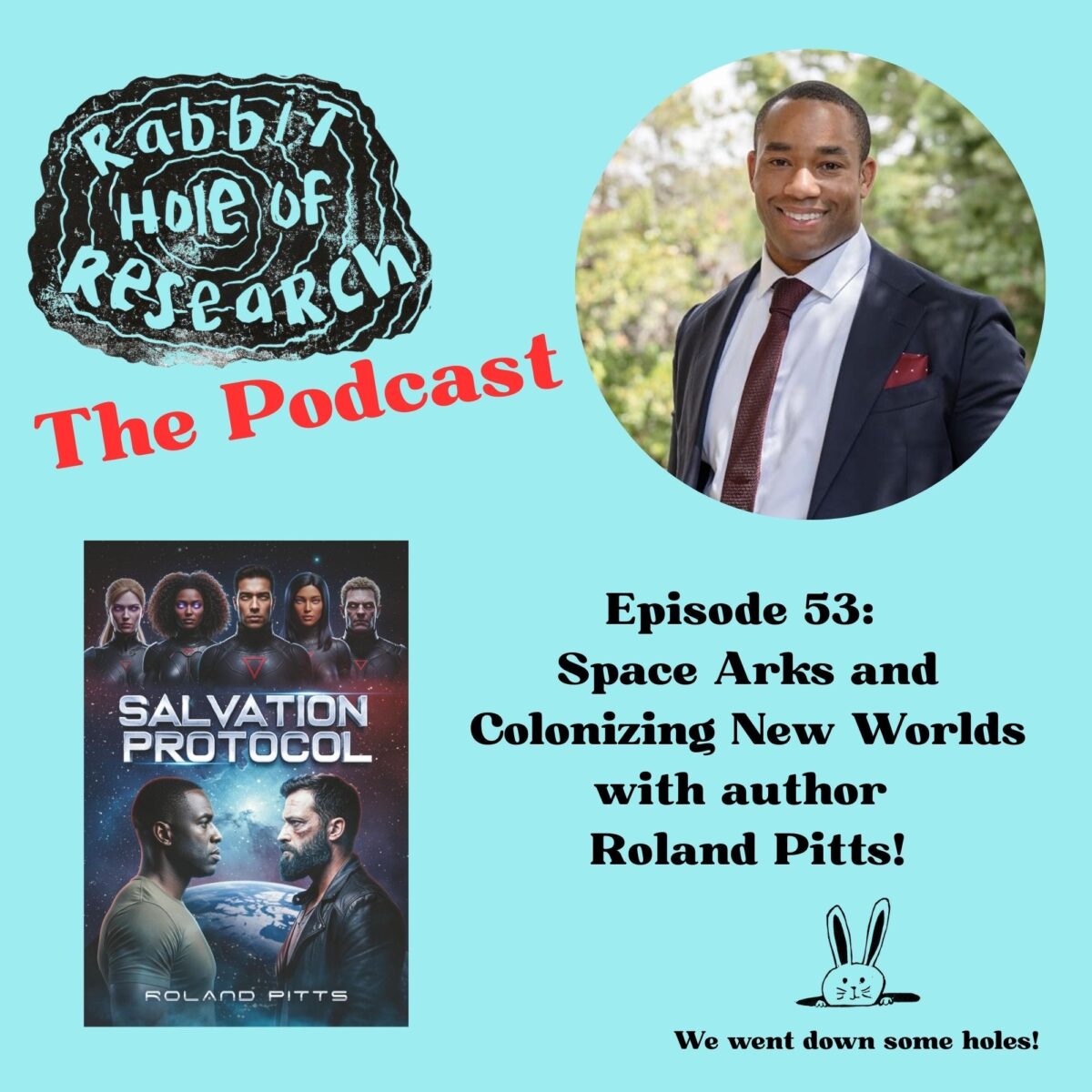
Roland: Hey, thanks for having me. So. Roland Pitts author of Salvation Protocol and, just quick background. A former army officer and
now I’m working in cybersecurity.
Geo: Oh, wow.
joe: Very cool. Yeah.
Nick: man, this season is really military heavy, isn’t it?
joe: yeah. Yeah, that’s very,
Geo: that’s awesome.
joe: It is. No, very good. A lot of expertise and especially on this topic, I think
strategic, long-term planning, planning for everything.
There was, interesting documentary with the, by a life coach. And he was saying
how we spent time with rangers and that whole mentality of plan and plan for every
scenario. And [00:01:00] that way when you go into a scenario, you’re not as surprised
or caught off guard. And it was this life skill for anxiety that if you plan, if you over plan
and when you get in, then you’ll be quick on your feet to pivot to the next
Nick: oh, so that’s just living with anxiety
Geo: was gonna say, so this,
joe: how,
Nick: is
joe: That’s how you,
4Geo: I was gonna say this is like the pros of having anxiety and thinking of every
possible scenario.
Nick: I’m never surprised
joe: Constructively though constructively, not de constructively.
Nick: It could be both constructively, deconstructive, or
Geo: you could just have a copy of your your what is it?
Country wisdom? Yes. Your country wisdom.
joe: country, you gotta have country wisdom. You should have both. You know,
keep that there.
Nick: you should have anxiety and country wisdom. Got it.
joe: anxiety, that you help
Geo: and then you could think of all the ways you might not be able to get to your
country wisdom book. Oh, no.
joe: And for those, I don’t know, country wisdom, it’s a survivalist Bible in some
ways. And so it has all these kind of , just wisdoms about how to build a, how to do an-
imal husband tree or how to start a farm or how to, , till [00:02:00] grounds or things
like animal what?
Husbandry
Nick: Oh I,
Geo: I, you don’t know that term.
Nick: Are you trying to, wed some animals over there. Like,
joe: Yeah. That’s
Nick: as an animal husband.
joe: Yes.
Geo: That’ll be a different es episode. Okay. All
5joe: let’s get on this. I have my, as always, I have a little grounding monologue that
I’ve put together and of course I have lists.
Geo: Please enlighten us.
joe: Yep. So we crossed ice bridges into unknown continents. We built boats be-
fore we understood the ocean. We looked up at the moon and decided it wasn’t be-
yond reach, but every migration before now had one thing in common, somewhere to
return to a space arc is different.
It’s a bottle cast into the vacuum of space with an unknown home. Carrying every-
thing we are and hope for what we might become. It’s a womb hurling through the
dark, gestating either our salvation or our extinction. The engineering alone is stag-
gering. Cryosleep chambers closed, ecosystems running for [00:03:00] generations,
propulsion into the unknown.
Genetic diversity by design and threats we can’t yet imagine. But the real chal-
lenge isn’t biology or physics. It could just be us. Can humanity survive the journey
through the stars to a new home, or do we become something else entirely by the
time we arrive?
Geo: So
joe: that’s,
Nick: Wow.
Geo: Nice.
Roland: good.
joe: well, thank you.
Nick: Do you have a list as well? I do. Or is Roland gonna take the list
joe: I have, I’m gonna introduce the list. I’m gonna give a list, and then I’m gonna
have Roland who
Geo: There’s lots of lists
6joe: his book Salvation Protocol and we can talk a little bit about that. Essentially
it’s Earth is been told by aliens.
Roland, you want to give the synopsis of your own book?
Geo: I don’t wanna man playing your book
joe: here, like I don’t wanna host splain in your book. So you’re right here.
Nick: Yeah.
Roland: yeah. No, no problem. So keep it short. It’s a sci-fi thriller and it’s when
these five guy like aliens, they come to earth and they tell us that there’s hostile
[00:04:00] forces coming. So they secretly choose one human being or protagonist,
Eli Evans, to select 1000 people and 1000 items to go and restart civilization on a new
world.
And so the novel explores really like morality, survival and the cost of, you know,
being chosen. And at the same time, the world leaders, the government leaders, are
trying to figure out who this person is, this guy who’s going around selecting folks be-
cause identity is hidden. And so he has one year to do this before the arc departs and
they arrive on a new planet Marx.
Geo: Wow.
joe: Very good. Yeah. So, and Roland and I, we met at Dragoncon. So it was at
Dragoncon last
Geo: summer, which tell us what Dragon Con is.
joe: Dragoncon is? Dragoncon is a large sci-fi fantasy convention in the heart of
Atlanta downtown.
It’s five days [00:05:00] of just nonstop
Geo: party
joe: excitement, nerdo, all the above. And Roland, he came up I was, did a panel
and then Roland introduced himself in his book. And then he had listened to the pod-
7cast, I presumed, and he said, oh, I think you’d really be interested in the lists in the
back of the book.
And so I’m like, yeah, I love lists.
Geo: You spoke, that’s like Joe’s love language.
And
joe: And when I got back we were like, how was the trip? Georgia and Nick,
they’re like, oh, how was it? We gotta talk about on the episode or something. I’m like,
yeah, and then I met this guy and he has this list in the back of the book.
He got, look, here’s the list. And so I’m like, , got the lists all thumbnailed and but
yeah. So, and the list was all about what you would need, the cargo manifesto of the
item selected to actually, make this journey and restart humanity. And I came up with
10, looking at your list, thinking of some things, 10 things that you could summarize
this list and the things that are in there.
So I, I’ll give this list of 10 things, or you can add, subtract. Tell me I’m wrong about
my list or what, , something I missed.
Nick: You can actually boo as
joe: You can boom. Me?
Nick: [00:06:00] fun.
joe: So I just had, , foundational biological assets. So,
genetic diversity plan, human microbial, plant animal seed banks, that type of
thing.
Pathogen detection ecosystems and life support architecture. Closed loop sys-
tems, water, air waste, backup life support , AI control, environment regulation, soil
substrates, propulsion, navigating vessel integrity. You got a long duration solution.,
autonomous course correction, haul materials for microm, meteoroid and radiation
shielding. I’ve got the colony infrastructure blueprint. Now, what the habitat module’s
8gonna look like. Manufacturing 3D printers, feedstock emergency grid for the colony,
terraforming or geoengineering kits and things like that to make the new world. Hu-
man friendly. Governance culture, social stability.
Charter, a constitutional framework, conflict mediation, justice law education sys-
tems for multi-generational crews. Recreation, knowledge, data systems, redundant
knowledge [00:07:00] archives, adaptive AI for maintenance communication systems
with Earth or other space arcs that are there. I’ve got medical genetic safeguards.
, you gotta have a full spectrum medical facility. Genetic health monitoring, cryos
stasis capabilities, pandemic containment. Security risk radiation protection, fire hall
breach plans, mutiny insurrection prevention supply redundancy, scientific explo-
ration, toolkits once you get there to understand your environment.
Geological, atmospheric, biological toolkits, robot scouts, environmental model-
ing. And then I got ethics, the rights of future generations. Cultural drift management,
what counts as success and protocols for encountering alien life. So those are my, if I
was tasked, I got called up
Geo: pretty extensive.
Nick: I feel like you just need the Hitchhiker’s Guide to the Galaxy and you’ll be
good.
joe: just a towel and don’t worry, right?
Geo: Well, yeah. And
Nick: yeah, you is the towel in there? Like, did you I
joe: don’t,
Nick: I think
Geo: I think [00:08:00] my list would just be, okay. What books and what movies,
you know, and a DVD player. I see
Nick: wifi up there? Is it good?
9Geo: But I also, I’m a little concerned you’re taking AI with you.
I wanna get away from AI
joe: ai. Yeah. I think, I mean, for all the issues with AI and that people have, espe-
cially on the creative side, but I think as a tool it would, you could use AI in a lot of
ways ’cause probably people would be sleep.
So that cryos stasis for some length of the journey. And there has to be some enti-
ty, MU/TH/UR, Axiom, , if we think of movies alien as
Nick: I don’t know if I trust MU/TH/UR
Geo: Yeah. Right. So, So Roland, how did you feel about this list? Is that pretty sim-
ilar to your list or,
Roland: Yeah. So the list is pretty good. And would say that when I was thinking of
the planet, probably the first thing is, okay, is this place gonna be sustainable human
life? And what we find out very early on. That this planet, it truly [00:09:00] is. In fact
the gravity is lighter. The oxygen intake inside the planet is a little bit higher.
So, and the water there is all potable. So the, when we get there, we don’t have to
worry about the base necessities of living. In fact, there’s even ecosystem where the
dominant predators for the game only stay, I’d say the top of the food chain for no
more than two decades. So this information is provided to the humans.
And so at this point, it’s okay, we can live there. How, what do we take to start? So
it’s going back. and I really tried to figure out how can we take the comforts of our life
but not be so technologically advanced. So if we have a power grid, we don’t have
electricity. All right, , do we need electricity?
To survive maybe not. So I would say it was really good. So first thing I did was
how do we survive year one? And a lot of research into [00:10:00] this. And without
going too deep into it, what I researched was how long with humans living, up until a
10hundred years ago in 200 and 300. And what I found was it’s really those microbacte-
ria that was killing us as a civilization.
So like the invention, penicillin things like that, sanitation. So if we were able to
solve those problems, okay, now we’re living, that’s fine. All right. What about sustain-
ing? So I think you mentioned like the seed vault, that it was great. It’s right on par with
what I had. And then just very basic things.
We need carpenters, we need brick and mortars. We need some type of
Nick: individual’s seed isn’t an account as an item that you’re bringing? Correct.
Roland: Yeah it’s not so
Nick: I’d be like, oh man, pound
joe: of wheat or a pound of wheat seeds.
Nick: That’s not, there’s two, I thought you were like a pound of wheat that’s all
good. Right. Then I
joe: But I was
Geo: Yeah. So, so there’s the things that you take and [00:11:00] then this person
is tasked with figuring out the minds, the people that you take, right?
joe: Well, I mean I think that’s, go ahead. Yeah, I was gonna say, that’s where I
think the AI and knowledge holding.
I don’t know how many of each I expert class you’re bringing with I think a thou-
sand people you said. So you’re gonna be tight. So if you lose the domain knowledge
expert, you will need something I
Geo: can, yeah. But then you can’t trust the AI. They’re gonna just make up shit.
joe: Hopefully you’ve, you can. , potentially you can cross reference things with, ,
other knowledge base, but on a fly trying to do an appendectomy. I talk about this in
the context of the stand Stephen King’s , novel about an apocalyptic event, which
wipes out 98% of humanity.
11So everything is here to use, but domain knowledge has now become the com-
modity. And so in that story, there was no AI, there was no informational gathering.
There wasn’t even Google. This was set in the late eighties. So you have this situation
[00:12:00] where you’re thrown back and now you have people, there’s all the tech-
nology there every, all the infrastructure, but very few who know how to use the pieces
of that infrastructure.
And so something like having an advanced computer system, maybe not as far as
ai a generative AI system, but one that can curate through information and give you.
resources and texts that would, I think really you would need that at some level. I
would advocate, you would, you should have that, , on there to go with you.
So I don’t know if you’ve, if you thought about that or is that
Roland: Yeah I think you both are spot on. So each of the humans selected, they
have this AI inside them. It’s called a bipa and essentially a stink and talk to them. And
so there is some sort of artificial intelligence that regulates their body, might tell ’em a
little bit about the environment, but we will need people with those hard skills.
And you know, to your point I something as simple as a cavity. If you have a cavity
and you just not get [00:13:00] treated. That used to kill us hundreds of years ago. But
part the people that we take is we have to have a dentist, someone with those fine
motor skills that knows what they’re looking at, how to remove it.
And when you break up a thousand people medical was about a quarter of all
those folks. Because you need someone like that. And then not only do you need it for
that time, how do we maintain that, that skillset? So there has to be some training pro-
gram in there, whether it’s written down or a practice dummy or something like that.
And so I think you’re both accurate in those assessments.
joe: Yeah. And some of the new training I was at my alma mater, Penn State
Behrend and they had a, their nursing program. They had the virtual medical tables
12for training, you input in different scenarios of the body and then you can go through
and pull it apart, the musculature, the skeletal, re you can have different scenarios, dif-
ferent , medical [00:14:00] conditions.
And so you get that training there in once again using your technology.
Geo: I still wanna play, I still wanna play the devil’s advocate against this high tech
thing because the movie that keeps coming to mind is Wall-E
joe: yes. Mm-hmm.
Geo: And think about it in Wally, they kind of let the technology and the computer
take over and then they just became these fat slobs that couldn’t even walk anymore.
’cause then they just,
Nick: but they were
joe: They were alive.
Geo: They were alive.
Nick: kill them,
Geo: but like what sliver of humanity was left? They didn’t even use their own
brains hardly.
You know, I don’t know. I just feel like I might be reliant just too much on
joe: I mean, you always have, I mean, I brought up Mu/TH/UR and Alien, right?
It’s mission was to get a weapon, right? It, that was, its, that was, its overly, it was
like keep the humans. Okay, but at this other level, the prime directives are what’s set,
and that seems [00:15:00] like the aliens who have come, they’re setting the prime di-
rective at some level.
And then they’ve entrusted us with someone to lead this mission to actually curate
all of these things. And the AI
Geo: and they picked a human to figure it out.
joe: Right? So, but ai, I mean, you’re gonna need yeah.
13Geo: Yeah.
Roland: it’s the AI in, in this novel is semiotic with the human. So it’s not its own
entity. It has to, if the human dies and it dies, so it’s, it, you know, they’re, they want to
live. And so it’s what the human and yeah, they choose a human to kind of do this and
lead this. More so because of that reason, you know?
Nick: I do feel like there’s rather hard sell on getting someone to join the. Ship the
arc because you know, like people have families and stuff and being like, yeah, you
can come, but you, your family they gotta stay, man I got a thousand people and
you’re one. Like, is that something that you end [00:16:00] up having to deal with the
whole picking and choosing?
Roland: Yes. So that was something I, I definitely wrote about. And for some peo-
ple it was a choice of, well, this alien race is coming and you guys are gonna face im-
mediate death or enslavement by this species. So what our main character does, and I
drew this a lot from my military experience, was our main character, didn’t know every-
thing.
He doesn’t know.
joe: Mm-hmm. Doesn’t know
Roland: stem, doesn’t know philosophy. So he finds people who are the experts
and because they’re the experts, that Expert has their crew of people who they know
would say yes. So what Eli does is kind of push out of his hands and gives it to those
individual experts, and he leans on them to try to find those who one will be willing to
do this, and then two, you know, are okay with bringing their family or not family.
So, it’s, it could be a hard sell, but there are [00:17:00] some people out there like
our one guy named Hero, a medical person who it’s, so, his ambition is so high to, to
try and just be that person that he is willing to leave his family. And it’s a hard ask, but I
guess the name is Science for Him.
14joe: Yeah. And I mean, is that if you have those people who are just , let’s do it,
let’s go, , and ignoring your family, are they even, are they mentally correct for the mis-
sion or how was that balance, right?
Because you got people, , like you were saying, his Hero character sounds like one
that’s just , I’m gonna go and I’m abandon everything else. But now when will I cross
the line later? , who will they abandon, to get some other thing on this planet? Maybe
there’s some cool thing they want to go explore, but maybe they shouldn’t.
You know what I mean? The temperament of the individual. It seems like it might
be at conflict between I’m ready to risk everything versus, , I let me chew on it for,
however long, , till the day before I got a board. Right. I think that’s,
Roland: yeah, it’s I added another layer of complexity to [00:18:00] it, and the ad-
ditional layer I said was okay.
Geo: okay,
Roland: If you find somebody who wants to go and you ask them and they say,
no, well, well, because that person may go off and tell their friend, Hey, Roland just
asked me. Come ark. It puts the entire mission at Jeopardy.
And so the directive then is if you say no, then you have to be killed because we
can’t risk it. And the way they’re killed is that,
Geo: That really makes a difference.
Roland: Yeah.
joe: Wow. So yeah,
Roland: very strategic of who you ask.
joe: now it feels like you would have some reluctant yeses
Nick: and more like Yeah, the morale is just shot for a lack of better words. It’s just,
yeah,
15Roland: it is. And I think about the astronauts, right? So when an astronaut goes to
space, they know that they’re leaving and the chance that they won’t come back. And
[00:19:00] it’s. The final frontier is this exploration and that ambition might overweigh
some of the familiars highs they have. That’s just some way I thought about it,
joe: But , the astronauts, even though there’s a probability that’s higher of for
them to meet a catastrophic end, there’s also a high probability that they’ll come back
and see their loved ones and their family.
Going off on an arc mission is different. It’s like the, if , you think about colonizing
Mars, the people that go there first, they’re probably gonna leave behind a lot of their
family, and they might not return. It might be a one-way ticket. They go there, you’re
gonna have to set everything up.
You’re gonna be there for a decade.
Nick: don’t think it’s a might. I don’t, I think it’s a You’re not coming back. You’re
there.
joe: Yeah. Well, at some point they might. , be able to do a return flight. Right. So
that’s what I’m saying, but I’m saying maybe a decade, you know, maybe two. So you’ll
be older.
You go there when you’re 20. Maybe you can come back to earth when you’re 40,
but now your physiology is so Yeah.
Nick: And peoples are dead.
joe: I agree. Nick [00:20:00] is
Geo: probably,
joe: right, that it’s a one-way ticket. You
Nick: go and,
joe: and, but those people that go, I mean, it’s a
16Geo: And then you have to think about someone that’s really driven, like maybe
science or whatever they’re really driven by. They might totally ignore their family for
10 years. So,
joe: you know,
Geo: it’s, you know what I mean? It could be a very similar to just leaving, you
know, I
Nick: I didn’t like them anyways.
I’m just gonna dip out now. Thank you. You
joe: I the other thing I had thought about and because I am a biologist is the num-
ber. Of people, it would really, that you had a chance to make this all work.
And a thousand I feel is like right on the line like that. Is that a, that was a choice, I
take it? Or did you Right, because that’s right. And you gotta, think you gotta do a
bunch of stuff too. Like you gotta a, everyone has to make it. But then I think just the
genetic, the, you know, kind of doing some genetic tooling with crispr, things like that
to actually make sure that the genetic population doesn’t begin to inbreed.
So part of the problem, the [00:21:00] population starts to inbreed generationally.
You then have alleles that can amplify recessive traits, which will lead to, , bad out-
comes. We can think of the royal family in England and hemophilia. And so because
there was a high level of inbreeding, they became very suscept susceptible to having,
hemophilia and bleeding out.
And so that, that was, that’s , a very. Famous case, but here when you have a small
population, the same thing. So was there genetic screening pre or post,
Roland: That was actually, this was probably the hardest part of the book was talk-
ing to experts. So I have friends here biologist as well, and I asked them, I was like,
Hey, look, if this was gonna happen, what is the minimum number of people? And she
was like, it has to be at least a thousand different people with different backgrounds
17because if not, you know, one, don’t know, the flu, whatever it is, might wipe out the
entire population.
So they go there. And what happens in the [00:22:00] cryo pods is a little bit of a, I
know your favorite word, hand wave, dium, some some hand wave. The happens to
where any type of negative recessive traits, whatever they have, any type of defects
that human has. In the cryo, it gets taken out.
So now they arrive on the planet full of health, you know, very healthy.
Nick: Does it matter their age? So like, say Joe is 70 years old right now, are we
gonna take him or are we gonna take the next best person?
joe: Yeah.
Roland: so that, that goes back to the conduit. And I would say that person who
chooses his followers
Geo: Yeah.
Nick: But then you still kill him, right? Like it
joe: well
Geo: but you also want somebody that has experience and knowledge, and that’s
probably somebody that may be older,
joe: but you also
Nick: then like once they get there, like having them procreate, right? That’s one
less person that can do it Well and if he can,
joe: Nick, I was gonna say, you probably have, you could have it where it’s a dou-
ble strike if it’s a 70-year-old [00:23:00] woman, because a 70-year-old woman defi-
nitely cannot procreate.
A 70-year-old man can actually still procreate. And we got a bunch of famous ac-
tors who have
Geo: but should he, but should they,
18joe: you know, they have kids. So you’re, you actually now have a different situa-
tion because women who are over. You know, have gone through menopause. They
are now become a liability at some level.
Right. Even though they’re very experienced not to, you know, to throw
Geo: geez
Nick: Georgia
joe: generating.
Geo: no
joe: I we’re gonna
Nick: she’s about to throw something at you, Joe.
joe: that’s a good thing. We don’t have a video now. This is, no, I’m just saying that
it becomes a double, almost a double strike there because I’m sure that the expertise
and especially diversity you need could lie in, in these women who have that experi-
ence and that domain knowledge and part of some team.
I’m picking my team of people. I’m, now at a point in my career where everyone
else in my window are about my age and I trust and would take on a mission like this
so that is something and that you could become problematic.
Roland: It’s definitely a challenge, right? To try to figure out [00:24:00] who and
what to take. And I think that’s what makes it interesting is how these conduits choose
their followers and they all have their different ways of doing it. But the age thing is
definitely consideration. And so I focused on, okay, how do we survive that first year?
If we can’t make it past year one, then we’re done here. So. I think Eli, when he was
talking to his conduit was just like, year one. Get past that. We can figure out the rest
of it. You know, and to George’s point, like, you gotta have some experience. We need
someone who can look at someone and say, Hey, I think this flower that we’re step-
ping on is causing problems because of my year, decades of experience.
19It can’t be much of 20 year olds. Which why the main character is 35. So, you
know, he’s, everyone is older, at
Nick: closer to my age?
Roland: Yeah. They’re old enough to handle the responsibility and mature
enough to know that this is probably the right or wrong [00:25:00] decision to make.
Nick: And you need someone to go ahead and lick the plant to make sure that it’s
not
joe: do not lick the plants, do
Nick: not.
joe: Well, I think another hand wavy on mean, especially where we’re at now,
would be to take embryos and, , just have this kind of model then. So maybe that’s the
way, so I’m trying to fix the problem that maybe we’ve created is to take out age a little
bit and you can have embryos there, or, I mean, even more hand avium is artificial
wombs where now you have , gestation pods
Geo: So you are separating, you’re separating the people you need to create this
society or whatever, away from the procreation.
joe: Yep. Exactly.
Geo: Yeah
joe: yep. And diversity. Right? Because now you can have a much more diverse
class of embryo class. Right. So this is the next question of one seed doesn’t count.
How many embryos can we take?
Can we pack up in there? And
Geo: and how many big mats.
joe: how many big Macs
Nick: see you? Actually, you have to have a chef on board too.
joe: You gotta get
20Nick: because if you don’t have a, like I, I know a lot of people [00:26:00] will
downgrade the chefs, but you know, chefs, you need to take a chef or else Yeah.
You’re gonna be eating nothing. Good. So
joe: that, you said medical was 250, you said a quarter.
So that was like 250 folks are in the medical side. And then you, does that include
scientists, gen, you know, geneticists, like, is that in the medical or is now we fill out
and then where does,
Geo: so you are just asking about scientists, basically.
I
joe: am. Yeah. How many scientists are you taking on your arc?
’cause I need to know where I’m at, like, you know. No, and I mean, but I mean, I
was going, I was kind of moving through your numbers there because I want to touch
on the cultural stuff. How many artists, how many librarians, how many, right? So is that
a quarter also, or are you like, did you really, you got
Nick: those, got downgraded. We got
Geo: we only need a couple poets. Come on.
joe: So like, how many chefs
Nick: you better be a multitasker?
joe: yeah. Yeah. So I it’s a. Because , you’re gonna, like most of us, we will top
heavy and the sciences the hard sciences. But you know what happens with the kind
of cultural historians who teaches [00:27:00] history, and things like that and the diver-
sity of history.
Roland: Yeah. So, you know, I think we’re talking about the quote unquote soft sci-
ences. If we say our artists, right? Which I took 50 and I said between these 50, I think
that should be enough. And then another 50 was our philosophers and lawmakers. So
21social sciences, and I only kept with that number because the largest part of folks we
need is gonna be what I call practical knowledge.
So these are our construction workers, our plumbers, our builders low overall blue
collar. It includes,
Geo: Right, right.
Roland: yeah, farmers, hunters. So, so these people are outdoorsmen, so to
speak. So they can take, you know, fish and they know how to hunt and that’s what’s
gonna feed us really. And then the second largest was our science.
It was the medical, but then I also put STEM in there because the very broad engi-
neers,
joe: Yeah.
Geo: right. Yeah, [00:28:00] definitely. Mm-hmm. Well.
Roland: to be able to, yeah. So those were the two biggest ones, was the practical
knowledge.
joe: it was interesting because I think I think of world, world War ZI was think of
Geo: the exact same thing. Like
joe: after that you need it.
Geo: The people that mattered were the people that had these
joe: That had the practical skills
Geo: and the trades and the celebrities were just like, oh we don’t need you any-
more. You know,
joe: You got downgraded. Right. Because I can imagine probably not many a-list
stars will be on the arc.
You know, that’re probably. Right, right,
Nick: Whoa. Isn’t Gordon Ramsey an a-list star? Like
Geo: yeah, but he’s a chef.
22Nick: chef.
Yeah,
joe: he’s a chef. Right,
Nick: Right.
Geo: you’re an Alist star because of something like that, I
joe: think you would get the chef, like the, what’s the lady who works at the barn?
She’s like a works on a farm.
Nick: Are you talking about a butcher? Yeah.
joe: No. She has a cooking show and she works
Geo: Oh, the Pioneer woman.
joe: woman. Right. So you grab the pioneer woman. Now you gotta, you got
someone with the dual skillset, right? So,
Geo: yeah, I don’t know.
Nick: dual wielding those skills,
joe: [00:29:00] cook, they can put you in a the hogs, you know, and move along.
Nick: I mean, most chefs I think if you’re high rank enough, you know how to do
that.
Like, pretty sure if you get Gordon to go do it, you know, I like
Geo: I like
Nick: We’ll ask him next time he is on the show. You know,
joe: old is Gordon Ramsey? He might not make the age threshold.
Nick: he’s like,
Geo: we’re
Nick: not, but
Geo: not, but we’re not worried about that. Remember? And you, I mean,
23joe: one, one interesting thing, if we’re gonna just whole handwavium on the
whole thing, I mean, in the cryo pod, then you could have where you do telomere re-
generation, things like that.
So someone who are, you know, older. That’s why I brought the male female thing.
’cause a older man, maybe you can genetically. Force ’em back
Geo: But don’t they say that they used to say that a lot of the genetic disorders
and things from having children older, they always put that blame on women, but then
they figured out that a lot of it comes from the men.
joe: both. Right? Because I think it was women, because, one of the things that’s
interesting and fascinating is that when a woman is born, they technically have all of
their [00:30:00] eggs there. And so as their life goes on, any stressors, effects their
eggs created at birth, whereas men, it regenerates. Every cycle you get a new batch of
sperm made from a group of stem cells that do that. And so that was the thought was
that, well, it must be women because they have these eggs for so long and men, they
get a new
Geo: Well, women always get blamed.
Yeah.
joe: But the thing they find out is that men as they age, their genetic, you know,
kind of have genetic issues also and your age, the same thing can affect the cells that
make the sperm. And so if you introduce a genetic defect there and then now you
have this kind of propagated and so you can start getting these other kind of deficien-
cies and defects as men age and,
Nick: they get all skunked out and everything and
joe: Yeah, you know, the bits are, the bits get old, you know, so, no, that’s, yeah.
Reproductive biology is not my area, but it is fascinating.
24Geo: It is. So Rollin, how did you come up with this idea or this [00:31:00] inspira-
tion for your book?
joe: Yeah
Roland: so I had like a similar idea, I would say for many years. And it was, it start-
ed off with if one of there is there life out there, and if life came and it told us that, you
know, how will we react to it? And it wasn’t so, so much more so like, oh, this is really
cool, it’s no what, how would we actually react to this?
How would it, how would the world really see it? And from there it just kind of
starts spiraling. And I said, okay, well if we had to leave. The planet. So back in my mili-
tary days, if we had to go out to the field for 30 days you would think about the stuff
you would take ’cause you’re not coming back.
And so it just morphed from that to just a larger scale. And I said, okay, well what’s
a bare minimum my need? Or if I had to stay out here forever, how would I actually do
it? And it just kind of started to unravel more and more. So that’s [00:32:00] really how
the idea came out. And I talked to my brother about it and I wrote my first sentence
and then I just kept writing,
joe: Mm-hmm.
Geo: Nice.
Nick: it all.
joe: say it, it re reminded me a little bit of when Worlds collide. So the 1951 classic
movie. And so there’s , earth is going to be destroyed. And so there’s, , as aliens, they
figure out these scientists, they select folks to go onto an arc and intercellular arc and
do that.
So, very interesting. And it in this whole look, , the one thing. What was interesting
is that the earliest quote unquote arc stories were flood myths and flood base, , in the
Mesopotamian flood myths, the 18th, 17th century, b, CE, some of the earliest stories
25talking about, and I thought it was interesting because at that point in time the explo-
ration of the world, , the known world was very small compared to, , the whole earth.
Now we have, [00:33:00] and so setting voyage on in a flood or in the ocean. With
everything you have is probably the same equivalency to us now, boarding a intercel-
lular star ship and trying to go somewhere else , into that unknown
Nick: scurvy and stuff, right? Like something can, yes, you could come up
joe: That’s right. Right.
Nick: Can you get scurvy on this ship?
Or is that the pod that takes care of that?
Roland: I think the politics here. That one for you?
Nick: Damn, I was really looking forward to getting
joe: it’s scurvy is a,
Geo: you just take lots of oranges.
joe: C. Yeah. Vitamin C deficiency is scurvy. So as it rickets is vitamin D, so cave
miners, we get rickets.
Nick: Scurvy and Ricketts scurvy.
joe: and ricks to get on both.
Geo: Ooh, fun. But yeah
joe: the, these flood. The flood and of course Noah’s ark , probably the most fa-
mous of the flood kind of narratives, but, , that’s where we started. And you get that
same idea. What do you load on there? What do you take, what do you save?
What part of humanity do you save
Geo: I think it’s just a really good thought process to go over that for yourself. You
know what I mean? Like
joe: Right.
Geo: whole deserted, the whole [00:34:00] like deserted island question.
26Like if you’re on a deserted island, what 10 things would, you know? I just think it’s
a good way to think about what we, what
joe: song would you want that you’ll play over and over?
No,
Nick: This is a song that never, and
Geo: Get one
joe: you know, to take with you.
Nick: I feel like the, there’s so much like mind juggling for choosing people that I,
it’s so hard to wrap my head around being like, oh, yeah, it, for me, choosing people,
it’d be a lot more difficult, but like having to look through it as.
An actual, like, we’re restarting humanity here. We have to do this. It’s like, yeah. I,
it’s just the mind loops jumping through there absolutely baffles me, man. I love it.
Geo: Yeah.
Roland: Yeah, he and what makes it interesting too is that, you know, our main
characters. It’s just this guy. So he gets some guidance from the [00:35:00] sentinels of
who he should try to recruit, you know, like this world class this world class artist. But
how does he get there? How does he
Geo: Mm-hmm.
Roland: how does, you know, these are things he has to try to figure out.
And so he’ll, you know, try to figure out some surveillance, seeing like what they
like, try to get them one-on-one and just kind of watching. So from day one, when he
is told this happens over the course of a year, and as this time comes closer where the
world knows that these people are being selected, you start to see that some people
volunteer and he’s trying to make contact with these people, but keep his identity hid-
den.
27And that puts in another layer of essentially like espionage you wanna say as well
as, you know, how do I. Get to their why as to why they wanna do this. And then avoid-
ing assassins. So it’s as much of a, you know, [00:36:00] just desert island, 10 items as
well as an experiment as to understanding the human psyche and just dealing with
just that immense stress that you’re potentially condemning all these other people
who don’t go to death but it’s for the greater good.
And so he goes through a lot of emotional turmoil. So was it was fun
Nick: Is there anything that they do to avoid having a class system on the arc or
once they get there
Roland: Yeah. So that was part of the reason why we chose the philosophers and
the social science and I named them as like our, social science. And so those 50 peo-
ple that’s what they’re due to, to try and maintain that ethical morality that we’ve es-
tablished. You know, if we go out to a new planet, how do we not create, you know,
this a class system?
I’ll be very challenging for a former neurosurgeon to look at, [00:37:00] I dunno, a
painter or a construction worker and not feel like he’s better, you know, than he is or
whatever. So that’s more of like the
joe: Second
Geo: second
Roland: novel. I don’t really go into that too much, this one. So.
joe: No, it’s interesting. I mean, I think right the class is not only who’s better, be-
cause I think once you get into the arc and you’re harling through space and you
come to this new planet, you might reset your importance, right? ’cause the neural,
you know,
Geo: like we were talking about, people that have these practical skills then be-
come more revered, you know?
28joe: But I was gonna say like even you have these 50 philosophers there, right?
We all hold our own philosophical beliefs. And , is there some rule that you must, ,
seed to. X and y you know, people because they were selected to do this type of
thing, or is it No, I think, right.
Geo: Well, I think you all have free will and like, right, you know, you all have your
own thoughts
joe: you fracturing your thousand, which then means that now you’re [00:38:00]
even
Geo: I think no matter
joe: right. You,
Geo: I don’t think, I think no matter how. Much you try to make it so there’s not
classes and there’s not that, I think it’s just human nature.
It’ll, people will,
joe: well, I mean,
Geo: will make classes and Well,
joe: it’s you don’t really have a scarcity economy. Well, yes or no, but when you go
to this new planet, you’re not really bound. Like your resources are shared. And it
sounds like the planet’s been set up, which is a very smart, you get away from ter-
raforming and things like that, but the planet’s already set up to accommodate human
life.
So you have this pristine environment. I imagine that the waters will be. Seated
with fish or things like that so that you would have this, so scarcity. So initially year one,
you won’t have a scarcity based kind of economic system. So classes really wouldn’t
interfere with that. I think it would be year 10 20, that now you’re rolling, that now you
know the grease to wheels, the friction of [00:39:00] society.
29You need to have some exchange of trade, exchange of materials or ideas. And
that might be where you start to get more of this might get more of these issues then
that you would need this kind of philosophical or historical basis. Like here’s what’s
happened, here’s what happened on earth when we tried this.
Right. Because I think it would be a lot of that, like, here’s what happened, almost.
It would fall into myth and lore. Like here’s what happened in mid 19th century and it
didn’t work out so well, so we shouldn’t try it. You know?
Roland: Yeah. Something else that I considered is, you know, maintaining law and
order. So when you have these people on that planet I’m assuming everyone’s gonna
be a good human being, but if they’re not, if someone does something wrong, well,
each one of those thousand people were hand selected. So we can’t just kick ’em out
of society because there’s only so many of us in every job, every life is very important.
So, so how do we handle that? Right? And that’s like book two stuff. But I would
say that I [00:40:00] reviewed like Scarlet Letter
Geo: mm-hmm.
Roland: I thought it was very interesting how society dealt with someone who did
something wrong. They didn’t kick her out, right? But there is a way to impose some
type of justice system and we’ll kind of figure that out when that book comes out.
But what you guys are talking about, it’s exactly the point when the resources
aren’t scarce, how do we fall back toward our normal raise? And that normal way
could be simply. Hey, I am a fisherman and I’m working every single day, and you’re a
dentist and you just sit in the shade, but yet you eat just like I eat.
You’re not doing anything. So those conflicts could arise.
joe: but I think that the dentist would be working, doing something in the field,
right? And then it’ll be like, oh, hey, you need to stop raising the barn and go over
30and, , do an extraction. I, so I think there would be some, I. Especially those early years,
I think everyone, it’d be all hands on deck.[00:41:00]
I just don’t see anyone chilling or the conflict will, year one will derail real fast. If
people did go, they reverted back to you. And you know what, Hey, I don’t do that
kind of thing. And,
Nick: oh, see, my hands are what I used to work with things.
That’s right. If I injure these ow how am I supposed to take that tooth outta your
face? That’s, it Might be a different tooth. Sorry.
joe: This gets to George’s point, maybe her issue there is that while you’re in
these cryo chambers, will there be any.
Personality modifications or things like that could happen. So the AI directive is,
well, we realize Nick’s a loose cannon. We love him, we love his knowledge, we need
him, but eh, he’s got some tendencies. Can we start to edit out? Right? I mean, if we’re
just playing this out kind of GATTACA style that we’re going to now to modify humans,
you know, or brave New World, that was the idea there.
They’re gonna recreate, just on earth with using genetics and classing. So is that a
thought or they’re safeguards or?
Geo: well, you need to read the book, Joe.
Roland: There’s a little safeguards in there.
Geo: I’m just teasing.[00:42:00]
joe: Louise.
Geo: I don’t want, I don’t want any
joe: spoil it, but Yeah, no, we can at a high level.
Like, you know what, you know, is that,
Geo: I’m just teasing.
31Roland: So, as I, each of the followers, or I guess each of the selected persons,
they get a bipa, right? There’s that little AI thing that connects our nervous system and
the moment they ingest it, so it’s like a little rice, they eat it that AI scans that person
and it does an assessment of them. And if that BPA realizes that this person would be,
you know, conducive to the environ, or I guess would be a bad pick to the environ-
ment, maybe has some character issues or anything like that, then this set to just kill
that human immediately.
Or if they believe that they’re going to tell that they have this machine inside them
or tell others. So that bpa it does its assessment and although it’s symbiotic, its prime
directive is. Get humans to the [00:43:00] planet and make sure the humans survive.
So there’s that kind of fail safe there of us selecting the wrong person.
joe: Interesting.
Geo: It’s really more black and white
joe: report style here. So,
Wow. Okay.
Nick: So you are planning on a second book already? Yeah. Is that what I’ve gath-
ered? Okay.
joe: Yes.
Roland: So
Nick: I
Roland: one is that’s, that one’s a little bit, a little more challenging, so no spoilers
away, but we, it will really dive into people and how we form little groups and yeah,
things like that how cults get formed and how Eli manages all that. So very work in
progress,
Nick: almost
joe: like the the game shows.
32Squid games game show or Mr. Beast had his show where you have a hundred
people, a pot of money, and then they have to form a little, , teams and they’re coop-
erate.
Nick: It’s high school. You’re getting your, yeah.
Geo: Yeah. It might even be kindergarten.
joe: Yeah. I mean, the stakes here is a little higher.
It’s like, you know, there as a pile of [00:44:00] cash, but here it’s like you
Nick: high school. You have to make it through it, you know? It’s a whole thing.
Geo: There’s a lot of navigating.
Nick: So one, one other question I had is, are there any other intelligent life forms
on the new planet?
Mm-hmm.
joe: Mm-hmm.
Nick: And
Roland: I don’t wanna answer that.
Nick: okay. Okay. Okay. So since this without answering, or you can if you don’t
want, if you want to, but do we end up finding out like that the aliens that brought
them to this planet eradicated the original life forms? You can say pass. You don’t have
Yeah,
Geo: we don’t answer.
joe: yeah.
Roland: I would say that when they arrive to the planet that everything is benevo-
lent. And as they’re trying to figure out how to survive, there are these injects that hap-
pen and they deal with those [00:45:00] injects. And so, I hope that helps. This is all
book two stuff.
So
33Nick: so
Roland: yet completely, but It’s
Nick: I’m so sorry. I’m like,
joe: Yeah. Yeah. So is book one in with them? That’s, I mean,
Geo: don’t talk about how it is, come
Nick: we have to finish the,
joe: right? He is writing a second book.
Nick: No they’ve actually died on
Geo: There’s a second one. So.
Roland: Book one ends, they’re on the planet. That’s not really a spoiler, right?
That’s They’re on the
joe: good.
Nick: It’s a
joe: ending there. All right. And George is like, you know, he’s not writing a
hearth, he is not writing a, you know, a hearth piece there. No, I was gonna say, be-
cause that gets in Nick, I think, to colonialism and kind of the idea that as you arrive
someplace, you’re now imparting
Geo: and now you’re trying to kind of take over. Take over.
Nick: manifest destination.
joe: if it’s been sterilized and that adds a different, it takes that out the way, but it
adds a different, you know, some guilt factor when you figure out, not only did you.
Abandon all of your fellow humans to, you now probably have died because of the
journey length, but now to create this planet, it was [00:46:00] also, there’s a lot of
blood on your hands.
And I can imagine, hopefully you have some therapists in your group. So
Roland: Yeah. We have a therapist. There’s a therapist in the
34Geo: very bus, a very busy therapist. They
joe: might be like, you know what, I can’t help them with the field work ’cause I
am,
Nick: And that’s when we throw to our sponsor better help.
Geo: So Joe and I are watching this new show. Pluribus.
joe: Pluribus.
Geo: I think, I don’t know if that’s how you pronounce it. It’s an Apple show.
That show the aliens. They come and take over Earth and they’re all like one big
hive mine. But it’s really interesting because it’s not just one hive mine.
It’s like all the individual memories and people are still intact, but all together it’s
just like fascinating. It’s really like,
Nick: so I haven’t watched it yet.
joe: in per and their mission is to make everyone, like them, bring them into the
collective and make them happy. Like so
Geo: Right. [00:47:00] Well, no, we don’t wanna say too much.
That’s
joe: a, like
Geo: okay. I know, but
joe: and a description.
Nick: This does sound like a Rick and Morty episode is, does that sound right
Geo: Maybe. Maybe that was what inspired it.
joe: It sounds like the Thing without the horror,
Geo: but I think
Nick: which is what like,
Geo: But I think it is interesting to step back and think about these aliens
Before they came to earth and did this takeover.
35Like what was their, what was that thought process and like coming? And I think
it’s really, it is really, it’s well done. It’s interesting. The
joe: The other one like that, and it’s reverse is a Three Body Problem. Have you
read that and you have that where you have, you know, not to spoil it, but here on
Earth it is almost like an alien, terraforming they’re coming to.
And it’s just, it’s done well. But it’s almost a reverse arc. So people are coming to
Earth and that’s been
Nick: done.
joe: Other stories where they wanna terraform, they wanna take over and they
come to Earth.
They’re bringing all their stuff to us, all their baggage here, but we’re still a
[00:48:00] sentient organism. That’s the Nick’s point. Like, who’s on the planet? Who’s,
Nick: there? Oh yeah. And then I don’t know if you have any archeologists on
your mm-hmm. Arc, but like, are they gonna end up finding stuff and then being like,
we aren’t the only ones that have lived here.
Geo: Yeah.
joe: Right, right. Well, that’s where the ai,
Nick: imagine Dwayne the Rock Johnson as that character. There’s other people
here.
joe: Are they archeologists? When you’re on board.
Roland: I don’t think so. I don’t think we have any.
Geo: damn.
Nick: Sorry. Rock.
Roland: sorry, Rock. Yeah. Other roles for you though?
joe: Yeah. No, I was gonna say it. And also like with the cultural bit I thought of
was, one of the other stories I thought of was Matched by
36Geo: Alex. Mm-hmm. And you only could have a hundred. A hundred.
joe: The hundred. Yeah. And so they picked the society limits and you only get ex-
posed to information by Choose. They chose the hundred best poem, songs, paint-
ings from history, and everything else was [00:49:00] destroyed, essentially.
So I, I the question is on your journey, I mean, ’cause a lot of this can be how is that
preserved the human stuff that we’ve generated? ’cause we’ve generated a lot of
things over to millennia. So how is that preserved? Or
Roland: yeah, I, so that took me a little bit to think about as well. And so I decided
to choose, you know, not only our 50 philosophers. That and these can also be reli-
gious leaders as well. But artifacts, so. Some of those artifacts, you know, they tell a
story because you’re right, like 50 years on Axl won’t have the same impact of let’s say,
oh I don’t know Anne Frank’s letter, right?
So, by having a replica of that, we could still tell a story about morality and, you
know, what we were as a society and how we’ve moved past that. And so those
Nick: artifacts
Roland: were kind of preserved in a sense along with the human telling story-
telling of these historians. [00:50:00] And so that’s kind of what I wanted to have in
there to remind us of who we are.
Because if there is something or people that live on our planet it’s probably wrong
for us to just, you know, in enslave them. And I like to think of Brandon Anderson’s
novel Way Kings and like the par shindi and how they just kind of. Slave, those folks.
And I thought about that while I was reading, so it’s a bit of inspiration from his novels.
joe: Yeah. One, I mean, something interesting is what if everyone just had their
minds wiped and to just maintain their domain knowledge and kind of went in clean?
Nick: Oh, you’re thinking servants.
joe: Yeah. Well, I mean,
37Nick: sev Severance. Yeah.
joe: Yeah. So just go through right where you just in there and
Geo: Did you watch that yet?
No
joe: the AI would maintain knowledge of human history and they would then go,
so year ones through whatever, they would not have domain the knowledge
[00:51:00] of earth as what they left behind the people, everything, the mental scar-
ring of that.
And then at some point they would. You know, open the vault. Oh, if the AI wants
’em, right. This is Georgia’s point, more sinister, , maybe things are going so well, let’s
keep everyone, , ignorant to the follies of humans on Earth. But yeah, that’s, I mean,
you could just have just, okay, you show up.
All I do is build, you know, structures. You know, all I do is pull teeth. All I do is
think about, you know, ways we could have a beautiful, you know, you know what I
mean? Like you could have this whole history kinda wiped and then move forward
which has set up a whole bunch of other
Geo: issues. Well, people are trying to wipe out history,
joe: well, right.
Roland: Yeah, that is a interesting idea and a very interesting concept. You know, if
someone’s just overwhelmed with just the stress of being there and their memories
that they can just say, Hey wipe me clean.
Geo: Well, like Eternal Sunshine.
joe: Oh, spotless Mine, right? No, that’s one. Yeah. Yep. Yep.
Nick: That also [00:52:00] touches onto Alien Earth, which I think we were talking
about prerecording, right? I don’t know if we weren’t.
That was in the recording or not. Yeah.
38joe: Yeah.
Nick: But yes, that is something that they touch on. Yeah. Yeah.
joe: yeah.
Nick: Which you still
joe: you still have because you’re still bringing, I know you, you had mentioned
you wanted to get away from technology, so they’re here on this new planet, and you
want ’em to go back which is easier for to build up society.
It’s probably easier to take technology, high technology out and start low, but you
will have this arc ship just full of technology, right? I mean, they get there and so I think
the curious individual will go, you know what? Why are we using, , a windmill? Why
can’t we just tap into the nuclear propulsion system and power up and, , get our pro-
jector and our IMAX theater building, what are we spending time?
You know? So you have this you would start to almost go, why are we, why do we
have to do it this way? You know, Eli what’s going on here? It sounds like that’s when
we booked too, but in my head I’m like, this would automatically go, why are we doing
this?
Like, why can’t we why can’t we all just chill back and [00:53:00] relax and , take
advantage of the technology we, we brought along with us. So, hundred
Roland: A hundred percent agree. And that’s, that is an inject. Because you’re
right, we have this sophisticated technology right here. I mean, we can salvage this
and help build our infrastructure, you know, why we’re looking for shelter when we
have this giant thing here. And so, yeah, that is a significant inject.
So I’ll probably stay away from talking about it too
Nick: yeah.
Roland: but yeah, that’s,
joe: And
39Nick: It’s okay. You can go back and take notes.
joe: Right. And one other, and the Biogen just to me is now like, what’s the build-
ing materials there? ’cause I was talking about building barns and I think wood, but
wood is very earth bound.
And you’re not gonna get mature wood in year one. So I don’t know what the, I
Geo: I think figuring out the environment and figuring out what’s the best,
Nick: if you have water, you can make some kind of mud or clay,
Geo: Well, I think we could,
joe: you’re building stone structures. Okay. Yeah.
Nick: that would make sense to me. I don’t
joe: just asking. Yeah, no, yeah.
Geo: I
Nick: not on a planet that, I [00:54:00] don’t know,
Geo: I think we could really go down some, a mini many,
joe: I mean, yeah, it’s just kind of, yeah. Right. Yeah. That’s not what we’re doing
here. No.
Roland: Yeah.
joe: you’re right. Yeah. Yeah.
Roland: what I wrote in there was that the planet is essentially Earth during Juras-
sic period. So we’re gonna have most of our, the things we have
Geo: Resources. Okay.
joe: Yeah.
Roland: just a plant is healthier, you know, there’s no people,
joe: No industrial Revolution yet has happened, right? That’s not yet.
Nick: not yet.
Geo: Yeah,
40Roland: Yeah. Not yet.
joe: Not yet.
Nick: Coming in and I’m gonna make a nuclear plant.
Geo: It’s kind of like a clean slate in a way. Yeah. And then how long does it take
us to mess it up? See
Nick: 10 years max
joe: Yeah.
Geo: anyway?
Yeah.
joe: Cool. Yeah. Well, I think we’re up rolling. Do you have something to add?
Roland: No that’s exactly right. It’s clean slate. So what do we do? And really the
novels kind of what happens all before that, you know, the process and then these, or
governments chasing [00:55:00] after him. And so if we just say today, and we all
know about this is arc, it’s like, okay, well hey, here’s the head of NASA
this is what this person thinks we should take. How do we get this item or this list
to this mysterious shepherd when no one knows who he is?
Geo: Mm-hmm. Great. Mm-hmm.
Roland: is he missing out on good information? And then could that person ma-
nipulate it? Is he gonna be hunted? All these things occur.
joe: Yeah. Yeah. How good is he at making a list? See, it’s important.
Geo: that list maker.
Nick: So do you what would be your top two things that you would bring with
you, like personally on this arc?
Roland: Oh so
joe: I would say
Geo: Like everything
41Nick: else is set, like the major things. ’cause you know, someone else’s, but
Geo: this is just your personal
joe: Yeah.
Roland: oh, I would say probably like photograph my family [00:56:00] assuming
that if they’re not
Nick: Wait you I was gonna say, wait, do you wanna remember them at that point?
Like,
Roland: Yeah.
joe: Yeah.
Roland: I think that would probably be like my number one thing would be just
type A photograph and. If we have all the other basin ses covered such as a food,
shelter, water, or some type of, you know, ax or
joe: or entertainment item, let’s say a record or book that you would just want to
consume over and over again on this voyage or while you’re starting, maybe make it a
little easier instead of like every item in the world.
Geo: That is a
Roland: it would say 100%. It would be a C player with my chemical romance.
Three. Cheers. Sweet Revenge on repeat. That would be
Nick: Oh, damn.
joe: it’s
Roland: the thing. Yeah. So it’s my favorite album of all time, so that’s what I’ll
Geo: Nice.
Nick: Nick, what
joe: what do you got? What do you got? What do you playing? Oh, that’s
Nick: Oh, so, playlist man. I just,
Geo: anything
42Nick: I feel like
Geo: What video game would you take? Well,
Nick: I think I would just take my [00:57:00] steam deck, which has a bunch of
games already
Geo: it. No, you gotta pick one.
Nick: Whoa.
It’s a single item.
joe: No, I think, how do you connect this steam deck?
Geo: Come on.
joe: What do you mean? Whatcha Are you connecting it to, isn’t it isn’t a game
and the
Nick: I mean No, it’s actually on the system.
joe: on the system, okay. So you’re bringing the system Yeah. With the
Geo: Okay. I think that,
joe: Okay.
And
Geo: kind of a plug
joe: You’re gonna plug it into,
Nick: I mean, if we have a nuclear plant that just has a plug, you know,
joe: you need a TV or something, right? Honey?
Nick: it’s right there, dude.
Geo: there. He’s using hand
joe: handheld gaming system.
Geo: Yeah. He’s
Nick: a handheld computer
Geo: wa him to play his hand.
43Nick: There is nothing Hand w about. And then it has pictures of my family on
there. Okay.
Geo: Tell us one.
Okay. One book or one record?
Nick: One book or one record.
joe: know you’re kind of cheating all thing. I’m gonna take my Apple
Nick: I’m sorry. I’m
Geo: just, I’m picking everything.
Nick: it’s a one item thing, but
joe: but he’s breaking the rules, right?
I mean, that’s rule
Roland: you know, it’s you know,
Nick: It’s an [00:58:00] art.
Roland: It’s challenging.
Nick: It’s efficient, but one record I would bring would probably be childish Gam-
binos Awaken my love.
joe: Yeah.
Roland: Nice choice. Nice choice.
Nick: What about you,
Geo: you, Georgia? I know. See, now that you’ve
Nick: I got
Geo: harassed.
joe: harassed.
Geo: I dunno if I can come up with one. You know
Nick: got one. I know. It’s
Geo: It’s so hard. I don’t know. Well, I would bring Harold Amad
44Nick: on.
Geo: And that also is the album. The album is awesome too. So that kind of fits
both, you know. But
joe: yeah. Wow. I got a movie there. Music wise, oh, you know, I have to go with
something. Well, Portis Head one of their albums. I’ll pick one. I’ll narrow down when I
got to, but yeah.
You know, either it’s gonna be their Portis head or it’s gonna be Dummy. One of
those two. I think I would take movie wise, man, that’s hard. ’cause I can, there’s a
bunch of movies I watch over and over again, so, you know, from Uncle Buck to .
Geo: [00:59:00] You would
joe: Thing
Nick: end game. End Game would be my one movie.
joe: I might bring, I might bring the
Roland: game’s. Good.
joe: I might do The Thing. I could
Nick: see you bringing the thing.
The
joe: thing might be it, like it, it feels like the movie you need in isolation. Just to
watch that in a paranoia and you know, have everyone watch it and be like, does not
do
Geo: or maybe you wouldn’t,
Nick: No. You would
Geo: maybe you wouldn’t be in the mood of that.
Nick: we’re all in this together to fight this.
joe: Yeah. I don’t
Geo: and then it sucks.
45Nick: then it sucks. And then Avengers assemble.
Geo: Okay. So
Roland: I mean, that works. Yeah.
Geo: I think for a book, I think for book for you, Joe is The Stand of course. I mean,
you read it every year. You read it every single year anyway. Yes,
joe: would come along with
Geo: but you usually do the audiobook.
joe: to audiobook. Yeah. Yeah. Yep. It’s really well read.
Nick: Oh man. If you would bring something that can play audio books. Well, I
Geo: can, maybe you
joe: it on, I can download it on your
Nick: device.
Geo: Yeah. You think he’ll let you borrow his device? You insult
Nick: you have insulted it,
Geo: Bring your own device.
joe: know. I’m gonna bring my laptop filled with music and everything.
I just, I’ll rip a bunch of, get Napster downloaded [01:00:00] and
Nick: Oh, I was gonna
joe: was, I know people are old enough for Napster, but
Nick: What is Napster? I’m sorry,
joe: Yeah, Uhhuh,
Geo: Shut up man.
Nick: Were you saying you were sailing in the Seven Seas
Geo: but recently, re recently a friend of mine was talking about this to another
friend and was giving a list of like, these are the movies that if you watch these movies,
or maybe it was novels or both, if you read or watch this set of movies
46joe: Yeah. Or
Geo: or these set of
joe: like five, five
Geo: Yeah. I can’t remember the number. You’ll really understand me.
joe: Yeah.
Geo: I thought, I really like that. I like
joe: or movies. I think it was Combined Media, like at
Geo: And I was trying to think, okay, what would mine be? And I’m actually still not
sure, but
joe: we’ll
Nick: have to an answer that on another,
joe: maybe in a mini episode.
Geo: Think some more about
joe: But also I think that if you did it over time, that would change
Geo: It would totally
joe: of five things in your twenties will probably definitely be different in thirties,
40, you know, fifties. So
Geo: just memory wise, I have certain books that I [01:01:00] remember loving.
Like I, this is like one of my favorite books of all times.
But now can I even tell you what that book is about? You know? So That’s horrible.
Yeah. So,
joe: right, well we better start wrapping this whole thing up when
Nick: thank you so much for being here with
joe: You wanna give a plug, talk about your book. You got any new writings or
anything people should look at?
47We’ll put your website and where to find a book and everything in a newsletter,
but if you wanna
Geo: to
Roland: Yeah, I mean, I’m, right now I’m just kind of knee deep into book two.
And that one’s doing a lot of consulting, talking to people, experts in different areas.
But man, it was just such a fun write to do the first
joe: Mm-hmm.
Roland: and it’s. I would say the heart of Salvation Protocol, I think it’s about who
we become when everything is on the line.
And so if that type of question answers [01:02:00] you I think you guys would love
diving into it and just seeing how we actually do things and then, you know, humanity
and how we figure that out. So it’s such a good ride. I loved writing it and I’m just su-
per happy to be here and to I share it with you guys and share it with the world.
So,
joe: absolutely.
Thank you. Yeah. No, it was awesome. Yeah. Can’t wait to dig in more.
Nick: If you need any other consultants, let us know. We’re
joe: where we are
Nick: We’re available.
joe: One, one of us is a really, a one is really a scientist, but, and a librarian and,
you know. Chaos. Chaos and
Roland: I think I will for sure.
Geo: expert in chaos.
Roland: Yeah, try keep it. Maybe keep it more realistic less hand wave D.
joe: less hand
Nick: waving.
48joe: Yeah. Yeah. We gotta go and we love Handwaving here, you know, and less
so. All right. Is that it? I, of the last words?
Nick: No, I think we
Geo: lived
joe: when
Nick: down.
joe: me, Joe,
Nick: No,
joe: we got Georgia. Huh? We got Nick. [01:03:00] Stay curious.
Nick: Bye.
Geo: Bye.