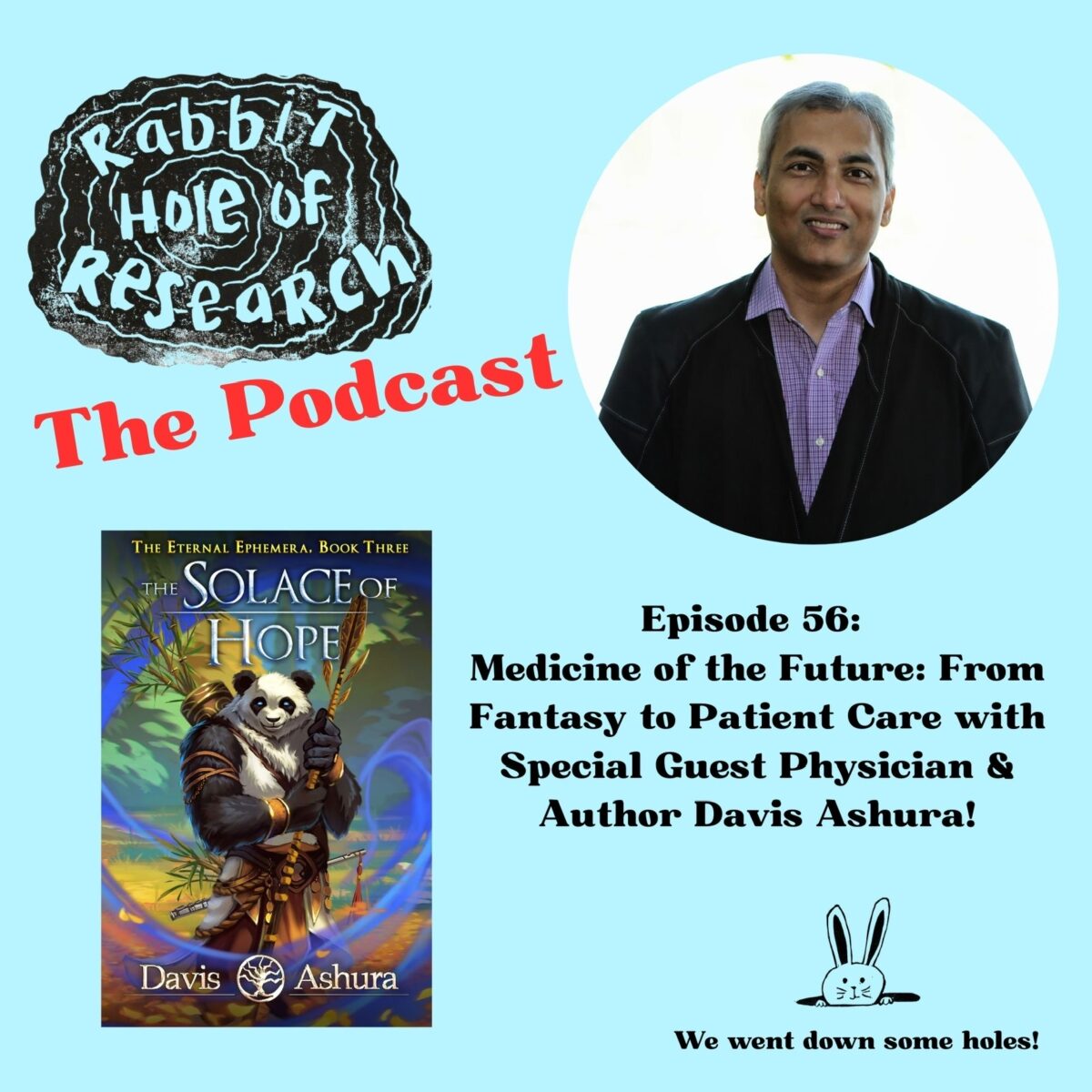
With Guest: Davis Ashura
Substack, Apple, Spotify, YouTube, Amazon
joe: [00:00:00] Hey welcome back to the rabbit hole of research down here in the basement studio, take two.
geo: Oh,
nick: you said it. I was gonna, I was gonna do a clap.
joe: Yeah. Yeah, I had a little incident with the soundboard. But yeah, we’re here for another exciting episode. Thanks for joining us. We’re gonna be all crewed up.
You got me, Joe?
nick: Yeah, I got Nick.
joe: Yeah. Got Nick. We got Nick
geo: Georgia.
joe: We’ve got Georgia. We’re gonna be talking about medicine of the future from fantasy to patient care, and we have a special guest with us
Davis.
Davis: Hi. I am Davis Ashura I’m a physician by training. That’s what I do every day. And I also write Epic Fantasy novels.
joe: Awesome.
nick: thanks for being here, David.
joe: Yeah, thank you
geo: Davis. Davis.
nick: I left off the ending part.
Davis: yeah, everyone calls, it calls me David, but the name itself is a little bit of a joke. It’s my pen name, but if you say it correctly, Davis Ashuras, angels and Demons and Hinduism. So
joe: Oh, [00:01:00] wow. That’s really cool.
nick: See, we didn’t get that
geo: first take.
Okay.
joe: No, we didn’t.
nick: Whatcha
joe: you bringing it up? Why
can’t we let my mistakes just fade away? So I have a little monologue to get us into the episode, so can’t be
geo: I can’t wait.
joe: A healer waves their hand and the wound closes A character drinks a potion and broken bones knit whole.
Lifeline rejuvenated. Every culture has told stories about miraculous healing From sacred springs to revival spells, we’ve imagined a body that could be fixed as easily as armor in a forge, and for centuries, that’s where these ideas lived on. Pages and games in myth. But reality has been slower.
Cells hesitate. Tissues resist. Healing is measured in years, months, weeks, not seconds. Every cure is a negotiation with biology, and biology doesn’t take orders. But something has started to shift. We’re programming immune cells, like video game characters growing, organs prolonging life medicine. I [00:02:00] can adapt faster than disease, evolve.
The gap between what we imagine and what can be done is thinner than it’s ever been. We’re here to explore the strange middle ground where magic starts becoming reality and science starts feeling mythic.
nick: like science always does feel mythic. Like if you don’t understand what’s going on, it just seems like you’re doing spells over there.
geo: It’s like magic. Yeah. Yeah.
joe: yeah. No, I mean, I think that’s that’s always a gap between, the science communicator and a physician who’s trying to explain complex kind of things and terminology. So in your practice, you are Davis.
Davis: I’m an endocrinologist. Sorry about that. I’m an
joe: no, you’re fine.
Davis: which which means most of what I deal with is is chronic long-term diseases like diabetes type two, type one, gestational what, whatever, hypertension, hyperlipidemia, the sort of things that happen as we get older. And one of the interesting things [00:03:00] about a lot of those spells that you mentioned that instantly heal wounds those are acute injuries.
And like I said on take one, a trauma surgeon would probably be able to handle that better than I would in terms of explaining some of it. But if you think about like all the things that have to be healed when somebody has their arm nearly severed. It’s not just flesh gets knitted, it’s what flesh gets re knitted.
It’s their arteries, their veins, their capillary soft tissue any bone bruises, but also tendons and ligaments, which don’t have good blood supply. So it’s like the spell is hyper intelligent at figuring out what needs to be fixed. And and so that’s interesting. I hadn’t really thought about that until just now, especially the la lack of good blood flow to tendons and ligaments.
Then what I was also saying was one thing that I like to think about is how does the pain affect the person, because. In the real [00:04:00] world when a person is repetitively injured, they shrink away from the pain. And, there are cases of that you see in football violent sport where running backs when they’re young will get to the hole and hit it hard and go far.
But just three years later, they’re still young, they’re 25 years old, they’re not hitting that hole quite as fast and their career is done and it’s because they can’t take the pain
anymore.
joe: Yeah. And that, I mean, that’s just due the repetitive wear and tear on their form.
geo: And I think a lot of literature like pop culture and things don’t necessarily talk about the pain behind. Yeah. You might talk about these miraculous healings, but not talk about the pain.
nick: So a football player wouldn’t get used to the pain after a while, or like
joe: you mean get
Davis: I don’t think they would.
joe: to the
pain? I think it would just, yeah. Gradually get worse and worse. that’s why you can [00:05:00] turn to addiction and addictive painkillers and things like that, so to, to try to, numb it.
But at some point the pain will. Override it be, it is gotta be a throb. I mean, that, that’s a constant.
Davis: I mean, I suppose if they were perfectly healed after every season and that punishing shot from the linebacker to their shoulder, which is probably hitting some, previously injured spot that no longer would be an issue. ’cause they’re perfectly healed. If they had that magic potion, maybe they’d still be able to perform as well as they always have.
But something about
It’s not even the pain, it’s the anticipation of the pain that causes them to pause.
joe: When you think of athletes their mentality is a bit different than the average, couch potato watching the game that goes, I could do that.
Like, I. And
nick: Oh, why didn’t you go for that?
geo: that? And then you think
joe: about it the player who was on the bench, rides the bench. They’re not the [00:06:00] star. They’re not, they don’t come into the game. They just, they’re the last person picked. They still, their mentality is so different than just an average person going along that stubs their toe potentially, because there is some, to Nick’s point, I think there is some tolerance of pain that you can shove that out your head.
And you’re right. I mean, what you’re getting to is that at some point that those skills don’t work any longer. That the injury then, and the repetitive injury, the repetitive getting hit, you just start thinking about that. And once you start thinking about getting hurt you actually are more susceptible.
Susceptible at some point. Because you can, you’re now protecting yourself to, to not take a blow, which then exposes you potentially to take even a harder blow or set you up to, not perform well
nick: thought that would do the opposite, like, all right, you’re anticipating this, so you’re gonna be able to go ahead and go this way a little bit to avoid that, to get through it.
joe: Yeah. I mean, the other thing is that you are [00:07:00] getting older and there is this natural aging that starts to happen. So at some point yeah. Father time is undefeated.
nick: Is there a potion yet for anti-aging? Like, is that.
Davis: there, I think y’all would know more about that than I would. I know what’s available on the market and I think y’all are working more on cutting edge what can be available. And I that’s pretty exciting. I just read on the edges about what can potentially happen. But just in terms of, my own field, one of the,
one
of the things that we, I mean, everybody’s heard of it now, GLP one
joe: That’s right. Yeah.
Davis: They’re the first true drug that we’ve had that has actually helped with weight loss on a long-term basis. We’ve had drugs that have helped a little bit, maybe five, 10% weight loss, but you can’t stay on ’em for very long. And this is the one that, that these drugs are the ones that are the first, that allow for sustained weight loss on a long-term basis.
Now, the weight itself is [00:08:00] less important to me than what that means underneath. So then we talk about physiology. And so with loss of body fat, then there’s probably lower blood sugars and not just. A lower hemoglobin, A1C or a monitoring of your diabetes, but maybe you actually normalize your blood sugars, you normalize your blood pressure, you normalize your lipids, and you lower your risk of heart disease and kidney disease because of all of those things.
So it’s pretty exciting and there’s a ton of money being poured into all these different GLP ones and other aspects of the entire I guess intestinal endocrine system. The GLP one, the glucagon-like peptide is just one, but there’s also GIP gut intestinal peptide and, blocking glucagon itself.
It’s it’s interesting. It’s cool, but there’s a lot of research being poured into it. But in terms of anti-aging, that’s the only thing that I know of that sort of reverses aging because, those are chronic diseases. [00:09:00] To not have them would be pretty, pretty phenomenal.
joe: I mean, I think the research on all of the diseases associated around aging, mental, physical there’s a lot of progress that’s happened. And we have seen life expect expectancy increase, with more modern medicine, from 30, 40 years to now, 70, 80 years.
So a significant increase there, and I think that will probably continue to increase. And with aging, you have things like, as telomere length, so you have caps on your DNA that, shortened as you age and Dolly the sheep that was cloned and you go, oh, it’s a new clone.
That’s age zero. So you took it from an adult, sheep made a, baby sheep, that’s identical. The thing that was interesting was that the telomere length actually stayed the same as the adult. It didn’t reset. So that’s because you clone yourself.
geo: does that mean then it then they’ll [00:10:00] age faster?
joe: not fasterr, but technically their cellular age would be equivalent to the adult, but they’re a youth.
geo: stinks.
joe: yeah, it does. So that’s
Davis: I would stink,
Right.
joe: in, in,
in sci-fi fantasy, when you get clone yourself and you go, oh, it’s a younger clone, but really genetically in cellular they’re probably the same age as the, among other handwaving things we have to figure out with cloning.
But
nick: So would you have to take that bit as a younger age?
joe: Yes. That’s the idea that you would, if you could harvest cells, which people are doing that at a young age, then you can create. Now organs you can create kind of body parts. That’s the idea
geo: You replace your body part with a younger body part.
And it’s based on your own DNA, your own.
joe: So this kind of idea of personalized medicine, feeling that’s way outta my price range.
Yeah, that’s, I was gonna,
geo: I don’t think my insurance [00:11:00] covers that.
joe: I was gonna, I was gonna and you on your Davis, not together, but on your about page, I’m gonna you go check out Davis’s webpage, put the link on the website on the newsletter when it comes out.
But you have, if the insurance lets you do it like, so it’s this whole idea
Davis: I have to plead the fifth about insurance companies or every seven all those seven words, I’m not allowed to say will come out. I cannot stand
nick: How trash they
Davis: say that much and end it there. that?
nick: I said how trash they are. Oh.
I think
geo: but either confirm
Davis: have no
idea
joe: But, and not to get you in trouble, but I think you do get into some really interesting ethical kind of questions where you do get, money starts to come in and scarcity of kind of these technologies and a have and have nots.
Like who actually gets GLP? You mentioned that there’s a lot of insurances that won’t cover that if you’re not diagnosed with pre-diabetes or diabetes. And so that’s ’cause that’s its primary,
Davis: is only, it’s only for type two diabetes right now. [00:12:00] It’s supposed to also be for fatty liver disease. For one of them. One of the GLP one’s got that indication. And we can get into the weeds of those kind of things, but you’re right, they’re not, unless they’re also covered for weight loss, but not all insurance plans cover weight loss medications, particularly GLP one agonists.
So yeah, it’s, they’re great drugs for lots of things off label, but you know.
geo: But then
Davis: write for them and then they go to the pharmacy and it’s $1,800. That’s like, who can afford that?
geo: There’s reality that going
joe: too far, I mean, you just talk a little bit about what GLP is for. A lot of folks aren’t in the
Davis: Oh, I’m sorry.
It was actually originally discovered, was actually discovered back in the 1990s. It’s called glucagon-like peptide one. It had and. In humans, it normally is metabolized within a few minutes. But what we found was that it has a plethora of different effects.
It slows gastric emptying, it potentially increases [00:13:00] insulin release, and it seems to have an effect at the level of the brain to increase your sense of satiety. So you don’t want to eat
as much. And it also causes a little bit of nausea, and in some people a horrific amount of nausea and other GI upset.
But in terms of the good effects, it’s slowing gastric emptying, increasing insulin production from the pancreas, and increasing your sense of satiety so you don’t eat as much. There may be. Other things that we’re still learning because there are receptor sites at other locations where it might have a beneficial effect in terms of cardiovascular health in a direct way rather than just through improved blood sugar and weight loss.
It might have direct effects at the level of the kidney, but the first GLP one that was synthesized was actually was discovered in the spit of the Gila monster,
geo: The
nick: what?
Davis: the spit of the Gila monster. You know the
joe: The lizard. The big lizard. The Gila [00:14:00] monster.
nick: Oh.
joe: Not a Sesame Street character. What do you think?
nick: I’m just so that was in
geo: Wow. And then to discover that I’m really curious how that
nick: they licked it.
Davis: I have no idea how they discovered it, but that was exenatide.
geo: I’m like, oh, I think I’m gonna check this.
joe: I could have been doing research on the he a monster. I mean, I think there are a lot
Davis: that’s
geo: But then to translate that into, that’s fascinating. There’s a
joe: lot of cross species where you’re looking at another organism and then you discover something like that, and then that translates
to Human kind of biology.
So yeah, it happens a
bunch.
Davis: I think that would be interesting if that’s how potions work too. Like magical potions. Like somebody is trying to figure out how to heal something and they’re like, oh, the sharks heal pretty nicely. There’s there’s arctic sharks and
joe: I think
Davis: grab something from them.
joe: that gets to you
Maybe Nick’s point about that line between science and [00:15:00] myth and kind of fantasy
nick: where it all sort of blurs
joe: sometimes you have something where you really don’t understand the science a hundred percent, but it does this function, and then you can manipulate that to work and you don’t necessarily, like potions, you don’t necessarily have to understand all of the science around it.
But it will heal up the bones or, a
nick: this makes you feel better.
joe: Yeah, exactly.
Davis: think in some, either some video games, some literature, that is how these potions are created. They take these different plants, fungi, whatever, moss, and they just know that if you mix them, ’cause they have certain properties that they’ve investigated, and if you mix them, you heat them to the right temperature.
It’s basically chemistry at that point. But they call it alchemy. Then they create this tablet or this potion or whatever that has the properties that they want. It’s it is interesting how science has seeped into that in a lot of ways.
joe: Yeah, no, and I think that was one of the, always one of the issues [00:16:00] with deforesting these star, these forestation in the jungles and things like that, that there’s a lot of botanical species, insect species that we just clear through that have been human, humans have devastated, which potentially hold pharmacological compounds that might be useful in disease prevention therapeutics and these functions.
And so it is, it’s one of these where you have a lot of these e eco ecologists going in and then taking samples to actually process later and see what compounds are in or what they do because tribal. Communities have been, they didn’t suffer from this disease.
Why not? Oh, they are used to, they may tee out the bark of this plant. And now it’s gone. So now no one knows why.
nick: So on that one I was watching the show’s Common Side Effects. It’s on Adult Swim where this guy comes across a mushroom that ends up being like, I heal all [00:17:00] video game style, mushroom. I don’t know what you’d call it, but it was a whole story about the big pharma not wanting that to become a thing.
Is that like an, is that something that they would, I don’t know if you could speak on this, but is that something they would put a stop to.
Davis: \ So if there was a naturally occurring substance that could. Do the same thing, let’s just say of of a GLP one help you lose weight. And you don’t have to take it in a tablet form. You don’t have to have it created in a lab. It’s just something that you can grow in your garden, right? Don’t think that they would want that to be available to the public.
I don’t know if they could control it, but they, I don’t think they would want it available to the public because your best health has always been and always will start in your kitchen, not in your doctor’s office. It’ll start in your kitchen and what you eat is gonna be the most important determinant
nick: So we’re going back to witchcraft over here.
Davis: Yeah, we are. That’s right. Witchcraft.
They [00:18:00] knew it.
right from.
nick: it.
geo: But Right. But then, yeah, but then they’re not making money
Davis: So that’s why there’s not a lot of research that is done on a, I mean, the amount of money spent on pharmaceutical research compared to research done on just proper nutrition it’s it the pharmaceutical research just dwarfs the research that’s done on nutrition. And it’s because you can’t patent a diet, right?
You can’t say, this is mine. Nobody else is allowed eat this kind of food the way I do.
joe: Yeah.
geo: So really medicine of the future can just be. Some really simple basic
nick: soup. Chicken noodle
joe: chicken
geo: Yeah. I mean,
joe: So I and Nick will, last night I watched Idiosyncrasy.
Is that, is it Idio with the,
geo: what’s his name?
Mike
joe: Judd.
nick: Oh, Idiocracy.
joe: Is it Idiocracy?
Is it Idiocracy? Okay. There it
geo: What did you say?
joe: Idiosyncrasy.
nick: Idiosyncra. I don’t know what that
joe: I don’t know what that is.
nick: That’s why I was like,
Davis: not quite the same.
joe: Yeah. [00:19:00] Idiocracy.
nick: that is such a fantastic film. But
joe: this point about where they were using the Gatorade, on everything. And it was like the electrolytes,
nick: It’s what plants crave.
joe: so it’s that whole idea.
’cause they bought the cd, the CDC, the FDA, and then they made it like their company logo and it was like, just everything and the, yeah, so
nick: I love that film, but it scares me so much. Yeah.
joe: But that’s to this point here about industry and, capitalism converging and the good of that and that I gets to that ethics question, like, when, where is the line
geo: Right. And it gets back to the money thing. Yeah.
joe: So Yeah.
nick: Yeah. WWW with the way they were doing stuff in that film, having everything so commercialized and very capitalistic was absolutely bonkers. Like the way that it does simulate what we are doing here in America [00:20:00] now. It’s,
all very like, okay, you can have this, but we’re gonna do this and then we’re gonna brand it this way.
geo: So it’s all about the spin.
joe: Yeah.
So
Davis: It’s also all about commodity, right? I, it’s like what can you make off of somebody else’s whatever problem or issue that they have?
joe: Right. Yeah.
I mean, we touched on pain and football in reality or sports, but in fiction, how’s that? I mean, how do you navigate that, squared at that circle with your characters and they’re dealing with,
Davis: So there is a certain amount of hand wam. ’cause I do injure my characters and I do want them healed and I do want them functional. But sometimes the healers don’t know what they’re dealing with. Had a patient patient, not a patient.
nick: In your
Davis: I had a,
joe: Right.
nick: patients. I get it.
Davis: I had a character who had [00:21:00] hyperthyroidism and it was it was, there’s a type, there’s different causes of hyperthyroidism.
This one was triggered by basically a cold.
joe: mm-hmm.
Davis: And so he was unable to train whatsoever because anytime he tried to exert himself, his heart would just race to, 180 beats a minute. And he had no stamina and nobody knew how to fix him because they didn’t understand what was wrong with him.
And the healing didn’t work ’cause they didn’t know what they were trying to heal. This is the handwaving part. One of my, I almost said patience, again. One of my characters recognized the symptoms and she was able to heal him of of what was going on with his thyroid. It actually was a fun little thing to write it in that way.
And it’s a it’s also cool because. We actually don’t have a cure for that particular issue. It’s you have to just wait it out and it’ll, you’ll get better on your own. But she healed him of it, so she sort short-circuited [00:22:00] the process and got him better, much quicker. So that’s part of what I do is I want to use diseases that are a little bit esoteric, but something that I know about and that the reader might not know about and even the healers might not know about.
And it’s not just, whoosh, here’s the spell and everything’s cured. It’s whoosh. This is the spell that will fix this particular problem because we understand what the problem is.
nick: So are there any side effects for using a potion? Or a cure for something that isn’t the correct diagnosis or ailment.
Davis: I mean, I think that would depend on what the author or the creator. Wants to do. Like if they want to give you a penalty for doing something wrong,
joe: Right,
Davis: then yeah, there should be a side effect. Or if they’re like, no, that’s just gonna slow down the plot, then there, it’s just gonna be an [00:23:00] effective, ineffective treatment.
joe: I was gonna say like in, maybe not in fiction as much, ’cause you’re right, you are limited by word count what you’re gonna throw in there. But you know, in the video game LAN is the nod to Nick here who probably has played more video games than I have in the last decade or so.
nick: In the last week I’ve played more.
Yeah.
joe: Yeah.
Davis: I think you probably have played more in the last day than I my entire life.
joe: But yeah, I mean, ’cause I, I think of older video games like in that the eighties, and Wolfenstein, a Doom Descent, like where you had a health bar, you’re going around, you’re collecting med kits and things like that, and you go, but , video games now that are multi-dimensional, character driven.
I mean, you could start introducing some of these things where you, a you’re, to your point, you’re penalized for taking the wrong potion or picking up the wrong rusty a needle you find off the ground and jabbing yourself. But you can also have long-term [00:24:00] diseases maybe that you are suffering from repeated injuries and the mental kind of strain of that.
And so you really need, you need a different type of healing all the way to, could you have a more long-term. Diseases that are affecting you. Your sy I mean, I don’t know. Is
nick: Joe, I’m gonna need you to cut this bit out so I can write it all down.
geo: We cannot
nick: let this go out.
Davis: I think that would be actually pretty cool. Like, if you’re injured in whatever way you’re injured. You took the, like in the real world, if you have some sort of disease, like your urinary tract infection and you were given the wrong antibiotic, one, you’re still gonna have a urinary tract infection and two, you might end up having a secondary infection.
Not likely, but it’s possible. You’re certainly gonna not feel great ’cause you’re, you might have, a bad reaction to the drug that, that didn’t cure the initial disease. So I think that would actually be cool that if video game developers [00:25:00] or authors incorporated the mistakes of medicine into the healing so that there is penalty, I think that would actually be pretty cool.
nick: I think that would be,
geo: of any examples
nick: I can think that would be good in like a d and d session, like Dungeons and Dragons would be a very easy start for that. Yeah. But as far as video games go, as of right now, I can’t think of any because it’s very, this one thing is gonna help you.
geo: Unless you go
joe: to carry on through, I mean, a lot of these games are mission driven and they, you’re just, you’re checking off the boxes,
geo: and do you have so many lives that
nick: much anymore.
I was
geo: say, is that even a thing?
nick: that was a thing more of the
joe: the pass. The pass, when I mean,
nick: so
joe: when the games I played, you would, you got three
geo: Right?
joe: There would be a Turkey leg along the way that you would eat or an apple, and that would, that, that was your bonuses for making it through to levels like Streets of Rage I’m referring to, which is one of my favorite, the Sega Genesis Theresa Rage.
one,
two and three. I spent a [00:26:00] lot of time on those. But yeah you would have, it would be a random chicken, a chicken on a road and you just, they eat the whole thing, bones and all, and your health bar recover. So it’s always yeah, you always have that. But I was, when I was, when you mentioned UTIs, for whatever reason I thought of Grand Theft Auto.
Like that would be where you would
geo: like, would that be the name of the game? UTI
joe: Ut that
nick: such a good game. UTI. What?
joe: Hey mom,
nick: can you get me UTI for Christmas? We
joe: the
UTI.
Davis: Yeah. Urinary tract infection. Those are always fun.
joe: Yeah. No, I just I think of it because it was our oldest son and he he wanted to play Grand Theft Auto with his friends, but we were like, I don’t think you’re old enough to play that game. And so he said, no, let’s play it. I’m gonna set it up in the living room. I’m gonna play it. You’ll see it’s not what you think.
And I was like, oh, I think it’s everything. I
geo: friends to join in. He
joe: got his friends to join in. But to start the game, you have to like perform a drug [00:27:00] deal. And so he’s trying to do it. Yeah.
geo: or you have to, yeah, you have to rob someone.
joe: He’s
trying to do it like
geo: and he goes, look, I can get a job and I can like earn points and stuff.
I’m like,
joe: are sitting here for about an hour and we’re like, just please just rob the bank. And so he robs the bank and the game starts in earnest and then he is there and he starts, oh, I’m gonna get a job. And I’m working at a store. He’s on his all this on, he is got a, and then just like, Porsche or something pulls up and they’re like, Hey Max, we’re glad you’re in the game.
And then and then they’re like, he is like, yeah, he is like, oh yeah, I’m going to my job. And they’re like, no, I got this. I beat up this old man. We took his condo and da. And so we’re like yeah, I don’t know about this Max. So it was
nick: I got my nine to five to go to guys. I can’t, and I’m tired after do it. So So
joe: I just, I thought
there with the real isn’t quite as fun of game,
having these kind of disease modalities, that would be that type of interface where you’re [00:28:00] there where.
right
geo: Aren’t you playing the game to escape all that?
joe: Yes,
nick: There are some people that are not like the amount of role playing that goes into those games.
I, I know a ambulance driver who. Plays as a policeman in the game. He goes, yeah I go in and I’m just, breaking up fights in the game. And I’m like, why? Yeah, why are you,
joe: are you
geo: Because maybe it’s all the stuff he wishes he could do in his regular job.
joe: Is it Nick Cage? Yes. Yeah.
nick: I’m not even gonna attempt to done
joe: He ambulance driver, was he? Yeah. In Was it?
Yeah. What movie was that? Bringing
the Dead? Waking the Dead, or one of those?
Davis: we, are we talking about Nicholas Cage again or
joe: Yep. Yep.
Davis: There was a one of my, so did you go to the did you go to the oh, what is it called at Dragon Con? They have this big parade with all these people.
Cosplaying. Did you go to that,
joe: I saw a part of it. I had a panel to get to. Like, while it’s like
Davis: [00:29:00] so I, I’ve seen it twice, but the funniest thing I ever saw was this group of people dressed up as Nicholas Cage from all his different movies,
and they just had like this little cardboard face on their, your, this
geo: Oh my God, that would be so amazing.
joe: would be fun.
Davis: It was hilarious.
joe: that would be fun.
geo: would be so I missed that. No
joe: I saw a part of the parade. I had to make my way through it. ’cause I was like trying to, get to a panel. But yeah,
Davis: Yeah. It’s a lot of fun.
joe: is, Dragoncon is a it was a ton of fun. So
geo: maybe we’ll get to go sometime
nick: I know we weren’t invited.
joe: You were invited.
Everyone’s invited. I wasn’t.
Davis: You should go. thing that just hit me is it’s not really an anti-aging that you guys are doing anymore, but it’s more of a life extending,
Yes.
like it’s Yeah. it’s not just life extending what you’re trying, I wanna see is
Quality, of yep. Exactly
So it’s not just you live more years, but the years you have, you can [00:30:00] still do the things you wanna
geo: That’s huge. Huge. If you want,
nick: a pain or suffering
geo: now. That’s huge.
Davis: right or limited because of constantly having to go to the doctor or co or your health just doesn’t allow you to go up the, go up a flight of stairs or go for a walk with your grandkids.
That’s what you want. You want those kind of qualities where you can go with your grandkids to the Grand Canyon if you have the money and show them the Grand Canyon and you’re not bogged down
nick: Not
just showing it to them on the tv. Man, look at
Davis: Yeah, there you
nick: Grand Canyon right here, ain’t it? A Butte.
Davis: really cool in real life too.
joe: And I was gonna say some of the, that, the other thing about medicine and is that’s changing a little bit is disease prevention and that goes to this quality of life.
Like to actually not wait until you’re actually in disease state.
geo: Goes back to the thing about nutrition and how you’re just living your daily life and how much that is a matter of prevention
joe: and [00:31:00] working out.
I think we under es estimate our activity levels and we get very sedentary in our daily lives and I think moving and being active.
Davis: Yeah. I mean, our bodies were meant to be used not to sit at a desk all day. I think you’re absolutely right about that. We’re healthier when we’re moving.
joe: And we talked about on other episodes where, we’ve evolved to be, these kind of long distance creatures that can stalk prey.
I think in the heart of the superhero episode, si he was talking about that. And in the performance episode we had, we talked about those things about how just a human body we’ve evolved to go long distances and to, endure. Through that,
nick: And now we’re just hunting deals on
joe: hunting deals. Yep. Getting our thumbs of work out.
that was
nick: a hard time
Davis: Or looking for the closest Chick-fil-A.
joe: That’s
nick: man. I gotta go on a scavenger hunt to the [00:32:00] grocery store.
geo: I always think of Wall-E
joe: yeah.
geo: I always think that, like, that being the future.
nick: Is that your movie of the season?
geo: Yeah. I just feel like, like we think that, I think that’s just that’s exactly what’ll happen if we just continue to just look at our phones, our little screens and just ride around on little motorized vehicles.
You know what I
nick: Do you have one yet? No, they’re coming in the mail.
joe: A motorized
nick: Yeah. The little
joe: A scooter. Oh,
Davis: A little hovercraft. Yeah,
joe: Yeah.
With a
Davis: go play golf.
joe: can
watch.
That’s right. Yeah.
nick: I mean, you could still bowl and it won’t make a difference.
geo: and you’re totally distracted just looking at your little screen and you don’t even know at all what’s happening.
joe: I think we talked about character in game and all the attention or protagonists, the attention’s usually focused on them, but I think in real life we are moving towards personalized medicine and
Davis: That’s the goal.
joe: that might be,
Davis: it’s.
joe: Yeah.
Davis: Whether it’s cancer therapy or [00:33:00] anything, you’re looking for medications that will target that particular cancer with particular receptors and no other receptor sites so that there’s not a bunch of side effects that you have to deal with. And we’re getting much better at that every single year, which which I think is like, one of the best things that so when I was in training, the whole thing about chemotherapy with cancer, it’s like, what’s worse?
The chemotherapy or the cancer, know?
And now when I see some of my patients they go to the oncologist and they’re on their chemotherapy agent. They’re tho those side effects are still present, but nothing like they used to be. it’s just been wonderful to see.
joe: Yeah. I’m even thinking of pushing beyond that where you were talking about some of the GLPs and how per person one can have, very intense nausea and some have very little. And so this idea of personalized medicine really personalized that each individual,
the
geo: a different formula.
[00:34:00] Exactly.
joe: it would be tailored to their genetics, their cellular makeup.
So that when you give it to them, it, the dosage, everything is so finely tuned that it, it does that. And we’re, and that’s part of this longevity
geo: And I feel
joe: of life. These things are starting to come where
it’s gonna be. help
geo: but be cynical and think going that, going back to like the dollar
joe: Yeah. That’s,
geo: Who’s gonna be able to afford that kind of,
joe: Un unfortunately,
nick: I
feel like that wouldn’t be that bad though. ’cause if they, I know we’re gonna bring it up, but AI if that goes around and is supposed to be personalized to your, like genetic makeup, they can have these, alright, this is what the formula is, what is gonna be the perfect ratio for this body.
joe: I think people are working on it, but to as well, to George’s point and Davis, you can jump in, but to George’s point, I think some of the drive is [00:35:00] about money.
So to entice research, especially as government funding is now amorphous and weird, we’re in some weird state. That means private sector has to pick up the tab and they’re only gonna pick up the tab if there is profit, right? Because that’s, we’re all a good, we’re all raised good American capitalists.
And so that’s the way it works. And so with, to your cynicism I think it’s well-founded that the driver of the technology is going to be people who can pay for that technology and a pharmaceutical company see a buck in it, and then after they make their money back, then they will.
Start to lower price or as technologies develop. So things that might be difficult and expensive that comes down. We sequencing the genome really expensive. The first one was really expensive, took a long time, and now you can take a cheek swab and mail it in and get genetic information back. So that’s what happens.
But you need someone to [00:36:00] say, I can make money in this industry, and then they do it. And that’s the way a lot of progress unfortunately has propagated, was can I make a buck off this? And if I can, then let’s throw two bucks at it. If I’m gonna get three bucks back, if I’m gonna get four.
So it is
Davis: I mean, that is, that is, how pharmaceutical research occurs. It’s driven by profit. There’s nothing necessarily wrong with that, but you don’t love it when you know that somebody can be of, can be, can benefit from something and they can’t afford it ’cause the drug costs too much. And I don’t think that’s because of the pharmaceutical industry.
That’s actually because there’s three layers of bureaucracy between where the drug is made and the pharmacy where you pick it up. And all of those bureaucrats or those companies that really, I’ll stop there
nick: I feel like this is our most anti-capitalism episode ever.
Davis: So I’m not against pharmaceutical research or capitalism, I just, I feel [00:37:00] for my patients that.
I can’t afford drugs that I know that they could benefit from. And I know where the problems are. A drug company actually provides benefit. They’re developing stuff that can help
geo: right.
Davis: but there’s other players that get their fingers in the pot that I don’t think they really, shouldn’t be there.
joe: yeah. And to your point, Nick and Willie, but , AI, I think at that kind of the cutting edge of technology, especially drug discovery, we’re starting now to see a lot of AI look at protein structure, try to,
Davis: where I think that’s gonna be where the personalization comes from, and that’s my hope for why the limitation on cost or affordability, I should say, won’t be as much of an issue because the thing that. I would hope the AI can do as far as pattern recognition eventually. If it’s as good as we are at pattern recognition, it’s gonna be able to sweep through [00:38:00] receptor sites.
’cause receptor sites, they’re 3D hodgepodge is that are really amorphous and it’s really difficult to understand what’s supposed to fit in that thing. It’s hard to visualize it, hard to model it. And if you have a program that can model it and it can look for that particular receptor within somebody’s cell wherever it happens to be looking. If that cost comes down, which we hope it does, since it always seems to come down with technological innovation, then at that point you would have compounded medicine that’s specific for that individual, which would hopefully be far less expensive than some pharmaceutical company producing a huge amount of the same drug where they have to make a
joe: I, I each vial.
using, so Open AI is the one that, that does protein structure. And as a structural electron microscopist this is something where [00:39:00] you talk to pharma folks and the AI models are nice. But they still have to, go to the experimental, I think that’s still, we’re still building all the experimental data up that you start seeing, errors in the AI models.
And so it’s really now this handoff, we get a model that’s close, go to experimental research, refine it, actually figure out the right structure the ligand binding sites, and then go to AI and go, what can fit what actually makes sense to go into this ligand binding site make a hundred, go through pharmacology and just make wild stuff.
And then we can make that synthetically to fit in that pocket. And so I think then you build that up. Then you can look at what are the differences in your protein structure and Nick’s protein Davis mind, and then go, okay, these are the same, but your pocket’s a little bit. And this, like, this key doesn’t fit in [00:40:00] this lock as well.
We need a different lock. And I think that’s what you’re getting at. Now. We can find the lock the key to the lock a lot faster if we know, we can get to that protein structure. ’cause that now has become faster to get to. And now can we find keys to the locks faster?
geo: And a totally unscientific thing popped into my head when you’re talking about this, but it makes me think of like, like publishers going to like print on demand versus just printing like thousands and thousands of copies and then we’ll see how many, but no, this specific person wants this specialized personal thing, you know what I mean?
So you’re only gonna print it when they demand it. So like that with medicine.
joe: No, I, yeah, sure. I know.
that works. No, I, yeah. Anything. But I mean, the thing that you fear is that personalization, because it’s unique to you, will cost more.
And it’s like, how do we bring down the cost [00:41:00] of this
geo: But you’re only printing it when you need it. But do you see
Davis: print on a unit basis a print on demand is gonna be a lot more expensive than if you do a large print run.
geo: oh,
Davis: for instance, if you do a, a print run of like 5,000 books, each unit might cost
$3 to print,
Print on demand. Each unit will cost around if it’s trade paperback, it’s gonna be around.
Depending on how
long it is, it may be anywhere from eight to $12.
Yeah, I know it’s,
geo: so it’s the total opposite of what I just said. Okay.
joe: Yeah. Personalization usually drives, yeah. Because you’re making something that’s
Davis: I it’s like if you hired somebody to build you a car versus going to a dealer and just buying one of their cars.
geo: Yeah. Anytime you customize something,
joe: Yeah. And then you have all the people that were involved, so that didn’t add tax on to that final
Yeah. Your final cost becomes, yeah. Just higher. Yep.
Davis: But I mean, those are different sort of [00:42:00] examples I think because there’s a lot of material cost into building, printing a book or creating a or making a car. There’s just a lot of material on that, whereas there might not be quite as much material cost to create that medicine that one particular person needs.
I don’t think we have a, we won’t have a handle on that for a long time,
joe: yeah
Davis: as to what it actually is.
joe: lot of the costs might be the first, because if, you know the drug works in this pocket receptor, it, it will do
what it
geo: you figure out
joe: then
making derivatives of that tailored to different people. That process should be going through all the, the checks and balances should be faster and easier for a drug company, making product, the derivative B is cheaper than making, the alpha.
geo: Okay, that makes sense. Yep.
joe: so that’s where you could that’s how you save
Davis: that’s the hope
joe: and getting that so you don’t need to do as much chemistry. You don’t have to keep trying to reiterate and reinvent the [00:43:00] wheel every time. You can just jump to making,
geo: got
joe: A different color wheel.
nick: So this is what AI should be used for.
joe: Yes. Among other things, I mean, doing taxes or something like that.
I can,
Davis: Joe, you’re a writer, aren’t
you?
joe: I do. Yep.
Davis: There’s a, there’s an AI program that I’m using that sort of, you can upload your PDFs into it and then it just lets you, it sort of uses that as a database where you can interrogate your previous work so that you don’t have, I have trouble remembering my kids’ names sometimes, and so
I’ll call them the wrong names all the time, or I’ll call my cat, my, my dog’s name and vice versa.
So that is that. I’ve found that to be extremely helpful since, the series that has the fewest number of named characters in my series is at 155.
So
geo: Wow.
Wow.
Davis: there’s 155 named characters. I’m [00:44:00] never gonna remember all that. The most I think is 280 in
one
joe: I think there, I always, I mean, that’s the touch on this. I mean, not a little bit to do with this episode, but, I always say I think there’s different things and we always gotta separate that ethical, moral bit out of a lot of this, even medicine, but the AI creation of the large language models and how that data was curated.
There’s a great argument to be made. I’m glad to see some compensation starting to happen with the, it’s the endoscopic case that was, that’s settled philanthropic case that was just settled. And so I think that’s one discussion. But like a lot of these technologies, we’re not putting the genie back in Pandora’s box.
It’s out there. It’s gone. It’s loose. And so I think to your point, Davis is how to use the tools
to
best aid us in our craft. And that’d be medicine, that’d be science and not a replacement for the things that we enjoy doing, right? We enjoy writing for writing’s sake. [00:45:00] AI really is bad at that, so don’t use it for that at all.
But for something like this where you’re curating your characters and saying, I can’t remember, what character interacted with what character, and then it’s, it has this kind of, you fed it your own personal data. You’re controlling out what you’re feeding it, controlling that chat box.
I, I think that’s the perfect example. Of how these things, these tools should be used. The Nick’s point. This is how you should use ai in there.
Davis: where it’s it’s a wonderful feature and a wonderful aid to the creative process rather than a replacement of the creative
joe: Yeah.
geo: Yeah. So Davis when did you start writing your novels?
Davis: Oh gosh, I’m old. So I’ve wanted to be a writer probably since 1985, when I was much younger than I am now. But
things got in the
joe: older than some of us in
geo: retreat. I then notice how he looked at me.
Davis: Y’all look a lot younger than I do.
joe: I, I, yeah
geo: [00:46:00] no.
joe: we can talk off offline, but Yeah. I think we’re, it’s surprising sometimes, so Yeah.
Davis: so I, things got in the way, my career going to college, med school, that sort of thing. And so I didn’t really, I tried my hand when I was a teenager. Really tried when I was about starting when I was about 38 years old and then published for the first time in 2014. I’ve been a published author for 11
nick: Congratulations, man.
joe: Yeah.
Davis: It’s a long journey.
geo: and always fantasy. Always.
Davis: Yeah it’s always been fantasy because that was always, it was science fiction and fantasy have always been my first loves. I would love to write science fiction but I’m caught up in a couple of long series, so I don’t know when I’ll be able to do that. But I would love to, to write Space Opera or write First Colony.
I would love to write a first colony story. And I just don’t know if I’ll ever have the time to do those kind [00:47:00] of things. But those are my br bread and butter. I’ve been reading a lot of Freedom McFadden lately, though. I don’t know if you know who she is, but she’s she’s very popular. Everybody in my office absolutely adores her and she’s they’re about to come out with the movie, I think with Sidney Sweeney the House housemate.
I think is the name of the book in the movie. But yeah, I’ve been reading a lot of hers and now I’m kinda like, gosh, the show would be fun to write a thriller too.
joe: Yeah.
geo: Right, yeah.
Davis: and is actually a, is also a physician. I think she’s a neurologist by
geo: Oh, really? Yeah.
Yeah.
joe: Yeah.
yeah. A lot of,
Davis: So go Frida.
geo: That’s awesome.
joe: it is. I’ll put that in the show notes.
nick: So what’s been your biggest inspiration for your books?
Davis: So I wanted to be a writer when I read Lord of the Rings. That was my biggest inspiration wa for wanting to be a writer. ’cause I wanted to create something that epic that, and some books by Arthur C. Clark was ki and also Robert Heinlein was what [00:48:00] Spur. That’s what I, why I wanted to write sci-fi, especially as Heinlein’s, a young explorer series of books, like The Moon is a Harsh
Mistress.
joe: good one.
geo: Mm-hmm.
Davis: And so those would probably be the biggest inspirations for why I wanted to be a writer. In terms of the books I’ve wanted to always have an homage towards would be Wheel of Time.
Um, I absolutely loved Robert Jordan’s books, even the slow ones that everyone complains about. The middle book syndrome, I guess you could say.
But those were the books that I always gravitated towards those big epics where something world shaking is about to happen.
joe: happen. Yeah, and it’s funny, the, you mentioned Moon is a Harsh Mistress, but that one, it had the AI component on there that, that helped the the moon colonies fight for independence. So I thought, it was all through telephone lines, kind.
It’s been a while since I read it, but I still remember that. And it was one of these, books. I mean, that was the early de sentient self, the [00:49:00] computer had self-agency and was intelligent and then made a decision of who they thought was right and wrong.
No, it was a great read in there. Cool.
geo: And just like a question more on like process creative how do you find the time? Because it sounds like you have quite a few books and series and then also to have such a, i what’s the word? But your job,
nick: a
geo: a, right?
Your job takes so much. How do you find the time to.
Davis: It’s it was easier a few years ago before COVID where the stress of just being in healthcare wasn’t quite as much. So I’d have plenty of emotional energy when I got home. I’d be able to spend time with the family and my kids, and I’d have a few hours of writing that I could do. I didn’t read much and I didn’t watch much TV at that time. And that’s really how I found the time to be a writer was because I sort of had to [00:50:00] sacrifice entertainment because I was wanting to write the books that I wanted to read.
And that’s how I found the time. It’s been more challenging more recently to get that balance, just to be emotionally ready to write at the end of the day compared to how it used to be. hoping that’ll
change. It’s one of those doctor healed, I sell things, like stop stressing so much.
nick: Then
joe: in your writing, I think you touched on it, but the inner kind of the real medicine, fantasy medicine how do you strike that balance in your, in your own works,
Davis: want injuries to feel real in terms of recovery, even if it is, the recovery is shortened in terms of the physical healing, I want the mental healing to, to occur and not just be hand waved away. So that’s one of the things that, that. I draw from as a physician, is that you have to recover, you have to [00:51:00] grit your teeth and fight through to do physical therapy.
Like if you have a knee replacement , that’s the beginning of your journey. That’s not the end of the journey. The knee replacement, the surgery is the surgery, but afterwards comes the physical therapy and that’s where the work happens. And so when my characters get injured, I want them healed, but I want them to work for recovery. and so that’s part of what I, how I think about things. Other people. It’s, and that’s not to say that you can’t just hand wave it and say the person’s healed and off they go to do whatever they need to do. Because it all depends on what kind of story you’re trying to tell too, right? I mean, when you have those video games where you just have to eat a loaf of bread and you’re get to go that the game developers don’t want you to slow down
to, to, heal.
They want you to be able to eat that loaf of bread and then get right back into it. And that’s the journey they want the player to involve themselves in [00:52:00] rather than what we were talking about earlier. Like, that was a, that was the wrong loaf of bread that didn’t do anything. That was,
nick: that just made me
Davis: had a protein, A protein meal.
joe: You’ve lost a
Davis: That’s not the journey that they want you to take. So it, it just depends on what you want. But that’s what I want.
joe: Very good.
Awesome. We’re coming to the end here. Nick. You got something? You got, it looks like you’re,
nick: I’m trying to piece on how to put it together. What is something you think everyone should do to be healthier? You mentioned that having it starts in the kitchen.
What is one thing that you’re like, oh yeah, this is something that I would recommend people do to help with this?
Davis: Well
nick: I’m looking for free medical advice, is
joe: how do people live forever is what he is asking though.
Davis: that is a good question. I did mention there’s not as much research done on nutrition as there is on pharmacy or pharmaceuticals. And one of [00:53:00] the things that is challenging is that there’s all these diets that have come whether it’s the Mediterranean diet, the keto diet, high protein diet, or Atkins diet, whatever you want, all these different things. What’s interesting is that and Joe was talking about this before we were all talking about it, same diet is not necessarily applicable to every single person in terms of their health. For some people, for me, for instance a low carb diet does nothing for my glycemic control. It doesn’t help a high protein, moderate carb, lots of exercise.
Does wonders for And so it, giving nutritional advice isn’t really something I can give because I, that’s something you almost have to discover. But there are some basics. Processed food is not good food. So if you go to the grocery store, stay along the edges, not in the aisles where the food is processed and [00:54:00] in a box.
So fresh food is your friend not the food in a box. If you get the majority of your food along the edges of the grocery store, that’s where you should get the majority of your food. In terms of exercise, it, it depends on what you’re trying to do, but a half hour of walking every day is a wonderful thing.
If nothing else, it’s almost meditation. And so that’s always a good thing to, to have that space to. Let the stress of the day sort of empty out of you if you can. If you wanna maintain muscle mass as you’re getting older, weight training is fantastic. If it’s done safely, you don’t need to, try to lift like Arnold or Ronnie Coleman or something.
You’ll actually probably hurt yourself if you did. So moderate weight training would also be good. But if you can’t do any of those, shop at the, on the perimeter of the grocery store and eat fresh foods
nick: Oh yeah,
joe: I [00:55:00] got a lot and really interesting to tether earlier that, I talked about genetic sequencing, but some of that’s now tethering into nutrition and kind of your own genetic background. And as that becomes a bigger thing, getting that information that can guide your nutritional, like what should your diet be? How should you eat? And things like that. So really there’s a lot of convergence of these ideas. But
geo: yeah,
this and this, I’m trying to pull this up outta my mind. This is coming back to like memory issues and that type of aging, but this guy, he was spending like, he spent like $2 million.
He’s like trying to like figure out how he can like, live much, much longer. And, but it was interesting some of the things that he was doing and one of the things was. He was taking his sleep so serious, like he was like gamifying it. Like, okay, like I have to, and all these different techniques to get better sleep.
And [00:56:00] that’s huge. I mean, that’s just another part of it.
joe: And there’s also genetic factor in that they just found that there are people who only need four or five hours of sleep genetically, that they’re coded that way. And there’s other people that are the extreme other end that need eight, nine hours of sleep.
And so once again, it’s like nutrition. People give the average, but really you have to listen to your body, I think. And I, and go with it. And, even disease states and things like that, body wisdom is a thing that, I don’t think people get enough credit to you that you know what your body is doing, how it feels when to speak up and advocate for yourself.
But yeah, so what I didn’t mention is the. Oldest piece of fiction with healers in it. Nick, you wanna take a
nick: I’m going to say it goes back to one of the first writings where it’s on a scribbled on a cave wall where they’re like, Ooh, eat this. It makes you feel better, right?
joe: It’s our to [00:57:00] Epic of Gilgamesh.
nick: I’m gonna say that you’re wrong. It’s gonna be cave drawings.
joe: Yeah, no, that’s, it has healers
Davis: What was it in, what was it in Gilgamesh that they talked about? I don’t remember
joe: it was the the link, it was plants and herbalist and healing that, that relationship to that. But yeah, almost a lot of
geo: And what was the year
joe: in there.
geo: that?
joe: At 2000 BCE yeah. Yep.
geo: been a while. Is that
Davis: to be
geo: can get print on demand?
joe: print?
Davis: supposed to be a hieroglyph. One of my one of my attendings, he’s he’s from, he was from Egypt. He was telling me that there’s, there was a hieroglyph from one of the pharaohs one of the sons of the Pharaohs died, and the inscription or hieroglyphic said he lost his life through his urine. And so the question, the, what he thought of, ’cause he is an endocrinologist, was he had type one
diabetes. And so with type one diabetes, your blood sugars are really
joe: high. Yep.
Davis: You’re constantly thirsty and you’re urinating [00:58:00] all the
time and you waste away through your urine. So he thought that was the first documented case of type one diabetes.
So I
nick: That’s hilarious. I would not have thought of that.
joe: Yeah, that Egyptian mythology at 1500 BC also talked about the healers and healer goddesses and things like that,
nick: I’m pretty sure mine was right though. Cave drawings.
joe: Oh, I don’t know. I don’t think so.
nick: We’ll put it in the show
joe: I said fictional writing, so that’s a drawing yeah.
nick: yeah.
joe: Yeah. Yeah. Potato. Potato.
Cool. All right. Davis, you wanna tell folks about your books? I know you, we had a little bit of segment here at the end about your writing process, but just in where we can find you online.
Davis: Sure.
So I’ve got a set of books that are all interconnected called the Anchored Worlds. There’s four series. They’re actually separate series. You don’t have to read any of them to any of the other series to appreciate the one you’re on. But they’re all interconnected, [00:59:00] kinda like, I guess Brandon Sanderson’s, Cosier.
The books are available on Amazon and most of them are also available on other stores like Cobo, Barnes and Noble, Google Play, Apple. And then the audio books are available on Audible. And I got great narrators. I got Nick Podell as as the narrator for most of my books, and Travis Baldry for for three of my books.
So I got great narrators.
nick: And we can get those personalized, right?
Davis: Yeah. Just send them to me.
I’ll send ’em back.
nick: Thank you so much for being with
joe: And you said you had a new book coming out in the summer, was that
Davis: Yeah I have a series called Instrument of Omens and four books are out right now and I am working on book five and I promise it’s gonna come out.
joe: Cool. Let us know when it does and we’ll send that out to everyone to grab it.
Davis: Absolutely.
joe: Davis, thank you for joining us on
Davis: you for having me. This was awesome. I appreciate
nick: sorry about our earlier
Davis: you having me.
joe: Yeah.
Oh, [01:00:00] that’s hopefully we didn’t get you in any trouble with insurance companies I work I work in a medical, institution, so I don’t maybe I
I’m
sure
geo: you’ll be in trouble.
Davis: to say, but that’s okay.
joe: Awesome. So yeah. Got me, Joe.
nick: you got Nick,
joe: Got
geo: Georgia,
joe: We got Georgia
nick: and we went down some holes.
joe: Stay curious. Bye. Stay safe. Eat healthy, love y’all.
geo: Get sleep.
