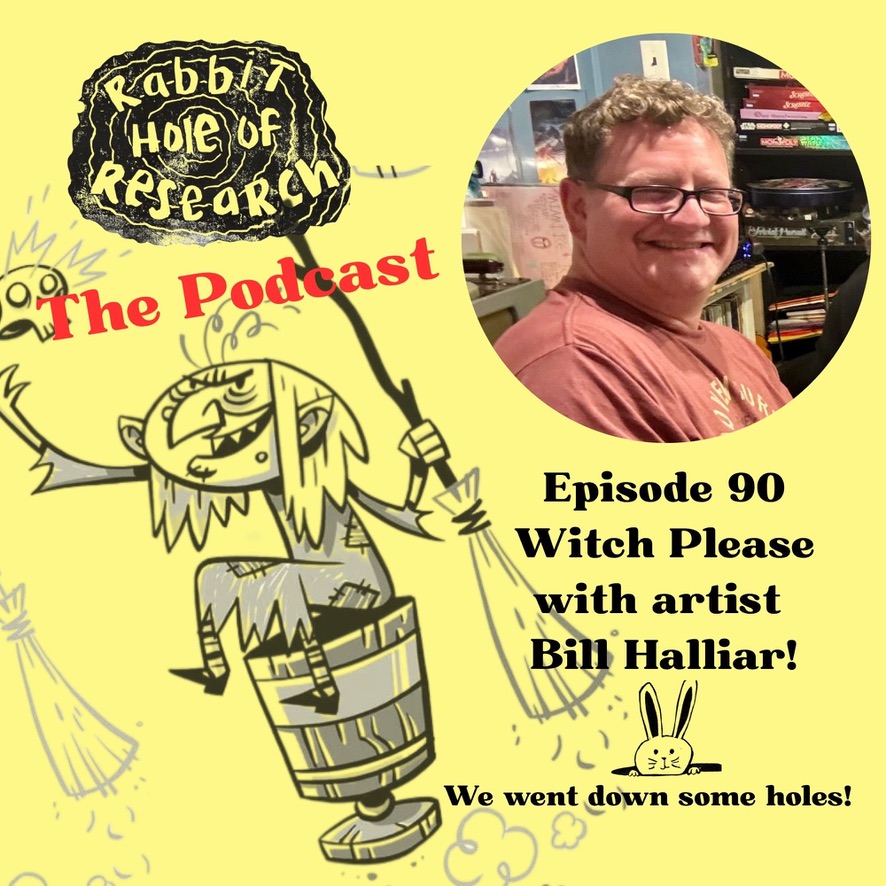
Newsletter and Transcript of Rabbit Hole of Research Episode 90: Witch Please

A protective spell, witch hunts, flying ointments, Salem and bad rye bread, black cat myths, and witches from Rosemary’s Baby to Hocus Pocus.

Substack, Apple, Spotify, YouTube, Amazon

Episode 90 Transcript


In Episode 90 of the Rabbit Hole of Research, Joe, Nick, and Georgia head back to the basement studio for the second episode in their month of horror. Returning guest Bill Halliar kicks things off with a protective spell, just in case. We talk about the Malleus Maleficarum, the numbers behind Salem and Europe’s witch hunts, the science of flying ointments and eating moldy rye bread, did the Pope really order black cats to be killed, and how witches have been portrayed in media, from Rosemary’s Baby to Hocus Pocus. And a Live Lobotomy…What???


Where to find Bill Halliar:

Bill Halliar (@skeletongue)


Georgia and Jim’s Touch of Noir 2027 Wall Calendar —

12 months of all-original art by Jim and Georgia; orders are open now, with mailing expected in September


Check out what the RHR crew is creating:

Joe:


Future Events to Hang with the Crew:

Podcast Cross-Appearances

Events & Conventions:

Joe:

It’s Science for Weirdos

Want to support the show? Tell your friends. Follow us on social media, Discord, share the podcast, and let us know what topics you are excited about. Leave a Comment. And for email alerts sign-up for the Substack newsletter and never miss an episode, exciting updates or the bonus images we talk about on the episodes. 


We discussed these questions on the episode and now want to Hear From You (leave a comment):

  • Did you ever mix leaves, twigs, and rocks into a “potion” as a kid? 
  • What’s your favorite witch or witchcraft in media: a movie, show, book, or comic?
  • Did you grow up thinking witches were women and warlocks were men?

Drop your thoughts in the comments. We read them all, and your ideas often shape future episodes.

Leave a comment


Future Episodes

  • Episode 92: Surviving After the ApocalypseGuest: Wil McCarthy
  • Episode 94: Doomsday series 1: Dr. Doom, Science and AlchemyGuest: Rengasayee (Sai) Veeraraghavan, PhD
  • Episode 96: Doomsday series 2: Building Dr. Doom and His WorldGuest: Julio A. Guerra (@artedeguerra)
  • Episode 98: Season 3 recapGuest: Alex and others TBA

Subscribe now

Share

Leave a comment

For more stuff (Images, Episode Highlights, events, etc), subscribe to our Substack newsletter!


Show Notes & Fun Facts 

Stuff crew said they’d put in shownotes:

Books, comics, and plays

  • Malleus Maleficarum: Heinrich Kramer, 1486/87 (Speyer, Germany)
  • The Witch-Cult in Western Europe: Margaret Murray, 1921
  • More Weight: A Salem Story (graphic novel): Ben Wickey
  • From Hell (graphic novel): Alan Moore and Eddie Campbell, 1989/1999
  • Witchcraft for Wayward Girls: Grady Hendrix, 2025
  • The Southern Book Club’s Guide to Slaying Vampires: Grady Hendrix, 2020
  • The Girls We Sent Away: Meagan Church,2024. 
  • The Mad Wife: Meagan Church, 2025
  • “Old Virginia” (short story): Laird Barron, collected in The Imago Sequence and Other Stories, 2007
  • Conjure Wife: Fritz Leiber, 1943
  • The Witches of Eastwick: John Updike, 1984, and the sequel The Widows of Eastwick, 2008 
  • Practical Magic: Alice Hoffman, Putnam, 1995 
  • The Dresden Files: Jim Butcher, beginning with Storm Front (2000) 
  • Discworld series: Terry Pratchett, beginning with The Colour of Magic (1983). The witches debut in the third book in the series Equal Rites(1987)
  • The Crucible (play): Arthur Miller, 1953 
  • The Scarlet Letter (1850) and The House of the Seven Gables (1851): Nathaniel Hawthorne 
  • The Handmaid’s Tale: Margaret Atwood, 1985 
  • Dungeons & Dragons (tabletop RPG): Gary Gygax and Dave Arneson, published by Tactical Studies Rules, 1974

Films

  • The Wizard of Oz (1939)
  • Rosemary’s Baby (1968)
  • The Wicker Man (1973)
  • The Wicker Man (2006): starring Nicolas Cage
  • The Thing (1982)
  • The Witches of Eastwick (1987)
  • Thelma & Louise (1991)
  • Hocus Pocus (1993)
  • Practical Magic (1998)
  • The Blair Witch Project (1999)
  • Ginger Snaps (2000)
  • Ocean’s Thirteen (2007)
  • ParaNorman (2012)
  • The Conjuring (2013)
  • The Witch (2015)
  • Hereditary (2018)
  • Weapons (2025)
  • Practical Magic 2 (2026)
  • Lady and the Tramp (1955): Disney

TV

  • Bewitched: ABC, 1964–1972
  • Charlie’s Angels: ABC, 1976–1981
  • Halloweentown (TV movie): Disney Channel, 1998 
  • Buffy the Vampire Slayer: The WB/UPN, 1997–2003 
  • Gilmore Girls: The WB/The CW, 2000–2007 
  • American Horror Story: Coven (Season 3): FX, 2013
  • WandaVision: Disney+, 2021 
  • Agatha All Along: Disney+, 2024 
  • Widow’s Bay: Apple TV, 2026. 

Fun Facts to Impress Your Friends With or Win Trivia:

  1. The “flying ointment” was real. The salves were fatty mixtures made from nightshade-family plants like deadly nightshade and henbane. They contain tropane alkaloids (atropine, scopolamine, hyoscyamine). Eating the plants can kill you, but absorbed through the skin they can cause sensations of flying and falling, along with vivid dissociative hallucinations. Technically a deliriants, a different class from classic psychedelics.
  2. Salem and the moldy rye bread theory. Ergot is a fungus that grows on damp rye. It produces alkaloids that are chemical cousins of LSD. In 1976 researcher Linnda Caporael proposed that tainted rye explained the Salem accusers’ fits, but most historians now consider it largely discredited. The symptoms, timing, and pattern of accusations track social and political rivalries much better than moldy bread.
  3. The Black Death was a flea problem, not a cat problem. Yersinia pestis was carried by fleas, and the plague spread through multiple routes, helped by poor sanitation, malnutrition, and dense trade routes. Pope Gregory IX’s 1233 letter Vox in Rama never ordered cats killed. There’s no credible evidence of a church-directed cat cull, so the “Pope killed the cats and caused the plague” story is a myth and gave black cats a bad rap.

Episode Highlights

  • 00:00 Basement Studio Roll Call: Joe welcomes everyone back to the basement studio for the month of horror, and Bill Hallier joins as a three-peat guest.
  • 01:37 Spooky Season Witches: Joe sets up the topic, pointing out that witches and their iconography are everywhere this time of year.
  • 02:14 Protective Spell Intro: Bill recites a mock protective spell to shield listeners from “the evil spell” they’re about to hear, and the studio lights promptly flicker.
  • 04:58 What Is Witchcraft: Joe explains that witchcraft is usually defined as an innate ability to help or harm through supernatural means, while sorcery is a learned technique.
  • 06:27 Warlocks And Semantics: Georgia asks if warlocks are just male witches, and Joe says the word carries a “corrupted bargain” undertone of a pact with the devil.
  • 09:15 Malleus Maleficarum Origins: the 1487 Malleus Maleficarum by Heinrich Kramer, a misogynistic witch-hunting handbook that even the Catholic Church criticized.
  • 11:47 Salem Trials And Numbers: Salem lasted about 15 months with 200 accused, 30 convicted and 19 hanged, and nobody was burned, while Europe saw roughly 100,000 trials.
  • 15:35 Why Witch Hunts Happen: Little Ice Age crop failures created a need for scapegoats, and some historians argue the hunts were a tool to break women’s economic independence.
  • 16:46 Modern Witch Hunts Today: witch hunts still happen in places like Tanzania, Nigeria and New Guinea, often targeting elderly women or children with albinism.
  • 18:28 Pop Culture Witch Journey: Bill traces his path from shrugging off the Wicked Witch of the West to Margaret Murray’s invented ancient cult and Lovecraft, and then to realizing how much of the genre is built on accusations against the powerless.
  • 26:49 Spotting A Witch Tests: Joe lists the “toolkit” of the devil’s mark, familiars, the rigged swimming test and the Sabbat.
  • 29:52 Buying Spells Online: Nick discovers you can order a love spell or a $9.99 money spell on eBay, which sends the group to urban fantasy and The Dresden Files.
  • 31:40 Black Cats And Plague Myth: Joe debunks the story that the Pope’s 1233 bull set off mass cat killings and fueled the Black Death, since the real document targeted a specific sect and never ordered cats killed.
  • 34:56 Science Behind Witch Lore: Georgia want real science and Joe brings up the “flying ointment” made from nightshade and absorbed through the skin could produce sensations of flight and falling.
  • 38:10 Salem Ergot Theory Debunked: s Linnda Caporael’s 1976 theory that moldy rye bread caused the Salem fits, which is now largely discredited because it doesn’t match the symptoms or the social pattern of the accusations.
  • 41:28 More Weight Pressing Story: Bill tells how Giles Corey refused to enter a plea and was pressed to death, answering “more weight,” so his land stayed with his family.
  • 43:34 Fear Politics And Scapegoats: trials correlated with cold periods, crop failures and economic competition, with older, poor or widowed women hit hardest.
  • 45:12 Satanic Panic Memories: Bill remembers hiding his Dungeons & Dragons books under the bed and says police interviews were great at convincing kids that something happened.
  • 45:33 Coerced Confessions: Nick describes how leading questions, no sleep and hours in a room make you “say anything you can to get out of that room.”
  • 46:46 Mass Hysteria Explained: mass psychogenic illness, a conversion disorder that spreads through a socially bonded group under stress.
  • 47:46 Stockholm Syndrome Debate: Nick asks whether children in Satanic Panic interviews experienced something like Stockholm syndrome, and Bill explains how it differs from a kidnapping.
  • 49:05 Witchcraft in Horror: Joe says that horror usually portrays witchcraft as a negative force, examples like The Witch, Hereditary, Rosemary’s Baby and The Conjuring.
  • 52:39 Wicker Man and Witch Films: The group debates the 1973 Wicker Man against the Nicolas Cage remake (“Not the bees!”), and Georgia calls Rosemary’s Baby one of her favorite movies.
  • 53:24 The Witch Deep Dive: Bill and Georgia praise Robert Eggers’ The Witch for echoing Salem, with children as accusers and open questions about what the film is saying.
  • 56:13 Witchy Childhood and Potions: Nick asks whether Georgia mixed leaves and twigs as a kid, then admits he has a cast-iron cauldron.
  • 59:03 Wicca as Real Religion: Wicca is a real modern religion, founded by Gerald Gardner in 1954, and distinct from both historical accusations and fictional witches.
  • 01:01:03 Iceland Fairy Rocks: Joe says about 90% of Iceland’s accused witches were men, and Bill recalls roads built around rocks where the fairies might dance.
  • 01:02:56 Pop Culture Witch Roundup: The group covers American Horror Story: Coven, Wanda Maximoff and Agatha All Along, Bewitched, and the witches of Terry Pratchett’s Discworld.
  • 01:05:47 Wizard of Oz Witch Template: Joe says the 1939 film set the template for the green-skinned, pointy-hatted witch, even though the hat was actually a Puritan fashion, and Bill recommends ParaNorman.
  • 01:09:46 Books and Female Friendship: After a detour through The Witches of Eastwick and Practical Magic and the scarcity of female-friendship movies, Georgia shows off the Subterranean Press edition of Grady Hendrix’s Witchcraft for Wayward Girls.
  • 01:12:09 Salem Dogs Tragedy: Joe shares that two dogs were killed during the Salem hysteria by residents who believed they were witch familiars.
  • 01:13:56 Favorite Witch Media Picks: Georgia picks Ruth Gordon in Rosemary’s Baby, Bill picks Laird Barron’s “Old Virginia” and the graphic novel More Weight, Nick picks Hocus Pocus, and Joe picks The Blair Witch Project, with a nod to Widow’s Bay and Aunt Gladys from Weapons.
  • 01:20:41 Wrap Up and Next Topics: Nick thanks Bill for his three-peat and pencils him in for a future episode, and Bill pencils himself in for his fourth appearance to talk about D&D and the occult.

“Stay curious, stay safe… Love Y’all!”


Join Rabbit Hole of Research on Discord: https://discord.gg/2nnmKgguFV

Subscribe and Share our Substack newsletter to get email updates, never miss an episode, and spread the word!! Don’t forget to give us 5 stars or a like!


Transcript

00:00:00 joe: Hey, welcome back to the Rabbit Hole of Research down here in the basement studio for the month of horror.

[00:00:10] Georgia: Ooh. Ooh

[00:00:12] Bill: treat.

[00:00:12] Nick: on you.

Oh,

[00:00:15] joe: down here in the basement studio. You’re

[00:00:17] Bill: down here than

I- remember, guys.

[00:00:18] joe: here

[00:00:18] Nick: really did some d- redecorating.

You

[00:00:21] joe: got me,

Joe.

[00:00:22] Nick: You got

Nick.

You got Nick.

[00:00:23] Georgia: Georgia.

[00:00:24] joe: got Georgia,

[00:00:25] Nick: hey, we got a- Special guest … special

[00:00:26] joe: guest.

[00:00:27] Bill: Hi, Bill Hallier.

[00:00:28] Georgia: Hallier.

[00:00:28] Nick: we seen you before?

[00:00:30] Bill: I might have been here.

[00:00:31] joe: here. He’s been

here.

[00:00:32] Bill: Hiding.

[00:00:34] joe: and I wanna-

[00:00:34] Nick: You haven’t left.

[00:00:36] joe: He’s just been living

in the basement studio- Oh … in the

[00:00:39] Georgia: been living in the studio. Oh, Bill’s still here.

[00:00:39] Nick: Yeah.

[00:00:40] Bill: Every time something goes missing from that little fridge-

upstairs-

[00:00:43] joe: Yeah.

[00:00:44] Bill: it’s been me.

[00:00:45] joe: I was gonna say that when David Pincus was on, he became the first three-peat guest. Oh. And yourself and Melissa from Reed’s Local are also three-peat guests. Oh, good. [00:01:00] And so- Yeah … David, he’s petitioning to get an episode- … right at the beginning of season four.

So, and y- yourself and Melissa usually does the, the horror episodes.

You guys come on and anchor us in towards the end of the year. So- Yeah … I don’t know. It’s like now this,

Competition … this

competition

happening, so I just want everyone to know where they’re at in the

[00:01:17] Bill: The

three-peat. What is

You got three-peat? What is the four? Four.

[00:01:22] Nick: think it’s still

four-peat I

[00:01:23] joe: a four-peat,

yeah.

I don’t know if they get creative after

[00:01:26] Nick: do They go turkey after that, right?

[00:01:28] joe: They go turkey? after that, right? They go turkey?

Yeah. Oh, I don’t know.

[00:01:30] Georgia: Oh,

[00:01:30] Bill: ’cause of the five.

fingers? Yeah.

[00:01:31] joe: I

[00:01:32] Bill: see.

[00:01:32] Nick: Yeah. Yeah.

All

[00:01:33] joe: see. Yeah.

Yeah. All right.

Well, we’ll cross

those roads when we get there. Let’s

let’s focus in.

This episode here, we’re gonna be talking about witches that was kind of here in, in spooky season.

Witches are everywhere, and- Mm-hmm … you see their iconology and things like that. So yeah, we’re gonna dig in. But I, in this episode, don’t have a monologue,

but-

[00:01:53] Nick: Is it ’cause someone put a spell on you?

[00:01:56] joe: Okay.

Yeah.

[00:01:57] Georgia: That’s- You used

[00:01:58] Bill: You

used that one so

[00:01:58] joe: know, right.

Yeah.

[00:01:59] Nick: [00:02:00] Listen, I’ve already used it twice.

[00:02:01] Georgia: right out the gate. Right

[00:02:02] joe: out the gate we’re there. But it sound like Bill, before we started, he had something up his sleeve ready to go, so.

[00:02:10] Nick: Go ahead, bewitch us.

[00:02:12] Bill: his Ladies

to go, so. Go ahead, Bill, witch us. Ladies and gentlemen,

the podcast you’re about to hear contains an evil spell, as used by practitioners of witchcraft for centuries.

Even today,

in many parts of the world, people practice black magic and witchcraft.

Charms, amulets, amulets, voodoo candles, grave dirt, and locks of hair are believed to ward off evil spirits and spells. You may doubt the effectiveness of these spells, but through every civilization, people have believed in witches. Could they all be wrong? don’t I don’t think so, for I have seen its power proved too many times.

I am now about to dispel all evil spirits that may radiate from the speaker during this performance. [00:03:00] Oh, creator of Hecate,

Damkina, marduk’s messenger, Tempkera, Ra neemu,

Beelzebub in the netherworld, Satan in Gehenna,

controller of the 7,007 curses and talismans, and who is known to obedient disciples as Gangida, hold all your powers and those of your do-bidders

and their familiars, and cast a protecting shield above those gathered here present. Pull back from any airy bodies those vested with evil. Grant, oh magnificent one, no harm from the spells about

to be heard. Direct them not. This faithful servant begs for thy favor.

Ihtefa inae ina’e zet. now, with a free mind and a protected soul, we ask you to enjoy the Rabbit Hole of Research.

[00:03:56] joe: research. Nice. Yeah.

Man.

[00:03:59] Nick: The [00:04:00] voices in my

head

have stopped. “What did you do? Really. I also think I have to leave.

now. like- something is pulling me.

[00:04:06] Bill: ran out.

[00:04:06] joe: lights are- ……My

[00:04:07] Nick: is tingling.

[00:04:09] joe: Lights are flickering on and off. The sensor

light just kind of flicked off and-

[00:04:13] Georgia: off and,

[00:04:13] joe: even though we’re all …sitting here.

[00:04:15] Nick: You did a great job.

with that.

Thank you. I was so impressed.

Yeah,

[00:04:19] joe: yeah.

[00:04:19] Nick: That’s…

[00:04:19] Bill: I love that stuff. It’s so fun.

[00:04:22] joe: It is. No, but,

I

[00:04:25] Bill: it protects

us. I hope it protects all the listeners at home, in their car, doing their

laundry, you know? ‘ that’s the last thing you want is to be accidentally bewitched.

[00:04:34] joe: No. You don’t wanna be bewitched.

[00:04:36] Nick: now I can easily t- bring up Robert The Doll right? Is that what the episode- Oh, yeah … we’re talking about?

[00:04:42] joe: We’re not talking about Robert Taddeo.

[00:04:44] Nick: I don’t know why You guys never let me talk about Robert. No. No. No.

[00:04:47] Georgia: he-

[00:04:49] Bill: I don’t know Robert the Doll. Who’s Robert the

[00:04:50] Georgia: Who read them? Oh, gosh what We’ll talk about them Yeah. We

can’t.

[00:04:53] Nick: have an episode next season about it. No, we

[00:04:55] Georgia: No we won’t.

[00:04:56] joe: So

yeah, just,

Witch- [00:05:00] witchcraft came up there, and that’s It’s usually defined as a belief that certain people can cause help or harm through supernatural means, not necessarily through a ritual. That’s more like sorcery. And so sorcery would be learned technique. Witchcraft is innate

[00:05:19] Bill: Oh, interesting. I don’t know that I’ve ever heard

that distinction

[00:05:22] Georgia: in

[00:05:23] joe: I don’t know that I’ve ever heard that distinction. In Eng- everyday English, kind of looking this up, it’s used… They’re used pretty interchangeably now, but there were historically, and so we’ll maybe get more into this and how it got there, but European history, witch was a legal and religious accusation- Mm-hmm

that became there. And so,

and there’s no unified, at that time which religion being persecuted. It was just a label applied to a huge range of actual behaviors: folk healing, midwifery- Being a

[00:05:50] Nick: So mainly women, right? …

[00:05:52] joe: a neighbor, having unexplained illness or simply being an unmarried, widowed, older woman. So you have that. Yeah. That’s totally-

[00:05:58] Georgia: So it’s always referred to… [00:06:00] women.

[00:06:00] joe: It’s

not necessarily referred to women, and actually something I… When I looked this up and get into some of this, there were a, a number of men who were also persecuted under witch- … witchcraft kind of label. And so you can have that. Definition is not…

It’s gender neutral-esque, like,

…but

women generally are the… Especially European. I mean, the European witch hunts and witch trials were mostly women, but there were men also in

[00:06:27] Georgia: the term warlock Is

that related? I don’t know why I thought witches were women and warlocks were men.

Is that-

[00:06:35] Nick: honestly believe that as well.

[00:06:37] Bill: That’s that school ground, you know?

Yeah, “Don’t call me a witch, I’m a warlock.”

Shit,

[00:06:42] joe: I’m a…

[00:06:42] Bill: man.

[00:06:42] Nick: Yeah.

[00:06:43] Georgia: a warlock. Yeah.

[00:06:45] joe: Yeah,

I mean,

I think you have that term where warlocks are considered, like, a male witch, but I don’t…

[00:06:53] Georgia: And that might’ve been, like- because there

is so much …negative associated with [00:07:00] women and witchcraft and witches. Maybe it was like, “Oh, we need another word for us ’cause we’re guys,

and-

Okay. I don’t know, maybe.

[00:07:08] Bill: be lumped in with all the ladies.

[00:07:10] joe: and I think

the- …

interesting here

[00:07:12] Nick: like that? … the semantics …

[00:07:13] joe: notes I had that the warlock it- it’s a corrupted bargain undertone.

Oh.

[00:07:19] Nick: And that that- So w- warlock was a deal made with

[00:07:21] joe: devil …right, with the devil kind of thing. A pact. A demon, a fiend, or other worldly,

[00:07:25] Nick: you, that’s where you draw your power.

from.

[00:07:28] joe: Yep.

[00:07:28] Georgia: that- but it’s- … that is pretty different, then.

[00:07:30] joe: it’s pretty different then … pretty different, but it does show up just as a neutral synonym for male witch also. And I think maybe historically in American culture, Bewitched, Buffy the Vampire Slayer, they used the term warlock to mean male witch. But historically, that, that’s not its definition.

It’s kinda like the, sorcery and it, they get, they just get interchanged now because we’ve lost the historical context of these things. But yeah, the warlock just culturally been a, a male witch.

And in D&D I [00:08:00] think warlocks

[00:08:00] Bill: a- Mm-hmm …

[00:08:02] joe: Kind of lean into the original meaning of a, a pact.

[00:08:07] Bill: I was wondering, I, m- I didn’t come across it. I ended up doing, look- looking at a bunch of pop culture stuff.

[00:08:14] joe: Yeah.

[00:08:15] Bill: But I’ve, I was wondering when, obviously all these things that were witchcraft, they’re all labeled witchery, like you said, healers and, and the like. That was all stuff all sorts of people did forever people did forever

up to a certain point.

When did things start… W- when did it go from, “Oh, I go down there and, you know, Agnes Nutter makes me a poultice that helps my arm,” go from that to, like, “She’s making a tincture to make my cows sick.”

[00:08:48] joe: yeah. Yeah. Like,

[00:08:49] Georgia: where does it,

[00:08:49] Bill: where does it change from, “She’s doing good for us,” to “She’s a witch and she’s gotta be hanged,” you know?

[00:08:56] Nick: I thought they were burned at the stake- or drowned.

[00:08:59] joe: [00:09:00] No …actually,

[00:09:00] Bill: most witches were hung

from what

I’ve seen. Right. yeah, burned at the stake. There’s very few

[00:09:05] Nick: that was like, the, just the most- effective way that they-

could

[00:09:07] joe: them. Yeah. Yeah. Yep.

[00:09:08] Nick: Just- all right. I mean, I feel like that’s just a general

thing

[00:09:11] Bill: them in a row

[00:09:12] Nick: kills humans. Mm-hmm. Like-

[00:09:15] joe: I think one of, one of the things that I had found was a document from 1487,

[00:09:21] Nick: The

[00:09:22] joe: the Malleus Maleficarum, Ma- Malle- Malleus

[00:09:25] Bill: Ah, yes … Mali- Malleus

[00:09:26] Nick: Malle- Malleus

[00:09:28] joe: Maleficarum The Hammer of

[00:09:28] Bill: The Hammer of Witches

Yeah.

[00:09:29] joe: that, right. So that was kinda this text and probably some say the most influential witch hunting text that was there. And it was this

really weird thing in that you would have very misogynistic,

[00:09:39] Georgia: misogynistic.

[00:09:40] joe: In, in this whole thing.

[00:09:41] Georgia: was- No, You’re

[00:09:42] joe: Yeah the devils.

And yeah, it was there. And it was kind of interesting because the Catholic Church actually criticized parts of it as theologically unsound and unethical in its methods. I mean-

[00:09:54] Nick: wait, I have to read this now.

Where do I find this?

[00:09:56] joe: sure you can find a copy

[00:09:58] Bill: on the internet

for sure.

[00:09:59] joe: that’s it [00:10:00] probably.

[00:10:00] Georgia: Internet

[00:10:01] Nick: they’re against it.

Yeah.

I sorta

[00:10:03] Bill: Latin translation.

[00:10:04] joe: And some of it was

the,

like the…

I think a lot of people think it was the switch, especially with Christianity kind of coming in. But actually one of the things I had read was that the… that transition, they actually rejected witches and witchcraft because God was the ultimate power.

So you couldn’t go… that you had these other people with innate abilities that would rival. And so it took a little bit, but then eventually then you started getting to heresy when that started coming along, and then it became… It went from this kind of helping or making tinctures or doing these kind of helpful things

to accusatory.

It started to have legal, you know, kind of persecution with it, and really it was just out

[00:10:46] Nick: just,

[00:10:47] Georgia: just

[00:10:48] joe: You just want… You didn’t like somebody, like I said, you would go, “They’re a witch.” And then you would have to… you would go through these things to try to prove if they’re a witch or not,

so.

[00:10:57] Nick: did they actually try to prove it, or did they [00:11:00] just go, “These are some random things that I’m gonna ask you, and I think you’re a witch already, so it’s pretty much a done deal”?

[00:11:07] Bill: The Malleus

Maleficarum has like, has some of that in there, right? It says , “Here’s what witches do, and here’s what you do to find-” out witches. And here’s also what you should do- once you’ve found out they’re witches.” It was like a whole handbook for sniffing them out and then dealing with them.

[00:11:24] joe: After that,

[00:11:24] Georgia: Who wrote this book?

Do we know?

[00:11:28] Bill: know? A German.

[00:11:29] joe: Yeah,

it- was. And I, actually

have

[00:11:31] Georgia: guess it was a …

man. Heinrich Kramer …

[00:11:33] joe: yep. I was like, I have it in my notes. That sounds right.

I

[00:11:36] Bill: it was published in Germany in 1486. I just remembered that …1487,

[00:11:41] joe: yep.

[00:11:41] Bill: in there. Yeah.

[00:11:43] joe: Yep. Heinrich Kramer,

[00:11:45] Bill: And then the,

[00:11:46] Georgia: th-

[00:11:47] Bill: one always comes up and then the, the Boys from Salem. The,

what are they Cotton Mather and Increase Mather.

[00:11:53] joe: Mather

[00:11:54] Bill: Both wrote books about witches and how to s- you know, s- spot [00:12:00] them and deal with them. All

rolled up in

that

whole American Salem witchcraft

[00:12:06] Nick: stuff.

Yeah.

I, Yeah.

that, th- that’s always Such a shocking situation to know that was part of our history. It really is. Like,

I do believe that a lot of that was due to land.

[00:12:20] Bill: Yeah, it does feel

that way. Like- some historians say definitely not. But then you look at

the land- where the land went from the people who were accused of being

witches and hung, and it all sorta s- started pooling with the people that accused them of being witches. Whoa And that does seem a little odd. Well, and

[00:12:38] Georgia: Well, and you just look at anyth- any time in history when somebody is like, “Oh, look over there, bad people.”

And then, you know, so that you can do whatever the hell you want. you know? Exactly. Yeah.

[00:12:50] joe: So

That, the Salem witch trials it lasted 15 months approximately. 200 people were accused, 30 [00:13:00] convicted, 19 were hanged. One man was pressed to death.

[00:13:03] Georgia: Nobody was burnt. Trials- No one was burnt,

[00:13:06] joe: No one.

That was, that’s a, that

that imagery is usually- That’s like a European thing … it had continental European things. So they did, there were places like Europe, it wasn’t even. There were some places that

went after witches in Europe, especially like kind of germany- hundreds-

and, you know, these countries like that.

Hundreds and

[00:13:22] Georgia: and hundreds.

[00:13:23] joe: you had-

[00:13:24] Georgia: People

were

[00:13:25] joe: Yeah,

I mean, historians say somewhere around there was 100,000 formal witch trials in Europe between 1400 and 1780

1780 resulting in, you know, the center is somewhere around 50,000. You know, there’s some, you know, between 40 and

60,000, right?

But you have that. It was, like I said, it was uneven. About three quarters of Europe saw no witch trials at all. The craze is really centered in the Holy Roman Empire by the modern Germany, Switzerland, France border regions.

[00:13:54] Georgia: did I

think Ireland?

I don’t know.

[00:13:56] Bill: yeah, ‘

Cause it’s such a magical

[00:13:58] Georgia: Yeah,

[00:13:58] joe: Ireland. It’s a magical place. Yeah, right. That’s

kind of feels like [00:14:00] witches

would be there. No, I and then

roughly 75 to 80% of the accused were women. Male victims run 20, 25%. Germany alone, they had about 16,500 documented trials, 7,000 executions. So that was the numbers there.

So really it was

this

[00:14:15] Nick: How many trials?

[00:14:16] joe: In Germany alone, about 16,500 documented trials. Oh.

[00:14:21] Nick: Oh. So yeah.

Interesting.

[00:14:23] joe: All together it was about 100,000 formal witch trials in these kind of, this, this time period, this kind of 300, 400 years that this lasted. And,

[00:14:33] Georgia: you know, I wonder why it

[00:14:34] joe: there were… Oh, go ahead

[00:14:35] Georgia: Oh, no. I was just gonna say, I wonder why it was such a short-lived thing in in, america.

or-

[00:14:42] joe: Oh,

in

the Salem, that was interesting. It kind of, fizzled out- …

When the the governor’s own wife was accused.

Exactly. And then the colony pulled back. So that

was

[00:14:52] Bill: have any, like,

[00:14:53] joe: I don’t know if we have, like- You know? Yeah …historical,

[00:14:54] Georgia: like,

[00:14:55] Nick: documents

[00:14:55] Bill: to prove this, but I feel like in most cases, that [00:15:00] kind of thing is

what

[00:15:01] joe: That is… Yes.

[00:15:02] Georgia: Like, it

[00:15:02] Bill: reaches its height, and then somebody says, “Hey, I accuse-“

the mayor. I accuse his wife. And they’re like,

Hold up.” “

Yeah Pull back on this witch thing.” “Maybe it’s not

cool”

[00:15:10] Nick: are nonsense. And so

[00:15:12] joe: And so they, the burning was more common in Scotland and on the continent of Europe.

So Scotland is maybe where you’re

[00:15:18] Georgia: Maybe that’s what I’m thinking, of. yeah, even, and, Ireland But

[00:15:20] joe: yeah, you probably

had it there, but Europe was the… Continental Europe was the, the hub, was the there. But you were asking, it was kind of interesting. So you had the document, the Malleus Maleficarum, which I’m, I am just gonna say that how many times in different ways.

But in

other things in this time period, like you had the, a little ice age, which caused a lot of crop failures, needed scapegoats. Mm-hmm. There you go.

[00:15:43] Bill: to blame.

[00:15:43] joe: Yeah. And then there was, like, some feminist historians that argued that the witch hunts were a deliberate tool of early capitalism to break women’s economic independence and control r- reproduction.

[00:15:55] Nick: I’d believe

that, too. Oh, I-

[00:15:56] joe: this was, like, kind of-

…Interesting … it’s contested. Like there’s, you know,

[00:16:00] historians debate that, but that is another

theory about

[00:16:03] Georgia: I mean-

[00:16:04] joe: especially at this time period where you had

[00:16:06] Nick: I bet those are men who are- disputing these.

[00:16:09] joe: these. I betcha.

[00:16:11] Georgia: I mean, and you

[00:16:12] Bill: You mean warlocks? … if you think

about-

[00:16:14] Nick: women. Yeah. Yes.

[00:16:15] Georgia: You think about seeing women hung, , in some public spot, I mean, that’s

gonna curb a lot of, you know- Right,

right. “No. Okay. I think I’ll get in line Like, i, my head I think of Handmaid’s Tale.

Mm-hmm. I think it’s the same-

[00:16:31] joe: Mm-hmm …

[00:16:34] Georgia: thing. And Margaret Atwood based everything in her book on actual events, actual things that happened. Yep. yep. So I wouldn’t be surprised if she did pull from- Mm-hmm … The Salem witch- Oh …

trials.

[00:16:46] joe: yeah. And I will say the other thing that I found, which I…

There’s so many crazy things in the world I, some things go missed, but there still are modern witch hunts. Yes. They’re… and especially in Sub-Saharan Africa.

Mm-hmm.

Tanzania, [00:17:00] Nigeria New Guinea. They often target elderly women or children with disabilities or Oh,

[00:17:05] Bill: Al-

[00:17:05] Nick: Of

albinism

[00:17:06] joe: albinoism

So-

[00:17:06] Bill: That’s the thing that always cracks me up in many of these tales, is, like, this person here, for whatever reason, has power, so we have to be wary of them and take them out.

That old lady who lives by herself

in a

[00:17:20] Georgia: a hut-

[00:17:20] joe: hut- Right,

[00:17:21] Bill: can barely

sustain

[00:17:23] joe: she is

[00:17:23] Bill: she is m- super powerful. Let’s go kill

her. Right. You know? She’s- g- Right … why wouldn’t

she use her power to do anything for herself? Right. Yeah. There’s no outwardly… You would think, like, the rich guy obviously has power.

He is using it to spin flax into gold or, you know, make sure that his crops yield. But no, it’s the people that are weak and-

Yeah … have nothing that always become the- That’s

[00:17:46] Georgia: That’s ’cause they can’t fight back,

[00:17:48] Nick: focus for this.

You know?

I think that’s the main thing.

You act like you- have more power then after that.

[00:17:52] Georgia: And then, the, it’s, like, that almost just totally sums up a lot of the… I don’t wanna bring up politics,

[00:17:58] Nick: I mean- maybe- it’s

[00:17:59] Georgia: may- Yeah, [00:18:00] that’s what this- But-

……But- We do

[00:18:02] Nick: yeah it’s just witches. But- …

[00:18:03] Georgia: But the thing is, I feel like that happens every day when we’re talking about, like, immigrant rights- and …things. It’s like, oh yeah, those very poor people that have absolutely almost nothing, they’re the ones that are making your life- miserable. It’s not the billionaires that are, you know-

[00:18:22] Nick: The trillionaire now?

Yeah. Exactly,

[00:18:24] Georgia: So it’s exactly the same thing.

[00:18:26] Nick: Well, this

actually-

[00:18:27] Bill: Yeah.

[00:18:27] Georgia: this

[00:18:28] Nick: is…

[00:18:28] Bill: thing. Well, this- is- Yeah …actually, …this is, I’ve come to recently over the past couple years, this is sort of my jour- I’ve had a journey with witches. Like, I started off as a kid, couldn’t care less about witches. You know, the,

[00:18:39] Nick: Really? … green faces, Oh, boy … the, like,

The neon green- Wizard

[00:18:42] joe: of

Oz …

[00:18:43] Bill: the Wizard of Oz.

I’m like, “

Ah, witches? Who cares? Yeah. That- doesn’t interest me at all.

And then I got older, and I got, I came across some cooler stories, , and with witches were portrayed as sort of, like, more like,

There’s a book by Murray, Witch Cults in,

[00:19:00] the Witch Cult in Western Europe, this woman named Margaret Murray wrote.

And she, based on very little evidence, wrote this whole thing about, oh, this is how witches work, and they’re actually this ancient cult that’s been passed down, since antiquity, and they have these, all these rules, and that’s where we get, like,

a coven of 13,

and we get all these i- you know, all these modern ideas- Right

are things that she made up from reading, , transcripts from the witch trials- and took hold in the popular culture. that’s the stuff that got me. I’m like, oh, the idea of this, like, ancient cult that’s been around forever, that are, like, lurking behind the scenes and manipulating things, that I really got into.

[00:19:45] Georgia: Now tell me again, how did you discover that and how old were you? Like-

[00:19:49] Bill: … so that was probably, well, I was, I started reading Lovecraft.

H.P. Lovecraft. …In my teens, my early teens, and he subscribed to her ideas. He [00:20:00] even mentions her in a couple stories- …talking about these ancient cults and unspeakable rites carried out under a full moon, and that kind of a thing.

And I’m ” like, Oh, that’s

[00:20:08] Nick: cool.”

And

[00:20:08] Bill: that got me into more, like, cosmic horror. And there

are, like,

great authors like Fritz Leiber did this wonderful story, the– called The

Conjure Wife.

And there’s a modern guy, Laird Barron, I love, that does such cool witch stories. You know, very creepy. And they’re these, the witches are-

You don’t get a leg up on the witches, you know?

You only think you do because they’re allowing you to, and then as soon as they’re done with you, you, it’s over, you know? And they’re so cool. It’s really interesting, but it is as I have learned more and grown older and seen that, oh, all of these ideas are really just, like, to put women in their place,

to put- …poor people …in their place, to take ad-advantage of already disadvantaged people, [00:21:00] it really s- it, it really, like, sours the stories. And I go back and look at these stories written and They’re horror stories. They’re written s-to scare you. But, like, everything that’s levied against the witch is something that’s like, “Oh, that’s exactly what you would say if you wanted

[00:21:17] joe: Yeah

[00:21:17] Bill: to kill somebody and take their land. That’s exactly what you would accuse

somebody of- …if you wanted to get a whole group of people against them. And that has really

That’s kind of, tainted my whole enjoyment

story as ,

Of the… genre, you know? right. Yeah. And it’s-

it’s interesting, ’cause it’s something that I, you know, you need to know and you need to deal

with. But it is it’s just sad how badly these people were treated, you know? A, a couple months ago, I read a really good graphic novel called More Weight. It’s this huge doorstop of a graphic novel- oh, damn that is heavily researched. It’s about the Salem witch trials. Mm-hmm. And, A

bunch of the text from [00:22:00] the trials are actually straight from the transcriptions.

Oh. Right?

So the things that people are

[00:22:04] Nick: other- That …is cool

[00:22:06] Bill: like

right word for word out of the transcriptions. So it’s like, oh, that’s, really close.

And it’s just so sad. Yeah. And insane to see these things, you know, like play out, where just a handful of young girls start saying, “This person is persecuting me in the night.” And her dad is like, “

She’s got some land for… Yeah, she… Yeah, she is in… Huh? Let’s let’s do something about that. That’s terrible. That’s really terrible.”

[00:22:38] joe: Yeah. I think,, one of the other things, there’s a couple things I wanna touch on, that, you have this dynamic where, the witches often embodies body horror or aging fears- … Decay, transformation which is really interesting ’cause it’s different than other monsters that we have.

‘Cause this one is very female specific- … And

[00:22:57] Georgia: I- female human, female … female human, yeah.

[00:22:59] joe: [00:23:00] That’s right, yeah. So, but yeah, you have it, the fear, the unlicensed knowledge, power- … kind of we gotta keep ’em under control,

[00:23:07] Georgia: The horror of a woman It really- …growing old

[00:23:10] joe: And e- even

in that

time-

They had knowledge. They were healers. Yeah. Herbalists. They did have this kind of understanding of the natural world that other people didn’t, and that, that was a fearful thing, that knowledge to have there. So, that was interesting. Y- and a coven like you said, really up until 1921 when that, that book was written, there was no…

Coven really was, it just meant to gather. Mm-hmm. And then the 13 was based off of one particular trial, and that w- historically, that was it, and that was just some people thought they saw 13 women gathering. But really there was no other evidence or anything like that,

[00:23:47] Georgia: because I always think of the number 13 to mean You know, like Friday the 13th. or, you know- I don’t know … 13.

[00:23:54] Bill: and

[00:23:54] joe: and I think that’s why,

Yeah, that, 21. Yeah, I mean, that’s-

[00:23:57] Georgia: came from then, or

did the number 13 [00:24:00] carry something, even before?

[00:24:02] joe: There was… This is where it all comes from, this Margaret’s Murray’s book. And she made a basis for the number 13 being this kind

[00:24:09] Georgia: this kind of- And then why did

[00:24:10] joe: go-

Said in that,

[00:24:11] Georgia: I wonder why We started thinking Friday the 13th.

was…

Anyway, I’m

[00:24:15] joe: Yeah. No, that’s

interest- … That’s a different … Yeah.

[00:24:17] Bill: numbers in

[00:24:17] joe: kind …Right.

[00:24:18] Bill: Like-

[00:24:18] Nick: Just,

[00:24:19] Georgia: just- Yeah

[00:24:20] joe: You go and, you have that. So that’s,

[00:24:22] Bill: I read… I knew about H- Margaret Murray’s

book, but when I was looking that stuff up, I saw that she wrote the entry in the Encyclopedia Britannica for witches.

[00:24:33] joe: Really? Wow.

[00:24:34] Bill: it was- Wow

[00:24:34] Georgia: the,

[00:24:36] Bill: it was the, you know- Definition … the go-to definition for witches for, like, almost 20 years.

[00:24:41] Nick: And

[00:24:42] Bill: that was, like, the ’40s through the ’60s or whatever. If you wanted to f- know what a witch was, you read Margaret Murray’s definition for a witch is in the Encyclopedia- Wow

Encyclopedia

Britannica, And you came away with all these ideas

that

[00:24:55] Georgia: And she came away with all these ideas that basically, …you know- Yeah … Led to the witch hunts And

[00:24:56] Bill: they’re all- And at that same time just one person’s ideas ………where

[00:24:59] Georgia: [00:25:00] anything that a woman, like, anything that a woman did would, it was, like, a mental illness. It was, Like hysteria. It was like, “Oh, no, she needs a lobotomy.”

I mean, you know what I mean? Lobotomy.

[00:25:11] Nick: Georgia, have you had your lobotomy yet? Like, I know that you’re due for one, but

[00:25:15] Georgia: me

[00:25:15] Bill: me to top you up? I’ve

got

[00:25:17] joe: it came … Yeah, right. He’s ready to

[00:25:18] Georgia: And that

that

[00:25:19] Nick: That’s really good. And that, that- Is this where we do the live lobotomy?

[00:25:20] Georgia: He’s growing another eyeball.

[00:25:20] joe: I know. We’d need video for that.

[00:25:22] Georgia: It

fits perfectly with that same time period.

[00:25:25] Bill: 100%.

[00:25:26] Georgia: Oh. 100%. The ’40s to the ’60s, you know. And I brought this up on a different episode, but

Oh, shoot. Megan Church, The Mad Wife. And that it’s basically about that, like, you know, just it was just so easy to throw- …a woman into a mental institution and say-

[00:25:46] joe: Oh,

yeah,

[00:25:47] Nick: Yeah, I mean-

[00:25:48] joe: Right. Didn’t do your housework.

[00:25:49] Bill: Know-

[00:25:49] joe: was all sorts of… Yeah, that was your grounds to be tossed away into a mental institution.

[00:25:54] Bill: Oh, man. So- I’d be in so much trouble.

[00:25:57] joe: Well, yeah.

[00:25:58] Georgia: so much trouble.

Well, yeah. No, you’re a man. I am. But [00:26:00]

[00:26:00] Nick: what,

I-

it,

there’s so many things that even we’ve learned from that we still do that are witch- considered witchcraft. Yeah.

[00:26:07] joe: Like- Mm-hmm …

[00:26:09] Nick: you ever spilled salt and threw it over your shoulder? That’s considered a witchcraft. I wanna say it was even blowing out candles on your birthday because you’re making a wish before blowing them out, and that is part of witchcraft. Talking to the trees or plants.

[00:26:24] joe: the candles, like, isn’t it you, if you blow out a candle then you kill a Oh. that

[00:26:28] Bill: Oh. Something like that, Oh, no.

[00:26:30] joe: in kind of, Wasn’t that’s, like, another one. I mean, it…

Those are s- Yeah …like, some of those are superstitions, right? Yeah. So you’re- All of them …you’re blending that. Yeah, right,

so. Is that why when

[00:26:35] Nick: I- the,

I mean, they all stem

from- You relate

[00:26:36] Georgia: Yeah, right. So. Is that like when you

hear a bell an angel gets its wings?

[00:26:41] Bill: a bell and you forget something?

[00:26:42] Nick: I

don’t even- know what you’re talking about

[00:26:43] Georgia: A witch. Witch. She knows too much.

[00:26:46] Bill: She knows too

much. the arcane arts flow through

her.

[00:26:49] joe: gonna say how to, how do you spot a witch, right? This was the toolkit to spot a witch. It came up. I was looking through my notes because I have it. There was, like, four things. One is the witch’s mark or the devil’s [00:27:00] mark. Mm-hmm. Any mole, birthmark, scar, extra nipple was

[00:27:04] Nick: I have three.

[00:27:06] joe: Three.

He says-

[00:27:06] Bill: It says- Wait, You have a third nipple or three extra

[00:27:08] Nick: Three

[00:27:08] joe: would,

[00:27:09] Bill: Oh,

[00:27:09] Nick: Wow. Yeah. You

[00:27:10] Bill: wanna

[00:27:10] joe: So they

would

[00:27:11] Bill: bring enough for The whole class. Yeah. What’s up?

[00:27:13] Nick: The,

[00:27:13] joe: Yeah, he’s got a bunch of nipples.

But the, the accusers would search the bodies for insensitive spots, pricking them with needles since a true witch’s mark supposedly didn’t bleed or hurt, and it was a rigged test since the needles could be retractable frauds.

So they would have it, like, “Oh, I got a needle. Look, I’m gonna do it.” And then it’s, like, you know, a trick needle where it didn’t

really.

Familiars, so this was

animal companions. Mm-hmm. We see that. Cats, toads, birds, they believed to be demons in disguise serving the witch. And this is almost certainly why black cats got their sinister reputation in the West.

And actually, there was… I got a follow-up on the black cat thing, so that was an interesting little rabbit hole.

The swimming test.

Accused were bound and thrown in water. Floating proved guilt ’cause water is a pure element and said to reject the guilty.

…Sinking proved [00:28:00] innocence,

But

[00:28:01] Georgia: But then you drown.

[00:28:02] joe: Yeah, so a, a horrifying rigged test either way. Like, like less,

[00:28:07] Nick: You’re screwed. Either you’re

gonna be thrown in the water.

Yeah.

And then hanged.

[00:28:11] joe: you float, and then you’re h- yeah, or you drown, and then you sink down, and then you float again, like, right? I mean, it’s kinda

like, “Yeah, “

look at that.”

[00:28:19] Georgia: at that.

[00:28:20] joe: then

the Sabbat it was an alleged nighttime gathering of the witches to feast, dance, and pay homage to the devil. largely, it was largely an, an invention of demonologists and c- and conquistadors, not a real practice, but it became the template for centuries of witches, covens, imagery, and fiction.

So that was

[00:28:38] Georgia: So

[00:28:38] joe: it.

[00:28:39] Georgia: So when you

are reading

[00:28:40] Nick: wanting to been involved, invited.

I’ve always wanted to be invited to one of those.

So

[00:28:44] Georgia: I

know, right?

[00:28:46] joe: wanted to

[00:28:47] Georgia: you read How to Spot a Witch. What year did that come out, or-

what- that was all part, what was

[00:28:52] joe: that was part of this that document, 1487. That was all kind of ways… It was embedded in there. “This is how you can tell.” That… It [00:29:00] was used, that was a true document. It was like, “Here’s a document.

This is how you tell

a witch-

This is how you dis- patch of them. You know, how you get, how you purge this from, , society.” And that was really interesting. And I w- I was gonna… The other thing we, we got, we touched a little bit on class and things like that, and to really nail that point during that Middle Ages period, right, you had wizards were really respected, and wizard just means wise.

Mm-hmm. You know, and so you had people actually practicing wizardry, and they were respected. They were, , included in royalty, all sorts of things there. And, , Merlin, I mean, you have, you’ve, it… You can just think about that, but you had people who were, … The women were poor, or they were being just classified as witches, like, because they knew too much,

or, “They’re too powerful.

We gotta

go get them,” like you said. They’re just chilling, like, just kinda living their life and, you know.

[00:29:52] Nick: Hey, guys, I do have something to add right now.

If you go to eBay, you can go ahead and order a spell. Oh. [00:30:00] Yeah.

[00:30:00] joe: know what that means. What are

[00:30:01] Nick: what that means.

[00:30:01] joe: now?

[00:30:01] Bill: The rack? What,

[00:30:02] Nick: or- yeah Intense biting, binding love spell

[00:30:05] joe: like, “Biting?”

[00:30:06] Nick: That’s only

$15, guys.

[00:30:08] Bill: That’s only $30, guys. 15 bucks. that’s a

steal.

[00:30:09] Nick: That’s-” steep. Athletic spell boosts physical s-

strength- Physical- …and …performance. …

[00:30:13] Georgia: a witch,

[00:30:15] Bill: that’s very

[00:30:15] Georgia: on? I

[00:30:16] Nick: I believe it is. Yeah. They they have pictures of all the stuff that they use, and I don’t know. Do I order one, guys?

Like, is this in our budget for, the … I don’t think-

[00:30:25] joe: I don’t know, man …

[00:30:26] Nick: can I order spells in our budget? I

[00:30:28] joe: think you should be ordering spells

[00:30:29] Bill: can Write it

[00:30:30] Nick: There’s a money spell though …

Money spell?

It’s only $9.99. That

reminds

[00:30:34] joe: me,

too. This is kind of,

[00:30:36] Nick: a- …

[00:30:36] Bill: That’s pretty

[00:30:37] joe: that touches into, like, urban fantasy, right?

‘Cause that’s the whole idea, that vampires- Yes … werewolves, witches, they all kind of exist, wizards, in contemporary times- Mm-hmm … and then they can do things. I’m just reading Jim Butcher, and the, the Dresden Harry Dre- he’s a PI. He’s a wizard PI, and you can go, and he… It’s, like, very noir.

It’s, like, [00:31:00] kind of a noir feeling. There’s things happening, and then he kinda goes. There’s a coven. There’s a, a, not a coven, a council of, the guardians of magic or whatever. You know, it’s like this whole thing. So yeah, it’s really kind

[00:31:11] Bill: great …

[00:31:12] joe: really cool.

I think it’s got like 17 books

or something like that, and so yeah, eBay that doesn’t surprise me that

[00:31:17] Nick: Yeah. Some witches

[00:31:18] joe: who thinks they’re a witch, or maybe they really are. I don’t wanna,

I don’t wanna- And

[00:31:22] Nick: you been on WitchTok? I have not

[00:31:24] joe: I have

[00:31:24] Nick: No? They have a whole subgenre. Is that

TikTok?

Yeah, on TikTok

you

can find a

[00:31:28] joe: Oh, I

thought it was like

a witch specific

thing.

[00:31:31] Nick: It’s just like once you go down that rabbit hole, you- get-

[00:31:34] Bill: Boy, you don’t come back.

[00:31:34] Nick: Oh.

I’ve

been down it quite a few times.

So,

[00:31:40] joe: So I was … So I talked about the black cats, and this one was really interesting because we get the y- it’s the black cats, Black Death.

So the idea was that Pope Gregory, the ninth? 1233 bill Vox in Rama declared cats, especially black cats, to be agents of Satan, triggering mass cat [00:32:00] killings across Christian

Europe.

With the cats gone, the rat population exploded, and then rats had the fleas, which carried Yersinia pestis, which is Black Death.

Black Death? Oh.

[00:32:09] Nick: plague? Oh.

[00:32:09] joe: And that result, that supercharge of Black Death, Okay … you know, plague, 1347 to 1351. Now that’s the-

[00:32:15] Nick: I love when that

[00:32:16] joe: the myth.

That’s

the claim. Okay.

But what the actual document says, this is a real document, it was really issued, but it was addressed to the King of Germany and a arch- archbishop of Mainz about a specific alleged h- sect the Luciferians near Schrodinger, Germany.

It describes a bizarre initiation ritual in which a black cat statue supposedly comes to life. It does not order the killing of cats, does not mention cats in general as evil, and was never a Europe-wide kind of directive. So there’s no credile- no credible evidence of any organized church-directed mass cat culling of

it.

Okay. And so the, the myth does persist because [00:33:00] cats, especially black ones, and especially those kept by older solitary women generally just … They’d pick up these supernatural sinister associations in later medieval and modern folklore linked to the familiar concept so that’s

kind of

like that cultural connection.

And then you had , this the conveniently packaged church superstition and a pandemic into kind of a morality tale about religious irrationality causing mass death. So weaponizing this to go after the church and what they’re doing. So, but there’s really… They haven’t…

They- they’ve traced the primary source and how it’s described. And the causes of Black Death severity there was multiple plague transmission routes you had poor sanitation, malnutrition, the trade route density, lack of any concept of germ theory but that’s all more boring

than

[00:33:48] Bill: all very- …the cats,

Very. complicated Yeah, right.

[00:33:51] joe: The Pope

killed The

[00:33:52] Bill: The Pope killed the cats the living statue

Yeah,

[00:33:54] joe: that’s right. Yeah. Yeah. It

w-

That was

the only thing they wanted, and

then

it was like, “

You know what? This kind of germ theory thing is kinda [00:34:00] boring. Why don’t we just say you know, the Pope killed all the cats?” And then

yeah.

So that’s a much more exciting

and lively story, but then that just persisted into kind of this idea that black cats have some weird, tether to the occult.

[00:34:12] Nick: And I do have to say that black cats are adopted or tried

to be adopted around this time of year. And as soon as the s- season’s over, they go to the animal shelters. and stuff.

[00:34:23] joe: Yeah,

[00:34:24] Nick: So please do not.

Yeah.

No.

Leave those cats alone.

[00:34:29] Bill: a

kitty. Yes. You know?

[00:34:30] joe: Yeah,

[00:34:31] Nick: yeah. It’s not just a thing to be like, “Oh, I got a black cat.” for Halloween.” It’s like-

[00:34:35] joe: your

[00:34:36] Bill: What, you don’t need a supernatural servitor. in like, December? A familiar? You know? of course you do. I want

a familiar like

that. January comes around, I still need it. You know? I

still need a demon to do my devilish bidding. I…

[00:34:48] Georgia: follow. Right, right.

[00:34:50] Bill: Right.

[00:34:52] Nick: Can’t do it all by myself.

[00:34:53] joe: are not-

[00:34:54] Bill: No

[00:34:55] Nick: is there any

[00:34:56] Georgia: damn. Black cats are not- So is there any science related to witchcraft?

[00:34:58] Bill: to witchcraft.

[00:34:59] Georgia: Science

[00:34:59] Nick: is [00:35:00] witchcraft. Yeah.

[00:35:00] Bill: That’s

[00:35:01] joe: Science is the witchcraft. Yeah. That’s true. There

[00:35:01] Bill: that

is the thing, Right?

[00:35:02] joe: Like- There

were some-

[00:35:03] Bill: were early scientist alchemists- and stuff-

Yeah … where they’re testing-

the natural world and Using

what they think

works. ……a

[00:35:09] joe: few interesting ones that I found. The flying ointment

[00:35:15] Bill: classic Gross. By

[00:35:16] joe: witches

And so I was gonna say also cunning folk was a term that was used for people before they were called witches.

They was called cunning folks. That would include men and women who were kinda herbalists. You go to them. You had folks too, there was kinda two classes: one who would do kinda medical things, you know, midwifery, kind of child birthing, you know, all this stuff here, healing. And then you had other, folk who would…

I’m like, “Folk,”

Who would,

You go to them and say, “Well, I lost my, my precious, necklace that was from my grandmother. Can you help me find it?” And then they would go out and help you find it. Or kinda like eBay here.

Like, …you know,

you can buy a potion or something

like that.

It was kind of…

That was this, this other class, [00:36:00]

[00:36:00] Nick: Joe. It’s- a

[00:36:00] joe: know what it is.

[00:36:01] Nick: So-

They do it and then send it to you.

[00:36:03] joe: So this kind of this this, this flying ointment, they made it from the nightshade family, so the deadly nightshade. If you eat it, you, you would die. It’s deadly.

But if you take it and you make a fatty salve with the kind of compounds that are in nightshade- Mm-hmm … and applied it to the skin, so a topical it was absorbed through the skin, and it would cause sensations of flight, falling, and vivid dissociative

hallucinations

and a distinct class of psychedelics.

Yeah. Wow. So it was a real thing, and you had it.

[00:36:38] Bill: Now, this is the thing they say you make this with a baby

right?

[00:36:41] joe: That, that was the… Right. So that, that’s, I know what you’re talking about. At death or at birth, you get a burst of DMT, which is the a, the hallucinogenic at birth and at death.

But there’s really no

[00:36:53] Bill: no scientific,

Right. you could also use, like, a hanged man. Yeah. This, The

Hands of a hanged man or something like

[00:36:57] joe: of a hangman or something like that. There’s

No scientific proof that happens, [00:37:00] so.

[00:37:00] Bill: Oh, well then I’ve got a lot of cleaning up, to

do when

[00:37:02] joe: we

were done. Now

let’s say there was,

[00:37:03] Bill: disappointing.

[00:37:04] joe: There was a

claim,

and this gets to the broomstick, is that the broomstick was coated with this ointment and then inserted vaginally.

It was like a popular, it was a popular kind of online- Guys, that’s

[00:37:18] Nick: that’s not what they were doing … They were trying to do something that the men

of their time could not.

[00:37:23] joe: was not … and that was

a…

[00:37:24] Nick: But the, And if they had ’em, It was- considered Witchcraft … But

[00:37:27] joe: that was done. Like, that’s just a, that’s kind of just internet rumors going out.

But yeah, you get… Yeah. So

[00:37:35] Nick: that

[00:37:35] joe: one- was,

[00:37:35] Georgia: me how this relates to science.

[00:37:38] joe: Well,

the- The actual flying ointment

is true, that you

could-

[00:37:42] Georgia: that it was- … hallucinogenic and- ……give

you a hallucinogenic and

[00:37:44] joe: like you’re flying or

whatever. Yeah. So, right. So

[00:37:46] Georgia: that

was one theory about it. Well, Yeah. I would see there’s a lot of natural- But I think it’s more- … medicines … the

[00:37:50] joe: in this broomstick thing. That’s, you know,

[00:37:52] Nick: Is that not just ecstasy or-

[00:37:53] Bill: So…

[00:37:54] Georgia: There’s a lot of, like, natural medicines and ways

to use,

[00:37:58] joe: Yeah, but this one,

it gave you the [00:38:00] sensation of flight and falling, so that’s why, because we think of witches flying or doing something.

Right. so.

[00:38:06] Bill: They’re all just tripping out

In the living room.

[00:38:08] Georgia: Yeah.

[00:38:09] joe: do

[00:38:09] Nick: Yeah. I do

that on

a nightly.

[00:38:10] joe: There was another idea for d- for Salem. It’s ergotism. And so the ergot fungus grows on damp rye, and it produces a type of alkaloid, so it’s a kind of a chemical cousin of LSD.

And so the idea is that it was proposed by a researcher in 1976 Linda Caporael,

Caporael

that it was rye, just a bad batch of rye bread that was tainted with this,

[00:38:38] Nick: Wait, so that

wasn’t witches?

[00:38:39] Georgia: It’s like a fungus

or? It’s a fungus.

[00:38:41] joe: right. Okay. And

it produces a type of alkaloid that’s similar to LSD,

and it was like

You know, it’s an interesting, fantastic science hook.

[00:38:51] Nick: I love

that idea. But most

[00:38:52] joe: now consider it largely discredited since it doesn’t match the specific symptom patterns and timing or the social pattern of the ac- [00:39:00] the accusations. So, and like you guys are saying, a lot of the, the accusations tracked social political rivalries than any other- Right … Kind of- Plausible kind of contamination map.

So that’s why that… But the rye bread thing was an interesting idea. Mm-hmm. That you do have these. So that was one. So we talked about the flying ointment. That was actually a real thing. And then this one,

[00:39:19] Georgia: Eating bad rye bread … yeah, tripping

off

[00:39:22] joe: bad bread …

Yeah.

They’ve been tripping off

[00:39:23] Nick: But it

was witches who did

[00:39:24] joe: But it

was really- Yeah …witches, that’s right. Yeah. And then I- you got the psychology aspect of it, right? You got the moral panic, scapegoating coerced confessions, all that kind of ropes into-

[00:39:35] Nick: Well, yeah. Then

they force them to confess that they were witches- and- that’s the only way that they would be saved.

[00:39:42] Bill: saved.

Yeah.

[00:39:43] Nick: And it would o- They would say, “Oh, it would… It will save your soul.”

[00:39:48] Bill: This,

This I ke-

[00:39:49] Georgia: c-

[00:39:49] Bill: The stuff in this Moore-Waite book really- … laid some of the stuff.

[00:39:53] Nick: out.

[00:39:53] joe: it’s

[00:39:53] Bill: It’s truly bonkers.

[00:39:55] joe: Like- Mm-hmm …

[00:39:56] Bill: the people who were accusing the witches were [00:40:00] in the room with the witches, in the court, right? And they’re mostly young little girls, and They’re being like, you’re like, “Yes, go ahead, tell them what’s happening.” They’re freaking out in front

of everyone. ……And

They’re even saying things like, “

You’re here, you know? You’re… I’ve accused you, Georgia.”

And I’m sitting there saying, “Georgia’s coming to me now. She’s here, she’s standing next to me. She’s poking me, she’s pinching me. It’s- I’m tormented by her.” And you’re sitting there, everyone can see you, but this little girl is saying that you’re also standing next to her and tormenting her,

and they’re like flopping around and screaming. And going crazy. And- And-

[00:40:38] Georgia: And then,

[00:40:38] Bill: went for

[00:40:39] Georgia: and they should- … be the ones- locked

[00:40:40] Bill: Yeah. Why

[00:40:41] joe: yeah. It’s

[00:40:42] Bill: they, why aren’t you… You’re Obviously something’s wrong with you.

Not

anybody else. It was- really-

Where- …

[00:40:48] Georgia: Yeah. Wow

[00:40:49] Nick: bonkers.

[00:40:50] Bill: would you look at that and be like, “Oh, that’s obviously this person who’s sitting here normally, who has no power, who’s-” not doing anything, [00:41:00] …and this other person who’s freaking out is, must be telling the truth, you know?

[00:41:03] Georgia: Wow.

[00:41:03] Nick: Wow.

I wonder how many people actually were like, “

Yeah, it’s me” and like- … just to see if they would back off, like…

[00:41:11] Bill: That’s a good question. ‘

[00:41:12] Nick: I mean-

[00:41:13] Bill: like to scare them. Yeah. You know? I will use my powers on you if you- Yeah …get out of

here.” I

[00:41:17] Georgia: think

[00:41:17] joe: you’d just get hung

[00:41:17] Bill: down. Yeah.

[00:41:18] joe: Yeah. Yeah. I think you would just go

[00:41:19] Nick: Not unless you curse … them …It was,

[00:41:21] joe: Agatha All Along, right?

[00:41:22] Nick: mind. I

love that. Well, that

[00:41:23] Bill: Corey

got pretty close, that dude who

got

pressed.

[00:41:26] joe: dude who got pressed. Oh,

[00:41:26] Georgia: He-

[00:41:28] Nick: He

[00:41:28] Bill: started off, he actually a- accused his wife

at the beginning and was like, “I think she bewitched me.”

And they arrest her, and then after a while things start getting going and he’s like, “Wait a minute, none of this makes any sense.”

And he tries to take it back, and it doesn’t work, and then… Well, they tried, he tries to take it back because they accuse him. If your wife is a witch- And

you know what she’s doing …you know what she’s doing- you must also be a witch. He gets accused, he gets arrested, and then basically they accused him of being a witch, they put him on trial, and apparently,

I’m not [00:42:00] 100% how this works. I’m not a 17th century lawyer

[00:42:03] Nick: Are you

sure? Yeah,

[00:42:04] Bill: But if he pled guilty or not guilty,

he would be entering the legal bonds of, you know…

And then after he was, after he dies, the court would get his land. Mm-hmm.

[00:42:18] joe: Mm-hmm.

[00:42:19] Bill: So he decided not to say anything at all.

[00:42:22] Nick: And

it

[00:42:23] Bill: was part of the law that if you didn’t,

[00:42:26] Nick: you didn’t

[00:42:26] Bill: say anything, you weren’t part of it yet. So that’s, they’re like, “Well, s- you know, d- are you guilty or not?” And he didn’t say anything.

And eventually they’re like, “Well, you gotta You press him. So they put him under some some wood, and then they started putting rocks on top

of him. And they kept asking him, “Are you ” guilty? Are you guilty or not? Are you guilty or not?” And all he said was- “More weight. More weight.” And eventually

[00:42:51] Nick: That is …so cool …after

[00:42:53] Bill: three days-

[00:42:54] joe: I wouldn’t go as far as cool, but

[00:42:56] Bill: from being crushed by the rocks. But because he never-

[00:42:59] Georgia: Then they weren’t [00:43:00] able to take

[00:43:00] Bill: said he was guilty or not guilty, he was never actually part of the legal proceedings- and his son-in-laws retained the rights to his

[00:43:10] joe: Wow.

[00:43:10] Nick: Wow. So, so he- r- figured out what was going on.

[00:43:14] Bill: It seems that way, you know- But- From what-

Granted,

[00:43:16] Nick: he’s probably not the first- to have figured that out. Yeah. But he was the first to-

[00:43:22] Bill: was

[00:43:22] Georgia: of- the- Wow.

And just the

[00:43:23] Bill: maybe one of the only- Yeah … is …to

like,

stick it out.

Most

people,

after a while of- being

crushed- Yeah …

would just say, “Screw it. Yeah.

[00:43:29] Georgia: kind of torture. “

[00:43:30] Nick: I’m not guilty.”

[00:43:31] Georgia: Yeah. Wow.

[00:43:32] Bill: It’s wild. Wild stuff.

[00:43:34] joe: But that, that idea too about the kind of land and politics, you had that a lot of the trials correlated with cold periods, crop failure, economic competition among women.

You were asking about the older women. Mm-hmm. And if you’re in trades like midwifery, brewing, healing,

the accused were disproportionately older, poor, unmarried, or widowed women who threatened or burdened the social order. So you had this kind of [00:44:00] competition, jobs. It’s like, jobs are scarce. Right. I need to get in.

Then let’s take that person out and move forward. So yeah, you had a lot of that, It was all just a big, , cover to eliminate and take out people- Mm-hmm … who you didn’t… You wanted their land, so you go after them. Or once something happened like that, the wife got accused did the opportunity come up,

“What- yeah we could do is we can actually, we can use this to our advantage and get, get the land,” right? So I think you had this,

[00:44:26] Georgia: And

I’m sure

There were people that believed it. I mean, you know what I mean, And I’m sure

[00:44:32] Nick: sure See, look at the things people believe nowadays.

And right.

[00:44:35] Georgia: I’m

sure there are people, like, were very scared.

like

[00:44:38] joe: moral panic. Yeah.

[00:44:39] Georgia: Yeah. they saw these

people freaking out. and They really thought it was. Yeah. You know, witches

And,

[00:44:44] Bill: What a terrifying

[00:44:45] Georgia: So to really Play on people’s fear- and panic, paranoia.

[00:44:50] Bill: like,

[00:44:50] Nick: think about it. How much fun would it be to play on people’s fear like that?

[00:44:55] Georgia: like that?

Just

[00:44:56] Bill: be to play on people’s fears like

that?

[00:44:57] Nick: Yeah. they’re terrified of this. How stupid [00:45:00] are they? And like just rolling with it, I… The joy I’d get.

[00:45:06] joe: I don’t know. I

[00:45:07] Georgia: I don’t know. “Oh, I think You’re a

[00:45:10] joe: You’re gonna be…

[00:45:12] Bill: I always, it it always brings me back back to

the… I lived through the Satanic panic. I vividly remember that. growing up.

remember hiding my Dungeons & Dragons-

[00:45:23] Nick: I

was gonna

[00:45:23] Georgia: you play D&D,

did

[00:45:25] Bill: to hide them

under the bed- … you know? I, because they were evil, and devilish. And I was l-

, com- communing with, the the great Satan or whatever. And you hear some of those, you know, some of those early interviews where the cops have a kid, and they just…

They’re… First off, they’re terrible at interviewing to get the truth.

They are great at interviewing to convince the kid that something happened.

Yep. And that’s exactly what happens every time,

Listening to

[00:45:55] Nick: to all of that just- It’s- … was a modern-day- … it’s it- … Salem

witch trial. yeah.

[00:45:59] Bill: And it’s, v- …I’m [00:46:00] sure very similar things happened during the witch trials,

Oh. yeah. Where the people in charge

just convinced people-

Right, you know, to say the things that they needed to say. And then after a while, , if it’s been days and people have been telling you, “No, this is… well, Tell us what really happened.” you start to think it did, you know? Maybe you start to- Well, yeah.

[00:46:21] Nick: You, get into your

head … to think it yourself.

[00:46:23] Bill: Yeah, exactly. ‘Cause they’re-

Maybe I am in league with Satan

[00:46:26] Nick: It’s leading the questions and then having the answer that you want. You’re not getting any sleep. You’re not getting- Right … what you need. You’re locked in a room answering these questions for what?

24 hours? If that. And then you, ju- you just kinda give in. Yeah. You’ll say anything you can to get out of that room.

[00:46:46] joe: No, I was gonna say that mass mass psychogenic illness is there. It’s this,

[00:46:50] Nick: some,

[00:46:52] joe: accusers

The convulsions and fits of the com- the accusers resemble documented cases kind of mass, this mass psychogenic [00:47:00] illness.

It’s a conversion disorder spreading through a socially bonded group under stress. And so you see it in modern outbreaks too, kind of unexplained feigning or tics in schools. So you have these kind of outbursts that no one knows, and it’s just this- We talked

about that …

we talked, yep,

[00:47:14] Georgia: very recently.

Yeah.

[00:47:16] joe: an

[00:47:16] Bill: is really interesting. so it’s like a meme this i- ideas are transferred. And you catch it. That’s right. People start catching it.

[00:47:23] joe: you start doing it, then it just builds up. Yeah. So you can imagine at this time- Yeah … you start having that. Not only do you get them in and try to coerce this this thing out of them, but you also then you start

behaving in some way because it’s, you know, it’s

[00:47:37] Bill: Yeah

[00:47:38] Georgia: Yeah

everyone

else

[00:47:39] Bill: it. Everyone’s doing it. yeah.

[00:47:40] Georgia: of- Everyone’s doing it. Yeah

[00:47:40] joe: you know,

[00:47:41] Bill: That is w- that is

[00:47:43] joe: Yeah.

So that one is really kind of, crazy there, so.

[00:47:46] Nick: What’s the term when you’re kidnapped and they convince you that you’re one of them?

[00:47:53] joe: The Stockholm

[00:47:53] Nick: Stockholm

syndrome. Would that be considered what they did to these kids too, the [00:48:00] police?

[00:48:00] Bill: Oh, you mean, like it, in the

[00:48:01] Nick: in the Satanic panic.

Like because-

[00:48:05] joe: Because- Mm-hmm …

[00:48:06] Nick: they’re young

[00:48:07] Georgia: It is

[00:48:07] Nick: They don’t know what they’re doing …kinda

[00:48:09] Bill: that, but it’s different because-

[00:48:12] Nick: They’re cops?

[00:48:13] Bill: Well, yeah. a- actually, yeah. It’s d- Which I see the difference

[00:48:15] Nick: I don’t see the difference then …because they’re

still being-

[00:48:18] Bill: putting

the same pressures, the same exact kind of pressures on those kids. But there is

[00:48:25] Nick: the

[00:48:26] Bill: s- you know, when you’re being, when you’re kidnapped by somebody-

Yeah … there is no, you know, you don’t know you’re getting out of that or

what’s gonna happen. At least the cops ostensibly have to book me tonight, young tonight …let

[00:48:36] Nick: that young and naive- Or whatever … you don’t know

[00:48:38] Bill: you’re a kid,

[00:48:39] Nick: you don’t have any of this information yeah,

it’s like, well, same kind of things, yeah. But

I think- You’re in fear. You’re in- you,

[00:48:44] joe: empathize with your kidnapper.

Like you, you begin to agree with them, so you don’t,

[00:48:50] Nick: you

Which they

are- …

end up agreeing that-

[00:48:53] joe: But I think a

[00:48:54] Nick: these things happened to me. I’m- In- ……Under

this satanic spell …

[00:48:57] joe: Yeah.

Yeah.

[00:48:59] Nick: season I think we’re gonna have [00:49:00] to cover

the Satanic Panic.

[00:49:01] joe: have to cover the Satanic panic. We’ll have to do it.

[00:49:02] Nick: ‘

‘Cause I

totally feel like I’m going into that rant. It’s

[00:49:05] joe: I was gonna kind of, you know, somewhat in, in our fictional world,

[00:49:10] Nick: let’s

[00:49:11] joe: there, is that in horror you always see, , witchcraft presented as negative forces, right? So

in,

[00:49:20] Nick: like it’s been

[00:49:21] Georgia: changing … not always.

[00:49:22] Nick: Been changing more in recent

years sure, yeah. I think Look at Practical Magic?

[00:49:26] joe: Pop cul- I was gonna say, but that’s not… I mean, is that a horror movie? I said horror. I said in

[00:49:31] Bill: when it’s horror.

[00:49:31] Nick: it’s horror,

it’s- I mean-

[00:49:32] joe: witches, witchcraft is always portrayed negatively. In pop culture I think there’s many examples that we can find that would be more positive and you would have that.

So that’s an example there. But I’m, I was saying that- Halloween Town …horror is one of those that you get…

[00:49:47] Nick: I’ll start naming off some stuff. I’ll rattle

[00:49:50] joe: them. I’m just saying it’s one it’s interesting that in horror you have

[00:49:52] Georgia: say, what, you know, I would say the majority.

[00:49:56] Bill: Yeah.

[00:49:58] joe: you know? ‘

[00:49:58] Nick: cause I mean, you end up [00:50:00] going from a supernatural to a human. That whole jump, anything above human is terrifying because you

[00:50:10] joe: don’t- Not necessarily witchcraft though. That could be many other things. You know- I’m thinking like you got The Witch, you got Hereditary

Rosemary rosemary’s Baby. Good … The Conjuring.

[00:50:18] Bill: Conjuring.

[00:50:18] Nick: Baby was-

not- Horror. I’m

[00:50:21] Bill: big fan of

[00:50:22] Nick: that. That wasn’t witchcraft. Yeah.

[00:50:24] joe: it

was.

[00:50:24] Georgia: was.

They were witches. that

[00:50:25] Nick: was- yeah, Satanic.

[00:50:27] Bill: it’s like combined.

[00:50:28] joe: I think that was- Well- Yeah …

[00:50:30] Georgia: I think that is a good point. You can have witches that

are- like this

satanic-

Mm-hmm coven and you’re summoning demons- and you’re worshiping Satan or whatever. That isn’t always the case, but that was in

Rosemary’s Baby.

[00:50:47] Bill: you had, like, those original things, like the, the Malleus Maleficarum- and all that stuff- and Salem stuff those, they were communing with the devil.

And then in- Murray’s book, she’s saying that, [00:51:00] “Oh, they communed with something older than the devil that the Christians looked at and in- interpreted as the

[00:51:07] Georgia: the devil.” Mm-hmm.

[00:51:08] Bill: then those two things kinda get watered down and mingled together, so sometimes in some stories, the witches are communing with the devil, and sometimes they’re

communing with anc- more, ancient- earth species or something.

[00:51:21] Georgia: then you can talk about, like, pagan relig- Right, Like a pagan- which is, it’s like, can be very positive. Yeah. You know? right. So- but, I, but-

[00:51:31] Nick: But I feel like a lot of our fear comes from the Catholic religion- Mm-hmm … when it comes- to witches and stuff.

[00:51:36] Georgia: and stuff- Mm-hmm

[00:51:37] Nick: because it’s something that they never truly understand, but they ended up taking some stuff from paganism, what’s- what’s the witch, Which witch is which?

But, like, a lot of the stuff ended up being influenced by it even though they said it was bad. Yeah.

[00:51:54] Bill: Yeah, that all the, yeah, it all- there’s a lot of

stuff they picked up and-

Yeah-

[00:51:58] Nick: I mean, ’cause-

[00:51:58] Bill: Became, you know-

[00:51:59] Nick: I [00:52:00] grew up Catholic, right?

from all different places. It’s something

that y- you, you do, and then just going through the rituals- Mm-hmm … you notice that, like, it’s- some stuff of it is, like, what they have that incense burning- … and it’s like, that’s a paganist- thing Yeah …that they stole, and they were like, “Oh, yeah, this is the way we do it.”

[00:52:22] Bill: Ritual, yeah. It’s very important.

[00:52:24] Georgia: Yeah. So Wiccan- It’s powerful …like-

[00:52:27] Nick: that’s what it is. Wiccan,

[00:52:29] Georgia: and

As a

[00:52:30] Nick: religion …

[00:52:31] Georgia: is-

right. it’s based on pagan, or

it’s different?

[00:52:36] Nick: I thought it was, like, an offshoot.

[00:52:37] Bill: Yeah, I think it is.

Which, you know, which brings in… You can sort of make something like The Wicker Man, one of my favorites- …I could bring that maybe under the witch-

[00:52:47] Nick: bees! Getting that- Not the bees!

[00:52:48] Bill: The bees! Get it, Not that- Not the

[00:52:49] Nick: Not the bees! that’s Not the Wicker

Man.

[00:52:50] Bill: not that Wicker Man.

Oh, God.

[00:52:52] Nick: No, that’s The best one.

[00:52:53] Georgia: Not the bees … not that bad Wicker Man. Oh,

[00:52:54] Nick: that’s the

only one there

is.

[00:52:55] Bill: is.

[00:52:56] Nick: the

bees!

[00:52:57] Georgia: you talking about 1974? The [00:53:00]

[00:53:00] Bill: bees!

[00:53:00] Georgia: one.

Or,

’70… Yeah. Yeah, that’s my Wicker Man.

Yeah.

[00:53:02] Bill: Wicker Man.

[00:53:02] joe: Yes. Yeah.

[00:53:03] Nick: yes. Okay. Nick Cage

is my Wicker Man.

[00:53:05] Georgia: know who you’re talking about.

No.

[00:53:08] Nick: the Nick Cage one. The one-

[00:53:11] joe: We love

Nick Cage, but,

[00:53:12] Nick: that was fantastic. …I consider, you know,

[00:53:14] Bill: certainly, How many- …Rosemary’s Baby gets brought- Oh,

into the witches. The, …

[00:53:18] Nick: Rosemary’s

Baby

[00:53:19] Georgia: is,

[00:53:19] Nick: like-

[00:53:19] Bill: like-

[00:53:20] Georgia: one … of my top top favorite movies.

Yes. The Witch.

[00:53:25] Bill: Yeah, that

Robert Eggers’

Witch, that’s a really

[00:53:27] Georgia: my gosh.

[00:53:29] Nick: God, So

[00:53:30] Georgia: incredible

[00:53:32] Bill: your viciously.”

[00:53:33] joe: Yes.

[00:53:34] Bill: please.

[00:53:35] Nick: Yes,

[00:53:37] Georgia: That one is- Oh, my gosh … that is a crushing one. And that is just such genius in

[00:53:38] Bill: That one

[00:53:38] Georgia: to just the smallest details, you know? It just, yeah. There’s so much in

[00:53:40] Nick: gosh …

[00:53:40] Bill: That

is,

a crushing one.

to

[00:53:41] Nick: that is

[00:53:42] Bill: And that is

[00:53:43] Georgia: such

genius

in filmmaking, like,

there that’s related to the Satanic structures.

Mm-hmm

You know, with

[00:53:50] Nick: just…

Yeah.

[00:53:52] Bill: There’s so much in that’s related to the Salem witch trials- you know, with

the children, the younger children being the sort of, like, [00:54:00] accusers, you know? And,

[00:54:01] Nick: Black Phillip.

[00:54:02] Bill: you know, Black Philip. But then the question is, like, well, what is this movie saying?

Well, they turned out, it seems that, you know, that there is a devil and there are witches and they are

[00:54:14] Georgia: It works good for a horror

[00:54:15] Nick: movie.

[00:54:15] joe: Which is,

[00:54:16] Bill: Witches, exactly, yeah.

[00:54:19] Georgia: Exactly,

yeah.

[00:54:20] Bill: even though everyone turn… Everyone dies because they turned on each other,

they turned on themselves.

It was just that small tipping point at the beginning that set everything off, when the baby gets taken, you know? And then at the end when our final girl- gets,

[00:54:38] Georgia: how old is this movie? Are we

[00:54:40] Nick: We’re fine.

[00:54:42] Bill: But, then like, you know, it’s like,

well, what is- are you saying that

women are evil? Is that what this thing was?

Is that what

this, I don’t know,

it, I

I don’t know.

what’s great about it is that it is, there is a lot,

There’s a lot of space, a lot of unanswered questions- around it. you know? it’s-

[00:54:58] Georgia: It’s really just

an

[00:54:59] Nick: [00:55:00] in the emptiness. Like-

It’s really

[00:55:01] Georgia: just an evil goat.

Yeah. You know?

[00:55:05] Bill: Black goats.

Black cats.

[00:55:07] Nick: thought they were all just tripping, like- Someone

got drugs by accident and, you know.

[00:55:13] Georgia: There was a book I read, and it was a couple years ago and I can’t think of the title, but-

[00:55:18] Nick: of the title, but

[00:55:19] Georgia: it was a book about this woman who had been in, like, a corporate world, and her husband was horrible and, like, she, so she was divorced from her husband and she ended up just going back to nature and she let her house kinda go back to nature and and then she became really wise in,

like- in using herbs and …using, and she actually could do

spells.

[00:55:44] joe: of the house are, the bone’s buried?

[00:55:46] Georgia: But it was so cool because it was like this empowerment. Mm-hmm. It was like taking the witch’s story, but making it like this woman was empowered, and then she helped these other women and these kind of horrible m- mainly men.[00:56:00]

[00:56:00] Nick: they were-

able- What? Are men being horrible? Never heard of that. And

[00:56:04] Georgia: able to

[00:56:04] Nick: know-

[00:56:05] Georgia: kinda get their revenge in a good way. You know what I mean? So. So Georgia- But I’m sorry I can’t think of the name of it. I will think of it.

[00:56:13] Nick: I have a question for you.

[00:56:15] Bill: I can…

[00:56:16] Nick: Do you ever recall as a little girl if you were mixing, like, leaves and stuff with twigs and,

like, rocks? Like, is that something you ever did?

[00:56:29] Bill: Did you make potions?

[00:56:30] Nick: Like, yeah, no,

like-

[00:56:31] Georgia: I’m trying to remember. I mean, I remember playing outside and, you know, playing in nature- and stuff. But to be honest, I, my favorite thing to play was that I was a Charlie’s Angel.

[00:56:46] Bill: Nice.

[00:56:48] Nick: Cause I, like, I, I know people, I know Michelle ended up doing this as well, where they would end up putting stuff together and mixing them up, and not understanding what they’re [00:57:00] doing, or, like, knowing about witches, but they would be like, “Oh, I’m gonna mix all this stuff together, and mix it around, and throw it everywhere.”

And, you know, later in life you were like, “Oh, wow, that was, like, an early form of what you would f- see a

[00:57:16] Georgia: w- almost just seemed like a natural thing to do. Exactly. Mm-hmm.

[00:57:20] Bill: Oh, there is- there is some great-

There’s like

[00:57:22] joe: is that, that… Is that tethered to, like, cooking and- Exactly … mixing things?

‘Cause

[00:57:27] Nick: have a cauldron now at my

[00:57:29] joe: a caul- Yeah,

right.

[00:57:30] Nick: No, like a legit- cast iron- cauldron? And I love using it- … Because I’m like, “I’m creating stuff that is good for you.” Mm-hmm. Like- Yeah …it is my version of a potion.

[00:57:42] joe: But that’s a positive… I mean, that’s kind of the witchcraft in its true…

And we started there. In its truest form, it was about being a, a herbalist, making potions, healing trying to do these, these types of things i- for your [00:58:00] community. So if you go back to that root before it was politicized, I guess- … in some ways, and demonized, you would have this…

No pun intended there. …

[00:58:08] Georgia: you

[00:58:08] joe: would have

this… I mean, I guess it was, but you would have that kind of thing, where it was

[00:58:13] Georgia: And there’s a lot …of

[00:58:13] joe: some knowledge and some-

And also- … ability, so-

[00:58:17] Georgia: ability, so- The, also, I

think a really positive thing was women coming together and understanding those friendships.

Mm-hmm. right. and

having

[00:58:25] Bill: knowledge down …

[00:58:25] Georgia: understanding that community, and I think that’s something also, because I think if anything- People wanna divide everybody.

[00:58:34] Nick: the moral of

the story is- groups of women are dangerous?

[00:58:38] Georgia: They

[00:58:39] Nick: They should be feared?

[00:58:41] Georgia: Yes.

[00:58:41] joe: that was the idea, yeah. That was it.

[00:58:44] Nick: Yeah,

[00:58:44] Georgia: they have a

[00:58:44] Nick: Charlie’s Angels.

[00:58:46] Georgia: have

[00:58:46] joe: have

Yeah, that’s right. They have a lot more power than people give ’em credit for. Yeah,

And so

[00:58:47] Georgia: a lot, they have a lot more power

than people give ’em credit for. And so look out.

[00:58:51] Nick: I am

all down for groups of women who want to cast spells. Yeah. Please do it more often.[00:59:00]

[00:59:02] Georgia: Right.

[00:59:03] joe: So, and then just touch that Wicca is an actual religion.

[00:59:08] Georgia: Mm-hmm.

[00:59:08] joe: that just don’t wanna have that lost in, I think it was Gerald Gardner, I have, in 1954,

[00:59:14] Bill: 1954

[00:59:16] joe: was a retired British civil servant who did Witchcraft Today.

[00:59:20] Georgia: And

I know at least one person that practices Wicca, and…

Not practices. Do You say practices Catholicism. I don’t know, that’s a weird way to

[00:59:30] Nick: would think that

[00:59:31] Georgia: Okay. But and I feel like it’s a very positive-

[00:59:35] Nick: Right

[00:59:35] Georgia: it’s a very positive thing Yeah,

[00:59:37] joe: Yeah, there’s a lot of- yep. I mean, that’s kinda going

[00:59:39] Nick: No religion anyone’s like, this is a evil religion that I’m practicing. It’s

[00:59:44] Bill: like-

[00:59:45] joe: Yeah

[00:59:46] Nick: It’s just

not a

thing for

[00:59:48] Georgia: those,

you know, teenagers back in

[00:59:50] Nick: in the

Right.

[00:59:52] Bill: Oh, we were into the

evil. Yeah. We were doing it ’cause it was scary.

[00:59:54] Georgia: the-

[00:59:54] joe: wanna make that it’s, it is a real practiced modern religion, and it’s [01:00:00] meaningfully distinct from the historical trial here.

Witch which was more an accusation, And in the fictional pop culture kind of witch, which are usually story devices, as we were talking about. So I just wanna-

And that- I wanna make it clear that is a

real thing

[01:00:12] Georgia: more of a supernatural.

[01:00:15] joe: In fiction, right, yes.

[01:00:17] Nick: I would like to add on that if there’s any Wiccans out there

that would like to contact us to talk more about it- we’re totally down. Yeah. I want to know more.

Please.

[01:00:27] Bill: Love spells, money spells

[01:00:29] Nick: I’m going to

[01:00:30] joe: I- Love spells, money spells.

That’s right. Yeah, no. That’s-

[01:00:31] Georgia: ac- Money spells. I’m going

[01:00:32] joe: don’t

[01:00:32] Georgia: I’m not sure about that.

But

[01:00:34] joe: but yeah. I will open a radical research college. I actually- I actually think

[01:00:35] Nick: the Rabbit Hole of Research wallet for this. I

[01:00:37] Georgia: I actually think

I h- might have a connection.

so.

[01:00:40] Bill: Oh,

[01:00:41] Nick: Cool.

[01:00:41] joe: not

[01:00:41] Nick: Connection.

Where were they for the today, Georgia?

[01:00:44] Georgia: I know.

That’s because,

[01:00:46] Bill: This is how all the horror movies start.

[01:00:49] Georgia: I’m

really

not good

about-

[01:00:51] Nick: Talking

to people?

Yeah, and scheduling stuff,

[01:00:54] Georgia: so.

Actually, this podcast would’ve been dead in the water a long time ago [01:01:00]

if it was based on my ability

to

[01:01:02] Nick: it wasn’t for Joe.

[01:01:03] joe: Iceland, georgia. Maybe you’re thinking of Iceland also. They had witch trials. Oh. But they mostly executed men. About 90% of its 120 accused.

Good. So that was a, that was an exception, and it all tethers to, like, old Norse- Mm-hmm … Kind of,

[01:01:19] Bill: Iceland is really cool They still have,

like- like, just across the board, like supernatural beliefs, they are much more open to things, just in general. Like, this stone is where the fairies dance.”

[01:01:36] joe: Mm-hmm. Oh,

[01:01:37] Georgia: yeah.

[01:01:38] Bill: let’s just go around the s- let’s build our road around the

stone.”

Well,

[01:01:41] Nick: yeah, you don’t wanna

mess with the fairies.

[01:01:43] Bill: Like, the, they will do that, you know? Well, they believe in chances.” They have a very rich very

[01:01:47] Georgia: be real.”

[01:01:48] Nick: “This could be real”

like

[01:01:50] Georgia: history.

and- It’s

[01:01:51] Nick: Whimsy- whimsical.

…It is.

And I love that.

[01:01:53] Bill: You know? And I talked to a whole bunch of people when I was over there, and they’re like, “Yeah, well, maybe there is.” Yeah. I know. Who’s to say that it’s [01:02:00] not, that’s not a fairy rock? Let’s just go around it just in case.

Well, yeah. You know what I mean?

[01:02:04] Nick: we-

[01:02:04] Georgia: much

[01:02:04] Nick: People believe in a

[01:02:05] Georgia: world would be if we had that kind of attitude. They

[01:02:08] Bill: rolled with it, like, “All

[01:02:10] Nick: let them be.

[01:02:10] Georgia: Yeah.

[01:02:11] Bill: Yeah.

Like,

[01:02:11] Nick: I,

y- you don’t stop anyone from believing in things. You just let them be.

[01:02:15] Bill: Well,

you know- I don’t, again, I don’t wanna get political, but unless you’re hurting people.

But

[01:02:20] Nick: Unless you’re hurting people-

Consumerism,

[01:02:22] Bill: you know, like,

You know, you can’t run a company really well if you’re spending extra money to go around rocks. You know what I mean?

Got it. You

[01:02:31] Nick: I mean-

[01:02:31] Bill: bu- bulldoze through it,

you know? If you don’t care about

people- Papa, I’m home …you also don’t care about- you don’t care about what they believe

or

what they don’t believe or anything, so

[01:02:40] Georgia: If you

[01:02:41] Bill: it’s

easier to just,

eh.

[01:02:42] Nick: Just smudge it up.

[01:02:44] Georgia: just bulldoze it up”

[01:02:46] Bill: But then I’ll make some little stuffies based on

the fairies that used to live in that rock, and I’ll, we’ll sell those online.

[01:02:52] joe: Yeah.

There you go. On eBay. Seems

like there’s a market maybe. Yeah.

[01:02:56] Georgia: So I, and just some other, I mean, there’s so [01:03:00] many pop, pop culture-

References. But the American Horror Story- one of my favorite …seasons was- it called The Coven.

it

was called The Coven, Yeah. Yeah. Mm-hmm. And, but I think they’re bringing The

Coven back.

Yeah. I think

that’s gonna be a,

a, like a, another s-

[01:03:16] joe: s-

[01:03:16] Bill: got the impression this

new season- is gonna have a whole bunch of

[01:03:20] Georgia: bunch of

[01:03:20] Bill: it’s gon- it’s bringing all sorts

[01:03:22] Georgia: sorts of Coven together, okay … Oh, so maybe

[01:03:24] Nick: I didn’t know the show was.

still going.

[01:03:26] Bill: show was still going.

I didn’t either. Yeah.

Yeah.

It

[01:03:27] Nick: I thought they ended that years ago.

I

think

[01:03:29] Bill: it’s on the 13th season …

the

[01:03:31] Georgia: So

[01:03:31] joe: or whatever

was the

[01:03:32] Nick: Are they ending it on this season? … have a break?

[01:03:34] Georgia: Or have they been- Yeah … I’m curious. too because When they made that one that was more or less like a p- about politics- Mm-hmm …and about, I, I just couldn’t do it.

I’m like, you know what?

[01:03:45] joe: Yeah.

[01:03:46] Georgia: I need to escape from

[01:03:47] Bill: I need to escape from it.” You need a break.

[01:03:49] joe: Because we need the, a

little- It is

[01:03:51] Georgia: and I

[01:03:51] Nick: something a little bit more lighthearted. Yeah.

[01:03:53] Georgia: I know. My horror needs to be a little like, yeah, more-

[01:03:57] Bill: yeah, more-

[01:03:57] joe: of light, I was gonna, I was gonna ask about Wanda [01:04:00]

Maximoff in the MCU- Yeah.

Scarlet

[01:04:01] Nick: She’s- The Scarlet Witch

[01:04:03] joe: that

duality of both good and, , when she’s grief stricken, she’s, \ , a

little

[01:04:09] Georgia: Don’t mess with

her

[01:04:10] joe: Agatha … you know. It was Agatha all along. I gave that reference earlier, no

[01:04:13] Nick: You did. I know. So I’m bringing it

[01:04:14] joe: fits. I’m

bringing it back

now more full-throated.

[01:04:17] Nick: enjoyed that

[01:04:18] Georgia: Agatha all Along.

I gave that reference earlier. Yeah.

I really, I r-

Now

[01:04:20] Nick: I

think WandaVision and Agatha All Along were super well-written.

Mm-hmm.

[01:04:25] Bill: Yeah. Very

cool.

[01:04:26] Georgia: Like, Agatha All Along-

[01:04:28] joe: Yep

[01:04:29] Georgia: was

[01:04:29] Nick: Holy shit

that show

[01:04:31] joe: positive examples, I mean, I think they’re,

I mean, we, ’cause I’ve s- said horror, they have it as mostly, but I think that’s one where you get… It is n- nuanced.

[01:04:40] Bill: Yeah. there’s

[01:04:40] joe: have that

kind of, right, that, that story there of them using their abilities , to empower themselves- Mm-hmm

and to get, what they want. I mean, right?

Mm-hmm. That’s kind of the

whole idea there.

[01:04:51] Georgia: And

then you do have the more lighthearted, like Bewitched.

[01:04:53] joe: Like Bewitched, that’s

right, yeah. And I

[01:04:55] Georgia: think- Bewitched was just brilliant because- she was just al- like, he was just such [01:05:00] a fricking idiot.

You know? And like, just

[01:05:03] Bill: it’s

just like…

[01:05:05] Nick: I don’t

[01:05:05] Georgia: know. I loved Bewitched when I was… I loved watching

that.

[01:05:08] Bill: that was good.

[01:05:09] joe: Yeah,

[01:05:10] Bill: You know, the, you know, Terry Pratchett In his Discworld

we have hundreds of, Right of books in there. A good chunk of those are witch.

He’s got a g- group of witches, and those are really fun,

Very positive, like cla- classic, you know, wise woman style- Yeah

[01:05:27] Georgia: Oh, very good.

[01:05:28] Bill: The mother, the crone, and they, like, get things done. And a lot of their magic is really just-

knowing

things. Just- Yeah

[01:05:36] Georgia: Just being wise …

[01:05:38] Bill: wise …just being wise. Yeah. Not like magic, but just, like, knowing, Don’t eat that mushroom.”

[01:05:41] Georgia: Don’t lick the

rock,

[01:05:43] Bill: one. Yeah, exactly.

[01:05:44] Georgia: Listen-

[01:05:45] joe: Listen- And you

[01:05:45] Nick: this is how I get my powers.

[01:05:47] joe: You also had, like, the Wizard of Oz, I think. We didn’t… I don’t think we’ve touched on that in 1939, and I think that set the template for what we think of

in

[01:05:55] Georgia: You have the Wicked Wi- right?

witch but you also

[01:05:58] joe: skin and the pointed hat …

[01:05:59] Nick: I [01:06:00] feel like that was also tied in racism.

Like-

[01:06:03] joe: You did have some of

[01:06:04] Georgia: then you had the Good

[01:06:05] Nick: the Good

[01:06:06] Georgia: witch

[01:06:07] Nick: because She’s all, white and pure It could

[01:06:09] joe: But you also had the I mean, like the, the hat

[01:06:11] Bill: too Well,

[01:06:12] Nick: do. It’s ’cause I’m bewitched. Thank

you. the

[01:06:15] joe: hat was actually a Puritan fashion as- accessory. It wasn’t part of the witch costume element. Like, they didn’t really go around wearing the pointy

hats like that. Mm-hmm. But that in The Wizard of Oz, that, so that witch hat, that is…

That’s totally-

100%

[01:06:30] Bill: 100% from The Wizard of Oz? Or, yeah. Because visually?

[01:06:33] joe: It’s-

[01:06:33] Georgia: It’s a- No, it was a Puritan hat

[01:06:35] joe: It’s a

Puritan hat, right, but I mean, it wasn’t

…associated- Puritan …with

witches per se.

It was just this Puritan kind of thing, and they associate it. Now we associate that with witches more.

If you see someone with that pointy hat, you

don’t go, “Oh, they’re a Puritan.” No.

You, which, I mean, a Puritan and witch is

probably-

No … polar opposites.

[01:06:49] Nick: Are they not the

[01:06:50] joe: not the

same?

[01:06:51] Nick: I’ve always thought that they were the same.

[01:06:53] Bill: So yeah- …

[01:06:54] joe: no, I think that’s

[01:06:55] Bill: You’ve gotta see- ParaNorman. You can get to

see the witches fight the Puritans Yeah …in that one.

There’s some good

[01:07:00] stuff.

[01:07:00] Nick: the Puritans. There’s some good stuff. I’m totally down for that. Oh wait, that was the

claymated? …

[01:07:03] Bill: Yeah, that, like,

stop-motion

animated one.

Oh, I

[01:07:05] Nick: I

do remember that.

[01:07:06] Bill: where, like,

Oh … …

it’s zombies, but they’re Puritan zombies- Yeah … who are brought

back by a curse from a witch-

[01:07:11] Nick: I remember that … Type of thing.

Yep.

[01:07:12] Bill: Yeah. That’s got some good stuff.

in

[01:07:14] Georgia: So- I did- Oh, go ahead.

[01:07:16] joe: Oh, I was gonna say, I was gonna… I was just on a movie kick here looking at my list, and I had the Witch of Eastwick-

Witch

[01:07:21] Nick: Which

I

just watched recently.

[01:07:23] joe: then it’s a book also, which-

It’s a

book …

It is a book yeah.

[01:07:27] Nick: Just like Practical Magic?

[01:07:28] Georgia: Practical Magic- is a book- … and then a movie of course,

Which

[01:07:32] Nick: I

didn’t know about …

[01:07:33] joe: they’re

[01:07:33] Georgia: making a n- a new

one. Which

[01:07:35] Nick: I think it’s coming out this

month.

[01:07:37] Georgia: very… And then-

[01:07:38] Nick: last month …

[01:07:39] Georgia: and

then-

[01:07:39] Nick: or

[01:07:39] Bill: a TV show?

[01:07:40] Nick: Movie.

Oh.

Number

[01:07:41] Georgia: the, but also

the book.

I also think she’s releasing a book. I think

[01:07:45] Nick: a book.

I think the book already came out.

[01:07:46] Georgia: Okay.

[01:07:47] joe: Yeah. It was

John Updike, right? He wrote Witch

[01:07:50] Nick: Which I can’t wait to see.

[01:07:51] Bill: Wait, really?

[01:07:52] Nick: Practical Magic 2.

[01:07:53] joe: Wait, really? …

Fresh. Didn’t he write it? Didn’t he write that?

Oh. Am I wrong about

[01:07:55] Bill: not know.

[01:07:55] Nick: I

think we’re planning on going,

[01:07:57] joe: Let

[01:07:57] Nick: opening weekend.

[01:07:59] Bill: [01:08:00] Is it just in time for

Halloween

[01:08:01] Nick: believe

so. I’m gonna look that up real quick.

[01:08:04] Bill: I had no idea.

[01:08:07] Georgia: And then I was gonna mention- it

[01:08:08] joe: was a 1984 novel by John Updike. The sequel was The Widows of Eastwick. Oh. Was published in 2008.

But It

[01:08:16] Nick: came out September 10th.

Oh.

[01:08:19] Bill: It’s happening

already.

They’re already here

[01:08:22] Nick: I am late.

[01:08:25] joe: But I think it was like the, the book, it was supposed to be like a, a female power, you know, kind of empowerment story.

[01:08:32] Georgia: The Witches of Eastwick. or Practical

[01:08:34] joe: The Witches of Eastwick was supposedly a… But, you know, the, a lot of people say the book didn’t really push it as hard as the movie did. So the movie really kind of- I mean-

That

[01:08:44] Nick: the actresses in it For Sure

were fantastic.

Right.

[01:08:47] Georgia: Right, right, right. And then the thing

[01:08:49] Nick: Oh, Cher … Practical-

Holy shit, she was amazing …

[01:08:51] Georgia: Practical Magic, it was, like, female friendship, and it was like… And if you think about it, what-

[01:08:58] Nick: Well, the

covenant was, that they [01:09:00] had, they ended up pulling that group of women together, and they all had such a strong bond, like, after the fact.

It was beautiful.

[01:09:08] Georgia: is beautiful And then think about movies about female friendships. There’s not a lot. There is not a lot. I think of Thelma Louise and-

[01:09:16] Nick: Ocean’s

13

[01:09:17] Georgia: end well? No.

[01:09:19] Nick: Yeah. Ocean’s 13, Gilmore Girls,

[01:09:23] Bill: Gilmore

[01:09:24] joe: Ginger

[01:09:24] Nick: me some Gilmore

[01:09:25] Bill: Ginger Snaps.

[01:09:26] Georgia: I

don’t know

about that.

[01:09:27] Bill: of

[01:09:28] joe: Spiced Girls.

Okay, I’m just

[01:09:30] Georgia: Okay, I’m just saying.

[01:09:31] Nick: I can go on.

[01:09:32] joe: I

[01:09:33] Georgia: Magic really-

[01:09:34] Nick: really- Oh, yeah, but, like, women being- friends in movies and TV shows I can back you up on those. you need recommendations, I will

give

you. them.

[01:09:44] Georgia: Okay, good.

[01:09:46] Bill: And

[01:09:46] Georgia: I was gonna have a little show and tell in our podcast that you can’t see.

[01:09:50] Nick: Oh, wow.

But-

Is that the book of the dead, Georgia?

[01:09:54] Bill: Georgia? No, this

[01:09:55] Georgia: No, this is-

[01:09:56] Nick: The Necro- This is Grady

Hendrix,

[01:09:59] Georgia: Witchcraft,

[01:10:00] R-

[01:10:00] joe: Rich…

[01:10:01] Nick: Raw.

[01:10:02] Georgia: ugh Witchcraft?

Yes, For Wayward Girls. And I’ve read this, and I didn’t know, and Joe bought this beautiful-

[01:10:09] Bill: a beautiful

[01:10:10] Georgia: is beautiful, This beautiful Subterranean Press copy …of it where this artist- Babs

Y- we actually met her at Dragon Con.

[01:10:20] Nick: you get it signed?

Awesome.

[01:10:21] Georgia: No, because I mean, it, how, I didn’t have this book. You didn’t? Well, it is signed. Oh. ‘Cause

[01:10:22] Nick: we didn’t have- Oh …I didn’t have this

[01:10:23] joe: book. It was already signed, yeah. It is signed.

[01:10:25] Nick: Oh.

[01:10:25] Bill: sh- ‘Cause that’s, when

[01:10:26] joe: that’s,

[01:10:26] Georgia: you

purchase it, it’s signed by Grady Hendrix and the artist.

[01:10:30] Bill: awesome.

[01:10:30] Nick: Yes.

[01:10:31] Georgia: it is,

[01:10:31] joe: like-

[01:10:32] Georgia: and we actually bought one of her you know, prints of one of her pieces that is like this.

But look at this artwork.

[01:10:38] Bill: Oh, man, it’s

[01:10:39] Georgia: It’s just-

[01:10:40] Bill: evocative ……

[01:10:41] Georgia: oh, my gosh. But this is, …I have to say this is one of my very favorite Grady Hendrix books, and it is so powerful. I don’t know if you guys

have

[01:10:51] Nick: it. worth the wi- read?

[01:10:52] Georgia: to What Street? Oh, my gosh, it’s so good.

And

it’s about, witchcraft is in there, but [01:11:00] more importantly, it’s about the time period in our history where girls that were pregnant were all just taken away and put- into …these maternity houses. And then their baby’s …taken away. So,

I,

I wanna ‘

say

[01:11:17] joe: ’60s?

[01:11:17] Georgia: 60s?

[01:11:18] Bill: say ’60s.

[01:11:19] Georgia: I’d have to look, but it’s just, it’s so good. Anyway.

[01:11:24] Nick: Very.

[01:11:25] Georgia: So That was

my-

Sure.

[01:11:26] joe: That’s awesome …

[01:11:27] Georgia: and-

[01:11:28] Bill: I’ve read a few Grady hendrix books.

[01:11:30] Georgia: I’ve read Grady Hendrix books. Yeah,

and I think this is, like, my favorite. This, and then I love Southern, The Southern, Book Club Guide to Slaying- Vampires

or

something.

I don’t…

Like,

but there’s also another book about the same, it not in about the witchcraft, but about that same thing about the, that time period when so many women

were,

had no control over their bodies and were taken, and it was like, “Oh, here’s this pregnant girl.

We can take her [01:12:00] baby,” because another book, and it was actually by that same woman, Megan Church, wrote The Girls We Sent Away. And it’s so good. So anyway.

[01:12:09] joe: So I wanna- But the pivot, ’cause I hadn’t, you know, you do a

[01:12:13] Georgia: two, doing a

little

[01:12:13] joe: research,

and there’s just some weird

stuff. But during the Salem kind of hysteria two dogs were killed also.

We d- we talked about the human

victims- … but two …

[01:12:25] Bill: but the dogs,

[01:12:26] joe: and

they were not officially tried or executed by the court.

Instead they were killed by terrified superstitious residents who believed the animals were either witchers- witch familiars or demons in disguise.

And so

that was,

[01:12:39] Bill: did those dogs do to

[01:12:40] joe: that was like,

[01:12:41] Nick: know- They

[01:12:42] Georgia: Oh,

my gosh … it

[01:12:43] joe: cast some spell … it was really

[01:12:44] Nick: They got r- a little mischievous, like- I mean, it’s

[01:12:45] Georgia: like-

Wow I mean, they go like

That is being in the-

[01:12:47] joe: don’t like someone’s

dog. …Like- Yeah. We need- I don’t like your dog, Bill. I think it’s a witch.”

[01:12:50] Nick: dog looked at me

[01:12:51] Bill: night.

[01:12:52] joe: We

[01:12:52] Georgia: being in the wrong place at the wrong time. That

[01:12:55] joe: dog just kinda chilling like, “What?

[01:12:57] Georgia: Me?”

[01:12:57] Nick: at the wrong time. That poor dog is kinda chilling like, “What? Me?” That dog’s eyes are going this

way and [01:13:00] that way. Huh? “You talking to me?” He left a

[01:13:00] Bill: and “

[01:13:00] joe: You’re talking to me?”

[01:13:02] Bill: left a

spell

all over my front

[01:13:03] Nick: The guy,

[01:13:04] Bill: That’s what

[01:13:04] joe: yeah. That’s what got it. They, they

really knew, and he was like, “You talking to me?”

[01:13:09] Nick: I wanna go poop on your floor.”

[01:13:12] joe: I think that’s

[01:13:13] Georgia: no.

[01:13:13] Bill: I’ve heard

about pigs being tried? And, you know, animals, But boy, two dogs getting-

Two dogs. pulled into that. That’s

[01:13:19] joe: kinda

[01:13:20] Nick: that.

That’s so sad. Poor puppers.

[01:13:21] Bill: I would love to see that story.

The Salem witch trial.

From

The two dogs

that

[01:13:26] joe: suspected. That’s right, yeah.

[01:13:27] Bill: It’s Just

What?

[01:13:27] Nick: Huh?

[01:13:28] joe: Huh? They’re coming for

you.

[01:13:29] Bill: you.

It’s

[01:13:30] joe: It’s like

Lady and the Tramp meets, you know,

[01:13:32] Bill: my. The Crucible.

[01:13:33] joe: Yeah.

[01:13:35] Georgia: Scarlet Letter

[01:13:36] Bill: and Lady

and the Tramp.

[01:13:37] Nick: You never suspect the Spanish.

Inquisition.

Oh.

[01:13:43] Bill: Inquisition. There you go. I

[01:13:43] joe: got it good, yeah. Yeah. No.

[01:13:45] Bill: go back to the

’70s- …we have Dis- … and have Disney- Yeah … animate that.

[01:13:48] joe: Yeah, go to Disney. We got a perfect story for you. Yeah. All right. Well, I think we’ve-

Well-

Go ahead. You got something? Yeah.

[01:13:56] Nick: So, I’m gonna go ahead and ask the table what’s your favorite [01:14:00] witchcraft media?

[01:14:01] joe: Witchcraft media?

[01:14:02] Georgia: Yeah.

[01:14:04] Bill: that’s

[01:14:04] Nick: when- Books.

Oh, I see.

[01:14:06] joe: I thought you meant like myrtle and petals or

you know,

raven’s feathers.

[01:14:10] Georgia: I

[01:14:10] Nick: you wanna start it off?

[01:14:11] Georgia: I, prefer potions.

No.

[01:14:13] joe: Yeah.

I’m like…

[01:14:16] Georgia: I have to say my favorite witch is Ruth Gordon in Rosemary’s Baby.

[01:14:22] Bill: Oh, she’s so great.

[01:14:23] Nick: Ah, yes. Ah,

[01:14:24] Bill: yes. Ah, with that little voice.

Ah.

So,

like, politely

insistent

You know? But, like, “Get, what are you… Get out of here. I didn’t invite you

in.” “Oh, “No,

it’s all right. I’m

coming in

Like,

[01:14:38] joe: anyways.” “It’s fine. It’s great. Don’t worry about it. It’s

[01:14:40] Bill: gritty, Don’t worry about it. “It’s tannis root, You’re fine.”

[01:14:43] Georgia: fine.”

You’re losing your hair?

[01:14:45] joe: hair? Awe, it’s

[01:14:47] Georgia: Aww, it’s

[01:14:47] Bill: Oh, man.

Well, for me, I… There are so many great, like, witch movies, but the

things that resonate with me are these witch stories

I’ve read- like n- Novels and short stories and stuff by [01:15:00] …specifically, like, Laird Barron, somebody I’ve read a lot in the last 20 years or so, who does awesome cosmic horror- and also, like, pulp-

[01:15:10] joe: also, like, witch-

[01:15:10] Bill: right …

stuff. And when he combines them together,

It

doesn’t get much better than that for me.

He’s got a story in one of his first collections I read called Old Virginia, which is, like, narrated by a old five-star general that’s gone to seed, and he’s doing, like, one last job for the for the government. A black ops, black bag job. He’s just supposed to be watching this science experiment, and it just so happens the science experiment is

on this ancient witch who’s- like- wow who is- the …familiar

of an ancient earth goddess. And they think they’re in control, and they’re not, you know. And it’s such a, it’s such a hard-boiled story

and also, like,

such a creepy story.

[01:15:56] Nick: I,

[01:15:56] Bill: think about that one all the time.

[01:15:57] Nick: I have to check

that out.

[01:15:59] Bill: It’s

not long. [01:16:00] It’s- Yeah. Yeah … It’s a great Halloween read. Old Virginia by Laird Barron. We’ll

[01:16:04] Georgia: Ooh. I’ll definitely check that, out. And I definitely wanna… …I le- I wanna look up the More Weight. That sounds- Yes.

[01:16:11] Nick: That one sounds amazing

[01:16:13] Bill: that one was a heck of a read. It was very long, really beautifully drawn. incredible stuff in there. Oh, yeah. It, did this… Have you guys ever read From

Hell- Yeah … by Alan Moore? It… He was obviously influenced by From

[01:16:26] Georgia: From Hell- N- From Hell is- … Jack the- Yeah Ripper, right? Jack the Ripper.

[01:16:28] joe: Yeah. Mm-hmm.

[01:16:29] Georgia: Yeah.

[01:16:29] Bill: but, like, in From Hell, Alan Moore does this thing where, like, he jumps back and forth a little bit between… Well, like,

Jack the Ripper sort of initiates the 20th century in a way, and there’s this, like, long, awesome chapter where he takes his, like, helper around London and points out all these spots where the patriarchy is chaining- or just destroying the matriarchy, and this is leading- into what the 20th century will be,

and [01:17:00] he is doing this spell, basically, how he kills and where he kills, that’s going to initiate the 20th century. And in More Weight, he j- he does a similar thing where he jumps through time. He does the, like, straight, this is what happened in Salem story, but then he jumps back to, I mean, forward to, like,

Nathaniel hawthorne,

and another author I can’t rem- oh, I can’t believe

I forgot his name.

Their,

Haw- Hawthorne’s,

like, great-great-grandfather was one of the, one of the judges, Hathorne, and he actually changed his name so he wouldn’t be associated with That- Yeah. And then he wrote a bunch of stories- like the House of the Seven Gables and

stuff- Yeah … yeah,

[01:17:42] Georgia: Self- Yeah. Yeah- that were …

[01:17:43] Bill: trying to, like- saying that this is bad and crazy. And so you get that story, and then you get a

s- you

get,

like, what’s Salem like

now and how everything is

cartoony

and commercialized- Yeah

and witches are, like, just these, like, silly-

[01:17:56] Georgia: Magnet … yes. You get a magnet. or like-

you get a little

[01:17:59] Bill: of it or this, [01:18:00] like, or this little puppet

or whatever.

[01:18:01] Nick: I’m not even gonna lie to you … my movie is one of those. Yeah? Hocus Pocus.

[01:18:07] Bill: Hocus Pocus.

[01:18:08] Nick: I- …

love- that movie.

[01:18:11] Bill: I don’t think I’ve seen that. No? No.

I mean- I gotta check that out …

[01:18:14] Nick: I don’t know if it’s nostalgia for me for that one, because, like, I watched it when I was really young- obviously, or if it’s actually any good. I

can’t-

[01:18:23] Bill: when

the devil gets his

hooks

[01:18:24] Nick: I can’t tell you.

But it’s one of those movies where it’s like, “Oh, yeah, this is a Salem movie”- and you’re like

[01:18:30] joe: like-

[01:18:31] Bill: like- “

Oh, “

[01:18:31] Nick: Oh, okay.” Like, I know the backstory of it now, and that’s really…

dark

[01:18:37] Georgia: it’s

[01:18:37] Bill: weird, right?

[01:18:38] Nick: Yeah. What about you, Joe? What’s your go-to?

[01:18:41] joe: Yeah, you know, I was gonna… It didn’t come up in the episode, but I had it on my list, ’cause… and that was the Blair Witch Project. Oh,

[01:18:49] Bill: boy, oh, boy.

Because

[01:18:50] joe: you don’t…

[01:18:51] Nick: You don’t, you

[01:18:52] joe: you don’t s- …you don’t

see the witch, which we talked a lot about this, and it’s really about the paranoia- Yes … of something of an event, [01:19:00] of just this kind of shared- … psychosis, this kind of shared

[01:19:03] Georgia: like The Thing? like The Thing.

yeah.

[01:19:05] Nick: The Thing. Which I never

really- yeah, took that movie as a witch movie. be- right. I, It’s in the title, yes. But- you don’t ever see it until the very end. right.

[01:19:13] joe: Yeah. You don’t

even… At

the

[01:19:15] Georgia: And you don’t even really

[01:19:16] joe: in a corner, right? I mean,

that’s all, that story

re- That’s right, yeah. Yeah. Yeah.

Yeah.

[01:19:21] Bill: That’s

just so great and

[01:19:22] Nick: That’s such a good movie …

[01:19:24] Bill: that, gets the closest to making you feel like maybe- the c- people in Salem might have felt at

[01:19:30] joe: right. That’s right.

[01:19:31] Bill: That paranoia- that, like- creeping dread- …that something- …is out there …and completely out of your control- and maybe it’s got powers that you can’t- understand

or control … and

[01:19:40] joe: mention a, a modern one, and that’s, and then we gotta cut right off the air, but Widow’s Bay-

I think also has

[01:19:47] Georgia: Oh.

[01:19:47] Bill: God, I love it …

[01:19:48] joe: that, that witch, that

that-

It’s all that undertone of it,

[01:19:52] Georgia: Oh, Yeah,

Patricia Getting the book

[01:19:54] joe: And they had the mushrooms, they had the hallucinogenic mushrooms, that rye bre- You know. Yeah. all these

things

we talked about [01:20:00] as I was thinking about

less there,

but- You were on the podcast … of Blair Witch and… Yeah, right. It’s I mean, you

told

me not to… You told me to be supportive.

Yeah, no, I think that’s,

Yeah,

so that’s a good one and I thought about that. But I was also in a Widow’s Bay-

[01:20:12] Nick: Yep, yep. at,

[01:20:13] joe: At Dragon Con, so that was really fun. But-

[01:20:15] Georgia: was really fun. Oh, nice. But, And another new,

another fairly recent one is of course Aunt Gladys

From, Weapons Oh.

Oh.

[01:20:23] joe: Oh, right.

Yeah,

[01:20:24] Nick: I was

like, Aunt Gladys.

Okay,

great. Your Aunt Gladys, is a

witch. Great.”

[01:20:28] Georgia: and they’re gonna make the story about Aunt Gladys, yeah. So that’s

…gonna

be something. to look

[01:20:33] Bill: That’s really interesting. I totally forgot

about that, but

[01:20:36] joe: There you go … yeah.

So many, like you said. Yeah. There’s just a lot as you start going down the

the rabbit hole.

hole.

[01:20:40] Nick: Mm-hmm. But thank you so very much- for being here again. for your three-peat.

[01:20:45] Georgia: Three-peat.

[01:20:47] Nick: Woo.

Next year you’re coming on for Satanism, right?

That’s

right?

Hell

[01:20:51] joe: right, yeah.

[01:20:52] Bill: Let’s Talk about D&D and the occult.

[01:20:54] Georgia: Yes.

[01:20:55] joe: Yes.

Well, you

got me,

Joe.

[01:20:57] Bill: up

a new

[01:20:57] Nick: You got Nick.

[01:20:58] Georgia: Georgia.

What you got, Georgia?

[01:20:59] joe: time. What do you [01:21:00] got, Georgia?

[01:21:00] Nick: And we

went

down some witchy holes. Love y’all. Bye

[01:21:05] Georgia: Stay safe.

All those

[01:21:08] joe: those black

[01:21:08] Georgia: cats.

Love y’all.

[01:21:10] Nick: Bye.

[01:21:11] Bill: Bye.

[01:21:13] joe: Bye.
Newsletter and Transcript of Rabbit Hole of Research Episode 89: The Mini: Crazy

Fatal insomnia, 8-hours of sleep, postpartum psychosis, an AI imaging controversy, a new cat species, questions that keep scientists up at night, and swimming cyborg cockroaches.

Substack, Apple, Spotify, YouTube, Amazon

Episode 89 Transcript


In Episode 89: The Mini, Joe, Nick, and Georgia recap Episode 88: The Crazies, and tie up a few loose ends. Who was the man that stopped sleeping? Did mattress companies invent the eight-hour of sleep for marketing? And there are a couple fun events happening at Reed’s Local, a Halloween Bike ride on October 29th, and a Karaoke Costume Party on the 31st.

In the Science Holes: The Nikon microscopy contest winner was found to have used Generative AI enhancements, and the crew discusses. The New York Times curated a list of 100 questions that scientists ponder, and Nick thinks this should be our next 100 episodes. A new cat species may turn out to be more than one, raising questions about conservation efforts, and Georgia and Nick wrestle with what a species even is (episode ideas: X-Men/Homo Superior, and Planet of the Apes). A modified parasite drug could bring some relief to endometriosis suffering, and Nick was freaked out by the cyborg cockroaches, but all Joe could think about was The Fifth Element and Georgia wondered what protections bugs get in scientific research.


Go visit our friends at Reed’s Local (Say Hi to Melissa):

  • Cycling Club, Oct 29 at 5:30: Ride 4 to 8 miles through the Avondale neighborhood and check out the Halloween decorations.
  • Halloween Karaoke, Oct 31: Costume contest with a cash prize.

Stop by if you’re in Chicagoland, and tell Melissa the Rabbit Hole of Research sent you.


Listen now


Order the Touch of Noir 2027 Wall Calendar by Jim and Georgia—

12 months of all-original art by Jim and Georgia; pre-orders open now, with mailing expected in September


Words // Friends with Sara: Replay on YouTube

Jump to Joe’s Reading (But you should listen to all the amazing authors)


Check out what the RHR crew is creating:

Joe:


Share

Leave a comment

It’s science for Weirdos

Want to support the show? Tell your friends. Follow us on social media, Discord, share the podcast, and let us know what topics you are excited about. And to see all the content (studio images and artwork) subscribe to the Rabbit Hole of Research newsletter!

Stay curious, stay speculative, stay safe, and we’ll catch you in the next rabbit hole. Love Y’all!


Hang with the Crew:

Podcast Cross-Appearances:

Events & Conventions:

Joe:

Georgia:


Upcoming Episodes

*The Mini will now be every other episode!

  • Episode 90: Witch PleaseGuest: Bill Halliar (@skeletongue)
  • Episode 92: Surviving After the ApocalypseGuest: Wil McCarthy
  • Episode 94: Doomsday series 1: Dr. Doom, Science and AlchemyGuest: Rengasayee (Sai) Veeraraghavan, PhD 
  • Episode 96: Doomsday series 2: Building Dr. Doom and His WorldGuest: Julio A. Guerra (@artedeguerra)
  • Episode 98: Season 3 recapGuest(s): TBA

Share

Leave a comment


What the Crew is Digging, Links, Resources, and Topics Mentioned in mini and/or full episode:

  • Fatal familial insomnia (FFI), a rare inherited disease that destroys the ability to sleep
    • Silvano (1984), the Italian man whose case helped lead to FFI’s discovery. Prions had destroyed his thalamus.
    • Thai Ngoc, the Vietnamese man who reportedly stopped sleeping around 1962. 
  • Sleeping in pieces: Segmented (biphasic) or polyphasic sleep has deep historical roots, but modern health views are mixed.
  • Mattress companies and the eight-hour night: They didn’t invent the six-to-eight-hour guideline. Large population and peer-reviewed studies did, and mattress companies used it as a benchmark in their advertising.
  • The short-sleeper gene: A small number of people with a genetic mutation function normally on about four hours of sleep. Genes found to be involved: SIK3-N783Y, ADRB1, DEC2 (BHLHE41), NPSR1 and GRM1
  • Georgia’s “brain washing” at night: This is the glymphatic system, discussed on an earlier episode. NBC News: A Night’s Sleep Cleans Brain of Harmful Toxins

Postpartum psychosis court cases

  • Andrea Yates: drowned her five children in 2001 in Houston. She was convicted in 2002, the verdict was overturned on appeal, and a 2006 jury found her not guilty by reason of insanity.
  • Lindsay Clancy: Her trial ended in a mistrial on September 4, 2026, and the case remains unresolved. 

Animal research rules for bugs and invertebrates:

  • In the US, the Animal Welfare Act and the Public Health Service Policy (which covers NIH-funded research) don’t cover insects or other invertebrates, so work with cockroaches and fruit flies doesn’t require ethics review. 
  • Octopuses, squid, and cuttlefish are protected elsewhere: the EU has protected them in research since 2013 and the UK since the 1990s (all cephalopods in 2012). 
  • In the US, NIH proposed guidance in 2023 to require ethics review for cephalopod research, but it’s 2026 and nothing has been finalized. 

Science Holes:

1. Nikon Small World image and motion competition winner used AI?

  • The first-place winner of the 16th Nikon Small World in Motion video competition was disqualified in October 2026. The entry was a microscope video of abnormal cilia beating in a patient with primary ciliary dyskinesia, a rare genetic respiratory disorder. Nikon said the video “did not comply with the competition rules regarding generative AI” but didn’t say how. The entrant said he used AI only in post-processing grayscale images to highlight features. Outside scientists said the video looked computer-generated and didn’t resemble real cilia.
  • Link: Digital Camera World

2. The New York Times’ 100 questions science is trying to answer

  • The Times curated 100 questions by asking scientists, then a second list of 100 from the public. The lists are unranked.
  • Joe highlighted Question #6, “What is curiosity?”, submitted by Victor Ambros, a molecular biologist at UMass Chan Medical School.
  • Link: NYT

3. New cat species discovered

  • Leopardus tilcayo is the first new cat species described in over 100 years and genomic analysis shows that tiger cats that were once treated as one species, is really five.Study: Current Biology

4. Mouse trial offers hope for endometriosis

  • Researchers modified niclosamide, an FDA-approved tapeworm drug, to help it dissolve in blood, and target rogue immune cells. In mice a single injection reduced pain symptoms and slowed lesion growth, and in some cases stopped it.
  • Co-author Kanako Hayashi (Washington State University) called endometriosis understudied and underfunded.
  • Study: Advanced Healthcare Materials

5. ‘Cyborg’ cockroaches go diving

  • Madagascar hissing cockroaches (Gromphadorhina portentosa) with electrodes attached to their brains and sensory organs can be controlled remotely. 3D-printed suits connect tubes to their breathing apparatus allow them to swim underwater. 
  • Link: Popular Science

Science Terms

  • Fatal familial insomnia (FFI): A rare inherited prion disease that damages the thalamus and gradually destroys the ability to sleep. It leads to hallucinations and is typically fatal within a few years.
  • Prion / misfolded protein: A misfolded protein is one folded into the wrong shape, so it can’t do its job and may clump. A prion is a misfolded protein that makes normal copies of itself misfold, too.
  • Thalamus: A deep brain structure that relays sensory signals and helps regulate sleep and wakefulness.
  • Insomnia: Ongoing trouble falling or staying asleep. This is common, unlike FFI.
  • Sleeping in pieces: Sleeping in two or more periods instead of one unbroken block.
  • Postpartum depression: Depression that follows childbirth.
  • Postpartum psychosis: A rare, severe condition, usually within weeks of giving birth, involving hallucinations, delusions, and confusion.
  • Schizophrenia: A chronic psychiatric disorder involving hallucinations, delusions, and disorganized thinking.
  • Cilia: Tiny hair-like structures on cell surfaces that move fluid or mucus, such as in the airways.
  • Pseudo-coloring: Assigning colors to grayscale image data so features are easier to see.
  • De-noising: Removing random graininess from an image.
  • Generative AI: AI that creates new content, such as images or text, so it can add details the original data never contained.
  • Peer review: Independent experts check research before it’s published.
  • Species: Classically, a group that can breed and produce fertile offspring, though definitions vary. Genetic analysis is now used to tell species apart.
  • Genetic incompatibility: When populations are similar genetically but can no longer mate and reproduce successfully, a sign they may be separate species.
  • Endometriosis: A chronic condition in which tissue similar to the uterine lining grows outside the uterus, causing pain and inflammation.
  • Off-patent drug: A drug whose patent has expired, so anyone can make it.
  • Human trials: Tests of a treatment in people, which come after animal studies. They’re expensive because participants must be compensated and cared for if there are side effects.
  • Invertebrate: An animal without a backbone, such as an insect or octopus.

Media Holes: What the Crew is Digging:

TV and film

  • Below (Netflix, 2026). Six-episode limited series.
  • Son of Ingagi (1940). Directed by Richard C. Kahn and written by Spencer Williams. Billed as the first science-fiction horror film with an all-Black cast.
  • Pachinko (Apple TV+). 2 seasons, 2022. Series adaptation of Min Jin Lee’s novel.
  • Lanterns (HBO, DC Studios). 2026.
  • VisionQuest (Disney+, Marvel). 2026.

Books

  • Pachinko by Min Jin Lee (2017).
  • Blood Slaves (2025) and Blood Rising (Aug 25, 2026) by Markus Redmond. Books one and two of The Blood Saga.
  • The Sea-King and the Sorceress: Life and Death in the Viking Age (2026) by Neil Price.
  • Strange Animals (2026) by Jarod K. Anderson

Video games

  • Control Resonant (Remedy Entertainment). Released Sept 24, 2026 on PS5, Xbox Series X|S and PC. Mac to follow later in 2026.
  • Alan Wake and Max Payne. Earlier Remedy games.

“Stay curious, stay safe… Love Y’all!”


Join Rabbit Hole of Research on Discord: https://discord.gg/2nnmKgguFV

Subscribe and Share our Substack newsletter to get email updates, never miss an episode, and spread the word!! Don’t forget to give us 5 stars or a like!


Transcript

00:00:00 joe: Hey Welcome back to The Rabbit Hole of Research down here in the basement studio for the mini. You’ve got me, Joe

[00:00:11] Nick: You got Nick

[00:00:12] joe: We got Nick

[00:00:13] Georgia: Georgia

[00:00:14] joe: And we have Georgia. Excellent. We’re all

sane.

[00:00:20] Nick: crew’d up.

[00:00:21] joe: All crewed up

yep.

That’s what we were at Reed’s Local recording that one with Melissa and Luke Fun, fun trip.

So yeah, so Melissa had a few things going on. A cycling club October 29th. They’re gonna be riding through Avondale, checking out all the Halloween decorations, and they’re doing karaoke on the 31st, costume contests, and cash prizes. So

[00:00:53] Georgia: Very

[00:00:54] joe: be a fun … time,

Sent that in.

[00:00:56] Nick: Sounds like a great time

[00:00:57] joe: Yeah, both of those sound like fun.

Go do [00:01:00] some karaoke, dress up.

[00:01:02] Georgia: Yeah, I wish we lived

[00:01:03] Nick: would go

[00:01:04] joe: Yeah. Yeah, not too

[00:01:06] Nick: find a way to get my bike out there. I’ll go

[00:01:08] joe: Yeah, right. Right. Rent a bike. Get one of those divvies, right? That was kind of fun

[00:01:14] Nick: I don’t know. I like my own bike.

[00:01:17] joe: Yep. Yeah, I got a few things on calendar. So just had the opening at the Promise You Art House, and so that

[00:01:25] Nick: Which was a good show

[00:01:27] joe: Thank you. Thank you. That exhibit will be up until November. And then November 14th, I’ll be doing something at the Smart Museum of Art in Hyde Park in conjunction

with

[00:01:39] Nick: was that?

[00:01:41] joe: TeamLabs,

[00:01:41] Nick: Oh, November

[00:01:42] joe: November 14th.

It’ll be in the show notes, so subscribe and you’ll get all this, and then I’ll be talking zombies in December way out there. So keep your eyes on the newsletter for that.

[00:01:54] Georgia: Where are you doing that?

[00:01:55] joe: At Parlor and Ramp, located downtown Chicago

yeah. [00:02:00] Cool. Georgia, you still got a couple things going on?

[00:02:03] Georgia: Oh well, the print exhibit is still up at the Chesterton Art Center, I believe until November 28th.

[00:02:11] joe: Hmm.

[00:02:13] Georgia: And we’re gonna have an art talk on November 7th, and they have a lot of other events and stuff going on there.

But,

But

I think that’s about it.

[00:02:25] joe: Excellent. And

[00:02:26] Nick: is your calendar still available, Georgia?

[00:02:30] Georgia: It is. And it’s good because it’s not 2027 yet, so it’ll still

[00:02:36] Nick: Yeah. I

[00:02:37] joe: get it in

time for

[00:02:38] Nick: a little time

[00:02:40] joe: Yeah.

[00:02:40] Georgia: Yep.

[00:02:41] joe: That’s all we have is time. Time is on our

[00:02:45] Georgia: No, time is slipping away

[00:02:48] joe: slipping out. Cool. Cool

[00:02:49] Nick: on slippin’, slippin’, slippin’

[00:02:52] Georgia: the future.

[00:02:55] joe: That’s a

[00:02:55] Nick: Thanks, Georgia. I’m glad you

picked that one up Yeah, right. Thought we were gonna… I didn’t think we were [00:03:00] going there. But a few things in the episode just to re-go over before we go to our science and media holes. One, Luc had mentioned a man who could not sleep. I did put this in a newsletter when the episode came out, but wanted to touch on it again.

[00:03:13] joe: It’s a real-life condition where a person completely loses the ability to sleep. It’s called fatal insomnia, and there was a case in ’84 Silvano, he was an Italian man that helped them discover FFI, which is fatal familial insomnia, so it’s kind of a genetic disorder. And after watching some of his family members die from this inability to sleep, he developed total insomnia, hallucinations, and he passed away within months of having no sleep.

And so they found that he had misfolded proteins, prions had destroyed his thalamus the brain’s sleep regulating center. So really interesting. We had

talked about the prions before, these proteins that cause normal proteins to misfold.

And then I think maybe [00:04:00] Luc was referring to Thai Ngoc, a Vietnamese man who reportedly stopped sleeping around 1962 following a fever during the Vietnam War.

But unlike FFI, the fatal familial insomnia, he has lived for decades without normal sleep while remaining surprisingly active.

[00:04:19] Georgia: Wow.

[00:04:19] joe: So yeah. Wow.

So kind of crazy. So.

[00:04:22] Georgia: And I would say that fatal insomnia-. is fairly rare.

[00:04:27] joe: Yeah, I believe so. Yep, yep. It’s not common.

[00:04:29] Georgia: common … A- although insomnia- is very

[00:04:33] Nick: That is a very real thing.

[00:04:34] Georgia: Yeah.

[00:04:35] joe: Yes,

people do suffer from insomnia. But not… Usually they can work around it or medications, things like that to help them fall asleep.

[00:04:42] Georgia: but- And I was thinking back to when we talked about it before- Mm-hmm

that your brain gets like washed- at night.

[00:04:50] joe: talk- Yep.

That was on the episode. I forget which one.

[00:04:53] Nick: Oh yeah, I do remember

that

[00:04:54] Georgia: sometimes I think about that when I’m like laying in bed awake, like, “Oh, no, [00:05:00] my brain’s not not getting washed

[00:05:03] joe: So I was gonna mention, speaking of sleeping, as Melissa said, sleeping in pieces, and she had mentioned that mattress companies invented the eight-hour sleep kind of idea.

They did not. That was done through a number of studies large population studies peer review studies, that six to eight hours is the recommended amount of sleep. Mattress companies just kind

[00:05:26] Georgia: kind of- They probably really seized on that

[00:05:28] joe: that idea- Yeah … and kind of used it as a benchmark in

[00:05:31] Georgia: sure that there wasn’t other studies that didn’t show that, but then the mattress just really made that?

[00:05:41] joe: No, the large population studies says that the majority of people need six to eight hours of sleep to function properly. They have more recently found that there are people with a genetic mu- mutation that only need four hours or so of sleep to function normally.

But that, once again, is the minority, not

[00:05:59] Georgia: a very-

[00:05:59] joe: [00:06:00] Right. So- …

[00:06:00] Georgia: small number

[00:06:01] Nick: How would you find out if you are part of that?

[00:06:03] joe: You would have to get genetically tested and sequence those gene regions, and then they’ll go, “Oh, look at that. You have the mutation.” I think I put in the show notes which genes those are,

[00:06:16] Georgia: But I do think socially and culturally There are times when it was believed that, you could get up in the middle of the night and do things and then go back to

[00:06:28] joe: is this idea that sleep is in pieces, is…

That’s an idea out there. But the overwhelming amount of data and evidence su- shows that six to eight hours of continuous sleep is the ideal. So that’s just peer review studies. Just wanted to say it wasn’t no- we play into mattress companies for a lot, but it wasn’t-

[00:06:48] Georgia: They are a front

[00:06:49] Nick: but like, what do they actually do?

[00:06:51] Georgia: Some sort of evil-

[00:06:53] joe: There are a lot of… I… Well, there’s mattress stores, not the mattress companies

themselves. So-

[00:06:58] Georgia: the deal with that?

[00:06:59] joe: [00:07:00] Okay,

a different Okay, that’s a different thing. Georgia, you had mentioned in that episode about the woman that killed her children after suffering postpartum depression. So I, I did look that up.

There were actually two cases. I think one was this Andrea Ye- Yates. I was gonna say Yeats, but it’s Andrea Yates. That’s

a St- Stephen King, The Stand. She drowned her five children in… This was 2001 in Houston Texas. She suffered from severe postpartum depression, postpartum psychosis, and schizophrenia, and she also had a history of kind of psychiatric hospitalizations and suicide attempts.

She was initially convicted of capital murder, but that verdict was overturned on appeal due to erroneous testimony regarding expert witness statements on insanity. And in 2006, a jury found her not guilty by reason of insanity, and she was committed to a mental health facility. More recently, and this might have been the one you were thinking about, Georgia, ’cause [00:08:00] you said it was recent, was Lindsay Clancy.

She was a nurse from Duxbury, Massachusetts, killed her three young children in 2023, and she said that postpartum psychosis was the cause. She pleaded not guilty by reason of insanity, and her televised trial did end in a mistrial in September 2026 when we were recovering from our power outage.

[00:08:23] Georgia: I was gonna say it’s very recent.

[00:08:25] joe: Yeah. And the case remains unresolved, so those are kind of two-

[00:08:28] Nick: I think that’s the one I was thinking about too

[00:08:30] joe: Yeah. Yeah. Yeah. It’s a good episode. A lot of great media to check out that was mentioned in there, but these were a few of the real things I wanted to touch back on.

I looked into a little bit for y’all. So once again, it’ll be in the show notes if you follow that. You probably already read these, ’cause I put it in the original episode show notes, but wanted to put a little spotlight on it.

[00:08:49] Nick: Hey, I mean, can never make it less

[00:08:53] joe: That’s right, yeah. We wanna

[00:08:54] Nick: You wanna find that information, we’ll make it available

[00:08:57] joe: get it there too, yeah, so that you’ll have it.

[00:08:59] Georgia: And [00:09:00] maybe you can read the show notes like in the middle of the night when you

[00:09:03] joe: You can read the show notes in the middle.

[00:09:04] Georgia: The show notes in the middle of the

[00:09:06] joe: my show notes are

[00:09:07] Georgia: notes are exciting. And maybe then you’ll go back to

[00:09:10] joe: My show notes are Very exciting. and Exhilarating.

[00:09:17] Nick: you– all those drawings you do in the margins, Joe, fantastic.

[00:09:21] joe: would go

[00:09:21] Nick: Those need to be in the

[00:09:23] joe: he would go down more rabbit holes and not go to sleep, so, but cool. Speaking of holes, you guys ready for the science holes? We got something, anything you wanna mention about the episode? We can wrap that sequence

more

[00:09:40] Nick: I, just– It was a– It’s always a good time to go down to Reed’s.

[00:09:44] joe: Yeah. No, it was. Go check it out if you guys are here in Chicagoland. Go stop by Reed’s, friends of the podcast. Tell

[00:09:52] Nick: or if you’re visiting

[00:09:54] joe: the Rabbit Hole sent you.

[00:09:55] Georgia: Or if you’re from somewhere else, you may wanna make a special [00:10:00] trip.

[00:10:00] joe: Yes. Yeah, ma’am. Mm-hmm. Let us know.

[00:10:02] Nick: why I said if you’re visiting. Come

[00:10:04] joe: Let us know. We’ll meet you out there.

[00:10:06] Georgia: that can be your destination.

[00:10:08] joe: Have a little Malort with y’all

[00:10:11] Nick: Gladly have some more lore with you guys

[00:10:13] joe: Cool. Science holes, going down. Science

[00:10:17] Nick: We got some science hoes.

[00:10:20] joe: I need, like, little laser sound effects. Cool.

You

got… I got a few. It was a busy week, or, I mean, I don’t know. I put these together. They didn’t necessarily come out this week,

[00:10:33] Georgia: I was gonna say, I didn’t know we had any kind of rule that

for that,

’cause I probably really-

[00:10:39] joe: And there’s

[00:10:39] Georgia: deviated from that if we did

[00:10:42] joe: I don’t know.

[00:10:43] Nick: What? Georgia deviating from the rules?

[00:10:46] joe: exciting-

[00:10:47] Georgia: developments from this week only

[00:10:51] joe: from this week’s news No, no not this week. Just when I see it, but yeah. No, there’s a few things. You guys just want me to go, or you guys-

[00:10:57] Georgia: Yeah, I’m completely science-hole-less.

[00:10:59] joe: All right. [00:11:00] Well, I’ll take you down. We’ll go down some holes here.

So one, th- a couple, these are quick hitters, I think. But might lead to a little bit of conversation.

But one was the Nikon Small World Image and Motion competition winner was announced with this really cool lung cilia-moving light microscope pseudo-colored animation or video that they said they captured using a microscope.

But it turned out that they actually processed it with AI and might have done other stuff with AI. It’s a little unclear. And so they were disqualified, and the second place winner won.

And then there was a interesting conversation about processing images from microscopy using AI.

[00:11:43] Georgia: Which you would know a little bit about … a

[00:11:46] joe: Well, no, I don’t use AI. Oh.

but-

I do know

[00:11:47] Georgia: you would know about-

[00:11:48] joe: yes, that’s what I- …

[00:11:49] Georgia: microscopy

[00:11:50] joe: Oh, okay … images, yes and looking out, and representing those images.

And the conversation was interesting about, there’s a lot of different post-processing, de-noising images or [00:12:00] pseudo-coloring images to make it more accessible as you’re trying to understand the research that was done. But where is that line at? And then the other line is, in, this competition, is there a line when you add decoration to an image to make it more accessible to the public?

And so it was c- it was really interesting and I think,

it-

[00:12:20] Georgia: And then there’s the issue between whether you use AI to make that-

[00:12:26] joe: That’s right. That’s

right …

[00:12:26] Georgia: the, those colors. Or let’s say you get out a marker and you do it with your hand, then

[00:12:31] joe: what’s that? Is it… the same?

[00:12:32] Georgia: You know what I mean?

[00:12:33] joe: What I mean? And when they pointed out this one… Oh, go ahead, Nikki. I was

[00:12:37] Nick: Which one is more acceptable? Like,

[00:12:39] joe: If

[00:12:39] Nick: AI is not acceptable for that. But then again, I

[00:12:43] joe: you’re coloring

it, if you’re just

[00:12:44] Nick: are going ahead and using it more often

[00:12:47] joe: is AI doing? It’s a black box. You don’t know. Because you could go with this pixel value, make it green, with this pixel value, make it yellow, and it goes through, which I don’t know if that’s AI necessarily.

But what an interesting thing- And then is it [00:13:00] generative AI or just AI? Right. Right. does

AI start with just editing the image to do denoising or something, and then it decides to, as in this video, to add extra things that the cells weren’t doing to add clarity that wouldn’t be there necessarily from this type of image, which then sets up false standards, so other people trying to collect those types of images, they go, “Well, I saw this really great image.

How come you can’t do that?” And you have the

public

[00:13:28] Nick: Dilute your findings,

[00:13:30] joe: Sure

[00:13:30] Georgia: but wait, go

[00:13:31] Nick: it can’t be, you know

[00:13:33] Georgia: But go back to what this contest was. It was Nikon-

[00:13:38] joe: was Nikon,

[00:13:39] Georgia: and it was about seeing small things. Yes. Was it supposed to be scientific?

[00:13:44] joe: Yes,

[00:13:44] Georgia: it was. It had, it, it

[00:13:45] joe: to be using equipment I believe Nikon, but I didn’t re- I didn’t read these, the rules of this contest.

But yes, using microscopy equipment, you’re capturing some phenomenon of life or of science, and [00:14:00] that’s the idea of the competition.

[00:14:01] Georgia: So it wasn’t like-

[00:14:03] joe: Make the prettiest or

the best animation artistic- Right … you know, like whatever. Exactly. It was that these images were for science.

[00:14:11] Georgia: Okay, and which was deemed-

[00:14:14] joe: Yes

[00:14:14] Georgia: The m- most interesting, the Yep, yep. Exactly. Or most visually stunning. Mm-hmm.

[00:14:21] joe: And

there was, there were stories attached, the announced winner that used AI they had a story. These were patient samples. A lung from a young patient and show this.

So that was the other thing ’cause it is f- public picked it up. The story gets picked up,

Nikon small world.

Yeah.

And so if patients see that in, in the public, when you go to your doctor, and then they show you an image that’s of lesser quality, which is the real image, and then they go, “Well, I saw… How come I don’t get, you know, this beautiful image like that?”

Or, how do…” You know. So once again, you set up these expectations- Mm-hmm … not only in the research community, but in the public community, and you have to be careful with that [00:15:00] when you add decoration and things

like that to the image, so.

[00:15:03] Georgia: chosen, they thought it was, that’s the way it looked, the-

[00:15:07] joe: Yeah

[00:15:07] Georgia: when they just did it.

[00:15:08] joe: And once again, that was this came up in that discussion, is that, at first glance, it looks right, but if you study it, you can start finding issues. So I don’t study cilia in lung. And so seeing the image, it just looks really cool, and at first glance, I probably wouldn’t think much of it.

But people who study that and look at these types of images all the time, they were quick to pick up that the scale was wrong, that the cilia were doing things that they shouldn’t do, that the imaging, the way the image looked, it looked over-processed and you really couldn’t get an image like that in, in any microscope, in any technology we have existing today.

If you look at it, and when I started looking at it, it was like, “Oh yeah, this does look bizarre,” the cilia, like, going inside of cells and doing weird things that cilia shouldn’t do no matter where they exist at.

And I was just going to say AI was used here, [00:16:00] but you know, people cheat at these things, and so competitions, like there’s wildlife imaging competitions- And they have rules like don’t use stuffed animals, right? Because people would take a stuffed animal- and put it on, set up their shot, and then, “Wow, look at that,” you know, “It’s a great shot.”

So people will go into lentghs to get the, a nice image or try to manipulate the image to do that. Those things have happened. So we don’t know what the intent was. This could’ve been we don’t know if they were potentially trying…

They were using it for a purpose to help, clean up the image, and then AI added something, or they go prompt it, “Hey, make da.” We, we don’t know and I don’t wanna imply that

[00:16:41] Nick: don’t know. I feel like it is a form of cheating. Like,

If you can’t use steroids in sports, this is cheating.

[00:16:51] joe: Yeah.

[00:16:52] Georgia: Yeah, no, I agree because the whole thing wasn’t about making a… It was about-

[00:16:59] joe: Yeah

[00:16:59] Georgia: You [00:17:00] know what I’m

[00:17:00] joe: saying? Mm-hmm. mm-hmm.

[00:17:01] Georgia: I can’t

[00:17:01] joe: Yeah … And I think, I mean,

personally, I think when you’re interacting with the public, it you have, you should be honest about that. And if you did use AI, then you should go, “This was AI enhanced.”

And then people will maybe not take it as true. But then it’s a science image and we tell people, “Oh, science is about finding absolute truth, and peer review and going back through it.” And, using AI in science, the, the thing about it, unlike other disciplines, is that people do go through and try it again.

if another researcher tried to repeat this experiment and cannot get that image- then your career would be ruined, which is really special about science, is that there is this, this iterative process, so.

[00:17:45] Georgia: I

think it’s interesting, and you wonder if more was out about this contest and about this, all this whole thing because of this controversy. Like,

[00:17:56] joe: It’s a, it’s like the 13th year. It’s a really popular contest. Oh.

[00:17:59] Georgia: [00:18:00] sure it is

[00:18:00] Nick: No, but Georgia is saying that it’s brought a lot of new people

[00:18:04] joe: Oh, right. yeah. Maybe, yeah. Yep, they could have. Yeah, which is,

[00:18:08] Nick: Right? Is that what you

were talking about, Georgia?

[00:18:10] joe: Yeah, Yep, yep, yeah

Mm-hmm.

[00:18:11] Nick: Okay. I didn’t wanna step over you for that one and

[00:18:13] joe: really

[00:18:14] Nick: be wrong

[00:18:15] joe: the links to it if you didn’t see it or know about this, this Nikon Small World Image Competition. It’s really cool and fascinating.

I always look

[00:18:22] Georgia: Have you ever thought about entering something?

[00:18:24] joe: mm-hmm? I have not. I don’t really use any Ni- I don’t do a lot of light- Oh … microscopy, so, and I don’t use any Nikon- Okay … equipment. I’m imagining that’s one of the conditions of the contest. Like, I could be wrong, it could just be any image, but usually they’re nice, really nice light micrographs

and-

Yeah

They have motion to them. The things I look at have been fixed and are no longer- Right … moving and not even living, so. Right. But yeah. Okay.

Yeah, so that was cool. So that’s we bring up AI in here, and that’s, you see it in different aspects. And it was a interesting conversation because AI, just like, you use [00:19:00] spellcheck and things like that in, in writing, you know, it it’s there.

It lives among us, but then it’s where’s that line at, I think- Mm-hmm … And when has that line been crossed? And like I always think, decision-making, did you make the decision or did the AI make the decision to do whatever? And then the other thing is that you don’t know what it’s doing. So in science, where you have to have repeatable

[00:19:20] Georgia: have to know what it’s doing, yeah

[00:19:22] joe: you can’t tell the next person, “Oh, just put the prompt in AI and it’ll do this,” ’cause it won’t. It’ll do something different

every time.

and we don’t know what that, that mix is. And, same thing in writing and crafting. You tell it to prompt and it gives you some paragraph or something. You don’t know how it came up with that, that paragraph.

You didn’t do it. You didn’t… The genesis wasn’t there of yours, so. But interesting.

The other thing I saw that was curious and once again, a, a popular more science thing, was The New York Times. They curated a list of 100 questions scientists or science is trying to answer, and they queried scientists.

And then I [00:20:00] think they did a follow-up list where they, curated 100 questions from public responses.

[00:20:04] Georgia: Mm-hmm.

[00:20:05] joe: And,

And I, I went through the list. I don’t know if I went through all 100 questions to be honest. But,

[00:20:11] Nick: Why didn’t you throw 100 questions,

[00:20:13] Georgia: did they rank them like these were the best-

[00:20:15] joe: no or the most important? They were just- They were just random … it

was random. Okay. It wasn’t a, a ranked list. Mm-hmm. But number six, I thought and relevant to what we do and we talk about a lot is: what is curiosity?

[00:20:27] Nick: I’m surprised we haven’t done that as an episode

[00:20:29] joe: That was Victor Ambros, a molecular biologist, at UMass Chan Medical School. Who actually- Submitted that.

It was a cool list and I’ll put a link in the show notes so people can go find that and check it out.

Read the list and let us know what your favorite question is, I guess. Yeah

[00:20:47] Nick: Yeah. Like, that one is definitely, like, one that I could see us having a whole episode about. . Maybe we should be answering the questions.

[00:20:55] joe: Yeah we could go through episodes.

[00:20:59] Nick: That’s the [00:21:00] next 100 episodes we

[00:21:01] joe: the next hundred episodes- … is going through your list. I don’t know. I think that would be that’d be pretty

[00:21:07] Nick: For answering scientist questions.

[00:21:10] joe: Yes, that’s what we’re gonna do.

[00:21:12] Nick: What’s next, one Joe?

[00:21:13] joe: But yeah, so we, on other Minis we had talked about science moving forward, and we always think, oh, everything is set, and we talked about discovering new species and how that happens and destroy environments we’re missing things.

So they just actually identified for- over the first, I mean, more than 100 years, a new cat species-

[00:21:36] Georgia: Oh, I saw

[00:21:37] joe: that.

they have. Yeah, yep. So the,

[00:21:39] Georgia: yeah.

[00:21:40] Nick: I’m sorry, a new what?

[00:21:41] joe: Cat species, the leopardus tilcayo, it’s smaller than a house cat and covered in leopard-like spots. It’s a really,

[00:21:50] Georgia: And where did

[00:21:51] joe: looking uh, animal …

[00:21:53] Georgia: or something? Or-

Where was that?

[00:21:56] joe: it was in South, it’s a group of South American tiger [00:22:00] cats. And they were thought to be just one species, covering from Brazil to Costa Rica,

but what they’re finding is that genetically there’s more, you know, five or so or different species in there. And so it’s really interesting ’cause, what was interesting was that if you just look at it and go, “Oh, this is one species. Look how much territory it covers, and it’s doing really well.”

But then when you go and you do this genomic study and you go, “Well, actually, there’s five different species and they’re not doing so well. They’re actually endangered now because they’re not as

[00:22:30] Georgia: when you say they discovered a new cat species, it almost sounds like they discovered four new cat species.

[00:22:40] joe: So that was the the idea here.

[00:22:42] Nick: So is it just that they just now noticed it? Or is it that like the natives knew about it that scientists didn’t?

[00:22:52] joe: I don’t know what the natives knew or the people in those populations, so they didn’t really cover that. But I think scientists [00:23:00] assumed that these were the same species, and it was through genetic analysis that they determined that they were not the same, that they were different enough to be individual species, if that makes sense.

[00:23:14] Georgia: I don’t They, they look, look

look similar. It’s like it kinda makes sense, but then when I think about it, it doesn’t make sense. Like, I guess the whole idea of what is a species and, like, what makes something a different species.

[00:23:28] joe: So a species it’s a cla- way to classify things

[00:23:31] Georgia: I understand, but like could they just like one day go, “Oh my gosh, there’s a whole nother human species and we didn’t realize.

[00:23:40] joe: I mean, that was the… So that the movement, the fiction a little bit, that was the idea with the mutants in the Marvel Universe, the X-Men e- and et cetera, that they were becoming a different species.

They were no longer Homo sapien. They were Homo superior, I think Magneto would…

[00:23:58] Nick: Homo superior. Yep, that is the [00:24:00] correct

[00:24:00] joe: yeah. So that was, that’s the, that is that idea that if you accumulate unique genes there, there could be different behavioral categories. There also a lot of times you could have genetic incompatibility where you no longer…

You are similar genetically, but you no longer can mate or reproduce successfully.

[00:24:21] Nick: So like if– can these cats still reproduce and stuff or no? Like with each other or

[00:24:28] joe: That I don’t know. I mean, I’m not sure if they’ve tested that also, right? Because they’re just, they just figured out that they’re different, so I don’t know if they’ve now

gone

[00:24:38] Georgia: different?

[00:24:39] joe: Into- Do

[00:24:39] Georgia: you

[00:24:39] joe: know

[00:24:39] Georgia: what

[00:24:39] joe: I mean?

so genetically, so there must be… They must have looked and there must be genetic differences that they can point to that would make them, have enough different genetic makeup that you go, “Okay, these two things aren’t…

They’re similar, but they’re different species.”

[00:24:56] Nick: Yeah. Yeah I think I wanna look more into that one, see like what, [00:25:00] why they determined this

[00:25:03] joe: yeah,

I- it was just fascinating that you have going through using genetic tools now that, and that changes conservation efforts if you think about it. You go from this is one big species to potentially, five different species within this family, and they all should be protected, right?

Yeah, I’ll put the links up on that, so that’s a very,

[00:25:26] Nick: I think I would like to do more into that episode. Like dive into that

[00:25:33] joe: No, I mean, genetics as a, and speciation

[00:25:36] Nick: that’ll be a Planet of the Apes episode

[00:25:38] joe: Planet of the Apes. Yeah, there you go.

[00:25:40] Nick: That’s a connection right there

[00:25:44] joe: Yep. Yeah

Okay. One follow-up to our disability and horror episode.

I thought this was interesting. There was a mouse trial that that showed some promise for endometriosis. And so we had talked on the disability episode with Grace [00:26:00] about that and her experience suffering with that condition.

And so they took a a drug that was used to treat parasitic infections niclosamide, and made a weakened form of that or tweaked it a little bit, and it helped to ease the symptoms of this chronic condition of endometriosis in mice. And gave this to the mice, this modified drug, and, they developed fewer, smaller lesions, than mice that had not been given a drug.

So kind of, seemed to be a breakthrough in treatment

[00:26:34] Nick: That’s really good, right?

[00:26:36] joe: yeah. Yep, yep. So hopefully, fingers crossed that keeps on a positive track,

[00:26:41] Nick: Oh, yeah. Like, that’d be great. Like,

[00:26:44] joe: So yeah

[00:26:45] Nick: It’s always good to see that things are being cured still

[00:26:49] joe: Yeah, or people are treat- we were talking about women’s health and research

and-

[00:26:52] Georgia: If find something like that, what’s the next step then? They just keep doing [00:27:00] more studies with

[00:27:01] Nick: Will it be in and

[00:27:02] Georgia: mice or-

[00:27:03] joe: Yeah, probably start to apply to go to human trials and to get folks to invest in it and kind of go.

And it’s always, it’s hard ’cause when you take older drugs and I don’t know how they… This was tweaked and but sometimes if there’s an older drug you’re just modifying or a different dosage the patent is worn off. It’s no longer available, so drug companies aren’t necessarily excited about it ’cause they can’t make tons of money.

So there are other mechanisms and government-funded mechanisms to do human

trial

studies, so.

[00:27:32] Georgia: subsidies are important.

[00:27:35] joe: so yeah. Right.

[00:27:36] Nick: Let me ask Joe a question real quick

[00:27:38] joe: You mean grants?

[00:27:40] Georgia: Yeah,

like-

subs- Yeah … things being subsidized- Oh, right … is what I mean.

[00:27:44] joe: By, yeah, yep, grant money or research grants or government-funded, public-funded, yep, research.

Mm-hmm.

[00:27:51] Nick: So in other countries, do they have the same problems or no?

[00:27:55] joe: With

[00:27:56] Nick: Like with getting medicine in the mainline, [00:28:00] mainstream, like

[00:28:01] joe: You mean if it’s a older drug that’s off patent now yeah. I mean, it’ll be similar anywhere, right? Because if you’re at a drug company, and you invest research dollars into an older drug, and then anyone can make it, then you won’t get your investment back. And that’s to Georgia’s point, then the subsidies come in and say, “Well, if you work on this, you’re being compensated for the work and the effort to push it forward.”

So yeah. Yep. And then the trials and all that ’cause the human trials are expensive, right? You have to compensate people , take care of them if there are side effects, things like that. So, it’s an investment and time, but yeah. It sounds like they’re moving forward, so, at least the initial research seems really promising.

So hopefully that will allow them to keep going through, forward with it.

[00:28:48] Nick: So what…

[00:28:48] joe: Oh, go on.

[00:28:50] Nick: Oh, do you have any other rep or sign

[00:28:52] joe: one. Just one last-

[00:28:54] Georgia: you got a lot of ’em

[00:28:56] joe: Well, a couple I

[00:28:56] Georgia: is this, Swiss cheese?

[00:28:58] joe: But the title caught my eye, [00:29:00] Cyborg Cockroaches Go Diving. And they’ve been working on this for a while to connect electrodes to the, kind of the, the brains or sensory organs of cockroaches Madagascar hissing cockroaches, and then controlling them to remote control their movements and send them places. They’ve been using it, yeah, they’ve been using them to go into disaster areas, things like that, to search around.

So you get into small crevices. But this paper is interesting as they made this 3D-printed suit, and then it would it would attach tubes to the insects, breathing apparatus. And then they could go un- underwater, which is, that’s a, a few inches of water. So they weren’t like, scuba diving in the ocean or anything.

But it did work. Like, they could get them under there. They could then move them around and have them swim. And so there’s all this kind of, idea that they could explore different areas or, pipes and things like that. So yeah, it was [00:30:00] interesting to

see how they’re doing that,

[00:30:01] Nick: to me

[00:30:02] joe: It reminded me though, and the title caught my eye and attention ’cause I thought of Fifth Element. And there’s a scene where he sends the-

[00:30:08] Georgia: Oh, yeah …

[00:30:10] joe: cockroach- to listen to their president and figure out where the stones are at. If you’ve seen Fifth Element you’ll know what I’m, that scene I’m talking about.

So I think we should do a, we should do a episode on Fifth Element ’cause I think that’s a- Or cockroaches. Yeah, there it is. Cockroaches, cats.

[00:30:24] Georgia: Yeah,

[00:30:25] Nick: one kind of idea,

[00:30:26] Georgia: I know,

[00:30:26] Nick: I could do it

[00:30:27] Georgia: they are fascinating.

[00:30:29] joe: Yep. So-

[00:30:30] Georgia: Well, my other question is, okay, so they’re doing research with these cockroaches.

And I know this sounds like I’m making fun, but I’m not. You have animal trials and you have human trials, and you have to, there’s certain rules, right?

[00:30:47] joe: Mm-hmm.

Mm-hmm.

[00:30:48] Georgia: Because you shouldn’t be causing un- undue suffering for… I mean, do cockroaches and bugs have the same kind of- don’t know. What would you say that?[00:31:00]

[00:31:00] joe: Yeah they usually don’t because they’re invertebrates, so-

[00:31:04] Georgia: they feel like they just don’t feel pain?

[00:31:06] joe: Exactly right. I would have to look at the animal care protocols, but I don’t … They’re not as strict as they would be. That was the issue, same issue that comes up with octopus research or- Yeah … squid research

They’re

[00:31:18] Georgia: invertebrates

are very smart. Right.

[00:31:19] joe: And so- because they’re

invertebrates, they’re not protected, and that was a

We, I think on a, another mini we talked about how they were trying to get more protections for octopus and especially under research because they do have this level of intelligence. But you’re absolutely right. That type of thing, like fruit flies there’s a lot of fruit fly research and things like that, but there’s really no … Like, when I worked with fruit flies

in genetics lab, there wasn’t any, protocols or do this. No, it was just, put ’em to sleep and count ’em, wake ’em up, mate ’em, and, , you’re doing this test on whatever.

But yeah, so. Right. Yeah it’s really,

[00:31:51] Georgia: I mean, you think about some of these cockroaches.

[00:31:54] joe: Yeah.

[00:31:55] Georgia: And when you said it was a hissing

[00:31:57] joe: cockroach. Yeah. They’re- So they’re- Pretty big, yeah … they’re- They are. Yep, yep, [00:32:00]

[00:32:00] Georgia: And I actually- Yeah … have known people to have

[00:32:03] joe: pet

They collect them, right.

Yep. Yeah. They do things with them. Yep.

[00:32:05] Georgia: it just made me think, you know, like, I don’t know

[00:32:08] Nick: gross.

[00:32:09] joe: Yep.

[00:32:10] Nick: I’m so sorry. That just gave me the shivers.

[00:32:14] joe: Yeah. I don’t know.

[00:32:16] Nick: Well, what kind of media holes have you guys been going down?

[00:32:20] joe: Georgia?

[00:32:20] Georgia: . Started watching that show called Below

[00:32:24] joe: Below, mm-hmm. Yeah. The Netflix?

[00:32:26] Georgia: Netflix, yeah.

[00:32:29] joe: Yeah.

[00:32:29] Georgia: It’s pretty good. We’re not too far into it yet, so.

[00:32:33] joe: Yeah, just a couple episodes into it,

[00:32:35] Georgia: we did watch the Son of… What was it?

[00:32:38] joe: Ingagi.

[00:32:39] Georgia: Son of Ingagi.

[00:32:41] joe: Yeah, it was really cool. It was 1940, and it was really it was the first horror film or known horror film to feature an all-Black cast. Directed by Richard C. Kahn. And that was really really unique in 1940. Usually, Black characters who [00:33:00] weren’t servants or deviants of some, some sort or, uneducated. So in this here, they were scientists detectives-

The doctor … um,

[00:33:08] Georgia: A woman

[00:33:09] joe: the woman. So yeah, it was really it was really interesting. And there was a original film, 1930s Ingagi, which was a exploitation film. And it was

[00:33:19] Georgia: you know what that means, Ingagi? Is that the name of… I didn’t, I don’t really know

[00:33:25] joe: Ingagi is actually Rwanda for… It means gorilla. Oh. It’s kind of in, in that language. So Eastern Africa tourist context it’s used. So there’s like the Ingagi Park View Lodge near Rwanda’s volcanic national park.

So it’s , a term that was used, and it was used grossly in a 1930s movie the fake documentary, and it was just a pretty gross hoax movie that was purported as real. So, you know. And so you’re right.

I wonder if Son of Ingagi was kind of taking that back. And there was an ape [00:34:00] man in the basement like that the doctor was doing research on or controlling it with a gong.

[00:34:08] Georgia: You know what I really enjoyed was the music. There was the band in it. And the, and I’m trying to remember their name,

[00:34:14] joe: the Four Toppers

[00:34:15] Georgia: oh, wait, The Four Toppers. Oh, The Four Toppers.

[00:34:17] joe: The Four Toppers that was it,

yeah.

[00:34:19] Georgia: And I

[00:34:19] Nick: like I know that

[00:34:20] Georgia: I gotta get, do some research and see if that was an actual band.

Yeah. Yeah. Okay. Anyway

[00:34:27] Nick: it, uh, am I thinking of Frankie Valli and the

[00:34:32] Georgia: There was something with the… No, but I think you’re right. There was something with toppers in it. Let me

[00:34:39] Nick: ‘Cause if I’m not mistaken, I think they were in Fallout,

[00:34:43] joe: The four

[00:34:44] Nick: or their

[00:34:44] joe: were in Fallout?

[00:34:45] Georgia: Oh, well, I love the way they use retro music in Fallout. That’s, like, my favorite

[00:34:52] Nick: Oh, yeah. They– It’s so aesthetic

[00:34:55] Georgia: It’s so good, yeah [00:35:00] Anyway

[00:35:00] Nick: what about you, Joe?

[00:35:01] joe: Yeah, what Georgia said.

[00:35:03] Nick: Oh.

[00:35:05] Georgia: You know what

[00:35:05] Nick: I didn’t know if you read any books or anything

[00:35:08] joe: I finished,

Pachinko?

Is it Pachinko.

Pachinko. Like a pachinko

[00:35:12] Nick: a pachinko machine

[00:35:13] joe: Like a pachinko machine, yes, that’s exactly right.

So I did read

that.

[00:35:18] Georgia: He read that on my recommendation.

[00:35:20] joe: Right.

[00:35:21] Georgia: And it

[00:35:21] joe: about on the podcast.

[00:35:22] Georgia: it was very good, right?

[00:35:24] joe: Yes, I just said it was good.

[00:35:26] Georgia: And- It

[00:35:26] Nick: Was good, right, Joe?

[00:35:28] Georgia: I told-

[00:35:29] joe: a finger at me.

[00:35:30] Georgia: I told you so. No. And then she has a new book out, and … ‘Cause I think Pachinko came out, like, 10 years ago or something

[00:35:41] joe: like that.

[00:35:42] Georgia: Mm-hmm. And they also made a show.

Was it on HBO? I don’t know. But now finally we can watch the show since Joe read the book

[00:35:54] Nick: is it something that you have to watch the show for, or let’s read the book first,

[00:35:58] Georgia: Well, that’s a rule [00:36:00] that Joe put onto it, so

[00:36:02] joe: then watch the movie just

[00:36:04] Georgia: Or the show

[00:36:04] joe: It’s

just what I like to do. Yeah. Show or movie, if there’s a

[00:36:07] Nick: it was like, it’s really in, you have to know backstory

[00:36:12] joe: No, I don’t think so.

[00:36:14] Nick: Got it.

[00:36:15] joe: reading,

[00:36:15] Nick: know it

[00:36:17] joe: reading-wise, I’m reading Blood Rising. Marcus Redman. I read the first book of his in the series, Blood Slaves, and so it’s a alternate history where An African vampire was enslaved in early America and then used that power to free Himself and others on a plantation.

So this is book two in that series, so pretty good.

[00:36:45] Nick: Damn.

[00:36:46] joe: And then,

yeah,

[00:36:47] Nick: to check that one out. What was it called?

[00:36:48] joe: Blood Slaves was the first one, and then two is Blood Rising. Yep, so Blood Slaves. It’ll be in the show

[00:36:54] Georgia: Yeah, that sounds really good …

[00:36:55] joe: It was a really good read.

[00:36:57] Georgia: Is that like a current– Is that a

[00:36:59] joe: [00:37:00] Yeah, no, a couple years ago, and I think the, the second one just came out this year, so pretty, pretty

[00:37:04] Nick: Oh, cool. So it’s just still an ongoing story

[00:37:07] joe: Still ongoing, so- Still ongoing, or as far as I know. Book two, so I haven’t finished it, so I don’t know where it’s gonna end. And but yeah really good.

And then I’m reading stuff about Vikings and The Sea King and the Sorceress just came out, and it’s Neil Price, and he’s written other books.

But it’s all about tackling the stereotypes of Vikings and this book talks about how they’re a lot more diverse and, interesting than some of the things that we’ve heard or learned about them, so. Right. Exactly. So, so yeah, so just a couple things in there that are interesting.

But how about

[00:37:43] Nick: Very cool.

[00:37:44] joe: What’s going on?

[00:37:45] Nick: I just finished up the Lantern show, watched the season finale. That was really good. Enjoyed that. It feels like DC’s doing a good swing back.

[00:37:56] joe: Oh, nice

[00:37:57] Nick: as well as [00:38:00] Marvel’s vision Quest

[00:38:02] joe: Vision Quest. Yeah, how’s that?

[00:38:04] Nick: First two episodes are fantastic so far. Has me hooked. But yeah I can’t wait to see more of this show.

[00:38:12] joe: Yeah, it’s cool

[00:38:13] Nick: And then I started playing Control

[00:38:15] joe: Resin?

[00:38:16] Nick: Resonant.

[00:38:17] joe: Resent

Resent

[00:38:19] Nick: Yes. And I honestly think it is fantastic. It might be my game of the year.

[00:38:27] joe: Oh, wow

[00:38:29] Nick: Yeah. I’m

about?

I can’t say without giving spoilers, so I will have to talk to you about that off mic ’cause I… Yeah, it’s a whole… It’s in this is the second game in the series, but it’s also in a greater game universe by Remedy, which is with the Alan Wake storyline where, yeah, it’s all [00:39:00] together and it’s…

I love it. Yeah. I think you would end up liking the backstory and lore of this ga- these games, Joe.

[00:39:08] joe: Oh,

[00:39:08] Nick: It’s very tw- David Lynchian

[00:39:10] joe: Oh, that’s kinda cool. I’ll have to check that out. Mm-hmm.

Yeah.

[00:39:14] Nick: I, it’s a… I’ve been a fan of their games for a minute. They started, or they had games back like Max Payne, which you might be familiar with

[00:39:24] joe: Doesn’t sound familiar

[00:39:26] Nick: No, that was on like the PS2 era

[00:39:29] joe: Yeah. I don’t know. Don’t

remember.

[00:39:32] Nick: yeah.

[00:39:33] joe: Cool. Cool

[00:39:35] Nick: Yeah that’s pretty much what– where I’ve been at lately. I restarted Strange Animals ’cause Georgia recommended it to me a while ago, and then for whatever reason, I stopped, but I just picked it up again. So I’ll be able to give more information once I get further in that.

[00:39:57] joe: Very good

[00:39:58] Nick: But

[00:39:59] joe: With [00:40:00] that, you have me, Joe

[00:40:02] Nick: You got Nick

[00:40:03] joe: got Nick.

[00:40:05] Georgia: And Georgia.

[00:40:06] joe: We got Georgia.

[00:40:08] Nick: And we went down some mini hole

[00:40:12] joe: safe, stay curious

[00:40:15] Nick: Bye.

Newsletter and Transcript of Rabbit Hole of Research Episode 88: The Crazies

At Reed’s Local we talk about Romero’s The Crazies, the history of women labeled “hysterical, insane asylums, sleepless nights, the rest cure, and one scary word: thud

Substack, Apple, Spotify, YouTube, Amazon

Episode 88 Transcript


In Episode 88 of the Rabbit Hole of Research, Joe, Nick, and Georgia take the show on the road to Reed’s Local, where Melissa and Luc join them to dig into what we really mean when we call someone “crazy.” Using George Romero’s 1973 cult film The Crazies as a starting point, we explore psychosis, sleep deprivation, and how madness is portrayed in horror, sci-fi, and music, the long history of women being persecuted as “hysterical,” and real-life cases of the mind playing tricks, from contagious laughing, a dancing plague and the how the insanity defense changed over time. And who gets to decide whose reality is real?

And there is an awesome horror list of media mentioned in the episode.


Reed’s Local Events:

3017 W Belmont Ave
Chicago, IL 60618

  • Cycling club, Oct 29 at 5:30, 4 to 8 miles through Avondale, checking out Halloween decorations.
  • Halloween karaoke, Oct 31, with costume contest and cash prize.

Georgia and Jim’s Touch of Noir 2027 Wall Calendar —

12 months of all-original art by Jim and Georgia; orders are open now, with mailing expected in September


Check out what the RHR crew is creating:

Joe:


Future Events to Hang with the Crew:

Podcast Cross-Appearances

Events & Conventions:

Joe:

It’s Science for Weirdos

Want to support the show? Tell your friends. Follow us on social media, Discord, share the podcast, and let us know what topics you are excited about. Leave a Comment. And for email alerts sign-up for the Substack newsletter and never miss an episode, exciting updates or the bonus images we talk about on the episodes. 


We discussed these questions on the episode and now want to Hear From You (leave a comment):

  • Do you sleep eight hours straight or in pieces? Has a lack of sleep ever made you feel not quite yourself?
  • Have you ever had a moment where you wondered, “Am I losing it?”
  • How much of a “haunted” experience is the place, or how much is our wanting something to happen, or group think?

Drop your thoughts in the comments. We read them all, and your ideas often shape future episodes.

Leave a comment


Future Episodes

  • Episode 90: Witch PleaseGuest: Bill Halliar (@skeletongue)
  • Episode 92: Surviving After the ApocalypseGuest: Wil McCarthy
  • Episode 94: Doomsday series 1: Dr. Doom, Science and AlchemyGuest: Rengasayee (Sai) Veeraraghavan, PhD
  • Episode 96: Doomsday series 2: Building Dr. Doom and His WorldGuest: Julio A. Guerra (@artedeguerra)
  • Episode 98: Season 3 recapGuest: TBA

Share

Leave a comment

For more stuff (Images, Episode Highlights, events, etc), subscribe to our Substack newsletter!


Show Notes & Fun Facts 

Stuff crew said they’d put in shownotes

  • Luc mentioned a man who could sleep:
    • The real-life condition where a person completely loses the ability to sleep is called Fatal Insomnia (FI)
    • Silvano (1984): An Italian man whose case helped discover FFI. He developed total insomnia, hallucinations, and passed away within months. An autopsy showed that misfolded proteins (prions) had destroyed his thalamus, the brain’s sleep-regulating center.
    • Tai Ngoc: A Vietnamese man who reportedly stopped sleeping around 1962 after having a fever during the Vietnam War. Unlike people suffering with FFI, he has lived for decades without normal sleep while remaining active.
  • Georgia mention the woman that killed her children while suffering with postpartum depression:
    1. Andrea Yates, a Texas mother who suffered from severe postpartum psychosis and postpartum depression, drowned her five children in a bathtub in June 2001. She had a history of psychiatric hospitalizations and suicide attempts. She was initially convicted of capital murder in 2002, but that verdict was overturned on appeal because of false testimony from a prosecution expert witness. In 2006, a jury found her not guilty by reason of insanity, and she was committed to a mental health facility.
    2. Lindsay Clancy, a former nurse from Duxbury, Massachusetts, killed her three young children in January 2023 and has said that postpartum psychosis was the cause. She pleaded not guilty by reason of insanity. Her trial ended in a mistrial in September 2026, and the case remains unresolved.
  • Melissa Mentioned “Sleeping In Pieces”:
    Melissa wondered whether humans are really meant to sleep in one unbroken eight-hour block. Sleeping in pieces is known as segmented sleep (biphasic) or polyphasic sleep. It has deep historical roots, but modern health views are mixed
    • Historian A. Roger Ekirch documented pre-industrial accounts of a “first sleep” and “second sleep” separated by a waking period, in his 2001 paper “Sleep We Have Lost” (American Historical Review).
    • Where did 8 hr rule come from:Mattress companies did not invent the 8-hour sleep rule, though they have historically used the benchmark in their advertising
      • Labor Movements: The 8-hour sleep standard evolved from the 19th-century labor movement’s slogan of “8 hours work, 8 hours recreation, 8 hours rest,” championed by Welsh reformer Robert Owen as early as 1817.
      • Medical & Scientific Consensus: Major health organizations, such as the American Academy of Sleep Medicine and the Sleep Research Society, recommend 7 to 9 hours of sleep per night for healthy adults based on extensive clinical and epidemiological data.
      • The “Short Sleeper” Genetic MutationsWhile the average person requires 7 to 9 hours of sleep, natural short sleepers comfortably function on 4 to 6 hours. Recent genome-mapping studies have identified a series of rare, inherited genetic mutations responsible for this trait.

Movies and TV

  • The Crazies (1973), dir. George A. Romero
  • The Crazies (2010), dir. Breck Eisner
  • White Zombie (1932), dir. Victor Halperin
  • 28 Days Later (2002), dir. Danny Boyle
  • Fallen (1998), dir. Gregory Hoblit
  • 30 Days of Night (2007), dir. David Slade
  • Psycho (1960), dir. Alfred Hitchcock
  • Halloween (1978), dir. John Carpenter
  • The Silence of the Lambs (1991), dir. Jonathan Demme
  • The Fisher King (1991), dir. Terry Gilliam
  • One Flew Over the Cuckoo’s Nest (1975), dir. Miloš Forman
  • Jacob’s Ladder (1990), dir. Adrian Lyne
  • Girl, Interrupted (1999), dir. James Mangold
  • 12 Monkeys (1995), dir. Terry Gilliam
  • The Thing (1982), dir. John Carpenter
  • Solaris (1972), dir. Andrei Tarkovsky
  • Solaris (2002), dir. Steven Soderbergh
  • Annihilation (2018), dir. Alex Garland
  • Event Horizon (1997), dir. Paul W.S. Anderson
  • The Shining (1980), dir. Stanley Kubrick
  • Session 9 (2001), dir. Brad Anderson
  • Shutter Island (2010), dir. Martin Scorsese
  • Shock Corridor (1963), dir. Samuel Fuller 
  • The Visit (2015), dir. M. Night Shyamalan
  • E.T. the Extra-Terrestrial (1982), dir. Steven Spielberg
  • Cropsey (2009, documentary), dirs. Joshua Zeman and Barbara Brancaccio
  • Blindness (2008), dir. Fernando Meirelles
  • The Professor and the Madman (2019), dir. Farhad Safinia
  • The Wall (1982), dir. Alan Parker
  • The Wailing (2016), The Chaser (2008), Yellow Sea (2010), all dir. Na Hong-jin
  • Hope (2026), dir. Na Hong-jin
  • The Boroughs (2026, TV series), Created by Jeffrey Addiss & Will Matthews

Books

  • The Republic (c. 375 BCE), Plato
  • Strange Case of Dr Jekyll and Mr Hyde (1886), Robert Louis Stevenson
  • “The Yellow Wall-Paper” (1892), Charlotte Perkins Gilman
  • “Diary of a Madman” (1836), Nikolai Gogol
  • Psycho (1959), Robert Bloch
  • One Flew Over the Cuckoo’s Nest (1962), Ken Kesey
  • The Shining (1977), Stephen King
  • The Silence of the Lambs (1988), Thomas Harris
  • Shutter Island (2003), Dennis Lehane
  • Girl, Interrupted (1993), Susanna Kaysen
  • Solaris (1961), Stanisław Lem
  • Annihilation (2014), Jeff VanderMeer
  • Blindness (1995), José Saramago
  • The Professor and the Madman (1998), Simon Winchester
  • The Mad Wife (Sept 30, 2025), Meagan Church
  • Back for Blood: Never Whistle at Night Part II (Aug 18, 2026), eds. Shane Hawk and Theodore C. Van Alst Jr.
  • Never Whistle at Night anthology (2023) eds. Shane Hawk and Theodore C. Van Alst Jr.

Comics

  • Batman, first appeared in Detective Comics #27 (May 1939), DC Comics
  • The Joker, first appeared in Batman #1 (spring 1940), DC Comics
  • Two-Face, first appeared in Detective Comics #66 (August 1942), DC Comics
  • The Punisher, first appeared in The Amazing Spider-Man #129 (February 1974), Marvel Comics, created by Gerry Conway, John Romita Sr., and Ross Andru
  • 30 Days of Night (2002), Steve Niles and Ben Templesmith, IDW Publishing

Music (not requested, but it came up)

  • “Mind Playing Tricks on Me,” Geto Boys, We Can’t Be Stopped (1991)
  • “Diary of a Madman,” Gravediggaz, 6 Feet Deep (1994)
  • The Wall (1979), Pink Floyd
  • “Institutionalized,” Suicidal Tendencies, Suicidal Tendencies (1983)

Fun Facts to Impress Your Friends With or Win Trivia:

  1. The 1518 dancing plague. In July 1518, a woman known as Frau Troffea began dancing uncontrollably in the streets of Strasbourg. Within a month, as many as 400 people had joined her, and some reportedly danced to death from heart attack, stroke, or exhaustion. Nobody has determined a biological cause. One idea blamed mold, but it doesn’t explain why everyone reacted the same way.
  2. The Tanganyika laughter epidemic. On January 30, 1962, three students at a school in what is now Tanzania started laughing uncontrollably. It spread to 95 of the school’s 159 students, forced the school to close, but this didn’t stop the laughter, but moved into surrounding villages. Roughly 1,000 people were affected, and about 14 schools closed over 18 months.
  3. The Rosenhan experiment (1973). Healthy volunteers got themselves admitted to psychiatric hospitals by faking one symptom: hearing the word “thud.” Once inside, they acted completely normal. Staff never declared any of them sane, and all were discharged as “in remission.” Later scrutiny: Susannah Cahalan’s 2019 bookThe Great Pretender questioned the study’s methods and found details that couldn’t be verified.
  4. “Hysteria” was an official diagnosis until 1980. The word comes from the Greek for uterus, and Hippocrates and Plato theorized a “wandering womb” behind women’s psychological and physical symptoms. The diagnosis was an accepted medical diagnosis until the DSM dropped it in 1980.
  5. The insanity defense started with a case of mistaken identity. In 1843, Daniel M’Naghten, suffering paranoid delusions, shot and killed Edward Drummond, secretary to British Prime Minister Robert Peel, believing he was Peel. M’Naghten was acquitted by reason of insanity. Queen Victoria personally pushed for stricter standards, and the House of Lords formalized the M’Naghten Rule, which still underpins the insanity defense in the UK and some U.S. states. After John Hinckley Jr.’s 1981 attempt on President Reagan ended in an insanity defense acquittal, the U.S. passed the Insanity Defense Reform Act of 1984.
  6. A real asylum starred in a horror movie. The film Session 9 (2001), about a crew removing asbestos from an abandoned psychiatric hospital, was filmed at the Danvers State Hospital in Massachusetts. Danvers was one of the Kirkbride Plan asylums, which opened in 1878.

Episode Highlights

  • 00:23: Meet the Guests. Joe, Nick, and Georgia kick off their third visit to Reed’s Local and introduce Melissa (third appearance) and Luc, his second appearance.
  • 01:22: Defining Crazy. Joe opens with the Plato’s cave though exercise, then explains that “crazy” can mean mentally ill or just “crazy delicious,” while psychosis is a symptom rather than a diagnosis.
  • 05:00: Sleep Deprivation Effects. Melissa, fresh off a shift that ended at 4 a.m., notes that lack of sleep can feed delusions and wonders whether eight unbroken hours is natural at all.
  • 06:30: Circadian Rhythm Talk. Luc and Joe explain how morning sunlight resets the body clock and how sleep cycles through deep and light stages, and Luc and Nick talk about infant sleep cycles and how that affects parents.
  • 13:54: Romero’s The Crazies. Georgia asks whether this was Romero’s first step beyond zombies, and the group digs into the Trixie agent, the government response, and the film’s Watergate-era mistrust compared with the 2010 remake.
  • 17:34: Fictional Crazy Tropes. Joe walks through his categories of fictional “crazy”: the contagion crowd, the threat, the oracle, the genius-adjacent, and the tragic victim.
  • 21:51: Women Labeled Hysterical. Joe covers The Yellow Wallpaper, the rest cure, and the “wandering womb,” while Melissa shares her thesis on Mary Todd Lincoln and Georgia recommends The Mad Wife.
  • 28:40: DSM and Misdiagnosis. The group traces hysteria’s removal from the DSM in 1980, then moves through insurance codes, misdiagnosis, diagnoses as social control, and the lack of a mental health safety net.
  • 36:26: Back to Horror Movies. Needing a break from real-world horrors, Joe notes that fiction rarely depicts psychosis accurately and offers Jacob’s Ladderas a non-violent example.
  • 37:44: Isolation Horror Picks. Melissa and Joe point to Girl, Interrupted, 12 Monkeys, and The Thing as stories where isolation and lost sleep warp the mind.
  • 38:02: Space Madness Movies. Luc raises Solaris and Annihilation, Joe adds Event Horizon, and Luc jokes that putting people in a “big metal tube in the middle of nowhere” guarantees they’ll lose it.
  • 39:46: Aging and Mistrust. Nick asks how age affects mental health, and Joe cites dementia before the group recalls stories where elders and kids aren’t believed, from The Visit to E.T.
  • 42:08: Asylums to True Crime. Joe describes Danvers State Hospital, the real Kirkbride-plan asylum behind Session 9, and Luc recounts the documentary Cropsey.
  • 44:22: Mass Hysteria Cases. Joe recounts the 1518 dancing plague in Strasbourg and the 1962 Tanganyika laughter epidemic.
  • 45:50: Psych Experiments Explained. Joe explains the Rosenhan “thud” experiment, in which healthy volunteers faked one symptom and were never declared sane.
  • 47:38: Sleep Deprivation Spiral. Nick shares his college experiment with audio hallucinations, Luc recalls all-night youth lock-ins, and the group jokes about how cults use sleep deprivation.
  • 50:37: Ghost Hunting Suggestibility. Melissa asks how much of a “haunting” is wanting something to happen, Joe says we’re social animals prone to going along, and Luc raises Shock Corridor, the Milgram and Stanford experiments, and Blindness.
  • 55:09: Insanity Defense History. Joe covers the 1843 M’Naghten case and John Hinckley Jr.’s 1981 acquittal.
  • 58:23: Madness in Music and Art. Joe cites Geto Boys, Gravediggaz, and Pink Floyd’s The Wall, Melissa adds “Institutionalized,” and Luc brings up artists whose self-portraits fragment with dementia.
  • 1:05:17: Plugs and Sign Off. Melissa promotes Reed’s karaoke and Halloween events, Luc recommends Hope, and Melissa and Georgia add The Professor and the Madman and Never Whistle at Night Part II before signing off.

“Stay curious, stay safe… Love Y’all!”


Join Rabbit Hole of Research on Discord: https://discord.gg/2nnmKgguFV

Subscribe and Share our Substack newsletter to get email updates, never miss an episode, and spread the word!! Don’t forget to give us 5 stars or a like!


Transcript

00:00:00 nick: for myself.” We

[00:00:01] joe: welcome back to the Rabbit Hole of Research.

Down here in the Basement studio.

Well, actually we’re not

[00:00:09] nick: We’re on the road today, We are

[00:00:11] geo: We’re on the road today,

[00:00:13] joe: at Reed’s Local. This is part of our, Oh …

[00:00:16] nick: did a light just turn on over there?

[00:00:17] joe: As you know, we’ve done a couple episodes here.

We had the ghosts

visit us,

[00:00:21] geo: Yeah. so third time. so

with

[00:00:23] joe: that, it’s me, joe

[00:00:25] nick: Oh,

you got Nick. Sorry I’m distracted

[00:00:27] geo: Georgia,

[00:00:28] joe: We got Georgia, and then we have two guests joining

us.

[00:00:31] melissa: Hey,

Melissa

from Reed’s Local.

[00:00:34] geo: Thank you,

[00:00:34] nick: back. Yep …

again. Thanks for having us

Words.

[00:00:37] luc: Luc

the handyman, also a regularReed’s.

[00:00:40] joe: man,

[00:00:40] melissa: Yeah,

[00:00:41] joe: awesome.

And-

[00:00:42] nick: is also your second appearance

[00:00:43] luc: This is. right.

My Second.

yes. And

[00:00:46] joe: very

brief…

Gave a list of movies at 40.

[00:00:50] geo: very very- He

[00:00:51] joe: in with

some deep

[00:00:52] geo: cuts,

yeah, some Very good- was that

[00:00:54] nick: first time around?

[00:00:55] joe: first

visit,

[00:00:56] geo: that

the- r- Yeah the actually recorded? recording? Or the- No, that was

[00:00:59] nick: [00:01:00] the

second one. that was

[00:01:01] joe: Yeah, we

had the

[00:01:02] geo: one that

was,

Yeah.

so- The one that actually- Yes. The one that people heard.

[00:01:04] joe: that

actually- Yes. The one

[00:01:04] geo: the

[00:01:04] nick: people

[00:01:05] geo: one that mattered. I was- I was- Yeah. That was the one that I was

recording on. It

[00:01:07] joe: mattered. Luke was, on

[00:01:08] melissa: heard. You’ve been here four

[00:01:08] luc: was- on it. I went and heard it.

I, oh,

[00:01:10] geo: right. Somebody, heard me. Yeah,

it wasn’t like

[00:01:12] nick: on the edit

floor. Like,

[00:01:13] geo: “Oh, did I…”

[00:01:15] nick: “Oh, just-” At

[00:01:15] luc: I heard

myself. Yeah,

[00:01:16] nick: Yeah, That’s it. I

[00:01:17] luc: I didn’t have headphones. I’d have gone deaf.

[00:01:18] joe: no.

[00:01:19] nick: Neither do I.

But

[00:01:20] joe: Yeah,

everyone’s talking about the headphones. But,

hey,

we’re here to talk about,

Crazies. And

so we can interpret that

as we like,

[00:01:28] nick: Is that how we’re gonna be acting with the whole-

like, ghost? Well,

[00:01:31] joe: guys started

[00:01:32] nick: a

[00:01:32] geo: I mean, I

think this is gonna go through- I

[00:01:34] melissa: bartend karaoke, so- Oh

are those horror stories for the

Crazies or It’s

[00:01:38] nick: like I feel like it, it’s pretty damn close.

[00:01:42] joe: So I do have my opening

[00:01:45] nick: Oh, you have a mono- monologue

[00:01:46] geo: Wow … coming up

[00:01:47] joe: Just a little before,

[00:01:49] geo: so.

[00:01:50] joe: Have you ever lost your mind, laughed uncontrollably during a serious situation, held a conversation with yourself, or swear you saw someone pass you in a [00:02:00] hallway that no one else saw at the party?

Our minds are complex, wonderful biological machines that take in millions of data points every second and filter them to form your reality. But

what if the filtering is corrupted, enhanced, different than the average consensus?

Like Plato’s cave, prisoners chained since birth, watching shadows on a

wall, and because shadows are all they saw, they formed their reality based on that.

One day, a prisoner broke free, went outside, and sees the sun, trees, the real world. Excited, he goes back to tell the others, and they don’t call him enlightened, they call him crazy. So

[00:02:38] geo: I thought you were gonna

[00:02:39] nick: say he was, like, afraid of what was going on out there, and he just went back to his cave- No, he was- and then told the stories of, that he,

[00:02:45] geo: what would happen now.

[00:02:46] nick: a,

[00:02:46] luc: Yeah,

[00:02:47] joe: exercise, right? That if your reality is challenged, do you… Are you…

How perceptive are you to, think about and how curious, how enlightened would you go, or would you just dismiss that

[00:02:58] nick: So would that just be like- how skeptical [00:03:00] you are about things in life,

then?

[00:03:01] joe: about things in life then? I- you could

Or

[00:03:03] nick: if

that

just paranoia?

[00:03:07] joe: You’re paranoid.

[00:03:08] nick: Yeah, and I mean, and,

the

[00:03:09] joe: crazy

is a hard one. I mean, it, it means it can mean mentally ill, extremely

foolish, wildly enthusiastic. We use it in a lot of different ways. So that, that term crazy is like, the sandwich we had earlier was crazy delicious, right?

So that’s

[00:03:23] nick: Oh, the slang type?

[00:03:24] geo: the slang type?

Just

[00:03:24] joe: crazy … it was… But it’s

like, but it’s all, like,

used that way,

so,

But fiction, probably psychosis is what we think about, or… And that’s a break from reality, hallucinations, delusions, disorganized thought.

More a symptom than a diagnosis ’cause there’s a lot of disorders that can have this type of schizophrenia, bipolar disorder, drug reactions, sleep deprivation, fever can induce kind of

this, departure from reality. So that’s,

[00:03:53] melissa: that’s

[00:03:53] joe: At,

so…

And Crazies comes from the

’73

Romero

movie. [00:04:00] That, that’s where the, the title of the episode comes from, but it’s been in our literature and fiction for some time, so…

You guys have thoughts on cra- I’m just talking.

Maybe I’m just

[00:04:10] melissa: and

other people?

[00:04:11] joe: people?

Like,

[00:04:12] luc: all captivated by your monologue. I-

[00:04:14] geo: hear other people, like, introduce stuff, so Yeah. Yeah. I,

[00:04:16] melissa: So

I was distracted the bar’s making funny

noises just for Nick today.

[00:04:19] joe: is.

[00:04:19] geo: It

[00:04:19] nick: is. I love it. I’m like, where am I supposed to be looking today?

[00:04:22] melissa: I make-

[00:04:23] joe: Am I going

[00:04:23] nick: crazy? Is

[00:04:24] geo: Is

happening?

Yeah.

[00:04:26] melissa: make the joke that,

[00:04:27] joe: make

[00:04:28] melissa: come from a family of, like, Sicilian witches or schizophrenia that’s never been diagnosed. because, like, we have stories that go back

[00:04:37] nick: to, like-

I think it’s a blurred line of the

two.

[00:04:39] melissa: I know.

We have- … like- …probably a little

bit of both. Like, we have

stories that go back to,

like, our family,

like

in Sicily, and Italy, like doing stuff. And

my

sisters and I and my aunt, we’ve all, like, seen stuff, heard stuff,

done weird shit. I’m like, or are we just just it’s a friend. I don’t know. I, not

to make light of mental illness- …but we’re like [00:05:00] there’s something. So I’m like, Yeah, anyway, I’m a little tired. I worked

till 4:00 in the morning last night. Apologies.

[00:05:05] joe: is sleep deprived.

[00:05:06] nick: the morning last night. Apologies. There

it is. Sleep deprived. So, so y- so You’re- definitely gonna be- Sleep deprivation hearing these things. Sleep addiction. Plus, minus two delusions.

[00:05:09] melissa: sleep deprivation also adds to delusions .

[00:05:13] joe: Yes.

It can indeed.

[00:05:14] melissa: indeed. So that could also-

be it.

[00:05:16] nick: Yeah, the whole insomnia- just the lack of sleep …

[00:05:18] melissa: just never slept my whole life .

[00:05:20] nick: Is I, is that like a true thing? Like, people get eight hours of sleep? like-

[00:05:23] melissa: sleep? I

actually …read something interesting about that. Oh. That the eight hours, and this also makes sense to me, ’cause I

very rarely

can sleep through an entire night.

Yeah. And I’ve always had a weird

schedule. Like, I’ve always liked

to be up. Like, even as a kid, I would read till

very late night. And, you know, like, the parents would, my parents would come in and be like, “Stop reading.” I’m like, “Well, I just got a few more pages left of this,” And then would wake up and go back to sleep, and apparently that’s how humans are supposed to sleep, is not eight hours through. It’s supposed to be sleep in pieces to catch it all up.

[00:05:59] nick: Interesting. [00:06:00]

[00:06:00] melissa: And That the eight hours was actually a con from a mattress company so they could sell mattresses.

[00:06:06] nick: And How many matt- like, all right. N- Yeah, like, that’s just ridiculous. Yeah. Do they really need that much of a con to m- sell mattresses?

It’s a

mattress.

Yeah.

[00:06:16] joe: Whenever it’s like the, the eight hours, I mean, there is something about sleeping in there, and some people do need that six to eight hours I think is the average then. I mean, I think there’s some science to that,

That’s what

[00:06:26] nick: but that’s what- But

is it, like- other- … supposed to be a consistent sleep

or

a broken-up sleep?

[00:06:30] luc: Yeah. The Sleep

The way they describe it, it’s the circadian rhythm. Right. So the idea that your

body

regist- and evidently the way

we are s-

[00:06:40] geo: The …

[00:06:41] luc: The way you can reset yourself is when you get up in the morning and you go

outside

in the

sunshine,

because

that will

tells your

body, “This is when I’m awake,” and you’re gonna go cycle for

so long in daylight

to the

point where so

many hours later you

will

[00:07:00] automatically conk out.

[00:07:01] joe: Yep.

[00:07:01] nick: Interesting.

[00:07:01] luc: And

that is how you will set your sleep

schedule.

That being said, the way that our

bodies

use rest

are in hour and a

half increments. I don’t know why. But that seems to

be it. yeah. So you’ll get-

hour and a you’ll do like a half-hour nap To an hour and a half is

enough

time that your

brain will

like set. Yeah. And then most people will get somewhere between six to

seven and a

half- mm-hmm …or something.

So when they say eight, it’s like- well, you’re not quite like- don’t

on the number. …Right, right. Yeah. But It’s a weird- notion. And I

have a similar thing. I also don’t sleep through the night. I have a

d- I’ve just become a terrible

sleeper, I think via apnea and weight or whatever. But just not being able to

breathe,

All those things that play into it. But that, that can also lead to it.

[00:07:50] joe: Yeah. And your sleep cycles, right? So at night you have a sleep cycle between deep sleep, REM sleep, core sleep, and then, or maybe a period of wakefulness.

But you usually [00:08:00] try to minimize the wakefulness, but your body naturally cycles through this deep sleep cycle to a lighter sleep. And so I think that registers also, you know, you’re thinking, “Oh, I was awake,” but really you’re just in a less deep sleep to maybe fully awake. And then they found also there’s people genetically who don’t need that six hours.

They can actually function quite well on four hours of sleep. And so

there is this, this little bell curve that happens, and they’re finding out more

about some of the, the sleep cycle and how that works. And then circadian rhythm is a rhythm that’s set by day, night cycles. And so every organism has a circadian rhythm to them where they do certain things at night versus

things they do during the day. And that’s set, you know, on a cellular level that you have this, this rhythm

[00:08:46] nick: I feel like We touched on that during the living underground episode, right?

[00:08:50] joe: We did, yep, ’cause That’s where you have to be mindful that if you’re, if you disrupt that or space travel, things like that, if you disrupt that

[00:08:57] geo: Or you work a second shift …You get to,

[00:08:59] joe: [00:09:00] well, you get into the psychoses and, you know, you become like crazy on the spaceship. And that’s

You know,

[00:09:05] geo: But it’s also really related to age, I think, because kids definitely- need, They say like 10 hours of sleep, I think. 10 hours.

And I think that’s related to, like, brain development. That’s right, yeah. And then

[00:09:18] luc: little- one- They want them to sleep for 12 hours … and I think that’s related to, like, brain development. That’s

right. Yeah. And then

as you-

[00:09:19] nick: as

[00:09:20] geo: you’re older, people

that are elderly, don’t they say they don’t sleep they sleep much less than-

[00:09:25] luc: That’s true. yeah.

[00:09:26] geo: Is that… Yeah, I

[00:09:27] joe: you sleep much less, not, doesn’t mean that you might need less sleep,

right?

[00:09:31] geo: That could

just be- …

other issues, but- How

[00:09:35] joe: get and want are

two different… And you just might, you know, ‘ cause like you said, if you

train yourself, if

[00:09:40] luc: you,

[00:09:41] nick: you know,

[00:09:41] geo: there’s a

[00:09:41] joe: lot of

things your

body

repeats. So if you are used to waking up at 3:00 AM and then becoming functional and doing things, then even if you try to sleep through the night your body’s gonna wake you up.

You almost have to untrain yourself and do things as to start resetting that. Either take care of physiological things that might be impeding [00:10:00]

sleep cycle or, your environment. Maybe there’s a loud noise. Your neighbor leaving for work at 3:00 AM wakes you up.

Even when they don’t

leave and make the loud noise, you still wake up. Like, people notice that, and like that’s now become part of your rhythm ’cause your brain is now,

once again, filtering all these signals. It’s trying to make sense of your world and relay that to you in a way that makes sense, but what you’re seeing and feeling. So if that’s what you’ve set as your

normal, it becomes your new normal, and you live with it so… And

I’m, pointing at Luc

[00:10:29] luc: I didn’t I didn’t mean to single you out.

the wrong person. This is my normal.

Yes, it’s

[00:10:33] melissa: That’s sad.

[00:10:34] luc: Two things come to mind. One, one is the when having an infant and the fact that you have to try to teach them to sleep- because they will just awful. Wake

up.

And I, don’t, I

[00:10:45] geo: curious- …

[00:10:46] luc: how, h- has your child, taken to sleeping regularly, or is, are they- still- …off on own, off the rage?

[00:10:53] nick: So,

S-

she is a little bit more on her,

[00:10:56] geo: like,

[00:10:58] nick: getting that bedtime [00:11:00] routine. Yeah. But she’s

also

changing it herself. So what we’ve never been ones to be like, “All right, this is when you’re going to bed, and this is when you’re waking up.”

We kinda just like, “All right, when you’re tired, we’re gonna start, like, winding down, and then we’ll-“

[00:11:15] luc: Yeah, ’cause the b- the best thing- to do- Yeah … is with a routine. But it’s always that first, when you bring them home, infant-

[00:11:21] nick: Oh, that was … always- you come in- …and it’s

[00:11:23] luc: sort of like- this child just wants to sleep every half hour,” And then

just wake ‘ up screaming cause

they’re hungry …or …they wet themselves. and you’re like, “Ah.” and then

you are, doing what you do, and you don’t have any rest ‘

cause you- you walk around with coffee in your hand like, ” I just

found the new drug.” you know.

It’s

[00:11:39] geo: like…

[00:11:40] melissa: This is the first of three I’ll probably have today. But like, I was also kind of thinking, like, as far as the sleep thing, like we’re talking sleep deprivation, trying to get back on crazies, I was like, there’s also, because my schedule is so chaotic and so busy, and,

Like I have a nighttime schedule. I’ve had a nighttime schedule for as long as I can remember. [00:12:00] However I also am a daytime person. It’s very strange.

[00:12:04] joe: Yeah.

[00:12:04] melissa: And, i- I’m like, there’s been times where it’s, I’ve been up for 24 hours, and if, God forbid, anyone sees me at the end of, like, after 24 hours awake, I am not myself. I wouldn’t necessarily say that I’m seeing things and hallucinating at that point, but, like, sounds will sound strange to me.

Like, things that would normally be comforting, like, they get in my head and they sound completely different, where I’m like, “Ah.” It’s, you know, like,

[00:12:32] nick: That’s ’cause you’re losing it. Yeah.

[00:12:34] luc: yeah.

[00:12:34] geo: I’m

[00:12:34] melissa: absolutely- …losing

it at that point.

Like, there’s been times where I’ve had to, like, I’m like, “I might hurt somebody, and I might not remember it, so I’m going to go now.”

But then when I try to go to sleep at the end of that 24 hours- …it’s difficult

and I can’t go to sleep. I have

to

[00:12:49] nick: just hit that wall.

of- …

Yeah.

[00:12:50] melissa: It’s like I’m ready to go another 24.” so that’s a dangerous thing with-

[00:12:55] nick: when you hit there, do you end

[00:12:56] melissa: point,

[00:12:56] nick: do you ever end up going for that another, like, do you

[00:12:59] melissa: Oh, [00:13:00] no. The, if I stayed up for two days straight,

…I-

am scared

of myself.

[00:13:04] nick: to give yourself a rest

I definitely

have been in that point where it’s like, I know I’ve been up for way too long, but I’m not gonna sleep, and once I lay my, down, it’s not working.

Yeah.

So I’ve just- said, “

All

right. I’m back up again,” and then I just continue on with the day.

[00:13:17] melissa: I will- I’m gonna refrain from what I actually call it ’cause it’s

not appropriate for ears. I will usually- … have, like, it’s a sleep- You can

[00:13:25] nick: We can bleep it.

[00:13:25] melissa: yeah. It’s

a sleepless sleep that I have a lot of those times.

[00:13:30] nick: a lot of those shifts. Ah, yes.

[00:13:30] melissa: it’s like I’m laying down, and I can’t remember if I’ve actually fallen asleep or not. Yeah. Like, ’cause I can feel and hear everything, but I’ve felt like I’ve slept, and I’ll feel well-rested, and that’s even scarier. But usually I’ll do that, and then go through the rest of the day, and then I’ll go back to normal.

[00:13:45] geo: Yeah.

[00:13:45] nick: I know

that. feeling.

[00:13:46] melissa: Yeah.

[00:13:47] joe: And

usually, oh, go ahead,

[00:13:48] geo: Oh, no.

[00:13:49] nick: I usually … Do you have a question?

[00:13:49] luc: ahead, No.

[00:13:50] geo: No, I actually,

was

kinda changing the subject.

But The Crazies by

Romero- was that pretty much I should know [00:14:00] his work better,

but

I feel like the prim- he’s primarily zombies. Was that the first time he went into,

like, mental health for his, do you know what I mean?

[00:14:11] joe: Right,

It

[00:14:12] geo: was a de- departure from a zombie-

[00:14:14] joe: health was his focus.

[00:14:16] luc: I think the detail was that the government- Yeah. Right. that’s right

[00:14:19] geo: did Right. It was a, virus, right?

Well,

it was-

[00:14:21] luc: it

was-

[00:14:22] geo: Or- ……Trixie. It was a

[00:14:23] luc: chemical chemical

agent,

right, which I think was supposed to mirror-

perhaps …Agent

Orange or- a vir- virus. Yeah, I’m not even sure what the whole- Trixie

[00:14:31] geo: Yeah,

[00:14:31] joe: like Trixie

virus, and that was the

[00:14:33] geo: And then …they… But I’m just saying it was an interesting departure- from He usually always talked about undead and zombies.

[00:14:41] nick: and

[00:14:41] joe: you could think of zombies though

as a loss of self and loss of control of self and identity, right? And kind of this very

mindless kind of creature. Oh,

[00:14:50] nick: yeah. there’s different form, there’s different zombies … that you can get.

[00:14:53] joe: like the voodoo zombies from the early, quote-unquote, “zombie movie” like White Zombie in the, or the ’30s, [00:15:00] that was the idea there, that you’ve lost autonomy, and then you could be controlled by someone else.

So-

[00:15:04] nick: would be- Yeah, you know- You’d be

[00:15:06] joe: crazy. And

so- having

[00:15:07] geo: Without The actual undead …

part. Yes. Yeah.

[00:15:10] joe: And then

how would you tell someone is having

a

psychotic breakdown versus just someone who

[00:15:17] geo: slept

[00:15:18] joe: hasn’t slept for

24 hours or had to, ran the long

shift, right?

So you had this thing and he played with

that in that movie

really

well, where you had that, and then you had the government

response, and then you had this, the ’73, so you had all of the government mistrust, which, you know, still probably exists.

[00:15:33] nick: What?

I don’t know What you’re talking

about.

[00:15:35] luc: you’re talking about.

[00:15:36] joe: yeah, so

you had that. You know, Watergate

was kind of in that timeframe. So you really had a lot of,

[00:15:41] nick: I think We’ve had 10 since we’ve walked into this place.

[00:15:44] joe: yeah. Very, I think it was more political commentary

versus the remake, which was a straight horror-thriller in, in 2010, ’11, somewhere in that ballpark.

[00:15:54] luc: but

[00:15:55] joe: yeah, this started it.

[00:15:56] melissa: up some steps.

[00:15:58] joe: started-

[00:15:59] nick: What? We’re not [00:16:00] going crazy. We’re just- no,

no … sitting here

recording. You’re

[00:16:02] joe: looking over your shoulders, and that makes me stop and go, like, “What’s happening over in the corner?”

[00:16:06] nick: a

[00:16:07] joe: but yeah, so that

was that was

R- Romero’s kind of take on it. So

[00:16:11] melissa: of take on it, so

[00:16:11] luc: Yeah,

I was just looking well, I was trying to find the name of one character, ’cause there

was

a

a

fella

in…

I

thought it was a Japanese man who

at some point just stopped sleeping.

He’s

now deceased, but I was- trying to

get a- register on how long he l- survived- without 80s form of

rest. Yeah

[00:16:30] joe: Yeah, I think I know who you’re talking about. He did… I think that came up in the… Well, there was a living underground, like, going sensory deprivation idea. But yeah, there was that thing. Was it weeks? was a while.

[00:16:43] luc: I don’t know. But- then

[00:16:44] nick: know what he was- using to keep himself awake, or was

it

[00:16:47] luc: he wasn’t trying. to. He literally

[00:16:49] nick: it was just like, insomniac?

[00:16:51] joe: Yeah.

[00:16:52] luc: made himself… And then he just- stopped being

able to function- Essentially, He would just lie there

and- be,

Yeah …you know,

eyes

wide

[00:16:59] joe: I wanna say people

[00:17:00] have done experiments on people, like to have, where they’ve locked them in-

That’s-

some

[00:17:05] luc: different

[00:17:05] joe: kept them

[00:17:05] luc: cases …kept

them up with music

[00:17:07] joe: just- Right, yeah. It was like this,

you know, how long

can you function? And I think it was more a military applica- how long can you run

troops- Yeah …

[00:17:13] luc: can you last? Yeah, with the whole thing with Afghanistan- where their CIA was doing

all sorts of things …to get people to talk … I don’t think those things

really

work.

They did the similar thing in Panama.

It’s like we’re

just- …gonna

play, you know- …Metallica until you

come up. Oh.

[00:17:27] joe: until you do

[00:17:27] nick: I

don’t know. If someone plays

Baby Shark to me constantly- Something like that.

I’m gonna lose it.

But, the,

but then in the

[00:17:33] luc: in

[00:17:33] joe: crazies,

I mean, in the fictional world, we think about it, we have the crazies, and I had some kind of categories

a little bit, and I

think that was like the contagion crowd

category

with like 28 Days Later, with Fallen, with the Crazies.

It was the rage virus, and that was kind of, you

[00:17:49] nick: got 28 Days Later was… Oh, no. I was thinking 30 Days of Night. Sorry.

[00:17:52] joe: that was vampire. Yeah. Yeah, no. 28 Days Later was

the rage virus. Yeah. And then you had that, and then people got it, and then it was who do you trust? Break, social

[00:18:00] breakdown.

But then I had the, the, like a,

a threat character. The unknown, seems kind but, you know, they’re kind of have disassociated from reality. Norman Bates, Psycho Michael Myers, Hannibal Lecter. These characters, they have some connection to reality. Well, Michael Myers might not as

[00:18:19] nick: I mean- But the

other ones, they,

they

[00:18:20] joe: seem like, right? They have…

But

[00:18:22] luc: they seem like they have- We just know

he was- certifiable. Or So he was Diagnosed

care, according to the

[00:18:27] joe: made decisions that

were very

targeted. Like, it wasn’t just… I mean, at, in the later m- the first movie,

he seemed to be very, he had a

focus, and he kinda went about his business. And if you p- necessarily got in his way, then he took care of you.

But if you were across the street, he didn’t necessarily cross the street just to kill you, right? I mean, that was kind of his thing. He, you had to be… Like, he was driving a car, right? I mean, there was that scene where he drove the

car. I mean,

[00:18:52] luc: was- Yeah, for a guy who’s never driven a car- …He

seemed

to

take- to that pretty

[00:18:55] nick: the car.

[00:18:55] joe: so he had

some mental

capacity

To

Function

in

[00:19:00] reality

[00:19:00] nick: and present

[00:19:01] joe: as semi-normal, and then it was like, well,

he’s not.

He, something’s wrong with him.

[00:19:05] nick: think that was just writing just so they can have him drive?

[00:19:08] geo: Maybe.

[00:19:09] joe: don’t know

[00:19:09] nick: if he could drive. They’re just

[00:19:09] joe: to drive?

like- it was kind

[00:19:11] nick: He

[00:19:11] geo: gets everywhere

[00:19:12] nick: quickly on foot. Yeah.

I don’t think-

I

don’t

ever- think I

need to see him in the car.

[00:19:16] joe: He, we’ve talked about in

episodes,

[00:19:18] geo: Even though he’s not really moving that quickly, he gets there

quick, you know?

[00:19:22] joe: Yes. Always lock the doors especially car doors. I don’t know.

[00:19:25] nick: Is this a PSA now?

[00:19:26] joe: That’s right,

yeah.

Then I had the,

like,

the oracle or seer

kind of a character who seems mad. They can see truths that others can’t. You know, Fisher King McMurphy in One Flew Over the Cuckoo’s Nest, even the Joker at some level.

He’s kind of, “I’m not a monster, I’m just ahead of the curve.” Like, he kinda has this kind of, of,

[00:19:46] nick: would never think of him as an oracle, though. Crazy,

yes …Or seer.

[00:19:50] joe: But that, he’s …saying he can see into

the future. He can prophesize. He’s

seeing

[00:19:54] nick: lore? I’m like…

[00:19:55] joe: Yeah,

I mean, I think, yeah,

[00:19:56] luc: It’s I would say- There

is- a piece to it where he, Because of the way [00:20:00] that he suddenly has all these =followers, that he has this fandom because everyone’s suddenly

into him, Even though it’s sort of farcical and the idea of saying,

[00:20:09] nick: of “

[00:20:10] luc: Oh yeah,

the crazy,” you know-

Right.

That’s right, yeah … mixed up

guy- Right, …is suddenly leading us astray. Right. But then you could compare that to all sorts of other sorts

[00:20:19] nick: mean-

[00:20:19] geo: was gonna say some- something came to

my mind. when you were saying that,

but-

[00:20:23] nick: man then too, like-

[00:20:25] joe: he doesn’t have… I mean, his followers aren’t… I mean, they just want

protection.

[00:20:29] nick: That’s why they- The rich?

[00:20:32] joe: Well,

right. I mean,

well, the rich don’t really associate with

Batman. I think he’s…

[00:20:37] luc: Well

[00:20:38] nick: and

[00:20:39] joe: once you asked for, about lore, what,

where does he, where does…

He goes to the parties and stuff as Bruce Bruce Wayne, but he

[00:20:45] nick: does- So he’s,

has split personality.

[00:20:48] joe: Sure, you can say that.

He,

he has

[00:20:50] nick: psychosis.

[00:20:50] luc: thought that was Two-Face,

[00:20:51] nick: So he’s a crazy man. He’s crazy.

I will- So if you’re gonna split the man between- I …the bat and

the

[00:20:57] melissa: don’t think

[00:20:57] joe: I think he

would

be… I got other [00:21:00] categories.

You know, I

[00:21:00] nick: a-

[00:21:01] joe: him

in either

[00:21:02] nick: the,

[00:21:02] geo: i,

[00:21:02] joe: I’d

put him into,

like, the genius adjacent kind of category. Interesting.

A smart guy,

[00:21:06] geo: a

[00:21:07] joe: lot of money, but he’s got some, some problems,

[00:21:09] nick: Kinda like the Dr. Jekyll and Dr. Hyde?

[00:21:12] joe: genius trope, where he’s kind of there and it’s cost him something, ’cause he just goes out and beats up on people who have psychosis.

Yeah. He probably needs some institutionalization and corrective behavior and it’s like,

and corrective behavior. It’s no, he just goes and beats them to a pulp and kills them.

Yeah, so you have that. Then I have the tragic victim trope,

where you have something, someone’s

been wronged, and then, or oppressive system, and then

They’re manifesting their quote-unquote crazy through… That, that’s

[00:21:39] nick: kind of thing.

[00:21:40] geo: Maybe

[00:21:40] joe: Hi, mayor.

[00:21:40] nick: after that murder, you know what I’m saying?

[00:21:43] geo: verse. Oh,

[00:21:43] luc: society’s

getting me down. gonna

have to tell you who’s wrong here.

[00:21:46] geo: Maybe The Punisher, in that case. Like,

[00:21:49] nick: Punisher? yeah

The Punisher,

[00:21:51] joe: yep, could be in there.

And I was gonna say one of the, the writings that I found was in The Yellow Wallpaper, and it, w-we can get into, how people were helped,

Cure their [00:22:00] psychoses. But in, 1982, it, this

woman Charlotte Perkins Gilman, wrote a short story about a woman confined to her room by her physician husband under a rest cure. And then she kinda gradually really descends into psychoses and becoming a convinced woman as she’s trapped inside of a room with, yellow wallpaper.

So it was really fascinating. So this was, a, almost a firsthand account, I think she actually was… This actually ha-kinda happened to her, and then she wrote this story about it. So really interesting in the history, especially with women, I think, in being labeled as crazy.

[00:22:35] melissa: and, My master’s thesis I wrote

it 15 years ago, so I can’t give details right now off the top of my head, but my master’s thesis was on Mary Todd Lincoln, who- I’m kind of glad she’s having a resurgence right now, but, you know, she was put in an institution and she was called crazy. And originally I was going back to diagnose her with my thesis, to be like, how would we diagnose her now?

And when I was going back and reading the original papers and reading her notebooks, I’m like, [00:23:00] she wasn’t crazy. Are you kidding me? She was

literally this brilliant woman who pissed off all these men. And then she was selling her clothes because she wasn’t getting her pension that she should have gotten after Lincoln was killed.

She watched her husband and her son die in front of her. Like- She might

have been a little, you know, dealing with that could have used

[00:23:19] nick: very deep- I mean, that was probably just some hard depression. Like- Right

[00:23:22] melissa: But what happened what happened was she was selling her clothes because she was broke, and they’re like, “She’s crazy. She’s selling her clothes. She’s embarrassing the family.

We’re gonna put her in an institution.” And I’m like, “No, it was all these things that led up to her just becoming absolutely destitute.” And there were, like, men who, like… They’d be like, “Hey, Mary Todd,” like, before she got married to Lincoln. And she’d be like, “Eh, no.” she had standards.

she had standards. and they did not like that, and then they would go back and call her a snake.

So I’m like, yeah, like, women have been vilified- and called crazy and put into institutions

[00:23:55] nick: for- And witches

[00:23:56] melissa: and-

[00:23:56] geo: Witches Abort. Yeah. But just, her things Just

[00:23:59] melissa: for [00:24:00] you know-

[00:24:00] luc: Existing

[00:24:01] geo: existing. Non-conformity.

[00:24:02] joe: Yeah. Just for things, just for, you know- existing.

Nonconformity, I mean, and going.

So ever since, like, 400 BCE, like, I was looking up some of this hysteria, which is the Greek for uterus Hippocrates and Plato, they theorized a wandering womb causing psychological and physical symptoms. So that was back, like, 500 BCE.

[00:24:19] nick: And

[00:24:20] joe: And then 19th century, kind of hysteria became a catch-all diagnosis for women showing anxiety, emotional intensity, fatigue, sexual excess, infertility, or nonconforma- conformity to

[00:24:30] luc: to

[00:24:30] nick: Estimates suggest that this made up

[00:24:31] joe: domestic

roles.

And so, estimates suggest that this made up a large majority of psychiatric hospital patients during this kind of time period, were just women.

And your husband could have you committed just on their word. So they didn’t really have to have proof or anything. It was just like, “Oh you know, she’s not doing the laundry.” you know, you would

go.

And then, yeah, they

[00:24:52] nick: She has Postpartum depression

Yeah, right. Throw her

[00:24:55] geo: Throw her away

[00:24:56] joe: And so

one of the things was this you know, in the rest [00:25:00] cure, it was developed by an American physician Silas Weir Mitchell, in the 1870s, and he would prescribe extreme bed rest.

So it was like this prolonged strict confinement to a bed for weeks or months, isolation, and enforced idleness for women. Doctor’s orders?

Doctor’s orders. You just stay in bed. Which leads to

[00:25:19] nick: sounds Great … issues.

[00:25:20] joe: I, for… That’s all you do. You just lay in a bed. You don’t do

[00:25:24] nick: anything Oh, yeah, this was a time Before internet. and- Yeah … that would kinda suck. But,

like- …

[00:25:28] luc: like- …I wouldn’t

[00:25:29] nick: I wouldn’t mind some,

like, “

[00:25:30] geo: I’ll try it.”

[00:25:31] nick: right, now. I- You, want a rest cure? I don’t

[00:25:32] joe: you want the rest

cure?

No.

[00:25:33] melissa: now. Yes.

[00:25:34] joe: I don’t think you want what they had in mind for the

rest cure. That wasn’t just go take a nap or two and, you know. This was, “

You’re just, you’re st-

[00:25:41] geo: s- you know,

[00:25:42] joe: in bed. Do not

step foot out of bed.”

So

[00:25:46] luc: But is part of it that then they would be, like, strapped in the bed?

[00:25:50] nick: I

think s-

[00:25:50] geo: I mean,

the

[00:25:50] luc: that would …I imagine- that there’s something- …to the tone of like- Yes

Yes

“No, you can’t leave the room- Right, even if you want to. right. Right. Yes.

And then you

[00:25:57] joe: then you’d be there- Yes. they would hope you would, [00:26:00] conform to that, but probably they would take measures to…

Yeah.

Yeah

[00:26:04] geo: I recently

read the book The Mad Wife. I don’t know if you’ve heard of it. It’s

[00:26:09] melissa: my list.

[00:26:09] geo: it’s so good.

and it’s by Megan Church, and it’s set in the ’50s and

Goes into a lot of these issues. And sh-

she did such a good job incorporating, actual history

of these types of treatments. I don’t wanna go too much into it cause you should read the book.

[00:26:28] luc: book. What

[00:26:29] nick: What was the name of the book?

[00:26:30] geo: the book? The Mad Wife.

[00:26:32] nick: The Mad Wife. Got it.

[00:26:33] joe: it.

[00:26:34] melissa: Yeah. Just, like, from personal experience as a woman, like, that bed rest would drive me absolutely bonkers.

Like, that is something I could never do. I also, like, A, I have had to do extreme bed rest because of health issues- I had- when I was younger, and- it was probably also the drugs they were giving me-

but I was hallucinating, and it was a very strange time when, [00:27:00] like, you literally cannot get out of bed.

I always joked, like, unfortunately I can’t run like

I used to because of my hamstring tear, but, like, activity and movement is how I process things. Like, literally, like… And I know that there’s also scientific reasons behind that, especially, like, just the steady beat, but activity and stuff, like, if I’m stressed out, I have to go out, do activity, then my brain can finally process it while I’m in the act of moving. So I imagine for… And I, know that’s not the same for everybody, how we process things, but I’m sure for a lot of these women who were pegged as crazy

for them to not be able to move, for them to be stuck in a bed or stuck in a room, like, that just will exasperate it ’cause they cannot

[00:27:42] nick: that part of their plan?

That’s why they’re being put into these beds, so You mean

[00:27:46] melissa: men are

[00:27:46] nick: they, Yeah. I mean,

Like-

[00:27:48] melissa: Right,

No offense

[00:27:49] geo: it’s, like- To break somebody.

Right. Yeah. To break

[00:27:52] nick: Stockholm syndrome- Yeah … is essentially- what they’re doing, where it’s like- social control. Yeah. Like, you, You can’t leave your bed … a- [00:28:00] And now you’re gonna be breaking down because you’re under this- thumb. there’s

[00:28:04] luc: angle to it, too, in the sense that

when you talk about

mental issues or the, or anything that had to do with mental health was sort of like,

[00:28:14] nick: like,

[00:28:15] luc: it

was the equivalent to the physical ailments of being bloodletting and, you know- like- Okay …oh, we’ll just-

[00:28:21] joe: yeah. Yep.

[00:28:22] luc: Clearly you have too much blood. That’s

why we need to- Or

[00:28:25] nick: we need to-” We need to

[00:28:25] luc: it would be the equivalent of, of- Bad blood …”Well, They’re crazy. It’s like, “Well, we’ll tie them to this pole- … and … then they’ll- when they calm down, we’ll let them go.” And it’s like- Right … that’s not really a cure. That’s,

[00:28:35] geo: a-

Yeah, like Being

[00:28:36] nick: tied down to a pole makes me freak out

[00:28:38] geo: issues, right?

[00:28:39] luc: you freak out more.

[00:28:39] joe: no, I think that was…

And I was gonna say hysteria was a formal diagnosis. It persisted until the 20th century. It wasn’t until the 20th century. What was it,

1980 when the Diagnostic and Statistical Manual of Mental Disorders, DSM, dropped it and it got phased out, and then it kinda turned into other,

more, clinical kind of diagnoses. So really, it persisted

for [00:29:00] for some- for some

[00:29:00] nick: 1980 was the last time there was someone labeled as hysterical, or no?

[00:29:06] geo: That it w- could be, like, a professional-

Yes …diagnosis.

right,

[00:29:10] joe: that was the last time when a professional would say

you-

You’re being diagnosed with hysteria. Disorder. Right,

yes.

[00:29:17] geo: Yeah. But the

DSM has so many huge issues. and- right, yeah, it’s

[00:29:20] joe: gone under revisions,

[00:29:22] geo: and, yeah. tied to lots of political and- right, yeah …social issues.

Well,

[00:29:28] luc: concerns the concerns are also sometimes where doctors, if the concern of a doctor not wanting to label you with something because it will affect- Health insurance … you… Yeah, exactly. Yeah. They you won’t get it

covered anymore if they Well, you’re actually-” fine. Right, you

don’t have that code. like, Yeah.

So always

careful- not

to-

[00:29:49] joe: Yeah …

[00:29:50] nick: m-

[00:29:50] luc: misdiagnose somebody. Although, e- even having said that, that seems to

happen all the time when it comes to mental illness because so many [00:30:00] cases

where someone goes out and has caused these horrific events, and then they realize, like, “Well, we kept asking for help, but we never got it.”

And then turns out to have been, like, a, had

schizophrenia or bipolar or s- or multiple personality disorders or all sorts of things that come into play. And that’s part of the… th- that also spins back around to, like, “Well, who’s crazy now?” You know? Because- Right.

[00:30:25] nick: And

I mean, like,

we

also, Goin’- going off that,

pe-

we have people using AI now and self-diagnosing themselves.

And

then-

[00:30:33] geo: Yeah,

WebMD

[00:30:34] nick: into a

whole different hole down there.” Yeah.

[00:30:38] melissa: there’s

there is a… s- This is another podcast.

[00:30:41] luc: right.

[00:30:41] joe: Yeah. That’s- It’s too

AI otherwise. But Yeah,

[00:30:43] nick: have?

[00:30:44] geo: yeah. How long do we have?

Do you ever

[00:30:44] nick: episodes, right?

[00:30:45] melissa: I was getting- When I got my master’s degree, they were changing over the DSM,

and so it went from Asperger’s and autism, and I know asperger’s has

issues with the terminology, but it went from two different diagnoses to the autism [00:31:00] spectrum.

And I predicted, and I have always felt, and I n- know there’s people who disagree, when I saw the autism spectrum, I was like, “There’s going to be issues with this,” because anyone can be diagnosed as autistic- at the bottom of the spectrum.

the spectrum.

And a lot of people like I I have seen it a lot with friends who are be like there’s a certain spoon I like, I must be autistic.

I overshare, I must be autistic.” Whereas I have dealt with people who are on the farther end, and I’m like, “They should not… They both need treatment completely separate.” they’re total- to me, they’re totally different diagnosises. They may stem from the same thing, but to group them together, but that’s a whole- nother podcast I’m so sorry. That’s just a rant. This is just a rant at this point. for me.

Sorry.

[00:31:44] joe: No, I think it’s good.

[00:31:45] geo: me.

[00:31:46] melissa: and it is controversial. People disagree with me on this, but

[00:31:49] nick: I think

[00:31:50] melissa: I’m right. But I was also gonna joke, like, how you’re talking about how they’re, they don’t want to diagnose.

I’m like, “Have you ever been a woman going to a doctor though?” Because a few years ago I went to a [00:32:00] doctor for my colitis issues that I’ve been having since I was 17 and had surgery for. And the last doctor I went to, they couldn’t figure out what was wrong with me. So they go, “Well, this is something that should start calming down your colon.”

And I started taking it, and I was like, “This makes me feel really funny,” and I stopped taking it. And I went to my primary care. She goes, “

They gave you, like, Buspirone,” which was basically like an anti-anxiety med. I’m like- …”Why would they give that to me?” She goes, “Because they think that you’re just crazy.”

She’s like, …”They didn’t believe that you were having all these problems, so they’re just like- ‘We’ll ‘Calm her down and give her this.'”

[00:32:37] nick: I was like, “Okay, look.” That is a super common thing, isn’t it?

[00:32:39] melissa: see see me go crazy now.”

[00:32:41] geo: Like, that is a super

common thing, right?

I think that is- pretty common. And

[00:32:44] melissa: common … for women.

[00:32:45] nick: And e- Even with women who are giving birth, like if you’re a woman of color- they don’t always give you. the… Oh, Man, I feel like this- is taking a weird turn. I We can never

[00:32:57] geo: Very

tied

[00:32:58] joe: There’s

[00:32:58] luc: We went from crazies to

[00:32:59] nick: [00:33:00] insane, the madness of… human failure. Diagnoses,

[00:33:02] luc: failure.

[00:33:03] joe: they were always used

either, A, for, a, a lot of it was social control, so for women, and even explaining why people didn’t wanna be bound in chattel slavery in America, right?

It was like, oh, they’re just, they’re crazy. This it was one of these

things. So people have used these labels and the things they didn’t

like out of behavior to go, oh, this

[00:33:23] luc: is…

[00:33:24] joe: We can easily label

this, and then codify it, and then have a system set up to try to control that population or, whoever they want, and isolate it.

So we do see that in history how these labels are used. So no, I think it’s a natural, Reflection of the real, actual, factual- Horror …

you know, right, horror.

The

[00:33:44] nick: The actual horrors that live with among us.

[00:33:47] joe: women, like some of the diagnoses, the treatment was like extreme surgeries and procedures. So hysterectomies and things like that to try to

cure, to try to break, as, as Georgia, I think you said, break the women and make [00:34:00] them conform to

whatever their husband’s wishes were or society’s wishes. So

[00:34:05] geo: were. Well, it’s

very timely because, and I wish I was more up on this, but the case where the woman killed her children and then she had- Oh

yeah extreme postpartum depression. And a lot of people are coming out and very much supporting her because she tried so hard to get help. And no one listened to her. And I don’t… And I partially because I was out of Wi-Fi and internet for a while, and I didn’t really follow. I know that went to court. I don’t know where they’re at with

that

[00:34:36] joe: follow. I know that.

went to court. I don’t know where they’re

[00:34:37] geo: that, … case.

[00:34:38] nick: on it ’cause I’ve been just reading bits on it. Yeah. And I feel like I’m gonna get be wrong, and- that’s me too. I don’t

[00:34:45] geo: That’s me, too. I don’t feel

like I know that story completely,

[00:34:47] nick: but Yeah …

[00:34:48] joe: a pin on it for the mini.

[00:34:49] geo: I mean, if someone’s reaching out and- saying they’re having some issues, that needs to-

[00:34:55] luc: Yes … be taken seriously.

[00:34:55] geo: be taken seriously.

[00:34:57] joe: we’ve no… I mean, examples of people who [00:35:00] reach out and then their children are taken or things like that as unfit when really they’re just asking for… They need sleep, right? That’s it. It’s like, “I haven’t slept in two days straight, and I’m just losing my mind ’cause my kid is colicky,” or whatever.

And that’s… These are serious issues. It’s not one of these things that… And we don’t have the infrastructure.

It’s not funded well enough, right? So we had in the 1880s into the 1900s the system of the insane asylums and kind of government funded, private funded.

Most were moral based, not actual scientific and medical based, but there were these places that were funded. The sites were created, and then they became underfunded, and then jails and homelessness became kind of the outlet now. And so really there is no mental health, safety net in America really to speak of. So when you have these cases like this, where do people really turn for help? How do you get help? And Nick used AI now. That’s where people are going because they can’t… No

[00:35:58] nick: you say Nick uses

AI [00:36:00] now? What?

[00:36:00] joe: AI now? What? What

[00:36:00] geo: No, like you brought it

[00:36:01] nick: No, like people- Oh, I thought you were like, “Nick uses AI now- for his problems.” And I’m

[00:36:05] geo: it

up that AI is-

[00:36:07] nick: Yeah, if I couldn’t hear you. That would be great.

[00:36:09] melissa: And

[00:36:09] geo: there was a case recently where the woman committed suicide

And not a lot of people around her knew about her issues, but there were recorded hours and hours of talking to an AI bot

[00:36:24] melissa: Yeah

[00:36:24] joe: And anyway

[00:36:26] geo: anyway- Yeah, So people are turning to that But back in fiction land,

[00:36:31] joe: let’s go, ’cause the real stuff is a little horrific, and,

[00:36:34] luc: it?

[00:36:35] melissa: Let’s go back

[00:36:35] nick: I’m trying

[00:36:36] joe: The problem

[00:36:36] melissa: horror movies

[00:36:37] geo: Yeah,

let’s get back to like- Horror

[00:36:39] nick: the, the- Yeah, Let’s get back to the- The fun

[00:36:39] geo: to like-

Staying with

[00:36:40] nick: Horror movies … we can get into

[00:36:40] joe: bit,

You know, really in fiction you don’t really get a true depiction of the psychoses accurately. Generally it’s the idea of it, and then other anxieties overlay into that and often the person with the psychoses is seen as violent

and aggressive. Where in reality, that’s not always the case. [00:37:00] And so I was trying to think of examples where I think Jacob’s Ladder might be one,

where you have someone going through this kind of psychotic break and then, sleep deprived, war trauma and then, just totally disconnected from reality.

But not necessarily violent. Like it wasn’t, don’t know. Is… Do you guys

[00:37:21] nick: The…

[00:37:22] melissa: I haven’t seen it in years, but I just remember, I’m, like, thinking back, like, ’90s movies, that there were a couple that just dealt with the Crazies, which was like Girl, Interrupted, which I loved, and then I’m trying to think. 12 Monkeys, I remember-

[00:37:35] geo: Oh, yeah.

[00:37:36] melissa: Monkeys was a good one. Yep. Yeah.

[00:37:38] nick: I feel like I’m drawing blanks today. when it comes to the movies with-

[00:37:42] joe: but

[00:37:44] melissa: another

one that’s kinda coming to

mind is

The Thing, but that’s a-

completely different Thing?

but That’s

a Thing.

That’s right,

[00:37:48] nick: than- Yeah …

The Thing

[00:37:49] joe: is- yeah.

[00:37:50] nick: them being isolated

[00:37:52] melissa: been drawing blanks today when it comes to the movies with- I mean, like, another one That’s, kinda come into mind is The Thing but that’s a completely different thing. That’s, The Thing is- from

them

being isolated and there being a monster, but, like, the psychosis around it is because they’re isolated.

[00:37:57] joe: And it was sleep deprived- I’m sure they

weren’t sleeping very

[00:37:59] luc: [00:38:00] they weren’t sleeping very well. you know.

One that also sort of plays into that is Solaris, which was remade.

The, it was the Russian film by Tarkovsky, but there was the remake with George Clooney and that based on the idea that they a spaceship goes to this planet in another galaxy,

and the idea is that they don’t hear any communication from it, and they go to seek out what’s happened to the crew. Most of them have turned up dead, but part of what’s happened is it’s the planet that’s effectively

[00:38:32] geo: feeding-

[00:38:32] luc: off of their mental state. So it’s if their memories are of someone they love, suddenly that person appears.

[00:38:39] geo: Yeah.

Interesting. I guess

[00:38:40] luc: it also

[00:38:42] geo: brings

[00:38:42] luc: to

mind Annihilation

is another one-

because it- That’s right. yeah sort of- Yeah … sets a domain that a, how a foreign entity would-

Predict or try to-

[00:38:50] joe: try to- Yeah …

[00:38:51] luc: Interpret

human, Yeah,

yeah.

[00:38:52] joe: yeah.

[00:38:53] melissa: behaviors. Oh, Is that, the Jeff VanderMeer book? Okay. yeah … I

[00:38:56] joe: but then the movie also was… They did the

[00:38:58] luc: based on- yeah, the Alex Garland film was- Okay …[00:39:00]

was really good.

[00:39:01] joe: Mm-hmm. Yep.

Another one, I was gonna say Event Horizon, when you’re talking about the space.

Yes.

[00:39:06] melissa: Oh, yeah.

[00:39:06] luc: That film. yes. that

also…

[00:39:07] geo: Also,

[00:39:08] joe: I mean, it was a…

Once again, it

was more a ghost ship in space.

[00:39:11] luc: Space, Space, right. But

[00:39:12] joe: he was going through some sort of psychotic break where it, you should have pulled back and, like, “Hey, let’s just go,” but he was, like, totally

seeing his, dead wife, and it was, like, this

[00:39:21] luc: I think that’s a common-

Yeah …thing. that happens in sci-fi genre- It’s sort of like- you put people in a big metal tube- in the middle of nowhere- … and they’re gonna lose it. You know? how do they deal with this? Yeah … it’s like, well- either the monsters- come

[00:39:35] geo: or- Mm-hmm it’s

[00:39:36] luc: all in their mind. yeah,

[00:39:36] joe: or you go back, like The Shining. That, that also had that,

[00:39:39] luc: one also had that,

[00:39:39] melissa: had

[00:39:40] joe: that kind of thing there, so I’d

[00:39:41] melissa: thing there, so.

[00:39:42] nick: age also get you to go,

[00:39:45] joe: yeah.

[00:39:45] geo: Yeah, it’s hard. Would age

[00:39:46] nick: also have an effect on the mental health of someone? Like, to be not all there anymore? Sure. I mean,

[00:39:53] joe: especially you think of things like Alzheimer’s and dementia.

[00:39:56] nick: top of my head. Well,

[00:39:57] joe: Those are age

[00:39:58] melissa: kinda

[00:39:58] joe: specific… It [00:40:00] can happen younger, but most of the time you’re usually in advanced age when you start having these kind of mental breakdowns and, , deteriorations. So that, that comes into

[00:40:10] geo: play. Mm-hmm. I don’t know fictional

examples. Well, there’s a very new show that we watched.

watch

Shoot. The

[00:40:17] joe: one

out in the the suburb? What, like the, the community,

The, nursing community?

[00:40:21] geo: about, and it’s set, like, in a nursing home. And then it’s like nobody will believe certain things they say because, oh, they’re just- they’re just, old. and- I feel like

[00:40:31] nick: was

an M. Night Shyamalan film that came out, and I didn’t like it, but I remember it having something to do with grandparents being crazy and what? I think she tried to shove her granddaughter in the oven or something.

[00:40:43] luc: Oh. Okay. Something. Yeah, I know the one you’re speaking of. They, The, kids go to visit Grandma and Grandpa- Yeah and they just drop them off, and they’re there, and then they come to realize that isn’t Grandma and Grandpa.

[00:40:54] nick: Yeah.

[00:40:55] geo: Just like- which

is

[00:40:56] luc: the twist,

[00:40:57] geo: and it’s who are those

old people?” You know, it’s like,

they’re

[00:40:58] joe: old

[00:40:59] melissa: people?

You know,

[00:40:59] luc: [00:41:00] like, “They’re crazy people. “They’re

murderers who escaped from the asylum,

You know, it’s like, “Oh, my children.”

you know? It’s

[00:41:05] geo: children,” you know? It’s like,

oh.

That

[00:41:06] joe: It w- that was The buroghs

[00:41:08] geo: oh.

right, right, Right. Yeah.

[00:41:09] luc: The Buroghs the Buroughs I, the whole thing. I enjoyed that. for-

[00:41:13] geo: I did enjoy

It yeah. As you get

[00:41:14] joe: Especially

when you got a little

[00:41:15] geo: older,

you can start appreciating the…

[00:41:16] joe: dad one

[00:41:17] luc: Right.

[00:41:17] geo: Right, right.

[00:41:18] luc: Yeah, especially when you gotta put Dad

[00:41:19] geo: dad away.

[00:41:20] luc: it’s like, “Dad, “

[00:41:21] nick: Dad,

[00:41:21] luc: can’t be on your own

anymore.” It’s

[00:41:24] geo: really good. But it had that thing

[00:41:25] joe: about

mistrust and about mental, decay that you have as you get

older.

A little slower to recall.

Things like that happen, and so now if you’re put in a situation in a sci- in, in a monster flick it’s the same thing with young kids, right? Like, so the young pre-teens, early teens telling their parents about, , Martians behind the the mulch pile building up in Munster, they don’t believe you, right?

They

[00:41:49] geo: Or like ET,

like, basically. like, okay, well.

[00:41:52] joe: Jeez

Louise, yeah.

[00:41:53] geo: Like Brute-

[00:41:54] melissa: some ET lore.

[00:41:55] geo: Drew Barrymore

[00:41:57] melissa: and Dr. Ellis

[00:41:58] geo: tried to tell

[00:41:58] joe: came out or something. yeah.

[00:42:00] Yeah.

[00:42:00] nick: So-

It’s an episode that, that’ll release later this year.

Or did It already release? It did, yeah.

Oh,

[00:42:06] melissa: I have to catch up. Sorry.

[00:42:07] joe: yep, ET, yep. But

I was gonna

say that one of the things, ’cause I, I, did,

Some history of kind of insane asylums

In starting up. But a set of them were the, the Danvers State

Hospital in Massachusetts. It was part of this Kirkbride Plan of asylums that opened up in 1878. And it was interesting as I was looking up movies I saw that had kind of people descending into madness, and one was Session 9. So 2001, it it it was like a crew removing asbestos from an abandoned psychiatric hospital, and they kinda slowly… They started listening to the tapes

of Session, and then started hearing things and not sleeping well. But

that location was one of the actual… It was the actual, the site Right

[00:42:48] luc: Site of the- … of one

[00:42:49] joe: of these asylums that were opened in the 1870s.

Mm-hmm. it it was really kind of interesting, that little tether

to an actual place, so,

[00:42:58] geo: There

[00:42:58] luc: There was a weird [00:43:00] documentary

that I saw

that was

Co-directed by two different filmmakers a, a guy and gal, and it was called Cropsey. And it’s

[00:43:08] nick: Oh, yeah. It

[00:43:10] luc: about in new york and how they used to have this, as teens would talk about- this old asylum and how the, the Cropsey was gonna get you. Like, it was like the, g- the ghosts of the old crazies.

[00:43:21] nick: He was started, like, he was like an urban

legend. to them, wasn’t he? Right,

[00:43:24] luc: Yeah. But then what they come to understand is, like, well, there were a lot of homeless people, and there were a lot of ex patients who were there, and then it opens up this portal into, like, pedophiles. And then it goes down the rabbit hole chasing all different children who went missing, and these, this

still ongoing case of this one guy who had committed

[00:43:45] geo: And this is a documentary? Yeah. Yeah. Wow. But it

[00:43:48] luc: starts off as this sort of wildly, like, …weird ghost story, but in in reality

it’s like, no. once

[00:43:55] geo: they-

It’s even- …turn it over. It’s More horrific. It’s, a real

[00:43:58] luc: messed up people.

[00:43:59] nick: It [00:44:00] definitely

was something I was not expecting.

[00:44:02] geo: Yeah, I,

[00:44:02] luc: it, it- yeah. That’s what’s most sort of, like, taken by that- Yeah … especially, is

[00:44:07] nick: were just like, “Oh,

[00:44:07] geo: yeah” … just …sort of unearths

[00:44:08] luc: this whole other

thing- Yeah … and just

keeps going,

[00:44:10] geo: and-

Wow.

That,

[00:44:12] luc: that

was

the wildest one

[00:44:13] joe: and- Wow.

That, that was

the wildest one. Well, there was…

I had, looking up things,

I found a few that were, like, these bizarre cases. So we’re going from fiction to, you know, stranger than fiction which is fact. Which was the dancing plague of 1518.

[00:44:26] nick: yeah. Wow. You dance till you’re dead.

[00:44:28] joe: Strasbourg- Right there was a woman known as Fra Troffea,

began dancing uncontrollably in the streets in July of 1518. Within a month, as many as 400 people had joined her some reportedly dancing to death from heart attack, stroke, or exhaustion. And it was funny ’cause the town originally, started getting bands to play music and stuff, then they realized it was like, hold on, they’re not stopping. They just kept dancing and when the music

[00:44:52] nick: the music stopped.

[00:44:53] joe: yeah,

there was no… And still to this day, no one can explain. There’s no clear biological vector or what happened. It was kind of this weird…

[00:45:00] Some people said maybe it was a mold, but they said that doesn’t explain why everyone reacted the same

way.

Like, it would- Yeah …

so,

[00:45:05] nick: yeah, But

[00:45:05] luc: were all… up- Something- got into their systems- that just had them going.

[00:45:09] nick: move. So

[00:45:09] joe: And they go, yeah. It was really,

Yeah. So that was one, and then had the the Tanganyika laughter epidemic In January 30th, 1962, in,

What’s now Tanzania, three students began laughing uncontrollably, and then the epidemic spread to 95 to 159 students forced the school to close, surrounding villages, and eventually 1,000 people were just kind of, closing about 14 schools or 18 months, just uncontrollably laughing, like

just couldn’t

[00:45:41] nick: That feels like the Joker had something to do with this one. Like, laughing gas. He’s just-

[00:45:47] melissa: Like, laughing gas. He’s just-

[00:45:48] nick: having fun down

there …

[00:45:49] joe: That was one of the,

The ones there. But then there was an experiment, the Rosenhan experiment in 1973, and this kind of made me think of you, Nick, and the story you told about your [00:46:00] sound.

Maybe this, this episode might be more appropriate for that, the repeat. But they were testing out, they had got pseudo-patients, so they were clinically normal,

But gained admission to psychiatric hospitals by faking a single symptom of hearing the word thud. So they just said, “Oh, I keep hearing this word thud.”

[00:46:19] melissa: And

[00:46:20] joe: And then they went in, and then they behaved completely normal once they were admitted. And none of the staff would declare them sane. They kept them there, and they all were discharged with a diagnosis in remission rather than them admitting, oh, these were actually nothing was wrong with them. And so this led to the questioning,

And it was a science article written up about can diagnoses be reliable and separate sane from insane even at this, this moment.

So it was really interesting how that, that works and that perception that when someone says or says, “Oh this is happening to me,” then you don’t even really diagnose something’s not, but then we’re quick to say nothing is happening, right? So it’s what you were [00:47:00] talking about there earlier where this was like the opposite of that.

So really interesting. So, that’s about hearing a noise

[00:47:05] nick: Yeah … So

[00:47:06] luc: like

[00:47:06] geo: w-

[00:47:06] melissa: this …w-

[00:47:08] nick: w-

was

it only one noise that they heard or? Just the

[00:47:11] joe: the word thud. that was

That was it.

[00:47:13] nick: The

word

thud. Not like the sound Thud. It was Just-

[00:47:17] joe: The word. Yeah.

[00:47:19] nick: All right. Yeah. Like thud Thud Thud That’s all you hear in your head.

[00:47:23] joe: Thud, that’s all you hear in your head. Thud No

[00:47:24] nick: Thud. Not

[00:47:26] joe: You kind of crazy, though

[00:47:27] melissa: No

Mm-hmm.

[00:47:27] nick: dong.

That kinda is an

[00:47:29] joe: onomatopoeia- Yeah …

so it makes a noise, right? So that, it sounds like the noise, so

But you want to tell, so I mentioned your

[00:47:35] nick: Oh, yeah.

The, the one where I was walking around? Chicago with my head-

So I was writing a paper for college, and I wanted to really put, get some hands-on work with this. So I went ahead and downloaded some audio hallucinations and threw my headphones in, had them to where I can still hear the environment around me, but it was just that nice [00:48:00] whisper that got loud sometimes. And yeah, after a whole day of that, I was like, “Oh, maybe I am gonna go crazy.” ‘Cause you kinda just start losing. it. You hear these voices over and over again. And I had them, like, looping, and they would go through a whole playlist of, like people talking really nice, and then it would go to a little bit more angry, and then it would go slightly-

[00:48:25] geo: this is probably not something we suggest anyone try.

[00:48:27] nick: I, I think it was fun.

[00:48:29] joe: think it was

[00:48:30] nick: I don’t,

I,

[00:48:31] geo: I’m not re- We’re not- endorsing this.

[00:48:33] joe: Yeah. That, Maybe

[00:48:34] nick: I’m not … liable for you trying this, but yeah,

Yeah,

[00:48:37] geo: he

says,

[00:48:37] joe: the Rabbit Hole of Research.

[00:48:39] geo: were you gonna say, Hayley? Oh, I

[00:48:42] nick: were

you gonna say-

[00:48:42] melissa: Oh, I was gonna make a joke, like, do it after not sleeping for 24 hours. and then listen to that and see. Oh. Come back to us and let us know how it is.

[00:48:50] nick: I’ll try, you know. I’ll just…

[00:48:51] joe: in.

[00:48:54] melissa: try it. right now. Right in.

[00:48:56] luc: As

As a teenager,

I was in, like, a youth group [00:49:00] club kind of thing for a time, and they would do lock-ins, they’d call them, where you would stay up all night. Yeah. So you …This whole idea of, like, yeah, you’re gonna party and go crazy and drink soda and just play basketball and, do whatever. yeah,

So as a teen, it’s like it was this cool thing to do because you were like, “Yeah, I’m wired. We’ll do this.” Like, “Let’s go.” and yet by Sunday, you’re just like dead to the world- and …you’re gonna sleep all afternoon …’cause you you can’t function anymore.

And I remember doing a similar thing with the same group, where it’s like they would prepare for this big garage sale, and they would get all these donations to raise money or whatever.

And but it would be that thing where, like,

after

you hit that 24-hour mark, it’s like that part of your head is just, like…

Y- everything’s fuzzy. Everything is just not… like you can’t- m- you know… e- everything is giddy as could be because you are not…

……You’re not used to being- in your own skin.

It’s like you are just… like is is just a [00:50:00] little fuzzy.

It’s so really weird-

[00:50:02] nick: I definitely feel like that’s the time where if I was running a cult, I’d be like, “Hey, you wanna come join my cult?

You know, it’s a good time.”

[00:50:10] joe: Well, I think that’s what

they…

[00:50:11] melissa: know what I’ve always said when I

retire? I

want a good cult.

[00:50:15] nick: A good cult? A good cult. A

[00:50:16] melissa: cult? Like a good-

cult. Yeah,

Like a nice cult.

[00:50:17] nick: cult. Like a, you know-

[00:50:19] melissa: down for that.

[00:50:20] joe: Yeah.

[00:50:20] nick: Not having to think? Yeah, great.

[00:50:22] luc: course. I think that’s one of the, like,

[00:50:24] melissa: another… Yeah.

[00:50:25] geo: But they have,

[00:50:26] joe: that they

do the sleep deprivation as part of it, where they’ll play their music or sounds or something to kind of that breaking process- Yeah, that’s what I was gonna say … to

[00:50:33] nick: a whole breaking down.

[00:50:35] joe: so

mentally.

[00:50:36] nick: Yeah.

[00:50:37] melissa: A little off subject, but another thing I was thinking of, just ’cause like you were talking about like earlier, like going into like haunted asylums and stuff like that, like,

I… And

[00:50:45] geo: I…

[00:50:45] melissa: And this is somebody who, like I

s- I believe in ghosts, but I am also a skeptic at the same time. I’m like, “You need to like make me believe it.” And I wonder if like some of these psychoses in like haunted houses is, like, it’s an old house that makes noise. [00:51:00] Like how much- of these psychoses is from people wanting something to happen so badly.

Like, I’ve gone on ghost hunting excursions, and I’ve had some where I’m like there is shit that happened I’m like, “Okay, there’s other witnesses. There’s no denying that this happened.” But there’s other things where they’re like, “This happened.” I’m like, “That’s…” Like, like earlier, I’m like, “There’s somebody- Yeah who …lives over there.” That’s just the ATM going off. W- this is 120-year-old building. It makes funny noises in the

[00:51:26] luc: squeak all the time.

[00:51:28] melissa: It squeaks

all the time …

[00:51:29] nick: Security thing- And then, yeah … is on around that corner- Right … where I was like there’s a light there. Yeah. I know you went over there to, un- to turn off the alarm.

Yeah. Like,

yeah. It-

[00:51:36] melissa: But then

there’s also ghosts. But you know, like a lot of

[00:51:39] nick: yet to h- I’ve yet to have any reason to believe this place is haunted. So if you wanna go ahead and show yourself- now would be a good time.

[00:51:46] melissa: It’s 2:00 in the afternoon. They’re not gonna bother you now. An experiment proves, right? That once you prompt people with some sort of,

[00:51:48] geo: AM. They’re not

[00:51:48] nick: the afternoon. That not gonna happen. Yeah. The Rosenhan experiment Ugh.

[00:51:49] joe: right?

That once you prompt people with some sort of, you know, thing, something’s gonna

[00:51:54] melissa: They’re gonna

believe it … It’s like-

[00:51:56] joe: you begin to

buy into that. A, we’re social animals, [00:52:00] so we wanna buy into… So if,

you know, one person laughs, so you might laugh or you know, you don’t wanna be left out. So if you’re hearing funny noises during this

tour, then I’m gonna, “Oh, I heard something too.” Yeah, you’re gonna

jump in. Or you

[00:52:12] melissa: gotta play s- And you might believe

[00:52:13] joe: Yeah, Right.

Right. Or you gotta play

hard skeptic and go, “I don’t… You know, I…

Or- You’re gonna play devil’s

[00:52:17] nick: you play complete fool and

[00:52:20] joe: like-

Yeah

[00:52:21] nick: I’m lying about hearing these things.

Did you hear that? I think It whispered in my ear and you, then You’re

like, “

Oh.”

[00:52:28] joe: Right,

[00:52:28] nick: You can hype it up. Thanks. You can build

that

[00:52:29] melissa: Mm-hmm …

[00:52:30] joe: psychosis

where

[00:52:31] nick: psychosis where everyone- See, I would go with Georgia

first to tell that to.

[00:52:34] joe: coming out,

[00:52:35] luc: the other m- another movie that

it made me think of immediately especially was Shock Corridor, which is an, a 1963- Sam Fuller film where he

The, the character’s a, an investigator, and he has himself committed into a psychiatric ward because he’s trying to figure out a murder that had occurred.

And he thinks he’s gonna solve it by going into the- by committing himself.

and [00:53:00] instead- yeah …doesn’t kinda work that way. Shutter Island,

I believe, follows in the same-

[00:53:05] melissa: Shutter Island.

[00:53:05] geo: everybody- Oh, Shutter Island. Ooh,

[00:53:06] luc: Yeah. Yeah,

So tho- those kinda like roll into that same- arena. And then the other ones ……that come to

my mind were the

Specifically

when you, we’ll speak to like reading into people’s behavior.

I’m

forgetting the way that it, This was a real

case, but it’s been like a fictionalized version, was the

the guy who would do the tests he would have a regular person come in, and the idea is, like, you’re quizzing someone in the other room, and if they answer wrong, you’re supposed to give them so many volts.

[00:53:33] geo: Oh, god. And

[00:53:33] luc: then the guy in the other room is like,

[00:53:34] geo: like, “Ah,” You know, and

[00:53:35] nick: was like, …keep

[00:53:36] geo: going.

[00:53:36] luc: And the idea that they will just continue …to-

respond. Well, he would do similar

tests where, like, he would get into elevators and he would face the other

[00:53:45] geo: way,

[00:53:46] luc: and then

it would cause everyone else

to sort of

respond in kind-

because they’re

all-

Nobody wants to

be-

[00:53:51] joe: Right, because they’re all, “Nobody wants to

be-“

[00:53:52] luc: Right,

Like, awa-

[00:53:53] nick: like-

[00:53:54] luc: opposing

the

[00:53:55] nick: the wave

Of,

[00:53:56] luc: whatever the majority

does.

It’s- There’s some

strange [00:54:00] kind of, like- phenomena when

it comes to

those. And then there was also the, the one about the

The case of the pretending… the, s- the Stanford experiment.

[00:54:08] nick: Oh.

[00:54:09] geo: Yeah. it

[00:54:10] luc: it was, Like The jailers and prisoners.

That’s Right.

and-

[00:54:12] nick: were all students- and- Yeah …

[00:54:13] luc: they were all students, and all of a sudden it just

[00:54:15] joe: Yeah, it

Went,

[00:54:16] luc: of control. That

[00:54:16] nick: really- gave into that role. Right.

[00:54:18] geo: Everybody got way too into

[00:54:19] luc: their

[00:54:19] geo: roles.

Yeah.

[00:54:20] nick: Blindness

[00:54:21] joe: by was it Jose he won the Pulitzer Prize, Jose Sagra-

Santiago …

[00:54:26] geo: Santiago.

[00:54:27] luc: Santiago. Yeah.

[00:54:28] joe: So Blindness was like that where

everyone

[00:54:31] geo: went

[00:54:31] luc: blind.

Correct.

[00:54:33] joe: Except for

the one, the protag- the one woman, the wife, and then she could see. But the jail scene where they went and everyone…

I mean, it just devolved

[00:54:41] geo: And

[00:54:41] joe: into

[00:54:42] geo: the movie is actually really good. too …the movie was like,

[00:54:45] joe: it was

scene by scene of the

Book, I mean, it was probably one of the most faithful reproductions book to movie,

which at some scenes you probably wished they had not

reprinted, but

it

[00:54:54] geo: was- Yeah, it gets- yeah. It gets pretty intense,

[00:54:56] luc: depraved. yeah. “

[00:54:57] nick: Ugh,

are

[00:54:58] joe: are

we, would we really do this?” But yeah, [00:55:00] it’s one of those

where that, that break, societal breakdown then leads to kind of people doing kind of questionable things really fast. Like, it’s interesting.

And

speaking of that, I was gonna say there was a couple incidences, ’cause we talk about, like, pleading guilty or insanity as a defense, but a couple famous cases, one was the M’Naghten Rule. In 1843, Daniel m. M’Naghten suffered paranoid delusions

delusions and shot and killed Edward Drummond, the secretary to British Prime Minister Robert Peel, mistaking him for Peel

himself.

But he was quitted, he was acquitted reason of insanity, and then Queen Victoria really personally advocated for stricter standards, and in the House of Lords they formalized the M’Naghten Rule, and it was kind of set the basis for defense in the UK and in United States for many, states today.

[00:55:54] geo: And

[00:55:54] joe: in 1981, we had John hinckley Jr.’s attempted assassination of President [00:56:00] Reagan to impress a young Jodie Foster, and he was acquitted also by reason of insanity, which then triggered,

A lot of reforms, the Insanity Defense Reform Act in, in 1984.

[00:56:12] luc: He just recently, guess was interviewed or talked to, and he evidently made a shout-out to Jodi.

[00:56:21] geo: Yep. No. “

[00:56:22] luc: I hope she’s okay- I hope the family’s all right,”

[00:56:25] geo: Sort of like- Oh, no. that’s the last person

[00:56:27] luc: I wanna talk to.

[00:56:29] geo: And

I mean, he, was …

[00:56:30] joe: Right,

so he probably had some mental issue, but- Yeah … yeah, it

was

[00:56:34] nick: he’s still really into Jodie. That’s- Right. that that’s the moral of

[00:56:37] geo: that he brought her up- to

[00:56:38] luc: with. was

A like, Oh- don’t Do that” … he’s consistent,

[00:56:41] nick: you know?

[00:56:42] joe: I mean,

[00:56:42] luc: I don’t know.

[00:56:43] geo: begin with. Well, who isn’t? Come on. don’t

do that. He’s getting released. He’s consistent, you know…

I, don’t know.

[00:56:44] luc: He might be out. I don’t know. I don’t- know.

[00:56:46] melissa: no, He I think he, is ’cause Didn’t he,

[00:56:48] nick: like-

[00:56:49] melissa: he

was, like, doing a tour and he was- at the Chicago Theater not. Like- a few years

[00:56:53] nick: He, doing a tour for?

[00:56:54] melissa: Don’t know, Music … Oh, he’s a musician. Yeah.

[00:56:56] joe: He plays music and Right. yeah. Any good? I don’t-

[00:56:59] nick: [00:57:00] I

don’t … Oh.

[00:57:00] joe: he

[00:57:01] geo: was

[00:57:01] melissa: know.

[00:57:01] nick: a-

[00:57:01] luc: I’m familiar.

[00:57:02] joe: He

[00:57:02] melissa: go- I didn’t go.

We did not book him here.

[00:57:04] joe: he’s out. I mean, he didn’t, I don’t, he didn’t, serve

[00:57:07] luc: the whole level of- So ……The states have very distinct- That’s right.

rules on claiming- insanity. Claiming

[00:57:13] joe: and the proof of it and things like that.

[00:57:15] geo: Right.

[00:57:15] joe: it is very

interesting, ‘ cause what we just talked earlier and gave

plenty of examples where insanity and

being committed, uncommitted, have all sorts of

diagnoses.

It’s not

[00:57:26] nick: Mental health needs- … to have more, you know, more given into it.

[00:57:30] joe: Yeah. No. I think … And there’s,

I mean, there’s people studying it, but you’re right, we don’t give enough to that. Like, we have the,

you

know, neuro average, and then everything else is either, you get bounced around that but we don’t really think tails the tales of, mental capacity, mental health, and how that looks or should look.

And situational, that in this situation you’re gonna have … You’re more susceptible to a breakdown than in this situation. And, you know, that’s just,

we don’t, we

don’t, yeah, we don’t take that. I don’t think that’s [00:58:00] factored in

a lot.

[00:58:01] geo: But I do think that what is normal, I don’t

think- most people don’t fall into that. And

[00:58:08] melissa: Georgia,

[00:58:09] nick: I do. I’m the most- Normal.

[00:58:11] melissa: We,

[00:58:12] geo: Point in case

here.

[00:58:13] joe: normal.

[00:58:14] melissa: writing, you know-

[00:58:17] geo: no. I

[00:58:17] joe: gonna… We touched on fiction, writing, you know, movies, TV shows.

But the other area that hit me was was music, and in particular I thought of two, and then I started digging a little deeper, and then you guys could jump in. But one was Mind’s Playing Tricks on Me by the Geto Boys in ’91,

which this… you know, it’s a hip hop

and they just talk about kind of paranoia, being in, the hood, gang violence, the whole thing, and then just

really

losing their minds

through

this narrative.

And

the other one was The Gravediggaz

in the

’94,

which was this kind of first hip hop horror kind of

idea.

And Diary of a

Mad Man,

which actually was a,

[00:59:00] A short story written in the 1800s by the same kind of title and the same kind of idea, just a diary of someone losing their mind slowly through the narrative and documenting it through their own diary, so.

And then the other one was Pink Floyd’s The Wall, which that album had the concept of it, just someone struggling with reality. And then if you’ve ever seen that movie, it was a struggle of, with reality after you finish watching it, so I don’t know.

[00:59:29] nick: Wait, there was a movie?

[00:59:30] joe: There was a movie?

There was,

Yeah.

[00:59:30] nick: I didn’t know that. Oh,

[00:59:31] joe: The Wall. Yeah.

[00:59:32] luc: Alan Parker directed. it.

yeah.

[00:59:33] nick: Oh.

[00:59:34] joe: It’s

pretty intense.

[00:59:35] nick: I

legit just-

[00:59:36] luc: Did not know.

[00:59:37] nick: know. No

I just know the album and- yeah. that was about as deep as that went.

[00:59:41] joe: Yeah.

no,

so I think music has and kind of looking, and I started headed down that way. But, you know, that’s another exploration that people have where they talk about their mental state and explore these kind of topics, so.

As well

[00:59:53] nick: as, like, art, people have where they talk about their mental state and explore these kind of topics, so. As well as, like art, like just the painting and stuff- right. and the,

[00:59:58] geo: Mm-hmm …Where,

[00:59:59] nick: Georgia, I n- [01:00:00]

think you

showed me some artist who had a series of, like, they knew that they were h- having dementia and they were trying to- do paintings. Or was it schizophrenia was it? I don’t remember. But-

[01:00:13] melissa: think

[01:00:14] joe: was

dementia where

they were- Yeah … slowly,

and they would do their drawings and

[01:00:17] nick: and you

slowly saw it pro-

[01:00:19] joe: Yeah,

Progressively-

Yeah.

[01:00:21] nick: Yeah.

[01:00:22] geo: Right.

[01:00:23] nick: Was that you?

Or maybe… I

[01:00:24] geo: I mean, It

seems really

[01:00:25] nick: showed me a lot of things. I’m not sure.

[01:00:27] joe: it’s like

[01:00:27] geo: very familiar, but I can’t

think of it right now.

[01:00:30] joe: dream. is, this

[01:00:31] luc: it. was just a dream.

[01:00:32] nick: it. Is this

my descent into

madness?

[01:00:34] luc: right.

[01:00:35] melissa: dreamt it. It’s just a dream. Is this my descent into madness? Yeah, it’s just a dream. Oh.

Wait-

[01:00:36] nick: podcast is,

The diary

[01:00:38] geo: of

[01:00:38] joe: of

[01:00:38] luc: Bleek, you know.

[01:00:40] melissa: When you were

talking about the music the first one that popped in my head, there were two songs. The first one was just like, a… because the Smash Mouth, songs are my favorite little thing that y- at the end of, like, it’s a hidden Track where it’s like, “I’m going crazy.” But really the the one is Institutionalized by Suicidal Tendencies. Ah. That’s the one that, like, popped up in my head

[01:00:57] luc: only when it was a

[01:00:58] geo: Pepsi. [01:01:00]

[01:01:01] melissa: And Now we got some customers coming in. Oh, it’s just Kevin. Hi, Kevin.

[01:01:04] luc: Kevin. Hey,

[01:01:05] nick: Kevin.

Yeah,

to swing back,

I had the note of

[01:01:08] joe: and it was

Nicola, Gogol, Gogol,

[01:01:10] geo: It was a novella by a golem, a diary

[01:01:11] nick: of a Madman in 1835. It was a

short

[01:01:14] joe: about a clerk. Diary entries chart

his escalating delusions of grandeur,

Culminating in his belief that he was the King of Spain. So you had this whole kind of kind of descent into madness. Once

again,

non…

Not

[01:01:25] melissa: as violent,

[01:01:25] joe: it’s, it’s-

[01:01:26] nick: So

if you have a descent into madness- can you have a descent out of madness, or is

that not a

thing?

[01:01:31] joe: Is it be a ascent out of madness? Yeah. So you can have a crazy descent?

[01:01:32] geo: Ascent.

[01:01:33] luc: be an ascent? Ascent An ascent out of

madness. Recent? A recent?

If you

[01:01:36] geo: Like you come back … out Like you’re com-

[01:01:39] luc: You would- send out, Yeah.

you would

[01:01:40] geo: I

[01:01:40] joe: Yeah.

[01:01:41] nick: I don’t know. Yeah.

Can I

dig myself out

of the madness? I think

[01:01:44] joe: you can, yeah.

[01:01:45] nick: Like-

[01:01:45] luc: there were

two- things on Y-

[01:01:46] geo: there

[01:01:46] luc: are two,

two,

YouTube items I was gonna point. There’s one

that does

show a collection of various artists who,

have some kind of psychological dementia and the idea that as he…

as the paintings progress, they become [01:02:00] more and more just fragmented- Yeah … And detached. And it’s, it, You really see this, like, progression

of, you know, something is awry in terms of the way the artists… It’s because they’re all supposed to be self-portraits that’s the other part. of it. Oh, it’s Like, the artist isn’t able

to- leave the house. Yeah, Oh, yeah … and he’s literally just… This is his… He’s just constantly trying to r- reapproach how he’s envisioning his world around him, and it just, it’s just apart.

[01:02:26] nick: It’s slowly just… Yeah. Each one just has a little bit more dialed of the descent from it.

[01:02:34] luc: Right. And then there was another weird one

only because it’s, Ah, I, I have a way of going down these rabbit holes of dark- … scary, messed up true crime stories. But there was a whole thing about a family and how, it was a big family. The parents had s- six sons. All of them had schizophrenia.

[01:02:55] geo: What? And- and That

sounds familiar too ……one of them

[01:02:58] luc: committed [01:03:00] several murders. The Other one had kind of gotten a grip or I think may have ended his own life, if not two of them. But the w- the weird one is, and when you mention the music part, the one believes he’s Paul McCartney.

[01:03:15] nick: Oh.

[01:03:15] luc: Or maybe it’s Lennon. I forget. He thinks he’s one of The Beatles is what it comes down to.

It’s like all these- guys have these horrible stories, and then the one guy who just- …you know, …apparently escaped it all by thinking he’s somebody else. So W- and I guess you could go up to him today and he’s, carries around a guitar and he’s like, “Hi, I’m and he starts playing Beatles

[01:03:32] nick: I’d believe it?”

[01:03:33] joe: believe It,

[01:03:33] luc: It’s like- it is so …weird. And of course he looks nothing like

[01:03:39] nick: any

[01:03:40] geo: any of

[01:03:40] luc: them.

[01:03:41] joe: That’s his reality, right? right? So you have that thing, right.

[01:03:43] luc: it. and then it’s like- you know, it’s kinda,

[01:03:45] joe: the- Yeah

[01:03:46] luc: it’s the strangest turn- to think that you would have these really… And then part of that saga is the fact that the parents just kept it in the family. Right. They just, you know,

suppressed

[01:03:58] joe: all. Right.

[01:03:58] luc: Didn’t want anybody to know. Everything’s [01:04:00] good under this roof. This is a happy family, and it’s like no it’s not. This is all wrong.

And I wanna say they were all kids, like, in the ’60s and ’70s. ‘

[01:04:08] nick: 70s. Ooh.

[01:04:08] geo: Wow.

[01:04:09] luc: this was a while ago. But

[01:04:11] geo: very,

[01:04:12] melissa: very-

Mm-hmm

[01:04:13] nick: crazy.

[01:04:14] joe: Yeah. Cool.

I think that’s getting close to the end here,

[01:04:19] nick: Why are you looking at me like…

Why do you have that crazy look in your eyes? crazy

[01:04:22] geo: have crazy … it’s not my ears.

He’s taking

[01:04:23] luc: He’s Taking his glasses

off. He’s starting to get all, wildly.

[01:04:26] joe: We’re, you know, wild

[01:04:27] luc: like, I don’t know.

His

hair

[01:04:29] nick: has

progressively gotten bigger. the entire

episode.

It is. Yeah. I mean, why don’t… Why don’t you, the other half of of Question Time-

[01:04:32] luc: it

is. He’s-

[01:04:33] geo: bigger and more out

of control. It is.

[01:04:35] joe: thoughts? You usually have a last,

[01:04:36] geo: We usually have a last

[01:04:37] joe: a

question,

[01:04:38] nick: I really

don’t- … So- …know

a good

question. for this one? where it’s

[01:04:42] geo: Like,

What’s your

[01:04:42] joe: crazy person? No.

[01:04:46] nick: You and your crazy friend Exactly. It’s like- Or

[01:04:47] luc: my Other

self.

[01:04:48] joe: myself. Yeah, right.

[01:04:49] melissa: Right. That

[01:04:49] geo: The,

Have

[01:04:50] nick: y’all had a moment in like, your life where you were like, “Eh, is this the time where I’m losing it?” I mean…

[01:04:56] geo: And- I don’t think I think that question,

[01:04:59] nick: Sorry. [01:05:00]

[01:05:00] geo: don’t think

we

can go there. In a any timely manner. In

[01:05:04] nick: I know a recent time, but I’m not gonna talk

[01:05:06] geo: talk

about it.

Yeah. Yeah,

[01:05:07] melissa: Yeah.

[01:05:07] geo: I think we’re all gonna

just ignore that.

question. I

[01:05:10] nick: like to hear.

[01:05:11] melissa: too

[01:05:12] luc: Do you

[01:05:12] nick: talk about also.

[01:05:13] melissa: to

[01:05:13] luc: have Any-

[01:05:14] geo: confessions to Let’s just- … share right to you right here. I

[01:05:14] joe: you guys want to plug or talk

about?

Melissa, Luke?

[01:05:17] melissa: see.

Oh, there’s so much stuff going up.

[01:05:19] nick: Yeah.

[01:05:19] melissa: We’re gonna have a lot of Halloween stuff going

[01:05:21] geo: that I don’t

[01:05:21] joe: Yep. Yeah.

[01:05:22] melissa: don’t have the schedule yet. Well, I guess some things that I can plug if you wanna come to Reid’s Local and see a bunch of crazies, we have karaoke every Tuesday and Saturday night. from 10:00 PM- … to Last Call hosted by myself and Millie May.

[01:05:37] nick: Now, do you get

up there for karaoke as well? I

do. I knew it. You were part of the crazies.

[01:05:42] geo: Of course, I s- I,

I host

[01:05:43] melissa: host karaoke because I love karaoke.

[01:05:47] nick: karaoke.

[01:05:47] melissa: And I, and Luc also hosts for me sometimes,

so.

it’s- I

[01:05:52] nick: have

to show up to do, some karaoke. sometime.

[01:05:54] geo: doesn’t

do karaoke.

[01:05:54] luc: Yeah.

[01:05:54] geo: Yeah.

he’s

[01:05:55] melissa: I love karaoke. I joke that F- Friday or Saturday nights are a little bit feral-

[01:05:59] luc: [01:06:00] Mm-hmm …

[01:06:01] melissa: most of the time, but they are actually really fun. But if you want to see, like, mass psychosis, and I mean this in a nice way, like karaoke, I guess could be one, of it. it’s

[01:06:08] nick: like

[01:06:08] joe: i-

[01:06:09] melissa: it’s a thing. Like, it’s a whole cultural thing, and you wanna be part of it, and, you know.

[01:06:15] nick: kinda feel left out if you’re there and you’re not doing it.

[01:06:18] joe: karaoke. Yeah. Yeah.

Mm-hmm. And then any

Halloween,

Halloween is,

[01:06:21] melissa: We do have a bunch of Halloween stuff coming up I can send you a calendar- for that the calendar

[01:06:26] joe: links. Yep.

[01:06:26] melissa: Calendars, yeah … be released soon.

[01:06:28] joe: Yep. Cool. Luc anything? Any

Thing to plug or movies someone should watch?

[01:06:33] melissa: Boy.

[01:06:34] luc: What are…

Well, we named a couple of them here,

[01:06:37] nick: So,

[01:06:37] geo: All

[01:06:37] luc: those that we

were discussed

in the episode, certainly. For upcoming things- that’s coming circa October would be

The film Hope

is gonna be playing. Although, again, that’s gonna- that’s

the new

South Korean director who did the Wailing and The

Chaser Oh, right, right and

Yellow Sea. That’s his new one.

It’s sci-fi. Yeah. It played at Cannes, and then [01:07:00] Michael Fassbender is in it as

well. Although I think the tie-in– I mean, it’s still in Korean. and I don’t think he speaks Korean.

[01:07:07] joe: Yeah.

So-

[01:07:08] luc: so-

how that will play out, we’ll yet to be

[01:07:10] nick: might surprise us

[01:07:11] joe: all. Yeah.

[01:07:12] luc: It definitely– it’s a sci-fi thriller, so it’s definitely gonna be, a high-octane action, kinda thing.

[01:07:18] joe: We’ll put it in the show notes and do that,

[01:07:20] melissa: Thanks. Yeah. there was two

more things I was

thinking of. A book that

I was thinking of

earlier, it’s The Professor and the Madman. It’s just one I recommend to people. It’s about somebody who was in an institution. It’s a true story, true historical story, and he basically helped write the Oxford English dictionary.

[01:07:38] geo: Interesting.

[01:07:38] luc: It was

also made into a movie.

It was? Oh.

Oh, was it? Mel Gibson and Sean Penn?

[01:07:43] melissa: Oh, Yeah. I had No idea about that, but the book Was wonderful.

[01:07:45] nick: the book was

[01:07:46] joe: No idea.

[01:07:46] geo: was the movie as wonderful as the book?

[01:07:48] luc: well? I thought it was quite

[01:07:49] joe: I thought

[01:07:50] geo: Okay.

[01:07:50] luc: It’s an English

[01:07:51] melissa: the movie as wonderful as the book? I thought it was quite good. an English story. Yeah.

[01:07:51] nick: good. English director. Huh.

[01:07:53] joe: it’s gotta be good. Sad. Well, I’m American. Yeah,

it made all the sense.

[01:07:54] luc: I mean, to our American

ears, It all sounds good, doesn’t it?

[01:07:58] geo: And the other thing? [01:08:00] What

[01:08:00] joe: Any other thing? Well, you said-

[01:08:01] nick: You said

two things, yeah? Oh,

no.

No.

[01:08:03] luc: it.

[01:08:03] melissa: Sleep.

[01:08:06] joe: Call the

insane asylum. We’re

[01:08:07] geo: there.

I know The

[01:08:08] joe: no.

[01:08:09] geo: the second-

Oh, yeah

[01:08:10] nick: I’m already on the

[01:08:11] geo: part of Never Whistle

at Night is coming out.

Oh, Yeah,

[01:08:14] nick: is the- Oh,

[01:08:15] geo: Yeah,

that

[01:08:15] melissa: did that just come out.

[01:08:17] joe: Yeah …

[01:08:18] melissa: Oh,

[01:08:18] joe: out.

[01:08:18] melissa: excited- about

[01:08:19] geo: that.

Yes. That looks so much

fun …

Oh, it’s a lot of fun.

[01:08:21] joe: know. I’d- That was so much fun … yeah. Yeah. That one’s a lot of fun. That was a good, that was a good… It’s a collection of short- it was an anthology of short

[01:08:25] geo: And I know, I think Jim Terry’s in this one …

Oh. Yeah. Who? Huh? Who are you- Jim Terry.

[01:08:32] joe: Terry.

[01:08:32] melissa: stories.

[01:08:33] nick: He’s- No no … the drumming.

[01:08:35] melissa: I

know,

[01:08:36] joe: no, that was Tim Curry

you’re thinking

[01:08:38] nick: No, I thought she said Jim Carrey is in this one.

[01:08:42] luc: was in this one.

[01:08:42] joe: Terry?

[01:08:42] nick: yeah. Oh, Terry. not Terry. Carrey. Yeah. Got it. I’m like, What is going on?

[01:08:46] geo: Okay, “I’m confused.” Okay. Carrey. We’re

all

[01:08:48] nick: have the

headphones in.

[01:08:50] luc: ear.

[01:08:50] geo: We

need to sign off.

[01:08:52] melissa: have the headphones in. We’re all going crazy. Well, This has been a hard week.

This

is

the

week …that we lost …Tim Curry and Dolly Parton,

[01:08:55] nick: love Tim Curry

and Dolly Parton. Ah.

[01:08:56] joe: thud. No.

[01:08:58] geo: So.

[01:08:59] nick: All [01:09:00] right.

[01:09:00] joe: Well, on that note,

I’m gonna thank

Reed’s Local for hosting us as always in our

month of horror in October.

Melissa, Luc

[01:09:07] nick: Thank

[01:09:07] luc: you …

[01:09:08] nick: and our Watch Party in October. Melissa, Luc. Thank you so much both for being here with us today.

[01:09:10] melissa: you, guys. It’s always really fun.

[01:09:12] joe: You did great. Yep.

Well, you had me, Joe.

[01:09:14] geo: Yeah, I

[01:09:14] nick: I

got

a

[01:09:14] geo: Nick. Georgia.

[01:09:16] joe: I got Georgia.

[01:09:18] luc: got next? And

[01:09:20] geo: we went down some holes

[01:09:22] joe: Stay curious.

[01:09:24] nick: Got a neck. You work here. And we went down some

[01:09:24] joe: we love y’all.

[01:09:25] nick: Bye-bye.

[01:09:25] melissa: Thank you

[01:09:27] geo: Thank you

Newsletter and Transcript of Rabbit Hole of Research Episode 87: The Mini: Nick vs the AI chef

The Stand, disability representation in the MCU, fake eggs, LED health risks, the Plague, and Nick throws the gauntlet down over an AI-designed burger.

Substack, Apple, Spotify, YouTube, Amazon

Episode 87 Transcript


In Episode 87: The Mini, Joe and Georgia welcome Nick back, recap the Disability in Horror episode, and add a bit more to the conversation. Joe forgot to mention during the episode one of his favorite characters, Nick Andros from Stephen King’s The Stand (which he reads almost every year). They touch on disability representation lacking and casting controversy across both screen adaptations of The Stand, and highlight MCU characters and actors that do it right. Listener Alex also mentioned stories and characters in fiction that he felt got disability right: Graphic novels featuring Hawkeye and Echo. The graphic novel Wytches is problematic and added that in The Killing Joke, Barbara Gordon’s disability was portrayed well, but the reason she became disabled was problematic.

Science Holes: Nick talks about a plague death in a Russian lab that is being compared to COVID (the crew puts this into context and you shouldn’t panic). Georgia was intrigued by two Instagram Clickbait Reels, one on LED lights and health (Joe gives tips for critically reviewing sensational findings) and the other claiming fake eggs are already in your grocery cart (a little misleading twist of the facts to get clicks). Then Joe opens a can of worms talking about an AI that was trained on “what goes into a burger” and developed something a panel of 101 tasters liked better than a Big Mac (also came up with a tasty bean burger and a sustainable mushroom burger). Nick was not impressed and challenged the AI to a cookoff.


Where to find Grace Daly:

www.GraceDalyAuthor.com

Order The Scald-Crow (Bram Stoker-nominated debut)

Grace’s upcoming books preorder now


Listen now


Order the Touch of Noir 2027 Wall Calendar by Jim and Georgia—

12 months of all-original art by Jim and Georgia; pre-orders open now, with mailing expected in September


Words // Friends with Sara: Replay on YouTube

Jump to Joe’s Reading (But you should listen to all the amazing authors)


Check out what the RHR crew is creating:

Joe:


Share

Leave a comment

It’s science for Weirdos

Want to support the show? Tell your friends. Follow us on social media, Discord, share the podcast, and let us know what topics you are excited about. And to see all the content (studio images and artwork) subscribe to the Rabbit Hole of Research newsletter!

Stay curious, stay speculative, stay safe, and we’ll catch you in the next rabbit hole. Love Y’all!


Hang with the Crew:

Podcast Cross-Appearances:

Events & Conventions:

Joe:

Georgia:


Upcoming Episodes

*The Mini will now be every other episode!

  • Episode 88: CraziesRecorded at Reed’s Local with Melissa and Luc
  • Episode 90: Witch PleaseGuest: Bill Halliar (@skeletongue)
  • Episode 92: Surviving After the ApocalypseGuest: Wil McCarthy
  • Episode 94: Doomsday series 1: Dr. Doom, Science and AlchemyGuest: Rengasayee (Sai) Veeraraghavan, PhD 
  • Episode 96: Doomsday series 2: Building Dr. Doom and His WorldGuest: Julio A. Guerra (@artedeguerra)
  • Episode 98: Season 3 recapGuest: TBA

Share

Leave a comment


What the Crew is Digging, Links, Resources, and Topics Mentioned in mini and/or full episode:

Books mentioned by Alex

Science Holes:

1. Plague Death in a Russian Lab 
A 28-year-old woman died in a Russian laboratory after breaking a test tube may have contained the plague bacterium. Her contacts were placed under quarantine and medical supervision. The crew discusses how the plague (Yersinia pestis) is bacterial and treatable with antibiotics, unlike COVID which was a virus, and Joe adds this context: roughly seven human plague cases occur in the US annually, and we don’t live in the Middle Ages.

2. LED Lights and Health 

Read the Instagram post

Referenced Paper: Barrett EM, Jeffery G. LED lighting (350–650nm) undermines human visual performance unless supplemented by wider spectra (400–1500nm+) like daylight. Nature Scientific Reports. 2026;16:3061. doi:10.1038/s41598-026-35389-6


An Instagram post claimed LED lighting could be a public health crisis on the scale of asbestos, citing University of London researcher Dr. Glen Jeffery’s work on how LED light damages mitochondrial function in mouse cells. Joe walks the crew through how he reviewed the actual paper and gives tips of things to look at: the abstract, funding, methodology, sample size and composition, and real-world context. The study had 22 participants in a windowless London building in winter. The Instagram headline overstretches the findings. Light quality matters, but the practical takeaway: go outside.

3. Fake Eggs 

Read the Instagram post

Company referenced: EVERY
An Instagram post warned that lab-grown egg protein is already in food products at major retailers with no labeling. Joe explains this is the same recombinant protein fermentation process used to make human insulin and cheese rennet, where yeast is genetically programmed to produce ovalbumin (egg white protein) without hens. This post is clickbait, fear-mongering, not a food safety crisis.

4. AI Burger 

Paper: Tac, V., Gardner, C. D., & Kuhl, E. (2026). Generative artificial intelligence creates delicious, sustainable, and nutritious burgers. npj Science of Food10, 199. https://doi.org/10.1038/s41538-026-00953-x


Nutrition researchers set out to create a delicious, nutritious, sustainable burger. they trained an AI model on ingredient combinations and quantities of known burger recipes. A panel of 101 taste testers judged the AI’s creations better than a Big Mac (Nick has opinions). The AI also produced a more nutritious bean burger and a sustainable mushroom burger. Nick and Georgia thought AI-companies funded this research to find a use case.

But Joe checked (it’s in the paper), AI-companies did not fund this research, it was a mix of academic, government, and philanthropic: National Science Foundation (NSF) (Government grant), Schmidt Science Fellows in partnership with the Rhodes Trust (Philanthropic sciences), Bezos Earth Fund (Philanthropic Environmental), European Research Council (ERC) (Academic grant), and Stanford University Programs. Nick was still unconvinced at the need to use an AI for this, and challenged AI to a cook-off.


Science Terms

  • Yersinia pestis — the bacterium responsible for plague, Black Death, treatable with antibiotics
  • Mitochondria — the energy-producing organelles inside cells, often called the powerhouse of the cell
  • Circadian rhythm — the body’s internal 24-hour clock regulating sleep, metabolism, and hormone cycles
  • Seasonal Affective Disorder (SAD) — a form of depression linked to reduced light exposure, typically in winter months
  • LED (Light Emitting Diode) — an energy-efficient light source that produces light through electroluminescence, emitting a narrower spectrum than incandescent bulbs
  • Incandescent bulb — a light source that produces light by heating a metal filament, emitting a broader spectrum including infrared wavelengths
  • Precision fermentation — a biotech process using genetically programmed microorganisms to produce specific proteins
  • Ovalbumin — the primary protein in egg whites
  • Recombinant protein — a protein produced in large quantities by inserting a gene into another organism 

Media Holes: What the Crew is Digging:

Music

  • Czarface Meets Frankie Pulitzer

Books

  • Blood Slaves — Marcus Redmond

Movies and TV

  • Aliens (1986) 
  • Prime Time (2026)
  • Nosferatu (2024) 
  • The Beast in Me — Netflix (2025)
  • Werewolf — Robert Eggers, December 2026
  • Nick is watching Old school horror films, ’80s–’90s era (Poltergeist territory)

Video Games

  • Alan Wake 2 — Nick’s spooky season replay ahead of Control 2

“Stay curious, stay safe… Love Y’all!”


Join Rabbit Hole of Research on Discord: https://discord.gg/2nnmKgguFV

Subscribe and Share our Substack newsletter to get email updates, never miss an episode, and spread the word!! Don’t forget to give us 5 stars or a like!


Transcript

00:00:00 joe: Hey, welcome back to The Rabbit Hole of Research down here in the basement studio. You have me, Joe.

[00:00:11] nick: You got Nick

[00:00:12] joe: got Nick. Nick is back as promised.

[00:00:15] nick: I am alive, as I told you all.

[00:00:19] joe: Georgia And Georgia down here for The Mini. We had a really lively episode with Grace Daly talking about disability and horror. So it was really fun

[00:00:34] nick: miss not being on this episode. I mean, yeah, you guys can hold it down without me, obviously,

[00:00:40] georgia: we missed you so much.

[00:00:43] nick: You’re only saying that ’cause I’m

[00:00:44] georgia: we might

[00:00:45] nick: talking about it

[00:00:45] georgia: we might have even cried, we might have even cried a little.

[00:00:49] joe: yeah.

We edited that part out, though. Like, no.

[00:00:51] nick: guys mourned my death?

[00:00:54] joe: Yeah. But like all good comic book storylines, the hero always returns, [00:01:00] and the

[00:01:00] nick: Wow. I get,

this is the first time I get called a hero. I know.

[00:01:04] joe: I don’t know. Maybe. I know also, a villain’s too, so you could be or anti-hero, or just a,

[00:01:09] georgia: the- Just all the characters come back … yeah.

[00:01:11] joe: you’re not a commoner because they usually don’t come back.

[00:01:15] georgia: Well- Or-

unless it’s like a multiverse

[00:01:17] joe: unless it’s a multiverse. You’re right, yeah. So thinking about that episode one of the things I forgot to mention, and I thought about it, was the stand, which I read that all the time.

I thought about listening to the episode, editing it. Nick Andros, who was a deaf mute-

Oh, the

[00:01:31] georgia: he the trash can?

No.

[00:01:32] joe: No, he

was not. He he had me- that trash can man didn’t

have- Trash can mental instabilities. Yeah That’s right. He had

a disability. But

Nick Andros- Right …was kind of

a hero of the story.

And you no this when Stephen King wrote that, , it was the, the late ’70s, and, , that’s when disability representation in fiction was pretty rare especially positive

there. That’s

[00:01:52] georgia: really good, yeah Like

[00:01:53] joe: non-verbal hero in the

story.

[00:01:55] georgia: a really good point.

[00:01:57] joe: and then you had the screen [00:02:00] adaptations.

Mm-hmm, oh. And I think Grace talked about the casting kind of controversies that come up. So in the ’94 miniseries, Nick Andros was played by Rob Lowe. So a hearing actor. And then in the 2020 mini-series, the role was played once again by a hearing actor and then that really sparked significant backlash from the deaf community- Right

And prominent deaf artists who criticized the production for failing to audition or cast authentic deaf talent for the role. So, you know, that representation and seeing it, so even in the story, but then going to the film you still have that kind of… that gap. And we talked about it on the episode.

[00:02:36] georgia: I think that was, that, that’s a good example

[00:02:39] joe: Nick,

[00:02:40] nick: Did you guys end up bringing up the actress from Echo?

[00:02:44] joe: No we did not. That was Alex actually was writing in on Substack or YouTube, one of the channels about some of his favorites, and he was talking about Hawkeye’s hearing loss, and then we kinda got into Echo and the portrayal in this, the show, and she [00:03:00] was actually portrayed by a a Native American deaf actress Alaqua

[00:03:05] nick: And amputee.

[00:03:07] joe: And amputee. Oh, and

[00:03:07] nick: think she’s also an amputee?

[00:03:09] joe: I didn’t see that. All right. Yeah. Yes.

[00:03:11] nick: That prosthetic leg was her you know, not having a leg

[00:03:16] joe: Okay. And then that’s the second deaf character that’s been in the MCU. Actor who portrayed was Lauren Ridloff’s character Makkari in the film Eternals. So.

Um, so yeah, so that was,

[00:03:30] georgia: And not exactly horror, but-

[00:03:34] joe: Yeah

but definitely,

But still talking about the

representation in there definitely related, yeah. exactly, exactly. Yeah

that you have some good one. And then Alex had mentioned a graphic novel, Wytches, W-Y-T-C-H-E-S. Maybe a little bit of preview for an episode we have coming up. But it’s disabled characters in the book who wanted to be cured, and so goes into

that- That- that

idea

of trying to cure back to normal-

[00:03:59] georgia: from- [00:04:00] Right. Is it something that you want to, quote, unquote, “fix”?

[00:04:04] joe: It was some good conversation. Yeah, you should check out the conversations. I think across the socials people chimed in, so thank you, and thanks for listening.

[00:04:12] nick: Yeah, it’s always good to be able to read or talk about with everyone who listens.

[00:04:18] georgia: Mm-hmm.

[00:04:20] nick: it’s just a good way to hear stuff that isn’t just from us.

[00:04:25] joe: Right. Yeah, and speaking of seeing us I’ve got a couple shows coming up. An art show Saturday, October 10th- Right around the- … so it’s a- right around couple days after release. Ultrastructure, Science is Fun. Doing that with Carole Estes. We’re gonna have some great… She’s gonna have her chlorophyll prints up. I’ma have electron micrographs of plant cells. There’s gonna be a talk at 3:00 PM, so it’s gonna be a really fun event. So yeah, I’ll put that in the show notes.

[00:04:56] georgia: Did you say where?

[00:04:57] joe: At the Promise

[00:04:59] nick: No, I don’t think he did. [00:05:00]

[00:05:00] joe: House

In Highland?

[00:05:02] nick: I’m a few

[00:05:02] joe: Yeah, Promise You Art House,

[00:05:04] georgia: yeah, in Highland.

[00:05:05] joe: all that will be in the show notes.

And

[00:05:09] nick: Could you just try to sing that?

[00:05:12] joe: No, that’s just a,

[00:05:13] nick: notes.

[00:05:14] joe: that’s just I have a Sounded like you were like voice there. You’re just recovering still, so your hearing is, you know, it’s like you haven’t heard my

[00:05:21] nick: Oh, yeah,

[00:05:22] joe: a

[00:05:22] nick: yeah. It does feel like I haven’t talked to you guys in a while, yeah

[00:05:27] joe: I know, yeah. And then November 14th, which is a little ways out, once you get me the show notes, Family Day at the Smart Museum , there’s a fall exhibit which is really cool the TeamLabs Everything Exists in infinite Continuity at the Smart Museum of Art in Hyde Park, Illinois. And I’m gonna be doing a Family Day Seeing the Invisible World to Build a New One.

So we’re gonna have some demos. It’s gonna be really fun and kind of, a fun event, so for everyone 11:00

[00:05:56] nick: Now, are you going to be doing a demo yourself, or are you [00:06:00] just doing the you know, tours again?

[00:06:02] joe: I’m doing a demo. Yeah, so the exhibit’s in it’s really immersive. It’s really it was… It’s just mind-blowing. It’s really cool. There will be like a scavenger hunt kind of aspect, where things I’m talking about, you can go through and trying to tether it into the exhibit.

But my thing, though, I’m gonna do extracting DNA from strawberries, show people DNA and how we get it out, and then I’m gonna do show some micrographs and do some electron microscopy and show the tools of the trade, how do we see, inside of cells, and try to tether the ultra structure to the macro structure, what we see.

So gonna use butterfly wings. So yeah, should be pretty cool putting that together now and starting to think about it, so. Mm-hmm.

[00:06:44] nick: Very cool. I mean, I will probably be there as well,

[00:06:47] joe: Yeah, definitely.

[00:06:48] nick: doing any of that, just just for funsies

[00:06:51] georgia: a lot of, like, science and art- Yeah … intersection kinda.

[00:06:57] joe: Yeah, and I think the TeamLabs exhibit’s gonna be [00:07:00] there until February, I believe,

cool,

[00:07:01] georgia: really cool- And that’s, the Smart Museum is really nice- Yeah … on campus at the UChicago

[00:07:05] joe: very cool

Cool.

Yeah. What do you guys got? Anything? You’re making

[00:07:10] georgia: us seem like slackers

[00:07:11] joe: here.

No, I mean, I didn’t talk about the December 10th event, but I’m just gonna leave that. That’s way out there, so- … you guys can go on. Oh. No, I mean, any- anything about the episode, if you got an event coming up. We can move on to the science holes, media holes we

[00:07:24] georgia: a hole or something. We, I have a couple pieces in a show- the show is up till November 28th

[00:07:30] joe: Where’s that? at

[00:07:30] nick: Which show, Georgia?

[00:07:31] georgia: at the Chesterton Arts Center on Fourth Street.

It’s the Fourth Street Print Fest Print Exhibition. And then I- I’m actually gonna do, be on a panel to talk about the show on November 7th.

[00:07:48] joe: And you have a piece in

[00:07:49] georgia: oh,

I ha- I do have another piece up in Chicago.

At Fulton Street Collective.

The Black, White and Gray exhibition, and it’s at the Fulton [00:08:00] Street Collective.

This really great, art collective that is there, not just the Fulton Street Collective, but I don’t know what the name of that whole big building. But it’s

[00:08:10] joe: Okay. I’ll put it in the show notes …yeah. Excellent,

[00:08:13] nick: Are you guys also taking orders for the calendars, Georgia?

[00:08:18] georgia: Why, yes. Yes, you can order a… I know Joe was very nice. He put that in the

[00:08:24] joe: notes The show notes? Show notes. Yep, they’re there. All right, we don’t gotta sing everything.

[00:08:32] georgia: Yes. No, you started this. We’re singing

the Touch of Noir 2027 wall calendar with Jim Sergey and myself art

[00:08:44] joe: Excellent. Cool. Now, this all will be in the show notes.

If you subscribe to get the newsletter-

[00:08:51] georgia: will not sing it to you

[00:08:52] joe: It’s not sung in the newsletter. You can read it.

But you’ll We will do a whole show for you.

you’ll [00:09:00] get a nice email. It’ll have things digested and terms, and you’ll see where we’re at, and links and all that good stuff.

So yeah, thanks. All right. Wanna move

on?

[00:09:12] nick: let’s move on to the Science Hole. s- Science Hole

[00:09:17] joe: Going down science hole Hey,

[00:09:19] georgia: There he is trying to sing again.

[00:09:21] joe: wants

[00:09:21] nick: are you gonna… I already sang the science whole part. Come on.

[00:09:27] joe: start?

[00:09:27] nick: Yeah, it’s not really a science hole, but it’s a science-adjacent hole. It’s a hole that has science in it

[00:09:38] georgia: Okay. Okay.

[00:09:39] joe: really built this up here

[00:09:42] georgia: It’s a s- it’s a hole next to a hole.

[00:09:44] joe: It’s a science pit. I mean, what we got?

[00:09:47] nick: So, this article was updated three hours ago, but there has been a death in a laboratory in Russia that is linked [00:10:00] to a plague. And I saw this earlier, and so I started reading up on it. But now, of course, there’s new information that I didn’t get to.

But it doesn’t look like this is one that is v-viral per se, like the same way as COVID, but more of spit particles and stuff. But a 28-year-old woman died and yeah, it’s still being investigated right now. They’re trying to figure out what went on.

[00:10:34] georgia: And I think it was

[00:10:35] nick: anyone that was close to her is now under a medical supervision.

So they’re… Luckily, they’re not taking it light

[00:10:45] georgia: Yeah, I saw that article. I m- well, maybe not the same article, but I saw the same… And it was the plague. Yeah. And it was she broke a test tube- yeah … in the laboratory. Yeah.

[00:10:57] joe: So I know it gets sensationalized and things

[00:10:59] georgia: [00:11:00] it’s scary.

[00:11:00] joe: is. It is. Any time anyone gets sick by something that we don’t hear about or is not common we do, you know, it can be troublesome or you think about it that way. But yeah, but there are, random cases, , about seven or so of human plague cases in, US, right? So That it does happen. So, you can have it. There have been incidences in labs.

Okay.

so- I’m not gonna-

[00:11:26] georgia: the lab

[00:11:27] joe: lab safety … lab safety, I’m not gonna mention. But yeah, there, there have

[00:11:30] nick: Why with lab

[00:11:31] joe: I’ve heard that, Which episode was that? … where you had folks get it. This person seemed like they were young, but if you’re immunocompromised, a little older you could

get

[00:11:39] georgia: could get- Well, there’s also different strains, right?

Some are much more- Yeah … much more- Right … Fatal and much more easy to catch. What’s the word?

[00:11:48] nick: Transmissive,

[00:11:49] georgia: Transmissible Yeah, there’s different strains that would spread e- more easily than others, right? Yes. Or is all [00:12:00] the plague pretty much the same, or?

[00:12:03] joe: Yes.

[00:12:04] nick: know what they say, plagues gonna plague

[00:12:06] joe: It’s bacterial, right. So the plague the Yersinia pestis it’s a bacterium and so you have it. If that’s what it is, then that can be treated with antibiotics, things like that, that you can get. It’s not some potentially super virus or it’s gonna be,

[00:12:25] georgia: I think you think historically- Yeah … of like the Black Plague, right? Right.

[00:12:29] joe: Yeah, no, definitely. But when, in the Middle Ages they didn’t have antibiotics. Right, right. So we do, and so that’s

[00:12:35] nick: They didn’t have. ways to fight it as we do

[00:12:37] georgia: it seems like we’re moving backwards in a lot of those cases. I mean, look

[00:12:42] nick: There’s a good chance of that

[00:12:44] georgia: look at measles now. I

[00:12:45] joe: mean, Measles, right …that’s another-

That’s very different.

[00:12:48] georgia: another whole, another science hole. But I’m just saying.

[00:12:51] joe: I’m just saying that this one here you do have it where, I don’t know. I don’t know how sensationalized this is, but it’s one of these things that there’s probably other things we could [00:13:00] worry about in the world.

But yeah.

[00:13:02] nick: I think it’s it’s… good to to note it. No, right, right, right. I think like any of this is to read and try to understand what’s happening and put that in context that, this isn’t like COVID or a super flu. This is, , a bit different in nature and, , can be contained differently.

[00:13:21] joe: So u- unless they were doing something else, then we don’t wanna speculate, but this is, you know.

[00:13:26] nick: But Yeah, that’s, that’s where I was going. I started reading about that. I mean, it’s gonna be a couple days old already. Probably new information will come out by the time this episode drops, but

[00:13:37] georgia: Right

[00:13:38] nick: just wanted to bring it up, it a little, you know,

[00:13:43] joe: Yeah

[00:13:44] nick: air who’s going next? Georgia, you have something?

Oh, no. Did they put you on the spot? It’s

[00:13:52] georgia: I I did. I had one, and again, I saw something on Instagram [00:14:00] and I thought, “Oh, this might be interesting.” But again, I never know.

This one is Paul So- Solidino warns LED lights could be a health crisis on the scale of asbestos. Under LED lights, the energy factories in mouse cells started to fail. And this is kinda what the… Then they talked about what the lights would do to office workers that they tested. So I did send this to you, Joe.

I don’t know if you had a chance- Yeah … to look at it more closely, ’cause I think might have even been an AI generated post, but I had never heard of any health issues with, LEDs and-

[00:14:49] joe: really interesting, and it, once again, it has a very clickbaity kind of thing that you have that.

But, there has been, we know that light quality [00:15:00] can affect us, right? So there’s , seasonal depression that if you don’t get enough sunlight and different wavelengths of light. So the, the light we get from outside, it has different wavelengths. So this idea that you could have the lights in your home, and LED lights have

even a tighter-

[00:15:18] georgia: what LED stands for? Cause obviously LED is the lights we mainly use now, right? That- Right … that conserve a lot more energy than and I’m trying to think what traditional lights were.

[00:15:30] joe: incandescent. Yeah. And I… And the incandescent bulb, the way that you’re running a current through a filament usually tungsten or some thin metal, and drive light out of that, but you also drive off a lot of heat. So you get the…

Because of the wavelength, infrared things that are not visible light, but there’s still an electromagnetic scale that, that wavelength scales that are generated when you have incandescent bulbs. So the idea with the LED light emitting diode, , “Well, [00:16:00] just why don’t we focus that in on the wavelengths of visible light, and then you’re not wasting thing through heat and things like that.”

So if you ever remember, an incandescent

bulb- It would last a lot longer, right? gets really hot. It

would last a lot longer. And you don’t remember incandescent bulbs, if it’s on, it gets

[00:16:14] georgia: Ooh, I do remember

[00:16:15] joe: remember And you would have that. So whereas LEDs don’t. They, they can get… They still will get a little hot, but not as hot.

So that’s

[00:16:21] nick: They get warm, they don’t get

[00:16:22] joe: Exactly, yeah. You

can still handle them by touch.

[00:16:25] georgia: light? Is that different?

[00:16:27] joe: Yeah. So fluorescent light, usually they have a gas in them that you’re heating. mercury vapor is in there, and it it produces ultraviolet light, which then there’s a phosphor coating that causes a tube to glow.

[00:16:41] georgia: much. But I think of office buildings having a lot of fluorescent lights, but I don’t know if that’s so true anymore. I think- Right … a lot of things have gone

[00:16:50] nick: think office buildings really do have… They have a fake fluorescent for the most part,

[00:16:55] georgia: They So says here that Dr. Glen Jeffery of [00:17:00] University College London is the researcher.

He is. He is. And he’s finding that the LED light does certain things to living cells, and I guess that was mainly on mice?

[00:17:13] joe: I think, no, the study,

[00:17:14] georgia: it was humans

[00:17:15] joe: did do humans, mice and humans, and it was all about mitochondrial function, kind of the powerhouse to cells, metabolism, and the whole thing was that if you’re missing out on long wavelength lights because the LEDs now have narrowed the light spectrum that we get you’re missing out on this this you know, light that our bodies need.

The article, states that we evolved in sunlight, so we, you know, our

full

[00:17:42] georgia: tho- would those, that spectrum ha- we had, we were getting it from the other type?

[00:17:48] joe: Incandescent lights? I mean, technically, yeah. But you still had, once again, you don’t get full spectrum, right?

That’s why you had SAD. Yeah. Like,

you get, you would have different light. Like, you need to have a sun lamp,

right? So people use

incandescent [00:18:00] lamps all the time, and then, oh, you need a sun lamp because you’re not getting-

[00:18:02] georgia: getting out- Or you’re growing plants- So- … and stuff, right?

[00:18:05] joe: well, that’s a, let’s leave plants- Okay

in the plant category. Let’s talk about, let’s focus on this, this study, ’cause this I think there’s something interesting I wanna talk about a little bit. So when you see things like this, and it did have a paper there and so this researcher, and you can go to the paper. I don’t know how many people are gonna do that, but you go, it was in Nature Scientific Reports, so a fairly

know-

well-known, respected journal.

So I went through, and when I go, I read the abstract ’cause the abstract is the condensed version. It tells you what they did the findings, , what these findings mean in, in some sort of context. And then the other thing, I look at a few things.

I look at who paid for the research, right? So are there funding and conflicts there? So you can go in every paper that’s published. You, there’s a section that talks about funding or competing interests or things like that, and you can read that. So, if it’s a s- a article about [00:19:00] juice and it was funded by the juice industry, then, maybe you gotta take these

[00:19:05] nick: We all know how bad Big Juice

[00:19:07] joe: We do know Big Juice. Yeah … So that’s one. The second one I think about is the sample size- Mm-hmm … and the composition of that sample. Like, who was in the study? And so this, this paper here, they had 22 human subjects.

[00:19:23] georgia: Which is a small s- Which is-

[00:19:24] joe: which is very small. And so 11 was in the experimental group that got the LED with the supplemental incandescent light treatment, and then that’s the other 11 that had got nothing.

They all, they were healthy, age 23 to 65, seemed like a mix of both male and female. You had that. But one of the things I thought of, and is as a lot of these studies, is there was no discussion about skin tone or things like that. Because the melanin in people with darker skin will actually absorb [00:20:00] some of these wavelengths that they’re talking about.

So, , is it as big of a deal for someone of color versus someone not of color? Y- it’s really interesting to put this kind of into context of real working. And then it’s just the real world context, like kind of the how. Like whether they do…

And what I mean by that, like in this paper, they didn’t go, “Oh, you need to get a high-tech red light therapy device to compensate.” It was like, no, you just need a regular bulb. Like, so that’s what I’m talking there. Like, what is the, what was the fix? Like, you need to buy a $10,000 laser to, you know, to correct this problem

[00:20:34] georgia: way this w- the way this post was talking about that this, they were saying this could be a real crisis bec- since everything is LED now.

[00:20:45] joe: Yeah, I mean- I don’t know how much of a crisis it is. Really the, the thing is you should go outside. But that would solve a lot of- Um, and that’s kind of the that’s right.

It would solve a lot of problems. So- Go

[00:20:56] georgia: nature- That- Just 10 minutes

[00:20:58] nick: Just go touch some [00:21:00] grass.

[00:21:00] joe: You know, so you had, in this paper, you had 11 people who, or 22 people they’re deprived of natural light in a London winter. And you give them a incandescent bulb with a, wider band of, , light frequencies, wavelengths, and yeah, they’re gonna, they’re gonna do, they’re gonna be a little bit better, right?

So that’s kind of the idea. W- it’s something that’s

known-

[00:21:21] georgia: problem? What happens not getting those frequencies?

[00:21:26] joe: Oh, I’m sure

that there are-

[00:21:28] georgia: what the- Right … what the issue,

[00:21:31] joe: I think part of this is that our bodies we are in our environment, and so light is one of the factors that we respond to.

Our circadian

[00:21:41] nick: Which we’ve talked about on different

[00:21:43] joe: We have, right. So yeah, so there’s, this is a-

[00:21:46] georgia: of this is That’s what I was trying to

[00:21:49] joe: idea is … that, yeah, it’s- You know? … the, what

they’re saying is that because you’re missing these these kind of long light wavelengths, that your body, your metabolism is [00:22:00] changing. That’s affecting metabolism, it’s affecting your eyesight.

So your eyes is a it’s a photoreceptor, so you can imagine that different frequencies might affect that. Okay … kinda interesting thing is that, oh, it’s affecting things in your cells, which that means that light is being absorbed in certain ways that your skin is responding to, or in, inside your body that’s kind of responding to light.

But like I said, a lot of this has been studied, and , people know these correlations, but

[00:22:28] georgia: So you’re saying take this with a grain of salt?

[00:22:30] joe: I’m saying, put it in context. It’s like, go outside or get a light bulb, right?

I mean, it’s what does this mean? Is it gonna be the same as asbestos? I don’t know. That might be maybe pushing it too far, it feels like a bit of a stretch , but are there some health benefits to thinking about the light that we sit under all the time?

Yeah that could be it. And it could, because we just use LED bulbs, we sit inside more, yeah, that makes sense that it would have negative impacts, and that’s something that we should be alarmed, but-[00:23:00]

[00:23:00] georgia: should go outside for

[00:23:01] joe: minutes a day … that’s right. You should go outside. I mean,

sitting at your desk eating fast food- Yeah, but I mean-

probably isn’t the he- right? So we have all these things where- Yeah … just go outside, get a little sun we’ll fix you right up, you know? Right. So that’s the plan or so.

[00:23:13] nick: You know, it’s good to do

[00:23:15] joe: lick rocks,

[00:23:15] georgia: okay. I had one more.

[00:23:17] joe: So yeah.

[00:23:18] nick: we all say lick rocks.

[00:23:20] joe: But I, we’re gonna put the links

to this- No … we’re gonna put links to the study in, in the Nature Scientific Reports.

I encourage people to give it a read. I think it’s really, it’s one of these things, kind of go critically and think about it. That’s what we’re here for. So you see these kind of headlines, and dig in a little bit

to the paper- Well, and that study- … and check it

[00:23:37] georgia: gonna be more studies

[00:23:39] joe: gonna be more studies probably. I would hope so, yeah with larger Yeah.

[00:23:41] georgia: sample sizes.

And maybe I don’t know if it’ll be conducive to, like, the people making the light bulbs. I- if it costs too much, they probably won’t. But

But maybe

if they discover, “Oh, we add this thing to these bulbs, and it’s healthier for people,” maybe that’ll be an [00:24:00] outcome. Right. You know?

[00:24:01] nick: Oh, that’s a highly unlikely one, but I hope for

[00:24:04] joe: Or just go out and get some sun, people. You know, and it, yeah, I was gonna say that there, the, there was no funding, Issues … issues there either. So

it was, yeah, just, mean, it’s- It was, good … it was good. I wanted to kind of go through it, ’cause it is nice. You see something on Instagram and say, “Oh, look at this,” and then, you know- you can’t really click the links- So you can’t click the link to the paper

and- And sometimes,

[00:24:22] georgia: you said, they make s- Yeah … They sensationalize it.

[00:24:25] joe: Right. Right. You get those very you know, you know, what they said. It’s a little bite-sized thing Yes.

[00:24:29] georgia: thing as you’re dr- Yeah … you know what doom scrolling

[00:24:33] joe: think, uh, It

goes, “The lights above your desk may be doing more than lighting the room. Under LED light, the mitochondria in mouse cells went downhill. Most LEDs are heavy on blue light and missing the red and near-infrared that sunlight carries.”

so then it says, “Save this for the next time you shop for bulbs.” Like, then you’re gonna follow these people and so it’s kind of like-

[00:24:52] georgia: out there to buy are still gonna be the same bulbs.

[00:24:54] joe: Exactly. I mean, you gotta unpack that whole thing- Oh, I

need Like which bulb.

Yeah.

[00:24:58] georgia: those, those old [00:25:00] bulbs we used to use. Let’s see, where are they? Ugh.

[00:25:04] joe: No, so that’s, but no,

[00:25:05] nick: think I could ever go back to those old bulbs. They hurt so bad

[00:25:09] joe: Yeah. Just go get some sun, people. That’s what we say. Go out, enjoy

[00:25:13] nick: No touching grass,

[00:25:14] georgia: you know what? I w- I wonder if that is something like, the whole seasonal depression thing. Yeah. Yeah. Mm-hmm. And then don’t some people get lamps that have- They

[00:25:24] joe: do. Yeah. You get sun lamps. That’s right … like something that- And they have different- … help you … wavelengths. No, it’s… That’s why

I

[00:25:29] georgia: that really is a thing,

[00:25:30] joe: so that really is a thing, Yeah,

seasonal effective disorder, SAD. So yeah, so the, the, this core idea that light quality ef- deeply impacts human health isn’t- Right

isn’t some new, “Oh, wow, this is it.” Right. But no, that, that’s something that, that we’ve had, especially staying indoors. Like, if you stay indoors, then you need a sun lamp. The full, or a full spectrum light-

[00:25:51] georgia: And then what do you

[00:25:52] joe: what You would

[00:25:53] georgia: have one of ’em, and so you just go sit under it

[00:25:55] joe: would sit under it, yeah. So you would have your, you would have a sun box. That’s the treatment. And you [00:26:00] would set a timer and hang out, like going

outside.

[00:26:02] georgia: your phone while you’re doing that.

[00:26:04] joe: that- No. Probably shouldn’t, yeah. And most of the time it’s in the wintertime, right?

‘Cause the wintertime is when we stay inside more, and so that makes sense that during the winter, you would have these kind of light effects because you’re staying inside more. You’re not going out as much, and now that’s being extended into the spring, the fall, the summer.

Mm-hmm. Just said those out of order, but that’s

[00:26:24] georgia: also, yeah, people I think are just- Yeah, mm-hmm … in, in a lot, like, it’s easy to just end up staying inside, you know?

Yeah.

[00:26:33] joe: Yep. Yeah.

[00:26:34] georgia: Just break that habit. Go outside.

[00:26:36] joe: All right, part two.

[00:26:37] georgia: Do you want me to do another

[00:26:39] joe: Go for it. I think there’s another Instagram goodie.

[00:26:41] georgia: I think it’s another- ‘Cause- … Instagram goodie … well, I

[00:26:42] joe: don’t wanna I got this one

[00:26:43] georgia: I don’t wanna take up too

[00:26:45] joe: no. I think this one is interesting

also. Okay.

[00:26:48] georgia: interesting also … okay. This one is fake eggs are already in your grocery cart at major retailers like Walmart and Target.

All [00:27:00] right? Mm-hmm.

[00:27:00] joe: Right?

[00:27:01] georgia: And it’s not an egg substitute sitting next to the real thing. This i- is actual chicken egg protein- Mm-hmm … made without a chicken. So that really confuses the whole chicken and question. Yeah, Yeah. Right …

And it goes into the product as the egg. Mm-hmm. And then it kinda gave a little diagram and talked about the chicken gene

[00:27:26] joe: Mm-hmm.

[00:27:28] georgia: And it also said it really– there’s no way of knowing if this is the type of egg that’s used in certain products.

There’s no labeling. So,

[00:27:39] nick: What do you mean there’s no labeling? Like,

[00:27:42] joe: Like,

All

[00:27:43] nick: are they just willy-nilly like,

“Hey

[00:27:46] georgia: tell you which products have this in. You know, this is which pro- which products this is in

[00:27:54] joe: Yeah. So egg powders have been made for, a long time. And generally the way they’re [00:28:00] made is that you take, you know, thousands of hens and their eggs, and you get the eggs, and then you extract it, and then you make this product.

So you- people go, “Oh, that’s, you know, the egg powder that you can get.” Or in food manufacturing they use these egg powders. Because

[00:28:15] georgia: probably it just

[00:28:17] joe: easier then … e- exactly right. It’s sto- storage,

shelf life,

[00:28:20] nick: Oh

[00:28:20] joe: all this kind of stuff,

[00:28:21] georgia: so- Yeah.

[00:28:21] joe: Yeah.

[00:28:22] georgia: So, processed foods- That’s right … will use

[00:28:24] joe: will use these.

That’s right. And so the… what this is, what they’ve done here, kinda the same thing they’ve done with Impossible Burger or fake chicken or these other fake meat products, is that they’ve taking the, a, a particular protein, , so I think in Beyond Beef or Impossible’s hemoglobin or one of these, and it gives it the red color, you know, the, the- Mm-hmm

fake blood kind of look. And so you put that gene into yeast, you grow it up, and then the yeast makes a bunch of that protein, and then you can extract that protein, and in this case, this is albumin. That’s the, you protein that’s in the egg.[00:29:00]

Albumin. Albumin, right. So

that’s kinda- Is the name of the protein … the name of the pr- protein, right. Okay. So, that’s the protein. Protein. Yeah. So you have that. So, and that’s the egg white. So that’s essentially what that is. So if you were making one of these powders, you would collect all the eggs, separate the yolk from the egg white, and then you would dehydrate it in some way, and then process

[00:29:19] georgia: see how

[00:29:20] joe: you could see how much-

easier- and you get that …

[00:29:20] georgia: that …easier this would be.

[00:29:21] joe: It’s, right. So the-

[00:29:23] georgia: what are, any, are there any concerns about doing it this way? Except that you’re not, like, putting all these hens through this

[00:29:32] joe: Right.

Yes, that’s right

[00:29:33] georgia: and making them all lay

[00:29:35] joe: growing up this, yes, you’re avoiding all that.

It could be safer, ’cause it’s a little… You can do it more sterile. You have a pipeline. So there are,

[00:29:45] nick: less risks of getting diseases.

[00:29:48] joe: So I mean, I think,

right- Cow, cow milk … so this thing, it it fits right. It’s kind of this emotional maybe fear, whatever So

[00:29:54] georgia: there anything that you can think of that would be a side effect or a [00:30:00] problem with that?

[00:30:01] joe: I mean, . it’s a highly processed food either way, right?

So it’s,

I, no, I’m not,

[00:30:06] georgia: said that was tr- Yeah … like, kind of being kind of a- Yeah … a alarmist, “Nobody at the FDA tested this. The company decided it was safe, told the FDA it, it decided that, and the FDA wrote back that it had no questions.” So what do you think about that part of it?

[00:30:25] joe: I mean, so are we talking about the process that they’re using? Because the same technology they’re using is the same one that we use to make human insulin for diabetes, or rennet for cheeses mostly. M- a lot of… 90% of the world’s cheeses. Instead of killing the animal to extract this protein, if we know the gene which a lot of these cases we do, you’re gonna just grow this up in, in yeast in vats, and have a much more sterile process, a more humane process, and then you come to an endpoint.

So if you’re going to the FDA for approval we have this process- It’s still, it’s been done many ways … we’re gonna grow up

this [00:31:00] protein.

[00:31:00] georgia: protein.” It’s been done many

[00:31:01] joe: look at what you give

them and go, “Yeah, we have no questions,” because we… They understand that it’s not a new process, right? So, and I didn’t go into what… I mean, I probably sh- I could go take a deeper dive in this, but I can imagine that the review panel reviewed this and said, “Oh, yeah, this makes total sense.

Yeah, we can… You know. This is a process that’s familiar. It’s not,

[00:31:20] georgia: I know this feeds into the whole, like, fear of ar- like the whole AI thing, artificial, well, obviously artificial intelligence and digital stuff, but I think we really are just feeling like, ugh, is anything real anymore?

And so then you see, oh my gosh, there’s fake eggs, and we don’t know about it.

[00:31:42] joe: Right. Right. But

[00:31:44] georgia: I think this could’ve been spun totally differently. It’s just how you write it and how you spin it, because they could have written a post on Instagram saying, “Look at this great way we’re doing this, and we’re saving all these hens from, you know-[00:32:00]

[00:32:00] nick: Yeah, it’s all about perspective

[00:32:02] joe: Yeah. Right. So I think that’s,

[00:32:04] nick: Hey, I think we did an episode on that.

[00:32:07] joe: I really, I wanted to explore these two Instagram posts ’cause, ’cause the first one we talked about with the light there’s quite a bit of good science there. Probably a little preliminary, but also, you know,

[00:32:18] georgia: Kinda more basic

[00:32:19] joe: Very basic

it got taken, maybe stretched a bit. Mm-hmm. You know, 22 pe- you know, it’s not like thousands. Even the the SAD we talked about, those have been huge population studies, so those ideas were really vetted, run through peer review, different population segments, and you see this trend.

Here how’s it affect other people? Like, is this just- Yeah. You know? So-

But, but- But it had some… But this one here, the, you know, with the fake egg, I feel like this is sensationalizing something and trying to get

[00:32:49] nick: like that’s sort of a fear-mongering,

yeah

[00:32:51] joe: make an

[00:32:51] georgia: issue out of maybe-

[00:32:53] joe: Right.

I think it’s something- Not an issue … should you like any processed food, should one, , think [00:33:00] about how it’s made and what goes into it? Yeah, sure. Mm-hmm. I mean, so if you’re, like, saying, “Oh, th- my favorite chip or whatever, they use fake eggs,” right, then that’s… Yeah. Yeah. They could’ve used, they could’ve done, they could’ve used this processed or genetically purified product or it could’ve been from, a bunch of hens that, eggs that they collected and dried down and then used that powder and stabilized.

So I don’t know, right? If they’re using this- Right … thing, alblumin.

[00:33:29] georgia: Yeah, I think it’s more… Yeah. Anyway, that, like I said, it could almost be a whole episode. Maybe we could

[00:33:34] joe: could I mean, I think, yeah

yeah

or food,

[00:33:38] nick: I would go broader and say food.

[00:33:40] joe: Yeah. Just do food, right? Just what we eat and how we eat it.

[00:33:44] nick: No, just eggs.

[00:33:46] joe: but I think, yeah this was interesting, but I think it was a little… They had pictures of eggs, like you were gonna be at the store getting a fake, chicken egg.

like- you know- Yeah, you’re gonna crack it open, right.

It had

[00:33:57] nick: not like they’re selling It as …

[00:33:59] joe: when I

[00:33:59] georgia: that [00:34:00] post, I’m like, “What?”

[00:34:00] joe: Yeah. And it was

AI content warning was on it too,

[00:34:03] georgia: And then I’m, like, looking and I’m like, “No, this isn’t,

[00:34:07] nick: I think if it was more like the, “Oh, you’re buying a dozen eggs, but are they real?” “Yes, they’re

still real

[00:34:15] joe: even like the like some of the FDA stuff you’re talking about and they’re, they said, “Oh, you’re gonna eat this much and it’s gonna be, you know, crazy amount of this fake egg product.” But the FDA, when they, when you submit stuff, they mandate a theoretical maximum exposure model.

And so the numbers that they were using is like the worst case calculation. Like someone just goes-

[00:34:36] georgia: kinda like that tabletop-

[00:34:37] joe: right. When you- It’s just kinda… Right, right. So, but yeah that’s if they would replace, they would take this new protein product that’s being made and replace 100% of all the eggs that they eat in their diet with this.

and so yeah, so-

[00:34:51] georgia: not an issue.

[00:34:52] joe: And then Right.

[00:34:52] georgia: That the same thing

[00:34:53] joe: Egg beaters? Egg beaters.

I think that is it’s a, it’s made from real egg [00:35:00] whites though.

Oh. So yeah, it is right … okay.

So this is the idea, right? This

would

[00:35:02] georgia: it’s the sa- Okay. Yes.

[00:35:04] joe: This is what you’re kind of replacing, is taking this

engineered protein-

[00:35:09] georgia: get the fake egg beaters?

[00:35:11] joe: Right. That’s, exactly. That’s, the whole point is that

it’s, they’re processed food … so. I actually

[00:35:15] georgia: I actually, I actually like this because less animals are being harmed. Mm-hmm. But anyway, we can move on Did you have something, Joe?

[00:35:25] joe: You know, I did.

[00:35:27] nick: the one where Joe had nothing.

[00:35:29] joe: yeah, nothing. No, I do have one and I’ll just go ahead and… I have two, but I’m just gonna do one because w- I wanna… I think we spent time, rightfully so, on these interesting kind of clickbaity Instagram articles, so we should do more and go through the papers if they have it.

Like, the one didn’t even have a paper about the fake egg. It was just, the company, and sensationalizing it. The other one actually had science and interesting paper. Go check it out. Those links will be there. But I had this one, I found it, it w- saw it. It was on a food related and AI.

So using [00:36:00] AI to build a better burger. These nutrition researchers, engineers, trained AI on models of ingredient combinations, quantities in various burgers. So they analyzed burgers and broke it down.

[00:36:14] georgia: about the, just the meat, the burger? The burger, yeah. The burger … or are you talking about, like, all the fixings on the burger? Like-

[00:36:22] joe: I think it was just the burger itself, the patty, but you’re right. It was

kind of- you would… I guess you make a sandwich for somebody, it has bread and things like that. Right. But you can normalize, you can take a McDonald’s burger, a Burger King burger, a Wendy’s burger, a Joe Schmoe’s burger, and put it on the same bread, and they go, “Okay, which burger is the…”

Right. So I think you

[00:36:40] georgia: could- Okay. You think it’s talking just about the

[00:36:42] joe: you can standardize. Right, just the patty

Okay. Um, a- I think any ingredient. I think it’s the whole, it- Okay … this ingredient combinations. Yeah.

[00:36:48] nick: I would assume it’s a whole

combination

[00:36:50] joe: the burger, so… And I can look it up really fast, you guys are- Yeah, because-

[00:36:54] georgia: you think about, like, I love a… Well, I don’t eat

[00:36:58] nick: What was that, Georgia?

[00:36:58] georgia: don’t eat burgers, [00:37:00] but I love my fake burger.

I love it to have, , melted Swiss cheese and , sauteed mushrooms. That’s completely

[00:37:11] joe: than a- Yeah, this was just, this is the burger itself. The- Just- … the meat patty.

They, that’s my… That’s kind of going in through it randomizing to make a… It represent each burger recipe solely by its ingredients and their associated weights, and so that’s how they set up their model.

The idea in this is that it is about can you begin to think about cooking methods identifying ingredients especially you know, if you’re, you got food scarcity or supply chains, energy concerns, can you begin to use AI to utilize your ingredients that you have at hand to make a very delicious burger

[00:37:49] nick: All right.

[00:37:50] joe: you?

[00:37:50] nick: I do have something to

say.

[00:37:52] joe: know.

[00:37:52] nick: do have

[00:37:53] joe: see what they do. That’s, I

[00:37:54] georgia: mean

[00:37:55] nick: that are going to say that this is all blown out of proportion because [00:38:00] the AI is gonna be the reason that we have a lot of these problems.

And if you’re cooking in the kitchen and you have so much ingredient that with these, y-you can create so many cool things just going through your kitchen and figuring out what you have and just putting a meal together.

[00:38:20] joe: That’s,

[00:38:20] nick: Just do that.

[00:38:21] joe: I think this is you can do that, but it also,

like they- I guess you could modeled out.

they made,

[00:38:26] georgia: guess you could ask AI, “Okay, this is what I have in my fridge right now. Tell me what I

[00:38:30] joe: make.” Well, it’s also like they made a healthier bean-based burger and a more sustainable mushroom option of burgers.

I don’t know. So they have this thing where they went through, but they, I was gonna say they had a panel of 101 taste testers. They judged the AI

burger- this?

is- … better than the McDonald’s burger. That’s better than the McDonald’s burger. So

[00:38:52] nick: ’cause a McDonald’s burger is shit.

[00:38:54] joe: I’m just saying, that’s the number one bur- I mean, that’s the-

[00:38:56] nick: No. This is it, right?

[00:39:00] It’s not a good standardization, though. You’re going

with a fast food burger, which is already super processed, to another processed food

[00:39:10] joe: think for the study you have to, I mean, my guess they picked McDonald’s is because it is worldwide popular and their burger recipe is, you know, or

[00:39:20] nick: burger you can find is better. yeah, but

I’m so upset by this one

[00:39:24] joe: people might not- Oh, no. I’m just, I’m just telling you here that they have it, that it beat out the McDonald’s burger. So you’re right, it’s the Barlow.

I don’t know, that’s- Yeah … that’s an opinion. But like they said, it’s one of the most widely consumed burgers worldwide, served in more than 100 countries, and you have this, a high degree of palatability across diverse populations, so that’s why they use it as a benchmark. So I’m just reading, this is what they had, why they picked the Big Mac as

[00:39:51] nick: It just seems like such a low bar.

[00:39:52] georgia: Yeah.

[00:39:54] joe: So yeah, it’s, I mean, it’s just

[00:39:55] nick: the study. I feel like it has a lot of problems [00:40:00] though.

[00:40:03] joe: The idea is that can you use it to actually help with designing food? I mean, people have nutritional needs. Can you use it for that

[00:40:10] nick: that’s what you have chefs for.

[00:40:12] georgia: ask a nutritionist?

[00:40:13] nick: there are so many

people out there that are doing

[00:40:17] georgia: why they went to

[00:40:18] nick: and that, that I would trust

[00:40:20] joe: I’m not def- I’m not defending this or not.

The, the links will be there. You guys can read it and, you know, No, gonna argue you, Joe,

[00:40:27] nick: as

[00:40:27] joe: you build a, you know- Yeah … Can you use the ingredients to make something more delicious, right? So if you got your fake eggs, can you use it to build a bigger, better burger, man? That’s all, you know.

Right. You just got all your fake foods. No, but I think that was kind of, the, the title was Generative Artificial Intelligence Creates Delicious, Sustainable, and Nutritious Burgers. So there was all these kind of sta- … nutrition optimize it across all of these factors. ‘Cause you can have a delicious…

You can have a nu- nutritious burger that’s not delicious, and you can have a delicious burger that’s not [00:41:00] nutritious. So I think it was, can you make one that’s delicious, that’s palatable, but also nutritious, like, so actually have a threshold of nutrition- Okay … And sustainability. All right. All right.

That’s all I’m saying. Okay. And so yeah. And then they made a mushroom burger. Like they said, “Oh, r- let’s push it to the extreme,” with sustainability

[00:41:16] georgia: Or- A- are you saying the burger patty was made out of mushroom?

[00:41:19] joe: yeah. So they made a delicious mushroom burger.

[00:41:22] georgia: I could see that.

[00:41:23] joe: and they made a bean burger that had twice the nutritional score of, you know, bean burgers that you just- I could- … get or make,

[00:41:30] georgia: get or make yourself. I mean- That, that’s what

[00:41:31] joe: that’s what they used this for, so. It had

[00:41:33] georgia: study said, so

I’ve had the fake- Yeah … it’s supposed to be like a fake steak, and that’s what it’s made of, mushroom. Yeah.

[00:41:40] joe: So that was the gist of this.

That’s

[00:41:42] georgia: funny, we’ve kind of just gone into the whole-

[00:41:45] joe: You guys are… Y’all have made a

[00:41:46] nick: Are we gonna have to have a food episode next season? I feel

like we

[00:41:49] joe: we do.

yeah.

[00:41:50] georgia: I, yeah.

I think we need to get a food scientist, so we’ll work on that.

[00:41:56] joe: No, I just caught my eye as

[00:41:57] nick: know what? I’d rather just get a chef.[00:42:00]

[00:42:01] georgia: We could do both.

[00:42:03] joe: You can. And I mean,

[00:42:05] nick: I’m gonna get

[00:42:05] joe: also this feels like this is more like how do you mass produce the sustainable, nutritious, delicious burger?

No, I

think they’re, they’re- not Nick in his kitchen, right? ‘Cause that’s Nick’s getting offended ’cause it’s like AI’s coming for his kitchen knives

[00:42:20] georgia: burger’s gonna be better every

time

[00:42:23] nick: I honestly just feel that it’s being waste- like they’re really grasping at straws now for the uses of AI that it’s really showing, man.

[00:42:34] joe: Yeah, and they

[00:42:35] nick: I don’t know

[00:42:36] joe: to my knowledge, they weren’t funded by an AI company, so it wasn’t like,

[00:42:41] georgia: know-

[00:42:41] joe: Generative AI said, “Do this research.” I was looking to see their if what their conflicts of interest were. Like I said earlier we should do

[00:42:49] georgia: Brought to you by…

[00:42:51] joe: Right.

That’s it.

[00:42:53] nick: OpenAI, ChatGPT,

Gemini

[00:42:57] georgia: Claude. [00:43:00] Better burger by Claude. Yes,

[00:43:05] nick: we’re gonna have McDonald’s using AI for their burgers.

Actually, I don’t know if it’s true, but I heard M- McDonald’s is pulling AI from their drive-throughs

[00:43:19] joe: Oh, ‘

[00:43:19] nick: cause it keeps getting orders wrong and stuff. We’ll have to look more into that,

[00:43:23] georgia: Oh, they’re using AI to help, like, take the order?

[00:43:27] joe: Oh, interesting.

[00:43:28] nick: and it’s just getting it wrong and

people are getting

[00:43:31] joe: Well, yeah.

[00:43:34] nick: And so like,

[00:43:35] georgia: Well, yeah. Wait.

[00:43:36] nick: getting an order wrong,

[00:43:38] georgia: know, and

[00:43:38] nick: I don’t think I want them near my food.

[00:43:40] georgia: they’re like, “Oops, sorry, that was just our system hallucinating. We didn’t mean to give you

[00:43:47] joe: So yeah, in, in here they were– It was funded somewhat by the partnership with the Rhodes Trust Schmidt Science Fellowship.

And then they got some funding from

the- related to AI?

That is [00:44:00] not. It doesn’t look that way. But just going through all their money, they got the Stanford Doerr School of Sustainability Accelerator, the Stanford Bio-X NaCK Grant program, the Bezos Earth Fund, and a NSF grant, and they got another ERC Advance

Grant.

Oh. So uh- got a big pile

[00:44:19] georgia: on that

[00:44:19] joe: a

pile of money there. They did have– They did work with an executive chef in, in trying to get some of the, the creation, the preparation instructions, and things like that. So it’s interesting. I mean, yes, Mm-hmm … but it’s out there.

Mm-hmm. You get a taste of your AI burger

[00:44:38] georgia: All right.

Well, moving on.

[00:44:40] joe: It feels like, it’s like John Henry over here. Nick’s gonna be in a kitchen racing a AI machine like they get those

[00:44:49] nick: I will do this 100%.

We want to do a cook-off with me versus AI, I will do it any day of the week. Just sign me up. y’all want to pay for it, we’ll put [00:45:00] it towards charity against AI stuff. I don’t care. I’ll do

it.

[00:45:04] joe: Yeah, there it is. We do it. The, the Rabbit Hole Of

[00:45:07] nick: This is me challenging you

[00:45:09] georgia: yeah,

[00:45:10] joe: you throw in a gauntlet. You know AI is gonna scrub through this, this episode transcript and see

[00:45:14] nick: Oh yeah. This is gonna be the one episode that like is gonna be the reason AI kills

[00:45:19] joe: When it- Well, or the Terminators show up, you’re gonna have to, you know, cook for your life.

[00:45:27] nick: Guys, we need to write this script out now. I want Arnold Schwarzenegger

a cast as soon as

[00:45:33] georgia: you’re in-

[00:45:34] joe: right. Yeah … and one day you’re out … the AI, they’re gonna be like, “Oh, you think you can make a better burger than Earl here? We’ve exterminated

[00:45:41] georgia: We’ve collected

[00:45:44] joe: 101 humans.”

[00:45:49] georgia: And then it becomes like what are they made of? Never mind. Oh, my-

[00:45:55] nick: Oh,

Soylent

[00:45:56] joe: Green? Soylent Green. Let’s hope not.[00:46:00]

[00:46:00] georgia: Soylent

[00:46:00] joe: Green Yes. It’s like Nick’s like, “What are these ingredients here?” Don’t worry about the ingredients. Yeah.

That’s Soylent Green. It’s easy

[00:46:07] georgia: for their model. Oh

[00:46:08] joe: I know.

Okay. All right. This has gotten off the rails.

[00:46:12] georgia: Okay. Yeah. So any media? Media holes?

[00:46:16] joe: Sure, yeah, we gotta… Let’s get

this quick, man. Let’s do a fast, media This episode’s getting long. This is a Maxi episode. I’m about to change it. Yeah, no, I listening music Czarface meets Frankie Pulitzer, so I kind of been dig, digging into that album.

Really cool. Reading-wise read Blood Slaves by Marcus Redman, so it’s an alt fiction. Sen- the premise is what if one of the enslaved Africans was a vampire, and then recruited other enslaved peoples to lead a revolt for their freedom in exchange for being a vampire ,

and then movie-wise just the other day, I started, I watched Aliens. It had been a while. There was some Instagram memes, and I was [00:47:00] like, “Oh, I haven’t seen this in a little bit.” It’s the 40th anniversary, so, yeah, I kind of

[00:47:03] nick: Oh yeah, you and I were talking about that,

weren’t we?

[00:47:05] joe: yep. So that’s it.

[00:47:06] nick: Go ahead, Georgia

[00:47:07] georgia: I was gonna say, we watched the show The Beast in Me.

[00:47:11] joe: Oh. Mm-hmm. Mm-hmm. Yeah, it was really good. It

[00:47:13] georgia: was really good. Yeah … it was so good. And every single episode had, that tension and had something, keeping you right there. And oh gosh, the actor from Widow’s Bay – Mm-hmm … is his name Matthew?

Have you seen it, Nick? Have

[00:47:32] nick: No, I haven’t. What’s it on

[00:47:33] joe: called? it is on Netflix. Netflix, yeah. And it is just… And so he did win, he won, like, of course Widow’s Bay won, like, 1,000 Emmys. He actually won for both Widow’s Bay and The Beast- Yeah … in Me. And for

[00:47:50] nick: Oh, no shit

[00:47:51] joe: for good reason. Really good.

[00:47:53] georgia: It was so good. And then it’s Claire Danes.

Claire Danes is the lead woman and

[00:47:59] nick: oh,

[00:47:59] joe: oh, [00:48:00]

[00:48:00] georgia: it is… Yeah, you gotta check it out. It’s really

[00:48:04] nick: Yeah, that sounds right up my alley. Horror-themed, I assume?

[00:48:08] joe: I don’t know if

[00:48:08] georgia: more thriller maybe

[00:48:10] nick: or coded

[00:48:11] joe: more like psychological thriller.

[00:48:13] georgia: Yeah. Yeah.

[00:48:14] nick: Okay, cool

[00:48:15] joe: yeah.

[00:48:16] georgia: And I think that’s it.

[00:48:18] joe: Nick?

[00:48:19] nick: What I just saw, the new Robert Pattinson movie, Prime Time, which is about h- to catch a predator, and that was really good. I… It’s not a film type that I would normally see in theaters, but we did. Thoroughly enjoyed it. Robert Pattinson was fantastic in it. I know there’s been some controversy around the film, saying with Chris Hansen saying he didn’t wanna see the film or whatever.

I don’t know. All I know is it was really well-written. They did a good job with that, and Robert Pattinson was fantastic in it. [00:49:00] Did I talk about finishing Wolverine last time?

[00:49:03] joe: Yes. Okay. Mm-hmm.

[00:49:05] nick: Okay, ’cause I finished that, moved on to Alan Wake 2 again, just ’cause it’s spooky season. Playing that before I get to the next Control 2, and just watching some old-time horror films lately.

Just spooky season hit hard. We’re just getting into the cozy horror.

[00:49:26] georgia: horror,

You’re

not talking like u- universal monsters like-

[00:49:31] joe: Poltergeist or where are we at in the-

[00:49:33] georgia: we at in the- We’re not talking

[00:49:34] nick: In the Poltergeist era,

[00:49:35] joe: okay, ’80s,

’90s,

[00:49:37] georgia: 1931 Dracula or- Okay … that you

[00:49:41] nick: No, but I watched those last year around this time, I

think,

[00:49:44] georgia: Yeah. Mm-hmm. Okay.

[00:49:45] joe: Like Abbott and Costello meets Frankenstein.

[00:49:48] georgia: Or

[00:49:50] nick: honestly think

[00:49:52] georgia: think of Frankenstein, I wanna see that

[00:49:54] joe: again. Mm.

[00:49:55] georgia: seen that for a while, the, the original Frankenstein. Oh my gosh, [00:50:00] yeah

[00:50:00] nick: didn’t they have that del Toro, Guillermo del Toro, didn’t he release one last year?

[00:50:05] georgia: He

[00:50:05] joe: on Netflix, I

[00:50:06] nick: Or was

[00:50:07] joe: Was it a Netflix series? Yeah.

[00:50:09] georgia: And then of course Nosferatu came back

[00:50:11] joe: that was like December No-

[00:50:14] georgia: and that we saw at Christmas Day, I think.

[00:50:16] joe: We did. We went to the movie theater on Christmas Day.

[00:50:19] georgia: To see Nosferatu

[00:50:20] joe: Yeah. It was just fun. That was a fun one

[00:50:23] nick: And then Wolf Man comes out this year too, doesn’t it?

[00:50:25] joe: Oh, really?

Oh, wow

Oh, I didn’t know that.

[00:50:28] georgia: Is that

[00:50:28] nick: I think they have a new Wolf Man coming.

[00:50:30] georgia: Is that del Toro? No. Okay All right.

[00:50:34] joe: Yeah.

Now, Wolf Man came out last year in 2025. Oh

[00:50:40] nick: Weird, I thought there was a new one coming out

[00:50:42] joe: There’s another one?

[00:50:44] nick: All right Werewolf

[00:50:47] joe: Okay

[00:50:47] nick: By Robert Eggers.

[00:50:49] georgia: Ooh, September 25th, Ooh, Robert Eggers. Ooh, when is it?

[00:50:55] nick: December

[00:50:56] georgia: Oh, okay. Maybe Christmas. Maybe that’ll be the

[00:50:59] joe: Christmas [00:51:00] movie.

[00:51:01] nick: That’s why I was like, I know I, I saw a new one coming out. I just

[00:51:06] joe: Yeah that Wolf Man, they were attacked by an unseen animal and they barricade themselves inside a farmhouse.

[00:51:12] georgia: Oh, I remember that. I didn’t see it. I

[00:51:14] joe: didn’t either. Yep.

[00:51:15] georgia: trailers.

[00:51:16] nick: Isn’t it black and white too?

[00:51:18] joe: This one’s color, so

[00:51:20] georgia: But the new one you’re talking about or the-

[00:51:23] nick: Yeah. I thought it was…

[00:51:25] joe: Oh yeah, I

[00:51:25] nick: Oh, Willem Dafoe’s in it too

[00:51:27] joe: William. Well,

that’s gonna be awesome. Oh, Oh. Mm-hmm. Mm-hmm. Yeah.

Cool.

[00:51:33] georgia: All Right. All

[00:51:34] nick: Yeah

[00:51:34] joe: Well, we should wrap it up. Thanks for hanging in there with us. We went down some good science holes. I think that was that was really informative, so, but yeah.

You got me, Joe?

[00:51:45] nick: You got Nick

[00:51:46] joe: Got Nick

[00:51:47] georgia: Georgia

[00:51:48] joe: We got Georgia

[00:51:50] nick: And we went down some holes

[00:51:54] joe: Stay curious, stay safe, and we love y’all

[00:51:59] georgia: [00:52:00] Bye-bye