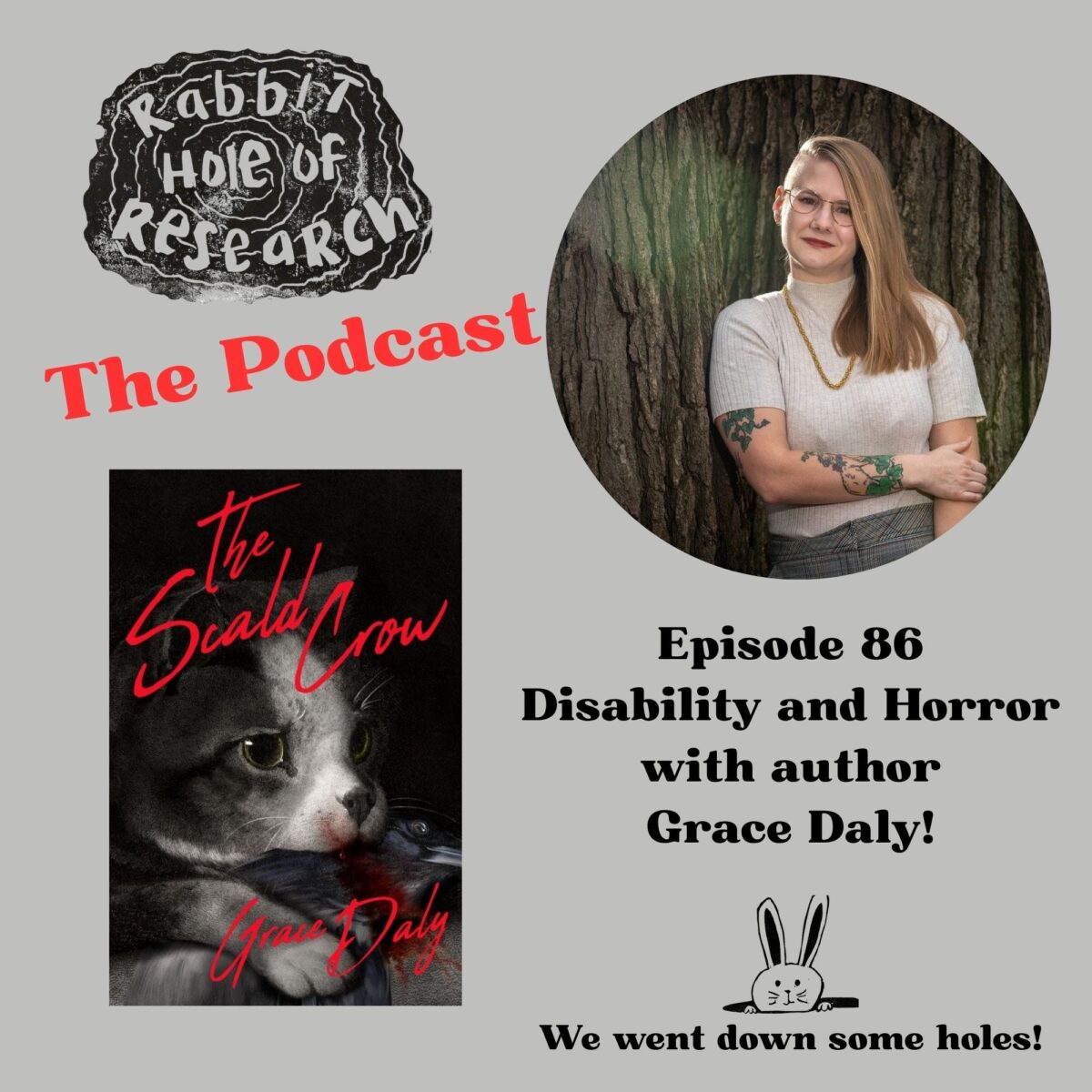
The crew digs into what horror gets right and wrong about disability representation, aging, chronic illness, eugenics, pregnancy, and ableist tropes.
Substack, Apple, Spotify, YouTube, Amazon
Episode 86 Transcript
In Episode 86 of the Rabbit Hole of Research, Joe, Georgia, and Mary (Nick had an emergency) are joined by Bram Stoker-nominated horror-comedy writer Grace Daly to dig into one of horror’s oldest and laziest shortcuts: the different body as a signal of danger, evil, or tragedy. From ableist tropes and chronic invisible illness to eugenics, pregnancy horror, and the potential and ethics of gene editing, we explore what storytelling gets right, what it gets wrong and that a different body means danger.
And don’t worry, Nick will be back next episode!
Where to find Grace Daly:
Order The Scald-Crow (Bram Stoker-nominated debut)
Grace’s upcoming books
- The Star of Kilnaely (pronounced ‘kill-nay-lee’) – A fantasy/comedy novella set in a fantasy version in of the American Midwest, told in short stories inspired by both American and Irish folk music and tales, The Star of Kilnaely explores the beauty found in local ecology, community, and legends. Perfect for fans of The Princess Bride or Terry Pratchett. You just might find you live closer to Kilnaely, and to magic, than you think. Releasing November 17, 2026.
- Escapist Fiction (Pre-order Now) – Ostensibly about an alien hivemind that overtakes people’s bodies when they become too involved in the escapist media they are consuming, Escapist Fiction is an adult pick-a-path style novel with increased intensity: not only will you make choices, but you will be asked to solve puzzles, smear food on the pages, decorate paper dolls, stab the book, rip the book in half, and more! Ideal for fans of tabletop role-playing games, Black Mirror, video games like The Stanley Parable and Doki Doki Literature Club, and, of course, the classic Choose Your Own Adventure series. Releasing with Agita Publishing on February 16, 2027.
Georgia and Jim’s Touch of Noir 2027 Wall Calendar —
12 months of all-original art by Jim and Georgia; orders are open now, with mailing expected in September
Check out what the RHR crew is creating:
Joe:
- Named by the Guild Literary Complex as one of the 35 Writers to Watch!
- Red Line: Chicago Horror Stories Anthology featuring a story by Joe!
- Joe’s Sci-fi physiological thriller Novel: Will You Still Love Me If I Become Someone Else?
- Joe’s Rom-Com Novella: Tomorrow May Be Too Late
Future Events to Hang with the Crew:
Podcast Cross-Appearances
- Joe on GoIndieNow: 21grams with Joe Compton talking about villains.
- RHR Crew on This Podcast Will Change Your Life with Ben Tanzer
Events & Conventions:
Joe:
- Art show Ultrastructure: Science is Fun, with Carol Estes at Promise You Art House in Highland IN, October 10th, 10-3pm
- Family Day: Seeing the Invisible World to Build a New One; in conjunction with the fall exhibition: teamLab: Everything Exists in Infinite Continuity, at the Smart Museum of Art In Hyde Park, IL, Nov 14th, 11-3pm
- Art and Science lecture about Zombies: Dec 10thGeorgia:The inaugural 4th Street Print Fest at Chesterton Art Center on Saturday, October 3, from 1–4 PM
It’s Science for Weirdos
Want to support the show? Tell your friends. Follow us on social media, Discord, share the podcast, and let us know what topics you are excited about. Leave a Comment. And for email alerts sign-up for the Substack newsletter and never miss an episode, exciting updates or the bonus images we talk about on the episodes.
We discussed these questions on the episode and now want to Hear From You (leave a comment):
- Do you have a favorite horror film or book that you think gets disability representation right or spectacularly wrong?
- Has a chronic illness, injury, or disability, temporary or permanent, ever changed the way you experience or think about horror?
- If gene editing could edit out a condition that caused you intense pain but also reshaped who you are, would you do it?
Drop your thoughts in the comments. We read them all, and your ideas often shape future episodes.
Future Episodes
- Episode 88: CraziesRecorded at Reed’s Local with Melissa and Luc
- Episode 90: Witch PleaseGuest: Bill Halliar (@skeletongue)
For more stuff (Images, Episode Highlights, events, etc), subscribe to our Substack newsletter!
Show Notes & Fun Facts
Stuff crew said they’d put in shownotes
- zinebakery.com — Georgia’s find on horror and disability, including a disability representation analysis tool for film and a resources list
- Bodies of Horror podcast
- Jeremy the Dud — Australian comedy short film that flips disability tropes
Books:
- Frankenstein — Mary Shelley
- The Strange Case of Dr. Jekyll and Mr. Hyde — Robert Louis Stevenson
- The Phantom of the Opera — Gaston Leroux
- I Am Legend — Richard Matheson
- Flowers for Algernon — Daniel Keyes
- Rosemary’s Baby — Ira Levin
- The Silence of the Lambs — Thomas Harris
- Baby Teeth — Zoje Stage
- Blindness — José Saramago
- Such Sharp Teeth — Rachel Harrison
- Brave New World — Aldous Huxley
Films and TV:
- Freaks (1932)
- Whatever Happened to Baby Jane? (1962)
- Rosemary’s Baby (1968)
- The Silence of the Lambs (1991)
- Jacob’s Ladder (1990)
- The Sixth Sense (1999)
- X (2022)
- A Quiet Place (2018)
- Hush (2016)
- Evil Dead (1981)
- The Shape of Water (2017)
- The Voices (2014)
- The Substance (2024)
- Novocaine (2025)
- Primate (2025)
- Silver Bullet (1985)
- Omega Man (1971)
- I Am Legend (2007)
- Blindness (2008)
- GATTACA (1997)
Fun Facts to Impress Your Friends With or Win Trivia:
- Endometriosis and Adenomyosis are conditions affecting an estimated 10% of people with uteruses — Endometriosis occurs when the uterine lining grows outside the uterus on the fallopian tubes, ovaries, bowel, and in extreme cases as far as the brain, continuing to shed monthly and causing internal bleeding, profound pain, and inflammation. Adenomyosis is similar but the uterine lining grows into the walls of the uterus itself, causing it to become severely misshapen. Despite the level of physical agony involved in these two chronic diseases, the average time to diagnosis is 7 years for endometriosis and 10 years for adenomyosis, largely due to medical gaslighting and systemic underinvestment in women’s health research.
- The PTSD diagnosis didn’t exist until 1980 — the condition was known as “soldier’s heart” in the Civil War, “shell shock” in WWI, and “combat fatigue” in WWII. It took a political advocacy movement by Vietnam veterans, feminist groups, and Holocaust survivor organizations to get it formally recognized in the DSM-III.
- Your threat-detection system is faster than conscious thought — the amygdala processes fear responses in as little as 74 milliseconds (documented in a study published in Nature Neuroscience by Méndez-Bértolo and colleague), well before your rational brain has time to remind you that you’re sitting safely on your couch reading a book.
- Buck v. Bell, the 1927 Supreme Court ruling that upheld forced sterilization of disabled people, has never been formally overturned — The U.S. Supreme Court ruled 8–1 that a state could legally perform compulsory, forced sterilization on individuals deemed “feeble-minded” or mentally defective without violating the Fourteenth Amendment’s Due Process Clause. An estimated 60,000 to 70,000 Americans were forcibly sterilized under these state programs, disproportionately targeting the poor, minorities, and institutionalized individuals. While later rulings—such as Skinner v. Oklahoma(1942)—undermined its broader application, Buck v. Bell has never been formally or expressly overturned by the Supreme Court, though modern constitutional standards on bodily autonomy render its core premise obsolete
- Ehlers-Danlos syndrome (EDS) is a group of heritable connective tissue disorders affecting collagen production — collagen is the structural protein that holds your joints, skin, and organs together, so when it doesn’t work properly the results range from hypermobile joints that dislocate easily, to chronic pain, fatigue, and in severe cases life-threatening systemic complications.
Episode Highlights
00:00 — Basement Roll Call
Nick is out with a family emergency, but Joe, Georgia, and Mary (on Zoom) kept the show going.
00:46 — Meet Grace Daly
Grace introduces herself as a physically disabled horror-comedy writer whose debut novel The Scald-Crow is a Bram Stoker nominee.
02:07 — Disability as Horror Shortcut
Joe reads the open and Grace responds with a poetry slam snap — “You kind of just did my job for me right there.”
04:11 — Classic Tropes and Slashers
Grace breaks down the major disability tropes in horror — Tiny Tim, inspiration porn, disability as evil marker — and calls out A24’s X as a recent offender.
08:11 — Better Representation Examples
Grace highlights Ash’s chainsaw prosthetic in Evil Dead, Elisa in Shape of Water, and Baby Teeth as examples of disability representation done right.
09:27 — PTSD and The Voices
Joe connects Jacob’s Ladder to the history of PTSD diagnosis, and Grace praises The Voices while noting the uncomfortable reality that its schizophrenic character is still the murderer.
15:11 — Cures, Fixes, and Models
The crew digs into the medical model vs. social model of disability, Flowers for Algernon, and the horror genre’s obsession with the off-screen miraculous cure.
18:51 — Deaf Culture and Gene Editing
The cochlear implant debate and the case of deaf parents who wanted a deaf child, leading into the ethics of gene editing disability out of existence.
23:16 — Invisible Illness and Diagnosis
Grace shares her experience of years of medical gaslighting as a woman with chronic invisible illness and connects it directly to The Scald-Crow.
25:01 — Endometriosis Explained
Grace breaks down endometriosis and adenomyosis — what they are, how severe they can be, and why diagnosis takes an average of 7 to 10 years.
31:28 — Pregnancy Horror and Agency
The crew discusses pregnancy as a horror device, with Grace making the case for Rosemary’s Baby as one of the rare examples that handles female agency and medical gaslighting with real intention.
37:40 — Temporary vs. Permanent Disability
Grace draws the line between pregnancy horror and chronic disability representation, noting that the unending nature of permanent disability is rarely captured in fiction.
39:58 — Achilles Injury Perspective
Joe recounts tearing his Achilles tendon and what a temporary disabling injury taught him.
44:20 — Dynamic Disability Reality
Grace explains dynamic disability, conditions where symptoms fluctuate hour to hour, and why the wheelchair user who can stand for short distances confuses everyone at Disney World.
46:41 — Writing Disabled Characters
Joe asks Grace how to write disability well and gives a shout-out to Seanan McGuire as a model for getting it right.
48:05 — Writing Disability Respectfully
Grace’s practical advice: consume media from within the community, know the tropes, humanize your characters, and always use a sensitivity reader.
49:01 — Tropes and Sensitivity Readers
Grace emphasizes that even when a disabled character does something bad, the disability itself should never be framed as the source or signal of the evil.
51:28 — Teratogens and Environmental Harm
Joe breaks down the difference between carcinogens and teratogens and connects environmental racism, Cancer Alley in LA, and Flint MI.
54:31 — Eugenics and Genetic Inheritance
Grace shares her personal experience with Ehlers-Danlos syndrome, a 50% heritable genetic condition, and the deeply personal question of whether it’s moral to pass it on.
59:21 — CRISPR Identity Questions
The crew wrestles with what CRISPR editing means for identity — Grace notes she wouldn’t have written The Scald-Crow if she hadn’t been disabled.
01:02:27 — Blindness and the Able-Bodied Savior
Joe and Grace dig into Saramago’s Blindness, the National Federation of the Blind’s critique, and why the sighted doctor’s wife as sole savior is the able-bodied savior trope in plain sight.
01:08:13 — Resources and Representation Checklist
Georgia shares zinebakery.com’s disability representation analysis tool and the Bodies of Horror podcast, and reads the six-point checklist for evaluating disability in film.
01:13:53 — Flipping Disability Narratives
Joe brings up I Am Legend and Grace recommends the Australian short film Jeremy the Dud as an example of flipping who gets to define “disabled.”
01:17:49 — Movies That Get It Right
Mary asks Grace for horror films that get it right — Grace praises Novocaine for its portrayal of invisible disability, and gives props to Hush, A Quiet Place, and Primatefor their Deaf representation and disabled actors.
01:24:38 — Wrap Up and Upcoming Books
Grace plugs The Scald-Crow‘s Bram Stoker nomination, previews The Star of Kilnaely(November 2026) and the wildly interactive Escapist Fiction (February 2027), and the crew signs off.
“Stay curious, stay safe… Love Y’all!”
Join Rabbit Hole of Research on Discord: https://discord.gg/2nnmKgguFV
Subscribe and Share our Substack newsletter to get email updates, never miss an episode, and spread the word!! Don’t forget to give us 5 stars or a like!
Transcript
00:00:00 joe: Hey, welcome back to the Rabbit Hole of Research down here in the basement studio. We are not crewed up down here this week. You do have me, Joe. We’ve got- Georgia … we’ve got Georgia. We’ve got- Mary … we’ve got Mary, and Mary’s not in studio. She’s on Zoom. And a familiar voice is, if you’ve been listening to the pod is missing, and that’s Nick.
He, um,
[00:00:28] geo: Oh. He unfortunately
[00:00:29] joe: couldn’t be on, on the show during the recording. He had a family emergency-ish kind of thing happen. So, we- the show goes on, and he will be
[00:00:38] geo: love you,
[00:00:39] joe: We do. We miss you. fans
miss you. They might turn it off now. “We’re only here
for Nick Like…
Those
[00:00:44] geo: point.
That is a really good possibility.
[00:00:46] joe: We do have a very special guest, so I wanna go ahead and let Grace introduce herself
[00:00:54] grace: Hi my name’s Grace Daly. I’m really excited to he- to be here, bleh. I [00:01:00] am a horror comedy writer. I also do some fantasy comedy and some sci-fi comedy, but everything I do is a little funny and a little silly. I am physically disabled by chronic invisible illness, and all of my writing involves disabled characters.
My debut novel, The Scaldcrow is a Bram Stoker nominee and focuses on the experience of living with invisible chronic illness and undiagnosed chronic pain
[00:01:27] joe: Yeah. Thank you. And so, yeah Grace and I, we met at an author event, and I told her about the podcast, and we were just chatting, and she says, “Oh, you should do an episode.” So we’re here. We’re here to talk about disability in horror, and it’s something that I hadn’t really thought about, maybe like on the surface, but it was interesting, so I’m really excited to dig in to this topic.
As everyone knows who listens, I have my open. I know Mary really loves the open, so, just
[00:01:59] geo: [00:02:00] She’s
[00:02:00] joe: here in studio to give me the look, so I get to… Yeah, so it’s just
[00:02:04] geo: me And-
[00:02:05] mary: Fine. Okay
[00:02:07] joe: Yeah, so we’ll set the stage for everyone. Your brain has been programmed through millennia of evolution to be tribal and cautious of the other.
The uneven gait, the scarred face, the eyes that don’t work right, the voice that chitters, the valley of uncanny flesh, and something in your lizard brain responds faster than your rational brain can process that you are safely sitting in the comfort of your living room, watching or reading fiction.
Horror didn’t create that response. It’s our built-in flight or fight threat detection system that’s been running in the background since before we had language. A system that was never designed to be rational, only fast. What horror and sci-fi did was figure out how to exploit that reflex, and a good storyteller weaves a story that has us sleeping with the lights on.
But the lazy writer figured they could exploit our physical differences [00:03:00] for a cheap jump scare. Define normal and point a camera at a wheelchair, a tremor, a mind that doesn’t work the way the audience’s does, and can get the same valley of uncanny flesh response in them. And now we have to undo 200 years of storytelling that exploited the plot shortcuts of the different body is a thing you should be afraid of.
What does it cost all of us when a genre teaches over and over that a different body means danger? And what happens when a person the genre spent two centuries using as a prop decides to write the horror themselves? So that’s,
[00:03:35] geo: That’s it.
[00:03:35] grace: I’m doing like a poetry slam snap
in case if it’s not
[00:03:39] geo: Yeah.
[00:03:40] joe: Yeah. No, so
[00:03:42] grace: in audio
[00:03:42] joe: yeah. As I was putting my notes together and doing research I kinda really thought about it like I said, I didn’t really think about how people and disabilities are used as a prop in fiction. So I’ll let you go ahead if you wanna jump off Grace, and it sounds like you, you were [00:04:00] snapping there, so you
[00:04:00] grace: was so excited. Yeah. I mean, you kinda just did my job for me right there.
[00:04:05] joe: that’s a good host, right? No.
[00:04:08] geo: host, right?
[00:04:08] grace: Yeah, that’s beautiful. So yeah, so historically disability has not been presented in fiction in particularly positive lights. There are a series of tropes that a lot of fiction including horror, tend to kind of fall into.
One that’s really familiar to a lot of people is the Tiny Tim phenomenon, where s- a disabled person is expected to be kind of this this very gentle, cute and childlike figure who is serving basically as an inspiration to able-bodied people to be a good person and, and to be generous.
Another common one, again, disability as inspiration, is a disabled person who is [00:05:00] inspiring to the protagonist or to an able-bodied character because they’re doing something pr- pretty normal, it’s usually not a disabled person who, goes and, wins the Olympics or writes a bestselling novel.
Usually when it’s structured this way, it’s a disabled person who, goes to the grocery store or is a parent and then that inspires your able-bodied character to live their best life. The comparison I’m thinking of immediately, and I don’t know if your listeners would know this reference, but a little bit like a women in refrigerators phenomenon, like in comic books, where women are killed to inspire the male protagonist to go, fight the villain.
A lot of the times a disabled character will overcome something or will suffer in some way to inspire the able-bodied character to do something. But another really common trope that Joe just pointed out is disability as a marker or [00:06:00] as a signal of either latent or overt evil and wretchedness.
And obviously this is pretty present in historical depictions of horror. Especially the slasher era of the ’70s and ’80s had a lot of that, with Leatherface and Jason Voorhees. But it’s still happening in a lot of modern media. The one that really stuck out to me and that I didn’t hear a lot of outcry about, which was kind of surprising to me because it was so popular, is in A24’s X that came out in 2022.
I watched it expecting, … Oh, I don’t know what I was expecting. I wasn’t expecting so much of the horror to come from just a- old woman being old and disabled,
[00:06:51] geo: Right.
[00:06:52] geo: The old ro- the old woman the old hag the… Is in so many m- [00:07:00] movies,
[00:07:00] grace: Yeah, in so, so, so many movies. And actually if we go like way, way back, like into the early 1900s and even like the late 1800s a lot of the times disabled figures in like horror works were more framed as tragic figures of pity. Like Frankenstein’s monster,
[00:07:19] joe: or a monster. Mm-hmm. Phantom of the Opera was
[00:07:21] grace: yeah, Phantom of the Opera Hunchback of
Notre
[00:07:23] joe: Dame, yeah, Quasimodo.
[00:07:24] geo: and Quasimodo. Mm-hmm Yeah.
[00:07:25] grace: yep, Quasimodo. 1932 had T- Todd Browning’s Freaks,
[00:07:30] geo: I was gonna, I was, yeah, I was gonna bring up Freaks,
[00:07:34] joe: Yeah. Yeah
[00:07:35] geo: I’d love to hear what you think of Freaks. That
[00:07:37] grace: Oh, well, what’s really interesting about Freaks is that it actually had a pro- predominantly disabled
[00:07:44] joe: I
[00:07:44] geo: Exactly.
[00:07:45] joe: of the first
[00:07:46] grace: Yeah, so something that you see in a lot of modern media, even when there is the rare disabled character the cast members themselves won’t actually be disabled.
And I don’t know, I mean, it’s the year of, our Lord, not that I’m [00:08:00] religious, but it’s the year of our Lord 2026, and in 1932 they were doing a better job of actually hiring disabled actors than we are these days. And that’s not to say that there aren’t really cool representations of disability in horror.
One of my absolute favorites is for movies, obviously there are deaf characters in A Quiet Place and Hush, both of which are really cool. One that’s a little older that I really love is in Evil Dead, Ash loses his hand and just, you know- Oh, yeah … what a prosthetic with that chainsaw.
[00:08:35] joe: chainsaw. Yep.
[00:08:38] grace: You gotta love that sort of disability representation. Elisa in Shape of Water by Guillermo del Toro is a really cool disabled character. I really like Elisa, especially because her disability not only impacts her character, but it also directly impacts the plot, and she’s able to [00:09:00] interact with, the monster in a completely different way that none of the other characters even think to attempt because of her disability.
And then in literature, I really recently enjoyed Baby Teeth by Zoje Stage which features a main character who has Crohn’s disease and is deeply impacted by this invisible disability that she’s struggling with. And there’s, I mean, there’s lots of other cool stuff too.
but
[00:09:27] joe: To throw in there is and see how you feel, Jacob’s Ladder. I thought especially with the PTSD because that disorder was one that wasn’t recognized at first, and it kinda went through a lot of,
[00:09:40] geo: of,
[00:09:40] joe: historically, it was kind of this thing, soldier’s heart in Civil War time or shell shocked in World War I- Mm-hmm
combat fatigue in World War II, and it was never really diagnosed un-
[00:09:53] geo: And that-
[00:09:53] joe: Oh, you were- A while. Yeah. I was gonna say until the until the ’50s and ’60s, where they kinda started to put some [00:10:00] descriptors around it. And then Vietnam War happened, and that was not politically,
[00:10:05] geo: And they talked about Agent Orange in
[00:10:07] joe: Yeah, the whole thing where the veterans, Vietnam veterans, came back, and in doing some research, they, they worked alongside feminist advocates who were working on rape trauma and Holocaust survive- survivor groups organized politically to demand recognition for PTSD as a diagnosis.
And so it was really like it, it wasn’t just they knew this scientifically this was happening, but it took a political movement- Yeah … and advocacy for this to be recognized. And the thing in Jacob’s Ladder, you did have… He was a Vietnam vet, and you had this kind of… He had all this disassociation kind of trauma, P- the PTSD trauma that he was having there, and it was
[00:10:49] geo: well- And it worked really well. Yeah. The very unreliable- Narrative … Like you really… And also that, but also I, I think horror [00:11:00] really lends itself to talk about men- mental illness or mental not even mental illness, but mental issues because have you seen Voices?
The movie
[00:11:10] grace: have not seen Voices
[00:11:11] geo: Oh it’s so well done. It’s so disturbing. But
[00:11:15] grace: look it up
[00:11:16] geo: it really gets into, I think he had, what, did he have schizophrenia?
[00:11:21] joe: I think so, yep. Yep.
[00:11:22] geo: But it, and it’s what’s
[00:11:24] grace: Oh, is this the one starring Ryan
[00:11:26] joe: a little scary, but I
[00:11:27] grace: I
have seen Voices. It’s amazing.
[00:11:29] geo: is really amazing.
[00:11:31] grace: the title of it.
[00:11:32] geo: Th- Yeah … I think that’s one of the only times you really get an insight.
It was just so well done. Yeah.
[00:11:39] joe: And you move the
narrative up-
[00:11:41] grace: my one criticism of Voices, and this isn’t necessarily a criticism of Voices the film in isolation, but we are running into, again, the disabled person as monster problem in
[00:11:56] joe: gonna say.
[00:11:57] geo: Right,
[00:11:58] grace: On its own, it stands [00:12:00] alone as a really interesting movie. But I can’t think of another movie with a schizo- of another horror movie with a schizophrenic character at all.
The only one I can think of is Voices. And spoiler alert for anyone who hasn’t seen it, the schizophrenic guy’s a murderer. So one of the things- Thank
[00:12:23] geo: but you do really kind of re- not relate.
[00:12:26] grace: him much better. He’s
not just, like,
[00:12:29] joe: not a mas- yeah, he’s not a Jason or Michael Myers
who-
[00:12:33] geo: And he’s very human. And he’s
[00:12:35] joe: and you have that. yeah. But
you’re right.
I was gonna, that was my, I was gonna bring that up that … it’s still one where mental, most people- with mental disability, with n- neural diversity aren’t violent people, right? I mean- Statistically they’re no more violent than anyone else in our society, but they get
portrayed,
[00:12:53] grace: actually if you look at the data folks who have mental illness are much, much more likely [00:13:00] to be victims of
violent
[00:13:02] joe: Exactly right. Yep, that’s
[00:13:03] grace: of violent
[00:13:03] geo: Exactly. Yeah.
[00:13:05] joe: other thing I… Oh,
[00:13:05] grace: this… Oh, sorry,
I was just gonna say, and this does dovetail very nicely into The Scald Crow. My main character in The Scald Crow does have very clearly cPTSD, which isn’t technically in the DSM, but it’s pretty well-established.
So complex PTSD, which for the listeners is distinct from, your more classic PTSD, because your classic PTSD is usually formed by one very high-stress episode. So a car crash, you’re in the trench with your best friend and he gets blown up, a one specific, one specific moment.
Whereas cPTSD is developed when somebody suffers a traumatic situation over and over and over and over again, oftentimes a lower trauma than a car crash or an explosion, but consistently exposed. And they’re not [00:14:00] able to properly stand up for themselves, defend themselves, and actually protect themselves from the danger that they’re experiencing.
And my main character, Briege, in The Scald Crow, is physically disabled but does also clearly have cPTSD that impacts her. And she is not a murderer, so
[00:14:20] joe: Yeah, that’s
good. Very good
[00:14:22] geo: Yeah. Right. It’s one of
[00:14:23] joe: Yeah, no. You’re right. It’s one of these things that you have. And I wanted to say you used the acronym, and I might have used it too DSM Diagnostic and Statistical Manual that they go through and they
[00:14:33] geo: evaluate- And that is a very, just that topic all by itself is fascinating.
Just like how that came about and what ends up in The and it’s so political and so- Yeah …
[00:14:46] joe: What you’re gonna cover, what you’re gonna take care of because you think you got veterans you now have to take care of them and so now if they have a diagnosis, then you have to treat them for that diagnosis.
If you… But then you can, if you write the rule book and say, “Well, this isn’t [00:15:00] really a
[00:15:00] geo: And it’s all a matter of-
[00:15:02] joe: then you don’t have to treat it. And so
[00:15:03] geo: it’s all a
matter of numbers and codes that get used, whether the insurance will pay for this or that. Right.
[00:15:10] joe: So- But
[00:15:10] grace: Oh, definitely
[00:15:11] joe: say speaking of cure zones, we talked about this. I always think one, the other thing is we’re talking about like trope-y things. One is the fix. So you have the horror and I, and one, we talked about this the other day, Jordan and I have just by chance I was putting things together and Flowers for Algernon, which I think
[00:15:29] grace: I love
[00:15:30] joe: it’s very… It is, it’s such a great… And if people haven’t read it, it’s just so one of these stories where you have a person with a mental disability- Yeah … and then they’re, and then they’re fixed they- by this special treatment. Right And you’re rooting for them and they’re, spoiler alert, they’re not violent or anything like that.
But it’s like the, it, you have a disasterous end. So it, it follows the H- the Jekyll and Hyde kind of thing too, where you have someone that’s unstable, they’re trying to fix their own problem, and [00:16:00] then you’re using that as the plot device to drive the story forward and, this false cure kind of thing that, that f- we’re gonna fix you to make you normal instead of recognizing that the normal is a, is some sort of range and not always- Yeah
not always
[00:16:19] grace: Flowers for Algernon does it very beautifully. But yeah, you’re right that another common trope of disability in media is that the … A- and this is actually a societal opinion of disability too. It’s usually described as the medical model of s- disability versus something like the social model or the humanist model.
The medical model being that disability is a medical issue. The only way it should be addressed is to cure the disability, fix the disability, make the person normal. If they can’t be made normal, it is a failure. They are a failure. And it’s really problematic for a wide variety of reasons.
[00:17:00] But yeah, that shows up in fiction a lot too. Another horror trope disability horror trope that I see a lot that I think is kind of related to the medical model, or I think it holds hands with the medical model in that sort of every disability should be fixed trope is one where you see this so much in horror.
People suffer all of this incredible physical violence and emotional trauma and just, just are totally torn apart. And then the book ends, the movie ends. There’s the little scene of everything, and
they’re fine. There’s no …That the miraculous cure that just kinda happens off screen and off page is one that’s always very funny to me because that’s not at all how, our bodies function.
But yeah the kind of drive for cures and the drive for fixes is a really interesting thing in fiction. And as for me as a disabled person, it’s one I really struggle with a lot because my conditions [00:18:00] involve a lot of physical pain and a lot of limitation. And so sometimes you do hear disability rights advocates arguing very strongly that they don’t want a cure, that they are perfectly content the way they are.
And I’m … Like, two thumbs up for those people. I’m so glad that they have that level of, self-love, self-acceptance and that, they’re able to feel that way. I really struggle with perceiving my disability in that light, I think because it causes me so much physical pain.
And so this is an interesting point of, I don’t wanna say conflict in the disability rights community, but it is an interesting point of push and pull. Yeah of, is it
right, is it moral to want to be cured?
To stop being disabled
[00:18:50] geo: areas I
[00:18:51] joe: I saw in just researching up this topic was in the deaf community.
[00:18:55] geo: was gonna say- we talked about this recently … and
[00:18:58] joe: cochlear
[00:18:59] geo: [00:19:00] several
times we’ve talked about this recently.
[00:19:02] joe: And some of the th- I mean, ’cause this gets into implants, and we can we’ll probably get into prosthetics and things like
[00:19:08] geo: And also the gene editing,
right?
[00:19:10] joe: Gene
editing where they’ve now edited out back in function. And so I know there’s a lot of people in the deaf community who are advocates because there’s a culture and the aligned ALS and, this is one of the things that’s really rich, and so they advocate against not using cochlear implants in young children.
Let them… Right. And so it’s this whole,
like-
thing why- Well, but- You’re fixing, we’re fixing the problem.
[00:19:35] geo: was also- “… but really-” You said there was a case where the parents were both deaf, and they wanted their child to be deaf. Right. Wasn’t that one
[00:19:43] joe: that was- That’s right. There was, there were case- Yeah
yeah, there was cases like that where it was this argument made that we, we’re a deaf family and this is our culture, and this is our- But it- … way of life, and that’s, why is this not normal in this, and it’s not… I think the pain one is really interesting ’cause that’s a physical almost [00:20:00] impairment that you have to deal with, and that affects so much of your life, whereas maybe some of these other ones are, they don’t involve physical pain, which I think physical pain is always
[00:20:10] grace: Physical
pain, yeah.
And it’s not just pain. I also get brain fog. I get incredibly dizzy. I faint. I’ve got these, episodes of systemic anaphylaxis where I really could die. And so one of the things that’s so important to remember when we talk about disability, and one of the reasons why I love disability representation so much, and why I think it’s so important, and why I’ve made it the focus of my writing, is because disability is not a monolith.
The
[00:20:35] joe: That’s right. Yeah, exactly.
[00:20:37] grace: say that, like- Right … every woman feels this way,
[00:20:41] joe: right.
Right, Right,
[00:20:43] grace: Yeah,
[00:20:43] joe: a community, yeah, and you have that and no, I think
[00:20:46] geo: it’s- Well,
it’s on an individual basis. Every
single individual, how
they’re-
[00:20:51] grace: it’s also interesting because it’s really the only minority group that you can join at any time, and that the [00:21:00] vast majority of people will one day join. I often joke that death comes for us all, disability comes for most of us. It came for me a little earlier.
[00:21:10] joe: Yep. No, it’s-
[00:21:12] geo: And I recently saw a quote, and I’m not gonna get it right, but it was something like, “I don’t have the luxury to have a disability.” I mean, and it was an interesting quote because it was like healthcare, like this person had no healthcare, and like it was just so… That, I don’t know, that was just struck me like-
[00:21:30] joe: Yeah, And it’s, I mean, to pull back into fiction a little bit I mentioned in my open, it’s just lazy. You can… It’s very easy just to use that, even the fix, because all the stories are about fixing.
It’s not about… I mean, you could write a great story about the fix and how you’re interacting now with your friends who might not have. They might be on the other side of the fix, and they might not wanna be, quote-unquote, “fixed,” and how you, your whole life would change in that. Usually, it dives into you become a psycho, or you become, [00:22:00] unstable emotionally, or you become…
It’s all this, it becomes very horrific and horrible, and it’s what are we warning against? And I think some of it is warning or not wanting to, become disabled. And then we have stigma built in oh, when you get old, I don’t wanna wear glasses. I don’t wanna, I don’t need a hearing aid.
And then these things have even, now there’s links that people who don’t treat their hearing loss or get hearing aids at earlier age, that may lead to Alzheimer’s and things like that. We’re starting to see now other ramifications of this kind of cultural, stig mating,
stigmatizing-
[00:22:36] geo: Stig mating. Ooh …of these lenses. that’s a new, that’s a new one.
[00:22:40] joe: When we stig mate lenses, you stig mate
[00:22:42] geo: Oh,
[00:22:43] joe: I’m a-
[00:22:43] geo: I
like that. I kinda like
[00:22:44] joe: that I’m
an electron microscopist, so it’s like I don’t wanna stig mate the lens, no. But you have this it, you have this happen, and then people don’t take care of themselves.
They ignore problems because they don’t want to, because we’ve been taught through our media and through our culture the [00:23:00] l- culture at large, that this is something to be fearful of. And if it happens to you, you’ll be on the outside looking in and not able to participate. So I think it’s this really it was interesting.
[00:23:11] grace: Oh, and there are so many interesting social ramifications and thought experiments too with that. Like trying to decide, who is… One topic that I feel like comes up a lot is who’s worthy of healthcare and who is worthy of receiving care, if two people need a liver transpa- plant and, one of them’s an alcoholic and one of them isn’t, is kind of like a clear classic example. But you can see this happen a lot subconsciously particularly in cases of chronic invisible illness. I’m kinda like connecting it back to Skull and Crow again.
But there is this feeling that I… I mean, I experienced this a lot. It took me a long time to get a correct diagnoses after symptom onset. And there is this implication you [00:24:00] get as a person who has an invisible illness, but especially as a woman who has a dis- invisible illness or, assigned female at birth person who has invisible illness, that you’re anxious, you’re a hypochondriac.
And because you are a woman and you’re expected to be anxious and you’re expected to be melodramatic, you are less deserving of care. There’s also a expectation that women and people who have uteruses experience a lot of pain. And when I say the expectation, I’m talking about in medicine, for gynecological procedures and for women’s healthcare.
I have among my many diagnoses, I have endometriosis and adenomyosis. And it was not unusual for
[00:24:51] joe: before you go on, just for
[00:24:52] grace: Oh, sorry. Should I explain what
[00:24:54] joe: Yeah, please do. Yeah, so that we can educate a little bit
[00:24:57] grace: of course. Sorry, I’m, I talk about them [00:25:00] so much I forget. So endometriosis and adenomyosis are very common health conditions that impact people who have uteruses, women.
E- estimated to be about 10% of people have one, or of people with uteruses have one or the other condition or both. Endometriosis is when the lining of your uterus grows in places outside of the uterus. So you’ll have endometrial t- put tissue that grows on the fallopian tubes, on the ovaries, on the bowel.
But it’s found, it has been found as far away as in women’s brains. So it can be like a full body thing. W- and when I talk about this uterine lining, it’s not just a one-time thing. It’s not like the lining grows and then, whatever. You continue having a menstrual cycle with this lining. So the lining grows and sheds and grows and sheds every month, [00:26:00] resulting in just, interior bleeding profound pain and inflammation.
There are all sorts of, involvements of other systems. Frequently, bowel problems are highly correlated. Hormonal issues are highly correlated. It’s not rare for it to get so bad that different organs are fused together by the endometrial tissue growing in the wrong places.
Oh my God. So you know, your bowel fused to your uterus or your ovaries or something. That’s not uncommon. Adenomyosis is a very similar condition with where the uterine lining, the endometrial tissue is growing into the wrong place, except for instead of growing outside the uterus improperly, it is grows into the walls of the uterus.
Ooh. Again, where it is not supposed to be. It causes the uterus to become, incredibly misshapen. The lining continues to shed into the muscle walls of the uterus. It’s not supposed to be there. Incredibly painful. Causes all sorts of, wide-ranging complications. And [00:27:00] 10% of people with uteruses have these conditions, and it takes, on average…
I have the exact numbers written in the afterword of Scald Crow, but I believe the average time for diagnosis is seven years for endometriosis and 10 years for adenomyosis. Oh, wow. Which, yeah, is unconscionable- Yeah … Because the… I cannot overstate the physical agony. And I remember talking to one of my male friends once when I was just in such pain.
I mean, couldn’t stand up, puking on the floor level pain. And I had one of these episodes, and then I was talking to him later. And I didn’t go to the ER because this happened to me every month s- often- Oh my God … many times a month. Oh, God. And I had gone to the ER before, and I would get treated like I was drug-seeking.
I would go to gynecologists and be told that it seemed like, I was [00:28:00] anxious. I would be told to try birth control pills. I tried, I think, 12 different types of birth control, none of which effectively controlled my symptoms, and in fact, made me way worse due to complications with my genetic disease, Ehlers-Danlos syndrome.
And then I wasn’t believed about those complications either. And it’s just this kind of horrible merry-go-round. And I remember talking to one of my male friends after one of the episodes and saying, “Is there any-” any physical symptom you could have that caused you this much pain where you would be dismissed by a doctor?”
And he said, “No, I can’t think of a single thing,” and what’s really crazy is a lot of women I’ve talked to have experiences like this, and every woman [00:29:00] I know has a close friend or a family member who has experienced exactly what I just described. This is not a rare thing. And so it’s really crazy when I talk about, who deserves healthcare.
Again, the one we always think about is well, who’s gonna… Who deserves the organ transplant? Who deserves to live? But who deserves pain control, who deserves to be taken seriously when they go in?
[00:29:29] geo: Well-
[00:29:29] joe: And have that. And I was gonna point out, and this has come up in, I think with Sai in the heart episode just how underfunded and understudied women’s health is in general as you go through there. Just thinking about outcomes, li- health cardiovascular health, menopause, autoimmune
[00:29:49] geo: health,
[00:29:50] joe: none of this is… Right. Yes. Right.
[00:29:51] geo: I was gonna say, look at menopause
and all that stuff. I think that I’ve talked to several people that were nurse practitioners or and they said they only got a month. [00:30:00] They talked about menopause for a month in their studies.
[00:30:04] grace: Yes. yeah. Menopause is
famously unknown
[00:30:08] geo: so much,
[00:30:09] joe: a month in their studies. Right. Right. Yep. And, you know- Yep … it was like… And I was like- Yeah.
There’s so much research there, and I’ll point out ’cause Nick’s not here now, so there’s three, women I, that’s here. So I’m, I mean, so
[00:30:17] grace: Joe stands alone.
[00:30:18] joe: treading a little lightly here. I’m not gonna I have no… I
[00:30:22] grace: don’t think anyone’s gonna go, “What did you mean by
[00:30:24] joe: Yeah.
Right. Exactly. No. Yeah. I, I can… No, my only- I think
[00:30:28] grace: with
[00:30:29] joe: No. The only, I mean, only insight I have too is that I am a Black man person of color, and we also, you can go in pain and things like that. It’s “Oh, you’re much more tolerant.” there’s many racist studies that were done- Yeah
Thick skin studies, and these things have been taught into- Right … current, med school. People still believe this, and you have this, that women have a holler- higher tolerance of pain because of childbirth, and you’ve just stories in the last few years of Black women in particular dying in childbirth [00:31:00] because their pain management wasn’t tended to carefully, and
[00:31:04] grace: can’t remember exactly what the rate is. But yeah, Black women are so much more likely to die in childbirth. I do believe that the rate of Black women getting accurate diagnoses for endometriosis and adenomyosis is also even longer than white women. And disclaimer, you can, people can probably guess from my name, Grace Daly, but I’m white.
So It’s a very Irish name.
[00:31:28] joe: Yeah, and I was gonna say that, I mean, we’re speaking of women but birth is one of these that gets, in horror, it’s used a lot. Like that’s a trope that comes out- Oh,
[00:31:38] grace: Oh, yeah
[00:31:39] joe: so,
[00:31:40] geo: can be horrifying.
[00:31:41] joe: childbirth, Yeah,
Yeah, right. I have I’ve only,
[00:31:44] geo: I mean,
[00:31:44] joe: I- I’ve only been on the watching end of it,
[00:31:46] geo: of
[00:31:47] joe: it’s kind of…
But yeah, so. No but I was gonna…
[00:31:51] grace: pregnancy. One I always love is, and actually ironically written by a man, but Ira Levin’s Rosemary’s Baby. I know- Mm-hmm … [00:32:00] okay, it’s been out for 50 years, folks,
so s- spoiler alert, she
[00:32:03] joe: You can… On a show, you can spoil anything that’s 20 years or older.
[00:32:08] grace: Cool.
[00:32:09] joe: Other than that, you have to give a warning.
If it’s 20 years or older, you can, you don’t have to give a warning.
[00:32:14] grace: I don’t know
[00:32:15] joe: but yeah, so.
[00:32:16] grace: it was
la- it was that,
that came out last century, folks.
[00:32:20] joe: Right.
[00:32:21] grace: but yeah.
So, one of the things, so if you actually read Rosemary’s Baby, which I highly recommend folks do. It’s a very slim, it’s very well-written. I’m a big fan of that little novella.
But he does a great job of depicting Rosemary as losing so much of her agency once she becomes pregnant because she stops being viewed as a person and starts being viewed as a vessel.
[00:32:45] geo: right. Right, right,
[00:32:46] grace: and there’s like kind of this, you learn at the end, evil doctor character who she keeps going to visit this obstetrici- ob- obst- obstetrician, that’s a hard word for me. But she keeps going to [00:33:00] visit this OB and she keeps talking about her pain, and he keeps saying “Oh, it’ll be gone any day. It’ll be gone any day. It’ll be gone any day. It’ll be gone any day.” doing this kind of medical gaslighting, which is, also a theme in The Scald Crow and happens so frequently.
And there’s this one really salient moment, and I remember I loved it so much when I was reading the book, I took a picture of the page. And she’s decided to throw a party for her friends who aren’t in what we later learned is this Satanic cult, and she decides that she really wants to throw this party and see her friends.
She’s been cooped up because of this sickness and this pregnancy, and she hasn’t seen them for months. And her husband, who’s part of the Satanic cult, is like trying to dissuade her to do it and, from doing it, and he says, “Well, how are you gonna tolerate the pain?” And she looks at him and she goes, “Well, didn’t you hear?
The doctor say it’s gonna be gone any day.” And it was just this really beautiful moment of this, ill, disabled woman [00:34:00] taking her power and her agency back. And I really love that moment. It’s great. It’s great, Rosemary’s Baby.
[00:34:06] geo: I have to say it. Oh, sorry.
[00:34:09] grace: Oh, go ahead. No, go ahead, Georgia.
[00:34:10] geo: I just wanted to put a shout-out for the movie too, ’cause that’s my favorite movie or one of my top five favorite movies, so.
[00:34:19] grace: But,
[00:34:19] geo: What were you gonna say, Mary?
[00:34:21] mary: I’m also… Oh, gosh, I haven’t, I haven’t read Rosemary’s Baby in so long, but when you started to talk about it, I remembered, remem- And I think it was, like, the same party where she’s with her friends, and her friends they see her and “Oh, my God.” They’re just horrified by her condition, and it’s so affirming for her.
And, it gives- Yes … her the the confidence that she needs, and she realizes that she’s been sort of just surrounded by these people that just don’t listen to her.
[00:34:51] grace: Yes. Yeah. Yeah.
[00:34:53] geo: Yeah
[00:34:53] joe: Yeah.
[00:34:53] grace: especially- Oh, my God … when dealing with invisible illness- Mm-hmm … that kind of validation is so, so [00:35:00] valuable.
Again, big- Mm-hmm … theme in Skull Crow is the way that my main character has been gaslit into believing that even as she, bleeds profusely, even as she has these incredible painful bowel episodes, even as she has this incredible pain every single day, that, there’s nothing wrong with her and that she’s just being melodramatic.
Mm-hmm. And that’s so, so demoralizing, so dehumanizing, and it’s so common in cases of, invisible illness and chronic pain. It really is. Yeah.
[00:35:34] geo: No, I just, it made me think of another book that I really love, is Such Sharp Teeth. I don’t know if you’ve read that, by Rachel Harrison.
[00:35:43] grace: that one, but I hear it’s wonderful
[00:35:45] geo: that, and it’s and it’s fairly new, so I’m not gonna go too much into it, but it’s a werewolf story.
But I think it’s real-
[00:35:52] grace: Harrison,
[00:35:53] geo: yeah, I think it’s really interesting, the whole idea of pregnancy and transformation in a werewolf story.
[00:35:59] joe: Like- Right[00:36:00]
[00:36:00] geo: but a- actually, your body is transforming with this other human inside. It’s it, there’s a lot of
[00:36:06] joe: There’s a lot of changes that happen. Can speak per- personally about that, but yeah- Yeah … there’s a lot of changes that happen and-
[00:36:12] geo: But I think it makes a perfect- Right … it, not metaphor, but it makes a perfect in fiction. Yeah. It was, it, yeah.
[00:36:21] joe: Yeah. ‘Cause you are kind of having that transformation event and going through yeah. So-
[00:36:28] grace: And I, I did have an interesting experience where my best friend who’s able-bodied, when she was pregnant, she had Oh I’m try- I’m I believe it’s called hyperemesis. The- … condition where basically she was incredibly nauseous, and she was, vomiting profusely every day through the first trimester and into the second trimester.
She was… It was very scary. She lost a lot of weight. She was very weak. She was very fatigued. And I remember talking to her on the phone [00:37:00] one day and her saying for the first time- Mm-hmm … she was like, “I think I understand what living is your, in your body must sort of be like.” And she’s “And for me, this is going to end, and I’m gonna get a pretty cool baby.”
And she’s “And for you, it’s never going to end, is it? It’s only going to get…” My conditions are progressive. And she goes, “It’s only gonna get worse.” And I was like- … “Yep.” And
[00:37:31] geo: Yeah.
[00:37:32] grace: I know it sounds like a depressing conversation to have, but actually I was very comforted because again, it’s this profound feeling of validation.
Mm-hmm. And so that’s always an interesting thing is one thing that I have noticed in horror and in a lot of fiction too is that one of the… And one of the reasons why I find myself forced to kind of reference Rosemary’s Baby as often as I do is because there’s not a lot of portrayals of disability that aren’t stereotyped and harmful in [00:38:00] horror.
And a lot of the times when there are portrayals of disability, like the big famous ones that come to mind are pregnancy stories. And pregnancy can be permanently disabling, and pregnancy is certainly in a lot of cases temporarily disabling. And it is a transformative event, and it is a health event.
And for a lot of women, it’s their, first encounter with serious healthcare. And I’m not saying that it’s not a big deal. It’s a huge deal. But it is fundamentally a temporary state. And disability, again, it’s not a monolith. People can become disabled and not be- and become undisabled and stuff like that.
But a lot of the times when someone’s disabled, they’re disabled for life. And when we’re talking about chronic invisible illness and chronic pain, there’s a lot of, grief, and a lot of the experience has to do with the unending nature of it. You can you can never forget, and you can never ignore it.
I [00:39:00] had a close friend who had Type 1 diabetes, and he and I on paper had absolutely nothing in common other than being disabled, but we were able to have this really kind of intimate and special friendship because He really understood in a way that, most straight men I talk to just don’t, the inescapable nature of living with my disability.
So even though they were both so different, even though both of our conditions were so different, he related to that feeling of never being able to forget about it, and never being able to relax ’cause with Type 1 diabetes, you can very easily die. And so that is one thing that I always draw the line between, like in like pregnancy horror and, other representations of disability is pregnancy is inherently a temporary state.
And a lot of the times, a lot of the stress of disability is the permanence of it
[00:39:56] joe: Yeah. Well, sometimes you feel that. I, and I was, while you were [00:40:00] talking about that and I, I think at closer to the open you had said people will maybe eventually have a disabling episode or will have as they get, as they age and I was thinking about when I tore my Achilles tendon And, it was, so I was in my 30s, and it’s it’s s- you get a cast of, they do the, a two-hour sewing job to sew the tendon back together. You get a cast on, and it’s eight weeks no weight bearing. So, here you are, very athletic, and we had I think a our youngest was four months old, so it was kind of this weird…
And we had a six-year-old at the time. And so really I was out I couldn’t… You- no weight bearing, that means you’re on crutches or a little trolley thing, a little
[00:40:46] grace: got your little
[00:40:47] joe: Yeah, so you, you are essentially you’re in this temporary disabled state, and then you realize how much of the world is difficult.
And I tell a story Georgia, ’cause [00:41:00] I’m just brooding around the house. I can’t go upstairs, I can’t go downstairs in our house. So I’m just staying in the guest room in our downstairs, and can’t take a shower ’cause the shower’s upstairs, so I’m just, washing up. And so I’m just really, a few weeks in, I am not in a good head space.
And,
[00:41:16] geo: All work and no
[00:41:17] joe: and your- Yeah, right. And then my my old boss was bugging me about writing this paper, this manuscript, so he was like, “Since you’re home doing nothing.” Well, I’m doing something. So it’s this whole hopped up on, right. So yeah, so I’m… And so Georgia’s “Well, I gotta go and, pick up, get daycare, do this,” do stuff.
So she’s, and I’m just at home. She’s “Well, I made you lunch. It’s in the kitchen, and just get it when you’re ready.” So I crutch into the kitchen, I crutch in there, and I look and she had made this great sandwich-
[00:41:47] geo: I’m sorry.
Okay?
[00:41:48] joe: sliced fruit. It was this whole little thing, like a juice box.
It was just laid out there. But I can’t carry this anywhere, right? ‘Cause I got two crutches. So I’m like why would you do this?” [00:42:00] “Why would you do this to me?” And I’m, like, freaking out. So I get a Ziploc bag and I throw all the food into the Ziploc bag, then I go back to the room.
So when Georgia comes home, I’m, like, eating out of this Ziploc bag with a clawed hand. I’ve gone completely psycho.
And you “What are you doing?” And I’m like, “Well, I couldn’t carry a plate, could I?” So I’m like, just really that
[00:42:20] geo: was like-
He had that Jack Nicholson look in his eye.
And she’s
[00:42:23] joe: like, “Why don’t we get you…
Why don’t we go get some ice cream?” And then we went to Dairy Queen and then I was happy again. But it was, like, for a moment I thought I, I completely snapped. I was in there just talking to myself. And so no, I, it is one of these things when you are abled-bodied and in that, this thing, especially suddenly, it’s not a gradual…
Like, when you get older, you gradually kind of, hopefully you gradually ease into so you can’t You know, can’t run as fast, you can’t cut, but you’ve had time to adjust to that. When you have this sudden this debilitating thing happen, [00:43:00] I think it is, it you do
get that
[00:43:01] geo: o-
[00:43:02] joe: I will, I will- right, you get
that perspective and you understand a little bit more. And you’re right, it was one of these things that in your head… And I, you said, I think something you said was interesting, that it’s not permanent, but when you’re in the middle of it, it feels very permanent, and it feels like you’re going to be, this is my life now and I need to get used to that.”
And I remember starting physical therapy, and they were like, “You’re, we’re gonna get you back and you’re you can recover. You just put the work in.” And it’s “What? Oh, m- what do you mean I can re-” it’s like this it was, you’re surprised. It was like, “Oh, I can? Oh, what do I need to do to get there?”
It was very, yeah, but in your mind, going through to eight weeks and then another eight weeks to get back to a little weight bearing, I mean, so 16 weeks of not walking, not being able to use your leg, not being able to move around like you’re used to, really fast it was like, “This is my new life.
This is my new condition.” And then if someone goes, “No, y- you can.” And that whole [00:44:00] idea of fixing it that, that comes in, and, “Yes, let’s do it. Let’s go.” “I’m ready to go.” I think that’s, I think it’s, starting… And you see that in fiction, or at least when it’s well done, someone starting some place and then, a good classic story.
But, handling that well and the psychology that goes into that, it’s really, it’s interesting. Yeah. Yep. So,
yeah.
[00:44:20] grace: one of the things that’s interesting too for a lot of disabled people, and this is my experience, is there’s something called a dynamic disability. A dynamic disability being a disability that isn’t where symptoms and ability levels aren’t the same day to day, hour to hour. And that, a- and a dynamic disability often doesn’t fit the mold of what we imagine disability to look like.
So your classic joke of this would be like, somebody who can stand and walk a short distance, but not a long time. I mean, the joke I’ve heard is at Disney World if you’re a wheelchair user, you can [00:45:00] cut the line and just go right up to the front of the line. But a lot of wheelchair users can stand and walk for short distances.
They might not need to use a wheelchair in their home, but maybe they do when they’re out. Maybe they’re using a wheelchair not because they can’t walk, but because they have a fatigue condition. There’s lots of reasons why you might use assistive technology. And so one of the jokes that I’ve heard a bunch of times is, someone’ll skip the line at Disney or whatever, and then they’ll stand up and everybody in line will be like, “Hey, what’s the deal there?”
And, the person’s “It’s a miracle,” is like the joke. But that’s something that’s really hard for a lot of able-bodied people to wrap their head around. It’s
[00:45:41] geo: All
right
[00:45:42] joe: right
[00:45:42] grace: bro too. And it’s, and it’s this concept of a dynamic disability where sometimes your symptoms, your pain, your whatever might be very severe.
And in those moments, yeah, you’re… I mean, I at least– Okay I can’t speak for everyone, but I’m gonna speak for [00:46:00] myself. I mean, when my pain is very severe, I am a shell of a person. I barely exist, I yearn for the sweet release of death. And then, 24 hours later, I can be chatting the same way I’m chatting now.
It’s very disorienting and in its, in and of itself, exhausting and just full of grief and trauma just to experience that physical experience. ‘Cause you’re totally right, Joe, that when you’re significantly suffering or when you’re significantly limited, it’s very difficult to keep, like a positive outlook.
It’s very difficult to adjust to a new normal. It’s very difficult.
[00:46:41] joe: Yeah, and I mean, so, I how would you advise people to write, I think, I’m thinking of authors who write disabled characters well. Seanan McGuire
[00:46:54] grace: Oh, Seanan McGuire’s
[00:46:56] joe: Mira Grant and her horror. And I read a lot of her work, and so when I [00:47:00] started thinking about this, I was like, you know what?
[00:47:01] grace: She’s
[00:47:02] joe: has, right, she’s done a lot of that, and the characters,
[00:47:06] grace: And she herself is autistic,
[00:47:07] joe: She also has ADHD. That’s right, yeah, and ADHD y- yep, she got diagnosed. And, it’s I feel it’s similar to writing, about anybody who is not yourself. Your own cultural background or whatever
[00:47:20] geo: Or gender or- Yeah, your gender or
[00:47:22] joe: is, I always say do no harm and as you navigate that. But y- it’s very easy in horror, and I think in sci-fi too, to slip into something. I mean, so how- That
[00:47:33] geo: of those tropes and- Yeah. ‘
[00:47:34] joe: cause it’s oh, I’m gonna write this character who gets, they get the gene edit, and now all of a sudden they can ta-da, and then it goes off the rail, right?
Or they get… Or Substance, right? Now, don’t, I’m not gonna spoil it if you haven’t
[00:47:45] geo: you haven’t seen it.
[00:47:47] joe: It was about aging and- Yeah, right. Fixing it … aging
was a disability, right? Because you lose your job, your livelihood, you get displaced. I mean, that is, that’s now…
It was treated as a disabling [00:48:00] kind of thing that if you can’t live your life or
y- Which you can’t, I think, in your head.
[00:48:03] geo: I think, is this- and so
[00:48:04] joe: and so here’s this fix to it. And so I wonder, do you have, how do you navigate, I mean, in your characters, right? I mean, and how would you suggest able-bodied people that wanna write you know,
[00:48:16] grace: Yeah, totally. So, one thing again, disability’s not a monolo- mo- a monolith.
I don’t speak for all disabled people. I’m just saying that up top. And I’m sure you could find a disabled person who says that you shouldn’t write a disabled character if you don’t have that disability, blah, blah, blah. I a, staunchly disagree with that.
I think that disabled representation’s really important. I think if someone is approaching it, even if they’re able-bodied or they’re writing a disability that they don’t have, if they’re approaching it with as much respect and mindfulness as possible I think they should totally do it. I really I really think it’s an incredible opportunity for empathy for both the writer and the creator and the [00:49:00] reader to experience.
That being said I think you should kind of try and follow good rules of thumb that you’re ri- that you would follow for any minority group or anything that you yourself are not a member of. So that means try to quietly, without making it about you experience, media and culture and conversations from those groups of people.
And so that you’re better to able to understand their real perspective, not just a stereotyped perspective that you’ve seen. So consume media, conversations, culture from those, from that specific group. Try to be aware of the disability tropes that already exist, like using disability as an inspiration, acting as if disability only exists to be fixed the disabled body as a grotesque or horrifying figure, disability as a sign of latent evil.
You should know [00:50:00] all of those and look into the different disabled tropes to make sure that you’re not falling into one of those. And if you do have a disabled character who does something bad, like Ryan Reynolds in The Voices make sure that you’re humanizing them and making them an entire person.
And try to not make it that the disability itself is the source of the evil or a sign of the evil. And then this is my, gold standard mwah, is, Talk to somebody who has the disability that you have and have them be a sensi- that you’re writing about, and have them be a sensitivity reader.
And you can pay people to do this, you can find people to do it. It’s really important that you do this because those sensitivity readers are gonna be able to catch things that you might not catch. So highly recommend that. And just in general, and this is a really good rule of thumb for writing about any group [00:51:00] that you yourself are not a member of, just remember to create a well-rounded character, and r- remember that they, the character is a person, is a person.
That they’re not gonna be defined by just this one thing
[00:51:18] joe: Right. Yeah they’re well-rounded. No, I think that’s a… Yeah, that’s good- Yeah …
[00:51:22] grace: Yeah.
[00:51:23] geo: good in, in every situation. Yeah. Like in like-
Right … to keep those things in mind. Yeah. Yeah.
[00:51:28] joe: I was gonna swing back, if I can ’cause I was just thinking, we brought up Freaks in, in that movie, and I wanted to touch upon teratogens, so I gotta talk maybe a little science and carcinogens and things like that.
So yeah a carcinogen, most people are familiar, is an agent that directly increases incidence of cancer. So as a mature body person these are things that you encounter. Alcohol is one that you can encounter [00:52:00] that’s a carcinogen, right? So you get, liver cancers, mouth cancers.
Smoking nicotine, that’s a carcinogen. A teratogen is something that causes a kind of malformations of embryos and birth defects. And so, and so the same chemical c- can be, it can be both a carcinogen or teratogen, but some things are just teratogens, and then as you’re an adult, a mature, you…
It doesn’t affect you the same way. It’s not a… it may not be a carcinogen. And so you have this kind of thing that you have to think about. And so there’s a lot of, kind of speculation, especially in the ’20s and the eight- late 1800s things like lead was used in a lot of products. And so lead is a teratogen, and it does have a lot of effects on early embryogenesis and development of the fetus.
And so you have these agents that come in, [00:53:00] and you can, have this kind of high incidence and things in your environment. And so it’s really, something to think about as we policy and as I was looking up things and it was this really interesting one was Cancer Alley in Louisiana.
So I, I didn’t know anything about this. It’s a 85-mile stretch along the Mississippi River in Louisiana between Baton Rouge and New Orleans, known for having one of the highest concentrations of petrochemical plants, over 200. And so there’s a really high incidence there of, of birth defects and birth problems.
And so you have this kind of issue. And still even now in, our day and age you still see this there. But it was just interesting. There’s some little history and that’s been played kind of, environmental racism. You got Flint and their, kind of lead in their water problems and things like that, and people freaked out and but for good reason. It’s not oh, they should, shouldn’t have. But yeah,
[00:53:59] grace: [00:54:00] and one of the ones that I worry about in our very modern day is, like AI data centers. Yeah. And, like taking like spiking electricity bills and taking water resources and things like that, mostly from disadvantaged frequently not white communities,
[00:54:16] geo: Yeah.
[00:54:16] joe: yep. No, yeah, I think that’s… So you have these, yeah I, that’s maybe new horror can be there about
[00:54:24] grace: New horror. Yeah.
[00:54:26] joe: in and- There’s
[00:54:27] geo: There’s lots of
[00:54:28] joe: really challenging
that
and- and having that. And I was gonna say the other area getting into a little bit of the the science there, but that’s kind of trying to breed out disability.
[00:54:39] geo: and that goes with eugeni- ju- eugenics Right. Right. Yeah. Eugenics. Sorry.
[00:54:43] joe: Yeah,
[00:54:43] grace: Yeah,
and eugenics. Yeah. And that is such, I mean, obviously for so many reasons that’s such a thorny issue, you … I think that con- it comes up a lot in discussions about neuro divergence, autism and ADHD. I personally also have my own [00:55:00] interesting feelings about this because my kind of
I always joke that I’ve got my main disease that, like, all other diseases stem from. So my primary diagnosis is a genetic disease called Ehlers-Danlos syndrome. And so, I have a genetic disease. And so I’ve actually thought about this a lot. I’m one of seven children. It has about a 50% pass down trait.
It’s it seems to be dominant. They don’t know exactly the subtype that I have. They don’t know- … exactly what genes trigger it. But it seems to be pretty dominant and of the seven kids in my family it’s, four of us have the clinical diagnosis, so yeah, we’re pretty much spot on there.
And it’s something I think about a lot. It tends to be milder in people who are assigned male at birth, men. Testosterone has a protective effect that reduces some of the symptoms. It’s not the disability and when men have it but it tends to be milder in [00:56:00] men, tends to be more severe in women.
My brothers that have it did both have children. Me and my sister have not partially because our symptoms are so severe, and it’s actually something I thought about a lot. I it was ultimately determined that me getting pregnant would be too dangerous with my level of symptoms, and so I, I decided, not to.
It would be very dangerous for me, for the child, very high rates of of miscarriage, et cetera, et cetera. This is very detailed. But I remember being younger and thinking about it and trying to decide whether or not it would be moral for me to have a kid if I knew there was a 50% chance that they would have the same disease that I, or the same, the same genetic disease I have.
And I remember thinking about it very hard and it being something so difficult for me personally to answer. And I don’t know how it’s such a thorny issue, and I worry about it a lot [00:57:00] as science advances because, who’s to say, again, who deserves healthcare and who’s to say who deserves to exist, and so it’s
[00:57:10] joe: But you could have it– I mean, you can think of it the other way, too, that if it’s a genetic disorder that now with CRISPR technology that you could, you, you could get pregnant and they go, “Yeah the embryo now we’ve detected a genetic anomaly, and we can go in now and edit that out and put a functional correct gene in.”
So now you’ve made this choice very early and they won’t, now you can still… Right? So that, that might change your thought pattern about it. You might go, “You know what? Let’s do it.” And then, well, right, yeah, I’m just saying, right, I’m just saying that you have
[00:57:48] grace: but for somebody, yeah, for somebody else. Yeah,
no,
[00:57:51] joe: you get into that where especially with genetic dis- like, especially ones that maybe you can pinpoint down and that– then that gets into the [00:58:00] deaf community, right? Because now you go early on, “Hey, we can correct this,” and your, son or daughter now, right, won’t– you won’t have this, issue to deal with and that, that’s very interesting.
But I wanna take a little pause because I threw two terms out. I threw epigenetics out ’cause I was talking about environmental stuff, and it’s come up on other episodes. So epigenetics is kind of, how your environment can in- affect your gene
[00:58:28] geo: gets turned on and turned off
turned off.
[00:58:30] joe: and then that can be passed gen- hered- that can be inherited th- as you have kids.
And eugenics is the pseudoscience movement to improve the human population through selective breeding. And so that, and that was really it was a big movement in and I think they would target disabled people targeted sterilization so that the bad, genetics wouldn’t get into the population and it was a Supreme Court…
Right. So the Supreme Court actually, I believe, upheld sterilization of [00:59:00] disabled people in the Buck versus Bell in 1927 ruling, and it’s never been formally overturned.
So I was looking up
[00:59:07] geo: That’s interesting …so it was kind of, Yeah
[00:59:09] joe: That’s how pervasive it was and
[00:59:11] geo: very scary. Yeah. And
[00:59:12] joe: Yeah,
[00:59:12] geo: who has a right to do
[00:59:13] grace: It’s very spooky. Again, like who has a right to exist?
[00:59:17] joe: And so now with the genetic tools you can now– That’s why now it, it segues into
[00:59:21] grace: other thing that’s kind of like spooky to think about and this one, this is just, this is now I’m just like kind of going like musings that Grace has at 2:00 AM when she can’t sleep, is exactly how different am I if I’m not disabled?
Let’s say I got magically CRISPRed, I can tell you for certain that I wouldn’t have written The Scald Crow
[00:59:42] geo: Right,
[00:59:42] grace: I wasn’t disabled. I only started writing because I stopped being able to work a, quote-unquote, “real job” due to the severity of my symptoms. And, writing I can do a few hours here and there when I’m feeling capable.
And so I’m able to kind of fit it in with my [01:00:00] symptoms. But I mean, I sleep a cool 12 to 16 hours a night. I can’t I do a couple hours of physical therapy every day. I’m not I’m not able to do, a 40-hour work week. And so it does… I do often think, ah as, as much as I don’t want to experience, my pain, my dizziness, my fainting, my, my bowel problems, my dislo- my joint dislocations, et cetera, et cetera as much as these are all, personal tragedies, also who am I without these things?
And what do we culturally and societally lose when we just decide that disabled people don’t have value, it’s- Yeah … it’s such an interesting and and complicated quandary. And I don’t know. I always think disability rights is such a fascinating topic because it’s so thorny, it’s so complex, and it’s so deeply personal
[01:00:56] geo: Right Yeah.
[01:00:57] joe: No, and it, yeah, it’s really [01:01:00] Yeah, it’s interesting now, especially with some of the genetic tools that are coming online and what can be done, and I think these decisions will be… And when are these decisions made? How will they be made?
[01:01:12] geo: and
[01:01:13] grace: will they be made? Who will be involved in the decisions? Yeah
[01:01:16] geo: Mm-hmm …
[01:01:16] joe: And I think you’ll…
I, Brave New World comes to mind, right? And that that also had this, kind of where you start, creating classes with, because who
[01:01:25] grace: Or GATTACA? Yeah.
[01:01:26] joe: Gattaca,
[01:01:27] geo: you
[01:01:27] grace: Oh,
[01:01:29] joe: and he had… I mean, technically he was, because everyone else got genetically modified and their, kind of their flaws were genetically corrected, if we call them quote-unquote flaws he the protagonist in that story was struggling as an a normie, I guess, it… That he was a natural born without genetic editing, and he was now saying, “I can be just as great because I’m not bound by limitation. I’m not bound by expectation,” [01:02:00] right? “Because no one expects anything, and now I can go out and achieve.” And so I think you, you do have that, but, now we’re getting to the point where Gattaca isn’t maybe As sci-fi
[01:02:11] grace: As sci-fi as it once was, Yeah
[01:02:14] geo: a
[01:02:14] joe: of handwavium in there because it’s still like you, you shed a lot of hair and skin and DNA stuff, so that whole he took a scrub shower and… Yeah, right. Yeah. He’s it’s I don’t know, buddy. You’re working there. What I was gonna, I was gonna point out, and it was interesting, is probably should reread this novel, but I really enjoyed it.
But that’s Jose Saramago’s Blindness.
[01:02:37] grace: Linus,
[01:02:37] joe: came out in 1995. And if people know, he was a Nobel Prize winning novel- novelist about, excuse me, a mass epidemic of people, they become blind. This white blindness they called it, and then society collapses. And kind of blindness was being used as this metaphor for moral de- the moral kind of collapse and [01:03:00] social breakdown.
W- and so it’s kind of interesting. And so I… This was a really well-written story. So it’s a really good
[01:03:07] geo: it’s also a movie. It’s also really, and it’s
[01:03:09] joe: But there was… There’s also a
really… And it’s a really good movie that follows the book.
[01:03:13] geo: just like- Yeah
advocating movies.
[01:03:15] joe: I know. Yeah. And it, it follows the
[01:03:16] grace: the book.
[01:03:17] joe: I mean, almost scene-for-scene-
Really
[01:03:19] geo: a
really good
[01:03:20] joe: It was one of… I mean, I think in terms of a book to movie, it was almost translated directly. That was why I was like, “Oh man, look, that scene was… They’re not gonna do that scene. Oh, they are doing that scene.” Like kind of… But you had… I mean, the thing now, you had fo- the National Federation of the Blind, they came out and critiqued the movie.
Because they said the blind characters in the novel lose not only th- their sight, but their courage, their decency, and their ability to tend to basic needs. And you had this, and then the one immune character the sighted doctor’s wife, the only person capable of action and kind of the… ‘Cause the people who were blind before this an epidemic happened, they [01:04:00] became like kind of lords of the prison and, they actually got…
They were taking advantage now. But it wasn’t like they didn’t have decency to go, “Hey, let me help you out, buddy. Let me help you guys figure this out.” It was like, “What can I get for this?” And it was like it was like when, it’s that thing when the tables turn-
[01:04:16] geo: Sometimes you think, “Well, maybe that’s pretty
realistic.”
And
[01:04:19] joe: maybe that’s pretty rude. I mean, right, but that was the same- Sometimes- I mean, I guess that was the- Occasionally … that was the same, I mean, kind of the same arguments about freeing slaves. That if they get power if the slave or enslaved peoples get power, then they’re gonna treat white people like they were treated.
And, that’s never in a narrative that happens. It’s this kind of a fear. And so this, the book, I think it was kind of like that if disabled, blind, people were given equal footing, they would become treacherous and dangerous, right? And it was a, it was written in there.
You… I didn’t… I think I said I was reading the critique, and I was like, “Oh, you know what? I didn’t actually think about that.” But,
you
[01:04:55] geo: know- Yeah …it
[01:04:56] joe: like they were just characters in this book, and I just
[01:04:58] grace: I, yeah, I [01:05:00] mean, I need to read that critique because I’m gonna be honest, when I read Blindness by José Saramago, and like the actually, the blind characters were suddenly at an advantage, I was like, “Yes, queen!”
[01:05:15] geo: Yes. Yeah.
[01:05:16] joe: I didn’t see anything wrong with it, right, but I could see how that,
um- right
that, that could be, could be seen as being uncivilized and animalistic, and that all of a sudden now you could be, you have an opportunity now to lead. Yeah, right, right, right,
right.
[01:05:32] grace: I see the validity in that criticism. I should look it up and read it. I, and I wonder Yeah, I really wonder, because part of me is okay, yes, that’s … I’m gonna have to read it, because part of me immediately goes, that’s a very valid criticism.
Blind people aren’t inherently treacherous, evil people. That would be crazy. But there, but then the, then there’s the other half of my brain goes but they’re not virtuous either, because you don’t wanna fall into a trap of every [01:06:00] disabled character
being perfectly moral either. That’s not a well-rounded
character.
We’re running into inspiration-like vibes
[01:06:09] geo: just human nature, human nature. You’ve been like- Right … put in this situation, and now suddenly you have this power. It’s, and-
[01:06:17] joe: I mean- You know?
I’ll point out, I’ll say this here, because the same critique is put on movies of the white savior in movies with people of color. And so, and the same here, you had a sighted savior, an able-bodied
savior- Oh, my gosh …who
was the…
[01:06:34] grace: that I agree is a problem. Oh, yeah. yeah. I’m
[01:06:36] joe: why couldn’t you have…
So I mean, and
[01:06:38] grace: sighted savior is a problem. Yeah.
[01:06:41] joe: don’t want, I mean, he won a Nobel Prize for writing. I’ve won no prizes for my writing, so I don’t wanna go there. But he could’ve had the character who showed decency and compassion be a blind person who was already blind, and come in and then, “Oh, hey, let me help.
Hey, you’re doing the wrong thing.
[01:06:59] grace: How much [01:07:00] more interesting, yeah. How much more interesting would Blindness by José Saramago be if the doctor’s wife was just blind?
[01:07:08] joe: That’s right. That’s right. And all of a sudden it was like, hey you know what? And then she gets into that prison scene, and then she real- she would realize, hold on, there’s people taking it… Right, ’cause you’re right, people are people. It’s not a monolith. There’s, you’re right. We just
[01:07:20] grace: yeah, I would
rather
[01:07:22] joe: could have, right, you could have that. I mean, I’m just thinking out loud, like it would’ve been
so much more- powerful to have it… Right, right, right. I mean, and it was a good… Like I… Grace, I agree with you. When I read it, I was like, “This is a great… This is
like- if I can write a
[01:07:35] geo: a lot of people really liked
[01:07:37] joe: it.
was like, yeah.
[01:07:38] grace: point though. Yeah,
[01:07:39] joe: yeah, their critique, and once again, I’m not blind, and so I probably didn’t pick up on that. I pick up on themes in books with, people of color in it because that’s my cultural background and probably if people had kind of, invisible pain syndromes, you might pick up on that and go, “Oh, hold on.
That’s why they portrayed us,” but, so I think
that
[01:07:58] grace: and
this is coming back to what [01:08:00] feels like the theme of the episode, which is disability is not a monolith. Disabled people are people. Yeah
[01:08:07] joe: And
in Power, I mean, when you get a chance in Power and… Go ahead. I was gonna s- I’ll segue to something, but go ahead.
No, I- Georgia.
[01:08:13] geo: I was just gonna say I found a really good source.
It’s the website zinebakery.com. I don’t know. That’s
just
[01:08:23] joe: show notes.
[01:08:24] geo: random, but it’s this essay on horror and disability, and it’s so excellent. So I definitely want you to put this in. And they also have on here … I … They went through a lot of different films and was talking about, and some of, a lot of them are ones that we talked about.
It’s interesting. The earliest one goes back to the eugenics, and I’ve never heard of this movie. Not a surprise, ’cause it’s from 1917, The Black Stork. Actually about eugen- eugenics. Mm-hmm. And basically [01:09:00] it was basically promoting the murder of disabled children. And yeah. And it’s just fascinating.
But, and then of course Freaks and
[01:09:10] grace: don’t murder disabled children.
[01:09:12] mary: We’re gonna take a stand.
[01:09:14] grace: I’m against it.
[01:09:15] joe: of research. And then
[01:09:17] geo: Of course, one, one of my, one of my fun… not fun, but one of my movies that I enjoy is Whatever Happened to Baby Jane? Of course. Bette Davis and Joan Crawford. But of course, that’s got so many issues, so many problems. But
[01:09:33] joe: y- or go ahead. I was gonna add something ’cause I had that, I just saw on this hagsploitation. The, were you gonna say that? It was a term that came up, and I didn’t realize this was a thing. And it… I was doing stuff and what happened to Baby Jane, it’s a thriller, a horror thriller subgenre arising in the 1960s, and it features an aging, formerly glamorous actress playing mentally unstable or m- ma- malevolent woman [01:10:00] typically trapped in isolation and terrorizing others.
So there was a whole subgenre of this hag-
Right, sure … hagsploitation, and I d- I was like, “Oh, that’s… I didn’t
know
[01:10:09] geo: about this disabled person that is totally relying on this other person, and, have no power whatsoever, and yeah. And I mean,
[01:10:18] joe: And it was, like, mean, that was, I’m trying to think, and that was, the… It was a subplot of it, but Sixth Sense, right? ‘Cause that was the girl that she kept sick.
[01:10:27] geo: the mom the stepmom
[01:10:28] joe: The stepmom kept the girl sick- … and kept, and then he went and found the video of getting fed the poison.
[01:10:35] geo: fed the poison. And there’s actually a really interesting movie that’s pretty recent about a boy that, that the mom is trying to keep him s- disabled and sick and I can’t think of the name of it.
[01:10:48] joe: do. I think I
know what you’re
[01:10:49] geo: But also, and this is like just such a great essay, and they also have a lot of would you like to know more and resources, books, videos, articles. But [01:11:00] one of the things is they have on here a tool for analyzing disability representation in film, and they go over authen- A list.
Yeah, I have a list.
[01:11:10] joe: a list. Nick’s not here, and Georgia has the list. What’s happening,
Mary? I’m
[01:11:15] geo: gonna
[01:11:16] joe: go into- Mary’s… Georgia has the list.
So Grace, if you don’t listen, every… I usually have a li- I do have a list, actually and I go through fiction stuff, so Georgia has the list now, so let’s…
[01:11:28] geo: so. So authenticity, is the actor playing the disabled character disabled?
Frequency, is there more than two disabled characters? Embodied empathy, is the story told from the disabled person’s point of view?
[01:11:45] joe: of view?
[01:11:46] geo: Status, is the disabled character equal to other characters, neither superior or inferior, and not playing subordinate, de- dependent, or a [01:12:00] super I feel like I shouldn’t say that.
It’s almost derogatory. But what was I on? Status. Mm-hmm. Depth. Does the disabled character exist for themselves with flaws, ambition, character, development, a range of emotions, and disability being one aspect among many? Avoiding the character being primarily defined by disability or their narrative purpo- purpose being exclusively for the education, growth, or motivation of non-disabled characters.
And then the last being range. The portrayal is normalizing counterstere- stereotype or stereotype subverting and avoiding reinforced stereotypes. So I thought that was a good list- … to look at. Yeah. Yeah.
[01:12:53] joe: It is.
[01:12:54] geo: But yeah, I want … I don’t see an actual author name on this essay, so that’s [01:13:00] why Yeah.
But it is a zine. Okay. And and under podcast, I thought this was very interesting, so I went, I saw the resources to find out more, and there’s a podcast Bodies of Horror. I don’t know, have you heard of that, Grace?
[01:13:13] grace: Oh, I don’t know that one
[01:13:15] geo: And it’s part of, it’s part of a bigger … Because then I went to Apple, and it’s part of a bigger
net- You
[01:13:22] joe: a rabbit hole?
[01:13:22] geo: Apple?
I did. I did. And I’m trying to remember. Let’s see. Anatomy of a Scream is like the pod- It’s Anatomy of a Scream Pod Squad. So they have different series within that, and one of them is this body, Bodies of Horror, and they go through different films and talk about specifically disability in film.
And I was like, “So cool.” Yeah. That,
[01:13:49] joe: add one
[01:13:50] grace: before.
[01:13:51] geo: one other,
[01:13:53] joe: I think, I don’t know, I thinking about things, but a little flip of it all was I Am Legend [01:14:00] Richard Matheson 1954. And so you have that case is that you have the world is mo- is all vampires, and you have just the one human or last normal human which then particularly the, that human is the disabled person in this world, right?
I mean, so it’s this kind of flip. If you think of that, it’s stories that flip the, the whole thing on its head, where you have this kind, especially in horror, where you have now and he’s going through who’s the monster in that ’cause he’s out. Especially then in the movie portrayals, Omega Man, I Am Legend, he’s, they’re going out just killing.
Indiscriminately the others because they feel they’re the normal, but really, they’re outnumbered now, right? Y- Th-that hadn’t even switched. It’s not oh, you know what? You’re just the la- you’re holding on to this lost cause. So I think it’s just really interesting when you think that how do y- who defines disability
[01:14:59] geo: And [01:15:00] normal. And
[01:15:00] joe: So and define normal, right, in that, so, There’s actually an
[01:15:03] grace: So there’s actually a really interesting short film. This is not a horror short film but it plays with
[01:15:09] joe: Yeah, so far
[01:15:10] grace: and it’s called Jeremy the Dud. I was just
[01:15:12] joe: No,
[01:15:13] grace: flipping around. That’s why I was being so rude flipping on my phone, ’cause I thought it was called Jason Jason the Dud, but no, it’s Jeremy the Dud.
It’s an Australian comedy short film. And it flips disability kind of tropes and narratives by it shows a world where every the vast majority of the characters in the world are disabled, and able-bodied people are the distinct minority, and they’re called without specialty. And they’re treated as like a subclass of human.
And it’s a really … It’s really interesting. Highly recommend. It’s 20 minutes long. Highly re- It’s free on YouTube. Highly recommend looking up Jeremy the Dud as a made by disabled people, like [01:16:00] featuring a lot of disabled actors kind of like view of exactly that interesting thought of “Wait, what defines who is disabled?”
[01:16:07] joe: Right. No, yeah, I think it’s– I think there’s ways to tell these stories without diving into stereotypes and
[01:16:15] geo: much, there’s so much material there. Wow. From different
[01:16:18] joe: right? I mean, ’cause I think you can have this and, even interacting as an able-bodied person, how, these conversations and in the story and writing that, it, I think there’s there’s ways to do it.
I’m thinking coming off the top of my head, Stephen King in Misery, right? ‘Cause that was a twist on that where, he was able-body until he got in the accident, and then he was,
[01:16:38] grace: And then he’s trapped,
[01:16:39] joe: And he’s trapped in this situation when, you know, and
[01:16:42] geo: he has-
[01:16:42] joe: to get out, and he is, I think to my Achilles tendon episode like, you realize this, right?
[01:16:48] grace: And I mean, I can only speak for myself, but I feel pretty confident saying this, that if you’re an able-bodied person and, disabled people, you have disabled people who you love in your life, which you almost definitely do lots [01:17:00] of people are disabled. I personally am always very moved and very appreciative when my able-bodied friends, want to watch or consume media with a disabled representation, and then talk about it with me, and talk about my experiences and what I connect to, what I don’t expect connect to.
It can be a really good way to like kind of show care and build a better connection and better understand the world of somebody who you care about. . There are so many millions of reasons why disability representation is important, but you know, that’s another great thing too.
Disability representation isn’t just for disabled people. You know- … It’s part of the human condition. So- Well,
[01:17:37] joe: Yep. Well, like you said, we’re all … I mean, at some point we’ll either have
[01:17:42] grace: vast majority of us are gonna be disabled at some point,
[01:17:44] mary: can I ask a question?
[01:17:46] joe: Yeah, go for it
[01:17:47] geo: it
[01:17:47] mary: I have a question for Grace. So, in movies do you have any examples of movies that you feel like get it right or feel authentic to you?
Hor- I’m looking at horror movies.
[01:17:59] grace: Okay, so [01:18:00] this one is more of an action comedy. Mm-hmm. But the one that I really loved that came out recently was Novocaine. And- Oh, yeah … the actor of Novocaine, unfortunately, is able-bodied, Jack Quaid. But he has a neurological disorder in that movie where he’s not capable of feeling pain.
Mm-hmm … and he, the beginning of the movie sets up… It’s one of the better portrayals of invisible dis- disability that I’ve seen in a mainstream- Mm-hmm … film, Mm-hmm … because it really sets up the way every aspect of his life is impacted by his disability in his day-to-day life, in his dating, in his j- choice of job, his choice of car, the sorts of foods he’s able to eat.
So I- … think that one did a really good job.
[01:18:51] joe: Is that the one he had the genetic disorder, he feels no pain? Is that one? Yeah, right, which is a real thing where it’s… And it’s [01:19:00] serious, ’cause there’s… I think people think, “Oh, that’s awesome,” right? I mean,
the,
[01:19:03] mary: No, no, it’d be very
[01:19:04] joe: bring, I was gonna bring up the, kind of the other one trope that I don’t think we mentioned, was the superhero trope, right?
Where you go and then you become, so Daredevil where you get this special ability so your disability becomes this strength and this power and, your neuroplasticity takes over and you get echolocation. What’s that? There are people who are in the blind community who are, learning echo- human echolocation. And so that, that is a real thing. But it’s not to the extent, you’re not a
[01:19:35] grace: not to the
[01:19:36] joe: You’re not yeah,
[01:19:36] geo: so but- Right
[01:19:37] joe: you have this kind of there where you become this kind of superhero, but you go, “Oh, I can feel no pain.”
You can do things, but that’s also bad. If you-
[01:19:45] geo: Right.
Well-
[01:19:46] joe: in something hot- Yeah …or
things like
that. I
[01:19:48] geo: a reason. Yeah.
[01:19:49] joe: tells us to back off and to back away. But I think on the surface you go, “Wow, that’s super cool.” But then it’s like time travel.
It sounds cool, but it’s really not,
[01:19:59] grace: It’s really [01:20:00] not.
[01:20:00] joe: thing. This disorder is a real disorder.
[01:20:03] grace: disorder. So other horror movies that do a good job I mentioned up at the top Hush and A Quiet Place have deaf characters and deaf actors in them. Another one that recently came out that had a deaf character and a deaf actor was Primate.
And Primate I think was particularly fun because lot of practical effects and just, I’m just gonna be honest top to bottom it was just, it was just like a gory kinda stupid horror romp. Mm-hmm. And so it was like kinda… I don’t I shouldn’t say stupid, but it was like a gory horror romp, and I love seeing disability representation that’s done well in, in, in romp movies, I don’t know- Yeah … if everything has to be super serious all the time when we talk about disability. Amen, hear. Yes. I like the idea of disability representation being kinda campy too, I think that’s fun. Yeah. And then [01:21:00] also, up at the top I kinda mentioned Elisa in Shape of Water by Guillermo del Toro.
I thought that was pretty well done too. Unfortunately though, there aren’t that many horror movies that have disability- Yeah … Representation in them. There aren’t that many horror books with disability representation in them. Please
[01:21:18] joe: Do you have a, do you have any feeling of Silver Bullet? That was a Stephen King short, then it became a movie, about the… It’s the boy, he’s a teenager in a wheelchair. It’s like a werewolf movie. So it’s been a while since I’ve seen it, but yeah, Silver Bullet. And so he was the main character, and then he, kind of, he’s
[01:21:38] grace: he’s
a wheelchair user?
[01:21:40] joe: and he’s a wheelchair r- user, so he has to navigate that, and he’s trying to save his… I think it’s like a, all Stephen King stories in a small town, so save his small town
[01:21:49] grace: I assume it’s a small town in Maine, yeah.
[01:21:52] joe: Yeah. So no, Silver Bullet, that was I wanna say ’85-ish?
[01:21:57] geo: ’85-ish
[01:21:58] grace: Okay, I’ll have to look that one [01:22:00] up
[01:22:00] joe: Yeah
[01:22:00] mary: but can I’m going to I wanna bring up something about A Quiet Place, which I think is a good… The first one is a good movie. I, so I’ve been ar- If you’ve been around deaf people are, like, the loudest people on earth. Okay? Yes.
And I’m like, deaf people would be the first to be wiped out in A Quiet Place, unfortunately. I hate to say that, but I, because you can hear yourself.
[01:22:27] grace: I think- Yeah … I think how they got around that in the movie- yeah … eh, it’s been a couple years since I seen it, but if I remember properly, I think only one member of the family is deaf.
Sure, yeah. And so I think the, I think it’s a little bit handwavium but I think the hand-wavy explanation that they try to do- Sure … is that well, this family was able to survive because since there’s one deaf family member, they all
know ASL. Yeah. And I think that was kinda how they tried to hand-wave that one away.
Sure. But yeah, actually-
[01:22:58] geo: good point. Yeah
[01:22:59] grace: I, and you [01:23:00] s- I think that’s a, I think that’s true they tried to do that one.
[01:23:03] joe: Yeah. There was a few issues in there ’cause the noise, I think they break sometimes ’cause the level of sound sometimes it’s like just the smallest leaf drop into the ground and other times it’s a louder noise and it’s oh, nothing happens. And you’re waiting for the jump scare.
Like it’s kind of, they’re building that. So it is, a little fast and loose with their mechanics on that. But yeah, that, that
[01:23:26] grace: Yeah, I wanna tell all of- If I have to be perfectly honest- Yeah … it’s not my favorite movie, but the deaf character- It’s great … is played by a deaf actor and- Mm-hmm … They did a decent job on the, Yeah
[01:23:40] mary: I wanted to sp- I, I did wanna break in and say yeah, I thought that the the actor play- she was awesome.
It, Yeah,
[01:23:47] grace: she did a great job.
[01:23:48] mary: Yeah. Oh, yeah. But you know, Georgia and I were both working libraries and yeah, if you’ve ever been i- it, it’s like Hollywood, just because they maybe don’t hear doesn’t [01:24:00] mean that they don’t make any sound.
[01:24:01] joe: That’s right.
[01:24:02] mary: so anyways,
[01:24:04] geo: might
[01:24:04] joe: be aware they’re making sounds either, right? Because that’s hard
[01:24:07] geo: making sounds either, right? Because that’s how they- Well, they don’t- Yeah … they don’t know that their voice is so loud. Right. Yeah. Yeah
[01:24:12] joe: Yeah.
[01:24:13] grace: There’s very funny threads that you can read online of deaf people talking about what things they were surprised to learn made sounds. And so- Oh, really? … that, that can be a, that can be a fun one, a fun read.
[01:24:27] joe: Yeah.
[01:24:29] grace: grow up deaf and in deaf families, and then they learn that certain things make sound, that they didn’t
[01:24:35] geo: That’s funny.
[01:24:37] joe: Excellent. Well, yeah, so we’re here, probably at the end. So Grace, it was, great having you. Do you have any final thought? You can give some promo, tell us about your novel, your, you’re about to, at the time of recording you’re gonna be off to the Bram Stoker ceremonies and all that, right?
Or has that happened? Yeah, right. Yeah, that’s right. Yeah.
[01:24:57] grace: So at time of recording, [01:25:00] StokerCon is in a few short weeks. My debut novel, The Scald Crow, which as I mentioned up top, has a main character who’s experiencing undiagnosed chronic pain as well as some other symptoms and CPTSD that novel is currently a finalist for Superior Achievement in a First Novel, so, I guess- Ooh
we’ll see whether or
not I win. Google me to find out when this episode comes out. So I don’t know yet, but either way,
[01:25:28] joe: We’ll have an update on the show notes. We’ll put an update there, so we
won’t, uh… Yeah, we’ll have
[01:25:33] grace: so
that’s my big thing right now at time of recording. Also I have at time of recording, I don’t know the release date, but I have a fantasy comedy novella called The Star of Kilnaly that’s a short story, a novella told in short stories all about a folk hero, and every story is based on Irish folktales.
But there’s disability representation in that book as well. That’s coming out later in 2026. And then at time of [01:26:00] recording, this hasn’t been officially been announced yet, but it will be by the time the episode comes out, so I’m just saying it in early 2027, I am going to have a h- horror/sci-fi/comedy pick-a-path book, so that’s similar to the legally distinct Choose Your Own Adventure series, Ooh
coming out with a small press, and that also features dis- disabled representation. And that book is about a ali- that’s called Escapist Fiction, and it’s about a alien hive mind who overtakes people’s minds when they became overly involved in escapist media. And as you play through the book, you learn that the book you’re holding is itself trying to overtake you.
So, Ooh. Okay.
It’s very meta and very weird and very interactive. It- it’s more interactive than a standard pick-a-path novel. You’re prompted to spill your drink on the book and solve puzzles and stab the book and light the book on fire, and all sorts of wacky stuff. So, Awesome.
[01:26:59] mary: That’s[01:27:00]
[01:27:00] geo: You might need to pick up a few
copies.
[01:27:02] joe: copies.
Yeah, right. Yeah, buy
two.
[01:27:04] grace: Ideally by 5 or 6.
Not that I have any vested interest in that.
[01:27:09] joe: Yeah. Well, cool. Well, yeah, it was a fun episode. I learned a lot during research. I didn’t talk about everything. I usually do
[01:27:17] geo: do when we record- Mm-hmm
[01:27:17] joe: is good. But yeah, we’ll have to have you on again after some of the other projects come out and talk about
Pick
[01:27:24] geo: I think we, and I think we need to do one on comedy.
[01:27:27] joe: We should, yeah. I think it’d be good.
We need to get Nick here, right? ‘Cause that’s Nick’s bag,
[01:27:31] geo: so- Yeah
[01:27:31] joe: We’ll yeah. Yeah. But, that’s a
[01:27:34] grace: a
[01:27:35] joe: fun episode. You’ve got me, Joe.
[01:27:37] geo: Georgia. You’ve
[01:27:38] joe: We’ve got Georgia.
[01:27:40] mary: You got Mary
[01:27:41] joe: mary. We’ve got Mary, and we went down some disabled holes? The rabbit hole? I don’t know, yeah. Stay safe, stay curious. I’m not Nick, obviously, so please come back.
[01:27:58] geo: We might just have to, like-[01:28:00]
[01:28:00] joe: We might just have
[01:28:00] geo: We might have to just grab that part from another episode- Yeah,
maybe … and put it in there.
[01:28:05] joe: guys, what are you saying here? I
[01:28:07] geo: I don’t
know.
[01:28:08] joe: Stay
curious, stay safe. We do love y’all. Bye-bye. Bye.